Wednesday, February 24, 2016

Russia takes concrete steps towards Syria ceasefire, Turkey continues shelling – MoD

Moscow has started taking concrete steps towards ceasefire in Syria, the Russian Defense Ministry said on Wednesday. Meanwhile, shelling of the Syrian territory is continuing from Turkey despite the peace deal.
The intensity of Russian airstrikes in Syria has “significantly” decreased over the past two days, Defense Ministry spokesperson Major General Igor Konashenkov told a media briefing on Wednesday.
However the airstrike against terrorist groups like Islamic State (IS, formerly ISIS/ISIL) and Al-Qaeda-linked Al-Nusra Front are continuing.
“I would like to stress that the Russian-US ceasefire agreement does not include ISIS, Al-Nusra Front militants and other militants designated as terrorists by the UN Security Council. Therefore the Russian Air Force is continuing airstrikes against these international terrorist groups’ targets as usual,” he said.
Russia has started taking practical steps towards ceasefire in Syria and expects the same actions from the US, Konashenkov said.
“We have started specific and complicated practical work towards the peace settlement in the Syrian Arab Republic. We expect that our American colleagues start taking specific steps instead of talking as soon as possible.”
In a telephone conversation between the Syrian and Russian presidents on Wednesday, Syrian President Bashar Assad told Putin that his government was ready to help implement a cessation of hostilities. The two leaders also stressed the need to continue fighting Islamic State and the Al-Qaeda-linked Al-Nusra Front, as well as "other terrorist groups," according to the official Twitter account of the Syrian president.
On Tuesday, Moscow handed over the hotline contact to the US, as required by the joint plan to monitor the truce. As yet there has been no reply from the American side, Konashenkov added.
Despite the peace deal reached between the US and Russia, Turkey is continuing to shell Syrian territory, according to the Russian Defense Ministry. Konashenkov urged interaction human rights organizations, to access the actions of the Turkish military.
“Instead of accusing us of indiscriminate airstrikes we call on the Amnesty International, Human Rights Watch, Doctors Without Borders and other organizations to give their official position on these criminal actions by the Turkish armed forces,”Konashenkov said.
A coordination center to reconcile the warring parties in Syria started its work at the Khmeimin airbase near Latakia, on Tuesday.
Local authorities and armed groups are to contact the center to express their willingness to cease firing and join peace talks, Konashenkov said on Wednesday. He added that over two dozen messages have been received over the past two days.
On Monday, the US and Russia reached an agreement on a Syrian nationwide ceasefire plan and adopted “Terms for a Cessation of Hostilities in Syria” – a document that outlines major aspects of the future truce.
According to the plan, the ceasefire is due to begin Thursday at 22:00 GMT, and all the parties should voice their agreement by 10:00 GMT. The truce will be applied to all parties of the Syrian conflict excluding Islamic State, Al-Nusra Front and other terrorist organizations.
Meanwhile, the United Nations carried out its first airdrop of humanitarian aid to the Syrian city of Deir al-Zor on Wednesday, according to UN aid chief Stephen O'Brien, delivering 21 tons of relief civilians besieged by Islamic State militants.
"Earlier this morning a WFP (World Food Programme) plane dropped the first cargo of 21 tons of items into Deir al-Zor,"O'Brien told the UN Security Council. "We have received initial reports...that pellets have landed in the target area."

Video - Hillary Clinton: 'Supreme Court Fight Is So Important'

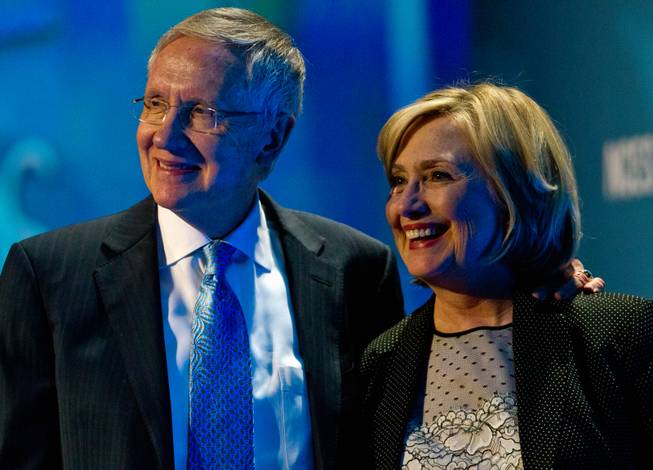
Sen. Reid endorses Clinton


After months of staying neutral in his party's primary, Senate Minority Leader Harry Reid is endorsing Hillary Clinton for the Democratic presidential nomination.

A spokeswoman for the Nevada senator said today that Reid was making the endorsement, which comes four days after Clinton won his state's caucuses. Reid participated but voted as "uncommitted," saying he would remain neutral in the competition between Clinton and Vermont Sen. Bernie Sanders so he could not be accused of rigging the caucuses.
The high-profile endorsement is a boost to Clinton and comes from the most senior Democrat in the Senate. Clinton also has secured the backing of Rep. Jim Clyburn of South Carolina, the assistant Democratic leader in the House.
The former first lady, New York senator and secretary of state narrowly won Iowa, suffered a double-digit loss to Sanders in New Hampshire and prevailed in Nevada. She leads in public polls ahead of Saturday's South Carolina primary.
In an interview with CNN, Reid said the middle class would be better served by Clinton."I think that my work with her over the years has been something that I have looked upon with awe," he told CNN.
He noted her work on health care, and said "she's the woman" to become the first female president of the United States.

Senate Republicans Lose Their Minds on a Supreme Court Seat


Following the death of Justice Antonin Scalia, Senate Republicans apparently believe they can profit by creating a political crisis that the nation has never seen before. On Tuesday, the leadership doubled down on its refusal to take any action on any nominee from President Obama to replace Justice Scalia.
Senator Mitch McConnell of Kentucky, the majority leader who seems to have lost touch with reality and the Constitution, accused Mr. Obama of plunging the nation into a “bitter and avoidable struggle” should he name anyone to the court.
Forget an up-or-down vote on the Senate floor. Top Republicans are pledging not to hold hearings or even to meet with a nominee.
In a statement dripping with sarcasm, Mr. McConnell said that Mr. Obama “has every right to nominate someone,” and “even if doing so will inevitably plunge our nation into another bitter and avoidable struggle, that is his right. Even if he never expects that nominee to actually be confirmed but rather to wield as an electoral cudgel, that is his right.”
Senator John Cornyn of Texas, the majority whip, said, “We believe the American people need to decide who is going to make this appointment rather than a lame-duck president.”
These statements are so twisted that it’s hard to know where to begin. Let’s take them one by one.
First, Mr. Obama is not a “lame-duck president.” The lame-duck period is broadly understood to run from after the November election until a new president is inaugurated in January. November is more than eight months off. Based on the average number of days it has taken the Senate to act on previous Supreme Court nominees, the seat could be filled by this spring.
Second, no matter how often Republicans repeat the phrase “let the people decide,” that’s not how the system works. The Constitution vests the power to make nominations to the court in the president, not “the people.” In any case, the people have already decided who should make this appointment: They elected Mr. Obama twice, by large margins.
Third, it is preposterous to accuse Mr. Obama of causing a “bitter struggle” by nominating someone who will not be confirmed. The only reason a nominee would not be confirmed is that the Senate has pre-emptively decided to block any nominee sight unseen. Mr. Obama is once again the only adult in the room, carrying out his constitutional obligation while Senate Republicans scramble to dig up examples of Democrats trying to block nominees. But those examples show only that Democratic senators have pushed hard for Republican presidents to pick ideologically moderate nominees. Until now, neither party has ever vowed to shut down the nomination process entirely, even before it has begun.
Only two Republican senators, Mark Kirk of Illinois and Susan Collins of Maine, were brave enough to say that they would vote on President Obama’s nominee. This is what passes for moderation in today’s G.O.P.: simply stating a willingness to do the job you were elected to do.
Unfortunately, for too many Republicans moderation now equals apostasy. These Republicans have stubbornly parked themselves so far to the right for so many years that it is hard to tell whether they can hear how deranged they sound.
The truth is they are afraid — and they should be. They know Mr. Obama has a large pool of extremely smart and thoroughly mainstream candidates from which to choose a nominee. They know that if the American people were allowed to hear such a person answer questions in a Senate hearing, they would wonder what all the fuss was about.
So Mr. McConnell and his colleagues plan to shut their doors, plug their ears and hope the public doesn’t notice. The Republican spin machine is working overtime to rationalize this behavior. Don’t be fooled. It is panic masquerading as strength.

President Obama Weighs Republican Nevada Governor For Supreme Court


By Jeff Mason and Richard Cowan

Nevada Governor Brian Sandoval, a Republican and former federal judge, is among candidates being considered by President Barack Obama for appointment to the Supreme Court, a source close to the process said on Wednesday, as Obama sought to overcome Senate Republican resistance to any nominee.
Sandoval, a 52-year-old Mexican-American, is considered a moderate Republican, particularly on social issues. He supports abortion rights and abandoned the state’s legal defense of a same-sex marriage ban before the U.S. Supreme Court ruled that such bans were unconstitutional.
Sandoval has supported gun rights as governor, which could prompt concerns from gun-control advocates. He was appointed as a federal judge by Republican George W. Bush, Obama’s predecessor, before being elected governor in 2010.
An intense political fight has erupted since the Feb. 13 death of long-serving conservative Justice Antonin Scalia created an opening on the Supreme Court bench. Republicans are maneuvering to foil Obama’s ability to choose a replacement who could tilt the court to the left for the first time in decades.
The Republican-led Senate must confirm any high court nominee and Majority Leader Mitch McConnell announced on Tuesday that the chamber will not hold hearings or vote on any Supreme Court nominee until after the next president takes office in January.
Sandoval met on Monday in the U.S. Capitol for about 30 minutes with Senate Democratic leader Harry Reid of Nevada. Reid asked the governor whether he would be interested in being considered for the high court job, according to the source, who asked not to be identified.
“He said he was interested,” the source said of Sandoval, adding that “a number of people are being checked out” for the job.
Sandoval, who was in Washington for a National Governors’ Association meeting, also spoke to Reid by telephone last week, the source said.
Sandoval opposed Obama’s healthcare law known as Obamacare, but opted to expand his state’s Medicaid health insurance program for the poor under the law, breaking from a number of Republican governors who refused to do so.
    He also expressed support for bipartisan immigration legislation that passed the Senate in 2013 before dying in the House thanks to Republican opposition.
In 2013, Sandoval vetoed legislation to require background checks on all gun sales in Nevada. Last year, he signed a law backed by the National Rifle Association that, among other things, expanded the defenses for justifiable homicide and repealed a local ordinance in Clark County, where Las Vegas is located, that required registration of handguns.
‘WORTHY TO SIT’
Obama vowed on Wednesday to move ahead with a nominee and said Republicans would risk public ire if they blocked a qualified candidate for political motives, as well as diminishing the credibility of the high court.
Obama said he expected the Senate Judiciary Committee to extend his nominee the courtesy of a hearing and then vote on whether he or she is qualified.
“In the meantime, the American people are going to have the ability to gauge whether the person I’ve nominated is well within the mainstream, is a good jurist, is somebody who’s worthy to sit on the Supreme Court,” Obama told reporters in the Oval Office.
“I think it will be very difficult for Mr. McConnell to explain how, if the public concludes that this person’s very well qualified, that the Senate should stand in the way simply for political reasons.”
The president said he understood the political predicament Republicans faced and said he had expressed sympathy in calls to their leaders. He said they were sheepish in their arguments that a nominee should not be confirmed until next year and predicted their posture would change.
“I think the situation may evolve over time. I don’t expect Mitch McConnell to say that is the case today,” he said.
In a post on the independent SCOTUSblog.com website, Obama listed his criteria for a nominee including “an independent mind, rigorous intellect, impeccable credentials and a record of excellence and integrity.”
Liberals vowed to pressure Senate Republicans into considering an Obama nomination this year, with several groups delivering to the Senate boxes of what they said contained 1.3 million signatures from citizens demanding that a confirmation process go forward after the president announces his pick.
Democratic Senator Chris Murphy of Connecticut said Republicans “are giving a middle finger to the American people and they are giving a middle finger to this president.”
The U.S. presidential election is set for Nov. 8 and Republicans want the next president to fill Scalia’s vacancy, hoping a Republican will be elected.
Scalia’s death left the court with four liberals and four conservatives, with Obama’s nominee positioned to change the court’s ideological balance.
Obama already has appointed two Supreme Court justices during his seven years as president. The Senate confirmed his prior two nominees, Sonia Sotomayor in 2009 and Elena Kagan in 2010. The Senate was controlled by Obama’s fellow Democrats at the time.
http://www.nationalmemo.com/obama-weighs-republican-nevada-governor-for-supreme-court/

Video - President Obama sings Al Green's 'Let's Stay Together' at the Apollo Theater

Afghan Persian Music Video - Ahmad Zaher - Laily Jan

Afghanistan at the crossroads


She was planning her wedding. On the evening of January 20, at the end of her working day, Mehri Azizi, boarded a packed staff bus in Kabul that was to take her home. She never made it. Azizi and six of her colleagues were killed in a targeted Taliban bomb attack; 15 others were injured.
This was not just a suicide attack on the young and thriving media in Afghanistan. It was an attack on everything the Afghan people had come to value during the past 14 years.
Azizi, a bright, energetic graphic artist of 21, had joined Tolo TV five years earlier — quickly rising through the ranks of Afghanistan’s largest media organisation. As a teenager she had taken up the job and became part of our Tolo family to escape the tensions of everyday life — in one of the most dangerous cities in the world. Azizi was about to be promoted.
In the dark days following, as condolences poured in from around the world and as we laid each victim to rest, I couldn’t help but fear and wonder whether we were also burying the dreams of millions of young hopeful Afghans. Azizi, Mohammad Jawad Hussaini, Zainab Mirzaee, Mariam Ibrahimi, Mohammad Hussain, Mohammad Ali Mohammadi and Hussain Amiri embodied the optimism and determination of a whole generation of youth who, since the ouster of the Taliban, had worked hard — and succeeded — in making their country a better place.
Azizi, a woman from the Hazara minority group, was a role model for many of her peers and committed her spare time to a variety of environmental and social causes. She dazzled the Tolo TV studios with her presence and colourful headscarfs. She was a shining example of the progress made by Afghan women in our largely conservative society.
The young lives lost in this devastating attack had much to be proud of, for they had benefited most from the fall of the Taliban. Since 2002, more than nine million Afghan children now attend school, compared with fewer than a million before 2001. Almost half of Afghan girls are enrolled, and women make up 20 per cent of students in higher education, a proportion increasing year on year. Advances in technology and healthcare have reduced the infant mortality rate by half.
Afghans are more connected and better-informed, with access to more than 70 TV stations and 175 radio stations compared to one radio station before 2001. Mobile data services are available in 27 of 34 provinces through five network providers and, in 2014, we held our third national democratic elections, with people casting votes across the country.
However, this latest attack is yet another reminder of the precarious situation in which Afghanistan finds itself, and there are no quick or easy solutions.
On the military front there have been major setbacks. The drawdown announced by President Barack Obama in October to reduce the US troop commitment to 5500 by year’s end is looking increasingly unrealistic. The new commander of NATO forces in Afghanistan, General John Nicholson, warned in January the situation was deteriorating, and vowed to make a new assessment of counter-terrorism requirements. This is amid concern of the rise of the so-called Islamic State group in the east and a resurgence of al-Qa’ida in the south.
Beyond the troop commitment, the US can assist by authorising coalition airstrikes against the Taliban, not just al-Qa’ida and Islamic State. This was recommended recently by General David Petraeus and would provide much needed air support to stretched Afghan troops.
The political transition is the second challenge. Difficulty to agree on key appointments between President Ashraf Ghani and his chief executive Abdullah Abdullah has contributed to the frail security situation and hampered economic reform. Critical positions such as defence minister and intelligence chief remain vacant, and economic reforms promised 18 months ago have not moved beyond proposal stage.
An emboldened Taliban has attacked the symbols of democratic governance and institutions, with an attack on parliament last year while politicians were in session, and recently sabotaging powerlines in the north of the country, leading to electricity shortages in the capital. Coalition partners can support Afghanistan through the appointment of a special envoy or interlocutor to help bridge the gap between power centres in the Afghan government, similar to the role played by US ambassador Zalmay Khalilzad in 2001.
The third challenge is the drive by the US, China, Pakistan and Afghanistan to set out a road map for peace talks between the Afghan government and the Taliban. It is legitimate to ask whether a movement that is intent on undermining progress and democratic governance, that brazenly kills journalists and has no regard for women’s rights or plurality of opinion, should be allowed to participate in the Afghan political process. This sentiment is shared by the large majority of Afghans.
An ATR survey conducted in 2014 found only 7 per cent of Afghans polled were in favour of Taliban rule. If anything, appeasing the Taliban will likely embolden it to provide further shelter to al-Qa’ida, Haqqani network and other terrorists, and bring with it the prospect of another protracted civil war, and a real risk of spill-over into Central and South Asia.
The Taliban and its backers need to be held accountable for the countless atrocities it has committed on Afghan and Pakistan soil, and against civilians on both sides. The US should designate the movement as a terrorist organisation — something long overdue — and its leaders and financiers should be indicted before the International Criminal Court for war crimes and crimes against humanity.
Afghanistan is at a crossroads and we cannot allow for the situation to just deteriorate without taking appropriate measures to safeguard the gains of the past 14 years. We simply cannot allow for the dreams of Azizi and the other young lives lost in the terrorist attack of January 20 to be shattered.

Pakistan's Invisible Baluch Displacement Crisis

He once dreamed of a bright future and a stable career working for Pakistan's biggest gas company.
Instead, Suhail Ahmed Bugti has been crushing stones for the past 10 years after his clan was banished from their gas-rich homeland in Pakistan's southwestern Balochistan Province into the stony deserts of Rohri district in neighboring Sindh Province.
"Our lives are so miserable that we are just like walking corpses," the 34-year-old says of life in exile. "It is our misfortune that we have become refugees in our own country and nobody is even bothered by our misery."
Bugti's misfortune began after his tribe's patriarch and leading Baluch nationalist leader, Nawab Akbar Bugti, was killed by Pakistani forces in 2006. In the months leading up to his death, more than 170,000 Bugtis left their homes in Balochistan's Dera Bugti district and moved into other parts of Pakistan and neighboring Afghanistan.
Ten years later, the authorities and their pro-government tribal rivals are reluctant to allow the displaced Bugti clans back into their homes.
Suhail says his extended family of 28 has survived on hammering stones into gravel for road and construction work. He says a month's hard work earns them nearly $200, which is barely enough to feed them.
Back in Dera Bugti, his clan was one of the most affluent communities in Balochistan. Nawab Bugti was paid handsome royalties, and his supporters had jobs and contracts in Pakistan's oldest gas field, which has warmed Pakistani homes and fueled industry since the 1950s.
"Two of my brothers were employed by the gas company, while three of my cousins were teachers. One of my uncles used to work in a bank," he said. "But they all lost their jobs once we were banished from our homeland."
Suhail says that now most men, women, and children in his extended family crush stones to eke out a living. "Only the very old stay at home," he told RFE/RL's Gandhara website.
He says the 20,000 Bugtis living in Rohri feel as if they have lost everything. "Many of our relatives are scattered across Sindh and the neighboring eastern province of Punjab. It is too difficult to even gather for funerals because we just can't afford to travel."
Bugtis are among the estimated 250,000 Baluch displaced by violence in their homeland since the August 2006 killing of Nawab Bugti, which prompted a simmering separatist insurgency. Thousands of civilians, soldiers, and rebels have been killed in insurgent attacks and government crackdowns.
While Bugtis make up the largest number of displaced Baluch, tens of thousands of members of the neighboring Marri tribe have also been rendered homeless by sporadic fighting between separatists and government forces.
The crisis has forced some 20,000 Baluch tribesmen to seek shelter in neighboring Afghanistan. But the displaced Baluch in both countries have so far received little or no government help or assistance from international aid organizations.
Jan Zeb is one of the 14,000 Bugtis living in the southern Afghan province of Kandahar. He says that, while Afghan authorities have not harassed them, they have received little assistance from Kabul or international aid agencies.
"I cannot tell you the miserable conditions we live in," he said. "We don't have food or clean drinking water. We have no healthcare or schools for our children. Their lives are being wasted."
Zeb's wife and four children live in a small hut made of plastic sheets and wooden poles, which offer little protection against attacks.
"Fear and harassment rule our lives," he said. "We are afraid that we are very vulnerable to being attacked by Pakistan."
During the past two years, two grandsons of Nawab Bugti have attempted to lead their supporters back into Dera Bugti, but the government prevented them from reclaiming their homes and property. Hundreds were arrested after thousands of Bugti tribesmen blocked a road to Dera Bugti in February 2014.
Pakistani authorities are reluctant to acknowledge the scale of Baluch displacement.
Anwarul Haq Kakar, a spokesman for Balochistan's government, says only the hard-core supporters of Baluch separatist factions have moved into provinces in southern Afghanistan. He says a handful of communities have left their homes in various Balochistan districts because of tribal feuds.
"Our estimates are that 2,000 to 3,000 people have gone to Afghanistan, while the number of those moving within Pakistan is no more than 7,000," he said. "It is the responsibility of the state to look after its citizens. This is not a major crisis that requires us to seek international assistance."
Former lawmaker Sanaullah Baloch says Islamabad is reluctant to address the Baluch displacement crisis as a humanitarian problem because sees it as an offshoot of separatism by secular Baluch nationalists.
"It is not possible to paint a comprehensive picture or come up with an accurate picture because the Pakistani government is reluctant to allow anyone to look into this crisis," he said. "Islamabad has been trying to tell the international community for some time now that there is no conflict in Balochistan," he says. "This is why this crisis is never highlighted."
Baloch says the displacement crisis in Balochistan is much bigger than the plight of Bugti and Marri tribespeople.
"There are estimates that more than 700,000 people have been displaced across Balochistan since 2005," he said. "These include [the minority] Hindus and other communities, but most are Baluch. These are tribes and communities that were involved in the conflict, but many were not involved and yet were forced to leave their homes."
In recent years, tens of thousands of Baluch civilians have been displaced in Balochistan's southern Makran region, which turned into a main theater for separatist violence since 2010.
The displaced in Balochistan include a sizeable number of ethnic Punjabis called "settlers" for living in the province's major cities for generations. They were targeted by Baluch separatists in what they claimed were retaliatory attacks for atrocities by the Pakistani military, most of whose soldiers and officers are ethnic Punjabis.
The tiny Shi’ite Hazara community, based in Balochistan's capital, Quetta, has been faced with incessant attacks by Sunni extremists, forcing some members of the beleaguered community to seek shelter in other Pakistani cities or attempt dangerous journeys to escape to Australia and Europe.
Baloch says that, if unaddressed, the plight of displaced Baluch will eventually haunt Islamabad.
"Such suffering further fosters a sense of alienation and discrimination among the displaced communities," he said. "Eventually, a new generation will yet again pick up guns against the state."

د مورنیو ژبو قانون کې د بدلون راوړلو هڅه کوو. عثمان کاکړ

د يونيسکو په رپورټ کې راغلي، ژبه د دوه مخې تورې په څېر ده. مانا دا چې که د پرمختګ لپاره يې 
کار وشي نو ويونکی قام به يې سرلوړی وي، او که داسې نه وه نو د يوه قام د زوال سبب کېږي.
په ملګرو ملتونو کې د تعليم، ساينس او کلتور چارو پرمختيا ادارې يونيسکو، د مورنيو ژبو نړيوالې ورځې په مناسبت، چې د فبرورۍ پر ۲۱ مه ونمالځل شوه، يو رپورټ خپور کړی.
په رپورټ کې راغلي د پاکستان پشمول د نړۍ په يو شمېر هېوادونو کې ماشومانو ته د هغوی په مورنيو ژبو زدکړې نه ورکول کېږي، چې له وجې يې، د يادې ادارې په خبره، نه يوازې د ماشومانو زدکړې اغېزمنېږي، بلکې په هغو هېوادو کې سياسي ترينګلتيا هم پيدا کېږي.
په رپوټ کې د پاکستان پشمول د ترکيې، نيپال، بنګله دېش او ګواتیمالا هېوادونو له حکومتونو غوښتل شوي چې ماشومانو ته د هغوی په مورنيو ژبو د زدکړو ورکولو لپاره لازم اقدامات وکړي.
د پاکستان په اړه په رپورټ کې ويل شوي چې په هغه هېواد کې سربېره پر دې چې يوازې اته فيصده وګړي يې په کورونو کې په اردو خبرې کوي، خو بیا هم د سرکاري سکولونو د نصاب ژبه ګرځول شوې ده.
د رپورټ تر مخه، دغه حکومتي اقدام په هېواد کې د سياسي ترينګلتيا لامل شوی دی.
د پښتونخوا ملي عوامي ګوند يو مخکښ، سېنېټر عثمان کاکړ د يونيسکو دغه خبره تاييدوي او وايي، چې د پاکستان په سکولونو کې د اردو ژبې تسلط د هېواد د نورو قوميتونو وګړي د احساس محرومۍ ښکار کړي دي.
((اردو يې پر موږ د قومي ژبې په توګه مسلط کړې ده. موږ هر وخت او پر هر فورم ويلي دی چې د پاکستان قومې ژبې پښتو، بلوڅي، سیندي، سرايکي او پنجابي دي. البته د رابطې لپاره که د اردو او يا هم انګريزي انتخاب وشي، نو قباحت پکې نشته. او که نه ته يوه ژبه مسلطوې، نو نتيجه يې هغه څه وي لکه په بنګله دېش کې چې وشول. پاکستان خو يو قوم نه دی، پاکستان يو ملک دی، چې د بېلا بېلو قوميتونو خلک ژوند پکې کوي. پر دوی اردو مسلطول، زياتوب دی، دا يوه ستره سياسي مساله ده.))
د يونيسکو په رپورټ کې ماشومانو ته د هغوی په مورنيو ژبو د زدکړو ورکولو ارزښت په ګوته شوی دی.
دغه ټکي ته په اشاره د خېبر پښتونخوا په صوابۍ کې د تعليمي چارو پوه او پېژندل شوی ليکوال نورالامين يوسفزی وايي چې ماشومانو ته په پرديو ژبو زدکړې ورکول د فطرت ضد يو عمل دی.
((د ځينو پوهانو په اند، يو انسان چې کله پيدا شي نو د خپلې مورنۍ ژبې قريباً ۲۵۰۰۰ ويي [الفاظ] يې په ډي اين کې موجود وي. دا د فطرت خلاف يو کار دی چې ته يو ماشوم ته په بله هره ژبه کې، که هغه هر څومره ښکلې او معياري وي، تعليم ورکوې نو د ده دغه زدکړې بالواسطه وي. په مورنۍ ژبه کې چې کله دی زدکړه کوي نو د واسطې ضرورت نه پېښېږي. دلته خلک داسې فکر کوي چې ګنې د يوه کس چې انګريزي او يا هم اردو څومره ښه زده وي، هغومره هغه زيات پوه وي. د دې برعکس، چې کوم ماشوم ته د هغه په خپله مورنۍ ژبه زدکړې ورکړل شي، نو د دنيا په هره موضوع کتاب لوستلای شي، او د استاد ضرورت ډېر کم احساسوي.))
يوسفزی زياتوي، د ماشومانو زدکړې د هغوی د تعليمي او شخصيت جوړونې له چارو سره يوازې هغه وخت مرسته کولای شي چې د زدکړو ژبه يې مورنۍ وي.
((ايوب صابر وايي، چې د کور وي کوم ژبه، هم هغه به د مکتب وي – چې د مور وي کومه ژبه هم هغه به د ادب وي.
په کومه ژبه کې چې يو بچی خوب ويني، او په کومه ژبه کې چې د هغه جذبات او احساسات ځايېږي، په هم هغه ژبه کې به ماشوم ته تعليم ورکول غواړي، چې تعليميافته شي. يو ماشوم لکه د طوطي ګوټې بايد و نه لګوي، بلکې هغه څه چې ورته ښودل کيږي، سم اداراک يې وکولای شي.))
د پښتونخوا ملي عوامي ګوند سېنېټر عثمان کاکړ بيا وايي، دوی هڅه کوي چې د پاکستان په اساسي قانون کې د بدلون راوړلو په ترڅ کې د هغه هېواد د ټولو قوميتونو ماشومانو ته د هغوی په مورنيو ژبو د زدکړو تر لاسه کولو حق ورکړي.
((زموږ د ګوند غوښتنه هم دا ده چې د پاکستان په ايين کې دې يو نوی ترميم وشي. پښتو، بلوڅي، سیندي، سرايکي او پنجابي ژبې دې قومې ژبې وګرځول شي، ماشومانو ته دې زدکړې په مورنيو ژبو ورکړل شي، د دې قوميتونو د ژبو، کلتورونو، موسيقۍ، ادب، معاشياتو، د قامي ستونزو، پر دې ټولو موضوعاتو هراړخيز مالومات ماشومانو ته بايد د هغوی په مورنيو ژبو ورکړل شي.))
د يونيسکو رپورټ زياتوي، ژبه د دوه مخې تورې په څېر ده. مانا دا چې که د پرمختګ لپاره يې کار وشي نو ويونکی قام به يې سرلوړی وي، او که داسې نه وه نو د يوه قام د زوال سبب کېږي.

British MPs warn Pakistan of aid cuts over persecution of Ahmadiyya Muslims

Highlighting attacks and mistreatment of minorities in Pakistan – particularly Ahmadiyya Muslims – several MPs have asked the UK government to review aid to Pakistan to ensure it is not misused to promote religious intolerance.

Participating in a debate in the House of Commons on “Persecution of Religious Minorities: Pakistan”, more than 15 MPs recalled the plight of Christians, Sikhs and Hindus along with that of the Ahmadiyya Muslim community in the country to seek a review of aid.

Pakistan is one of the largest recipients of British bilateral aid, receiving nearly £1.17 billion between 2011 and 2015. The MPs paid tribute to Britain’s peaceful Ahmadiyya Muslim community and recalled Mohammad Ali Jinnah’s 1947 speech promising a secular Pakistan.

Siobhain McDonagh (Labour), who led the debate, said:

“The Ahmadiyya community is also denied the right to religious freedom and expression in Pakistan. On orders from the united religious clerics board, all works by that religious group are now banned in the region of Punjab.

“That includes books, CDs, periodicals and newspapers, and it means that hundreds of thousands of law-abiding Ahmadi Muslims in Punjab face police searches, criminal charges and up to five years in prison. Those texts are all religious, and their censorship is totally unjustified.”

Focussing on the plight of women from minorities, Fiona Bruce (Conservative) said: “Following this debate, I hope that the UK government and those responsible for disseminating aid in Pakistan will pay particular attention to the plight of women and girls in religious minorities, because they are doubly at risk of discrimination, regardless of the faith they adhere to.”

She added: “They risk systematic abduction, extortion, hijacking, being held for ransom, trafficking, rape, forced marriage, forced conversions, and allegations of blasphemy…Women are treated as second class, but if they come from a minority group, they are third class citizens. For example, Hindu girls in Sindh and Christian girls in Punjab are abducted, raped, or forced to convert to Islam in the face of extreme pressure, including threats to them and their families.”

Siobhain McDonagh MP, is also Chair of UK All Party Parliamentary Group (APPG) for the Ahmadiyya Muslim Community.

MPs also called on the Pakistan Government to release 70-year-old Mr Abdul Shakoor, an Ahmadi shopkeeper from Rabwah who was jailed in January for 7 years under the country’s anti-terror laws and anti-Ahmadi laws for possessing copies of the Holy Quran and some religious books.

Ms Tasmina Ahmed-Sheikh MP, Foreign Affairs Spokesperson for the Scottish National Party and Fabian Hamilton MP, Labour Spokesperson for Foreign Affairs noted the dire situation of freedom of religion in Pakistan and called for urgent action by the Pakistan Government to address this issue. Other MPs who attended included Steve McCabe MP, Nic Dakin MP, Naz Shah MP, Alison Thewliss MP, Rt Hon Tom Brake MP, Chris White MP, Gareth Thomas MP, Stephen Timms MP, John Spellar MP, Steve McCabe MP, Kate Green MP

Responding to the debate, Tobias Ellwood of the Foreign Office assured MPs that the government will continue to take every opportunity to raise issues of concern with the Pakistan government, particularly the Ahmadiyya issue with the chief minister of Pakistan’s Punjab.

The Ahmadiyya Muslim Community, which has roots at Qadian in India’s Punjab, comprises nearly 0.2% of Pakistan’s population. MPs listed several threats the community faced, including anti-Ahmadi laws and discrimination.

The three-hour debate also covered the persecution of Shia Muslims, Christians, Hindus, Sikhs and minority women, and featured speakers from all parties of the political divide.

Ahmadiyya Muslim Community UK welcomed the UK Parliamentarians’ call to end persecution of religious groups in Pakistan.

Mr Rafiq Hayat, National President of the Ahmadiyya Muslim Community UK said:

“It was an important and timely debate. The persecution of Ahmadi Muslims in Pakistan must end as must the horrific violence against Christians and other minorities. Pakistan must repeal is discriminatory laws that deny its own citizens their basic human rights. I thank Siobhain McDonagh MP for calling the debate and all who contributed – it sent a loud and clear message that such persecution will not be accepted and Pakistan must be held to account. We pray for peace in Pakistan and for the success of the country based on justice and equality for all.”

Pakistan - Poor state of health


ONE of the most dismal numbers to come out of Pakistan is the paltry allocation of budgetary resources to health.
The figure stands below 0.7pc of GDP, both provincial and federal combined, and is among the smallest expenditure heads in the budget.
Even for a country known for its misallocation of resources, the smallness of this number is staggering, especially when we consider the kind of health emergencies that plague the land.
From diseases such as polio, TB and hepatitis, to malnutrition among a large proportion of the population, to high infant and child mortality rates — among the highest in the region — Pakistan shoulders some of the world’s biggest health-related burdens. How then do we justify such meagre resource allocation to the health sector?
Economic surveys that are the government’s own telling of the health story show that the myriad programmes being run in the health sector are the authorities’ response to the challenge.
Data is presented on the availability of food, which, apparently, is sufficient to handle the nutritional needs of the entire country.
The availability of cereal, pulses and milk has only increased over the past five years. However, the data on calorie intake shows a deterioration, with 22pc of our population in the undernourishment category and in the same league as countries that are food deficient.
Lack of food then is not the issue; the problem is how the food that is available is allocated, whether through market mechanisms that are highly distorted by speculative interests or through an ineffective, corrupt government.
The story is the same whether one looks at hospitals and medicines, or access to doctors. In general terms as well, both the centre and the provinces are more geared towards serving the interests of the rich, through the construction of roads and bridges, than of the poor.
Public-sector spending on health, which is the mainstay for meeting the health requirements of the poor, is a dismal 0.7pc of GDP as mentioned above. But when one adds private-sector spending, the figure jumps to 2.8pc of GDP; this is four times what is spent on the poor.
This shows that whatever allocation of resources to the health sector there is in the country, most of it is through private healthcare providers that serve the interests of those with more money.
It is no exaggeration to say that the poor have been left to their own devices while the rich have built for themselves a comfortable world where all basic needs are amply catered for, and sealed away behind a wall of high prices.
The state of public health in the country paints a truly dismal picture, especially when it comes to the skewed manner of the allocation of available resources.

Gender insight in Pakistan

By Murtaza Talpur  


In almost all institutions in Pakistan where women work they face different behaviours of discrimination. They are given less importance in decision-making. Out of the 47 million employed people in Pakistan in 2008, only nine million were women.
The proportion of women in Pakistan is around 53 percent; even though they are in the majority they are living very miserable lives. The rural as well as urban woman in Pakistan has so much talent and aptitude but the predicament is that in a male dominated society, women’s abilities have been culled. Their potentials have been degraded.

The countryside of Pakistan has a high rate of poverty and an alarmingly low rate of literacy. It was recorded in 2002 that 81.5 percent of 15 to 19-year-old girls from high-income families had appeared in school and 22.3 percent of girls from low-income families had never attended school. The rural-urban divide in the education sector has caused alarming consequences in the country.

According to UNESCO, the Education for All Global Monitoring Report, 2011 says that there are 7.261 million children out of school at the primary level in Pakistan and that 58 percent are female. In almost all institutions in Pakistan where women work they face different behaviours of discrimination. They are given less importance in decision-making. Out of the 47 million employed people in Pakistan in 2008, only nine million were women and of those nine million, 70 percent worked in the agricultural sector. The income of Pakistani women in the labour force is generally lower than that of men.

The situation is very embarrassing in various parts of Pakistan where women are not allowed to go out of their homes and are even not permitted to attend school. “Women are born to do household chores; what will they do if they are educated? Many young men in our village have been educated but they have not gotten any job,” were the words of a villager in some remote area of Sindh.

The Global Gender Gap Report (2015) illustrates that out of 145 countries, Pakistan stands second last. On economic participation and opportunity, Iran, Jordan, Pakistan, Syria and Yemen hold the last five spots on this sub-index. In spite of all the efforts being made, we have been lagging behind to fill the gender gap, which shows the poor planning and dishonesty towards filling this gap from the government as well as other concerned institutions.

According to the Gender Inequality Index (GII) 2014, out of 155 countries, Pakistan ranked at 121. Moreover, a report says that in Pakistan, only 19.7 percent of parliamentary seats are occupied by women and 19.3 percent of adult women have reached, in any case, a secondary level of education compared to 46.1 percent of their male counterparts. For every 100,000 live births, 170 women die from pregnancy related stress and the adolescent birth rate is 27.3 births per 1,000 women of ages 15 to 19. The participation of females in the labour market is about 24.6 percent compared to 82.9 for men.

The Global Gender Gap Index (GGGI) 2014 says that out of 142 countries, Pakistan stands at 141 in the gender gap. Yemen, the lowest ranking country, has closed just over 50 percent of the gender gap and Bangladesh is at 68. Furthermore, the report explains that Pakistan occupies the last place in the regional ranking. The country’s score has oscillated over the past nine years, with a minor improvement shown when compared to 2006. On the Economic Participation and Opportunity Sub-Index, Pakistan has experienced one of the highest negative percentage changes relative to its 2006 score. However, it has accomplished one of the uppermost percentage changes comparative to its own 2006 score on the Educational Attainment Sub-Index; the score still falls below the 2014 world average on that sub-index. Pakistan ranked at 141 on the Economic Participation and Opportunity Sub-Index in the year 2014. It is one of the 10 lowest-performing countries on all indicators of this sub-index with the exception of wage equality for parallel work. Pakistan is one of the three countries with the lowest percentage of firms with female participation in ownership. Finally, the country ranks at 119th on the Health and Survival Sub-Index and 85th on the Political Empowerment Sub-Index.

The increasing gender gaps in Pakistan can only be overcome by giving due rights to women in all spheres. They must be provided proper education both in rural as well as urban areas. Political will is an added value for gender empowerment in the country. Moreover, as an individual need we need to understand the potentials that women have in our society instead of prisoning them the four walls of the home; we have to allow them to live free, liberal and dignified lives. In addition, the outmoded values and norms seen everywhere here for women, which have made their lives hell, need to be shattered.

Pakistan - Formidable arms race

The data released by the Stockholm International Peace Research Institute (SIPRI) about global arms purchases has put Pakistan at number 10 on the list of top global arms importers. India remains the largest arms importer over a period of five years. However, on an annual basis, India ceded its top spot to Saudi Arabia in 2015. The fact that Pakistan is the 10th largest arms importer in the world is not an issue to take pride in. Rather, the relentless subcontinental competition for arms has entered an unusually perilous phase. Pakistan spent $ 735 million on the import of arms, while India imported arms worth $ 3,078 million in 2015. Big powers like the US, China and Russia are fuelling this arms race by providing arsenal to ambitious states to defend their borders from aggression by other countries as well as to fight the growing threat of militancy that is becoming a global phenomenon.

It is cause for concern that the global transfer of major arms has risen in recent years. The overall transfer of arms has gone upwards this century after a relative drop in the previous 20 years. There are certain factors that have given birth to a rise in the purchases of sophisticated weapons at the international level. The presence of various terror groups in various parts of the world has made it necessary for victim states to have stockpiles of weapons to deal with the militants who pose a risk to their stability. Instead of focusing on the accumulation of arms alone, it is also necessary for arms importers to review those policies that gave birth to these terror organisations. More efforts should be made to promote regional cooperation instead of making investments in militants and using them as strategic assets. It is also disappointing that super powers like the US, Russia and China are the largest exporters of weapons. Though these countries talk about peace in the world and urge rival states like India and Pakistan to resolve all conflicts through a meaningful dialogue process, yet they are also fuelling the arms race in South Asia and the Middle East.

Arms build-up by various states is hardly necessary in a world that badly needs peace. Instead of getting involved in the arms race and making irrational increases in defence budgets, rival states should spend money ion those social sectors that need their immediate attention. It is also necessary for Pakistan and India to, instead of escalating tensions and increasing military expenditure, should work for the establishment of lasting peace.

US Senators accuse Pakistan of 'duplicity' in fighting terrorism


"Do you agree with my position that should not occur until they stop the duplicity that has continued for 14 years while we have been in Afghanistan?" Chairman of the powerful Senate Foreign Relations Committee Senator Bob Corker asked Secretary of State John Kerry during his testimony before the hearing on State Department's annual budgetary proposals.

"They (Pakistan) have asked to be able to purchase F-16s. I would rather ask them to purchase from a US company than some other company but they also want US taxpayers to subsidise more than half of that purchase over time," Corker said yesterday.

"I just met with Prime Minister Nawaz Sharif a few weeks ago and we discussed our concerns about the need to rein in particular terrorist groups that are either homegrown in Pakistan or are using Pakistan as a sanctuary. And we have been very, very clear that they have to target all militant groups," Kerry said to a question from Corker.

Corker, who was in Afghanistan a few months ago, said he "witnessed continued duplicity on Pakistan's part, outright blatant duplicity, where they continue to support the Taliban, the Haqqani network, and give safe haven" to al-Qaeda.

Corker alleged that the Pakistan army is not taking actions against terrorists.

Meanwhile, Senator Rand Paul said Pakistan can be described as a "frenemy" - sometimes friends, sometimes enemy.

"I do not think I will convince you but I think the American people are convinced that we do not have the money to be sending all around the world when our infrastructure here is falling down and our country is struggling. We just simply do not have the money and it makes no sense to borrow it," he said.

BILAWAL BHUTTO - NO MATCH OF PPP IN SACRIFICES FOR DEMOCRACY

Chairman Pakistan Peoples Party (PPP) Bilawal Bhutto Zardari Tuesday said that PPP had no match in sacrifices and strengthening democracy in the country.
Bilawal Bhutto Zardari said that being a major party in all provinces, Azad Jammu & Kashmir, Gilgit-Baltistan and FATA it had protected the rights of downtrodden segment of the society.
He said that all decisions in the party were made through collective consultations in the greater interest of the masses and taking workers as well as leadership on-board.
Bilawal Bhutto said the party will continue its efforts for the emancipation of the people from the clutches of poverty, illiteracy, extremism and terrorism.
https://ppppunjab.wordpress.com/2016/02/24/no-match-of-ppp-in-sacrifices-for-democracy-bilawal-bhutto/

Tuesday, February 23, 2016

Video - Hillary Clinton: Criminal justice problems can't be ignored

Video - Kerry Faces Skepticism On Syria Cease-Fire

Kerry to Visit Cuba for Human Rights Dialogue

U.S. Secretary of State John Kerry said Tuesday he plans to travel to Cuba "in the next week or two" for talks on human rights.
Kerry made the statement before the U.S. Senate Foreign Relations Committee.
"I may be down there in the next week or two to have a human rights dialogue, specifically," he said.
Kerry, who went to Cuba last August to raise the U.S. flag over the American Embassy in Havana, told the committee that concerns about the human rights situation in the communist-ruled island still remain.
Upcoming Obama visit 

The secretary's trip comes ahead of President Barack Obama's visit to the nation next month, when he will become the first sitting U.S. leader to visit Cuba in nearly 90 years.
"The president hopes to press forward on the agenda of speaking to the people of Cuba about the future and obviously he is anxious to press on the rights of people to be able to demonstrate, to have democracy, to be free, to be able to speak and hang a sign in their window without being put in jail for several years," Kerry said.
Normalization of relations 

In December 2014, Obama announced the U.S. would re-establish diplomatic relations with Cuba and begin the process of normalizing relations more than 50 years after they severed ties.
Diplomatic ties were formally restored on July 20, 2015.

The Plan to Shut Down Gitmo


The Obama administration this week will begin the task of trying to persuade Congress to support its plan to shut down the prison in Guantánamo Bay before the president leaves office in January.
Republican lawmakers all too often have been reflexive and thoughtless in their opposition to closing Guantánamo, one of the most shameful chapters in America’s recent history. Closing the prison by the end of the year is feasible. It would make the United States safer, help restore America’s standing as a champion of human rights and save taxpayers millions of dollars.
In recent weeks, the Pentagon and the State Department have made considerable progress toward the goal of further reducing the number of inmates at Guantánamo, which stands at 91. Of those inmates, the government expects to resettle 35 in other countries by this summer.
Of the remaining 56, 10 have been convicted of terrorism charges or have pending cases before the military commission established to prosecute terrorism suspects.
That leaves 46 inmates whose fate is uncertain.
Lawyers who represent Guantánamo inmates say that roughly 10 of those detainees would be willing to plead guilty in federal court to charges such as providing material support to terrorism or conspiracy to commit terrorism. The logistical and legal challenges of those potential plea deals should be relatively easy to overcome if officials at the White House and the Justice Department make settling those cases a priority.
American officials are separately exploring the possibility of sending some detainees to allied countries that might be willing to prosecute them. Meanwhile, in the coming months, a review board consisting of officials from multiple national security agencies will continue to examine whether some of the remaining detainees can be cleared for release.
Progress on those fronts would reduce the population at Guantánamo to a very small number. And that would make the cost of running the overseas prison increasingly hard to justify. The cost to taxpayers in the 2015 fiscal year was an astounding $445 million, which translates into a per-detainee amount that is exponentially higher than the cost of housing maximum-security prisoners at a federal correctional facility.
There will inevitably be a small number of detainees whom the government deems ineligible for prosecution and too dangerous to release. Officials at the Pentagon have been studying detention sites in the United States where they can be sent. Unfortunately, Congress has passed legislation that bars the administration from bringing Guantánamo detainees onto American soil.
White House officials have suggested that the ban unduly restricts the president’s executive authority, raising the possibility of a constitutional showdown during the final weeks of the Obama presidency.
It shouldn’t come to that. The heads of the armed services committees in the House and the Senate should seek to work constructively with the administration after it unveils its plan for closing the base. This will require inoculating the debate from the irresponsibly bellicose national security rhetoric of the Republican presidential candidates, some of whom have vowed to keep Guantánamo open indefinitely.
When Congress asked the White House last year for a plan to close the base, it posed one question that the administration has largely sidestepped and must now confront. As the United States ramps up military campaigns in Iraq, Syria, Afghanistan and Libya, lawmakers have asked what detention authority and protocols should apply to future cases involving terrorism suspects who cannot be prosecuted in federal court.
There is no easy answer, but that is an issue that the administration, in consultation with Congress, should address.

Video Report - President Obama Delivers Remarks on Closing of Guantanamo Bay