Friday, January 15, 2016

Oregon armed militia to announce how and when it plans to end protest


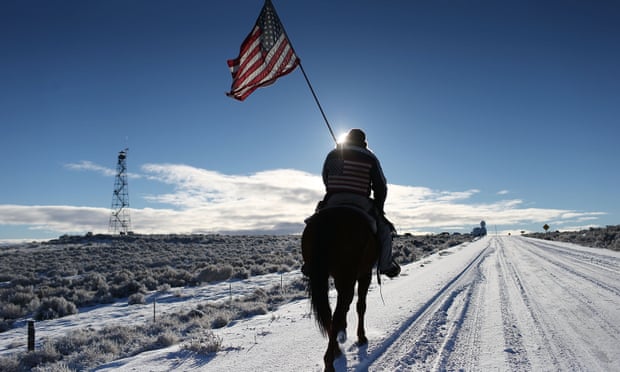
The armed militia occupying a wildlife refuge in eastern Oregon plans to tell the local town of Burns on Friday how and when it plans to end its protest – it just needs to find a space to hold a community meeting.
With the second week of the occupation of the Malheur national wildlife refuge coming to a close, Ammon Bundy and his fellow militiamen have said that on Friday at 7pm, they want to come to Burns – the closest town to the compound, located 30 miles away – to speak directly with residents and explain their plans to leave the federal lands.
But officials in rural Harney County, who have become increasingly outspoken against the militia, have denied them access to public buildings, saying they refuse to host a group that supports the illegal takeover of government property.
By Thursday, Bundy, the leader of the militia from Nevada, was expressing doubts about whether the meeting would happen at all if the militia can’t find a venue. If the meeting does move forward as planned, it will be the first time the militia leaves the wildlife sanctuary for a formal public meeting with Burns residents – many of whom have loudly demanded that the occupiers go home.
The rightwing militia, which is made up of mostly out-of-state anti-government activists, first took over the refuge on 2 January in protest of the federal government’s land-use regulations and the recent imprisonment of two Harney County ranchers, Dwight Hammond, and his son Steven. From the start, however, many residents of Burns – including ranchers who are supportive of Bundy’s message against government overreach – have criticized the militant tactics, saying they were harming the reputation of their small ranching community.
Harney County judge Steve Grasty, one of the most vocal local opponents of the Bundy bunch, released a statement on Wednesday saying the county would not allow the militia to enter government buildings for a forum.
“The County must deny use of those facilities to any group associated with, supportive of or on behalf of the armed militants at the Refuge,” the statement said. “The County does not take this action lightly. The Harney County message to the armed militia remains steadfast, ‘please go home to your families’.”
Tensions surrounding the venue of Friday’s meeting escalated on Thursday when Chris Briels, a county fire marshal, resigned from his post in protest of Grasty’s refusal to grant the militia access to a county room. Briels, a former Burns fire chief, announced his resignation during a news conference at the refuge while standing alongside Bundy.
Earlier in the week, LaVoy Finicum, one of the main spokesmen of the militia,told reporters at the refuge: “We will be going into town and holding a meeting with the community, to explain to the community … why we’re here and when we will be leaving. And that will be important.” He said: “We invite all to attend.”
The announcement of a community meeting was significant after days of speculation that the occupation could come to an end, given that Bundy said he plans to eventually accept Harney County sheriff Dave Ward’s invitation to peacefully escort the occupiers off the refuge and out of the state.
Bundy has said he hopes to transfer his cause to a so-called Harney County Committee of Safety, a new group made up of local representatives. Last Friday,members of that group said they were eager to take over the fight and for the militia to leave - but Bundy has repeatedly said he’s not ready to end the occupation.

Video - President Obama in Omaha

After delivering his final State of the Union on January 12th, President Obama headed to Nebraska to sit down with Lisa, a new mother who wrote a heartfelt letter to the President about her son, Cooper. The President sat down with Lisa and her friends and family for a conversation in her living room.

Urdu Ghazal - Iqbal Bano - Dasht e Tanhai Mein

It’s time to unleash America’s airpower in Afghanistan


By David Petraeus and Michael O'Hanlon

President Obama’s desire to avoid large new ground commitments in the Middle East is, in many respects, understandable, given the experiences of some 15 years of war. At present, however, the modest number of U.S. and coalition troops in Afghanistan operate with one hand tied behind their backs — at a time when Afghan forces, though fighting hard, are struggling. That should be changed. We should unleash our airpower in support of our Afghan partners in the same way that we support our Iraqi and Syrian partners against extremists.
At present, U.S. and NATO airpower in Afghanistan is used only to attack validated al-Qaeda targets, to counter specific individuals or groups who have attacked coalition forces previously and to respond directly to attacks on coalition forces. According to leaders on the ground, U.S. and NATO forces are otherwise not allowed to attack Taliban targets. The situation appears to be in flux in regard to Islamic State elements, but through 2015, they too could be targeted only under narrow circumstances.
The origins of this contorted policy are, once again, somewhat understandable, even if the policy itself should be changed. When he was Afghanistan’s president, Hamid Karzai frequently objected to NATO’s use of firepower, especially when tragic accidents took the lives of Afghan civilians. Though this war has probably involved the most carefully controlled airpower in the history of warfare, with NATO troops taking extraordinary measures to protect innocents, mistakes inevitably occurred. Karzai’s accumulated frustration led him to increasingly react to such tragedies not just with private outrage but also public excoriation. At times, the mission’s future hung in the balance. To minimize such friction, while also prodding Afghans to view the fight against the Taliban more as their own and less as ours, Obama decided to end NATO targeting of the Taliban in most situations.
Also, some administration lawyers harbor concerns that the authorization for the use of military force approved soon after 9/11 does not extend to justify the continued use of force against the Taliban. That is logic we believe unfounded; after all, it was the Taliban that allowed al-Qaeda the sanctuary it used to plan the fateful attacks 15 years ago. In addition, the Taliban, in cahoots with the Haqqani network and other extremist elements, is trying to overthrow the very Afghan government that is now committed to keeping al-Qaeda and the Islamic State at bay.
We have the tools in place to step up our game considerably. When combined with a motivated and competent ground force, airpower can be quite effective. This was witnessed in 2001, when U.S. airpower and special operatives worked with the Northern Alliance to oust the Taliban from power. It was seen on a vast scale while supporting coalition and host- nation forces in Iraq and Afghanistan — increasing in effectiveness, in fact, as the fleet of drones and other precision-strike assets expanded dramatically over the course of the “surges” in each war. It has also been seen of late in Iraq and Syria, where U.S. airpower collaborated with Kurdish forces and other partners in both countries to prevent further inroads by the Islamic State in 2014 and then to liberate places such as Sinjar and Ramadi in Iraq and a number of villages near Kobani in Syria last year.
In Syria and Iraq, U.S. and coalition airpower has been used increasingly vigorously. In 2014, coalition aircraft dropped ordnance during about 2,000 aircraft sorties; that number grew above 9,000 last year.
But we have moved in the opposite direction in Afghanistan. Even though our military footprint there is more firmly established, with nearly 10,000 U.S. troops and 6,000 other foreign troops , and with several major airfields accessible to NATO forces in country, ordnance was dropped during only about 400 sorties last year. The corresponding tally for 2014 was about 1,100; in 2010, it was about 2,500.
The Taliban is not winning decisively in Afghanistan by any means, but it has learned that it can mass for attack in many places without fear of NATO airstrikes. Partly as a result, it temporarily took control of the provincial capital of Kunduz in the fall; more recently it has taken large swaths of Helmand province, as well as a number of places in the country’s mountainous east.
We do not need a big U.S. troop buildup in Afghanistan, but we should take the gloves off of those who are there. Afghan forces are doing perhaps 99 percent of the fighting on the ground, and that is as it should be — though as the tragic recent casualties in Helmand and near Bagram Airfield reminded us, Americans are certainly still in the fight.
The development of the Afghan air force will take a least a few more years. In the meantime, we can and should do more to ensure that the Taliban does not win the war, which could lead to new sanctuaries for al-Qaeda and the Islamic State on the eastern flank of their broader area of operations. Vigorous use of the airpower we already have in the region is the most logical and straightforward next step for doing so.

India and Pakistan: The hawks strike back

By Lal Khan

Just days after Indian Prime Minister Narendra Modi’s surprise visit to Pakistan, there were two terrorist attacks: on the Pathankot air base in Indian Punjab and on the Indian consulate in Mazar-e-Sharif in Northern Afghanistan. The hardliners of the region had struck with a vengeance. As in most terrorist acts there are many accusations and suspected individuals and organisations. A Kashmiri separatists’ alliance based in Pakistan-controlled Kashmir, the UJC (United Jihad Council), claimed responsibility for the Pathankot attack, although the Indian media insists the attackers were members of the banned Jaish-e-Mohammad militant group.
The Indian Defence Minister, Manohar Parrikar, on Tuesday admitted to “some gaps” that led to the terror attack. On Tuesday Pakistani Prime Minister Nawaz Sharif called Modi on the phone to “convey sorrow and grief on the loss of life in Pathankot terror attack,” a PM House statement said, adding, “terrorists always try to derail the peace process between the two countries.” Modi “strongly emphasised the need for Pakistan to take firm and immediate action against the organisations and individuals responsible for and linked to the Pathankot terrorist attack,” said the Indian government in a statement.
However, an unprecedented news item came out on Wednesday. “PM Nawaz Sharif assured PM Modi that his government would take prompt and decisive action against the terrorists,” the Indian Prime Minister’s office said in a press statement, after Mr Sharif called Mr Modi from Colombo to condemn the weekend strike in Pathankot and convey Pakistan’s promise to act on the intelligence given by India about suspected handlers and the mastermind of the terrorist attack.
The contradictions within the Pakistan establishment were evident in the statement by the Pakistani authorities. Unlike the Indian statement, the one issued by Mr Sharif’s office did not contain any explicit commitment about action on Islamabad’s part, but said, “Our (Pakistan) government is working on the leads and information provided by the Indian government. We would like to investigate the matter.”
But it was the day of the hawks. Shiv Sena, the party which shares an uneasy alliance with the BJP, hit out at Modi: “Seven of our soldiers get martyred in return of (Modi’s) cup of tea with Nawaz Sharif . . . The only national work being done is condoling the deaths of soldiers on Twitter,” it said in an editorial in party mouthpiece Saamna on Tuesday. Further on, the editorial said, “Had the Congress been in power today, there would have been demands to strike at Pakistan and avenge the deaths of soldiers, but now nothing is being done about the incident . . . The Prime Minister was in Lahore only last week as a guest of his counterpart Nawaz Sharif. At that time, we had warned him not to trust Pakistan . . . if India does not avenge the Pathankot terror attack, then displaying its military and arms and ammunition strength on Republic Day would be futile.”
With the television channels spewing venomous hatred on both sides of the Radcliffe Line, jingoism is peaking. The Hindu and Muslim fundamentalists, along with the secular national chauvinists, are having a heyday. However, the more serious representatives of the ruling classes are calling for caution. The so-called “doves” are warning that the terrorists want the “renewed” peace process to continue.
The serious representative of the Pakistan bourgeois, Dawn, wrote in its editorial on January 6th,
“The UJC leadership, which has with varying degrees of success put together a disparate group of militants over the past two decades, is believed to be politically close to the Pakistani state, but its role in militancy has been doubtful for many years, particularly since the Musharraf-era freeze on cross-LoC attacks. Has that changed? Or have elements inside the UJC gone rogue? If the state wants to convey that it speaks with one voice and that dialogue resumption between India and Pakistan is the result of a consultative process and consensus decision-making, then it must demonstrate that the UJC claim is being taken seriously. It cannot be that Mr Sharif tells his Indian counterpart that terrorists always try and derail the peace process between the two countries, and then the state here tries to sweep under the carpet the claims of an armed attack made by a group whose leadership is based in Pakistan. If the UJC claim is a ruse, it should be exposed as such. If not, the architects of the Pathankot attack need to be brought to justice.”
The imperialists, who have equally good connections with the so-called doves and hawks, are trying to defuse the rising tensions, although eliminating the hostility and enmity is and never has been their game plan. US Secretary of State John Kerry said he expressed his concerns to Pakistan’s prime minister on Tuesday about the recent increase in public tensions between his country and nuclear-armed rival India. “It’s of enormous concern to all of us for all the obvious reasons,” Kerry told reporters. “These are two very, very important countries, playing a critical role with respect to regional interests . . . Prime Minister Nawaz Sharif was ‘extremely forthcoming’ and said he had just spoken with his Indian counterpart.”
This vicious cycle of wars and peace, talks and cancellations of negotiations, and posturing of friendship and enmity has marred the relations of the two nuclear armed states ever since they were bloodily partitioned by the British imperialists in connivance with the native elites to defeat the 1946 revolution. That revolution was sparked by the famous and gallant sailors’ revolt against imperialist rule and the contorted capitalism that they had grafted on during the colonisation of the subcontinent. Almost two million innocent souls had perished in this reactionary cleavage of one of the most ancient and rich civilisations, where peoples of various religions, sects, races, and tribes lived together for almost seven thousand years. Pakistan was created in the name of religion as a separate state for the Muslims of the subcontinent. Hence, this gave the Islamic fundamentalists the basis to turn it into a theocratic state where they could impose their sectarian draconian laws and social practises.
However, it was the virgin Pakistan’s virgin proletariat and vibrant youth and students, rising in militant movements, that has held the Islamists back, and the religious parties never got more than five percent of the total vote in the elections held during Pakistan’s seventy-year existence. On the other hand, in spite of the secular and liberal stances taken and portrayed by its rulers in the past, particularly Nehru, the India of the partitioned subcontinent was never the India of the time before this forced bifurcation of the subcontinent. The intensification of the crisis of the postcolonial, distorted, and incapacitated capitalism has given rise to fundamentalist tendencies in India also. The surge of this new aggravated menace of terrorism in Pakistan and India over the last few decades is the distilled essence of this rotten system. The delay in the mass movements—and the betrayals of the struggles of the workers and the youth by their leaders—has further created a vacuum for these forces of dark reaction to rise, with the failure of the liberal and the so-called secular parties of the two countries to deliver and develop societies even slightly. The resulting poverty and misery has made the subcontinent world poverty’s largest reservoir. With no glimmer of hope for the masses in the political spectrum that encompasses the horizon of the subcontinent, a social malaise and streaks of reaction have swamped the region’s socio-economic milieu.
It’s not just in Pakistan, but also in India that the internecine conflicts and crisis of the state and the elite have created various centres of gravity in policy making strategies. And not only in the subcontinent, but also in various other regions, the crisis-ridden states have been using terrorist outfits as their non-state actors to further their interests and aims. As these procedures get prolonged, new contradictions and clashes erupt between these proxies and their mentors. Terrorism in India and Pakistan is not just the tool of the states, but now more frequently these pawns become rogues and hit their masters stealthily. This shadowy relationship between the bourgeois states and the terrorist outfits gives rise to serious allegations of the complicity of the states in the funding and orchestration of these acts of brutal terror and massacres by these religious bigots. The financing mechanisms, from drug production and smuggling to ransom and other criminal acts, designed originally by the CIA and other imperialist organs, have now become lucrative business networks in the hands of the bosses of these terrorist organisations.
The sections of state agencies and red tape have also amassed huge fortunes through this illicit financing. But the knowledge of these rogue elements about the methods of their trainers is deep, and they develop tactics that can cut through the state defences and security strategies without much difficulty. The material interests of the hawks lie in this continuum of hostility and conflict, while the doves want a relative peace to trade and get more access to markets to let their profits soar. But due to their character of a historical, financial, and technological debilitation, and the obsolete nature of their system, they cannot overcome these fissures of their states and overcome the unravelling socio-economic crisis. There are some difference between the two countries’ capabilities and the depth of crisis, but the fundamentals are the same. Hence, they can neither go to war nor sustain peace.
But terrorism has become a worldwide phenomena. Now the wars are not being fought on the frontiers, but in the towns, cities, and villages of numerous countries. Alan Woods, the editor of Marxist.com, wrote in a recent article,
“Terrorism, which is spreading through the globe like an uncontrollable epidemic, is itself a symptom of the diseased nature of capitalism in the 21st century. Further acts of terrorism are inevitable. The terrorists cannot be halted by police methods. There are not enough policemen in the world to deal with a large number of determined and fanatical individuals who wish to perpetrate acts of murder against unarmed and defenceless civilians. When Lenin wrote that capitalism is horror without end, he was speaking the truth. It is as useless to complain about these horrors, as it is to complain about the pains that accompany childbirth.”
From the harrowing scenario of a war looming between Saudi Arabia and Iran, to the ravaging of Iraq, Libya, and Syria, to the dangerously poised hostilities and tensions between Pakistan and India, along with the crisis in Europe and America, the turbulence in Africa, and the turmoil in Latin America, the world has been transformed into a terrible and dangerous place to live for the vast majority of the human race. The collapsing economic model of China has once again exposed the reactionary nature of the capitalist system. It’s imperialism in crisis, resorting to insane aggression, and decaying capitalism coercing humanity. Now their overthrow is overdue for the emancipation of mankind.

An open letter to Canadian Premier from Pakistani Christian asylum seeker

From past three years I have been living in Bangkok Thailand waiting for my case registered with UNHCR for my refugee status. I am an Asylum seeker from Pakistan and facing many Problems like many other Pakistani Asylum seeker here in Thailand. 

Having already written to Pope Francis but have not received any reply. Now, I am also extending my appeal to your honor to help me and other Pakistani Christian asylum seekers in Bangkok. 

I must bring in your kind notice, a tragic death of Mrs. Faisal aged 29 and mother of 2 years child in Immigration Detention Center IDC Bangkok without any medical assistance. It is agony of this family that dead body of Mrs. Faisal is laying in any mortuary after weeks of her death without any funeral services. Any NGO or UNHCR have not stepped up for any funding for last rituals of this dead woman who fled from Islamic Republic of Pakistan for safety and security of life of her family after persecution. Is it not slap on face of humanity in this century when that a coffin cannot be provided to a dead body?

His Excellency, Prime Minister of Canada: It is for ready reference that thousands of Pakistani Christian are living in miserable situation in Sri Lanka, Malaysia and Thailand after fleeing from Islamic Republic of Pakistan after rising violence against them on pretext to blasphemy;

The Pakistani Christian Asylum seekers duly registered them with UN Refugee Agency UNHCR in respective south and south eastern countries but due considerations are not given on cases which are lingering from years without decisions.

The UNHCR is not providing any medical assistance to Pakistani Christian asylum seekers nor any arrangements for education of their children which is denial to norms and practices of this UN commission.

After deaths of Pakistani Christian asylum seekers mercilessly without medical help and their children without education facilities, I ask myself very common question that who is responsible for such issues, weather, UNHCR or immigration of Bangkok?

We fled from Pakistan on fear of attacks by Muslim majority while here Pakistani Christian asylum seekers are living under constant fear of Thailand immigration police who is making mass arrests of asylum seekers. There are more than hundred Pakistani Christian asylum seeker women, children and men in Immigration Detention Center IDC.

As Canada is very generous country and opens its door for persecuted human beings around world, I wish to draw your kind attention towards thousands of stranded Pakistani Christian asylum seekers who are dying without any UNHCR and International community support in Thailand, I appeal his Excellency Prime Minister of Canada to have mercy on us as you delivered for Syrian refugees and open doors of Canada for us also.

A Pakistani Christian Asylum seeker from Bangkok: Zahid Younis - See more at: http://www.pakistanchristianpost.com/detail.php?hnewsid=5753#sthash.1MtXNRLy.dpuf

Pakistan - Christian MNA Asiya Nasir raises the issue of stranded Pakistani Christians in Thailand in the National Assembly

Pakistani Christian member of National Assembly Asiya Nasir has raised the issue of the stranded Pakistani Christians in Thailand, who are in despicable conditions.

News is, that during a recent meeting of the National Assembly MNA Asiya Nasir- who belongs to the one of Pakistan’s prominent political parties Jamiat Ullema-e-Islam (F) JUF; has highlighted the issue of stranded Pakistani Christians seeking asylum in Thailand. The JUF MNA also shed light on the issue of Pakistanis seeking asylum abroad and questioned government’s actions for their relief.

While addressing the National Assembly, MNA Asiya Nasir said: “I would like to invite the attention of the Minister for Interior and Narcotics control to a matter of urgent public importance regarding illegal migration of Pakistanis to Thailand and Sri Lanka; resulting in their detention over there, causing grave concerns to the public.”

To her question, the State Minister of Interior and Narcotics Control- Muhammad Baligh ur Rehman replied that the deportees who approach the Ministry of Interior assesses what is going on. He said that the Foreign Office deals directly with those Pakistanis who had been detained abroad on charges of any crime or other cause.

He said that in 2014, 378 Pakistanis were deported from Thailand, while in 2015, 382 Pakistanis were deported. He said that 136 Pakistanis were deported from Sri Lanka in 2014, while in 2015; 116 Pakistanis were deported.

He said that there are several causes due to which Pakistanis have been deported. This may include, overstay (staying after the visa expires), anti-refusal and lost passport. He said that Pakistan has chalked out a deportation policy, which is the first of its kind. A person to be deported will be certified of his/her Pakistani citizenship.

Followed by this response from State Minister Baligh ur Rehman, MNA Asiya Nasir asked him that her intention to raise this issue was direct the attention of the House towards thousands of stranded Pakistani Christians in Thailand and Sri Lanka. She said that it is possible that the Mr. Baligh ur Rehman has not been informed about this issue.

She said that majority of these Pakistani Christians are detained in Thailand and Sri Lanka and are living in extremely “miserable” conditions. She said that they spend years in detention, and become old. She asked the Minister for Interior and Narcotics Control Baligh ur Rehman that whether the Interior Ministry was in contact with the interior ministries in Thailand and Sri Lanka; regarding the plight of stranded Pakistani Christians in these countries.She said that whether these Christians are seeking asylum in those countries or are there for any other reason they are still Pakistanis. They leave Pakistan due to worsening conditions primarily the religious minorities.

She said that religious minorities’ decision to leave Pakistan and seek asylum in these countries is a wrong decision, nonetheless, they are still Pakistanis. She also mentioned the incident of death of a Pakistani Christian woman, Sanaiana Faisal; who died in detention center. She asked that whether the Interior Ministry is in contact with the Thai interior ministry on how to tackle this crisis.

To this, Baligh ur Rehman replied that he is well aware that there are Pakistani Christians and members of other minorities and sects in Thailand. He said that, the Ministry is well aware that these Pakistani Christians had applied for asylum there. He said that the latest deportation requests which the Ministry had been dealing with were of Christians.
He said that it is the duty of government to assist each and every Pakistani stranded abroad no matter which religion, sect or class they come from. He said that over the period of past two years, the situation of law and order has been stabilized and that the causes which were driving the religious minorities out of Pakistan have been gradually diminishing.
He said that he received facts and figures from the Foreign Office which reveal that according to the data 81 Pakistani nationals had been detained in Thailand. He assured that once the nationality of those detainees gets ascertained, government is obliged to assist them.

To this, Baligh ur Rehman replied that he is well aware that there are Pakistani Christians and members of other minorities and sects in Thailand. He said that, the Ministry is well aware that these Pakistani Christians had applied for asylum there. He said that the latest deportation requests which the Ministry had been dealing with were of Christians.
He said that it is the duty of government to assist each and every Pakistani stranded abroad no matter which religion, sect or class they come from. He said that over the period of past two years, the situation of law and order has been stabilized and that the causes which were driving the religious minorities out of Pakistan have been gradually diminishing.

While talking with CIP she said, “I can’t leave my people to suffer and die like this since no support is coming from UNHCR. I raised this issue as I was receiving so many messages from people to take up this issue.”

- See more at: http://www.christiansinpakistan.com/christian-mna-asiya-nasir-raises-the-issue-of-stranded-pakistani-christians-in-thailand-in-the-national-assembly/#sthash.49jj6Ibs.dpuf

Pakistan - Ahmadi Muslim man sentenced to 8 years in prison for selling Books

Abul Shukoor a member of Ahmadiyya Muslim Community Pakistan has been sentenced to 8 years in prison for the crime of keeping Ahmadiyya books.
81-year-old Shukoor and his bookstore manager Mazhar Ahmad were arrested on Dec. 2 by Punjab Police. Both were charged under section 298-C and provision 8 of the anti-terrorism act for the simple act of keeping books of Ahmadiyya Muslim faith. Shukoor has been sentenced to 8 years in prison and fined 150,000 PKR ($1,500) while his store manager Mazhar has been given a 5 year prison sentence and has been ordered to pay a fine of 100,000 PKR ($1,000).
The Ahmadiyya Muslim Community was declared non-Muslim by law in 1974 and its members have faced severe persecution at the hands of the Government and the public since. Members of the Ahmadi sect are prohibited from calling themselves Muslim and are banned from “acting like Muslims”. Recently Punjab’s provincial government also criminalized the act of keeping literature and books of the Ahmadiyya faith.

HOW JAISH E MUHAMMAD'S OFFICE WAS OPERATING WHEN THE ORGANIZATION IS BANNED, WHO IS RESPONSIBLE?

How Jaish e Muhammad's office was operating when the organization is banned, who is responsible?

Chairman of parliamentary interior committee and former interior minister Senator Rehman Malik raised an important question in committee's meeting on Thursday. He said that the government claims that banned Jaish e Muhammad's office had been sealed and some arrests were also made but the question is that when Jaish e Muhammad is a banned organization, how its office was operating and who was running it? Who is responsible for it? He demanded the government to present answers to all these questions to the committee in order to clear doubts. NECTA officials while answeringa question told that information provided by India regarding the Pathan Kot attack had not been shared with NECTA.
Rehman Malik said "we have been completely cooperating with India over whatever happened in Pathan Kot but 65 people were martyred in Samjhota Express' incident. The FIR of their killing should be registered in Pakistan and the Pakistani team that is going to India to cooperate in investigations of Pathan Kot attack should take the FIR against the criminals of Samjhota Express, including Colonel Prohit and 7 other Indian officers".
Senator Rehman Malik further said "we appreciate PM's initiative for friendship with India but national interests should not be ignored in this matter". He also announced that families of 65 martyrs of Samjhota Express would be called in the next meeting of the parliamentary committee and their cases would be heard. 
http://www.shiitenews.org/index.php/pakistan/item/20705-how-jaish-e-muhammad-s-office-was-operating-when-the-organization-is-banned-who-is-responsible-rehman-malik

Balochistan: Pakistani forces abducted three Baloch women from Hoshaab

 Pakistan forces opened indiscriminate firing on peace protesters in Hoshaab region of Kech Balochistan injuring several people including one woman on Wednesday.
According to details the Pakistan attacked Baloch population in Shanzi Dann Abbas Bazar area of Hoshaap and abducted several people including Dr. Barkat and his wife, Owais, Ali Murad, Aqeel, Ameer Bakhsh on Wednesday morning.
Later in the day women from the region organised a protest to demand the release of innocent people but the military instead of releasing the previously abducted persons, have opened indiscriminate firing on peaceful protesters injuring many people including a women named Zafraan Baloch.
Pakistan forces then took Zafraan Baloch and her sister Mahdem Baloch into their custody and shifted them to an unknown location. The whereabouts of all above named and unnamed persons remained unknown until the filing of this report.
The protesters were also harassed and directly threaten by personal of Pakistan military saying, “they [detainees] are all insurgents and we have orders from higher authorities not to release anybody.”
It is worth mentioning that harassing and mistreating Baloch women and children has become the daily practice of Pakistan army in Balochistan. Also previously, Pakistan army abducted Baloch women from Kahan, Kohlu, Dera Bugti, Sibbi, Bolan and Mahskay regions of Baloch.
Some of the women were later released but a significant number of them still remains in the custody of Pakistani forces.
Sources on conditions of anonymity informed Baloch Warna News that leaders of National Party and other pro-establishment parties have advised the military to arrest women and children of pro-liberation activists in order to coerce them to give up their struggle for independence of Balochistan.

http://balochwarna.com/2016/01/14/balochistan-pakistan-forces-abducted-three-baloch-women-from-hoshaab/

Pakistan's battle against Polio - Another setback

In its battle against polio, Pakistan seems to move one step back for each two steps it takes forward. It was driven back quite a few steps again on Wednesday by the suicide bombing that took place outside a Unicef-run anti-polio centre near Quetta. Fifteen people were killed, 12 of them policemen and one a member of a paramilitary force. This attack sets us back despite the successes Pakistan has had over the past year in its battle against polio – with only 51 cases confirmed in 2015 as compared to 306 the previous year. As we could have predicted, the pattern seen during the attack is a familiar one. Two separate militant groups have each claimed responsibility for what the police are confirming was a suicide bombing using a huge dose of explosives. The attack occurred just as a police vehicle entered to protect vaccinators setting out to vaccinate children against polio across Balochistan. Similar deadly attacks have held back the anti-polio drive in the country for years. This is one of the reasons Pakistan remains an endemic country.
If we are to break out of this bracket, we will need to break away from the hold exerted by extremist groups, such as the Taliban and Jundullah, which have said they have acted against the vaccinators because they there were Western agents involved either in spying or in causing harm to children. The issue of similar attacks has continued now for years. It is an extremely grave one, denying children the safety that a few drops of amber liquid can so easily provide. The fact that the matter has become such a major one in our country is disturbing. There has obviously been a huge official failure, aggravated by the mishandling of cases such as the Dr Shakil Afridi affair which since 2011 has created further complications. Security alone is not the solution. The protectors themselves have come under attack again and again, as we saw once more in Quetta. It is mindsets that must change. The increased refusals from parents witnessed last year even in major cities are disturbing. They tie in to militant actions and the ideas that feed them. We need to fight back harder, much harder. We owe this to our children and to a country that continues to suffer in so many different ways because it has been unable to defeat a preventable disease.
- See more at: http://www.thenews.com.pk/print/90329-Another-setback#sthash.gTuoTaFx.dpuf

Pakistan in Denial - Are we discovering Jaish only now?


Maulana Masood Azhar, founder and leader of Jaish-e-Muhammad – an outfit dedicated to ‘jihad’, the liberation of Kashmir and similar heady stuff – has been one of our more enduring ‘jihadi’ symbols, a long-standing fixture on the ‘jihadi’ scene.
He was arrested in India in 1994 and spent years in Indian prisons. When an Indian civilian aircraft was hijacked in December 1999, the hijackers demanded the Maulana’s release. The plane was flowing to Kandahar.
Maulana Azhar, Omar Saeed Sheikh, serving a sentence in Hyderabad jail for his role in the killing of the journalist Daniel Pearl, and Mushtaq Zargar, the third militant, were flown by Indian authorities to Kandahar and handed over to the Taliban, then ruling Afghanistan. The then Indian foreign minister, Jaswant Singh, flew to Kandahar to supervise the handing over of the militants and the freeing of the passengers.
The Taliban brought Maulana Azhar and his two companions to the Pak-Afghan border at Chaman where they were said to have ‘disappeared’. Maulana Azhar was later seen being hailed as a hero and feted at various places. It took some time for the military government of Gen Pervez Musharraf to realise that this glorification of someone freed as a result of a hijacking was not something to celebrate…at least not openly. The Maulana reduced his public profile.
Jaish hit the headlines once more when along with the Lashkar-e-Taiba it was accused of being behind the attack on the Indian parliament in December 2001. On the one hand Pakistan was fully engaged with the United States in the ‘war on terror’ and here was this huge distraction caused by our ‘jihadi’ friends. Indian and Pakistan troops took up battle positions on the border.
There is thus a long history attached to Maulana Azhar. Since ‘jihad’ at one time was a sub-franchise of our school of national ideology based in Aabpara, Islamabad, it is not too far-fetched to infer that the Maulana and our strategy handlers have known each other for a long time.
So either we are first-rate idiots or we take the rest of the world to be peopled by idiots. For does it take a degree in advanced mathematics to see that if there is an adventure across the border – such as the attack on the Indian parliament, or the Mumbai attacks in 2008, or the Pathankot attack now – the finger of suspicion will be pointed not at someone from outer space but at our own ‘jihadi’ apparatus, which we all recognise is very powerful with its tentacles spread far and wide, and their present or erstwhile godfathers?
When Mumbai occurred the handlers of the attacks were seen to be operating from Pakistan. The Pathankot attack takes place and the Indians say the footprints go all the way to Pakistan. Either we say the Indians are talking nonsense and then we stick to our guns or we recognise the gravity of this charge. If Pakistan, not official Pakistan but the soil of Pakistan, was connected in any way with Mumbai, if there is any connection now with Pathankot, what will make us realise that this is embarrassing for Pakistan?
No one is saying anyone in authority here had anything to do with these operations. That would be suicidal, the height of folly. But if the presence of elements involved in these attacks can be traced to Pakistan, doesn’t it bring the focus back on Pakistan as a fount and haven of terrorism?
Our soldiers and officers are rendering huge sacrifices in this war against Islamist jihadism…so many have laid down their lives. At the same time there are loonies out there, with past links to the security establishment, treating these sacrifices with contempt by carrying out adventures in the name of ‘jihad’, thus nullifying the spirit of the army’s war against Islamic jihadism. Is this too complicated to understand?
There are varieties of ‘jihadists’: some on the run because of the army’s operation, some gone into hiding and some living in relative openness. Maulana Azhar belongs to this last category. He wasn’t going around making speeches or leading rallies but everyone knew his whereabouts in his hometown Bahawalpur. So the question arises: if he was a free man and not on the run, what kind of an eye was being kept on his activities?
No doubt there is an element of speculation in this narrative because we don’t know all the facts. And we don’t know what kind of leads the Indians have provided to our authorities. But the Indians are shouting from the housetops that Jaish is involved. From the reported arrests of some Jaish activists it appears we are not entirely disbelieving what the Indians are saying.
So then who is to blame? What were the erstwhile godfathers doing? And why hasn’t the Punjab government, with its fixation on metros and the like, taken the terrorism issue more seriously? Southern Punjab is not Fata. If the TTP with its assortment of allied outfits like the so-called Punjabi Taliban could be taken on in Fata and if major operations could be carried out in Karachi, why was Bahawalpur not kept under the radar, especially when it was common knowledge that it was a hotbed of militancy?
Now there is talk of a Rangers’ operation in Punjab along the lines of what we’ve seen in Karachi. The Punjab government was keeping alive the fiction that there was really no militancy problem in Punjab. Pathankot, if a southern Punjab link is proved, gives the lie to this story.
Greater understanding regarding this whole issue is required. This is not about pleasing India. It is not about salvaging the foreign secretaries’ or any other talks. Action against jihadi-terrorism – whether carried out here or transported across border-lines – is about us…it’s about the health and future of Pakistan.
The time for all kinds of ‘jihadi’ activity – whether or not there was any justification for it in a simpler past – is over. What will it take for our strategy masters to realise that it is a proposition which is no longer viable and affordable? We cannot revisit the past. We didn’t plan the Soviet incursion into Afghanistan. It happened and certain things occurred as a consequence…and we just had not the vision to figure out the consequences of our actions.
But the present and the future…that’s in our hands. We shouldn’t need the United States to give us advice. We don’t need India to dictate to us what we should be doing in response to Pathankot. It is self-interest, self-survival, self-preservation which should be telling us that the time of the Masood Azhars is over.
We can have zero relations with India, no talks, no normalisation. And yet we should dismantle and throw into the sea what remains of the infrastructure of ‘jihad’. It brought us not the sovereignty of Afghanistan or the liberation of Kashmir. It turned our country into a war zone.
President Obama said in his State of the Union that there would be instability in Pakistan for decades to come. We should be proving him wrong.
- See more at: http://www.thenews.com.pk/print/90331-Are-we-discovering-Jaish-only-now#sthash.8ZSHbLCN.dpuf

IS in Pakistan?


M Akbar Notezai


It is obvious that IS is gaining a foothold in the country, and hardliners are joining the group. Therefore the government should take strict actions against them.
On January 13, 2016, two masked men reportedly threw a grenade and fired gunshots at the office of ARY News Channel in Islamabad, injuring one media person. The self-styled Islamic State’s (IS) Afghanistan chapter claimed responsibility for the attack in pamphlets and stated it was in reaction to the coverage the channel is giving to Operation Zarb-e-Azb.

Besides this, in late December, the Counter Terrorism Department (CTD) claimed that it had busted a cell of the militants, belonging to the IS group operating in Sialkot. Accordingly, they arrested eight suspects and seized weapons, explosives and laptops, as well as a large number of compact discs containing publicity material. Moreover, media reports stated that the suspects had taken an oath of overthrowing democracy and introducing Khilafat in Pakistan through armed struggle, and the suspects, who were arrested by CTD, are said to be belonging to different districts of the Punjab province of Pakistan. But Sialkot, according to media reports, served as the base of their operations.

“The suspects dislike democracy in Pakistan while they hate police and Pakistan Army,” official documents said, further stating, “In order to persuade other people to join their organisation, they would show them some video clips in which the Rangers were seen shooting a young man in Karachi. The prime objective of the [IS] men was to fan hatred against the country’s law enforcement agencies (LEAs).” According to CTD investigations, the suspects were indoctrinated and recruited by two brothers — Babar Butt aka Abu Akasha and Nadeem Butt. They also told reporters that the suspects had sworn allegiance to al Baghdadi and joined IS in Daska tehsil of Sialkot district in June last year.

Talking to media persons in Islamabad after an event, the Adviser to the Prime Minister (PM) on Foreign Affairs, Sartaj Aziz, said that the rise of IS in Afghanistan was a point of concern for Pakistan, and he went on to add that certain elements trying to associate with IS were arrested from Sialkot.

After the arrest of eight suspects in Sialkot, it is reported that a Lahore based women called Bushra Bibi along with her four children left for Syria to join the IS in Syria, and a civilian intelligence agency has reported that around 20 men, women and children connected with Bushra’s network also left to join IS.

A week after the CTD claim of busting a cell of IS in Sialkot, Punjab Law Minister Rana Sana Ullah said that those who were arrested had been tasked with setting up sleeper cells for IS, and that those arrested include the purported IS Islamabad chief Amir Mansoor, his deputy Abdullah Mansoori and the group's chief for Sindh province, Umer Kathio. He further stated in the statement, the arrests were the result of raids in four Punjab cities over the weekend.

Meanwhile, an Interior Ministry report revealed that youngsters from Pakistan are being sent to Afghanistan to join IS. According to the report, the total number of people sent from Pakistan to Afghanistan is between 40 and 50, and that they were also paid a salary between Rs 30,000 and Rs 50,000 each. It was also stated in the report that several banned organisations and Taliban commanders were merging with IS.

Tashfeen Malik, the 29 year old Pakistani woman, involved in the San Bernardino shooting had also reportedly pledged allegiance to IS. In Pakistan, Tafsheen’s family comes from Layyah District of the Punjab province, and it comes into Southern areas of the Punjab, a hotbed of extremism in the country. From 2007 to 2012, Tashfeen studied in Bahauddin Zakariya University in Multan, the biggest city in Southern Punjab. A national newspaper reports that southern Punjab, with thousands of seminaries and a history of having provided foot soldiers to militant and sectarian outfits for decades, now offers a promising opportunity for IS to strengthen its network in the region. On the other hand, analysts believe that Tashfeen, before moving to the United States, was in Saudi Arabia where she was radicalised.

According to a poll by the Pew Research Center, IS has potential to make significant inroads in Pakistan. According to the poll, nine percent of Pakistanis held a favourable view of the IS, while 28 percent had a negative view. But very surprisingly, the 62 per cent had no opinion regarding the group, which raises concerns.

In recent months, IS launched an anti-government radio-station called “Voice of the Caliphate” in Nangarhar, Afghanistan. IS’ militants use it to promote themselves and attract new recruits. This station can also be clearly heard in Pakistan’s bordering tribal areas called FATA, which is likely to increase militancy in FATA, as it borders Afghanistan.

In 2014, three months after IS announced a global Islamic caliphate, IS propaganda pamphlets were found in Khyber Pakhtunkhwa (KP) and FATA in the Pashto and Dari languages. The 12-page booklet called "Fatah" (Victory) was being mainly distributed in Afghan refugee camps on the outskirts of Peshawar, the provincial capital of KP. The logo of the pamphlet had the Kalma, the historical stamp of Prophet Muhammad (PBUH) and a Kalashnikov assault rifle. Moreover, some copies were also reportedly sent to journalists working in Peshawar.

In May last year, 46 Ismaili Shias were killed in an attack on a bus near Safoora Chowrangi, Karachi. The Jundullah, which had pledged allegiance to IS, claimed responsibility for the attack. In 2015 the same year, the IS also announced its Khorasan chapter, which includes parts of Afghanistan and Pakistan.

It is reportedly said that eight suspects who were arrested in Sialkot and had pledged allegiance to IS originally belonged to Jamaat-ud-Dawa (JuD). The JuD is listed by the UN as a terror organisation, and its chief Hafiz Mohammad Saeed has a $10 million US government bounty against him. After 2008 Mumbai attacks which killed 166 people, the UN declared JuD to be a front for Lashkar-e-Taiba (LeT) (which was blamed for the attack). Following 9/11, former Pervez Musharraf proscribed LeT due to its involvement in some high profile attacks in Indian administered Kashmir and Indian cities. Subsequently, the name ‘Lashkar-e-Taiba’ was replaced with that of ‘Jamaat-ud-Dawa’ on the signboards of the group's offices and recruiting centres all over Pakistan. Ahmed Rashid, a noted Pakistan author, said in an interview, “There is no evidence to suggest that the LeT is a part of the [IS]. But I think as a tactic of war, they are very impressed [with Let]. Of course, such attacks are very complicated. You have got to get explosives, guns, bomb makers and trained personnel to use those weapons. For IS, to do all this in the heart of Europe is complicated. It is not like training someone in Iraq’s desert which is very easy to do compared to this.” Nevertheless, it is obvious that IS is gaining a foothold in the country, and hardliners, who are from JuD, are joining the group. Therefore the government should take strict actions against them.