M WAQAR.....
"A man's ethical behavior should be based effectually on sympathy, education, and social ties; no religious basis is necessary.Man would indeed be in a poor way if he had to be restrained by fear of punishment and hope of reward after death."
--Albert Einstein !!!
NEWS,ARTICLES,EDITORIALS,MUSIC... Ze chi pe mayeen yum da agha pukhtunistan de.....(Liberal,Progressive,Secular World.)''Secularism is not against religion; it is the message of humanity.''
تل ده وی پثتونستآن
Punjab Police is looting passengers of Balochistan who travel to Punjab by road, reported Jang Quetta.
Passengers of Balochistan travel to Punjab by road using Jacobabad-Kashmore route.
At Sindh-Punjab border, all vehicles coming from Balochistan are stopped by Punjab police and passengers are asked for bribe.
Those passengers who refuse payment of bribery are made to stand in scorching heat for several hours by Punjab Police.
Passengers have complained that Punjab Police personnel even don’t care about the women and children in the vehicles which are stopped for hours.
Passengers have requested from Chief Minister of Punjab Shehbaz Sharif and Inspector General Police of Punjab Mushtaq Sukhera to take notice of the inhumane attitude of Punjab police towards passengers of Balochistan.
It’s as if each passing year has been erasing memories of the legend. The seventh death anniversary of famous actor Badar Munir was observed with less pomp and circumstance at a small event arranged by Badar Munir Federation (BMF) on Sunday at a hujra on Dalazak Road.
The event was attended by few but those who celebrate the actor say nary can hold a candle to him. “He [Badar] was considered the most versatile actor who could play any sort of a role with perfection,” BMF President Sherin Zada Badar told The Express Tribune. “People still remember him for his action roles and his posters are seen pasted on rickshaws across the city even today.” Sherin added invitations were sent to all Pashto actors but very few turned up.
The reason behind the insignificance of the event could be attributed to the general standing of Pashto films among people of the province. This had a dousing effect on the memorial event. Some of the members of BMF said nearly all actors of the Pashto film industry are busy with shooting in Lahore.
Life of the hero
Munir worked in the country’s first Pashto film Yousaf Khan ao Sherbano with Yasim Khan as his co-star. The film was written by the late poet Ali Haider Joshi.
After the success of Yousaf Khan ao Sherbano, another folk story of Adam Khan was adapted as a film in which Badar played the lead role . The film was shot in Lahore and did well in the box office. Other successful movies of Badar included Orbal, Baghi and Dehqan. Badar worked in over 400 films of Pashto, Urdu, Punjabi and Sindhi. He was born in Madyan, Swat and died in 2008 at the age of 70 in Lahore.
The Pakistan Environment Protection Agency (Pak-EPA) has made it clear that hospitals are inadequately disposing of their hazardous waste and burning it in the open. It has accused some high-profile names of blatantly violating almost every cleanliness rule. The Federal Government Tuberculosis Centre at Asghar Mall in Rawalpindi buries the sputum of patients in the ground, while Shifa Hospital at H-8 buries the incinerated waste in an inadequate pit - all causing ground and air pollution.
Most of these health facilities have no waste management standard operating procedures (SOPs), while the few that do try to manage their waste have a poor and insufficient criterion for disposing of dangerous throw away. According to an official, this hazardous hospital waste included human specimens, contaminated instruments, infectious tissues, chemicals and infectious waste generated by patients.
The major issue is with small private hospitals, pathological labs and clinics, who have no understanding and concept of handling the infectious waste. Private hospitals and clinics have commercial considerations and, therefore, cut on the waste management costs. On the other hand, public hospitals have budgetary constraints. There has always been a great deal of talk regarding cleanliness and hygiene of hospitals, one that is always brushed away or hushed up. If patients are paying hefty amount of money to go to hospitals, especially the private ones, do they not deserve to be treated with the best possible care?
The environment body found all hospitals mixing hazardous waste with the municipal waste. More than half of such health facilities with poor hospital waste management SOPs were served with notices. This is a good thing. What should be done is establishing a centralized facility for disposal of infectious waste away from human settlement and shutting down all incinerators within residential areas, besides treatment of infectious liquid waste before discharging it in municipal sewage system.
Hospital waste management was a serious issue and all the stakeholders should concentrate to resolve the problem directly affecting the human life and environment health. The government should provide ample funds as well. There is a need for training and capacity building not only for the staff but also for adopting information technology in data collection.
Fudged numbers, delayed responses, too many still missing and glaring governmental negligence. — this is the aftermath of the Mina tragedy in which more than 1,000 hajjis (pilgrims) were crushed to death in a stampede during the holy pilgrimage. The Saudi authorities placed the number of dead at somewhere around 750 but a new tally (without Saudi help and cooperation) puts the number at over the 1,400 mark, making it the deadliest incident to mark the monumental hajj event. One of the most undeniable facts has been the complete and utter disdain with which the Saudi authorities have handled the situation. There has been no proper official inquiry into the reasons behind the stampede. Many reports suggest that it was the VIP movement of a Saudi royal that caused chaos and confusion amongst the pulsating mass of pilgrims. Some cite the fact that there were too many pilgrims in that small, compact space at one time. Whatever the reason, the Saudis seem hesitant to offer any answers. And what about our government, what is it doing to calm the families of the many missing and to ask the Saudi royals to expedite the matter? So far, all that we have heard is that it is unacceptable to criticise ‘friendly countries’, and we all know what that means. The callousness with which the PML-N government is behaving makes the cold attitude of the Saudis pale in comparison. Have any arrangements been made to bring back the bodies of the Pakistanis who died in the Mina stampede? Is any inquiry being held to find out exactly how many Pakistanis are still missing? We hear our authorities talk about the declaration that all hajjis sign before going on the pilgrimage, which absolves the host country of any responsibility if a hajji should die during the holy event. That declaration does not cover catastrophic incidents such as this stampede, which was definitely caused by someone’s negligence. The offhanded manner with which this entire incident is being handled speaks of disregard and heartlessness where common Pakistanis are concerned. That is what hajj this year has left us with: many dead, many still missing and a government too thoughtless to care.
Aseefa Bhutto Zardari visited Shaheed Mohtarma Benazir Bhutto Medical College, Lyari in Karachi today to personally review the facilities available there and apprise herself about the requirements for further improvement in the College in the heart of Karachi’s old area Lyari.
She said that SMBB Medical College was established in the light of vision of Shaheed Mohtarma Benazir Bhutto for progressive, prosperous and educated Lyari where Lyari General Hospital was approved by Shaheed Mohtarma Benazir Bhutto herself two decades back.
Aseefa Bhutto Zardari visited the faculties and was briefed by the Principal Prof Anjum Rehman about the College and its needs. She intermingled with the medical students and exchanged pleasantries with them. Students were excited to see Aseefa Bhutto Zardari among them and took selfies with her.
She was pleased that the SMBB Medical College has been promoted to A-Category College within four years of its establishment. She was also happy to know that the first batch of 100 will be graduating from the College within next few months and exhorted them to go to their own areas, especially the areas of province having meager health facilities and serve the poor humanity.
Aseefa Bhutto Zardari also assured the students and the management of the College that she will talk to Chief Minister and Sindh Health Minister for resolution of their problems.
Pakistan Peoples Party Chairman Bilawal Bhutto Zardari left for China via Dubai today to participate Asian Political Parties Special Conference on the Silk Road to be held between October 14-16 in Beijing.
A statement issued by the PPP media said that Bilawal was accompanied by former Ambassador to United States Senator Sherry Rehman, former Deputy Speaker of National Assembly Faisal Karim Kundi and Political Secretary Jameel Soomro.
The Communist Party of China (CPC) is holding the Asian Political Parties’ Special Conference on the Silk Road in Beijing.
The conference, themed New Vision of the Silk Road, Actions for Common Development, shall include three panels with their respective topics being Political Leadership: New Consensus for Political Parties , People-to-People Bonds: New Dialogue between Civilizations and Economic Integration: New Impetus for Development , as well as deliberations on regional economic cooperation.
It may be recalled that in ancient times, the overland and maritime Silk Roads were once symbols of economic, cultural, and people-to-people exchanges between different countries and regions, whose profound impact hasn’t withered with age.
The PPP delegation led by Chairman Bilawal Bhutto Zardari is likely to return by the end of the week.
''Recep Tayyip Erdogan's double-dealing over Islamic State and Syria have put Turkey on the path to disaster.''
Is Turkey the new Pakistan? Even a year ago it would have seemed unreasonable to compare our Nato ally on the fringe of Europe, an active candidate to join the EU, with poor, politically unstable, terrorist-plagued Pakistan.
Since 2000, Turkey had become the poster-child for those who hope a predominantly Muslim society could combine democracy with economic success. While Pakistan had remained in the shadow of Afghanistan’s perpetual crisis since 1979, under the leadership of Recep Tayip Erdogan Turkey had steamed ahead since 2002.
But over the last few years a slow-motion train wreck in Turkey has become increasingly apparent. Saturday’s suicide bombing in Ankara was just the latest in Turkey’s renewed terrorist crisis.
Turkey admitted the prime suspect is Islamic State in Iraq and the Levant over the border in Syria. It then launched air strikes against the dissident Kurds fighting Isil along the same frontier. That is how murky Erdogan’s security policy has become.
One of the big gains of his rule had been a ceasefire with the militant Kurdish PKK in south-east Turkey. Erdogan actually returned to the Turkish Parliament after being banned from a Kurdish region in 2002 for his Islamic activities. It seemed his mix of religion and politics meant a Muslim leader could reach out to fellow Muslim Kurds as well as ethnic Turks.
But as elections in June showed, the bulk of Turkey’s Kurds now support opponents of Erdogan’s AK Party. This is largely the result of his backing anti-Assad forces in Syria who are not only Sunni but hostile to Syria’s Kurds.
Like his allies in Nato, Erdogan had expected the Assad regime to implode as quickly as other Arab dictatorships in 2011. But unlike the rest of the West, Erdogan took sides in the sectarian politics of Syria. Turkey’s sympathy for jihadists there and its blind-eye to weapons supplies to Isil have bitterly divided the Turkish public.
Syria’s implosion along ethnic and sectarian lines is a warning to Turkey. Many of the dividing lines in Syria reach over the border. France partitioned its Syrian mandate in 1939 to give Antioch to Turkey. Many of the “Turks” there still use Arabic and regard the mainly Sunni rebels in Syria (and the Sunni refugees who have flooded into their border region) with barely veiled hostility.
In July, Kurds in the southern city of Suruc suffered a savage suicide attack. The Turkish state’s failure to forestall such terrorism and the Turkish army’s response to an Isil attack on the Kurdish town of Kobani last year are works of malign indifference. This fuels suspicions among Erdogan’s opponents that his government is behind terrorist violence that so often has Kurds as victims. It is all horribly reminiscent of how Pakistan’s Inter-Services Institute intelligence agency played a double game with the Taliban and al Qaeda in Afghanistan.
Of course, Turkey, like Pakistan, does not just face home-grown problems. Both live in difficult neighbourhoods. Both can argue that Western allies have pursued policies which have made their situation worse. But each should deal with self-inflicted wounds too.
Erdogan’s ambition to dominate Turkish politics and the Middle East has hit the buffers. Turkey lacks the resources to play the old Ottoman role. Anyway, few Arabs – and not many Turks – wish to see it revived.
His relations with Putin’s Russia have soured as the Kremlin sent warships and supplies to Syria through the Bosporus as well as the oil that energy-poor Turkey needs. Erdogan upped the ante by threatening to cancel Russian energy imports and a nuclear power project. Now Russian and Turkish warplanes shadow each other, fingers on the trigger.
Desperate to achieve a majority in next month’s parliamentary elections, Erdogan seems prepared to drop the mantle of statesman and gamble that if Turks polarise on sectarian lines, his side will be the majority. This strategy is reopening Turkey’s domestic wounds.
Intensifying internal divisions while playing politics in a neighbour’s civil war is a recipe for recreating Pakistan’s problems on Europe’s doorstep. That would be disaster for us as well as the Turks.
Russian President Vladimir Putin confirmed on Sunday that the time frame of the Russian military operation in Syria would be limited by the Syrian army’s offensive.
Putin added in an interview with Russia 1 TV channel that the Russian military mission in Syria aims at working to secure stability and create the conditions for a political solution to the crisis.
Answering a question about whether Russia would take part in ground operation in Syria, “This is out of question,” Putin told Russia TV channel, adding “Whatever happens, we’re not going to do this, and our Syrian friends know about it.”
“We have absolutely no desire to recreate the empire,” or interfere in any sectarian conflicts, said Putin.
The Russian President made it clear that Syria operation was well-planned beforehead, it was not some spontaneous action.
“We have continuously carried out aerial and space reconnaissance, comparing the data we obtained from different sources, and the specialists from the General Staff… in coordination with their partners established, as you know, the Information Center in Baghdad,” Putin explained.
He renewed stress that Russia informed its “partners in the United States, many other partners, especially in the region of the Middle East about our intentions and our plans,” noting that Moscow is not losing hope that other countries will join its operation in Syria.
Putin emphasized that the simplest way to fight terrorists is that foreign partners join Russia in its efforts to combat terrorism since Russia had gotten the approval of the official authorities in Syria to conduct air strikes, noting that many leaders in the Middle East countries are well aware of the threat of terrorism and ready to participate in combating terrorism.
The Russian President pointed out that the United States planned to train 12000 militant within the training program of the so-called Free Army. Later, they reduced the number to 6000 but at the end they trained 60 militants, only four or five of them fought ISIS terrorists. “They spent 500 million dollars for that .. It would have been better if the United States gave us these millions and we would have used them in a better way in combating terrorism,” Putin added.
The threat of terrorism exists in many countries but Islamic countries and Russia can be the victims in the first place, Putin said.
“The terrorist threat looms over many countries in the region… It is us, the countries of the region, the Islamic countries, who are the first victims of terrorism, and are willing to fight them,” the Russian president said.
The risk of terrorists’ involvement in terrorist operations in Russia has been there even before conducting military operations in Syria, he added.
Putin pointed out that supplying the Russian troops with the most developed weapons is not related to what is happening in Syria, but it is a decision taken ten years ago when necessary plans and tasks were laid out.
The large-scale offensive which Syria’s government army launched on Thursday against the positions of Islamic State militants with Russia’s air support has brought to the forefront the issue of Syria’s future political system after the victory over the IS has been achieved, polled experts have told TASS. In the meantime, the future of Bashar Assad as the head of state remains an apple of discord among the countries and parties involved in settling the Syrian crisis.
Russian President Vladimir Putin last week said the struggle with terrorism must proceed alongside the political process in Syria. "The Syrian president agrees with this. He is prepared to call early parliamentary elections, establish contact with the sound opposition and invite it into running the nation," Putin said. For the first time ever since the beginning of the Syrian crisis Assad told Iranian television in an interview on Monday he would be prepared to step down, if that decision of his would settle the crisis. But it is entirely up to the people to decide who would be their next president, Assad said. Germany’s Chancellor Angela Merkel insists Syria should start a political process with representatives of the Syrian opposition and the government in Damascus taking part. And President Francois Hollande, of France, too, has pointed to the usefulness of pooling efforts by the authorities in Damascus and the Syrian opposition in the struggle against the Islamic State.
The president of the Religion and Politics Institute, Aleksandr Ignatenko, believes that "the shift of Western politicians’ emphasis from the demand for Assad’s resignation to the need for starting a political process in Syria is a good sign ruling out a solution from the position of strength."
"A political process implies the establishment of institutions of power, which cannot be done in the context of the civil war in Syria and the struggle against the Islamic State. It will be wrong to place the cart before the horse. But while the struggle against the radical Islamists continues, it might be possible for the ruling coalition and the opposition to meet for talks, conferences and round-table discussions, in other words, to continue the Geneva process with the aim to find a way out of the dead end. The probability is high the Syrian people will elect a different man, not Bashar Assad, as their president," Aleksandr Ignatenko said.
The leading research fellow at the Oriental Studies Institute under the Russian Academy of Sciences, Boris Dolgov, believes that Assad’s statement he would agree to resign, if that helped settle the crisis in Syria was nothing but "rhetoric." "Who is the man Assad will be able to hand power over to? There is no worthy personality on Syria’s political landscape at the moment. As for the Syrian opposition abroad, whose delegation we welcomed at our institute on five or six occasions, it represents nobody but itself and has no forces inside the country to rely on," Dolgov told TASS.
"Since the Syrian crisis began I’ve been to Damascus twice, and I have first-hand experience that more than one-third of the country’s population is connected with Assad’s regime and supports him in his struggle against the Islamic State. He is the sole leader that unites IS opponents. The Syrian people pin their hopes for a peaceful future on this man," Dolgov said.
Turkey’s ambassador to Russia Umit Yardim whose country is a member of NATO, strongly disagrees with this. "The Assad regime has no future and the Syrian crisis will remain insoluble without a diplomatic solution of the Assad problem," Yardim told TASS at a reception at his residence in Moscow on Thursday.
He claims the influx of Syrian refugees into Turkey is a result of Assad’s rule. "Turkey has had to accommodate 2.5 million Syrian refugees, including one million children. As many as 350,000 children from refugee families need education in Turkey and 250,000 Syrians are staying at refugee camps. Turkey has to spend $7-8 billion a year to support all those who have fled from the civil war in Syria."
Yardim sees a solution of the "Assad problem" in drafting road maps for establishing a new system of government in Syria after victory over the Islamic State.
In the wake of US-Russian discussions on preventing accidental collisions between each others' aircraft while operating in the sky over Syria, the American side issued a special rule, prohibiting US jets from closely approaching Russian planes.
Defense representatives of both nations conducted a video conference on safe flight operations over Syria on Saturday, CNN reported.
During the negotiations, they discussed ways of avoiding any possible incidents between Russian and American air forces during air raids in the sky over Syria.
The US has implemented a decree that forbids American pilots from getting any nearer than 32.2 kilometers (20 miles) to Russian jets while flying over Syria. Moreover, if Russian aircraft is detected in the area of US military operation, any American forces are obliged to cancel their operations in the area. Several US air raids have already been cancelled under that rule.
According to CNN, the US is concerned about the possible scenario in which a pilot would be forced to eject over Syrian territory, and situations like this are unacceptable for Russia as well.
Pentagon representatives said that the hour-and-a-half meeting was “productive,” and Russian media sources reported a Russo-American agreement on the issue. So far that document hasn’t been revealed publicly.
These negotiations are not the first instance of such meetings. Talks between Russians and Americans to guarantee the safety of their respective flight operations over Syria have been carried out for the last two weeks.
Both sides have now moved on to discussions about preventing approaches into Turkish airspace, considered to be an important issue for the US, but also for its NATO allies.
During the recent series of Russian air raids against ISIL, militants suffered significant losses, according to CNN. The Russian defense ministry claimed that Russian military struck at least 55 ISIL targets, destroying the most crucial logistics centers of militants.
Russian Air Forces have extended the range of their airstrikes on Islamic State positions in Syria to four provinces, focusing primarily on demolishing fortified installations and eliminating supply bases and the terrorists' infrastructure.
Over the last 24 hours Russian aircraft have attacked terrorist positions in the Hama, Idlib, Latakia and Raqqa provinces of Syria. In total, 64 sorties targeted 63 Islamic State installations, among them 53 fortified zones, 7 arms depots, 4 training camps and a command post.
The airstrikes were carried out by Sukhoi Su24M and Su-34 bombers and Su-25SM assault aircraft, with Sukhoi Su-30 fighter jets ensuring air escort for the assault groups.
“Having accomplished combat assignments, all aircraft of the task force operating in Syria successfully returned to the Khmeimim airbase,” said the spokesperson for the Russian Defense Ministry, Igor Konashenkov.
Radio intercept data has revealed “growing panic” among Islamic State militants, according to Konashenkov. He added that IS field commanders have urged senior staff to expedite supply armament and military equipment, as well as to redeploy reinforcements from Raqqa province as a result of Russia’s air bombardment.
In the vicinity of the city of Saraqib in northwest Syria, an artillery position known for inflicting strikes on the nearby residential areas has been exposed and eliminated.
A group of Sukhoi Su-24M bombers attacked a terrorist field headquarters near the village of Salma in northwest Syria. This command post has been coordinating operations of the militants in whole of the Latakia province.
“A direct hit of a guided KAB-500 air bomb completely destroyed a building with militant commanders inside," the Defense Ministry’s spokesperson reported. “The airstrike also eliminated five SUVs with ZU-23 double-barreled 23mm anti-aircraft guns mounted on them that were parked nearby.”
A Sukhoi Su-24M bomber attacked a thoroughly concealed position of SUVs with mortar launchers mounted on them near the village of Kafer-Delba. As a result of the attack, a mobile sub-artillery battery consisting of four vehicles was eliminated.
Aerial reconnaissance discovered a stronghold of terrorists near the village of Achan. A pinpoint airstrike carried out by Su-24M aircraft eliminated the installation, along with an ammunition and logistics depot.
The Russian Defense Ministry’s spokesman, Igor Konashenkov, also said that the Russian and American armed forces have held a second video conference regarding the operation in Syria. The two sides discussed in detail proposals voiced at the first such event and focused on issues of air security to be ensured by both sides, since both US and Russian aircraft are currently operating in Syria’s airspace.
The date for the next consultation is to be arranged later.
Videos of Islamic State fighters driving brand-name S.U.V.s and pickup trucks in Syria, Iraq and Libya are graphic proof that efforts to squeeze the group financially have not done nearly enough. Now that the Obama administration’s program to train and equip anti-Islamic State fighters has ended in failure, there is even more reason to double down on efforts to choke off the group’s ability to raise funds and buy supplies.
For the Islamic State, which is seeking to establish a caliphate across Iraq and Syria, money is a potential Achilles’ heel. Unlike nations like Iran, which have been under international financial sanctions and controls, the Islamic State — also known as ISIS or ISIL — is not a state. It lacks traditional economic relationships, it generates the vast majority of its revenue from within the territory it controls, and the sources of its revenues are not fully understood — all of which present a difficult challenge, American officials say.
The Treasury Department is leading an international effort to disrupt trade routes, cut access to the international financial system, and impose sanctions on Islamic State leaders and anyone who assists them. Last week, the State Department offered a reward of up to $5 million for information that leads to a significant disruption of sales of oil or antiquities benefiting the group.
Administration officials say they are making progress in starving the Islamic State of revenue and the ability to spend that money in world markets for military equipment and other supplies like oil production gear. But the sight of brand-name vehicles in the group’s convoys is a sure sign that something is awry, especially when Toyota, the manufacturer, says it has a policy of not selling to purchasers who might modify vehicles for terrorist activities.
Nearly a year ago, David Cohen, then the Treasury undersecretary for terrorism and financial intelligence, told Congress the Islamic state “does not have the money to meet its costs.” Yet the terrorists now control a huge swath of territory in Syria and Iraq with millions of people and have drawn thousands of recruits from Europe and elsewhere. They are waging war against an American-led coalition and other forces. That takes hundreds of millions of dollars. They also must provide services to mollify civilians under their control, pay fighters’ salaries estimated at $500 a month or more and equip an army.
American officials say the Islamic State generates most of its revenue within the territory it rules, beyond the reach of the usual counterterrorism tools. Extorting civilians and businesses has brought in hundreds of millions of dollars, they say. Despite American efforts to cut off the group’s oil revenues, the most recent estimate is that ISIS earns about $40 million a month selling oil from fields in Syria and Iraq, with refined products going to local buyers, while crude oil is sold to middlemen and smugglers with customers in Iraq and Syria, including the Syrian regime, and beyond.
The Islamic State is also looting banks; demanding ransom from kidnap victims; engaging in human trafficking; selling off plundered antiquities; and leaning on private donors, mainly in Qatar, Kuwait and Saudi Arabia.
When it began bombing the Islamic State last year, the United States had some success disrupting the group’s oil revenues by targeting pipelines and refineries. Since then, producers have moved from using mobile refineries to using homegrown operations that are harder to target, officials told The Times. Concerns about leaving local citizens without crucial refining facilities and with the daunting job of rebuilding them later may be tempering the American approach, some experts say.
Last November Mr. Cohen stressed the importance of working with Turkey and Kurdish leaders to clamp down on cross-border smuggling, but that hasn’t been effective enough. Some American officials now say they are less confident that tightening Turkey’s border will disrupt the Islamic State’s profits from black-market oil sales.
The top priority now seems to be the blocking of the Islamic State’s use of banks and financial exchanges in Iraq, so the group won’t be able to buy weapons and other supplies. Treasury officials say they have succeeded in cutting off dozens of banks in Islamic State territory from the Iraqi and international financial systems. As the Islamic State moves to establish affiliates in other countries it may become easier to uncover those networks, because they will have to communicate over long distances and possibly assist one another financially, officials say.
If the group’s brutal rampage is to be halted, more effective efforts to undermine its finances are essential. Military force can be only one element of a multipronged strategy.
By Anthony Salvanto, Jennifer De Pinto, Sarah Dutton and Fred Backus
The Democratic race
Just days before the first Democratic candidate debate, Hillary Clinton is ahead of Bernie Sanders by 19 points in the Democratic race for the nomination nationally. Forty-six percent would vote for her. Her lead is similar to last month, but has narrowed since August. Potential candidate Vice President Joe Biden comes in third, with 16 percent, while the other candidates trail far behind.
2016 Democratic nomination for president
If Biden decides not to enter the race, Clinton's lead over Sanders widens. She would have 56 percent support, compared to 32 percent for Sanders.
Clinton is still viewed as the candidate with the best chance of winning a general election. Nearly six in 10 Democratic primary voters see her as the most electable, far ahead of the other candidates in the field.
Clinton gets strong support from women (51 percent) and older voters (48 percent). Clinton's lead is narrower with men (39 percent), and she and Sanders run about even among Democratic primary voters under age 50.
Just under half of Democratic primary voters nationwide say they would enthusiastically support Clinton if she became the party's nominee. Twenty-seven percent would support her with some reservations and another 11 percent would only back her because she is the nominee. Fourteen percent would not support her in a general election.
Democratic voters currently backing Clinton are especially likely to be enthusiastic about her. Those not supporting Clinton are less fervent- only about a quarter would enthusiastically support her if she became the party's nominee.
Clinton, Sanders and Biden are viewed more positively than negatively among Democratic primary voters. While fewer see Sanders favorably, over a third has yet to form an opinion of him.
Among voters nationwide, opinions of Biden and Sanders are divided, but more than four in 10 voters - 44 percent - are undecided about Sanders or don't know enough to have an opinion of him.
But among that broader electorate, 53 percent have an unfavorable opinion of Clinton, an increase from August and the highest since the CBS News Poll began asking about her in 1992.
Democrats: The candidates on the issues
On handling of two key issues -- the economy and an international crisis -- more Democratic primary voters say they are very confident in Clinton's abilities than in her nearest competitors'. 47 percent are very confident in Biden to handle an international crisis, while Sanders lags on this issue.
Still, majorities of Democratic voters are at least somewhat confident in both Sanders and Biden.
Clinton, Sanders, and Biden get similar marks from Democratic voters on the issue of regulating banks and financial institutions.
Democrats: Candidate Qualities
Democratic primary voters choose honesty and trustworthiness (26 percent) and having a candidate who cares about people like themselves (26 percent) as the top qualities in deciding their vote for their party's nominee. These are closely followed by strong leadership (21 percent), the right experience (20 percent) and electability (4 percent).
Clinton supporters value experience and empathy as their top candidate qualities. Among Democratic voters not backing Clinton, 34 percent say honesty is the quality that is most important to them, while just eight percent say experience is important.
Generally, the Democratic candidates, or potential candidates, get positive marks on these qualities and characteristics. Majorities of Democratic voters see Clinton, Sanders and Biden as honest and trustworthy, although Biden does the best on this quality, with 85 percent.
Clinton and Biden run about even on leadership and experience (more than 8 in 10 say they each possess these traits). Experience is less of a strength for Sanders -- 52 percent of Democratic voters thinks he has the right experience to be a good president.
All three are viewed by large majorities of Democratic primary voters as caring about the needs and problems of people like themselves.
On all of these measures, about one in 10 Democratic voters do not have an opinion of Sanders.
2016 Candidate Qualities Among All Voters
The poll also tested how potential nominees fared among all voters, not just primary voters, across a number of those same qualities.
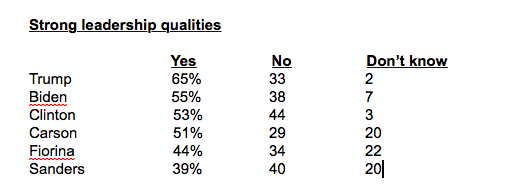
Among all voters, Donald Trump (65 percent) gets good marks on strong leadership, just as he does among Republicans. Majorities also see Vice President Biden (55 percent), Clinton (53 percent), and Carson (51 percent) as strong leaders. Fiorina and Sanders rate lower on this, but are also more unknown.
CBS News
Joe Biden ranks highest on being honest and trustworthy, with 61 percent, though Ben Carson is close behind with 58 percent. Hillary Clinton continues to struggle in this area among all voters, with 35 percent, as does Donald Trump, with 33 percent.
Both Biden (67 percent) and Ben Carson (63 percent) do well on caring about voters' need problems. This is also one of Bernie Sanders' strongest attributes of those tested among all voters. More say Trump does not care about people like them than say he does.
More see Biden (60 percent) as having the right experience to be a good president, compared to the other candidates asked about. Clinton is second with 51 percent), and the political newcomers are much further behind, along with Sanders.
The Clinton email controversy
As questions continue about Clinton's email practices as Secretary of State, 71 percent of registered voters nationwide do not think it was appropriate for Clinton to use a personal email address and server for work-related matters while Secretary of State, up from 64 percent in March. Majorities of Republicans and independents say her actions were not appropriate, while Democrats are more divided.
In addition, about six in 10 voters are dissatisfied with her explanation of the matter, while far fewer - a third - are satisfied.
But how will this affect Clinton's campaign for president? Voters are split: 50 percent say the email issue will be important in their vote for president, while almost as many - 48 percent say it won't be. Most Democrats say the email matter won't be important, while most Republicans say it will be. Independents are divided.
Views on the Role of Government and the Economy: A Partisan Divide
Democrats and Republicans have distinctly different views on the role of government in America. Three in four Republicans say the government is doing too much, while two in three Democrats see it as doing too little.
Overall, a majority of Americans think the government is now doing too much that is better left to businesses and individuals; just 39 percent think the government should do more to solve national problems.
On economic fairness, just over half the public - 54 percent - think that only a few people at the top have a chance to get ahead in today's economy; 42 percent think everyone has a fair chance. But Republicans are more likely to say that everyone has a chance to get ahead; most Democrats think only those at the top do.
Cross-over Appeal?
With the election for president more than a year away, about a third of Democrats and Republicans say they would consider voting for a candidate from the other party. Most, however, are inclined to stick with their own party. Fifty-nine percent of Republicans will not consider voting for a Democrat, and the same percentage of Democrats also say they wouldn't consider voting for a Republican.
This poll was conducted by telephone October 4-8, 2015 among a random sample of 1,251 adults nationwide, including 1,038 registered voters. Data collection was conducted on behalf of CBS by SSRS of Media, PA. Phone numbers were dialed from samples of both standard land-line and cell phones.
The poll employed a random digit dial methodology. For the landline sample, a respondent was randomly selected from all adults in the household. For the cell sample, interviews were conducted with the person who answered the phone.
Interviews were conducted in English and Spanish using live interviewers.
The data have been weighted to reflect U.S. Census figures on demographic variables.
The error due to sampling for results based on the entire sample could be plus or minus three percentage points. The error for subgroups may be higher and is available by request. The margin of error includes the effects of standard weighting procedures which enlarge sampling error slightly.
The margin of error for the sample of 343 Democratic primary voters is 6 percentage points.
Anyone who sells 50 to 100 guns in a year would be treated like a gun dealer.
Among the options being reviewed is a proposal to redefine who is considered a licensed gun dealer, which would also change requirements for conducting gun background checks. According toNBC News, under the proposed executive action anyone who sells 50 to 100 guns every year would be considered “in the business” of selling guns and have to adhere to laws that apply to gun dealers such as conducting background checks on buyers.
The action would reportedly not apply to people who occasionally sell, exchange, or purchase guns for their personal collection or anyone who sells off all or parts of their personal firearm collection.
The proposal was first drafted in 2013 in the wake of the tragic shooting at Sandy Hook Elementary School, according to the Washington Post, but it has resurfaced as the President and his team consider ways to take action against gun violence. Timing on this proposal is still up in the air, according to an administration official. The news of its consideration comes shortly after Democratic presidential candidate Hillary Clinton proposed her own executive action that would address the federal background check system if Congress does not.
Gun control has been one of the areas where Obama has had some of the least success, despite a bevy of national tragedies that have kept the issue at the forefront of national conversations. Since the shooting at Umpqua Community College that left nine dead and several others injured, Obama has been visibly angry over the fact that mass killings have become “routine” in America.
“Our thoughts and prayers are not enough. It’s not enough,” Obama said hours after the shooting. “It does not capture the heartache and grief and anger that we should feel. And it does nothing to prevent this carnage from being inflicted someplace else in America — next week, or a couple of months from now.”
The attack has further escalated political tension in the country only 20 days before the parliamentary re-election. Polls show that a similar outcome to the June 7 election is likely, which could force a coalition government.
Two bombs that exploded among people gathering in front of the Ankara train station on Oct. 10 in the morning claimed the lives of at least 95 people, wounding 246 others, many of them heavily.
Prime Minister Ahmet Davutoğlu has stated that the government suspected two suicide bombers committed the attack. The victims were about to attend a rally in Ankaraorganized by civil society groups in order to call for peace against the resumed clashes between the outlawedKurdistan Workers’ Party (PKK) and the security forces, as Turkey heads for a key snap election on Nov. 1.
That was the biggest act of terror in Turkey’s history, killing more than any former ones.
PM Davutoğlu announced a national mourning for three days, not only for those killed in the latest attack but also for police and military officers who have died in the recent wave of violence.
It is not yet clear who or which organization committed the violent attack, but Davutoğlu said it “could be the PKK or the Islamic State of Iraq and Levant [ISIL].” However, it is clear that the blast has created a wave of shock in all layers of Turkish society. The country has been living in an atmosphere of clashes with ups and downs for decades but it has never been the stage of such an awful attack directly targeting civilians using their democratic rights.
Calling themselves “The Labor Platform,” the associations that led the rally - including labor unions, civil servant unions, the bar association, the chambers for medical doctors, engineers, architects and others - applied to theAnkara Governor’s Office weeks ago to get permission for the rally route. Answering a question after the attack on whether he was thinking of resigning due to the lack of security measures, Turkish Interior Minister Selami Altınok said he did not think there was any problem with the measures, so he would keep his post.
Cancelling his election programs during the mourning period, Kemal Kılıçdaroğlu, the leader of the social democratic Republican People’s Party (CHP), said he was ready to give all support necessary to the government to end terrorism. “Turkey doesn’t deserve this,” Kılıçdaroğlu said, adding that government’s excessive “involvement in Middle Eastern affairs” was having terrible side effects.
Davutoğlu said he wanted to consult over the recent situation with Kılıçdaroğlu and Nationalist Movement Party (MHP) head Devlet Bahçeli, because they could draw a “bold line between themselves and acts of terror.” However, he said he would not be consulting with Selahattin Demirtaş, the co-chairman of the Kurdish problem-focused Peoples’ Democratic Party (HDP), who slammed President Recep Tayyip Erdoğan, PM Davutoğlu, and the government over the attack.
The attack has further escalated the political tension in Turkey only 20 days before a re-election of key importance. Polls show that the chances of a similar outcome to the June 7 elections, which could force a coalition government, are higher than chances of Davutoğlu’s Justice and Development Party (AK Parti) regaining power in parliament. That would also mean that President Erdoğan’s hopes of changing the country’s regime into a presidential one would diminish further.
But right now Turkey must focus on finding those responsible for the biggest act of terror in its history.