Wednesday, August 5, 2015

Afghanistan: sharp rise in women and children casualties in first half of 2015


UN reveals 1,591 civilians killed and 3,329 wounded as war enters its 14th year, as fighting in residential areas and greater role of militias contribute to increase.

 The war in Afghanistan is killing or wounding increasing numbers of civilians, with women and children showing the sharpest rise in casualties as it enters its 14th year, according to new figures from the UN.
“Afghan civilians have suffered far too long from this destructive conflict. The devastating consequences of this violence against civilians as documented in this report should serve to strengthen the broad conviction that peace is urgently needed,” said Nicholas Haysom, head of the United Nations Assistance Mission to Afghanistan.
The first six months of 2015 saw 13% rise in child casualties compared with the same period last year and a 23% increase in the number of women killed or injured. Total casualties were up 1% from record levels seen in 2014, with 1,591 civilians killed and 3,329 wounded.
The numbers reveal the war’s changing dynamics. After the end of Nato’s combat mission, Afghan government forces are fighting with less airpower and material support.
As a result, the conflict has moved closer to residential areas, where the warring parties are fighting with indiscriminate weapons such as mortars, rockets and grenades. In fact, government forces are responsible for most casualties, 59%, caused by this type of weapons.
Mortars were, for instance, used on 5 June when Afghan national army soldiers accidentally hit a wedding party on the outskirts of Ghazni, killing eight children. The UN describes how the security forces subsequently gave contradictory explanations, in a sign of a troubling lack of transparency from the government’s side.
While insurgents are still responsible for the majority of civilian casualties, government security forces killed or injured almost 300 more civilians compared to the first half of 2014, which amounts to a 60% spike. In total, pro-government forces caused 16% of civilian casualties, of which international forces are responsible for 1%.
The war’s main killers remain improvised explosive devices (IEDs) and ground engagements. However, a rise in suicide bombings and complex attacks also helps to explain why women and children suffer more than ever.
In April, a suicide bomber on a motorcycle blew himself up outside Kabul Bank on the main street of Jalalabad, killing at least 35 and injuring 125. Mohammad Naeem, 25, heard the explosion, and rushed to the scene, knowing his father worked in the vicinity.
“When I came to the bank, I saw a lot of dead bodies – men, children, women, old people. I found my father. His body was in several pieces. I found his leg and hands in different places,” Naeem told the Guardian over the phone.
“After I found my father’s body, I walked around the dead bodies like a crazy man,” he said. “There are 16 people in my family, and my father was feeding all of them.”
The Jalalabad bombing targeted queuing government workers, whom the Taliban – contrary to international law – don’t consider civilians. In the first half of 2015, the Taliban claimed 36 attacks on civilian government officials and 18 on judges, prosecutors and judicial staff.
“This report lays bare the heart-rending, prolonged suffering of civilians in Afghanistan, who continue to bear the brunt of the armed conflict and live in insecurity and uncertainty over whether a trip to a bank, a tailoring class, to a court room or a wedding party, may be their last,” said UN High Commissioner for Human Rights, Zeid Ra’ad Al Hussein.
With shifting dynamics, the war is also widening geographically. Since spring, the Taliban have sustained an offensive in the north, targeting especially Kunduz province.
The government is increasingly turning to irregular militias for help. But these forces have acted with impunity, says the UN, committing “deliberate killings, assaults, extortion, intimidation and property theft”. In total, militias account for 11% of civilian casualties caused by pro-government forces.
Abdurrezaq, a village elder from Gur Tepa in Kunduz, told the Guardian that the militias did not bring security. They only increased the chance of getting caught in the crossfire. “Our houses are destroyed but who should we complain to? We are victims of both sides.”

Afghanistan - 4,000 Soldiers Desert Their Posts Monthly: Gen. Campbell

General John F. Campbell, the Resolute Support Mission and the U.S. Forces commander in Afghanistan, said on Tuesday that at least 4,000 Afghan security force members are deserting their posts every month.
Speaking at a question and answer session titled Afghanistan's Future at the Brooking Institution in Washington DC, Campbell criticized senior security officials in Afghanistan and said the main reason for troops deserting was because of a lack of a proper management of army and police personnel in the country.

But on a lighter note he said the Taliban has no other way except to join the peace process because they will not be able to topple the Afghan government through war.

"The number of Taliban insurgents that have been killed [this year] is probably three or four times higher than it was last year. The Afghan security forces are becoming casualties but again they inflict a lot of casualties. I think we do see signs of fracturing in the battlefield from the leadership, lack of supplies and lack of money," he said.

He said the Taliban are tired of war and suggested they join the peace process.

According to Campbell, the Taliban had realized now the need for joining the peace process because the Afghan government was not going to fall to the Taliban.

Talking about the ability of the Taliban, he said "They are not taking territory they are not meeting any strategic level goals that they set out. They are going to take a district and they are going to lose it. They are going to take another district center but they are going to lose it."

He stressed: "They [Taliban] are competing against Daesh now in parts of Afghanistan. Daesh pays more money to recommend to Daesh and takeaway from the Taliban."

Meanwhile, an advisor to the four-star American general, who was also present at the session, noted the death of Taliban's supreme leader Mullah Omar had further paved grounds for the peace process
"With regards to Mullah Omar, what is important is that all sides continue to try to push towards peace," Campbell's political advisor Matt Sherman said. "I think that is the real drive that will continue."

He however continued to say that peace would not happen in near future as he said the process would take years.

The remarks come as the National Unity Government (NUG) has no defense minister almost a year since it took power after a disputed election. Also, the parliamentarians have gone on summer recess while the war is going on in northern and other parts of Afghanistan.

Afghan President Possesses Pakistani CNIC

In a stunning development, it has come to light that incumbent Afghan President, Asharf Ghani possesses a Pakistani Computerized National Identity Card (CNIC).
This revelation was made by Malik Dilmurad Hasni, member of district council Chagai, during a meeting of the district council.
Mr. Hasni presented copies of the CNIC issued to Afghan President during district council Chagai.
It was also revealed that former Afghan guerilla command late Ahmad Shah Masood also holds a Pakistani CNIC.
District council members severally criticized National Database and Registration Authority (NADRA) for its incompetence and lack of check and balance mechanisms.
NADRA officials in the past have confessed to have issued illegal CNICs to hundreds of thousands of Afghan refugees.
http://thebalochistanpoint.com/afghan-president-possesses-pakistani-cnic/

Pakistan - Only an insane person can demand foreign interference in Karachi: Qaim

Sindh Chief Minister Syed Qaim Ali Shah in a statement released Wednesday said only an “insane person can think to approach any foreign country, particularly India,” to intervene in Karachi, in an implicit reference to Altaf Hussain's recent speech to workers in Dallas.
“All political parties had unanimously agreed in presence of civil and military leadership to weed out terrorists, criminals and outlaws from the country in general and from Karachi in particular,” said the chief minister, praising police and Rangers for their "unforgettable sacrifices for restoration of peace in Karachi.”
“When peace has returned to the city, an unconstitutional demand for deployment of Nato and UN forces in Karachi was made by Altaf Hussain,” added Qaim.
“No one should invite any other country and no other country has any right to interfere in the internal affairs of Pakistan.”
The chief minister categorically stated that the targeted operation in Karachi is not against any political party, group or leader but against terrorists, criminals and outlaws.
“With the joint efforts of Sindh police, Rangers, agencies and with the backing of Pakistan Army we have controlled crime substantially,” he said.
“We would not tolerate if any attempt is made to make the targeted operation controversial and the demands made against the sovereignty of the country.”
Syed Qaim Ali Shah said “this city belongs to each and every one of us. We, as the residents of Karachi owe our thanks to the law enforcing agencies for their extraordinary efforts to restore peace in the city.”
“The Sindh government on its part has substantially increased the salaries of police officials, equipped them with latest gadgets and imparted specialised training to increase their efficiency,” Shah said.
The chief minister also said that Urdu speaking people living in Sindh are Sindhis.

Pakistan empowers military courts to pass death sentences on civilians

Pakistan’s supreme court has ruled that secret military courts are legal and can pass death sentences on civilians, a judgment that critics say further strengthens the military’s grip on power at the expense of civilian authorities.
Military courts were empowered to try suspected militants after Taliban gunmenmassacred 134 children at an army-run school in December. The government argued that civilians were too scared to convict militants.
Several lawyers challenged the constitutionality of the military courts in the supreme court. But on Wednesday, Nasir ul Mulk, the chief justice, announced that all “petitions have been dismissed”. A detailed judgment would be released later, he said.
Pakistan, a nuclear-armed country with a population of 190 million, is plagued by a Taliban insurgency, sectarian violence and militancy.
Military courts have heard at least 100 militants’ cases and passed judgment in at least 27, the law ministry said in June. The military published the names of six men sentenced to death in one case.
“The six men convicted by military courts whose executions were stayed by the supreme court will now go ahead,” Ashtar Ausaf Ali, minister of state for law, said after the judgment.
There is no public information about the identity of other suspects or convicts, about the charges or evidence against them, or about their sentences or appeals. The military has not responded to repeated requests for comment.
Military courts have been empowered to try militant suspects until February 2017. The government has promised to use that time to reform the broken civilian justice system.
Critics say the government has handed the military too much power and that there are few signs of reform.
“Ceding space to the military isn’t the answer,” said Saroop Ijaz, a lawyer who represents Human Rights Watch. “Parliament can’t pass the buck for creating a functioning criminal justice system. There’s been no movement on reform,” he added. “When the military courts lapse, the criminal justice system will still be broken.”
An investigation by Reuters of previous military court martials found that accusations of torture were common.
The military is already holding thousands of civilians without trial, according to supreme court hearings into missing persons. It is unclear whether some may face military courts.
“We cannot know what is happening inside those courts, we have no access to them,” said Amina Janjua, an activist for the families of the missing whose own husband was detained 10 years ago. “Who will know whether the judges’ decision is right and what proof there was?”

Music - MAHJABEEN QAZALBASH - OLD PASHTO SONG - PTV

Music Video - BILLO DE GHAR

Music Video - Lokan Do Do Yaar Banaye Afshan Zebi Song Live 2014 Punjabi Song

Music Video - NOOR JAHAN - JO BACHA THA - UMRAO JAN ADA

Music Video - Benjamin Sisters - Gari ko chalana babu zara halke halke

Music Video - Benjamin Sisters/ - Menon rab di saun tere naal pyar hogaya

Music Video - Benjamin Sisters - Aaye Mausam Rangeele Suhane

Ghazal - YE ALAM SHAUQ KA - AHMED FARAZ AND TAHIRA SYED

Music Video - FARIDA KHANUM - BALLE BALLE

Urdu Ghazal - EK BAR MUSKURA DO - MUNNI BEGUM

Tuesday, August 4, 2015

Music Video - Nicki Minaj Sexy Booty Tribute #12 (Anaconda Recut)

Music Video - [All-Star Booty] Shakira & Rihanna SEXY Tribute

Music Video - Rihanna - Birthday Cake (feat. Chris Brown)

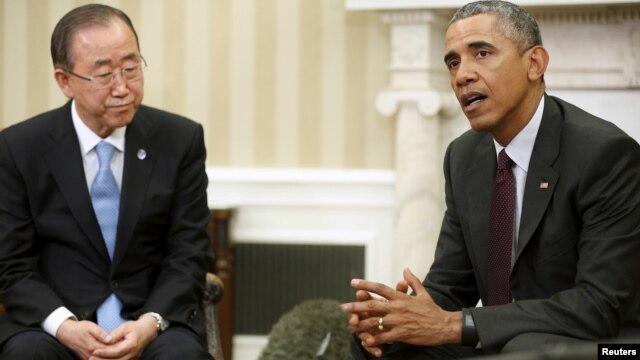
UN Chief Praises Obama's Climate Proposal

When the leaders of the United States and United Nations meet, there is seemingly no limit to the number of pressing issues that are up for discussion.  President Barack Obama acknowledged the demands on the United Nations have never been greater when he welcomed U.N. Secretary-General Ban Ki-moon to the White House for talks Tuesday.
Obama said the “urgency of a world response” to the threat of climate change topped the list of issues during their talks, which came a day after he unveiled a plan tosharply cut the carbon pollution produced by American power plants.
The president's call to cut carbon emissions by 32 percent below 2005 levels by 2030 is opposed by major U.S. industry groups as too costly and illegal. Republicans in Congress vowed to fight the tougher power plant standards, saying they would hurt coal-mining states.
Sitting next to Ban in the Oval Office, Obama said he highlighted U.S. work on renewable energy and meeting “aggressive” targets in preparation for the U.N. climate conference in Paris later this year.
He said he encouraged the secretary-general “to continue to work with us to press those countries who have not yet put forward bold, aggressive plans to do so. Because we need Paris to be a success, and the world has to step up in a concerted way on behalf of our children and future generations.”
Ban commended Obama’s strong commitment to climate change from his first day in office, noting his “visionary and bold” announcement Monday.
“This Clean Power Plan powers economies and generates jobs. And also it can generate huge dividends here at home in the U.S. economy,” Ban said, turning to Obama. “And I am sure this will impact a lot of countries. And I really appreciate your personal engagement, starting with China, Brazil and India and many others.”
Syria, Yemen, Libya
Conflicts in the Middle East were also a focus of the talks between Obama and Ban, with the two leaders sharing “deep concerns” about the humanitarian situation in Syria. Obama noted the need to “stop the killing and arrive at a realistic, political process that can lead to a stabilizing of the country.”
But diplomatic efforts aimed at resolving Syria's political conflict have stalled. The United States leads an anti-Islamic State coalition conducting airstrikes in Syria, and recently welcomed Turkey's adoption of a military role in Syria.   
Ban said the United Nations is trying to expedite humanitarian assistance to the war-torn nation.
The secretary-general also made a plea to member states for generous humanitarian assistance in Yemen, where he said 80 percent of the population, or more than 21 million people, is in need of urgent help. Ban said both leaders reinforced the need for a political, not military, solution in that country.
And in Libya, Obama noted some “modest progress” in bringing together the many factions that have created great difficulty in governance and “created a vacuum that is causing everything from to an outflow of refugees to the safe havens for organizations like ISIL,” an acronym used for the Islamic State group.
Both leaders also discussed the situation in South Sudan, with the secretary-general praising the president’s efforts to stop the violence. He noted Obama’s recent trip to Ethiopia, where the president convened a meeting with regional leaders on South Sudan.
Obama said hope regarding South Sudan’s recognition as a country had been squandered by President Salva Kiir and opposition leader Riek Machar. He said the goal is to have an agreement in place by August 17 to stop the bloodshed and move forward with an inclusive government.
“If they miss that target, then I think it is our view that it’s going to be necessary for us to move forward with a different plan and recognize that those leaders are incapable of creating the peace that is required,” Obama said.

Video - President Obama Hosts the First-Ever White House Demo Day

President Obama Turns 54: Michelle Obama Wishes Her 'Favorite Dance Partner' a Happy Birthday on Twitter


Barack Obama 
✔@BarackObama
Celebrate President Obama's birthday by wishing him a happy 54th: http://ofa.bo/f9AH  pic.twitter.com/IqnRnAraM8
Happy birthday, Mr. President! 

Barack Obama turned 54 on Tuesday and all of Twitter is celebrating – including his First Lady Michelle Obama and his presidential predecessor Bill Clinton. 

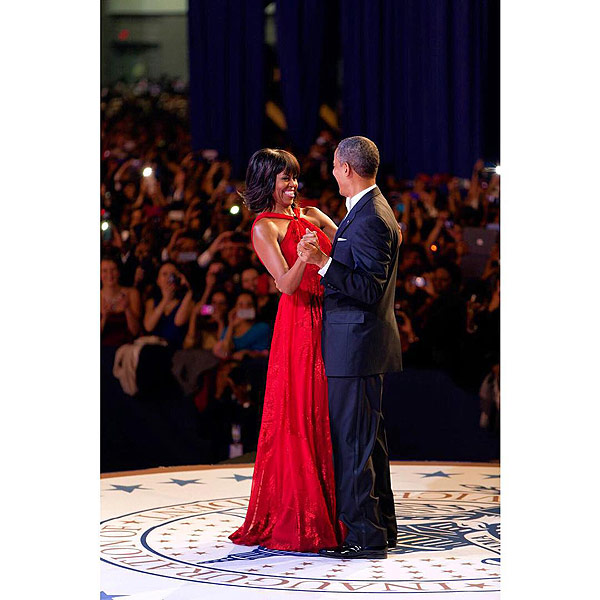
@FLOTUS sent her "loving husband" (and "favorite dance partner") a sweetTweet to ring in his special day, including the above shot of the couple hitting the dance floor at the 2013 Inaugural Ball. 

She captioned the photo, "Happy birthday to a loving husband, wonderful father and my favorite dance partner. 54 looks good on you, @POTUS! -mo." 


Michelle, wearing a stunning red dress by Jason Wu, is beaming at her husband in the picture – but she might not be so happy when she sees Clinton's birthday message to Barack. 
The 42nd president sent the 44th president this little birthday joke on Twitter: 


Happy birthday, @POTUS! Hopefully when @FLOTUS isn’t looking you can have some cake.

So much for the First Lady's healthy eating campaigns! But at least the president can work it off with his sweet dance moves: 

A dreadful wakeup call for Turkey

SEMİH İDİZ

The attack in Suruç is a dreadful wakeup call for Turkey. It’s a shame that this call comes at the expense of so many lives, most of them young people - 24 of which were university students. Looking at the picture of these idealistic young girls and boys, who only wanted to take aid and friendship to Kobane and comparing them to the pictures of rabid militants from radical Islamic groups like the Islamic State in Iraq and the Levant (ISIL), one has to be totally blind not to see who provides hope and promise for a modern Turkey that is respected internationally.

It boggles the mind therefore to think that the Justice and Development Party (AKP) government could have in anyway, directly or indirectly, given passage to or turned a blind eye to the activities of groups like ISIL or al-Nusra in the hope that they would expedite the downfall of Bashar al-Assad and his regime in Syria. This is not the sort of thing responsible governments do.

The U.S., Pakistan and Saudi Arabia aided the Mujahedeen in Afghanistan in the 1970s and 1980s, in a bid to undermine the Soviet Union, and succeeded to an extent, but just look at what they ultimately spawned for themselves. There are tomes that have been written about this. The Taliban, al-Qaeda, and 9/11 are all the products of that era. Daily Cumhuriyet’s headline commentary on the Suruç attack on July 21 carried a very apt title when it quoted a Turkish saying: “Feed the crow so it can turn around and poke your eye out.” 

It is equally mind boggling that the AKP, with help from President Recep Tayyip Erdoğan, should have provided grist to the mill, which claims that the Syrian Kurds are somehow more dangerous for Turkey than ISIL. The time has come for the AKP to not only act more decisively together with Turkey’s allies against real and immediate threats to the country, but also to stop politicking in thinly veiled bid to promote its Islamist ideological worldview.

Religion has to be sent back to the private domain where it belongs. In other words, it is time for Turkey to return to its secular mode of governance for the sake of the country as a whole, rather than trying to promote an agenda which less than half the population supports. Erdoğan himself told the Egyptian satellite channel Dream TV in 2010 that secularism is not irreligion. 

“Secularism is definitely not atheism. I recommend a secular constitution for Egypt,” he said, after the country’s dictator Hosni Mubarak was toppled.  “I, as Recep Tayyip Erdoğan, am a Muslim and not secular. But I am the prime minister of a secular country. In a secular country, people have the freedom to be religious or not,” he said (For the original Turkish story: http://www.hurriyet.com.tr/planet/18735423.asp).

Wise words but he did not stand behind them. He went on to say that he wanted to see a religious youth emerge in Turkey. Well, it is clear that a portion of the Islamic youth he desires to see in this country is not just religious but also deeply vengeful, carrying no respect for human life. 

Turkey was always a predominantly conservative and religious country – not unlike the U.S. - even when it adopted a secular form of government. This is why such remarks from Erdoğan always made people think that he was after more than he was claiming.  But using politics to impose religious values on society as a whole has not brought any advantages to Turkey, which is a heterogeneous country when it comes to creeds. 

The June 7 elections have given the AKP a chance to change tack and work for the better of the country as a whole. A grand coalition with the Republican People’s Party (CHP) is a historic opportunity in this respect that should not be wasted for the sake of promoting the religious worldview. Suruç should act as a wakeup call in this respect. It remains to be seen if the AKP will use this opportunity or squander it.

Saudi Arabia's war in Yemen is a tragic blunder


The Houthi rebels and their ally Ali Abdullah Saleh, former president of Yemen, show no sign of bending to the will of Saudi Arabia's King Salman bin Addul-Aziz Al Saud Salman after more than four months of war.
The grim struggle in Yemen goes on with a frightful toll for the Yemeni people.
The leader of the Zaydi Houthi rebels, Abdul-Malek al-Houthi, gave a speech this week to his followers promising "we are in a great battle in which we must use all our efforts."
He acknowledged the Saudis and their allies had retaken the southern port of Aden but said "the enemy threw all their weight to gain a limited achievement."
Abdul-Malek accused the Saudis and their ally, President Abed Rabbo Mansour Hadi, of working with both Israel and the Islamic State to take Aden. He called for an internal Yemeni political solution to the war.
Former President Saleh, in an interview, went further and called Hadi a traitor for backing the Saudis who should be tried for treason. Saleh called his former deputy "an enemy of all Yemenis" who should be tried for war crimes in the International Court of Justice in The Hague.
Saleh went on to blast the new Saudi leadership for abandoning the wise policies of the late King Abdullah who died in January. The new leadership "is no longer a sisterly or friendly country but rather an aggressor against our Yemeni people."
YemenRNGS Reuters
Meanwhile, the Yemeni people are heading towards a humanitarian disaster as the war continues.
Some aid is now moving into Aden but the rest of the country is desperately short of water, food, and medical supplies. Both sides have sabotaged efforts to arrange short cease fires to allow temporary relief.
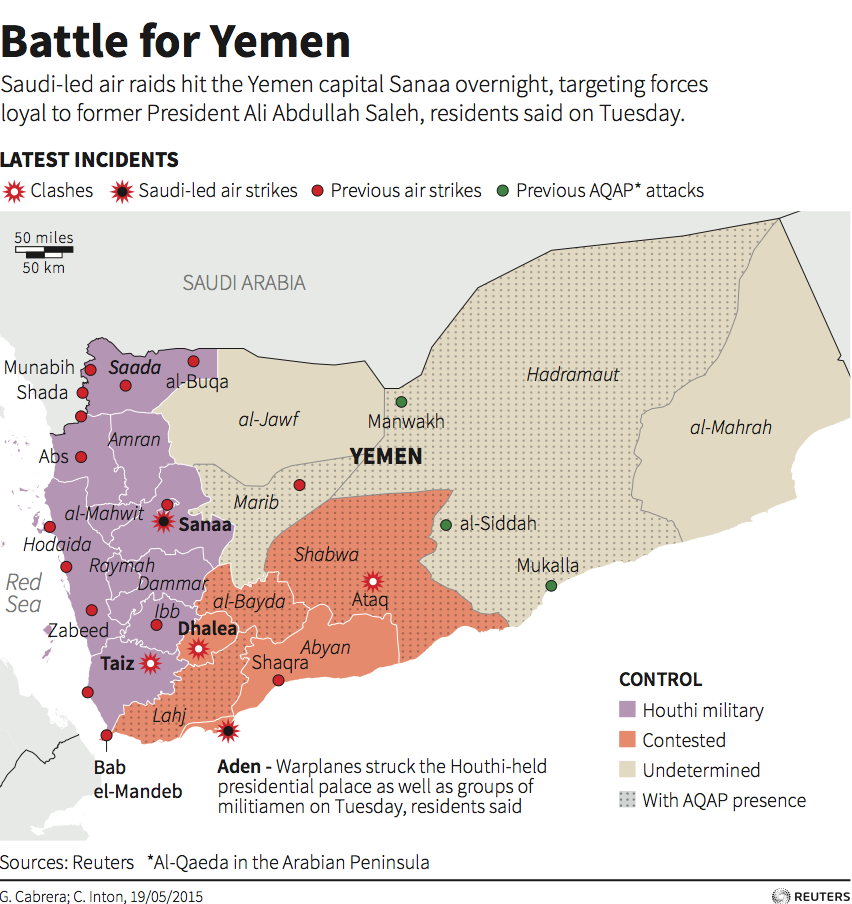
The strong words of defiance from Abdul-Malek al-Houthi and Ali Abdullah Saleh suggest they are not cowed by Saudi air power. Their forces retain control of most of what used to be North Yemen. The Saudis, Hadi, and al-Qaida have control of the ports of what used to be South Yemen: Saudi Arabia and Hadi have Aden; al-Qaida has Mukalla.
The Saudis and the United Arab Emirates (UAE) are pouring arms into Aden and trying to expand their foothold north. It's slow work uphill literally. A major battle is underway at a large Soviet-built air base north of Aden at Al-Anad. The air base is on the main road to Taiz, the next Saudi military objective.
The Saudi press reports 1,500 troops from the UAE are participating in the battle for Al-Anad, the first major ground unit from the coalition to enter the war. This suggests the Hadi forces are too weak to win on their own. Hadi is calling for total victory.
Inside the kingdom growing doubts about the war are circulating quietly. The king's ambitious son, Deputy Crown Prince Mohammed bin Salman, and minister of defense, is derisively called the "little general" behind his back for his role in starting the war.
The late foreign minister Prince Saud al-Faisal is rumored to have opposed the war and warned that it would be a quagmire or worse before passing away. Saud enjoys great respect among Saudis; invoking him against the young Mohammed bin Salman is a calculated maneuver to undermine the war and the prince. Of course, Saud cannot speak for himself.
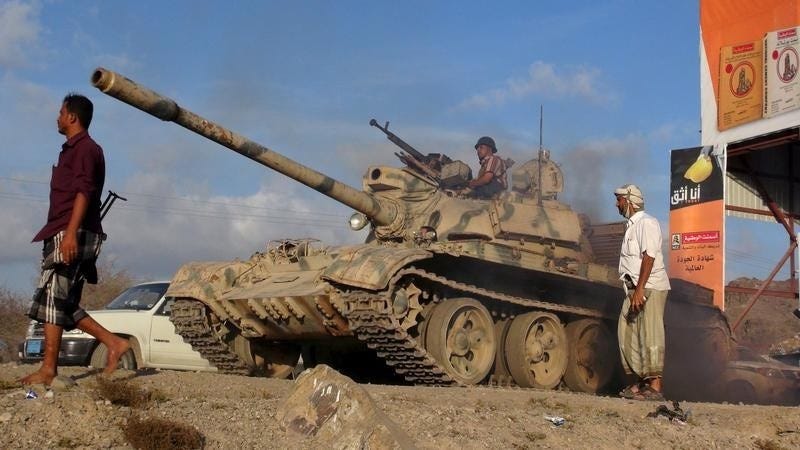
Southern People's Resistance militants loyal to Yemen's President Abd-Rabbu Mansour Hadi take positions on the frontline of fighting against Houthi fighters in the country's southern province of Lahej March 24, 2015. REUTERS/Nabeel QuaitiThomson ReutersSouthern People's Resistance militants loyal to Yemen's President Abd-Rabbu Mansour Hadi take positions on the frontline of fighting against Houthi fighters in the country's southern province of Lahej
A great humanitarian tragedy is unfolding in the Arabian Peninsula. The international community appears powerless to help the Yemeni people or, even worse, indifferent to their fate. The richest countries in the Arab world are waging war and blockade against the poorest nation in Arabia with no end in sight.
For its part, the United States has committed to accelerating arms deliveries to the kingdom and the Gulf states which helps them continue the air and naval blockade.


Read more: http://www.brookings.edu/blogs/markaz/posts/2015/08/04-yemen-rebels-defy-king-riedel?rssid=foreign+policy#ixzz3hu6hEAOe

Yemen health system in state of collapse: MSF

A humanitarian organization has warned that the health system in war-stricken Yemen is close to collapsing under Saudi raids.
Thierry Goffeau, the coordinator for Médecins Sans Frontières (MSF) or Doctors Without Borders in Yemen's southern city of Aden, issued the warning on Tuesday after a 10-week mission to Yemen.
“The population is faced with food shortages, the health system is in a state of collapse. I have never seen such a level of violence,” Goffeau said.
Meanwhile, Laurent Sury, the MSF's head of emergencies, said transportation has been totally disrupted by Saudi Arabia's continuing air raids.
“Women needing a Caesarian die because they cannot get to a hospital in time,” Sury said, adding, “It is very difficult to get access to the population and for the population to access hospitals as a result of the bombardments and the fighting.”
The MSF's head of emergencies went on to say that as many as 20,000 people had been treated for injuries in the country with only half of them having received treatment.
He further noted that the MSF's clinics in the port city of Aden alone “receive nearly 350 new patients per week.”
The warning by the MSF comes as Saudi Arabia continues to pound areas across Yemen.
The Al Saud regime launched its military aggression against Yemen – without a UN mandate – in a bid to undermine the Houthi Ansarullah movement and restore power to Hadi, an ally of Riyadh.
According to UN figures, the Saudi war has killed nearly 1,900 civilians since late March. However, local sources have given a much higher death toll.
http://www.presstv.com/Detail/2015/08/04/423277/Yemen-MSF-Saudi-Aden-

Video - Putin enjoys killer whale show at Moscow's new oceanarium

Use of Russian troops in Syria is out of question — Kremlin spokesman

The use of Russian troops in the Syrian conflict has never been even discussed, [Syrian President Bashar] Assad has never asked for that, Russian president’s press secretary Dmitry Peskov said on Tuesday.
"No, this issue [sending of Russian troops to Syria] has never been discussed in any way. This issue is out of the agenda," he told journalists.
When asked whether Syrian President Bashar Assad had ever asked Russia to send its troops to his country, Peskov said, "No, this issue has never been raised."
Commenting on the statement by Russian airborne troops commander Vladimir Shamanov who said that Russian paratroopers were ready to go to Syria if they were ordered to, the Kremlin spokesman said, "There ought to be no doubts that Russian airborne troops will fulfill any order from their commander-in-chief."
Earlier on Tuesday, Shamanov told journalists that Russia’s airborne troops were ready to assist Syria in countering terrorists, if such a task is set by Russia’s leaders. "Of course we will execute the order set forth by the country’s leadership, if there is a task at hand," Shamanov said, in response to a Syrian reporter’s question about the readiness of the Russian airborne troops to render assistance to Syria’s government in its battle against terrorism.
Peskov also said that the use of Russian military aircraft in Syria is out of question at the moment. "This issue is not looked at now," he said. "I have no other information."

Putin to Turkey Envoy: Tell Erdogan He Can Go to Hell along with ISIL Terrorists

Russian President Vladimir Putin broke the accepted diplomatic protocols and personally summoned Turkish Ambassador to Moscow Ümit Yardim, and warned him that the Russian Federation shall sever the diplomatic relations immediately unless Turkish President Recep Tayyip Erdoğan stops supporting ISIL terrorists in Syria, where Russia holds its last navy base in the Mediterranean sea, FNA reported.

The AWD news website quoted Moscow Times as reporting that the Russian president purportedly went into a long diatribe criticizing the Turkish foreign policy and its malevolent role in Syria, Iraq and Yemen by supporting Saudi-backed al-Qaeda terrorists, which escalated the conversation with the Turkish ambassador to a fierce polemic.

Also the Republican news website said that according to the leaked information obtained by the Moscow Times, the meeting between Putin and Turkish ambassador was imbued with intense mutual resentment where Yardim repudiated all Russian accusations, laying blame on Russia for Syria's bitter and protracted civil war. 

"Tell your dictator president he can go to hell along with his ISIL terrorist and I shall make Syria to nothing but a 'Big Stalingrad', for Erdoğan and his Saudi allies are no vicious than Adolf Hitler," replied Vladimir Putin in the 2-hour closed door meeting with Turkish emissary.

"How hypocrite is your president as he advocates democracy and lambasts the military coup d'état in Egypt," added Putin, "And he simultaneously condones all terrorist activities aimed to overthrow Syrian president." 

The Russian president continued by saying that his country won't abandon Syrian legitimate administration and will cooperate with its allies, namely Iran and China, to find a political solution to Syria's interminable civil war which descended the 23-million Arab nation to an utter ethnic and religious anarchy.

http://www.almanar.com.lb/english/adetails.php?fromval=1&cid=22&frid=22&eid=224398

Pashto Music - Sardar Ali Takkar - دَ خپل فوک یوه ملغلره