Tuesday, August 4, 2015

Pakistani Christian refugees face ordeal in Thailand

Pakistani Christians escaping to Thailand from persecution in their native country are not receiving the protection they so desperately need as they face poverty, arrest and possible deportation.
Thousands of Pakistani Christians have fled their homes due the country’s reported mistreatment of religious minorities. Fleeing to Southeast Asian countries due to how cheap and easy it is to maintain a tourist visa, these Christians soon discover they are not to be treated well in their new home either.
Because Thailand is not a signatory to the 1951 Refugee Convention or its 1967 Protocol, and does not have a formal national asylum framework, the Pakistani Christians are not treated as refugees or asylum seekers but as illegal immigrants. Often, Thailand will not grant asylum status to those declared genuine refugees by the United Nations High Commissioner for Refugees (UNHCR).
“The poor can’t and don’t escape but the middle and upper classes flee to Thailand,” said Wilson Chowdhry, chairman of the British Pakistani Christian Association, who has issued an appeal and a petition calling for help for the refugees. “[Back in Pakistan] they are doctors, lawyers, professors, politicians.”
“Pakistan’s blasphemy law has been used in a way to target religious minorities,” said Phil Robertson, deputy director of the Asia Division of Human Rights Watch in a separate interview. “There has been violence perpetrated against people accused of blasphemy. When facing that kind of persecution, many have no choice but to leave.”
Those fleeing Pakistan face tough roads. They are often stopped by border guards when suspected of being Christians even with a legal visa or plane tickets. Many are not allowed to cross the border until they have paid a bribe or a fine. When Raymond John and his family crossed the border, they had to pay the guards 112,000 Pakistani rupees ($1100).
“We refused twice and they would not let us pass but on the third time we finally paid,” John said.
In European countries and the United States, it can be an arduous and expensive process to apply for a tourist visa. Although easy to obtain one from Thailand, the Pakistanis’ stay is anything but easy. Upon arrival, the refugees realize they cannot attain citizenship and cannot buy property. Even if a Pakistani marries a Thai citizen, they are not granted legal citizenship and their status is returned to refugee upon their spouse’s death.
Farrukh Saif, head of the Farrukh Saif Foundation dedicated to helping persecuted Pakistani Christian refugees, has criticized the delay of the UNHCR to classify the Christians who have fled to Thailand as refugees, saying it affects the livelihood of those seeking asylum.
“According to a mandate, in 90 days they have to determine the status of these people as refugees, but in reality it can take four to five years,” he said. “If a minor, a child, cannot go to school for four to five years, what is his future? A whole generation of Pakistani Christians in Bangkok is being destroyed.”
UNHCR’s Field Media Officer for Thailand, Vivian Tan, said that by nature, refugee status determination (RSD) is time-consuming and labor-intensive.
“In many urban settings, the demand for RSD exceeds processing capacities. In Bangkok, UNHCR has been working to speed up processing times,” she said.
Refugees would agree that the process has been anything but speedy. Sunny Gil arrived in Thailand in August 2013 and was given an appointment with the UNHCR for an interview in May 2015 to be assigned refugee status. When the time came for the interview, however, it was postponed for a year.
“It is silly - the excuses that they give for postponing the interviews. It is such a big organization and they should be able to help us,” he said.
Additionally, because these Pakistanis do not have refugee status, they are not allowed to work and therefore have no legal income. They often make their money doing illegal jobs or begging and seeking charity from churches.
“We want to work and we want to earn and support our families on our own,” said Cyril Lamran of the Christian Asylum Seekers Association of Thailand and a refugee himself. “But they’re not giving us the opportunity for us to earn and not providing us basic human rights.”
Tourist visas last up to two months after which they can only be renewed if the applicant is working. Because, however, the Pakistani Christians are treated as illegal immigrants and are unable to work, their visas cannot be extended making them subject to arrest and detention at any point in time.
In March, upwards of 400 Pakistani Christian refugees were reported to have been arrested.  Homes were raided by the Thai immigration police and the arrestees were taken to be held at the central jail or the Immigration Detention Center (IDC) in the capital of Bangkok.
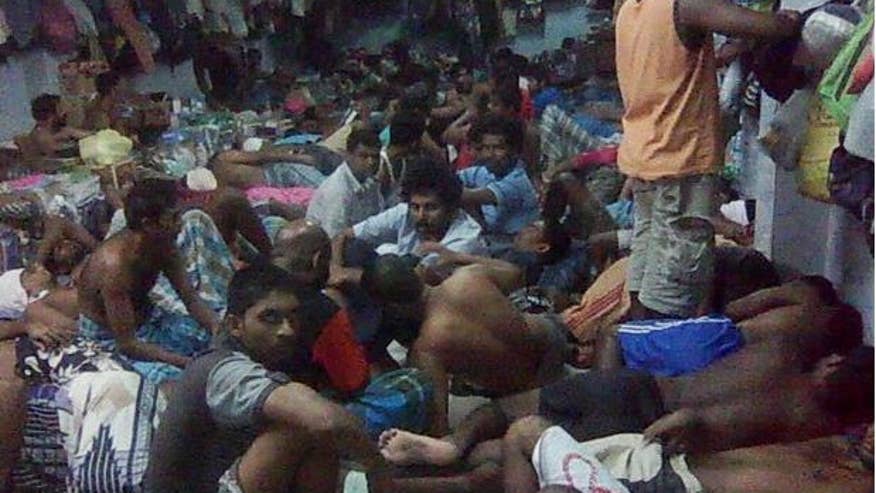
Former inmates speak of horrendous conditions including cramped cells, inadequate nutrition and children being incarcerated with adults. In the central jail, the men are bound in shackles and forced to stand in the hot sun. In the IDC, up to 200 people can be packed in a room meant for 100 leaving very little space to properly sleep. Many have since been released for up to a year until they get a proper visa, otherwise they face being put back in the IDC or being deported back to Pakistan.
While Gil said he could perhaps see why people were being sent to the IDC (his own sister-in-law was held in central jail and the IDC for one month), he could not understand the need to send refugees to the former.
“The central jail is for criminals, not asylum seekers, but they put us in jail like we are criminals,” he said. “Even though they are not signatory, there is something called human rights.”
Other concerns also plague these families. The refugees do not have the money to cover medical costs and multiple families often are forced to share a single room because they cannot afford the rent.
Currently, there are an estimated 4500 Pakistani Christian refugees living in Thailand and while they wait for help, activists stress the dire need for action to be taken, requesting the international community to hasten the determination process of the UNHCR.
“The UNHCR is the mother of human rights but they’re essentially denying human rights,” John said. “The West has to know the persecution the Christians face in Pakistan and in Thailand. Who will speak for us when those who speak will speak for the government?”

Asia Bibi's lawyer blames Pakistani government for failure


By Carey Lodge 

The Pakistani government has failed to uphold numerous legal requirements in the case against Asia Bibi, her lawyer has said.
Sentenced to death for blasphemy in 2010, Bibi has lived on death row ever since. She denies charges levelled at her by former colleagues that she insulted the Prophet Muhammad, and last month hopes were raised that she may walk free after the Supreme Court of Pakistan temporarily suspended her execution.
Her lawyer, Saiful Malook, took over her case in October 2014. He claims that Pakistani officials have been influenced by religious hardliners who want Bibi, a Christian, to be killed for her alleged crime.
"The authorities must put aside religious sentiments and verify the facts, first. However, they are subject to the influence of religious fundamentalists and do not stop the militants from attacking those accused of insulting the Prophet Muhammad, or setting fire to their homes," he told Asia News.
"Blasphemy is within the hudud (crimes against God), but none of the judges asked if the State in person or an authorized officer have filed a complaint of blasphemy against Asia. Sharia (Islamic law) says that the accused must confess their crime and all testimonies verified before the trial. All these requirements have been ignored".
Malook is a Muslim, and has been targeted by religious fundamentalists for working on behalf of Bibi. Two prominent politicians, governor of Punjab Salmaan Taseer and Minority Affairs Minister Shahbaz Bhatti, were assassinated in 2011 after defending Bibi. Malook said that he has had to be very careful in order to avoid the same fate.
"I have asked reporters not to take pictures. I am the father of three daughters. Special security agencies have taught me how to avoid threats when handling similar cases," he said.
"People, even judges, say I am crazy to have taken over this case. They say I am the enemy of my daughters, handshakes became rarer. I was a proud Vice President of the High Court, but now my acquaintances shake their heads. Religious parties hold grudges against me. "
Malook insists that the charges against Asia Bibi are entirely false. Human rights groups say Pakistan's strict blasphemy laws are frequently misused by extremists, and false charges brought against Christians in order to settle personal scores or to seize property or businesses. Bibi is the first woman to be sentenced to death for blasphemy in the country, however.
According to the BBC, Pakistan has the largest number of death row inmates in the world, with more than 8,000 people currently awaiting execution. This morning, Sharqat Hussain – convicted of killing a child in 2004 – was hanged, despite international calls for his release. His lawyers say he was tortured into confessing the murder when he was just 14.

Pakistan - Systematic Deprivation of Balochistan in Federal Jobs


Adnan Aamir
 A detailed study of vacancies announced by Federal Public Service commission (FPSC) hints towards systematic deprivation of Balochistan in federal jobs quota.
FPSC is an autonomous body that is constitutionally mandated to carry out recruitment on federal government vacancies for jobs of scale BS-16 and above.
Federal government jobs are distributed among four provinces of Pakistan, FATA, Azad Jammu and Kashmir (AJK) And Gilgit-Baltistan (GB) according to a prescribed Quota. Balochsitan’s quota is 6 percent in Federal jobs.
The Balochistan Point studied the newly advertised vacancies by FPSC to investigate systematic deprivation of Balochistan.
On 2nd August, FPSC announced 156 vacancies in 19 different categories. These vacancies comprise of jobs from BS-16 to BS-18 in different departments and organizations under federal control.
Following is a detailed breakup of these jobs with provincial allocation:

JobMeritPunjabSindh (U)Sindh (R)KPGB-FATA
Balochistan
AJKTotal
OMO3115
APS2215
Staff Nurse133420
APS314
APS31034422129
APS112
APS11
AFDC11
AD11
Director11
Staff Nurse11
ACAO3115
DCAO141118
Cameraman11
Program Analyst213
SWO112
Inspector –FIA8364282161
RO21115
ASO11
Total1783121615553156
AD = Assistant director, OMO = Ordnance Management Officer, APS = Assistant Private Secretary, AFDC = Assistant Fisheries development commissioner, ACAO = Assistant chief Administrative Officer, DCAO = Deputy Chief Administrative Officer, SWO = Social Welfare Officer, RO = Research Officer, ASO = Assistant Security Officer
Balochistan has only been allocated just 5 vacancies out of 156 advertised vacancies. As per 6 percent quota, Balochistan share should have been allocated 10 seats but actual allocation is 5 seats less than the quota.
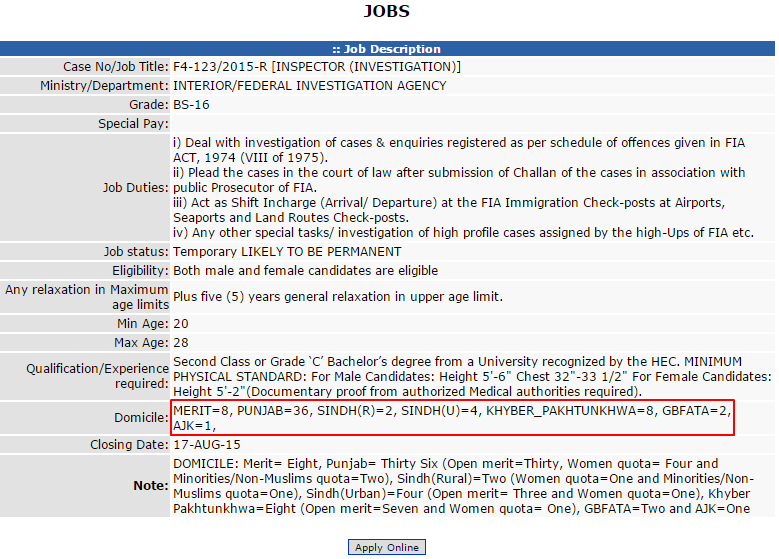
Balochistan has been completely ignored in the allocation of important vacancies such as Inspectors for Federal Investigation Agency (FIA).
Out of 61 vacancies of Inspector FIA, not a single one has been allocated for Balochistan. Even Azad Jammu and Kashmir and Gilgit-Baltistan have been given allocations but not Balochistan.
FIA
Screenshot of FIA jobs section of FPSC website
These inspectors, among other duties, can also act as shift In-charge at the FIA Immigration Check-points at Airports.
People of Balochistan have often complained about the treatment that they receive at Airport immigrations counters. Author is eyewitness to the discrimination that Shalwar-Kameezwearing Balochistan citizens face at FIA Immigration Check-points and Anti-Narcotics Force (ANF) check points at Airports.
“We face discrimination at Airport check points because the FIA and ANF personnel consider us aliens,” Haji Badr-ud-din a frequent international traveler told The Balochistan Point. He added, “FIA officers form Balochistan, if there are any, should be posted on Airport check points of Quetta and Karachi from where we normally travel.”
Despite repeated attempts by The Balochistan Point to make contact, Secretary FSPC was not available for a comment on quota rules violation for Balochistan.
Current vacancies announcement by FPSC is not first instance of violation of Balochistan Quota. On 27th July Quetta Electricity Supply Company (QESCO) a federally controlled entity, also violated Balochsitan’s job quota in 45 vacancies that it advertised.
Out of 47 vacancies of BPS-17, not a single one was allocated for Balochistan. QESCO was asked to stop recruitment process by Chief Secretary of Balochistan after he took notice of the protests from civil society of Balochistan against violation of quota rules.
“In my capacity as a member of different Senate standing committees, I have put up questions with PIA, HEC, CDA, OGDCL, SNGPL, SSGC and other departments and asked them to explain how they are fulfilling 6 percent quota of Balochistan,” Senator Jehanzeb Jamaldini told The Balochistan Point.
Senator Jamaldini further revealed that people of other provinces possessing fake domiciles of Balochistan take jobs on what’s left of Balochsitan’s quota. “DMG officers serving as Deputy Commissioners and Assistant Commissioners have issued domicile certificates to their relatives, in huge numbers, which are used to deprive people of Balochistan form their quota in jobs,” claimed Senator Jamaldini.
In a move which was severally criticized by people of Balochistan, Last year, Federal government declined to commence recruitment on 3,692 Federal jobs reserved for Balochistan.

Pakistan - #PTI in peril

The Pakistan Tehreek-e-Insaf, formed on the slogan of creating a ‘Naya Pakistan’, seems to have instead found itself in a heap of trouble with new layers added to it almost each passing day. The latest crisis has erupted following the unfavourable verdict of the Judicial Commission on its election rigging charges, with senior lawyer Hamid Khan, a stalwart of the party who had played a major role in setting it on its feet, attacking PTI Secretary General Jehangir Tareen for taking the wrong steps while leading the talks on setting the TORs for the JC. In an interview, Hamid Khan has pointed out that the PTI had plenty of legal experts, but Tareen was not among them and his actions in insisting on dealing with the JC had in fact badly messed things up for the party. It is for party chief Imran Khan to find a way out of this mess, with the internal rifts within the PTI growing wider by the day. He does not appear to be doing a very effective job and at a convention in Islamabad on Sunday openly backed Tareen, who was reappointed the secretary general of the party a few weeks ago after being removed from that position, as a man of solid standing and a good tax payer. These qualities do not mean Tareen is a good political leader, and certainly within the PTI his growing power has created animosity with those who see themselves as the founders of a party set up to bring change. Tareen, on the other hand, belongs to a more established set of politicians and the two groups now march to different tunes.

The problems within the PTI have been growing for some time. Justice (r) Wajihuddin Ahmed criticised internal polling within the PTI in a verdict that was rejected by Imran Khan. This does not seem to be a particularly democratic way to run a party. Others who were fundamental to the creation of a political group that many had hoped would usher in real change have also now distanced themselves from the PTI. They include Fauzia Kasuri, who has made no bones about her displeasure with the manner in which she has been treated. Whether justified or not, this level of displeasure suggests a leadership problem within the party. This is not good news for anyone. The PTI, many had hoped, would bring new life to politics in the country. The induction of new people into politics and the burst of interest created within this group by the PTI were hugely significant. A class of educated persons who had in the past kept themselves away from the murky politics of their homeland was drawn in to the political battlefield and all its intricacies. But now, after the JC verdict which has left the PTI badly weakened, it seems all this could be squandered and that would be a huge pity for politics in the country as well as for the PTI itself.

Pakistan - Imran Khan may disagree with this


By Dr Fawad Kaiser  

Political parties want leaders who can help them grow politically and have the influence to advance their status over time. They are leaders who know how to organically manage within the corrupt culture.

PTI supporters and workers are growing noticeably more frustrated with their leaders. The Judicial Commission (JC), tasked with probing allegations of rigging in the 2013 elections, has declared that the polls in question were organised and conducted fairly in accordance with the law. Supporters wanted Imran Khan to achieve a judicial victory and allegations converted into verdicts according to their concerns. The PTI was to provide clarity of purpose and performance expectations, and to chart a roadmap for the future. PTI party followers expected leadership from their leaders but, instead, many supporters are finding themselves being led by decisions that lack focus and vision, mismanaged resources and getting caught up in the politics of blame and shame. Leaders need to step up their game and begin to provide the required strategic support and direction to keep their supporters motivated and their teams inspired.

Leadership is not for everyone; this quickly becomes evident when leaders make bad decisions. Unfortunately, the PTI, like many other political parties, promoted people into leadership positions where they did not really belong, for the wrong political reasons. Whether Imran disagrees with this or not, the common people on the street can sense this. They know when someone is not ready for leadership responsibilities and increased levels of accountability. Supporters are aware of those who assume the role of party nominated watchdogs to ensure that the political culture that is being dictated from the top is being adhered to versus the presence of opportunist leaders with no real agenda to help the masses.

Political workers are inspired when their leaders are empowered to make good, thoughtful and smart decisions, and they respect leaders who take calculated risks, not those merely serving as another layer of wrong politics at the behest of assumptions that stunt reputation and credibility. Furthermore, when leaders make bad decisions, their political workers and supporters begin to lose confidence in them and trust decreases, especially when their poor decision making patterns do not change. Imran Khan has now so many times announced and then retracted his political decisions that he does not appear very different from other politicians, but then his ‘U-turns’ do not help in him gaining enough trust to serve in the role of a leader one can consistently rely upon. Imran Khan has now spent enough time observing what the more stereotyped political leaders do; it would have been best for him to have remained different instead of mimicking their ways and style. Following the JC verdict he did not appear to be a natural leader and missed the opportunity of establishing his own identity and leadership credibility.

Imran is a political Genghis Khan and, of course, this has made everyone on the team uncertain about how to approach him, making the lines of communication disjointed. As a result, he has begun to make bad decisions, some senior PTI party leaders have lost confidence in his ability to lead and the top talent has become divided along the way. Needless to say, performance has declined rapidly and the team has become uninspired. Intra-party elections and audit reports have begun to question the senior management because of its decision to support policies that brought the party down. Imran Khan has reluctantly agreed to these but has never sutured relationships with the people that matter the most.

Power inside the party prevents Khan from listening to direct reports from the frontlines that would help him make better decisions and be more successful for the long term. This person-focused leadership by Imran’s incumbents leads to unsatisfying political agendas and fails the building of internal networks that did not matter in the performance of the cricket team he was responsible to lead. However, Imran has to remember that his long cherished captaincy tenure embodied 10 players whereas now millions of people may be at risk of one wrong decision and poor leadership.

Political parties want leaders who can help them grow politically and have the influence to advance their status over time. They are leaders who know how to organically manage within the corrupt culture, maximise resources, motivate, inspire and, most importantly make good, sound decisions. Imran always talks about how important experience is. He overstates his cricketing experience because it does not exactly fit the situation he is in now. He is guilty of relying on it in a way that is just not going to be that helpful. He tends to rely on past experience that seems useful but is actually sometimes dangerous. He is making bad decisions on complicated issues due to his rigidity and defiance. He does not need public penance for those hasty decisions but atonement does not hurt.

This explains why Imran is having a difficult time transferring his prior success to his new role as a political leader. Just because he has a track record of prior success does not mean that it will apply as well within this current political scenario. As such, he needs to be mindful of critical media appraisal, competence of his co-workers, resources and how to create momentum in this hostile and opportunistic political environment. He needs to know where the potholes are located and how leaders have been historically successful in the political system they are now serving.

Do we have a leader in Imran Khan who is politically motivated? Unfortunately, this is all too common and results in bad decision making, and a short-lived tenure. Political motivations make it difficult to make objective decisions and manage the core responsibilities at hand. Imran Khan has fallen victim to the political trap set at the expense of his rising popularity. He can lose his street power and get sucked into other people’s agendas and motives. Most of the time these motives do not align with his beliefs and, thus, over time he finds himself making poor decisions to keep a bad relationship alive, though at the time he believes it is a good decision to enhance a politically motivated result.

In a hurry to achieve power, leaders can get addicted to corrupt politics. They become blinded by the addiction and lose sight of their primary role and responsibilities as leader, in many cases unknowingly putting their own political reputation and party into quicksand, making it almost impossible to revive any positive momentum and trust from the supporters who depend upon them. When purpose becomes disrupted, you lose touch with your instincts and begin to make decisions without the right dependencies and resources you need to make sound decisions. Imran Khan may disagree with this but then it would not be the first time he did.