Tuesday, May 26, 2015

#Punjab - Law and order: ‘Shahbaz has nothing to show for 7 years in govt’


The Punjab Assembly was unable on Monday to conclude a debate on law and order after a discussion on recent incidents of violence in Lahore and Daska districts besides the report of a joint investigation team formed to probe killings of Pakistan Awami Tehrik workers in a public rally last year.
Opposition Leader Mahmood Rasheed’s resolution demanding an inquiry into the Daska Bar Association president’s killing was passed unanimously. The house also offered prayers for the deceased. Earlier, the opposition leader staged a token walkout to register protest against ‘police handedness’.
Referring to recent unrest in a Christian neighbourhood of Lahore, Shehzad Munshi speaking on a point of order lamented that yet again an entire community had been targeted following allegations of blasphemy that involved a certain individual.
He said blasphemy was a serious matter and it was condemned by Christians and Muslims alike. He said out of fear for their lives several Christian households had reportedly left the neighbourhood in Sanda. Human Rights and Minorities Affairs Minister Khalil Tahir Sindhu told the House that the chief minister had taken notice of the incident and ordered an inquiry.  Home Minister Shuja Khanazada promised that investigation would be held on merit. He also asked the House to assist the government in promoting interfaith harmony in the society.
The House managed to pass just one of the three bills scheduled for the day as opposition insisted on a debate on law and order. The Fatima Jinnah Medical University Lahore Bill of 2015 was passed after the opposition withdrew all amendments it had earlier proposed to the draft. The amendments were withdrawn on the condition that the deputy speaker would postpone discussion on the University of Jhang Bill of 2015 and the University of Sahiwal Bill of 2015 and let the House proceed with debate on law and order. Treasury member Dr Farzana Nazir, who had also proposed an amendment to the bill draft, broke into tears as her protests were ignored by the deputy speaker. She later walked up to the law minister and registered her disapproval of the act.
During the law and order debate, Rasheed criticised the government saying that the JIT report on Model Town riots had not absolved it of its responsibility to bring to justice those responsible for the killings.
He said the government had failed to improve law and order in the province. “It has been seven years now that Shahbaz Sharif is the chief minister of the province. He has yet to do anything about law and order,” he said. “We demand that the inspector general of the police be given a free hand to rid the police of political influence,” he said.
As the House failed to conclude the debate, the deputy speaker prorogued the session for an indefinite period and asked the home minister to give his concluding speech at the next session. Ehsan Riaz Fatyana and Sardar Vickas Hasan Mokal had insisted that the debate be concluded on Monday.
Earlier, Mian Aslam Iqbal alleged that Rs26 million had been allocated in the upcoming budget for installation of closed circuit television (CCTV) cameras and Rs40 million for flood-lights at the Jaati Umrah residence of Prime Minister Nawaz Sharif.  He claimed that he had received a message from a source in Youhannabad that the chief minister was responsible for the recent riots in the area.
During the debate, the deputy speaker and Sardar Ali Raza Dreshak over allegations against the Gorchani family. It ended after the deputy speaker directed the home minister to investigate the allegations.
Four bills, the Provincial Motor Vehicles (second amendment) Bill of 2015, the Punjab Motor Vehicle Transaction Licensees Bill of 2015, the Punjab Commission on the Status of Women (amendment) Bill of 2015 and the Punjab Protection of Women against Violence Bill of 2015 were introduced in the House and were referred to the standing committees concerned.

Pakistan - Weapons of mass instruction


Federal Minister for Information left many a religious elements flabbergasted with his May 3 comments on Madrassas. Never has any politician spoken so clearly on this purportedly ‘sensitive’ issue against the religious extremists promoting organized hatred, ignorance and culture of ‘unlearned hordes’ in Pakistan.
The Minister’s pluck caused him public criticism by the religious ‘scholars’, decrees of excommunication from Islam and of blasphemy, accusations of being Ahmadi (yes, being Ahmadi is that bad!), public expressions of hatred through prominently placed banners etc., and a notice to explain himself to the Senate. No wonder he had to pronounce on May 24 that madrassas had no link with terrorism and militancy. On both instances the Minister used generalizations. The first one was met with strong criticism (even from his own party members), but the latter was accepted by all and sundry without even a proviso. Everyone lives happily ever since.
Just when the madrassa elite was harassing Pervez Rasheed and his own party leaders and ministers had left him alone to deal with it, Islamabad Police was hunting the people who were putting up highly inflammatory banners and posters full of hatred and incitement to violence against Pervez Rasheed. Thanks to the Interior Minister, the police quite strongly followed the case. There were few who were arrested. A few others posed resistance to the police party, who then chased them to a madrassa in F-6/4. That’s where even the Police – the key civilian law enforcing machinery – thought their jurisdiction ended. The culprits are still at large, in the protection of that madrassa.
Cases have been registered in two police stations of Islamabad, Thana Aabpara and Thana Shalimar under Sections 500 and 501 of the Pakistan Penal Code that deal with defamation, printing of defamatory material and statements conducing to public mischief. As per the media reports, it was the Islamabad chapter of Jamiat Ahl-e-Sunnat Wal Jamaat (JASWJ) that had put up the banners. When the media contacted ASWJ, the banned organization that is so far operating openly with impunity, and asked about its links to JASWJ, the former denied any kind of ties. There might not be any possible way to prove the links even if they exist. Even if proven, there is nothing that the state would choose to do.
There is no one in the government that could do anything about it. Mainly because no institution of the state is ready to trust the Prime Minister or the Chief of Army Staff who have repeatedly said in different statements post Peshawar School Attack that they are absolutely serious about crushing all kinds of terrorism and that there were no more any good or bad terrorists. Every institution wants to pass the buck to the other for one simple reason. There have been certain institutions that have created and nurtured these monsters. Why would the weaker civilian institutions like Police, trust the creators? If A has created the problem, why is B expected to clean the mess with little muscle and almost non-existent power to deal with the possible blowback?
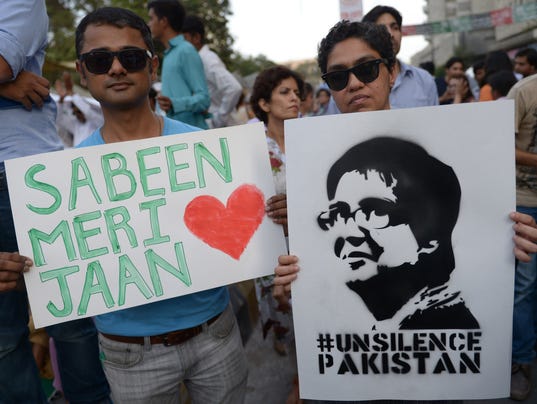
Pakistan Rangers (Sindh), a paramilitary force, has been conducting a ‘Targeted Operation’ in Karachi since a few months. Despite this, high profile targeted killings as well as brutal terrorist attacks are still happening (the Sabeen Mehmud murder and Safoora Bus Attack are cases in point). Not only that, the way a banned organization like ASWJ is openly functioning under plain sight of the ‘Targeted Operators’ not only in Karachi but in rest of the country as well is appalling. If ASWJ would not be covered by the operation, the Federal Interior Ministry would be justified to choose the status quo in Islamabad viz a viz ASWJ operations. No wonder we are witnessing ASWJ rallies everywhere including Islamabad and Quetta recently.
This inaction, indecisiveness and wooliness around the militancy issue have been fairly old phenomenon in the Islamic Republic. It has mainly emanated from our policy of using our strategic location for rent seeking from world powers, positioning ourselves in geopolitics of the region in certain way and defining our national interest with the lens of state power rather than people’s development. Started in early 1970s – as opposed to just the Afghan Jihad in the 1980s as is perceived popularly – this policy has damaged us in more ways than we can fathom.
Gone are the days when madrassas were the only breeding grounds for extremism. Today, they remain a fountainhead of religious violent extremism, but the roots have spread in practically every societal institution. The state made a symbiotic partnership with political entities like Jamaat e Islami etc. This strategy did a great deal in popularizing certain narrative that proved to be the precursor of militant Jihadism. It had many strands like anti-West, anti-everything-non-Pakistan-and-non-Muslim, etc. With the passage of time these strands kept increasing in number. Anti-politician, anti-liberal forces, against anti-establishment resistance forces, so on and so forth.
All these strands, although emanating from the madrassas initially, were successfully brought to the popular consciousness through infiltration in academia, intelligentsia, students unions, workers’ unions, media, civil and military bureaucracy, industrialist and agricultural elite, politicians, what not. It was mainly the media, the academia, the intelligentsia and the students unions through which a lot of literature was produced and a strong popular narrative was built around all these strands of radicalism.
For example, be it Malala Yousafzai or Mukhtaran Mai, be it non-Muslim victims of the misuse of Blasphemy Laws or forced conversions of Hindu and Christian girls, be it the issue of good versus bad Taliban or Indo-Pak peace, be it civil military relations or ties with the Western countries especially USA, you would see a strong radical narrative about each of these. Any dissenting voice would be humiliated, discredited and vilified, mostly, by or with patronage of military establishment. On each of these issues, the usual proxies of the establishment would speak in symphony against the dissenters.
The practice of killing the dissent through libel and slander, supported and encouraged by the state institutions has brought public mental health to a point where any dissent or resistance or even a slightest non-conformity is considered to be treason, anti-Pakistanism or anti-Islamism. Public aggression is incited against dissenters using social media and talking heads on the TV. That has been happening quite aggressively after Peshawar School Attack, which has a strong bearing on why nothing could be done on National Action Plan.
This is also one reason why a Federal Minister was left alone to deal with the rage of madrassa elite amidst fatwas to declare him Ahmadi and murtad. This is one reason why no political government can ever take action against militancy-linked madrassas or proscribed organisations. This is one reason amongst many contributing factors why Saad Aziz was produced. This is also one reason why we will keep producing more Saads.

Pakistan - The Fate Of Abductees - Gillani & Taseer

On Sunday, former Prime Minister, Syed Yousuf Raza Gillani received a phone call from his son, Ali Haider Gillani, who has been in the custody of the Taliban since May 9, 2013. In the brief conversation, Haider assured his father of his safety, while his captors reiterated their demand for the release of several Al-Qaeda militants held in Pakistani prisons. This new development in the kidnapping saga brings into focus the plight of several other high profile abductees – such as Shahbaz Taseer, son of the slain Salman Taseer – which had slipped from the public limelight in recent months. Also surfaces the difficult question of the correct government’s policy towards negotiating with militants, which up till now has been unarticulated and ad-hoc. Should the government cater to the demands of the militants to secure the release of high-profile abductees, even if it entails inadvertently furthering the cause of the said militants?
The instinctive – and sentimental – answer is yes. It is the state’s job to protect its citizens at all cost, and wilfully rejecting the option of doing so would surely elicit a strong backlash from the public; especially the family members of the victims. Apart from this normative burden, there are several policy points, which favour such an answer. A government official or a politician whose family member has been kidnapped by militants is liable to manipulation – having a key official crippled by sentiment is damaging to the government’s efforts. Furthermore, the failure to recover high profile abductees not only damages the perception of state control – already crucially weakened in the tribal regions – and forces politicians to stay away from controversial issues and hard-line stances out of fear for their relatives. The Taliban have increasingly shown their willingness to target children of senior politicians and government officials, with the son of President Mamnoon Hussain being the latest. The state needs to counter this fear to give its officials the freedom to take bold steps.
Yet these arguments apply equally to clandestine rescue operations and ransom negotiations; and while the government has employed a flexible policy in this area, the uncertainty is also damaging. Haider Gillani can be freed if the demands of the captors are met; yet is the life of one person worth the release of several hardcore militants – which will inevitable contribute to more death and destruction? This seemingly heartless question becomes more pressing when we consider that the government would never negotiate such a transfer for a common soldier or civilian. The prisoner release not only helps the militants, it reassures them that kidnapping is a lucrative trade, prompting them to go for even bigger marks. A ‘no negotiation’ policy - like the one employed by the U.S – at least makes kidnapping redundant; albeit at the cost of a few lives. Whatever policy the Pakistan government employs, it must keep both sides in mind.

#PPPstandsWithLawyers - Asif Ali Zardari condemns violence against lawyers in Daska, says PPP will stand by the lawyers

https://ppppunjab.wordpress.com/


Former President and Co Chairman PPP Asif Ali Zardari has strongly condemned the use of brutal force against lawyers in Daska today resulting in the death of two lawyers terming it as reprehensive and unacceptable”.
Condemning the incident the former President also called for a thorough, expeditious and transparent investigation into the incident, fixation of responsibility and bringing to book those responsible for transgression of authority and the trigger happy response of law enforcing agencies.

It is most unfortunate that lawyers who protect citizens from violence and brute force should themselves be subjected to violence and brute force, he said.
The PPP Co-Chair said that the PPP will stand by the lawyers’ community in this hour. Spokesperson senator Farhatullah Babar said that former president also directed the Party to extend all support to the lawyers in their peaceful protest against the incident.
Praying for those those who lost their lives the former President also expressed his deepest condolences to the bereaved families, he said

#PPPstandsWithLawyers: PPP expresses solidarity with the lawyers community‏

https://ppppunjab.wordpress.com/


Mian Manzoor Ahmed Wattoo, President Punjab PPP, accompanied by the local leaders and workers of PPP went to the Lahore Press Club to express solidarity with the lawyers’ community who were protesting the murder of Rana Khalid Abbas, Deska Bar President, and a lawyer by police firing.
He demanded that the government should immediately apprehend the culprits and award them exemplary punishment for the heinous crime of murdering two lawyers.
He pointed out that if the culprits of Model Town incident had been punished the abhorrent incident of Daska might have not occurred in the first place. The Punjab Government and the police consider itself above law and therefore flouting it with impunity without fear of legal consequences, he maintained.
He observed that the law and order situation in the province was deteriorating day by day and the life and property of people were not safe. They are suffering from the acute sense of insecurity and more frustrating is that they have lost hope of betterment in the state of affairs, he added.
He paid rich tributes to the lawyers’ community that had played historic role for the supremacy of the constitution, independence of judiciary and the restoration of democracy in the country. PPP and its leadership hold the community in the highest esteem, he added.
Earlier, Samina Khalid Gurkhi, President Lahore PPP, described the abhorrent incident as the worst type of provincial government’s terrorism adding the culprits must be brought to book at the earliest.
Those who were present included Tanvir Ashraf Kaira, Naveed Chaudhry, Suhail Milk, Dewan Mohyuddin, Khurram Jehangir Wattoo, Raja Amir, Advocte Supreme Court, Rana Gul Nasir, Jehan Ara Wattoo.

Egypt protests Pakistan criticism of Mursi death sentence

Egypt summoned Pakistan’s charge d’affaires to protest at Islamabad’s criticism of the death sentence handed down to ousted Islamist president Mohamed Mursi, the foreign ministry said on Tuesday.
Egypt denounces any “interference in its internal affairs which casts a shadow on relations between the two countries,” the ministry said in a statement a day after summoning Mohamed Eijaz.
Mursi, Egypt’s first freely elected president, and more than 100 other defendants were sentenced to death by a court on May 16 for their role in a mass prison break during the 2011 uprising.
The sentence was criticized by human rights groups, the United States and the European Union, as well as Pakistan.
“The dispensation of justice must be based on the principles of equity and fairness,” Pakistan’s foreign ministry said in a statement issued on May 19.
“This is all the more important when political prisoners especially a former elected president, who was ousted from office, is brought before the court of law.”
Mursi was ousted by then-army chief and now President Abdel Fattah al-Sisi in July 2013 after mass street protests against his one-year rule.
A government crackdown overseen by Sisi has left hundreds of Mursi supporters dead, thousands imprisoned and dozens sentenced to death after speedy trials, described by the United Nations as “unprecedented in recent history”.
Mursi has also been sentenced to 20 years in jail in a separate trial.

Why Pakistan is friends with everyone – and no one

By Paula Newberg

Pakistan’s diplomacy has become a high-wire act.
Though Islamabad hasn’t yet ended the domestic terror that rips through its schools, mosques and markets, or sorted out its hostilities with neighboring India, it has embarked on a complicated foreign policy. Seeking to solve its many economic, political and security problems, Pakistan is trying, concurrently, to court four rich and powerful patrons: China, Saudi Arabia, Iran and the United States.
This is a tough task because these governments’ relations with one another have global politics tied in knots. Islamabad’s efforts to juggle their competing demands are quixotic enough. Trying to make them all work in Pakistan’s favor is ambitious — and could easily backfire.
Pakistan has sought foreign protection and financing since its independence almost 70 years ago. It joined Western alliances in the 1950s. Pakistan let the United States use it as a foothold in south, southwest and central Asia throughout the Cold War, the Afghan wars, Pakistan’s wars with India, Washington’s opening to China, the rise of terror politics and recent tilts toward Asia.
Both Washington and Islamabad gained, and both lost. Alliances are like that.
But Pakistan has long tied its domestic governance to its foreign-policy engagements. With its various military alliances, a security state flourished, which almost inevitably diminished its capacity to democratize. Islamabad today reflects its on-again, off-again dictatorships and intermittent elected governments: Though parliament liberalized the country’s constitution, it also sanctioned military courts to try civilian offenders accused of terrorism.
Pakistan’s recent foreign-policy forays thus offer mixed messages to its people and the world. For the first time in a long time, Pakistan is trying to align its diplomacy to its pressing domestic needs. It hopes to manage its external relationships — some toxic, some constructive — to buy time to sort out its own profound governance problems. It is a big gamble to try to balance its relationships with Saudi Arabia, Iran, China and the United States — and, of course, India and Afghanistan — in order to secure its economy and create desperately needed domestic stability.
Let’s start with Yemen. In April, Saudi Arabia asked Pakistan to contribute to its armed coalition to fight Houthi militia. Prime Minister Nawaz Sharif, no doubt out of habitual obeisance to a financially profitable (if ideologically complicated) relationship, initially agreed.
A boy holding a candle attends a candle light vigil in Kathmandu
A boy at a candle-light vigil on December 17, 2014, for the 132 students killed at the military-run Army Public School in Peshawar. REUTERS/Navesh Chitrakar
In a rare show of political independence, however, Pakistan’s parliament refused to sanction military participation. It argued that Yemen’s fight was not Pakistan’s, and that Saudi Arabia should no longer assume that Pakistan would do its bidding: Despite financial recompense, Saudi Arabia’s backing of the Taliban had proved terribly costly for Pakistan, in too many ways to count.
With an eye toward its own sectarian tensions — Pakistan’s substantial Shi’ite minority has been under vicious attack for years, as have other religious minorities — parliament explicitly refused to choose between Saudi Arabia and neighboring Iran in another regional proxy war. Islamabad’s offer to help mediate was politely ignored by all sides.
Islamabad’s unexpected demurral to Saudi Arabia’s request sets it on a different diplomatic course. It is cash-poor, investment hungry and desperate for energy. Though Saudi Arabia contributed $1.5 billion to Pakistan for foreign exchange and energy projects last year (a sum probably dwarfed by the Saudis’ underwriting to Pakistan’s treasury during the Afghan Taliban years), Pakistan is also betting on its future relationship with Iran, with which it shares a long and critical border with Afghanistan.
Pakistan desperately needs Iran’s natural gas and hopes a U.S.-Iran deal will pave the way for importing fuel. A prospective pipeline from Iran to Pakistan and China has been dubbed the “peace pipeline.” Islamabad also needs to secure its western border with Iran, and restive Afghanistan to balance its restive eastern border with India.
At the same time, Pakistan is shoring up its relationship with China — again, by trading energy for diplomatic support. Beijing recently completed the construction of a major port at Gwadar, on Pakistan’s Arabian Sea coast, and has signed a deal to manage it for 40 years.
Ten days after refusing engagement in Yemen, Pakistan hosted Chinese President Xi Jinping to establish a China-Pakistan Economic Corridor that will run from the new port to Kashgar in Xinjiang province. The infusion of almost $50 billion is billed as a boon to Pakistan. In return, Islamabad has promised military protection for the Chinese construction workers. Meanwhile, China’s government and companies will no doubt make considerable profits.
China’s Asia-wide ambitions are becoming ever clearer. Indian Prime Minister Narendra Modi visited Xi last week to secure an evolving security partnership. While China cannot assume that its own diplomacy will lessen tensions between Pakistan and India, it is clear that money — and energy — talks across all populous, poverty-ridden south Asia. Pakistan’s benefits are derivative and echo a kind of colonialism: The country is essentially leasing itself to a foreign benefactor because it is too poor and inadequately governed to develop its own resources.
This potential cash boon leaves Pakistan with crucial domestic and foreign policy choices. The Chinese economic corridor’s route is already disputed in Pakistan:  Sharif’s preference is to skirt the restive provinces of Baluchistan and Khyber Pakhtunkhwa in favor of his home province of Punjab. This continues a pattern of unbalanced investment that has contributed to the country’s uneven development.
What looks like a financial investment in stability is perceived as a slap in the face to Baluch insurgents. They have spent decades fighting for a voice in national politics and, ironically, a share in energy resources that originate in their home province.
Islamabad’s response has been brutal. Baluch have been intimidated, jailed, disappeared and killed since the 1970s. Most observers believe that the price of doing business with China will be to stifle the Baluch, impose a faux peace and broadly limit civil liberties.
This cost is too high — and most likely unnecessary. Pakistan has yet to contend with two issues that have slowed its development since independence. First, its refusal to provide equal citizenship rights for all has led to persistently corrosive subnational and sectarian tensions. This has soured relations among its provinces, slowed economic decision-making and reinforced a self-defeating propensity to solve political problems with state-sanctioned violence.
No amount of money will fix these difficulties. But serious, public discussions to help correct the misdeeds of the past and, most important, to organize responsibility for the future can help to craft policies that address these deep political fissures.
Second, Pakistan’s economic choices — often convenient for the rich and always devastating for the poor — have left deep holes in its budgets, financing and investment. Its energy shortfalls result from years of waste, misuse, circular debt and bad investments that now leave parts of the country without electricity for 10 to 20 hours each day.
Building roads from Pakistan to China — with Chinese labor — will not fix the poverty and absence of rights at the heart of Pakistan’s economic crises. Only better politics — starting with respect for Pakistan’s largely unorganized labor force and protection of critical rights for the entire public — can begin to ensure that China’s cash can turn into an investment for all Pakistan.
The burden of reconciling these competing demands is now Islamabad’s. Its challenges are critical: not to let foreign engagements provide cover for domestic political decisions; not to mask the political fissures that have created resource crises, and not to mistake motion for progress.
Pakistan cannot afford to fall off its high wire. Diplomacy can’t fix its governance, but even some initial improvements will be a big step toward securing its diplomacy.

Who is killing Pakistan's educated elite?

Lawrence Pintak 

"We live in a kingdom of fear, fortified by religious extremism and intolerance," columnist Ghazi Salahiddin recently wrote in The News on Sunday, one of Pakistan's leading English-language newspapers.
Such hyperbole reinforces stereotypes about Pakistan. But sometimes, stereotypes contain more than a grain of truth.
This port city is Pakistan's business and media capital. It is also one of the most violent cities in the world. To give you some sense: a recent crime log in The Express Tribunenewspaper had a sub-section for "grenade attacks and encounters."
These are the kinds of "encounters" you don't want to have. They included the ambush of a convoy carrying the city's chief of counter-terrorism; the attempted assassination of another government official; nine other targeted killings; a grenade attack on a bus stop; and a shoot-out that killed four armed militants. And a man was burned alive by an angry crowd after he shot a policeman.
With America's impending withdrawal from Afghanistan, Pakistanis are shifting their focus from the U.S. military presence to their own internal problems, much of it fueled by regional geopolitics. At the top of the list: homegrown violence that continues to wrack the nation, epitomized by a massacre of 42 Ismaili Muslims in a Karachi bus attack this month.
Some of the violence involves crime gangs; some battles between political factions or, as in the case of the murders of the Ismailis, religious sects. But the motive behind a portion of the violence reaches beyond those boundaries.
And that's where things get complicated.
A wave of targeted assassinations in Karachi in recent weeks has shaken Pakistan's intelligentsia. Among those killed were a university professor, the owner of a bookshop that hosted frequent free speech events, and the marketing manager of one of the largest media groups. An American medical school administrator was also shot and wounded.
Among the educated elite, conversations inevitably include speculation about who was behind the killings. As columnist Saroop Ijaz wrote in The Express Tribune, "Public and private conversations in Pakistan have been reduced to obituaries."
Conspiracy theories abound; the more Machiavellian, the better. They can make your head spin.
A dominant line of speculation involves the rebellious province of Baluchistan, where the military has used brutal tactics to put down an insurgency.
China is building a major port there, which threatens the efficacy of rival ports in Iran,India and the Arabian Gulf, and gives the Chinese Navy a base less than 200 miles from the strategic Straits of Hormuz — not something that's attractive to U.S. military strategists. All of those governments are alleged to be stirring the pot.
The bookstore owner, Sabeen Mahmud, had hosted a controversial talk on Baluchi human rights just hours before her assassination. Many liberal activists immediately pointed fingers toward the military's notorious Inter-Services Intelligence (ISI) arm, frequently blamed for attacks on, and threats against, activists and journalists treading where they should not.
Others say it was the Baluch rebels trying to make it look like the military was responsible. The ISI's commanders, these people say, are too smart to kill someone in a way that so obviously points back to them.
"There are 10 ways to intimidate without killing," Azhar Abbas, the top news executive at the new Bol television channel, says, arguing that it would be counterproductive for the military to stage such a high-profile assassination. "By this murder," the Baluchi issue "got more publicity than from the talk itself."
Former television host and liberal activist Qatrina Hosain sees the situation differently. "Would the ISI be stupid enough to do this right after the talk? Yes, because it's blatant and aggressive. The message has gone out loud and clear to the (activist) community."
Shema Kermani, a liberal activist who was a close friend of the murdered bookstore owner, rejects both the ISI and Baluch connections. She blames the Pakistani Talibanand its militant allies: "These are the stakeholders who want to keep Pakistan very, very conservative, very right wing and move it towards a Saudi Arabian system."
Islamist militants. Sectarian rivalries. Gangs associated with the political party that controls Karachi. A "foreign hand." Unnamed "dark forces." They've all been blamed in the wave of killings.
And that is precisely the point: the politics of fear.
"If you don't know who your enemy is…" said Qatrina Hosain, her voice trailing off. "There are very few of us (in the activist community). We can all be picked off one by one."
Emblematic of the swirling mysteries is the assassination of Waheed ur Rehman, aUniversity of Karachi professor, who was sprayed with bullets by gunmen on motorcycles in late April. Police now say the killing was "blind murder" — in other words, they've given up looking for a culprit, which has not satisfied many of his colleagues. Some believe the murder is linked to the fact that he was a friend of the liberal dean of Islamic Studies at the same university, who was assassinated a few weeks before Rehman's own murder. The dean had been accused of blasphemy.
Others blame Rehman's death on internecine conflict between the Muttahida Qaumi Movement (MQM), a political party that dominates Karachi and maintains its own armed wing, and Jamaat-i-Islami (Islamic Society), an Islamist group that controls the mass communication department at the University of Karachi, where Rehman was a professor. Still others accuse another militant group called Jundallah (Party of God) for Rehman's death. Jundallah has its roots in the Baluch conflict, which brings us right back to that restive province and regional power politics.
Pakistani authorities last week arrested four "terrorists" it claimed were involved in both the bus attack and Sabeen Mahmud's murder — one of whom was a graduate of the University of Karachi — raising the possibility of a connection to the Rehman killing as well, but they did not say with which faction they were allied.
Meanwhile, the shooting of the marketing director at the Dawn newspaper group, found dead in his car, and the American educator, wounded as she was walking home, remain mysteries. That contributes to the sense of fear, even among those who are not overtly political or working in the media.
"People in our community are very concerned, and they should be," says Seeminaghmana Tahir, a professor at the Federal Urdu University.
Adds one of her colleagues, "The low level of anxiety we all feel has kicked up a notch. We all think we're going to be next."

Pashto Music - Sardar Ali Takkar دَ ګلاب رَب POETRY GHANI KHAN

Monday, May 25, 2015

Music Video - Madonna - Papa Don't Preach

Music Video - David Guetta - Hey Mama

Music Video - Trey Songz - Slow Motion

Video Report - Brides for Sale: Sham Marriages Rise in Europe

Video - Bill Clinton on David Letterman - 5/12/2015

Video - Tips for the Perfect Summer BBQ

Video report - Michelle Obama to graduates - "Go out there and make it happen"

Video Report - Mysterious sinkholes spreading across Russia's Urals

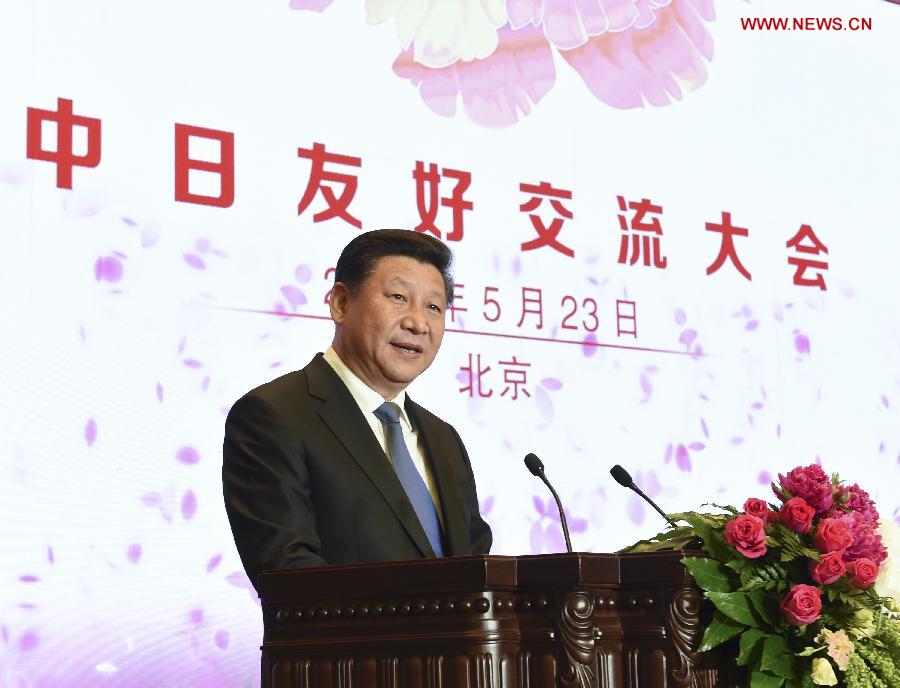
Warming and warning: Xi's speech on China-Japan ties in foreign eyes


Chinese President Xi Jinping's recent reception of and address to a large Japanese delegation has generated a ringing resonance in Japan and beyond.
The Saturday event, in which Xi met more than 3,000 Japanese visitors at the Great Hall of the People in Beijing, was an indicator of warming China-Japan ties after three years of tension, noted Press Trust of India (PTI).
The Indian media outlet quoted the Chinese president saying that the root of China-Japanese friendship comes from the public and the future of the relationship is in the hands of the people.
Japanese daily Mainichi Shimbun described the visit by the delegation, led by Toshihiro Nikai, chairman of the Liberal Democratic Party's General Council, as a practical step to improve bilateral ties.
Together with Asahi Shimbun newspaper, Kyodo news agency and other heavyweights in the Japanese media circle, Mainichi Shimbun noted that Beijing attaches importance to bilateral people-to-people exchanges, particularly between the young generations of the two nations.
Xi's speech, Kyodo said, also signaled China's readiness to seek a broader thaw of relations with Japan.
On the other hand, Xi's remarks were also a warning against attempts to distort or whitewash Japan's history of aggression, noted Japanese and global media.
PTI quoted Xi as saying that this year marks the 70th anniversary of the end of World War II (WWII), and the nations that suffered Japan's barbarities seven decades ago will never accept words and actions by the Japanese side that distort history.
Japanese national broadcaster NHK noted that Xi's speech meant China's basic policies on developing relations with Japan remain unchanged.
Quoting Xi's remarks that the crimes committed by the Japanese militarists during WWII should never be covered up, Tokyo Shimbun said the statement indicated China's doubts about Japanese Prime Minister Shinzo Abe's stance on historical issues.
The address, said Kyodo news agency, also showed that Beijing is closely watching Abe's planned 70-anniversary statement.
Peace and friendly cooperation between China and Japan is the common will of the people, and the friendship between the two countries deserves to be cherished and protected, leading international news agency Agence France-Presse quoted Xi as saying.

RT Documentary - Indian nightmare: GMO killer-cotton

Turkish Music Video - Demet Akalın - Türkan

HRW urges EU to press Arab monarchies on activists

Human Rights Watch (HRW) has urged the European Union to publicly call for an “immediate and unconditional” release of political activists imprisoned by the Arab monarchies of the Persian Gulf countries.
The call was made in a letter sent to EU foreign affairs head Federica Mogherini ahead of Sunday’s [Persian] Gulf Cooperation Council-EU ministerial meeting in Doha, the capital city of Qatar.
The New York-based group said on Friday that “hundreds” of dissidents have been imprisoned across the sheikdoms of the Persian Gulf region “for nothing more than exercising their rights to free expression and association”.
The organization also noted that the human rights “situation continues to deteriorate” in certain countries, namely Saudi Arabia, the United Arab Emirates (UAE), and Bahrain.
The rights group called on the 28-member block to translate its commitment to human rights into concrete action. HRW also urged the EU to adopt a policy that could go beyond mere expressions of support for those unfairly imprisoned.
“Despite the EU’s oft-stated commitment to human rights, it hasn’t so much thrown its weight behind advocates of human rights in the Persian Gulf as nervously wagged its finger,” the rights group said.
The developments come as United Nations and rights organizations have frequently condemned the Saudi, UAE and Bahraini governments for clamping down on dissidents.
The Manama regime has been severely criticized by rights groups for its harsh crackdown on anti-government protesters, which has claimed the lives of scores of people so far.
Since mid-February 2011, thousands of pro-democracy protesters have held numerous demonstrations in the streets of Bahrain, calling for the Al Khalifa royal family to relinquish power.
On March 14, 2011, troops from Saudi Arabia and the United Arab Emirates invaded the country to assist the Bahraini government in its crackdown on peaceful protesters.
There have been numerous demonstrations in Saudi Arabia’s Eastern Province since February 2011, with protesters calling for the release of political prisoners and an end to discrimination against the Shia Muslims of Saudi Arabia.
http://en.shiapost.com/2015/05/24/hrw-urges-eu-to-press-arab-monarchies-on-activists/

Wahhabis Go Nuclear — Literally. Saudi Arabia’s Bomb?


The serious possibility of a nuclear deal between Iran and the P5+1 is only a few weeks away – on June 30.
So guess what the terminally paranoid House of Saud is up to: Lay their hands on a nuclear bomb to counteract the non-existent “Iranian bomb”, which Tehran, via Supreme Leader Ayatollah Khamenei, has consistently abhorred as un-Islamic, and wouldn’t have it anyway because of stringent inspections bound to be part of the final nuclear deal.
The proverbial “former Pentagon official” has leaked to a Rupert Murdoch paper that the House of Saud is bound to buy a ready-made nuclear bomb from Pakistan. The choice of media already offers a clue; Prince Alwaleed bin Talal is one of News Corporation’s leading shareholders.
The “why now?” concerning the leak is pretty obvious. Yet the whodunit is hazier territory.
Meanwhile, adding fuel to the jihadi fire, as the Wahhabis in Riyadh dream of going — literally — nuclear their faith brothers across “Syraq” are going figuratively nuclear, adding victory after victory on the ground; from the assault on Palmyra, the Silk Road-era jewel of the desert in Syria, to the fall of Ramadi in the former “triangle of death” in Iraq.
The “Iranian bomb” was never really an issue for successive U.S. administrations; only a convenient pretext to box in, harass, sanction and “isolate” the Islamic Republic, the former “gendarme” of the Gulf in the Shah era. The U.S. government always knew nuclear bombs can be bought on the black market; so whether Tehran could develop a nuclear weapon was irrelevant.
The House of Saud, for its part, may — and the operative concept is “may” — already have a bomb, for a long time now, to offset Israel. And they “may” have paid Islamabad for it. There is no conclusive proof.
What’s certain is that the — non-existent — “Iranian bomb” is where the House of Saud, other GCC minions and, crucially, Bibi Netanyahu’s extremist, fundamentalist Israeli government converge; they all consider it an “existential threat” to their survival.
The problem is we can’t just dismiss outbursts of the type as mere instances of geopolitical surrealism. A running myth — very popular in the Beltway — goes that Riyadh’s got some credit with Islamabad as the House of Saud invested billions of dollars in the 1970s to develop the Pakistani nuclear program, which was a counterpunch against the Indian nuclear program.
Already on December 2011, the House of Saud announced publicly that it was pursuing a nuclear bomb. But only as the possibility of an Iranian nuclear deal advanced they started to embark in a wag the dog attempt to control U.S. foreign policy.
Israel got into the game as early as November 2013, when the BBC reported on an alleged nuclear deal between Riyadh and Islamabad. A key quote was from a former head of Israeli military intel, Amos Yadlin; if Iran had a bomb, “the Saudis will not wait one month. They already paid for the bomb, they will go to Pakistan and bring what they need to bring.”
Compare this with wily Prince Turki, former Saudi intelligence chief and close pal of one Osama bin Laden, who has always waved the possibility of a nuclear House of Saud. The last time was in fact in April, at the South Korean Asan Plenum; “Whatever the Iranians have, we will have, too.”
The new Godfather of the Riyadh mob, King Salman, wanted Islamabad to provide troops for his ongoing war on Yemen. Islamabad said thanks but no, thanks. Instead, a nuclear deal might – and the operative word, once again, is “might” — have been struck. Naturally no high-ranking official in Riyadh or Islamabad will confirm any of this.
Watch the Pakistani angle 
King Salman is pretty much aware that in the event of ISIS/ISIL/Daesh achieving regime change in Syria – still a pretty remote possibility – the next in line would be the House of Saud.
And then there’s the fact of Washington keeping those infamous 28 redacted pages of the 9/11 secret under wraps after all these years. So possessing a nuclear bomb might be as much an insurance policy against Washington as against the non-existent “Iranian bomb.”
Beyond propaganda, the fact remains that several Masters of the Universe VIPs are positively fed up with the House of Saud on a number of key issues, most of all the Saudi oil price war decimating the U.S. shale oil industry.
Still, the House of Saud would never be allowed to go — literally — nuclear — without a green light from Washington.
The view from Pakistan helps to clear the haze. Pakistani nuclear project chief A.Q. Khan — with some support or at least acquiescence by Islamabad — did sell nuclear weapons technology to North Korea, Iran and Libya. Yet the whole Pakistani nuclear program cost less than $450 million. Scores of Pakistani analysts stress it was that cheap because Islamabad received help from China, not the House of Saud.
Both Iran and Saudi Arabia are key Chinese energy suppliers. Both Iran and Pakistan will be key players in the emerging, Chinese-led New Silk Road(s) project. Islamabad would be extremely foolish to jeopardize its relationship with Beijing by providing a nuclear weapon which would be used to threaten a non-nuclear neighbor — Iran — that not only is a Chinese strategic ally but will play a key role into easing Pakistan’s energy problems, via the Iran-Pakistan (IP) pipeline, partly financed by — who else — Beijing.
Watch the Battle of Ramadi – remixed
Wahhabism as practiced in beheading-friendly Saudi Arabia is and will continue to be the ideological matrix of all forms of Salafi-jihadism let loose in the Middle East and beyond. That especially applies to its latest social media-friendly spectacular, ISIS/ISIL/Daesh.
ISIS/ISIL/Daesh – to the “civilized world” consternation – has seized Ancient Silk Road pearl Palymra. UNESCO is “concerned.” The White House is “worried.” Palmyra is a strategic crossroads in the center of Syria which will allows the fake Caliphate to launch attacks in all directions and harass the Syrian government’s vital axis, from Damascus to Aleppo. They have already taken over the crucial Syria-Iraq border control point of al-Walid, in Syrian territory.
Moreover, over a third of Palmyra’s 200,000 residents have already been turned into refugees. Hundreds have been made hostages. The macabre beheading show is on. Is the Empire of Chaos — which, in thesis, is at war with the fake Caliphate — doing anything to save Palmyra’s priceless Roman ruins from possible, imminent destruction by Wahhabi-drenched barbarians? Of course not.
And the same applies to Ramadi, capital of Anbar province, roughly 110 km west of Bahgdad, which the U.S. did not “lose” because it never had. While ISIS/ISIL/Daesh gloated about their victory with megaphones at all the major mosques, the Pentagon was spinning this “is a fluid and contested battlefield”, and insisted on “supporting (the Iraqis) with air power.”
Cue to gleaming Toyota convoys of Caliphate goons laughing their Kalashnikovs off while they make their mark on the “fluid and contested battlefield.” The Pentagon may “support” anything they want with “air power,” but bombing won’t disrupt the fluidity. The Pentagon has run out of targets. ISIS/ISIL/Daesh are not sitting ducks; they are an asymmetrical guerrilla very apt at redeploying in a flash.
ISIS/ISIL/Daesh invested in a lot of strategic planning to take Ramadi. The symbolism is far-reaching; a major defeat not only for Baghdad but also for the “leading from behind” Empire of Chaos, even though a clueless Barack Obama insists “we are not losing” the fight against the Caliphate.
Iraqi Prime Minister Haydar al-Abadi is finally starting to get the picture. He met with leaders of key Shi’ite militias — who will have to do the heavy lifting crossing the Euphrates and trying to retake Ramadi before the Caliphate goons decide to advance towards holy Karbala, which holds the tomb of Imam Hussein, the martyred grandson of Prophet Muhammad. It’s a race against time because ISIS/ISIL/Daesh may also try to control nearby Iraqi military bases and weapons depots.
As for Sunni tribal sheikhs around Ramadi willing to fight the Caliphate, they were — and remain — fuming because they never received promised weaponry from Baghdad. Besides, no one knows why the Iraqi Army on site did not get air support; helicopter gunships would have turned scores of Caliphate goons into minced meat.
Al-Abadi finally acted by removing his early ban for the Shi’ite militias to operate in hardcore Sunni Anbar province; they did that in the first place obeying a command by revered Ayatollah Sistani.
Meanwhile, the head of the Badr Corps and overall commander of the Shi’ite militas, Hadi al-Ameri, is sure that taking back Ramadi is easier than campaigning north of Baghdad in Salahuddin province — where the militias, alongside the Iraqi Army, recaptured Tikrit and Beiji from ISIS/ISIL/Daesh. In both cases, Empire of Chaos bombing played a minimal role.
Al-Abadi also met with Iranian defense minister, Brig. Gen. Husain Dehqan, in Baghdad; he stressed both Iran and Iraq are fighting (Sunni) terrorist extremism; and crucially, he said, “we do not support the war on Yemen,” which puts Baghdad in direct conflict with Riyadh.
It gets even better; al-Abadi has gone to Moscow, where he hopes to get plenty of support — and weapons. After all, ISIS/ISIL/Daesh is crammed with Chechens. Moscow wants the Caliphate smashed; as it thrives, there is a direct threat of a jihadi renewal in Chechnya.
So now the stage is set for the Battle of Ramadi — remixed; Shi’ite militias plus Sunni tribals, the odd American adviser, and discreet help from Iran and Russia, against Caliphate goons, many of them mercenaries, lavishly supported by assorted wealthy Wahhabis in Saudi Arabia and across the Gulf. As far as the Empire of Chaos goes, Divide and Rule remains the sweetest game in town.