Thursday, April 9, 2015

Violence against women in Pakistan often met with 'state inaction'

By Gabriel Domínguez

Eight years into Pakistan's democratic transition, violence against women is still endemic, a new ICG report found. The group's Samina Ahmed talks about why biased attitudes towards women lie at the heart of the problem.
Released on April 8, the report by the International Crisis Group (ICG) says that discriminatory laws and a dysfunctional criminal justice system have put women in the South Asian nation at grave risk.
The paper, titled "Women, Violence and Conflict in Pakistan," argues that while some progress has been made after democracy's return, particularly through progressive legislation, there is still a climate of impunity amid state inaction and biased social attitudes toward women.
The document cites police officers who are not held accountable for failing to investigate gender-based crimes, and "discriminatory laws" which "continue to deny women their constitutional right to gender equality and fuel religious intolerance and violence against them."
Moreover, it points to the extent to which women's security is threatened in the conflict zones of Khyber Pakhtunkhwa (KPK) province and the Federally Administered Tribal Areas (FATA), where they are targeted by violent extremists with an "overt agenda of gender repression."
In a DW interview, Samina Ahmed, senior Asia Adviser and South Asia Project Director at the ICG, says women in Pakistan are currently subject to institutionalized discrimination, militant violence and religious intolerance, and urges PM Nawaz Sharif to keep his promise to protect and empower women.
DW: How has Pakistan's democratic transition affected the lives and rights of women in the country?
Samina Ahmed: Since democracy's return in 2008, there has been some progress towards protecting women and enhancing their rights. Women's political participation as voters and candidates has increased even in the Federally Administered Tribal Areas' (FATA) conflict zones.
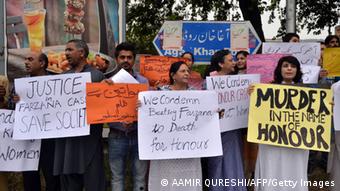
Pakistan Ehrenmord in Lahore 27.05.2014 Protest
Ahmed: 'Informal justice systems have sentenced women to death for dishonoring their family'
Women's rights activists in the federal and provincial parliaments have spearheaded progressive legislation including laws to criminalize sexual harassment and the 2011 Prevention of Anti-Women Practices Act which bars forced marriages, depriving women of their right to inheritance, or giving away women in marriage to settle tribal disputes.
Yet, violence against women is still endemic, amid a climate of impunity and state inaction.
What have been the main challenges faced by women over the past eight years, both legally and economically?
Discriminatory laws, such as the Hudood Ordinances remain on the books, denying women their constitutional right to gender equality. A gender-insensitive and dysfunctional criminal justice system has failed to protect women's rights and lives.
Parliament has failed to remove or repeal the Hudood Ordinances and to pass a national law to protect women against domestic violence. Existing laws, such as the 2010 Protection against Harassment of Women at the Workplace Act, are poorly implemented.
What has changed in terms of societal attitudes towards women?
Women's rights activists, political leaders and development workers have been instrumental in working towards ending violence against women and gender-based discrimination.
Yet, social attitudes towards women, including girls, remain biased. Supported by some communities, informal justice systems such as jirgas (all-male councils) have sentenced women to death for dishonoring their family and have given away females, often minors, to settle tribal disputes.
Even within the formal justice system, the subordinate judiciary has often ignored women's rights violations as has a gender-insensitive police force. Even within mainstream moderate political parties, some members, such as in the 2013 polls, signed agreements to bar women from voting in their constituencies.
What has the government done to improve women's lives?
Despite a comfortable majority in parliament, the ruling Pakistan Muslim League-Nawaz (PML-N) has not championed women's rights. Nor has it, or the provincial governments, enforced the laws that protect women and ensured that rights violations are punished.
What role does the volatile security situation in parts of the country play in this context?
Women's security is especially threatened in the conflict zones of Khyber Pakhtunkhwa (KPK) province and FATA, where women are subjected to state-sanctioned discrimination, militant violence and sexual assault. Militants target women's rights activists, political leaders and development workers with impunity.
The government's indiscriminate military operations, which have displaced millions, have further aggravated the challenges women face in the conflict-zones.
Based on your findings, what do you urge Islamabad to do to curb violence against women in Pakistan?
Respecting international commitments and constitutionally guaranteed rights, the federal and provincial parliaments should repeal all laws that discriminate against women. The federal and provincial governments should support new legislation and implement existing ones to empower and protect women.
Prioritizing the development of a gender-responsive security apparatus, they should ensure that women can exercise their right of franchise and to stand for public office. Islamabad should also reflect their priorities in all government policies, including counter-insurgency and peace-building efforts.

GROUNDHOG DAY IN U.S.-PAKISTAN RELATIONS

The United States generally, and the U.S. State Department in particular, seem perennially unwilling to grasp the realities of Pakistan. Refusing to recognize that Pakistan pursues ideological goals through the use of terrorism under its ever-expanding nuclear umbrella, the United States persists with the same strategy it has always used to handle the “Pakistan problem” – namely, attempt to induce better Pakistani comportment through handsome allurements. The most Panglossian American policy makers believe that there is some magical combination of rewards and engagement that, over some time horizon, will transform Pakistan from the regional menace it is today, into a state that is at peace with itself and its neighbors. The most pusillanimous of policy-making poltroons fret that should the United States curb its generosity and demand that Pakistan honor its varied commitments like any other responsible state, Pakistan may fail and the Islamist barbarians will knock down the nuclear gates with grisly consequences for humanity.
Once again, the U.S. State Department revealed that it has no intention of taking the Pakistan problem seriously. This week, Foggy Bottom approved Pakistan’s request to purchase some $952 million of American military hardware which includes attack helicopters, missiles, and communications equipment. In an explanatory press release from April 6, the State Department justified this decision by arguing that
This proposed sale will contribute to the foreign policy and national security of the United States by helping to improve the security of a country vital to U.S. foreign policy and national security goals in South Asia.
While in some sense such foreign military sales benefit the U.S. defense industry, approval of these sales evidences perduring obfuscation of the root causes of Pakistan’s problems and abjuration of what a better course of action might be. After all, Pakistan’s problem is not a lack of capability to fight the various terrorists ensconced in its territory; rather the will to do so comprehensively. Equally important, Pakistan continues to create new militant proxies while sustaining old ones even while it attempts to fight those who have turned against the state and who cannot be bullied or bribed back into the fold of the deep state.
The time for such folly has long passed. The United States needs a more realistic policy towards Pakistan. In this essay, I argue why these decades-long policies have long failed and I put forward several propositions that should inform a new policy towards a state that is the problem from hell.
A Laundry List of Dirty Deeds
To summarize briefly, since FY 2002, the United States has provided Pakistan $7.6 billion in security-related assistance, $13.0 billion in lucrative reimbursements under the dubiously-named “Coalition Support Fund” program, and another $10.5 billion in economic assistance. This largesse was both to reward Pakistan for its putative support in the war on terrorism while incentivizing future support.  Has the United States secured value for this $31 billion? Let’s recount how Pakistan has “contributed” to the war on terrorism.
Pakistan has persistently supported the Afghan Taliban, who are responsible for the deaths of 2,356 U.S. military personnel, another 677coalition military deaths, and the deaths of thousands of civilian contractors, for whom there is no official count under U.S. reporting requirements. This is in addition to the more than 21,000 Afghan civilianswho have died since 2001. The death toll of Afghan National Security Forces (ANSF) is a tightly guarded secret; however, various sources estimate that more than 20,000 Afghan police and army personnel have been killed since 2003. More than 5,000 ANSF were killed by insurgents in 2014 alone. Without Pakistan’s direct military, diplomatic, political and financial support as well as secure sanctuaries in Pakistani territory, the Taliban would not be as lethal or capable. The Taliban might even not be viable as an insurgent movement without these vast Pakistani amenities. In addition to the Afghan Taliban under Mullah Omar, Pakistan continues to support the Jalaludin Haqqani network, which has conducted sophisticated, deadly suicide operations at U.S., NATO and Indian facilities in Afghanistan.
This sort of behavior has become Pakistan’s standard operating procedure.Since 1947, Pakistan has used Islamist militants in an effort to wrest Kashmir from India. It has used Islamist militants in Afghanistan since 1974, if not earlier. Since 1990, Pakistan has introduced extremely lethal groups such as Lashkar-e-Taiba (LeT, now operating under the name of its above-ground wing Jamaat-ud-Dawa, JuD) and Jaish-e-Mohammad into the Kashmir theater and elsewhere in India. Since 2002, according to theGlobal Terrorism Database at the University of Maryland, these two groups have killed more than 1,132 persons and injured more than 2,423 in about 162 attacks. Moreover, the Jaish-e-Mohammad attack on India’s parliament in December 2001 and LeT’s May 2002 attack on military families in Kaluchak nearly brought the two countries to the brink of war. LeT, finally concentrated the attention of U.S. policy makers when it conducted a multi-site attack on India’s port city of Mumbai, which culminated in a siege that lasted several days. By the time the carnage ended, ten LeT militants slaughtered 166 people including six Americans.
Of course, as all Americans know, the United States located Osama Bin Laden’s lair a short distance from the Pakistan Military Academy. So far, Pakistan has shown little interest in investigating—much less identifying and prosecuting—those persons who aided and abetted him and his protection racket. Instead, the only person Pakistan has arrested was a physician who contributed to his capture.
Yet despite this never-ending list of outrages from America’s erstwhile “partner,” Washington still finds ways of wasting the hard earned taxpayers’ dollars on this country which works strenuously to undermine U.S. interests in the region and beyond. It seems that the United States is paying Pakistan ostensibly to support the war on terrorism while Pakistan is using terrorism and American generosity to wage its proxy wars, in which many Americans have been the victims.
In Pakistan Whac-a-Mole is an Olympic Sport
In the afore noted press release, the U.S. State Department argued that “This proposed sale of helicopters and weapon systems will provide Pakistan with military capabilities in support of its counterterrorism and counter-insurgency operations in South Asia.” The press release further contended that this sale will enable Pakistan to better conduct operations in North Waziristan Agency (NWA) and elsewhere by providing Pakistan with “a precision strike, enhanced survivability aircraft that it can operate at high-altitudes” and by conferring upon Pakistan the ability to operate in “all-weather, day-and-night environments.”
Such argumentation would make sense if there were any evidence that Pakistan is fighting the same war on terrorism that America is. There is no such evidence. However, what every American must understand is that Pakistan fights a highly selective war on terrorism. It has only taken up arms against those militants who have turned against the state and whom Pakistan’s military and intelligence agencies cannot bring back into the fold. These militants, most of them operating under the banner of theTehreek-e-Taliban-e-Pakistan (TTP or “Pakistani Taliban”), have their varied roots in Pakistan’s support for Mullah Omar’s Afghan Taliban; a zoo of Islamist militants such as Jaish-e-Mohammad, which Pakistan raised to fight in India; and sectarian militants such as Lashkar-e-Jhangvi and Sipah-e-Sahaba-e-Pakistan, which Pakistan’s military and civilian leaders have cultivated at various times for domestic purposes, including the slaughter of Pakistani Shia. These militants share a Deobandi interpretative tradition as well as an archipelago of Deobandi madrassahs and mosques. They also have political support among some factions of the Deobandi Islamist political party the Jamiat-e-Ulema-Islam (JUI).
After 2002, many of the leaders of these Deobandi organizations began to question then General and President Musharraf’s decision to facilitate U.S. military operations in Afghanistan to oust the Afghan Taliban. After all, the Afghan Taliban successfully established an Islamist regime in Afghanistan consistent with their Deobandi interpretation of Islam. President Musharraf was actively conniving with the United States to bring that down. TheseDeobandi groups had also become close with al Qaeda, sometimes training in the same camps. As the Taliban and al Qaeda were rousted from Afghanistan and pushed into Pakistan’s tribal areas, new militant formations began to emerge.
By 2004 if not earlier, Pakistan began to experience the formation of insurgents based in the tribal areas after Pakistan began undertaking military operations there under U.S. pressure. These Deobandi militant groups began to form micro-emirates of sharia first in the tribal areas and then elsewhere in what is now known as Khyber Pakhtunkhwa.
As this insurgency developed, Pakistan’s military began facing heavy losses. Pakistan uses these losses to argue to the United States that it is just as much a victim of terror as is the United States. It pointed out years ago that its battlefield deaths vastly outnumbered those of Americans in Afghanistan. It uses these fatality figures as counterpoints to those Cassandras, such as this author, who have long decried the double game that Pakistan was and is playing in Afghanistan.
This is not to say that Pakistan is not fighting someone. For several years Pakistan has tried to persuade the Pakistani Taliban to either join the fight in Afghanistan or rejoin groups that operate in India such as the revivified Jaish-e-Mohammad. In fact, the ISI, Pakistan’s premiere intelligence organization, denervated this Deobandi group precisely for this reason. Those who took the offer were re-baptized into the deep state and their murderous sins forgiven. Those who demurred are the targets of these various offensives which have killed far more innocent civilians than the drone program and have displaced millions from their homes.
Grabbing the United States by the GLOCS
In 2009, the Obama administration acquiesced to the demands of his generals in Afghanistan and authorized the “surge.” The surge was never about battlefield effects because the small numbers of the surge could never deliver such effects. After all, if one took Field Manual 3-24 on counterinsurgency seriously (and I did not), you would need about450,000-500,000 troops in Afghanistan. We never had more than 140,000.Moreover, the surge misdiagnosed the problem. We were—and are—losing in Afghanistan in large measure due both to industrial strength corruption and malfeasance in the Afghan government and to the enduring sanctuary and other amenities that Pakistan affords the Taliban. To win in Afghanistan—by any metric of winning—the international community had to foster better business practices amongst themselves and amongst their Afghan partners. And it had to put serious pressure on Pakistan to kick the Taliban habit. It did neither.
Instead, the surge made the United States more dependent upon Pakistan for ground lines of control (GLOCs) than ever before while doing little to develop genuine alternatives. The Northern Distribution Route could never carry more than 20% of the logistical demands and Russia insisted that it not be used for lethal goods. And since this is about supplying a war, that restriction was important. And even though the United States was perfectly capable of working with Pakistan despite a well-known history of horizontal and vertical nuclear proliferation and decades of supporting terrorism, neither the United States nor its NATO partners could find a way of working with Iran’s private sector to resupply the war.
After all Iran, with Indian help, built a deep water port in Chabahar and India and Iran collaborated to connect that port to the Ring Road in Afghanistan. Even though Iran had more in common with the United States when it comes to Afghanistan and Pakistan, the United States overlooked Pakistan’s nuclear proliferation and terrorism penchant while failing to see any virtue in the Iran option. This was unfortunate because in the early months of the war, Iran supported the United States bilaterally and in bilateral fora. Had Washington capitalized upon this Iran opening rather than proclaiming it to be a founding member of the Axis of Evil, it may have had a chance of “winning” in Afghanistan.
In the end, the United States made itself more vulnerable to Pakistani predations at a time when it needed to pressure Pakistan heavily if it wanted to ensure an Afghan future with little likelihood of a non-elected Taliban presence.
A Way Forward
Cynics in South Asia and beyond contend that the U.S. decision to keep arming Pakistan to kill terrorists while it continues to make terrorists is a collusion of convenience. The U.S. arms industry gets a buyer and Pakistan continues to make itself relevant, and thus eligible for continued assistance, in a war on terror of its making. It’s a self-licking ice cream cone. Frondeurs will further gripe that the United States also desires to sell arms to India. This seems to put the United States in the dubious position of benefiting from an arms race that it encourages. Generally, I rubbish these arguments. However, many in Pakistan and in India accept these canards as reality. This perception undermines legitimate American efforts to engage both countries. More importantly when the United States justifies such sales to Pakistan as being inherently in U.S. interests, the United States looks explicitly foolish or complicit in such games.
Washington needs to take advantage of its declining dependence upon Pakistan to support its presence in Afghanistan and forge a very different means of engaging Pakistan. I am not suggesting that the United States cut off ties to Pakistan and stop all programmatic activities. Instead, I am arguing that the United States treat Pakistan like any other state and hold it accountable for its actions. Any “special engagement” with Pakistan must be under very strict guidelines that explicitly and genuinely advance U.S. interests.
At a minimum, U.S. security assistance generally and defense sales of strategic systems and any platforms that materially increase Pakistan’s warfighting capabilities in particular should be predicated on three conditions. First, Pakistan must recognize the line of control in Kashmir as the legitimate border. After all, the zoo of terrorists that Pakistan has assembled to prosecute its proxy war in Kashmir has precisely contributed to the internal security challenges for which Pakistan now wishes to purchase these helicopters and hellfire missiles. Moreover, nothing will stop Pakistan from using these in India or against ethnic insurgents in Balochistan. Arming Pakistan to kill some terrorists while it continues to nurture others makes little strategic sense. The United States should most certainly continue to train Pakistani military personnel in the United States and other forms of engagement and assistance that will help Pakistan buttress its internal security capabilities. But it should demur from materially adding to Pakistan’s military capabilities vis-à-vis India while it remains committed to territorial revisionism through the use of terrorists and nuclear coercion.
It should be noted that Pakistan has no legal claims to the portion of Kashmir under Indian administration. Pakistanis who point to U.N.S.R. 47 of 1948 to argue that it does should read the text of the resolution to disabuse themselves of this fantasy. To this end, the United States should stop recognizing the line of control as a disputed border and use its influence within the United Nations to secure support for this position. Doing so will deprive Pakistan of the political justification for its reliance upon the menagerie of terrorists it has reared to wrest Kashmir from India. By removing Pakistan from the equation, the United States can more usefully engage India quietly to redress the myriad problems it has with its own Kashmiri citizens. Equally important, the United States should encourage Pakistan behind closed doors to integrate those Kashmiris under its own administration.
Second, any such sales of weaponry should be contingent upon Pakistan not only ceasing support for the various terrorists it has nurtured but actively de-mobilizing them. This will be a long process. However it makes no sense for the United States to provide arms to Pakistan to fight terrorists when confederate terrorists undertake operations in India, which is the most likely precipitant of the next war between India and Pakistan.
Third, Pakistan wants to be respected as a legitimate nuclear power. Yet Pakistan has proven itself to be a reckless nuclear power boldly boasting of developing tactical nuclear weapons to contend with Indian doctrinal evolution. The United States should seriously consider curtailing provision of conventional military capabilities as long as Pakistan pursues these nuclear capabilities. After all, the logic of these tactical nuclear weapons is not to defend Pakistan against Indian aggression. Rather, they are meant to deter an Indian military response to a terrorist outrage in India committed by a Pakistani proxy.
In addition, the United States should allow the IMF and other multi-lateral funding agencies to hold Pakistan accountable for its past and deliberate failures to make the economic reforms it promised to make as a condition for the various “bailouts” it has received. Excessive bilateral and multilateral bailouts allow Pakistan to abscond from making the necessary tax reforms which form the ballast of a true democracy. These bailouts also lubricate any friction that arises between those who want a more genuine democracy and those that are satisfied with the current deep state. Tax reform is a necessary but insufficient condition for the development of democracy in Pakistan and a first step towards renormalizing civilian-military relations.
Critics of such a way forward will argue that the United States will “lose influence” in Pakistan. My response to this assertion is that I see little evidence of such “influence.” Since 9/11, Pakistan has expanded its nuclear arsenal and redoubled its commitment to terrorism. If this is influence, I’m happy to forego it.
In the end, such a realistic policy towards Pakistan may not result in a Pakistan that behaves better in the policy-relevant future. However such a policy will at least spare the American public the continued indignity of subsidizing Pakistan’s most dangerous policies, several of which account for thousands of dead Americans and many more injured in the Afghan war.

Pakistan Has Complicated Nuclear Relationship With Saudi Arabia, Iran


Iran’s foreign minister visits Pakistan Wednesday to discuss the conflict in Yemen, which many see as a fight for influence between regional rivals Iran and Saudi Arabia. 
Iran also has recently reached a framework nuclear agreement with six world powers to possibly curb the weapons potential of its nuclear program.  
Saudi Arabia, in the past, has reportedly sought to form its own nuclear alliances to counter a perceived Iranian threat. A member of the Saudi royal family and the kingdom’s former intelligence chief, Prince Turki al-Faisal, warned a few months ago that the kingdom would seek the same nuclear capabilities that Tehran is allowed to maintain under any deal.
In this regard, Pakistan’s relationship with the kingdom is unusual. 
On one hand, it has sold nuclear secrets to Iran in the past through a network run by former chief Pakistani nuclear scientist A.Q. Khan. The network also sold nuclear technology or know-how to Libya and North Korea.
On the other, it has faced allegations of promising Saudi Arabia a nuclear umbrella against Iran.
'Unacknowledged nuclear partnership'
Bruce Riedel, director of the Intelligence Project of the Washington-based Brookings Institute, wrote in 2008 that Pakistan has “an unacknowledged nuclear partnership to provide the kingdom with a nuclear deterrent on short notice if ever needed.” 
A BBC Newsnight story in 2013 declared that Saudi nuclear weapons were practically “on order” from Pakistan.
“Saudi Arabia has invested in Pakistani nuclear weapons projects, and believes it could obtain atomic bombs at will,” the story said based on sources. 
As late as last month, a Wall Street Journal story on Saudi nuclear ambitions declared: “Saudi officials have told successive U.S. administrations they expect to have Pakistan’s support in the nuclear field, if called upon, because of the kingdom’s massive financial support for the South Asian country.” 
While Pakistan denies all of these allegations - and unlike Pakistan’s nuclear dealings with Iran, Libya and North Korea, the Saudi connection has never been officially proven - its past behavior makes people suspicious.
“We know that Pakistan’s nuclear program was heavily subsidized by outsiders, financed by outsiders,” Pakistani nuclear physicist Abdul Hameed Nayyer said. 
Some of those, such as Libya, who helped finance the program, received help with their nuclear programs in return.  
Evidence of Pakistan’s involvement was discovered when Libya abandoned its nuclear program and turned over its equipment to the United States.  
“If Saudi Arabia also financed Pakistan’s nuclear program, it is possible that Saudi Arabia would also demand such a thing from Pakistan,” Nayyer said. 
While there is no concrete evidence of Saudi financing of Pakistan’s nuclear weapons program, critics point to ancillary support.
Slapped with sanctions
After Pakistan tested its nuclear device and was slapped with international sanctions, Saudi Arabia provided it with oil on deferred payments for three years and later forgave some of the payments.   
According to Riedel, the Saudi promise to provide 50,000 barrels of free oil per day to counter any sanctions was key in helping then-Prime Minister Nawaz Sharif to decide to go forward with its nuclear test.
Saudi Crown Prince Sultan bin Abdul Aziz was given a tour of Pakistani nuclear facilities in 1999, soon after Pakistan’s nuclear test. Pakistan claims he was not shown the weapons program.   
Awais Laghari, head of the foreign affairs committee in Pakistan’s national assembly, insists Pakistan's nuclear proliferation chapter is closed, and despite its excellent relationship with Saudi Arabia, the country will not share its nuclear weapons or know-how.  
“Pakistan can’t afford to do that. … Pakistan’s own nuclear program would be at stake,” Laghari said.  
Nuclear physicist Nayyer hopes Laghari is right.
Nayyer acknowledges that Pakistan’s nuclear support to Iran stopped after the A.Q. Khan network was discovered. And he thinks the changed international environment may have convinced Pakistan that the cost of nuclear proliferation now is too high.

Wednesday, April 8, 2015

Iggy Azalea - Fancy (Explicit) ft. Charli XCX

Dzhokhar Tsarnaev is convicted Boston Marathon bomber

Putin: Greece hasn't asked Russia for bailout

Sanjay Gupta interviews President Obama

Video Report - Pakistani lawmakers oppose involvement in Saudi-led war on Yemen

Video Report - The Debate - Saudi Invasion of Yemen (Part 1-2)

Delegates from Middle East, Muslim world to convene in Israel for nuclear conference

Israel will host a prestigious, UN-sponsored international conference next week on the ban of nuclear tests. Around 100 representatives will take part in the meeting, including from Arab and Muslim states that don’t have diplomatic relations with Israel.
Jordanian and Egyptian delegates will also attend the conference. To ensure the safety of the participants, the Foreign Ministry issued safety and travel assurances.

The conference is organized by the Comprehensive Test Ban Treaty Organization headquartered in Vienna.

The purpose of the gathering is to evaluate and draw lessons from a recent on-site field exercise held in Jordan in November. Senior Israeli officials participated in the exercise, which tested the preparedness of the equipment used by CTBTO to monitor nuclear tests.

There are hundreds of monitoring stations in the world linked to the Vienna headquarters which are ready to monitor, identify and evaluate nuclear tests. Israel is home to two such stations and one laboratory in the small nuclear research reactor at Sorek, 20 km. south of Tel Aviv.

The CTBTO stations were the first ones to trace and identify North Korean nuclear tests nearly 10 years ago.

Lassina Zerbo, the executive secretary of CTBTO, will lead the international delegation.

He will meet with Intelligence Minister Yuval Steinitz and other Israeli officials. One of the purposes of the visit is to persuade Israel to ratify the treaty. Israel signed the treaty

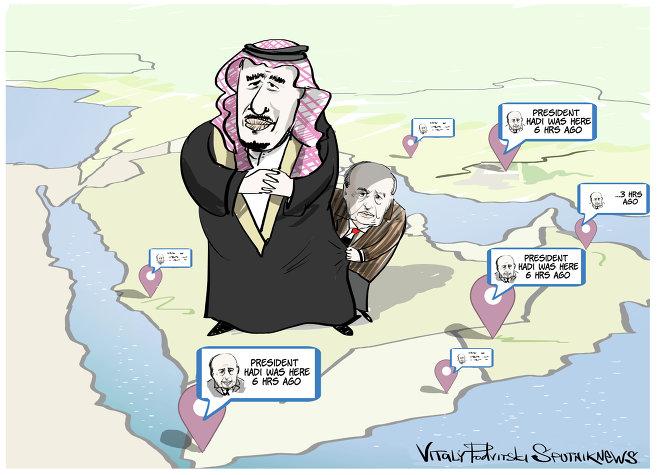
Saudi Arabia’s trail of foolishness, hypocrisy and mistakes from Syria to Yemen


By Harry J. Bentham


The Saudis and their allies are usually a puzzle when it comes to foreign policy. In their reaction to events in Yemen, they just look like bumbling fools.


After the Saudis and their allies spent multiple years pushing and pushing earnestly to bring down Bashar al Assad’s regime in Syria, he is still in power and stronger than ever, gaining an increasing advantage over the Saudi-backed insurgents. Even as the Saudis meddled in Syria (and even Iraq and Lebanon, according to some reports on their relationship with ISIS), their own walls have started to fall down on them, with the pro-Saudi government of former president Hadi in Yemen collapsing. In other words, the plan that Saudi Arabia wrote for Iraq, Lebanon and Syria has happened to Yemen and destroyed one of Saudi Arabia’s own friends.
Most amusing is the fact that the Saudis and their ideologues in the Arabic media are convinced that Iran is behind the fall of the Yemeni government and the success of the Houthi Movement’s Ansarullah paramilitary wing, effectively “taking over” Yemen. However, as reported in an analysis at Stratfor, Iran is simply too far away to really have any meaningful involvement in the conflict in Yemen. There is no evidence that Iran has provided any money, training or weapons to any of the parties fighting in Yemen. However, Iran’s alleged disrespect for Yemen’s “sovereignty” (according to Hadi and his Saudi freinds, that is something to be determined by foreign armies and planes rather than the Yemeni people) is argued to be the reason for the violent campaign now being waged against Yemen.
Saudi Arabia, unlike Iran, has been bombing the factions it disagrees with in Yemen, killing hundreds of civilian bystanders, and has been airdropping weapons to the groups it wants to kill its enemies in the country. In sum, Saudi Arabia wants you to think some kind of invisible, unproven specter of Iranian connections in the sovereign country of Yemen is an “aggression”; lunatics like US Senator John McCain (see his remarks at the Munich Security Conference) and other anti-Iran maniacs also see Iranian influence in Yemen as aggression… but Saudi Arabia’s blatant airstrikes and airdrops of guns into the country are seen as necessary countermeasures to protect Yemen’s “sovereignty” from Iran.

In reality, Iran has not done anything hostile in Yemen, while Saudi Arabia has committed acts of blatant aggression and is sending weapons to factions in the country.

What is astonishing is that Saudi Arabia and its allies are crazy enough to simultaneously claim to be intervening in countries to keep “legitimate” presidents in power (like Yemen’s Hadi) and intervening in other countries to remove “illegitimate” presidents from power (as in Syria).
Former president Hadi and the so-called Syrian opposition are  not legitimate rulers of anything, but they do have one striking similarity: both are cowering in foreign capitals and suckling on foreign promises, while pretending to rule over their respective countries and denying that their people have rejected them. Cowering in Riyadh is what passes for being a “legitimate” ruler for Yemen in the eyes of Riyadh.


Read more: http://www.beliefnet.com/columnists/lordre/2015/04/saudi-arabias-trail-of-foolishness-hypocrisy-and-mistakes-from-syria-to-yemen.html#ixzz3WlKGjLAe

Read more at http://www.beliefnet.com/columnists/lordre/2015/04/saudi-arabias-trail-of-foolishness-hypocrisy-and-mistakes-from-syria-to-yemen.html#sSsMjcTKMfAPjOUB.99

Video - With Kelly and Michael April 6, 2015 - First Lady Michelle Obama

President Obama on Climate Change, Health Insurance, Family

Pashto Music Video - Yar Me Musafar Dy - Gul Sanga

China: Afghanistan’s New Hope


BY TAMIM ASEY

Afghanistan, China’s missing link in its regional diplomacy, needs China’s financial resources, construction industry, and political leverage. The two need to build a strong partnership based on mutual interests.

With the recent surge in direct diplomacy and high level visits between China and Afghanistan there is an emerging hope amongst Afghans that China can be counted on as an honest partner, broker, and good neighbor. An increased economic and security interest in China by former Afghan President Hamid Karzai during his last months in office and the current president, Ashraf Ghani, with his first foreign trip to Beijing are all indicators of a great rebalancing act by Kabul to reach out to China after decades of tepid relations. But this new hope of a partnership should go beyond diplomatic niceties and be based on a strong foundation of mutual interests.
Afghanistan needs Chinese financial, economic, and technical resources and its political leverage at the international stage whereas Afghanistan is the missing link in China’s regional diplomacy and geopolitics. As a rising power, China cannot and should not tolerate an unstable Afghanistan in its neighborhood. A troubled and unstable neighborhood infested with extremists and regional proxy terrorist groups is probably the biggest impediment to China’s rise to a peaceful and responsible power.
History is filled with examples, such as the Byzantine, Ottoman, and Khmer Empires, where rising powers eventually fell or disintegrated due to instability in their neighborhood. Both China and Afghanistan have suffered from imperial conquests and fell prey to various geopolitical games. These empires were mostly supported by outside powers, and today, while China has managed to throw off the influence of those powers and strengthened internally, Afghanistan is still fighting its battle for a united, prosperous, and peaceful Afghanistan.
China has international diplomatic clout, influence in the region, and is an economic powerhouse, all of which can help to facilitate talks with and pressure groups and states to achieve regional stability. While China might have legitimate security and geostrategic concerns over engaging itself in such a controversial international and regional issue (and potentially a never-ending insurgency in Afghanistan), the costs of staying indifferent will be much higher. A neighborhood engulfed in terrorism, the drug trade, extremism, and proxy wars is the biggest threat to the national security and rise of China.
On the other hand, China should stop relying on Pakistan when dealing with Sino-Afghan border issues, particularly when it comes to the East Turkestan Islamic Movement. The time has come for China to end its passivity with Afghanistan, directly engage with the Afghan government, and help support build a strong, national government for Afghanistan to serve as a credible partner for China in its neighborhood.
Afghanistan has natural and human resources as well as a prime geographic location that are ripe for Chinese picking. The World Bank has termed Afghanistan as a country with huge potential to serve as a resource corridor between South and Central Asia. China — one of the biggest consumers of raw material and energy inputs — has some of the world’s biggestconstruction, railway, and road companies. They are efficient, experienced, and highly competent companies who have been building infrastructures across the globe — from China to Africa to South Asia. Afghanistan, however, has one of the most underdeveloped infrastructures in the world, barely even tapping into its full resource potential. China should invest in Afghanistan’s infrastructure development to gain access to Afghanistan’s resources and create a land bridge, better connecting China to Central Asia and the Middle East.
Furthermore, Afghanistan is the backyard of the Persian Gulf, and given that the majority of Chinese oil supply passes through the Gulf, it is of vital national security interest for China to expand its economic and political influence in Afghanistan. With some much of China’s energy imports passing through Afghanistan’s sphere, the security of the Chinese energy supplies depends on the stability of Afghanistan.
China has some of the best vocational training institutes and higher education institutions in the region. According to the recent Times Education ranking, Chinese universities and institutes rank among the world’s 100 best universities and institutes. Meanwhile China has also over the years accumulated valuable assembly and manufacturing experience for the international market. China can assist Afghanistan in creating an indigenous manufacturing industry in the country. Afghanistan — a country where much of the population is still illiterate — can greatly benefit from Chinese education and manufacturing prowess.
Chinese business interests and products have mainly been rerouted and exported to Afghanistan via Pakistan because Afghan roadways from China cannot accommodate the demands of the mountainous border between the two countries. The Afghan business communities have a keen interest for partner with Chinese firms and factories. Chinese state-owned companies such as the China National Petroleum Corporation International and China Metallurgical Group Corporation have invested in Amu Darya oil river basinand Aynak copper mine in Afghanistan, though the experience with the two projects has not been encouraging so far. The contractual obligations have either been not met or were asked to be renegotiated.
Despite China’s issues in following through and delivery in Afghanistan, Afghanistan has much to learn from the Chinese economic model. Afghanistan needs to move away from an aid dependent economy move towards a trade and export oriented economy. China’s economic policies have a lot to offer in terms of models and examples. China has successfully used a state capitalism economic model mixed with special economic zones, assembly lines, and export oriented trade to become one of the world’s biggest economies.
In the long run, the benefits of Chinese engagement and influence in building a stable and peaceful Afghanistan far outweigh the costs. China can exert its diplomatic status to bring parties to the negotiating table and use its powerful economy to support mutually beneficial infrastructure development programs in Afghanistan. A stable and peaceful Afghanistan can be both a reliable trading partner with China and bring needed stability to the region. Instability in a country breeds instability in the region, and China cannot afford such a liability. China will have to engage in Afghanistan for its own national and economic security.

Video Report - U.S. service member killed in Afghanistan

Pakistan - Mr Nawaz Sharif, the Saudi-Yemeni conflict is not our war to fight


As the Houthi rebels strengthen their stranglehold over the country, amid the surreptitious flight of the Yemeni president, Abed Rabbo Mansour Hadi, the long raging civil war in Yemen has finally come into the international spotlight.
Pakistan is, once again, at crossroads with Saudi Arabia, who is attempting to suck in inter-ethnic, inter-religious, and intra-sectarian conflicts into their black hole.
The prospects of petro-dollars coupled with the longstanding romance between the Sharifs and Sauds, buoyed by a rise of the Pakistan Army as a bulwark against both domestic as well as international terrorism, in recent times, might have made the temptation of joining the Saudi alliance irresistible, but it is an alliance which must be resisted.
That Pakistan should not embroil itself in a new war seems a no-brainer. Yet decades of misplaced priorities and mercurial and xenophobic foreign policy-making decisions have clouded or perhaps, blinded us towards our ‘national’ interests and how to achieve them.
The disorder of social amnesia amongst our public may be one of the major reasons for this disastrous ideological bickering among ruling elites. Moreover, the recent statement of Prime Minister Nawaz Sharif about his stance on Saudi Arabia seems more like a ploy to support his Saudi ‘brothers’ in their imperialist adventures in the Gulf region, rather than a purely threat-based assessment.
For those of us wise or old enough to recall, the last time the Pakistan army aided a war in the Gulf from 1967-1970, under the command of the infamous General Ziaul Haq, it became known as “Black September”. Thousands of Palestinians were killed and displaced from Jordan, squandering all the goodwill that we had achieved earlier. Therefore, this time around, we must not be on the wrong side of history. But before going further, let’s stop for a bit and analyse the current situation in Yemen.
Saudi Arabia is currently busy helping the ailing Yemeni government to fight off the Houthi rebels – a Shi’ite group of the Zaidi denomination who ruled North Yemen for about a 1000 years. They are mostly concentrated in the north of the country, which used to be a separate republic before it was unified with the south to form modern day Yemen in 1990.
Since then, the Houthis – who named their movement after Hussein Badraldin al Houthi, the man who led the first uprising against the Yemeni government in 2004, and was assassinated subsequently – have steadily gained ground in the past few months, closing in on Sana’a, the capital city of Yemen.
The Saudis have long been meddling in the political upheaval in Yemen. Their current preoccupation is therefore a part of the larger desire to maintain their long established political, religious, and now more so, military hegemony in the Gulf region.
To make matters worse, its nemeses, the ultra-sectarian Islamic State of Iraq and Syria (ISIS), and the al Qaeda in Arabian Peninsula (AQAP) have also managed to consolidate their power in the chaotic country. The Islamic Republic of Iran, a long-standing Saudi contender for ideological influence in the Middle East, is also stepping up support for the Houthis, their fellow Shiites. Thus, engulfed in a bitter intra-sectarian and inter-ethnic rivalry, the Saudis are desperate for help.
This hodge-podge of sectarian strife, spiced up by the entry of ISIS and AQAP, warrants a cautions and pragmatic policy by Pakistan. In its crusade against the so-called ‘terrorists’ in the country and region, Pakistan must not get carried away and adopt a blanket policy towards all insurgencies.
The Houthis, for example, are not the Taliban or al Qaeda, contrary to what the Saudis might suggest. They do not call for the establishment of an obscurantist and puritanical form of theocracy; instead they are fighting primarily to achieve socio-economic security, and just political representation which has long been denied to them by the dictatorial central government.
We must not, therefore, in principle, be privy to such a coalition. Since principles hardly matter when it comes to Pakistan’s foreign policy, Realpolitik may help deter us from yet another military adventure for two reasons.
First, Pakistan shares a long and porous border with Iran through its troubled province of Balochistan. With a separatist insurgency brewing in its own backyard, irking the Iranians by thwarting their attempts in Yemen could only turn out to be ominous. That Iranians would not retaliate by propping up the Baloch rebels (freedom fighters) is wishful thinking at best and naivety at its worst.
Tensions have already been simmering under the surface of Pak-Iran bilateral relations over the issue of Pakistan’s alleged support for Sunni terrorist groups operating on Iranian soil, and this move will just add fuel to the fire.
Secondly, and more importantly, allying with the Saudis to take on ISIS, AQAP, and Houthis all at once, would only entangle Pakistan into a protracted and tiring war with the Middle-Eastern jihadists, leading to increased hostilities at home and abroad. If the blowback of the ‘Afghan Jihad’ in the 1980s seems lost in retrospect, the recent quagmire of the US, Saudi, Qatari, Jordanian, and Iranian forces battling both each other and the Syrian forces should refresh our memories.
After 70 years of precarious existence, far from what Jinnah envisaged as a democratic Muslim model, we are still grappling with core issues such as basic healthcare, a faltering education system, rampant corruption, and moral and cultural depravity.
Thus, it is time that we stopped meddling in others’ wars and started fighting our own.