Tuesday, April 7, 2015

The Life and Times of Michelle Obama Examined in New Biography


BY KARU F. DANIELS


"Michelle Obama: A Life" sets out to be the definitive historical biography of the First Lady. The 432-page hardcover tome was a true labor of love for Peter Slevin, a first time author who worked as a journalist for the Miami Herald and The Washington Post during a career spanning thirty years.
"Michelle Obama is a real player in the national conversation right now," said Slevin. "I wanted to understand what she is doing in The White House and why, where those ideas came from, really where that passion came from."
"The more I worked on the book, the more clear it became that what she's doing now connects very closely with her upbringing, with the lessons of her childhood and her experiences along the way," Slevin, who worked on the biography for four-plus years, added.
"I learn in the book that she is motivated to make a difference. I describe it in the book as 'to unstack the deck in a society defined by great inequality.'"
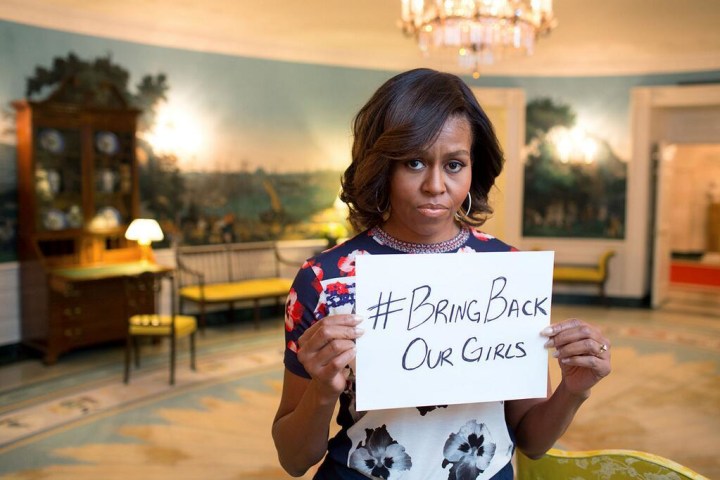
COURTESY WHITE HOUSE

Slevin, currently a professor at Northwestern University's Medill School of Journalism, pored over hundreds of thousands of Mrs. Obama's own words (via his exhaustive research of interviews, speeches and other published materials) and talked to numerous family members, friends and professional colleagues.
The author interviewed Mrs. Obama twice while on the campaign trail in 2007 however The White House didn't make any new interviews with the First Lady possible for the book.
Through richly detailed prose, the narrative and tone of the book takes form as if Michelle Obama wrote it herself. "Her voice carries through the book," Slevin, 58, noted. "The book starts in her voice where she talks to some kids in Anacostia and it ends with [her] remarks at Maya Angelou's memorial service. So even though I wasn't able to interview Mrs. Obama, her voice carries throughout."
The seasoned writer, who spent parts of his career reporting from over 50 different locations, notably London and Berlin, revealed that he was surprised by his discovery of some of the outward disrespect people have shown FLOTUS.
PETE SOUZA / THE WHITE HOUSE

"One of the things I did not appreciate was the vitriol that she faces as a black woman in this role," Slevin revealed. "You can see it in emails and photo-shopped pictures and comment sections on websites. This is a job she didn't ask for; this is a job for which she is not paid. She is doing a remarkable service and yet there are some people out there who can barely contain their anger and their vitriol."
"I think part of the vitriol is about what a polarized country we are now," he further elaborated when probed about why Mrs. Obama could be seen as a polarizing figure. "It's not just about Michelle Obama but I also think that part of it is that a lot of people in this country don't know, as Gwen Ifill has pointed out, how to or what to think about an outspoken, accomplished African American woman. And I think that it is unquestionable that some of it is about race and I say race but of course I mean racism."
There are tons of little-known nuggets revealed in the book, offering readers a closer look at the Mrs. Obama they never knew..
  • One year while working as a research assistant for law professor Randall Kennedy, she and her friends would sit in front of a big television set in the Harvard's Black Law Students Association's office on Thursday nights and watch 'The Cosby Show' and 'L.A. Law.'
  • Michelle LaVaughn Robinson (her full maiden name) once dated Patti LaBelle's adopted son, Stanley Stocker Edwards.
  • The law firm Michelle Obama decided to start her career, Sidley & Austin, had one black attorney whose clients included Muhammad Ali and Don King. At the firm, her assignments as a young associate ranged from AT&T, Coors and the purple dinosaur Barney.
  • A photo of dance legend Judith Jamison performing Alvin Ailey's iconic 'Cry' hung in the first Chicago apartment Barack and Michelle Obama owned
PETE SOUZA / THE WHITE HOUSE
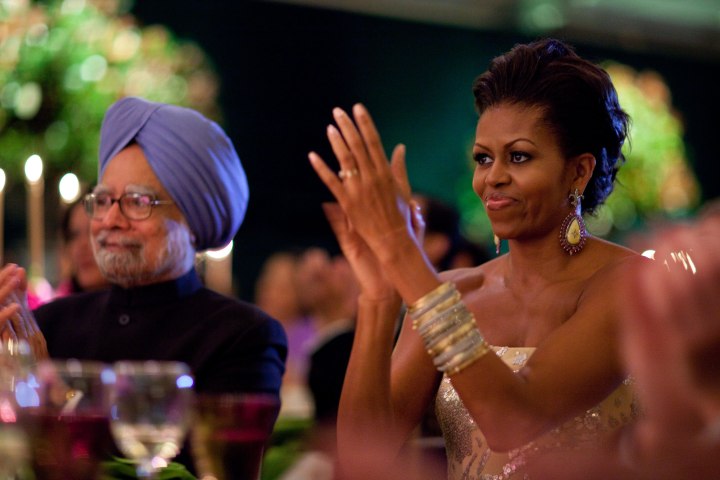
First Lady Michelle Obama claps during the entertainment portion of the State Dinner for Prime Minister Manmohan Singh of India, left, and his wife, Mrs. Gursharan Kaur, held in a tent on the South Lawn of the White House, Nov. 24, 2009.

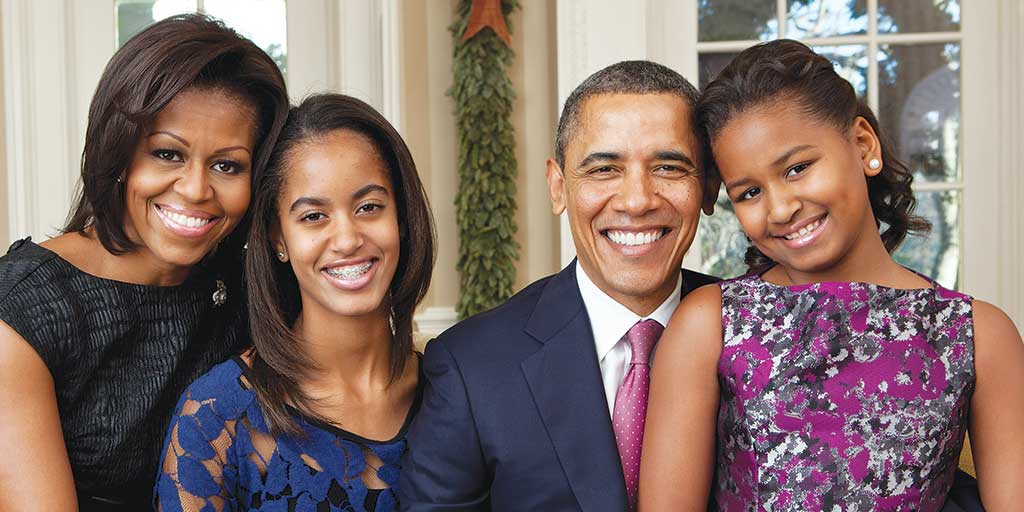
As a parent, Slevin noted that Michelle Obama was always clear that she saw her first job to be raising two great daughters who will lead meaningful lives and who will be protected as much as possible from the difficulties of having two parents in the public eye.
"When she said that she would be Mom-In-Chief, part of that was to give herself a little time to figure out what role she would play as First Lady," he furthered. "But a big part of it was she really meant it. She wanted to make sure that Malia and Sasha were in a good place."
There are many examples in the book of her parenting choices. "She wanted each of the girls to play two sports but they could only choose one of the sports and she [Mrs. Obama] would choose the second, because she wanted the girls to know what it was to be good at something they had not chosen," noted Slevin.
Out of all the subjects he could've chosen to make his mark in literary form, Slevin felt that the First Lady was the perfect choice. "I never wanted to write a book until I felt that I had something to say and until I had a story that excited me and Michelle Obama's life is that story," he explained.
"I thought she deserved a book where she is at the center of that narrative, where she is not just "Wife Of The More Famous Barack Obama."

Music Video - Khwabon Kay Ghar - M.M.Ali

Pakistan - Senator Farhatullah Babar calls for non interventionist assistance to Saudi Arabia and balancing act with Iran


https://ppppunjab.wordpress.com


Taking part in the debate Senator Farhatullah Babar called for supporting Saudi Arabia in non interventionist way and instead seek to position itself as honest mediator in peace making in the strife torn Yemen.
Without boots on Yemen soil Pakistan should assist Saudis in logistics, intelligence sharing, security of key installations, training in mountain and difficult terrain warfare and medical assistance.
This is a tight rope walk he said and suggested that this limited assistance to the kingdom should be accompanied with a balancing act through stepped up dialogue with Iran on border security and bilateral talks on Afghanistan.
It is not in our national interests to be used by any Middle Eastern country for posturing against Iran, he said.
He said that Pakistan was the biggest contributor to UN peace keeping and called for UN peacekeeping in Yemen. This will enable us to have our troops in Yemen but only for peace keeping and under UN barrets.
An immediate ceasefire and humanitarian assistance must also receive priority as delay will not only result in a human catastrophe but also defeat the very purpose of the ongoing operation in Yemen.
He said that the crisis in Yemen was basically political that called for a political solution and not a military response.
Last week Iran offered that it could talk with Saudi Arabia for resolving the Yemen crisis. This provides an opening for Pakistan to act as honest mediator. He said strengthening relations with the Muslim world was also a constitutional requirement and this is possible only if Pakistan is seen as a mediator and not as a party in the war.
The government would be well advised to look into the past history of interventionism for drawing appropriate lessons.
He recalled that intervention in Jordon in 1967 to drive out Palestinians earned some dollars but alienated the PLO which then never supported Pakistan on the issue of Kashmir.
The intervention in Afghanistan in the eighties in the name of Islam earned some dollars but also brought huge devastation in the form of drugs and Kalashnikov culture, refugees and rise of militancy. By adopting ‘iman, taqwa, jehad fi sabelillah’ as the fighting motto for our forces then we paved way for the privatization of jehad in the country and its devastating consequences.
After 9/11 he said on a telephone call Pakistan allowed its air bases to be used for strikes against Afghanistan. As a result we may have got some 20 billion dollars but also lost over 56,000 citizens including solders and suffered huge material losses in militancy.
Faced with the choice of playing the role of an interventionist on the side of any country or as honest peace maker Pakistan should opt for the latter he said.
He also welcomed PTI lawmakers for rejoining the parliament as “triumph of parliament and democracy” and criticized Khwaja Asif for his brashness against PTI and called for expunging the defense minister’s unparliamentary remarks.

Pakistan - Jobs Are Being Sold In Balochistan

Justice Jawad S. Khawja, Justice Supreme Court of Pakistan has said during a case hearing that presently the recruitment process in Balochistan is controversial and jobs are being sold.
Justice Khawja made these remarks while hearing the illegal recruitment case in Balochistan filed by National Accountability Bureau (NAB), on Monday.
Justice Khawja further said that nepotism and favoritism is rampant in Balochistan and there is lack of transparency in jobs recruitment process.
“Talented and deserving candidates are ignored while incompetent candidates are being recruited after receiving bribes from them,” lamented Justice Khawja.

Pakistan & Saudi Aggression - Can we at least be spared the fabrications?

Ayaz Amir

The hypocrisy and the charade on parade would stick in throats more capacious than ours. The defence of the Holy Mosques is every Muslim’s sacred duty, we are breathlessly informed. But who is threatening the Holy Mosques? Certainly not the Houthis of Yemen who are being attacked by Saudi warplanes. It is they who are the victims of aggression, not our Saudi friends. But for obvious reasons, we can’t bring ourselves to say this.

Item number two in the list of frothy declamations: any threat to Saudi Arabia’s territorial integrity will elicit a forceful Pakistani response. But where is the threat to this integrity? Who is planning to attack Saudi Arabia?

Of course Pakistan – the world’s original Islamic Republic, plus in its more charged moments, the Fortress of Islam – faces a dilemma. Its heart and its emotions are in one place, its mind – when it chooses to work – in another. Pakistan knows the risks involved in committing troops to Saudi Arabia’s uncertain adventure. So it is not saying an open yes. But for fear of upsetting the Saudis, for whom this is a matter of life and death, it cannot bring itself to say no.

Yemen may turn into a nightmare for the Saudis in the days to come but it is already a minor nightmare for Pakistan, especially its military, which is being called upon to choose between the devil and the sea. 

There is a third fabrication, that this is somehow a Sunni-Shia war. It is not. The Houthis are Zaydi Shias, whatever that means. But their allies, troops loyal to the former strongman, Ali Abdullah Saleh, are Sunnis. Where does this leave the sectarian divide? 

As George Galloway, the thorn in many a sensitive skin, points out in a diatribe which you can access on YouTube, the people of Gaza are all Sunnis. But when the Israelis were slaughtering them last year, the great House of Saud lifted not a finger to stop the Israeli aggression. So much for the defence of Sunni Islam.

The issue in Yemen is altogether different. It is about influence and control, about Saudi Arabia being able to control the affairs of its impoverished and conflict-racked neighbour. The Houthis are trying to right ancient wrongs. They do not fit into the Saudi scheme of things because their uprising and bid for power set a bad example for Saudi Arabia’s own restive Shia population which is concentrated, unluckily, in Saudi Arabia’s oil-producing regions.

The Saudis were concerned about the Shia uprising in Bahrain for the same reason. It was setting a bad example. So they sent their troops into Bahrain to quell the unrest.

As we all know, retired Pakistani defence personnel are a vital component of Bahrain’s security forces. Shorn of rhetoric and doublespeak, the Saudis want Pakistan to play a similar role in Yemen. What they are seeking, and demanding, are not sentries to stand guard at the gates of the Holy Mosques, but an expeditionary force to help turn the tide against the Houthis and their allies.

The funny thing is that despite being the fourth highest defence spenders on the planet – after the United States, China and Russia – Saudi Arabia is still unable to defend itself or, as we are seeing in Yemen, sustain a war of aggression on its own. Hence the looking to Pakistan to fill this need.

Going by the contours of their chequebook diplomacy, however, the Saudis should really have made the first request for troops to Field Marshal El-Sisi of Egypt. They’ve given him much bigger largesse than anything given to Pakistan – 5 billion dollars President Mohamed Morsi was deposed, and a 12 billion dollars package, along with other Gulf contributors, pledged recently. But the field marshal has announced sending four warships, that’s all, which, come to think of it, is smart thinking.

Pakistan, receiving an advance of 1.5 billion dollars – a gift gratefully received by a cash-strapped government – is being asked for much more: the manpower, the boots on the ground, the special forces, for victory on the battlefield. No other country fits this bill. No other country has the same history of rushing in where angels fear to tread. 

Pakistan, in effect, is being asked to do in Yemen what Iran is doing in Iraq. General Qasem Soleimani, commander of Iran’s elite A-Quds force, is in Iraq leading the Iraqi war effort against the Islamic State. He helped stop the Islamic State’s advance on Baghdad. He was in command of the battle for the recapture of Tikrit. He is involved in the fighting in Syria in defence of the Assad regime. 

When Pakistani officials talk of the defence of the Holy Mosques and threats to the territorial integrity of Saudi Arabia whom are they trying to fool? Saudi Arabia wants a Pakistani Gen Qasem Soleimani in Yemen – or a Brigadier Ziaul Haq (yes, the same who later rose to become our Commander of the Faithful) to do in Yemen what he did in Jordan against the Palestinians during the Black September uprising in 1970.

But Iran has deep interests in Iraq. What interests do we have in Yemen? No one calls the Iranians involved in the defence of Baghdad or the recapture of Tikrit mercenaries. We’ll be called that and will be seen as that if our civil and military leadership take the fateful step of sending troops to Yemen.

Whether the Saudis gain anything from their attack on Yemen or find themselves in a quagmire time will tell. But let us not take them for fools. They don’t want lollipops from Pakistan. They don’t want hollow statements about laying down our lives for the defence of the Holy Mosques, rhetoric which comes so easily to us in Pakistan. They want something tangible – troops on the ground, troops to do their bidding, to fight for them and, if need be, die for them. 

For us it’s not just a question of having enough problems of our own and of our army and air force being over-stretched. The fundamental question is a bit different. Why should we become foot-soldiers in a war which is of no concern to us? True, as a close friend of Saudi Arabia we have an obligation to help it, short of getting directly involved. But even thinking of sending troops is folly.

Trouble is that the Saudis, having got themselves in this mess, are not likely to be impressed by our logic. For them the stakes are high. If they fail in achieving what they have set out to do, their prestige is seriously damaged. And there may be – who knows? – internal repercussions.

The Hapsburgs of Austria triggered the series of events which began the First World War. By the time it ended their empire was lost and they had become part of history. The Saudi monarchy rests on unstable if not shifting sands. They should have confined themselves to diplomacy and to the formidable power of their deep pockets. If they are already looking to allies for military succour it shows that they had not fully thought through the details of their adventure.

Yes, we have sold ourselves cheaply in the past. Yes, we have served the interests of outside powers and hurt ourselves in the process. But hopefully we have learned something from those travails. Even the army is questioning doctrines and dogmas and strategic theories earlier considered as self-evident and as the gospel truth.


Yemen, however, is a test case and will show whether we have fully imbibed the lessons from our own disastrous adventures. Helping Saudi Arabia within our limits is one thing. But humouring the House of Saud, dancing to its tune and serving its strategic interests at the cost of our own…you don’t have to be a Clausewitz or a Metternich to see that it makes no sense at all.

Pakistan - #YemenCrisis - A Closed Discussion


It is odd that in a joint parliament session convened to discuss the open-ended question of Pakistan’s involvement in the Yemen conflict, the Defence Minister, Khwaja Asif, opened the proceedings with a written statement. A predetermined statement in itself would not have been an issue had it not read like a press release; vague, full of rhetoric and stocked with appeasing political phrases. How can the government expect to have a debate on going to war at the request of another country if it fails to tell the parliament the number of soldiers required, where they will be deployed, where will they be drawn from, and what is going to be their job? The only thing that set his address apart from previous press releases was the information that the Kingdom wanted “combat planes, warships and soldiers”. Predictably, the rest of the session was spent criticising the government’s unclear stance, before it descended into political mayhem – another thing the Defence Minister is partly responsible for.
The session has been adjourned till Tuesday, and much of the debate is still to come. Yet so far the only contributor to the debate has been the opposition. Apart from pointing out the government’s unclear statement, the opposition questioned their stance on the Yemen crisis itself; how does the government justify the Saudi-led coalition against the Houthi rebels? So far the government has skated over the issue, only focusing on the intervention’s effect on Pakistan, not its legitimacy. This question is an important one to consider, if the government intervenes in Yemen without the United Nations Security Council’s authorization or a principled stance, what separates it from countries like the United States, Israel or Russia; all of whom the government has heavily criticized for regional aggression in the past. If the government truly wishes to seek the parliament’s – and by extension, the people’s – permission before embarking on this quest, it must provide solid facts, principles and details in the next session.
However, the government’s sincerity in the exercise does seem wanting. Arabian news channels and officials continue to firmly maintain that Pakistan is part of the coalition. Pakistani sources continue to assert that preparations for deployment are already underway. The most telling factor is the Defence Minister’s behaviour during the whole session. Despite being charged with the responsibility to present the government’s case and to seek a quick consensus, he unleashed a fiery tirade at the PTI Chairman, which turned the parliament into a political circus, diverting further from the issue at hand fragmenting any possible consensus.

Amnesty slams Afghanistan's 'failure' to protect women rights defenders


Women human rights defenders in Afghanistan are facing mounting threats of violence and sexual assault, a new AI report found. Despite the gains made over the past decade, laws meant to support them exist on paper only.
"Anti-government groups are targeting prominent and outspoken women's rights advocates [in order to] spread fear among other women's rights activists [and] stop their activities." These are the words of Rohgul Khairkhwah, a woman elected as senator for Nimroz province in southern Afghanistan, and a recipient of the Ministry of Women's Affairs' "Bravest Woman in Afghanistan" award.
Her statements are part of an Amnesty International (AI) report released on Tuesday, April 7 in Kabul, which aims to take a look at the reality of women as rights defenders in the conflict-ridden country.
More violence
Based on interviews with more than 50 rights defenders and their families, the 71-page document titled, "Their lives on the line: Women rights defenders under attack in Afghanistan," illustrates the range of violence women human rights activists are confronted with on a daily basis - from threats, harassment and intimidation to physical attacks on their family members and property, and unlawful killings - despite the gains made over the past 13 years.
According to the document, the year 2013 saw a string of assaults carried out against high-profile women, with many of the perpetrators openly stating that the motivation of their attacks was that their female victims were working, or in public roles.
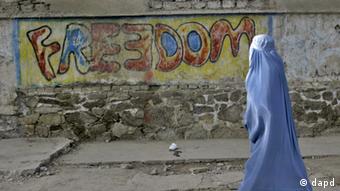
Graffiti Afghanistan
The Taliban and other armed opposition groups are responsible for the majority of human rights abuses
"These women are perceived as challenging existing power structures and defying cultural, religious and social norms concerning the role of women in society and, as such, are deliberately targeted, regardless of whether they are doctors, journalists, educators, female police officers or elected representatives," said the rights group.
The perpetrators
This mindset puts them at risk of sexual and other forms of gender-based violence and can further restrict their movements, as a female doctor quoted in the report pointed out. "The reason I have stopped going to work is that you can see the consequences if you don't listen to their warnings. I hope that by not working I will be safe. If the Taliban say they will do something they are serious about it. There is a security gap everywhere so I don't think it will be difficult for the Taliban to do something harmful."
But while the Taliban and other armed opposition groups are responsible for the majority of human rights abuses, the report found that they are not the only ones. "Many women rights defenders are facing attacks and intimidations from different sides including government officials, local warlords, from the Taliban and other armed insurgent groups and sometimes by their own family members," AI's Afghanistan Researcher Horia said in a DW interview.
In this context, the AI paper also accuses the Afghan authorities of being indifferent to the worsening situation and of "failing to create and enable" an environment for female human rights defenders to carry out their activities and to bring those responsible for abuses to justice.
A 'patchy' rights record
The report comes at a critical time in Afghanistan's history. With the end of the ISAF mission, the Afghan army and police are now fully in charge of security in a country plagued by conflict and a resurgent insurgency. But the NATO drawdown has also been followed by a reduction of economic and political support from the international community.
The rights group is now concerned that with international interest fading and foreign aid waning, the Afghan government will de-prioritize human rights amid growing economic hardship and instability, and that human rights, especially those of women and girls, will be traded off in the interests of security.
"The political and financial support of the international community should not be linked to the military presence in Afghanistan. We are calling on the international community to take women rights issue seriously and keep pressuring the Afghan government to protect women right defenders," said Mosadiq.
But what about the gains made over the past decade? The report argues that the government's record is "patchy" in terms of meeting its legal obligations under the UN Convention on the Elimination of all Forms of Discrimination against Women (CEDAW) and that, as a result, Afghanistan remains near the bottom of the UN Development Program Gender Inequality Index.
At the same time, AI says that conservative forces and ideas have slowly been increasing their positions and leverage within Afghan institutions, enabling them to intensify their attacks on women's rights. This is reflected in the 2013 election law, which rolled back the quota for women's representation in provincial councils from 25 percent to 20 percent, and removed it altogether for district councils.
It can also be seen in the response to the Elimination of Violence Against Women (EVAW) Law, which was decreed into law through an Executive Order by the former Afghan President Hamid Karzai in 2009, while parliament was in recess. When a female MP tabled it before parliament so that it would be passed there - and prevent Karzai's successor from just rescinding the decree - the move backfired as there was not enough support from MPs.

In a heated debate in parliament, the law was called "un-Islamic" and questions were raised about the minimum age of marriage for girls,the prohibition against forced marriage and the existence of shelters for abused women and girls, which were called "immoral."
Not taken seriously
Moreover, police, prosecutors and courts allegedly refuse to take threats against women human rights defenders seriously, with few investigations into complaints of attacks, and even fewer prosecutions or convictions.
"This failure to respond effectively to the threats, harassment and attacks that women human rights defenders face is a result of weak state structures, particularly within the judiciary and law enforcement and security agencies. It is reinforced by an enduring culture of impunity, a judicial system based on the ability to wield power rather than on a concept of justice, and a multiplicity of overlapping and often-competing legal systems," said the report.
In this context, a woman provincial council representative was quoted by AI as saying: "I am supposed to have two bodyguards but I haven't seen them for a year. [Each time I have had them] after a few days the police come and take them away so you never know what's going on. This doesn't happen to my male colleagues."
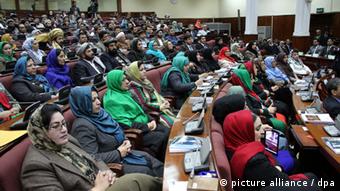
Parlament Afghanistan 2013
The Elimination of Violence Against Women (EVAW) Law was called 'un-Islamic' during a heated debate in parliament in 2013
Mosadiq said double standards by the authorities towards men and women have led AI to the conclusion that both current and former Afghan governments "have failed to protect women and do not show a strong commitment to do so in the future."
In light of this development, the rights group stressed that laws and policies alone cannot achieve transformative social change. "The Afghan government must also demonstrate the political will and financial commitment to ensure that obligations on paper to protect the rights of women and girls translate into genuine protections on the ground."
Any action by the authorities should be undertaken with the meaningful participation of women human rights defenders and civil society, the rights group added.

Bearing the brunt: Peshawar worst hit by terror in 2014


Known by old timers as the city of flowers, Peshawar now holds the unenviable position of being the most militancy-hit district of the province. In 2014 there were 401 incidents of terrorism, including suicide attacks, IED blasts and target killings in Peshawar district. It was followed by Hangu and Charsadda, states the confidential police report State of militancy in K-P.
Peshawar district
About 283 civilians and 73 law-enforcement personnel were killed in various attacks. At the same time, 601 civilians and 87 law-enforcement officials suffered injuries in these brutal strikes. There have been seven suicide bombings, 169 IED attacks, 65 target killings, 79 firing incidents and 19 mortar attacks among others forms of terror strikes.
Not only has the district borne the brunt of the war against terror, but Peshawar Division, which also comprises Charsadda and Nowshera, suffered 50% of all militant attacks in the province in 2014.
Attacks
In 2013, there were 405 militant attacks in Peshawar Division; a number which shot up to 508 the following year.
Also, the number of terrorist attacks in Peshawar district jumped from 291 in 2013 to 401 in 2014. The favoured modus operandi of extortionists and militants remained IEDs as 212 of these devices went off in 2014 compared to 202 in 2013.
Though suicide attacks decreased from nine in 2013 to seven last year, IED blasts, hand grenade attacks and target killing incidents rose considerably in Peshawar district.
Hangu witnessed the second highest number of terror-related incidents with 88 different attacks in 2014. This compares to 63 incidents in 2013, while Charsadda was the third worst affected in 2014 with 86 terrorists attacks. In 2013, Bannu was the second-worst hit district in 2013 followed by Charsadda with 94 attacks.
A police official told The Express Tribune there was an overall decrease in the number of large-scale bombings in Peshawar district, but IEDs planted by militants and extortionists remained a problem throughout 2014.
“Peshawar is the heart of the provincial government and is quite accessible from the Khyber Agency, Mohmand Agency, Darra Adam Khel and FR Peshawar at large,” he said. The officer added the ongoing military operation had limited the militants to some extent, but they consequently hit soft targets as was evident from the Army Public School massacre.
“I think the threat to Peshawar will continue in future,” he said, adding considerable security arrangements were required to counter the danger.

Pakistan does a North Korea, openly brandishes its nuclear weapons


By Seema Sirohi
At the recent Carnegie Conference on Nuclear Policy, Pakistan openly brandished its nuclear weapons, advertised its bellicose intentions and generally sounded more like North Korea than a maturing nuclear power.
The full-throated cry of frustration had a purpose—to put hurdles in the way of India’s entry into the Nuclear Suppliers Group (NSG) because it would be yet another sign that the international community accepts India’s nuclear programme for special treatment but not Pakistan’s.
Gen. Khalid Kidwai, who has overseen Pakistan’s nuclear programme for more than 15 years and is still involved as an adviser, was in full flow, spinning scenarios and issuing warnings to India from what is arguably the most prestigious international platform on matters nuclear. You have the eyes and the ears of hundreds of western experts, government officials and budding scholars. In short, it is the best place, especially for countries with a highly questionable nuclear past, to muddy the waters and raise straw men. And he did both.
Kidwai faced no push back from the moderator as he built his case on what was essentially fiction. He said “Cold Start” was the reason for a Pakistan gone wild and for piling up an arsenal of tactical nuclear weapons (TNWs). Pakistan has also developed “full-spectrum deterrence” and is working towards a second-strike capability to counter India, he helpfully informed the audience.
Frankly, he should have been stopped in his tracks because “Cold Start” is not Indian policy. The political leadership never embraced it and the last one heard the Indian armed forces were firmly under the command of the elected government. Cold Start was an “idea” of a quick and limited conventional strike against Pakistan with the narrow aim to deny Islamabad the ability to raise things to a nuclear level. Indian generals, frustrated after the army’s mobilisation on the border in response to the ISI-supported Lashkar-e-Taiba’s attack on the Indian Parliament in 2002, had floated the idea but it was never adopted.
A principal recommendation of Cold Start was to move the Indian Army closer to the border. This never happened. The fact is whatever India does or doesn’t do, the Pakistani army will conjure up clouds of paranoia to justify its strategy. It is this imagination that is behind Pakistan’s rush to build TNWs. Tactical nukes are deemed highly destabilising because they are small and to be effective on the battlefield, they must be distributed to lower-level officers. The more diffused the command and control, the more likelihood of mistakes and escalation in the fog of war. The mechanics of deploying TNWs are tricky at best but Kidwai dismissed questions on command and control as “lesser issues.” Then he added Pakistan’s nuclear policy is one of “ambiguity.”
The nuclear gurus must ponder if “ambiguity” gives them confidence or bolsters “transparency” or marks an improvement from the days of AQ Khan when Pakistan was found proliferating nuclear technology from Libya to Iran.
Yet, Kidwai kept up the charade that Pakistan is the victim. In fact, he argued his TNWs had made “war less likely” because they would make India “think twice, ten times” before attacking Pakistan. If India still doesn’t get scared, “MAD (mutually assured destruction) will come into play.” He boastfully told India to keep in mind Pakistan’s “complete inventory.”
If it weren’t the Carnegie nuclear conference, one might be forgiven for thinking Kidwai was doing what today’s teenagers call “drama.” The climax of the drama: You gave India a nuclear deal but now don’t allow India to enter the Nuclear Suppliers Group — the anticipated next step stemming from the 2008 Indo-US agreement— or Pakistan will go madder.
Blackmail? It sure sounded like it. Kidwai wants India’s entry into the NSG to be “criteria-based” because that would allow Pakistan to enter at some later date if it meets those criteria. It shouldn’t be a special favour for India. This demand is nothing but a giant ruse.
It is designed to tickle and press into service the same non-proliferation hardliners in the United States and Europe who initially opposed the India-US nuclear deal. They still have grievances against India and putting hurdles in India’s path to NSG membership has their attention.
But let’s go along and see how a “criteria-based” approach might develop. Here are some questions: Keeping in mind Pakistan’s record of proliferating nuclear technology to the likes to North Korea just a decade ago, what should be the period of punishment? Or should bad behaviour be incentivised?
Is outwards proliferation the same as inwards proliferation? Is bravado as displayed by Kidwai the same as transparency? Western observers tend to confuse braggadocio with facts without a shred of verification. Do statements like Kidwai’s help build strategic stability?
How about a criterion that no one with a jihadist mindset should ever get close to nuclear weapons? How can this ever be ascertained? Sorry, but Kidwai’s word is no good after insider attacks on Pakistan’s naval base and army headquarters. US experts are well aware of the penetration of Pakistan’s armed forces.
Another criterion could be determining the “motive” to enter the NSG. Is it prestige and parity as in Pakistan’s case or accessing technology as in India’s case? How about a criterion on the end-game: the country in question must give up revisionist tendencies.
And while the experts are at it, they can also examine the dangers of a country conducting terrorist attacks under a nuclear umbrella. That should certainly mean “No Admission” or shouldn’t it?

Analysis: Several Factors Motivate Saudi Outreach to Pakistan


By Pamela Dockins
Saudi Arabia’s bid to get Pakistani military support for the Saudi-led effort against Houthi rebels in Yemen is designed to “scare” the Iranians, says Charles Schmitz, an analyst at the Middle East Institute.
 
Schmitz says Pakistan would be a much greater threat to Iran than the Saudis are.  He said bringing Pakistan in “increases the pressure on the Iranians,” who are backing the Houthi rebels.
 
“The Pakistanis are very effective. They are militarily accomplished,” said Schmitz. “They are trained and disciplined and “battle-ready units,” he said.
 
Saudi Arabia Steps Up After Yemen Spins into Chaos
 
A Saudi-led regional coalition began launching airstrikes against the Houthi rebels last month. The rebels seized control of the capital, Sana’a, in September. They began marching on the southern city of Aden last month.
 
Yemen’s U.S.-backed leader, President Abd-Rabbu Mansour Hadi, left the country last month and went to Riyadh.
 
The Pakistani parliament is considering the Saudi request to provide ground troops as well as air and naval support.
 
The country’s defense minister, Khwaja Muhammad Asif, told parliament on Monday that the country’s decision would “reflect the wishes of the people of Pakistan.”
 
“I want to reiterate that Pakistan has pledged to defend the territorial integrity of Saudi Arabia and, if needed, Pakistan will fulfill this pledge,” he added.
 
U.S. Takes Neutral Stance
 
At the U.S. State Department, spokeswoman Marie Harf declined to weigh in on whether Pakistani involvement would be beneficial or destabilizing.
 
“Every country can make their own decisions about whether to join these kinds of efforts. The same goes for the Pakistanis,” said Harf.
 
Several Motives Behind Saudi Request
 
Nabeel Khoury, an analyst at the Atlantic Council’s Rafik Hariri Center does not think Pakistani involvement would be destabilizing. But he says adding Pakistan would be “overkill.”
 
“All [of] these countries that Saudi Arabia is adding have a more sophisticated military, specifically the Arab countries of Morocco, Jordan and Egypt,” said Khouri.
 
He said there are other motives behind Saudi Arabia’s decision to reach out to Pakistan.
 
Saudi Arabia has extended financial assistance to Pakistan to help with its troubled economy. Also, the Saudi royal family provided shelter to Pakistani President Nawaz Sharif after he was ousted in a 1999 military coup.
 
“Riyadh likes to keep Pakistan on tap,” said Khouri. “They have a special relationship,” he said.
 
But Schmitz says Saudi Arabia’s decision to try to engage Pakistan may be more of a reflection of its concern about widening Iranian influence in the region.
 
He said Saudi Arabia is concerned that the nuclear talks that are under way between Iran and the five permanent members of the U.N. Security Council and Germany could lead to rapprochement between the U.S. and Iran.
 
Schmitz said the Saudis are clearly worried about this possible outcome.
 
He said the Saudi decision to lead the regional coalition fight against the Iran-backed Houthis is a “Saudi defense pact.”
 
“It is a means for them to assert their ability to defend themselves without the United States, and to not take directions from the United States,” he said.
 
The U.S. has not indicated that a nuclear deal with Iran would lead to closer engagement with Tehran on other issues.

Eight Iranian guards shot dead on Pakistan border

Iran’s semi-official Fars news agency says gunmen have killed eight Iranian border guards in the country’s volatile south-east, near the border with Pakistan.
The report says the attack happened on Monday in Sistan-Baluchistan province. Fars says four of the soldiers killed were conscripts.
The area has been the scene of occasional clashes between Iranian forces and militant groups believed to be affiliated with al-Qaida. It was the second incident reported there in a day.
Earlier on Monday, Iran’s official news agency, IRNA, said Revolutionary Guard units broke up a militant group linked to a foreign intelligence agency, killed three of its members and detained several others. IRNA also said Guard forces confiscated a large amount of weapons and communication equipment.
http://www.theguardian.com/world/2015/apr/07/iranian-guards-shot-dead-pakistan-border