Sunday, December 21, 2014

The Kremlin's foreign policy gamble in 2014: Implications and expectations


http://www.russia-direct.org/


With Russia losing traditional and reliable partners in Europe, it is trying to find new ones in Asia, the Middle East and Latin America. Yet can these “new allies” satisfy Moscow’s trade requirements and replace the partners Russia has lost over its schism with the West?

 
Russian President Vladimir Putin (left) and Foreign Minister Sergei Lavrov chat before their meeting with Canadian Prime Minister Stephen Harper before at the Asian-Pacific Economic Cooperation (APEC) Summit in Vladivostok in 2012. Photo: AFP
With 2014 coming to an end, the results of Russia’s controversial foreign policy this year are becoming even more conspicuous. Not only did Moscow spoil its relations with the U.S. in 2014, but also with its traditional allies in Europe, particularly with France and Germany, as indicated by the Mistral case with France and the failure of German Chancellor Angela Merkel and Russian President Vladimir Putin to see eye to eye.
Crimea’s accession to Russia, the Kremlin’s alleged support of separatists in Eastern Ukraine, the downing of Malaysia Airlines flight MH17 – all this contributed to dividing European countries in their assessment of Russia’s policy in Ukraine and the sanctions war between the Kremlin and the West.   
Likewise, Eastern European countries, and particularly, the Visegrad group, or V4 (an alliance of four Central European states – the Czech Republic, Hungary, Poland and Slovakia) were split. With Poland insisting on a tougher response to Russia’s policy in Ukraine, the Czech Republic, Slovakia, and Hungary were hesitant to support sanctions and reluctant to blame Moscow because of their economic and political links, as well as energy reliance on Russia.
Russia’s foreign policy resulted in a split even among close and long-standing partners like Serbia and Bulgaria, which seem to be vacillating over how to respond to Russia’s policy in Ukraine. Under the pressure from the European Union, Serbia is faced with a challenge: It should join the Western-led sanctions campaign against Russia if Belgrade wants to join the EU.
Meanwhile, Bulgaria, previously described by experts as Moscow’s Trojan Horse,suspended the South Stream energy project in June 2014 as one of the key transit points for the gas line. The lack of certainty over the South Stream pipeline finally led to the closure of the project in early December, initiated by the Kremlin.     
Germany and France are also showing signs of indignation toward Russia’s foreign policy, as well as solidarity with the U.S. in its response to the Kremlin’s role in the Ukrainian crisis. The recent suspension of the Mistral warship delivery to Russia indicates that Paris is not going to support the Kremlin despite the fact that French President François Hollande is the first senior Western leader to have paid an official visit to Moscow since the incorporation of Crimea into Russia. 
Likewise, there is a noticeable chill in Russian-German relations, with Merkel failing to find common ground with Putin and remaining intransigent in rebuking Russia over its gamble in eastern Ukraine. Even though German society is divided in its assessments of the prospects of Russian-German relations, there are increasing debates over the possibility of a cold war between Germany and Russia.
Steven Pifer, former U.S. ambassador to Ukraine and Brookings Senior Fellow at Center on the United States and Europe, agrees that “one of the unintended but major consequences of Russia’s illegal seizure of Crimea and its intervention in eastern Ukraine has been the setback in Russian relations with Europe (as well as the United States).”
As a result of its Ukraine policy, Russia is seen as a security threat: Berlin – which until now has been pursuing its Ostpolitik, the eastern approach that underpinned the German-Russian relationship before the Crimea precedent and the downing of MH17 – appears to be reassessing its fundamental policy to the Kremlin, Pifer added. 
“While Chancellor Merkel keeps lines of communication open to President Putin, she has emerged as a leader within Europe for a tough response toward Russia until it alters its course on Ukraine,” he told Russia Direct.
So, while losing its partners in Europe, Russia makes no bones about its turn to Asia, the Middle East and Latin America in attempt to persuade the West that it is not isolated and has numerous partners. Putin’s visits to India, Turkey in December, China in May andLatin America in July look like a clear gesture from Russia, demonstrating that it can make do without the West.
Likewise, Russia is attempting to establish closer ties with Iran amidst its schism with the West, as indicated by the conference held in Moscow on Nov. 25 on “Development of Strategic Partnership between Russia and Iran" organized jointly by the Russian International Affairs Council (RIAC), the Center for Energy and Security Studies, the Iranian Embassy in Moscow and the Institute of Iran Eurasian Studies (IRAS), Tehran.
The conference brought together leading Russian and Iranian pundits and diplomats in a quest both to broaden and deepen bilateral relations in light of their shared interests and the common challenges (sanctions) they face. In particular, both are interested in energy security and so-called multipolarity, the term that became a sort of a buzzword for Russia’s Foreign Ministry in its PR campaign to account for its recent foreign policy initiatives to undermine the United States’ global influence and political heft.      
Who will replace Moscow’s lost partners in the EU?
With Moscow trying to find allies in Asia and the Middle East, several questions remain unanswered.
Will the Kremlin’s allies be able to minimize the consequences of the Russian rupture with the West? To what extent will the relations with them be sustainable in 2015? Will these countries remain interested in collaboration with a weaker Russia and prefer it over the partnership with West?  
Jack Goldstone, a political expert and professor at George Mason University, points out that Russia has always sought strong relationships with Central Asia, and was engaged in the Shanghai Cooperation Organization (SCO) and the BRICS group well before this summer’s difficulties with Europe.
“But Russia is now trying to deepen and strengthen ties in Asia and the Middle East more than ever to offset the losses of business with Europe,” he said, pointing out that Russia might succeed “only to some degree” in this turn.
According to Goldstone, Russia is able to replace certain raw materials markets and strategic alliances by invigorating its ties with Turkey, India, and China. However, he highlights, Russia also needs capital and technical and academic expertise, and “these can NOT so easily be obtained outside of Europe and North America.”
“Turkey and India themselves are in dire need of capital, and have weaker educational systems than Russia,” Goldstone explains. “China has plenty of capital and plenty of expertise, but needs its capital internally and is also keen to invest in Africa and Iran and elsewhere, and lacks some of the specific expertise (e.g. Arctic oil exploration, tight oil extraction, innovation-based entrepreneurship) that Russia needs most.”
 
Russian Foreign Minister Sergey Lavrov listens during voting in the Federation Council during a session in the Russian parliament's upper chamber in Moscow, Russia, Friday, March 21, 2014. Photo:AP
Likewise, Pifer raises eyebrows at the possibility of deep and extensive ties between Russia and China, India and Turkey. They “might work” with Russia on trade, but “they are unlikely to ally with Moscow, and they won’t “displace Europe in trade terms.”
“In 2013, EU-Russia trade was more than four times Russia-China trade, and more than 15 times Russia-Turkey trade,” Pifer said, echoing Andrei Kortunov, general director of the Russian International Affairs Council (RIAC), who also points to this fact.
Even though Asia and the Middle East do matter for Russia’s foreign policy, Moscow should abandon its deep-seated illusion that there is an opportunity to switch from its Western partners to eastern ones, Kortunov warns. According to him, Russia’s partnership with its “new allies” should be based on positive aspects: teaming up not against somebody, but for the sake of the understanding of mutual interest and benefits.
“Russia’s new allies in the Middle East and Asia should not replace, but rather should be an addition to our traditional partners, including those in the zone of the European Union,” he said.
Mikhail Troitskiy, an international affairs analyst and an associate professor at Moscow State Institute of International Relations (MGIMO-University), echoes his view. He sees no clear evidence of the willingness of “Russia's supposed ‘new partners’ to engage in preferential relationship with Moscow because of the crisis in Russia's relations with the West.”
“In most cases, Russia's ‘new partners’ pursue their own – mainly economic – agendas, while considerations of ‘standing up to U.S. dictates’ take the backstage as a motivation for engaging with Russia,” he said.
In fact, Troitskiy is doubtful that Russia aims at replacing its EU partners with other ones elsewhere. If there are promising bonds and benefits to Moscow from cooperation with Asia or the Middle East, they had to be expanded irrespective of Russia's relations with the U.S. or the EU.
“I do not think that the ‘partner replacement’ logic works in contemporary international relations,” he said. “Such logic can only be applied – albeit with limited effect – to military alliances. If we are talking about trade, other forms of economic engagement, and even diplomatic coordination, ‘replacing’ one set of failing relationships with another simply makes no sense. There was never any reason why Russia should not have been developing ties with potential partners in the Middle East or [the] Asia Pacific [region] before its conflict with the West over Ukraine started.”
Are the Middle East and Asia really eager to team up with Moscow?
Even though Moscow made several attempts to woo the Asian and Middle East countries, there is still a lack of certainty over whether these “new allies” are eager to team up with Moscow and sacrifice their relations with the U.S. (Washington is unequivocal about its insistence and pressure on other countries to join their campaign against Russia’s policy in Ukraine).
According to Pifer, although these countries are interested in doing business with Russia, they are hardly likely to put at stake “their far larger business relations with the West.” He gives the example of China.  
“The European Union and United States are China’s first and second largest trading partners, accounting for some 30 percent of China’s overall trade. Russia does not even figure in the top ten of Chinese trading partners,” Pifer said, pointing out that “Moscow holds a weak hand” in its relations with Beijing.   
However, Kortunov believes that countries such as India and China are hardly likely to yield to U.S. pressure. He sees them as “independent players of world politics” that have no reason to join the U.S. campaign against the Kremlin. Yet those countries that have economic and political links with Washington will yield, as in the case of Japan, which has imposed sanctions against Russia.
“Japan was forced to support sanctions due to its geostrategic and geopolitical positions,” Kortunov said. "Tokyo wants to develop its relations with Russia, yet it has to be in solidarity with the U.S.”

Video - Obama: Back and forth between racial divides

Obama Condemns Murder of NYPD Officers


U.S. President Barack Obama denounced the close-range shooting deaths of two New York City police officers in an ambush earlier threatened in an online posting.
“I unconditionally condemn today’s murder of two police officers in New York City,” Obama said in a statement yesterday from Hawaii, where he is spending the Christmas holiday with his family. “Two brave men won’t be going home to their loved ones tonight, and for that, there is no justification.”
New York City Mayor Bill de Blasio, in a press conference last night, called the execution-style killings of Officers Rafael Ramos, 40, and Wenjian Liu, 32, a “despicable act.” Police CommissionerWilliam Bratton said the officers were “quite simply, assassinated.”
Ramos and Liu were sitting in their vehicle near Myrtle and Tompkins avenues in the Bedford-Stuyvesant section of Brooklyn when Ismaaiyl Brinsley, 28, walked up from behind, took a shooting stance and opened fire on the passenger side at about 2:47 p.m., Bratton said.
“They may never actually have seen their assailant,” he said. The officers were taken to the Woodhull Medical Center, where De Blasio and Bratton held last night’s press conference.
Bratton described how Brinsley earlier in the day shot his ex-girlfriend in the Baltimore area before writing “very anti-police” postings on social media. At approximately 2:45 p.m., Baltimore authorities sent a warning flier. “Tragically, this was essentially at the same time that our officers were being ambushed and murdered by Brinsley,” he said.
The assailant fled into a subway station, where he died from a self-inflicted gunshot wound to the head on the platform, Bratton said.
De Blasio said New York “is in mourning.” “Our hearts are heavy,” he added.

North Korea says it did not hack Sony

Obama says Sony hack not an act of war


U.S. President Barack Obama moved to prevent U.S. anger at North Korea from spiraling out of control on Sunday by saying the massive hacking of Sony Pictures was not an act of war but instead was cyber-vandalism.
Washington's long-standing dispute with North Korea, which for years has centered on its nuclear weapons program, has entered new territory with the accusation that Pyongyang carried out an assault on a major Hollywood entertainment company.
Obama and his advisers are weighing a range of options on how to punish North Korea for the attack after the FBI concluded on Friday that Pyongyang was responsible. North Korea has denied it was to blame.
The hack attack and subsequent threats of violence against theaters showing the film prompted Sony to withdraw a comedy, "The Interview," prepared for release to movie theaters during the holiday season. The movie depicts the fictional assassination of North Korean leader Kim Jong-un.
Obama and free speech advocates criticized the studio's decision, but Sony Pictures Entertainment CEO Michael Lynton defended it.
Obama put the hack in the context of a crime.
"No, I don't think it was an act of war," he told CNN's "State of the Union with Candy Crowley" show, which was taped on Friday and aired on Sunday. "I think it was an act of cyber vandalism that was very costly, very expensive. We take it very seriously. We will respond proportionately."
Obama said one option was to return North Korea to the U.S. list of state sponsors of terrorism, from which Pyongyang was removed six years ago.
At a time when so much information is digitized, "both state and non-state actors are going to have the capacity to disrupt our lives in all sorts of ways," he said.
"We have to do a much better job of guarding against that. We have to treat it like we would treat, you know, the incidence of crime, you know, in our countries."
Republican Senator John McCain disagreed with Obama, telling CNN the attack was the manifestation of a new kind of warfare.
Republican Representative Mike Rogers, chairman of the House Intelligence Committee, criticized Obama for embarking on a two-week vacation in Hawaii on Friday without responding to the attack.
"You've just limited your ability to do something," Rogers told Fox News Sunday. "I would argue you're going to have to ramp up sanctions. It needs to be very serious. Remember - a nation-state was threatening violence."
North Korea has been subject to U.S. sanctions for more than 50 years, but they have had little effect on its human rights policies or its development of nuclear weapons. Experts say the nation has become expert in hiding its often criminal money-raising activities, largely avoiding traditional banks.
NORTH KOREA DENIES ATTACK
North Korea said on Saturday that U.S. accusations that it was involved in the Sony attack were "groundless slander" and that it wanted a joint investigation into the incident with the United States. It said it could prove it had nothing to do with the attack.
The White House said on Saturday it remained confident North Korea was responsible.
The U.S. Federal Bureau of Investigation said Pyongyang's actions fell "outside the bounds of acceptable state behavior."
Obama says North Korea appeared to have acted alone. Washington began consultations with Japan, China, South Korea, Russia, Australia, New Zealand and the United Kingdom, seeking their assistance in reining in North Korea.
Japan and South Korea said they would cooperate. China, North Korea's only major ally, has yet to respond, but a Beijing-run newspaper said "The Interview" was not a movie for Hollywood or U.S. society to be proud of.
It was the first time the United States had directly accused another country of a cyberattack of such magnitude on American soil and set up the possibility of a new confrontation between longtime foes Washington and Pyongyang.
U.S. experts say Obama's options in punishing North Korea could include cyber-retaliation, financial sanctions, criminal indictments against individuals implicated in the attack or even a boost in U.S. military support to South Korea, which is still technically at war with the North.
But the effect of any response would be limited, given North Korea's isolation and the heavy sanctioned already in place for its nuclear program.

Turkish police use force to break up pro-secular education rally


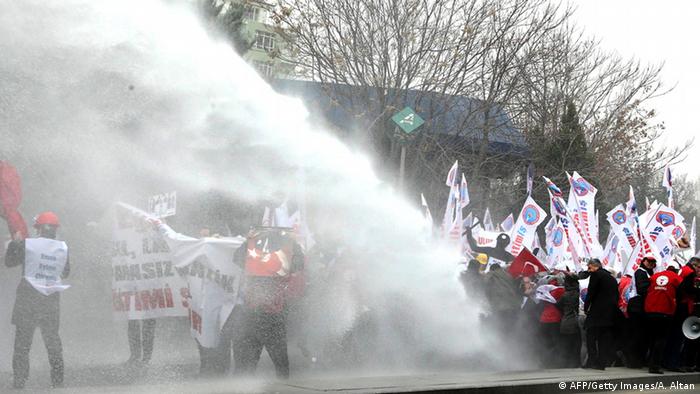
Turkish police have moved in to forcibly break up a demonstration in the capital, Ankara. The authorities said the protest, organized by a teachers' union, was illegal.
Demonstration gegen die Bildungspolitik der AKP in Ankara 20.12.2014
Police used pepper spray, tear gas and water cannons to disperse demonstrators who had assembled in the Kizilay district of Ankara on Saturday. Some reports said as many as 100 people had been arrested by police, including the head of the Egitim-Is teachers' union, Veli Demir.
A video posted on the website of Turkey's Hurriyet newspaper showed protesters, some of whom were holding large banners, being driven back by the flow of water coming from water cannons mounted on police trucks. Later, what appear to be dozens of protesters are led away by police officers wearing riot gear.
The union organized the rally to demonstrate in favor of secularism in Turkey's education system, as required by the country's constitution.
Some fear that this could be threatened by President Recep Tayyip Erdogan, who founded the ruling Islamic-rooted Justice and Development Party. He has recently made statements on education, which some have interpreted as a signal that he is planning to bring more religion into the classrooms.
Last year, Turkey's parliament lifted a long-standing ban on Islamic headscarves in the civil service and this past September, it removed a ban on female students wearing them in high schools.
At odds with the EU
Erdogan has also faced growing international criticism in recent months. Leading up to local elections in March, while he was still prime minister, Erdogan manged to temporarily ban the social media websites Twitter and YouTube, after they were used to disseminate tapped compromising phone calls that cast corruption suspicions on members of his inner circle. The bans were subsequently overturned by Turkey's constitutional court.
More recently, he has been at loggerheads with the European Union, which Turkey is seeking to join, over the arrests of more than 20 people, including the editor of Turkey's biggest-selling newspaper.Those arrested have links to US-based Muslim cleric Fethullah Gulen, who is Erdogan's former political ally but is now his arch foe.
The EU's foreign policy coordinator, Federica Mogherini, and Englargement Commissioner, Johannes Hahn, condemned the raids ass "incompatible with the freedom of the media."
http://www.secularism.org.uk/media-round-up.html

#PeshawarAttack - Voices of grief and determination in Peshawar


Taliban gunmen killed 141 people - most of them children - at a school in the Pakistani city of Peshawar earlier this week. There are many emotions among the bereaved and the survivors.
You didn't need to see the pools of blood in every corner of the school auditorium to know that a massacre had taken place there.
A thick smell hit you as you went in; the eerie silence of the shocked adults looking at the remnants of the children's belongings strewn around itself told a devastating story.
Almost every row of seats in this school hall bore a similar picture of horror - the blood-splattered textbooks, the school shoes left behind in a desperate attempt to escape, scattered bits of paper on which you could see the children's handwriting.
This is where the Taliban gunmen stormed in and shot more than 100 pupils at close range.
The students were in the hall learning about first aid when the attack happened. One corner of the room bears scorch marks: that's where the militants set fire to one of the teachers.
When I arrived at the Lady Reading Hospital, where many of the victims were taken, I could see a group of parents and family members gathering in front of a wall, pushing to get to the front.
A list of names had been stuck up on the wall. Names of the dead and injured.
As the day went on the list grew longer and the crowd around it grew bigger - all of them desperate to find out what had happened to their loved ones.
In the hospital's intensive care unit, I found 13-year-old Saeed lying on a bed, his family next to him.
He was still too shocked to talk about what had happened.
His mother Naheda is a teacher at the school.
She tells me Saeed hid under a chair and called her as the attack began.
"I heard everything," she tells me.
"My son was on the phone. He said 'I'm shot, please come and get me.' And I didn't know how to reach him. As a mother - I can't describe to you what I felt," she tells me through her tears, adding: "But Alhamdulillah, thank God, he's now here with me."
But many other parents are now having to live with the fact that their loved ones are not coming back. Like the Awan family, whose 14-year-old son Abdullah was shot in the face during the attack.
At the family courtyard the female relatives gathered around the boy's body which was lying in an open coffin. His slim body was covered in flowers and I could clearly see the bullet marks on his face.
His mother sits on the floor weeping, wiping his forehead, holding his hand, still calling out his name.
This is a family gripped by grief, wailing relatives, small children looking on in disbelief.
At the local graveyard the male relatives recite verses from the Koran and pray for Abdullah before laying him to rest.
"He was a top student," his uncle tells me.
"He loved birds, he had a couple of them at home and one of them laid eggs. He was counting the days for them to hatch but now he's gone."
After the funeral I talk to the boy's father about his loss.
"He's now with Allah," the man said, "and I have to be patient. I don't feel anything now. All these people are around me, they are supporting me. But it will hit me tonight. When I'm in bed all alone."
In the days after the attack the crowds gathering at the school gate grew larger and larger.
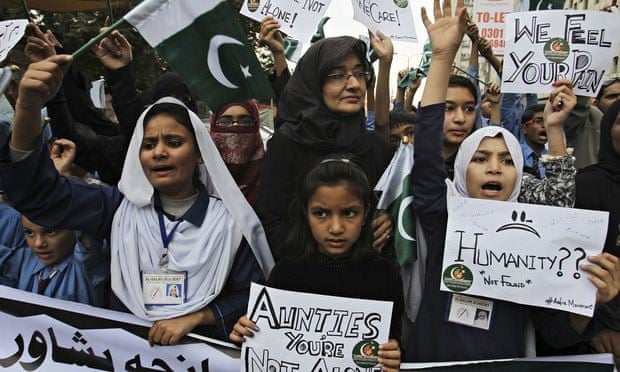
The gates began to resemble a shrine with roses, marigolds, candles and placards.
There were messages of grief and solidarity. The smallest coffins are the heaviest, one sign says. My boy was my dream and my dream was shot dead, says another.
A group of teenagers from the Army Public School was gathering there.
They came dressed in their uniforms.
Aakif Azeem, one of the senior students, still had some spots of blood on his jacket. He had survived the attack but he tells me he saw many fellow students die in front of him.
"I've been going from one funeral to another," he says.
"I haven't slept for two days," he adds.
So, could he face going back to school after what had happened, I wondered.
"That's why I came here today dressed in my uniform," he told me.
It's a message to those who carried out the attack. You can take my friends. You can take my teachers. But I am still here. In my uniform. And I will go back to school.

The Peshawar school massacre united Pakistan – but cracks are already showing


By Ali Dayan Hasan
Sadly, once the dust settles, it is likely the military will stick to the policies that ripped apart so many families


 The Peshawar school massacre has given Pakistanis an unprecedented moment of unity. A country so deeply divided that even 40,000 deaths from terror attacks since 2001 could not create a shared sense of suffering has finally been brought together in horror.
It is tempting to believe that this is a moment of paradigm-shifting lucidity, that the country has woken up to the stark realisation that we cannot carry on with business as usual. After all, if the cold-blooded mass murder of your children does not give you clarity about the Taliban, nothing else can or should.
Yet, just a few days into our collective mourning, our shared revulsion is already fraying at the seams. Taliban-apologist clerics still enjoy airtime on television, pundits are beginning to point the finger away from domestic militants towardsIndia, and the sickening mantra of “Muslims could not possibly do this”, recited after so many other attacks, is resurfacing.
In the coming days, as anger gives way to the hard business of fighting the Taliban, and they in turn unleash further atrocities, the country’s myriad social and political fissures are likely to re-emerge through the anger and grief.
Our dirty, open “secret” is that the war against the Taliban is also Pakistan’s war within – a strategic, political, cultural and religious schism that creates an atmosphere of denial and myopia. We are unable and unwilling to look clearly at the nature and causes of the Islamist threat, or evaluate our own response rationally.
Prime Minister Nawaz Sharif has declared an end to decades of trying to differentiate between “good and bad” Taliban, until now a cornerstone of the country’s controversial national security policy. His political nemesis, Imran Khan, has grudgingly agreed to put his campaign to oust Sharif on the backburner to make common cause on the Taliban threat.
It remains to be seen whether this truce can endure, and even if it does, Pakistan’s cowardly political class is usually happy to play “blame the military” rather than grapple with anti-extremist efforts. But politicians are the least of Pakistan’s problems.
Above all, this is a moment of truth for Pakistan’s powerful military. Can it wage an effective war against the jihadi network it has created, while continuing to use elements of that system against its perceived enemies in India and Afghanistan? If not, would it really give up those carefully nurtured allies?
On this, the Pakistani military has disagreed with much of the world since 9/11, clinging to its policies even as its proxies turned first on Pakistani civilians, then on army officers and installations, and now on the children of military personnel.
Sadly, once the dust settles, it is likely the military will stick to the policies that ripped apart so many families in Peshawar last week. It may ratchet up its fight with the Pakistani Taliban but is unlikely to take off the kid gloves used for handling both their Afghan counterparts and its principal jidahi ally in India, Lashkar-e-Taiba. The world finds this duplicity galling. It is. But it is not just a function of a self-annihilating quest for power.
Support for Islamist extremism and the militancy that goes with it is a fault-line that runs through the length and breadth of the country, driven not just by fear, but religious conviction and social acceptance. Any all-out onslaught on the web of jihadi organisations would strain the state and risks turning the country’s heartland and its major cities into warzones.
An underlying fear, that Peshawar could become the bloody norm, drives a national security narrative that presents support for extremists as a sophisticated protection of national interests rather than what it really is, Stockholm syndrome affection for an organisation holding us all hostage.
There can be hope, if Pakistan’s allies and neighbours are willing to create a conducive environment for the country to wean itself away from “Jihad Inc”. Most urgently, Pakistan’s military needs to rework its understanding of the threat posed by India. But unless India acknowledges the centrality of a stable and strong Pakistani state to its own security imperatives, and can find the empathy to see Pakistan as a victim of terror (albeit of its own making), it is unlikely that Pakistan’s military will ever fully abandon its jihadist allies.
Pakistan’s perceived friends have emerged as its greatest enemies. The country has little hope of changing course for the better if its perceived enemies cannot learn to be its friends.

America's $28-Billion Failure in Pakistan


The U.S. has never convinced the Pakistanis to confront militants. Could that change after the Taliban's school attack?

Since 2001, the United States has tried virtually every strategy available to persuade Pakistan's army to take the threat of militancy more seriously, but 12 years and $28 billion in aid later, all the American approaches are widely viewed as having failed.
First, the Bush administration heaped praise on former Pakistani President Pervez Musharraf, agreed to reimburse the Pakistani army for anti-Taliban military operations, and launched drone strikes that killed al-Qaeda leaders and militants wanted by the Pakistani government. Adopting a more confrontational stance, the Obama administration unilaterally carried out the raid that killed Osama bin Laden, vastly increased aid to Pakistan’s weak civilian institutions, and, at times, cut off aid to the Pakistani military.
Yet the militants continue to operate, ever more brazenly, as illustrated by Tuesday's harrowing attack on a school in Peshawar, in which 132 students were killed by a faction of the Pakistan Taliban. And with the United States increasingly focused on other crises, Washington's options for bringing about change in an increasingly unstable Pakistan are dwindling fast.
There is great ‘Pakistan fatigue’ in Washington," said Cameron Munter, who served as the American ambassador to Pakistan from 2010 to 2012. “Not only have the last dozen years been very difficult, but other challenges—from Syria to Ukraine to Iran, to name a few—demand our attention."
Although Tuesday’s attack sparked widespread condemnation, current and former U.S. officials expressed cynicism that the bloodshed would cause Pakistan's military to change its view of militants.
Munter and other officials said the United States has been unable to break a powerful, army-backed narrative in Pakistan that militant attacks are the result of America’s war on terror. Foreign powers, not Pakistan, are responsible for growing militancy in Pakistan, according to the narrative. And Pakistan is not responsible for the problem and unable to stop it.
That narrative played out immediately when Pakistan’s army chief, General Raheel Sharif, flew to Afghanistan within 24 hours of the attack to meet Afghan leaders. They said they had information that the school attack was directed by militants hiding inside Afghanistan. "We are hoping that we will see strong action from the Afghan side in the coming days," said Pakistani army spokesman Major General Asim Saleem Bajwa.
One senior American official said he hoped the trip was not "communications Kabuki" designed to divert blame for the failure to stop the attack away from the Pakistani army. Analysts said the army is failing to own up to its decades-long history of training, funding, and sheltering some militant groups and using them as proxies to counter archrival India in Afghanistan and Kashmir.
Since 2001, a parade of American officials—from presidents to CIA directors—have repeatedly warned Pakistan's generals that they will lose control of their militant proxies and eventually be attacked by them. Pakistani military officials have denied sheltering militants.
But some current and former U.S. officials said the sheer brutality of this week's attack would intensify demands from Pakistan's public for the army to confront militancy. James Dobbins, who served as the Obama administration’s special representative to Afghanistan and Pakistan from 2013 to 2014, said there was also growing pressure from Pakistan’s longtime ally China. “I think they are pressing Pakistan to take this threat more seriously,” he said.
Munter, the former ambassador, argued that the problem reflects a more fundamental question of whether militants have become so entrenched that the Pakistani army cannot defeat them. The senior administration official was more optimistic, contending that even before the school attack, the Pakistani public was raising pressure on the army to act. The ongoing military operation in North Waziristan that militants said prompted the school attack was evidence of change.
"There has been a growing sense in Pakistan that this is an issue that they need to deal with,” said the senior official, who asked not to be identified by name. But Shamila Chaudhary, who served as senior director for Pakistan and Afghanistan on the National Security Council from 2010 to 2011, warned that as U.S. attention has shifted elsewhere, the steady deterioration of Pakistan’s institutions, security forces, and economy has continued.
For years, Chaudhary said, she dismissed alarmist warnings from other U.S. experts on Pakistan that the country's nuclear arsenal was unsafe. The inability of Pakistan’s security forces to protect a military-run school, she said, has given her doubts regarding Pakistan’s atomic arsenal for the first time.
"I will have a hard time saying to people that militants can never steal Pakistan’s nuclear weapons,” she said. “The more these things happen, that rate of risk goes ahead, and I just think, well, it could happen one day.”

Video Report - Tehreek-e-Taliban Pakistan's Peshawar school attack was well planned

Pakistan dares to ask: will school attack finally end myth of the ‘good Taliban’?


Jon Boone

Decades of state support for jihadis has led to national confusion over who the real enemies are. But the latest attack might be a watershed.

It is not just the survivors of Tuesday’s assault on Peshawar’s Army Public School who have been reliving the nightmarish attack that left 132 teenage boys dead. The entire country has been traumatised by graphic accounts of gunmen spraying bullets into a hall full of children and then later sadistically killing others after checking whether their parents served in the military.
On Wednesday, Pakistan’s army made a point of letting scores of television crews trample over the crime scene in order that they could broadcast pictures of rooms blasted by suicide bombers, floors covered with pools of barely dried blood, and the sad detritus of an ordinary school day suddenly interrupted by seven terrorists.
Rifaat Hussain, an academic, said the military was trying to generate a commodity that has long eluded Pakistan: a national consensus to fight terrorism. “The army had already decided Pakistan will never know peace or become a normal country unless these guys are put out of business, but they are using this horrific event to drive the point home,” he said.
That Pakistan should need any encouragement to tackle a problem that has claimed 50,000 lives since 2001 baffles outsiders. But decades of state support for jihadist groups, combined with reluctance by politicians to confront violent groups, has led to a national confusion over who Pakistan’s enemies are.
In the aftermath of Tuesday’s attack, politicians and many members of the public were unwilling to say publicly whether they thought the Taliban had really carried out the atrocity, even though the Islamist movement’s franchise in the country – the Tehreek-e-Taliban Pakistan (TTP) – had wasted no time in claiming responsibility.
At Friday prayers few mullahs dared utter the word “Taliban”, with many shifting the blame on to vague conspiracies hatched by the west. “May God bless the departed souls and give courage to bereaved families,” the cleric of one unexceptional mosque in a prosperous area of Islamabad told the worshippers, before adding: “May God foil the conspiracies of the Jews and infidels aimed at dividing the Muslims.”
Such statements are what Pakistani journalist Ejaz Haider calls “whataboutery”. “When you say we have a real problem here, the other side will say ‘what about the Americans inAfghanistan?’, or ‘what the western world is doing’, or ‘what the Israelis are doing’,” he said. “It is part of the extremist mindset which has seeped deep into sections of society.”
Many blame Zia ul-Haq, the 1980s military ruler and hardline Islamist who massively increased Pakistan’s use of militants as proxy warriors in its struggle to dominate Afghanistan and win control of Indian-controlled Kashmir. Backed by US and Saudi money, Pakistan created a vast infrastructure of radical religious schools and training camps. The “mujahideen” that resulted were sold to the public as heroes of Islam who kicked the Soviet Union out of Afghanistan. Generations of schoolchildren have since been brought up on textbooks praising holy war and vilifying Hindus and India.
Pakistan repeated the trick in the 1990s, sending jihadists to stoke insurgency in Indian-held Kashmir and giving massive assistance to the Taliban, the once lowly mullahs’ movement that had seized control of Afghanistan in 1989.
Even after the al-Qaida attacks on the US in 2001, Pakistan refused to abandon the Taliban, despite being a nominal ally of the western powers who toppled Islamabad’s client regime in Afghanistan. Pakistan continued to shelter the Taliban, even as some militants, feeling betrayed by the country, turned against their old masters with attacks on the country, such as the 2008 truck bombing of the Marriott Hotel in Islamabad.
This is the bizarre-sounding phenomenon known as “good Taliban” and “bad Taliban” that for a decade has sown deep confusion among the Pakistani public and infuriated western powers. As Hillary Clinton put it in her 2011 warning to Islamabad, “you can’t keep snakes in your backyard and expect them only to bite your neighbours”.
Some are now daring to hope that Pakistan has finally learned its lesson. Sartaj Aziz, Pakistan’s acting foreign minister, described the attack as “our 9/11” and a “game changer” that has finally exposed the futility of targeting some groups but not others.
“It was realised that in the end they support each other and that if you do this you’re creating space which can become dangerous in the future,” he said.
On Wednesday the prime minister, Nawaz Sharif, announced that “there will be no differentiation between ‘good’ and ‘bad’ Taliban”.
The end of Pakistan’s disastrous “double game” has been predicted before. This time around, optimists are encouraged by new leadership in the region. The Afghan president, Ashraf Ghani, is determined to improve relations with Pakistan, which under Sharif also has a civilian government interested in trade rather than proxy wars.
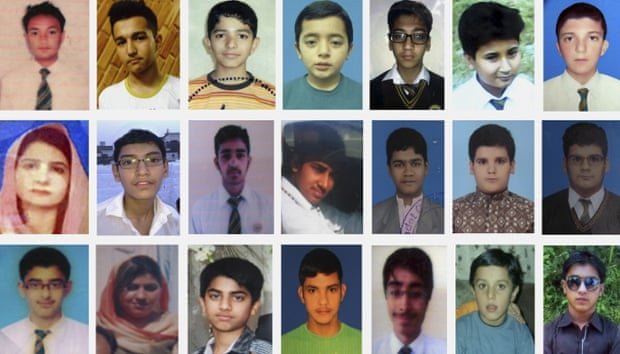
Some of the students and teachers of the Army Public School in Peshawar who were killed by the Taliban in a combination of photographs provided by their families.
Pinterest
 Some of the students and teachers of the Army Public School in Peshawar who were killed by the Taliban in a combination of photographs provided by their families. Photograph: AP
There are also high hopes for General Raheel Sharif, the powerful army chief appointed last year, who in June sent troops into north Waziristan, the infamous terrorist sanctuary bordering Afghanistan where many politicians had long dreaded a showdown with the TTP. On Tuesday both Sharifs ordered an immediate blitzkrieg against the TTP, with revenge air strikes on militant hideouts even as Peshawar’s hospitals were still filling with casualties.
Dozens of alleged militants have been killed since by aircraft, ground assaults and “encounters” by security forces around the country. On Friday night Pakistan executed its first two prisoners since 2008 after abandoning a death penalty moratorium.
For all the action against the TTP, sceptics point out that there is no sign of the “good Taliban” being inconvenienced. In an attempt to remain in official favour, several groups responsible for atrocities against civilians rushed to denounce the Peshawar attack, including the Afghan Taliban and even a vicious TTP splinter group called Jamaat-ul-Ahrar. And in an astonishingly ill-timed move, a court on Thursday ordered the bailing of Zaki-ur-Rehman Lakhvi, mastermind of the 2008 attack on the Indian city of Mumbai, which killed 166 people. The government quickly promised to try to get the decision reversed after New Delhi expressed outrage.
Few analysts believe Pakistan is ready to take on Lashkar-e-Taiba (LeT), the militant group that Lakhvi co-founded and which is devoted to “liberating” Kashmir. With its huge corps of jihadists hardened by years of fighting in Kashmir, it is arguably too big to confront at a time when Pakistan is battling the TTP.
In a country with weak public services, the LeT has worked hard to ingratiate itself with ordinary Pakistanis through its welfare organisation, the Falah-e-Insaniyat Foundation (FIF). It is now one of the largest charities in the country, running ambulance services in nearly 200 cities and towns, as well as six hospitals and hundreds of schools. In Peshawar last week hundreds of FIF activists wearing fluorescent jackets were helping survivors in hospital and hanging around funerals. The group’s leader, Hafiz Saeed, is subject to a $10m US bounty, but he moves around Pakistan freely. This week heclaimed India was responsible for the attack in Peshawar.
Then there are Pakistan’s vicious Sunni supremacist groups responsible for killing minority Shias. Despite their crimes, Sharif’s faction of the Pakistan Muslim League has been accused of striking electoral pacts with them in his heartlands of Punjab province. The biggest battle of all, though, will be to overcome decades of pro-jihad propaganda that has made many Pakistanis susceptible to conspiracy theories, such as the view that the shooting in the head of schoolgirl Malala Yousafzai was a “drama” staged by western powers.
Last week a couple of hundred people attempted to push back against such noxious narratives by protesting outside Islamabad’s Red Mosque, a bastion of Taliban sympathisers that could not bring itself to unequivocally condemn the Peshawar attacks. But as the night echoed with chants denouncing Taliban apologists as traitors,some in the crowd quietly admitted their doubts. “We’ve been at this point before,” said Sarwar Bari, a journalist, recalling a similar outrage sparked in 2009 by a video of a Talib flogging a woman in Swatwho was accused of adultery. “There was a great hue and cry and everyone came out – but pretty soon the mullahs sabotaged the consensus and it all went quiet again.”