By Sarah Khan
Maj. Gen. Athar Abbas, the former head of the ISPR, has revealed in no uncertain terms that it was Gen. Ashfaq Pervez Kayani who didn’t allow the launch of an operation in 2010 because of his indecisiveness. According to Gen. Athar Abbas
“It had been decided in principle that preparations for the operation would take place between 2010 and 2011, and that it would be launched in 2011 to rid North Waziristan of extremists once and for all. He was very reluctant when it came to the North Waziristan operation. Kayani thought the decision to launch the operation would reflect on his personality and people would take it as his personal decision, which is why he kept delaying the operation”
We as a nation have had to pay a heavy price for this “indecisiveness” of Gen. Kayani who ruled the roost as head of ISI and then Chief of Army Staff for an unprecedented six years. His time was the one in which Pakistan bled. Starting from the nonsense of Lal Masjid to the ridiculous Lawyers Movement in 2007, Pakistan was submerged in a pool of blood during his tenure. Targeting Shaheed Benazir Bhutto, the militants against whom Gen. Kayani didn’t take action through a comprehensive military action, Pakistan lost thousands of men and women to merry killers.
On the other hand, Gen. Kayani supported people like Iftikhar Mohammad Chaudhry, Gen. Shuja Pasha and the mindless media circus to bring the PPP led coalition down on one pretext or the other. Be it corruption stories or Memogate or Drones or Raymond Davis saga or actual killings of leadership of the coalition of PPP, ANP and MQM, one can now link Gen. Kayani in no uncertain terms to all the ills Pakistan has faced post 2007.
Maj. Gen. Athar Abbas is now being asked by mindless Chaudhry Nisar and members of the media by saying “Senior retired army officers should be very careful while making statements regarding the current sensitive situation prevailing in the country. At this stage of history, bringing into open decisions of the current or former leadership of the military in this way may create difficulties but cannot be helpful in providing a solution”.
It is quite certain that what Maj. Gen. Athar Abbas has said is pricking everyone who have benefited most from the mayhem caused by Gen. Kayani and his indecisiveness. While Maj. Gen. Athar Abbas has been very decent in calling just indecision, one can see through the method to madness of Gen. Kayani and his cohorts in the military, media and judiciary.
The need to have a Truth and Reconciliation Commission asked first by Shaheed Benazir Bhutto in 1997, cannot be lesser in this critical time. The military generals and their mindless policies in collusion with their foot soldiers in political, religious, judiciary and media have brought a nation of 200 million people on its knees. The Truth and Reconciliation Commission must ascertain what went wrong and who were responsible for their actions. Demanding people to be hanged for their sins is a wishful thinking whose only targets can be politicians and especially the PPP. The nation needs to know who is responsible. Thank you Athar Abbas. You have done a service to this country.
- See more at: http://lubpak.com/archives/316386#sthash.RzvkIpwF.dpuf
by Lal Khan
At dawn on Sunday, June 15 the Pakistan government gave the green signal to over 30,000 ground troops, backed by air force jets, to move into action in North Waziristan. This is the beginning of a long talked about and expected military operation against the many and numerous Islamic terrorist outfits that have been wreaking havoc throughout the country for almost two decades. The terrorist attack at the Karachi Airport in the preceding week seems to have been the final straw.
However, irrespective of various spins and gloss from Sharif and his coteries, it was the “generals” who decided that “enough is enough”. The reasons for the top brass to ultimately break the stalemate are many. Perhaps the most forceful and compelling reason was the pressure building up within the ranks of the military due to the increasing number of causalities, the increasingly eroding military credibility in society, the immoral and ill-gotten wealth of the top brass and the elite giving rise to unprecedented inequality and the fallout from the shooting of a controversial TV anchor near the Karachi airport.
According to a military spokesperson, 167 individuals including the Uzbek mastermind Abu Abdul Rehman al-Maani, believed to have helped orchestrate the five-hour Karachi airport siege, was thought to be among the dead along with many Uzbek and other foreign and local commanders. There is now a mass exodus of the civilians coming out of the North Waziristan agency, the vast majority of whom are heading towards an already war torn Afghanistan.
The political establishment across the spectrum have come out in support with the PPP leading the loud chorus, closely followed up by the religious right, including the proscribed Islamic groups, who came out with their guns blazing and calling on the military’s might to eliminate terrorism. Imran Khan’s PTI looked quite awkward when its “core committee” announced their support for this operation.
After the judiciary’s restoration movement in 2007 this is yet another occasion when the conservatives, liberals, the secularists and the Islamists and the so-called left and the extreme right wing have shown an astonishing solidarity for the sake of their country. These air-conditioned politicos mistakenly think the military operation will surgically wipe out the terrorist networks. This shows the level of their understanding of the crisis this country is afflicted with and the catastrophic socio-economic situation society is mired in.
Despite all the mantra about the first ever hand over of civilian regime and the deepening of democracy, the presence of the army is now more visible and glaring in all cities and towns of Pakistan than even during the periods of martial law. As soon as the operation started, the scenes in the country were reminiscent of the declarations and impositions of martial laws in the past. Military vehicles and APC’s are patrolling all the major cities and towns with numerous checkpoints making day to day movements for ordinary people a cumbersome affair. The media moguls have given instructions for patriotic and nationalist songs to be broadcast with many anchors vociferously beating the drums of chauvinistic sentiment as if the country had gone to war.
The present rulers are terrified despite their massive security apparatus. Their cowardice is perhaps best expressed by the “Lions of Punjab” [a mocking reference to the Sharif brothers], with the Chief Minister Mian Shahbaz Sharif personally visiting and pleading the Lahore garrison Corps Commander to provide him military protection in his palatial mansions at Model Town in Lahore [a plush residential suburb for the rich]. His police force of 196,000 personnel which has terrorised the ordinary working population of the province seems inadequate to him. Islamabad’s security, where the elder brother is the third time prime minister has already been handed over to the military.
This is not the first time the Pakistani military have announced such an operation. There have been several in this region alone. Most were aborted for reasons known only to the ruling elites. The military operation in Baluchistan has inflicted horrendous brutalities both by the state and non-state actors. The Shia and Sunni proxies, supported by the Iranian and Saudi oligarchies for their own imperialist designs, are shedding Pakistani blood. But it is mainly the Hazara Shias that are the victims of this brutality, mercilessly butchered by the Islamic sectarian beasts. The state has not only failed to guarantee protection, but according to some is encouraging this horrid carnage.
The situation in Karachi is far worse with numerous military and paramilitary operations over the years. The military operations are everywhere in one form or another, but in the recent period they have become more frequent and bloody for the military, with ever increasing pressures and tensions within the state. The military has fought three disastrous wars, imposed four dictatorships and directly ruled the country for more than 50% of the country’s rather short but extremely chequered history. The only think they have achieved is greater suffering and an intensified crisis in society. However, if the military have proved to be a disappointment for the rulers of this country, their “democracies” have been even bigger failures.
North Waziristan is rightly described as the centre of gravity of terrorist activity. Groups like Gul Bahadur, the Haqqani network (“good” Taliban), the so-called TTP, East Turkmenistan Islamic movement led by the Uzbeks, remnants of Al-Qaida and Al-Arab terrorists (“bad” Taliban) are running bloody havoc. The relations of these groups with the army, the US and other regional and imperialist powers have been dodgy and deceitful, with changing loyalties and affiliations. Their main sources of revenues are extortion, drug running, kidnapping and ransom, and other criminal activities. It is fear that guarantees their booty and hence they are all competing with the state and with each other to see who can carry out more heinous, cruel and inhuman acts of terror.
It is precisely because of this that the multinational companies, and imperialist and regional states, make deals and contracts with them to the advantage of their own financial and strategic policies and interests. Hence their connections with certain sections of the state, that has now vowed to obliterate them, are not so concealed anymore. This operation will not be a straightforward military campaign, as it is difficult to differentiate between friend and foe. After all, this has been the dilemma of the “good” and the “bad” Taliban that has been haunting and convulsing the establishment for decades now. It will be a long and a protracted and internecine war that has very remote chances of reaching any clear and decisive solution or conclusion.
And if this operation fails what will happen then? The political elite are so removed from reality that they can’t even dare to think about it. These billionaires and upstarts are not the ones who are suffering. It is the workers and the poor who are the victims of this fundamentalist onslaught and also of the economic terrorism being inflicted upon them by the system and the ruling classes through their state apparatus. When these toiling masses rise in class war they will have no other option but to do away with this whole edifice of plunder, tyranny, exploitation and terrorism. To accomplish this they will have to carry out a revolutionary insurrection to remove the whole system.
By Hasan Khan
Although militants have threatened retaliation against the military offensive, the threats have thus far been all talk, analysts say, and the sustained effort is keeping the Pakistani Taliban off balance.
Militant threats of retaliation for the Pakistani offensive in North Waziristan are proving to be nothing more than words.
The continued pounding in North Waziristan has given the militants little time to organise and carry out reprisals, Mehran Wazir, a native of Waziristan and a research analyst at the Islamabad-based think tank FATA Research Centre (FRC), said.
"The government is all-out serious on finishing the job" of eliminating the militants in this operation, Wazir said.
The offensive caught militants off guard, allowing the military to kill more than 340 militants and to destroy the insurgents' command-and-control centres, observers told Central Asia Online.
Operation Zarb-e-Azb in North Waziristan is not the only government action against the militants, but it is a focal point because the agency is seen as the nerve centre of the militants, Peshawar-based senior journalist Muhammad Riaz said.
"The majority of the militants gather in North Waziristan, as it is the headquarters for local and foreign militant groups," he said.
Concern over potential retaliation
The action, as expected, has raised the hackles of the militants, and they have made dire threats, but so far they have been all bluster.
"Nawaz Sharif's government … is responsible for the loss of life and property of tribal Muslims in this military operation," Tehreek-e-Taliban Pakistan (TTP) spokesman Shahidullah Shahid told Central Asia Online by email June 23, vowing to burn down Islamabad and Lahore.
The government has not taken the TTP's threats lightly. In response to such messages, officials took extra security measures, calling on troops to patrol big-city streets, Riaz said.
What has helped dampen such talk is that the government took pre-emptive security measures before the military operation hit high gear, some surmise.
"Before the operation was launched, there were reports of [civilian authorities] handing over Islamabad and other big cities to the military," Islamabad-based journalist, Anwar Ali Bangash said.
The government, he said, carried out intelligence-based search operations and arrested a large number of suspected militants in Peshawar, Islamabad and Lahore before Operation Zarb-e-Azb started June 15.
Status of sleeper cells
Operation Zarb-e-Azb surprised many observers who considered Pakistani Prime Minister Mian Muhammad Nawaz Sharif loath to risk militant backlash from such an offensive, military analyst Brig. Said Nazeer said. Indeed, he suspects the militants will strike back later.
"I believe [militants] are in waiting. The moment the government relaxes, they will strike," Nazeer said. "Sleeper cells are there, waiting for an opportune moment."
But Bangash said it was unlikely that militants would be able to launch a heavy blow.
No relaxation on offensive
Meanwhile, with militants scrambling, the government is committed to taking full advantage.
Besides bombing terrorists in the valleys of Waziristan, government forces are chasing them down in the streets of major cities, such as Karachi, where security operations have broken the backs of the militants, Ismail Mehsud, a Karachi-based political worker, said.
"After the attack on the Karachi airport, the government has turned its whole attention to militants and has shown no mercy," Mehsud said.
http://newsweekpakistan.com/
INTELLIGENCE AGENCIES CLAIM AT LEAST A DOZEN TERRORISTS HAVE ENTERED THE FEDERAL CAPITAL TO STAGE ATTACKS ON GOVERNMENT INSTALLATIONS.
At least 12 suspected terrorists have entered Islamabad with an intent to stage attacks on sensitive installations, according to a senior intelligence officer.
“Intelligence agencies have submitted reports to the Interior Ministry, informing it that 12 terrorists, between 20 and 30 years old, have entered the federal capital and are hidden somewhere in the suburbs of the Tarnol area,” he said on condition of anonymity as he is not authorized to speak to the media.
“We have informed the government that they [terrorists] could stage suicide attacks in Islamabad or Rawalpindi to target sensitive government installations,” he added. According to the official, the threat of retaliation from the Taliban would persist as long as the military offensive against the militants’ hideouts in North Waziristan continued. “With the military operation already in progress against Pakistani and foreign militants in North Waziristan,” he said, “there will always be a fear of strong retaliation from the terrorists.”
On June 15, the day the government launched Operation Zarb-e-Azb in North Waziristan to clear the country’s tribal areas of militants, two companies of the Pakistan Army were deployed to Islamabad for extra security. The Tehreek-e-Taliban Pakistan had earlier warned the government that its militants would “burn” Islamabad and Lahore, the capital of Punjab province, in retaliation for the PMLN-led government’s decision to opt for the military operation.
http://www.digitaljournal.com/
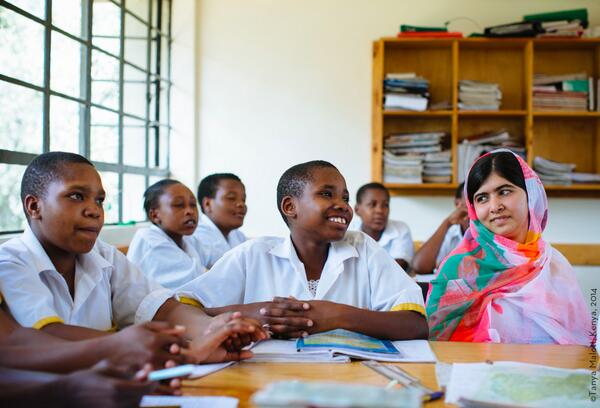
On her first trip to Africa, education activist and Malala Fund co-founder Malala Yousafzai said she was inspired by the dreams and determination of the schoolgirls she met while learning about the many challenges they have overcome to obtain an education.
The 16-year-old spent several days speaking with girls from rural Kenyan communities about their passionate desire to go to school and the many obstacles they encounter, including discrimination, poverty, child labor and early marriage.
Malala said the moving stories the girls shared with her will strengthen her work as an education advocate. Malala visited Kenya recently on behalf of the Malala Fund, a foundation that empowers girls through education.
"I came to Africa to raise awareness about the 58 million children not in primary school who face numerous barriers to education," Malala said. "I was particularly inspired to meet young girls in Kenya who are so passionate about getting an education, building their future and the future of their country."
Malala was hosted by Craig Kielburger, co-founder of Free The Children, a global organization of children engaged in service and development programs. Free The Children's young supporters have raised funds to build more than 650 schools and schoolrooms throughout the developing world, while the organization works to topple the barriers to education.
On her visit, Malala also took up a shovel, mixed cement and laid bricks to help build Free The Children's Oleleshwa All-Girls' Secondary School, in rural South Narok, where the majority of girls do not attend high school.
Malala was also accompanied by her father, who is the Malala Fund's chairman, along with its CEO, Shiza Shahid, who called on other school children to stand up for the rights of their peers.
The Malala Fund also financially contributed to the building of Oleleshwa All-Girls' Secondary School, its first gift to Africa, because of Free The Children's sustainable approach to education and because of a common bond with young people from the United States, United Kingdom and Canada who support Free The Children.
"We feel honoured to have laid the foundation of the first school that the Malala Fund is building in Africa with Free the Children," said Shahid. "This is the beginning of a deep commitment to Africa, and a testament to our belief that educating the children of the world holds the key to spurring progress and countering violence."
Free The Children is currently building Oleleshwa All-Girls' Secondary School, a boarding school which now accommodates 60 students but when complete will educate and board two hundred. These new students will join the 4,780 girls already enrolled in Free The Children primary and secondary schools across Kenya.
Free The Children's innovative holistic development model, Adopt a Village, eliminates all barriers to education by providing schools, clean water projects, support for health care, agriculture and food security, and local small businesses, many run by women.
"We are so grateful to work together to build a school," said Kielburger. "After the horrific kidnapping of the Nigerian girls, we are inspired by Malala's compassion and leadership in ensuring education for girls on the African continent."
While in Kenya, Malala spoke to a community gathering about the importance of educating girls and preventing early childhood marriage. When she finished speaking, the local children, in traditional Maasai dress, leapt to their feet and chanted "Malala" over and over. Finally, the community presented her with a goat, a sign of great respect in Maasai culture, in honor of her fight for girls' education.
Malala's visit with Free The Children followed her participation in the organization's youth empowerment event We Day UK, when she addressed 12,000 people at London's Wembley Arena along with Prince Harry, Sir Richard Branson and Jennifer Hudson. Click here to watch Malala's speech at We Day UK and visit www.weday.com for more information on the event.
For more information, please visit www.Malalafund.org or www.freethechildren.com.
Read more: http://www.digitaljournal.com/pr/2032900#ixzz36PPll2oK
 http://mediacellppp.wordpress.com/
Sindh Chief Minister Qaim Ali Shah has directed all health department officials to make sure that every child entering Sindh from Waziristan is administered polio drops.
Presiding over a meeting on the anti-polio strategy, Shah asked the officials to establish polio control rooms in each district. He also wants all IDPs to be registered by the district administration at the border, along with data on the number of children and family statuses.
“There is a dire need to set up a provincial emergency operation centres for polio eradication and make it functional as soon as possible,” said the chief minister. “The police and law enforcement agencies must provide full security to the polio teams while they are in the field.”
The officials must conduct an extensive anti-polio campaign, especially in the vulnerable areas of Karachi, to avoid any further spread of crippling disease of Polio in the city and province, Shah added.
The officials informed the CM that strict checking has been ordered at all the entry points of the borders and cities in the province to ensure that neither the children of actual IDPs nor any others can pass without taking the polio drops.
Shah feared that several displaced persons and families are moving from North Waziristan as the armed forces carry out Operation Zarb-e-Azb. Most of the children accompanying these families have never been vaccinated and they are posing a threat.
Seven cases this year
The coordinator of polio oversight committee, Shahnaz Wazir Ali, told the participants of the meeting that seven polio cases have emerged so far this year. All these cases were reported from Karachi and the victims belong to Pakhtun families, except for one child who belongs to a Punjabi family. The union councils from where these cases have emerged are on the top of the priority list and special attention is being paid to such vulnerable areas, she added.
“In addition to the deployment of 28 anti-polio teams on the Sindh-Punjab and Sindh-Balochistan borders, more than 166 teams are working at all the transits points of the cities, airports, railway stations, and toll plazas to administer polio drops to each child up to five years old,” she explained.
The provincial focal person for polio, Dr Ahmed Ali Shaikh, told the participants of the meeting that two anti-polio campaigns will be conducted in Karachi; the first one from July 5 to July 8 and the second one from July 17 to July 20. As many as 153,564 children will be vaccinated in each round.
A total of 194 anti-polio teams have been deployed at all the transit points in the province including the borders of Sindh, said Dr Shaikh. Between April 2012 and April 2014, as many as 5,828,520 children have been vaccinated at all transit points in Sindh and 264,129 children have been vaccinated at the transit points in Karachi.
http://mediacellppp.wordpress.com/
Bilawal Bhutto Zardari, Patron-In-Chief, Pakistan Peoples Party has extended congratulations to the newly-nominated Chief Justice of Pakistan Justice Nasir-ul-Muluk adding nation has high expectations from him for institutional strengthening judiciary and democracy in the country.
In a message, Bilawal Bhutto Zardari said history is going to be ruthless in recording the jurisprudence in the world and our judiciary needs true reforms that manifest justice system, which is free from both overt and covert personal or political bias.
PPP Patron-In-Chief welcomed the appointment of Justice Nasir-ul-Muluk as Chief Justice of Pakistan and assured that his Party and its leadership will always stand for a free and independent judiciary as it has always strived for it despite having been wounded in the past by some of the most biased judges in the history of Pakistan. “We stand for an independent judiciary as it is the basic requirement of any democratic system to flourish,” he added.
www.pakistantoday.com
The country is fighting what the ISPR has described as a war of survival. Operation Zarb-e-Azb, the biggest and most well-coordinated operation ever conducted against terrorists, is in full swing. The PML-N claims the prime minister is leading from the front. The PM says he has pledged to wipe out all foreign fighters and local terrorists without exception. Federal ministers for information and defence too are busy rousing the masses to support the army operation.
What is missing from the scene is the interior minister who is required to play the most vital role in complementing the military action. It is widely known that Ch Nisar considered talks with the Taliban the only way to bring terrorism to an end.
The gradual change in the government’s policy towards TTP which has now culminated into full support for military operation was presumably unacceptable to him. Weeks back he stopped attending the National Assembly sittings and was absent from both the Senate and NA when the PPO was presented for ratification. On June 10 he attended a high level meeting with PM, COAS, CGS and chief of ISI’s counterintelligence desk. Days later, fighter jets attacked North Waziristan killing 50 terrorists, including the mastermind of Karachi airport attack. The same night Ch Nisar was taken to hospital for chest pain.
Ch Nisar’s performance as interior minister was hopeless. His biggest failure was to carry out the much needed revamping of the security system. The militants are presently on the run and their activities have drastically decreased. A number of TTP groups currently enjoying Karzai’s hospitality are however looking for an opportunity to retaliate in major cities. Whether Ch Nisar has withdrawn due to ailment or on account of ideological differences, there is an urgent need for finding a replacement. The government needs to appoint a new interior minister who is energetic, in sync with the times and capable of finishing the work left undone by Ch Nisar.
http://dunyanews.tv/
The ground operation phase of Zarb-e-Azb continues successfully as the forces advances after crushing militant hideouts. More check posts have been established near Miranshah bazaar, Dunya News reported.
Pakistan Army is continuing to advance in the military operation against terrorists. Reportedly, the ground operation is achieving more than anticipated results.
Forces have tightened the surrounding of the terrorists’ hideouts on various points.
Pakistan Army continues to destroy the militant hideouts. The aerial surveillance of the affected areas is also being carried out.
It merits mentioning here that the armed forces successfully seized landmine manufacturing factories in the region on Wednesday. According to ISPR, during the operation, three more improvised explosive device manufacturing factories with large quantity of explosives, anti-tank mines, a suicide bomber training centre, a media facility and a rocket cache were recovered from cleared.
Six IEDs attached with four computers in a ready position were also recovered from a private hotel.
Earlier, Military helicopters shelled militant hideouts in the country’s restive northwest on Wednesday as part of a massive ongoing offensive against the Taliban and other extremists, killing 10 insurgents, officials said.
The helicopters pounded Islamist compounds in the Khar Warsak area, 12 kilometres (seven miles) north of Miranshah, the main town in the North Waziristan tribal region.
"The helicopters destroyed three militant compounds and killed 10 insurgents during the shelling," a local security official told AFP. A local intelligence official confirmed the attack and militant casualties.
Nearly 500,000 people have fled the offensive in North Waziristan, which is aimed at wiping out longstanding militant strongholds in the area, which borders Afghanistan.
Tens of thousands of families have left for the town of Bannu, close to North Waziristan, while hundreds more have moved further afield to the towns of Lakki Marwat, Karak and Dera Ismail Khan since the offensive began in mid-June.
Jets and artillery began hitting militant targets in North Waziristan on June 15, launching an operation to regain full control of the district after years of pressure from Washington and other powers.
The assault was finally launched after a dramatic attack on Karachi airport last month which killed dozens of people and marked the end of a faltering peace process with the Pakistani Taliban.
So far, 376 militants and 19 soldiers have been killed in the offensive, according to the military, though with the area off-limits to journalists the number and identity of the dead is impossible to verify.
Major General Asim Bajwa, the chief spokesman for the Pakistani military, said on Tuesday the ongoing offensive would target all militants, including the feared Haqqani network.
He also demanded Afghanistan do more to track down hardline cleric Maulana Fazlullah, who took over the Tehreek-e-Taliban Pakistan (TTP) leadership last year after previous chief Hakimullah Mehsud was killed by a US drone.
Fazlullah is believed to be in hiding across the border.
Relief for IDPs:
The government established three more registration centers at various points in Bannu on Thursday in order to facilitate the smooth registration of the IDPs arriving from the war zone. Reportedly, thousands are yet to receive government’s aid in terms of food and shelter.
 By DOUGLAS SCHORZMAN and KIRAN NAZISH
The North Waziristan tribal agency in northwestern Pakistan has been the focus of a lot of firepower: The C.I.A. has made it ground zero for its drone strike campaign, the Pakistani military has sporadically unleashed raids and barrages there, and now it has been stormed by Pakistani infantry forces trying to clear out entrenched militant groups.
But long before Al Qaeda and the Taliban found shelter in the forbidding mountains of the tribal region, Waziristan was a wellspring of guerrilla insurgency and resistance to whatever power had tried to bring it in line. The Pashtun tribes of Waziristan have never been truly conquered, and courting them as allies has almost always ended up backfiring on whoever has tried — ask the British, Pakistanis, Afghans and, for that matter, the Americans.
From the mid-19th century until their departure in 1947, British forces fought Pashtun rebels in Waziristan at huge losses of life to both sides. Then, as now, the tribesmen knew the mountains and treacherous pathways better, and were never completely jarred loose, even by the 20th-century dawn of airstrikes, delivered by British biplanes.
In the strategic maneuvering of “The Great Game,” the British imposed the Durand Line border with Afghanistan in 1893, and in the process divided the Pashtun population. To this day, that border is an irritant to governments and a fiction to inhabitants.
In the decades after, Pashtun fighters waged a new jihad that spanned governments: first against the declining British Empire, then against the Pakistani government founded in the partition of 1947. One of their goals was an autonomous Pashtunistan, spanning the Durand Line, and at times they were aided covertly by the Afghan government.
Even as the fledgling Pakistani government fought the Pashtuns, they also sought to employ them, paying tribal fighters to deploy against India. That effort reached new heights in the 1980s, after the Soviet invasion next door in Afghanistan.
Suddenly, Pashtun jihadis were the allies of choice for Pakistani, Saudi and American officials who were trying to bloody the Soviets, and Waziristan — rugged, impregnable, close to the border — was the perfect training ground for them. Money and arms, and thousands of volunteers from the Arab world, flowed into North and South Waziristan under the watch of the Pakistani military spy agency, Inter-Services Intelligence, and with the blessing of the United States.
The relationships and expertise forged in the fight against the Soviets became the foundation for new militant movements after the American invasion of Afghanistan in 2001, this time in the Taliban insurgencies in Afghanistan and Pakistan, and in the global terrorism campaign directed from the tribal areas by Al Qaeda against the United States and Western world.
The Pakistani military struck a tenuous peace deal with the Waziristan-based factions a few years later, but as it fell apart, many of the army’s former allies among the militants turned against it and the Pakistani government. Crackdowns on the tribal areas intensified, and a military offensive in South Waziristan and other areas of the northwestern frontier was waged in 2009. The assault sent hundreds of thousands of people fleeing, including militant commanders, who moved north to join their comrades in the even more rugged terrain of North Waziristan.
Since then, drone strikes have cut into the militants’ leadership ranks. But for the most part, the militant groups sheltering in the mountains of North Waziristan were able to kill or force out resistant tribal leaders, share resources and grow stronger together for years. “There is no militant group in the world that you won’t find here,” one tribal leader said in a telephone interview. “From Uzbeks, to Chechen, to Chinese and Turkish militants, everyone is free in N.W.”
Now, the Pakistani military has marched into Miram Shah and Mir Ali, the main towns in North Waziristan. Again, a huge wave of refugees has been created, with many crossing the gossamer border into Afghanistan, where the political process is struggling and the American military is withdrawing. With those refugees, many officials say, are again a number of militant commanders and fighters.
 By Aman Shareef
On June 15, the Pakistan Army began a military operation in North Waziristan to “eliminate these terrorists regardless of hue and colour”. In the fortnight since operation ‘Zarb-e-Azb’ began, numerous airstrikes have been carried out, killing 370 militants as of June 30.
At this stage of the operation, the Army is carrying out door-to-door searches in the town of Miranshah, in North Waziristan. This town has been one of the main bases of the Tehreek-i-Taliban Pakistan (TTP). Between airstrikes, American drone strikes and ground forces, Zarb-e-Azb is the most major operation against religious extremists the Pakistan Army has conducted in years!
Analysts have speculated about the reason behind this sudden shift in policy. Some say that the Pakistan Army believes that it is critical to carry out this operation before the US withdraws at the end of 2014. Others argue that recent attacks have proven that the peace talks are a failure, and therefore the Army is finally taking action. Some have even said that the military leadership has wanted to carry out this operation for a while, and the civilian government is no longer able to rein them in.
Although all these have some merit, the underlying reason for the shift in policy is the shift in public opinion. Since Nawaz Sharif’s government came to power last year, there have been attacks in Quetta, Peshawar and against military convoys in North Waziristan. The Taliban attacks on the Karachi International Airport on June 8 are altogether different from prior attacks because they actually succeeded in shifting public sentiment past an unknown tipping point in favor of the military taking action against these extremists.
Moving in line with public opinion is not new for the Pakistani military, but many analysts have failed to grasp the extent to which the Army’s options for any given scenario only exist within the universe created by public opinion.
The Pakistani Army does not see itself only as a tool to protect its nation, but as a governing institution that may have to step into the role of governance at any moment. Due to this understanding of its own responsibilities to the country, the Army must have the people on their side at all times. The military is aware that a successful coup, and the ability to continue ruling, is dependent on the approval of the public.
Since its founding in 1947, Pakistan has been under the rule of three different military governments. The first coup of General Ayub Khan in 1958 was met with general public approval, creating a precedent for the Pakistan military to take over whenever it felt it necessary. The later military coups of Zia-ul-Haq and Pervez Musharraf were able to lean on this precedent when carrying out their own coups.
In 2007, when the Lal Masjid (Red Mosque) incident took place, President Musharraf was already unpopular with his firing of the Chief Justice. Since Musharraf was unpopular, the operation to root out the heavily armed extremists in the Red Mosque was seen as being questionable. I remember being in Pakistan at the time, and being a part of conversations where people were expressing their doubts as to the validity of the military’s actions.
These extremists had practically turned a mosque in the middle of Islamabad into a fortress. The military had no other choice, and yet Musharraf’s unpopularity at the time made people question even this course action. Arguably, the Lal Masjid incident was the beginning of the end of Pervez Musharraf’s reign. The lesson Pakistan’s military took away from this incident is that military operations that are unpopular will lead to the downfall of its leaders, and hinder the Army’s ability to lead.
In 2009, the Taliban took control of the entire Swat region and hundreds of thousands of people fled to escape the harsh rule of the extremist group. Yet, the Army did nothing of note for months. Then, a video of a young girl being brutally caned went viral, and the whole of Pakistan became outraged. It was this dramatic change in public sentiment that allowed the Pakistan Army to carry out a major operation to root out the Taliban in Swat.
While military policy is not dictated by the sways of public opinion polls, the options available to them exist only in the realm of what the people of Pakistan will approve of. As a result, if the United States wants to influence the actions of the Pakistani military, they need to keep their thumb on the pulse of public sentiment in Pakistan.
Similarly, if India and the rest of the world would like to predict and understand what actions the Pakistan Army will take, keeping an eye on public opinion will be a critical component of their analyses.

The Human Rights Watch (HRW) has asked Sri Lanka not to deport members of Pakistan's minority communities until the UN refugee agency gains complete access to them and determines their needs for international protection.
At least 142 Pakistanis arrested during police raids in Sri Lanka in June 2014 are being held in custody of that country's authorities and are at risk of deportation, said a HRW report.
Majority of those arrested are members of the Ahmadi community although a few detainees also include Shia Muslims and Christians.
The report says that the United Nations High Commission for Refugees (UNHCR) has so far been unable to acquire complete access to the detainees, who it said are being kept at the Boosa detention centre. Although, the UN refugee agency has recognised at least six of the group as refugees.
Media reports quoted Immigration Controller Chulananda Perera as saying that the Sri Lankan government could deport the detained Pakistanis because it had not sanctioned them to register asylum claims.
“Sri Lankan authorities are threatening Pakistani minority group members with deportation at the very time when persecution of these groups is escalating in Pakistan,” said Bill Frelick, UN refugees director.
“Preventing asylum seekers from lodging claims in no way absolves Sri Lanka from its duty not to return them to possible persecution.”
According to the principle of nonrefoulement in international law, governments cannot pressurise returning refugees to places where they would be vulnerable to persecution. The principle applies equally to people prevented from lodging asylum claims who would still face serious harm upon return.
The raids on Pakistani minorities in Negombo, a city on the western coast of Sri Lanka, commenced on June 9, with authorities citing security concerns for the crackdown. Negombo has been a major haven for refugees from Pakistan. In 2013, UNHCR registered nearly 1,500 refugee claims of Pakistanis in Sri Lanka.
Attacks on religious minorities in Pakistan are rampant and the government has failed to investigate cases of violence and discrimination against religious and ethnic minorities, the report noted.
The report also noted that Christian and Ahmadi communities were especially vulnerable to persecution and discrimination in Pakistan due to threats by militant organisations.
Last year, in September, twin explosions at All Saint's Church in Peshawar's Kohati gate area killed 80 people and wounded over 100 others.
Notwithstanding the persecution of members of ethnic and religious minorities in Pakistan, the government has shown callous disregard for those who have fled the country and sought asylum abroad.
Foreign Office spokesperson Tasneem Aslam was unsympathetic to the plight of the detained refugees in Sri Lanka, saying: “These people [asylum seekers] obtained asylum in Sri Lanka by badmouthing Pakistan. If they are in trouble, I have no idea.”
“Sri Lankan authorities should know that Pakistan fails to protect its minority communities from persecution,” Frelick said.
“Sri Lanka must honour its international obligations, and allow UNHCR access to ensure that no detainee is deported to face the risk of persecution or torture.”

The United Nations Development Programme (UNDP) Wednesday ruled out Chairman Pakistan Tehreek-e-Insaf (PTI) Imran Khan’s charges of 'disruption' in its election project on May 11, 2013, Samaa reported.
“None of our consultants were forced out of Returning Officers' (ROs) offices on the election day” Country Director UNDP Marc-Andre Franche told Samaa.
Brushing aside Khan’s allegations, Franche also swore that not even a single of UNDP’s computers was switched off following President Pakistan Muslim League-Nawaz (PML-N) Mian Nawaz Sharif’s election victory speech on the night of election.
“On May 11, six UNDP consultants rendered only technical assistance to ROs regarding new computerized result management system in place”, Franche explained.
To a question, Franche said that none of UNDP consultants lodged a complaint that ROs showed them the door or their computers were forcibly shut down.
It is noteworthy that speaking at a public rally in Bahawalpur Friday Imran Khan had alleged that after Sharif’s “declaration of a clean sweep in polls”, none of the data-enrtry operators sent a single computerized result copy to the Election Commission of Pakistan (ECP).
Another of Khan's accusations was that ROs coerced operators to hold up the operation.
"Using this delay as a justification, the ROs sent handwritten results to ECP. This is how the results were rigged to defeat PTI in different constituencies."
The UNDP project titled “Electoral Cycle Support to the Election Commission of Pakistan” was aimed at ensuring transparency in the May 11 polls.
The UN agency had extended similar technical assistance to over 60 countries.
 The latest in a nearly year-old string of attacks on Express News personnel and installations
Reporters Without Borders condemns today’s bombing of the home of Jamshed Baghwan, Express News TV’s bureau chief in Peshawar. It was the third attempt to target Baghwan and his family with an explosive device since March and the latest in an 11-month-old string of attacks on Express Media group personnel and installations, some of which have been claimed by the Taliban.
Left in a milk pack in front of the house by men on a motorcycle, today’s home-made bomb damaged the outside of the building but caused no injuries when it was set off by a timer at 11 am.
“We are outraged by this latest murder attempt targeting an Express News journalist and his family,” said Benjamin Ismaïl, the head of the Reporters Without Borders Asia-Pacific desk. “We urge the authorities to react quickly and to assign security personnel to protect their home.”
“My family members and I are all safe, thank God,” Baghwan told RWB. “More than one kilogram of explosives was used in the attack. Today’s blast was bigger than the previous ones.”
Asked who he thought was behind the bombs, Baghwan said: “The enemy is unknown. I am clueless as to why these elements are targeting my house. I see no reason to believe that these attacks are unrelated to my profession.”
Although no group has claimed the bomb attacks on Baghwan’s home, the police think the same people were behind them, and that the motive may have been to put pressure on him and other journalists.
Baghwan also expressed dismay at the Khyber Pakhtunkhwa provincial government’s failure to protect him. “No-one from the government side has contacted me since these bombs started going off outside my home. I’ve not been provided any security nor has the information minister expressed any solidarity with me.”
The attacks on Express News began in August 2013, when shots were fired at its headquarters in Karachi. It was the target of shots and bombs again in December. Three of its employees were shot dead in Karachi in January. And, on 28 March, shots were fired at a car carrying star programme host Raza Rumi, killing his driver and injuring his bodyguard.
Some of these attacks have been claimed by Tehreek-i-Taliban Pakistan, which said it acted to combat the negative coverage it was getting from Express News and other media.
Pakistan is ranked 158th out of 180 countries in the 2014 Reporters Without Borders press freedom index.
 By Osita Nwanevu
Two weeks ago, Pakistani security forces launched Operation Zarb-e-Azb, a major offensive against militants in Waziristan, a region near the country’s border with Afghanistan. Just days before, the C.I.A. had conducted its first drone strikes in nearly half a year against militants of the Haqqani network based in the very same region. The Pakistani government wants you to believe this was a coincidence.
"Are you implying that these attacks have been coordinated?" Pakistani Foreign Minister Tasnim Aslamm demanded of a reporter asking about the strikes." If that is the case then you are wrong. There is no way we condone these attacks. We have condemned them."
The C.I.A, for its part, hasn't said anything about taking part in Zarb-e-Azb, but the consensus among Pakistan watchers seems to be that the operation and the strikes are products of cooperation behind the scenes. "These strikes were almost certainly commissioned and supported by Pakistan’s military and intelligence services," wrote The New Yorker's Steve Coll. "It would seem unthinkable for the Obama Administration to act unilaterally with drones just when Pakistan was at last doing what it had long urged."
The fact that neither the U.S. nor the Pakistani government—putative allies—have been willing to own up to their cooperation on this front says volumes about just how complex things have become in the region. It’s a world where, in the eyes of Pakistan's leaders, there exist good militants, and bad militants, and in-between militants and the only party they can safely criticize publicly with any consistency is the C.I.A., whose drone strikes, they maintain, are violations of sovereignty that do little more than kill innocents. The C.I.A., Pakistan argues, bears full responsibility for drone strikes and their consequences because the C.I.A. pulls the trigger—never mind the fact that Pakistan has always wanted to tell the C.I.A. where to shoot.
And vice versa. In an October 2010 press briefing, then Assistant Secretary of State Phillip J. Crowley was open about the need for a Waziristan campaign. "We want to see greater action, particularly focused on North Waziristan," he told reporters. "We have said that publicly and privately.” Earlier that year, Pakistani military chief Ashfaq Parvez Kayani had been directly asked by General Stanley McChrystal and other American officials to combat obvious Al-Qaeda and Pakistani Taliban activity in North Waziristan as soon as possible.
Recently, Congress elected to take the arm-twisting a little further. The version of the National Defense Authorization Act for 2015 now pending passage in the Senate would have withheld $300 million in expected counterterrorism reimbursements to Pakistan had the military not launched a Waziristan campaign.
Pakistan, it seems, has finally gotten the message, and Zarb-e-Azb may ultimately be a strategic success. But it has already been a humanitarian disaster.
Over 500,000 refugees have fled from Waziristan into neighboring regions of Pakistan and Afghanistan over the past two weeks, leaving behind their homes and those too poor to hire others to help them move. Last week, refugees frustrated with the authorities' spotty relief distribution network, long waits in triple-digit heat, and shortages confronted security forces with protests in the city of Bannu.
Meanwhile, a third week of jet strikes and shelling continues and the Pakistani Army’s ground campaign has only just begun. The number of casualties thus far is unclear, in part because the Pakistani military has banned journalists from entering the field of operations. Its own reports claim that 376 militants have been killed. No one seems willing to hazard a guess about the number of civilians lost.
None of this should be a surprise to American officials. In 2009, a similar offensive, Operation Rah-e Rast, was launched against militants in the Swat Valley region bordering Waziristan. Five years later, the death count for civilians during the operation is still anyone's guess. Over two million people were displaced in an exodus from the region that was compared by U.N. officials to 1994's refugee crisis in Rwanda. This time around, Pakistan’s polio crisis has complicated the outflow of the displaced even further, as aid workers rush to vaccinate thousands of the unimmunized before they scatter across the country.
Fortunately, these efforts could be helped by the $8 million in aid for the displaced pledged by USAID late last week. Additionally, recent history suggests that the Obama administration could be forthcoming with more money in the near future: after Operation Rah-e Rast, the U.S. pledged $110 million in aid for refugees from the Swat Valley. But, as is the case with much U.S. aid to Pakistan, it's difficult to ascertain where exactly that money went. Moreover, the amount was dwarfed by the $989 million in "security-related" aid given to Pakistan in fiscal year 2009—money that was presumably used in the operations that displaced the refugees in the first place.
That year, then Special Representative for Afghanistan and Pakistan Richard Holbrooke called the notion that the United States deserved direct blame for the unfolding humanitarian situation in the Swat Valley “ludicrous." This was fair. It also would have been fair to ask where U.S. culpability for the civilian toll incurred by its Pakistani allies begins—a question made especially relevant by Operation Zarb-e-Azb, a campaign American officials have long wanted Pakistan to carry out. If the Obama administration really does have an obligation to continue the fight against the Taliban alongside Pakistan, it stands to reason that it has an additional obligation to minimize the costs that fight imposes on innocent civilians. For half a decade now, that obligation has grounded critiques of our drone policy. It should also ground critiques of all the other counter-terrorism strategies we endorse—whether or not the United States is directly behind the trigger.

A Christian businessman receiving threats from extremists as they make his life miserable.
A Christian man who is resident of a Christian colony in District of Nahla- Lahore has been lately receiving threats by extremists asserting: If you do not convert to Islam, you cannot continue your business. This Christian man is reported to own a shop offering meagre livelihood to him. He reveals that the extremists by force have closed his shop restraining him to approach police, threatening him death or a false complaint to the police otherwise.
The troubled Christian approached a local Christian Human Rights activist for help who in turn guaranteed him all possible legal assistance, as he facilitated the distressed Christian man to file an FIR against the extremists in the nearby police station.
The Human Rights Activist while stating this story to Fides said: At the basis of such acts of violence, which are very common in Pakistani society, there is a discriminatory ideology, because, according to the extremists, Christians should not be allowed to carry out economic or commercial activities, as they belong to the lower castes. They are considered ‘inferior’. So they should only do the most menial jobs.
As reported another Christian man from the same area received similar threats from the extremists. Christian residents of the same colony in Nahla dread that their can be possible threats to other Christians of this area while further Christians become terrified of extremists.
The Human Rights Activist said: This kind of daily pressures and discriminatory ideology is the basis of the constant bleeding of the Christian faithful who, slowly, are leaving Pakistan and are choosing other destinations, such as India or Europe, in the hope of living in peace.
- See more at: http://www.christiansinpakistan.com/extremists-threat-a-local-christian-to-convert-to-islam/#sthash.3xNzAJlu.dpuf
Pakistan Army claims on Wednesday that three more IED making factories with large quantity of explosives, anti-tank mines, a suicide bomber training center, a media facility and a rocket cache were recovered from the cleared area in North Waziristan Agency during the military offensive.
A spokesman for the Inter-Services Public Relations (ISPR) told Dawn.com that Operation Zarb-i-Azb was progressing successfully as planned as six IEDs attached with four computers in a ready position were also recovered from a private hotel in the area.
“Forces are making swift progress in NWA as forces are hitting and shelling militant hubs and hide outs,” he said.
Sources said sniffer dogs are also being used in the cleared areas to find hidden explosives in the tribal agency bordering Afghanistan.
Meanwhile, former DG ISPR Major General (retd) Athar Abbas demanded that the military should give access to the media to such areas which have been cleared by the troops.
Earlier, Pakistani military helicopters shelled militant hideouts in Khar Warsak area of Miramshah, killing 10 insurgents.
Nearly 500,000 people have fled the offensive in North Waziristan, which is aimed at wiping out longstanding militant strongholds in the area, which borders Afghanistan.
Tens of thousands of families have left for the town of Bannu, close to North Waziristan, while hundreds more have moved further afield to the towns of Lakki Marwat, Karak and Dera Ismail Khan since the Operation Zarb-i-Azb began in mid-June.
http://mediacellppp.wordpress.com/
Pakistan People’s Party has expressed grave disappointment over the revelation that the National Security Agency of the USA has been spying on the PPP in 2010 and called upon the government to take up the issue at diplomatic level and seek guarantees that such grave violations of international law do not take place in the future.
According to media reports the declassified documents have revealed that the NSA has been spying on the PPP in 2010.
The revelation of spying on a major political party of Pakistan is a grave, unwarranted and totally unacceptable interference in the internal affairs of a sovereign country and is condemned, Spokesperson of the Party said in a statement today.
The PPP is proud of its record of always acting in supreme national interest, it owes no explanation to any foreign agency and no other country, regardless of its might and power, has any right to spy on it.
Such insensitive operations and unacceptable interference in the affairs of a political party of a sovereign country will serve no purpose except to increase resentment and distrust, he said.
Those who have violated the norms of responsible behavior by spying on the political institutions of a sovereign country owe an apology, he said.
http://mediacellppp.wordpress.com/
Yesterday at Senate session PPP Senator Sehar Kamran raised issue of IDP’s and pointed out lack of government will to support IDP’s and poor planning. Operation support of govt is only restricted to advertisements of one province, overseas Pakistanis are kept in isolation, they have always been standing with the country at all times of need, they want to help their displaced brothers and sisters but there is no communication, government had not announced any bank account where remittances could be sent.
Op Zarb e Azab is offensive against terrorists, it aims at flushing out foreign and local militants from North Waziristan.
Pak Army is fighting the enemies of Pakistan, it is a war for peace and stability of our beloved homeland. At this time when we need national unity and string resolve to eliminate terrorism, it is unfortunate to witness non-serious attitude of government. Either they should accept that government lack administrative skills and will to eliminate terrorism or there are vested interest behind.
There has been no proper planning to manage issues of IDP’s and extend them open hearted support. Differences between KPK provincial and federal government have surface, parliament is kept in isolation and political will to bring National Unity is lacking.
When operation Rah e Nijat was launched in Swat there was a complete harmony between government and army, the whole nation was united to support IDP’s, successful operation and rehabilitation of IDP’s was a remarkable achievement of PPP government,
Today there is no sign of national unity, PMLN government has self centered agendas, no planning has been done for IDP’s. Interior Minister is nowhere, NDMA has not demonstrated any responsibility. State TV and Radio is not seen broadcasting any telethon. Government is lost.
If we are not going to look after IDP’s today we will be denying our national obligations and basic human rights. PPP chairman was first to announce support to IDP’s, and first to announce support to Pak army. We stand today with our brave army fighting to protect Pakistan from those elements who martyred our great leader Shaheed Mohtarma Banazir Bhutto. Terrorist have been killing innocent civilians, attacking our security forces, blowing mosques, destroying our infrastructure and they have made heavy damages to our economy and social lives. It us time to purify our motherland from terrorists.
http://america.aljazeera.com/
by Saim Saeed
When Pakistani readers of the International New York Times opened the front page of the newspaper on March 22, they were confronted with an odd sight: more than a quarter of the page was blank. The e-paper filled in the missing bits: excerpts from Times reporter Carlotta Gall’s new book detailing the relationship between the Pakistani state and militant Islamist outfits, which the government preferred to keep hidden. Two months later, it happened again when an opinion piece on Pakistan’s blasphemy laws was blanked out.
The big white spaces are less conspicuous than the violent attacks that journalists in Pakistan have repeatedly suffered. (The most recent was in April, when Geo TV journalist Hamid Mir was injured in a gun attack as he was exiting the Karachi airport.) Both, however, point to the muzzling of media outlets, which have come under attack from many factions, including Islamist militants, political parties, commercial interests and the state itself.
According to a recent Amnesty International report, 34 journalists have been killed in Pakistan since 2008, when a democratic government returned to power. In only one case have the killers been convicted: Wali Khan Babar, a correspondent who also worked for Geo TV, was killed in January 2011 by suspected members of the Muttahida Quami Movement (MQM), a dominant, Karachi-based political party. Six men were convicted in March. Four received life sentences, and the other two, tried in absentia, were sentenced to death. The party denies having anything to do with the murder.
In an “overwhelming majority of cases,” the Amnesty report finds, “the Pakistani authorities failed to carry out prompt, impartial, independent and thorough investigations into human rights abuses against journalists, or to bring those responsible to justice.” The perpetrators vary, from the Directorate of Inter-Services Intelligence (ISI), the military’s powerful intelligence agency; the MQM; and a range of militant outfits, including the Pakistani Taliban, Lashkar-e-Jhangvi and Al Qaida-linked groups.
In the early ’90s, Pakistan had only one state-owned TV channel, which delivered the news at 9 p.m. every day. In 2002, then President Pervez Musharraf loosened regulations, allowing private ownership of media outlets. Now, the country has 89 privately owned TV channels and 115 FM radio stations. While radio reaches more Pakistanis than any other medium, television tends to be more influential in shaping political discourse. Most newspapers are written in regional languages, but the Urdu ones have a high circulation, despite the fact that nearly half of Pakistan’s 180 million people are illiterate. While English-language papers do not have a high readership across the country, they are influential because they cater to Pakistan’s educated elite. One of the most prominent media conglomerates is the Jang Group, which owns several Urdu- and English-language newspapers and Geo TV.
Despite the recent gains in media freedom, the state, and especially the ISI, keeps tight control over what is printed.
Hamid Mir made an official statement about the threats he had received from “rogue elements” within the ISI. He cited his coverage of the killings of Baloch separatists, who have been fighting a low-intensity insurgency with the state for decades, as the reason he was made a target. Immediately after the attack, Geo TV, a privately owned channel, aired his suspicions about his attackers, accusing the ISI of the assault. For a few hours, the picture of Zaheerul Islam, the agency’s furtive chief, was ever-present in Geo’s coverage. The ISI’s response was swift. It filed a complaint against the network with the Pakistan Electronic Media Regulation Authority (PEMRA), and the Jang Group was fined, forced to issue an apology and its channel was blocked for two weeks. Yet even while the case was still pending, some cable operators preemptively took Geo TV off the air, citing government pressure.
“This sets a very dangerous precedent and opens the door for future attempts to shut down news channels that are critical of the state and its agencies,” the Committee to Protect Journalists said in an open letter to Pakistan Prime Minister Nawaz Sharif.
“It was the first time Geo took Pakistan’s spy agency’s name openly on TV — but it has been taught a lesson,” said Taha Siddiqui, an independent TV journalist. “As we see, it issued an apology and yet is facing shutdown.” While the case is over, Geo continues to face pressure from both the state and other media companies that smell blood. In May, Mubashir Lucman, an anchor for a rival TV station, accused the channel of blasphemy for televising the wedding of an actress in which musicians were playing a religious song.
The ISI is also widely suspected in the 2011 death of Saleem Shahzad, a freelance journalist who, just days before being abducted, published a story about the alleged infiltration of the armed forces by Islamist militants, much to the army’s chagrin. He was kidnapped in a heavily guarded neighborhood in Islamabad, the capital, and was found by a ditch on the outskirts of the city two days later, bearing torture marks. A high-level judicial investigation was inconclusive. But before his disappearance, he discussed his fears and the agency’s attempts to reach him with Human Rights Watch, saying that he had received a murder threat.
“In Pakistan, no matter what the political rivalries are, the ISI is always at the top,” said a copy editor at the English-language newspaper The Express Tribune, who did not wish to be named for fear of losing her job. (Disclaimer: The author of this article also works at The Express Tribune.) “In a recent story I wrote, I was asked to not name the ISI; the name was basically cut out and I was asked to just write ‘agencies.’ ”
Criticism of the Pakistan army is only one “invisible red line” out of many, said Shoaib Hasan, a former BBC correspondent. “Others include the nationalist insurgency in the southwestern province of Balochistan and the state’s covert backing of Islamist militants.”
Balochistan has been a particularly sore point for the military, which has been implicated in kidnappings and extrajudicial executions of Baloch residents whom it suspects of being insurgents. In response, many relatives of missing persons have held protests against the government. Last October, the members of Voice of Missing Baloch Persons (VBMP), an organization that pressures the government to release information about abducted citizens, walked from Quetta, the regional capital of Balochistan in southwestern Pakistan, to the nation’s capital in the north to raise awareness of the issue. The protesters were frequently harassed and threatened by government officials on their march to Islamabad.
“When the VBMP long march reached Islamabad, we were told it will not be covered or will only be covered in the local edition,” said the Tribune copy editor. When the marchers arrived in the capital, Dawn, the country’s most widely read English-language newspaper, was one of the few to cover the story on its front page. The Tribune ran a two-column story without a picture on Page 4. The News, an English-language daily also owned by Jang, didn’t run the story, but alluded to it in a different article about “[l]eft-wing Pakistani activists” in London protesting in solidarity with the marchers; the piece was 120 words long. It was left to international channels Al Jazeera and the BBC to do more in-depth coverage. Many of those interviewed suspect that the ISI attacked Hamid Mir because of his coverage of the march, which included an interview with the leader of the march, Mama Qadeer Baloch.
And it’s not just what is reported but how it’s reported that is a source of tension. While doing an investigative story about the nationalist movement in Pakistan-controlled Kashmir for a local paper, TV journalist Siddiqui said, his editor told him that “the story could not contain the words ‘Pakistan-occupied’ or even ‘Pakistan-administered’ Kashmir. Instead it would go as ‘Azad Kashmir,’ which literally means ‘independent Kashmir,’ when in reality it’s not so.”
Zarrar Khuhro, magazine editor at Dawn, said that the “decline of the power of the state” has prompted many nonstate actors — euphemistically referred to in the press as namaloom afraad, or unidentified persons — to bully the media as well. Journalists call out political parties for their coercive tactics. According to Hasan, the former BBC correspondent, newspapers were intimidated with veiled threats into covering speeches by MQM head Altaf Hussain and Shahi Syed, a regional leader of the Awami National Party.
Islamist militant groups also use pressure tactics: a Guardian report from February detailed exactly how editorial policy at the Tribune changed in the wake of multiple attacks on its building and offices, at least one of which was claimed by the Pakistani Taliban, also known as the Tehrik-Taliban Pakistan (TTP), and its affiliate Lashkar-e-Jhangvi. Armed men, who still have not been identified, threw explosives and fired indiscriminately at the paper’s offices in August 2013 and then again in December. Three staffers were killed in another attack in January, also claimed by the TTP.
In March, Raza Rumi, an Express News anchor known for his liberal views, was shot by armed men on motorcycles as he left the television studio in Lahore, allegedly for his criticism of Pakistan’s blasphemy laws, which have consistently been used to target religious minorities. While he survived, his driver did not. Rumi has since fled the country. In an email interview, he wrote, “The teams that worked with me for my TV shows constantly told me not to speak about [the] blasphemy law and accept it as a fair law. I defied and faced the music, I guess.”
Following the TTP attacks, The Express Tribune clamped down on its criticism of Islamic militants, who had telephoned the channel right after to claim responsibility. According to an email by editor Kamal Siddiqi to senior staff that was leaked to The Guardian, “[N]othing against any militant organization and its allies” should be published. Ayesha Siddiqa, an op-ed contributor to the Tribune and the author of a book on the Pakistani military’s business interests, complained to The Guardian about the lack of freedom in writing about militancy and the state. “I said to the editor, ‘What am I to do, start writing about cooking or films?’ Because that’s all that’s left.”
 ISPR DG says Fazlullah sitting in Kunar or Nuristan, Afghanistan needs to do something about it * Operation in North Waziristan will target all terrorists, including Haqqanis
Pakistan on Tuesday asked the Afghan government to either eliminate Pakistan Tehreek-e-Taliban (TTP) chief Mullah Fazlullah or extradite him to Pakistan.
Inter-Services Public Relations DG Maj Gen Bajwa said that terrorists of all hues and colours are being killed in the military operation in North Waziristan Agency. Ruling out any discrimination in the operation against terrorists in North Waziristan Agency, Pakistan on Tuesday made it clear that it will never allow anyone to use its territory against any other country.
Minister for States and Frontier Regions (SAFRON) Abdul Qadir Baloch said this during a joint press briefing along with Minister for Information, Broadcasting and National Heritage, Senator Pervaiz Rashid and ISPR DG Major Gen Bajwa. The briefing was held for foreign media on the ongoing military operation, Zarb-e-Azb. The minister for SAFRON said that anybody involved in terrorist activities would be eliminated irrespective of the group he belonged to.
He said the internally displaced persons (IDPs) of North Waziristan have given the supreme sacrifice for the country by leaving their homes and they are our national heroes. He thanked the Pakistan Army for providing support to the civilian administration to cope with the IDP crisis. ISPR DG Asim Bajwa said that the army will eliminate Tehreek-e-Taliban Pakistan chief Mullah Fazlullah whenever he comes to Pakistan.
Bajwa urged Afghanistan to do more to track down hardline cleric Fazlullah, who took over the TTP leadership last year after previous chief Hakimullah Mehsud was killed by a US drone. “This is something we have been crying hoarse – this has been raised at every level,” he said. “The leader of the TTP, Mullah Fazlullah is sitting across the border in Kunar or Nuristan and Afghanistan needs to do something about it.”
Nervous laughter rippled around the room as Bajwa faced aggressive questioning about whether the military was pursuing the Haqqanis or allied Taliban commanders who stage attacks inside Afghanistan but leave Pakistani forces alone. Although Bajwa did not refer specifically to the Haqqanis, he promised that the military would go after “terrorists of all hue and color” and there would be no discrimination between Taliban factions.
To a question, he said that it was totally Pakistan’s own operation and the country has only requested Afghanistan and ISAF to seal the border so that the terrorists do not cross the Durand Line. The ISPR DG made it clear that drone attacks were not part of the plan, as Pakistan was using its own air force very effectively and with precision.
He said that Pakistan has an estimate on the number of terrorists in North Waziristan and not a single terrorist would be spared in the operation. About the success of the operation, he said that the target was to re-establish writ of the state in the agency, eliminate all the terrorists and make the agency ready for development works like those in South Waziristan. To a question about delay in the operation, Abdul Qadir Baloch said that there was a popular demand that peace should be given a chance and the government was extremely sincere in talks, but the TTP broke the dialogue process and started terrorist activities.
Pakistan, he said, has given great sacrifices in the war against terrorism, and the terrorist sanctuaries present in FATA were not made by Pakistan. He said that Pakistan would not ask for any financial support from the international community but the world community should realise its responsibility and do what it was supposed to do. He said that target was to break the TTP and there were clear signs that it was breaking
A Christian street sweeper saved by a Muslim Human Rights activist from the hands of a raging mob alleging him to have committed blasphemy.
Mansha Masih, young Pakistani Christian has been earning bread by scavenging the streets of Hajweri- a town of District Faisalabad. Mansha has been working for 15 years now and is illiterate. As the story unfolds that one day as he was picking up litter and leaves from abandoned houses in a street when a young Muslim named Billu accused him of defiling pages of the Holy Quran.Soon a raging mob rallied against the Christan street sweeper that was ready to carry out an extra judicial judgement upon the accused Christian, brutally beating him.
As revealed later that the pages were ripped up by two students. Following the rumours of a probable case of blasphemy committed by a Christian had promptly circulated in the town and a fanatical crowd was ready to punish Mansha even after the confession of two young men who had actually committed the crime. As reported the crowd was not willing to consider the plea of innocent Mansha Masih, who repeatedly stated that he was “illiterate” and “had done nothing wrong.” He claimed that he did not know the content of the verses printed on the papers.
As the mob was ready to kill him, a 26- year old Muslim Human Rights Activist Farhan Sadiq stepped forward and saved the innocent blasphemy accused from being killed. This young activist belonged to a network of pro human rights organization Human Rights Defenders Network. He seized the wounded Mansha from the hands of zealous mob and safely took him home. Later on he carried on an independent investigation to verify the facts presented by the accuser Billu. After careful investigation he was able to find out that the pages containing sacred verses were “desecrated” by two underage students in the area, who did not want to go to the local mosque and so they burned the books and most importantly Mansha was uneducated unable to read or write.
Suneel Malik- Director of Peace and Human Development Foundation ( Phd ) in an interview to an international news agency elucidates this incident as A “success” story with a happy ending thanks to the intervention of ” a Muslim activist, who saved the life of an innocent young Christian” who “is not even able to read”. He expressed hope that social and communal tolerance will increase in the Pakistani society in the days to come; specially the level of tolerance towards religious minorities living in Pakistan.
- See more at: http://www.christiansinpakistan.com/a-young-christian-street-sweeper-barely-escapes-blasphemy-accusation/#sthash.BlNFEqFI.dpuf
Pakistan’s government should take all necessary measures to stop Sunni extremist groups in Balochistan province from committing further killings and other abuses against Hazara and other Shia Muslims, Human Rights Watch said in a report.
The 62-page report, “‘We are the Walking Dead’: Killings of Shia Hazaras in Balochistan, Pakistan,” documents Sunni militant group attacks on the mostly Shia Hazara community in Balochistan. Since 2008, several hundreds of Hazara have been killed in steadily worsening targeted violence, including two bombings in the provincial capital, Quetta, in January and February 2013 that killed at least 180 people.
“Sunni extremists have targeted Hazara with guns and bombs while they participate in religious processions, pray in mosques, travel to work, or just go about daily life,” said Brad Adams, Asia director. “There is no travel route, no shopping trip, no school run, no work commute that is safe for the Hazara. The government’s failure to put an end to these attacks is as shocking as it is unacceptable.”
The ongoing attacks have meant that the half-million members of the Hazara community in Quetta live in fear, compelled to restrict their movements, leading to economic hardship and curtailed access to education and employment. This oppressive situation has prompted large numbers of Hazara to flee Pakistan for refuge in other countries.
Human Rights Watch interviewed more than 100 survivors, members of victims’ families, law enforcement, security officials, and independent experts for the report.
Since 2008, Pakistan’s Shia Muslim community has been the target of an unprecedented escalation in sectarian violence as Sunni militants have killed thousands of Shia across the country. The Lashkar-e-Jhangvi (LeJ), group has claimed responsibility for most attacks, yet many of its leaders continue to play command and leadership roles and avoid prosecution or otherwise evade accountability. A number of convicted high-profile LeJ militants and suspects in custody have escaped from military and civilian detention in circumstances the authorities have been unable to explain.
On January 10, 2013, the suicide bombing of a snooker club in Quetta frequented by Hazaras killed 96 people and injured at least 150. Many of the victims were caught in a second blast 10 minutes after the first, striking those who had gone to the aid of the wounded. On February 17, 2013, a bomb exploded in a vegetable market in Quetta’s Hazara Town, killing at least 84 Hazara and injuring more than 160. The LeJ claimed responsibility for both attacks, the bloodiest attacks from sectarian violence in Pakistan since independence in 1947.
“It’s obscene that the Hazara community has been forced into a fearful and terrorized existence because the Pakistani authorities have failed to stop the LeJ’s violence,” Adams said. “But it’s beyond obscene that Pakistani authorities have suggested to Hazara that their severely curtailed rights are simply the price of staying alive.”
Civilian and military security forces deployed in Balochistan have done little to investigate attacks on Hazara or take steps to prevent the next attack. Many Hazara told Human Rights Watch that discriminatory attitudes and hostility towards them by elected officials and state security services are an important reason why such attacks go uninvestigated and unpunished.
The LeJ has also killed with increasing impunity members of the Frontier Corps paramilitary or police assigned to protect Shia processions, pilgrimages, and Hazara neighborhoods. While the Pakistani military and political authorities deny any complicity in the LeJ’s abuses or sympathy for its activities, the LeJ has historically benefitted from ties with elements in the country’s security services.
Pakistani and Balochistan authorities claim to have arrested dozens of suspects in attacks against Shia since 2008, but only a handful are known to have been convicted. Pakistan’s government should disband and disarm the LeJ and criminally investigate its leadership and others implicated in crimes. Pakistan’s international allies and donors should press the government to uphold its international human rights obligations and promote good governance by investigating sectarian killings in Balochistan and prosecuting all those responsible.
“Government officials and security forces need to understand that failure to tackle LeJ atrocities is no longer an option,” Adams said. “Inaction in the face of the slaughter of the Hazara and the wider Shia community is not only a callous betrayal of its own citizens, but suggests state complicity in allowing these crimes to continue.”

As Pakistan Army on Monday formally announced to have kicked off ground offensive against the militants in the region killing at least 15 more terrorists in parts of NWA.
More than 270 alleged terrorists including fair number of fugitives, it may be recalled have been mowed down in the strikes by the PAF planes that had come into action from the day one of the Operation Zarb-e-Azb and have been pounding militants’ hideouts. However, the security forces claimed to have been waiting for the complete evacuation of the more than six lacs civilian population from the agency before starting the ground operation in order to avoid the collateral damages.
According to Inter Services Public Relations the Pakistan Army has started the ground operation in and around Miranshah after evacuation of the civilian population. The army has started a house-to-house search in Miranshah which is being carried out by infantry troops and special service group. “After evacuation of all civil population, ground operation started in Miran Shah today. Troops enter town for house to house search,” Director General ISPR, Maj. Gen. Asim Saleem Bajwa tweeted on Monday.
An ISPR press release said 15 terrorists had been killed in the ground offensive while troops have recovered underground tunnels and IED preparation factories inside. Three soldiers were injured in an exchange of fire adding the terrorists concentrations continue to be targeted by artillery fire, tanks and other heavy weapons in Mir Ali and other areas of North Waziristan.
“The special contingents of the Pak army led security forces, reports say, have been conducting thorough door to door search as fifteen terrorists were killed in ground action in and around the NWA headquarters on Monday while three troops also sustained injuries in exchange of fire with the miscreants”, military sources said adding the forces also seized factories manufacturing the landmines and the locally made bombs.
According to ISPR statistics since the start of Zarb-e-Azb on 15th June, 376 terrorists have beenkilled while 19 have surrendered to security forces. The Pakistan military has destroyed 61 terrorist hideouts while 17 soldiers embraced martyrdom during the two weeks of surgery.
The army’s infantry troops and Special Services Group conducted door-to-door searches in Miramshah town to ensure that the civilian population had evacuated the area.
The ISPR statement added, “Meanwhile integrated fire of artillery, tanks and other heavy weapons is being carried out on terrorist concentrations in Mirali and other areas. Effective cordon is in place at other areas housing terrorists.”

The convergence of different ideas, groups, or societies is the process by which they stop being different and become more similar. The convergence of opinion that terrorism is a common threat to both Afghanistan and Pakistan expressed through a joint statement following Dr Spanta's meetings with Pakistani officials is not entirely a new development except for its arguably profound timeliness. The two sides seemed to have realised that those who were their proxies yesterday are their rivals today and insist on reversing the role both for governance in Kabul and Islamabad. Early this week, the Afghan government found it hard to fight back a massive attack by Taliban in Helmand, bringing home the reality that a war the US-led coalition claimed is over has only begun. For Pakistan, success in war over Taliban did come but only in miserly measures. Not that our forces couldn't defeat terrorists, they could always but other 'considerations' came in the way and never before was a comprehensive military operation allowed by the governments of the day. In North Waziristan Agency, there were the 'good' Taliban, the Haqqani Network and others like Mulla Gul Bahadar, who on the one hand signed peace agreements with the government, and on the other played generous host and provided protection to al Qaeda fighters. It took time, and quite a few precious lives, for the government to realise that a lack of action against them meant giving milk to snake. Then there were these peace-preachers who worked hard, and initially succeed in keeping the terrorist sanctuaries safe from any retaliatory action. But that was not to be, a time came when the government was left with no other option but to go for a full-fledged war on these enemies of the state. The baggage of a bitter past has proved to be too heavy to shoulder-carry any longer, a fact reflected through Karzai government's prompt response to Nawaz Sharif's letter delivered by Mehmood Khan Achakzai by sending here a high-level team headed by his national security advisor to set in motion a joint approach towards terrorism.
Terrorists have so far survived by seeking shelter across the common border that is the crux of the understanding that has finally dawned on both sides. Now that both sides have agreed to stop this crisscrossing of terrorists the sanctuaries are expected to run dry of fresh arrivals with a renewed zeal. But there is the imperative of going hard on presently existing sanctuaries and hideouts. On the Pakistani side terrorists have been encircled by troops and their escape is difficult. But on the Afghan side not much seemed to have done against terrorist sanctuaries. In the bordering provinces of Kunar and Nuristan the anti-Pakistan terrorists enjoy refuge of a protected sanctuary, which they use as a launching pad for their murderous forays into Pakistan. Hopefully, the first and foremost task before the joint working group on security agreed to during Dr Spanta's visit should be the complete elimination or Kabul may arrest them and send them to Pakistan. More than any other the Fazlullah group has with it to throw a spanner in the works. The ongoing military operation 'Zarb-i-Azb' in North Waziristan has been rightly described by the ISPR chief Major-General Asim Bajwa as Pakistan's "war for survival". It got to be won, there is just no alternative. By helping Pakistan at this juncture Afghanistan leadership would be fighting the same war for their national survival. Afghanistan too cannot afford to lose it; Kabul, therefore, must seize, not squander, this enormous opportunity.
It seems that being a woman is fast turning into a curse in Pakistan. In another heartbreaking case, an 18-year-old girl has been doused with petrol and set on fire in a village in Toba Tek Singh, Punjab, by a jilted young man who was denied her hand in marriage. Storming into her house while her parents were away on Saturday, he burned her so horrifically that she died before reaching the hospital. While this is not a crime of ‘honour killing’ per se as the girl was murdered because of a rejected man’s ego, it can be classified in the same league because it underscores the fact that women are thought to be no more than male property to be bartered, oppressed and done with as pleased. If he could not marry her, he made sure that no one else would either. This murder comes just days after a particularly heinous honour killing in which a couple were beheaded by the girl’s family for marrying without their consent. A public beheading in Sialkot, a young pregnant woman stoned to death outside the busy Lahore High Court (LHC) and this most recent incident are just the tip of the iceberg. It is terrifying the speed with which these crimes are increasing in Pakistan — or maybe the media has decided to become more sensitive to the issue and is reporting honour crimes more diligently. Even the international community is watching in horror the sorry situation of our women, going so far as to label us with having an “honour killing epidemic”.
With this spike in honour deaths, are we seeing a corresponding response by our government and law enforcement agencies? Not in the least. The government seems to have completely absolved itself of all responsibility in protecting its girls and women. The reason is probably two-fold: allowance of the use of the Qisas and Diyat laws, in which murder can be settled outside the courts with the payment of ‘blood money’, and the fact that such crimes are considered ‘family matters’. This mindset permeates the police force also, which does not bother to investigate these crimes, hardly ever bringing the perpetrators to book. Hence, honour crimes go unpunished in Pakistan leading to greater impunity for other men to commit such atrocities against the women under their sway. Nothing is being done to even educate society against this menace due to which our sisters, mothers and daughters are being killed on what appears to be a daily basis. The government needs to step up and take note of the worrying statistics on honour crime and do away with the use of discriminatory laws, which enable murderers to get off scot-free without fear of punishment. We really are in the midst of an epidemic but no one seems to be willing to find a cure.