Thursday, February 27, 2014
Hard Talk Aside, Little Desire by the West to Leave Afghanistan

Afghanistan: BSA impasse encourages Taliban: Dempsey
http://www.pajhwok.com/The top US military officer on Wednesday depicted a grim future for Afghanistan without US help, saying Kabul’s refusal to sign the security agreement could make the summer fight more difficult this year.

Hindus struggle to protect temples in Pakistan
timesofindiaThe minority Hindu community in Pakistan is struggling to protect its temples and the land around them from the land mafia, a media report said on Wednesday. Most of the Hindu inhabitants migrated to India at the time of Partition, leaving behind a number of properties and places of worship. "These properties have been up for grabs. Some allege that locals forged documents in order to occupy land around temples and construct markets. These temples are located in areas where the value of land is very high. This acts as a magnet for the land mafia," Express Tribune reported. "No temple here exists that has been spared by land grabbers," claims Amarnath, a resident of Kirtarpura. The helpless community can do nothing to protect the dilapidated and plundered buildings, the report said. For around 5,000 Hindus living in Rawalpindi, Krishna Mandir is the only place of worship left. The temple is built on a small plot which is not enough to accommodate the community members during religious ceremonies. "But the fact that this temple remains is also nothing short of an achievement. There was a time when its future was also bleak and even today's there are challenges to its daily existence," the daily said. The community members believe that the land mafia attacked temples around which Muslim families were living so that the families would vacate the land and the land grabbers could take over, considering the commercial value. Some local politicians led mobs and attacked temples, the report said. "There is a perception that the Hindus (who migrated) had buried their wealth in these temples. Temples on the outskirts of the city were dug but when they found nothing, they destroyed the statues and defaced the statues," a community member said.
Pakistan: Blasphemy Sentence: Asia Bibi’s Petition Yet To Be Heed


Pakistan: Gunships target militant hideouts in Dera Ismail Khan, SWA

Gunship helicopters targeted militants’ hideouts in Kolachi Tehsil of Dera Ismail Khan and mountains bordering South Waziristan Agency (SWA) Thursday. According to the sources, three gunship helicopters took part in the surgical strikes in Zarkani Luni and other adjoining areas. This is the fifth in a series of airstrikes targeted militant hideouts in the tribal areas. In the first strike on February 19, 30 militants were killed when military jets and gunships pounded their hideouts in North Waziristan and Khyber Agencies. Nine militants were killed in shelling on February 22 in Hangu. 38 militants including key commanders were killed when airstrikes were carried out in the Tirah Valley of Khyber Agency on February 23. On February 25, 30 militants were killed in airstrikes in North and South Waziristan agencies.

Pakistan's Shia Genocide: Eminent Shia scholar Allama Taqi Hadi Naqvi shot martyred by Yazidi terrorists
www.shiitenews.com
Allama Taqi Hadi Naqvi embraced martyrdom in a terrorist attack by Yazidi takfiri nasbi terrorists of banned Sipah-e-Sahaba/Lashkar-e-Jhangvi (now renamed as ASWJ) on Thursday noon. Shiite News Correspondent reported in the initial report that he was ambushed near Board of Secondary Education (BSE) Karachi in North Nazimabad. Shia parties and leaders have condemned the targeted murder of Allama Taqi Hadi Naqvi who they said was a famous Zakir-e-Ahl-e-Bait (AS) and a respected religious scholar among all Sunni and Shia Muslims.
5 rockets fired on Peshawar villages

Pakistan campaigners say lift YouTube ban after US ruling


Pakistan won’t target militants who fight in Afghanistan

Iran fires mortar shells into Pakistan
The Express TribuneLess than a week after the formation of a Pakistan-Iran committee to check border violations and terrorist activities, Iranian border guards fired mortar shells into Pakistani territory on Wednesday. “Iranian border guards fired two mortar shells which landed near Peshuk check post in Panjgur,” a local official confirmed to The Express Tribune. Such violations continue unabated even though the matter was taken up with the Iranian diplomatic mission and their border security officials, he added. The official revealed that Iranian border guards fired five rockets in the same area on Monday but the incident was not reported to the media considering the sensitivity of the Pakistan-Iran relationship. “There were no casualties, though,” he added. On Friday, the joint border commission agreed on joint efforts for tracking down the five Iranian guards, who were allegedly abducted near the Pakistani border earlier this month.
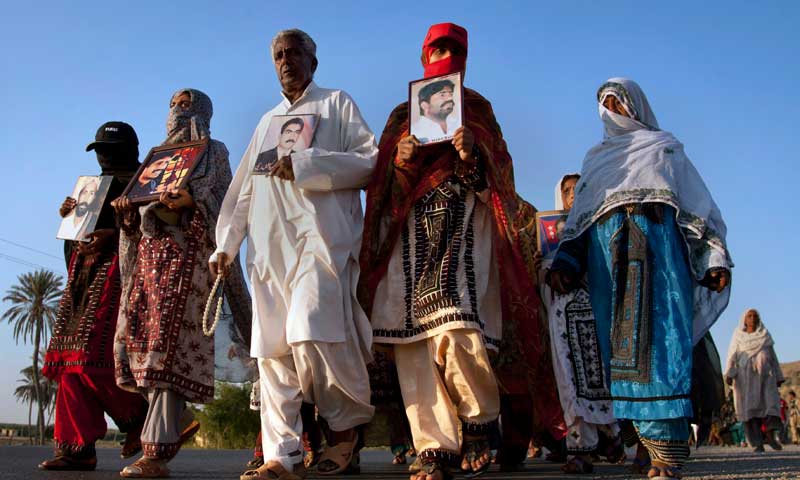
Baloch marchers reach near Rawalpindi

Pakistan: Security policy and reality
FIRST, the good news. The National Internal Security Policy has been unveiled before parliament and the government appears to have absorbed a basic, but key understanding: there are no quick fixes when it comes to internal security; patience and perseverance will be required. Welcome too is the latest attempt to turn the moribund National Counter-Terrorism Authority into the coordinating policy body that it was envisaged to be. And while the idea of new rapid-reaction police forces in Islamabad and the provinces may not be ideal — the politicians’ penchant for reinventing the wheel instead of working to strengthen existing institutions appears to have won the day again — at least the emphasis on the capacity of the civilian security apparatus is correct. As details of the policy are parsed in the days ahead — and likely parts of the classified section leaked — its likely efficacy will become much clearer. Suffice it to say, without a focus on implementation and adaptation — even the best of plans need to be tweaked when implemented — there will be little long-term success.
Now to the less welcome news. For one, the approach the government has taken is narrow and starts at the wrong end of the policy pyramid. Internal security is not established in a vacuum and, particularly in Pakistan’s case, is linked to the overall national security strategy, which looks both internally and externally and encompasses everything from military power to foreign policy. So, while the NISP does talk of past flawed policies on Afghanistan, India and Kashmir, it spends far too little time connecting the dots — and, perhaps most problematically, appears to assume that the past has been left behind and that all institutions today understand and accept what went wrong and are determined not to repeat the same mistakes. If only. Even if it were accepted that there really has been a fundamental change in institutional thinking, the reality of institutions and decades-old security policies is that change will not come through words alone.
Consider just two small examples of the problem with the overall approach. Yesterday, Interior Minister Nisar Ali Khan referred to a war that is 13 years old — implying that it began with the latest war in Afghanistan and so ignoring that the militancy in Pakistan has older roots. If the diagnosis itself is wrong, can the prescription work? Secondly, can militancy and terrorism be selectively eliminated after years of cross-pollination and cooperation between various groups and organisations? Every group that has turned its war on Pakistan itself was at one time considered an ally or asset. Are there still some non-state allies and assets today?
Pakistan: Inching towards action
Dr Mohammad Taqi
What the army is formally and informally putting out for public consumption suggests a focused operation against the TTP in NW while leaving the HQN and the Hafiz Gul Bahadur group aloneFederal Interior Minister Chaudhry Nisar Ali Khan has offered the Tehreek-e-Taliban Pakistan (TTP) to sort matters out by playing a cricket match. It is truly astounding that someone holding an important official position at such a critical juncture in Pakistan’s history could make such cavalier remarks. The TTP swiftly rebuked his offer not just verbally but also by attacking several targets in Khyber Pakhtunkhwa including the Iranian consulate and cultural centre in Peshawar, killing two Frontier Corps (FC) soldiers. The interior minister owes an apology to the families of the thousands killed at the hands of the TTP, including the ones that very day when he carried on with his loose talk. Casual remarks like Mr Nisar Ali Khan’s indicate how poorly the Pakistan Muslim League-Nawaz (PML-N) government is handling the war of words even as a military action against the TTP seems increasingly inevitable. For over a month, after the now botched negotiations with the TTP had started, the Pakistani electronic media showcased assorted clergymen and rightwing nuts spewing conspiracy theories, downright bigotry and total nonsense. The ostensibly centre-right PML-N seemed to have abdicated media space to the virulent rightist fringe. What passed for the government’s response was the incoherent mumblings of the PML-N leaders. Were it not for the TTP overreaching, as it had done in Swat, and continuing its vicious spree, especially against the security personnel, perhaps the talks might still be going on. Pakistani public opinion seems to be turning against the TTP despite the PML-N’s horrible handling of the narrative, not due to it. Prime Minister Nawaz Sharif must put his house in order for selfish reasons if nothing else. No matter how religiously conservative society gets under the mercantile capitalism of the PML-N variety, it is still incompatible with the TTP’s austere and violent sharia. It is not every day that the Pakistan army is predisposed to take action in North Waziristan (NW). Mr Sharif should count his blessings and grab the moment. While the TTP’s chosen surrogate, Mr Imran Khan, taunts the PPP, ANP and the MQM for not launching the NW operation on their watch, the fact remains that the former army chief, General Ashfaq Pervez Kayani, virtually stonewalled any action there throughout his tenure. Even when the overwhelming evidence pointed to the “internal existential enemy”, which General Kayani had become fond of mentioning in his speeches, was using NW as its logistic sanctuary, he refused to budge. The reasons given ranged from the army being stretched too thin between domestic operations and the eastern frontier to insinuating, through friendly media persons and politicians, that the terrorist groups being harboured in NW “protected the western flank”. An unannounced agreement with the Haqqani terrorist network (HQN) and a proclaimed one with Hafiz Gul Bahadur still hold. Whether the incumbent COAS, General Raheel Sharif, will roll back the Kayani-era policy, and if so to what extent, remains to be seen. Is there a General Sharif doctrine in the offing to roll back the fanciful strategic depth and the blowback it has unleashed? I wouldn’t hold my breath. However, some tactical posturing is clearly a departure from the days of General Kayani and the former ISI boss General Ahmad Shuja Pasha who described madrassas (seminaries) preaching jihad as their freedom of opinion. What the army is formally and informally putting out for public consumption suggests a focused operation against the TTP in NW while leaving the HQN and the Hafiz Gul Bahadur group alone. While the knee-jerk reprisal attacks against the TTP go on, a paradigm shift in military thinking, which discards the arbitrary distinction among the ‘good’ and the ‘bad’ Taliban, does not seem imminent. The security establishment has not put even half the effort in dissipating this flawed and highly dangerous notion of good/bad Taliban, which it created post-2007. The Pakistani policy still appears to be that the good Taliban, a la the HQN, Mullah Omar’s gang and Hafiz Gul Bahadur’s group, etc., will eventually move to and/or focus on Afghanistan after the US withdraws. The presumption also seems to be that the bad Taliban of the TTP variety can, on the other hand, be forced to negotiate or restrained through sporadic punitive action. Inherent in this premise is a calculation that the ‘good’ Taliban will not come out on the side of the TTP. The idea perhaps is to capitalise on the fissures within the TTP and between the TTP and other jihadists in NW. Some of their reluctance may actually be a serious capacity issue with the Pakistani forces to prosecute an asymmetric war against a guerilla enemy. Like the US military, and the Soviets before that, the Pakistani army doctrinally and operationally remains a conventional force and counterinsurgency its Achilles heel. However, unlike the US and the Soviets, the Pakistani security establishment is responsible for creating the mess in its own territory. Not even the army knows how many like their Kashmir jihadist Major Mast Gul, who has claimed three recent terrorist attacks in Kohat and Peshawar, are on the loose today. The sooner the Pakistani military and civilian leadership realises that there is no such thing as a good cancer, the better. Pakistan cannot unleash Mast Guls on the world and expect to remain immune to the contagion they spread. The NW operation is imperative but more important is to realise that bloodthirsty terrorists cannot be invited to play cricket. The TTP and its ilk have thrived in the ideological space provided to them through such kid-glove treatment. Merciless killers cannot be called ‘our own people’. The only thing worse than the TTP atrocities is dignifying and legitimising butchery through the so-called peace talks. Now that the talks travesty has met its only logical fate, Mr Nawaz Sharif would be well advised to muzzle Mr Nisar Ali Khan’s ilk. The TTP will again try to gain respite and divide public opinion by trying to engage in talks but there should be a limit to how many times the government falls for their ruse. The TTP, Mr Nisar Ali Khan and Mr Imran Khan had their chance to negotiate peace and they blew it. As he rolls out his weak prescriptions on national security policy, the prime minister has to take charge now. The waffling has to end. As Pakistan inches towards action against the TTP, even if a limited one, the message to the terrorists must be clear, consistent and stern.
Blockading NATO supplies:- 'Peshawar High Court declaration'

Iran says Pakistan obliged to complete gas pipeline
 Iran's oil ministry said Wednesday that Pakistan is contractually obliged to complete a major pipeline project which would allow Tehran to export gas to its southeastern neighbour.
The warning came a day after Pakistan's oil minister, Shahid Khaqan Abbasi, said work on the pipeline was not possible because of sanctions imposed by the United States and the European Union on Tehran over its controversial nuclear drive.
"Iran has carried out its commitments ... and expects the Pakistani side to honour its own," the deputy oil minister, Ali Majedi, said in a statement seen by AFP.
"They should even pick up the pace of work and make up for falling behind schedule" in constructing Pakistan's 780-kilometre (485-mile) side of the pipeline, he said.
Iran, which has the world's second largest gas reserves, says work on its side in the $7.5-billion project launched in 2010 is almost finished.
But the project's fate has faced uncertainty, with Pakistan repeatedly running into problems, including major financing issues, while being pressured by the US.
On Tuesday, Abbasi told AFP that the work on the pipeline "is affected by the sanctions imposed" on Tehran. He did not elaborate on how the sanctions could derail the project.
In Tehran, Majedi rejected the argument, saying the issue of sanctions was not a new development.
"Pakistan faced pressure at the time of signing the deal," he said. "But fully aware of the situation and the issue of sanctions, it still signed the contract."
Majedi added that the option of "bringing in a third party to finish the pipeline" had been raised in recent negotiations with Pakistani officials.
He did not elaborate.
Iran's Oil Minister Bijan Zanganeh said in late October he had "no hope" for the project, after Islamabad asked Tehran for $2 billion in financing to build its side of the pipeline.
That request was denied by Iran.
Iran currently produces nearly 600 million cubic metres (21.2 billion cubic feet) of gas per day, almost all of which is consumed domestically.
Its only foreign client is Turkey, which buys about 30 million cubic metres of gas per day.
Pakistan is struggling with a severe gas crisis, with natural gas supplies running out in winters, forcing consumers to rely on liquid gas cylinders.
Wednesday, February 26, 2014
SAUDI’S SEEKING PAKISTANI ARMS AND SOLDIERS TO STRENGTHEN SYRIAN MILITANTS TO OUSTER ASAD

Turkish opposition holds protest rallies

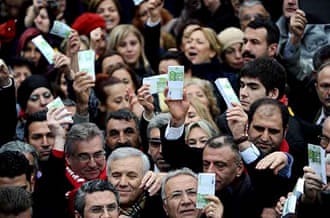
Demonstrations coincide with president's signing of law tightening controls on judiciary and new audio-recording leak.Thousands of protesters have taken to the streets in Turkey after the president signed a controversial bill tightening controls on the judiciary, deepening opposition resentment towards a government already struggling with a corruption scandal. Police used tear-gas to disperse protesters in the capital Ankara on Wednesday, while in Istanbul demonstrators gathered on central Taksim Square, the scene of protests that have dogged the government for months. Protests that swept six Turkish cities on Tuesday continued on Wednesday as demonstrators chanted "Thieves!" and "Government resign!" Mustafa Sarigul, the main opposition Republican People's Party (CHP) candidate for Istanbul mayor - the biggest prize in the country's March 30 elections - called on the government to resign, as party officials handed out fake money amounting to 30m euros. Recep Tayyip Erdogan, Turkey's prime minister, has accused his ally turned rival Fethullah Gulen - a US-based Muslim leader with strong ties to the country's police and judiciary - of being behind the corruption investigation. In retaliation, the governing Justice and Development Party (AKP) government has sacked thousands of police and prosecutors. Second recording leak The latest protests were organised by the CHP amid leak of a second audio recording, presented as the voice of Erdogan, asking his son not to accept an amount of money on offer in a business deal but to hold out for more. The recording was posted on the video-sharing site YouTube by an anonymous poster using a pseudonym on Wednesday, Reuters news agency said. "Don't take it," the voice on the latest recording, presented by a user under the pseudonym Haramzadeler as that of Erdogan, says. Whatever he has promised us, he should bring this. If he is not going to bring that, there is no need." "The others are bringing. Why can't he bring? What do they think this business is? ... But don't worry they will fall into our lap." Erdogan said a similar post on YouTube late on Monday, allegedly of him telling his son Bilal to dispose of large sums of cash as a corruption investigation erupted, was a "vile" montage and "completely untrue". The recorded conversations allegedly took place on December 17, when a high-level corruption scandal implicating highly placed Erdogan allies erupted. Reuters could not verify the authenticity of either recording. Fikri Isik, Turkish technology minister, said on Wednesday that five officials overseeing the encrypted phones used by the Erdogan's office had been dismissed. The tensions come as new legislation gives the Justice Ministry greater control over the Supreme Board of Judges and Prosecutors (HSYK), an independent body responsible for appointing members of the judiciary. More government powers The law, signed into force by President Abdullah Gul on Wednesday, will give the government more say in the naming of judges and prosecutors, a role currently fulfilled by the High Council of Judges and Prosecutors (HSYK). Critics say the move contravenes the basic principle of the separation of powers enshrined in the constitution. Gul last week dismissed calls to reject the bill, saying it was not his place to challenge legislation passed by parliament. He also indicated he would sign another bill strengthening state control over the internet. Gul said he had objected to 15 provisions that were "clearly unconstitutional", and that he believed the Constitutional Court would deal with them. The CHP is expected to file a challenge to the law at the Constitutional Court, seeking its annulment. But even if the court rules to overturn some articles in the law, the government will have enough time to make changes that will tighten its grip over the HSYK, according to Murat Arslan, president of the Association of Judges and Prosecutors. The law will come into effect once it is published in the Official Gazette and all personnel of the HSYK, excluding the 20 elected members, will then lose their jobs. The unelected staff amounts to about 1,000 people, including its secretary-general, inspectors, audit judges and administrative staff, whose positions will then be filled by the justice minister, the Hurriyet daily said.
China blasts Japan's pro-military tendencies, nuclear stockpile
In an interview with the Wall Street Journal last week, Etsuro Honda, Japanese Prime Minister Shinzo Abe's economic aide who is also a key architect of Abe Economics, said Japan needed a strong economy so it could build a more powerful military and stand up to China. When asked to comment on the remarks, Chinese Foreign Ministry spokeswoman Hua Chunying told a regular press briefing on Wednesday, "Those words show that Abe Economics is in fact aimed at serving Japan's military expansion, which mirrors the country's pre-war militarism. "Those voices from Japan have proved the country's so-called active pacifism and willingness to hold dialogue with China as deceptive." Such statements revealed Japan's "dangerous tendencies" to stand against China, and to change its post-war peaceful development road, she said. Japan, led by its right-wing forces, is on a dangerous direction and is becoming a troublemaker which would harm regional peace and stability, Hua said. Hua also commented a recent report from the United States Congressional Research Service (CRS), which expressed worry over Abe's view on history. "The CRS report pointed out problems that exist in the Japanese leader's view on history," Hua said. She criticized Japan's recent moves to deny or whitewash its aggression history. "They are in fact challenging the world's anti-fascism achievements and the post-war order," she said. Hua urged Japanese leaders to listen to the voices of the international community and to regain trust from its neighbors and the world via tangible measures. DOUBTS ON NUKE STOCKPILE While commenting on reports that the Japanese government is to hand over its plutonium stockpile to the United States, Hua said China supports the U.S. to demand Japan return those nuclear materials. She urged Japan to return weapons-grade nuclear materials at an early date. Since the nuclear security summit in Washington in 2010, the U.S. government has been pressing Japan to return 331 kilograms of weapons-grade plutonium given to the country during the Cold War. The U.S. plans to reach an agreement with Japan before the nuclear security summit in the Netherlands in March. However, it has been reported that a large amount of highly enriched uranium is also in Japan's hand. "Highly enriched uranium is a problem which could ignite nuclear security and proliferation risks," Hua said, adding that doubts from the international community should be addressed. "Does Japan have highly enriched or weapons-grade uranium? How much does Japan store?" Hua asked, adding that China urges Japan to take a responsible attitude and explain its answers to the world.China on Wednesday strongly denounced the Japanese government's pro-military tendencies and controversial view on history, and threw doubts on the country's nuclear material stockpile.
23-Year-Old Detained by Police in Bahrain Dies
http://abcnews.go.com/A 23-year-old Bahraini suffering from sickle-cell anemia who was detained by police as part of a security investigation has died a week after being taken to the hospital, authorities in the Gulf island kingdom said Wednesday. The country's main Shiite opposition group, al-Wefaq, hailed the man as a martyr and blamed the government for his death because of what it alleged was improper care while in custody. The Ministry of Interior said the man, identified as Jaffar Mohammed Jaffar, had sickle-cell anemia and died at around 3:15 a.m. Wednesday. He had been receiving treatment at Salmaniya Medical Complex after being admitted on Feb. 19. It is unclear how — or if — his disease contributed to his death. The office of public prosecution said in an email that the hospital report indicated that Jaffar died of a pulmonary embolism and that there were no signs of injury on his body. As a result of his sickle-cell condition, he suffered from blood clots in the lungs that led to respiratory failure and bleeding in his digestive system, it said. He was being held awaiting trial. Opposition activists and human rights groups in the past have raised concerns about the alleged mistreatment of detainees amid a three-year uprising by a Shiite-dominated opposition seeking greater political rights from the country's Sunni rulers. Bahrain, an American ally that hosts the U.S. Navy's 5th Fleet, says it is committed to complying with human rights norms. In April 2011, a supporter of Bahrain's anti-government movement, Rashid Zakaria Hassan, 40, was found dead in a detention facility. A medical examiner determined that complications from sickle-cell anemia resulted in his death. Jaffar was one of several suspects detained in connection with an operation in December that resulted in the seizure of stocks of weapons and explosives, including some being smuggled in by sea. The man's family alleges that their son was subjected to beatings and electric shocks, according to al-Wefaq. A government ombudsman has opened an investigation into the death, and investigators have spoken to family members and "relevant persons" at the detention facility, according to an emailed statement in response to questions. It said results of the investigation will be made public once it is complete. Jaffar is the second person to die in police custody this year. In late January, Fadhil Abbas Muslim, 20, died from injuries sustained when he was shot in the head while trying to flee the scene of a police investigation, according to authorities. In a separate statement, the Interior Ministry urged Bahrainis not to take part in fighting in conflicts abroad and warned against becoming involved with religious extremist groups. It specifically raised concerns about Bahraini citizens who have joined the fight in Syria, and said it was preparing draft legislation aimed at further deterring citizens from fighting abroad or receiving weapons training. It follows a royal decree issued earlier this month by neighboring Saudi Arabia's King Abdullah punishing citizens who fight in conflicts outside the kingdom with prison sentences ranging from three to 20 years in jail. Many Sunnis in the Arab Gulf back predominantly Sunni rebels against Syria's President Bashar Assad, who comes from a Shiite offshoot sect.
Calls for Turkey PM Recep Tayyip Erdogan to resign in leaked tape scandal
http://www.euronews.com/A voice recording said to be of a telephone conversation between Turkish Prime Minister Recep Tayyip Erdogan and his son Bilal is at the centre of the latest political storm in Turkey. In the conversation the pair allegedly discuss how to hide large sums of money on the day police raided houses as part of a corruption inquiry into Erdogan’s government on December 17, 2013. Erdogan’s office described the recordings as a “dirty immoral fabrication”. After the alleged leak, Turkey’s main opposition Republican People’s Party (CHP) held an emergency meeting where they discussed the voice recording. The CHP said the government has lost its legitimacy and called on Erdoğan to step down. The executive board of the Nationalist Movement Party (MHP) also held a meeting under the leadership of chairman Devlet Bahçeli. Bahçeli said “the talks between the Prime Minister and his fugitive son is beyond our capacity of understanding.” In the newly released voice recordings, it’s claimed Erdoğan and his son discuss in five wiretapped phone conversations plans to conceal huge sums of cash from police, who raided a number of venues as part of a corruption investigation that has implicated sons of three Turkish ministers, businessmen and the head of the state bank. The Prime Minister’s office released a statement late on Monday, claiming that the voice recording is a “product of montage” and it is “completely false.” Justice Minister Bekir Bozdağ repeated the claim and said those responsible will be brought to justice. The voice recording is the latest in a series of leaked phone conversations that purportedly reveal wide-range corruption. The Prime Minister claims that all these are a plot against his government and are completely unfounded. Pro-government newspapers yesterday published reports of what it claims were illegally tapped phone calls. The political uncertainty hit Turkish markets, with the Turkish Lira losing value against the euro and the dollar.
Bilawal Bhutto visits Moenjo Daro
http://mediacellppp.wordpress.com/


Bilawal Bhutto Zardari, Patron in Chief, Pakistan Peoples Party visited the historic site of Moen Jo Daro along with Sindh Chief Minister Syed Qaim Ali Shah and attended a briefing regarding the preservation and promotion of the world-famous Indus valley civilization heritage and the steps to be taken in future for Moen Jo Daro’s preservation and promotion. Bilawal Bhutto Zardari stressed on the need of further excavation and dry core drilling to determine the complete area of the world heritage site. Further steps were discussed to safeguard the site and promote cultural tourism.
'Taiwan independence' a dead end: spokesman
"Taiwan independence" will not win the support of Taiwan people and is doomed to be opposed by people from across the strait, said a mainland spokesman on Wednesday.
Ma Xiaoguang, spokesman with the State Council Taiwan Affairs Office, made the remarks at a press conference in response to a question about the pulling down of Dr. Sun Yat-sen's statue in Tainan City by supporters of Taiwan independence.
Dr. Sun is the great forerunner of China's democratic revolution and is respected by people from both sides, Ma said.
Organizations and people from the island expressed their indignation and denounced the pulling down of Dr. Sun's statue, Ma added.
Cold War passions in Ukraine
PRESIDENT JOHN F. Kennedy memorably called the Cold War a “long, twilight struggle’’ — the four-decade contest in Europe for freedom and power between the United States and Soviet Union. Last week’s dramatic revolution in Ukraine was compelling evidence that Cold War passions continue to burn in a country deeply divided between East and West. It is too early to predict where these momentous events will carry the people of Ukraine. The new interim government, dominated by nationalists from the central and western parts of Ukraine, acted swiftly to set presidential elections in May and seek greater economic and political ties with Europe. But in the industrialized country’s east and south, millions of ethnic Russians want to maintain Ukraine’s centuries-old symbiotic cultural, linguistic, and economic links to Russia. One thing is certain — Russian President Vladimir Putin will not easily accept Ukraine’s separation from Moscow. He will push back hard to keep Ukraine within the Kremlin’s orbit. It is unlikely in the short term that Russian tanks will roll across the border to defend ethnic Russians in Donetsk, Kharkiv, and the Crimea. Instead, his instinct will be to use Russia’s stranglehold on the Ukrainian economy to intimidate, if not blackmail, the interim rulers in Kiev. Putin has turned off Russia’s natural gas spigot in the past and may do so again. He could also cut loans and exports if the new leaders veer too far in an anti-Russian direction. Putin will be prepared to play a tough, cynical game. President Obama is thus right to proceed cautiously given the risk of conflict with Moscow. But Ukraine matters to American interests too. Every president since Harry Truman has viewed a democratic, free Europe as one of America’s most vital strategic aims. President George H.W. Bush described it as a Europe “whole, free, and at peace.” It was the absence of such a Europe that compelled our entry into the First and Second World Wars and the long Cold War. That is why the downfall of the Soviet bloc was the single most important US foreign policy success during the last half century. Don’t look, however, for a repetition of the old Cold War strategy as the Obama team prepares to duel with Putin. The United States will not deploy military forces on the front lines of a new East-West divide. Instead, it is countering with a more patient diplomatic strategy to help Ukraine steer clear of Moscow’s smothering embrace. In the last few days, the United States and Europe have stressed the importance of an independent, undivided Ukraine built by free elections and peaceful change. Obama is challenging Russia to join a global financial effort to rescue Ukraine’s nearly bankrupt economy. He should also push the interim government to reach out to distrustful ethnic Russians in eastern Ukraine. All this will help to build global pressure on Putin not to deploy military force. But Obama will need to lead this Western effort for it to be successful. Obama’s hand is also strengthened in the chess match with Putin by the prescience of Presidents Bill Clinton and George W. Bush, whose expansion of NATO to take in 10 Central European countries was criticized by some as excessively provocative to Moscow. But NATO’s push eastward has protected those countries from Putin’s aggressive muscle flexing in Russia’s so-called “near abroad.” Lying outside of NATO and EU territory, however, Ukraine finds itself in a renewed Cold War struggle between East and West. If the United States and Europe have their way, this battle will not be decided by armies but by a persistently powerful ideal. Shouldn’t all Europeans, including the people of Ukraine, be free to choose their own future? The Ukraine crisis has reminded us of an important geopolitical reality. While pivoting to Asia and coping with Middle East fires are priorities, Europe is still our largest trade partner and investor and home to our strongest alliance, NATO. Europe — its unity and continental peace — still matters greatly to Americans. And strong US leadership in the Ukraine crisis is vital to preserve the democratic peace in Europe.By Nicholas Burns
Russia calls on OSCE to condemn "neo-fascist" sentiment in West Ukraine
Voice of Russia
Russian Foreign Minister Sergei Lavrov called on democracy watchdog, the Organisation for Security and Cooperation in Europe, on Wednesday to "decisively condemn" the rise of "nationalist and neo-fascist" sentiment in western Ukraine. In a foreign ministry statement, Lavrov also said the OSCE should condemn attempts by nationalists to ban the Russian language in Ukraine. "Lavrov called on the OSCE to decisively condemn the rise of nationalist and neo-fascist sentiment in the west of the country, (to condemn) calls to ban the Russian language, to turn the Russian-speaking population into 'non-citizens' and to restrict freedom of expression," the ministry said in a statement.
Any forms of assistance to Ukraine, including from the Organization for Security and Co-operation in Europe (OSCE), should be rendered at the request of this country's legitimate authorities and with respect for its sovereignty, Russian Foreign Minister Sergei Lavrov said at a meeting with OSCE Secretary General Lamberto Zannier. "It has been emphasized that any forms of assistance, including from the OSCE, should be rendered at a request from the legitimate Ukrainian authorities and with unconditional respect for Ukraine's sovereignty," the Russian Foreign Ministry quoted Lavrov as saying at the meeting in a statement summing up its outcomes.
Moscow is soon going to provide video evidence to the EU and OSCE proving that extremists provoked unrest in Ukraine, the Russian Foreign Ministry has stated on its Facebook account. "The Western media prefer not to talk about the riots for what they really were, demonstrations arranged by extremist groups. Perhaps the leaders of the European institutions do not know about the actions of these extremists who were disguised as civilians," the statement reads. "We are most deeply concerned about what is happening in Ukraine. We are startled to hear that some Western countries misinterpret the events, trying to influence the situation," the Ministry said.
Ukraine revolution: Putin puts troops on alert in western Russia
http://www.telegraph.co.uk/
Moscow flexes military muscle with urgent drills amid confrontation between pro and anti-Russian protesters in Crimean capitalIn the Crimean capital of Simferopol, supporters of Ukraine's revolution and their pro-Russian opponents are embroiled in an ugly stand-off outside the regional assembly, where members were holding an emergency session to discuss the crisis gripping the country. A crowd of several thousand people shouting pro and anti-revolutionary slogans have gathered outside the assembly, which pro-Russian protesters claim they are defending from the "fascists" who have taken power in Kiev. Small scuffles broke out as the two sides pushed and shoved each other. Pro-European demonstrators, most of them ethnic Tatars, rallied under a pale-blue flag, shouting: "Ukraine! Ukraine!" and the Maidan's refrain of "down with the gang!" The pro-Russian crowds, some of them cossacks in silk and lambswool hats, shouted back "Crimea is Russian!". Protesters said parliamentarians were debating the possibility of a referendum to decide the future of the Black Sea peninsula though this could not be immediately confirmed. The autonomous eastern peninsula, which is home to a largely ethnic Russian population, is at the centre of tensions over the overthrow of President Viktor Yanukovych, an ally of Moscow, by pro-European protesters at the weekend. Earlier, Cossack protesters hung the Russian flag across the assembly's facade, according to Russia's Interfax news agency, calling on the government to ignore what they regard as illegal resolutions by the new authorities in Kiev. Moscow has denounced the removal of Mr Yanukovych as tantamount to a coup, and has become increasingly concerned by swift moves by Ukraine's parliament to break away from the Russian sphere of influence. Sergei Lavrov, the Russian foreign minister said that Moscow's "policy of non-intervention" will continue. But the combat drills in the western district bordering Ukraine are likely to raise the temperature in the region. "They wouldn't have done it now unless they wanted to have a political effect. If they had a planned exercise at this time in that command they would have cancelled it - if they wanted to de-escalate the situation," a former British Army commander said. "The converse is obviously true." The Telegraph's David Blair in Kiev said: "Russia’s decision to place its forces near the Ukrainian frontier on high alert sends another pointed signal to its western neighbour. The Kremlin wants no-one to misunderstand its strength of feeling over the downfall of a friendly pro-Russian regime in Kiev, and the possible emergence of a new pro-Western government in Ukraine. "But military alerts of this kind have been ordered before – and the term itself means little. What exactly will the armed forces in western Russia be doing today that they weren’t doing yesterday? "Vladimir Putin’s latest decision is best viewed in the same light as the withdrawal of Russia’s ambassador from Kiev. The goal is to send a pointed message, perhaps timed to coincide with the possible formation of Ukraine’s new government. But the alert probably means nothing more than that. In particular, it emphatically does not suggest that Russian tanks are about to start rolling over the border." On Tuesday, the country's interim president, Oleksander Turchynov called an emergency meeting to discuss "the question of not allowing any signs of separatism and threats to Ukraine's territorial integrity - meaning the events which have taken place in Crimea - and punishing people guilty of this," according to an official statement. In the fiercely pro-Russian Crimean port city of Sebastopol, the home of Russia's Black Sea fleet, the newly installed mayor announced the formation of vigilante 'self-defence' units to defend the region against the "fascist" revolutionaries in Kiev. Alexei Chaliy also said he would guarantee the salaries of the Berkut riot police, which was this morning officially disbanded by Mr Turchnyov. Video has emerged via Channel 4 of members of the feared riot police begging for forgiveness for their role in repressing the Kiev protests, as they knelt in front of members of the pro-European movement on Tuesday night.
The United States and Britain have sought to lower the temperature amid fears the former Soviet state could fragment in the struggle between its pro-Russian and pro-European populations. John Kerry, the US secretary of state, insisted the country must not be a battleground between East and West, after meeting William Hague, the Foreign Secretary, on Tuesday. "This is not a zero-sum game, it is not a West versus East," said Mr Kerry after the two men met at the State Department. "This is about the people of Ukraine and Ukrainians making their choice about their future." Mr Hague, who is planning to visit Kiev shortly, urged the country's interim leaders "to form an inclusive government, involve people from different parts of Ukraine including from the east and the south of Ukraine. It's important for Ukrainians to be able to make these decisions together after the terrible divisions of recent months." "We want to send our strong support for the territorial integrity and unity of Ukraine," he added. Mr Lavrov this morning called on Europe's democracy watchdog to condemn the rise of "nationalist and neo-fascist sentiment" in western Ukraine. In a statement, his ministry said the Organisation for Security and Cooperation in Europe (OSCE) said the organisation should also condemn moves to ban the Russian language and to turn the "Russian-speaking population into 'non-citizens'". The United States has warned Russia against interference in the crisis, saying military intervention by Moscow would be a "grave mistake". After a classified State Department briefing on Tuesday, Senator John McCain, who has openly expressed suspicion of Vladimir Putin for years, warned that the Russian leader has long had his eye on Ukraine as the "crown jewel" of the former Soviet states. "I know that Putin believes that Ukraine is part of Russia. He is committed to that," Mr McCain said.
US museum eyes influences of Indian-Americans
 Indian-Americans are doctors, engineers, motel owners, taxi drivers and spelling bee champs — just a few takeaways from a new exhibition at the Smithsonian.
Looking closer, though, curators are probing the history behind certain cultural stereotypes of this population of 3.3 million Americans in a new exhibit opening Thursday.
The influx of Indian doctors, for example, began in the 1960s as the U.S. needed more physicians for its new Medicare system and immigration law opened the door to those with medical training. Later, the American inventors of Hotmail, the Pentium chip and fiber optics were all of Indian origin, perhaps because H-1B visas for engineers were a U.S. effort to remain competitive with the Soviet Union during the Cold War.
"Beyond Bollywood: Indian Americans Shape the Nation" is the Smithsonian's first major exhibit to examine the history of Indian immigration to the United States and the influence of Indian-Americans. The exhibit is on view for at least a year and is expected to travel to 15 cities through 2019.
It's a story that dates to the first Indians arriving in 1790, those who helped build the nation's railroads and farms, and those who fought for citizenship when immigration from Asia was discouraged. There are also plenty of more recent contributions of leading Indian-American writers, entertainers, athletes and a fashion designer favored by first lady Michelle Obama.
Curator Masum Momaya said her team used Indian-American stereotypes as an entry point for visitors to learn more.
"We want to take people beyond some of the things they know and have seen in popular culture to the deeper and more nuanced history," she said. "I think one of the things that museums can do is add history and add context to contemporary conversations about race and immigration."
So in a subtle way, curators show the current debate over immigration has been debated before.
The Smithsonian borrowed and collected objects from many Indian-Americans, from family photos and shoes that evoke a family home to the a professional football helmet worn by the first Indian-American to win the Super Bowl, Brandon Chillar with the Green Bay Packers.
For more than a year, curators worked to borrow a dress made by Indian-American designer Naeem Khan for Mrs. Obama. Khan draws on a line of Indian embroidery techniques in his design for an American silhouette.
The rarely seen gown joins items from other Indian-American ground breakers. There's the NCAA basketball jersey from the first player wear a turban in competition as a symbol of his Sikh faith, a silver Olympic medal won by gymnast Mohini Bhardwaj in Athens, and the first U.S. spelling bee trophy won by an Indian-American in 1985. Coincidentally, Indian-American students have been on a spelling bee winning streak for most of the past decade.
"It's novel, but at the same time, it does speak to that experience of becoming American," said Konrad Ng, director of the Smithsonian Asian Pacific American Center. "Spelling bees have this symbolic value of being American, being literate in the language of the country and excelling in it."
The yearlong exhibit at the National Museum of Natural History is part of a $2 million ongoing heritage project at the center. It will also help bring new items into the Smithsonian's collection to represent Indian-Americans.
Newly acquired artifacts include campaign materials from former U.S. Rep. Dalip Singh Saund, who was the first Asian-American elected to Congress in 1957.
Eyeing Afghan exit, U.S. intensifies campaign against Haqqani militants
 The United States has intensified its drive against the Taliban-linked Haqqani network in an attempt to deal a lasting blow to the militants in Afghanistan before foreign combat forces depart this year, according to multiple U.S. officials.
The effort is taking on added urgency as the clock ticks down on a NATO combat mission in Afghanistan set to end in December, and as questions persist about whether Pakistan will take action against a group some U.S. officials believe is quietly supported by Pakistani intelligence.
The Obama administration has created a special unit based in Kabul to coordinate efforts against the militant group, according to officials familiar with the matter. It was set up late last year, as part of a new strategy that involves multiple government agencies.
The unit, headed by a colonel and known in military parlance as a "fusion cell", brings together special forces, conventional forces, intelligence personnel, and some civilians to improve targeting of Haqqani members and to heighten the focus on the group, the officials said.
"Things are coming together in terms of the more comprehensive approach (against the Haqqanis). So, there's a lot of focus - there's a lot of energy behind it right now," said a U.S. defense official, who asked not to be identified.
It was not immediately clear whether the intensified focus on the Haqqanis has led to increased strikes on the group by the U.S. military or the CIA, which operates drones over Pakistan's tribal areas.
And it remains to be seen, this late in the NATO combat mission, how much damage the United States can inflict on the Haqqani network, which has proven resilient and uses Pakistan's tribal areas along the Afghan border, including the North Waziristan region, as a sanctuary.
AUDACIOUS ATTACKS
The White House announced on Tuesday that President Barack Obama had ordered the Pentagon to prepare for a possible complete withdrawal of troops following Afghan President Hamid Karzai's refusal to sign a bilateral security pact.
The Haqqani network, which professes obedience to Taliban leader Mullah Omar, is believed to have been involved in some of the most audacious attacks of the Afghan war. These include assaults on hotels popular with foreigners, a bloody bombing of the Indian embassy in Kabul, a 2011 attack on the U.S. embassy, and several massive truck bombing attempts.
The group is also believed to be holding Bowe Bergdahl, the only known U.S. soldier missing in the war in Afghanistan.
Some U.S. lawmakers have complained that the Obama administration has dragged its feet in cracking down on the group after designating it a "foreign terrorist organization" in September 2012.
For example, it is unclear what diplomatic pressure Washington is putting on Islamabad to arrest individuals connected to the group, the lawmakers say.
This month, the U.S. Treasury froze the U.S. assets of three suspected militants linked to the Haqqanis, the Obama administration's first significant non-military move against the network since that 2012 designation.
The Pentagon has regarded the Haqqanis, seen as more skilled in attacks on foreign targets than other militants in Afghanistan, as an acute threat to its soldiers for years.
U.S. General Joe Dunford, who commands U.S. and allied forces in Afghanistan, told Defense Secretary Chuck Hagel of his concern about the state of the current U.S. effort against the group in a private letter last November, sources familiar with the matter said.
During a recent visit to Washington, Dunford told senior White House officials that the group was a top priority for him, the sources said.
'PERVASIVE, VIRULENT ENTITY'
Retired General John Allen, who commanded U.S. and NATO forces in Afghanistan from 2011-2013, said he initiated the request to designate the Haqqanis as a terrorist group in spring 2012 because military efforts alone were insufficient.
"My reason for doing that was that it is simply such a pervasive, virulent entity," Allen said in an interview.
"I was going to pressure them in every possible way inside the country, but I wanted them to feel it at a strategic level, to include attacking their finances, their assets - pressuring the entire nervous system of the Haqqanis."
Some Afghan and U.S. officials remain skeptical that the United States can seriously weaken militant groups such as the Haqqanis unless Pakistan cracks down on them from within or better controls its borders.
"Until the Pakistanis do something about the safe havens, that's going to be a problem. (Militants) can recruit and train and equip and prepare to launch in Pakistan," said Major General Stephen Townsend, who commands U.S. and NATO forces in eastern Afghanistan.
Townsend was speaking about the array of militants who infiltrate the border with Pakistan, not just the Haqqanis.
On Tuesday, the Pakistani military launched new air strikes on militant hideouts in North Waziristan, killing at least 30 people. Pakistani fighter jets have been pounding targets in the area since efforts to engage the Pakistani Taliban in peace talks broke down this month.
The former top U.S. military officer, Mike Mullen, told U.S. lawmakers in 2011 the Haqqanis were a "veritable arm" of the Pakistani intelligence agency ISI, which some U.S. officials believe seeks to strengthen the Taliban and its allies as a means of ensuring that archenemy India does not wield influence in Afghanistan. Pakistan denies such charges.
Founded by mujahideen leader Jalaluddin Haqqani, the group fought the 1980s Soviet occupation of Afghanistan with varying levels of support from Pakistani, Saudi and U.S. policy-makers.
In November, six members of Congress sent Obama a letter calling efforts against the Haqqanis "woefully insufficient", according to a copy of the letter obtained by Reuters.
"It is past time for the administration to comprehensively address the threat posed by the Haqqani network's deadly attacks," Mike Rogers, chairman of the House Intelligence Committee, told Reuters in a statement.
Subscribe to:
Posts (Atom)