
Monday, January 13, 2014
Pakistan: Ambivalent on militancy
Pakistan's Hero Aitezaz Hassan: All recognise valour of Hangu hero but PTI govt

Pakistan: Orya Maqbool Jan’s attack on Jinnah
By Yasser Latif Hamdani
Jinnah’s idea of Islam was of social justice and equality and never of narrow-minded interpretations by the orthodoxyFamous civil-servant columnist Orya Maqbool Jan continues to claim — like a broken record — in column after column that Jinnah’s August 11 speech was made up by secret forces who were Lord Conwallis’ followers and who were secularists. His original claim was based on the fact that he looked through the record of the Civil and Military Gazette and he could not find it; hence the great civil servant concludes it must not exist. The Hindu, apparently, is not a reliable source because, well, it is ‘The Hindu’. Similarly, the record of the Indian Constituent Assembly with Indian legislators referring to Jinnah’s speech was also ‘tampered’ with I suppose. Jinnah papers have the complete record of the speech in Jinnah Papers Volume IV Appendix IX, Item 4: President’s address, but you guessed it — according to Orya Maqbool Jan that is tampered with as well. He claims that the Constituent Assembly debates are also made up, because, well, they were published on October 9, 1948 after Jinnah’s death. He then claims erroneously that Selena Karim’s Secular Jinnah: What The Nation Does Not Know is his source. Perhaps he should read his source more carefully. Selena Karim questions a quote that Justice Munir had stated in his book Jinnah to Zia, not the Munir Report. This was not about the August 11 speech but Jinnah’s interview with Doon Campbell. The actual quote, which is much longer — which Selena refers to — in fact is even more clearly secular in the real sense of the word. How that becomes relevant to Orya Maqbool Jan’s claim that Jinnah never spoke on August 11 can only be explained when one sees how desperate Orya Maqbool Jan is now having been exposed rather badly. One wonders what it is about the August 11 speech that bothers people like Orya Maqbool Jan that they would go to such lengths in denying the existence of a speech that really cannot be denied. The issue is obviously of the content. It is too fine for the philistines. Here we have our Quaid-e-Azam, the founding father of Pakistan, the largest Muslim majority state at the time, saying that the religion of a citizen should not matter to the state and indeed going even further and saying that, if this policy is followed, in due course of time, the political distinctions between Hindus and Muslims would cease to exist. To Jinnah’s mind, the question of ‘secular’ versus ‘Islamic’ did not even arise. The issue between Hindus and Muslims was a political question to him. He was schooled in the British tradition and there secularism and religion were never mutually exclusive. Toleration and equality of citizenship were the ideals to be achieved with progress and maturity. This was a constant view that Jinnah held throughout his life. It was there when he was a Congressman, it was there when he proposed the 14 points and it was there again when he warned Muslims against raising sectarian questions and theological debates. Jinnah’s idea of Islam was of social justice and equality and never of narrow-minded interpretations by the orthodoxy. Perhaps if Orya Maqbool Jan had read Mr Jinnah’s speeches as a legislator in the Indian Central Legislature between 1910 to 1945 he would find many speeches far more ‘secular’ than the August 11 speech. I will, in due course, produce these speeches in public record but suffice to say that Jinnah remained consistent in the principle that the state should, at all costs, remain neutral and impartial on questions of religion. To Jinnah, at least, this was in no way contrary to the principles of Islam. He also said on December 17, 1947, speaking to the last session of the All India Muslim League, that Islam did not endorse an “ecclesiastical state”. Perturbed by this scurrilous claim against Jinnah by a civil servant on the payroll of the state — and who would not be perturbed when one makes such erroneous and patently false claims as Orya Maqbool Jan has done — I called up Dr Akbar S Ahmed who is visiting Pakistan and asked him what he made of this. Dr Akbar S Ahmed, who is an authority on Jinnah and on contemporary Islam, was categorical: “Jinnah did give the speech. I researched it in the course of my Jinnah quartet. The issue of Islamic versus secularism is a false binary. What Jinnah said on August 11 about an inclusive state is perfectly Islamic.” He suggested that Orya Maqbool Jan should read the Meesaq-e-Medina, where Jews and Muslims are described as one ummah or community. Maybe he feels that too is made up. Jinnah’s August 11 speech, call it secular or Islamic, was one of the most remarkable speeches ever given. It shows the immensity of his vision and his idea of Pakistan. It calls for an inclusive society where no bars are placed against anyone on the basis of religion, sect or caste. It was the crowning glory of a passionate career devoted to constitutional advance and progress. The real reason that it bothers Orya Maqbool Jan is that it goes against the narrow minded and fanatical worldview our mighty civil servant holds. An opponent of democracy, Orya would sooner have the Taliban ruling Pakistan. To Orya, Islam is incompatible with democracy. To Jinnah, democracy was “in the blood of every Musalman”. Well too bad; Jinnah, the founder/maker of Pakistan, was a liberal democrat all his life. No amount of mental gymnastics and odious claims by dishonest civil servants can change that fact, try as they may. Now that is what hurts people like Orya Maqbool Jan so much. As for Pakistan, for now the Oryas, dime a dozen, have managed to thwart Jinnah’s magnificent vision; not for long though. Ultimately, truth will triumph, Inshallah.
Pakistan: TTP’s culpability
Pakistan: Dialogue or deterrence: govt told to make up its mind
The National Assembly leader of the opposition said on Saturday that the government needed to make up its mind as to whether it would chose “dialogue” or “deterrence” to tackle the issue of terrorism. “The government has weakened its own position by persisting that it wants to hold talks with terrorists,” Syed Khursheed Ahmed Shah told reporters on Saturday. “Will Pakistan be a secure and safe country for the coming generations if the writ of the State has been severely compromised by the threat posed by extremists and terrorists?” Shah was talking to the media after attending a seminar on the sacrifices rendered by slain Pakistan People’s Party chairperson Benazir Bhutto and other party leaders for the sake of democracy organized by the People’s Youth Organisation at the Karachi Press Club. “The government should have utilised the option and mandate given to it through the forum of the all-parties conference attended by every mainstream political party,” he said. “The conference had backed the new government to hold talks with the extremists. Now it is high-time for the government to pick an option in the drive against terrorists.” Privatisation Shah said the PPP would move the apex court against the government’s newly-announced policy of privatising national institutions. “The opposition party can also use the option of launching an agitation drive against the policy,” he added. He said the policy of privatisation in earlier instances had resulted in the national exchequer receiving billions of rupees, but at the present, there were no clues available about where the money would go. “The privatisation of national institutions would result in exacerbating the trend of unemployment in the society, which is tantamount to the economic murder of the masses.” Earlier, while speaking at the seminar, Shah defended the decision of the PPP to nominate the young Bilawal Bhutto Zardari as the new leader of the party. “No other leader of the PPP, regardless of their age or political experience, would be more suitable than Bilawal to become the new patron of the party,” he said. “Bilawal will soon emerge as the new icon of the struggle for revival and continuance of democracy in the country.” Shah said he had advised Bilawal to assemble the youth of the country on a single platform for the cause of democracy and resolving major national issues. In this regard, he added, a youth festival would be held in Lahore in the coming weeks. He said he had also advised the Sindh chief minister to hold a youth convention in the province. Bilawal Bhutto Zardari, in his a message read out on the occasion, said the sacrifices rendered by the leadership and activists of the PP had glorified name of the party. He also praised the political services of his father, former president Asif Ali Zardari, who despite facing incarceration for several years, had always strived for the survival and progress of Pakistan. PPP leader Abdul Qadir Patel said the party’s leaders and activists had endured hardships and laid down their lives in their struggle against autocratic rulers and terrorists, but their spirit and morale had never been dampened. Senator Saeed Ghani praised Bilawal for taking over the responsibility of leading the PPP.http://mediacellppp.wordpress.com/
Sunday, January 12, 2014
Keep War Away from Us… artistic cry of Syria children

War fire could not silence their throats or stop their small hands, school students expressed their adherence to hope of a better future through participating in the event "Keep War Away from us" held in the Damascus-based the Opera House. The event taken place on Sunday in cooperation between Ministries of Education and Culture is a children's initiative for calling upon the world to stop the war of terrorism waged against their country, which has reached a systematic targeting of schools.


The event included an exhibition of paintings and photos of school students who expressed their hopes and sorrow as messages to the relevant sides in the state for affirming their role in defending them, as well as the international organizations. "Keep War Away from Un" event also included a documentary on the damaged schools, containing images and statistics provided by Ministries of Education and Culture and Syrian Commission for Family Affairs.
Education Minister, Hazwan al-Wazz, said that all government bodies are working to confront repercussions of terrorism committed by armed groups against children, pointing out that a full file has been set to expose the damages of the education sector despite some turbulent, hard-to-reach areas. "We have not come only to alleviate children's sorrow, but also to contribute to pushing the educational development operation forward," the Minister clarified.
Friends of Syria: Only Geneva-2 talks can pave way for political solution in Syria

Russia’s Foreign Minister also met with Jarba, who was re-elected as the leader of the Syrian National Coalition of Opposition and Revolutionary Forces, a Western-backed coalition, for a second six-month term the previous Sunday.During the meeting in Paris Lavrov said that Russia was not indifferent to the fate of the Syrian people. "I understand that you are primarily concerned about the fate of your homeland. We also care about the fate of the Syrian people," Itar-Tass reported him as saying. Despite all the preparations, it remains unclear who will represent the Syrian opposition during the January-22 forum. German Foreign Minister Frank-Walter Steinmeier said earlier it was vital the opposition came to the negotiating table. "I know that it is not an easy decision for the opposition in Syria," he said. "We want to work to convince them today in Paris and remove the last obstacles that may arise. We must get down to work in earnest. I fear that we will not be successful if we do not manage to include the opposition in these talks." Political analyst Sharmine Narwani told RT that she predicts the external opposition will attend the talks. “The Syrian external opposition that has been backed by foreign governments hostile to Syria’s president has spent the better part of two and a half years predicting, demanding and threatening Bashar Assad’s downfall. They boxed themselves in with this one repeated sole demand, so they find themselves in a very embarrassing position today. So I suspect they will come to Geneva, just spend their time on getting there to make it look like there is actual debate on the issue.” Moreover, it is still to be seen if Iran will be invited to attend the talks. This after earlier statements by the US administration that it was unlikely to happen, and Iran indignantly refuting Washington’s conditions to be involved in the talks. Iran will take part in the Geneva-2 peace conference if “invited without preconditions, to negotiate its presence," Foreign Minister Javad Zarif said at a conference in Beirut international airport, adding: "We support any initiative aimed at finding a political solution to the Syrian crisis." Russia has been insisting that Tehran should be part of the process. The issue is likely to dominate discussions on Monday between Lavrov, the US Secretary of State, John Kerry, and the United Nations and Arab League Special Envoy to Syria, Lakhdar Brahimi. Syria is experiencing a dramatic split between the opposition factions: between the main rebel Free Syrian Army and somewhat more extremist groups, frequently Al-Qaeda-linked. In the past week alone, 700 people, including 85 civilians, were killed in the violence raging between rebel groups and an Al-Qaeda branch in Syria, according to the Syrian Observatory for Human Rights. UN urges more humanitarian aid for Syrians UN Deputy Secretary General for Humanitarian Affairs Valerie Amos has completed a two-day visit to Syria, holding meetings with the country’s authorities and visiting a refugee camp near Damascus. During the meetings Amos “discussed plans to build up humanitarian operations in 2014 to provide more assistance to those who need it." She has also expressed concern about the situation in the cities besieged by government troops and opposition forces. "I am particularly concerned about famine reports," she told reporters in Syria, stressing the need for taking measures to reduce the impact of violence on the civilian population. Among the measures already taken, she named the recent agreement on a ceasefire that allowed the evacuation of residents from Homs and Adra. According to Amos, many Syrians are being forced to take refuge in abandoned buildings without access to drinking water and medicine. "We have to help them through this very cold winter," she said. In December, Amos announced that UN organizations and partners will need $ 6.5 billion for humanitarian assistance in Syria in 2014. According to some reports, the number of Syrian refugees is expected to double this year to 4.1 million people.
Putin admired more than Pope Francis – YouGov poll


Iran nuclear deal to take effect on January 20
 A deal between Iran and six major powers intended to pave the way to a solution to a long standoff over Tehran's nuclear ambitions will come into force on January 20, the Iranian Foreign Ministry and the European Union said on Sunday.
Shortly after the interim accord takes effect, an Iranian official added, Tehran and world powers will start negotiating a final settlement of their differences about activity the West suspects is aimed at obtaining a nuclear weapons capability.
Iran says its atomic energy program is aimed purely at electricity generation and other civilian purposes, although past Iranian attempts to hide sensitive nuclear activity from U.N. non-proliferation inspectors raised concerns.
The November 24 agreement appeared to halt a slide towards another, wider Middle East war over Iran's nuclear aspirations, but diplomats warn it will not be easy to carry out because of long-standing mutual mistrust.
The Iranian official, Deputy Foreign Minister Abbas Araqchi, said the deal would allow Iran to stop complying if it saw its partners not living up to their own commitments.
"We don't trust them," he told state television, reflecting ingrained suspicions between Iran and the West that underlie what have been protracted negotiations.
In Washington, President Barack Obama said Sunday the United States and other nations would begin to give Iran "modest relief" on economic sanctions as long as the Islamic Republic lived up to its end of the agreement.
Obama said he would veto any new sanctions passed by the U.S. Congress during talks on a long-term deal with Iran, but added Washington would be prepared to increase its sanctions if Iran fails to abide by the agreement.
"The Geneva deal will be implemented from January 20," Marzieh Afkham of the Iranian Foreign Ministry told reporters in Tehran, the semi-official Mehr news agency said.
European Union foreign policy chief Catherine Ashton also confirmed the date, and said the sides would now ask the U.N. nuclear watchdog to verify the deal's implementation.
"We will ask the IAEA to undertake the necessary nuclear-related monitoring and verification activities," she said in a statement, referring to the International Atomic Energy Agency.
Ashton represents the six powers - the United States, Russia, China, France, Britain and Germany - in contacts with Iran related to its contested nuclear program.
SANCTIONS RELIEF TIMETABLE
Senior U.S. officials offered details for the first time on how the estimated $7 billion in sanctions relief envisaged in the November 24 agreement will be distributed.
The officials, who spoke to reporters on condition that they not be identified, said some sanctions relief would start on the first day of the six-month agreement's implementation - January 20 - and some will be withheld until its final day.
Among the total sanctions relief over the six months, $4.2 billion is in the form of access to currently blocked Iranian revenues held abroad.
One official said access to some of those funds depended on Iran keeping its commitment to dilute half of its 20 percent enriched uranium to no more than 5 percent enriched uranium.
Another official said the first $550 tranche would be paid on or about February 1, and the final payment, of the same amount, on or about July 20 A total of $900 million would depend on Iran diluting the enriched uranium, this official said. (ID:nL2N0KM0AY]
Senior officials from the European Union and Iran met in Geneva on Thursday and Friday to iron out remaining practical questions related to the implementation of the November 24 deal, under which Iran agreed to curb its most proliferation-sensitive nuclear activity - higher-level uranium enrichment - in return for some relief from Western economic sanctions.
Such relief would include suspension of some restrictions on trade in gold, precious metals and petrochemicals, and in the auto industry. The deal allows third-country purchases of Iranian oil to remain at current levels. Some $4.2 billion in oil revenues would be allowed to be transferred to Iran.
EU spokesman Michael Mann said on Friday that any agreements would need to be validated by the governments of Iran and the six powers.
The accord is designed to last six months and the parties hope to use the time to negotiate a final, broad settlement governing the scope of Iran's nuclear program.
Giving details about the deal, Deputy Foreign Minister Araqchi told state television that each party's commitments would be implemented "in one day".
"After the first step is taken, then in a short period of time we will again start our contacts for resumption of negotiations for the implementation of the final step."
He added: "We don't trust them. ... Each step has been designed in a way that allows us to stop carrying out our commitments if we see the other party is not fulfilling its commitments."
HIGHER-GRADE ENRICHMENT
Under the terms of the interim deal, Iran must limit its enrichment of uranium to 20 percent fissile purity for a period of six months as the price for relaxation of some sanctions.
Ali Akbar Salehi, head of Iran's atomic energy organization, said on Saturday it would have no choice but to step up enrichment to the 60 percent threshold if a bill now moving through parliament is approved - even though it has no current need for such highly enriched uranium.
The bill's supporters say uranium refined to 60 percent concentration would be used to fuel nuclear-powered submarines. That would put Iran on the technical verge of 90 percent fissile purity, which is enough for the core of an atom bomb.
The measure has received expressions of support from at least 218 of parliament's 290 members and, if passed, could threaten progress toward a resolution of the nuclear dispute.
The parliament is much more hawkish than moderate President Hassan Rouhani on the nuclear issue.
But some see the proposal, put forward last month, as a response to a bill introduced in the U.S. Senate that would impose stiffer sanctions on Iran, which Western diplomats fear would shatter the nuclear diplomacy.
Sanctions supporters in the U.S. Congress say the economic penalties have brought Iran to the negotiating table and that keeping up the pressure with more sanctions is the way to ensure that Iran keeps to the November 24 accord and negotiates a comprehensive deal.
Afghanistan: New terror weapon: Little girls?

Disturbing reports are emerging from Afghanistan that a 10-year-old girl named Spozhmai was pre-empted from carrying out a suicide bombing attack against a police station in Khanshin. Though Taliban forces are already deploying female operatives in a limited capacity, it was the first report of a young girl who was groomed for martyrdom. It represents the latest development in a long history of terrorist organizations' use of children. BBC reports suggest the girl is the sister of a Taliban commander. This is not unexpected. Indeed multiple Islamist groups specifically recruit within their own families. In Chechnya and Dagestan, we have seen sisters, brothers and cousins involved in terrorist operations, sometimes together. In both Afghanistan and Pakistan, various Taliban units have engaged in targeted recruitment of pairs of siblings.
In our research over the past year into children being groomed for terrorist activity in Pakistan, several of the youth we encountered undergoing de-radicalization and preparation for reintegration via the Sabaoon facility (Pakistan's rehabilitation facility for child militants) were recruited by relatives in the Pakistani Taliban. In almost all cases we have studied, the child recruits were genuinely unaware of what they were being asked to do -- what such operations could entail. Those who were aware displayed serious hesitation and were often given drugs by their recruiters to help them to comply. Some of the children changed their minds at the last minute and thus found refuge at Sabaoon. Duping children into carrying out a suicide attack is not a new tactic. In June 2007 in the southern Afghan province of Ghazni, the Taliban failed to deceive a 6-year-old boy, Juma Gul, into being a suicide bomber. Putting the vest on him, the Taliban repeatedly told him that "flowers and food would appear once he pressed the button." Walking toward his target, Juma hesitated. He decided not to press the button and instead called out for help from nearby Afghan National Army soldiers, who deactivated the device on his body.
The incident was a watershed. Abdul Rahim Deciwal, the chief administrator for Juma's village of Athul, brought the boy and his brother to meet with the village elders, who expressed strong disapproval of the tactic and even began cooperating with NATO forces to weed out the Taliban. Incidents such as these would appear to indicate that Taliban fighters are adopting the strategies of Iraqi insurgents, who have been known to use children to disguise bomb-laden vehicles or dupe drivers into carrying improvised explosive devices, or IEDs, at times without their knowledge. In those cases, the would-be bombers are detonated by remote control. This week's report of the attempted attack did not include a remote control detonator, and the 10-year-old girl was unsuccessful in executing the mission of those who deployed her. Afghan security forces, however, have long been aware of this particularly insidious tactic. Taliban spokesman Qari Yousef Ahmadi has denied the group used child fighters, disclosing at the time of the Juma Gul incident that the Taliban had hundreds of adults ready for suicide missions. "We don't need to use a child," he said. "It's against Islamic law, it's against humanitarian law. This is just propaganda against the Taliban." Such statements are easily disputed. For example, in the publicly released documents seized from his Abbottabad, Pakistan, compound, Osama bin Laden acknowledged that "most of the work in Afghanistan (has) turned to the goal of luring and preparing the youth." More recently, in November, there were media reports that Afghan police had pre-empted a 12-year-old bomber in the Panjwai district of Kandahar; the child was allegedly wearing an explosive vest en route to a local girls' school. When children are forced into terrorism, they become victimized and traumatized by their experiences in the process. In turn, they exploit and victimize others. Many remain in the movement until adulthood and beyond. And it's not just in their home countries: Efforts to groom children and adolescents as a future generation of militants has also been uncovered in diaspora communities within the United States and the UK. Perhaps the most well-known case in recent times has been the disappearance of some 17 Somali-American adolescent boys and young men from Minneapolis. Jonathan Evans, former director-general of the British Security Service, or MI5, warned that al Qaeda is targeting vulnerable youth -- even the very young -- in such communities as terrorist recruits, underscoring the need to protect children everywhere from exposure to violent extremism. Evans explained: "They are (radicalizing), indoctrinating and grooming young, vulnerable people to carry out acts of terrorism. This year, we have seen individuals as young as 15 and 16 implicated in terrorist-related activity." Such realities pose serious challenges to countering violent extremism, especially when most efforts today place firm emphasis on undermining the allure of troublesome ideologies. Most of the children are not recruited on ideological grounds, and in cases where some children do appear to be under some ideological influence, it is clear they do not understand it. Whether for children recruited by the Pakistani Taliban, or young Somalis recruited in Minneapolis, there is a critical role to be played by families and communities in protecting young children from being vulnerable to the clutches of violent extremists. These efforts cannot be limited to a frame of counterterrorism. This is a challenge of basic child protection.
Peshawar: ANP leader among eight killed in KP attacks
Unknown gunmen shot dead a senior opposition leader along with two others in Pakistan's northwestern city of Peshawar on Sunday, police said, hours after a bomb attack in another part of the region killed five.
Mian Mushtaq, a former high-ranking member of the secular Awami National Party (ANP) that ruled the northwestern Khyber Pakhtunkhwa province until last year, was in his car when he was attacked, senior police official Rahim Shah told AFP.
“Up to four gunmen had taken position on both sides of a road and as soon as Mian Mushtaq's car passed they started firing and fled in the nearby fields,” Shah said.
“Mian Mushtaq and two others died in the firing,” he added.
The ANP is known for its outspoken views against the Taliban and backed military operations against the insurgents while it ruled the restive Khyber Pakhtunkhwa province for five years till March 2013.
Imran Khan's Pakistan Tehrik-i-Insaf (PTI) has now formed a coalition government in the province but ANP leaders remain in the militants' sights.
Earlier in the day two roadside bombs targeting Amir Muqam of the ruling Pakistan Muslim League Nawaz (PML-N) party killed five of his security detail in the Martoong area of Swat valley, which the Taliban controlled from 2007-2009.
“At least five policemen were killed and four others were wounded,” senior police official Abdullah Khan told AFP.
The dead and wounded were travelling in the security car that was leading the other vehicles, he said.
Another senior police official, Gulzar Khan, confirmed the attack, which was later condemned in a statement by the prime minister's office.
Khan said two improvised explosive devices weighing two kilograms (4.4 pounds) each were remotely detonated minutes apart and a third unexploded device found at the crime scene was defused by a bomb disposal squad.
Muqam, an adviser to Prime Minister Nawaz Sharif, told AFP that he was safe but distraught over the loss of the men in his security detail.
“I thank God for saving my life. I am very sad over the loss of my people who gave their lives while protecting me,” he said.
He said that he was travelling in the area with some 15 vehicles in his convoy as part of campaign efforts for local elections.
The Pakistani Taliban, other militant affiliates and al Qaeda-linked networks all have strongholds in the country's northwest, particularly in the semi-autonomous areas on the Afghan border.
Afghanistan: 2 killed, 21 injured in Kabul suicide attack
Pakistan: Can the local bodies deliver?
By Lal Khan
In a system that is starved of funds for developmental projects, to create another tier of scavengers will not bring any prosperity. These local elections would again be contested on similar monetary conditions as those of the parliamentary electionsAs with numerous other political decisions of the present regime, the local bodies polls have ended up in a quagmire and, once again, judicial activism has jumped into the fray exposing the utter indecisiveness and failure of the political elite to resolve anything at all. In the last few years, the nation has witnessed the judiciary’s unprecedented interference in almost every sphere of the state and society. For a weak and belated ruling class, burdened with increasing economic, social and political crises, even the most basic and obvious decisions have become complicated and debilitating. The truth is, the ruling elite is at ease in allowing judicial activism to take over day-to-day executive decisions in the certainty that they will be delayed till posterity and eventually will fade out in the mass memory, and exited from the immediate agenda of the media. It is not an accident that most of the local bodies elections in this country’s history were held under the military. This, in reality, is a hark back to 19th century colonial ideas of political tutelage in which the elite civil service forms the backbone of a system of governance that privileges administration over participation. From Ayub’s system of ‘basic democracy’ to other ingenious innovations of local governments by different military generals, local elections were for one particular purpose only: to bargain for some social base and legitimacy for their despotic rule at the grassroots level by rewarding a compliant political class. However, sooner rather than later, these local governments fail to satisfy mass needs and to stem the growing resentments, the threat of the masses invariably leads to the induction of tried and tested loyal politicians and technocrats into the government to maintain the fallacious shroud of a democratic set up. The main reason behind the rulers’ indecision is that the funds allocated for ‘public spending’ are so meagre that the political structures themselves cannot fulfil the costs and the commissions under this system of contractors and subletting. In almost every area of the state’s activity and developmental projects, there is an army of multi-tiers of contractors going for these contracts to extract huge profits. With the aggravating financial dearth and exasperating lust for money, they can only behave like vultures and, in the process, have ended up becoming billionaires. The end product for the masses is hardly anything to talk about. This also explains the decaying and distraught social and physical infrastructure, and the extremely poor access of the masses to basic provisions of collective social life such as sanitation, water supply, streets and pavements, roads, electricity supply, healthcare facilities, schools and others. This is leakage of the channels of the funds allocated for these projects. The other main reason is that the original budget spending on these provisions at the national and the provincial levels is already paltry but, with the passage of time, the first victim of financial cuts and diversion to other more ‘important’ sectors is developmental spending, which is more than often sought from imperialist financial institutions like the World Bank, Asian Development Bank and other western and Chinese governmental funding. This assistance comes with a heavy price in the form of exorbitant interest rates and other harsh and stringent conditions. The state bureaucracy, at all levels, and at different rates, extracts its booty from these funds in allocating contracts to the bidders who pay the highest bribes. The relationship between these officials and the contractors is one of the largest sources of corruption in the economy and society. From the top echelons of the ruling elite to the lowest rungs of the system, there is an ongoing haemorrhaging of the funds that are supposed to alleviate poverty and provide basic collective needs to the people. With a democracy based on moneyed parliamentarianism, the members of the national and the provincial assemblies take charge of these projects and activities. One should not be surprised at this development; after all, it is an electoral system where one could only rise by investing heavily and does so in the belief that this is a business, and furthermore does so with a surety of rich and fast dividends. This leaves very little room for any transformative development in the social life of the urban and the rural areas. The reliance on administration as opposed to participation is the need of the day to reward their parliamentarian scavengers for whom this is nothing but a lucrative business. In a system that is starved of funds for developmental projects, to create another tier of scavengers will not bring any prosperity. These local elections would again be contested on similar monetary conditions as those of the parliamentary elections albeit at a lower level, both financially and politically. However, the psychology and the aims of these grassroots representatives would not be any different. Their vested interests are intertwined with their sponsors. In a system of aggravating economic and financial crisis, the political structures, however democratic and transparent, cannot do much to end or improve the plight of the ordinary people. What most right-wing reformers are giving priority and importance to is the changes in the administrative structure. This is again concentrating on the form while ignoring the content of the problems and the immediate issues being borne by the vast majority of the populace. However, the problem with these politicians and intellectuals is that they have no alternative economic system to improvise and to carry out substantial development within society. This philosophy, in fact, is giving a political form to a social content. The major economic resources of the country are usurped by the loot and plunder of the political and the military elite, and interest and debt servicing of the imperialist institutions and financial capital. Pakistan is one of the poorest countries in the world while its ruling class is one of the richest. There are a few dozen people at the top who have more assets than the total GDP of the country. In fact, they can buy Pakistan several times over. No ruling class in history has given up its wealth, power and privileges voluntarily. So, the whole question of grassroots participation and local bodies effectiveness is intrinsically linked to the economic model on which these structures of governance are based. The oppressed masses can only play a social, political and economic role when they break their shackles and free themselves from this capitalist slavery. Only then can they form the collective councils (panchayats) or whatever they may be called. This is only possible in an egalitarian society when ownership of the wealth economy and resources are common ownership and control. In the present glaring economic disparity, there can never be political or social equality.
Pakistan: Fighting Price Rises – Myth and Reality
Inflation and the prices of basic commodities under the incumbent Pakistani Muslim League (Nawaz) [PML(N)] government have risen enormously wreaking havoc on the lives of ordinary people. Purchasing power is declining rapidly with the depreciating value of incomes and salaries. The high rate of inflation over a long period of time has had some serious economic, social and political consequences. Real income and the wages of the poor have fallen and the profits of landlords, big business houses and foreign investors have risen alarmingly. There has never been such a gulf between the rich and the poor and it is widening with a ferocious velocity. The fierce resentment and anger of the masses against this economic brutality is palpable. The cynical indifference and contempt of the ruling elite for the oppressed is unashamed. Imran Khan’s Pakistan Tehreek-e-Insaf Party (PTI) and the Islamic fundamentalist Jamaat e Islami called for a rally in Lahore on December 22nd to protest against price rises. The Pakistan People’s Party’s (PPP) heir apparent, Bilawal Bhutto Zardari, and other leaders of the elite’s formal opposition parties are supporting Mr Khan. From a general point of view, this is a positive step as one of the real issues in mainstream politics is now being addressed after a long time. But within society there is tangible scepticism of anything really being done about price rises. There is no hope in hell that Imran Khan can persuade the regime to scale back the price rises or even if he himself comes to power, he will be able to reduce the prices of commodities. What is also true is that Sharif and his coterie do not want any of this either. They desperately want to control this spiralling inflation. However, the country faces surmounting fiscal deficits, inflation, abuse of resources and a decaying physical, social and administrative infrastructure. The fact of the matter is that the system on which their political rule is based cannot sustain itself without inflicting such wounds as price rises on the toiling masses. This was also true in the previous PPP led coalition government. Any future government in this capitalist system in terminal decay would do the same if not worse. Never in the country’s history has the price of products been substantially reduced. In a capitalist system commodities are produced not for the benefit and consumption of people but for the profits of the owners of the means of production. There are two types of ‘capital’ that are involved in the production of human needs. ‘Variable’ capital comprises the labour necessary for production along with the raw materials and the services consumed. ‘Constant’ capital is the investment of the capitalists in the machinery, buildings and technology involved in production. This investment comes from ‘borrowing’ capital from the banks, capital that has been deposited by society as a whole. One way in which the capitalists try to increase their profits is through a reduction in ‘variable’ capital. The key for capitalist is to increase their rate of profit. However, to sustain the rate of profit, cuts in ‘variable’ capital can take place up to a point, as consumption by workers will diminish thus contracting the market and thus affecting profits also. To prop up the market and the rate of profit the state intervenes by pumping financial liquidity through borrowing. (It can also do this by printing money – pump priming or QE).This is known as Keynesianism. But this creates inflation and ultimately the profits wither and the system is in crisis. The bourgeois alternative to Keynesianism is known as ‘monetarism’. This is intended to eliminate the role of the state and every sector of the state and the economy is privatised to boost the rate of profit. This again deregulates price controls and exacerbates price rises. This was the ‘old’ capitalism of the 1860’s that was reintroduced after the failure of Keynesianism in the 1970’s. The ‘monetarist’ model, with all its privatisations and cuts in public welfare, in turn required a massive injection of credit for it to work, which in turn resulted in the biggest crash of capitalism in 2008. Impoverishing the working classes and increasing the prices of the commodities of consumption are necessary to sustain the rate of profit under capitalism. Imran Khan and Jamaat e Islami are ardent supporters of capitalism. Their economic foundation is based on the policy of capitalist investment whose sole purpose is to seek higher and higher profits. Maulana Maudoodi, the founder of Jamaat, wrote extensive works on Islamic jurisprudence (Tafseers) to validate and subscribe to the capitalist system. No wonder he was supported and sponsored by the Muslim bourgeoisie and imperialism in their crusades against the planned economy and socialism. Jamaat is still today the ideological and belligerent bulwark of this exploitative system. The economic doctrine of the Sharifs and other parties in the imposed political spectrum are absolutely the same. So where is the difference? Thus their rally is more political gimmickry to dupe rather than relieve the masses from these atrocious price rises. Jamaat knows that it will never capture the imagination of the Pakistani masses and this explains why it has either sat in the laps of the military or the Establishment’s sponsored right-wing leaders like Sharif and now Imran Khan to attain their aim of creating a despotic Islamic emirate. The PTI has in fact become a mass front of the Jamaat. All the main policies of the Khyber Pakhtunkhwa (PPK) government are being overseen by Jamaat’s bigoted ideologues. The hard fact is that all the different shades of right-wing parties and religious outfits are squabbling for power to share the loot in the name of political Islam and Pakistani nationalist chauvinism. The economic agendas of the so-called secularists and the liberals are not much different. The crisis of capitalism is tearing apart the social fabric of this tragic land. Price rises to a rotting infrastructure have brought misery and devastation for the masses. None of these can be resolved on a capitalist basis. This agonising gulf between the rich and poor has been amplified on a world scale with the catastrophic crisis of capitalism. A Credit Suisse report revealed that 32 million people control $98.7 trillion. That means that 41 percent of the world’s wealth is in the hands of 0.7 percent of the total adult population. At the other extreme 68.7 percent of the world’s adult population controls just 3 percent of its wealth. These figures confirm Marx’s prediction concerning the concentration of Capital: “Accumulation of wealth at one pole is, therefore, at the same time accumulation of misery, agony of toil slavery, ignorance, brutality, mental degradation, at the opposite pole, i.e., on the side of the class that produces its own product in the form of capital.” (Capital, vol. 1, chapter 25). The situation in Pakistan is even worse. With the organic crisis of capitalism deepening the menace of price rises will continue to pulverise society. The only alternative is a planned socialist economy where the cause and incentive of production is not profit but the fulfilment of human need.by Lal Khan

Pakistani boy who stopped suicide bomber: another Malala Yousafzai?
By Sara Miller Llana

Pakistanis are rallying around a teen who tackled a suicide bomber, but Pakistanis are also asking why it is youths who are standing up to the Taliban and not the government.
Angered by sectarian strife and government inaction to curb it, Pakistanis have hailed a teenager who died after wrestling a suicide bomber to the ground and averted a likely mass killing at his school. Journalists, bloggers, community members, and observers are calling for the student to be awarded top honors in Pakistan for his bravery, and some have even compared him to Malala Yousafzai, the teen girl in Pakistan who was shot and almost killed by the Taliban for attending school and later became an international household name. Many had expected she would win this year's Nobel Peace Prize. Aitzaz Hasan was running late for school on Monday when he and friends were interrupted by a stranger in school uniform who was asking for directions. Suspicious of the query, Aitzaz tackled the man as he walked away. The man then blew himself up, taking both lives. “The other students backed off, but Aitzaz challenged the bomber and tried to catch him,” his cousin Musadiq Ali Bangash told CNN. “During the scuffle, the bomber panicked and detonated his bomb.”
At least 1,000 students attend the school targeted by the suicide bombing, reports the New York Times, in an area of northwestern Pakistan, which is a hotbed of sectarian violence. Pakistanis have rallied around the boy whose community includes many Shiites and has been frequently attacked by Taliban militants and Sunni extremist group Lashkar-e-Jhangvi. “We must honor him,” Nasim Zehra, a Pakistani journalist and talk show host, told the Times, calling earlier on her Twitter account for him to receivePakistan's top military award. “This courageous teenager attempted to battle death. What gave him this confidence? Outrage? Parenting? Faith? From the bloodletting terrorism in Pakistan are emerging uniquely inspiring and iconic individuals like Malala and now Aitzaz Hasan.” The case underscores the daily threats and government incapacity to stem violence along sectarian lines, despite continued efforts to stabilize the country. The Christian Science Monitor reported recently about an effort to crack down on hate speech to curb intra-faith violence, which was up 71 percent in 2012 from the previous year. In December, the CSM notes, "32 groups representing the major Islamic sects in Pakistan signed on to a code of conduct that prohibits hate speech against other sects, restricts the use of mosque loudspeakers, and bans incendiary literature and graffiti." But, as Monitor correspondent Umar Farooq says, enforcement of the code is a challenge and intra-faith violence a daily threat: since the new year, a suicide bomber on Jan. 1 killed two Shia pilgrims on their way home from Iran; and two senior Sunni leaders were killed in Islamabad on Jan 3. Many Pakistanis fed up with violence have channeled their energies into honoring Aitzaz. In today's Nation in Pakistan, an editorial is dedicated to the boy: ''Most of us have already surrendered to the Taliban, at least in our hearts because we believe that nothing can stop an attack from taking place, unless fortune is on our side. The precious few that are still fighting are dropping like flies,” the editorial notes. “How many more children have to sacrifice themselves before we get a reality check? For the sake of Aitzaz and all the countless children that have been taken before their time, somebody from the government needs to take a page out of Aitzaz’s book and resist terrorists till they can no longer harm Pakistan.'' Aitzaz has two sisters, according to local reports, and was well-loved in his village. The Express Tribune quoted his father, who works as a driver in United Arab Emirates, who said he returned home not to mourn his child's death but celebrate his life. “My son made his mother cry, but saved hundreds of mothers from crying for their children,” he told the paper.
Zardari won’t let govt make privatisation a private affair


Pakistan: 'Apathy: Most schools in Chaudhry Nisar’s constituency in a shambles'
The Express Tribune

There is no furniture at all in four classrooms, while in the two other classrooms, students must settle for shabby rugs, or for the lucky few, broken desks. Most students, both girls and boys, are from underprivileged families and lack the finances to study at a better school. The conditions of other government schools in surrounding areas including Government Primary School Dhoke Ziarat, Primary School Abadi Number-1, Tench Bhatta, and the Primary School Tulsa are no better that of Anwarul Islam. Interestingly, these primary schools are operating in rented buildings, and in case of delays in the release of funds from the education department, teachers have to go about arranging the money to clear the rents themselves. “Due to a shortage of funds, we are compelled to pay rent of the schools from our salaries,” said Zahir Shah, headmaster of Anwarul Islam Middle School. Shah said that he has taken up the issue with the authorities time and again, but to no avail.
While talking to The Express Tribune, students at Anwarul Islam urged the Punjab government and the education department to at least provide them with furniture and other basic amenities. “I want to become a doctor, but lack of facilities here makes me wonder why I must come to this school. My parents force me to attend,” said Sajida Bibi, an eighth grader. She said that due to biting cold in the morning, she never wants to sit in the classroom. Teachers have to force her go inside. Syed Ishfaq, a teacher in the school, said Bibi was one of their most gifted students and could achieve great things if she was given an environment cohesive to education. “Bibi is a brilliant student with God-gifted abilities.” We have no furniture and it is really unbearable to sit on the floor especially in the morning these days, said second grader Ghulam Abbas. “Currently, we have six classrooms, but only two have furniture. Even that was purchased from the student fund,” headmaster Shah said while talking about the shortage of proper seating. He said that every month they meet most of the school expenditure from the student fund. The school also lacks gas supply, with the school peon seen sitting in the front yard of the school preparing tea for teachers on firewood. Education Executive District Officer (EDO) Qazi Zahoorul Haq confirmed that many schools in the area were facing shortages of furniture. He claimed that funds have been released and all schools would be provided with furniture in the next few months.
Pakistan: Alarming rise: Five new polio cases confirmed in Fata
On a single day, five new polio cases were confirmed in the Federally Administered Tribal Area (Fata), increasing the total number of cases in the country to 91 in 2013.
According to the laboratory report, these cases were reported in the third week of December last year, but the National Institute of Health, Islamabad, confirmed the cases on Saturday. Four of the cases were reported from North Waziristan Agency while one case was detected in Khyber Agency.
The volatile tribal areas have been the highest contributor to the total number of cases, with 65 children affected by the crippling virus in the Fata.
According the NIH, the infected children – like all other cases – had not received any dose of Oral Polio Vaccine (OPV).
One of the five cases confirmed included that of 15-month-old Adil, from tehsil Razmak, North Waziristan agency. Others from North Waziristan include: Zakimullah, the 18-month-old son of Sharoof, from Miran Shah; another 18-month-old Amina, daughter of Hayatullah, also from Miramshah; and two-year-old Muntazir, son of Molvi Ataullah, from Miramshah.
Meanwhile, the fifth child infected with the poliovirus is 15-month-old Shamsullal from Bara tehsil, Khyber Agency.
Out of a total number of 91 polio cases across the country, seven are from Punjab, nine from Sindh, 10 from Khyber-Pakhtunkhwa, and 65 from Fata.
Pakistan: Refusal by polio workers
Pakistan: Rulers begging for dialogue with terrorists: Khursheed Shah
http://mediacellppp.wordpress.com/
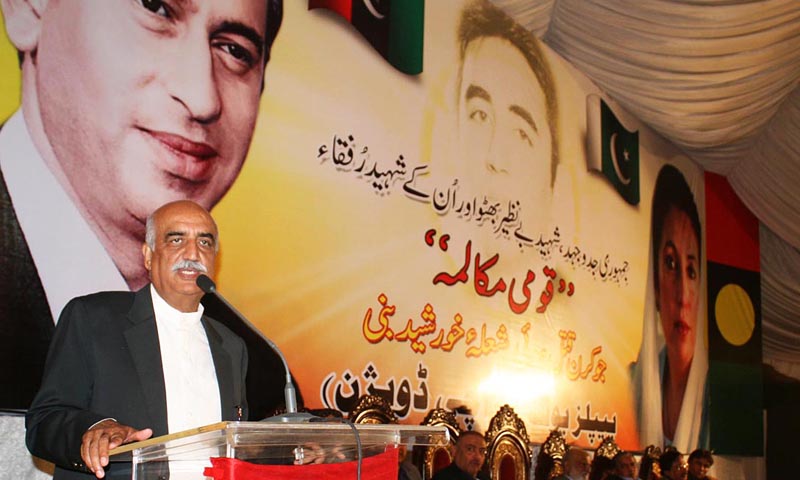 Leader of the Opposition in National Assembly Syed Khursheed Ahmed Shah on Saturday said that opposition parties will support the government’s initiatives to bring peace in the country.
He said these peace initiatives include dialogue with Pakistani Taliban, if this was in the interest of the country and the nation.
The Pakistan People’s Party (PPP) leader was speaking at a seminar titled “Struggle of People’s Youth of Karachi Division for Democracy: Shaheed Mohtarma Benazir Bhutto and her Companions” at Karachi Press Club.
Khursheed Shah urged the Pakistan Muslim League-Nawaz (PML-N) government to make up its mind without wasting anymore time of the nation regarding dialogue with the banned Tehrik-i-Taliban Pakistan (TTP) or launching a military operation against them.
“The government should take every step for the safety and integrity of the country,” he said.
Shah also hailed SP CID Chaudhry Aslam, who was killed in a suicide car bombing by Taliban in Karachi earlier this week.
Other leaders of the PPP and senior journalists also spoke on the occasion.
Pakistan: Use of contraceptives decrease in provinces
If official figures are to be believed, the use of contraceptives has increased in the country’ relatively conservative regions Gilgit Baltistan (GB) and Azad Jammu and Kashmir (AJK) in the year 2012-13 compared to the previous year.
On the other hand, their use had sharply decreased in Punjab, Sindh, Balochistan and Khyber Pakhtunkhwa according to a contraceptive performance report prepared by the Pakistan Bureau of Statistics (PBS) for 2012-13.
The report explores the usage of contraceptives provided in the market by government and private outlets.
Even in Islamabad, where most of the people are believed to be more educated and aware of the effects of the rising population, contraceptives’ use has declined by 20.3 per cent.
The table provides the percentage increase or decrease in the use of contraceptives in 2012-13 compared to the year 2011-12. However, the report does not delve into the reasons for the steep fall in the use of contraceptives in the four provinces.
PBS maintained that at the national level, the use of contraceptives witnessed a decline of 2.2 per cent in 2012-13 from the previous year.
Pakistan is the sixth most populous country in the world as its population increased from 37 million in 1947 to 184.35 million in 2013, the report stated.
As part of the programme, 187.707 million units of condoms were sold followed by 6.460 million cycles of oral pills, 1.228 million insertions of internal uterine devices (IUDs) and 2.911 million vials of injectables.
In addition, 103,842 contraceptive surgeries were also performed during the financial year 2012-13.
The overall use of condoms, oral pills, and injectables increased by 25.7 per cent, 3.8 per cent and 7.6 per cent respectively, the report claimed. However, a decline of 6.6 per cent in IUDs and 13.2 per cent in contraceptive surgery was observed, it added.
Use of condoms witnessed 20.3 per cent increase in Fata, 19.1 pc in KP, 26.2 per cent in GB, 4.5 per cent in Sindh, 9.7 per cent in Punjab, and 10.4 per cent in Islamabad. However, Balochistan and AJK saw a decrease of 1.6 and 6.1 per cent respectively in the use of condoms.
The use of oral pills went up by 52.5 per cent in Fata, 14.9 per cent in KP, 2.7 per cent in Punjab and 1.4 per cent in GB, the report said. In Sindh, this figure went down by 14.1 per cent, 14.8 per cent in Balochistan, 5.5 per cent in Islamabad and 5.4 per cent in AJK.
For percentage increase in contraceptive surgery cases, AJK led with 27.3 per cent increase. However, a decrease of 16.9 per cent was observed in Punjab followed by 21.2 per cent in Sindh, 4.2 per cent in KP, 21.4 per cent in Balochistan and 2.6 per cent in Islamabad.
Pakistan: That little matter of Asia Bibi's life...
Ahmadiyya Times
By Waqar Gillani |

Pakistan: Protest Staged Against No Quota Reserved For Minorities In PM’s Youth Loan Scheme

No quota reserved for the minorities in the Prime Minister’s Youth Loan Scheme censured by Human rights and religious sectors.

Subscribe to:
Posts (Atom)