

 That there is no easy solution to the problem of militancy once again became obvious on Thursday when blasts in all the provincial capitals of Karachi, Lahore, Quetta and Peshawar rocked the country. In Karachi, three suspected militants mishandled an explosive device and ended up only killing themselves; in Lahore one person was killed when an explosive device placed in a restaurant in Anarkali detonated; in Quetta the worst happened when six people lost their lives and 42 were injured in the main shopping centre; and in Peshawar there was yet another explosion – although with no casualties this time. Anyone who thought that the prospects of peace talks may lead to a brief respite from the unceasing violence now has to confront the reality that the militants are not going to ease up on us. That much was obvious in an interview that the TTP chief Hakeemullah Mehsud gave to the BBC where he said that that the Pakistan state as it is currently configured does not follow the dictates of Islam. Mehsud has basically reiterated that he is not at war against just the government or the US; any of us who do not want to live in a country ruled by him and his ideology are legitimate targets in his eyes. At the same time, Mehsud did say that he was open to the prospects of talks with the government although he absolutely ruled out accepting any preconditions to come to the negotiating table.
Prime Minister Nawaz Sharif, even if he did not know before, should now be absolutely clear in his mind that we are facing an enemy that will remain violent and with whom almost no common ground can be found. This does not mean that he should abandon altogether the idea of negotiations with the TTP, as decided by the All-Parties Conference. But he should go into the talks understanding that there is only a limited amount talks can achieve. And since the militants refuse to stop attacking us even when the government is willing to talk, the prime minister should be under no obligation to cease law-enforcement and even military actions against the TTP. As it is, we face enough problems with prosecuting suspecting militants. That was pointed out by Nawaz Sharif in a visit to Peshawar where he said that even judges are too scared to take action against militants. The prime minister also reiterated changes in law enforcement that he had earlier proposed, including setting up a separate counterterrorism force and improving our intelligence capabilities. As the four blasts on Thursday showed, we are still a long way from being able to pre-empt attacks and will need major improvements in our terrorist-fighting capabilities. The only way talks with the TTP will yield any breakthroughs is if we have the strength and capacity to actually scare them into compromise. Right now, they are continuing to operate with impunity and that simply cannot be allowed to continue.
Ahmadiyya TimesThe attitude of the Saudi Arabian Government to human rights is well known, although the way the European Union treats it as an ally is at odds with its systematic violation of these rights. Recently, Sultan Hamid Marzouk Al‐Anzi and Faleh Sudi Awad Al‐Anzi, citizens born in Saudi Arabia whose only crime was to be members of the Ahmadiyya Muslim community, were arrested. They were held and charged with the crime of apostasy, since religious conversion is considered to be a crime in Saudi Arabia. Against this background, the international community continues to maintain its usual criminal silence, since Saudi Arabia is adopting the same double standards in the observance of human rights as the European Union. The Ahmadiyya community is a religious movement within Islam that is committed to peaceful expansion and calls for dialogue instead of holy war. The movement is persecuted in many Islamic countries where the extremist and fundamentalist Islamic movements have become strong, in many cases thanks to support provided by Saudi Arabia. While the Western powers bomb and occupy countries in the Middle East on the pretext of terrorism, Saudi Arabia, the main stronghold of the most radical Islamic fundamentalist and terrorist movements, is seen as an ally. Is the Vice-President/High Representative aware of the abovementioned arrests, which infringe respect for human rights? Does she intend to publicly condemn the Saudi Arabian Government for religious arrests of this kind? Does she intend to demand that Saudi Arabia abolish all provisions in its legislation that are in conflict with respect for human rights in the sphere of religious freedom? Does she intend to suspend relations within the Gulf Cooperation Council until Saudi Arabia undertakes to respect human rights?
By Vardha Khalil When Washington DC is sleeping, half of the world is awake and when morning appears here many countries, including Pakistan, are concluding their day. So when you wake up in the morning and check your phone and social media then you get updated about what was happening around the globe while you were asleep. When I got up in the morning, I got the horrible news on both regular and social media. The more I studied, the more pain I felt. The biggest optimism for any person is the belief that the future will be better than the present. And as a Pakistani, every time I think that now the country’s situation cannot get worse and may be now it will recuperate but one after one every blatant act of terrorism is making this a shallow and rusty hope. As the Pakistani government was weighing its options to tackle the Taliban and their affiliates, indulged in a debate of good and bad Taliban, at the same time those outfits were planning the suicide attacks at a church in Peshawar. More than 80 innocent Pakistani citizens perished in these atrocious attacks. The sense of loss over this grizzly massacre is quite natural yet some political circles cling to the idea of opening dialogue with the Taliban. The agenda of these political circles is no different from those Taliban who want to convert Pakistan into a sect-minority-free “Islamic State”. Extremist Taliban factors and their sympathizers in political parties, in a bid to enforce self-style version of Islam over Pakistan, are transforming it into a land where inhabitation of humans will be impossible. In current situation the terrified minorities and secular groups are already forced to leave their houses. After target killings of Hazara people in Balochistan, thousands of citizens are seeking shelter in other parts of the country. Several people are moving to other countries because of Shia genocide in the country. The Ahmadiyya community, which has already taken the brunt of sectarian hatred, is once again on the hit-list. Hunting of Ahmadiyya community had started right after the very creation of Pakistan. Yet, in 1973, their persecution was legalized by declaring them non-Muslims in the constitution. The “Islamisation” that started during Zia-ul-Haq’s era in 1980s not only failed miserably but such efforts also gave birth to such monsters who have changed the whole country into a haunted place. The requirement of the new era is to avoid transforming Pakistan into some ideology or religion and just make it a secular country which is suitable for a common human being to live in. We should strive to make our country a place where all human beings have basic rights and there is no human rights violation in the name of religion.Balcoh Hal
 She didn’t win the Nobel peace prize — this year — but she has won the world’s admiration and respect. The gracefulness, poise and compassion of a 16-year-old girl who would rather campaign for every child’s right to education than against the Taliban who shot her in the face have been something truly remarkable to behold. That Malala was never your average schoolgirl has been evident for years; what the world has discovered in recent days is that she has grown into a truly extraordinary young woman. There is much sadness and despair in the reality of the circumstances that forced Malala into campaigning for the right to education and that have carried her to global fame. But Pakistan’s most famous young citizen has also demonstrated the kinder though no less resolute side of her country: Malala is focused on improving the human condition rather than lamenting its inadequacies.
To truly honour Malala and the millions of other schoolchildren she speaks for, Pakistan can attempt to translate her dream of universal education into reality. Whether it is school enrolment or the quality of education or infrastructure of the public school system, Pakistan consistently ranks near the bottom internationally — and even by regional standards, performs poorly. Fixing the broken education system here is not just about throwing more money at the problem — though surely the federal and provincial governments need to create the fiscal space to spend more on education and health. Every government comes in promising to improve the education sector, but none has left a significantly improved one as its legacy. The twin, and very familiar, problems of capacity and will appear to be the greatest impediments: the expertise to draft a realistic revival plan at the provincial level is missing as is the political and administrative will to stay focused on the issue of education.
Of course, there is also the very real problem of the radical mindset that opposes modernity and what the majority of the population would regard as the basic tenets of a good education. Malala’s mature and convincing voice has largely drowned out the howls of anger from the Taliban fringe in recent days, but for a still-too-large number of Pakistani children, especially girls, extreme conservatism and violent radicalism are crucial factors in denying them an education. Malala has shown what a single — though powerful and unique — voice can do to help change perceptions. Many more will have to add their voices to hers if the constitutional right to education is to become meaningful for all children.
President Barack Obama has met Malala Yousafzai at the White House in Washington and lauded her efforts for the promotion of girls' education.In a statement after the meeting‚ Malala Yousufzai thanked President Obama for the US support for education in Pakistan and Afghanistan and for Syrian refugees. She also expressed concerns that drone attacks are fueling terrorism. Innocent victims are killed in these attacks and they lead to resentment among the Pakistani people. Malala said it will make a big impact if we refocus efforts on education.


 As a campaign for Saudi women to defy the driving ban in their country heats up, one of the country's leading female bloggers was detained in Riyadh on Thursday after a woman she was with did just that.
Eman al-Nafjan, who tweets as Saudiwoman and has been one of the leading voices urging Saudi women to get behind the wheel on October 26, was in a car that was stopped by police in Riyadh, the capital, as she filmed another woman driving.
Al-Nafjan, who has been calling on Saudi women to upload videos of themselves driving in different parts of the kingdom, spoke exclusively with CNN on Friday about what happened.
"Yesterday, I kept getting called by women I know who wanted me to film them driving," she said, explaining how she spent most of the day filming and uploading information about those excursions online.
"When I was live tweeting, some people took it into their heads that we had to be stopped," said al-Nafjan, "and then called the police." She was live tweeting as they were pulled over, posting a picture of the police car that had pulled alongside them, accompanied by the message, "Police stopped us."
That tweet set off a flurry of concern and supportive messages from Twitter users throughout Saudi Arabia.
Al-Nafjan initially felt queasy about being stopped, but her unease and worry quickly dissipated when she saw that "police were smiling and easygoing, and their attitude was very positive. The police were really nice to us."
They were taken to the Olaya Police Station, where she and Azza, the woman who had driven her, waited.
"The vibe I got was that they didn't know what to do with us. We could see the police going around, calling, waiting," explained al-Nafjan, who says she believes this is a sign that the driving campaign has gained momentum and that many in Saudi Arabia, including officials, think the time has come to allow women to drive.
October 26 campaign
Women who want Saudi Arabia to lift a de facto ban on their driving have launched an online campaign urging Saudi women to stage a demonstration by driving cars on October 26.
"There is no justification for the Saudi government to prohibit adult women citizens who are capable of driving cars from doing so," reads part of an online petition on the Oct26driving.com website. Even though the website was reportedly blocked in Saudi Arabia shortly after its creation in late September, the petition has so far garnered more than 14,000 signatures.
No traffic law specifically prohibits women from driving in Saudi Arabia, but religious edicts there are often interpreted to mean women are not allowed to operate a vehicle.
CNN was unable to reach Saudi Arabia's Interior and Justice ministries for comment on the issue.
Just a day before being stopped by police, al-Nafjan posted online another video she filmed of a woman driving for two hours throughout Riyadh. They were not stopped, and the video shows male drivers waving to the women and supporting them with the thumbs-up sign. That video quickly went viral, eliciting numerous comments. While most were supportive, there was also a negative reaction -- at one point, a hashtag was created calling for al-Nafjan's arrest.
Al-Nafjan says her husband was also made to come to the police station Thursday. When al-Nafjan was finally told to come inside, she was asked if she knew that what she did was wrong.
"I said it's not wrong," said al-Nafjan, who was then told to sign two documents: one stating that she would no longer get into a car with a woman driving, and another that she would no longer film women driving.
When asked if she would adhere to those agreements, al-Nafjan said that "it doesn't matter whether or not I go out. This isn't about me. This is a people's movement. This is not about me. This is about many women."
Al-Nafjan, who was in extremely high spirits while speaking via phone with CNN, said the experience with police ultimately bolstered her confidence in the movement she is helping spearhead. She said the lack of her arrest and her and Azza's quick release show that this campaign is making a difference and things are beginning to change.
Other challenges to driving ban
The issue of women driving in the conservative kingdom has long been contentious. And while such demonstrations are extremely rare, they have been staged at least twice before.
In May 2011, prominent Saudi women's rights activist Manal al-Sharif was arrested after uploading a video to YouTube that showed her driving in Saudi Arabia. She spent more than a week in jail and quickly became a hero to numerous women in her country and across the Middle East.
In a sign of just how influential she had grown, on June 17, 2011, dozens of women across Saudi Arabia, emboldened and inspired by al-Sharif's ordeal, participated in the "Women2Drive" campaign by getting behind the wheel, defying the ban and driving throughout the streets of their cities.
In 1991, a group of 47 women protested the prohibition by driving through Riyadh. After being arrested, many were further punished by being banned from travel and suspended from their workplaces.
Recently, a leading Saudi cleric made headlines when giving an interview in which he warned Saudi women that driving could cause damage to their ovaries -- a comment that was widely interpreted to be a reaction against the October 26 driving campaign and how popular it had grown.
In addition to prohibiting driving, the country's strict and compulsory guardianship system also prevents women from opening bank accounts, working, traveling and going to school without the express permission of a male guardian.
Saudi Arabia has been moving toward change under its current ruler, King Abdullah, who is considered a cautious reformer and proponent of women's rights. In January, he appointed 30 women to the Shura Council, the first time women had been chosen for the country's top consultative body. In 2011, he announced that women could run for office and vote in local elections in 2015. And in 2009, he appointed Saudi Arabia's first female Deputy Minister.
 At least 190 people were killed and more than 200 taken hostage by Syrian rebels financed by private Gulf donors in an August 4 military offensive in the Latakia governorate, according to a Human Rights Watch report.
At least 67 of the victims executed had lived in government-aligned Alawite villages, HRW said in its report, “You Can Still See Their Blood,” released Friday, which saw the events as the first evidence of planned crimes against humanity perpetrated by opposition forces.
The killings took place when President Bashar Assad’s forces were overwhelmed by the militants, who then proceeded to enter the 10 Alawite villages nearby, sometimes rounding up and executing entire families, while taking others hostage.
Torture and decapitations were also testament to the aggravated nature of the military offensive, proof of which was gathered by HRW through reports, witness statements, hospital records and materials recorded by the rebels themselves. HRW’s Syria and Lebanon researcher, Lana Fakih, told Reuters that “homes were destroyed and burned. Most villagers had not returned.” She spoke to Hassan Shebli, whose elderly wife and disabled 23-year-old son were gunned down and buried next to his home, as he found upon his return to his village. The assailants took videos and posed with their victims before the killings.
According to the human rights watchdog, the nature, scale and coordination of the abuses and killings elevate them to the status of crimes against humanity. Acting Middle East director at HRW, Joe Stork, explained that “these abuses were not the actions of rogue fighters…this operation was a coordinated, planned attack on the civilian population in these Alawite villages.” The attacks were found to have been planned and carried out by five distinct groups, including the Al- Qaeda-linked Jabhat al-Nusra and the Islamic State of Iraq and the Levant, as well as jihadists originating from outside Syria.
However, the broader offensive, which lasted until August 18, was thought to include 20 distinct groups.
The operation was thwarted by government forces on that day, after regaining control of the area.
Although the report could not confirm the presence of fighters from the Western-backed Free Syrian Army, the force’s commander, Salim Idriss, posted a video a week after the Latakia attacks in which he claimed the FSA participated in the operation “to a great extent.”
Other groups boasted about their exploits in their own recordings, used by HRW to corroborate its findings, although the rebels themselves also recounted the offensive to correspondents from Reuters, claiming to have killed about 200 people.
However, not all the groups admitted to the killings. A member of the Sunni Ahrar al-Asham militia claimed that his fighters only shoot in self-defense, although the group was among the five that were found to have participated in the Latakia killings.
The Syrian National Coalition’s spokesman, Khaled Saleh, also condemned the attacks and said that if any abuses by rebels associated with the coalition were found to have happened in Latakia, the perpetrators would be brought to justice.
"We have previously committed ourselves to applying these rules on all the brigades that work for us and we will hold accountable, after investigation and fair trial, all those responsible for violations against human rights or international laws. The incidents in Latakia are not an exception and we will treat them as we treated previous case,” Saleh said in a written statement to Reuters.Nonetheless, dozens of witness accounts from the province remain, together with footage shot by rebels, as a gruesome reminder of the executions carried out on August 4. Returning residents reported finding the bodies of loved ones strewn around the streets, lying next to their homes, as well as charred corpses lying in mass graves.
The organization also wished to point out that the report is by no means a move away from scrutinizing the Syrian government’s own human rights abuses – including sectarian cluster bombings of Sunni areas in May, as reported By UN officials.
The report proposes that the UN Security Council imposes an embargo on supplying arms to all sides implicated in the systematic abuse of human rights and the carrying out of planned attacks, which is classified as a crime against humanity. The organization also proposed referring all transgressions to the International Criminal Court in The Hague.
Stork, HRW’s Middle East chief, said: “Syrian victims of war crimes and crimes against humanity have waited too long for the Security Council to send a clear message that those responsible for horrible abuses will be held to account.”
“The ICC referral is long overdue,” Stork said.
The civil war, now in its third year, has claimed the lives of more than 100,000 people, according to UN estimates. Many experts fear that the sectarian nature and conflicting interests of the rebel groups involved are exacerbated by outside funding, and are turning Syria into a hotbed of extremism drifting further away from any resolution that outside actors may have planned for it.
By Louisa Peacock
Malala Yousafzai doesn't need a prize to confirm her status as a heroine, says Louisa Peacock, who asks what's next for the 16 year-old schoolgirl living in Birmingham.

http://mediacellppp.wordpress.com/
 Bilawal Bhutto Zardari, Patron-In-Chief of Pakistan People’s Party said no nation on earth has registered a genuine progress without educating their girls. On the eve of International Day of the Girl Child, he urged the educationists of Pakistan to come up with innovative ideas of educating Pakistani girl children to pull out the country from slough of perpetual illiteracy.
In his message on the occasion of the International Day of Girl Child being observed on Friday under the aegis of United Nations, Bilawal Bhutto Zardari said it is auspicious moment as this Day is coinciding with the announcement of Nobel Peace Prize where Pakistani girl heroine Malala Yousufzai is seen as hot-contender by the peace-loving world.
Malala Yousufzai’s yearn for education to Pakistani girls will be remembered among the key foundations of a peaceful and developed Pakistan, when the dream comes true. Her vision, “One Child, One Teacher, One Book, & One Pen Can Change the World,” sends strong message across the world that education remains the key weapon to bring a lasting peace, progress and development.
Bilawal Bhutto Zardari stressed for adequate budget for education, especially for the girls in country as a mere 12 per cent literacy rate among girls and women in Pakistan makes its future bleak until some revolutionary steps are taken.
PPP Patron-In-Chief further pointed out there was an urgent need for improving and extending education facilities for girls in rural areas and Federal and Provincial governments need to pay attention to safeguard the future of coming generations.
 Chemical weapons watchdog the Organisation for the Prohibition of Chemical Weapons (OPCW) has won this year’s Nobel Peace Prize.
The Norwegian Nobel Committee said that the Peace Prize had been awarded to the OPCW for its extensive efforts to eliminate chemical weapons.
 Despite being the favourite, Pakistan’s Malala Yousafzai did not win the prize but in the run-up to the announcement, the 16-year-old won the hearts of people around the world. Malala over the course of the last week appeared on several television channels and not only advocated her cause of education for all, but also projected a positive image of Pakistan.
In a recent interview on CNN, Malala Yousafzai said she wanted to become the prime minister of Pakistan to cheers from the live audience. “I think it’s really good because through politics I can save my whole country.”
Malala Background
Malala Yousafzai first rose to prominence in 2009 when at the age of 11 she wrote a blog for the BBC Urdu service chronicling life under Taliban rule in the scenic valley of Swat.
Her struggle resonated with tens of thousands of girls denied an education by militants across northwest Pakistan, where the government has been fighting local Taliban since 2007.
When the army launched an offensive to oust the Taliban, Malala fled Swat with her family led by her father Ziauddin, school principal and himself a seasoned campaigner for education.
After this difficult period she resumed her work promoting education, received the first national peace award from the Pakistani government and was nominated for the International Children's Peace Prize.
But on October 9 last year the men with guns decided they could no longer tolerate the girl with a book and sent two hitmen to kill Malala on her school bus.
The Pakistani Taliban claimed the attack and warned that any woman who stood up to them would suffer a similar fate.
Incredibly she survived -- the bullet grazed her brain and travelled through her neck before lodging in her shoulder -- and as she lay fighting for life in hospital, Pakistan and the world united in horror.
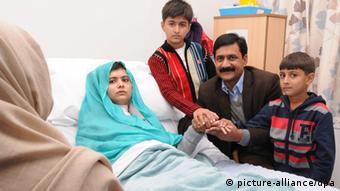
After surgery in Pakistan, Malala was flown for further treatment to Britain, where six days after the attack she woke up.
"The first thing I thought was, 'Thank God I'm not dead.' But I had no idea where I was. I knew I was not in my homeland," Malala wrote in an autobiography published this week.
Eventually she recovered enough to continue her studies at school in the central city of Birmingham, where her family moved to join her.
There she learned to enjoy things one might expect of a British teenager -- TV shows like "Masterchef" and "Ugly Betty", fried chicken and cheesy potato snacks.
But her determination to campaign for education, fired by her own mother's illiteracy, remains undiminished.
In her speech given to the UN on her 16th birthday in July, Malala pledged herself to the fight for all children to go to school and said the Taliban attack would not silence her.
"Nothing changed in my life, except this: weakness, fear and hopelessness died. Strength, power and courage was born," she said.
Time magazine has listed Malala as one of the 100 most influential people in the world, and she has spoken of her desire to enter politics to change Pakistan and improve education.
For now, she is concentrating on spreading the simple message she spelt out at the UN: "One child, one teacher, one pen and one book can change the world."
OPCW Background
The Hague-based OPCW was founded in 1997 to implement the Chemical Weapons
Convention signed on January 13, 1993.
Its work is currently in the spotlight, as it is supervising the dismantling of Syria's chemical arsenal and facilities by mid-2014 under the terms of a UN Security Council resolution.
A team of around 30 OPCW arms experts and UN logistics and security personnel are on the ground in Syria and have started to destroy weapons production facilities, with footage of their work broadcast on Syrian television.
The OPCW said on Tuesday it was sending a second wave of inspectors to bolster the disarmament mission in the war-ravaged nation.
With the SC granting bail to Pervez Musharraf in the Akbar Bugti case, the legal thicket that the former president and army chief found himself in upon his return to Pakistan continues to clear, presumably opening a path to his exit from Pakistan for a second time. Unhappily, though perhaps predictably, the legal thicket Mr Musharraf had been dragged into had little to do with the central problem of his rule: that it was illegitimate from the very beginning. Instead, the former military strongman has been pursued on other fronts: the dismissal of judges in November 2007; the assassination of Benazir Bhutto; the Lal Masjid episode; and the Akbar Bugti death. To be sure, each of those episodes was deeply troublesome and created a host of political and security problems from which the country is still struggling to recover. But legal liability and culpability is a separate matter from disastrous decisions with devastating consequences.
Seen from the perspective of what best strengthens the democratic and constitutional system in Pakistan, it was Mr Musharraf’s overthrow of an elected government in 1999 for which he most obviously ought to stand trial. Of course, while the former army chief may have been the face of the new regime in 1999, there were many others who both abetted his takeover and validated his rule. Those other individuals too have much to answer for. So why has Mr Musharraf so far escaped having to answer the most obvious of charges? The answer appears to lie in a combination of the old order still having much influence and the new, democratic order being unable to muster the courage or conviction to take up the past that truly matters. Since Mr Musharraf’s exit in 2008, the country has gone some way in shutting the door on extra-constitutional takeovers. But whatever the practice of continuity and the cleaned-up text of the Constitution may offer, it would send a powerful message to have the protagonists of a military takeover held to account in a court of law. Sadly, that chance appears to have been squandered.
 Afghanistan's aid donors should use their leverage to force the government to ban human rights violators from competing in a presidential election next year, a human rights group said on Wednesday.
Afghanistan's allies will be hoping the election, due next April, will set the country on a firm path to stability as it takes over responsibility for its security with the withdrawal of most foreign troops by the end of 2015.
Among the candidates who registered for the election by a Sunday deadline are several who have faced accusations of rights abuses during many years of war and turbulence.
The U.S-based group Human Rights Watch called for rights violators to be excluded as candidates.
"Had the Afghan government in the last decade properly addressed crimes of the past, several current candidates would now be disqualified from seeking office - or would even be serving time," said Brad Adams, Asia director at Human Rights Watch.
"Foreign donors should press the Afghan government to ensure future elections are not being contested by serious rights abusers."
One political leader accused of rights violations, General Abdul Rashid Dostum, in an apparent response to public pressure, this week took the unprecedented step of apologising for past bloodshed.
He has been accused of mistreatment that led to the death of enemies during the civil war in the 1990s and early the next decade.
"I want to be step ahead on this path and say that I apologize to all those who have suffered on all sides in the conflict," Dostum said on his Facebook page.
The apology did not convince some.
An analyst for the Afghanistan Analysts Network think-tank said it was aimed at forging an alliance for the polls.
"The statement was overtly linked to the election," wrote the analyst, Kate Clark.
The election is considered the most crucial since the U.S.-led overthrow of the Taliban regime in 2001, with more than a decade of Western-led reforms resting on its outcome amid increasing Taliban violence.
President Hamid Karzai is barred by the constitution from running for a third term but his older brother, Qayum, has registered as a candidate.
Foreign concern about Afghanistan was underscored last week when Norway took the rare step of cutting aid on the grounds that Afghanistan had failed to meet commitments to protect women's rights and fight corruption.
 At least four persons were killed and several others injured in a blast near city police station in Liaquat Bazar on Thursday.
Police and rescue teams reached the sport and the wounded were shifted to hospital while emergency was declared in Civil Hospital.
According to police, the bomb was implanted in a motorcycle. Security forces cordoned off the area and started search operation.
Earlier, an explosion killed one person and injured several others near a restaurant in busiest area of Lahore’s Old Anarkali.
Meanwhile, another explosion targeting polio team at Peshawar’s Ring Road injured three Khasadar Force officials.
The Express Tribune News
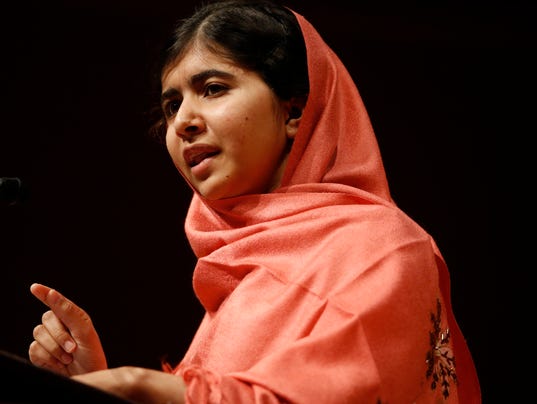
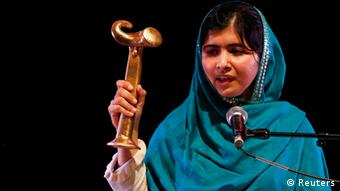
 Pakistani teenage activist Malala Yousafzai, shot in the head by the Taliban last year for campaigning for better rights for girls, won the European Union’s annual human rights award on Thursday, beating fugitive US intelligence analyst Edward Snowden.
Malala, 16, who was attacked in northwestern Pakistan by a group of gunmen who fired on her school bus, is also a favourite among experts and betting agencies to be awarded the Nobel Peace Prize.
The Sakharov Prize for freedom of thought is given by the European Parliament each year since 1988 to commemorate Soviet scientist and dissident Andrei Sakharov. Its past winners include Nelson Mandela and Burmese activist Aung San Suu Kyi.
Snowden had been nominated by the Green group in the parliament for what it said was his “enormous service” to human rights and European citizens when he disclosed secret US surveillance programmes.
Yousafzai was chosen as the winner after a vote among the heads of all the political groups in the 750-member parliament.



http://www.rferl.org/Tensions are mounting in a southern Pakistani town after Islamic fundamentalists dug up the grave of a Hindu man. Police said on October 8 that the unrest in the town of Pangrio in the southern Sindh Province flared after an Islamist party, Ahle Sunaat Wal Jamaat, objected to the burying of a Hindu man in a Muslim graveyard. Local police chief Shaukat Ali Khatian said a Muslim crowd dug up the body and dragged it through the streets of Pangrio. Hindus and Muslims have coexisted in Sindh for centuries. They have lived side by side and shared graveyards but the rise of Islamist extremists in rural Sindh has inflamed tensions. The province is home to most of Pakistan's small Hindu community. They number an estimated 2 million among a population of 180 million.

 Khyber Teaching Hospital (KTH) Communication Officer Farhad Khan told The Express Tribune the two people infected with the disease were brothers Muhammad Bilal, 26 and Bakht Jamal, 20, both residents of Gulbahar.
Khan said the brothers were administered treatment and their condition is stable. He added 38 patients with dengue fever had been brought to the hospital from across the province.
According to the Khyber-Pakhtunkhwa Health Department, 340 patients are still admitted in various hospitals, while 30 people have died.
According to official records, 7,242 cases of dengue have been confirmed from Swat, 112 from Mardan, 223 from Malakand, 111 from Lower Dir, 48 from Shangla, 31 from Mansehra, 20 from Buner, 18 from Abbottabad and five from Haripur.
However, according to the district health office in Mingora, 81 new cases of the disease were reported by late Wednesday evening, increasing the total count to 8,040.
 The Human Rights Commission of Pakistan (HRCP) on Wednesday criticised the Election Commission of Pakistan for not being fair with the issues faced by the minority voters and candidates.
HRCP Director I. A. Rehman, launching the report titled, ‘Religious minorities in elections – equal in law not in practice’ said that extra efforts needed to be made by the political parties and the system to enhance the participation of minorities in election process.
“Many reports of malpractices have been filed by the candidates belonging to minority communities at the election commission, but not much has been done for them,” Mr Rehman added.
While lauding the joint electoral system, he said that the political parties still have to show maturity and field more candidates at general seats, “This has not done even in constituencies where the minorities are in a sizeable number.’
The report was based on the study of six national assembly constituencies, five in Sindh and one in Punjab.
The report highlights that the voting pattern shows that the minorities have been voting on party lines and not on religious lines.
But he added that there have been reports of prejudice, threats and structural problems faced by the minority members.
“We have reports from certain areas that pamphlets were distributed by religious elements directing people not to vote for the candidate of minority community at general seat,” the Director HRCP added, “But no action has been taken against the persons by the authorities.”
The report also highlights the security problems faced by the candidates of minority communities, but Mr Rehman also added that most of the issues were localised.
“These oppositions were mainly class based and not based on religious grounds” he added and said there are reports that the upper class Hindus do not want to give chance to lower class Hindus to become politically active.
Meanwhile, Hussain Naqi, senior member HRCP said that if the situation has to be change the Election Commission has to be more proactive in this regard.
“They only had one liner policy statement for the minorities and that was - ECP will think about minorities in net five years.”
Mr Naqi also criticised the policy makers of the country for distorting the history and said that the key role played by Christians in establishment of Pakistan has been deleted from the history books.
“The key role by Christians in Punjab to get the province vote in favour of Pakistan has been forgotten – this is bad and it should not happen,” he added.
 By DECLAN WALSH-
A Pakistani court granted bail on Wednesday to Pervez Musharraf, the country’s former military ruler, clearing the way for him to leave the country as early as Thursday, his lawyers said.
Mr. Musharraf, 70, has been under house arrest at his villa outside Islamabad since April, facing criminal charges in three cases related to his nine years in power, from 1999 to 2008. The prospect of a former army chief facing potential imprisonment appeared, for a time, to signal new limits to the unofficial immunity from prosecution that Pakistan’s top generals have long enjoyed.
Mr. Musharraf had already been granted bail in two of the three cases, and the decision on Wednesday to grant bail in the third — related to the death of Akbar Khan Bugti, a Baluch nationalist leader killed in a military operation — opens the door for him to avoid prosecution entirely.
Mr. Musharraf’s lawyers said that his bail payment of $20,000 could be processed as early as Thursday morning; he could then leave Pakistan immediately. Ahmad Raza Khan Qasuri, the vice president of Mr. Musharraf’s political party, the All Pakistan Muslim League, said that Mr. Musharraf might go to see his 90-year-old mother.
“He’s a free person — he can go out whenever he likes,” Mr. Qasuri said in a telephone interview. “His mother, who is a very aged lady, lives in Dubai. He might go tomorrow or the day after to see her. But his base will continue to be in Islamabad.”
Still, Mr. Musharraf has rebuffed previous entreaties from his advisers, and from senior military leaders, to leave Pakistan, particularly if doing so would prevent him from returning to fight his battles in court. Aides say that Mr. Musharraf, a former commando with a famous stubborn streak, insists on clearing his name and does not want to spend his retirement in exile.
But for the military, his case has become an unwelcome distraction, complicating relations among the army, the civilian government and the courts, and raising the prospect of a troubling precedent.
Mohammed Amjad, secretary general of Mr. Musharraf’s party, told reporters outside his home that if Mr. Musharraf leaves Pakistan, it will be only temporarily. “He will not escape from Pakistan,” Mr. Amjad said.
Mr. Musharraf has been detained at his luxurious farmhouse outside Islamabad rather than in prison for security reasons, following Taliban threats to his life. Aides say he has been confined to two rooms in the house, which has a swimming pool and sweeping lawns, and has had limited access to his friends and family.
Still, in a country where senior military officers are generally considered to be above the law, the sight of a former military ruler facing justice in a civilian court is a startling novelty.
Besides the three current criminal cases, Mr. Musharraf faces potential treason charges over his role in suspending the Constitution in 2007, though few analysts believe that the government of Prime Minister Nawaz Sharif is likely to go ahead with those charges.
Mr. Musharraf was disqualified from running in the general election in May, in which his party performed poorly. More generally, few Pakistanis have shown much enthusiasm for returning him to power.
One factor in Mr. Musharraf’s present calculation might be the position of his nemesis, Chief Justice Iftikhar Muhammad Chaudhry, whom he tried to fire in 2007. With Mr. Chaudhry due to retire in December, analysts say that Mr. Musharraf might be waiting until then to decide whether his long-term future lies in or out of Pakistan.
Daily TimesThe Supreme Court Wednesday granted bail to former military ruler Pervez Musharraf over the death of Baloch nationalist Akbar Bugti, his lawyers said, bringing closer his possible release after nearly six months of house arrest. Musharraf has now been granted bail in three major cases against him, including one relating to the assassination of former prime minister Benazir Bhutto. His lawyer said the ruling meant he was a “free man”. But he is likely to remain under heavy guard at his villa on the edge of Islamabad, where he has been under house arrest since April, because of serious threats to his life. Musharraf was head of state in 2006 when Akbar Bugti was killed during an army operation. His lawyer Ibrahim Satti said a three-member Supreme Court bench had granted bail in the Bugti case in return for surety bonds worth two million rupees. Another counsel for Musharraf, Qamar Afzal, said bail was granted due to lack of evidence. “Pervez Musharraf is a free man now after getting bail in the Bugti case,” Afzal said. As well as the Bugti and Bhutto cases, Musharraf also faces cases over the suspension of judges during emergency rule, which he imposed in 2007. The Taliban have threatened to kill the 70-year-old former general. After getting bail in the Bugti case, the sub-jail status of Musharraf’s residence will likely end as the court has already granted him bail in judges’ detention and Benazir murder cases. The bench, headed by Justice Nasirul Mulk and comprising Justice Sarmad Jalal Usmani and Justice Musheer Aalam Khan, asked Musharraf to submit two surety bonds of Rs 1 million each. The court observed that substantial evidence was not available to establish that Musharraf was involved in the criminal conspiracy regarding the murder of Bugti. “This is a case of criminal conspiracy for which solid evidences are required, and due to their unavailability, there is no justification for rejection of the bail plea,” the court ruled. It asked Balochistan Additional Prosecutor General Tahir Khattak about the evidences which had been gathered against Musharraf and whether anyone had witnessed him conspiring against Bugti. Khattak told the court that according to the statements of co-accused, Musharraf had ordered action against Bugti. He stated that a CD recording was also available to prove this. Khattak said that Bugti was killed on the directives of Musharraf.
 The Spokesman for ANP Zahid Khan has said that both federal and KP governments are too afraid of Taliban, to criticise Taliban openly.
Talking exclusively to Online on Wednesday , he said that hesitant attitude of both these governments had fostered, encouraged militancy and terrorism in Country , while he also challenged PTI to account for countless dead and wounded in KPK.
He also acknowledged the helplessness of government to provide gas to masses due to depleted resources, while he defended the provision of commodity to household consumers as of being topmost priority of government; besides urging for paying more attention towards public transportation.
He also confirmed that both Prime Minister and opposition leader have reached consensus over a recommendation for NAB chairmanship, which, considering the past 5-year dismal and obdurate record of only government’s whims, forcing regular opposition references in Supreme Court, was a good omen.
Zahid Khan also expressed his annoyance over PTI’s reservations over almost everything, every issue, which PTI always translated into “hidden deals”.
“Take our (ANP’s) example, having maximum reservations, complaints about polls-riggings, backed by adequate proofs; yet we did not allow democracy to be derailed, and accepted all results with an open mind and heart”, he said.
He also berated government’s indecision and (yet) claims of progress in dialogue bid with Taliban, after every meeting with Maulana Fazl-Ur-Rehman, which was always denied by Taliban.
“These very aspects were responsible for bombings and killings in KPK”, he complained, wondering “and who would be responsible for all the resulting destruction and mayhem”.
He was chagrined over lack of understanding by both governments, about Taliban’s intention and reputation, who never even acknowledged the Constitution of Pakistan.
“Earlier we were always told that we are fighting America’s war, so why don’t we simply call this American war off?” he lamented.
He also said that PTI-led KPK government had no plans to block NATO supplies.
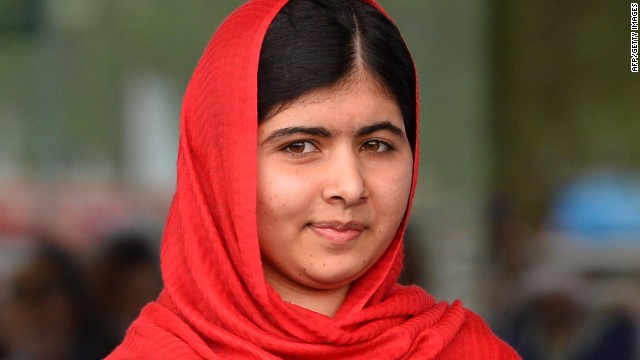
By Ben Brumfield and David Simpson, CNNA year ago Wednesday, Malala Yousafzai was riding the bus home from school when a Taliban gunman climbed aboard and shot her in the head. She nearly died. Now, the 16-year-old advocate for girls' education is a popular favorite for the Nobel Peace Prize to be awarded Friday. To mark the anniversary of the shooting, her memoir, "I am Malala," came out Tuesday. The phrase has become a battle cry for the right to an education around the world.
د تعلیم مبارزې ملالې یوسفزۍ ویلي دي چې هغې د طالبانو پر ضد پروپیګنډه نه کوله، بلکې د هغوی د سوچ او مفکورې مخالفه ده. نوموړې دا خبره د مشال راډیو له خبریال عبدالحي کاکړ سره په یوه ځانګړې مرکه کې کړېده، چې نن د اکتوبر پر نهمه نېټه پر هغې د برید یو کال پوره کېدو په مناسبت ده. ملالې وویل، کله چې طالبانو په سوات کې د نجونو پر تعلیم بندیز ولګاوه نو دې یې مخالفت وکړ او د تعلیم او ښځو حقونو لپاره یې هلې ځلې پیل کړې. ملاله په نړیواله توګه د تعلیم مبارزې په توګه پېژندل شوې ده او د ۲۰۱۳ز کال د سولې نوبېل انعام لپاره هم په کتار کې ده. دا لومړی ځل دی چې تر ویشتو وروسته ملالې د پښتو ژبې له یوې رسنۍسره خبرې کوي.

