The leak of a 336-page report investigating the security lapses that led to both Osama bin Laden’s extensive stay in Pakistan and the raid that killed him on May 1, 2011 shows that Pakistan has finally started asking itself some tough questions. The Abbottabad Commission, whose report was first obtained by Al Jazeera, was launched two years ago. The report is the most comprehensive Pakistani account to date of what went wrong in the Islamic Republic’s hunt for the world’s most wanted man.All of Pakistan’s major state institutions – the powerful military, its fearsome intelligence apparatus, its widespread police networks, and even its elected government officials – fall under the hammer in the unusually caustic report that found “gross incompetence” by all parties. It should come as no surprise that the report was not officially released. The frankness of the report is unprecedented for an official study commissioned by the nuclear powered Islamic republic that often blames foreign powers for all that ails its economy and its people. The report details bin Laden’s movements around Pakistan for almost a decade (from a major city, to a mountain resort, to small town, to a cantonment); the municipal permission to build an illegal structure that eventually became the mansion where he lived and fathered two children; the inability to follow up on intelligence shared by the United States; the lax attitude and negligence displayed by the Pakistanis that allowed the U.S. to conduct both the ground surveillance and the Navy SEAL raid that embarrassed the country; and even the inability of a policeman who once stopped bin Laden for speeding to recognize him. The details paint the picture of one of the worst intelligence failures in history. On bin Laden’s extensive stay in Pakistan, the report read: "Given the length of stay and the changes of residence of [bin Laden] and his family in Pakistan … the possibility of some such direct or indirect and ‘plausibly deniable’ support cannot be ruled out, at least, at some level outside formal structures of the intelligence establishment." On the failure of Pakistan's premier intelligence agency to gather information, the report said: "For the ISI [Inter-Services Intelligence] to say that it stopped its own search because it thought the U.S. had done so, showed both its naivete and its lack of commitment to eradicating extremism, ignorance and violence which is the single biggest threat to Pakistan." The country’s military is not happy. A ranking military official told NBC News, “We are going to find the leak. And he's going to wish he was [Edward] Snowden, living in an airport.” No government official has commented on the report and leading ministers did not respond to NBC’s request for comment. NBC News also reached out to the report’s four authors -- a former general, a former judge, a former diplomat and a former police official -- for comment, but none responded. The report’s leak has also been largely played down in Pakistan, a country known for its rambunctious media. “The Commission’s report has a healthy dose of skepticism that incompetence of this scale must involve duplicity,” said Cyril Almeida, a reporter for the daily Dawn newspaper. The Dawn published an editorial on Tuesday titled “No More Secrecy: Abbottabad Commission report” that urged the government to officially release the report so that corrective action and accountability can happen. Almeida cautiously praised the purpose of the report. “The report was key in reminding us of a narrative Pakistan often forgets, which is fixing itself,” said Almeida. “It said, 'Look guys, the national institutions of the country need a new script.' Something has to give. Or else, someone may come along, like [the movie] Zero Dark Thirty, and write a new script for us. And next, someone else will come along and unravel this entire project called ‘Pakistan’ for us.”By Wajahat S. Khan
Wednesday, July 10, 2013
In aftermath of scathing bin Laden report, Pakistan asks itself hard questions
ISI Chief: Punjab govt led by CM Shahbaz Sharif protected the Deobandi terrorists who massacred Ahmadis in Lahore in May 2010

http://criticalppp.com/archives/273753
 On May 28, 2010, Takfiri Deobandi terrorists (operating as Sipah Sahaba ASWJ-LeJ and Taliban) killed at least 93 members of the Ahmadiyya Muslim sect and injured around 100 others in attacks on two Ahmadi mosques during Friday prayer services in Lahore.
In the leaded OBL report published by Al Jazeera, it has been revealed that according to ISI’s Chief General Pasha, PML-N led government of the Punjab province (a political ally of Sipah Sahaba ASWJ-LeJ) protected the terrorists involved in Ahmadi massacre:
On May 28, 2010, Takfiri Deobandi terrorists (operating as Sipah Sahaba ASWJ-LeJ and Taliban) killed at least 93 members of the Ahmadiyya Muslim sect and injured around 100 others in attacks on two Ahmadi mosques during Friday prayer services in Lahore.
In the leaded OBL report published by Al Jazeera, it has been revealed that according to ISI’s Chief General Pasha, PML-N led government of the Punjab province (a political ally of Sipah Sahaba ASWJ-LeJ) protected the terrorists involved in Ahmadi massacre:
 “The situation was increasingly becoming true of Lahore and other cities. In Lahore police protected those who attacked #Qadianis last year (2010) and even directed them to the hospital where the wounded were being treated.The provincial Govt. had been informed of the situation but it took no heed of the advice and information provided by #ISI no guards were assigned by to the hospital as venal political influence intervened everywhere.” General Pasha, OBL Report, Page 208 para 1
Although members of religious and sectarian minorities Shias, Christians, Ahmadis, Hindus and their places of worship have been attacked by Takfiri Deobandi groups (Sipah Sahaba, Taliban) on an almost regular basis in Pakistan, this was one of the bloodiest incidents in recent memory. After the attack on Ahmadi community and the Joseph Colony incident where 100-plus houses and shops of Christians were ransacked, looted and set ablaze by Takfiri terrorists, religious and sect minorities of Punjab, are worried for their safety. The situation on the ground is very uncertain for them since sectors of the media appear free to propagate hatred against non-Muslims and non-Deobandis, while terrorists freely roaming across Punjab.
Meanwhile, the provincial government of Punjab is still maintaining close relations with militant groups while the pro-Islamist judiciary is releasing militants.
Various media reports suggest that Pakistan Muslim League (N) nourishes the banned outfits in Punjab and recently in Punjab Budget 2013-14 it includes millions for Wahhabi terrorist group Jamaat-ud-Dawa aka LeT. Malik Ishaq Deobandi, the self confessed killer of Shias enjoyed Punjab government’s financial assistance and in election 2013 Lashkar-e-Jhangvi terrorists contested on PML-N tickets.
Now, Lt. Gen. Ahmed Shuja Pasha in his recent interview admitted, and criticized the provincial leaderships of the Punjab government, claiming the Punjab police had “protected those who attacked the Ahmadis on May 28, 2010.” According to the report, the former ISI chief claimed the police even directed the militants to the hospital where the wounded were being treated. “The provincial government has been informed of the situation but it took no heed of the advice and information provided by the ISI,” the report quotes Pasha as saying. In May 2010, members of the homegrown Tehreek-e-Taliban Pakistan (an alias of ASWJ-LeJ Deobandi terrorists) attacked Ahmadi mosques in Lahore killing 94 people and injuring over 100. Gunmen also attacked a hospital where the injured were being treated the same day.
“The situation was increasingly becoming true of Lahore and other cities. In Lahore police protected those who attacked #Qadianis last year (2010) and even directed them to the hospital where the wounded were being treated.The provincial Govt. had been informed of the situation but it took no heed of the advice and information provided by #ISI no guards were assigned by to the hospital as venal political influence intervened everywhere.” General Pasha, OBL Report, Page 208 para 1
Although members of religious and sectarian minorities Shias, Christians, Ahmadis, Hindus and their places of worship have been attacked by Takfiri Deobandi groups (Sipah Sahaba, Taliban) on an almost regular basis in Pakistan, this was one of the bloodiest incidents in recent memory. After the attack on Ahmadi community and the Joseph Colony incident where 100-plus houses and shops of Christians were ransacked, looted and set ablaze by Takfiri terrorists, religious and sect minorities of Punjab, are worried for their safety. The situation on the ground is very uncertain for them since sectors of the media appear free to propagate hatred against non-Muslims and non-Deobandis, while terrorists freely roaming across Punjab.
Meanwhile, the provincial government of Punjab is still maintaining close relations with militant groups while the pro-Islamist judiciary is releasing militants.
Various media reports suggest that Pakistan Muslim League (N) nourishes the banned outfits in Punjab and recently in Punjab Budget 2013-14 it includes millions for Wahhabi terrorist group Jamaat-ud-Dawa aka LeT. Malik Ishaq Deobandi, the self confessed killer of Shias enjoyed Punjab government’s financial assistance and in election 2013 Lashkar-e-Jhangvi terrorists contested on PML-N tickets.
Now, Lt. Gen. Ahmed Shuja Pasha in his recent interview admitted, and criticized the provincial leaderships of the Punjab government, claiming the Punjab police had “protected those who attacked the Ahmadis on May 28, 2010.” According to the report, the former ISI chief claimed the police even directed the militants to the hospital where the wounded were being treated. “The provincial government has been informed of the situation but it took no heed of the advice and information provided by the ISI,” the report quotes Pasha as saying. In May 2010, members of the homegrown Tehreek-e-Taliban Pakistan (an alias of ASWJ-LeJ Deobandi terrorists) attacked Ahmadi mosques in Lahore killing 94 people and injuring over 100. Gunmen also attacked a hospital where the injured were being treated the same day.
Instead of blindly following Saudi Arabia, use scientific method for moon-sighting
http://criticalppp.com/archives/54480Why do Muslims in USA, UK, Australia and other countries start their Ramzan based on Saudi moon calendar but keep their fasts based on local sun schedule? Can we put a stop to the self-created Deobandi-Barelvi, Shia-Sunni, Pashtun-Punjabi conflict in the name of moon-sighting in Pakistan, UK, USA and other countries? The dates of Ramadan and other Islamic months depend on the [local] sighting of the new crescent Moon. Can we put a stop to the Saudi-ization of Eid and Ramazan in Pakistan and elsewhere? Why can’t Muslims in Pakistan and other countries use modern technology to ascertain the visibility of crescent with naked eye or with telescope. Why do Muslims in USA, UK, Australia and other countries start their Ramzan based on Saudi moon calendar but keep their fasts based on local sun schedule?
10 things we learned from the Osama bin Laden report
 1 Osama bin Laden's 10-year stay in Pakistan was a cock-up on the part of Pakistani intelligence, not a conspiracy. The Abbottabad commission said "collective incompetence and negligence" by the intelligence agencies was the main reason the al-Qaida chief remained undetected for so long. However, it could not rule out some degree of "plausibly deniable" support at "some level outside formal structures of the intelligence establishment".
2 A traffic policeman could have ended the hunt for the world's most wanted man soon after 2001. Long before Bin Laden and his family moved to Abbottabad he hid in Swat, a region north of Islamabad that was then still popular with tourists. While travelling with one of his two trusted Pakistani henchmen his car was pulled over for speeding. A few words from Bin Laden's bodyguard "quickly settled the matter". Bin Laden, who shaved his beard at the time, was simply driven away.
3 Bin Laden was fully aware of the need to hide from US spy satellites. Much has been reported about the difficulty the CIA had in determining whether the tall man pacing around the compound was the al-Qaida chief. He was even in the habit of standing under a grape trellis. One of Bin Laden's wives, who survived the attack on the compound and was interviewed by the commission, revealed another technique: he wore a wide-brimmed cowboy hat when outside.
4 Osama was a man of frugal tastes. Before coming to Abbottabad he had just six pairs of shalwar qameez, the long-tailed shirt suit that is Pakistan's national dress – three for summer and three for winter. He also had one jacket and two sweaters. The lack of possessions in the house prompted some Abbottabad locals to tell the inquiry that they did not believe Bin Laden had been at the house for long and that he probably moved between locations.
5 Pakistan suffers from "governance implosion syndrome". The problem of the country's dysfunctional and incompetent institutions are vividly illustrated time and again by the report's authors. Of particular concern is the unwillingness of the ISI, Pakistan's well-resourced military spy agency, to share important intelligence with the police. The former spy chief Ahmad Shuja Pasha told the commission: "We are a failing state even if we are not yet a failed state."
6 For the children, life was one of simple pleasures. None of the children were free to go outside the compound, but Bin Laden tried to entertain his grandchildren by encouraging them to compete against each other in tending their vegetable patches. He had less contact with the children of his two trusted Pakistani couriers. Supposedly they were kept in the dark about his true identity and told he never went to the bazaar because he did not have any money for shopping. Thereafter they nicknamed him Miskeen Kaka, or Poor Uncle. His cover was partly blown when one of the children saw him on a news report, prompting an immediate television ban.
7 Abbottabad is home to lots of soldiers – and terrorists. It is often referred to as a "garrison town" because of the presence of Pakistan's military academy. However, the report makes clear that terrorists also favour it. One resident told the commission that the town was free of terrorist attacks precisely because so many militant families lived there. A house belonging to Abu Faraj al-Libi, a senior al-Qaida commander, was raided less than a mile from Bin Laden's compound, the report said. Umar Patek, one of the Bali bombers, was caught in Abbottabad in January 2011. The report says it is very likely that he was helped by the same al-Qaida network that assisted Bin Laden, and his interrogation should have turned up "actionable intelligence".
8 Bin Laden did not pay property taxes and flouted local building regulations. The property was bought using a fake national ID card, the third floor was built illegally and the occupants did not pay taxes. The commission said all of these things should have attracted attention. Local officials blamed negligence, corruption and staff shortages. The report says: "Either OBL was extremely fortunate to not run into anyone [committed] to doing his job honestly, or there was a complete collapse of local governance."
9 Pakistan's spies deeply distrust their US counterparts. The evidence given by Pakistan's former spy chief contains fascinating insights into how the ISI views the Americans. According to Pasha, the "main agenda of the CIA was to have the ISI declared a terrorist organisation". He did not think the CIA refused to share intelligence with the ISI because they did not trust their Pakistani counterparts, but because the US wanted to deny Pakistan the credit for nabbing the world's most wanted man.
10 More details of apparent CIA activity in Abbottabad. These "ground assets" could have included personnel to guide the US special forces helicopters to the house. The report said "suspicious activities" included the cutting down of trees to clear the approach of the helicopters and the renting of a nearby house for people supposedly working for the United States Agency for International Development. Vehicles from the US embassy in Islamabad were spotted heading towards Abbottabad shortly before the raid.
1 Osama bin Laden's 10-year stay in Pakistan was a cock-up on the part of Pakistani intelligence, not a conspiracy. The Abbottabad commission said "collective incompetence and negligence" by the intelligence agencies was the main reason the al-Qaida chief remained undetected for so long. However, it could not rule out some degree of "plausibly deniable" support at "some level outside formal structures of the intelligence establishment".
2 A traffic policeman could have ended the hunt for the world's most wanted man soon after 2001. Long before Bin Laden and his family moved to Abbottabad he hid in Swat, a region north of Islamabad that was then still popular with tourists. While travelling with one of his two trusted Pakistani henchmen his car was pulled over for speeding. A few words from Bin Laden's bodyguard "quickly settled the matter". Bin Laden, who shaved his beard at the time, was simply driven away.
3 Bin Laden was fully aware of the need to hide from US spy satellites. Much has been reported about the difficulty the CIA had in determining whether the tall man pacing around the compound was the al-Qaida chief. He was even in the habit of standing under a grape trellis. One of Bin Laden's wives, who survived the attack on the compound and was interviewed by the commission, revealed another technique: he wore a wide-brimmed cowboy hat when outside.
4 Osama was a man of frugal tastes. Before coming to Abbottabad he had just six pairs of shalwar qameez, the long-tailed shirt suit that is Pakistan's national dress – three for summer and three for winter. He also had one jacket and two sweaters. The lack of possessions in the house prompted some Abbottabad locals to tell the inquiry that they did not believe Bin Laden had been at the house for long and that he probably moved between locations.
5 Pakistan suffers from "governance implosion syndrome". The problem of the country's dysfunctional and incompetent institutions are vividly illustrated time and again by the report's authors. Of particular concern is the unwillingness of the ISI, Pakistan's well-resourced military spy agency, to share important intelligence with the police. The former spy chief Ahmad Shuja Pasha told the commission: "We are a failing state even if we are not yet a failed state."
6 For the children, life was one of simple pleasures. None of the children were free to go outside the compound, but Bin Laden tried to entertain his grandchildren by encouraging them to compete against each other in tending their vegetable patches. He had less contact with the children of his two trusted Pakistani couriers. Supposedly they were kept in the dark about his true identity and told he never went to the bazaar because he did not have any money for shopping. Thereafter they nicknamed him Miskeen Kaka, or Poor Uncle. His cover was partly blown when one of the children saw him on a news report, prompting an immediate television ban.
7 Abbottabad is home to lots of soldiers – and terrorists. It is often referred to as a "garrison town" because of the presence of Pakistan's military academy. However, the report makes clear that terrorists also favour it. One resident told the commission that the town was free of terrorist attacks precisely because so many militant families lived there. A house belonging to Abu Faraj al-Libi, a senior al-Qaida commander, was raided less than a mile from Bin Laden's compound, the report said. Umar Patek, one of the Bali bombers, was caught in Abbottabad in January 2011. The report says it is very likely that he was helped by the same al-Qaida network that assisted Bin Laden, and his interrogation should have turned up "actionable intelligence".
8 Bin Laden did not pay property taxes and flouted local building regulations. The property was bought using a fake national ID card, the third floor was built illegally and the occupants did not pay taxes. The commission said all of these things should have attracted attention. Local officials blamed negligence, corruption and staff shortages. The report says: "Either OBL was extremely fortunate to not run into anyone [committed] to doing his job honestly, or there was a complete collapse of local governance."
9 Pakistan's spies deeply distrust their US counterparts. The evidence given by Pakistan's former spy chief contains fascinating insights into how the ISI views the Americans. According to Pasha, the "main agenda of the CIA was to have the ISI declared a terrorist organisation". He did not think the CIA refused to share intelligence with the ISI because they did not trust their Pakistani counterparts, but because the US wanted to deny Pakistan the credit for nabbing the world's most wanted man.
10 More details of apparent CIA activity in Abbottabad. These "ground assets" could have included personnel to guide the US special forces helicopters to the house. The report said "suspicious activities" included the cutting down of trees to clear the approach of the helicopters and the renting of a nearby house for people supposedly working for the United States Agency for International Development. Vehicles from the US embassy in Islamabad were spotted heading towards Abbottabad shortly before the raid.
Pakistan warns of civil war in Afghanistan if reconciliation process fails
 With the United States efforts afoot to end the stalemate in talks with the Taliban in Doha, Pakistan on Tuesday cautioned against a prolonged civil war in Afghanistan if the Afghan reconciliation process failed and peace and stability could not be brought back to the war-torn neighbouring state through dialogue and negotiations. The deadlock in talks between the US and the Taliban over the latter’s office in Doha, according to Pakistani officials was unfortunate and they feel that a meaningful dialogue between all the stakeholders in Afghanistan must begin to resolve the Afghanistan issue. On condition of anonymity, a senior Pakistani official said they felt the Qatari authorities had mishandled the issue of the ‘Taliban Office’ in Doha. “The talks between Taliban and US officials could have been held at some different venue as well,” he said. The official also expressed concerns over the role of Afghan President Hamid Karzai in the Afghanistan reconciliation process and said he should play a constructive role in this regard. He, however, hoped that the Doha talks would soon resume and the current impasse would prove to be a temporary one. He said the Taliban had been accepted as one of the stakeholders in Afghanistan as a result of the Doha process. “The United States, the Afghan government, the Taliban and Northern Alliance are stakeholders in Afghanistan and there must be a dialogue between them,” he said. “The resumption of the Doha process is vital for the peace and security of Afghanistan,” he said, adding that if the reconciliation process failed to deliver, Afghanistan could plunge into a prolonged civil war. Asked about Pakistan’s contingency plan for its own security in case of any civil war erupting in Afghanistan, the official said Pakistan would take all possible measures for its border security and to avert any spill over effect of the war and strife in Afghanistan on Pakistani regions. He said Pakistan would continue to support the peace process in Afghanistan and it would not engage in blame games with the neighboring state despite the harsh and negative statements being directed towards Islamabad from across the western border. On relations with the US, the official said Pakistan wanted to move beyond Afghanistan in its relations with Washington, adding that the strategic dialogue between Islamabad and Washington that encompassed talks on cooperation in different sectors must be restored. On Indo-Pak ties and the ongoing fresh efforts by both sides for the resumption of the peace dialogue, the official said the Indo-Pak ties had a good start but it was accident prone. He said Prime Minister Nawaz Sharif could have a meeting with his Indian counterpart in September this year in New York on the sidelines of the United Nations General Assembly’s meeting but before that both sides were required to have fruitful engagements at the officials and ministers’ level. Another senior Pakistani official, who also sought anonymity, said the prime minister’s visit to China was very successful and it was evident from various agreements and MoUs signed during his trip to the friendly neighboring state. “The agreements signed in China will bring investment of billions of dollars to Pakistan and will help revive the struggling economy,” he said. To a question on any agreement on the understanding reached at on the construction of more nuclear power plants in Pakistan by China, he said the cooperation in field of civilian nuclear technology between Islamabad and Beijing and China was an ongoing cooperation and it started before China became the member of Nuclear Suppliers Group (NSG), a global body that regulated the issues related to nuclear proliferation and commerce. - See more at: http://www.pakistantoday.com.pk/2013/07/09/news/national/pakistan-warns-of-civil-war-in-afghanistan-if-reconciliation-process-fails/#sthash.nfafEkqK.dpuf
Abbotabad Commission findings
Daily TimesThe Abbottabad Commission report was leaked by Al Jazeera on Monday. The controversial circumstances surrounding the assassination of Osama bin Laden warranted an inquiry due to which the Abbottabad Commission under Justice Javed Iqbal was set up. The commission submitted its findings to the previous People’s Party government under former Prime Minster Raja Pervez Ashraf in January. However, the report was swept under the carpet perhaps because the previous government was reaching the end of its tenure and it did not want to open up a new Pandora’s box. Also, revealing this report would have brought the role of Pakistan’s army and intelligence agencies under scrutiny and the previous government possibly wanted to avoid confrontation with the military. However, as fate would have it, the report has been leaked anyway. The report calls for an apology from individuals wielding authority, alluding to the leadership of military and civilian institutions who failed to play their part on May 2, 2011, a day on which Pakistan suffered immense humiliation. Due to the proximity of the compound Osama bin Laden was living in to the Pakistan Military Academy, there has been speculation over Pakistan’s possible role in harbouring the world’s most wanted man. On the other hand, there also has been speculation over the ease with which American Navy SEALs entered Pakistan’s airspace, raided the compound in which bin Laden was residing, caused a raucous in Abbottabad and left within three hours without being challenged by Pakistan’s military. An explanation was long needed to clarify what happened on the day bin Laden was killed and the Abbottabad Commission report begins to answer some questions at least. The report reveals that the reason behind bin Laden’s nine year long stay in Pakistan going unnoticed and the secret US raid on his compound was sheer ‘incompetence at all levels of government’. It cites a few incidents in which bin Laden could have been easily captured but was not due to the ineptness of security officials. One such incident was when a car in which bin Laden was travelling was stopped for overspeeding by a police officer but bin Laden, whose face wasn’t clearly visible as he was wearing a cowboy hat, escaped unnoticed as his driver quickly resolved the issue by paying off the officer. The report is particularly critical of the Pakistan’s premier spy agency, the ISI. It was revealed that the ISI acted unprofessionally, lacked commitment to fight extremism and also obstructed civilian spy outfits from carrying out their duties. The raid was seen as a huge intelligence failure. According to the report, ISI had abandoned its efforts in bin Laden’s manhunt as early as 2005 when it felt that the US’s interest in the matter had faded. Also, non-civilian spy intelligence agencies under the military refused to share intelligence with civilian agencies such as the FIA and the IB. The chief of FIA upon being questioned about the US raid on bin Laden’s compound by the Commission said that he wasn’t even aware of the mandate of his agency, let alone of any intelligence he might have regarding bin Laden. The IB also did not have a clue about the incident as its intelligence was based mainly on media reports. The fact that the Abbottabad Commission report was ignored by the previous government and similarly not brought into the limelight by the new government shows that our political leadership has not learnt from the past. The Hamoodur Rahman Commission report, which shed light on the 1971 debacle due to which Pakistan lost its eastern wing, was also conveniently brushed aside. Its findings, if implemented, could have saved us from repeating the same mistakes vis-a-vis Balochistan, which continue to date. The previous government should have discussed the findings of the report in parliament upon its submission. Also, the findings of the report should have been used for learning from intelligence lapses and lack of coordination between agencies due to which Pakistan had to suffer humiliation and its image was further tarnished. Most importantly, the individuals responsible for this national tragedy should have been held accountable. The leaking of this report may be a blessing in disguise for the nation as it has provided the civilian and political leadership with an opportunity to reflect on what happened on May 2, 2011.
Pakistan: Culpable negligence & incompetence
 The Abbottabad Commission Report posted by Al Jazeera on its website concludes that Osama bin Laden’s nine-year-long stay in Pakistan and the May 2011 secret US raid, in which he was killed, are because of ‘gross incompetence’ of the state institutions.
To the total amusement of many, a 336-page classified report given by the five-member commission led by Justice Javed Iqbal has been released to a foreign website for the reasons best known to those who are handling this important national issue. The government owes an explanation to this effect any time it deems fit.
Leaving aside the controversial move, the Commission believes that ‘culpable negligence and incompetence’ at almost all levels of the then government can more or less be conclusively established. The Commission unleashes a scathing criticism on the performance of the intelligence agencies saying that the well-resourced ISI acted unprofessionally, lacked commitment to fight extremism and obstructed the performance of other spy outfits. Despite public outcry over the secret operation of the US Navy “Seals” that killed OBL, the report says that ISI remained casual in tracking him and in investigating his death. The commission feels that the entire system became dysfunctional and described the situation as ‘Government Implosion Syndrome’. The Commission also slammed criticism on the FIA and Intelligence Bureau, finding the FIA chief unaware of mandate of his agency and IB head indulged in idle gossip. The MI chief admitted to his negligence in chasing high-value targets. The Commission has rightly pointed out mal-functioning of the Pakistan’s intelligence agencies. From the day one, every Pakistan had strongly suspected the role of Pakistan’s security system, its operators and particularly the intelligence agencies. Otherwise it is rather impossible for any foreign force to hoodwink the security apparatus of a country for well over three hours.
The way Americans, their contractors, their agents and their troops acted on Pakistan’s soil, it looks as if the country was given to them on lease and official watchdogs were either asleep or making merry on official perks and privileges. The sovereign states do not tolerate all what Pakistanis had suffered. Indeed, in previous regime, the state machinery and its rulers were dysfunctional.
With the change in the political hierarchy at the top, the visible change in policies is bound to come by. But it has been established beyond doubt, the intelligence agencies are run by either incompetent professionals or they lacked commitment to perform national duties which is why the terrorists and members of the banned outfits are toying with the security apparatus at their sweet will.
Hence they should be done away with immediately, and in the light of the recommendations of the Abbotabad Commission, culpable negligence & incompetence of the top government officials should not go unpunished. Compromise on the national security is not acceptable come what may. Total revamping in all state institutions should be carried out to make them effective for safeguarding the lives of the people and the frontiers of the country.
The Abbottabad Commission Report posted by Al Jazeera on its website concludes that Osama bin Laden’s nine-year-long stay in Pakistan and the May 2011 secret US raid, in which he was killed, are because of ‘gross incompetence’ of the state institutions.
To the total amusement of many, a 336-page classified report given by the five-member commission led by Justice Javed Iqbal has been released to a foreign website for the reasons best known to those who are handling this important national issue. The government owes an explanation to this effect any time it deems fit.
Leaving aside the controversial move, the Commission believes that ‘culpable negligence and incompetence’ at almost all levels of the then government can more or less be conclusively established. The Commission unleashes a scathing criticism on the performance of the intelligence agencies saying that the well-resourced ISI acted unprofessionally, lacked commitment to fight extremism and obstructed the performance of other spy outfits. Despite public outcry over the secret operation of the US Navy “Seals” that killed OBL, the report says that ISI remained casual in tracking him and in investigating his death. The commission feels that the entire system became dysfunctional and described the situation as ‘Government Implosion Syndrome’. The Commission also slammed criticism on the FIA and Intelligence Bureau, finding the FIA chief unaware of mandate of his agency and IB head indulged in idle gossip. The MI chief admitted to his negligence in chasing high-value targets. The Commission has rightly pointed out mal-functioning of the Pakistan’s intelligence agencies. From the day one, every Pakistan had strongly suspected the role of Pakistan’s security system, its operators and particularly the intelligence agencies. Otherwise it is rather impossible for any foreign force to hoodwink the security apparatus of a country for well over three hours.
The way Americans, their contractors, their agents and their troops acted on Pakistan’s soil, it looks as if the country was given to them on lease and official watchdogs were either asleep or making merry on official perks and privileges. The sovereign states do not tolerate all what Pakistanis had suffered. Indeed, in previous regime, the state machinery and its rulers were dysfunctional.
With the change in the political hierarchy at the top, the visible change in policies is bound to come by. But it has been established beyond doubt, the intelligence agencies are run by either incompetent professionals or they lacked commitment to perform national duties which is why the terrorists and members of the banned outfits are toying with the security apparatus at their sweet will.
Hence they should be done away with immediately, and in the light of the recommendations of the Abbotabad Commission, culpable negligence & incompetence of the top government officials should not go unpunished. Compromise on the national security is not acceptable come what may. Total revamping in all state institutions should be carried out to make them effective for safeguarding the lives of the people and the frontiers of the country.
Report reveals Pasha’s admission of Pak-US 'understanding' on drones
 Pakistan reached an understanding with the United States on drone strikes targeting Islamist militants and the attacks can be useful, according to leaked remarks from a former intelligence chief.
Pakistan publicly condemns US missile attacks on Taliban and al Qaeda operatives as a violation of its sovereignty, but the new revelations are the latest sign of double-dealing in private.
They come in findings of a Pakistani investigation into how al Qaeda leader Osama bin Laden evaded detection for nearly a decade, which were published by the Al-Jazeera news network Monday.
Ahmed Shuja Pasha, who headed Pakistan's premier Inter-Services Intelligence (ISI) agency at the time of bin Laden's killing in 2011, told investigators that drone strikes had their uses.
“The DG (director general) said there were no written agreements. There was a political understanding,” the report said.
The Americans had been asked to stop drone strikes because they caused civilian casualties, but “it was easier to say no to them in the beginning, but 'now it was more difficult' to do so,” it quoted the former spymaster as saying.
“Admittedly the drone attacks had their utility, but they represented a breach of national sovereignty. They were legal according to American law but illegal according to international law,” the report quoted the ISI chief as saying.
He also confirmed that Shamsi air base, in southwestern Pakistan, had been used for US drone strikes against people in the country.
Pakistan ordered US personnel to leave the base after botched US air strikes killed 24 Pakistani soldiers in November 2011.
His interviews also laid bare extraordinary levels of distrust between Pakistan and the United States, particularly in 2011 when relations plummeted over the US raid that killed bin Laden and a CIA contractor who shot dead two Pakistanis.
Pasha said US arrogance “knew no limits” and accused the Americans of waging “psychological warfare” over the whereabouts of Taliban leader Mullah Omar and bin Laden's successor Ayman al-Zawahiri.
He quoted a US intelligence officer as saying “you are so cheap... we can buy you with a visa,” and said himself that systemic failures showed Pakistan was a “failing state”.
The Pakistani report condemned the US raid as an “American act of war” and said the military should have responded much more quickly to a three-hour operation, 100 miles inside its territory.
It was Pakistan's “greatest humiliation” since East Pakistan seceded in 1971, it said.
Pakistan reached an understanding with the United States on drone strikes targeting Islamist militants and the attacks can be useful, according to leaked remarks from a former intelligence chief.
Pakistan publicly condemns US missile attacks on Taliban and al Qaeda operatives as a violation of its sovereignty, but the new revelations are the latest sign of double-dealing in private.
They come in findings of a Pakistani investigation into how al Qaeda leader Osama bin Laden evaded detection for nearly a decade, which were published by the Al-Jazeera news network Monday.
Ahmed Shuja Pasha, who headed Pakistan's premier Inter-Services Intelligence (ISI) agency at the time of bin Laden's killing in 2011, told investigators that drone strikes had their uses.
“The DG (director general) said there were no written agreements. There was a political understanding,” the report said.
The Americans had been asked to stop drone strikes because they caused civilian casualties, but “it was easier to say no to them in the beginning, but 'now it was more difficult' to do so,” it quoted the former spymaster as saying.
“Admittedly the drone attacks had their utility, but they represented a breach of national sovereignty. They were legal according to American law but illegal according to international law,” the report quoted the ISI chief as saying.
He also confirmed that Shamsi air base, in southwestern Pakistan, had been used for US drone strikes against people in the country.
Pakistan ordered US personnel to leave the base after botched US air strikes killed 24 Pakistani soldiers in November 2011.
His interviews also laid bare extraordinary levels of distrust between Pakistan and the United States, particularly in 2011 when relations plummeted over the US raid that killed bin Laden and a CIA contractor who shot dead two Pakistanis.
Pasha said US arrogance “knew no limits” and accused the Americans of waging “psychological warfare” over the whereabouts of Taliban leader Mullah Omar and bin Laden's successor Ayman al-Zawahiri.
He quoted a US intelligence officer as saying “you are so cheap... we can buy you with a visa,” and said himself that systemic failures showed Pakistan was a “failing state”.
The Pakistani report condemned the US raid as an “American act of war” and said the military should have responded much more quickly to a three-hour operation, 100 miles inside its territory.
It was Pakistan's “greatest humiliation” since East Pakistan seceded in 1971, it said.
Pakistan: Stewing in its own juice
Wasn't this embarrassment avoidable? Couldn't the damage caused be warded off? The Abbottabad Commission had submitted its report to the government way back in January. And even though the government had announced while establishing the commission that its report would be made public, it just kept it under wraps.
And now that a foreign television outlet has put out on its network what it claims to be the commission's report, the establishment is squirming and in a tizzy.
Justice (Retd) Javed Iqbal, who headed the commission, has told a national news channel that stories in the western media on the commission's report are baseless and misleading.
And the information minister says the report's leakage would be investigated and those responsible held to account but first it would be determined if what the foreign channel had aired was genuine or fiction.
Couldn't the Islamabad establishment be saved of all this botheration had it released the report as promised to the public? Who, after all, would buy the establishment's version of the report when what it would require is the stretching of credulity to the limits of incredulity? Isn't then the establishment is stewing in its own juice?
It really is beyond comprehension as to why had the establishment kept the report closeted for so many months when it should been brought to the public limelight imperatively. By every reckoning, the Abbottabad raid was a stunningly huge security collapse.
It took hours to American naval special forces commandoes in sneaking into our territory aboard giant helicopters, carry out their mission and return to their base in Afghanistan.
Yet our entire security apparatus was caught napping. And had not the Americans themselves intimated their Pakistani counterparts, our security leviathan would not have even known of the American raid to get Osama bin Laden.
This damning operational unpreparedness of our security apparatus, particularly the military, which this raid manifested so chillingly was not just startling. It catapulted the people's concerns about the country's security sky-high.
A yawning chink had been dreadfully exposed in the security apparatus's armour and a troubling sense of the country's easy vulnerability to foreign aggressive incursion settled on the public mind.
The report was thus awaited eagerly by the people at large. And had it been made public, it certainly would have sparked an informed debate among the thinking class that would have surely help further refine the commission's recommendations.
If there was something in the report that the establishment thought could compromise the national security that could have been held back.
But the rest of the report should have been released. Now the advantage is with the foreign channel. Even if its version is a fiction or doctored, that will be taken to be true, while the commission's own report will be taken with a pinch of salt.
That unfortunately is how the public mind works. The damage has been done and it will take enormous effort to undo it, if at all. The anti-Pakistan lobbies would certainly exploit it to the hilt to denigrate this country and demonise its institutions. And given their influence and clout, the establishment will really be hard put to offset their vilification campaigns.
In any case, what matters the most is to consider the commission's proposals and recommendations to plug off the chinks that the Abbottabad raid exposed worryingly in the state's security armour. Indeed, right at the outset the commission's report should have been brought up to the parliament for consideration.
But it was not, deplorably. Now that the cat is out of the bag, the report must be put up to the parliament where a bipartisan special parliamentary committee must scrutinise it thoroughly and submit it with its proposals to the parliament for discussions. The cabinet must review the commission's recommendations in the light of the parliament's report and formulate measures to make the country invulnerable to aggressive foreign incursions.
That is the government's one real task now.
Pakistan: A catalogue of failures
 The government of Pakistan would very much like to know who it was that leaked a copy of the report of the Abbottabad Commission that had looked into the circumstances surrounding the killing of Osama bin Laden – but it is not denying the veracity of the report that has been published online by Al Jazeera. The judge who headed the commission and wrote the report has stoutly defended it on TV saying he had done his job honestly and not blamed or protected any organisation. The story has been picked up around the world, and there will be tens of thousands of copies of the report downloaded by individuals. Several cats are now out of the bag. The report is long, detailed and scathing in its criticism of the intelligence services in particular, but speaks of a collective failure of Pakistani authorities as a whole without singling out any institution or individual for responsibility. The report raises many questions – one being a reference to strategic ground support that was provided during the American operation. Were they Pakistanis who were CIA assets, or Americans from the US consulate in Islamabad? We are not told, neither are we enlightened about how it was that four American helicopters were inside Pakistan for three hours without being challenged or, possibly, even detected by our own forces.
The report is a catalogue of complacency, negligence and more than a hint that there was collusion from within that allowed the world’s most wanted man to live in Pakistan for almost a decade, move around with a support crew that arranged housing for him and his family within the limits of the Abbottabad Cantonment, and generally assume the sort of invisibility only otherwise seen in fantasy films. An entire neighbourhood, local officials and intelligence services, the police and the army itself all failed to notice the unusual three-storey house that was built a stone’s throw from the heart of the military establishment. For six years seemingly nobody noticed anything unusual about a house that was so clearly unusual. The report is equally scathing about the Americans for mounting the operation in the first place. However, what is now in the public domain is a grotesque display of failure and incompetence at every level of Pakistan’s civilian and military and intelligence institutions. The government has been sitting on the report since January, and its reticence about publishing it unedited is unsurprising now that the contents are revealed. A single page appears to have been redacted – the one on which names are named. This may in due course emerge as well, though whether anybody is going to pay with their jobs or reputation for this collective ignominy is unlikely in the extreme. The American raid to kill Osama bin Laden was, as was observed by an American and quoted in the report… ‘as easy as mowing the lawn’. Given the layers of failure that the Americans faced in pulling off the raid, it would be hard to disagree with his perception. Today there are more questions than answers but of one thing we may be sure – secrets are hard to keep in the age of the internet. And there is always going to be somebody willing to leak them – whatever the price. It is time the government owned, officially released and then did something about the report.
The government of Pakistan would very much like to know who it was that leaked a copy of the report of the Abbottabad Commission that had looked into the circumstances surrounding the killing of Osama bin Laden – but it is not denying the veracity of the report that has been published online by Al Jazeera. The judge who headed the commission and wrote the report has stoutly defended it on TV saying he had done his job honestly and not blamed or protected any organisation. The story has been picked up around the world, and there will be tens of thousands of copies of the report downloaded by individuals. Several cats are now out of the bag. The report is long, detailed and scathing in its criticism of the intelligence services in particular, but speaks of a collective failure of Pakistani authorities as a whole without singling out any institution or individual for responsibility. The report raises many questions – one being a reference to strategic ground support that was provided during the American operation. Were they Pakistanis who were CIA assets, or Americans from the US consulate in Islamabad? We are not told, neither are we enlightened about how it was that four American helicopters were inside Pakistan for three hours without being challenged or, possibly, even detected by our own forces.
The report is a catalogue of complacency, negligence and more than a hint that there was collusion from within that allowed the world’s most wanted man to live in Pakistan for almost a decade, move around with a support crew that arranged housing for him and his family within the limits of the Abbottabad Cantonment, and generally assume the sort of invisibility only otherwise seen in fantasy films. An entire neighbourhood, local officials and intelligence services, the police and the army itself all failed to notice the unusual three-storey house that was built a stone’s throw from the heart of the military establishment. For six years seemingly nobody noticed anything unusual about a house that was so clearly unusual. The report is equally scathing about the Americans for mounting the operation in the first place. However, what is now in the public domain is a grotesque display of failure and incompetence at every level of Pakistan’s civilian and military and intelligence institutions. The government has been sitting on the report since January, and its reticence about publishing it unedited is unsurprising now that the contents are revealed. A single page appears to have been redacted – the one on which names are named. This may in due course emerge as well, though whether anybody is going to pay with their jobs or reputation for this collective ignominy is unlikely in the extreme. The American raid to kill Osama bin Laden was, as was observed by an American and quoted in the report… ‘as easy as mowing the lawn’. Given the layers of failure that the Americans faced in pulling off the raid, it would be hard to disagree with his perception. Today there are more questions than answers but of one thing we may be sure – secrets are hard to keep in the age of the internet. And there is always going to be somebody willing to leak them – whatever the price. It is time the government owned, officially released and then did something about the report.
Tuesday, July 9, 2013
Bribery & Corruption Worsening Worldwide, Survey Shows
Corruption and bribery are perceived to be getting worse in many countries, and trust in governments is falling worldwide, according to a survey by the group Transparency International. The Global Corruption Barometer 2013 paints a bleak picture. One in every four people paid a bribe in the last 12 months when accessing public institutions and services, according to Transparency International's report. Robert Barrington is Executive Director. “In terms of bribe paying, there are a couple of countries where three in four people say they have had to pay bribes in the past year. That’s Sierra Leone and Liberia," said Barrington.Transparency International interviewed 114,000 people in 107 countries and found that more than half believe corruption and bribery has worsened in the last two years. Again, Robert Barrington: “Ultimately our target has to be policymakers because leadership from the top is critical in this. And when you look at the countries that have improved, perhaps Georgia and Rwanda compared to past surveys, it’s generally been politically-driven governments that want to do something about corruption that’s made the change," he said. All too often a leader's drive to tackle corruption fades, says Bertrand de Speville who heads an anticorruption consulting firm that has advised more than 50 governments. “It suddenly dawns on him that that might affect colleagues, friends, political allies, family, maybe even himself. And time and again I’ve seen the light of that political will die while you’re talking to him," said de Speville. In India in 2011, social activist Anna Hazare gained worldwide fame after leading a hunger strike against corruption. “I want the poor to get justice. I want the money back that we have lost to corruption," said Hazare. Hundreds of supporters joined him in the hunger strike, and the government agreed to introduce anti-corruption legislation. But the so-called Lokpal Bill has yet to be passed. De Speville says the poor suffer the most - and bribery must be tackled on every level. “You only have to think of the fields of security or public health to realize the truth of that. One small bribe can have disastrous consequences," he said. But, says de Speville, advice on tackling corruption by institutions such as the World Bank have had little effect. “Given the amount of resources that have been devoted to the problem, in my view, it is little short of scandalous. I don’t believe it is that difficult. And indeed, places like Hong Kong and Singapore have demonstrated that it’s not that difficult," he said. Transparency International says those surveyed appeared eager to take on corruption themselves - with more than half of respondents saying they would be willing to report an incident of bribery.VOA NEWS
EGYPT: Analysis: Why was Tamarod successful?
http://www.egyptindependent.com/The Tamarod campaign has achieved considerable success in lobbying groups across the political spectrum in opposition against toppled President Mohamed Morsy through the signatures it collected to withdraw confidence from the now deposed leader. The campaign had managed to collect nearly 22 million signatures in less than the two months since its launch on 22 April. This achievement was the driving force behind its call for protests against the president on the first anniversary of his inauguration on 30 June. The crowds responded immediately, and Morsy was forced out of office on 3 July 2013. The campaign’s success recalls the question of the feasibility of popular action in Egypt in comparison to more traditional political groups. It represents a continuation of non-partisan youth and popular actions carried out since - and after - the revolution. Recently, a number of factors have exacerbated the success of popular mobilization in Egypt - particularly Tamarod. That success has played out against the backdrop of the declining influence of more traditional political elites. The first factor was the widespread public anger with governmental failures in the post-revolutionary period. This frustration persisted even after the election of Mohamed Morsy, and the public felt the need for change to achieve a better Egyptian future and the fulfilment of the revolution's founding goals. The second factor lies in the weakness of Egypt’s political parties, especially those that existed prior to the revolution. These parties had not enjoyed popular bases and failed to position themselves as alternatives in the political scene. The absence of nuance between party platforms and slogans also played a part. Their platforms suffered from a common want of offering alternatives or finding solutions to problems facing Egyptian society. Parties even failed to separate themselves on the grounds of platforms, slogans and policies, lacking a connection with social forces on the ground. The old regimes worked to politically neutralize Egypt's traditional parties, turning them into hollow shells unable to compete for power. Consequently, those parties lost the public's confidence, sustained a widening gap with the street, and, therefore, paved the way for emerging popular movements to take their place. Thirdly, Tamarod relied on a set of simple, smooth methods of operation that enabled its members to effectively reach the public and thus gain their confidence and support. The campaign took to the street and engaged with citizens directly, encouraged by earlier successes by youth movements that followed the January 2011 revolution. Tamarod embarked on using paper and online forms to collect signatures demanding a withdrawal of confidence in the president and calling for early presidential elections. As the demand for early elections tied in with the goals of the political opposition, the campaign gained in political clout. In addition, the campaign was able to avoid the mistakes committed by other popular initiatives in the past, choosing the right timing for its action and leaning on the mobilization of the youth, who are unaffected by the media limelight or attempts to defame them and are not engaged in any activities viewed unfavorably by a wide margin of society. Instead, Tamarod depended on grassroots initiatives and personal donations, giving it immunity against suspicions of shady financing. Lastly, unlike other popular mobilization groups like the Black Bloc, Tamarod, since its founding, adopted peaceful methods, enabling it to gain a favorable view among a wide spectrum of society. Tamarod has taught us that peaceful popular action will be a tool of change in the future. Traditional political movements, on the other hand, often result in bloody revolts, military coups, or foreign intervention. To conclude, the success of Tamarod and earlier youth movements has proved that changes in the Egyptian political arena are no longer brought about by the traditional elite, but rather by new political forces that operate outside of partisan boundaries and engage more effectively with the masses. This reflects the feebleness and erosion of Egypt’s partisan system, the political parties of which must evolve in order to regain the public’s confidence. This is particularly important given that many people will rely on the legislature – whose members belong to these political parties – to advance democratization in the coming months and years.
Gezi forums showcasing struggles of the oppressed in Turkey
 Turkey’s nationwide Gezi protests have evolved from frequent, direct confrontation with the state’s heavy-handed police forces to local forums in various parks in Ankara, Istanbul and Anatolia, providing a platform for once-invisible and still-marginalized communities the chance to speak out.
One particular aspect of the assemblies, as epitomized in Ancient Greece’s direct democracy where the floor belongs to everyone to speak their mind to steer where the Gezi will go from here is that there is a chance to revolutionize perceptions of society by speaking the unspoken. The prominence of Kurds, Alevis, members of the Lesbian Gay Bisexual Trans (LGBT) community and women in the protests can well be considered an extension of the “Gezi spirit,” assuring that nobody will ever walk alone.
Starting July 5, LGBT individuals organized under the Kaos GL association joined forums in Güven, İzci, Anıt and Ethem Sarısülük parks under their rainbow flag for the first time. It may be the first time they carried a flag, but definitely not the first time they were present. They were there for the funeral of Ethem Sarısülük, a protester who was shot dead by the police in Ankara; they were there when the police brutality hit its peak; and they were there in their tents sleeping over in Kuğulu Park. Until now, they protested individually, even “undercover.”
“People realized that it is not something to be done alone. This is the chance for the minorities to come together,” said Ömer Akgüner, a forum participant from the Kaos GL. While another participant, Aslı Demir: “I think people understood this: The LGBTs took the squares with similar worries, fears. They struggled. There is no difference. I think this is a step taken forward by society to address the problems of the LGBT.”
With the Gezi protests, the LGBT community is now able to draw the attention of those who were previously oblivious to them. “The feedback was this: We did not know until now,” Demir said.
‘Where are you, darling? Here I am, darling’
Many people learned to empathize with Kurds and how state-biased reporting has misrepresented their decades-old struggle after witnessing the mainstream media’s insufficient coverage of the Gezi protests. After all, struggling for the same cause is not built on being alike, but standing side by side.
The time to root merely for one’s rights has passed. The Gezi protests instigated a synergy among minorities, or in its most generic form, whoever feels degraded, bashed or impaired by societal norms or state policies. Therefore, it is not serendipity that this year’s Pride March drew thousands, gay and straight.
“Those who would not touch one another have realized that there is nothing to be afraid of once they ran into each other in the squares,” Demir said.
And yes, as Akgüner puts it: “Maybe not everyone there embraces them [the LGBTs], but they face their own prejudices there.”
For the first time this year, thousands chanted, “Where are you, darling? Here I am, darling”; – a signature slogan long used by the LGBT community in Pride Marches that is now being used out of context and without the fear of stigmatization.
Homophobic slogans are being replaced as people are made aware of their scornful implications. For the first time, LGBT individuals, once declared to be persona non grata, have found the courage to unite under their rainbow flag and come down to squares to exchange opinions. They have arrived to share what they have been exposed to – hate crimes at most, prejudices at least.
“The Gezi spirit” has indeed magnified people’s scope for struggling for their rights, meaning the increasing visibility of LGBT individuals is just one in a multitude of colors from the full spectrum of the oppressed.
Turkey’s nationwide Gezi protests have evolved from frequent, direct confrontation with the state’s heavy-handed police forces to local forums in various parks in Ankara, Istanbul and Anatolia, providing a platform for once-invisible and still-marginalized communities the chance to speak out.
One particular aspect of the assemblies, as epitomized in Ancient Greece’s direct democracy where the floor belongs to everyone to speak their mind to steer where the Gezi will go from here is that there is a chance to revolutionize perceptions of society by speaking the unspoken. The prominence of Kurds, Alevis, members of the Lesbian Gay Bisexual Trans (LGBT) community and women in the protests can well be considered an extension of the “Gezi spirit,” assuring that nobody will ever walk alone.
Starting July 5, LGBT individuals organized under the Kaos GL association joined forums in Güven, İzci, Anıt and Ethem Sarısülük parks under their rainbow flag for the first time. It may be the first time they carried a flag, but definitely not the first time they were present. They were there for the funeral of Ethem Sarısülük, a protester who was shot dead by the police in Ankara; they were there when the police brutality hit its peak; and they were there in their tents sleeping over in Kuğulu Park. Until now, they protested individually, even “undercover.”
“People realized that it is not something to be done alone. This is the chance for the minorities to come together,” said Ömer Akgüner, a forum participant from the Kaos GL. While another participant, Aslı Demir: “I think people understood this: The LGBTs took the squares with similar worries, fears. They struggled. There is no difference. I think this is a step taken forward by society to address the problems of the LGBT.”
With the Gezi protests, the LGBT community is now able to draw the attention of those who were previously oblivious to them. “The feedback was this: We did not know until now,” Demir said.
‘Where are you, darling? Here I am, darling’
Many people learned to empathize with Kurds and how state-biased reporting has misrepresented their decades-old struggle after witnessing the mainstream media’s insufficient coverage of the Gezi protests. After all, struggling for the same cause is not built on being alike, but standing side by side.
The time to root merely for one’s rights has passed. The Gezi protests instigated a synergy among minorities, or in its most generic form, whoever feels degraded, bashed or impaired by societal norms or state policies. Therefore, it is not serendipity that this year’s Pride March drew thousands, gay and straight.
“Those who would not touch one another have realized that there is nothing to be afraid of once they ran into each other in the squares,” Demir said.
And yes, as Akgüner puts it: “Maybe not everyone there embraces them [the LGBTs], but they face their own prejudices there.”
For the first time this year, thousands chanted, “Where are you, darling? Here I am, darling”; – a signature slogan long used by the LGBT community in Pride Marches that is now being used out of context and without the fear of stigmatization.
Homophobic slogans are being replaced as people are made aware of their scornful implications. For the first time, LGBT individuals, once declared to be persona non grata, have found the courage to unite under their rainbow flag and come down to squares to exchange opinions. They have arrived to share what they have been exposed to – hate crimes at most, prejudices at least.
“The Gezi spirit” has indeed magnified people’s scope for struggling for their rights, meaning the increasing visibility of LGBT individuals is just one in a multitude of colors from the full spectrum of the oppressed.
Russian inquiry to UN: Rebels, not Army, behind Syria Aleppo sarin attack
 Samples taken at the site where the chemical weapons were allegedly used indicate that it was rebels - not the Syrian army - behind the attack, Russia’s UN envoy Vitaly Churkin has said.
Russia has handed over the analyzed samples to the UN, he added.
“I have just passed the analysis of samples taken at the site of the chemical attack to the UN Secretary General (Ban Ki-moon),” Churkin said on Tuesday.
Evidence studied by Russian scientists indicates that a projectile carrying the deadly nerve agent sarin was most likely fired at Khan al-Assal by the rebels, Churkin pointed out.
“It was determined that on March 19 the rebels fired an unguided missile Bashair-3 at the town of Khan al-Assal, which has been under government control. The results of the analysis clearly show that the shell used in Khan al-Assal was not factory made and that it contained sarin,” he said.
Churkin added that the contents of the shell “didn’t contain chemical stabilizers in the toxic substance,” and therefore “is not a standard chemical charge.” The RDX - an explosive nitroamine commonly used for industrial and military applications - found in the warhead was not consistent with what the armed forces use.
According to Moscow, the manufacture of the ‘Bashair-3’ warheads started in February, and is the work of Bashair al-Nasr, a brigade with close ties to the Free Syrian Army. Churkin stressed that unlike other reports which have been handed to the UN, the samples were taken by Russian experts at the scene, without any third party involvement.
More than 30 people died in the Khan al-Assal incident in the northern province of Aleppo in March. Damascus was the first to ask for the UN investigation, accusing opposition fighters of launching a chemical weapon attack. Syrian rebel groups denied the accusations, in turn blaming government forces.
However, the UN investigation has largely become stalled after a group of Western nations insisted on launching an inquiry into a separate case of alleged chemical weapons use in Homs in December 2012. The inquiry requires access to military objects, which Damascus has been unwilling to give.
The UN has also decided to exclude Russian and Chinese experts from the investigation team, with Syria protesting this decision.
So far, the UN commission of inquiry for Syria has not found any conclusive evidence proving that either side of the conflict used chemical weapons. This is despite several reports submitted by the US, UK and France, which claim to show that Syrian President Bashar Assad’s forces used such weapons.
Syria finds enough chemicals to ‘destroy the whole country’
The Syrian government invited chief UN chemical weapons investigator Ake Sellstrom and UN disarmament chief Angela Kane for talks in Damascus on Monday, announcing that a rebels-linked storage site containing piles of dangerous chemicals had been discovered.
“The Syrian authorities have discovered yesterday in the city of Banias 281 barrels filled with dangerous, hazardous chemical materials,” Syrian UN Ambassador Bashar Ja’afari said, adding that the chemicals were “capable of destroying a whole city, if not the whole country.”
The chemicals, which included monoethylene glycol and polyethylene glycol, were found in a storage site used by “armed terrorist groups,” Ja’afari explained. He said that Syria has started an investigation into the discovery.
The Syrian envoy expressed Damascus’ confidence that there will be “constructive negotiations with the Syrian officials in order to reach an agreement,” particularly in terms of “reference, mechanism, and time frame” of the UN mission.
Ja’afari added, however, that one should not “jump to the conclusion” that the Monday invitation means that Syria would consider allowing the UN team access to sites beyond Aleppo.
UN Secretary-General Ban Ki-moon’s spokesman, Martin Nesirky, reacted by calling the invitation “a move in the right direction,” but did not say whether UN investigators would accept it. The UN has been demanding that Sellstrom’s team be granted access across Syria “without further delay and without conditions,” ordering the Aleppo investigation not to begin until those demands were reached. ‘No credible reporting that rebels used chemical weapons’?
Following Churkin’s announcement, both US and UK officials voiced their disbelief over any evidence suggesting that Syrian rebels used chemical weapons, stating they have yet been unable to see the whole report of Russia’s UN envoy.
The US has “yet to see any evidence that backs up the assertion that anybody besides the Syrian government has the ability to use chemical weapons, has used chemical weapons,” White House spokesman Jay Carney said.
When asked whether Washington had seen the Russian report, Carney replied that it had not.
The UK also voiced its skepticism regarding the report, stating that it didn’t believe the opposition could have obtained chemical weapons.
“We will examine whatever is presented to us, but to date we have seen no credible reporting of chemical weapons use by the Syrian opposition, or that the opposition have obtained chemical weapons,” BBC quoted a UK government spokesman as saying.
Samples taken at the site where the chemical weapons were allegedly used indicate that it was rebels - not the Syrian army - behind the attack, Russia’s UN envoy Vitaly Churkin has said.
Russia has handed over the analyzed samples to the UN, he added.
“I have just passed the analysis of samples taken at the site of the chemical attack to the UN Secretary General (Ban Ki-moon),” Churkin said on Tuesday.
Evidence studied by Russian scientists indicates that a projectile carrying the deadly nerve agent sarin was most likely fired at Khan al-Assal by the rebels, Churkin pointed out.
“It was determined that on March 19 the rebels fired an unguided missile Bashair-3 at the town of Khan al-Assal, which has been under government control. The results of the analysis clearly show that the shell used in Khan al-Assal was not factory made and that it contained sarin,” he said.
Churkin added that the contents of the shell “didn’t contain chemical stabilizers in the toxic substance,” and therefore “is not a standard chemical charge.” The RDX - an explosive nitroamine commonly used for industrial and military applications - found in the warhead was not consistent with what the armed forces use.
According to Moscow, the manufacture of the ‘Bashair-3’ warheads started in February, and is the work of Bashair al-Nasr, a brigade with close ties to the Free Syrian Army. Churkin stressed that unlike other reports which have been handed to the UN, the samples were taken by Russian experts at the scene, without any third party involvement.
More than 30 people died in the Khan al-Assal incident in the northern province of Aleppo in March. Damascus was the first to ask for the UN investigation, accusing opposition fighters of launching a chemical weapon attack. Syrian rebel groups denied the accusations, in turn blaming government forces.
However, the UN investigation has largely become stalled after a group of Western nations insisted on launching an inquiry into a separate case of alleged chemical weapons use in Homs in December 2012. The inquiry requires access to military objects, which Damascus has been unwilling to give.
The UN has also decided to exclude Russian and Chinese experts from the investigation team, with Syria protesting this decision.
So far, the UN commission of inquiry for Syria has not found any conclusive evidence proving that either side of the conflict used chemical weapons. This is despite several reports submitted by the US, UK and France, which claim to show that Syrian President Bashar Assad’s forces used such weapons.
Syria finds enough chemicals to ‘destroy the whole country’
The Syrian government invited chief UN chemical weapons investigator Ake Sellstrom and UN disarmament chief Angela Kane for talks in Damascus on Monday, announcing that a rebels-linked storage site containing piles of dangerous chemicals had been discovered.
“The Syrian authorities have discovered yesterday in the city of Banias 281 barrels filled with dangerous, hazardous chemical materials,” Syrian UN Ambassador Bashar Ja’afari said, adding that the chemicals were “capable of destroying a whole city, if not the whole country.”
The chemicals, which included monoethylene glycol and polyethylene glycol, were found in a storage site used by “armed terrorist groups,” Ja’afari explained. He said that Syria has started an investigation into the discovery.
The Syrian envoy expressed Damascus’ confidence that there will be “constructive negotiations with the Syrian officials in order to reach an agreement,” particularly in terms of “reference, mechanism, and time frame” of the UN mission.
Ja’afari added, however, that one should not “jump to the conclusion” that the Monday invitation means that Syria would consider allowing the UN team access to sites beyond Aleppo.
UN Secretary-General Ban Ki-moon’s spokesman, Martin Nesirky, reacted by calling the invitation “a move in the right direction,” but did not say whether UN investigators would accept it. The UN has been demanding that Sellstrom’s team be granted access across Syria “without further delay and without conditions,” ordering the Aleppo investigation not to begin until those demands were reached. ‘No credible reporting that rebels used chemical weapons’?
Following Churkin’s announcement, both US and UK officials voiced their disbelief over any evidence suggesting that Syrian rebels used chemical weapons, stating they have yet been unable to see the whole report of Russia’s UN envoy.
The US has “yet to see any evidence that backs up the assertion that anybody besides the Syrian government has the ability to use chemical weapons, has used chemical weapons,” White House spokesman Jay Carney said.
When asked whether Washington had seen the Russian report, Carney replied that it had not.
The UK also voiced its skepticism regarding the report, stating that it didn’t believe the opposition could have obtained chemical weapons.
“We will examine whatever is presented to us, but to date we have seen no credible reporting of chemical weapons use by the Syrian opposition, or that the opposition have obtained chemical weapons,” BBC quoted a UK government spokesman as saying.
Afghan Refugees in Pakistan Welcomed to Stay Until End of 2015
http://www.tolonews.com/The Pakistani government is expected to extend the stay of Afghan refugees living in Pakistan to the end of 2015. Officials indicated that the decision came out of a tripartite meeting between representatives from the Afghan and Pakistani governments, and the United Nations High Council for Refugees (UNHCR). An official from the Ministry of Refugee Repatriation in the Pakistani province of Khaibar Pakhtunkha, where many of the refugees that fled the most recent conflict in Afghanistan reside, said that the Pakistani Cabinet will soon announce its decision. Pakistan is also home to Afghan refugees from before 2001, those who fled the country under Taliban rule as well as those who left during the civil war period before that. News of the new lease on asylum in Pakistan was received warmly by the community of Afghan refugees there. "An extension of our refugee status is very important for us," said an Afghan refugee living in Khaibar Pakhtunkha. Other refugees criticized the Afghan government for not doing enough for them. "The government in Afghanistan has done nothing to settle the difficulties confronted by Afghan asylum seekers in Pakistan," another refugee told TOLOnews. "For the last 34 years, Afghan officials have done nothing for the betterment of refugees living in Pakistan," said another refugee. UNHCR has identified civil wars as one of the important factors that have increased the number of asylum seekers worldwide, leaving like Afghanistan, Somalia, Iraq, Syria and Sudan with nearly 50% of the world's total refugee population.
No more secrecy: Abbottabad Commission report
IT was, perhaps, inevitable: a high-profile report on a hugely damaging, and embarrassing, episode in the country’s history was unlikely to remain shrouded in secrecy forever. After this newspaper reported on some of the Abbottabad Commission’s findings and recommendations yesterday, Al Jazeera published the report last evening — and the report appears to pack quite a punch. Did it have to turn out this way, though? Where once the Hamoodur Rehman Commission’s report on the events leading up to the secession of East Pakistan could be suppressed for decades, today there is no such luxury. In the era of WikiLeaks and Edward Snowden and other whistleblowers who can use the global megaphone of a semi-regulated internet, the age of excessive secrecy and the suppression of information that is of legitimate public interest has passed. Indeed, the Hamoodur Rehman Commission’s ultimate fate underlined the changing times — when an Indian publication began to serialise extracts from the report, Pakistani authorities were forced to do what they long avoided, ie publish the report.
Why was the Abbottabad Commission report, handed over to prime minister Raja Pervez Ashraf in January, not made public? It is fair assumption that responsibility for the secrecy lay with the military leadership. An institutional culture that focuses more on the embarrassment that will be caused nationally and internationally by a comprehensive official account of any episode that is deemed to undermine national security ends up compounding the original errors. Whether it is Ojhri camp or Kargil or militant attacks on military bases in recent years, the approach is always the same: spill no secrets and promise that the necessary corrective measures have been taken, with no proof of whether that is the case or not. A high-stakes version of ‘trust us, guys’. But ‘trust us, guys’ has only led to bigger mistakes and the fact that Osama bin Laden spent years in Pakistan undetected and that US troops were able to kill him on Pakistani soil and leave undetected is surely one of the more staggering national-security lapses in the country’s history.
Now that the report is out and will be pored over nationally and internationally, there is still time for the government, and the army leadership in particular, to get at least one thing right. A leaked report cannot be the basis of accountability or any prosecutions deemed necessary. The government must — yes, must — officially release the report. Only then can the official narrative begin to be set right.
Pakistan: A counter-terrorism strategy that was never made
daily timesBY Hussain Nadim The nation has developed such 'critical skills' that despite the TTP's acceptance of terrorist attacks, it has turned a blind eye, and instead blames the United States for the attacks Well over 90 percent of the university-going students in Lahore and Islamabad cannot differentiate between the Afghan Taliban and Tehreek-e-Taliban Pakistan (TTP). And 67 percent believe that the TTP is the enemy of the United States, and working in the interest of Pakistan. While 76 percent see the Baloch grievances as unjustified, and blame the Baloch people for supporting their corrupt Sardars (tribal chiefs), only 12 percent blame the Pakistan military for the current crisis in the country. These are the unfortunate highlights of the study “Perception of militancy amongst urban youth” that I conducted in December 2012 at three top universities in Lahore and Islamabad. The study brings out the deep-rooted contradictions in Pakistan and suggest how miserably Pakistan’s security establishment has failed to develop an effective counterterrorism strategy. The ‘educated’ Pakistan as the study shows is pro-Taliban in geo-political terms, but would not want Taliban-style Sharia to disrupt their ‘liberal’ lifestyle. At the same time, educated Pakistan views the United States as an enemy, but would pay millions to live the American dream. Over 11 years into the war on terror, having lost thousands of lives, and nearly destroyed our economy, the people in the cities and on the media still debate over who the real enemy is: Taliban? TTP? Or the Americans? The nation has developed such ‘critical skills’ that despite the TTP’s acceptance of terrorist attacks, it has turned a blind eye, and instead blames the United States for the attacks, thanks to certain political leaders who have led the nation into an abysmal state of confusion by being sympathetic to militant outfits, and blaming the US and its drones for whatever is wrong in Pakistan, not realising that drones came out of the need to deal with militants, not the other way around. In war, confusion is bad, and tragically, more than a decade into the war, the same Pakistani politicians call it an ‘American war’, an idea utterly disrespectful to all those Pakistani soldiers and families who laid down their lives in this war to save Pakistan. What is even more unfortunate is the role of the top brass of the Pakistan military, which somehow gets little limelight within Pakistan. The first basic step in any counterterrorism strategy is to define the target, forge a national consensus, and make people firmly believe in the absolute necessity of wiping out the target, something that the United States did in the case of Osama bin Laden and al Qaeda. However, the military in Pakistan with all its budget and might during authoritarian rule when mobilising the people would not have been an issue, either forgot to strike up a consensus against terrorism, or deliberately allowed controlled chaos in information. Today, a decade later, as my study reveals, there is no consensus in Pakistan over the militant and terrorist groups, and the little consensus if any, tilts positive towards the TTP and Taliban. Either the state has lost its power over the narrative, or, the agencies are deliberately constructing this controlled narrative to meet their strategic interests in post-US withdrawal Afghanistan. Whatever the military advisors are doing, the reality should hit them hard by now that they are doing just about everything wrong. The strategic policies of the Pakistan military are not helping Pakistan increase its external sphere of influence, nor helping to resolve the Kashmir or Durand disputes, nor giving Pakistan an economic advantage in terms of natural resources. The strategic policy is only leading to more Pakistanis, ethnic and religious minorities, being killed inside the country, and the country eventually reaching a point of splitting asunder. What needs to be done? The Pakistan Muslim League-Nawaz (PML-N) needs to take bold steps. For one it needs to push the Pakistan military to open up its vault of secrets, and make its policies and strategies transparent so that the government knows what exactly the ground situation is. Second, the government must invite all political actors and reach a strict consensus on the national narrative towards terrorism. Parliament cannot stand divided with one side sympathetic towards the TTP, while the other side is being killed by the same group. Without consensus Pakistan entered this war, but without consensus, Pakistan cannot get out of this war. Third, the media must be taken on board to ensure that it supports the national narrative on terrorism. The voices that create confusion and chaos must not be entertained on the media. Last, the PML-N government needs to take the step forward to negotiate with the US, and with the terrorists themselves, rather than letting the military turn to diplomacy, something that the military is not genetically prepared for. Taking the forefront on the issue of terrorism will not be an easy task for the PML-N, but there is no other way out either. The clash between the PML-N and the military is inevitable; the clock, as a lot of people within the government and military know, is ticking. For a military that only believes in limited democracy and does not allow civilians to touch foreign and defence affairs, a strong Nawaz Sharif with both foreign and defence portfolios is a major crisis situation. The military will push back and is likely going to scheme. However, with the nation behind the PML-N, Sharif must take the leap of faith, once again.
AL JAZEERA: Leaked report shows Bin Laden's 'hidden life'

Government report obtained exclusively by Al Jazeera reveals results of investigation into AQ chief's life on the run.Former al-Qaeda chief Osama bin Laden was able to hide in Pakistan for nine years due to the "collective failure" of state military and intelligence authorities, a leaked Pakistani government report has revealed. The report, obtained exclusively by Al Jazeera's Investigative Unit, also outlines how "routine" incompetence at every level of civil governance structure allowed the once world's most wanted man to move to six different locations within the country. The report of the Abbottabad Commission, formed in June 2011 to probe the circumstances around the killing of Bin Laden by US forces in a unilateral raid on the Pakistani city of Abbottabad, draws on testimony from more than 200 witnesses, including members of Bin Laden's family, Pakistan's then spy chief, senior ministers in the government and officials at every level of the military, bureaucracy and security services. It was released by the Al Jazeera Investigative Unit on Monday, after being suppressed by the Pakistani government. It comes on the heels of a report by AP news agency revealing that top US special operations commander, Adm William McRaven, ordered military files about the Navy SEAL raid on Bin Laden's hideout to be purged from Defense Department computers and sent to the CIA, where they could be more easily shielded from ever being made public. Following the US operation to kill Bin Laden in May 2011, which was avowedly conducted without the Pakistani government or military's knowledge, the Commission was set up to examine both "how the US was able to execute a hostile military mission which lasted around three hours deep inside Pakistan", and how Pakistan's "intelligence establishment apparently had no idea that an international fugitive of the renown or notoriety of [Osama bin Laden] was residing in [Abbottabad]".The Abbottabad Commission was charged with establishing if the failures of the Pakistani government and military were due to incompetence or complicity, and was given overarching investigative powers. The Commission's 336-page report is scathing, holding both the government and the military responsible for "gross incompetence" leading to "collective failures" that allowed both Bin Laden to escape detection, and the United States to perpetrate "an act of war". Moreover, through the testimony of Bin Laden's family members, intelligence officials and the wife of one of his couriers, the Commission was able to piece together a richly detailed image of Bin Laden's life on the run from authorities, including details on the secluded life that he and his family led in Abbottabad and elsewhere. It found that Bin Laden entered Pakistan in mid-2002, after narrowly escaping capture in the Battle of Tora Bora in Afghanistan in December 2001. Intelligence officials say he stayed briefly in the South Waziristan and Bajaur tribal areas of Pakistan, before moving to the northern Swat Valley to stay with his guards, Ibrahim and Abrar al-Kuwaiti, for several months. While in Swat, Bin Laden reportedly met with Khalid Shaikh Mohammad, the alleged mastermind of the 9/11 attacks against the United States, in early 2003. A month later, Mohammad was captured in Rawalpindi in a joint US-Pakistani operation, and Bin Laden fled Swat. Bin Laden turned up next in the town of Haripur, in northern Pakistan, where he stayed for two years in a rented house with two of his wives and several of his children and grandchildren. In August 2005, they all moved to a custom-built compound in Abbottabad, a military garrison town located about 85km away from the Pakistani capital, Islamabad. He stayed there for six years, until he was killed in the US operation in May 2011. 'Culpable negligence' According to the Commission's investigations, Pakistan's intelligence establishment had "closed the book" on Bin Laden by 2005, and was no longer actively pursuing intelligence that could lead to his capture.Moreover, it found that there had been a complete collapse of governance and law enforcement - a situation it termed "Government Implosion Syndrome", both in the lack of intelligence on Bin Laden's nine-year residence in Pakistan, and in the response to the US raid that killed him. It finds that "culpable negligence and incompetence at almost all levels of government can more or less be conclusively established". On the presence of a CIA support network to help track down Bin Laden in Pakistan without the Pakistani establishment’s knowledge, the Commission determined that "this [was] a case of nothing less than a collective and sustained dereliction of duty by the political, military and intelligence leadership of the country". It also found that the US violation of Pakistani sovereignty, in carrying out the raid unilaterally, had been allowed to happen due to inaccurate and outdated threat assessment within the country’s defence and strategic policy establishments. "It is official or unofficial defence policy not to attempt to defend the country if threatened or even attacked by a military superpower like the US?" the Commission asked of several top military officers. Military officers, including the chief of the country's air force, testified that Pakistan's low-level radar was on "peacetime deployment", and hence not active on the border with Afghanistan, when the raid occurred. The report concludes that unless there are major changes to Pakistan's defence strategy, it remains vulnerable to a repeat of such an airborne raid. The Commission found that the country's "political, military intelligence and bureaucratic leadership cannot be absolved of their responsibility for the state of governance, policy planning and policy implementation that eventually rendered this national failure almost inevitable", and calls on key national leaders to formally apologise to the country for "their dereliction of duty". Perhaps aware of the implications of its findings, the Commission noted that it had "apprehensions that the Commission's report would be ignored, or even suppressed", and urged the government to release it to the public. It did not do so. The report was buried by the government and never released. Al Jazeera's Investigative Unit obtained a copy of the Commission's report, and has now released it, in full, along with accompanying coverage to help unpick the details, and implications of its findings. Al Jazeera has received credible reports that its domain (www.aljazeera.com) was blocked for users in Pakistan shortly after it released the Bin Laden Files at 15:00 GMT. Page 197 of the report, which contains part of the testimony of Lt-Gen Ahmed Shuja Pasha, then director of the ISI, was missing from all copies of the report that Al Jazeera obtained from multiple sources. It is unclear what was contained in that page, but the contextual implication is that, among other things, it contains a list of seven demands made by the United States of Pakistani President Pervez Musharraf in the aftermath of the 9/11 attacks in 2001.
Report Blasts Pakistani Leaders Over Bin Laden
http://www.voanews.com/A leaked Pakistani government report says "collective failure" by that country's military and civilian leaders allowed al-Qaida leader Osama bin Laden to live there undetected for years. The 336-page report was published Monday on the website of Qatar-based broadcaster Al Jazeera. It was written by a commission formed by the government to investigate the circumstances surrounding the covert U.S. raid that killed bin Laden in May 2011. As reported by Al Jazeera, the report said "negligence and incompetence to a greater or lesser degree at almost all levels of government" allowed bin Laden to live in Pakistan for nine years. It said no evidence was found that current or former Pakistani officials helped bin Laden hide, although that could not be ruled out completely. The fact that the compound where bin Laden was hiding was located only about one kilometer from an elite Pakistani military academy led many in the U.S. to suspect Pakistani officials of aiding the al-Qaida chief, although Washington never found evidence to back that up. The report also revealed details of the terrorist leader's daily life. It said bin Laden was so concerned about surveillance that he wore a cowboy hat when he was outside, to avoid detection from above. The widow of one of bin Laden's key aides told the commission that bin Laden and his entourage once were stopped for speeding in Swat region. But she said her husband "very quickly settled the matter with the policeman" before he could recognize the al-Qaida leader. Pakistani officials said for years they did not know the whereabouts of the world's most wanted man or even if he was alive. In the wake of the raid that killed bin Laden, it emerged that Pakistani authorities were kept in the dark about the U.S. operation.
Pakistan: Disquieting quietude
As the time is running out fast, the new incumbents in power are trailing far behind to the great consternation and concern of the masses. They had held out tall promises to the electorate and had also promised to deliver on them quickly. Of course, that was patently electoral politics, with the contestants irrationally but alluringly promising competitively to the electorate the moon for gains on the ballot box.
But rational or irrational, with that ploy they had raised the people's expectations abnormally high, who now want them to make good on what they had promised, which candidly is impossible in the given conditions. The incumbents' plea, even as absolutely true, that they have inherited a huge mess which would take time to clear up, is not carrying any much conviction with the masses. They have specific questions and only specific answers can satisfy them. And, appallingly, those answers are not coming forth from the incumbents. And this quietude of theirs is very disquieting, to say the least.
The PML (N) hierarchs had come crowing that they would get into grips with tortuous load-shedding powerfully and the masses would feel the change not in months or weeks but within days. They gave the sense that with clearing the vicious circular debt they would considerably slash it down. And now the people are intrigued and miffed. They can't understand why has there been no lessening in load-shedding even when the PML (N)-led federal government has paid up a huge chunk of that debt, and it instead is aggravating.
Nobody is bothering to tell them. Not even the power minister, who in effect appears to have just disappeared from the scene altogether. The word is long out from the party and government quarters that it is the prime minister who would in due course unveil his administration's energy policy. So be it. But that doesn't preclude any one else from answering a question troubling the public mind. Unarguably, unveiling an energy policy is a matter altogether different from answering a perplexing question bamboozling the people. And it doesn't have to be the prime minister to answer that puzzling question. The power minister should do it. Indeed, leave alone the minister, even a senior mandarin of the power ministry could have done it.
But none over there has deemed fit to assuage the boiling public disquiet on this score, realising not the baneful consequences of this quietude. As indeed has the PPP government in Sindh fretted not to tell the people as to why it is as yet failing again to curb violence and bloodshed in the province's metropolis of Karachi. The party couldn't be unaware that apart from load-shedding, it is the bloodbath of Karachi on its previous watch in Sindh that had largely cost it the 2013 election so unbearably humiliatingly. From a national party, it has been indefensibly reduced just into a regional party.
And had Sindh interior still not been under the sway of overbearing feudal lords and land barons, the party could have been possibly swept out from the political centre-stage altogether. Yet the PPP government is mum as to why the key port city of the nation is still in flames. Is it for its lack of trying, as on its previous watch? Or is it for reasons beyond its control? Of necessity, it has to come clean on the issue. But it is puritanically keeping quiet, wholly ignorant of the intense public sentiment to know this as well as of the tremendous dent its already-deeply besmirched public image is receiving because of this stupefying muteness.
The incumbents across the spectrum must know this. They have come promising moon to an impatient public dealt an atrociously raw deal by the previous rulers over their long, long five-year tenure.
This terribly-wronged public has no patience to wait for the whole lot of goodies promised to them. Since those promises as yet remain just that, a disturbing public unease and restlessness is setting in that potentially could ultimately flare up into something wholly undesirable.
Hence, the incumbents must take the questions taxing the public mind very seriously and answer them promptly to set the mass of the people at ease.
They must increase their truck with the media and speak out in press conferences, exclusive interviews and press meets frequently to answer those troubling questions.
Their existing nonchalance on this count is very dismaying, and baneful too.
Monday, July 8, 2013
Americans grade the Supreme Court: Most dislike Voting Rights decision
http://news.yahoo.com/
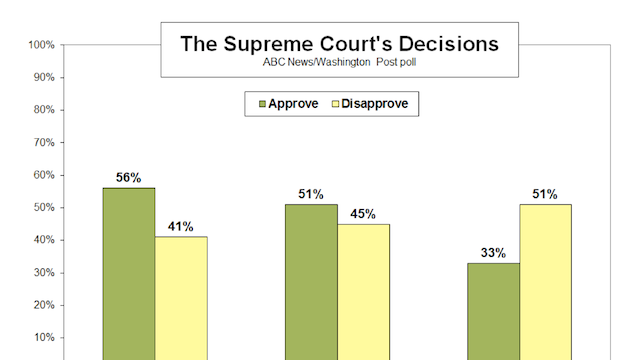 Just 33 percent of Americans approve of the Supreme Court's decision to overturn a key part of the Voting Rights Act, a cornerstone of the civil rights movement aimed at preventing racial discrimination at the ballot box.
An ABC News/Washington Post poll finds that 51 percent disapprove of the decision, with 15 percent undecided. Republicans are about equally divided on the decision, with large margins of independents and Democrats disapproving of it.
The Supreme Court ruled last month in a 5-4 decision that the federal government cannot pre-emptively reject changes to election laws in states and counties that have a history of discriminating against minority voters. The court ruled that the formula used to decide which states merit this extra scrutiny is based on decades-old turnout and registration data, which is unfair to the states covered under it.
The justices' decisions on gay rights are more popular with the public. Fifty six percent of respondents said they approved of the 5-4 decision striking down the Defense of Marriage Act, which prevented the federal government from recognizing same-sex unions. A narrower margin of 51 percent of Americans said they supported the court striking down the 2008 ballot initiative Proposition 8, which means same-sex marriage will be legal in California. Most Republicans disapproved of both decisions expanding gay rights, with Democrats and independents backing them.
The poll has a margin of error of plus or minus 3.5 percentage points.
Just 33 percent of Americans approve of the Supreme Court's decision to overturn a key part of the Voting Rights Act, a cornerstone of the civil rights movement aimed at preventing racial discrimination at the ballot box.
An ABC News/Washington Post poll finds that 51 percent disapprove of the decision, with 15 percent undecided. Republicans are about equally divided on the decision, with large margins of independents and Democrats disapproving of it.
The Supreme Court ruled last month in a 5-4 decision that the federal government cannot pre-emptively reject changes to election laws in states and counties that have a history of discriminating against minority voters. The court ruled that the formula used to decide which states merit this extra scrutiny is based on decades-old turnout and registration data, which is unfair to the states covered under it.
The justices' decisions on gay rights are more popular with the public. Fifty six percent of respondents said they approved of the 5-4 decision striking down the Defense of Marriage Act, which prevented the federal government from recognizing same-sex unions. A narrower margin of 51 percent of Americans said they supported the court striking down the 2008 ballot initiative Proposition 8, which means same-sex marriage will be legal in California. Most Republicans disapproved of both decisions expanding gay rights, with Democrats and independents backing them.
The poll has a margin of error of plus or minus 3.5 percentage points.
U.S. Considers Faster Pullout in Afghanistan
 By MARK MAZZETTI and MATTHEW ROSENBERG
Increasingly frustrated by his dealings with President Hamid Karzai, President Obama is giving serious consideration to speeding up the withdrawal of United States forces from Afghanistan and to a “zero option” that would leave no American troops there after next year, according to American and European officials.
Mr. Obama is committed to ending America’s military involvement in Afghanistan by the end of 2014, and Obama administration officials have been negotiating with Afghan officials about leaving a small “residual force” behind. But his relationship with Mr. Karzai has been slowly unraveling, and reached a new low after an effort last month by the United States to begin peace talks with the Taliban in Qatar.
Mr. Karzai promptly repudiated the talks and ended negotiations with the United States over the long-term security deal that is needed to keep American forces in Afghanistan after 2014.
A videoconference between Mr. Obama and Mr. Karzai designed to defuse the tensions ended badly, according to both American and Afghan officials with knowledge of it. Mr. Karzai, according to those sources, accused the United States of trying to negotiate a separate peace with both the Taliban and their backers in Pakistan, leaving Afghanistan’s fragile government exposed to its enemies.
Mr. Karzai had made similar accusations in the past. But those comments were delivered to Afghans — not to Mr. Obama, who responded by pointing out the American lives that have been lost propping up Mr. Karzai’s government, the officials said.
The option of leaving no troops in Afghanistan after 2014 was gaining momentum before the June 27 video conference, according to the officials. But since then, the idea of a complete military exit similar to the American military pullout from Iraq has gone from being considered the worst-case scenario — and a useful negotiating tool with Mr. Karzai — to an alternative under serious consideration in Washington and Kabul.
The officials cautioned that no decisions had been made on the pace of the pullout and exactly how many American troops to leave behind in Afghanistan. The goal remains negotiating a long-term security deal, they said, but the hardening of negotiating stances on both sides could result in a repeat of what happened in Iraq, where a deal failed to materialize despite widespread expectations that a compromise would be reached and American forces would remain.
“There’s always been a zero option, but it was not seen as the main option,” said a senior Western official in Kabul. “It is now becoming one of them, and if you listen to some people in Washington, it is maybe now being seen as a realistic path.”
The official, however, said he hoped some in the Karzai government were beginning to understand that the zero option was now a distinct possibility, and that “they’re learning now, not later, when it’s going to be too late.”
The Obama administration’s internal deliberations about the future of the Afghan war were described by officials in Washington and Kabul who hold a range of views on how quickly the United States should leave Afghanistan and how many troops it should leave behind. Spokesmen for the White House and Pentagon declined to comment.
Within the Obama administration, the way the United States extricates itself from Afghanistan has been a source of tension between civilian and military officials since Mr. Obama took office. American commanders in Afghanistan have generally pushed to keep as many American troops in the country as long as possible, creating friction with White House officials urging a speedier military withdrawal.
But with frustrations mounting over the glacial pace of initiating peace talks with the Taliban, and with American relations with the Karzai government continuing to deteriorate, it is unclear whether the Pentagon and American commanders in Afghanistan would vigorously resist if the White House pushed for a full-scale pullout months ahead of schedule.
As it stands, the number of American troops in Afghanistan — around 63,000 — is scheduled to go down to 34,000 by February 2014. The White House has said the vast majority of troops would be out of Afghanistan by the end of that year, although it now appears that the schedule could accelerate to bring the bulk of the troops — if not all of them — home by next summer, as the annual fighting season winds down.
Talks between the United States and Afghanistan over a long-term security deal have faltered in recent months over the Afghan government’s insistence that the United States guarantee Afghanistan’s security and, in essence, commit to declaring Pakistan the main obstacle in the fight against militancy in the region.
The guarantees sought by Afghanistan, if implemented, could possibly compel the United States to attack Taliban havens in Pakistan long after 2014, when the Obama administration has said it hoped to dial back the C.I.A.’s covert drone war there.
Mr. Karzai also wants the Obama administration to specify the number of troops it would leave in Afghanistan after 2014 and make a multiyear financial commitment to the Afghan Army and the police.
The White House announced last month that long-delayed talks with the Taliban would begin in Doha, Qatar, where the Taliban opened what amounts to an embassy-in-exile, complete with their old flag and a plaque with their official name, “The Islamic Emirate of Afghanistan.”
But the highly choreographed announcement backfired, with Afghan officials saying the talks gave the insurgents undeserved legitimacy and accusing the Obama administration of negotiating behind Mr. Karzai’s back.
To the surprise of American officials, Mr. Karzai then abruptly ended the negotiations over a long-term security deal. He has said the negotiations would not resume until the Taliban met directly with representatives of the Afghan government, essentially linking the security negotiations to a faltering peace process and making the United States responsible for persuading the Taliban to talk to the Afghan government.
The Taliban have refused for years to meet directly with Afghan government negotiators, deriding Mr. Karzai and his ministers as American puppets.
There have been other points of contention as well. Meeting with foreign ambassadors recently, Mr. Karzai openly mused that the West was to blame for the rise of radical Islam. It was not a message that many of the envoys, whose countries have lost thousands of people in Afghanistan and spent billions of dollars fighting the Taliban, welcomed.
The troop decisions are also being made against a backdrop of growing political uncertainty in Afghanistan and rising concerns that the country’s presidential election could either be delayed for months or longer, or be so flawed that many Afghans would not accept its results.
Preparations for the election, scheduled for next April, are already falling behind. United Nations officials have begun to say the elections probably cannot be held until next summer, at the earliest. If the voting does not occur before Afghanistan’s mountain passes are closed by snow in late fall, it will be extremely difficult to hold a vote until 2015.
Of potentially bigger concern are the rumors that Mr. Karzai, in his second term and barred from serving a third, is trying to find a way to stay in power. Mr. Karzai has repeatedly insisted that he plans to step down next year.
The ripple effects of a complete American withdrawal would be significant. Western officials said the Germans and Italians — the two main European allies who have committed to staying on with substantial forces — would leave as well. Any smaller nations that envisioned keeping token forces would most likely have no way of doing so.
And Afghanistan would probably see far less than the roughly $8 billion in annual military and civilian aid it is expecting in the coming years — an amount that covers more than half the government’s annual spending.
By MARK MAZZETTI and MATTHEW ROSENBERG
Increasingly frustrated by his dealings with President Hamid Karzai, President Obama is giving serious consideration to speeding up the withdrawal of United States forces from Afghanistan and to a “zero option” that would leave no American troops there after next year, according to American and European officials.
Mr. Obama is committed to ending America’s military involvement in Afghanistan by the end of 2014, and Obama administration officials have been negotiating with Afghan officials about leaving a small “residual force” behind. But his relationship with Mr. Karzai has been slowly unraveling, and reached a new low after an effort last month by the United States to begin peace talks with the Taliban in Qatar.
Mr. Karzai promptly repudiated the talks and ended negotiations with the United States over the long-term security deal that is needed to keep American forces in Afghanistan after 2014.
A videoconference between Mr. Obama and Mr. Karzai designed to defuse the tensions ended badly, according to both American and Afghan officials with knowledge of it. Mr. Karzai, according to those sources, accused the United States of trying to negotiate a separate peace with both the Taliban and their backers in Pakistan, leaving Afghanistan’s fragile government exposed to its enemies.
Mr. Karzai had made similar accusations in the past. But those comments were delivered to Afghans — not to Mr. Obama, who responded by pointing out the American lives that have been lost propping up Mr. Karzai’s government, the officials said.
The option of leaving no troops in Afghanistan after 2014 was gaining momentum before the June 27 video conference, according to the officials. But since then, the idea of a complete military exit similar to the American military pullout from Iraq has gone from being considered the worst-case scenario — and a useful negotiating tool with Mr. Karzai — to an alternative under serious consideration in Washington and Kabul.
The officials cautioned that no decisions had been made on the pace of the pullout and exactly how many American troops to leave behind in Afghanistan. The goal remains negotiating a long-term security deal, they said, but the hardening of negotiating stances on both sides could result in a repeat of what happened in Iraq, where a deal failed to materialize despite widespread expectations that a compromise would be reached and American forces would remain.
“There’s always been a zero option, but it was not seen as the main option,” said a senior Western official in Kabul. “It is now becoming one of them, and if you listen to some people in Washington, it is maybe now being seen as a realistic path.”
The official, however, said he hoped some in the Karzai government were beginning to understand that the zero option was now a distinct possibility, and that “they’re learning now, not later, when it’s going to be too late.”
The Obama administration’s internal deliberations about the future of the Afghan war were described by officials in Washington and Kabul who hold a range of views on how quickly the United States should leave Afghanistan and how many troops it should leave behind. Spokesmen for the White House and Pentagon declined to comment.
Within the Obama administration, the way the United States extricates itself from Afghanistan has been a source of tension between civilian and military officials since Mr. Obama took office. American commanders in Afghanistan have generally pushed to keep as many American troops in the country as long as possible, creating friction with White House officials urging a speedier military withdrawal.
But with frustrations mounting over the glacial pace of initiating peace talks with the Taliban, and with American relations with the Karzai government continuing to deteriorate, it is unclear whether the Pentagon and American commanders in Afghanistan would vigorously resist if the White House pushed for a full-scale pullout months ahead of schedule.
As it stands, the number of American troops in Afghanistan — around 63,000 — is scheduled to go down to 34,000 by February 2014. The White House has said the vast majority of troops would be out of Afghanistan by the end of that year, although it now appears that the schedule could accelerate to bring the bulk of the troops — if not all of them — home by next summer, as the annual fighting season winds down.
Talks between the United States and Afghanistan over a long-term security deal have faltered in recent months over the Afghan government’s insistence that the United States guarantee Afghanistan’s security and, in essence, commit to declaring Pakistan the main obstacle in the fight against militancy in the region.
The guarantees sought by Afghanistan, if implemented, could possibly compel the United States to attack Taliban havens in Pakistan long after 2014, when the Obama administration has said it hoped to dial back the C.I.A.’s covert drone war there.
Mr. Karzai also wants the Obama administration to specify the number of troops it would leave in Afghanistan after 2014 and make a multiyear financial commitment to the Afghan Army and the police.
The White House announced last month that long-delayed talks with the Taliban would begin in Doha, Qatar, where the Taliban opened what amounts to an embassy-in-exile, complete with their old flag and a plaque with their official name, “The Islamic Emirate of Afghanistan.”
But the highly choreographed announcement backfired, with Afghan officials saying the talks gave the insurgents undeserved legitimacy and accusing the Obama administration of negotiating behind Mr. Karzai’s back.
To the surprise of American officials, Mr. Karzai then abruptly ended the negotiations over a long-term security deal. He has said the negotiations would not resume until the Taliban met directly with representatives of the Afghan government, essentially linking the security negotiations to a faltering peace process and making the United States responsible for persuading the Taliban to talk to the Afghan government.
The Taliban have refused for years to meet directly with Afghan government negotiators, deriding Mr. Karzai and his ministers as American puppets.
There have been other points of contention as well. Meeting with foreign ambassadors recently, Mr. Karzai openly mused that the West was to blame for the rise of radical Islam. It was not a message that many of the envoys, whose countries have lost thousands of people in Afghanistan and spent billions of dollars fighting the Taliban, welcomed.
The troop decisions are also being made against a backdrop of growing political uncertainty in Afghanistan and rising concerns that the country’s presidential election could either be delayed for months or longer, or be so flawed that many Afghans would not accept its results.
Preparations for the election, scheduled for next April, are already falling behind. United Nations officials have begun to say the elections probably cannot be held until next summer, at the earliest. If the voting does not occur before Afghanistan’s mountain passes are closed by snow in late fall, it will be extremely difficult to hold a vote until 2015.
Of potentially bigger concern are the rumors that Mr. Karzai, in his second term and barred from serving a third, is trying to find a way to stay in power. Mr. Karzai has repeatedly insisted that he plans to step down next year.
The ripple effects of a complete American withdrawal would be significant. Western officials said the Germans and Italians — the two main European allies who have committed to staying on with substantial forces — would leave as well. Any smaller nations that envisioned keeping token forces would most likely have no way of doing so.
And Afghanistan would probably see far less than the roughly $8 billion in annual military and civilian aid it is expecting in the coming years — an amount that covers more than half the government’s annual spending.
Obama to discuss economy with Black Caucus
 President Barack Obama will meet Tuesday with black members of Congress about the economy and other issues.
The White House says Obama and the Congressional Black Caucus will discuss economic issues, immigration, implementation of Obama's health care law and voting rights.
It's the first meeting between Obama and the caucus since the Supreme Court last month stripped a key provision of the Voting Rights Act. Rep. Marcia Fudge of Ohio, who chairs the caucus, called it one of the worst days in U.S. history.
A caucus spokeswoman says all 43 members are scheduled to attend.
The meeting comes as Obama is seeking to shift focus back to the economy and an immigration overhaul after two recent foreign trips and global crises that have diverted attention from his domestic priorities.
President Barack Obama will meet Tuesday with black members of Congress about the economy and other issues.
The White House says Obama and the Congressional Black Caucus will discuss economic issues, immigration, implementation of Obama's health care law and voting rights.
It's the first meeting between Obama and the caucus since the Supreme Court last month stripped a key provision of the Voting Rights Act. Rep. Marcia Fudge of Ohio, who chairs the caucus, called it one of the worst days in U.S. history.
A caucus spokeswoman says all 43 members are scheduled to attend.
The meeting comes as Obama is seeking to shift focus back to the economy and an immigration overhaul after two recent foreign trips and global crises that have diverted attention from his domestic priorities.
Former President George W. Bush praises President Obama on counterterrorism and immigration reform
http://www.nydailynews.com/Former President George W. Bush had kind words for his successor Sunday, praising President Obama’s push for immigration reform and his tough counterterrorism policies.

Excessive use of force during Gezi protests should be punished
http://www.hurriyetdailynews.com/The Council of Europe commissioner for human rights has said the excessive use of force during the Gezi protests should not go unpunished. “All instances of excessive use of force by the police must be fully investigated and adequately punished,” said Nils Muiznieks, the Council of Europe commissioner for human rights at the end of a five-day visit to Istanbul and Ankara, during which he discussed the Gezi Park protests and other human rights issues. The commissioner recalled that, according to the case law of the European Court of Human Rights, the failure to effectively investigate the misconduct of security forces was a human rights violation in itself, and that Turkey had been condemned on numerous occasions by the court precisely for this reason. The commissioner had received serious allegations of human rights violations committed by law enforcement forces against demonstrators, backed up by witness accounts, photos, videos and forensic evidence, as well as the number of deaths and injuries over the course of the events. Most of these reports concerned excessive and improper use of tear gas, and ill treatment by police at the time of apprehension. On the other hand, members of the government and security forces considered the use of force proportionate in view of the actions of marginal groups hijacking the demonstrations, except for isolated incidents which are under investigation. “The only way to bridge this gap in perceptions, and to allow the healing process Turkey needs, is to conduct independent, impartial, and effective investigations with the involvement of victims into all allegations of misconduct by security forces, in accordance with the clear guidelines of the Strasbourg court. Given Turkey’s track record before the court, this requires a novel approach and determination by all relevant actors,” said the commissioner. The commissioner added that those demonstrators who resorted to violence must obviously also face the consequences of their actions, but said it must be the absolute priority of every democratic state to safeguard the trust of their citizens in law enforcement by combating impunity.
Turning on the Lights in Pakistan
By KATHARINE HOURELD | REUTERS
KARACHI, Pakistan — Since Pakistan’s biggest electricity company was privatized, its headquarters has been looted, its employees kidnapped and its boss nearly arrested by the government.
Despite all of that, it is regarded as a roaring success.
Power cuts lasting 12 hours a day or more have devastated the Pakistani economy. The loss of millions of jobs has fueled unrest in a nuclear-armed nation already beset by a Taliban insurgency.
The only city bucking the trend is the violent metropolis of Karachi, Pakistan’s financial heart — and that is thanks to Tabish Gauhar and his team at the Karachi Electricity Supply Co.
“It has consumed every ounce of my energy,” Mr. Gauhar, 42, said in an interview. “But we have helped millions of people.”
The new government of Prime Minister Nawaz Sharif won an election in May partly because it had promised to fix the power cuts. Now many are wondering whether the Karachi utility’s successful privatization will be repeated elsewhere.
Pakistan’s power companies share similar problems. Workers are often corrupt, and influential families rarely pay bills. The government sells power below the cost of production but pays subsidies late or not at all. Plants cannot afford fuel.
At the state-run Peshawar Electricity Supply Co., the majority of workers are illiterate, most new hires are relatives of existing staff members, and 37 percent of the power generated was stolen, according to a 2011 audit funded by the U.S. Agency for International Development.
Karachi Electricity Supply had all the same problems when the Dubai-based private equity firm Abraaj Capital bought a controlling stake in 2008. Mr. Gauhar and his Abraaj team decided to slash the work force by a third, cut off nonpayers and destroy illegal connections.
The moves started a small war.
Employees who had been laid off offered to work for free because they had made such fat kickbacks. When management refused, thousands of protesters ransacked the company’s headquarters. They camped outside for months.
Gunmen attacked Mr. Gauhar’s house. Workers crossed picket lines every day, hunkered down on the floors of police cars. More than 200 employees of the utility were injured.
“We felt very lonely then,” said Mr. Gauhar, who moved from chief executive to chairman of Karachi Electricity Supply earlier this year. “When I used to visit one of our injured employees in the hospital, it was hard for me to look them in the eye.”
Many in the populist pro-labor government vilified the power company. Later, legislators tried to arrest Mr. Gauhar on charges that he had not attended subcommittee meetings in the capital.
After the protests dissipated, Karachi Electricity Supply’s next problem was making customers pay. More than a third of the company’s electricity was stolen in 2009. Those who got bills often ignored them.
One wealthy patriarch said he could not possibly start paying because his colleagues would think he had no influence left.
Karachi Electricity Supply started cutting off those who did not pay their bills. When a transformer burned out in an area with high theft, the company asked for two months’ worth of payment from the area’s residents before replacing it.
The company divided up the city of 18 million. Areas where 80 percent of people pay bills now have no regular power cuts. Areas with high loss — often crime-ridden, sweltering slums — have long power cuts. Karachi Electricity Supply is widely hated in such places.
Muhammed Fayyaz, who works as a driver, says his neighborhood often has as much as 10 hours of cuts per day. Summer temperatures top 40 degrees Celsius (104 Fahrenheit), and protests are frequent.
“People block the main road and throw stones at passing vehicles,” he said.
Mr. Fayyaz lives in a high-theft area. Stealing power is easy. Makeshift wires with metal hooks festoon Karachi Electricity Supply’s lines in the sun-baked streets. Some lead to roadside businesses. Others head into the distance atop lines of makeshift bamboo poles.
“We clean them up, but in five minutes they are back again,” said Muhammad Siddiq, a manager at the utility.
Local gangs control the illegal lines. Power company workers who remove them are often attacked. Ten were taken hostage in a single occurrence last month. A mob attacked Mr. Siddiq’s office.
Some slums are held by the Taliban or gangs, and Karachi Electricity Supply workers cannot even enter. They are experimenting with licensing powerful local businessmen to collect bills and cut off nonpayers.
But the painful changes have begun paying dividends. Last year, the company made its first profit in 17 years. Theft has fallen 9 percent in four years. Half of the city, including two industrial zones, does not have daily power cuts.
“It has made a big difference to my business,” said S.M. Muneer, whose leather and textile factories employ thousands. “I cannot run a textile factory on a battery from my car.”
Not everyone is happy. Shortages of natural gas and maintenance problems still cause long power cuts. Customers who do pay bills suffer if their neighbors do not. Many cannot afford the bills.
To improve customer relations, the Karachi utility gives free power to hundreds of charity schools and provides uninterrupted or subsidized power to 18 big public hospitals. It has also built new call centers, connections and power plants.
The gleaming Chinese-built natural gas plant at the Bin Qasim Port in Karachi can generate 560 megawatts. But Pakistan rarely has enough natural gas for the plant to work at full capacity.
Karachi Electricity Supply blames that on nationwide gas shortages, but Sui Southern Gas Co., of which the government owns 70 percent, says that the Karachi power company owes it $500 million.
Karachi Electricity Supply disputes the assertion that the figure is that high and says it is offsetting the payment against outstanding bills from government entities that total $720 million.
“We’ve still got problems,” said Syed Nayyer Hussain, the Karachi company’s new chief executive. “But at least we’ve started.”
Subscribe to:
Posts (Atom)