 Turkey’s nationwide Gezi protests have evolved from frequent, direct confrontation with the state’s heavy-handed police forces to local forums in various parks in Ankara, Istanbul and Anatolia, providing a platform for once-invisible and still-marginalized communities the chance to speak out.
One particular aspect of the assemblies, as epitomized in Ancient Greece’s direct democracy where the floor belongs to everyone to speak their mind to steer where the Gezi will go from here is that there is a chance to revolutionize perceptions of society by speaking the unspoken. The prominence of Kurds, Alevis, members of the Lesbian Gay Bisexual Trans (LGBT) community and women in the protests can well be considered an extension of the “Gezi spirit,” assuring that nobody will ever walk alone.
Starting July 5, LGBT individuals organized under the Kaos GL association joined forums in Güven, İzci, Anıt and Ethem Sarısülük parks under their rainbow flag for the first time. It may be the first time they carried a flag, but definitely not the first time they were present. They were there for the funeral of Ethem Sarısülük, a protester who was shot dead by the police in Ankara; they were there when the police brutality hit its peak; and they were there in their tents sleeping over in Kuğulu Park. Until now, they protested individually, even “undercover.”
“People realized that it is not something to be done alone. This is the chance for the minorities to come together,” said Ömer Akgüner, a forum participant from the Kaos GL. While another participant, Aslı Demir: “I think people understood this: The LGBTs took the squares with similar worries, fears. They struggled. There is no difference. I think this is a step taken forward by society to address the problems of the LGBT.”
With the Gezi protests, the LGBT community is now able to draw the attention of those who were previously oblivious to them. “The feedback was this: We did not know until now,” Demir said.
‘Where are you, darling? Here I am, darling’
Many people learned to empathize with Kurds and how state-biased reporting has misrepresented their decades-old struggle after witnessing the mainstream media’s insufficient coverage of the Gezi protests. After all, struggling for the same cause is not built on being alike, but standing side by side.
The time to root merely for one’s rights has passed. The Gezi protests instigated a synergy among minorities, or in its most generic form, whoever feels degraded, bashed or impaired by societal norms or state policies. Therefore, it is not serendipity that this year’s Pride March drew thousands, gay and straight.
“Those who would not touch one another have realized that there is nothing to be afraid of once they ran into each other in the squares,” Demir said.
And yes, as Akgüner puts it: “Maybe not everyone there embraces them [the LGBTs], but they face their own prejudices there.”
For the first time this year, thousands chanted, “Where are you, darling? Here I am, darling”; – a signature slogan long used by the LGBT community in Pride Marches that is now being used out of context and without the fear of stigmatization.
Homophobic slogans are being replaced as people are made aware of their scornful implications. For the first time, LGBT individuals, once declared to be persona non grata, have found the courage to unite under their rainbow flag and come down to squares to exchange opinions. They have arrived to share what they have been exposed to – hate crimes at most, prejudices at least.
“The Gezi spirit” has indeed magnified people’s scope for struggling for their rights, meaning the increasing visibility of LGBT individuals is just one in a multitude of colors from the full spectrum of the oppressed.
Tuesday, July 9, 2013
Gezi forums showcasing struggles of the oppressed in Turkey
Turkey’s nationwide Gezi protests have evolved from frequent, direct confrontation with the state’s heavy-handed police forces to local forums in various parks in Ankara, Istanbul and Anatolia, providing a platform for once-invisible and still-marginalized communities the chance to speak out.
One particular aspect of the assemblies, as epitomized in Ancient Greece’s direct democracy where the floor belongs to everyone to speak their mind to steer where the Gezi will go from here is that there is a chance to revolutionize perceptions of society by speaking the unspoken. The prominence of Kurds, Alevis, members of the Lesbian Gay Bisexual Trans (LGBT) community and women in the protests can well be considered an extension of the “Gezi spirit,” assuring that nobody will ever walk alone.
Starting July 5, LGBT individuals organized under the Kaos GL association joined forums in Güven, İzci, Anıt and Ethem Sarısülük parks under their rainbow flag for the first time. It may be the first time they carried a flag, but definitely not the first time they were present. They were there for the funeral of Ethem Sarısülük, a protester who was shot dead by the police in Ankara; they were there when the police brutality hit its peak; and they were there in their tents sleeping over in Kuğulu Park. Until now, they protested individually, even “undercover.”
“People realized that it is not something to be done alone. This is the chance for the minorities to come together,” said Ömer Akgüner, a forum participant from the Kaos GL. While another participant, Aslı Demir: “I think people understood this: The LGBTs took the squares with similar worries, fears. They struggled. There is no difference. I think this is a step taken forward by society to address the problems of the LGBT.”
With the Gezi protests, the LGBT community is now able to draw the attention of those who were previously oblivious to them. “The feedback was this: We did not know until now,” Demir said.
‘Where are you, darling? Here I am, darling’
Many people learned to empathize with Kurds and how state-biased reporting has misrepresented their decades-old struggle after witnessing the mainstream media’s insufficient coverage of the Gezi protests. After all, struggling for the same cause is not built on being alike, but standing side by side.
The time to root merely for one’s rights has passed. The Gezi protests instigated a synergy among minorities, or in its most generic form, whoever feels degraded, bashed or impaired by societal norms or state policies. Therefore, it is not serendipity that this year’s Pride March drew thousands, gay and straight.
“Those who would not touch one another have realized that there is nothing to be afraid of once they ran into each other in the squares,” Demir said.
And yes, as Akgüner puts it: “Maybe not everyone there embraces them [the LGBTs], but they face their own prejudices there.”
For the first time this year, thousands chanted, “Where are you, darling? Here I am, darling”; – a signature slogan long used by the LGBT community in Pride Marches that is now being used out of context and without the fear of stigmatization.
Homophobic slogans are being replaced as people are made aware of their scornful implications. For the first time, LGBT individuals, once declared to be persona non grata, have found the courage to unite under their rainbow flag and come down to squares to exchange opinions. They have arrived to share what they have been exposed to – hate crimes at most, prejudices at least.
“The Gezi spirit” has indeed magnified people’s scope for struggling for their rights, meaning the increasing visibility of LGBT individuals is just one in a multitude of colors from the full spectrum of the oppressed.
Russian inquiry to UN: Rebels, not Army, behind Syria Aleppo sarin attack
 Samples taken at the site where the chemical weapons were allegedly used indicate that it was rebels - not the Syrian army - behind the attack, Russia’s UN envoy Vitaly Churkin has said.
Russia has handed over the analyzed samples to the UN, he added.
“I have just passed the analysis of samples taken at the site of the chemical attack to the UN Secretary General (Ban Ki-moon),” Churkin said on Tuesday.
Evidence studied by Russian scientists indicates that a projectile carrying the deadly nerve agent sarin was most likely fired at Khan al-Assal by the rebels, Churkin pointed out.
“It was determined that on March 19 the rebels fired an unguided missile Bashair-3 at the town of Khan al-Assal, which has been under government control. The results of the analysis clearly show that the shell used in Khan al-Assal was not factory made and that it contained sarin,” he said.
Churkin added that the contents of the shell “didn’t contain chemical stabilizers in the toxic substance,” and therefore “is not a standard chemical charge.” The RDX - an explosive nitroamine commonly used for industrial and military applications - found in the warhead was not consistent with what the armed forces use.
According to Moscow, the manufacture of the ‘Bashair-3’ warheads started in February, and is the work of Bashair al-Nasr, a brigade with close ties to the Free Syrian Army. Churkin stressed that unlike other reports which have been handed to the UN, the samples were taken by Russian experts at the scene, without any third party involvement.
More than 30 people died in the Khan al-Assal incident in the northern province of Aleppo in March. Damascus was the first to ask for the UN investigation, accusing opposition fighters of launching a chemical weapon attack. Syrian rebel groups denied the accusations, in turn blaming government forces.
However, the UN investigation has largely become stalled after a group of Western nations insisted on launching an inquiry into a separate case of alleged chemical weapons use in Homs in December 2012. The inquiry requires access to military objects, which Damascus has been unwilling to give.
The UN has also decided to exclude Russian and Chinese experts from the investigation team, with Syria protesting this decision.
So far, the UN commission of inquiry for Syria has not found any conclusive evidence proving that either side of the conflict used chemical weapons. This is despite several reports submitted by the US, UK and France, which claim to show that Syrian President Bashar Assad’s forces used such weapons.
Syria finds enough chemicals to ‘destroy the whole country’
The Syrian government invited chief UN chemical weapons investigator Ake Sellstrom and UN disarmament chief Angela Kane for talks in Damascus on Monday, announcing that a rebels-linked storage site containing piles of dangerous chemicals had been discovered.
“The Syrian authorities have discovered yesterday in the city of Banias 281 barrels filled with dangerous, hazardous chemical materials,” Syrian UN Ambassador Bashar Ja’afari said, adding that the chemicals were “capable of destroying a whole city, if not the whole country.”
The chemicals, which included monoethylene glycol and polyethylene glycol, were found in a storage site used by “armed terrorist groups,” Ja’afari explained. He said that Syria has started an investigation into the discovery.
The Syrian envoy expressed Damascus’ confidence that there will be “constructive negotiations with the Syrian officials in order to reach an agreement,” particularly in terms of “reference, mechanism, and time frame” of the UN mission.
Ja’afari added, however, that one should not “jump to the conclusion” that the Monday invitation means that Syria would consider allowing the UN team access to sites beyond Aleppo.
UN Secretary-General Ban Ki-moon’s spokesman, Martin Nesirky, reacted by calling the invitation “a move in the right direction,” but did not say whether UN investigators would accept it. The UN has been demanding that Sellstrom’s team be granted access across Syria “without further delay and without conditions,” ordering the Aleppo investigation not to begin until those demands were reached. ‘No credible reporting that rebels used chemical weapons’?
Following Churkin’s announcement, both US and UK officials voiced their disbelief over any evidence suggesting that Syrian rebels used chemical weapons, stating they have yet been unable to see the whole report of Russia’s UN envoy.
The US has “yet to see any evidence that backs up the assertion that anybody besides the Syrian government has the ability to use chemical weapons, has used chemical weapons,” White House spokesman Jay Carney said.
When asked whether Washington had seen the Russian report, Carney replied that it had not.
The UK also voiced its skepticism regarding the report, stating that it didn’t believe the opposition could have obtained chemical weapons.
“We will examine whatever is presented to us, but to date we have seen no credible reporting of chemical weapons use by the Syrian opposition, or that the opposition have obtained chemical weapons,” BBC quoted a UK government spokesman as saying.
Afghan Refugees in Pakistan Welcomed to Stay Until End of 2015
http://www.tolonews.com/The Pakistani government is expected to extend the stay of Afghan refugees living in Pakistan to the end of 2015. Officials indicated that the decision came out of a tripartite meeting between representatives from the Afghan and Pakistani governments, and the United Nations High Council for Refugees (UNHCR). An official from the Ministry of Refugee Repatriation in the Pakistani province of Khaibar Pakhtunkha, where many of the refugees that fled the most recent conflict in Afghanistan reside, said that the Pakistani Cabinet will soon announce its decision. Pakistan is also home to Afghan refugees from before 2001, those who fled the country under Taliban rule as well as those who left during the civil war period before that. News of the new lease on asylum in Pakistan was received warmly by the community of Afghan refugees there. "An extension of our refugee status is very important for us," said an Afghan refugee living in Khaibar Pakhtunkha. Other refugees criticized the Afghan government for not doing enough for them. "The government in Afghanistan has done nothing to settle the difficulties confronted by Afghan asylum seekers in Pakistan," another refugee told TOLOnews. "For the last 34 years, Afghan officials have done nothing for the betterment of refugees living in Pakistan," said another refugee. UNHCR has identified civil wars as one of the important factors that have increased the number of asylum seekers worldwide, leaving like Afghanistan, Somalia, Iraq, Syria and Sudan with nearly 50% of the world's total refugee population.
No more secrecy: Abbottabad Commission report
 IT was, perhaps, inevitable: a high-profile report on a hugely damaging, and embarrassing, episode in the country’s history was unlikely to remain shrouded in secrecy forever. After this newspaper reported on some of the Abbottabad Commission’s findings and recommendations yesterday, Al Jazeera published the report last evening — and the report appears to pack quite a punch. Did it have to turn out this way, though? Where once the Hamoodur Rehman Commission’s report on the events leading up to the secession of East Pakistan could be suppressed for decades, today there is no such luxury. In the era of WikiLeaks and Edward Snowden and other whistleblowers who can use the global megaphone of a semi-regulated internet, the age of excessive secrecy and the suppression of information that is of legitimate public interest has passed. Indeed, the Hamoodur Rehman Commission’s ultimate fate underlined the changing times — when an Indian publication began to serialise extracts from the report, Pakistani authorities were forced to do what they long avoided, ie publish the report.
Why was the Abbottabad Commission report, handed over to prime minister Raja Pervez Ashraf in January, not made public? It is fair assumption that responsibility for the secrecy lay with the military leadership. An institutional culture that focuses more on the embarrassment that will be caused nationally and internationally by a comprehensive official account of any episode that is deemed to undermine national security ends up compounding the original errors. Whether it is Ojhri camp or Kargil or militant attacks on military bases in recent years, the approach is always the same: spill no secrets and promise that the necessary corrective measures have been taken, with no proof of whether that is the case or not. A high-stakes version of ‘trust us, guys’. But ‘trust us, guys’ has only led to bigger mistakes and the fact that Osama bin Laden spent years in Pakistan undetected and that US troops were able to kill him on Pakistani soil and leave undetected is surely one of the more staggering national-security lapses in the country’s history.
Now that the report is out and will be pored over nationally and internationally, there is still time for the government, and the army leadership in particular, to get at least one thing right. A leaked report cannot be the basis of accountability or any prosecutions deemed necessary. The government must — yes, must — officially release the report. Only then can the official narrative begin to be set right.
Pakistan: A counter-terrorism strategy that was never made
daily timesBY Hussain Nadim The nation has developed such 'critical skills' that despite the TTP's acceptance of terrorist attacks, it has turned a blind eye, and instead blames the United States for the attacks Well over 90 percent of the university-going students in Lahore and Islamabad cannot differentiate between the Afghan Taliban and Tehreek-e-Taliban Pakistan (TTP). And 67 percent believe that the TTP is the enemy of the United States, and working in the interest of Pakistan. While 76 percent see the Baloch grievances as unjustified, and blame the Baloch people for supporting their corrupt Sardars (tribal chiefs), only 12 percent blame the Pakistan military for the current crisis in the country. These are the unfortunate highlights of the study “Perception of militancy amongst urban youth” that I conducted in December 2012 at three top universities in Lahore and Islamabad. The study brings out the deep-rooted contradictions in Pakistan and suggest how miserably Pakistan’s security establishment has failed to develop an effective counterterrorism strategy. The ‘educated’ Pakistan as the study shows is pro-Taliban in geo-political terms, but would not want Taliban-style Sharia to disrupt their ‘liberal’ lifestyle. At the same time, educated Pakistan views the United States as an enemy, but would pay millions to live the American dream. Over 11 years into the war on terror, having lost thousands of lives, and nearly destroyed our economy, the people in the cities and on the media still debate over who the real enemy is: Taliban? TTP? Or the Americans? The nation has developed such ‘critical skills’ that despite the TTP’s acceptance of terrorist attacks, it has turned a blind eye, and instead blames the United States for the attacks, thanks to certain political leaders who have led the nation into an abysmal state of confusion by being sympathetic to militant outfits, and blaming the US and its drones for whatever is wrong in Pakistan, not realising that drones came out of the need to deal with militants, not the other way around. In war, confusion is bad, and tragically, more than a decade into the war, the same Pakistani politicians call it an ‘American war’, an idea utterly disrespectful to all those Pakistani soldiers and families who laid down their lives in this war to save Pakistan. What is even more unfortunate is the role of the top brass of the Pakistan military, which somehow gets little limelight within Pakistan. The first basic step in any counterterrorism strategy is to define the target, forge a national consensus, and make people firmly believe in the absolute necessity of wiping out the target, something that the United States did in the case of Osama bin Laden and al Qaeda. However, the military in Pakistan with all its budget and might during authoritarian rule when mobilising the people would not have been an issue, either forgot to strike up a consensus against terrorism, or deliberately allowed controlled chaos in information. Today, a decade later, as my study reveals, there is no consensus in Pakistan over the militant and terrorist groups, and the little consensus if any, tilts positive towards the TTP and Taliban. Either the state has lost its power over the narrative, or, the agencies are deliberately constructing this controlled narrative to meet their strategic interests in post-US withdrawal Afghanistan. Whatever the military advisors are doing, the reality should hit them hard by now that they are doing just about everything wrong. The strategic policies of the Pakistan military are not helping Pakistan increase its external sphere of influence, nor helping to resolve the Kashmir or Durand disputes, nor giving Pakistan an economic advantage in terms of natural resources. The strategic policy is only leading to more Pakistanis, ethnic and religious minorities, being killed inside the country, and the country eventually reaching a point of splitting asunder. What needs to be done? The Pakistan Muslim League-Nawaz (PML-N) needs to take bold steps. For one it needs to push the Pakistan military to open up its vault of secrets, and make its policies and strategies transparent so that the government knows what exactly the ground situation is. Second, the government must invite all political actors and reach a strict consensus on the national narrative towards terrorism. Parliament cannot stand divided with one side sympathetic towards the TTP, while the other side is being killed by the same group. Without consensus Pakistan entered this war, but without consensus, Pakistan cannot get out of this war. Third, the media must be taken on board to ensure that it supports the national narrative on terrorism. The voices that create confusion and chaos must not be entertained on the media. Last, the PML-N government needs to take the step forward to negotiate with the US, and with the terrorists themselves, rather than letting the military turn to diplomacy, something that the military is not genetically prepared for. Taking the forefront on the issue of terrorism will not be an easy task for the PML-N, but there is no other way out either. The clash between the PML-N and the military is inevitable; the clock, as a lot of people within the government and military know, is ticking. For a military that only believes in limited democracy and does not allow civilians to touch foreign and defence affairs, a strong Nawaz Sharif with both foreign and defence portfolios is a major crisis situation. The military will push back and is likely going to scheme. However, with the nation behind the PML-N, Sharif must take the leap of faith, once again.
AL JAZEERA: Leaked report shows Bin Laden's 'hidden life'

Government report obtained exclusively by Al Jazeera reveals results of investigation into AQ chief's life on the run.Former al-Qaeda chief Osama bin Laden was able to hide in Pakistan for nine years due to the "collective failure" of state military and intelligence authorities, a leaked Pakistani government report has revealed. The report, obtained exclusively by Al Jazeera's Investigative Unit, also outlines how "routine" incompetence at every level of civil governance structure allowed the once world's most wanted man to move to six different locations within the country. The report of the Abbottabad Commission, formed in June 2011 to probe the circumstances around the killing of Bin Laden by US forces in a unilateral raid on the Pakistani city of Abbottabad, draws on testimony from more than 200 witnesses, including members of Bin Laden's family, Pakistan's then spy chief, senior ministers in the government and officials at every level of the military, bureaucracy and security services. It was released by the Al Jazeera Investigative Unit on Monday, after being suppressed by the Pakistani government. It comes on the heels of a report by AP news agency revealing that top US special operations commander, Adm William McRaven, ordered military files about the Navy SEAL raid on Bin Laden's hideout to be purged from Defense Department computers and sent to the CIA, where they could be more easily shielded from ever being made public. Following the US operation to kill Bin Laden in May 2011, which was avowedly conducted without the Pakistani government or military's knowledge, the Commission was set up to examine both "how the US was able to execute a hostile military mission which lasted around three hours deep inside Pakistan", and how Pakistan's "intelligence establishment apparently had no idea that an international fugitive of the renown or notoriety of [Osama bin Laden] was residing in [Abbottabad]".The Abbottabad Commission was charged with establishing if the failures of the Pakistani government and military were due to incompetence or complicity, and was given overarching investigative powers. The Commission's 336-page report is scathing, holding both the government and the military responsible for "gross incompetence" leading to "collective failures" that allowed both Bin Laden to escape detection, and the United States to perpetrate "an act of war". Moreover, through the testimony of Bin Laden's family members, intelligence officials and the wife of one of his couriers, the Commission was able to piece together a richly detailed image of Bin Laden's life on the run from authorities, including details on the secluded life that he and his family led in Abbottabad and elsewhere. It found that Bin Laden entered Pakistan in mid-2002, after narrowly escaping capture in the Battle of Tora Bora in Afghanistan in December 2001. Intelligence officials say he stayed briefly in the South Waziristan and Bajaur tribal areas of Pakistan, before moving to the northern Swat Valley to stay with his guards, Ibrahim and Abrar al-Kuwaiti, for several months. While in Swat, Bin Laden reportedly met with Khalid Shaikh Mohammad, the alleged mastermind of the 9/11 attacks against the United States, in early 2003. A month later, Mohammad was captured in Rawalpindi in a joint US-Pakistani operation, and Bin Laden fled Swat. Bin Laden turned up next in the town of Haripur, in northern Pakistan, where he stayed for two years in a rented house with two of his wives and several of his children and grandchildren. In August 2005, they all moved to a custom-built compound in Abbottabad, a military garrison town located about 85km away from the Pakistani capital, Islamabad. He stayed there for six years, until he was killed in the US operation in May 2011. 'Culpable negligence' According to the Commission's investigations, Pakistan's intelligence establishment had "closed the book" on Bin Laden by 2005, and was no longer actively pursuing intelligence that could lead to his capture.Moreover, it found that there had been a complete collapse of governance and law enforcement - a situation it termed "Government Implosion Syndrome", both in the lack of intelligence on Bin Laden's nine-year residence in Pakistan, and in the response to the US raid that killed him. It finds that "culpable negligence and incompetence at almost all levels of government can more or less be conclusively established". On the presence of a CIA support network to help track down Bin Laden in Pakistan without the Pakistani establishment’s knowledge, the Commission determined that "this [was] a case of nothing less than a collective and sustained dereliction of duty by the political, military and intelligence leadership of the country". It also found that the US violation of Pakistani sovereignty, in carrying out the raid unilaterally, had been allowed to happen due to inaccurate and outdated threat assessment within the country’s defence and strategic policy establishments. "It is official or unofficial defence policy not to attempt to defend the country if threatened or even attacked by a military superpower like the US?" the Commission asked of several top military officers. Military officers, including the chief of the country's air force, testified that Pakistan's low-level radar was on "peacetime deployment", and hence not active on the border with Afghanistan, when the raid occurred. The report concludes that unless there are major changes to Pakistan's defence strategy, it remains vulnerable to a repeat of such an airborne raid. The Commission found that the country's "political, military intelligence and bureaucratic leadership cannot be absolved of their responsibility for the state of governance, policy planning and policy implementation that eventually rendered this national failure almost inevitable", and calls on key national leaders to formally apologise to the country for "their dereliction of duty". Perhaps aware of the implications of its findings, the Commission noted that it had "apprehensions that the Commission's report would be ignored, or even suppressed", and urged the government to release it to the public. It did not do so. The report was buried by the government and never released. Al Jazeera's Investigative Unit obtained a copy of the Commission's report, and has now released it, in full, along with accompanying coverage to help unpick the details, and implications of its findings. Al Jazeera has received credible reports that its domain (www.aljazeera.com) was blocked for users in Pakistan shortly after it released the Bin Laden Files at 15:00 GMT. Page 197 of the report, which contains part of the testimony of Lt-Gen Ahmed Shuja Pasha, then director of the ISI, was missing from all copies of the report that Al Jazeera obtained from multiple sources. It is unclear what was contained in that page, but the contextual implication is that, among other things, it contains a list of seven demands made by the United States of Pakistani President Pervez Musharraf in the aftermath of the 9/11 attacks in 2001.
Report Blasts Pakistani Leaders Over Bin Laden
http://www.voanews.com/A leaked Pakistani government report says "collective failure" by that country's military and civilian leaders allowed al-Qaida leader Osama bin Laden to live there undetected for years. The 336-page report was published Monday on the website of Qatar-based broadcaster Al Jazeera. It was written by a commission formed by the government to investigate the circumstances surrounding the covert U.S. raid that killed bin Laden in May 2011. As reported by Al Jazeera, the report said "negligence and incompetence to a greater or lesser degree at almost all levels of government" allowed bin Laden to live in Pakistan for nine years. It said no evidence was found that current or former Pakistani officials helped bin Laden hide, although that could not be ruled out completely. The fact that the compound where bin Laden was hiding was located only about one kilometer from an elite Pakistani military academy led many in the U.S. to suspect Pakistani officials of aiding the al-Qaida chief, although Washington never found evidence to back that up. The report also revealed details of the terrorist leader's daily life. It said bin Laden was so concerned about surveillance that he wore a cowboy hat when he was outside, to avoid detection from above. The widow of one of bin Laden's key aides told the commission that bin Laden and his entourage once were stopped for speeding in Swat region. But she said her husband "very quickly settled the matter with the policeman" before he could recognize the al-Qaida leader. Pakistani officials said for years they did not know the whereabouts of the world's most wanted man or even if he was alive. In the wake of the raid that killed bin Laden, it emerged that Pakistani authorities were kept in the dark about the U.S. operation.
Pakistan: Disquieting quietude
 As the time is running out fast, the new incumbents in power are trailing far behind to the great consternation and concern of the masses. They had held out tall promises to the electorate and had also promised to deliver on them quickly. Of course, that was patently electoral politics, with the contestants irrationally but alluringly promising competitively to the electorate the moon for gains on the ballot box.
But rational or irrational, with that ploy they had raised the people's expectations abnormally high, who now want them to make good on what they had promised, which candidly is impossible in the given conditions. The incumbents' plea, even as absolutely true, that they have inherited a huge mess which would take time to clear up, is not carrying any much conviction with the masses. They have specific questions and only specific answers can satisfy them. And, appallingly, those answers are not coming forth from the incumbents. And this quietude of theirs is very disquieting, to say the least.
The PML (N) hierarchs had come crowing that they would get into grips with tortuous load-shedding powerfully and the masses would feel the change not in months or weeks but within days. They gave the sense that with clearing the vicious circular debt they would considerably slash it down. And now the people are intrigued and miffed. They can't understand why has there been no lessening in load-shedding even when the PML (N)-led federal government has paid up a huge chunk of that debt, and it instead is aggravating.
Nobody is bothering to tell them. Not even the power minister, who in effect appears to have just disappeared from the scene altogether. The word is long out from the party and government quarters that it is the prime minister who would in due course unveil his administration's energy policy. So be it. But that doesn't preclude any one else from answering a question troubling the public mind. Unarguably, unveiling an energy policy is a matter altogether different from answering a perplexing question bamboozling the people. And it doesn't have to be the prime minister to answer that puzzling question. The power minister should do it. Indeed, leave alone the minister, even a senior mandarin of the power ministry could have done it.
But none over there has deemed fit to assuage the boiling public disquiet on this score, realising not the baneful consequences of this quietude. As indeed has the PPP government in Sindh fretted not to tell the people as to why it is as yet failing again to curb violence and bloodshed in the province's metropolis of Karachi. The party couldn't be unaware that apart from load-shedding, it is the bloodbath of Karachi on its previous watch in Sindh that had largely cost it the 2013 election so unbearably humiliatingly. From a national party, it has been indefensibly reduced just into a regional party.
And had Sindh interior still not been under the sway of overbearing feudal lords and land barons, the party could have been possibly swept out from the political centre-stage altogether. Yet the PPP government is mum as to why the key port city of the nation is still in flames. Is it for its lack of trying, as on its previous watch? Or is it for reasons beyond its control? Of necessity, it has to come clean on the issue. But it is puritanically keeping quiet, wholly ignorant of the intense public sentiment to know this as well as of the tremendous dent its already-deeply besmirched public image is receiving because of this stupefying muteness.
The incumbents across the spectrum must know this. They have come promising moon to an impatient public dealt an atrociously raw deal by the previous rulers over their long, long five-year tenure.
This terribly-wronged public has no patience to wait for the whole lot of goodies promised to them. Since those promises as yet remain just that, a disturbing public unease and restlessness is setting in that potentially could ultimately flare up into something wholly undesirable.
Hence, the incumbents must take the questions taxing the public mind very seriously and answer them promptly to set the mass of the people at ease.
They must increase their truck with the media and speak out in press conferences, exclusive interviews and press meets frequently to answer those troubling questions.
Their existing nonchalance on this count is very dismaying, and baneful too.
Monday, July 8, 2013
Americans grade the Supreme Court: Most dislike Voting Rights decision
http://news.yahoo.com/
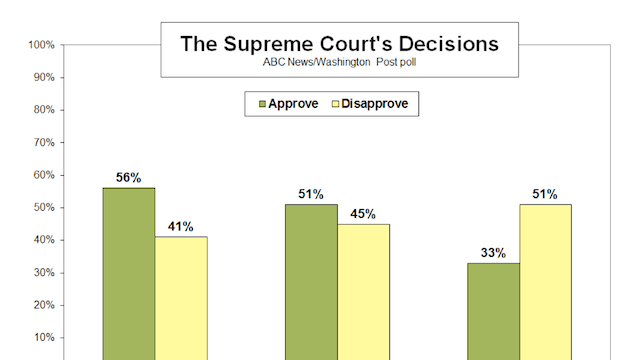 Just 33 percent of Americans approve of the Supreme Court's decision to overturn a key part of the Voting Rights Act, a cornerstone of the civil rights movement aimed at preventing racial discrimination at the ballot box.
An ABC News/Washington Post poll finds that 51 percent disapprove of the decision, with 15 percent undecided. Republicans are about equally divided on the decision, with large margins of independents and Democrats disapproving of it.
The Supreme Court ruled last month in a 5-4 decision that the federal government cannot pre-emptively reject changes to election laws in states and counties that have a history of discriminating against minority voters. The court ruled that the formula used to decide which states merit this extra scrutiny is based on decades-old turnout and registration data, which is unfair to the states covered under it.
The justices' decisions on gay rights are more popular with the public. Fifty six percent of respondents said they approved of the 5-4 decision striking down the Defense of Marriage Act, which prevented the federal government from recognizing same-sex unions. A narrower margin of 51 percent of Americans said they supported the court striking down the 2008 ballot initiative Proposition 8, which means same-sex marriage will be legal in California. Most Republicans disapproved of both decisions expanding gay rights, with Democrats and independents backing them.
The poll has a margin of error of plus or minus 3.5 percentage points.
U.S. Considers Faster Pullout in Afghanistan
 By MARK MAZZETTI and MATTHEW ROSENBERG
Increasingly frustrated by his dealings with President Hamid Karzai, President Obama is giving serious consideration to speeding up the withdrawal of United States forces from Afghanistan and to a “zero option” that would leave no American troops there after next year, according to American and European officials.
Mr. Obama is committed to ending America’s military involvement in Afghanistan by the end of 2014, and Obama administration officials have been negotiating with Afghan officials about leaving a small “residual force” behind. But his relationship with Mr. Karzai has been slowly unraveling, and reached a new low after an effort last month by the United States to begin peace talks with the Taliban in Qatar.
Mr. Karzai promptly repudiated the talks and ended negotiations with the United States over the long-term security deal that is needed to keep American forces in Afghanistan after 2014.
A videoconference between Mr. Obama and Mr. Karzai designed to defuse the tensions ended badly, according to both American and Afghan officials with knowledge of it. Mr. Karzai, according to those sources, accused the United States of trying to negotiate a separate peace with both the Taliban and their backers in Pakistan, leaving Afghanistan’s fragile government exposed to its enemies.
Mr. Karzai had made similar accusations in the past. But those comments were delivered to Afghans — not to Mr. Obama, who responded by pointing out the American lives that have been lost propping up Mr. Karzai’s government, the officials said.
The option of leaving no troops in Afghanistan after 2014 was gaining momentum before the June 27 video conference, according to the officials. But since then, the idea of a complete military exit similar to the American military pullout from Iraq has gone from being considered the worst-case scenario — and a useful negotiating tool with Mr. Karzai — to an alternative under serious consideration in Washington and Kabul.
The officials cautioned that no decisions had been made on the pace of the pullout and exactly how many American troops to leave behind in Afghanistan. The goal remains negotiating a long-term security deal, they said, but the hardening of negotiating stances on both sides could result in a repeat of what happened in Iraq, where a deal failed to materialize despite widespread expectations that a compromise would be reached and American forces would remain.
“There’s always been a zero option, but it was not seen as the main option,” said a senior Western official in Kabul. “It is now becoming one of them, and if you listen to some people in Washington, it is maybe now being seen as a realistic path.”
The official, however, said he hoped some in the Karzai government were beginning to understand that the zero option was now a distinct possibility, and that “they’re learning now, not later, when it’s going to be too late.”
The Obama administration’s internal deliberations about the future of the Afghan war were described by officials in Washington and Kabul who hold a range of views on how quickly the United States should leave Afghanistan and how many troops it should leave behind. Spokesmen for the White House and Pentagon declined to comment.
Within the Obama administration, the way the United States extricates itself from Afghanistan has been a source of tension between civilian and military officials since Mr. Obama took office. American commanders in Afghanistan have generally pushed to keep as many American troops in the country as long as possible, creating friction with White House officials urging a speedier military withdrawal.
But with frustrations mounting over the glacial pace of initiating peace talks with the Taliban, and with American relations with the Karzai government continuing to deteriorate, it is unclear whether the Pentagon and American commanders in Afghanistan would vigorously resist if the White House pushed for a full-scale pullout months ahead of schedule.
As it stands, the number of American troops in Afghanistan — around 63,000 — is scheduled to go down to 34,000 by February 2014. The White House has said the vast majority of troops would be out of Afghanistan by the end of that year, although it now appears that the schedule could accelerate to bring the bulk of the troops — if not all of them — home by next summer, as the annual fighting season winds down.
Talks between the United States and Afghanistan over a long-term security deal have faltered in recent months over the Afghan government’s insistence that the United States guarantee Afghanistan’s security and, in essence, commit to declaring Pakistan the main obstacle in the fight against militancy in the region.
The guarantees sought by Afghanistan, if implemented, could possibly compel the United States to attack Taliban havens in Pakistan long after 2014, when the Obama administration has said it hoped to dial back the C.I.A.’s covert drone war there.
Mr. Karzai also wants the Obama administration to specify the number of troops it would leave in Afghanistan after 2014 and make a multiyear financial commitment to the Afghan Army and the police.
The White House announced last month that long-delayed talks with the Taliban would begin in Doha, Qatar, where the Taliban opened what amounts to an embassy-in-exile, complete with their old flag and a plaque with their official name, “The Islamic Emirate of Afghanistan.”
But the highly choreographed announcement backfired, with Afghan officials saying the talks gave the insurgents undeserved legitimacy and accusing the Obama administration of negotiating behind Mr. Karzai’s back.
To the surprise of American officials, Mr. Karzai then abruptly ended the negotiations over a long-term security deal. He has said the negotiations would not resume until the Taliban met directly with representatives of the Afghan government, essentially linking the security negotiations to a faltering peace process and making the United States responsible for persuading the Taliban to talk to the Afghan government.
The Taliban have refused for years to meet directly with Afghan government negotiators, deriding Mr. Karzai and his ministers as American puppets.
There have been other points of contention as well. Meeting with foreign ambassadors recently, Mr. Karzai openly mused that the West was to blame for the rise of radical Islam. It was not a message that many of the envoys, whose countries have lost thousands of people in Afghanistan and spent billions of dollars fighting the Taliban, welcomed.
The troop decisions are also being made against a backdrop of growing political uncertainty in Afghanistan and rising concerns that the country’s presidential election could either be delayed for months or longer, or be so flawed that many Afghans would not accept its results.
Preparations for the election, scheduled for next April, are already falling behind. United Nations officials have begun to say the elections probably cannot be held until next summer, at the earliest. If the voting does not occur before Afghanistan’s mountain passes are closed by snow in late fall, it will be extremely difficult to hold a vote until 2015.
Of potentially bigger concern are the rumors that Mr. Karzai, in his second term and barred from serving a third, is trying to find a way to stay in power. Mr. Karzai has repeatedly insisted that he plans to step down next year.
The ripple effects of a complete American withdrawal would be significant. Western officials said the Germans and Italians — the two main European allies who have committed to staying on with substantial forces — would leave as well. Any smaller nations that envisioned keeping token forces would most likely have no way of doing so.
And Afghanistan would probably see far less than the roughly $8 billion in annual military and civilian aid it is expecting in the coming years — an amount that covers more than half the government’s annual spending.
Obama to discuss economy with Black Caucus
 President Barack Obama will meet Tuesday with black members of Congress about the economy and other issues.
The White House says Obama and the Congressional Black Caucus will discuss economic issues, immigration, implementation of Obama's health care law and voting rights.
It's the first meeting between Obama and the caucus since the Supreme Court last month stripped a key provision of the Voting Rights Act. Rep. Marcia Fudge of Ohio, who chairs the caucus, called it one of the worst days in U.S. history.
A caucus spokeswoman says all 43 members are scheduled to attend.
The meeting comes as Obama is seeking to shift focus back to the economy and an immigration overhaul after two recent foreign trips and global crises that have diverted attention from his domestic priorities.
Former President George W. Bush praises President Obama on counterterrorism and immigration reform
http://www.nydailynews.com/Former President George W. Bush had kind words for his successor Sunday, praising President Obama’s push for immigration reform and his tough counterterrorism policies.

Excessive use of force during Gezi protests should be punished
http://www.hurriyetdailynews.com/The Council of Europe commissioner for human rights has said the excessive use of force during the Gezi protests should not go unpunished. “All instances of excessive use of force by the police must be fully investigated and adequately punished,” said Nils Muiznieks, the Council of Europe commissioner for human rights at the end of a five-day visit to Istanbul and Ankara, during which he discussed the Gezi Park protests and other human rights issues. The commissioner recalled that, according to the case law of the European Court of Human Rights, the failure to effectively investigate the misconduct of security forces was a human rights violation in itself, and that Turkey had been condemned on numerous occasions by the court precisely for this reason. The commissioner had received serious allegations of human rights violations committed by law enforcement forces against demonstrators, backed up by witness accounts, photos, videos and forensic evidence, as well as the number of deaths and injuries over the course of the events. Most of these reports concerned excessive and improper use of tear gas, and ill treatment by police at the time of apprehension. On the other hand, members of the government and security forces considered the use of force proportionate in view of the actions of marginal groups hijacking the demonstrations, except for isolated incidents which are under investigation. “The only way to bridge this gap in perceptions, and to allow the healing process Turkey needs, is to conduct independent, impartial, and effective investigations with the involvement of victims into all allegations of misconduct by security forces, in accordance with the clear guidelines of the Strasbourg court. Given Turkey’s track record before the court, this requires a novel approach and determination by all relevant actors,” said the commissioner. The commissioner added that those demonstrators who resorted to violence must obviously also face the consequences of their actions, but said it must be the absolute priority of every democratic state to safeguard the trust of their citizens in law enforcement by combating impunity.
Turning on the Lights in Pakistan
By KATHARINE HOURELD | REUTERS
KARACHI, Pakistan — Since Pakistan’s biggest electricity company was privatized, its headquarters has been looted, its employees kidnapped and its boss nearly arrested by the government.
Despite all of that, it is regarded as a roaring success.
Power cuts lasting 12 hours a day or more have devastated the Pakistani economy. The loss of millions of jobs has fueled unrest in a nuclear-armed nation already beset by a Taliban insurgency.
The only city bucking the trend is the violent metropolis of Karachi, Pakistan’s financial heart — and that is thanks to Tabish Gauhar and his team at the Karachi Electricity Supply Co.
“It has consumed every ounce of my energy,” Mr. Gauhar, 42, said in an interview. “But we have helped millions of people.”
The new government of Prime Minister Nawaz Sharif won an election in May partly because it had promised to fix the power cuts. Now many are wondering whether the Karachi utility’s successful privatization will be repeated elsewhere.
Pakistan’s power companies share similar problems. Workers are often corrupt, and influential families rarely pay bills. The government sells power below the cost of production but pays subsidies late or not at all. Plants cannot afford fuel.
At the state-run Peshawar Electricity Supply Co., the majority of workers are illiterate, most new hires are relatives of existing staff members, and 37 percent of the power generated was stolen, according to a 2011 audit funded by the U.S. Agency for International Development.
Karachi Electricity Supply had all the same problems when the Dubai-based private equity firm Abraaj Capital bought a controlling stake in 2008. Mr. Gauhar and his Abraaj team decided to slash the work force by a third, cut off nonpayers and destroy illegal connections.
The moves started a small war.
Employees who had been laid off offered to work for free because they had made such fat kickbacks. When management refused, thousands of protesters ransacked the company’s headquarters. They camped outside for months.
Gunmen attacked Mr. Gauhar’s house. Workers crossed picket lines every day, hunkered down on the floors of police cars. More than 200 employees of the utility were injured.
“We felt very lonely then,” said Mr. Gauhar, who moved from chief executive to chairman of Karachi Electricity Supply earlier this year. “When I used to visit one of our injured employees in the hospital, it was hard for me to look them in the eye.”
Many in the populist pro-labor government vilified the power company. Later, legislators tried to arrest Mr. Gauhar on charges that he had not attended subcommittee meetings in the capital.
After the protests dissipated, Karachi Electricity Supply’s next problem was making customers pay. More than a third of the company’s electricity was stolen in 2009. Those who got bills often ignored them.
One wealthy patriarch said he could not possibly start paying because his colleagues would think he had no influence left.
Karachi Electricity Supply started cutting off those who did not pay their bills. When a transformer burned out in an area with high theft, the company asked for two months’ worth of payment from the area’s residents before replacing it.
The company divided up the city of 18 million. Areas where 80 percent of people pay bills now have no regular power cuts. Areas with high loss — often crime-ridden, sweltering slums — have long power cuts. Karachi Electricity Supply is widely hated in such places.
Muhammed Fayyaz, who works as a driver, says his neighborhood often has as much as 10 hours of cuts per day. Summer temperatures top 40 degrees Celsius (104 Fahrenheit), and protests are frequent.
“People block the main road and throw stones at passing vehicles,” he said.
Mr. Fayyaz lives in a high-theft area. Stealing power is easy. Makeshift wires with metal hooks festoon Karachi Electricity Supply’s lines in the sun-baked streets. Some lead to roadside businesses. Others head into the distance atop lines of makeshift bamboo poles.
“We clean them up, but in five minutes they are back again,” said Muhammad Siddiq, a manager at the utility.
Local gangs control the illegal lines. Power company workers who remove them are often attacked. Ten were taken hostage in a single occurrence last month. A mob attacked Mr. Siddiq’s office.
Some slums are held by the Taliban or gangs, and Karachi Electricity Supply workers cannot even enter. They are experimenting with licensing powerful local businessmen to collect bills and cut off nonpayers.
But the painful changes have begun paying dividends. Last year, the company made its first profit in 17 years. Theft has fallen 9 percent in four years. Half of the city, including two industrial zones, does not have daily power cuts.
“It has made a big difference to my business,” said S.M. Muneer, whose leather and textile factories employ thousands. “I cannot run a textile factory on a battery from my car.”
Not everyone is happy. Shortages of natural gas and maintenance problems still cause long power cuts. Customers who do pay bills suffer if their neighbors do not. Many cannot afford the bills.
To improve customer relations, the Karachi utility gives free power to hundreds of charity schools and provides uninterrupted or subsidized power to 18 big public hospitals. It has also built new call centers, connections and power plants.
The gleaming Chinese-built natural gas plant at the Bin Qasim Port in Karachi can generate 560 megawatts. But Pakistan rarely has enough natural gas for the plant to work at full capacity.
Karachi Electricity Supply blames that on nationwide gas shortages, but Sui Southern Gas Co., of which the government owns 70 percent, says that the Karachi power company owes it $500 million.
Karachi Electricity Supply disputes the assertion that the figure is that high and says it is offsetting the payment against outstanding bills from government entities that total $720 million.
“We’ve still got problems,” said Syed Nayyer Hussain, the Karachi company’s new chief executive. “But at least we’ve started.”
OPEN LETTER TO Mr. Imran Khan & CM Pervez Khatak :Who were doing sanitary workers jobs in Pakistan before independence?
http://www.pakistanchristianpost.com/
By Faisal GeorgeFirst of all – I am thankful to My Christian Community who shared this news, as many of us feel shy of sharing such news and talks, because of the hatred we get from the Pakistani Muslim Community. Secondly, I am not addressing to some or any specific community – I will write as an overall community of which we call Humans. So, please – before starting to write, I apologize early of using some of the harsh words which can hurt someone’s feelings but do not imply my words upon you. Before 1947 (Partition), the situation was different when only Hindus and Muslims were living together – all the Sanitary works or in easy words (dirty works) were done by Muslims in their densely populated lands and by Hindu Shudars in their lands, similarly in today’s KPK all the Pusthoons were doing all the dirty work before partition. But when the Missionaries (Christians) arrive in India and they conquered the whole land (India) then at that time many Hindus and Muslims converted to Christianity and those Christians started running the Churches, Cathedrals, Mission Schools, Colleges and Universities etc (I do not want to go in details, the list will be very long) with the help of the foreign Christians and after partition still these Missions are running in Pakistan and India by our local people. Ok – now coming to the point, in India the situation is different and there constitution too. So, let us discuss only Pakistan. Even till the late 60s the situation was very different in Pakistan (East and West) in Municipal Corporation more than 90% were Muslims and 10% were Hindu, Sikh and Christians. But after 70s when the Muslim Spiritual Leaders (Maulanas and Maulwies etc) started putting hatred in Muslim Communities against Minorities and especially in General Zia-ul-haq’s regime then the Muslims started a crusade against minorities because they were taught that they are the only true people on the face of the earth the rest is rubbish, so everything changed the minorities were thrown out from their white-collar jobs, their villages and lands were burnt and many people were hanged till death. So the minorities and especially Christians left with nothing because Hindus and Sikhs went to India but us (Christians) – we were left in the middle of nowhere, so our people forced to do the Sanitary works, because all Christian Colleges, schools and many other running departments were taken by the government of that time and our children were forced to stop education, so what than left behind is to do something for the living and from there it all was started and till now the pressure (crusade) of the Muslim Community increases on us and we are still forced to do the sanitary work. Now – I will start with my own personal experiences! Presently, I am living in Saudi Arabia – and working as Network / System Administrator in Computer House Marat, my cell # +966 56 531 2659. Why I am writing this all – if someone has any doubt he can contact me or can check my firm on the Internet. Because I am going to tell you real figures and about my Pakistani Muslim friends who are working in Baldia (Municipal Corporation), region Riyadh. You can check on the internet that more than 50% of the Pakistani Muslims are working in Municipal Corporation in Riyadh (cleaning streets, take the dustbins in front of every home empty them in another truck twice a day and all kinds of dirty works) you can also check the pictures available on the Internet. The person who takes my dustbin was telling me that he told his family in Pakistan that he is working in some good place but basically he does everything as Municipal Corporation people do in Pakistan. So – I was amazed at his talk that a Pakistani can do anything in other countries from cleaning till …. But in Pakistan he only does corruption. So, our Dear leader Mr. Imran Khan and Mr. Khatak Sahib please correct your statistics and have some mercy on our Minorities. We (our youth) do not need a Quota in Municipal Corporation but we need the Quota in Schools, Colleges, Universities, and Higher Government Organizations. Waiting for the comments and ready to answer any question? To Be Continued…. And really, I was amazed - that how badly Saudis treat our Pakistani Labor, why? Everyone knows... Saudis are thousand times better than our Pakistani Muslims, as I was also a victim of the hatred of our Pakistani Muslim Community when I was working in Islamabad and Lahore in different companies and firms on good posts. But when I compare working in Pakistan or in Saudia - the things are 100% different. My Saudi Boss (kafeel) he is just like friends - we sit together, we do lunch together - but he never mentioned any hatred sentences, as I used to hear from our community. So, why is it so - and why it happens with us only in Pakistan, I will write in more detail later The same situation – I have seen in Russia, when I was studying there Pakistani Muslims were washing clothes, cleaning etc and when I went to Malaysia, I stayed there in a hotel for one month, all labor was Pakistani, similarly in Thailand, I went to eat in a restaurant the cleaners were Pakistani. So, it means that if in Pakistan the will increase the salary of the people working in Municipal Corporation i.e., 40,000 or 50,000Rs. Per month I assure you that in Pakistan there will not be a single Christian working in such posts, all posts will be taken by the Muslims – if you do not agree, ask our government to do this experiment just for one month and see the change, it means Pakistanis can do anything for money. This is my experience and this is what I have seen….
PAKISTAN: Brainwashed: 2 arrested for attacking woman polio worker

Police on Sunday arrested two men for attacking a polio worker in Sahiwal. The injured worker was taken to the tehsil headquarters hospital, where doctors later said she was out of danger. The said she would be discharged from the hospital on Monday (today). An FIR was lodged with the Chichawatni police against the two men. Police said the polio worker, 23, who was assigned to the anti polio vaccination in Chichawatni, visited the house of Ziaullah Jutt to administer vaccine with a colleague. When Jutt entered the room, he began to hit her. He accused her of being a part of a US plot to give children a vaccine that caused mental retardation. When she tried to flee, Jutt and his brother Abrar Jutt ran after her. They caught her and dragged her by the hair into the streets shouting that “she was helping non Muslims to harm Muslim children”. Her colleague informed police and tried to get neighbours to stop the men. When police arrived, the brothers fled. They were arrested after a three-hour chase. Neighbours said that the brothers both taught at seminaries in nearby villages and used to give lectures on teachings of the Holy Quran in different villages and rural areas.
The Burnt ''MALALAS'' of Balochistan
The Baloch HalThe 16, June 2013 was a day for severe suffering for the parents in Balochistan, when they were receiving burnt dead bodies of their daughters, whilst the rest of the world was gifting flowers to their fathers on world father’s day. Even as fathers with immeasurable pain and anguish were trying to identify their daughters’ dead bodies those had been burnt in 15th June’s suicide attack in students bus of Sardar Bahadur Khan Women’s University, The only women university in the city of Quetta with 3000 female students, established in March 2004. The bloody incident occurred on 15th June when about 40 students and teachers from English, Mathematics and other departments were in the bus, waiting to go home after classes. It was the last day of their examination and that was regular day ,though, usually SBK remains off but that day due to papers it was on. A Woman bomber got in the bus and detonated her causing the extensive damage and killings. Twenty-two women were injured by the powerful blast. After the attack when the injured were shifted to the Bolan Medical Complex, a male suicide bomber and other heavily armed militants struck the building and fired indiscriminately. In result of multiple strikes death toll rose to 26. The students who could not escaped martyred in the bus were identified as Shagofta Jamali, Reyana Aurangzaib, Seyda Noor-ul-Hain, Sajila Shajahan, Mevish Asif Bangulzai, Seydtahia Bibi, Sadaf Murad Baloch, Abida Baloch, Soman Magasi, Zehra Ahmed Kakar, Nadia Durani, Hirah Javid Rajpot. At least 12 people including four militants, four nurses and the deputy commissioner of Quetta were killed in the nearly four hour’s siege of the complex where the injured students were brought for treatment. The banned sectarian militant Organization Lashkar-e-Jhangvi (LeJ) claimed responsibility for 15th June attacks on the bus and at the Bolan Medical Complex, counting them attacks for a raid against the group by security forces. The attack on the students is a clear message for the people of Balochistan, that already backward province in all sphere of life is clearly been occupied by religious extremists, allegedly given freehand by the secret agencies of the state. No doubt, more than 1000 people from Hazar community have been killed and thousands injured in the suicide attacks in Balochistan, mainly, in Quetta city. Prior to this the attacks were carried out against the Hazara community, whereas this time the victims were not from Hazara Community but Students of SBK women University and Suni Muslims. The attacks on Hazara community and Students are condemnable. The question rises on the freedom of religious extremists in Quetta city and it ratifies the allegations of victims of this religious extremism, that they are encouraged by the state patronized elements. It is being thought-out whether the state has failed, it is blackmailed by extremists or deliberately it is planned to now start killing Baloch female students to frighten others to give-up their education career. According to a lecturer and some students of the institution the dead students and injured ones belonged to middle class families and some of them are daughters of daily waged workers, who are now unable to bear their medical expenses. Balochistan, with the smallest population with a poor literacy rate is marked for backwardness; educating female is not less than a dream. The education backwardness or poor development is because of unequal opportunities and deficient interest of federation. Though it is claimed that tribal system is the biggest hurdle in the way of development of Baloch yet, the tribal people have always been part of government and pampered babies of establishment. On the other hand the religious groups have been creating obstacles for the development of not only female education but also education of male. The female students, who were attacked, belonged to far flung areas of Balochistan. The courage of their parents must be eulogized who sent their draughts to get education because their daughters are also models for other women in Balochista. In fact, the students who are getting education in Balochistan are the Malalas of this land, Malalas Yousaf Zai is famous for her struggle in female education in tribal areas, On 9 October 2012, Yousafzai was shot in the head and neck in an assassination attempt by Taliban gunmen while returning home on a school bus and she received international attention .But the questions raise why the national and International human rights organizations are silent on this incident, which extraordinarily supported Malalas case. The international human rights organizations , media groups are rally to be censured who claim to be human rights defenders but their silences on the burnt Malalas in Balochistan becomes questionable. Even UN secretary general sufficed only with a statement against ugly attack. It becomes responsibility of state to ensure protection of common people; apparently we witness failure of state in the protection of common people, mainly, the female where development of a state is contingent to the development of women. The horrible extremism must come to an end now. The Amnesty international, Human Rights Watch, Asian human Right, and Human Rights Commission of Pakistan should not consider it enough only reporting the violence but they ought to pressurize state to bring the perpetrators to the book. I conclude my write-up with poem of Nausheen Qambrani , a well-known Baloch poetess and an English language lecturer at the Sardar Bahdur Khan Women University in Quetta, She has written this poem after being in process of identifying the burnt dead bodies and losing her students. The history dried, religions melted… Wisdom burnt, civilizations buried… Lord of darkness dances around Spaces tremble on the evil’s sound, O’ killer of innocence, you turn to existence, Look your face in the blood of mirror, You find yourself just a pagan, May be a Shia, may be a christen Follower of wit or follower of love, Follower of dove… Had you felt the touch of earth, You’d have known the pain of birth
Bilour again in the run for Peshawar seat
The Awami National Party has announced its candidates for national and provincial assemblies’ seats for by-election to be held on August 22.
A meeting chaired by provincial president of the party Senator Afrasiab Khattak announced that Ghulam Ahmed Bilour will be contesting election from NA-1 Peshawar, Daud Khattak from NA-5 Nowshera, Sitara Ayaz NA-13 Swabi, Ahmed Bahadar Khan PK-23 Mardan and Hussain Ali Shah PK-42 Hangu.
The party has decided not to field candidate on PK-27 and support brother of an independent MPA Imran Mohmand who was killed in a suicide attack in Mardan last month, a press release said.
The meeting was also attended by Mian Iftikhar Hussain, Senator Baz Mohammad Khan, Aqil Shah, Ghulam Mustafa, Sardar Hussain Babak and district presidents and general secretaries. It nominated coordination committees to work for success of the ANP candidates in the polls.
On this occasion, Mr Afrasiab said that their workers would thwart any attempt of rigging in the election. He claimed that May 11 elections were engineered and the ANP faced defeat at the hands of agencies with the support of establishment.
The ANP leader said Pakistan Tehreek-i-Insaf-led coalition government in the province had failed to come up to the peoples’ expectations. He wondered why the PTI was undecided to ask Asad Qaisar to choose between the posts of KP Assembly Speaker and provincial head of the party.
He said that Mr Qaisar should know that he could not be party president and Speaker at the same time.
Sunday, July 7, 2013
PTI becomes largest Political Party that hates minorities especially Christians

http://criticalppp.com/archives/273117Christian news (Yeshwa Younis) Neither the ideology of Muhammad Ali Jinnah nor the ideals of the Pakistan’s constitution disrespects the non-Muslims as the Latest act of KPK Assembly has done. The teachings of Holy Prophet of Islam never were against the Christians but as the tsunami of PTI (Pakistan Tharak e Insaf ) as hit the KPK Gov’t there has passed the act that sanitary workers can only be non- Muslims (e.g Christians and Hindus). It is not only a disgrace to the Christians but to the teachings of the founder of the Pakistan as well as the teachings of Koran which clearly states that Christian religion is closest to that of Islam. Christians in Pakistan have expressed extreme distress at this action and foresee it as an attack on their religion & religious sentiments. We Strongly condemn the most controversial remarks of Chief Minister of Khyber Pukhtoonkhwa Pervez Khattak of Pakistan Tehreek-e-Insaf (PTI) that Muslims cannot be hired as the sweepers and cleaners in the province in the frequent absence of the current sweepers and if provincial government hires the replacements, only minorities will be given the chance to fill up the vacancies. “Chief Minister KPK’s comments about minorities strongly condemned: Albert David Chairman PUCM has strongly condemned the in house statement given by CM KPK. Whilst speaking in the assembly. The Chief Minister said that “cleaners/sweepers will only be from minority community and Muslims are not eligible to clean streets and roads” He said, these are highly insensitive, discriminatory and biased remarks. We demand a public apology and resignation from Mr Khattak. PTI will face a strong protest by Non Muslim Pakistanis if the leadership of PTI does not take an immediate action. Is it this “change” that PTI had been rallying for, he questioned the PTI leadership.” “Pakistan Christian Congress President Dr. Nazir S Bhatti has strongly condemned the state of Pakistan Tehreek-e-Insaf (PTI) nominated Chief Minister in KPK province that only sanitary workers’ jobs may be given to religious minorities in KPK province. Nazir Bhatti urged Christians to stay away from PTI because on next step it’s going to announce separate dress for non-Muslims in KPK where Jamat Islami (JI) an ally party of PTI in government of KPK have demanded separate assembly for women and minorities.”
The controversial Afghan film “Madrasa” screened in Kabul city

 The Afghan film “Madrasa” was finally screened in Lycee Esteqlal high school in capital Kabul following months of controversies.
The movie directed by Afghan filmmaker and actor Asad Sikandar, is considered to be one the most controversial movies in Afghanistan which sparked criticisms by neighboring Iran.
The movie was displayed in Lycee Esteqlal high school in Kabul city in the presence of film artists, filmmakers and representatives fo various cultural organizations.
The Madrasa film was banned by the government of Afghanistan after the government of Iran criticized the scenario of the movie, which reflects forced difficulties the Afghan refugees face outside the country.
The director of the movie Asad Sikandar said that certain parts of the movie was censored and the film was allowed to be screened following efforts by filmmakers, media agencies and a number of the Afghan parliament members.
The story of the film is based on an Afghan family migrated in Iran, and the issues the family was facing while admiting their children to school.
The film was due to be screened in a French cultural center in Lycee Esteqlal around two years ago, however the embassy of Iran in coordination with the French embassy prevented the film to be displayed.
Asad Sikandar the director of the film said that the main scenario of the film remains unchanged and only certain parts of the movie has been censored or deleted.
He insisted that the story is based on Afghan refugees who are facing educational issues outside the country, and the children must have the right to have access to education despite illegal migration by their parents.
India turns down Afghanistan’s arms plea
http://www.thehindu.com/India has turned down Afghanistan’s request for supply of lethal weapons, saying it was neither in a position nor willing to contribute lethal weapons right now, days after Afghan President Hamid Karzai raised the issue with Prime Minister Manmohan Singh. “We are going to help with non-lethal equipment but I don’t think we are either in the position to or willing to contribute lethal weapons right now,” External Affairs Minister Salman Khurshid said here. Noting that India already supplies important elements of supporting equipment, transportation, which includes helicopters, the minister said “...we think it is not advisable to go beyond that. It is a fragile area, there are stakeholders, there are other people. We don’t want to become part of the problem.” During his recent visit to India, Mr. Karzai had handed a “wish list” to Indian leadership seeking greater military and civilian support in the wake of proposed withdrawal of US-led forces from Afghanistan in 2014. Mr. Khurshid, in an interview to Straits Times, said there are lots of people who have perceptions about the future of Afghanistan and “if we can help Afghanistan without creating further problems for them, I think that would be a preferred way to do it.” He said, “We are in touch with them constantly, and we are committed and have said very categorically... We are not looking at exit routes for ourselves which means we are there to stay for a long term. We are very comforted by the fact that Afghans have confidence in us. We won’t let them down.”
Pakistan: Reopening ghost schools a lucrative business in Thar
President Zardari for indiscriminate crackdown against criminals

Pakistan: The state of children
 According to a report on "The State of Pakistan's Children 2012" launched by the Society for Protection of the Rights of the Child (SPARC) in Lahore on 27th June, 2013, almost 25 million children and adolescents were out of school in Pakistan, out of which seven million have yet to receive primary schooling. 225,000 annual newborn deaths were reported in the country that pose new challenges to an already under-equipped health sector of Pakistan. Besides, violence against children was culturally entrenched as children in Pakistan had to cope with physical violence, sexual abuse, trafficking, recruitment in armed conflicts and acid attacks. Not only they have to cope with a lack of educational opportunities but have also to face poor health conditions, a near absence of protection, miserable conditions in juvenile jails and employment in hazardous occupations.
Pakistan also lacks adequate facilities to deal with the children who come into conflict with the law. Ineffective implementation of law means that children are often denied bail, kept with adult prisoners and produced in handcuffs before the courts. The report also revealed that there were 12 million child labourers in Pakistan as of 2012.
The contents of the report reveal that SPARC has done a good job in highlighting the miserable conditions of children generally prevailing in poor and lower middle-class families. The poor state of education in the country was evident from Pakistan's position on the Education Index where it ranked 113 out of 120 countries. The lack of schooling among children shows that this position is not going to improve and Pakistan will fail to reach the education related MDGs by 2015, which call for 100 percent Net Primary Enrolment Rate (5-9 years) and Completion Survival rate (grade 1 to 5) whereas these rates were hovering around 50 percent in the country at present. Overall literacy rate was also much less at 58 percent in 2011-12 as against the MDG target of 88 percent. In the absence of a database on violence etc against children and massive under-reporting of cases, it was not possible to estimate such abuses with certainty. However, Sahil's Cruel Numbers revealed that there were 3,861 cases of child sexual abuse in the country in 2012 while Madadgaar Helpline reported 5,659 cases of violence against children from January to October, 2012.
Whether the government or families themselves will do something to improve the situation is not difficult to guess. Starved of resources and pre-occupied fully with other important issues like energy shortages, law and order situation, militancy in the country and a host of economic problems, the government does not find enough time to take effective steps to pass all pending legislation pertaining to children and fulfil its international commitments regarding human rights in general and child rights in particular. The existing laws to protect the children are also mostly ineffective due to obvious reasons. So far as families' own efforts to improve the lot of their children is concerned, they are basically handicapped by poverty and the children are used to make money to supplement the families' incomes through a variety of ways without caring for their welfare. In a situation like this, hardly any attention is paid to UN International Convent on Economic, Social and Cultural Rights of 1996, UNESCO's "Education for All" or MDGs' targets. Government of Pakistan has made education free and compulsory up to Grade 10. Parliament of Pakistan has passed a bill for free and compulsory education under Article 25-A of the constitution that entitles every child of age 5 to 16 years the right of education. Such steps could be a good beginning but a lot of ground has still to be covered before the condition of children could be expected to improve to make the lives of next generation more productive and fulfilling. We can only hope that the government and the parents could spare some of their time and resources for the welfare of children and check various kinds of abuses now prevalent in the society. This issue would appear to be a minor one but has huge implications for the future of the country.
Pakistan: Analysis: IMF bailout could help, but it probably won’t
The $5.3 billion International Monetary Fund’s bailout of the government certainly has the potential of helping Islamabad stabilise the economy, but judging by how the bureaucrats have played the negotiations, it will probably do nothing of the sort.
Pakistan has entered so many bailout programmes with the IMF that, by now, the bureaucrats at the finance ministry consider the Washington-based lender to be a serious source of regular funding instead of a lender of last resort that it is supposed to be. And they have grown increasingly more skilled at outright conning the IMF into imposing conditions that minimise the work the bureaucrats have to do, but also have the effect of sinking the country further into fiscal quicksand.
And this particular IMF programme has the Q Block babus’ fingerprints all over it. Consider, for example, the inexplicable condition that the Council on Common Interest somehow gets the consent of the provinces to run artificial surpluses in order to make the overall fiscal situation of the country look good. This is not a condition that originated in the IMF’s heads: it came from the finance ministry bureaucrats who loathe and despise the National Finance Commission award because it took away money – and therefore power – from them and gave it away to the provinces. They want it back, and they have managed to convince the IMF that this is a good way to reduce the budget deficit.
And therein lies the dirty little secret of the IMF bailouts: while the international lender has broad policy guidelines what it thinks is sound fiscal and economic policy, the detailed proposals for exactly how to achieve those goals are suggested mainly by bureaucrats in the finance ministry and the Federal Board of Revenue, with the occasional good idea wandering in from the State Bank of Pakistan or the Planning Commission.
So here is how this charade goes: the bureaucrats call in the IMF, because they do not want to actually do their job and collect taxes. They present a highly distorted picture of the problem which somehow omits just how flawed their own policies are and instead blame things that have nothing to do with the core of the government’s financial mismanagement problems.
This provincial budget surplus condition is a case in point. The NFC award is in no way responsible for the federal budget deficit, but the bureaucrats will not tell the IMF that. They will only show how much money gets transferred to the provinces, while neglecting to point out the fact that the deficit would shrink a lot faster if the government simply did what it is supposed to and cut back energy subsidies and privatise grossly mismanaged state-owned enterprises. That is where two-thirds of the deficit problem comes from.
Of course, the IMF is not stupid. They know they are being taken for a ride, but they also have no choice. They have sunk money into Pakistan and, much as one may hate them, it is the civil servants whose job it is to get that money back. So the IMF gives in on the provincial budget demand and in exchange demands that the deficit be reduced even more than the finance ministry’s original target and that the cuts come from subsidies.
Now, a fair deal would be for the bureaucracy to give the IMF what it wants in exchange for getting what they want. But the bureaucracy is not playing to be fair. They are playing to win. So the cuts may well come, but they will come from the development budget, which is the part of federal spending that does not pay for their perks and privileges. A small part of the development budget does provide perks to bureaucrats, but worry not: that is the part that will stay in.
Readers may have noticed by now that the finance minister has not been mentioned in any of this. There is a reason for that. If the repetitive cycle of IMF bailouts from 1989 has taught us anything, it is this: the finance minister may not be innocent in all of this, but at the end of the day, he is just a bystander, powerless in front of the mighty Civil Service of Pakistan.
Pakistan: Elahi slams govt over inflation ahead of Ramzan
 Pakistan Muslim League-Quaid (PML-Q) senior central leader Chaudhry Parvez Elahi Saturday criticised the government and said that prices of essential articles are already soaring prior to the holy month of fasting, Ramzanul Mubarak.
He said this while talking to representative delegations of different areas and political figures separately here.
He said that people's life was being made miserable instead of providing them some relief. He also said that his party regarded service to the people as worship and that was why the focus of their politics was on serving the poor and common man and solving every one's problems. He further said people of Gujrat were their benefactors and they did not forget their benefactors and colleagues.
Commenting on the new federal budget and Punjab budget, Parvez Elahi said that these have unleash a vicious cycle of soaring prices of essential articles, including eatables and other daily use items, electricity, gas, petrol, diesel and even transport fares have been increased unilaterally.
He said that besides daily use items, other service bills were also touching the sky, as rents of shops, houses and buildings were also increasing each days.
Elahi said that a meager allocation of Rs 10 lakhs had been made in the new provincial budget for the established Wazirabad Cardiology Hospital as a result of which it was impossible to make it functional even this year.
Those who met Ch Parvez Elahi also included important personalities of Union Councils Mangowal, Nagrianwala, Ghakaraan, Saroki and Chak Saada.
On this occasion, Mian Imran Masood, Ch Ejaz, Haneef Haideri, Javed Maajra, Hamid Warraich, Amjad Butt, Parvaiz Pagganwala, Mazhar Natt, Arshad Waheed Butt and other party leaders were also among those present.
- See more at: http://www.pakistantoday.com.pk/2013/07/06/news/national/elahi-slams-govt-over-inflation-ahead-of-ramzan/#sthash.ZYvmR80m.dpuf
PPP rues making Najam Sethi caretaker CM
The Pakistan People’s Party said on Saturday that proposing the name of Najam Sethi for caretaker chief minister of Punjab was a ‘mistake’.
“On the recommendation of the leadership I had proposed the name of Najam Sethi for the caretaker chief minister. Later, he joined hands with the Sharif brothers and extended his full support to them to win the May 11 elections,” PPP leader and former opposition leader in Punjab Raja Riaz told a press conference at the press club here on Saturday.
He said the Sharif brothers in return made Sethi the chairman of Pakistan Cricket Board. He said the monthly salary of the PCB chairman was Rs1.5 million.
Raja Riaz said the Election Commission bureaucracy and the caretaker chief minister were hand in glove in defeating the PPP. He demanded fresh elections in Punjab under the supervision of a new election commission.
He said he was ready to meet the expenditure to verify voters’ thumb impression in his constituency in Faisalabad but nobody was willing to redress his grievances.
Riaz said the PML-N leadership had made false promises with the people as there had been no letup in loadshedding and price hike. He dared the PML-N leadership to make the Abbotabad report public.
He asked the prime minister to shift former president Pervez Musharraf from his residence, which has been declared sub-jail, to the Adiala jail.
Pakistan: Death penalty revival
DAILY TIMESThe previous government of Pakistan People’s Party (PPP) had in practice operated an informal moratorium on executions of prisoners on death row since 2008 after Mr Asif Ali Zardari was elected president. In the past five years, the only execution carried out was of a soldier convicted by a court martial. The new PML-N government has decided against continuing the moratorium. Human rights groups such as Amnesty International have criticized this decision as retrograde in nature. More than 150 countries have either abolished the death penalty or have stopped administering it. The world over, the notion of rehabilitating incarcerated individuals and integrating them back in society has gained ground. The focus generally is on reforming prisoners who would otherwise be condemned to death. In a place like Pakistan where the judicial system is flawed and many innocent people are convicted solely because they are too poor to hire proper legal representation and efficaciously fight their cases, the death penalty seems not only primitive but also excessive and inappropriate. According to estimates, Pakistan has around 8,000 people on death row. These individuals, many of whom may be innocent, have exhausted the appeals process and will face imminent execution as the moratorium has been lifted. The interior ministry said that the new government will not give a general amnesty to prisoners on death row. Instead, it would deal with death penalty convicts on a case-by-case basis. It further said that the cases of individuals on death row would be examined and consideration entertained for special cases such as those involving women and the elderly. The number of individuals facing execution was said to be 450 according to the interior ministry, which is significantly less than the estimates of human rights groups. Research has revealed that the death penalty does not deter crime. What needs to be done on a war footing is to improve the justice system of Pakistan. The lower courts are extremely inefficient, clogged with a mountain of undecided cases, and notoriously corrupt. Moreover, the rich can literally get away with murder by offering bribes or blood money (Qisas and Diyat) whereas the poor can only pray for elusive justice. In such dismal circumstances, Pakistan should look to modernizing its judicial system and reform its prisons. If the justice system can be improved to an extent that people have confidence in it, that would in itself be a deterrent for those involved in criminal activities as they would know that it would be impossible for them to escape the clutches of the law.
Subscribe to:
Posts (Atom)