Monday, July 8, 2013

OPEN LETTER TO Mr. Imran Khan & CM Pervez Khatak :Who were doing sanitary workers jobs in Pakistan before independence?

http://www.pakistanchristianpost.com/
By Faisal George
First of all – I am thankful to My Christian Community who shared this news, as many of us feel shy of sharing such news and talks, because of the hatred we get from the Pakistani Muslim Community. Secondly, I am not addressing to some or any specific community – I will write as an overall community of which we call Humans. So, please – before starting to write, I apologize early of using some of the harsh words which can hurt someone’s feelings but do not imply my words upon you. Before 1947 (Partition), the situation was different when only Hindus and Muslims were living together – all the Sanitary works or in easy words (dirty works) were done by Muslims in their densely populated lands and by Hindu Shudars in their lands, similarly in today’s KPK all the Pusthoons were doing all the dirty work before partition. But when the Missionaries (Christians) arrive in India and they conquered the whole land (India) then at that time many Hindus and Muslims converted to Christianity and those Christians started running the Churches, Cathedrals, Mission Schools, Colleges and Universities etc (I do not want to go in details, the list will be very long) with the help of the foreign Christians and after partition still these Missions are running in Pakistan and India by our local people. Ok – now coming to the point, in India the situation is different and there constitution too. So, let us discuss only Pakistan. Even till the late 60s the situation was very different in Pakistan (East and West) in Municipal Corporation more than 90% were Muslims and 10% were Hindu, Sikh and Christians. But after 70s when the Muslim Spiritual Leaders (Maulanas and Maulwies etc) started putting hatred in Muslim Communities against Minorities and especially in General Zia-ul-haq’s regime then the Muslims started a crusade against minorities because they were taught that they are the only true people on the face of the earth the rest is rubbish, so everything changed the minorities were thrown out from their white-collar jobs, their villages and lands were burnt and many people were hanged till death. So the minorities and especially Christians left with nothing because Hindus and Sikhs went to India but us (Christians) – we were left in the middle of nowhere, so our people forced to do the Sanitary works, because all Christian Colleges, schools and many other running departments were taken by the government of that time and our children were forced to stop education, so what than left behind is to do something for the living and from there it all was started and till now the pressure (crusade) of the Muslim Community increases on us and we are still forced to do the sanitary work. Now – I will start with my own personal experiences! Presently, I am living in Saudi Arabia – and working as Network / System Administrator in Computer House Marat, my cell # +966 56 531 2659. Why I am writing this all – if someone has any doubt he can contact me or can check my firm on the Internet. Because I am going to tell you real figures and about my Pakistani Muslim friends who are working in Baldia (Municipal Corporation), region Riyadh. You can check on the internet that more than 50% of the Pakistani Muslims are working in Municipal Corporation in Riyadh (cleaning streets, take the dustbins in front of every home empty them in another truck twice a day and all kinds of dirty works) you can also check the pictures available on the Internet. The person who takes my dustbin was telling me that he told his family in Pakistan that he is working in some good place but basically he does everything as Municipal Corporation people do in Pakistan. So – I was amazed at his talk that a Pakistani can do anything in other countries from cleaning till …. But in Pakistan he only does corruption. So, our Dear leader Mr. Imran Khan and Mr. Khatak Sahib please correct your statistics and have some mercy on our Minorities. We (our youth) do not need a Quota in Municipal Corporation but we need the Quota in Schools, Colleges, Universities, and Higher Government Organizations. Waiting for the comments and ready to answer any question? To Be Continued…. And really, I was amazed - that how badly Saudis treat our Pakistani Labor, why? Everyone knows... Saudis are thousand times better than our Pakistani Muslims, as I was also a victim of the hatred of our Pakistani Muslim Community when I was working in Islamabad and Lahore in different companies and firms on good posts. But when I compare working in Pakistan or in Saudia - the things are 100% different. My Saudi Boss (kafeel) he is just like friends - we sit together, we do lunch together - but he never mentioned any hatred sentences, as I used to hear from our community. So, why is it so - and why it happens with us only in Pakistan, I will write in more detail later The same situation – I have seen in Russia, when I was studying there Pakistani Muslims were washing clothes, cleaning etc and when I went to Malaysia, I stayed there in a hotel for one month, all labor was Pakistani, similarly in Thailand, I went to eat in a restaurant the cleaners were Pakistani. So, it means that if in Pakistan the will increase the salary of the people working in Municipal Corporation i.e., 40,000 or 50,000Rs. Per month I assure you that in Pakistan there will not be a single Christian working in such posts, all posts will be taken by the Muslims – if you do not agree, ask our government to do this experiment just for one month and see the change, it means Pakistanis can do anything for money. This is my experience and this is what I have seen….

PAKISTAN: Brainwashed: 2 arrested for attacking woman polio worker

Police on Sunday arrested two men for attacking a polio worker in Sahiwal. The injured worker was taken to the tehsil headquarters hospital, where doctors later said she was out of danger. The said she would be discharged from the hospital on Monday (today). An FIR was lodged with the Chichawatni police against the two men. Police said the polio worker, 23, who was assigned to the anti polio vaccination in Chichawatni, visited the house of Ziaullah Jutt to administer vaccine with a colleague. When Jutt entered the room, he began to hit her. He accused her of being a part of a US plot to give children a vaccine that caused mental retardation. When she tried to flee, Jutt and his brother Abrar Jutt ran after her. They caught her and dragged her by the hair into the streets shouting that “she was helping non Muslims to harm Muslim children”. Her colleague informed police and tried to get neighbours to stop the men. When police arrived, the brothers fled. They were arrested after a three-hour chase. Neighbours said that the brothers both taught at seminaries in nearby villages and used to give lectures on teachings of the Holy Quran in different villages and rural areas.

The Burnt ''MALALAS'' of Balochistan

The Baloch Hal
The 16, June 2013 was a day for severe suffering for the parents in Balochistan, when they were receiving burnt dead bodies of their daughters, whilst the rest of the world was gifting flowers to their fathers on world father’s day. Even as fathers with immeasurable pain and anguish were trying to identify their daughters’ dead bodies those had been burnt in 15th June’s suicide attack in students bus of Sardar Bahadur Khan Women’s University, The only women university in the city of Quetta with 3000 female students, established in March 2004. The bloody incident occurred on 15th June when about 40 students and teachers from English, Mathematics and other departments were in the bus, waiting to go home after classes. It was the last day of their examination and that was regular day ,though, usually SBK remains off but that day due to papers it was on. A Woman bomber got in the bus and detonated her causing the extensive damage and killings. Twenty-two women were injured by the powerful blast. After the attack when the injured were shifted to the Bolan Medical Complex, a male suicide bomber and other heavily armed militants struck the building and fired indiscriminately. In result of multiple strikes death toll rose to 26. The students who could not escaped martyred in the bus were identified as Shagofta Jamali, Reyana Aurangzaib, Seyda Noor-ul-Hain, Sajila Shajahan, Mevish Asif Bangulzai, Seydtahia Bibi, Sadaf Murad Baloch, Abida Baloch, Soman Magasi, Zehra Ahmed Kakar, Nadia Durani, Hirah Javid Rajpot. At least 12 people including four militants, four nurses and the deputy commissioner of Quetta were killed in the nearly four hour’s siege of the complex where the injured students were brought for treatment. The banned sectarian militant Organization Lashkar-e-Jhangvi (LeJ) claimed responsibility for 15th June attacks on the bus and at the Bolan Medical Complex, counting them attacks for a raid against the group by security forces. The attack on the students is a clear message for the people of Balochistan, that already backward province in all sphere of life is clearly been occupied by religious extremists, allegedly given freehand by the secret agencies of the state. No doubt, more than 1000 people from Hazar community have been killed and thousands injured in the suicide attacks in Balochistan, mainly, in Quetta city. Prior to this the attacks were carried out against the Hazara community, whereas this time the victims were not from Hazara Community but Students of SBK women University and Suni Muslims. The attacks on Hazara community and Students are condemnable. The question rises on the freedom of religious extremists in Quetta city and it ratifies the allegations of victims of this religious extremism, that they are encouraged by the state patronized elements. It is being thought-out whether the state has failed, it is blackmailed by extremists or deliberately it is planned to now start killing Baloch female students to frighten others to give-up their education career. According to a lecturer and some students of the institution the dead students and injured ones belonged to middle class families and some of them are daughters of daily waged workers, who are now unable to bear their medical expenses. Balochistan, with the smallest population with a poor literacy rate is marked for backwardness; educating female is not less than a dream. The education backwardness or poor development is because of unequal opportunities and deficient interest of federation. Though it is claimed that tribal system is the biggest hurdle in the way of development of Baloch yet, the tribal people have always been part of government and pampered babies of establishment. On the other hand the religious groups have been creating obstacles for the development of not only female education but also education of male. The female students, who were attacked, belonged to far flung areas of Balochistan. The courage of their parents must be eulogized who sent their draughts to get education because their daughters are also models for other women in Balochista. In fact, the students who are getting education in Balochistan are the Malalas of this land, Malalas Yousaf Zai is famous for her struggle in female education in tribal areas, On 9 October 2012, Yousafzai was shot in the head and neck in an assassination attempt by Taliban gunmen while returning home on a school bus and she received international attention .But the questions raise why the national and International human rights organizations are silent on this incident, which extraordinarily supported Malalas case. The international human rights organizations , media groups are rally to be censured who claim to be human rights defenders but their silences on the burnt Malalas in Balochistan becomes questionable. Even UN secretary general sufficed only with a statement against ugly attack. It becomes responsibility of state to ensure protection of common people; apparently we witness failure of state in the protection of common people, mainly, the female where development of a state is contingent to the development of women. The horrible extremism must come to an end now. The Amnesty international, Human Rights Watch, Asian human Right, and Human Rights Commission of Pakistan should not consider it enough only reporting the violence but they ought to pressurize state to bring the perpetrators to the book. I conclude my write-up with poem of Nausheen Qambrani , a well-known Baloch poetess and an English language lecturer at the Sardar Bahdur Khan Women University in Quetta, She has written this poem after being in process of identifying the burnt dead bodies and losing her students.
The history dried, religions melted… Wisdom burnt, civilizations buried… Lord of darkness dances around Spaces tremble on the evil’s sound, O’ killer of innocence, you turn to existence, Look your face in the blood of mirror, You find yourself just a pagan, May be a Shia, may be a christen Follower of wit or follower of love, Follower of dove… Had you felt the touch of earth, You’d have known the pain of birth

Bilour again in the run for Peshawar seat

The Awami National Party has announced its candidates for national and provincial assemblies’ seats for by-election to be held on August 22. A meeting chaired by provincial president of the party Senator Afrasiab Khattak announced that Ghulam Ahmed Bilour will be contesting election from NA-1 Peshawar, Daud Khattak from NA-5 Nowshera, Sitara Ayaz NA-13 Swabi, Ahmed Bahadar Khan PK-23 Mardan and Hussain Ali Shah PK-42 Hangu. The party has decided not to field candidate on PK-27 and support brother of an independent MPA Imran Mohmand who was killed in a suicide attack in Mardan last month, a press release said. The meeting was also attended by Mian Iftikhar Hussain, Senator Baz Mohammad Khan, Aqil Shah, Ghulam Mustafa, Sardar Hussain Babak and district presidents and general secretaries. It nominated coordination committees to work for success of the ANP candidates in the polls. On this occasion, Mr Afrasiab said that their workers would thwart any attempt of rigging in the election. He claimed that May 11 elections were engineered and the ANP faced defeat at the hands of agencies with the support of establishment. The ANP leader said Pakistan Tehreek-i-Insaf-led coalition government in the province had failed to come up to the peoples’ expectations. He wondered why the PTI was undecided to ask Asad Qaisar to choose between the posts of KP Assembly Speaker and provincial head of the party. He said that Mr Qaisar should know that he could not be party president and Speaker at the same time.

Sunday, July 7, 2013

PTI becomes largest Political Party that hates minorities especially Christians

http://criticalppp.com/archives/273117
Christian news (Yeshwa Younis) Neither the ideology of Muhammad Ali Jinnah nor the ideals of the Pakistan’s constitution disrespects the non-Muslims as the Latest act of KPK Assembly has done. The teachings of Holy Prophet of Islam never were against the Christians but as the tsunami of PTI (Pakistan Tharak e Insaf ) as hit the KPK Gov’t there has passed the act that sanitary workers can only be non- Muslims (e.g Christians and Hindus). It is not only a disgrace to the Christians but to the teachings of the founder of the Pakistan as well as the teachings of Koran which clearly states that Christian religion is closest to that of Islam. Christians in Pakistan have expressed extreme distress at this action and foresee it as an attack on their religion & religious sentiments. We Strongly condemn the most controversial remarks of Chief Minister of Khyber Pukhtoonkhwa Pervez Khattak of Pakistan Tehreek-e-Insaf (PTI) that Muslims cannot be hired as the sweepers and cleaners in the province in the frequent absence of the current sweepers and if provincial government hires the replacements, only minorities will be given the chance to fill up the vacancies. “Chief Minister KPK’s comments about minorities strongly condemned: Albert David Chairman PUCM has strongly condemned the in house statement given by CM KPK. Whilst speaking in the assembly. The Chief Minister said that “cleaners/sweepers will only be from minority community and Muslims are not eligible to clean streets and roads” He said, these are highly insensitive, discriminatory and biased remarks. We demand a public apology and resignation from Mr Khattak. PTI will face a strong protest by Non Muslim Pakistanis if the leadership of PTI does not take an immediate action. Is it this “change” that PTI had been rallying for, he questioned the PTI leadership.” “Pakistan Christian Congress President Dr. Nazir S Bhatti has strongly condemned the state of Pakistan Tehreek-e-Insaf (PTI) nominated Chief Minister in KPK province that only sanitary workers’ jobs may be given to religious minorities in KPK province. Nazir Bhatti urged Christians to stay away from PTI because on next step it’s going to announce separate dress for non-Muslims in KPK where Jamat Islami (JI) an ally party of PTI in government of KPK have demanded separate assembly for women and minorities.”

The controversial Afghan film “Madrasa” screened in Kabul city

The Afghan film “Madrasa” was finally screened in Lycee Esteqlal high school in capital Kabul following months of controversies. The movie directed by Afghan filmmaker and actor Asad Sikandar, is considered to be one the most controversial movies in Afghanistan which sparked criticisms by neighboring Iran. The movie was displayed in Lycee Esteqlal high school in Kabul city in the presence of film artists, filmmakers and representatives fo various cultural organizations. The Madrasa film was banned by the government of Afghanistan after the government of Iran criticized the scenario of the movie, which reflects forced difficulties the Afghan refugees face outside the country. The director of the movie Asad Sikandar said that certain parts of the movie was censored and the film was allowed to be screened following efforts by filmmakers, media agencies and a number of the Afghan parliament members. The story of the film is based on an Afghan family migrated in Iran, and the issues the family was facing while admiting their children to school. The film was due to be screened in a French cultural center in Lycee Esteqlal around two years ago, however the embassy of Iran in coordination with the French embassy prevented the film to be displayed. Asad Sikandar the director of the film said that the main scenario of the film remains unchanged and only certain parts of the movie has been censored or deleted. He insisted that the story is based on Afghan refugees who are facing educational issues outside the country, and the children must have the right to have access to education despite illegal migration by their parents.

India turns down Afghanistan’s arms plea

http://www.thehindu.com/
India has turned down Afghanistan’s request for supply of lethal weapons, saying it was neither in a position nor willing to contribute lethal weapons right now, days after Afghan President Hamid Karzai raised the issue with Prime Minister Manmohan Singh. “We are going to help with non-lethal equipment but I don’t think we are either in the position to or willing to contribute lethal weapons right now,” External Affairs Minister Salman Khurshid said here. Noting that India already supplies important elements of supporting equipment, transportation, which includes helicopters, the minister said “...we think it is not advisable to go beyond that. It is a fragile area, there are stakeholders, there are other people. We don’t want to become part of the problem.” During his recent visit to India, Mr. Karzai had handed a “wish list” to Indian leadership seeking greater military and civilian support in the wake of proposed withdrawal of US-led forces from Afghanistan in 2014. Mr. Khurshid, in an interview to Straits Times, said there are lots of people who have perceptions about the future of Afghanistan and “if we can help Afghanistan without creating further problems for them, I think that would be a preferred way to do it.” He said, “We are in touch with them constantly, and we are committed and have said very categorically... We are not looking at exit routes for ourselves which means we are there to stay for a long term. We are very comforted by the fact that Afghans have confidence in us. We won’t let them down.”

Pakistan: Reopening ghost schools a lucrative business in Thar

The number of schools in the most-underdeveloped district in Sindh is roughly twice the number of total villages. According to education department records, there are 4,153 operational schools in 2,484 villages of Tharparkar district. The schools are ‘operating’ on paper only and are not even remotely related to providing education to children living in these villages. Such schools are used only to embezzle government funds received for their management, Dawn reliably learnt. A couple of years ago, more than 50 per cent ghost schools in the district were got reopened by local influential persons in connivance with officials of the education department. The schools regularly receive funds, ration for students, stipends and scholarships which the bogus schools management committees — comprising the supposed supervisor, teacher and at times the education district officer and additional district officer — distribute among themselves, according to sources in the education department. According to regulations of the education department, a primary school has to be opened after every two kilometres. However, since the education officers have a stake in schools funds they have been more than generous in opening as many as 60 bogus schools in a single village, said the sources. These officials have evaded notice by maintaining fake records for students’ enrolment and semis code. A school with a semis code receives Rs22,500 per year as school management committee fund, a stipend of Rs250 for every girl student enrolled and the person who opens the school in his locality or village gets the job of a lower staff or a naib qasid. Moreover, funds and wheat, oil and ghee are also given by the World Food Programme and Tawana Pakistan Project for these schools. According to education department records, there are 61 primary schools for boys and girls and one high school in Vaouridora village in Chhachhro taluka which has a total population of 6,580 people. Around 3,950 boys and girls — 60 per cent of the population — have been shown enrolled in these schools, also having 182 students who have even studied up to matric. Out of these 62 schools 42 do not even have a building but have been allotted a semi code by education officials. Meanwhile, 27, 22 and 17 schools have been supposedly functioning in Chhachhro, Diplo and Islamkot towns respectively. A greater number of schools are operating in several villages of Tharparkar district having a population of less than 5,000 people. Moreover, 24 schools have been opened in Chelhar, 23 in Karuro, 23 in Charnore, 22 in Thardos, 21 in Kitar, 19 in Kitari, 19 in Sakrio, 17 in Kantio,16 in Udani, 15 in Janjhi,14 in Danbhario,14 in Ranpario, 13 in Jetrar, 12 in Khimejopar, 11 in Pabuhar, 11 in Bhorilo, 10 in Dhaklo, 10 in Jese jo Par,10 in Kaloi, and 9 in Aranro village, state official bogus records. A senior teacher who worked with the Tawana Pakistan Project confirmed that many schools in Thar maintained bogus records of students’ enrolment.“Wheat and oil obtained for these schools is openly sold in the market of these villages and towns,” he said. An education official who wished not to be named shed some light on ‘the rationale behind opening several schools in a single village’. He said that influential persons of various communities used their clout to get as many schools opened as possible because for each school opened in a village, bogus teachers gave a cut of their loot to the school superviser and the influential person who had got the school opened. If a teacher paid Rs1,000 a month to the supervisor then more schools meant more teachers and more money, he explained. Tharparkar district education officer Abdul Majid Hur said that the matter was being probed thoroughly. He said that he would not hesitate to take a stern decision for putting the educational system in Thar on a sound footing and ensuring that quality education was imparted in schools. For about two years now, people working in such bogus schools in connivance with the education department have managed to pull the wool over the eyes of stakeholders who are funding these schools.

President Zardari for indiscriminate crackdown against criminals

President Asif Ali Zardari on Saturday directed the Sindh government to launch a crackdown against criminals in the port city without any discrimination. He also directed the Sindh government to convene an All Parties Conference (APC) to evolve a consensus strategy to deal with the scourge of lawlessness, terrorism, extortion and other such crimes in the metropolis. In a bid to quell the ongoing conflict in the restive Lyari neighbourhood, President Asif Ali Zardari also directed the Sindh government to put in all its resources to end the conflict. In a meeting held at Bilawal House, which was attended by Sindh Governor Ishratul Ibad, Chief Minister Qaim Ali Shah and heads of the police and Rangers, President Zadari said indiscriminate action should be taken against target killers, extortionists and land grabbers active in the city. The president was briefed by the chief minister, IG Sindh and DG Rangers on the law and order situation of the city in the meeting. The president directed the Sindh government to establish pickets in various troubled areas of the city and also said that high range CCTV cameras should be installed in all the entry and exit points of Karachi. He said that maintaining law and order was a shared responsibility of the political forces, which must join hands to maintain the peace in Karachi. Participants of the meeting gave their perspective on the reasons behind the volatile situation in Lyari and gave suggestions on how to tackle it. The president has also formed a three-member committee under the Sindh Chief Minister Qaim Ali Shah to negotiate with the Muttahida Quami Movement. Khurseed Shah and Rehman Malik are the two other members of the committee. The chief minister informed the president that the Sindh government was planning to call an All Parties Conference (APC) to restore law and order in the city. The other political parties will be invited to suggest ways to control law and order in Karachi. The president was told that by the end of this year, Karachi will have 3,000 CCTV cameras. The president told the chief minister to address the paucity of funds faced by the law enforcement agencies and reiterated that “establishing the peace and order of the city was the prime responsibility of the Sindh Government.” The president also heard a committee representing Lyari. A delegation, comprising Senator Yusuf Baloch, Senator Saeed Ghani, Abdul Qadir Patel, and MPA Sania Naz briefed them about the ongoing conflict in Lyari. Sources privy to the meeting said that the Baloch of Lyari were asked to sit and talk to the Katchis, to which the committee said that those behind the current conflict do not represent the Katchis which is fuelled by outsiders. The president said that the Pakistan People’s Party will soon organise a peace conference at the Kakri Ground, and a peace walk in the area to help calm the communal temperature in the area. However, the Lyari committee informed the president that “certain elements” from the MQM have penetrated into the Katchi neighbourhoods, which were responsible for the violence in the area. The committee also complained to the president that the law enforcement agencies do not heed orders from the elected representatives of Lyari, which was making it all the more difficult for them to restore peace in the area.

Pakistan: The state of children

According to a report on "The State of Pakistan's Children 2012" launched by the Society for Protection of the Rights of the Child (SPARC) in Lahore on 27th June, 2013, almost 25 million children and adolescents were out of school in Pakistan, out of which seven million have yet to receive primary schooling. 225,000 annual newborn deaths were reported in the country that pose new challenges to an already under-equipped health sector of Pakistan. Besides, violence against children was culturally entrenched as children in Pakistan had to cope with physical violence, sexual abuse, trafficking, recruitment in armed conflicts and acid attacks. Not only they have to cope with a lack of educational opportunities but have also to face poor health conditions, a near absence of protection, miserable conditions in juvenile jails and employment in hazardous occupations. Pakistan also lacks adequate facilities to deal with the children who come into conflict with the law. Ineffective implementation of law means that children are often denied bail, kept with adult prisoners and produced in handcuffs before the courts. The report also revealed that there were 12 million child labourers in Pakistan as of 2012. The contents of the report reveal that SPARC has done a good job in highlighting the miserable conditions of children generally prevailing in poor and lower middle-class families. The poor state of education in the country was evident from Pakistan's position on the Education Index where it ranked 113 out of 120 countries. The lack of schooling among children shows that this position is not going to improve and Pakistan will fail to reach the education related MDGs by 2015, which call for 100 percent Net Primary Enrolment Rate (5-9 years) and Completion Survival rate (grade 1 to 5) whereas these rates were hovering around 50 percent in the country at present. Overall literacy rate was also much less at 58 percent in 2011-12 as against the MDG target of 88 percent. In the absence of a database on violence etc against children and massive under-reporting of cases, it was not possible to estimate such abuses with certainty. However, Sahil's Cruel Numbers revealed that there were 3,861 cases of child sexual abuse in the country in 2012 while Madadgaar Helpline reported 5,659 cases of violence against children from January to October, 2012. Whether the government or families themselves will do something to improve the situation is not difficult to guess. Starved of resources and pre-occupied fully with other important issues like energy shortages, law and order situation, militancy in the country and a host of economic problems, the government does not find enough time to take effective steps to pass all pending legislation pertaining to children and fulfil its international commitments regarding human rights in general and child rights in particular. The existing laws to protect the children are also mostly ineffective due to obvious reasons. So far as families' own efforts to improve the lot of their children is concerned, they are basically handicapped by poverty and the children are used to make money to supplement the families' incomes through a variety of ways without caring for their welfare. In a situation like this, hardly any attention is paid to UN International Convent on Economic, Social and Cultural Rights of 1996, UNESCO's "Education for All" or MDGs' targets. Government of Pakistan has made education free and compulsory up to Grade 10. Parliament of Pakistan has passed a bill for free and compulsory education under Article 25-A of the constitution that entitles every child of age 5 to 16 years the right of education. Such steps could be a good beginning but a lot of ground has still to be covered before the condition of children could be expected to improve to make the lives of next generation more productive and fulfilling. We can only hope that the government and the parents could spare some of their time and resources for the welfare of children and check various kinds of abuses now prevalent in the society. This issue would appear to be a minor one but has huge implications for the future of the country.

Pakistan: Analysis: IMF bailout could help, but it probably won’t

The $5.3 billion International Monetary Fund’s bailout of the government certainly has the potential of helping Islamabad stabilise the economy, but judging by how the bureaucrats have played the negotiations, it will probably do nothing of the sort. Pakistan has entered so many bailout programmes with the IMF that, by now, the bureaucrats at the finance ministry consider the Washington-based lender to be a serious source of regular funding instead of a lender of last resort that it is supposed to be. And they have grown increasingly more skilled at outright conning the IMF into imposing conditions that minimise the work the bureaucrats have to do, but also have the effect of sinking the country further into fiscal quicksand. And this particular IMF programme has the Q Block babus’ fingerprints all over it. Consider, for example, the inexplicable condition that the Council on Common Interest somehow gets the consent of the provinces to run artificial surpluses in order to make the overall fiscal situation of the country look good. This is not a condition that originated in the IMF’s heads: it came from the finance ministry bureaucrats who loathe and despise the National Finance Commission award because it took away money – and therefore power – from them and gave it away to the provinces. They want it back, and they have managed to convince the IMF that this is a good way to reduce the budget deficit. And therein lies the dirty little secret of the IMF bailouts: while the international lender has broad policy guidelines what it thinks is sound fiscal and economic policy, the detailed proposals for exactly how to achieve those goals are suggested mainly by bureaucrats in the finance ministry and the Federal Board of Revenue, with the occasional good idea wandering in from the State Bank of Pakistan or the Planning Commission. So here is how this charade goes: the bureaucrats call in the IMF, because they do not want to actually do their job and collect taxes. They present a highly distorted picture of the problem which somehow omits just how flawed their own policies are and instead blame things that have nothing to do with the core of the government’s financial mismanagement problems. This provincial budget surplus condition is a case in point. The NFC award is in no way responsible for the federal budget deficit, but the bureaucrats will not tell the IMF that. They will only show how much money gets transferred to the provinces, while neglecting to point out the fact that the deficit would shrink a lot faster if the government simply did what it is supposed to and cut back energy subsidies and privatise grossly mismanaged state-owned enterprises. That is where two-thirds of the deficit problem comes from. Of course, the IMF is not stupid. They know they are being taken for a ride, but they also have no choice. They have sunk money into Pakistan and, much as one may hate them, it is the civil servants whose job it is to get that money back. So the IMF gives in on the provincial budget demand and in exchange demands that the deficit be reduced even more than the finance ministry’s original target and that the cuts come from subsidies. Now, a fair deal would be for the bureaucracy to give the IMF what it wants in exchange for getting what they want. But the bureaucracy is not playing to be fair. They are playing to win. So the cuts may well come, but they will come from the development budget, which is the part of federal spending that does not pay for their perks and privileges. A small part of the development budget does provide perks to bureaucrats, but worry not: that is the part that will stay in. Readers may have noticed by now that the finance minister has not been mentioned in any of this. There is a reason for that. If the repetitive cycle of IMF bailouts from 1989 has taught us anything, it is this: the finance minister may not be innocent in all of this, but at the end of the day, he is just a bystander, powerless in front of the mighty Civil Service of Pakistan.

Pakistan: Elahi slams govt over inflation ahead of Ramzan

Pakistan Muslim League-Quaid (PML-Q) senior central leader Chaudhry Parvez Elahi Saturday criticised the government and said that prices of essential articles are already soaring prior to the holy month of fasting, Ramzanul Mubarak. He said this while talking to representative delegations of different areas and political figures separately here. He said that people's life was being made miserable instead of providing them some relief. He also said that his party regarded service to the people as worship and that was why the focus of their politics was on serving the poor and common man and solving every one's problems. He further said people of Gujrat were their benefactors and they did not forget their benefactors and colleagues. Commenting on the new federal budget and Punjab budget, Parvez Elahi said that these have unleash a vicious cycle of soaring prices of essential articles, including eatables and other daily use items, electricity, gas, petrol, diesel and even transport fares have been increased unilaterally. He said that besides daily use items, other service bills were also touching the sky, as rents of shops, houses and buildings were also increasing each days. Elahi said that a meager allocation of Rs 10 lakhs had been made in the new provincial budget for the established Wazirabad Cardiology Hospital as a result of which it was impossible to make it functional even this year. Those who met Ch Parvez Elahi also included important personalities of Union Councils Mangowal, Nagrianwala, Ghakaraan, Saroki and Chak Saada. On this occasion, Mian Imran Masood, Ch Ejaz, Haneef Haideri, Javed Maajra, Hamid Warraich, Amjad Butt, Parvaiz Pagganwala, Mazhar Natt, Arshad Waheed Butt and other party leaders were also among those present. - See more at: http://www.pakistantoday.com.pk/2013/07/06/news/national/elahi-slams-govt-over-inflation-ahead-of-ramzan/#sthash.ZYvmR80m.dpuf

PPP rues making Najam Sethi caretaker CM

The Pakistan People’s Party said on Saturday that proposing the name of Najam Sethi for caretaker chief minister of Punjab was a ‘mistake’. “On the recommendation of the leadership I had proposed the name of Najam Sethi for the caretaker chief minister. Later, he joined hands with the Sharif brothers and extended his full support to them to win the May 11 elections,” PPP leader and former opposition leader in Punjab Raja Riaz told a press conference at the press club here on Saturday. He said the Sharif brothers in return made Sethi the chairman of Pakistan Cricket Board. He said the monthly salary of the PCB chairman was Rs1.5 million. Raja Riaz said the Election Commission bureaucracy and the caretaker chief minister were hand in glove in defeating the PPP. He demanded fresh elections in Punjab under the supervision of a new election commission. He said he was ready to meet the expenditure to verify voters’ thumb impression in his constituency in Faisalabad but nobody was willing to redress his grievances. Riaz said the PML-N leadership had made false promises with the people as there had been no letup in loadshedding and price hike. He dared the PML-N leadership to make the Abbotabad report public. He asked the prime minister to shift former president Pervez Musharraf from his residence, which has been declared sub-jail, to the Adiala jail.

Pakistan: Death penalty revival

DAILY TIMES
The previous government of Pakistan People’s Party (PPP) had in practice operated an informal moratorium on executions of prisoners on death row since 2008 after Mr Asif Ali Zardari was elected president. In the past five years, the only execution carried out was of a soldier convicted by a court martial. The new PML-N government has decided against continuing the moratorium. Human rights groups such as Amnesty International have criticized this decision as retrograde in nature. More than 150 countries have either abolished the death penalty or have stopped administering it. The world over, the notion of rehabilitating incarcerated individuals and integrating them back in society has gained ground. The focus generally is on reforming prisoners who would otherwise be condemned to death. In a place like Pakistan where the judicial system is flawed and many innocent people are convicted solely because they are too poor to hire proper legal representation and efficaciously fight their cases, the death penalty seems not only primitive but also excessive and inappropriate. According to estimates, Pakistan has around 8,000 people on death row. These individuals, many of whom may be innocent, have exhausted the appeals process and will face imminent execution as the moratorium has been lifted. The interior ministry said that the new government will not give a general amnesty to prisoners on death row. Instead, it would deal with death penalty convicts on a case-by-case basis. It further said that the cases of individuals on death row would be examined and consideration entertained for special cases such as those involving women and the elderly. The number of individuals facing execution was said to be 450 according to the interior ministry, which is significantly less than the estimates of human rights groups. Research has revealed that the death penalty does not deter crime. What needs to be done on a war footing is to improve the justice system of Pakistan. The lower courts are extremely inefficient, clogged with a mountain of undecided cases, and notoriously corrupt. Moreover, the rich can literally get away with murder by offering bribes or blood money (Qisas and Diyat) whereas the poor can only pray for elusive justice. In such dismal circumstances, Pakistan should look to modernizing its judicial system and reform its prisons. If the justice system can be improved to an extent that people have confidence in it, that would in itself be a deterrent for those involved in criminal activities as they would know that it would be impossible for them to escape the clutches of the law.

Saturday, July 6, 2013

‘Islamists throw youths off a roof in Egypt’

http://www.timesofisrael.com/
Clip reportedly shows Muslim Brotherhood supporters brutally killing a teen who celebrated Morsi’s ouster.A video clip circulated Saturday by Egyptian activists appears to show Islamist supporters of Egypt’s ousted Muslim Brotherhood president Mohammed Morsi throwing two youths off a building during demonstrations in the coastal city of Alexandria. The clip shows a group of men, apparently supporters of Morsi, milling about on a roof and then proceeding to throw two youths off a structure on the roof. The first youth plummets head-first and is later seen splayed, motionless, on the concrete. One of the activists then beats him with what appears to be a stick. Another bearded activist can be seen waving a black al-Qaeda flag. Clashes between supporters of Morsi, who was ousted by the military last week, and their opponents killed dozens in Egypt over the weekend. The youth who was confirmed to have been killed was identified as Hamada Badr. “Do you know the teen that they killed and disfigured his body and threw from the fifth floor is only 19 and four days,” Mohammed Badr, the youth’s father, was quoted by Al Arabiya as saying. Badr, the father said, was celebrating Morsi’s overthrow and lobbing stones at Muslim Brotherhood supporters, who retaliated and killed him. “All he was guilty of was that he was on the roof of the building, celebrating the ouster of Morsi. But the Brotherhood waged a war against whoever was celebrating Morsi’s departure!” the father was quoted as saying.

Britain ‘s royal family becomes 3rd most expensive in Europe

A new study has revealed the UK monarchy to be only the third most expensive monarchy in Europe following royals in Norway and the Netherlands. According to the study, Norway’s monarchy cost the taxpayer more than £36million, the Dutch royal family more than £34million and Britain’s royals spent £32million of the taxpayer last year. Meanwhile, the cheapest monarchy was in Spain at £6.8 million. The figures were rev­ealed in an annual report on eight monarchies including Sweden, Belgium, Denmark and Luxembourg, compiled by Belgian professor Herman Matthijs. Republicans in the UK will be dismayed to learn that France’s Socialist president Francois Hollande costs almost three times what Britons pay for the Queen, the study put the cost of the French presidency at £91million. Three years ago, it was concluded that the Queen headed the most expensive Royal Family in Europe - but since then other monarchies have been forced to become more transparent about their costs. The study does not include security and other hidden expenses that push the true cost of the Royal Family to more than £200million

Obama White House rejects 'false claims' of Egypt interference

The White House has rejected "false claims" that it is working with specific parties in Egypt to "dictate" how the country should proceed following this week's military coup. Breaking its recent silence over events in Cairo, the Obama administration released a statement reiterating that the US was "not aligned with, and does not support, any particular Egyptian political party or group". The statement came as Egypt appeared to prepare to swear in Mohamed ELBaradei, the former head of the International Atomic Energy Agency, as an interim prime minister. The Nobel peace laureate had been tipped for the post following the forced removal of Mohamed Morsi. The announcement – which the Egyptian president's office later rowed back on, suggesting that other options were being considered – was met by anger from Morsi's Muslim Brotherhood. "We reject this coup and all that results from it, including ElBaradei," Farid Ismail, of the Brotherhood's political wing, the Freedom and Justice Party (FJP), told the news agency Reuters. He added that ElBaradei was "Washington's choice", not that of the people of Egypt. That claim was rejected by the US. Noting that the situation remained "very fluid", the White House said that President Barack Obama "condemned the ongoing violence across Egypt and expressed concern over the continued political polarization". The statement continued: "The United States categorically rejects the false claims propagated by some in Egypt that we are working with specific political parties or movements to dictate how Egypt's transition should proceed. We remain committed to the Egyptian people and their aspirations for democracy, economy opportunity, and dignity. "But the future path of Egypt can only be determined by the Egyptian people." The statement, which followed a conference call between Obama and members of the National Security Council, broke days of silence from the president in regards to violence in Egypt.

Turkish police fire teargas, water cannon to disperse Gezi park protesters

Turkish police have fired tear gas to disperse thousands of anti-government protesters demanding the resignation of Prime Minister Recep Tayyip Erdogan in Istanbul.
Police on Saturday fired volleys of tear gas at protesters gathered at the city's landmark Taksim Square who were trying to enter the nearby Gezi Park, which has been cordoned off. Earlier, Istanbul’s Governor Huseyin Avni Mutlu, warned that the demonstration was illegal and participants would be dispersed.
Organizers of the Saturday protest had planned to serve notice to authorities of a court decision that has annulled redevelopment plans for Taksim and to break through police cordons. An Istanbul court in June ruled against the redevelopment plans. The court's decision however, is not final and is expected to be appealed at a higher administrative court.
Istanbul has been the epicenter of anti-government demonstrations since May 31, when the police broke up a sit-in staged at Taksim Square to protest against the redevelopment plan which involved the demolition of Gezi Park.
The Turkish protesters said Gezi Park, which is a traditional gathering point for rallies and demonstrations as well as a popular tourist destination, is one of Istanbul’s last public green spaces. The protests soon spread to other cities across the country and turned into calls for the resignation of the Prime Minister Recep Tayyip Erdogan, who had strongly backed the project. Erdogan opponents say he has become increasingly authoritarian since coming to power a decade ago. Several people have been killed in the violent crackdown on peaceful protesters, who Erdogan has described as foreign-backed extremists and terrorists. On June 24, Erdogan praised the “legendary heroism” of police forces in quelling anti-government protests.

ElBaradei named PM of Egypt's interim government

Three days after a coup that overthrew the nation's first democratically elected president, opposition leader Mohamed ElBaradei has been named interim prime minister, a spokesman for his party said Saturday.
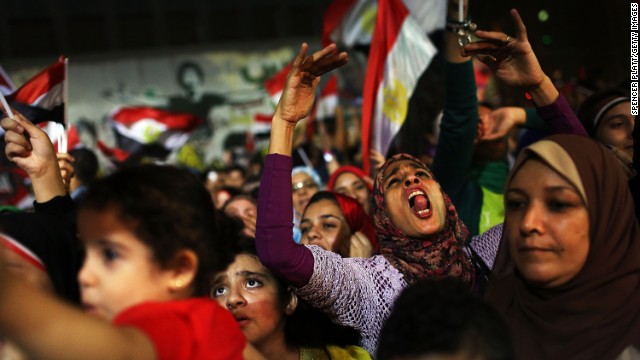
The news came after state media reported that the Nobel Prize-winning diplomat was summoned to the presidential palace by Interim President Adly Mansour for talks. ElBaradei inherits a divided country, where thousands of Egyptians returned Saturday to the streets to mourn their dead and decry the ouster of President Mohamed Morsy. "All the people have approved his legitimacy," said one Morsy supporter. But the opposition, reveling in its overthrow of Mohamed Morsy, was moving on. "We are the right and they are the wrong," said one young man in Tahrir Square, where anti-Morsy demonstrators had congregated. "We are here to protect against a terrorist regime." Outside the Republican Guard headquarters, where four pro-Morsy protesters died Friday in clashes with military forces loyal to the fledgling government, a funeral march was held Saturday. And pro-Morsy demonstrations continued around the Rabaa Al-Adawiya Mosque. The country stands divided between those who support the return to power of Morsy, who was forced Wednesday from office, and those who applaud the military takeover and accuse Morsy's government of having edged toward autocratic rule. Each side accuses the other of thwarting democracy. And on Saturday, each side was trying to present a unified front. The Egyptian Armed Forces, responding to "rumors and lies," said on its Facebook page that there was no division among its ranks over its decision to back "the demands of the Egyptian people" over the government. "These rumors are completely and utterly untrue," it said. Those supporting Morsy's return to power turned out en masse in squares around the country on Friday -- dubbed a "day of rejection" by the Muslim Brotherhood -- in demonstrations marked by sporadic violence between supporters of Morsy and his opponents and security forces. Thirty-five people were killed and 1,404 others injured since Friday across the nation, according to state TV which cited health ministry sources.On Saturday, the Muslim Brotherhood's political wing, the Freedom and Justice Party, rejected the call for national dialogue from the newly installed interim president, Adly Mansour. "The party reiterated its stance that it does not recognize the military coup and that the legitimate president of Egypt is Mohamed Morsy," said Hussein Ibrahim Amin, the secretary-general of the party, in a statement, according to state-run EgyNews. Crowds of Morsy supporters converged for a second consecutive day Saturday outside the Republican Guard complex, where Morsy was reportedly being held, according to a tweet from the party. "Steadfast Iron, Iron, president," the crowds were said to be chanting. "Behind you a million-man martyr." The complex had been the site Friday of at least four killings that occurred when demonstrators charged the military, the health ministry said. Soldiers used live ammunition, the Freedom and Justice Party said. Security forces, on state television, denied the assertion.
The "second revolution"
Wednesday's coup was the culmination of weeks of efforts by Morsy's opponents to push him out. They said 22 million people had signed petitions calling for him to step down -- more than had voted for him in the 2012 election -- and followed up with days of protests that attracted massive crowds. Morsy's supporters countered with rallies in favor of his government. At times, bloody clashes ensued. Dozens were killed. On Monday, the military issued a 48-hour ultimatum demanding that Morsy form a power-sharing government with his opponents. The end of Morsy's rule came on Wednesday, when his conciliatory gestures failed to placate the military. Opinion: How Egypt's military holds key to country's future Egypt's experience with democratic governance was short for a country whose history can be measured in millennia. Morsy won the presidency last year in an election deemed free and fair by observers after the longtime autocratic ruler, Hosni Mubarak, was pushed from power in February 2011. Read: Judge quits, throws first retrial attempt of autocratic former President Mubarak But Morsy failed to fix the nation's ailing economy or stop spiraling crime, both of which worsened during his tenure. He was seen by many as increasingly autocratic. Human Rights Watch has said he had perpetuated abusive practices that Mubarak had established, molding them to his own purposes and adding to them. These included the trial of civilians by military courts, the permitting of police brutality and the suppression of critical voices. Adly Mansour, head of the country's Supreme Constitutional Court, was sworn in Thursday as interim president. He dissolved Egypt's upper house of parliament, the Shura Council, and appointed a new head of intelligence, state TV said Friday. The new government moved quickly to arrest leaders of the Muslim Brotherhood and was following up on hundreds more warrants. Some taken into custody have since been released, state television reported. The Egyptian army has promised a path to new elections. Wearing his trademark sunglasses, the 85-year-old Mubarak appeared Saturday in the fourth session of his retrial over his alleged involvement in the killing of protesters during his ouster. His appeal of last year's guilty verdict began in May, but was postponed on Saturday to August 17. In Washington, a State Department spokeswoman on Friday condemned the violence following Morsy's ouster and called on the military to respect the will of the people, but did not call for Morsy's reinstatement. "The voices of all who are protesting peacefully must be heard -- including those who welcomed the events of earlier this week and those who supported President Morsy," spokeswoman Jennifer Psaki said. "The Egyptian people must come together to resolve their differences peacefully, without recourse to violence or the use of force." U.S. President Barack Obama was spending the weekend at Camp David; Secretary of State John Kerry was vacationing in Nantucket. But U.S. Sen. John McCain, R-Arizona, called Friday for the suspension of U.S. aid to Egypt's military, which exceeds $1 billion per year. "We cannot repeat the same mistakes that we made at other times in our history by supporting the removal of freely elected governments," the ranking member of the Senate Committee on Armed Services told CNN affiliate KNXV. Once the military sets a timetable for elections and a new constitution, "then we should evaluate whether to continue the aid," he said. Egypt is the most populous Arab country in the world and has long been a close ally of the United States, which supported it with military aid even during Mubarak's 30-year dictatorship. It controls the Suez Canal, a crucial sea route through which more than 4% of the world's oil and 8% of its seaborne trade travel. With Jordan, it is one of two Arab countries that have signed peace treaties with Israel.

اففانستان کې امریکايي عسکر د خپلې ازادۍ ورځ لمانځي

په افغانستان کې مېشت په لسګونه هغه امریکايي سرتېرو ته د جولايي پر څلرمه نېټه د دغه هېواد د آزادۍ پرورځ امریکايي تابعیت یا شهریت ورکړل شو. د ریپبلیکن ګوند سېنېټر جانمکېن په باګرام کې له امریکايي عسکرو سره یوځای د خپل هېواد د خپلواکۍ ورځ لمانځله. د رویټرز ویډيو

Pakistan: Fight against polio: Over half a million children miss immunisation

As many as 0.68 million children in Pakistan missed polio vaccination due to the deteriorating law and order situation and administrative issues during a three-day polio campaign in high-risk zones from July 1 to July 3 followed by a day-long catch-up activity.
The campaign, known as the Subnational Immunisation Days, aimed to target 17.4 million children of less than five years of age in 90 districts of the country. A report compiled by the Polio Operation Room – a copy of which is available with The Express Tribune – reveals that only 60% of the targeted children were vaccinated during the drive. As many 685,661 children missed vaccination during this campaign. “Catch-up activities are in progress and hopefully a large number of missed children will be administered to,” Dr Altaf Bosan, national coordinator for monitoring Pakistan’s polio vaccination programme, told The Express Tribune. He added that the major reason for the missed children is the fluid security situation in some parts of the country. Minister of State for Health Saira Afzal Tarar, while chairing a high-level meeting, announced the formation of a high-powered committee with membership from all four provinces to review periodically the plans, strategies and interventions. “It is a fact that despite advocating a strong routine immunisation, we are unable to achieve the desired immunisation. The international health agencies have also expressed concerns that we have not been able to protect our children against vaccine preventable diseases,” she said.
On the other hand, vaccination teams report that 40,971 children did not receive polio drops in their routine immunisation after childbirth.
FATA
Vaccination teams could not target 23,335 children in Frontier Region Peshawar because of the volatile security situation in the area. In the Jani Khel, Hindi Khel and Sain Tanga areas of Frontier Region Bannu, 12,099 children were supposed to be inoculated. But the campaign was postponed due to the poor security situation. In North and South Waziristan agencies, vaccination teams have no access to more than 260,000 children since June 2012. Taliban insurgents have banned polio vaccination in part of the two agencies calling anti-polio campaigns a ploy to spy on the militants in the region.
Khyber-Pakhtunkhwa
In Charsadda district, the campaign was postponed due to security issues. Peshawar missed the immunisation campaigns scheduled in May and June 2013 due to attacks on vaccinators. There is persistent isolation of poliovirus in the environmental samples collected from Peshawar. Balochistan In Jaffarabad, Killa Abdullah, Nasirabad and Pishin districts, the immunisation campaign could not kick off due to administrative issues where 526,339 children were to be inoculated. On the other hand, the campaign in Quetta was crippled by a lady health workers’ strike.
Punjab
The sub-national campaign in six districts of Punjab – Chiniot, Jhang, Kasur, Okara, Sheikhupura and Toba Tek Singh – will start on July 7. As many as 1.9 million children under five years of age will be vaccinated during the drive.

President Zardari convenes meeting on Lyari unrest

http://www.geo.tv/
President Asif Ali Zardari has summoned a meeting to review law and order situation in Karachi, especially in Lyari where violent protests erupted on Friday as killing spree continued unabated in the troubled neighborhood of the metropolis. The president who will arrive in Karachi today (Saturday) will chair a high level meeting at the Presidential Camp Office Bilawal House. Sindh Chief Minister Qaim Ali Shah, top officials from Karachi Police and Rangers are likely to attend the meeting. According to Geo News, the Rangers carried out a search operation in parts of Lyari on late Friday night.

په افغانستان کې په ایدز اخته کسان ډیر شوي

\ چارواکي وايي چې په افغانستان کې په ې یو لوی لامل د هغه په اړه د لږ عامه پوهاوي شتون دی ا
د افغانستان د روغتیا د وزارت د «اچ اې وي» ادارې مشر ډاکټر فدا محمد پیکان، په دې هیواد کې په HIV یا دایدز ناروغۍ په ویروس د اخته کسانو نوې شمیرې په لاس کې نه لري خو هغه ټینگار کوي چې د دغو کسانو شمیر د ډیریدو په حال کې دی. افغان چارواکي یوازې د ۲۰۱۱ کال تر پایه پورې په افغانستان کې په HIVد اخته کسانو له شمیر څخه خبر دي. دغه وزارت به خپلې نوې شمیرې د روان میلادي کال په دسمبر میاشت کې خپرې کړي. د ۲۰۱۱ کال د شمیرو له مخې په افغانستان کې ۱۳۶۷ کسان په HIV یا د ایدز ناروغۍ په ویروس اخته دي. خو ډاکټر پیکان بیا ټینگار کوي چې دغه شمیر کیدای شي تر دې هم لوړ وي. د هغه په خبره دا یوازې د هغو کسانو شمیر دی چې په داوطلبانه ډول یې خپله وینه معانه کړې ده. په دې ویروس ډیر شمیر اخته کسان د ټولنیزو لاملونو له کبله خپل روغتیايي حالت له نورو پټ ساتي. احمد (مستعار نوم) د غزني ولایت اوسیدونکی دی. هغه تر دې مخکې په یوه اروپايي هیواد کې ژوند کاوه. هغه وایي: «که رښتیا ووایم نو په اروپا کې مې ډیرې عیاشۍ وکړې. اوس په دې پوه شوی یم چې په HIVاخته یم. تر درملنې لاندې یم. هره میاشت باید دوه وارې خپل ځان معاینه کړم.» په افغانستان کې په HIVد اخته کسانو د شمیر د ډیریدو یو لامل د دغه ویروس په اړه د لږ عامه پوهاوي شتون دی. ډیر شمیر افغانان د HIV ویروسپه اړه معلومات نه لري او له یوه انسان څخه بل انسان ته د هغه د انتقالیدو په څرنگوالي خبر نه دي. محمد هاشم د هلمند ولایت یو اوسیدونکی دی. هغه وایي: «زه نه پوهیږم چې د HIVویروسن او ایدزناروغۍ له یوه انسان څخه بل ته څرنگه انتقالیږي. زه په دې هم نه پوهیږم چې په ایدز اخته کسان عادي وگړي دي او که له رواني لحاظّ له ستونزو سره مخامخ کسان دي.» ښايي د افغانانو د کمو معلوماتو له کبله وي چې احمد نه غواړي د خپلې ناروغۍ په اړه له نورو کسانو سره وغږیږي. اوس افغان حکومت د نړیوال روغتیایي سازمان او له مخدره توکو سره د ملگرو ملتونو د مبارزې ادارې په مرسته هڅه کوي چې د HIV ویروس او ایدز ناروغۍ په اړه افغانانو ته معلومات ورکړي او په دې ترتیب سره په دې ویروس د اخته کسانو د شمیر د ډیریدو مخه ونیسي. HIV یو ډول خطرناکه ویروس دی چې کله د انسان بدن ته وداخل شي نو د هغه یا هغې د بدن پر دفاعي سیستم باندې برید کوي. کله چې دغه ویروس د انسان په بدن کې د خپلې ودې څلورمې مرحلې ته وسیږي نو انسان په ایدز ناروغۍ اخته کیږي او د ناروغ ژوند ته گواښ رامنځ ته کوي. لا تر اوسه پورې د ایدز د ناروغۍ د درملنې کومه لاره نه ده موندل شوې، خو ډاکتران کولای شي د انسان په بدن کې د HIV ویروس د ودې بهیر ورو کړي. اوس مهال په افغانستان کې د HIV ویروس په اړه د معلوماتو ورکولو ۴۸ مرکزونه موجود دي. د ښاغلي پیکان په خبره همدا اوس د افغانستان په بیلابیلو برخو کې د HIV په اړه د معلوماتو ورکولو ۴۰ پروژې هم په جریان کې دي. دا په داسې حال کې ده چې په افغانستان کې په ایدز ناروغۍ د اخته کسانو د درملنې یوازې دوه مرکزونه په هرات او کابل ولایتونو کې موجود دي. د افغان چارواکو په حواله د هغوی څیړنې ښيي چې افغانستان ته ډیر شمیر په HIV اخته کسان له گاونډیو هیوادونو څخه راځي. له همدې کبله اوس د افغانستان په سرحدي ولایتونو کې داسې کلینیکونه جوړ شوي دي چې وگړي په کې خپله وینه په وړیا توگه معاینه کولای شي. د HIV ویروس د جنسي مقاربت، وینې د لیږد، د مور د شیدو او له تخریشي وسایلو لکه د ږیرې ماشین څخه د گډې استفادې له لارې له یوه کس څخه بل ته انتقالیږي. پر دې سربیره هغه ماشوم چې مور یې په HIVاخته وي د مور په رحم کې په دې ویروس باندې اخته کیږي. چارواکي وایي چې په افغانستان کې د HIVویروس د لیږد یو بل لوی لامل د مخدره موادو د کارونې پر مهال د څو کسانو له خوا د یوې ستنې کارول دي. په مخدره توکو یو شمیر روږدي کسان د پیچکاریو په واسطه یو بل ته دغه خطرناکه ویروس لیږدوي.

Does Nawaz Sharif Have A Balochistan Policy?

The Baloch Hal
BY MALIK SIRAJ AKBAR
Prime Minister Nawaz Sharif and his interior minister, Chaudhary Nisar Ali Khan, have fundamentally got a common problem: They both talk about the security forces and the intelligence agencies in the third person plural. Mr. Sharif and Mr. Khan both refer to the state institutions as “they” while apply “we” when talking about themselves. This either shows that the new government has not fully adjusted to its new offices and responsibilities or it still views the security apparatus beyond the control of the civilian government. Another possibility could be an intentional attempt on the part of the democratic government to exempt itself from responsibilities for which it is technically and morally required to provide an explanation. Since new governments were formed in Islamabad and Quetta, at least four major violent attacks have taken place in Balochistan, mainly Quetta, claiming the lives of nearly a hundred innocent citizens. These include the attack on the Ziarat Residency, bombing of a university bus carrying female students; the suicide bomb blast and the siege of the Bolan Medical College Hospital last month and the recent suicide bombing at an Imam bahargha in Quetta. In addition, dead bodies of the missing Baloch persons have also been frequently recovered since the new government came into power. During their visits to Quetta, the prime minister and the interior minister cited lack of coordination between various government agencies and departments as the main reason for unabated terrorist attacks. This could partly be the reason for the surge in the recent attacks. Prime Minister Sharif should know he cannot keep up the ‘we v/s they’ rhetoric for a long time. He is the head of the government and every intelligence agency and security force should be answerable to the prime minister. The chief executive of the country cannot shy away from his responsibilities for a long time by only saying that ‘they’ are not performing their duty while ‘we’ are attempting to grapple with the situation. This is no joke but a dire situation that involves the lives of innocent people. The government should move very fast to end this cycle of violence that is regularly taking away precious lives of unarmed citizens. Prime Minister Nawaz Sharif and opposition leader Imran Khan’s soft and conciliatory attitude toward the Taliban has emboldened all the extremist religious terrorist groups, such as the Lashkar-e-Jhangvi, which has been actively conducting terrorist attacks on civilian population. The Prime Minister should review his approach toward the religious groups and order a crackdown against them. They are the enemies of the country and the people who inhabit it. The longer the government keeps glorifying or justifying these religious groups, the more human lives they will claim. Within a few weeks, the fanfare about the historic election of Sharif as the prime minister for a third term and Dr. Malik’s as Balochistan’s first non-elite chief minister will fade away and attention would be focused on actual problems. That said, the prime minister and the Balochistan chief minister should prepare to face tough questions regarding their progress in improving the situation in Balochistan. Unfortunately, P.M. Sharif does not have a road-map to address the conflict in Balochistan. Here is a three-point strategy we think he should apply to normalize the situation in the province. First, Mr. Sharif and his team should start a serious conversation with the Pakistani army. This conversation, if they wish so, should not include any Baloch representatives. This should purely be a conversation among the Punjabi elite (mainly politicians and the army commanders). Mr. Sharif should educate the army about the destructive outcome of its policies in Balochistan and how these policies have taken the country on the verge of collapse. The Prime Minister should hold talks with the army chief about the issue of the missing persons, military operations and Baloch representation in the army. Until the army and the elected government at the center are on the same page, prime minister’s pledges to Balochistan will hold not significance. In talks among themselves, the Punjabi elite should discuss what kind of relationship they want to keep with Balochistan. Later on, they should clearly state whether they want to keep Balochistan as an equal, respected federating unit or a colony whose mineral wealth, not the people, would have importance for the central government. Second, Mr. Sharif should himself reach out to disillusioned Baloch leadership, starting from veteran politicians like Nawab Khair Baksh Marri and Sardar Attaullah Mengal. These two prominent leaders, who still influence the politics of their children, live inside Pakistan and they should be met and told that the conflict has had a very heavy price for the common man in Balochistan. The longer the conflict continues, the more ordinary citizens will suffer. They should, in a nutshell, find a solution that is acceptable to all stakeholders and capable of ending the bloodshed in the province. Third, Balochistan can no longer suffice with mere promises of the central government. An important way to win the hearts of the local people is to ensure the development of the infrastructure, including improving the state of education, health facilities and other domains of life. If the P.M.L.-N government pushes the Balochistan government to end corruption at official level, ensure good governance, create jobs and develop the infrastructure, there is no reason people’s sense of deprivation should not be eliminated. Unfortunately, Mr. Sharif still does not have a clear Balochistan plan. He only verbally states his commitment to resolve the issue which is not enough. The prime minister should have a plan and ensure its smooth and immediate implementation.

The Argentina Model For Balochistan? No, Thanks

Editorial: The Baloch Hal
A credible Pakistani Urdu-language newspaper, Express, has reported that the government is considering granting amnesty to all personnel of the security forces and intelligence agencies who have been involved in enforced disappearances, torture and killings. As a quid pro quo, these officials would assist in recovering the missing persons. The newspaper quoted ‘reliable [government] sources’ that the new administration is emulating the Argentina model where several missing persons were recovered under a similar arrangement. The report added that the government was contemplating registering terrorism-related cases against those who are recovered while the intelligence personnel would not be questioned regarding those whose who have been killed during custody. The cases of the dead missing persons, under this plan, will be permanently closed for future investigations. Since the majority of the missing persons in Pakistan belong to Balochistan, the fresh government plan should concern and caution us all. This is an outrageous plan if it is what the Pakistan Muslim League Nawaz government intends to do. For a long time, we have been proposing the formation of a Truth and Reconciliation Commission on Balochistan to ascertain the details of what had happened in the province during the past ten years. Since state institutions, such as the Supreme Court of Pakistan, have found ample evidence regarding the involvement of intelligence agencies and the Frontier Corps (F.C.) in missing persons’ cases, the government is hesitating from taking action against those who are involved in these crimes. The security forces have been operating in Balochistan with such impunity that their involvement is an open secret and there is barely a need for a thorough investigation. However, a Truth and Reconciliation Commission is still important to formally confirm the state-sponsored crimes against the Baloch people. Granting amnesty to those who were involved in illegal crimes does not set a positive precedence. The new government should end the culture of immunity and no one should be above the law. If the security forces and the intelligence agents carried out unlawful actions, they should face trial for their actions. The missing persons’ issue reflects a very complicated state policy which is not very easy to resolve. When General Musharraf took advantage of the context of the war on terror and sanctioned enforced disappearances in Balochistan, he had a long-term strategy in his mind. His regime, while initiating the enforced disappearances, had no intention of sending the people back to their homes once they were taken into official custody. So, he developed such a a mechanism that missing persons were constantly kept at different locations under the supervision of different officers. Their whereabouts were regularly changed so that officers and lock-ups would have no fresh records of people detained there. One such example is the case of Ali Asghar Bungalizai, a tailor master who disappeared from Quetta in 2002. While one brigadier of the Inter-Services Intelligence (I.S.I.) admitted before former Balochistan Governor/Corps Commander General Abdul Qadir Baloch, who is currently a federal minister in Prime Minister Sharif’s cabinet, that Mr. Bungalzai was in I.S.I.’s custody and would soon be released, a new brigadier, who replaced the previous one, completely denied having any information about Mr. Bungalzai. Eleven years later, no one still knows who among the two I.S.I. brigadiers lied. Renowned Pakistani novelist and journalist Mohammad Hanif has elegantly narrated Mr. Bungalzai’s story “Looking For Uncle Ali” in his book The Baloch Who Is Not Missing. Cases like Mr. Bungalzai’s were actually the outcome of an intentional policy pursued by Musharraf so that no officer could have complete information about a particular case. Because, the ultimate goal was to kill these people and dump their bodies at unknown locations. While some people’s bodies were found, many other’s faces were so mutilated that no one could identify them. Hence, there are several people who have been killed in the official custody but their families still cling with the hope that they are alive and one day will return home. Possibly, there are numerous other such people whose dead bodies were never found. On their part, the Baloch have repeatedly rejected government offers for ‘amnesty’ because they rightly argue that amnesty is generally granted to criminals whereas most of the Baloch are not criminals but the victims of state-sponsored crimes. They have not been convicted by any Pakistani courts. Instead, the Baloch have a genuine demand that those who have indulged in these unlawful acts should be punished. Since the government personnel involved in these killings directly have an issue with the families of the Baloch victims, the government has no moral and legal authority to grant them amnesty. We want international human rights groups, such as the Human Rights Watch and the Amnesty International, to get involved and prevent any such plans of the Pakistani government to grant absolute amnesty to gangs of official criminals. These people should be put on trial and punished for their crimes. This is not a matter of a few individuals but this is the question of the civil rights of thousands of citizens and their brutal murder. The law should not be so brazenly supportive of rights abusers.

Pakistan: 60 mortar shells fired from Afghanistan, five locals injured

Up to sixty mortar shells fired from Afghanistan landed in the border area of Angoor Adda in South Waziristan Agency on Saturday, injuring five people. The sources said unidentified people started indiscriminate shelling on Pakistani border villages in Angoor Ada. According to initial reports, 10 shells fell on Angoor Adda market which destroyed houses and shops. However, no casualties were reported. Moreover, security forces cordonedaned off the area and started an investigation.

Pakistan: Beggars can’t be choosers

Daily Times
The Pakistan Muslim League-Nawaz (PML-N) government and the IMF finally came to an agreement over the bailout package that is desperately needed to resuscitate Pakistan’s economy. Despite all the claims of the new government that it would break the begging bowl, the inevitable has happened as Pakistan seeks help from the IMF yet again. An agreement has been reached over a $ 5.3 billion three-year loan programme titled ‘Extended Fund Facility’. It has a repayment period of 10 years with an initial grace period of four years. The Ministry of Finance has requested an increase in the loan amount from $ 5.3 billion, which is 348 percent of Pakistan’s quota in the IMF, to $ 7.3 billion which is roughly 500 percent of Pakistan’s share in the IMF. IMF mission chief Geffrey Franks in a press conference stated that Pakistan would have to implement tough fiscal measures such as imposition of more taxes, withdrawal of tax exemptions, increase in power and tax tariffs, elimination of power tariff subsidies and privatisation or restructuring of public sector enterprises. Finance Minister Ishaq Dar and his team have vehemently tried to portray that the IMF loan is in line with the PML-N government’s homegrown fiscal policies and that the IMF had not dictated its terms in the agreed bailout package. Dar said that the conditions upon which the loan programme is contingent are part of the reforms PML-N had set forth in its party manifesto and which were also evident in the recent budget. This claim is false to the extent that in order to receive money from the IMF, the government has to levy new taxes, a measure that was not in the recent budget’s purview and had been denied until now as a possibility by Mr Dar. Moreover, the government will have to make some other tough decisions such as privatising public sector enterprises and reviving others such as PIA and the Railways that are bleeding heavily. Pakistan has had a long dismal history of borrowing from the IMF. Since 1988, Pakistan has engaged with the IMF in 11 loan programmes, out of which only four were termed successful by the IMF (and that too in terms of repayments made and not in terms of any positive effect on Pakistan’s economy). Considering Pakistan’s track record it comes as no surprise that, regardless of what the government might say, the terms offered by the IMF are harsh. The loan granted to the previous People’s Party government in 2008 was worth nearly $ 11.3 billion, significantly more than the present loan programme. The IMF was more generous last time, perhaps, to encourage the strengthening of democracy in Pakistan that had finally freed itself from General Pervez Musharraf’s dictatorial rule. The PML-N government should be honest with the nation. The elections of 2013 manifested the increased awareness of the people, who are in touch with ground realities. The People’s Party’s government was voted out as the electorate was quick to recognize that the government had failed to deliver. Mere promises and slogans are not enough to get the approval of the people anymore. The incumbent government will have to deliver in order to stay in the people’s good graces. It is advisable that the government should refrain from making promises it cannot keep as this would only raise undue expectations. Also, people should not be kept in the dark about national issues that affect everyone, such as the real state of the economy. We have witnessed how the government has had to take tough fiscal measures, and will further have to in the future, in conformity with the reforms prescribed in the loan programme. This is in sharp contrast to the dreamy picture that was being portrayed during the election campaign. The government should take necessary steps to educate the people about the current economic situation and the rationale behind the reforms that need to be introduced in order to achieve long-term economic growth.

Seeking an early Afghans’

In a bid to curb the worst-ever insurgency that left thousands of the people dead, the Kyber Pakhtunkhwa government, in response to the State and Frontier Region (Safron) Ministry’s draft policy recommendations for the Afghan refugees beyond 2013, has reportedly offered a couple of proposals for the ‘sustainable’ repatriation of 1.6 million registered Afghan refugees from Pakistan. The KPK government, opposing extension in Afghan refugees’ stay in the Pakistan, suggests that the registered Afghans be equally relocated in all four provinces instead of burdening one federating unit—the KPK. For last three decades, the KPK had been forced to host over 62 per cent of the refugees. Having been sick of the agonizing living conditions in the refugee camps because negligence of world bodies, the 60 % of the registered and the unregistered Afghans, reports suggest, have managed to settle themselves outside camps with the connivance of the corrupt officials in the provincial administration and others security agencies—many of them even hold National Identity Cards of Pakistan. Without a doubt, the war-torn KPK, having fragile economy and underdeveloped infrastructure and poor health, education and sanitation services, is feeling the burden of the massive settlement of Afghans refugees. On the top of it the province is finding it extremely hard to counter the security problems. Ignoring the problems being faced by the KPK over the years, the federal government has made another autocratic decision of granting another extension to the registered Afghans, hence feeling heat of security concerns, the KPK government is justified in proposing a comprehensive repatriation plan, calling upon the federal government to send all Afghan refugees home at the earliest otherwise these refugees being relocated in other federating units in case Islamabad wants to continue with its policy of hosting the Afghan refugees. Over the years, the free movement of Afghans from the both sides of the Afghan border has increased corruption manifold especially in Pakistan. The governments on the either side of the Durand Line are not in a position to plug in the countless pours existing in the long border though they keep shifting responsibility of their failure to control the intrusions of terrorists and civilians alike on each other. Secondly the refugees cards issued to Afghans living in Pakistan have also been expired hence they are facing the humiliation every now and then contrary to instructions of the Safron ministry to the agencies concerned not to harass the Afghans registered in Pakistan. Amidst growing incidents of bombing and massive corruption, the KPK government is rightly calling for installing biometric system to check movement of Afghan nationals. In the long wars against the two superpowers, the brave Afghan nation has made it clear to the World that no body can defeat them hence the displaced people of Afghanistan should be treated with dignity and respect. Pakistan with the help of the UNHCR should make honourable arrangements for their repatriation to their home land. Thus the federal government should earnestly endorse the provincial government’s demand seeking increase in per person UNHCR grant for the refugees from $150 to $500 along with the facilities to encourage Afghan nationals to return home. Inordinate delay in the repatriation of the Afghans will neither serve the interest of Pakistan nor of Afghanistan. To alleviate sufferings of the people of the KPK and FATA region, Islamabad needs to revisit its National Management and Repatriation Policy of Afghans on urgent basis. After a long war, the Americans and her allies have started their pull-out from Afghanistan which will be complete next year. Pakistan should also give a time-frame of one year to the Afghan refugees to return to home land or it should ask for the UNO help to make third country settlement of the Afghan refugees so that Pakistan especially the KPK can recover from the agony of war and the economic woes associated with it.

‘Misuse of Pakistan’s blasphemy laws is killing minorities,’ says human rights organisation

www.assistnews.net
The escalating misuse of Pakistan’s blasphemy laws is killing minorities in Pakistan, a UK-based human rights organisation is warning.Following the torching of 178 Christian homes in Pakistan due to allegations of blasphemy, the Global Minorities Alliance (www.globalminorities.co.uk), staged a protest outside the Scottish Parliament and launched a worldwide awareness campaign, which has so far received a massive response.
The trouble began in March of this year, when a highly-charged mob of between 3,000 and 4,000 extremists torched as many some 178 houses in the Christian-majority area of Joseph Colony, Badami Bagh, Lahore, over the weekend to “take revenge of the blasphemy” allegedly committed by a young Christian. Eyewitnesses said that the mob broke into houses, looted them and burnt the remaining belongings on the roads. At least two police officers were reportedly injured when the mob pelted a police contingent with stones. According to Christian Solidarity Worldwide (CSW), the violence was reportedly triggered by a blasphemy accusation made against a young Christian, Savan Masih. “The unrest spiraled as word spread of the allegation and protestors demanded his arrest,” said a spokesperson for CSW. “Police took him into custody today, but it is unclear whether or not he has been formally charged. At least one local religious leader has openly called for Savan to be killed.” The mob also attacked Savan’s house, setting it on fire and pelting it with stones.Nearly all the residents of Joseph Colony, home to around 150 Christian families, including women and children, hastily fled the area in anticipation of the attacks, some on the advice of local police.
The Alliance wrote letters to all the leaders of the G8, a forum for the governments of eight of the world's eleven largest national economies, who held their most recent summit in Northern Ireland on June 17th-18th, plus all representatives in the House of Lords, the House of Commons, the Scottish Parliament and the European Parliament prior to their demonstration over misuse of Pakistan blasphemy laws on April 8, 2013. Among the G8 countries, Germany, UK, Canada, and France responded to the Alliance and gave assurances of their dedication to protecting minorities’ rights in countries where minorities are marginalized and discriminated against. A letter from the office of the President of Germany, Joachim Gauck, expressed concern over the continuous misuse of Pakistan blasphemy laws, stating that “prosecuting someone because of her and his belief is in clear violation of human rights.” The Alliance was assured that Germany will impress the new political leadership in Pakistan to make reforms to ensure protection and safety of its citizens, as well as to focus on capacity development and training for the law enforcement agencies and the police. The response from the offices of the Prime Ministers of both Canada and France acknowledged the Alliance’s work to raise awareness of persecuted minorities, and stressed the need to safeguard rights of minorities. The Alliance also received a response from the Foreign and Commonwealth Office (FCO), condemning the continuous killings of innocent people on the basis of faith and ethnicity in Pakistan and offering assurances that the British Government will urge the Government of Pakistan to protect and guarantee the rights of its citizens. To continue its awareness-raising campaign, the Alliance demonstrated in front of the Scottish Parliament on April 8. They were joined by the Muslim Society of Edinburgh, the World Mission of the Church of Scotland, as well as members of public and other religious leaders from both Glasgow and Edinburgh. “We are deeply concerned over the misuse of Pakistan blasphemy laws, which has encouraged us to write to the international community in a bid to raise awareness. There has recently been an escalation in the use of Pakistan’s blasphemy laws and this is killing minorities in Pakistan,” said Mr. Manassi Bernard, the Alliance’s Chief Executive. The Alliance gave a thirty day ultimatum to the Government of Pakistan to rebuild torched houses in Joseph Colony, Lahore, where thousands of people attacked the Christian community following allegations of blasphemy on March 9, which led to 178 Christian houses being burnt to the ground. The Global Minorities Alliance (GMA) has since received numerous letters from the UK House of Lords, the House of Commons and the Scottish Parliament, plus religious leaders worldwide, expressing appreciation for the work of Global Minorities Alliance and solidarity with its ethos - to stand with the poor and the persecuted: A letter received on the behalf of Alex Salmond, the First Minister of Scotland, from the Directorate for Local Government and Communities shared the concern of Global Minorities Alliance and dubbed blasphemy laws as a “sensitive” subject in Pakistan. It stated that the Scottish Government will encourage new Government in Pakistan to support interfaith dialogue and the reforms of the blasphemy laws. Dave Thompson, Member of Scottish Parliament for Skye, Lochaber and Badenoch, wrote a letter to the Pakistan Consulate in Glasgow questioning the Pakistan Government’s relief efforts for the victims of Joseph Colony tragedy, and requesting that measures be taken to stop such tragedies in the future.The Ugandan-born Archbishop of York, Dr. John Sentamu, thanked the Alliance for their work in raising awareness about minorities in Pakistan and assured them he would raise the Alliance’s concern at the highest possible level. The Archbishop of Sydney, Cardinal George Pell, also encouraged the work of the Alliance and commended the efforts of raising awareness about the persecuted minorities. A letter from the European Parliament in Brussels also shared the Alliance’s concerns. “We would like to thank all those who have taken time and acknowledged the work of the Global Minorities Alliance to defend the defenseless and be the voice for those who are voiceless as we continue to further our struggle,” said Manassi Bernard, the Alliance’s Chief-Executive.I, as the Alliance's Vice-Chairperson, laud the efforts of Jason Kenny, the Canadian Minister of Citizenship, Immigration and Multiculturalism for facilitating the safe passage of teenager Rimsha Masih and her family into Canada. The family have been into hiding after she was released from blasphemy charges last year. The Alliance’s next step is to start an international campaign for the release of Asia Bibi, a Christian mother of five on death row in Pakistan. “We will not rest until she is released,” said Shahzad Khan, the International Director for Interfaith and Dialogue.
About Global Minorities Alliance
Formed in 2012, the Global Minorities Alliance is a Glasgow-based human rights organisation, committed to raising the voice of minority communities around the world.
The Alliance works towards this commitment by campaigning for: * Poverty alleviation * Interfaith harmony * Education * Empowerment of women * Reform of discriminatory laws * Peaceful co-existence
As stated by me on the Global Minorities Alliance website www.globalminorities.co.uk: “The absence of fairness, transparency, meritocracy and the rule of law in general in some countries leave minorities more vulnerable to abuse as the mighty and influential in these lawless lands take it as their birthright to mistreat minorities as they choose. In some parts of the world the integration of minorities into mainstream society is restricted by design due to the subjugation forced upon them. “We call for an end to the systematic discrimination of minorities in any shape or form and urge the governments of such countries to push through reforms aimed at providing equal rights to the poor and the disadvantaged sections of their societies. “No-one can choose where they are born or who they are born to. To be born into a minority community should not mean that you have to live a life where you suffer at the hands of your own countrymen. “We say enough is enough and call upon the international community and like-minded organizations and individuals across the world to support us in our commitment to help the minority communities across the world.”