Monday, February 4, 2013

Pakistan: Terrorist offensive

THE FRONTIER POST
On Friday, terrorist struck Hangu outside a Shia mosque and put to death at least 26 innocent civilians. The vile attack was obviously the handiwork of sectarian monsters. On Saturday, terrorists audaciously attacked a military camp in Serai Naurang and killed 13 soldiers and 11 civilians. The outlawed TTP claimed the responsibility. And the two thuggish assaults in two consecutive days tell chillily how fatally is the country in the throes of a vicious multifaceted terrorism. And yet the partisans out there are quarreling obsessively over the creation of new provinces. Of what avail would indeed be new provinces when the country is so visibly enmeshed in a threat from a wild monstrosity that has put its very existence in great peril? Yet none seems much pushed about it. Not even the state. It is now for more than half a decade that the nation is in the grip of this blood-thirsty terrorism. And even as the state functionaries not infrequently assert that with their counter-terrorism actions they have broken its back, it is not even a bit on the slowdown. Rather, it is in ascendancy and on the offensive, while the state appears in retreat. None seems safe from its vileness. Not even the security establishments that indeed have lately been its most favoured targets. That speaks alarmingly of the unpreparedness of the state to face up to this monstrosity mightily. The weakest link in the state's counter action appears to be the provincial administrations and their security and intelligence apparatuses. The country for the most part is in the clutches of urban terrorism. And fighting out this terrorism is primarily the job of the provincial governments, the maintenance of law and order on their domains is whose sole responsibility. Yet, they all have perceptibly taken a backseat, conveniently assuming that combating terrorism is the federal government's, especially the military's, task. This intrinsically is wrong. The military can fight the rebels on the mountains and deserts, caves and forests, but not on the city streets. There the recalcitrant have to be taken on by the provincial law-enforcement agencies and intelligence apparatuses. And yet they all are sitting pretty. Outlawed terrorist outfits are blithely plying their trade of murder and hate under their very noses with impunity. Some have assumed new names, though deceptively but not so deceptively. All know who they actually are. Some have bothered not even to do that and they go by their own old names. One such rabid sectarian outfit has indeed been claiming the responsibility of murderous attacks on the Shia community almost in every part of the country. Obviously, it has its sleeper cells, lairs and hideouts in the urban centres. And yet where are the CIDs of the provincial administrations that this outfit goes on with its bloodshed business unrelentingly without its cells and lairs being tracked down and busted and its network being dismantled in any part of the country? Indeed, this sluggishness of the provincial intelligence networks has come quite handy to the inveterate detractors of this country to vilify and demonise the Pakistani state. They assert, to a great conviction of the world community and to Pakistan's great grief, that these extremist outfits are not being touched by the state security apparatuses as they use them for their own ends inside and outside the country. Even this tirade has failed to impel the provincial administrations to pull out their intelligence and security networks from the stupor and go cracking on them to make them combat the urban terrorism manly. All feel content with their law-enforcers giving the weight of explosives used in a terrorist attack once it has happened. None seems asking them why had they not stopped that explosive from being used. No questions are apparently asked and no answers sought. No heads roll. It is always business as usual. Apparently, there is no watertight collaboration and cooperation either between the federal and the provincial intelligence networks, which is yet another weak link in the state's counter-terrorism action. They rather appear in competition, and worrisomely, in rivalry. This is very dangerous, and irresponsible too. All seem ploughing a lone furrow, whereas an effective counter-terrorism action is admittedly a joint effort and a combined action of various state arms. But, gallingly, no state strategy is even in evidence to combine up disparate security actions into a coherent, concerted and orchestrated effort to attain the national objective of defeating terrorism and throwing it out of the land. And this is very disturbing. The way it is being presently fought, we are visibly losing this war against terrorism. But we have to win it, in any event and at our cost, for our own survival and for the survival of our posterity. The state must come into action, in whole, not in parts. Let there be a national coordinated action to take on the monstrosity of terrorism, to defang it, prostrate it and behead it. This is a must.

PM David Cameron hosts Afghan-Pakistan talks in UK

UK PM David Cameron is hosting key talks on the Afghan peace process, involving the leaders of Pakistan and Afghanistan, at his country retreat.
The talks at Chequers will focus on cross-border security and how to engage the Taliban in effective peace talks. It will be the third round of discussions since Mr Cameron instigated the trilateral process last year. Foreign ministers, military leaders and intelligence chiefs will attend the talks for the first time. Nato troops are scheduled to withdraw from Afghanistan by the end of 2014. Mr Cameron hosted a dinner with Afghan President Hamid Karzai and Pakistani President Asif Ali Zardari at Chequers, north of London, on Sunday evening. Monday sees in-depth talks with both presidents and their key officials. UK Foreign Secretary William Hague said the goal was to help the two nations "build closer co-operation around their common interest in a secure future". As part of the process, Mr Karzai and Mr Zardari have agreed to work together on a framework of co-operation following the international troops' departure next year. With the Nato withdrawal looming, Afghan President Hamid Karzai has told the BBC he does not want a repeat of the mistakes made when Russia withdrew from Afghanistan a quarter of a century ago, plunging the country into civil war. Overcoming mistrust Downing Street said in a statement on Sunday: "This trilateral process sends a very clear message to the Taliban: now is the time for everyone to participate in a peaceful political process in Afghanistan. "As the prime minister has set out previously, a stable Afghanistan is not just in the interests of Afghans, but also in the interests of their neighbours and the UK." Overcoming mistrust between Afghanistan and Pakistan remains a central issue, BBC World Affairs correspondent Mike Wooldridge reports. The Afghan government has made it clear that it views the recent freeing by Pakistan of a number of Taliban prisoners as positive, he says. But it still wants the release of the former second-in-command of the Afghan Taliban, Mullah Baradar, in the hope that a senior figure like him could influence the Taliban to engage in talks with Kabul. For the first time, the trilateral talks will also include military and intelligence chiefs from both Afghanistan and Pakistan. Officials believe this could help in tackling some of the most sensitive issues to do with reconciliation efforts, our correspondent says. Mr Karzai told the BBC's Pashto Service that Afghan people should take the initiative for peace into their own hands. "As neither the communist government, nor the mujahedeen brought peace and security to the country, if we do not carefully manage our peace process the way we did not in the past, we will not achieve stability or security," Mr Karzai said. The first two rounds of the trilateral talks were held in Kabul and New York last year.

Sunday, February 3, 2013

Cheers for François Hollande, hero of Mali

They put on their most colourful clothes, belted out music, danced and, repeatedly and rhythmically, chanted his name. The people of Timbuktu were demonstrating that the shackles of Islamist sharia had been broken and hailing their deliverer, François Hollande . There was no doubting the warmth and gratitude in the welcome given to the French President by Malians, on his first visit since sending in troops. But behind the scenes there are ominous signs that the swift campaign which had driven the jihadists from the territory they controlled is not the end of this war. Over the last few days there have been discoveries of improvised explosive devices (IEDs) and the deaths of Malian soldiers from a landmine. At the same time the incendiary ethnic divisions that sparked the current turmoil have resurfaced just as the rebels are about to lose their final stronghold. There is an unofficial stand-off at the northern town of Kidal between French troops and their Malian partners, who are not being allowed into large parts of the town due to fears they would take murderous revenge on its Tuareg residents. Instead it is Chadian soldiers who are providing the African security presence. Tuareg fighters, armed with the looted arsenal of the Gaddafi regime which they served before it fell, had raised the flag of Azawad in Kidal. The rebellion was joined by al-Qa'ida in the Islamic Maghreb, who took over leadership and the weaponry, first sidelining and then driving out the Tuareg. Since then the community had been under attack from both sides, with Malian troops carrying our summary executions of "terrorist suspects". Under pressure from the French, Mali's interim President, Dioncounda Traoré, has begun talks with the Tuareg separatists, a deeply unpopular move among the army who carried out a coup last year. The United Nations' special advisor on prevention of genocide, Adama Dieng, warned that human rights abuses, already prevalent, will worsen further unless urgent counter-measures are taken. "We must tell President Hollande that he has cut down the tree but still has to tear up its roots. I am deeply concerned at the risk of reprisal attacks against ethnic Tuareg and Arab civilians." None of the unpleasantness was mentioned by officials during President Hollande's three hours and 48 minutes on the ground yesterday. In Timbuktu he visited the mosque of Djingareyber, an architectural masterpiece made out of mud 700 years ago, and the Ahmed Baba library where the jihadists had carried out their last concerted action before leaving the city – making a bonfire of priceless historic manuscripts. The area, normally crowded, was sealed off by French armoured personnel carriers. Two dozen dignitaries were there to meet Mr Hollande's party, which included the French Foreign Minister, Laurent Fabius. "He is the man who saved Mali, it is an honour to meet him. Without him we would never have got rid of the Salafists," said Khalif Mualam Traore, a local imam. "They stopped people from thanking Allah at the end of prayers. They beat people for no reason." Umar Sekou, a hotel owner, pointed out that ethnic divisions continued under the jihadists. "They normally punished black people most severely, not the Arabs. That's because so many of them were foreigners from places like Algeria and Tunisia. After the French came, the Arabs fled with the jihadists, their shops and businesses got looted, we found weapons in their homes." Mr Hollande then visited the Ahmed Baba library, where he was shown the charred manuscripts, a reminder, said Irina Bokova, the director-general of Unesco who was accompanying the President, that the jihadists were intent on destroying Mali's history as well as oppressing its people. There were tumultous greetings at the square for the French President, with French soldiers and Malian police struggling to control the surging crowd of more than 5,000. "All Mali is grateful to him, but especially the women," exclaimed Hania Kalbati, a 24-year-old teacher. "We lived in a constant night, they took away all our freedoms. We could not work, we had to cover ourselves all the time in the darkest clothes. We are glad all that is over." But Mr Hollande told French troops at Timbuktu airport: "The conflict is not over, it would be a mistake to think that because we have restored order in towns like Gao and Timbuktu we can stop there."

Malala awake, talking after successful surgeries

Pakistani teen activist Malala Yousufzai was in stable condition at a British hospital on Sunday after undergoing surgeries to repair her skull and help her hearing, officials said. "Both operations were a success and Malala is now recovering in hospital. Her medical team are 'very pleased' with the progress she has made so far," the Queen Elizabeth Hospital in Birmingham said in a statement. "She is awake and talking to staff and members of her family." Saturday's five-hour surgeries were the latest step on a long road to recovery for Malala, who was shot in the head and neck by Taliban gunmen in October for speaking out in favor of education for Pakistani girls. Last week doctors said they would use a titanium plate to cover an opening in her skull, and give her a cochlear implant to partially restore hearing in her left ear.The plate was necessary to replace a section of her skull about the size of a hand, which doctors removed to relieve swelling after the shooting. And the inner ear implant will restore some function to her damaged ear, doctors said last week. The 15-year-old became an international symbol of courage after she was shot by Taliban gunmen last fall for her crusade about girls going to school. She had blogged fearlessly about girls' education and accused the Taliban of thriving on ignorance. The Taliban forbid girls in the classroom and have threatened to kill anyone who defies them. Malala was in a school van on October 9 when the gunmen stopped the vehicle and shot her at point-blank range. She was flown to the British hospital six days later. Doctors there discharged her last month, and she has been recovering with her family at a temporary home nearby. Her father, who had been an educator in Pakistan, is now employed at the Pakistani Consulate in Birmingham. On Sunday, officials said Malala would remain hospitalized until she is well enough to be discharged.

Dangerous Gun Myths

The debate over what to do to reduce gun violence in America hit an absurd low point on Wednesday when a Senate witness tried to portray a proposed new ban on assault rifles and high-capacity magazines as some sort of sexist plot that would disproportionately hurt vulnerable women and their children. The witness was Gayle Trotter, a fellow at the Independent Women’s Forum, a right-wing public policy group that provides pseudofeminist support for extreme positions that are in fact dangerous to women. She told the Senate Judiciary Committee that the limits on firepower proposed by Dianne Feinstein, a California Democrat, would harm women because an assault weapon “in the hands of a young woman defending her babies in her home becomes a defense weapon.” She spoke of the “peace of mind” and “courage” a woman derives from “knowing she has a scary-looking gun” when she’s fighting violent criminals. It is not at all clear where Ms. Trotter gained her insight into confrontations between women and heavily armed intruders, since it is not at all clear that sort of thing happens often. It is tempting to dismiss her notion that an AR-15 is a woman’s best friend as the kooky reflex response of someone ideologically opposed to gun control laws and who, in her case, has also been a vociferous opponent of the Violence Against Women Act, the 1994 law that assists women facing domestic violence. But it is important to note that Ms. Trotter was chosen to testify by the committee’s Republican members, who will have a big say on what, if anything, Congress does on guns; and that her appearance before the committee was to give voice to the premise, however insupportable and dangerous it may be, that guns make women and children safer — and the more powerful the guns the better. Ms. Trotter related the story of Sarah McKinley, an 18-year-old Oklahoma woman who shot and killed an intruder on New Year’s Eve 2011, when she was home alone with her baby. The story was telling, but not in the way she intended, as Sheldon Whitehouse, a Rhode Island Democrat, pointed out. The woman was able to repel the intruder using an ordinary Remington 870 Express 12-gauge shotgun, which would not be banned under the proposed statute. She did not need a military-style weapon with a 30-round magazine. But there is a more fundamental problem with the idea that guns actually protect the hearth and home. Guns rarely get used that way. In the 1990s, a team headed by Arthur Kellermann of Emory University looked at all injuries involving guns kept in the home in Memphis, Seattle and Galveston, Tex. They found that these weapons were fired far more often in accidents, criminal assaults, homicides or suicide attempts than in self-defense. For every instance in which a gun in the home was shot in self-defense, there were seven criminal assaults or homicides, four accidental shootings, and 11 attempted or successful suicides. The cost-benefit balance of having a gun in the home is especially negative for women, according to a 2011 review by David Hemenway, director of the Harvard Injury Control Research Center. Far from making women safer, a gun in the home is “a particularly strong risk factor” for female homicides and the intimidation of women. In domestic violence situations, the risk of homicide for women increased eightfold when the abuser had access to firearms, according to a study published in The American Journal of Public Health in 2003. Further, there was “no clear evidence” that victims’ access to a gun reduced their risk of being killed. Another 2003 study, by Douglas Wiebe of the University of Pennsylvania, found that females living with a gun in the home were 2.7 times more likely to be murdered than females with no gun at home. Regulating guns, on the other hand, can reduce that risk. An analysis by Mayors Against Illegal Guns found that in states that required a background check for every handgun sale, women were killed by intimate partners at a much lower rate. Senator Patrick Leahy, the Judiciary Committee chairman, has used this fact to press the case for universal background checks, to make sure that domestic abusers legally prohibited from having guns cannot get them. As for the children whose safety Ms. Trotter professes to be so concerned about, guns in the home greatly increase the risk of youth suicides. That is why the American Academy of Pediatrics has long urged parents to remove guns from their homes. The idea that guns are essential to home defense and women’s safety is a myth. It should not be allowed to block the new gun controls that the country so obviously needs.

Raw Video: Egypt Security Forces Strip, Beat Protester

Afghanistan: the great game of thrones

Historian William Dalrymple's new book
charts the disastrous British attempt to set up a puppet king in Afghanistan in 1839, writes Manreet Sodhi Someshwar
Britain had conquered most of India by 1939, but its empire was stalled at Punjab by the powerful Sikh king Ranjeet Singh. Russia, the other big empire of the time, was moving south through Central Asia. What stood between these two empires was the fractious, mountainous region of Afghanistan, for centuries the gateway to Hindustan for invaders. But what if Russia decided to follow in the hooves of those conquerors? Eager to secure its prized treasure of India, Britain decided to pre-empt the Russians by invading Afghanistan. Thus began the Great Game, a term coined by Sir Henry Creswick Rawlinson, an Englishman who first sighted Cossacks in the disputed borderlands between Persia (today's Iran) and Afghanistan in 1837 and alerted his superiors. "As so often in international affairs, hawkish paranoia about distant threats can create the very monster that is most feared," writes William Dalrymple in Return of a King, a chronicle of the first Anglo-Afghan war from the spring of 1839 when the invasion began to the autumn of 1842 when the Union flag was lowered. The deposed Afghan king, Shah Shuja, had earlier sought British protection and had been living in Ludhiana, Punjab. The British decided to reinstate him on the throne and manage the country through this puppet. There was a second opinion to back the incumbent ruler and gain Afghanistan without bloodshed. However, the administration was rife with internal politics and nepotism, which resulted in twin policy tracks that were hostile to one another. The shah's backers won eventually and amassed an "army of the Indus" to defeat the incumbent ruler, Dost Mohammed Khan. It was made up of 58,000 men and 30,000 camels, and with Ranjeet Singh's assistance, was able to take Kabul and install the shah. Still, the British were loath to let Shah Shuja make decisions and this led to him being viewed by his people as a puppet. They worsened matters by having increasingly public liaisons with Afghan women, some of whom were married. The British were strangely sanguine: to fight the Opium war in China, they recalled a large contingent from Kabul, and reduced handouts to rebel groups who guarded their supply routes. The volatile situation was further compounded when they interfered in the mullahs' administration of justice. "All this came to a head in July 1840 when, at the instigation of Mir Haji, the ulema [Muslim scholars] began to omit proclaiming the name of Shah Shuja at Friday prayers, on the grounds that the real rulers were the kafirs," Dalrymple writes. Afghanistan was ripe for jihad and the Afghans rose in revolution. One of the original motives for the first Anglo-Afghan war was promoting commerce between India and Afghanistan. That initiative and the war ended with the British burning down the great Char Chatta covered bazaar, that visible symbol of bustling trade in Kabul. Originally built during the reign of Shah Jahan and renowned as a superb example of Mughal architecture, it was one of the greatest buildings in Central Asia. Carried out to avenge the killing of English official Sir William Hay MacNaghten, whose body was displayed on a butcher's hook at the bazaar, the savage destruction was chronicled by Mirza Ata, a historian, as another sign of British duplicity. Dalrymple quotes an Afghan proverb that sums up the popular Afghan sentiment towards the manner in which the English conducted themselves: "When you're not strong enough to punish the camel, then go and beat the basket carried by the donkey." In Return of a King, the eighth book from the best-selling and award-winning writer, Dalrymple asks why the English strayed so far from their original intent. In India, where Dalrymple has been based since the mid-1990s, the author is immensely popular but also draws his share of criticism. Sunil Khilnani, author of The Idea of India, has mockingly credited him with creating the genre of "Bollywood history". Historian Ramachandra Guha has said his "knowledge of this country is so superficial". However, Return of a King is based on rigorous scholarship. Dalrymple accessed a wide range of newly discovered material in Russian, Urdu and Persian from archives in South Asia, and delved into nine previously untranslated contemporary Afghan accounts, including the autobiography of Shah Shuja. Packed with colourful characters, his book is an engaging narrative about political ambition, cultural collisions and imperial hubris. Mark Twain said history doesn't repeat itself, it rhymes. In the case of Afghanistan, it clangs. Dalrymple picks startling similarities between the situation in Afghanistan in 1840 and the present. First, the political geography of Afghanistan continues to impact the way invasions evolve within the country. "The significance of Kabul's location is one issue - adjacent to both the Tajik population of Kohistan, on one side, and the eastern Ghilzais on the other." Another striking parallel is the continuing impact of internecine tribal warfare. Afghan President Hamid Karzai is from the Popalzai tribe and lacks a real power base; Shah Shuja was from the same sub-caste as Karzai and viewed as a British puppet. At the end of Kim, Rudyard Kipling's novel about the Great Game, his eponymous hero says: "When everyone is dead, the Great Game is finished. Not before." When the British withdrew from Kabul after two years of occupation, it was in the middle of a frozen winter. Of the 700 British soldiers and 3,800 Indian sepoys, only one survivor made it to the British garrison town of Jalalabad in eastern Afghanistan. This half-dead man, Dr William Brydon, was immortalised in a painting titled The Remnants of War. So the first Anglo-Afghan war ended with Britain's greatest military humiliation: an imperial army routed by ill-equipped tribesmen. "The only man who gained from the war was the very man whom the war was designed to depose. In 1843, after staying as the guest of the Sikh Khalsa in Lahore, Dost Mohammed rode to Peshawar," Dalrymple writes. It was no accident that the first war for Indian independence, commonly referred to as the Revolt of 1857, came after the fiasco that was the first Afghan war. The sepoys who marched into the frozen Khyber hills, whose bodies were strewn in the Bolan and Khyber passes, fuelled the legends the Persian presses printed in Uttar Pradesh, home state of the sepoys and the catalyst of the mutiny. When the British first marched into Afghanistan, a tribal chieftain rode up to them. "You have brought an army into the country. But how do you propose to take it out again?" It is a question every invading army - the British, the Russians and now Nato - has been at a loss to answer.

Afghanistan: Act on UN Torture Report

The Afghan government should urgently adopt meaningful steps to end the widespread use of torture in government detention centers. A United Nations report, released on January 20, 2013, found that more than half of 635 pretrial detainees and prisoners convicted on national security grounds had been tortured or ill-treated while in Afghan government custody. The Afghan government dismissed as “exaggerated” the findings of the UN report, which concluded that government reforms – including better monitoring and training but no dismissals or prosecutions – had not significantly reduced torture. Instead, officials who engage in torture benefit from complete impunity from prosecution. On January 22, President Hamid Karzai ordered an investigation to determine whether there are abuses in detention and identify perpetrators. “The new UN report should sound alarm bells for the Afghan government to take decisive action to end torture,” said Brad Adams, Asia director at Human Rights Watch. “President Karzai needs to deliver on his recent promise to identify perpetrators of torture, and to make sure those responsible are immediately arrested and prosecuted.” The January report follows up an October 2011 UN report documenting systematic and widespread torture in Afghan detention centers. Torture of prisoners in Afghan government custody has been regularly documented over the past decade, including by the Afghan government’s independent human rights commission, as well as by Human Rights Watch and other nongovernmental organizations. In his January 22 order, Karzai created a taskforce to investigate the report’s findings and respond within two weeks “so that follow-up measures can be taken.” Unfortunately, Human Rights Watch said, the taskforce consists almost entirely of Afghan government officials who have little or no human rights expertise, and includes representatives of the state agencies with the worst records on torture – the Ministry of Interior Affairs and the National Directorate of Security. The failure to include representatives of the Afghanistan Independent Human Rights Commission and civil society further undermines the credibility of the taskforce. “This government taskforce is little more than window dressing because it lacks the personnel, expertise and political will to credibly tackle the very serious problem of torture in Afghanistan’s detention facilities,” Adams said. “Afghanistan needs a fully independent and permanent anti-torture body staffed by experienced human rights advocates with the resources and powers to conduct long-term and consistent monitoring and reform.” The UN report found that torture was most common in detention facilities run by Afghanistan’s intelligence service and police. Since the 2011 report, abuses in police custody have actually increased, while there was some reduction in intelligence service abuses. A quarter of torture victims were children. Almost a third of the 79 interviewees who had been handed over to Afghan authorities by international military forces reported torture or ill-treatment in Afghan custody. Detainees told the UN investigators that torture was typically used to try to elicit confessions. Fourteen different forms of torture were reported, including suspension from ceilings, prolonged and severe beating including on the soles of the feet, twisting of the genitals of male detainees, electric shock, prolonged standing or forced exercise, prolonged exposure to cold weather, and threats of execution and rape. Many detainees described being subjected to varied and escalating torture if they refused to confess or answer questions in a way that satisfied interrogators. “It is astonishing that 11 years into the international intervention in Afghanistan, torture remains rampant,” Adams said. “Afghanistan’s international partners should be doing much more to press President Karzai to put in place credible and transparent systems to detect, deter, and punish perpetrators.”

Change of heart in Kabul

At long last the mistrust that had clouded the Pak-Afghan military relationship far too long seems to be dissipating, giving way to hope of constructive ties between the two sides to effectively cope with the security challenges following the withdrawal of coalition forces from Afghanistan next year. A high-powered Afghan delegation, headed by Defence Minister General Bismillah Khan Muhammadi, was recently on a visit to Pakistan, seeking co-operation between the two militaries - something quite unusual and a clear departure from the past, but certainly a welcoming development from Pakistan's point of view. Of course, there was a two-year-old invitation of General Kayani to the then Afghan chief and now defence minister. That the visit has now materialised is certainly indicative of the change of mind in the Afghan powerhouse military, though Pakistan has all along been supportive of Afghan efforts to find national solutions to their problems. But somehow Pakistan's image as a partner to Afghan Jihad and later on its support to the Taliban regime refused to fade out from the minds of the non-Pushtun military elite in Kabul. Given the in-depth deliberations the Afghan delegation has had with Pakistan army top brass, one tends to suggest that reality is finally catching up as the accusation that Pakistan is supportive of the Taliban or any other brand of insurgents in Afghanistan has not many takers in Kabul. That Pakistan has suffered as much as Afghanistan, if not more, at the hands of militants residing in the common border regions of the two countries is a strong reality for Kabul. Those militants with safe havens in the two countries are a common threat to both - that too is being realised in Kabul. That Islamabad is as much pro-Pushtun as it is pro-Tajiks, which General Bismillah is, or pro-Uzbek, is also being appreciated in Kabul. Afghans seem to have figured out. That there are some regional powers which consider the post-withdrawal Afghanistan an open invitation to establish their big-power ambitious agendas. But for all this the Afghan military leadership would not have come visiting Pakistan. Obviously, during the talks the Afghan team had with General Kayani at the GHQ Rawalpindi, the issues that came under sharp focus are the ones that are expected to dispel mistrust and try building constructive bilateral military-to-military relationship. Therefore, they discussed essentially three issues - to train Afghan security forces; to make border control mechanism a bilateral instead of the existing trilateral affair and to weed out militancy from the border regions. At the same time, Kabul seems to have recognised Pakistan's sincerity in weaning the Taliban away from militancy and to become part of the Afghan national reconciliation - in that General Muhammadi has appreciated the release of some Taliban leaders by Pakistan. Training of Afghan National Army has been Islamabad's standing offer to Kabul. At the Tokyo Conference on Afghanistan last July Pakistan committed a 20 million dollars assistance, but there was some reluctance on the part of the Afghan government. Some other countries, including India, were also found making such offers. But Kabul seems to have finally cast its vote in favour of Pakistan, as indicated by the composition of Afghan team of which two are linked with the training of Afghan security forces. They are scheduled to visit some of Pak Army's premier training stations and sites including Pakistan Military Academy, Kakul; Staff College, and School of Infantry, Quetta; and Combat Training Centre, Jhelum. Undoubtedly, the visit of Afghan military's top brass is the much-wanted and eagerly-waited development. It is, therefore, in the fitness of things that no effort is spared to convert this change of heart into a permanent reality. The bilateral gains made by Pakistan and Afghanistan are needed to be protected and preserved.

PTI’s popularity in question over delay in intra-party polls

The Express Tribune
The Pakistan Tehreek-e-Insaf (PTI) seems to be losing its grip and popular support in Khyber-Pakhtunkhwa (K-P) due to lack of leadership and unity. Though the PTI is relatively popular in K-P, no provincial or district leadership exists since PTI Chief Imran Khan dissolved party cabinets to hold intra-party elections. The strategy of internalising democracy in the party may be failing because the PTI has been unable to hold elections for the past 18 months. Sources familiar with the matter say this is the result of lack of coordination between the central and provincial leadership, constant interference of the Central Executive Committee (CEC) in provincial affairs and the differences over the assignment of important portfolios. Party leaders contesting for different portfolios remain optimistic about PTI’s popularity despite internal rifts and challenges. The scuffles have resulted in the postponement of elections in three districts. PTI’s provincial convener Dr Meher Taj Roghani expressed concern over prolonged delay in holding party elections. “The election commission needs to hurry up,” he said, so that a better election strategy could be prepared. The uncertainty over rewarding party tickets to candidates hoping to contest the general elections is also not helping. In the past six months, local heavyweights, including Iftikhar Jhagra and Khwaja Muhammad Khan Hoti have left the party due to this. Both candidates have previously served as provincial ministers in the past. While PTI has partially held provincial intra-party elections, the provincial cabinet is yet to be announced. The chairman of the political science department at the University of Peshawar, A Z Hilali thinks that it is still too soon to predict the decline in PTI’s popularity. “We have an immature political culture in Pakistan. Things change very rapidly here when it comes to the popularity of political parties,” he said, labelling PTI as an “Imran-centric party”.

Drones must roll in Pakistan, says Panetta

The United States will have to keep up an open-ended drone war against al Qaeda militants in Pakistan and elsewhere to prevent another terror attack on America, US Defence Secretary Leon Panetta has said.
The assassination of al Qaeda figures in Pakistan, Yemen and Somalia with unmanned, robotic aircraft has provoked widespread criticism from human rights groups and some US allies, but Panetta said the US campaign had been effective. Asked if the CIA “targeted killings” should be curtailed in coming years, Panetta said in an interview on Friday that there was still a need to continue the drone strikes more than a decade since the attacks of September 11, 2001. “I think it depends on the nature of the threat that we’re confronting. We are in a war. We’re in a war on terrorism and we’ve been in that war since 9/11. The whole purpose of our operations was aimed at those who attacked this country and killed 3,000 innocent people in New York as well as 200 people here at the Pentagon,” he said, who is days away from retiring as the Pentagon chief. Before taking over as the defence secretary, Panetta oversaw a dramatic increase in drone raids in Pakistan as the head of CIA from 2009-2011. “I think we had a responsibility to use whatever technology we could to be able to go after those who not only conducted that attack but were planning to continue to attack this country,” he said. “It’s been an important part of our operations against al Qaeda, not just in Pakistan, but also in Yemen, in Somalia and I think it ought to continue to be a tool we ought to use where necessary,” he said. The CIA drone bombing raids, by Predator and Reaper aircraft armed with Hellfire missiles, have caused an unknown number of civilian casualties and prompted accusations that Washington is carrying out extrajudicial killings in the shadows with no genuine oversight by courts or lawmakers. Panetta, who as CIA director presided over the successful raid that killed al Qaeda founder Osama bin Laden, said the campaign still needed to be regularly reviewed but did not say he favoured turning over the spy agency’s drone war to the military.

Govt undecided about Waziristan polio drive

The government continues to be undecided about the vaccination of around 300,000 children in North and South Waziristan agencies due to the Taliban ban on administration of polio drops to children. However, parents have developed a mechanism to ensure provision of oral polio vaccine to save children from the crippling disease. Since imposition of ban on vaccination in the two tribal agencies in June last year, top Fata Secretariat officials and representatives of the United Nations’ agencies have been scratching their heads to hammer out a strategy for resumption of immunisation, but the efforts have yet to bear fruit. In the meantime, local residents have evolved their own ways to procure OPV and protect their children against the vaccine-preventable disease. Taliban groups in both tribal agencies have linked provision of polio drops to children to cessation of US drone strikes in the area and stopped parents from vaccinating their children against polio since June 2012. Taliban are skeptical that the US and the government might use polio campaign for espionage, arguing after surgeon Dr Shakil Afridi’s involvement in the fake vaccination campaign to reach Osama Bin Laden in Abbottabad, it had been established that the enemies spied in the name of vaccination. The standoff between the government and Taliban has deprived around 300,000 children under five from the administration of oral polio drops in North and South Waziristan bordering Afghanistan. Local people said health officials could not store vaccines at the Agency Headquarters Hospital in Miramshah and others health facilities in North Waziristan due to reprisals by Taliban, who have cautioned to stay away from vaccination. Helpless parents in the volatile area have left their children at the mercy of Allah. “Nobody can talk about polio let alone administering OPV to children in Miramshah,” said a father, whose name has been withheld for security reasons. However, Taliban in South Waziristan had softened their stand and children were allowed to get vaccines in the hospital, but field workers could not conduct house-to-house campaign, said tribal elders from Wana, the administrative headquarters of the agency. “Children can take vaccines inside the government run- health centres in Wana,” said a local elder. During off-the-record discussion, members of many families from North Waziristan said they were taking polio vaccines in small cans and jars to their homes secretly from Bannu district and administered it to their children. “After realising that Taliban are reluctant to review their decision and the government is also least bothered about the issue, I have been bringing vaccines for my children from the government hospital in Bannu since,” said a tribesman from Miramshah. He said the people, who were conscious about their children’s health, concealed vaccines in their luggage on the way to North Waziristan from Bannu and provided it to minor children. An official at the district health office in Bannu said many parents from Waziristan visited the District Headquarters Hospital for immunisation to their children. “Many parents bring their children to the main hospital in the city for providing polio drops, while there are the people, who take vaccines to their homes in the tribal area,” the official said. He said health workers properly packed vaccines in flasks or bottles in the hospital and then handed them over to parents. The official said the health directorate had also deputed mobile teams at Derry Ghundai checkpost, which separates tribal area from the settled areas, to provide polio drops to children. The government instead of reaching these children has placed restrictions on parents and all incentives of the tribal people, including obtaining passports, national identity cards, domicile certificates etc, have been withdrawn by applying sections of the Frontier Crimes Regulation. An official at the Fata health directorate in Peshawar said the political administration was sitting idle and relying on elders and clerics to persuade Taliban Commander Hafiz Gul Bhadur to revoke vaccination ban. He said health officials in Peshawar awaited a breakthrough.

Sectarian attack in Hangu

EDITORIAL: DAILY TIMES
In the kind of tragedy the country seems all too familiar with by now, a suicide bomber has attacked a Shia mosque in Hangu, an area close to the tribal belt next to the Afghan border in northwest Pakistan, on Friday. The fatalities and casualties are devastating, with 24 dead and some 50 wounded. The bomber chose a location where Sunnis and Shias live in close proximity. The Shia mosque was close to a Sunni mosque and both sets of worshippers were at their respective places of worship. In what was no doubt a sectarian strike, the attack claimed the lives of many Sunnis as well, further proving that terror is indiscriminate. By attacking an area where both Shias and Sunnis so closely reside, the militants may be trying to scare Sunnis away from associating and living with or near their Shia brothers. After such an attack, one would not be surprised if there were an exodus of entire Sunni communities from Shia populated areas. This attack was bloody and it did not discriminate probably in the hope that in the aftermath, Sunnis would be alienated from the Shias. We are hardly a month into 2013 and already Pakistan has seen the worst kind of bloodshed of its Shia population. This is particularly worrisome because, when targeting a whopping 20 percent of the country’s population, the crime moves on from being murder to being all out genocide. On January 10 of this year, twin suicide blasts claimed the lives of 92 Shia Hazaras in Quetta in an attack that has been the worst human rights crime against the Shias in Pakistan’s history. Lashkar-e-Jhangvi (LeJ) (a supposedly ‘banned’ Sunni terror group) claimed responsibility for the attack on the Hazaras, claiming that they were infidels deserving of death. While no one has yet claimed responsibility for the Hangu attack, one would not put it past the LeJ to have orchestrated another gruesome strike. If this is the trend that keeps continuing, 2013 could well become the bloodiest year for Shias in Pakistan. This blatant criminality and murderous rampage is worsening because of one simple fact: terrorists have been emboldened by the sheer incompetence of those responsible for preventing such attacks. No one has ever been caught or punished for the murderous campaign against Ahmedis and other minorities in this country and no one has been detained and brought to book for the killings of so many Shias. The government and our security agencies have failed to come up with efficient strategies to pre-empt terror threats. It is common knowledge that blunt weapons and brute military might cannot be used to counter terrorism in cities and urban areas. While military operations may work to some extent in the tribal areas against militant insurgents, one cannot expect the army to go in and bomb entire cities. What is needed most urgently is precise and coordinated intelligence and police work. It is essential that our intelligence agencies predict and pre-empt any such deadly terror attack and work in tandem with the police to prevent suicide missions. Once a human ‘bomb’ is armed and off and running on his mission, nothing can stop him from carrying out his evil task, not even death. It is essential that the Centre work with the provinces to beat back the militants from urban centres as there has been a rise in Shia killings in Karachi and Quetta, as well as the northern areas. Intelligence must be improved and the police must be better equipped to deal with the menace that has begun to seep its way into our heavily populated areas. We are witnessing a genocide and if we do not halt it, it will not be long before it proves the curtain raiser for further destabilisation of the state and society.

Infected Sindh

The country’s first polio case of 2013, which Pakistan is observing as the year of children, has been detected in the Bin Qasim township of Karachi and measles took the life of thee more in Kandhkot, district Badin, making Sindh the most infected province where more than 450 have fallen prey to this disease although Punjab is also reported to have hit by this disease and the total number of children infected by measles is feared to have risen to about 500. As for polio, Pakistan figured high on the global map last year when about 200 cases were reported against 28 in 2006. According to a World Health Organization report, more than 3.5 million children missing polio vaccination in 2012 and 1.75 million of them were from Sindh. The parents of the newest victim also did not administer this vaccine to their child either. One reason of vaccination target not being achieved is the threat by militants particularly in the province of Khyber Pakhtunkhwa and the Federally Administered Areas where the campaign was suspended and resumed time and again because health workers continued to be targeted and around 20 of them also lost their lives in firing incidents. All the children falling victim to the disease are reported to be suffering from malnutrition. Another WHO report portrays a sorry picture of the outbreak of measles which has claimed the lives of at least 100 children between November and December last year and the scourge has entered January 2013 as well. Sindh is the worst-hit province and the disease seems concentrating more in areas hit by floods in 2010 and 2011 where people are still haunted by the disaster. Even a routine immunization coverage is not available to them and even their parents. Not only Sindh, but the epidemic is fast spreading to other parts of the country including Punjab and Balochistan. Thousands of children have been put at risk due to inadequate vaccination programme. The outbreak has prompted serious questions about efficacy of Children Immunization Programme being run by the federal government with a huge funding by the world organizations. The provincial governments have earmarked about 1.5 per cent of their annual budget outlay and this is like peanuts in grappling colossal health related problems. Even in overall scenario civil obligations get much less than what is required. Sindh needs more help than other provinces in fighting measles in particular and it is upon the Pakistan People’s Party-led government there that it meets the challenge. Not only this, the government in this province has to give a due to the flood stricken people whose miseries do not seem to be coming to an end soon.

Saturday, February 2, 2013

Music returns to Pakistan's restive Swat valley

Musicians who fled Pakistan's Swat valley plagued by the Taliban insurgency are returning to their homes as the Pakistani army now controls the area. Swat musicians speak to DW about their lives under the Taliban. Taliban militants forbade musicians from performing in Swat, a former stronghold of the militant group located in the northwestern Pakistani province of Khyber Pakhtunkhwa on the Afghan border. Prior to the military operation against the Islamist militants in 2009 - which forced the Taliban to flee the area - the Islamists would publicly set fire to television sets, CD and cassette players, and audio cassettes and harass local musicians who had been performing in the area for decades. Subsequently, most of the musicians and shop owners selling musical instruments, audio and video cassettes had to run for their lives.Now that the Taliban no longer control the area, musical performances in Swat have slowly but gradually started to make a comeback. Resilience "The situation in Swat is much better now and we have resumed our musical activities," a musician in Swat told DW on condition of anonymity. He said that like others, he also left his hometown after the Taliban took over the area. But Swat residents still fear the Taliban, who continue to carry out random attacks on civilians and military personnel even after retreating from the area. In October 2012, the Taliban shot and injured a 14-year-old Pakistani blogger and activist Malala Yousafzai in Swat. The Taliban said they attacked Yousafzai because she had been promoting "secularism" in Swat. But some brave musicians and singers are undaunted by the Taliban threat. Palwasha, a young singer in Swat, is confident that one day she will make it big in the Pakistani music industry. Her music teacher Shabana lost her life in a militant attack but that did not deter Palwasha. "Shabana used to guide me in music. Before her death, singing was just a hobby for me but now it has become a passion. Now I want to learn and help others learn, too," Palwasha told DW in an interview in Swat.Omar Yunus, a veteran musician in Swat, told DW that he had been able to perform freely in Swat before the Taliban took over. "When we started our musical career, things were still good in our town, but they slowly started to deteriorate," Yunus said, adding that he was happy that things were now getting back to normal. State protection But many Swat artists are not as courageous as Palwasha and Yunus. Many have already left for other countries in the Middle East, Europe or for the US. Those who could not migrate have taken up other professions. Swat musicians and other performing artists demand that the Pakistani government protect them from the Taliban and other militant groups who still harass them. Experts say it will take a lot of time for Swat to be completely normal again.

Hollande praises French troops on Timbuktu visit

Malians say "Thank you, France!" as Hollande visits

Malians chanting "Thank you, France!" mobbed President Francois Hollande on Saturday as he visited the desert city of Timbuktu, retaken from Islamist rebels, and pledged France's sustained support for Mali to expel jihadists.
Hollande, accompanied by his ministers for defense, foreign affairs and development, was on a one-day trip to the Sahel nation to support French troops who in three weeks have ousted fighters allied with al Qaeda from Mali's main northern towns. He met the interim president, Dioncounda Traore, and the two held talks in Timbuktu and later in Bamako, the capital in the south where the French leader also received a rapturous welcome. Speaking in Timbuktu, Hollande said the French operation, which has driven the rebels into the mountains of northeast Mali at the cost of only one French serviceman killed so far, would eventually hand over to a larger African military force. "The combat is not over," he said, flanked by Traore, in a speech praising the French forces. "We are obliged to support the Malians until they have recovered their entire sovereignty. We'll do it with the Africans," he added separately to reporters. Traore said: "Together we will hunt the terrorists down to their last hiding place." The United States and the European Union are backing the Mali intervention as a counterstrike against the threat of Islamist jihadists using the inhospitable and ungoverned Malian Sahara as a launch pad for international attacks. They are providing training, logistical and intelligence support, but have ruled out sending their own ground troops. In Timbuktu, the renowned Saharan trading town and seat of Islamic learning that spent 10 months under rebel occupation, Hollande visited the Djingarei-ber or Grand Mosque and the Ahmed Baba Institute, a library of ancient manuscripts that was ransacked by the rebels. Hollande said it was essential that Timbuktu, a UNESCO World Heritage site, should be properly protected so that it could "shine" as a cultural treasure for the world. HEAVY PROTECTION Heavily armed French soldiers in armored vehicles and Malian troops protected the French leader as he visited the mosque, which was built from mud bricks and wood in 1325. French and Malian flags fluttered from telephone poles. French sniffer dogs checked for explosive devices. In a dusty square at the Ahmed Baba library, several thousand Timbuktu residents in colorful robes and wraps sang and danced, shouting "Thank you, France" and "Papa Hollande". "I'm so proud of Francois Hollande, we have got our old lives back," Khalifa Cisse, the muezzin or crier who calls the faithful to daily prayer at the mosque, told Reuters. Hollande has said that the French operation, which has 3,500 soldiers on Malian soil backed by warplanes, helicopters and armored vehicles, aims to make way eventually for a U.N.-backed African force, which is still being deployed. Drawn mostly from Mali's West African neighbors, this force is expected to number more than 8,000. But its deployment has been badly hampered by shortages of kit and airlift capacity and questions about who will fund the estimated $1 billion cost. France's role in Mali has raised fears of reprisal attacks by Islamist radicals against French and other Westerners. A Frenchman was among four people killed in Senegal's restive southern Casamance region late on Friday when suspected local separatist rebels clashed with government troops, but the incident did not appear to be linked to Mali. UNVEILED WOMEN DANCE WITH JOY The international community has greeted the liberation of Timbuktu with relief. The town is a centre of Islamic scholarship in the tolerant Sufi tradition, but the radical Islamist occupiers smashed ancient Sufi mausoleums, calling them idolatrous. The rebels also destroyed up to 2,000 of some 300,000 priceless ancient manuscripts held in the city. Experts say the bulk of the texts are secure and safe, however. Timbuktu residents rejoiced at being freed from the severe version of sharia (Islamic law) imposed by the rebels, who had forced women to go veiled and inflicted beatings and amputations. "These so-called Islamists did nothing but evil to us, they beat people, they cut off limbs," said Lala Toure, a woman who went unveiled and wore a short-sleeved white T-shirt with the printed words "Thank you France for your help". Cisse, the muezzin, said the rebels, grouped in a loose alliance that includes al Qaeda's North African wing AQIM, had tried to impose an unfamiliar radical form of Islam on Mali. "We know Islam ... in this town of Islam, the first words a child hears are 'Allahu Akbar (God is Great)'," he said. French air strikes have forced the rebel fighters to retreat into the remote Adrar des Ifoghas mountains near the Algerian border. Hollande said this was where the rebels were holding seven French hostages previously seized in the Sahel. The next stage of the fight against the rebels, in a harsh Saharan battleground, could test the French and Malian forces and their African and other allies. Some Timbuktu residents begged the French never to leave Mali, which became independent from France in 1960.

Biden raises possibility of direct U.S.-Iran talks
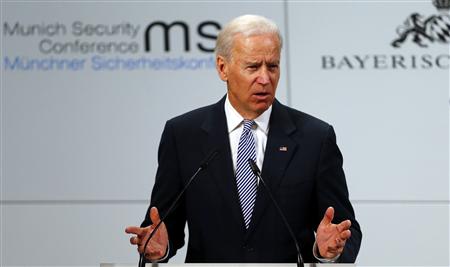
The United States is ready to hold direct talks with Iran if it is serious about negotiations, Vice President Joe Biden said on Saturday, backing bilateral contacts that many see as crucial to easing an international dispute over Tehran's nuclear program. Speaking at a security conference in Munich, Biden said Iran - which says it is enriching uranium for peaceful energy only - now faced "the most robust sanctions in history" meant to ensure it does not use its program to develop nuclear weapons. "But we have also made clear that Iran's leaders need not sentence their people to economic deprivation and international isolation," Biden said. "There is still time, there is still space for diplomacy backed by pressure to succeed. The ball is in the government of Iran's court."
To date, fitful talks on Iran's nuclear program have been between Tehran and the EU's top diplomat representing six world powers including Washington. But analysts have suggested that with his re-election behind him, President Barack Obama might have more leeway to take on direct negotiations with Iran. That makes the year ahead critical for chances of overcoming a stand-off which, if left to fester further, could see Iran approach a nuclear weapons capability and possibly provoking military action by Israel that could inflame the Middle East. Progress on Iran would also help ease regional tensions as the United States prepares to pull most combat troops out of Iran's neighbor Afghanistan by the end of 2014. Asked whether Washington might consider direct talks with Iran to smooth the process, Biden said, "When the Iranian leadership, Supreme Leader (Ayatollah Ali Khamenei), is serious. "We have made it clear at the outset that we would be prepared to meet bilaterally with the Iranian leadership, we would not make it a secret that we were doing that, we would let our partners know if that occasion presented itself. "That offer stands, but it must be real and tangible and there has to be an agenda that they are prepared to speak to. We are not just prepared to do it for the exercise." Negotiations with Iran have so far been overseen by European Union foreign policy chief Catherine Ashton on behalf of France, Britain, Germany, China, Russia and the United States. But they have made scant headway, raising fears Iran is simply playing for time while it develops its nuclear know-how. Ashton has asked Iran to hold a round of talks this month and on Friday called on Tehran to abandon plans to install and operate advanced centrifuges that would speed up its ability to enrich uranium - potentially making it easier for it to produce the highly enriched uranium needed for nuclear weapons. Many believe no deal is possible without a U.S.-Iranian thaw, requiring direct talks addressing myriad sources of mutual mistrust and hostility lingering since Iran's 1979 Islamic Revolution and the hostage crisis at the U.S. embassy in Tehran. Iran has avoided direct, public talks with the United States, though some suggest Tehran would eventually welcome an opportunity to end its international isolation.
"DECISIVE YEAR ON IRAN"
With Iran holding its own presidential elections in June, hopes of progress before then are limited. The United States and its allies, however, do not have an indefinite amount of time to negotiate. Notwithstanding the current stalemate, Iran's nuclear program is advancing and an international consensus on sanctions may be hard to maintain. Israel, which describes the prospect of Iran being able to weaponise enriched uranium as an existential threat, has made clear it would be ready to bomb the nuclear sites of its arch-enemy to prevent that outcome. The United States has also said it would not rule out the use of military force. Speaking at the Munich conference, German Foreign Minister Guido Westerwelle said that "2013 is the decisive year on Iran, especially for political reasons. "We had elections in the United States and Israel, we will have elections in June in Iran; we see increasing capabilities especially with the issue of enrichment - let us be very frank, we did not have progress in the last 12 months, so it is obvious that we have to use this year.." Russia, which has been impatient with decades of U.S. hostility to Tehran since its 1979 Islamic Revolution but backed U.N. Security Council sanctions since 2006, repeated on Saturday the need to find a diplomatic solution. "Iran must know the overall game plan, it must see what is in it for it in this process. We need to convince Iran that this is not about regime change ... this mistrust must be overcome," Foreign Minister Sergei Lavrov told the conference. That comment was echoed by Westerwelle. "If we want to reach this goal, it would be wrong to discuss all these military options and possibilities. It is now important to focus our whole attention, all our effort for a diplomatic and political solution." This would have to include a relief from sanctions as well as recognition of Iran's right to enrich uranium to the lower levels needed for civilian nuclear fuel, security analysts say.

Eastern Afghanistan residents wary of U.S. departure

http://www.usatoday.com
Along a sprawling roadside market, where butchered animals hang next to tiny, wooden stalls filled with auto parts, an Afghan man squats next to his apple cart, hoping to sell enough produce to feed his family. It's only been in recent months that Abdullah, who like many Afghans goes by a single name, returned to the Moqur market. For years, the Taliban controlled the Moqur district and much of Ghazni province, forcing schools and businesses to close and imposing strict Islamic law. The U.S. and Afghan forces here pushed out the Taliban fighters and allowed the market's vendors to return, giving hope of a normal life. But now that U.S. forces are preparing to depart, people here live in fear that the Afghan soldiers who are supposed to take over security will not be up to the task. "There are still a lot of bad guys in the area," says Abdullah, as a crowd on onlookers nods in agreement. By June 2014, security in every province in Afghanistan will have been turned over to Afghan forces following 11 years of hard-won battles against the Islamist Taliban in which more than 2,000 Americans have died. As NATO stated in its latest report Thursday, the success of the transition will rest on whether the Afghans can ensure that the country never again becomes a safe haven for terrorists. "Developments over the past year show they can," concluded NATO General Secretary Anders Fogh Rasmussen.Eastern Afghanistan will be the greatest test of that transition. U.S. Marines and Army soldiers succeeded in vanquishing Taliban fighters from the strongholds in the south in campaigns lasting years in Helmand and Kandahar provinces. Rather than reinforce the south, the Taliban attacked to the east, where fighters from militant-infested northwest Pakistan bolstered their forces. U.S. forces responded last year by shifting troops to the east, intensifying efforts in Ghazni to combat a persistent enemy as a deadline issued by President Obama closes in for U.S. troops to withdraw. Ghazni is an important thoroughfare for the Taliban and other militant groups in eastern Afghanistan. The country's main route, Highway 1, runs through this market halfway between the country's two largest cities, Kabul and Kandahar. Just off the highway are vast stretches of barren crop fields covered in winter frost and surrounded by snow-topped mountains. Winter is typically when many Taliban fighters return to Pakistan to rest and re-arm for the spring. But this winter the Taliban remained active, perhaps to test the strength of the Afghan forces that have taken up positions turned over by the U.S. military. Polish forces were leading the NATO effort in the province. The arrival of U.S. troops and Afghan soldiers kept the Taliban out of the bigger population centers. But some locals say the Taliban is still firmly in control of most districts and just waiting for U.S. forces to leave so they can take on the Afghan forces left behind. "They didn't bring security, the weather did," says Abdul Kaim, waving a bony finger at the American forces in the market as he explained that the recent snowfall is what stopped the fighting by making it too hard for either side to travel. Lt. Col. Jeremy Schroeder disagreed and said the region was secured well before winter's arrival. "I guess that's a good problem," says Schroeder, interpreting the Taliban's willingness to brave the cold months in Afghanistan as a sign the militants are concerned about losing too much ground to NATO and Afghan forces come spring. "It means you are having success." Under the protection of patrolling coalition troops, Afghans fill the Muqor market that acts as an open-air department store with clothes, produce, food and merchandise. During the summer -- when the Taliban controlled the market and much of the province -- Abdullah and other merchants were forbidden from doing business in what is the largest roadside bazaar between Kabul and Kandahar.Not all areas of eastern Afghanistan have such protection, and they can be at the mercy of the Taliban. Some have begun fighting back. In nearby Andar District, locals rose up against the Taliban and its strictures, according to the Afghan government. Some have taken up arms against the militants and forced them from villages, allowing Taliban-banned schools and shops to reopen. Taliban spokesman Zabihullah Mujahid has said the talk of life without Taliban control is an illusion. Mujahid says that much of Andar and Ghazni remains in Taliban hands. "People (residents of Ghazni) like to help the mujahadeen, they know it is their responsibility," he says. "But even if they can't help, they aren't making real problems for us." Townspeople in Moqur District are not banking solely on Afghan troops protecting them once U.S. forces go. A group called the Moqur Movement is helping to keep the Taliban out of the market and village, says the U.S. military. The groups in Andar and Moqur are critical to security because they can readily identify outsiders, particularly those who belong to the Taliban. "They have a certain amount of access (to the local population) and anonymity that Afghan forces do not," says Schroeder. Schroeder notes however that the groups can frighten some locals, such as when they enter homes after dark in search of suspected Taliban. U.S. forces are trying to bring members of the Moqur Movement into the fold of the Afghan Local Police, a constable force trained and equipped by Special Operations Forces. Several members have already been incorporated into the ranks of the ALP, but the police have issues too. People have complained that some in the ALP abuse their new-found authority by extorting bribes at checkpoints. "They are taking our money and even torturing us," Mullah Shamsullah, an elder in a nearby village says of the Afghan Local Police. U.S. forces say there are some ALP abusing their authority but that most cases involve men impersonating the police. In Afghanistan, where rumors are how many rural towns get their information, there is speculation that the uprisings against the Taliban were manufactured by Kabul to spin a positive storyline out of Ghazni. "At first it appeared it was a Pashtun (the predominant ethnic group in Ghazni) initiative to rise up," says Saeed Parto, an analyst with the Afghanistan Public Policy Research Organization. "Another version is the Afghan government and U.S. forces wanted to see a feel-good story, something to show that Afghanistan is worth saving."

Trilateral with Afghanistan,Pakistan Leaders

http://www.number10.gov.uk
David Cameron hosts trilateral at Chequers. Discussions expected to focus on the Afghan-led peace process and how the Pakistanis and international community can support it.A Downing Street spokesperson said: “The Prime Minister will host the leaders of Afghanistan and Pakistan at Chequers on Sunday and Monday as part of his ongoing efforts to help to strengthen Afghanistan-Pakistan relations, support an Afghan peace and reconciliation process and promote regional peace and stability. “For the first time, we will bring together the political and security establishments from both Afghanistan and Pakistan, with Foreign Ministers, Chiefs of Army Staff, Chiefs of Intelligence and the Chair of the Afghan High Peace Council attending the meeting. “Discussions are expected to focus on the Afghan-led peace process and how the Pakistanis and international community can support it. We also expect the Afghans and Pakistanis to make further progress on the Strategic Partnership Agreement they committed to in September. “The Prime Minister initiated the trilateral last Summer at the request of both parties. This will be the third meeting hosted by the Prime Minister, following meetings in Kabul in July and in the margins of the UN General Assembly in New York in September. The UK’s role has been to encourage ideas, identify areas of agreement and provide a forum for open dialogue. “And this trilateral process sends a very clear message to the Taliban: now is the time for everyone to participate in a peaceful political process in Afghanistan. “As the Prime Minister has set out previously, a stable Afghanistan is not just in the interests of Afghans, but also in the interests of their neighbours and the UK. We share the same vision for Afghanistan: a secure, stable and democratic country that never again becomes a haven for international terror. “We are working together to achieve it and Afghanistan’s neighbours have a vital role to play. It is vital not just for the future security of their citizens, but for their prosperity too.”

Militants hit Pakistan army camp, kill 23

Militants armed with rocket-propelled grenade launchers, automatic rifles and suicide explosive vests launched a predawn raid on a Pakistani army camp in the country’s volatile northwest Saturday, killing 23 people and injuring at least eight. The attack took place at a camp and checkpost in Lakki Marwat, a region just east of North Waziristan, the tribal area that the Pakistani Taliban, Al Qaeda and other militant groups continue to use as a primary base of operations, according to Pakistani security officials and local authorities. The militants converged on the camp at about 3:45 a.m. and engaged in a fierce firefight that lasted more than two hours. Thirteen of the dead were security personnel -- nine army troops and four officers with the Frontier Constabulary, a security force that polices the country’s northwest, said a Pakistani security official, speaking on condition of anonymity because he was not authorized to speak on such matters. The attackers also broke into a nearby house and killed a family living there, including four men, three women and three children. During the attack, 12 militants were killed, the security official said. At least two of them were wearing suicide explosive vests. Ahsanullah Ahsan, spokesman for the Pakistan Taliban, said his group claimed responsibility for the attack, adding that it was in retaliation for U.S. drone strikes that recently killed two Taliban commanders in Pakistan’s tribal region along the Afghan border. Ahsan accused the Pakistani military of “providing logistical support” for U.S. drone strikes. In the past, the Taliban has accused the Pakistani government of cooperating with Washington in the drone campaign, which has over the years killed numerous top Al Qaeda and Taliban leaders. The Pakistani government publicly denounces U.S. drone attacks as violations of their country’s sovereignty, but has also tacitly allowed them to continue. Last year, the frequency of U.S. drone strikes in Pakistan’s tribal regions dropped off. The U.S. carried out 46 drone missile strikes in 2012, compared to 64 in 2011 and 117 in 2010, according to the Long War Journal website, which tracks drone activity. However, Washington stepped up drone attacks in January, launching seven missile strikes on militant targets in Pakistan’s tribal belt. One of those strikes, the Jan. 2 attack on a house in the village of Angoor Adda in South Waziristan, killed Pakistani Taliban commander Maulvi Nazir, who had abided by a peace pact with the Pakistani military and had focused his efforts on U.S.-led forces in Afghanistan. Another drone strike the following day killed Shah Faisal, a top aide to Pakistani Taliban leader Hakimullah Mahsud. The Taliban faction led by Mahsud regards the Pakistani government as its main enemy and is responsible for hundreds of suicide bombings and terror acts across the country in recent years. Staff writer Alex Rodriguez reported from Islamabad, and special correspondent Zulfiqar Ali reported from Peshawar, Pakistan.

ANP demands crackdown on terrorists in Karachi

The Awami National Party (ANP) on Friday called for a targeted operation against terrorists in Karachi, where sudden surge in violence killed 18 people in less than 24 hours. Speaking to reporters outside the Parliament House, ANP Senator Zahid Khan said the Sindh government was responsible to protect life and property of citizens. He said Interior Minister Rehman Malik reaches London whenever something happens in Karachi. The government, he demanded, should crackdown on terrorists in Karachi. The government has failed to maintain law and order, he said, adding that issuing warnings alone would not work. Another ANP senator, Haji Adeel, said that faces of the killers could be seen in the CCTV footage aired by media on Thursday. He said that Karachi should be cleared of illegal arms.

US will not scale back drone warfare

http://rt.com
The US is engaged in a global war on terror, and drone strikes are an effective tool to eliminate Al-Qaeda militants planning terror attacks on America, US Secretary of Defense Leon Panetta told AFP, adding that drone operations should stay covert. The US will not curtail its extrajudicial assassinations in Pakistan, Somalia and Yemen, Panetta said in a farewell interview: “We are in a war. We're in a war on terrorism and we've been in that war since 9/11.”
"The whole purpose of our operations were aimed at those who attacked this country and killed 3,000 innocent people in New York [on 9/11] as well as 200 people here at the Pentagon," he said. Over a decade has passed since the beginning of the global war on terror; in that time, two countries were occupied by the US, and the mastermind of the 9/11 attacks, Osama Bin Ladenm was shot dead by American marines. Still, the war on terror must continue, Panetta said. "I think it depends on the nature of the threat that we're confronting,” he explained. Since terror threats continue to originate in Muslim countries – from Afghanistan in 2001 to Yemen in 2013 – it is unlikely the US will scale back its drone program in the foreseeable future. Though US drones assassinate Al-Qaeda operatives in these countries without a court verdict or any form of due process, Panetta said that those governments are “pursuing the same goal” as the US. He said that the Yemeni government, for example, is strongly in favor of the US drone program.But in October 2012, Pakistani Interior Minister Rehman Malik claimed that the majority of the people killed by American drones in Pakistan are civilians. A US study in September 2012 revealed that only 2 percent of those killed in drone strike in Pakistan are actually top militants. "I think we had a responsibility to use whatever technology we could to be able to go after those who not only conducted that attack but were planning to continue to attack this country," Panetta said. The departing US Secretary of Defense also rejected the idea that overseas drone operations should be turned over from CIA control to the US military, which would require open reporting on every operation: “When you got those kind of operations where, because of the nature of the country you're in or the nature of the situation you're dealing with, it's got to be covert.” An avid supporter of drone warfare, Panetta was largely responsible for the dramatic increase in drone attacks in Pakistan when he served as head of the CIA from 2009 to 2011. As the CIA director, he likely knew that the Hellfire missiles shot from drones have killed hundreds – if not thousands – of civilians, including children. But the drone program has only expanded in recent years. At the start of 2013, the CIA escalated its use of drones in Pakistan, launching seven deadly strikes during the first 10 days of 2013 and killing at least 40 people, 11 of whom may have been civilians. Because of the widespread claims that drone attacks are war crimes and an encroachment on national sovereignty, in January 2013 theUN launched a probe into civilian casualties from US and UK drone strikes and their legal implications.

Anti-polio drive postponed in Karachi

Health authorities in Sindh have decided to postpone anti-polio campaign in Karachi due to deteriorating law and order situation, Geo News reported. The decision to put off the campaign was taken at a high level meeting attended by DCOs and health officers. The campaign was to start on February 6. Police, paramilitary Rangers and other law enforcement agencies have failed in maintaining law and order in Karachi. At least four polio workers including three women were gunned down by unknown attackers last month. Geo News correspondent said that a meeting would be held on Monday to chalk out security plan to carry on anti- polio campaign in the city.

Chaudhry Nisar: ''Alarming virulence''

THE FRONTIER POST
What kind of an alarming virulence is this that Chaudhry Nisar Ali Khan, the leader of opposition in the National Assembly, has been indulging in so arrogantly over these days? Now he says he would not talk with the government party over the nomination of the interim prime minister. Does he think that he is above the constitution or enjoys some sort of a veto power? The constitution specifically lays down that as leader of opposition he is to talk this with the leader of house. This is a must. So he will be doing no favour to anyone if he talks. It is his bounden duty to do it. And the taxpayer is paying him not to flout the constitution but to abide by it and carry out all the duties, tasks and responsibilities the constitution enjoins on him. Ironically, he never tires of reading out constitution even at the drop of a hat, when it suits him. When the PPP-led government struck a deal with Tahirul Qadri, he was furious. How could Qadri be consulted for interim prime minister's nomination, he thundered. It is unconstitutional, he fumed, reminding all and sundry that constitutionally this consultation could only be held between the leader of house and the leader of opposition. And now he says he would not talk about this with the leader of house. Why indeed he is so resolved to ratchet up the tensions where should exist none? Why indeed is he behaving as if he and his party are not going into an electoral contest but in a war? Like a little czar, he says all the governors must be changed; the entire top echelons of the provincial administrations must be changed; and the secretaries of several ministers at the centre must be changed. Are we going into an election or into an administrative overhaul? Appallingly, he says he would not accept the nominations of the interim chief ministers in Sindh and Balochistan. But who is he to accept or reject those nominations if made in line with the stipulations of the constitution? After all, this country is not the real estate of anybody; nor is it the sultanate of anybody. No wrestling ring either is it of anyone. It belongs to 180 million people, who overwhelmingly are disgusted of the present crop of the political class from one to all and fed up with its shenanigans. With his rancour, stridency and arrogance, he may be getting the headlines. But the people's loathing he is culling in volumes. And how does he square up such contradictions in his stances that when Qadri asked for the re-composition of the election commission, he was all hue and cry? And now he himself is staging sit-ins for what he calls the empowering of the election commission. In any case, his is not the party alone that is flapping its wings feverishly to jump into the electoral fray. There are many other contenders, some even presently carrying more wider nationwide credentials. So who is he to arrogate to himself and his party the sole prerogative of agreeing this or disagreeing that when many other putative power contenders also are in the field? Why indeed is he so hell-bent on fraying the tempers when even otherwise the upcoming poll, by every indication, portends to be very contentious, divisive and controversial? Why is he after confrontations so insanely when the nation cannot afford even a slight confrontation at this point in time, so delicately-placed it is? Gigantic challenges are confronting it both internally and externally, to cope with which it needs harmony, solidarity and unity among the ranks of the nation, not chasms, fissures and divisions. This is not something that is hidden or not in full public view. Even a babe knows of it. And by no stretch of imagination the Chaudhry could be unaware of it. Yet he is behaving rashly and recklessly. He must tone down. He is no emperor or czar and the people are no slaves of him. He is just a politician like so many of them strutting on the national political landscape. And behave he must like one. He must speak logic, rationality and sanity. Pungency and rancour he must eschew. The people would surely do well without his insanity.