Monday, November 19, 2012

Why are 6000 Shia children killed in Pakistan less worthy than a few dozen Palestinians?

Let Us Build Pakistan
Abdul Nishapuri
Why are 6000 Shia children killed in Pakistan by Saudi-sponsored Takfiri Deobandis (Taliban, Sipah-e-Sahaba) less important than a few dozen Palestinians killed by Israel? We condemn all those thugs who express sympathy for rocket-firing Hamas militants but remain silent on Shia genocide in Pakistan. If you see a Salafist-Deobandi circulate pictures from Palestine or Burma, throw the present post on his/her face. Since mid-1980s, more than 20,000 Shia Muslims, thousands of Sunni Sufi (Barelvi) Muslims, hundreds of Ahmadis, Christians and Hindus have been killed in Pakistan by Takfiri Deobandi terrorists sponsored by Jihadist-minded generals of Pakistan Army. A detailed database of Shia genocide can be accessed here: http://criticalppp.com/archives/132675 According to an estimate, at least 30 per cent of the 20,000 Shias killed are children or minors (age 18 or below). This makes their number at least 6,000. On mainstream media and social media, one frequently sees pictures of Palestinian children killed or injured during Israel’s attacks on Hamas (Saudi-sponsored Salafist militants) hideouts in densely populated civilian areas in Gaza. However, there is completely no mention of the 6,000 Shia children killed by Saudi-funded Takfiri Deobandis (Taliban, Sipah-e-Sahaba) who are not only killing Shias but also Sunni Sufi (Barelvis), Ahmadis and Christians. The attitude of the Arab League, OIC, United Nations and human rights groups is equally hypocritical and disturbing. While they shed crocodile tears on the loss of innocent life in Palestine (and Israel), hardly any mention is made of the thousands of Shia, Sunni Sufi Muslims and other non-Salafist, non-Deobandis killed in Pakistan (and other countries, e.g., Afghanistan, Bahrain, Syria, Saudi Arabia) by the Saudi- and Qatar-sponsored terrorists. In the present post, we are providing a collection of only a few of thousands of Shia children killed by Takfiri Deobandis in the last few years in Pakistan. Things to note: Many Pakistani and international groups remain silent on Shia genocide in Pakistan. In fact while the same groups clearly mention the identity of the killed and the killer in Palestine, they make every possible effort to hide or obfuscate the identity of the killed (Shia Muslims, Sunni Sufis) and the killers (Takfiri Deobandis and their Saudi masters) in Pakistan. Supporters and enablers of Takfiri Deobandis dishonestly misrepresent Shia genocide and murder of Sufi Sunnis in Pakistan as Sunni-Shia sectarian violence in order to justify and hide the violence. While Iran and Iran-funded Shia Mullahs keep supporting Hamas and other militant groups, Hamas remains extremely hostile to Sunni Sufi Muslims and Shia Muslims. In fact, in 2011, Hamas forcibly stopped Shia Muslims of Palestine from celebrating the Ashura of Muharram and physically attacked and injured many Shias. It may be noted that majority of the Palestinians killed by Israel in Gaza are militants or activists of Hamas. In contrast, almost all Shias killed in Pakistan by Takfiri Deobanids are ordinary citizens with no link with any political or militant group. Shias face Gaza in Pakistan every day. But no Shia are firing rockets at ordinary Sunni Muslims or calling for Sunni destruction. Pakistan’s and the entire world’s Shia and Sunni Muslims should realize that Saudi-sponsored Takfiri Deobandis and Takfiri Salafist are bigger threat to Islam and Muslims than any other country or group. It is high time that we set our priorities in order and focus our attention on Saudi-funded Deobandis and Salafist, the biggest threat to humanity, Muslims, Christians, Hindus and Jews.

PTI leader receives Rs40m US fund

Senior Pakistan Tehrik-e-Insaf (PTI) leader Jehangir Tareen has received American funding of over Rs40 million through the US Agency for International Development (USAID) for his private business firm and family NGO working in Lodhran from where he is poised to contest the upcoming general elections instead of Rahim Yar Khan. When contacted, the PTI leader, who heads the party’s policy wing and think tank, confirmed that his Tareen Education Foundation (TEF) and Ali Tareen Farm got the money from the USAID, but said he received the funding before he joined Imran Khan’s squad. The TEF got approximately Rs20.75 million grant from the USAID’s Small Grants and Ambassador’s Fund Programme (SGAFP). The Ali Tareen Farm (ATF) received Rs20 million from another USAID project called FIRMS. Documents show that the TEF is a society, set up by Tareen in 2010, to work for improvement of education in Lodhran. In the same year of 2010, the two-time member of the National Assembly, Tareen, fell out with his close relative, Makhdoom Ahmad Mahmood, a powerful political figure of Rahim Yar Khan, and decided to contest elections from Lodhran where he also has the ATF. Tareen started working through the TEF for improvement of schools in six union councils of Lodhran in order to improve his visibility in NA-154 constituency. While the SGAFP provided the grant of about Rs20.75 million to the TEF, the NGO’s contribution to project is proposed to be Rs14 million, which will be spared by Tareen’s business concerns. Tareen launched himself in this constituency in a gathering of TEF in 2011, using the US funds to further his political prospects, according to the available record. The board of management of the TEF, registered in Lahore under 1860 Societies Act in April 2010, comprises Tareen’s daughter Mareem, and some friends and employees. The SGAFP are two grant programmes launched by the USAID to help Pakistani communities implement their initiatives. Grants under the US Ambassador’s Fund for projects of up to one year time duration support broad impact community level initiatives. Grants under the USAID’s Small Grants Programme for projects of one to three-years time duration support promising proposals and pilot initiatives, which are consistent with USAID’s strategic priorities. Documents showed that thirty government schools in district Lodhran, adopted by the TEF, are being upgraded by these US funds. The FIRMS gave the grant to the ATF under its Mango Muawan project for developing and processing export quality mangos, and help them get international certification for mango export, which went a long way in furthering Tareen mango export business. Tareen said that both the programmes were signed with USAID before he got associated himself with the PTI. He said first programme of ATF was regarding export of mangoes adding that the USAID planned to export fresh mangoes to US. This agreement was signed in 2010 and came to end in 2011. “The ATF is one of the leading farms in Pakistan considering its technology and management. As a result of this deal, we exported Pakistani mango to the US and the first consignment of the fruit went from my farm. This deal benefited Pakistan’s economy and mango growth,” Tareen said. He said that he has spent a lot of money from his own pocket for the TEF and adopted 85 government schools in Lodhran, which are not private. He said most of the money spent on this project came from his resources and he provided 100 teachers in the schools, which were facing such shortage. Tareen said he spent around Rs70 million per annum from his pocket. He said the USAID had a project under which they used to construct new rooms in government schools. The TEF signed an agreement with USAID for building 34 new rooms and boundary walls in these schools in 2011. This project facilitated the children of the poor, who are now studying in the good environment. This was a one-year programme and ended on Oct.30, 2012. On a political note, the PTI said that since the PTI has ideological differences with US on its drone attacks and its intervention in Pakistan, he has stopped making any deal with any US organisation. “I have many other options and offers but I will not indulge into any deal with US now.” Previously his strategy was: American dollars are good, policy is bad.

President Zardari emphasizes the need to defeat the negative mindset to save Pakistan

Radi Pakistan
President Asif Ali Zardari
emphasized the need to defeat the negative mindset to save Pakistan.
Addressing Khyber Pakhtunkhwa Assembly in Peshawar this afternoon‚ he said Pakistan has a very strategic location and we need stability to take advantage of the immense opportunities. At the outset‚ the President strongly condemned attack on leader of Jamat-e-Islami Qazi Hussain Ahmad. The President said completion of five years by the present assemblies is a tribute to the maturity of parliamentarians and politicians who demonstrated tolerance and accommodation. He said the democratic process is progressing ahead due to sacrifices rendered by political workers and armed forces. The President lauded the sacrifices of the people of Khyber Pakhtunkhwa and the security forces in fighting the negative mindset. Mr. Asif Ali Zardari said he entered politics after a particular mindset martyred Benazir Bhutto. He said democracy is the real revenge as demonstrated by Shaheed Benazir Bhutto and he himself. The President said democracy comes through evolution and the country needs practicing democracy as we see today. He said Khyber Pakhtunkhwa has necessary potential to develop and prosper as it is bestowed with natural resources like oil and gas‚ copper and chromites. He said the province was once abode of peace where there was no theft or robbery but today the situation has changed due to negative thinking and law and order situation is hampering development of the province. The President asked Khyber Pakhtunkhwa to prepare its police to take up the challenge of security as army cannot remain there for ever. President Zardari said his policy of taking all forces and federating units along has given a sense of participation in the people of Pakistan in the affairs of the state. He said he gave NFC Award and empowered parliament and the provinces. The President said he pursued the policy of reconciliation and voluntarily handed over his powers to the parliament to strengthen internal harmony. He said the country cannot be harmed by external forces if it is united and strong. He said he strongly believes that the federation would become stronger if provinces are strong and stable. The President said it was an honour for him to address the Khyber Pakhtunkhwa Assembly.Speaker Khyber Pakhtunkhwa Assembly Karamatullah Chagharmati‚ while welcoming the President in the House‚ said that President Asif Ali Zardari is the first ever president who addressed the Khyber Pakhtunkhwa Assembly. He said that the gesture shown by the president has proved that he is complete democratic and "awami" president. He said the policy of reconciliation adopted by the president is acknowledged by the entire nation and the assemblies are going to complete their term as result of this policy. Karamatullah Chagharmati highly appreciated the political sagacity of the president for giving identity to pakhtuns by giving the name Khyber Pakhtunkhwa to the province and thanked him on behalf of entire people of the province. Welcoming the President Asif Ali Zardari‚ leader of the house and Chief Minister Ameer Haider Khan Hoti termed the address of the President to the Provincial Assembly a historic event. He said that President Asif Ali Zardari has always supported the government and people of Khyber Pakhtunkhwa at every occasion.Leader of the opposition‚ Akram Khan Durrani said that the members of all the political parties and independent members are present in the house which demonstrate the rich tradition of Pakhtuns. He appreciated President Zardari for delegating his powers to the parliament which he described as the greatness of the President. He stressed the need for resolving the issue of terrorism and militancy politically.President Asif Ali Zardari attended a meeting on FATA reforms in Peshawar today. The president was briefed on law and order situation and development projects in FATA. Participants of the meeting said a special package would be announced for the families hit by terrorism. The meeting also proposed setting up of medical colleges and I.T university in the tribal areas.

PPP strengthened political process: Zardari

Addressing the provincial assembly, President Asif Ali Zardari said law and order was the major challenge for Khyber Pakhtoonkhwa. He said people of Pakhtoonkhwa had given unprecedented sacrifices for the security and survival of the country. “A particular mindset is bent upon destabilizing the country and we will continue to our fight against this mindset till we defeat it,” Zardari said adding it was the same mindset that assassinated Benazir Bhutto. “Democracy is the real revolution and after the assassination of Benazir Bhutto it was our responsibility to continue the political process,” he said. He said it was the power of the parliament that forced General (r) Pervez Musharraf to shed his uniform and ultimately leave the country. “We believe in tolerance and reconciliation,” he said. President Zardari said he learnt politics from ZA Bhutto, Bacha Khan, Khan Abdul Wali Khan, Maulana Fazlur Rehman and jail also taught him a lot. He condemned the attack on JI leader Qazi Hussain Ahmad saying the terrorists elements were not sparing even people like Qazi Hussain Ahmad. Enemies of the country wanted to create bad blood between provinces but we have defeated all these attempts, he said. “We gave provincial autonomy because we believe in indigenization of the provinces.” He said he had handed over powers of his office to the parliament in order to empower it. Provinces are stakeholders in Islamabad and it derives powers from provinces in return, he said. He vowed to defeat the internal enemies of the country. Speaker Pakhtoonkhwa Assembly welcomed the President said assemblies were completing their tenure for the first time in the history of Pakistan due to wise and conciliatory policies of President Zardari. Chief Minister Ameer Haider Khan Hoti in address said President Zardari has always listened to the grievances of Khyber Pakhtoonkhwa with great attention and had always been cooperative. He said amiable atmosphere in the Khyber Pakhtoonkhwa assembly must be an example for the others. He thanked the President for addressing the assembly and applauded his policy of reconciliation. Opposition leader Akram Khan Durrani said that the President had established a new tradition by addressing the Khyber Pakhtoonkhwa Assembly.

Zardari becomes first elected president to address Khyber-Pakhtunkhwa assembly

The Express Tribune
For the first time in the history of Pakistan, an elected president – Asif Ali Zardari – addressed the Khyber-Pakhtunkhwa assembly on Monday. Zardari became the first ever elected president to have addressed a provincial assembly session on the invitation of the provincial chief minister and speaker of the assembly. The speaker had invited the president to address the assembly during the SAARC conference in Islamabad. Upon arrival, the president was received by K-P Governor Barrister Masood Kausar and Chief Minister Ameer Haider Khan Hoti. Addressing the session, the president said that it was a huge example of maturity and patience of parliamentarians and politicians that the assembly had completed its five years. Zardari emphasised on the need of defeating the extremist mindset in order to save Pakistan, while condemning the attack on former Jamaat-i-Islami (JI) chief Qazi Hussain Ahmad which took place earlier during the day in Mohmand. He expressed happiness over visiting Khyber-Pakhtunkhwa and thanked the provincial chief minister for inviting him.

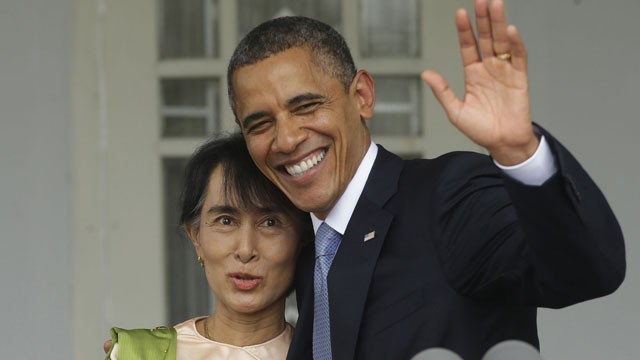
China hopes Obama's Myanmar visit conducive to stability

China hopes U.S. President Barack Obama's Myanmar visit will be conducive to east Asia's peace, stability and development. While commenting on the visit, Foreign Ministry spokeswoman Hua Chunying made the remarks at a regular press conference on Monday, adding that, "President Obama's visit is a matter between the United States and Myanmar."
She added that China and Myanmar are friendly neighbors, who, on the basis of the five principles of peaceful coexistence, conducted substantial cooperation in the spirit of equality and reciprocity, and they have also promoted their strategic partnership of cooperation. "The development of China-Myanmar relations benefits the two peoples, and contributes to regional peace, stability and prosperity. We are confident in the in-depth development of bilateral relations," said Hua. Obama arrived in Yangon on Monday morning kicking off his trip to Myanmar, becoming the first sitting U.S. president to visit the nation in the history of Myanmar-U.S. relations.

Afghanistan will descend into ‘chaos and civil war’

http://news.nationalpost.com
Afghanistan will descend into ‘chaos and civil war’ unless the international community remains committed there: Forum panel
Afghanistan is “very, very vulnerable” and will descend back into “chaos and civil war” unless the world — especially the United States, and NATO allies such as Canada — remains engaged and committed there. That stark warning was issued here Sunday by a panel of high-profile Afghan business and political leaders. They spoke on the future of Afghanistan and Pakistan at the Halifax International Security Forum, an annual conference on global security issues hosted by Canadian Defence Minister Peter MacKay. Afghanistan “needs a lot of resources and patience on the part of the international community,” said Abdul Rahim Wardak, a former defence minister and current advisor to Afghan President Hamid Karzai.“Unfortunately the Taliban and their supporters have counted from the beginning, that sooner or later the international community will run out of patience and they will leave, and that is why they are preparing for that day.” For that reason, said Wardak, “we hope international support will continue.” Canada has already ended its five-year combat mission in Kandahar province. About 900 Canadian troops remain in the capital city Kabul, training Afghan soldiers and police. All Canadian troops are scheduled to be withdrawn by March, 2014, before the Afghan elections that year. Other western nations are also winding down their military missions. The United States has said it will withdraw its 67,000 troops by 2014, although a small contingent of soldiers will remain as trainers and advisers, along with anti-terrorism special forces units. During the transition period leading to 2014, Afghanistan will prepare for a new round of elections, in which Karzai is prohibited from seeking a third term.Observers say it’s critical for the 2014 vote to take place freely and fairly, without interference from Karzai or intimidation from the Taliban, for the next government to have legitimacy and for Afghanistan to have any hope of a stable future. “How much leverage can the West bring to bear, to make sure those elections are free and fair?” said Ahmed Rashid, a respected Pakistan journalist and longtime Afghanistan observer. “The last elections were rigged openly by Karzai. If the next elections are rigged, Afghanistan will fall apart, and we’ll face a multi-dimensional war there like we’ve never seen before.” Said Amrullah Saleh, a former Afghan government intelligence chief who now runs an opposition, anti-corruption movement in Kabul: “Afghanistan is very, very vulnerable. If you in the West think, ‘We helped them for 11 years, and they didn’t help themselves, so now we will abandon them’ then we will collapse and the militants will come back.” Saad Mohseni, a Middle East media mogul whose company the Moby Group, owns several Afghanistan broadcast outlets, said despite the ongoing war with the Taliban, Afghan society has been transformed by the security offered by NATO and its allies over the past decade.He said millions of people are now going to school, moving to the cities, and a new generation of young people are hungry for peace and prosperity. But Mohseni warned that the “world needs to remain engaged in Afghanistan” if this progress is to be maintained. “If neglected, Afghanistan and Pakistan will become the world’s problems in the years ahead. With the nuclear weapons, the drugs and the terrorism, this region must not be abandoned. You have to understand the consequences. I think it’s very important for the political leadership in countries like Canada to explain the importance of Afghanistan to their people,” Mohseni said. “It’s very easy to disengage now, and it’s very easy to be insular and say your economy’s not doing well, so we have to walk away from Afghanistan. The last time the Americans walked away from Afghanistan, we saw 9/11.” After listening to the discussion Sunday, MacKay reiterated Ottawa’s position to fully end its military mission there by 2014, but to continue sending financial aid, currently budgeted at $110-million a year until 2017. “We will, I believe, be working with Afghans for many, many years to come on many levels. But the [Canadian] military piece is over.” MacKay, who visited Canadian forces in Kabul last weekend, said he came away from the recent visit more optimistic than before. “I saw first-hand the incredible efforts being made by Canadians and our allies to present the Afghan army and police with the skills they need to go out and defend their country,” he said. “We’re under no illusion as to the enormity of the task, but they are now a very capable force.”

Karzai, Accuses U.S. Forces Of Violating Detainee Pact

Afghanistan's president has accused U.S. forces of continuing to capture and hold Afghans in violation of an agreement signed earlier this year between the two countries. Hamid Karzai's late Sunday statement, which did not include any specific demands for the U.S., was made days after the beginning of negotiations on a bilateral security agreement that will govern the U.S. military presence in the country after the majority of troops draw down in 2014. Karzai's critics say he frequently strikes populist, nationalist stances that give him leverage in talks with the Americans. The Afghan president said some detainees are still being held by U.S. forces even though Afghan judges have ruled that they be released. He also decried the continued arrest of Afghans by U.S. forces. The two countries signed the detainee transfer pact in March but the handover of detention facilities has been slowed by the U.S., which has argued both that the Afghans are not ready to take over their management and insisted that the Afghan government agree to hold without trial some detainees that the U.S. deems too dangerous to release. "These acts are completely against the agreement that has been signed between Afghanistan and the U.S. President," said the statement, released by Karzai's office after the president was briefed by judicial authorities on the transfer. He urged Afghan officials to "take serious measures" to push for taking over all responsibility for the detention center on the edge of the main U.S. base in eastern Afghanistan. The detainee transfer agreement was one of two pacts that were key to a broad but vague strategic partnership agreement signed by Kabul and Washington in May that set forth an American commitment to Afghanistan for years to come. The second pact covers "special operations" such as certain American raids and other conduct on the battlefield. A third detailed pact — dubbed the bilateral security agreement — is now under negotiation, and covers logistical and legal questions such as the size and number of bases and the immunity of U.S. forces from prosecution.The two countries officially opened negotiations on the bilateral security agreement last week, and have given themselves a year to sign the pact. Karzai is under pressure to give an appearance of upholding Afghan sovereignty — which he has repeatedly claimed to champion — without putting so many restrictions on U.S. forces that an agreement becomes impossible. It is believed that the United States wants to retain up to 20,000 troops in Afghanistan after 2014 to train and support Afghan forces and go after extremists and groups, including al-Qaida. Afghanistan now has about 66,000 U.S. troops and it remains unclear how many will be withdrawn next year as they continue to hand over security to Afghan forces. The foreign military mission is evolving from combat to advising, assisting and training Afghan forces. The bilateral security agreement is essentially a status of forces agreement and will set up a legal framework needed to operate military forces in Afghanistan, including taxation, visas and other technical issues. It does not need to be ratified by the U.S. Congress. The U.S. has similar agreements with dozens of countries. In Iraq, a similar deal fell apart after U.S. officials were unable to reach an agreement with the Iraqis on legal issues and troop immunity that would have allowed a small training and counterterrorism force to remain there. Karzai said last month that the issue of soldiers being protected from prosecution in Afghanistan could be a problem in the talks. He has said Afghanistan might demand prosecutions in some cases. The issue took on new meaning after Staff Sgt. Robert Bales allegedly attacked Afghan civilians in two villages in southern Afghanistan. The American soldier faces 16 counts of premeditated murder and six counts of attempted murder in the March 11 attacks against civilians. A preliminary hearing was held this week at Joint Base Lewis-McChord in Washington state.

IRAN, PAKISTAN JOCKEY FOR AFGHANISTAN INFLUENCE

http://www.wnd.com/
Iran and Pakistan are jockeying for influence in Afghanistan once troops of the United States and the North Atlantic Treaty Organization leave at the end of 2014, but the internal dynamics – especially with the Taliban which envisions running the country – could cause the country to degenerate into a civil war, according to a report in Joseph Farah’s G2 Bulletin. In Afghanistan, there already is an effort under way by some anti-Taliban officials to set up militias to oppose the Taliban once U.S. and coalition forces leave, but this effort is facing internal opposition by current Afghan officials who believe working with the Taliban will be necessary. One Afghan lawmaker taking such an initiative is Afghan Minister of Water and Energy Mohammad Ismail Khan, who is closely allied with Iran. He wants to create a group of militias to fight the Taliban. This initiative strongly suggests a lack of confidence in the ability of the government to deal with the Taliban after 2014. It also will impair efforts to limit the Taliban in any post-NATO period. Khan’s efforts suggest an early effort by neighboring Iran to assert its own influence in competition with that of Pakistan, the other neighbor to Afghanistan. Given Iran’s interest in a post-NATO Afghanistan, sources say that Iran’s Islamic Revolutionary Guard Corps’ Quds Force is assisting in forming the group of militias to fight the Sunni al-Qaida-backed Taliban, which Shi’ite Iran opposes. Sources believe that such an arrangement of backing the creation of the militias gives Iran more clout in negotiating the future of Afghanistan and giving it a final say in the outcome of any political settlement. Pakistan similarly seeks to extend its influence in Afghanistan in a post-NATO period, but now Pakistan is beginning to have a change of heart on its backing of the Taliban which it originally created as its proxy in Islamabad’s fight with India. Now, the Taliban has developed into such a major Islamist force that the group it created could turn on the Pakistani government. For that reason, Pakistan is undertaking a major shift in approach by now wanting to work more with the government of Afghan President Hamid Karzai. Up until recently, Pakistan opposed the U.S.-backed Karzai government, but due to the rising influence of the Taliban may be more inclined to work with it to contain the Islamist militant group’s growing influence in Afghanistan at the expense of its own. In addition, Pakistan also appears to be reaching out with the anti-Taliban Northern Alliance, India and Iran and Russia. “Pakistan’s goal is to have a broad-based coalition government in power in Afghanistan that can limit the power of the Afghan Taliban,” according to a report of the open intelligence group Stratfor. “The dilemma that Pakistan faces is how to deal with an inevitable Taliban political resurgence on its western flank while neutralizing the jihadist threat at home – since the latter is a natural outcome of the former,” the report said. Sources acknowledge, however, that it will be difficult to contain the Taliban in both Afghanistan and Pakistan. In addition, the Taliban increasingly is linked with al-Qaida and other transnational Islamist militant groups. Further muddling an already big mess is the shaky relationship the United States has not only with Pakistan and Afghanistan and its efforts to attempt to manage a situation that clearly is leaning in favor of the Islamist militants. Given this trend, sources believe that in a post-NATO period, Afghanistan could disintegrate into another civil war while a rebounding Islamist insurgency in the region could threaten the government of Pakistan.

Bilawal Bhutto gets rousing welcome in Dadu

The Express Tribune
In a style reminiscent of his grandfather and mother, the chairperson of Pakistan Peoples Party (PPP), Bilawal Bhutto Zardari, visited Dadu, Sindh, and chanted ‘Jeay Bhutto’ as he met party workers, who eagerly swarmed around his car as it travelled through their neighbourhoods. Thousands of people came out on the streets to greet the PPP chairperson, excited that they would finally catch a glimpse of Benazir Bhutto’s son. This was Bilawal’s first visit to Dadu. He visited several towns of the district, including Bhan Saeedabad, Radhan, Phulji Station and Pyaro Goth. At Zardari House in Radhan, he said that he was certain that PPP would win the next election with a majority. Hundreds of people roared at the confidence with which he made this claim. “Do not fall for the propaganda that you are being fed by the anti-PPP elements. The PPP has popular support across Pakistan.” He claimed that the PPP would form the government.

Pakistan: President’s office’s status

EDITORIAL :DAILY TIMES
As predicted in this space when the Supreme Court’s (SC’s) detailed judgement in the Asghar Khan case was released, the observations of the court regarding the status of the president’s office have been challenged by the government in a review petition. What was strange about the declaration by the SC that the president’s office is one in the “service of Pakistan” is that this question was not before the court or even germane to the Asghar Khan case. While castigating the role of then president Ghulam Ishaq Khan in manipulating the 1990 elections to deny Benazir Bhutto’s PPP victory, the court went far beyond the issues before it by declaring the president’s office as one in the service of Pakistan, implying that the restrictions on, for example, taking part in politics until two years after leaving office would apply to the office. It is an interesting piece of jurisprudence for the court to have begun from and based itself on Ghulam Ishaq Khan’s misdemeanours to take a sideswipe at the present incumbent by denying the real character of the president’s office. This is the very issue the review petition takes up, arguing that the president’s office is political, not one in the service of the state. The petition requests the court not to make observations that weaken other institutions. The petition has been filed under Article 188 of the constitution read with the relevant SC rules for a review of the October 19 order in this regard. The government’s contention is that the conduct of the present incumbent of the president’s office was never an issue in the Asghar Khan case, nor was it relevant for a decision in the matter. The petition regards the court’s observations regarding the president’s office as academic or hypothetical, which runs counter to sound juridical precedents. Also, that the alleged activities of the then president Ghulam Ishaq Khan were conducted in his individual capacity and not on behalf of the presidency as an institution. Similar findings in the same case regarding the individual capacity in which Generals Aslam Beg and Asad Durrani conducted their hanky panky and did not imply any involvement of the army or ISI as institutions apply and strengthen the argument of the petitioners. While it is not our place to advise the SC how to approach the review petition, it is within the purview of fair comment on the October 19 order to examine the implications of the court’s observations regarding the president’s office. Redefining an office that is part of parliament, elected by an electoral college of the Senate, National Assembly and provincial assemblies, and always the choice of a political party or parties, as one in the service of the state went beyond the case before the court as well as beyond any known jurisprudential precedent, political philosophy, and parliamentary democratic norms. Such an out of the way observation can only bear comparison with an earlier observation of the court that the theory of parliament’s supremacy was out of date. Overturning the philosophic, jurisprudential and parliamentary democratic principles evolved over hundreds of years cannot do any good to the credibility, respect and dignity of the court nor to the political system. With the greatest respect, a tendency on the part of the restored judiciary to stray beyond its established purview into areas that are either the turf of other institutions of the state under the separation of powers doctrine, or into ‘speculative’ realms that have no solid jurisprudential bases is a disquieting development. In this space we have consistently argued for the time honoured principle of judicial restraint precisely because the honour, respect and dignity of the judiciary is dear to us, as it should be to any citizen of a modern, civilised state based on the rule of law. By straying into areas not strictly and uncontrovertibly within its legitimate purview, the judiciary continues to run the risk of being rendered controversial, a development no one can view with sanguinity, given our judiciary’s chequered past and newfound respect.

Zardari arrives in Peshawar to address Khyber Pakhtunkhwa Assembly

Radio Pakistan
President Asif Ali Zardari who arrived in Peshawar performed earth-breaking ceremony of Torkham-Peshawar Road extension project in the provincial metropolis. The project will be completed in two years at a cost of Rs5.90 billion with cooperation of the USAID. President Asif Ali Zardari will address an extraordinary session of Khyber Pakhtunkhwa Assembly in Peshawar today. President Zardari will be the first elected President‚ who will address the provincial assembly session on the invitation of the Provincial Chief Minister and Speaker of the Assembly. Radio Pakistan will broadcast the president's address to the Khyber Pakhtunkhwa Assembly live at 2pm today. In a press statement‚ Speaker Karamatullah Khan said that President's landmark address to the legislators of Khyber Pakhtunkhwa will be a great honour for the Assembly and people of the province. He said speaker had powers to relax rules and invite head of the state or any high profile dignitary to address the special session of the provincial assembly.

D-8 meeting begins today in Islamabad

A four-day meeting of the Developing-8 (D-8) countries beginning here today will formulate a strategy to enhance their share in global trade by 15 per cent by 2018. It will be inaugurated by Prime Minister Raja Pervaiz Ashraf. “The D-8 countries’ share in global trade has already increased from $67 billion in 2008 to $130 billion last year, which is almost double, and in this event a strategy will be chalked out to increase their share by 15 per cent,” Secretary of the Trade Development Authority of Pakistan (TDAP) Abdul Qadeer Qazi said at a press conference on Sunday. He said that on sidelines of the summit to be held at the Pak-China Friendship Centre significant activities, including a trade exhibition, a meeting of heads of trade promotion organisations of member countries and an interactive seminar on ‘exploring trade opportunities among the D-8 countries’ will be held. Prime Minister Ashraf will also inaugurate the exhibition on Monday. President Asif Ali Zardari will be the chief guest at Thursday’s session which will focus on ‘democratic partnership for peace and prosperity’. The event will be attended by leaders and representatives from Bangladesh, Egypt, Indonesia, Iran, Malaysia, Nigeria and Turkey. It will project Pakistan as a business destination and underscore the linkage of democracy with peace and development. Presidents Mohamed Morsi of Egypt, Susilo Bambang Yudhoyono of Indonesia, Mahmoud Ahmadinejad of Iran and Goodluck Ebele Jonathan of Nigeria and Prime Minister Recep Tayyip Erdogan of Turkey will attend the summit. Malaysia is likely to be represented by its deputy prime minister and Bangladesh by its foreign minister. Bangladeshi Prime Minister Sheikh Hasina Wajid has informed the government of her inability to attend the summit, despite having initially agreed to do so. Media reports said Bangladesh had sought an apology for war crimes allegedly committed during the 1971 war. Pakistan has said it had already expressed regrets at different forms and that “it is time to move forward”. Prime Minister Ashraf will open the D-8 Business Forum on Tuesday. The president and the prime minister will also hold bilateral meetings with the visiting leaders. The event will mark the visit to the country by an Egyptian president after four decades and that of a Nigerian leader after 28 years. The TDAP secretary said the agenda for enhancing global trade had been set in 2008 but it would be thoroughly debated this time. The commerce ministry is organising three main programmes aimed at promoting Pakistan’s potential and exploring trade opportunities the other countries have to offer. Mr. Qazi said pavilions had been allotted at the exhibition to member countries to exhibit their products. Pakistan’s stall showcases engineering, textile and Halal food products. He said D-8 leaders, exhibitors and business delegates and councils, representatives of local trade bodies, members of diplomatic corps and local businessmen were scheduled to attend the seminar and share experiences, especially in the fields of trade and investment and make recommendations for improving relations.

Justin Bieber dominates at the American Music Awards

Teen singer Justin Bieber dominated the American Music Awards on Sunday night, winning the show's top award, artist of the year, and two others. The singer's mom joined him onstage as he told her: "I wanted to thank you for always believing in me." He said it's "hard growing up with everyone watching me" and gave a shout-out to those who didn't think he would last on the music scene. "I want to say this is for all the haters who thought I was just here for one or two years. I feel like I'm going to be here for a very long time," he said. As Bieber won his second award, he was kissed on the neck by actress/activist and former Playboy model Jenny McCarthy, who presented the award. "Wow. I feel violated right now," he said, laughing. He gave a stripped-down, acoustic performance of "As Long As You Love Me" and then transitioned to the dance-heavy "Beauty and a Beat," joined by Nicki Minaj, who received two awards and grinded with the teen for a few seconds. Minaj won favorite rap/hip-hop artist and album for "Pink Friday: Roman Reloaded." She was in an all-white get-up, including fur coat and pink hair, when she performed her new song, "Freedom." Bieber's red and black outfit seemed to be the night's theme, as Taylor Swift and Usher wore similar ensembles. Swift won her fifth consecutive award for favorite country female artist. Luke Bryan won favorite country male artist and Lady Antebellum favorite country group. Carly Rae Jepsen, who performed early in the night, won favorite new artist. Party girl Ke$ha performed her hit single "Die Young." Kelly Clarkson also hit the stage, making a nod to her "American Idol" roots with a number on her dress and three judges looking on as she sang "Miss Independent." Fellow "Idol" winner Carrie Underwood won best country album and also performed "Two Black Cadillacs." American Music Awards nominees were selected based on sales and airplay, and fans chose the winners by voting online. The 40th-anniversary broadcast from the Nokia Theater in Los Angeles featured a tribute to Dick Clark, its creator. Winners Artist of the year: Justin Bieber New artist of the year: Carly Rae Jepsen Pop/rock female artist: Katy Perry Pop/rock male artist: Justin Bieber Pop/rock band, duo or group: Maroon 5 Pop/rock album: Justin Bieber, "Believe" Country female artist: Taylor Swift Country male artist: Luke Bryan Country band, duo or group: Lady Antebellum Country album: Carrie Underwood, "Blown Away" Rap/hip-hop artist: Nicki Minaj Rap/hip-hop album: Nicki Minaj, "Pink Friday: Roman Reloaded" Soul/R&B female artist: Beyoncé Soul/R&B male artist: Usher Soul/R&B album: Rihanna, "Talk That Talk" Alternative rock artist: Linkin Park Adult contemporary artist: Adele Latin artist: Shakira Contemporary inspirational artist: tobyMac Electronic dance music artist: David Guetta

President Obama: Controversial Myanmar visit "not an endorsement" of its government,

http://www.cbsnews.com
President Obama has become the first sitting U.S. president to visit Myanmar. He landed there Monday. While he's there, the Burmese public will hear him congratulate the former pariah state "on having opened the door to a country that respects human rights and respects political freedom," he said during a press conference Sunday. "But what they'll also hear is that the country has a long way to go." Mr. Obama's unprecedented stop through the nation - also called Burma - during his Southeast Asia trip has angered some human rights activists who believe the country should prove it has truly moved on from its years of brutal military rule before a sitting president pays it a visit. But Mr. Obama argued during Sunday's news conference in Thailand that Myanmar's steps toward democratization deserve acknowledgement.The visit "is not an endorsement of the Burmese government," the president pointed out, but "an acknowledgement that there's a process under way inside that country that even a year and a half, two years ago, nobody foresaw." Citing positive leadership from Myanmar President Thein Sein and Parliament member Aung San Suu Kyi - both of whom he and Secretary of State Hillary Clinton will meet with during their visit - as well as the release of political prisoners, Mr. Obama said the nation is demonstrating "an articulated commitment to further political reform." While admitting no one "is under any illusion that Burma has arrived," he argued, "If we waited to engage until they had achieved a perfect democracy, my suspicion is we'd be waiting an awful long time. "One of the goals of this trip is to highlight the progress that has been made, but also to give voice to the much greater progress that needs to be made in the future," the president continued. "Change can happen very fast if a spotlight is shown on what's going on in a country, and the people there start believing that their voices are heard around the world. And one of the things that we can do as an international community is make sure that the people of Burma know we're paying attention to them, we're listening to them, we care about them. "And this visit allows me to do that in a fairly dramatic fashion," he concluded. The president's stop in Myanmar also gives him an opportunity to see a place that helped form his Kenyan grandfather, according to the New York Times. Hussein Onyango Obama spent part of World War II in what was then Burma as a cook for a British Army captain. Later Monday, another presidential first: Following his Burmese visit, Mr. Obama will travel to Cambodia to attend the East Asia Summit.

Israel-Hamas fight more risky in a changed Mideast

When Israel launched retaliatory air and ground attacks against Palestinians in 2008, Egypt's president at the time showed no sympathy for the Palestinian cause. He closed the border with the Gaza Strip and harassed aid workers and activists who backed Hamas, the Islamist movement that controls Gaza. When the fighting broke out again over the past week, it happened in a very different Middle East, one reshaped by popular uprisings that brought down secular dictators in three countries, including Egypt, whose new Islamist president condemned Israel as "the aggressor." "I say to the aggressor to take a lesson from history and stop this farce and bloodshed or else you will face the wrath of the people and their leadership," Egyptian President Mohammed Morsi said. "Egypt today is different than Egypt yesterday and that the Arabs today are different than the Arabs of yesterday."Indeed, Israel and Hamas are fighting in a whole new Middle East, making this conflict much more dangerous for both Israel and the Palestinians, analysts say. This is the killing season many feared might follow the Arab Spring, a testing of loyalties and revival of violence that seems hard-wired in the region. Israel and Hamas have been preparing militarily, and this escalation is all the more worrisome because each has more potent weapons and refined tactics. But the politics of the Middle East also have shifted dramatically, giving more power and influence to Islamists who are aligned with Hamas. This, in turn, leaves Israel more isolated. "Before, Israel could count on Egypt to turn its back, keep the border with Gaza sealed and not intervene," said Benedetta Berti, a research fellow at the Institute for National Security Studies in Tel Aviv. "We can't count on that in case of a ground operation," and a more direct attempt to support the Palestinians cannot be discounted. "Egypt is different, the region is different," Berti said. "If you look at countries like Tunisia, Turkey, the position they've taken is definitely more vocal than a few years ago." Political analyst Mazen Hassan, in Cairo, says Israel is in uncharted territory. "This is the first time it is really engaged in military confrontation at a time when political Islam rules the largest and most populated Arab country (Egypt), and at least two others. The rules of the game are being rewritten at the moment." Under ousted president Hosni Mubarak, Egypt joined Israel in blockading the Gaza Strip in 2007, when Hamas took control of the territory from Fatah, the political wing of the Palestine Liberation Organization. The Egyptian border with Gaza remained closed during the Israeli air campaign and ground offensive that began in December 2008 and ended three weeks later. On Sunday, Morsi allowed hundreds of activists and aid workers to cross from Egypt into the Gaza Strip with medical and other humanitarian supplies, as Israeli warplanes killed Hamas leaders in their homes and struck Hamas installations. At least two missiles Sunday hit the roofs of the media center in Gaza City, which houses Hamas-run state TV as well as British, German, French and Lebanese news outlets. The strikes shook the high-rise buildings. Smoke ballooned from the building as media workers poured outside, while emergency workers raced to the scene. At least six Palestinian journalists were injured, including one who lost a leg.A more dangerous conflict The Israelis have been preparing for this fight because they knew Hamas has been importing huge quantities of weapons of much higher quality, says Matthew Levitt, a senior fellow at the Washington Institute for Near East Policy. Iranian-made rockets have increased Hamas' reach from 27 miles in 2008 to 46 miles now, according to military intelligence firm Globalsecurity.org. Hamas missiles flew over Tel Aviv on Sunday and over Jerusalem on Saturday, threatening Israel's major population centers for the first time. In addition to Hamas' more advanced Iranian weaponry, it has improved relations with Sunni Arab countries. Turkey, which in 2008 had strong ties to Israel, has a new Islamist ruling party that sharply criticized Israel for its Gaza policy. Turkey-Israel relations soured over Israel's 2010 raid on the blockade running ship, the Mavi Marmara, which sailed from Turkey and tried to deliver supplies to Gaza. Turkish President Tayyip Erdogan called the Israeli strikes "a pre-election stunt" and said he would confer with Egypt's Morsi, according to the Israeli news outlet Ynet. Israel is scheduled to hold elections this January. "The dominant world powers are now making the Gaza people and fighters pay, and as the Republic of Turkey we are with our brothers in Gaza and their just cause," Erdogan told reporters. The emir of Qatar, Sheikh Hamad bin Khalifa Al Thani, in October became the first head of state to visit Gaza under Hamas rule. He pledged millions of dollars in aid, including 1,000 new homes in the Khan Younis district, which was devastated in the 2008 fighting. On Sunday, Hamad urged the international community to end its Gaza boycott. Meanwhile, popular uprisings appear to be giving greater influence to political Islamist movements across the region. A civil war threatens the regime in Syria. Street fighting broke out last week in Jordan, the only Arab nation other than Egypt that has signed a peace treaty with Israel. And in Lebanon, Iranian-backed Hezbollah controls parliament. Hamas' new Sunni friends and patrons have close ties to the United States, however, and would want to restrain Hamas from attacking Israel, says Tony Badran, an analyst with the Foundation for Defense of Democracies.Hamas anticipated more support from Egypt's new Brotherhood president, but instead finds its legitimacy challenged by other violent Islamists, Badran says. For Hamas, launching an operation against Israel now is "dictating the terms of the relationship — that we (Hamas) are a 'resistance' movement." "The way to place yourself in the vanguard, to force the (Palestinian) issue on everybody is to do what every Arab regime in modern history has done, which is to start a war with Israel to establish yourself in the region," Badran says. Iran — far more isolated today — does not have the same level of influence over Hamas that it had in 2008, said Meir Javedanfar, an Iran-Israel expert and lecturer at the Interdisciplinary Center in Herzliya. "If (Hamas) were still tightly aligned with Iran it would have been easier to isolate Hamas in the international community," Javedanfar said, "but because Hamas is now leaning more toward Turkey and Egypt ... it's more difficult to isolate Hamas regionally." U.S.-Israeli relations Today's conflict finds Israel's closest ally, the United States, at a different juncture as well. In 2008, the fighting erupted while George W. Bush was president, and ended before president-elect Barack Obama was inaugurated. Today, while Obama and the U.S. Congress have expressed support for Israel's right to defend itself, Obama's backing for Israel is not unconditional, something he came under fire for in the presidential election. Obama has criticized Israeli settlement activity in East Jerusalem and has had a frosty relationship with Israeli Prime Minister Benjamin Netanyahu, who has taken a more aggressive posture toward Iran and its allies, including Hamas. Israel has new weapons and an extensive and more precise target list since 2008. That war, which Israel called Operation Cast Lead, inflicted heavy damage on Hamas but also devastated civilian infrastructure and killed hundreds of civilians.This time, Israel says its target list is more specific, based on intelligence gathered through a network of informers and aerial surveillance and a deeper infiltration of Hamas' ranks. Israelis in the towns and villages that have been getting struck by hundreds of rockets fired from Palestinians in Gaza said Sunday they are wary of cease-fire talks if they don't end the terror. Lior Amar, 24, who works at a Beer Sheva sunglasses store, has had to run for cover multiple times a day this past week as megaphones blast warnings of incoming missiles. "Seven, 10, even 12 sirens a day," she said. "We can't leave our homes." Amar said the Palestinians "use every cease-fire to get themselves re-armed." At the al-Maghazi refugee camp in Gaza, a convoy of four ambulances pulled in with the bodies of nine men, all Hamas members killed in Israeli airstrikes. The body of Osama Abd Al Jawad, 26, a Hamas fighter, was draped with the green flag and taken to the local mosque. "As long as the Israelis keep on occupying our land we must keep on targeting their lands, even harder," said Osama's brother, Amjad. Israel will almost certainly win militarily, but Hamas is likely to emerge stronger politically, says Marina Ottaway, director of the Middle East program at the Carnegie Endowment for International Peace in Washington. The result for Israel will be "a frozen peace treaty" with Egypt, which will provide less cooperation on security in the Sinai, and more isolation than ever, Ottaway says. While Gaza "will pay a horrendous price in life and destruction," its leaders "will gain politically."

Sunday, November 18, 2012

Southeast Asia adopts human rights declaration

Associated Press
Southeast Asian leaders on Sunday adopted a human rights declaration despite last-minute calls for a postponement by critics, including Washington, who said the pact contains loopholes that could allow atrocities to continue. The 10 leaders of the Association of Southeast Asian Nations, an unwieldy bloc of liberal democracies and authoritarian states, signed a document adopting the ASEAN Human Rights Declaration in the Cambodian capital of Phnom Penh, where the heads of state were holding an annual summit. The nonbinding declaration calls for an end to torture, arbitrary arrests and other rights violations that have been longtime concerns in Southeast Asia, which rights activists once derisively described as being ruled by a "club of dictators." ASEAN diplomats have called the declaration a milestone in the region despite its imperfections, saying it will help cement democratic reforms in countries such as Myanmar, which until recently has been widely condemned for its human rights record. Philippine diplomat Rosario Manalo said it is significant that the region's less democratic governments have embraced the declaration. Founded in 1967 as an anti-communist bloc in the Cold War era, ASEAN has taken feeble steps to address human rights concerns in the vast region of 600 million people, adopting a charter in 2007 where it committed to uphold international law and human rights but retained a bedrock principle of not interfering in each other's internal affairs — a loophole that critics say helps member states commit abuses without consequence. In 2009, the group unveiled a commission that was tasked to promote human rights but deprived of power to investigate violations or go after abusers. ASEAN leaders committed to promote and protect human rights, along with "democracy, rule of law and good governance" in a joint statement they signed to launch the declaration. But provisions in the declaration say rights could be limited for reasons of security, public order and morality. It adds that the "realization of human rights must be considered in the regional and national context bearing in mind different political, economic, legal, social, cultural, historical and religious backgrounds." Rights groups say that such conditions could be used to justify violations. "ASEAN has finally stumbled across the finish line with a flawed declaration that falls short of international standards," said Phil Robertson of the New York-based Human Rights Watch. Washington has also expressed concerns, along with ASEAN members Indonesia and the Philippines, which threatened to withhold support until the regional bloc agreed to add a paragraph where it pledged to enforce the declaration with a level of commitment accorded to the Universal Declaration of Human Rights, diplomats said. The ASEAN decides by consensus, meaning that if just one country disapproved, the declaration's launching would have been scuttled. That could have been embarrassing for the regional grouping still struggling to repair the damage to its image after its last ministerial meeting in July collapsed due to infighting over the handling of South China Sea territorial disputes. Myanmar's top diplomat, Wunna Maung Lwin, told The Associated Press that his country welcomes the declaration and will abide by it. "It's a very significant step that has been taken by the ASEAN," he said. ___

Zardari to address KP assembly on Monday

President Asif Ali Zardari will address the Khyber Pakhtunkhwa Assembly’s session on Monday.
President Zardari would be the first President, who would be addressing a provincial assembly session on the invitation of the chief minister and speaker of Khyber Pakhtunkhwa. KP assembly session has been scheduled at 10.00am on Monday, while the president will address at 2.00pm.

Interior Minister Rehman Malik,'' Blaming parliament''

EDITORIAL
Interior Minister Rehman Malik had a bad hair day on Friday. First, his order banning motorcycle riding and suspension of cellular phone services in Karachi and Quetta ran into heavy criticism by the public. Then the Sindh High Court (SHC) overturned the ban on motorcycle riding on the grounds that this would have inconvenienced millions of commuters. The cellular phone suspension in the two cities lasted about 10 hours and was then gradually lifted. Appearing in both houses of parliament on the day, the interior minister showed his frustration by lashing out at parliament for having failed to bring in legislation to help the counter-terrorism effort. An amendment bill to the Anti-Terrorism Act, the minister argued, had been lying in parliament for three years but nothing had come out of it. Rehman Malik said his decision was taken after intelligence reports indicated the threat of terrorist actions on Friday, the first day of Muharram. He said he had consulted all the stakeholders, including the Sindh government and the prime minister before imposing the restrictions. He went on to point out that 96 blasts in Karachi and 438 throughout the country during this year had used motorcycles as bombs, apart from the use of mobile phones as detonators. According to the SHC’s order, the ban on motorcycle riding per se was unconstitutional, but the court upheld the ban on pillion riding. The minister faced dissent from his own party’s Senators Babar Awan and Raza Rabbani in the upper house. The gist of their objections was legal and constitutional, but Raza Rabbani’s criticism also included the argument that no viable counter-terrorism strategy had been framed to date. The minister on the other hand referred to the lacunae in the laws that allowed terrorists caught and presented before the courts to walk free or on bail to carry on their nefarious activities. He vowed to go in appeal to the Supreme Court against the SHC’s order. There were claims from the Sindh police that Karachi was peaceful because of the ban on motorcycle riding and suspension of cellular services, but this is not conclusive, and does not negate the inconvenience to citizens and the losses suffered (once again) by the cellular service providers. The minister’s obvious frustration and irritation aside, one can sympathise with the arduous task he has on his plate. Decades of encouragement of jihadi extremists, initially for projection of power in the neighbourhood, has backfired spectacularly in recent years by subjecting the mentor state to the unwanted (violent) attentions of the jihadi extremist groups of all shades and hues. Not only do some if not all these groups enjoy support from the insurgents waging guerrilla warfare in FATA and Khyber Pakhtunkhwa, by now they have a network spread throughout the length and breath of the country, especially the big cities. Combating this malign presence is never going to be easy. The lacunae in the laws pointed out by Rehman Malik and the lack of witness protection programmes undermine the counter-terrorism effort, as does the lack of an overarching intelligence/counter-terrorism body that can pool all the information and data scattered over many agencies, military and civilian, and coordinate actions against a shadowy and elusive enemy. But there is also weight in the PPP and other legislators’ objections to blunt tools such as blanket bans on this or that means of transport and/or communications. Whatever temporary results this kind of action may bring, and that too is open to dispute, it should not be forgotten that the terrorists by now have many more means of delivering death and destruction than just motorcycles and cell phones. Blunt instruments have to be replaced by far more focused and targeted intelligence-based pre-emptive actions against the terrorists. A case in point is the arrest, with weapons and explosives, of two sectarian terrorists in Gujrat on Friday. This is the kind of intelligence-based action that may go much further in combating terrorism than blanket bans that are at best temporary palliatives and of course a source of great nuisance to the public.

Dr. Muhammad Azam Azam laid to rest

Radio Pakistan
Renowned Pushto poet and research scholar Dr. Muhammad Azam Azam was laid to rest at his ancestral graveyard at Rajarr Renowned Pushto poet and research scholar Dr. Muhammad Azam Azam was laid to rest at his ancestral graveyard at Rajarr in district Charsadda on Saturday.
Dr. Muhammad Azam Azam
http://www.afghanwiki.com
Soft-spoken Prof Dr Mohammad Azam Azam, the author of no less than 11 books, is a man with an unassuming personality. He has been rendering meritorious services to Pashto language and literature for the last 45 years. Dr Azam is a distinguished writer known for his individual and unique style, and for having introduced and contributed to modern literary trends both in substance and style in Pashto prose as well as poetry. He enjoys mass popularity and unprecedented fame among common folk, literary and cultural circles for his landmark achievements. Radio Pakistan Peshawar and PTV’s Peshawar Centre have aired more than 500 songs and ghazals by Dr Azam that have gained tremendous popularity due to their lucidity and mass appeal. He is also considered to be a trend setter in Pashto drama, on both radio and television.Birth December 21, 1940 Place of birth: District Charsadda, village Rajar, Khybar Pakhtunkhwa Education: PhD in Pashto literature Career Appointed as lecturer of Pashto at Islamia College, Peshawar in 1963 and also served as chairman Pashto Department University of Peshawar and Dean of Faculty of Oriental Languages. He retired on December 20, 2000 and took charge of the Academy of Letters Pakistan, Islamabad, as regional director Peshawar chapter in August, 2006. Important Books Pashto Afsana Tahqeeq Auo Tanqeed Pashto Adab Ke Kerdarnigaaree Lashey Rahman Baba Da Ulas Shair Pukhtanee Romanoonah Da Aqidat Guloona Andazoonah In several of his memorable plays Dr Azam has portrayed a true picture of Pashtun culture and society. “Unless a playwright delves deep into the people’s problems, s/he fails to depict the real picture of society. To me a writer and poet is the spirit of the age s/he lives in. Pashto drama seems to be on decline because of lack of observation and artificial presentation”. At the inception of PTV’s Peshawar Centre in 1974, he wrote the first ever Pashto TV serial ‘Rukey laarey’ (The lost paths) which provided a firm foundation for PTV drama in the Frontier. His most popular play ‘Namoos’ — in both its Pashto and Urdu versions — won accolades for PTV. According to a prominent poet, researcher, linguist, critic and fiction writer Qalandar Momand, Dr Azam is at the top list of modern Pashto poets and playwrights. As for his poetry, Dr Azam claims to be inspired by the progressive writer’s movement. “I am impressed by Ajmal Khattak’s poems and by the ghazals of Amir Hamza Khan Shinwarai because both of them are voices of masses, one delineates the social life of Pashtuns while the other appeals to their spiritual and national identity. I had started composing poetry during my school days. At Islamia College Peshawar, I was on the editorial board of the literary journal Khyber. “I have a penchant for music and can play the sitar therefore there is a musical quality in my poetry, but I stress on its social and thematic aspect. The poet should always say something new and touching. Digesting the same old stuff robs one’s art of its originality. I did not publish my poetry in book form because I thought there is an intense need for prose but now I am planning to bring it out under the Rungoonah on the request of my fans. Young Pashtun poets have introduced new subjects and there is still need for more experiment. Poetry is a vehicle available to be exploited for people’s welfare. It is both a means of instruction and a delight. Pashto poetry has an immense future”, Dr Azam concludes hopefully. Along with his creative literary pursuits Dr Azam has also presented invaluable services in the field of research. He has published numerous treatises, research articles and critical essays. Among all of his research works, his celebrated investigative prose work Pashto Afsana: Tahqeeq Auo Tanqeed is the first ever book on the subject. The book has been included in the MA course for Pashto literature. His PhD thesis titled “The art of characterization in Pashto literature” is considered to be of high literary worth. “Some Afghan scholars affiliated with Pashto Tolana in Kabul did valuable research on Pashto language and literature before the Russian invasion but nowadays research on scientific lines in Afghanistan is a farfetched notion. Also, writers there have become divided into various ‘groups’ which I believe is a bad omen for promoting healthy literary trends. Ulasi Adabi Jirga is a popular literary organisation founded by Hamza Baba, Dost Mohammad Khan Kamil, Qalandar Momand and other poets, writers and researchers in the early half of the 20th century. They helped to introduce new literary trends in Pashto literature. Men of letters like Haji Sanobar Hussain Kakajee, Fazal Mahmood Makhfi, Abdul Akbar Khan Akbar, Ghani Khan, Ashraf Maftoon, Master Abdul Karim Mazloom and Mir Mehdi Shah Bacha, under the influence of Bacha Khan’s Khudai Khidmatgaar Movement, gave a social awareness and political consciousness to the masses through their inspiring writings”. Awards Adamjee Award (1963) Pakistan Writer’s Guild (1965) Pakistan Writer’s Guild (1978) PTV gold medal for drama (1989) Tamgha-e- Imtiaz (1990)

PAKISTAN:Return of the Left: Will the hammer & sickle be enough?

The Pakistani Left has been rejoicing. They are hailing the creation of Awami Workers Pakistan (AWP) as a step in the right direction for building a socialist democracy in Pakistan. But as the revolutionary greetings are being exchanged, whispers of internal conflict, the controversial past of Pakistan’s left and ideological differences have also emerged. What is the premise of this merger? Official party statements have declared that it is mobilisation of the masses against class oppression that has been the direct result of the feudal-capitalist structure of Pakistan’s economic and social systems. They concede that they have learned their lessons from the Soviet experiments with socialism and recognise the potential of a strong movement to fight the economic and social suppression. They confess to their most primary criticism; that there has been no organised force to demand such a social and economic upheaval. But is the merger between Labour Party Pakistan, Awami Party Pakistan and Workers Party Pakistan the solution to the problems of Pakistan’s left? What are these problems? What do skeptics and believers say about these problems? THE CYNICS: Dr Ayesha Siddiqua, analysts and author of Military Inc.: Inside Pakistan’s Military Economy, had several misgivings about the future of AWP. “What they are trying to do is wonderful in principle,” she tells Pakistan Today. “But it boils down to the operationalization of these principles.” She then went on to explain why she is cynical about the future of AWP. “It is about execution, isn’t it? Running a mass campaign, mobilising the masses against the deep rooted patronage systems, it is not an easy task, and certainly not achievable just by bringing together three small parties,” she explained. Dr Ayesha held that the future of AWP depends on the amount of resources the party manages to accumulate and expressed her doubts on the party’s ability to gather them. “Pakistan inherited Pakistan Muslim League. Therefore the only successful example of a successful party in country is Pakistan People’s Party. They ran an incredible campaign in the seventies – one that was so strong, its legacy has lasted many years. I don’t see AWP putting together such a campaign. They haven’t developed a constituency, they don’t have the resources,” she said. She further added that it is not a question of whether the party is needed; what matters more is the organisational depth and capacity of such a merger. There are also questions about the ideology of the party – not just by the critics but also from the party members themselves. Critics have voiced their apprehensions about the three parties seeing eye-to-eye on the various issues that set them apart in the past. Labour Party Pakistan was known as a neo-Trotskyist organisation, continuing to stress the permanent revolution. Awami Party Pakistan was believed to be “ideologically hostile” to Marxism-Leninism, and known more for their liberal, democratic views on governance. The Workers Party Pakistan was known for its belief in the application of Marxism in Pakistan. Dr Ayesha Siddiqa also questioned the plurality of AWP. “I have my doubts about AWP being a pluralist organixation. How can you stress on one class alone and completely intend to uproot the other?” Professor Aziz ud Din Ahmad, former academic and a political analyst, too, remained on the bench. While lauding the change AWP hopes to bring, he also talked about the hurdles AWP has to overcome before it can manage to become a mainstream political force. “It remains to be seen if the new party is able to overcome some of the traditional flaws of the Left,” he wrote for Pakistan Today. “These include factionalism, addiction to terminology of a particular type, and failure to address the masses in a simple, everyday language they can best understand. Will the components of the new party which had so far worked separately and were at times involved in mutual skirmishes forget old rivalries and work as one party?” He, too, questioned the ability of AWP to manage the resources required for it to become a dominant political force of the Pakistani Left. “Will the new party be able to develop the minimum resources needed to contest the elections which have been made very costly,” he asked. “Will it be able to attract the burgeoning middle class and the civil society in general which happen to be politically the most active while maintaining its roots in its traditional constituencies of the working class and peasantry?” The believers: AWP, however, was quick to defend itself and shoot out replies to all the cynicism directed at it. Rana Aslam, former member of Labour Party Pakistan and currently an active member of AWP, said that in retrospect, the merger was a natural order of things. “It was time to do away with the old and bring in the new,” he said. When asked about the biggest hurdle faced while putting together the merger, he replied thoughtfully, “I would say it was convincing the senior leadership of the party to let go of the ideas of a bloody revolution. That isn’t going to happen and we were not sure anymore if we wanted that to be the way we came into mainstream politics.” He further explained that AWP is a sign of maturity of Pakistan’s Left. “When we were three different parties, we disagreed on so many different issues; nationalization, feudalism, and even what our priorities were. This merger has allowed us to see the one common point that brings us all together: oppression, poverty and the common man that has been neglected as while political parties squabble within themselves.” Ammar Ali Jan, a key figure in bringing together this merger, further explained the dynamics of Pakistan’s Leftist politics. “The Left in Pakistan has remained isolated and scattered since the 1980s, when our state and society underwent a massive turn towards the Right under the draconian regime of General Zia,” he told Pakistan Today. “A period of defeat, stagnation and depression is often followed by a period of isolation and sectarianism, since no group or party actually believes that it can challenge the status quo in any meaningful way and hence reverts back to obsolete debates around “ideological purity”. Since the Lawyers’ Movement (and before that, the Okara Tenants’ Movement and the Faisalabad Power Loom Workers Movement, to name a few) there has been an increase in political consciousness in the country, particularly amongst the youth. This also meant that after almost two decades, a number of young activists, particularly in the National Student’s Federation, gravitated towards the Left.” He then went on to explain why the need for the merger was felt by the existing Lefist parties. “The task then was to convince members and the leadership of the three parties to recognize the changing dynamics in Pakistan, and generally around the globe, and to seriously start engaging in building a Left alternative in the country,” he said. “The merger process was naturally a difficult process because all parties had a distinct ideological outlook and different opinions on questions of strategy. However, a vast majority of members realised that one of the key revolutionary tasks of today is to build an alternative to market fundamentalism and to re-introduce class-based politics in the country. There was complete consensus on resisting imperialism, religious fundamentalism and fighting for the rights of women, oppressed nationalities and religious minorities.” He said he was hopeful about AWP because today, there are more forces that unite the three parties than those who divide it. “The merger committee decided that the AWP must allow space for all tendencies of the Left, promoting a culture of open and frank debate, discussion and criticism,” he said, adding that parties often split in Pakistan because there is very little space for dissenting views, so this openness to new ideas is a positive development that will help maintain party cohesion. Respondeding to Dr Siddiqa’s concerns about plurality of AWP. “I think there is enough plurality in the new Party, but, it should be clear that this a Left party of different Marxist tendencies coming together,” he said. “I think it is important to take a clear ideological position when the only ideology available is either neo-liberalism/market fundamentalism (practiced by all mainstream parties) or reactionary religious fundamentalism. AWP is creating a third pole, which insists that this a false choice and that there is an alternative to the present crisis.” He then went on to explain the two biggest challenges of AWP. The first, he said, involves constructing a coherent organisational set-up throughout the country. This process will begin from next month with provincial committees being set up all across the country followed by district committees. The second, and more important, task is the party engaging with popular struggles erupting across the country. The main aim of any Left party is to become a consistent expression of popular movements, politicizing social movements by linking their struggles to structural and systemic injustices. Thus, the main challenge for AWP will be to develop a sustained engagement with such struggles without necessarily trying to subordinate them to the party, which was a common practice in the past. He conceded to the argument that AWP is currently ready to engage in any serious electoral effort, except in a few places in KPK and Punjab, and stressed that that should not be the immediate task of the party. “Electoral politics will become possible once the party has a powerful organisational network and when it commands the respect of various social movements across the country,” he said. He also touched on the question of the role of religion AWP’s politics. “AWP believes that religion is a private affair between a human being and God, while it can also be used to inculcate feelings of cooperation and mutual respect in communities,” he said. The party has absolutely nothing to do with people’s personal beliefs. The main point is that we should keep religion away from our decadent state, not only to promote tolerance and more freedom of thought, but also to save religion itself from being corrupted, he added. THE BYSTANDERS: The general elections are coming up. In the face of that, AWP is undoubtedly a rising force that cannot be ignored. Cynics and believers alike agree that now is not the time for AWP to flex its muscle. To the contrary, it faces the challenge of building a strong movement that becomes an alternative to the status quo. While that happens, what does the average man say? “It remains to be seen, doesn’t it,” said Allah Yar, a local fruit trader. “We hear of parties emerging and breaking up every day. If this new party i has solid footing to stand on, I will not hesitate to support it. But in the meantime, I am not going to waste my time chasing dreams that seem so far fetched.” Maryam, a student, was more hopeful. “Why not?” she asked. “If we can bring PPP to power so many times, if we are sick of the same old faces, why not give this one a chance?” Ibrahim, a farmer, further said, “this party looks like it focuses more on industry workers than the peasants. If it does not focus on the peasants, it is losing out on the support the feudal lords have in the country.”

Peshawar: Education plays vital role in changing society

Governor Khyber Pakhtunkhwa, Barrister Masood Kausar has said that educational institutions are true source of gaining wisdom to ensure better future of the students. The developed nations had also faced many problems but they made progress because of education .only education can make prosprous the progress and propriety of society, he added. Only education brings a better change both in individuals and collective lives and we also expect more effective response from our educational institutions. He was addressing the Convocation 2012 of Khyber Medical College, Peshawar, one of the most prestigious institutions of the country, at the Convocation Hall of University of Peshawar on Saturday. In all more than 170 graduates, Abid Ali with five different distinctions achieved the coveted award of the college for being declared the best student of the session while Adil Parvez bagged three distinctions. Similarly Hajra Zainab and Sara Azam Shah with two distinctions each and Misbah Manzoor, Sidra Afridi, Sidra Beg, Shahzad Khan, Bilal Ahmad, Ahmad Arsalan, Muhammad Asif and Abdul Haseeb Qazi each with single distinctions were also awarded gold medals. The Governor on his own behalf also announced cash awards of Rs 20,000 and Rs10,000 for girls and boys for their each distinctive positions. The ceremony was also addressed by the Vice Chancellor of the Khyber Medical University, Prof. Dr. Hafeezullah and the Principal of the college, Prof Dr. Sultan Mahmood. MPA Mr. Atif-ur- Rehman was also present on the occasion. The Governor who is also the Chancellor of the public sector Universities in the province reminded the students that they had chosen a field which demands missionary zeal and spirit to serve the humanity remaining above all kinds of considerations and having availed the opportunities of studying in prestigious institutions like this one, they are rightly expected to come up to the expectations. Appreciating the working of the college, the Governor said, this is an institution which we can present to the world as symbol of pride from amongst the medical institutions of the country and it indeed has been making outstanding contributions to promotion of medical education and healthcare at the national level and deserves to be fully supported. This mother institution of its nature in the province, he added, has been serving as nursery in providing healthcare professionals and intellectuals whose services and capabilities are second to none not only in the province and country but at the international level too. He also paid tributes to the Former Prime Minister, Shaheed Mohtrama Benazir Bhutto for her services to the college and said being her companion it always gives him extra satisfaction to contribute for betterment of this college. Referring to certain points raised by the Principal of the College in the annual report, the Governor pointed out that during general debriefings on education sector reforms two years back, he came across the state of challenges, which the system of medical education has been facing and the state of this college was also exceptional. Today, he remarked, great deal of progress in bringing improvement in its working, is a source of great satisfaction. The timely initiatives of the government and college management in rehabilitation and improvement of this institution are indeed appreciable, he added. As far as provision of additional land for promotion of sports facilities and residential accommodation are concerned, the Governor said, every possible step will be taken to materialize their requests. He also announced a grant of rupees one million for welfare services of the college. Earlier, the Governor gave away degrees and awards to the graduates.

Malala under attack

Ghazi Salahuddin
In many ways, Peshawar has a kinship with Karachi, even though they are the two most distant major cities in the country. Both are afflicted with violence and targeted killings. What is remarkable in this relationship is that Karachi has a larger population of Pakhtuns than Peshawar, a city of history unlike Karachi. So, when I was in Peshawar for three days during this week, I was looking, in a sense, for reflections of my own city in a somewhat alien environment. But my interactions, except for an entire afternoon when I walked the Peshawar streets, were restricted to students, teachers, writers, artists and social activists. If you wonder how such an ingenious congregation was available in a place that is surrounded by jihadi elements, let me tell you that I was there for Children’s Literature Festival, held in the environs of the great Islamia College. However, my encounters and observations were laced with some scary thoughts about the nature of conflict that is raging in the minds of our youngsters. I felt that the seeds of militancy and intolerance are scattered widely and have already sprouted into seemingly invincible biases in the thinking of many young students. If the powers that be do not readily confront this challenge, the entire edifice of what we perceive as national security is bound to crumble before long. Malala Yousafzai, come to think of it, has emerged as a great symbol that should help the authorities to promote the high ideals of education, particularly of girls, and of social advancement in a society held back by primitive and obscurantist ideas. Because Malala comes from the same region and culture, it was natural for her face to represent the very spirit of the festival. And she did figure in some of the festival’s activities. However, the lunatic fringe in this respect was also exposed as a few students angrily – or threateningly – expressed their views against Malala. It is all right, even necessary, to hold one’s opinions and express them in a rational manner. That is what education is all about. The problem is that the Taliban worldview, starkly at odds with our times, is being poured into the receptive minds of some groups of children and what we have in the name of education is not being able to deal with this deadly distortion. It is in this depressing setting that we have the shining light that Malala has personified. The rulers were gifted with a rare opportunity to build popular support for a decisive operation against terrorism and religious extremism when the Taliban hit Malala and the entire nation was suddenly pushed into a state of shock and disbelief. Alas, this Malala moment was not seized in spite of the liberal and democratic ideals that the rulers profess. After that initial display of indecision and weakness on the part of the wielders of power, it became easier for the religious lobby to put a spin on the Malala incident and confuse the entire issue. She was portrayed, in defiance of common sense, as a spy of the west and, unbelievably, the Taliban have continued to assert that she deserved to die. All this should only enhance the meaning and the power of Malala as a symbol. Hence, if Malala is under attack, Pakistan is under attack. This is a message that has not yet been received by our security establishment. Is it because this establishment is distracted by power games that have domestic, as well as global implications? Be that as it may, I am recounting here some impressions that I gathered at the Children’s Literary Festival held in Peshawar on Wednesday and Thursday. Sponsored by Idara-e-Taleem-o-Aagahi (ITA) and the Oxford University Press (OUP), in collaboration with Foundation Open Society Institute, Bacha Khan Trust Education Foundation and Islamia College University, the festival was a grand affair and must have been an occasion for great joy for thousands of school students who attended its varied and colourful activities. That such an event could take place in the present security environment in Khyber Pakhtunkhwa is in itself an achievement and it represents the silver lining that the civil society activists have provided in the realm of education and awareness. Writers, educators, artists and commentators were brought together from all parts of the country and the pace, on both days, was quite hectic. Incidentally, the first such festival was held in Lahore last year. It was followed by a similar show in Quetta two months ago. Understandably, security concerns did become an impediment in Quetta and Peshawar. My own participation was restricted to just four sessions, surely not as popular as stage shows and the fair on the lawns. My main interest was in talking to parents and teachers on ‘promoting the culture of reading’. I was impressed by the high-level of discourse in a session on ‘critical thinking’ that I moderated. Throughout, I was aware of a depressingly poor intellectual environment in educational institutions and the onslaught of militant and orthodox ideologies. At the same time, I was astonished and inspired by some examples of how these ideologies are being challenged. The inaugural session projected this conflict in an unexpected manner. One school presented a tableau on a martial theme. This obviously was not in sync with the spirit of the festival. But it was refreshing to see the two provincial ministers who were the chief guests to speak forcefully and eloquently against that tableau and what it sought to convey. In fact, what both the ministers – Qazi Asad of the Ministry of Higher Education and Wajid Ali Khan of the Ministry of Environment and Forests – were candid and courageous in their defence of liberal and progressive policies. I was also impressed by a number of other speakers and there was sufficient evidence to show that rational and progressive thinking may be gaining strength in small and isolated sections of our society. One problem, in this respect, is that our national policies are not supportive of the emancipation of the Pakistani mind. This will bring me back to the great tragedy of how the ruling coalition appears to be more interested in its own survival than in the survival of a truly democratic and egalitarian polity in which ordinary people are protected from ignorance and injustice. I have said that I spent an entire afternoon walking the streets of Peshawar. I was able to converse with a number of individuals and it was heartbreaking to find many of them ill-informed and totally biased about the national crisis. I have no idea how anyone, including the political leaders and the media, can communicate with these people.

Pakistan struggles to develop its own armed drones

The Denver Post
Visitors in Karachi, Pakistan, look at a model of the country's unmanned drones at an exhibition of its defense aircraft Thursday. Meanwhile, Pakistan is secretly racing to develop armed drones. (Shakil Adil, The Associated Press)
Pakistan, frustrated with U.S. refusals to provide it with armed drones, is secretly racing to develop its own aircraft — but struggling in its initial tests with a lack of precision munitions and advanced targeting technology. China, one of Islamabad's closest allies and Washington's biggest rivals, has offered to help by selling Pakistan armed drones it developed. But industry experts say there is still uncertainty about the capabilities of the Chinese aircraft. The development of unmanned combat aircraft is especially sensitive in Pakistan because of the widespread unpopularity of the hundreds of U.S. drone strikes against Taliban and al-Qaeda militants in the country's rugged tribal region bordering Afghanistan. The Pakistani government denounces the CIA strikes as a violation of the country's sovereignty, although senior civilian and military leaders are known to have supported at least some of the attacks in the past. Pakistani officials also call the strikes unproductive, saying they kill many civilians and fuel anger that helps militants recruit additional fighters — allegations denied by the U.S. Pakistan has demanded that the U.S. provide it with armed drones, claiming it could more effectively carry out attacks against militants. Washington has refused because of the sensitive nature of the technology and doubts that Pakistan would reliably target U.S. enemies. The U.S. has held talks with Pakistan about providing unarmed surveillance drones, but Islamabad already has these aircraft in operation, and the discussions have gone nowhere. Inaugurating a defense exhibition in Karachi last week, Pakistani Prime Minister Raja Pervaiz Ashraf indicated Islamabad would look for help from Beijing in response to U.S. intransigence. "Pakistan can also benefit from China in defense collaboration, offsetting the undeclared technological apartheid," Ashraf said. Pakistan has also been working to develop armed drones on its own, said Pakistani military officials and civilians involved in the domestic drone industry, all of whom spoke on condition of anonymity because of the classified nature of the work. Pakistan first began weapons tests seven to eight months ago with the Falco, an Italian drone used by the Pakistani air force for surveillance that has been modified to carry rockets, said a civilian with knowledge of the secret program. Pakistan lacks laser-guided missiles like the Hellfire used on U.S. Predator and Reaper drones and the advanced targeting system that goes with it, so the military has been using unguided rockets that are much less accurate.