
Wednesday, October 31, 2012

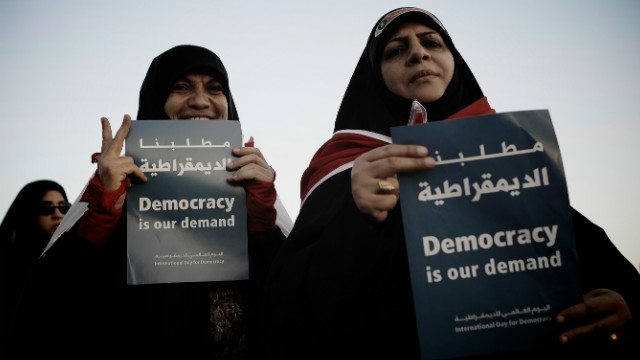
Rights group urges Bahrain to lift ban on protests

Rights group Amnesty International has called on Bahrain to lift a ban on all public protests immediately, saying it violates people's right to free speech and peaceful assembly. The ban was announced by the Interior Ministry on Tuesday on the grounds that public rallies "jeopardize civil peace and disturb security and general order," according to the state-run Bahrain News Agency.The government had sought to protect freedom of expression, but "that privilege has been abused repeatedly by organizers' violations" and people's lack of respect for the law, Interior Minister Sheikh Rashid bin Abdullah Al Khalifa is quoted as saying. Rallies will remain outlawed until "security is maintained," BNA reported.

Bahrainis hold anti-regime demonstrations in Manama despite ban

Bahraini anti-regime protesters have once again staged rallies in the capital Manama despite a recent ban on all opposition protests and public gatherings. The angry protesters took to the streets in support of political prisoners being held in jails, including opposition leader Hassan Mushaima. The family of Mushaima says he is gravely ill and needs immediate medical attention. Senior Bahraini cleric Sheikh Isa Qassim said the Al Khalifa regime has denied treatment of Mushaima in jail despite his “frightening” health condition. Bahraini security forces used tear gas and rubber bullets to disperse the demonstrators in Manama. The recent demonstration comes after Bahrain’s Interior Ministry imposed a ban on all protests and gatherings across the country and cited anti-regime demonstrations as repeated abuse of the rights to freedom of speech and expression. “All rallies and gatherings have been suspended and no public activity will be allowed until security and stability are achieved,” said Interior Minister Shaikh Rashid bin Abdullah Al Khalifa on Tuesday. “Rallies and gatherings will be considered illegal and legal action will be taken against anyone calling for or taking part in them.” Bahraini protesters have been holding anti-regime demonstrations since February 2011 and they hold King Hamad bin Isa Al Khalifa responsible for the death of demonstrators during the uprising. The protesters say they will continue holding demonstrations until their demand for the establishment of a democratically elected government is met.

Key suspect in Malala shooting arrested along with others

Interior Minister Rehman Malik said on Wednesday that the key suspect involved in shooting 15-year-old child activist Malala Yousufzai, Ataullah along with all the others has been arrested, reported BBC Urdu. Malik said that Ataullah was arrested along with his fiancée. According to the report, Khan had crossed over from Afghanistan in to Pakistan, before making his way to Swat. There, he tracked down his target, intercepting Malala’s school van on October 9, 2012. He fled shortly after the assassination attempt. Khan, a former Swat resident, was last week identified by police officials as the main suspect in the shooting incident. Police said that Khan had been a studying for a master’s degree in chemistry prior to opting for militancy and had studied for his Bachelor of Science degree in physics at Jahanzeb College in Swat. The interior minister said that the Tehreek-e-Taliban Pakistan had adopted a new strategy of carrying out attacks and were now teaming up with proclaimed offenders. Responding to a question regarding handing over of Maulana Fazlullah, Malik said that the government had not only spoken with Afghan President Hamid Karzai, but a written application had also been sent out to the Afghanistan government. However, he said, the Afghan government has not yet responded. Pakistan had requested Afghanistan to hand over Maulana Fazlullah, claiming that he was involved in planning major attacks in Pakistan from across the border, including the attack on peace activist Malala Yousufzai. Malik said that Malala shooting cannot be used as justification for demanding a military offensive in North Waziristan. He said that before a military operation, many aspects are looked into, on top of which is the security of the locals. The evacuation of inhabitants of that area is one of the implications other than appropriate time, weather and action.

Afghanistan presidential election set for April 2014

Afghanistan will hold its next presidential election on April 5, 2014, the Election Commission announced on Wednesday. President Hamid Karzai, who is constitutionally barred from seeking a third term, had denied speculation that security problems and the exit of foreign troops that year would delay the poll. The credibility of the vote will be vital to the security and stability of Afghanistan after the final foreign combat troops have left by the end of 2014. Karzai's re-election in 2009 was blighted by allegations of fraud.

India Okays cricket series with Pakistan

Indian media reported on Tuesday that Pakistan may tour India in December. The likely venues for the matches are Ahmedabad, Chennai, Bangalore, New Delhi and Kolkata. Bilateral cricketing ties were snapped following the Mumbai terror attacks in November 2008, though the two countries have played each other in the World Cup, Champions Trophy and Asia Cup. It is Pakistan s turn to host a bilateral series between the two. But there has been no international cricket in the country between Full Members since the March 2009 attack on the Sri Lanka team bus and it is understood that India are not keen to play at a neutral venue, as has been the case with all Pakistan s home series since the attack. The decision was taken by the BCCI at its working committee meeting few months back. Rajiv Shukla, a senior BCCI official had said the plan was to hold the three ODIs in Chennai, Delhi and Kolkata, and the Twenty20 matches in Ahmedabad and Bangalore. The decision comes after prolonged, high-level consultations between officials of the two boards and, latterly, of the two governments.

Baluchistan latest epicenter of attacks on Pakistani press

By
Sumit Galhotra/CPJ Steiger Fellow
It is one step forward and two steps back in Pakistan's restive Baluchistan province. The nation's highest court has acknowledged the dangerous climate journalists face in Baluchistan, but it has also affirmed a directive that only adds to the pressure cooker conditions that journalists work under. Last week, Chief Justice Iftikhar Chaudhry affirmed the Baluchistan High Court's order to bar news coverage of banned groups, which has caused tension among journalists. The order restricts the media from publishing or airing news items that cover banned groups or project their views. Journalists, however, are under intense pressure to report in line with the views of various militants and separatists. Now, pressure is being exerted from the other side as well. "It has become very difficult to work in such a stifling climate of threats," Essa Tareen, president of the Baluchistan Union of Journalists, told CPJ by phone. "Just today, we received news of a case where a journalist named Nadeem Garginari, a senior journalist and the president of Khuzdar Press Club, was targeted by miscreants just minutes ago. One of his sons was killed and another injured in the incident," he told CPJ. CPJ is investigating possible motives in the attack to determine if it is connected to Garginari's work as a journalist. Instead of providing relief to journalists, authorities recently lodged complaints to the police (or first information reports, as they are known in much of South Asia) against them for staging a sit-in to protest the murder of Abdul Haq Baloch last month in Khuzdar and the breakdown of law and order in the region, Tareen said. Noting this lack of law and order, Pakistan's Supreme Court issued an interim order last week asking the federal government to take effective measures to protect the lives and property of the people in Baluchistan, stating that the provincial government has been unable to maintain control. Chief Justice Chaudhry said incidents of targeted killings were taking place on a daily basis and that journalists were not safe there, according to news reports. Baluchistan--Pakistan's largest province by area, but smallest by population--is mired in a separatist movement, a conflict that has existed since the inception of Pakistan in 1947. The province is plagued by sectarian strife, tribal feuds, and criminal activity, with daily disappearances and targeted killings. On top of that, the capital, Quetta, and its surrounding towns are rearguard headquarters and staging areas for the Taliban, Al-Qaeda, and other groups fighting in Afghanistan. According to official figures, at least 868 people have been killed, 619 kidnapped, and 2,390 gone missing from the province since 2010. Journalists there face pressure from a number of sources: pro-Taliban groups and Pakistani security forces and intelligence agencies, as well as Baluch separatists and state-sponsored anti-separatist militant groups. The province receives scant international media attention amid the rest of Pakistan's political turbulence. But if Pakistan is one of the deadliest countries for journalists, then Baluchistan has become one of the country's hubs of hazard. CPJ research shows that this year alone, five journalists have been targeted and killed for their work in Pakistan--three of them in Baluchistan. More than a dozen journalists have been killed in the province since 2008. Local groups tend to put the numbers of journalists killed higher, but because of the political turmoil it is often impossible to discern the reason for an attack as many journalists straddle the line between political activism and reporting. Just last month, Baloch, also a longtime local correspondent for ARY Television, was shot by unidentified assailants. Hamid Mir, a prominent Pakistani journalist, wrote after Haq's death that the journalist had been threatened by the state-sponsored Baloch Musalah Diffa Army in November 2011 and had subsequently been named on a hit list issued by its spokesman. Haq's family declined to discuss widespread assertions by his colleagues that he was killed because security forces were angry that he was working with the families of missing Baluchis on presenting cases before a court. While the government announced that a judicial commission will be set up to ascertain the facts about Haq's murder, no information has surfaced to date. Past instances have shown that commissions and inquiries such as these are mainly symbolic, and few, if any, concrete steps are taken to address the impunity that exists in Pakistan. The country is ranked 10th on CPJ's Impunity Index, which spotlights places where journalists are murdered regularly and their killers go free. Conditions continue to look bleak for journalists operating in the province, as they do across Pakistan. Earlier this year, CPJ expressed concerns that the issues faced by journalists are inextricably linked to larger endemic problems in Pakistan, and applauded efforts by the Human Rights Commission of Pakistan to draw attention to the "constant cloud of intimidation and violence" under which journalists live. The chief justice's recent acknowledgment only adds to the resounding chorus demanding a change in the forecast.

Pakistan: Troops, tanks roll into Khyber

A large number of regular Army troops have been deployed for launched an operation in Khyber Agency, reported BBC on Tuesday. The move came following a clash between security forces and militants. According to eyewitnesses, security forces have cordoned off several areas in Barqamber Khel and Sepah, while arresting many suspects on Tuesday morning. Locals say that all major roads leading to Bara were closed creating difficulties for them. Locals say that regular military troops are being deployed in Bara sub-division. They say that scores of military personnel are entering Bara sub-division with tanks. Ahmad Nabi from Khyber Agency adds: Three persons including two children were killed on Tuesday when a mortar shell landed at the house of a tribesman in Sepah area of tehsil Bara, official and local sources said. Sources said that a stray mortar shell fired by unknown militants from unknown area hit the house of one, Saidullah which killed him alongwith two other children on the spot. The house was also damaged in the incident, sources said. In addition three unknown bullet-riddled bodies were recovered from tehsil Bara on Tuesday, locals said. All the three persons had been shot and killed, sources said. Identification of the deceased could not be confirmed till filing of this report. Meanwhile, the forces action was in progress in Bara and the dwellers of Shlober, Qamber Khel, Sem Baba and Malikdin Khel were instructed on mega phones to stay at their homes. Most of the families have evacuated their residence in the operation zones and have taken refuge in mosques and schools in Ber-Kamber Khel and were being providing food and water by the locals.

Don't Let the 'Malala Moment' Pass

By: Sonia Nassery
A 15-year old girl lies in a London hospital, air-lifted from Pakistan after an assassination attempt. Malala Yousafzai's "crime"? Believing that girls deserve the right to education. The attack was apparently ordered by a Taliban leader whom the Washington Post wrote is "infamous for his long campaign against female education." Thousands marched in cities across Pakistan in protest as pictures of this brave young girl became a rallying symbol. But less than two weeks later, the New York Times wrote that the "Malala moment" has passed, and the country has drifted back into religious extremism, conspiratorial paranoia, and chaos. Is this region, which has witnessed so much bloodshed, including the final sacrifices by American and allied servicemembers, beyond hope? Is extremism the inevitable conclusion of religious Muslims, or a perversion of Islam and a minority view within Afghanistan and Pakistan? I believe passionately that the latter is true, and I say this as an Afghan American facing death threats for my advocacy work for Afghan women. I have spent three decades involved in Afghan relief and giving voice to the voiceless people of Afghanistan, first in response to the Soviet invasion, and then to the tyranny of the Taliban, which hijacked Islam and claimed authority under the name of my religion. I spent over two months in Afghanistan in 2010, filming the first feature film to be entirely shot there in my lifetime. Black Tulip was made for simple reasons: To show the world how real families live in my country, and how true Muslims practice Islam, a religion which is the antithesis of the Taliban's terror. Extremists' hardened hearts may never change, but the real battle is for the majorities in both this conflict region and in the West. I believe that we must not let the Malala moment pass. We need to recognize the common aspirations of most families in every country; to refuse to let any religion be hijacked; and to insist on giving all individuals both basic human rights and education, which is the path to understanding and personal improvement. In the region of my birth, as Malala's plight makes clear, women are both the battleground and our greatest hope. As the West moves to end its military role in the region, it is all the more important that commonality is understood and nurtured. It is shocking to us to see quotes from Pakistanis wondering if Malala was really the victim of the Taliban or of some American plot. Unless one assumes a mass psychosis, such thinking must be seen as coming from a Pakistani media that too often whips up hatred rather than searches for truth, and a national mood that is understandably angry and preoccupied over civilian deaths from U.S. drone attacks, yet forgetful of the decades of U.S. humanitarian and economic aid. I believe that most people in the region understand and appreciate America's help, but it is easy to question a nation's intentions when you fundamentally do not know its people or its values. And that problem goes both ways. The comments of my native-born American friends who have seen Black Tulip have been both heartwarming and surprising. "Thank you for giving me a window to a world I have never seen before. With all of the media coverage of the war, this was the first time I really saw Afghanistan in its beauty and culture -- it makes the reality of what we're fighting for and identifying the enemy so much more powerful," one friend told me. "I had no sense of how a Muslim family in your country really lives -- what they eat, how they relate to one another, what their daily lives are, " another said. This hasn't been the role of our media -- all we see are men with guns and women with burqas -- and headlines are grabbed by the outrageous, not the ordinary. And for a generation, it hasn't been safe to film in my country, so how could these stories of ordinary life be told? That's why we stayed and kept the cameras rolling, even when the Taliban threatened us. The stakes for my film crew and me were personal, but the larger effort really impacts us all: Our enemies want to keep us strangers to one another, just as they needed to silence young Malala. Terror by definition works on our fears and forces us to retreat away from others in a desperate effort to stay safe. Thousands of Pakistanis and Afghans chose a very different approach when they took to the streets in mass demonstrations against the Taliban attempt on Malala's life and the broader effort to force women into a kind of slavery. It is hard to maintain this public passion knowing the likely retribution of a brutal enemy. That's why the West must bolster moderate voices and ensure access to education, which unquestionably is the ultimate change agent. If we turn our back on this struggle, we betray those Americans who have already given their lives. We write off a generation of women who could bring stability to countries too long victimized by violence, and we threaten our own safety by allowing a major world religion to be perverted by fanatics into a rationale for harming us. These are big stakes. Knowing them, Malala continued to speak and write despite death threats. Those stakes motivated us to create Black Tulip in spite of the risks. Let us all keep those stakes vividly in front of us, vowing not to let the Malala moment pass.
Sonia Nassery Cole is an Afghan American activist who founded the Afghanistan World Foundation in 2002. She is author of Will I Live Tomorrow? and director of Black Tulip, which was Afghanistan's official entry for the 83rd Academy Awards. The film premieres in theaters and on demand this week. is an Afghan American activist who founded the Afghanistan World Foundation in 2002. She is author of Will I Live Tomorrow? and director of Black Tulip, which was Afghanistan's official entry for the 83rd Academy Awards. The film premieres in theaters and on demand this week.

Malala The 'Voice Of Swat Valley'

Radio Free Europe/Radio Liberty
As Malala Yousafzai clings to life following a gun attack by the Pakistani Taliban, people around the globe are paying homage to the 14-year-old's bravery in defending her and others' right to an education. One is Abdul Hai Kakar, a former BBC Urdu Service reporter and current RFE/RL Radio Mashaal broadcaster who helped bring Malala's message to the world's attention. Interview conducted by Frud Bezhan. RFE/RL: When did you first meet Malala?
Abdul Hai Kakar:
In 2008, the Taliban took control of the northwest Pakistan Swat Valley. They imposed a ban on girls' education. I was working for the BBC and floated an idea that I would like to start a diary from Swat that would be genuine, I mean from a Swat girl. [I wanted] to give a human touch and first-hand eyewitness account of the conflict, which was a very humanitarian conflict. Malala Yousafzai's father was my friend and he was running a school in the Swat Valley. I talked to him because [I was hoping] he could find a schoolgirl for me. He tried for days and called me back and said nobody was ready to talk because everyone was afraid of the Taliban. But he hesitantly told [me] that if I agreed, then his daughter could work with me. Then I contacted her and started the diary. RFE/RL: How much risk was Malala taking in writing the online diary for BBC, a project she began at the age of 11? What measures were taken to ensure her safety?
Kakar:
Anybody in Pakistan who speaks against the Pakistani Army and the Pakistani Taliban [is a target because] there is a jihadist paradigm, jihadist mindset, and jihadist narrative. Anybody in Pakistan who is countering this narrative is a target. I thought [Malala] would be like that because she was giving us first-hand information, her perspective, and she was representing Swat. That would [pose] a problem both from the Taliban and the army. There was an impression that the Taliban and Pakistani army were and are the same faces of one coin. Then we decided that her [pseudonym] name should be Gul Makki. Gul Makki in our folk stories is a heroine. I wanted to give an indigenous, symbolic attachment to Swat and so that the people could own it journalistically. RFE/RL: You have said Malala was very close to you and your family. What is she like?
Kakar:
[There] were two or three things I liked about her. She was very confident. Whenever she was talking she wasn't shy. She belongs to a tribal area, so, in our region it's difficult for the child to talk to their elders. They're shy, but she was not. The second thing was she had a very good political understanding of her area. She was influenced by her father, obviously, because he was a political activist and he was trying to talk to her to tell her the environment. So she had good knowledge of the area and she was trained by her father how to talk to the media. Thirdly, she was a very keen observer. When she was writing her diary, it was like the voice of Swat Valley. Everybody I met would say, "Wow, this is a very nice diary." And what we have seen in the content is all true. RFE/RL: What was your role in the writing process and publication of her diary?
Kakar:
I talked to her and told her, "You can tell me on [the] telephone what you did that day, what you thought, what were your feelings, and what you saw." So [I told her] just share with me and I will take notes and then I will write it down. So, from my wife's telephone number I would call [Malala] because her [my wife's] phone was safe. So we used to talk to each other for 30 minutes each night for five or seven days [in a row]. Then after that I would send it to BBC English and Urdu to publish. RFE/RL: How important was it to publish Malala's diary? What kind of effect did it have in Pakistan?
Kakar:
So when people saw [Malala's diary], it was appealing for them journalistically and also for the international media. I mean, the Pakistani media was not highlighting the humanitarian issues but trying to show the world that it was only a security problem. But this diary gave a humanitarian face to the tragedy. All the international media was lifting this story. RFE/RL: What kind of effect has the attack on Malala had in Pakistan? Has it led to greater condemnation of the Taliban or the Pakistani Army, which many Pakistanis believe supports militant groups?
Kakar:
This [diary encouraged]...people to hate the Taliban and they unanimously condemned them. All the people are with Malala -- I would say 180 million people [Pakistan's population] are with Malala. So, it [highlights] what she meant for the people. She was a kind of a celebrity for them and they have an attachment with her. She is symbolizing the rights for [girls'] education. She shook the entire country and [only] now the people are debating and talking about how to fix the Taliban, army, and jihadist mindset and the militants.

Sharif brothers’ dream to rule country would never be realised

Pakistan People’s Party (PPP) Punjab President Manzoor Ahmad Wattoo on Tuesday said that Sharif brothers would know their real worth during the next elections. He was talking to delegations of PPP workers from Lahore and Sahiwal. While addressing them, he said that Sharif brothers were dreaming of Zia ul Haq’s days but that will remain their dream which would never be realized. Wattoo alleged that Punjab government was concentrating all its attention on the development of Lahore and there was none to look at the plight of other parts of Punjab. He said the PPP has been doing the politics of poor and was confident that it would emerge victorious in the province in the next elections. He held PML-N as the product of a dictator but made it clear that in future no one would be able to come through the backdoor and people of the nation would decide the destiny of Pakistan in the future. He said PPP was preparing for elections in Punjab and with the support of the allies, they would prove that Punjab belongs to PPP and no power would be able to stop them from victory in the province.

Pakistan:Interim govt to take over on March 19

Federal Information Minister Qamar Zaman Kaira on Tuesday said that caretaker setup would assume charge after March 18 and general elections will be held according to the time stipulated in the constitution. “Interim government will take charge from the incumbent government on March 19, 2013,” Kaira said after having a meeting with Norwegian ambassador at his residence. Talking to the media persons, he said that if consensus about the caretaker setup had not been formed before mid-March, the Election Commission would decide in this regard. The government does not want to waste its efforts made in the last four and half years by delaying elections and such rumours are being spread by the opposition, the minister said. “Delaying elections is not possible in the presence of independent judiciary, vibrant media and civil society. Opposition is spreading such rumours for the fear of defeat,” he added. Kaira said the PPP had spurned the practice of political victimisation. Criticising Pakistan Muslim League-Nawaz (PML-N) leadership, he said the PPP had not compromised on principles despite having troubles in the past while the Sharifs had preferred inking a 10-year exile agreement with General (r) Pervez Musharraf to save their skins. To a question, he said the government did not believe in victimising its opponents, adding that nobody can pinpoint even a single example of political victimisation during the tenure of the PPP. The information minister said that the Punjab government was busy in victimising its political opponents, referring the registration of cases against a PPP MPA, Shaukat Basra. To another question, he said: “The PPP members have accepted the appointment of Mian Manzoor Ahmed Wattoo as their Punjab president. Some PPP workers have reservations about the alliance with PML-Q, however, this is not an issue for a big political party. The federal information minister urged the institutions to work within their limits. Earlier, the minister hosted a luncheon meeting for Norwegian envoy to Pakistan Cecillie Landsverk and head of opposition Conservative Party Ms Erna Salberg. In the meeting, the leaders discussed matters of mutual interest. Talking to media persons, Ms Erna said Pakistan and Norway enjoy cordial relations. Pakistanis are playing important role in the development and progress of Norway. The policy-makers of Norway keep the interests of foreigners residing in Norway supreme before finalising the policies. She said Pakistanis are playing major role in the development and progress of Norway. Norway has softened the immigration laws aiming to facilitate the foreign workers, who want to bring their families with them. Ms Erna expressed her goodwill and best wishes for the forthcoming general elections in Pakistan. She said a Pakistani player is serving in the football team of Norway. After Swat operation the whole world accepted the sincerity of Pakistan in fighting terrorists. The minister thanked the envoy and Ms Erna for visiting his ancestral home. He said the government in collaboration with the opposition has already appointed a neutral CEC to ensure free, fair elections.

Pakistan: Secondary schools lack basic facilities

The government boys’ secondary schools monitored in September lacked basic facilities like libraries, playgrounds, physical training instructors, staffrooms and apparatus for science experiments, says a Free and Fair Election Network (FAFEN) report. The report released on Wednesday said FAFEN monitors collected data from 118 secondary schools in 73 districts. They found 37% schools without libraries; 35% having no playgrounds; 25% not having physical training instructors; 20% lacking staffrooms and 21% not possessing science apparatus. Despite these shortcomings, the findings suggested some positives. Up to 98% schools operated out of proper buildings, 86% had boundary walls and classrooms of 97% of them were clean. Ninety-seven percent schools had electricity with 89% having fans; 96% percent had desks and benches/chairs for students while 97% had them for teachers. Moreover, services of peons were available in 98% schools; cleaners (94%) and watchmen (84%). As for teaching staff, 9% positions lay vacant – Sindh (17%), Balochistan (7%) and Punjab and Khyber Pakhtunkhwa (6% each). However, the situation was slightly better for non-teaching staff with only 6% positions unoccupied. Of these 11% were in Punjab, Balochistan (8%) and Khyber Pakhtunkhwa and Sindh (3% each). The students-per-teacher ratio was satisfactory (26) and well below the government-set limit of 50 for high schools. Punjab had the highest ratio (27), followed by Khyber Pakhtunkhwa (26), Sindh (22), Balochistan (20) and Federally Administered Tribal Areas (15). The monitors reported low government oversight of these schools. The July-September quarter saw only 26 visits – Punjab (13), Sindh (7) and Khyber Pakhtunkhwa (6). The Executive District Officers/Education made the most visits (15) followed by government officials other than EDOs (9) and an MPA and another elected representative (one each).

European Parliament slams Pakistan for HR abuse

The European Parliament has slammed Pakistan for its "grave human rights abuses" and raised concern over the "pathetic condition" of the girl child in that country as it condemned the attack on Malala Yosufzai. It also called for a determined effort by the international community to use its moral, financial and military power to stem the rot that "afflicts certain societies where children have become targets of terrorist organisations like the Taliban which continue to have support and sanctuaries in Pakistan". During a debate organised in the European Parliament on March 26, the members of South Asia Peace Forum (SAPF) highlighted the pathetic condition of the girl child in Pakistan. The emergency debate specially focused on the discrimination against girls in Pakistan with special reference to Malala Yousafzai. "The members of the European Parliament spoke at length about the situation of human right abuses," an official statement said. The debate highlighted the attack in the city of Mingora in which the 15-year-old Malala was targeted. "Malala is widely respected for her work to promote the schooling of girls; something that the Taliban strongly oppose and apparently became the reason for the attack," it said. Malala was shot in her hometown of Mingora in the Swat Valley of Pakistan on October 9 and was flown to Britain two weeks ago for treatment at the Birmingham hospital. Charles Tannock, Member of European Parliament (MEP) during the debate said that, "This is more than just the case of the shooting of one brave girl, but a crisis for the entire Pakistani education system". He added that Pakistani government must take immediate steps to protect students, teachers, schools, and rights defenders at risk of attack and stressed that, "It's time for Pakistani authorities to understand that expressions of outrage alone are inadequate and such attacks will only end if they hold abusers accountable". He said that the people who seek to harm children are nothing but "cowards who fear the rise of their voice". "The members of European Parliament and members of SAPF called for a determined effort by the international community to use its moral, financial and military power to stem the rot that afflicts certain societies where children have become targets of terrorist organisations like the Taliban which continue to have support and sanctuaries in Pakistan," the statement said.

Peshawar to have model child protection institute soon

The Khyber Pakhtunkhwa Child Protection and Welfare Commission would set up an institute in the provincial capital soon where children at risk would be provided shelter, counselling and other needed support, said an official. Mohammad Ijaz Khan, deputy chief child protection and welfare officer, told Dawn that the commission was going to set up a child protection institute in Peshawar by end of November. “Funds have been allocated for the purpose,” he said. The building of the institute, constructed on Dalazak Road over a 13-kanal piece of land, would have two separate hostels for male and female children. About 70 boys and 30 girls could be accommodated in the hostels, the official said. “It will be a model child protection institute where children (below the age of 18 years) would be provided shelter and rehabilitation facilities,” said Mr Khan. He said that staff, qualified to deal with children at risk, would be hired for the institute. The children at risk including beggars, orphans and those who are trapped by criminal gangs as well as the children referred by court will be provided shelter at the institute. “If in the long run they need permanent shelter, these children will be referred to the orphanages run by the social welfare department,” the official said. He said that the commission, set up under Child Protection and Welfare Act 2010, became functional in May 2011 and received more than 4,000 cases of children at risk. The data was complied with the help of eight child protection units working in Peshawar, Mardan, Swabi, Kohat, Charsadda, Abbottabad, Buner and Swat districts. Mr Khan said that most of the problems were related to out-dated customs and violence resulting in violation of child rights. Forced child marriage of girls was also a serious issue, he said, adding that cases of corporal punishments were also reported. “Anybody from community or a child at risk can inform these units at the helpline 1121 and the unit’s team can come and collect the child caught in some problem,” the official said. He said that most of the children, who were at risk or faced some problem, would be protected and provided counselling at the institute. “We feel that best place for a child is his home and his family so we would focus on their rehabilitation and reunion with their families,” Mr Khan said. He said that the institute would be a bit different from other institutions run by the social welfare department for children as it would be a model institute. The official said that the commission came to know that many institutes run by the government and non-governmental organisations had no standing operating procedures. Every institute like orphanages, beggar welfare homes and shelter homes had its own procedure, he added. “We are devising a uniform standing operating procedure for all the government and private institutions dealing with issues of children,” he said. The official added that the commission was actively monitoring policies affecting children and it was also its task to make efforts to implement laws related to basic rights of children. Mr Khan said that the commission was going to bring uniformity and accountability by making registration mandatory for all such government and private institutes. The commission would issue them No Objection Certificate, necessary for them to operate, he added. The commission would ensure that all the institutions dealing with children had uniform rules and standards, said Mr Khan.

Peshawar: Pabbi girls demand furniture for college

Parents of Government Girls Degree College students on Tuesday appealed to provincial to provide the college with classroom furniture as the students were currently sitting on the floors. . They said that while the government was claiming it was spending billions of rupees on education, their college did not even have chairs for students. They said that it seems that the money claimed to be used on education is being misused somewhere else.

Karachi:Call for army to takeover

Editorial: Frontier Post
No doubt that the situation in Karachi, the largest city of Pakistan and the country’s economic capital, continues to deteriorate as target killing, extortion and kidnappings for ransom are rampant despite all assurances by the provincial government, police and Sindh Rangers, and the environment for smooth business is totally absent, yet the plea taken by the business on Monday involving the Federation of Chamber of Commerce and Industry that the city should be handed over to the army even for a short period of four to six weeks, cannot be supported for reasons. First it is a negation of democratic norms that all stakeholders have kept intact despite odds. Secondly, the army is already engaged in more important task of cleansing tribal agencies of extremists and terrorists who have again raised their ugly head with vociferous mischief of challenging the writ of the state. Therefore, deploying them is Karachi would mean diverting army’s attention from the more important issue of salvaging the country from a stinking impasse.Why it is always necessary to call in army to mend the wrong of the civil administration, be it earthquake or floods as the civil administration always lays off its hand showing its inability to take up the various challenges. And thirdly, law and order is the exclusive responsibility of the government of Sindh and only the provincial administration is obliged to rectify its national wrongs and give the citizen a right to live and live peacefully. Karachi’s business community on Monday resolved in favour of a strike, by although a divided vote. No-one can refute the community’s allegations and fear, yet a degree of acceptability has to be ensured. Karachi is probably heading for still worse in the wake of at least 10 people dying daily on an average due to rampant target killing and snipers firing. The strike call was endorsed by the President of Pak-Indo Chamber of Commerce SM Muneer who also insisted on the deployment of army. A call for strike is the legitimate right of the business community but nothing beyond that should be demanded or accepted. However, one group, which met governor Isharatul Ibad and accepted his assurance once again, is opposed to the strike call. Developing from land mafias, the city is in the grip of more mafias that have, of late, pinpointed traders, industrialists and other business persons who are facing serious threats from extortionists and receiving bullets and hand grenades for non-payment of “Bhata”(Extortion money). As such the call for strike and deployment of army appears to be the agony of a frustrated mind when the mainstream industry of Pakistan is badly suffering’ industrial units are closing down and investment is being shifted elsewhere. Political parties, especially the ruling coalition partners Pakistan People’s Party and the Muttahida Qaumi Movement, who were supposed to restore peace and create an environment of business and other socio-political activities seem to have become helpless and redundant. But not only the two coalition partners, all political parties owe the blame of not contributing to political steps that are necessary and required to bring Karachi back to normalcy. Who does not know the emergence of mafias? They were once the blue eyed groups of political activists patronized by a host of political organizations and are now conducting themselves like Frankenstein for their patrons. It was generally believed about a decade ago that Karachi’s problem stems out from political waywardness. The things might have changed in gravity; but this remains a political issue and its resolution also lies in skillful political craftsmanship. However, a strong political will is still the answer and if all the stakeholders demonstrate the desire for peace in the troubles city and also the will, a solution can still be found.

Pakistan: Country’s image tarnished by 1990 elections

Radio Pakistan
Information Minister urges PML (N) leadership to pay respect to Supreme Court's verdicts and face investigation. Information Minister Qamar Zaman Kaira has said that those involved in subverting people's mandate in the 1990 general elections should apologize to the nation. In an interview‚ he said the country's image was tarnished by rigging the elections. He said elections were totally maneuvered by agencies. The Minister said that in the past‚ the PML (N) had come into power through rigging and the Supreme Court verdict in the Asghar Khan has proved this reality. He urged PML(N) leadership to pay respect to the court's verdicts and face investigation. To a question‚ he said that action against those involved in misusing the public money would be taken according to the law. The Minister said that Islami Jamhori Itehad was formed by the generals and the establishment. He said when the PPP came into power in 2008‚ the country was confronted with a host of problems‚ inlcuding terrorism and power load-shedding. The government initiated several steps to steer the country out of the crises.

Tuesday, October 30, 2012

New York's subways swamped after Sandy

Gov. Christie Mourns Loss of Life and Shore Icons

Visibly exhausted and somewhat breathless from a tour of Hurricane Sandy’s devastation, Gov. Chris Christie of New Jersey took a few minutes on Tuesday evening to take stock of what was lost and mourn what he said could not be replaced. The vacation spots and haunts of his youth along the Jersey Shore were gone, he said. The roller-coaster and the log flume and the little kiosk that sold sausage and peppers were washed away. The piers and boardwalks where he took his children on vacation and where he was recorded shouting down a critic, ice cream cone in hand, were now buried in muck. “We’ll rebuild it,” he said in an evening news conference. “But for those of us who are my age, it will not be the same. Many of the iconic things are gone, washed into the ocean.” Thankfully, Mr. Christie said, the loss of life was minimal. At least six people died in the storm, he said, killed primarily by falling trees. About 1,000 people had been rescued from flooded regions, and 4,500 people remained in shelters, he said. Thousands remained without potable water, and as many as 2.6 million people had no power, he said. But by Tuesday evening electricity had been restored at Newark Liberty International Airport, and the Garden State Parkway had reopened — with tolls reinstated. The governor would not venture to guess what the cost of recovery would be: “We’ll be talking about numbers with a ‘B,’ ” he said. But he said federal money and private insurance would ensure that the burdens on the state budget would be minimal. “Today was a day of sorrow, and we need to feel that,” Mr. Christie said. “But as long as sorrow does not replace resilience, we’ll be fine.”

Aerial view of New Jersey destruction

Obama To Visit Storm-Ravaged New Jersey as Death Toll Mounts

http://www.voanews.com
U.S. President Barack Obama will visit the storm-battered state of New Jersey Wednesday to view damage with the governor and thank emergency workers struggling to cope with the disaster. The visit, announced Tuesday by the White House, comes as a vast army of rescue and utility workers confront the wreckage from Hurricane Sandy. The storm hit the New Jersey shore late Monday as a powerful tropical storm, causing massive flooding, raging fires and power outages that crippled the New York metropolitan area. The storm, which stalked the East Coast for days before coming ashore, has killed at least 43 people. Earlier Tuesday, the president declared "major disasters" in New York and New Jersey, freeing up federal funds aimed at off-setting billions of dollars in East Coast property damage. New York Mayor Michael Bloomberg said many of the city's flooded subway tunnels are closed, and warned that the city faces days, if not weeks, of storm recovery challenges. "The damage we suffered across the city is clearly extensive and it will not be repaired overnight. The two biggest challenges facing our city going forward are getting our mass transit system up and running and restoring power," said Bloomberg. Trading at the New York Stock Exchange was canceled Tuesday for a second day in a row, marking the first time since 1888 that trading has been suspended for two consecutive days because of weather. It will open on schedule Wednesday. In neighboring New Jersey, a possible berm breach has caused flooding in several towns, forcing at least 800 people to evacuate. Also, a New Jersey nuclear power plant declared an alert after waters rose to a designated high-level mark. Officials said there were no safety concerns at the plant, which was shut off for maintenance. In a news conference, New Jersey Governor Chris Christie said a popular vacation destination in his state has been hit hard. "The level of devastation at the Jersey shore is unthinkable," said Christie. VOA's Daniela Schrier took her camera to the East Village district in Lower Manhattan Monday night to document the damage from flood waters rushing city streets.

President Obama Signs New Jersey Disaster Declaration

The President today declared a major disaster exists in the State of New Jersey and ordered Federal aid to supplement state and local recovery efforts due to Hurricane Sandy beginning on October 26, 2012, and continuing. The President's action makes Federal funding available to affected individuals in the counties of Atlantic, Cape May, Essex, Hudson, Middlesex, Monmouth, Ocean, and Union. Assistance can include grants for temporary housing and home repairs, low-cost loans to cover uninsured property losses, and other programs to help individuals and business owners recover from the effects of the disaster. Federal funding is available to state and eligible local governments and certain private nonprofit organizations on a cost-sharing basis for debris removal and emergency protective measures, including direct Federal assistance, for the counties of Atlantic, Cape May, Essex, Hudson, Middlesex, Monmouth, Ocean, and Union. Federal funding is also available on a cost-sharing basis for hazard mitigation measures statewide. W. Craig Fugate, Administrator, Federal Emergency Management Agency (FEMA), Department of Homeland Security, named Michael J. Hall as the Federal Coordinating Officer for Federal recovery operations in the affected area. FEMA said that damage surveys are continuing in other areas, and more counties and additional forms of assistance may be designated after the assessments are fully completed. FEMA said that residents and business owners who sustained losses in the designated counties can begin applying for assistance by registering online at http://www.DisasterAssistance.gov or by calling 1-800-621-FEMA(3362) or 1-800-462-7585 (TTY) for the hearing and speech impaired. The toll-free telephone numbers will operate from 7 a.m. to 10 p.m. (local time) seven days a week until further notice.

Republican New Jersey Governor Christie praises Obama

Republican New Jersey Governor Chris Christie, a fierce critic of Barack Obama, praised the president and the federal government's response as the brutal storm Sandy swept through his state and caused widespread damage and power outages. Christie has attacked Obama repeatedly on the campaign trail and said the Democrat does not deserve a second term in the White House, instead backing Republican challenger Mitt Romney in the November 6 election. But on Tuesday, just hours after the worst of the once-hurricane knocked out power for 2.4 million people in the state just south of New York City, Christie applauded Obama and his administration's Federal Emergency Management Agency in interviews on nearly every major television network. "The federal government response has been great. I was on the phone at midnight again last night with the president personally," he told NBC's "Today" program. "The president has been outstanding in this. The folks at FEMA ... have been excellent," said Christie, once thought to be a contender for the White House or Romney's vice presidential pick. The governor's praise comes just a week ahead of the presidential election, with polls showing the race as a dead heat. The monster storm has caused havoc up and down the East Coast, forcing Obama and Romney to suspend their campaigns for two days. On "CBS This Morning," Christie said he spoke with Obama three times on Monday as the storm hit. Obama on Monday declared New Jersey a major disaster area so the state can quickly receive federal aid. "I can't thank the president enough for that," Christie told CBS.

U.S.: Race is tied, but most think Obama will win: Reuters/Ipsos poll

The U.S. presidential race remains a dead heat one week before Election Day but most Americans think President Barack Obama will defeat Republican Mitt Romney, according to a Reuters/Ipsos daily tracking poll released on Tuesday. Obama leads Romney among likely voters by 47 percent to 46 percent, a statistically insignificant margin, the online survey found. Neither candidate has held a clear lead since early October. But 53 percent of all registered voters predicted Obama would win the November 6 election, while only 29 percent said Romney would be the victor. A majority also said that they expected Obama to win their state. That reflects the opinion of many analysts and pollsters who say Obama holds a tactical advantage in the state-by-state battle to win the White House. Because Obama starts off with a greater likely number of states' electoral votes, Romney must win a higher number of the seven to 10 states that remain truly competitive. Obama also holds an advantage among the 22 percent who said they have already cast their ballots. Some 55 percent of this group said they had voted for Obama, while 40 percent said they had voted for Romney. The four-day poll was not affected in a significant way by Hurricane Sandy because only a small fraction of the 3,293 interviews were completed after the storm hit on Monday afternoon, Ipsos pollster Julia Clark said. Some other polls have suspended their activity due to the storm. The accuracy of Reuters/Ipsos polling is calculated using a credibility interval. In this survey, the credibility interval is 3.4 percentage points for likely voters and 2.9 percentage points for all registered voters.

After Sandy, Bill Clinton rails against Romney on global warming

http://www.cbsnews.com
President Obama has temporarily suspended his campaign events in the wake of Superstorm Sandy, but former President Bill Clinton hit the trail on his behalf in Minnesota today and used the storm to explain why the president should be re-elected. Speaking before a crowd of students at the University of Minnesota in Minneapolis, Mr. Clinton recalled watching "the triumph of the moderate Mitt Romney" in the first presidential debate.
"He ridiculed the president for his efforts to fight global warming in economically efficient ways," Mr. Clinton said, adding that Romney said to the president mockingly, "You're going to turn back the seas." (While energy policy did come up in the debates, Romney never said that). Mr. Clinton continued, "In my part of America, we would've liked it if somebody could've done that yesterday." The former president noted that cities like New York have to implement policies to prepare for the changing climate and said, "In the real world, Barack Obama's policies work better." Specifically, Mr. Clinton criticized Romney for opposing tax credits for wind and solar energy, noting that 175,000 Americans are employed in those sectors. Wind and solar jobs are "good, middle-class jobs," Mr. Clinton said, while the United States has one of the world's highest capacities for wind and solar energy. "Why in the world would we walk away from that?" he asked. The former president was making two campaign stops today at college campuses in Minnesota. The state should be a safe one for Mr. Obama, but the most recent poll there shows the president with just a three-point lead as Romney gains ground. Mr. Clinton told the students the election is about "three big questions": which candidate is more likely to restore prosperity to the middle class, which is more likely to build a 21st century economy, and which candidate is more likely to keep the nation on the road towards a more perfect union. "Amidst all of our differences, on those questions I don't think it's a close question," he continued. "Despite his 11th hour conversion to moderate rhetoric in the debates, Gov. Romney has not changed his position on the fundamental issues or his fundamental argument against the president." Mr. Clinton took on Romney's promise to create 12 million jobs over the next four years, pointing out that independent analysts predict the economy, as long as it keeps moving in the right direction, should produce 12 million new jobs anyway. "In other words, the argument is throw this guy out for the 12 million jobs that his policies made possible," he said. "I think the guy who should be at the helm is the person whose policies created those jobs to give us a more perfect union."

At least 38 dead, millions without power in Sandy's aftermath

Millions of people from Maine to the Carolinas awoke Tuesday without electricity, and an eerily quiet New York City was all but closed off by car, train and air as superstorm Sandy steamed inland, still delivering punishing wind and rain. The U.S. death toll climbed to 38, many of the victims killed by falling trees. The full extent of the damage in New Jersey, where the storm roared ashore Monday night with hurricane-force winds of 80 mph, was unclear. Police and fire officials, some with their own departments flooded, fanned out to rescue hundreds. "We are in the midst of urban search and rescue. Our teams are moving as fast as they can," Gov. Chris Christie said. "The devastation on the Jersey Shore is some of the worst we've ever seen. The cost of the storm is incalculable at this point." More than 8.2 million people across the East were without power. Airlines canceled more than 15,000 flights around the world, and it could be days before the mess is untangled and passengers can get where they're going. The storm also disrupted the presidential campaign with just a week to go before Election Day. President Barack Obama canceled a third straight day of campaigning, scratching events scheduled for Wednesday in swing state Ohio. Republican Mitt Romney resumed his campaign, but with plans to turn a political rally in Ohio into a "storm relief event." Lower Manhattan, which includes Wall Street, was among the hardest-hit areas after the storm sent a nearly 14-foot surge of seawater, a record, coursing over its seawalls and highways. Water cascaded into the gaping, unfinished construction pit at the World Trade Center, and the New York Stock Exchange was closed for a second day, the first time that has happened because of weather since the Blizzard of 1888. The NYSE said it will reopen on Wednesday. A huge fire destroyed as many as 100 houses in a flooded beachfront neighborhood in Queens on Tuesday, forcing firefighters to undertake daring rescues. Three people were injured. New York University's Tisch Hospital evacuated 200 patients after its backup generator failed. About 20 babies from the neonatal intensive care unit were carried down staircases and were given battery-powered respirators. A construction crane that collapsed in the high winds on Monday still dangled precariously 74 floors above the streets of midtown Manhattan, and hundreds of people were evacuated as a precaution. And on Staten Island, a tanker ship wound up beached on the shore. With water standing in two major commuter tunnels and seven subway tunnels under the East River, Mayor Michael Bloomberg said it was unclear when the nation's largest transit system would be rolling again. It shut down Sunday night ahead of the storm. Joseph Lhota, chairman of the Metropolitan Transportation Authority, said the damage was the worst in the 108-year history of the New York subway. The saltwater surge inundated subway signals, switches and the electrified third rails, and covered tracks with sludge. Workers began pumping the water out and will ultimately have to walk the hundreds of miles of track to inspect it. Millions of more fortunate New Yorkers surveyed the damage as dawn broke, their city brought to an extraordinary standstill. "Oh, Jesus. Oh, no," Faye Schwartz said she looked over her neighborhood in Brooklyn, where cars were scattered like leaves. Reggie Thomas, a maintenance supervisor at a prison near the overflowing Hudson River, emerged from an overnight shift, a toothbrush in his front pocket, to find his Honda with its windows down and a foot of water inside. The windows automatically go down when the car is submerged to free drivers. "It's totaled," Thomas said with a shrug. "You would have needed a boat last night." Most major tunnels and bridges in New York were closed, as were schools, Broadway theaters and the metropolitan area's three main airports, LaGuardia, Kennedy and Newark. "This will be one for the record books," said John Miksad, senior vice president for electric operations at Consolidated Edison, which had more than 670,000 customers without power in and around New York City. Around midday, Sandy was about 120 miles east of Pittsburgh, pushing westward with winds of 45 mph, and was expected to make a turn into New York State on Tuesday night. Although weakening as it goes, the storm will continue to bring heavy rain and flooding, said Daniel Brown of the National Hurricane Center in Miami. In a measure of the storm's immense size and power, waves on southern Lake Michigan rose to a record-tying 20.3 feet. High winds spinning off Sandy's edges clobbered the Cleveland area early Tuesday, uprooting trees, cutting power to hundreds of thousands, closing schools and flooding major roads along Lake Erie. In Portland, Maine, gusts topping 60 mph scared away several cruise ships and prompted officials to close the port. Sandy also brought blizzard conditions to parts of West Virginia and neighboring Appalachian states, with more than 2 feet of snow expected in some places. A snowstorm in western Maryland caused a pileup of tractor-trailers that blocked part of Interstate 68 on slippery Big Savage Mountain. "It's like a long-tailed cat in a room full of rocking chairs up here," said Bill Wiltson, a Maryland State Police dispatcher. The death toll climbed rapidly, and included 17 victims in New York State -- 10 of them in New York City -- along with five dead in Pennsylvania and four in New Jersey. Sandy also killed 69 people in the Caribbean before making its way up the Eastern Seaboard. In New Jersey, Sandy cut off barrier islands, swept houses from their foundations and washed amusement pier rides into the ocean. It also wrecked several boardwalks up and down the coast, tearing away a section of Atlantic City's world-famous promenade. A huge swell of water swept over the small New Jersey town of Moonachie, near the Hackensack River, and authorities struggled to rescue about 800 people, some living in a trailer park. And in neighboring Little Ferry, water suddenly started gushing out of storm drains overnight, submerging a road under 4 feet of water and swamping houses. Police and fire officials used boats and trucks to reach the stranded. "I looked out and the next thing you know, the water just came up through the grates. It came up so quickly you couldn't do anything about it. If you wanted to move your car to higher ground you didn't have enough time," said Little Ferry resident Leo Quigley, who with his wife was taken to higher ground by boat. Jersey City was closed to cars because traffic lights were out, and Hoboken, just over the Hudson River from Manhattan, was hit with major flooding.

Video: Huge waves blast New Jersey homes

Did Mitt Romney suggest eliminating FEMA?

http://www.csmonitor.com
In a GOP debate last year, Mitt Romney promoted the idea of sending emergency management back to the states, or better yet, the private sector. Now his campaign says he would not abolish FEMA.
The day after hurricane Sandy hit the eastern United States, to devastating effect, a political debate is raging over whether Republican presidential nominee Mitt Romney suggested last year the elimination of the Federal Emergency Management Agency, or FEMA. The Romney campaign maintains he did nothing of the kind in the Republican primary debate held on June 13, 2011. Democrats – and the editorial page of The New York Times – insist he did. Let’s look at the transcript. IN PICTURES: October surprises – last-minute election game-changers The topic under discussion was the role of the federal government, and which functions Washington keeps. Moderator John King turned to Mr. Romney and asked him about disaster relief, following the tornado that struck Joplin, Mo., the month before. “FEMA is about to run out of money, and there are some people who say do it on a case-by-case basis and some people who say, you know, maybe we're learning a lesson here that the states should take on more of this role,” Mr. King said. “How do you deal with something like that?” Romney’s response: “Absolutely. Every time you have an occasion to take something from the federal government and send it back to the states, that's the right direction. And if you can go even further and send it back to the private sector, that's even better. “Instead of thinking in the federal budget, what we should cut – we should ask ourselves the opposite question,” Romney continued. “What should we keep? We should take all of what we're doing at the federal level and say, what are the things we're doing that we don't have to do? And those things we've got to stop doing, because we're borrowing $1.6 trillion more this year than we're taking in. We cannot ...” King interjected: “Including disaster relief, though?” Romney replied: “We cannot – we cannot afford to do those things without jeopardizing the future for our kids. It is simply immoral, in my view, for us to continue to rack up larger and larger debts and pass them on to our kids, knowing full well that we'll all be dead and gone before it's paid off. It makes no sense at all.” Fast-forward to now. Contacted by the media, the Romney campaign asserts that Romney would not abolish FEMA, but still prefers that states take the lead in disaster response. “Governor Romney believes that states should be in charge of emergency management in responding to storms and other natural disasters in their jurisdictions,” Romney spokesman Ryan Williams said in a statement to Politico. “As the first responders, states are in the best position to aid affected individuals and communities, and to direct resources and assistance to where they are needed most. This includes help from the federal government and FEMA.” It’s not clear how, under a President Romney, the relationship between FEMA and state governments would change. But in liberal circles, Romney’s statement from last year is all the evidence needed that he would trim government spending and functions to harmful effect. On Monday, before Sandy engulfed much of the eastern US late in the day, the editorial page of The New York Times slammed Romney’s 2011 statement in “A big storm requires big government.” “Does Mr. Romney really believe that financially strapped states would do a better job than a properly functioning federal agency?” the editorial asked. “Who would make decisions about where to send federal aid? Or perhaps there would be no federal aid, and every state would bear the burden of billions of dollars in damages.” So far the Obama campaign has not taken up this line of attack. That might be risky. At a time of tragedy, Americans have little tolerance for politics.

Hurricane Sandy: Atlantic City mayor: Christie was ‘dead wrong’

http://www.politico.com/
The mayor of Atlantic City said Tuesday morning that New Jersey Gov. Chris Christie was “dead wrong” for suggesting that city residents were not encouraged to evacuate in advance of Hurricane Sandy. Mayor Lorenzo Langford said on the “Today” show that during a “major catastrophe” the governor chose to “play politics” when he singled him out during a Monday evening press briefing. Christie called Langford a “rogue mayor”) and said residents were given a mixed message on whether to evacuate when shelters in the city were opened.“I’m telling you that is absolutely false and the governor needs to be challenged,” Langford said when asked about Christie’s comments. “Where did he get that information? He’s dead wrong.” Langford said most residents heeded his warnings to flee, although some decided to stay. “There will always be those who will not heed that warning and decide to stay,” Langford said. “We had that contingency plan in place.” Langford said the “glass is half full” in his city after the storm and that damage could have been much worse. Also appearing on “Today” on Tuesday, Christie said his anger has turned to sympathy as he focuses on the massive cleanup and rescue efforts afoot in the hard-hit state. “We’re just going to try to save the folks. I feel badly for them that they got mixed messages,” Christie said of Langford. “I had signed an executive order declaring an emergency and ordering the evacuation of Atlantic City, and for some reason the mayor gave a mixed message. But my focus right now is on the people of Atlantic City, and we need to get them out and keep them safe.” The two have quarreled before. Christie said earlier in October that Langford has “failed” and is “impossible to work with.” And though Christie said his focus has shifted from chastising the mayor, all does not yet seem forgiven. “I would love nothing better than that to confront the governor mano y mano,” Langford said Tuesday morning after a “Today” host suggested the two go on air at the same time.

India's New FM to Focus on Pakistan, China Relations

http://www.voanews.com
India’s new foreign minister says he will strengthen relations with Pakistan and China. Salman Khurshid is expected to bring new energy to the government's efforts to improve ties with regional neighbors. Forging relations In one of his first comments after taking over as foreign minister, Khurshid said he hopes to work more closely with Pakistan. Khurshid, 59, is much younger than his 80-year-old predecessor and is widely described as one of India’s most sophisticated and articulate politicians. Khurshid comes from an illustrious Muslim family. And he is not a newcomer to the foreign ministry -- he was junior foreign minister in the 1990s. The head of New Delhi’s Center for Media Studies, Bhaskar Rao, says the new minister will give momentum to India’s efforts to resolve differences with its Muslim neighbor. “First and foremost the name itself rings a bell with people on the other side of the border. On any of these contentious issues, he is not known for taking [a] hard stand. He is a good negotiator. He would be able to establish a wavelength,” said Rao. Peace talks between the nuclear-armed neighbors - put on hold after the 2008 Mumbai attacks -- restarted last year. But Islamabad’s failure to prosecute the Pakistani militants who allegedly plotted those attacks has stifled progress. Common ground Nevertheless, Khurshid is optimistic and suggests India has more common ground with Pakistan than ever before. He says issues New Delhi has highlighted in the past have emerged as a concern for Pakistan. C. Rajamohan, a strategic affairs analyst at the Observer Research Foundation, says Khurshid is referring to India’s long-held concerns about terrorism and militant groups based in Pakistan. “India’s terrorism comes from across Pakistan and [in] Pakistan, much of the threat is coming from within. I think the idea is that look as Pakistan’s civilian leaders and probably even its military recognize that terrorism is a threat to themselves it is possible to work together and try and find a way of working together to combat terrorism and then in the process also look at resolving outstanding disputes like Kashmir and other issues,” Rajamohan stated. Closer ties with China Khurshid is also optimistic about India’s ties with China. He says the potential for growth is huge and that the passage of time and emergence of a new economic order in the world has brought China and India far closer together. As he vows to take India’s foreign policy ahead, the new foreign minister recommends so-call out-of-the-box thinking. Analysts say Khurshid will likely display more diplomatic skill than his predecessor, whose reputation was battered by several public gaffes. S.M. Krishna once began reading from the Portuguese foreign minister's speech at a meeting of the United Nations Security Council in New York. Another embarrassment came when he was accused by his Pakistani counterpart at a press conference in 2010 of having to take his orders by phone from New Delhi.

Germany's FES honors Pakistan's tribal journalists

Germany's non-governmental organization FES has decided to bestow its human rights award on Pakistan's Tribal Union of Journalists for consolidating media freedom in one of the world's most dangerous regions. Friedrich-Ebert-Stiftung (FES), an independent political foundation associated with the Social Democratic Party (SPD) of Germany, honors individuals and organizations annually for their outstanding services for human rights in different parts of the world. The FES announced that this year it would pay tribute to a Pakistani journalists' union - the Tribal Union of Journalists - which has been working for 20 years in the semi-governed tribal areas in the Pakistan's northwest.Pakistan's northwestern Federally Administered Tribal Areas (FATA) bordering Afghanistan is known to be the hub of Taliban militants and al Qaeda operatives. The United States blames these militants for launching attacks on international troops in Afghanistan. The Tribal Union of Journalists (TUJ) is a representative body of over 250 journalists working for national and international media. "The TUJ exemplifies the courage of local journalists who, at the risk of their lives, provide the outside world with crucial background from the 'black box' of the Afghan-Pakistani border region," Konstantin Bärwaldt of FES told DW. The award ceremony takes place in Berlin on October 31st. Recognition Safdar Dawar, TUJ's president, told DW he was thankful the TUJ had been chosen for the prestigious award. "The international community has realized how dangerous it is to work in Pakistan's northwestern tribal areas with almost no support from the government." Dawar added that a number of his fellow journalists had been killed by militants in the line of duty.Dawar lamented that the Pakistani government was not doing much to recognize the efforts of the tribal journalists. "On the one hand, international organizations like the FES are acknowledging our role in reporting from one of the most dangerous areas of the world, on the other hand, the Pakistani government is totally indifferent to our issues." He said that their demands for better facilities and life insurance had been falling on deaf ears. He also explained that the Pakistani laws did not allow independent media in the FATA, which made it more difficult for the tribal journalists to report. He demanded that the government change its laws and allow independent media to function in the tribal areas, which according to him, would facilitate democracy in the region. "I hope that international awards will make things better for journalists and the media freedom in the FATA." Perilous job Faridullah Khan, a DW correspondent in Peshawar, said that the FES award was a big milestone for journalists whose efforts went largely unacknowledged. "These journalists are paid less, their security is not ensured, yet they bring out the information from the most perilous areas and share it with the world." A 2012 UNESCO report ranks Pakistan "the second most dangerous country for journalists after Mexico. According to the South Asian Free Media Association (SAFMA), 17 journalists were killed in South Asia in 2011, 12 of them in Pakistan.Terrorism and Islamism are the most dangerous issues for Pakistani journalists to report on, SAFMA said. Imtiaz Alam, SAFMA secretary general, blamed both state and non-state elements for the situation. "So many journalists in Pakistan have been killed. Yet nobody has ever been brought to justice for their murders." Nasir Tufail of Geo TV told DW that the local and foreign media relied on only a few journalists for information about the restive northwestern tribal areas. "Most journalists can't even enter these areas," he said. "Therefore, it's not easy to get reliable news about the Taliban and the 'war on terror.'"

Pakistan supports application of human rights: Khar

The Express Tribune
Hina Rabbani Khar
in a statement at the 14th Universal Periodic Review (UPR) of the Human Rights Council in Geneva stated that Pakistan staunchly supported the promotion and application of human rights universally. In the second round of UPR, Khar presented Pakistan’s national report on promotion and protection to the Human Rights Council. Khar mentioned that Pakistan was committed to combating terrorist. However, she termed drone attacks to be counterproductive and against the sovereignty of the country. Pakistan’s foreign minister understated the government’s effort in improving the human rights conditions in Pakistan, adding that establishing National Commission on Human Rights and passing bills for women and children rights was a remarkable move made by the government. According to a press release, a few countries including India, UK, Brazil, Indonesia and South Africa have already presented their Human Rights reports. Other countries including Pakistan, Sri Lanka, Japan and Switzerland presented their reports to the Human Rights Council during the current session. The delegation sent to Geneva included Advisor to Prime Minister on Human Rights Mustafa Nawaz Khokhar, Advisor to Prime Minster on National Harmony Dr Paul Bhatti, Chairman, National Assembly Standing Committee on Human Rights Riaz Fatyana, and Member of the National Assembly Dr Araish Kumar. Earlier this year, the Human Rights Watch had issued a report terming the past year ‘disastrous’ for the country. The report stated that the there were increasing militant attacks on civilians and inflation was on the rise. Minorities on the other hand faced security issues. It also mentioned the problems the country faced after experiencing floods for the second year in a row.

The Durand Line

The bleak prospect lent to the Pak-US relationship by the contenders to the next White House tends to lift a bit in the wake of Washington's take on the Durand Line. The US State Department too has upheld Special Envoy Marc Grossman's recent assertion that the Durand Line is an internationally recognised boundary between Pakistan and Afghanistan. Rejecting Kabul's protest over Grossman's comment, the State Department spokesperson said last Wednesday the US policy on the Durand Line 'has not changed' and 'it was correctly stated by Ambassador Grossman'. Since the envoy said so in Kabul, on arrival from Islamabad the host government's reaction, quite expectedly, was vociferous. A statement issued by the Afghan foreign ministry said "Kabul rejects and considers irrelevant any statement by anyone about legal status of this line". And the issue came up in the Afghan parliament and media also. But the American position was unchanged in that even the newly accredited US Ambassador James Cunningham too fully owned up to his government's take on the status of the boundary line. But soon enough Kabul relented on its first reaction and is said to have 'later played down as a reiteration of an existing position rather than an approach'. The position on the Durand Line taken by the US government is quite close to Pakistan's. Given the lingering nature of controversy over its legal status, a historical perspective is in order. As the British rule in this region came to a close in 1947 the Kabul government came up questioning the validity of the Durand Line with Pakistan. The then Afghan government, in the words of Chaudhri Muhammad Ali, a former prime minister of Pakistan, "aided and abetted by India" and encouraged by the Red Shirts (Khudai Khidmatgar party of Bacha Khan), showed hostility. On September 30, 1947 when Pakistan was admitted to the United Nations the Afghan representative cast the solitary negative vote. The Kabul position was a negation of the Durand boundary agreement of 1893 which was negotiated on the initiative of Amir Abdur Rahman of Afghanistan. He had expressed full satisfaction with the agreement and reiterated its acceptance in 1905. In subsequent treaties of 1919 and 1921 the government of Amir Amanullah Khan reconfirmed the legitimacy of the Durand Line. As for the overlap of ethnicity, culture and language the Durand Line has it in common with most of the international borders. Now that the "Pakhtunistan" stunt is dead and buried deep - the death blow delivered to it by none other than the Pashtun on both sides of the border who find no problem criss-crossing it in thousands every day - there is no reason with Kabul to fret and fume over Grossman's statement. Unless Kabul intends justifying cross-border forays by Swati Taliban now enjoying Afghan hospitality into the Pakistan territory. But that would be a bad bargain; for peace to return to the region it is necessary that Kabul should respect the common border with Pakistan and its other neighbours. In fact, the Afghan government would be raising heckles about the Grossman comment at the cost of keeping the common border insecure and problematic to cross over - a condition all the more critical for a landlocked country. The historical fact is even when Kabul opposed UN membership for Pakistan and never stopped patronising the Pakhtunistan stunt Pakistan took it in stride and maintained brotherly relations with it. It's our hope that as it emerges from the long spell of chaos and anarchy, Afghanistan is stable, confident and at peace with itself and its neighbours. Following the US invasion of Iraq in 2003, a relatively democratic Baghdad too is at peace with its neighbours.

President Zardari stresses need for total elimination of polio

President Asif Ali Zardari has reiterated Government's commitment to undertake all efforts for complete eradication of polio virus from the country. Addressing a specially convened meeting in Karachi to review the current situation vis-à-vis Polio eradication efforts in Sindh‚ he advised the concerned authorities to follow innovative strategies in reaching out to those populace and places that were still serving as reservoir of the virus and have so far remained under-served due to various reasons. The President emphasized that we can secure future of our generations by ensuring proper vaccination.

U.K. Hospital resists requests to meet Malala

The Birmingham hospital treating Malala has defied political pressure from Pakistani and UK politicians who have inundated the hospital with requests for allowing them to meet Malala and pose with her for publicity images.
A source at the hospital confided to The News that dozens of requests have been received by the hospital from powerful politicians from Pakistan as well as some from the UK for media-ops but the hospital has turned down all such requests so far and have refused to treat requests from some of the most senior government figures. The first video of Malala with her family was released on Monday in which the young girl is seen talking to her parents. The News is aware that “official meeting requests” from Pakistani and British government have been made, including a plea made by Malala’s father Ziauddin Yousufzai for an official meeting, but the hospital doctors are taking no chance and not buckling under the pressure. A source at the hospital said: “We have never received so much interest for any patient. Requests for meeting have been flooding in from government figures, politicians, NGOs and media but we have the welfare of Malala on our minds. We will not expose her under any circumstances and we are glad she is recovering well.” The News has learnt that the hospital is only allowing two hours to Malala’s family members to visit her, an hour in the morning and an hour in the evening but they are under strict health and safety guidelines while inside the ward Malala is making recovery, on way to the reconstruction surgery. Some of the leading figures who have so far visited the hospital in Birmingham are Aseefa Bhutto Zardari, who spent Eid with Malala’s family in Birmingham on October 26th, Minister for Overseas Pakistanis Dr Farooq Sattar, Khyber Pakhtunkhwa Information Minister Mian Iftikhar Hussain, Awamy National Party (ANP) Swat lawmaker Dr Haider Ali, and Pakistani’s High Commissioner to the UK Wajid Shamsul Hasan.
Meanwhile, British Foreign Secretary, William Hague, Emirati Foreign Minister, Sheikh Abdullah Bin Zayed, and Pakistan’s Interior Minister Rehman Malik visited the hospital on Monday and met Dr David Rosser, the hospital’s Medical Director, and Ziauddin Yousufzai. They chatted with staff caring for Malala and were briefed by Dr Dave Rosser. In a statement issued after the visit, the foreign secretary praised her courage. Hague said: “Malala’s swift and full recovery is our absolute priority but we are also determined to do all we can to champion education for women and girls in Pakistan. The people of Pakistan have paid a high price from terrorism and extremism. We will stand by all those who, like Malala, are courageously defending the rights of women, in Pakistan and around the world.” Rehman Malik said he had visited the hospital to covey best wishes on behalf of the government and the whole Pakistani nation. Malik said: “Malala’s incident should not be seen in isolation. She is a symbol of courage and determination against the forces of extremist ideology. The attack on her was also meant to tarnish the true face of Pakistan and to discourage those struggling for human liberties and for the democratisation of our society. Besides, she is a strong exponent of education, especially for girls. Let me reassure our international friends that such acts of cowardice will not deter us, and the whole Pakistani nation stands behind Malala and her cause. We will do whatever possible to counter obscurantist forces and to take Pakistan on the path of peace and moderation, as envisioned by our founding fathers.” UAE Foreign Minister Sheikh Abdullah Bin Zayed said the people of the UAE were appalled by what happened to Malala. “Malala’s courage inspires us to reinforce our commitment to rejecting ideologies rooted in intolerance and extremism. By helping Malala, whose courage we applaud, the UAE is also voicing its firm belief in the right of girls to education everywhere.” APP adds: Malala Yousafzai’s father on Saturday thanked President Asif Ali Zardari and Chief of the Army Staff General Ashfaq Pervez Kayani for the support provided to his daughter after the tragic Swat incident. In an interview with journalists, after meeting his daughter at a Birmingham hospital, Ziauddin Yousufzai said he was happy to see his daughter and her improving health condition.He also thanked all those people who were concerned about Malala’s health and the support provided to her for promoting peace and education in Swat. INP adds: Meanwhile, Rehman Malik said the authorities were searching for the main suspect Attaullah and others involved in the attack on Malala Yousafzai. The interior minister while talking to a US news channel said Malala’s attackers were identified within 24 hours. Malik added that Malala and her parents could stay in the UK as long as need be and she would be provided foolproof security upon her return to Pakistan.

Malala status updates Tuesday 30 October 2012

Malala Yousufzai continues to make steady progress at the Queen Elizabeth Hospital Birmingham, where she is in a stable condition. Yesterday, UK Foreign Secretary William Hague, Pakistan Minister Rehman Malik and United Arab Emirates Foreign Minister Sheikh Abdullah Bin Zayed, met members of the medical team caring for the 15-year-old, and her father Ziauddin. Afterwards, the ministerial delegation held a short press conference during which Mr Hague said Malala's "swift and full recovery is our absolute priority" and thanked the doctors at the hospital. Only the medical team caring for Malala and her immediate family have been given access to her bedside.

Possible levee break in New Jersey floods three towns

A possible levee breach in northern New Jersey on Tuesday, flooded three towns with 4 to 5 feet of water in the wake of Hurricane Sandy, prompting the evacuation of hundreds from their homes. The towns of Moonachie, Little Ferry and Carlstadt were underwater after the swollen Hackensack River broke its banks, affecting around 2,000 residents, said Jeanne Baratta, chief of the Bergen County Executive. Baratta, who was on the scene with emergency personnel, said there was the possibility that the river overflowed its banks rather than broke a levee while a New Jersey State Police spokesman described it as a levee break in the borough of Moonachie. There were no immediate reports of any fatalities and rescue workers took approximately 200 residents out of the danger zone while some others left on their accord. "They are wet and they are cold and they have lost their homes and their property. It is very sad," Baratta said. "We are in rescue mode," she said, adding that the three towns had been "devastated" by the flood waters. Baratta described a scene of rescue teams using boats and trucks to move residents to safety at a nearby school in Teterboro, which also is home to a regional airport heavily used by corporate jets and smaller aircraft. The break came hours after Sandy, which dropped below hurricane status just before it hit the U.S. East Coast on Monday.