

The Express TribuneAnnouncing the short order of a 16-year-old case, Chief Justice Iftikhar Muhammad Chaudhry said the then Army chief, president and DG ISI were involved in rigging the elections of 1990 and ordered for an inquiry by the FIA against all those involved, Express News reported on Friday. The court said that corrupt practices took place in the 1990 elections and the Asghar Khan petition was now admissible for regular hearing as it is a crucial matter of national importance. The short order stated that a political cell was formed in the President House in 1990 and former DG ISI Assad Durrani, Army Chief Aslam Beg and president Ghulam Ishaq Khan were involved in the rigging of the elections. The court said that the elections were influenced monetarily. Ordering the FIA to initiate a transparent inquiry against those involved according to criminal law, the short order said that the FIA and Army can assist the civilian government but cannot interfere in it. The court also ordered for immediate termination of any poltical or election cell operational within the Presidency at the moment. The Mehrangate scandal emerged after the Supreme Court began the hearing of air marshal Asghar Khan’s petition in which he stated that the Inter-Services Intelligence (ISI) rigged the 1990 elections by handing out money to several politicians. During the hearing of the case, harsh words were exchanged between Attorney General Irfan Qadir and the three-member bench of the court. Qadir said that the Supreme Court cannot regulate the presidential office but that was what seemed to be happening here. Expressing displeasure over Justice Jawwad S Khawaja’s statement earlier that Pakistan Peoples Party (PPP) had not done anything in four years, the attorney general said that the court should not blame the government for this. Instead, he said, the court should tell the people why the case has been pending for 16 years. Further criticising the court, Qadir said that the judiciary had even given permission for military intervention, to which Chief Justice Iftikhar Muhammad Chaudhry remarked that he should present arguments according to his duty. Ministry of Defence representatives were also present in the court. They told the bench that letters had been written to the Military Intelligence (MI) and Inter-Services Intelligence (ISI) with regards to the Rs80 million that were allegedly kept away. The Supreme Court then reserved its judgement on the case and said that the short order would be announced at 12:30pm. Earlier, former head of the MI Sindh chapter Brigadier Hamid Saeed submitted his statement claiming that the 1990 operation was initiated by the army and supervised by the MI for “national interest”.

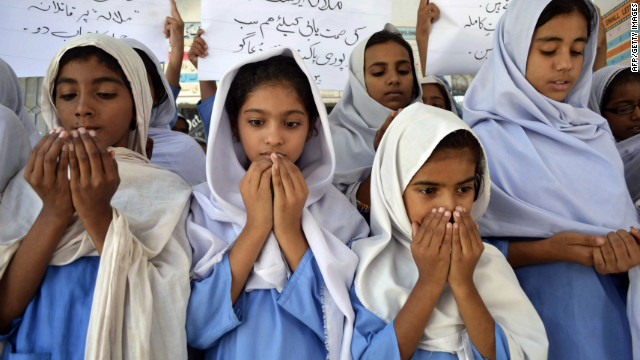
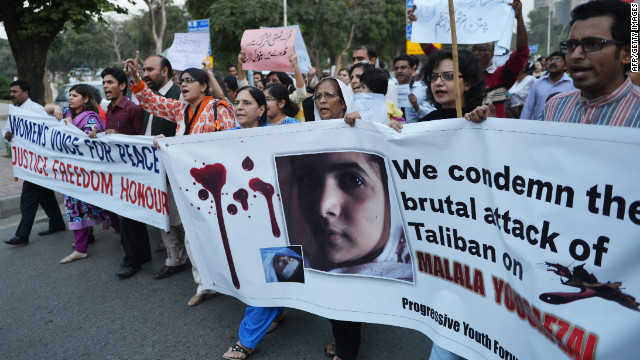
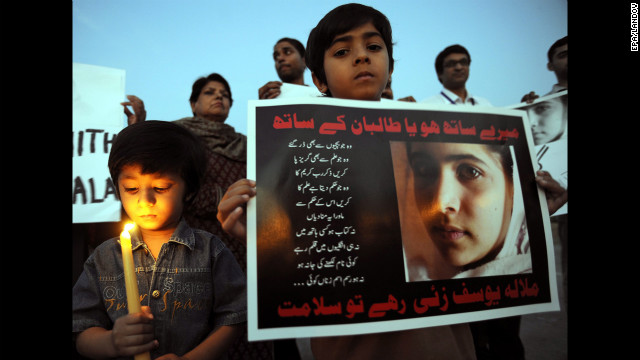
.........Malala Yousafzai is One of Many School-age Victims..........The Pakistani government must take immediate steps to protect students, teachers, schools, and rights defenders at risk of attack, Human Rights Watch said today. Armed groups including the Taliban, al Qaeda, and their affiliates should cease attacks that target children, educational personnel, and schools. Human Rights Watch has collected reports of 96 school attacks in Pakistan this year alone. Most of these attacks took place in Khyber Pakhtunkhwa province (KP) and the Federally Administered Tribal Areas (FATA) bordering Afghanistan. Fourteen attacks were reported from Mohmand Agency in the tribal areas. Dozens of attacks were reported from various districts of KP. Thirteen schools were attacked in Swabi district, 12 in Charsadda district, and 11 in Mardan district. Schools have also been attacked in Balochistan and Sindh provinces.The United Nations reported 152 incidents of partial or complete destruction of school facilities in FATA and KP in 2011. “Parts of Pakistan are among the most dangerous places in the world to go to school today,” said Ali Dayan Hasan, Pakistan director at Human Rights Watch. “It’s time Pakistani authorities understand that expressions of outrage alone are inadequate and such attacks will only end if they hold abusers accountable.” Malala Yousafzai, a 15-year-old student and outspoken advocate for children’s right to education, was shot in the head and neck on October 9, 2012, leaving her in critical condition. The Tehreek-e-Taliban Pakistan claimed responsibility for the attack. The attack garnered condemnation from across the political spectrum in Pakistan. Just three days later, at least three Shia university students – both male and female – were critically hurt when extremists threw acid at their faces while they were on their way home to Parachinar, in FATA, after taking exams in Kohat, KP. According to a local nongovernmental organization, this was the first such “acid throwing case” in FATA. The Tehreek-e-Taliban Pakistan also claimed responsibility for this attack. “The unity of global condemnation and the speed of response in the wake of Malala’s shooting were phenomenal, but we need to see the same kind of reaction every time a student or school is attacked,” Hasan said. “The schools that have remained for years as piles of rubble across Pakistan’s north-west bring into question the government’s level of commitment to seeing children return to school in safety.” Human Rights Watch said that nongovernmental organization workers in FATA and KP have been targeted, including for their work on education. · In July, Farida Afridi, a women’s rights activist was murdered apparently for her work on girls’ education and women’s empowerment in Khyber Agency, FATA. · In May, a local Islamist politician issued an edict [fatwa] decrying girls’ education as un-Islamic, arguing that education persuaded girls to join nongovernmental organizations, and threatened to have women nongovernmental organization workers in Kohistan, KP, forcibly married. · In December 2011, militants gunned down and killed Zarteef Afridi, a decades-long teacher who started a school and was committed to promoting children’s and women’s rights in Khyber Agency, while he was on his way to school. Pakistan’s federal government should cooperate with provincial authorities to create an advance rapid response system whenever there are attacks on schools, so that these facilities are quickly repaired or rebuilt and destroyed educational material is replaced so that children can return to school as soon as possible. During reconstruction, students should be provided education through alternative means and, where appropriate, given psychosocial support. The Pakistan army should also refrain from turning schools into targets by using them as bases, said Human Rights Watch. A 2009 documentary about Malala Yousafzai indicates, for example, that her school had been used as a military base by the army. “This is more than just the case of the shooting of one brave girl, but a crisis for the entire Pakistani education system,” Hasan said. “It is time Pakistani authorities understood that those who seek to harm students and teachers wish to rob Pakistan of its future.”
A senior Shia lawyer has been killed in an attack by unknown gunmen in Pakistan’s northeastern city of Lahore, Press TV reports. Shakir Ali Rizvi was gunned down on Friday while he was on his way to Lahore’s High Court. Lawyers in Lahore have announced they would boycott courts on Friday in protest against the recent killings of Shia lawyers. On October 12, another Shia Lawyer, Mirza Waqar Hussain, was targeted in the southern port city of Karachi and later died of his gunshot wounds. Over the past months, pro-Taliban militants have killed hundreds of Shia Muslims in various parts of Pakistan. The country’s Shia leaders have called on the government to form a judicial commission to investigate the bloodshed. The killing of Shias has caused an international outrage, with rights groups and regional countries expressing concern over the ongoing deadly violence. Human Rights Watch issued a statement in September asking the Pakistani government to “urgently act” to protect the Shia Muslims in Pakistan.


The Express TribuneIn a bid to counter improvised explosive devices (IED) blasts, the US Department of Defence’s Joint Improvised Explosives Devices Defeat Organisation (JIEDDO) Director Lt Gen Michael Barbero announced that the US has agreed to develop a framework of cooperation with the Pakistani military.


EDITORIAL: THE FRONTIER POSTWhat kind of a democracy are we that even the people’s basic needs of education and health, which in recognised democracies are in the deepest sights of their political leaders, are not even in the remotest thoughts of ours’ even at these election times? Even as in the western democracies they have strong delivering health services and educational systems, health and education are invariably hot topics of the hustings. The power contenders lay out in concrete terms to the electorate what they have in their plans to further revamp the health and education sectors so as to convince them of their intended programmes’ benefits and woo them over to vote for them. In the 2008 US presidential race, candidate Barack Obama’s healthcare plan was in great dispute. He was feverishly selling it to the American people, telling them it promised them better healthcare facilities. His Republican opponents were denouncing it equally vehemently as a bad plan. And his healthcare plan, now in force after he had got it through the Congress in the teeth of the Republican’s stiff opposition, is once again in bitter contention in the current presidential race. And the Republicans are vowing to quash it if their man Mitt Romney makes to the White House and they secure a decisive voice in the midterm Congressional elections. In Britain, they have very vibrant health and education services. Yet the politicians there keep all the time fretting how to spruce them further. And almost every government brings in whatever it deems would improve the facilities for the British public’s larger benefit. In fact, more often than not the power contenders’ education and health plans make or mar their fortunes at the ballot box. And in all probability, the education reforms that the incumbent Conservative-Liberal Democrat coalition has introduced will become the next election’s hot issue. The opposition Labour party contends that instead of doing good, these have hurt the education system. But here in the country both education and health are two orphans that draw a lot of lip service from the politicos across the spectrum but none embraces them affectionately or sincerely. They all only fiddle with them, meaning not what they say about their uplift in reality. The pathetic state in which both exist is no secret. It is an open reality, calling emphatically for doing all urgently to pull them out of the rot they have sunk in and are sinking in unchecked. When a disease like dengue fever breaks out, it snuffs out numerous lives in no time. The incidences like contaminated medication in a cardiology health facility push patients in droves to the jaws of fatality. And just a short visit to any government health facility is a lifelong searing experience in inadequate healthcare attendance and dirt and filth. And it is a mere wastage of breath to dwell on the sickening condition of education in the public sector, when no concern is even in evidence in any of the political echelons on this score. The state-run schooling in particular is just an insult to education. Dilapidated buildings or no buildings at all, rampant teacher absenteeism, near absence of science teachers and laboratories, moonlighting teachers, almost all political appointees, and ghost schools are its distinctive hallmarks. The system, indeed the entire government-run education, is screaming for cure. But its wailing has no takers at all out there in the political echelons across the divide. By their acts, the politicos, whether in or out of the government, have demonstrated inexorably that none has a heart in improving education or healthcare in the country. Vaguely, they all talk of increasing the share of health and education by this or that percentage of the GDP. But all that is unmistakably by way of sloganeering. When it comes to actualities, these two sectors are blithely starved of funds. The PPP government in fact inflicted its first economy cut on the Higher Education Commission by hefty billions and scrapped its predecessor’s plan for establishing nine science and technology universities, dismissing it peremptorily as impracticable. And as we are hearing the din of daanish schools, laptops and what not in Punjab, the state-run schooling there has been left to go to the dogs. Of education in Sindh and Balochistan, what we have heard is the closure of hundreds of schools, termed being of no use. And the public is in shrill in Khyber-Pakhtunkhwa over state-run education’s ever-worsening condition in the province. But the sorriest part is that even in these election times neither education nor health is figuring at all in the demagoguery of the political elites across the spectrum. It is the accountability, dual nationality and if elections will be held or not that is hogging the politicos’ all discourse. But then we are no democracy but a plutocracy. And in that system, it is the elites, not the people, which matter.

SUFYAN ABID
http://paktribune.comThe video of Chief Minister Shahbaz Sharif's daughter, Rabia Imran, throwing her weight around inside a bakery in Lahore is making the rounds online these days. She demanded that the closed bakery be opened specially for her so that she be able to purchase the items she wanted. When that did not go her way, she showed how rude she could be by abusing the bakery shop worker — who was helpless because of the instructions of the management — and then, later on in the evening, the CCTV footage shows that her hired goons returned to the bakery and beat up the worker. This is a rotten example of how the elite has deluded itself into thinking it can do whatever it wants, by hook or by crook. The CM has arrested his son-in-law in answer to this footage because they were his guards. However, should the onus of responsibility not lie with the person who ordered the guards to do the nasty in the first place? That person is the CM's own daughter.
LATEST:Ali Imran granted bail by pro-Sharif family courts.


rt.com


Daily TimesBalochistan has become the scene of yet another tragedy, this time in the form of a health worker shot dead in cold blood by masked gunmen. A polio vaccination team was going from door to door in Quetta to administer polio drops to infants, a day after a three-day nationwide campaign took off with great gusto, when unknown gunmen fired at them from their motorbikes. One of the workers was killed instantly. Needless to say, this incident has caused a huge setback in the province’s anti-polio drive, suspending services in some areas indefinitely. This is not just a tragedy, it is a huge loss for all those children who will be at the mercy of this debilitating disease, which is spreading like wildfire in all those areas where conspiracies, extremist mindsets and illiteracy rule supreme. Such an occurrence can, unfortunately, be expected in a place like FATA or Khyber Pakhtunkhwa where mullahs have completely banned immunisation campaigns, but to see the kind of oppressive mentality that castigates polio immunisation as being the evil doing of the US to make Muslims sterile move into other areas is disturbing indeed. If ever there were an award for absolute nonsense, it would go to this sort of mindset. Now the militants have turned their ire towards actual aid workers who are now putting their lives at risk to make sure that the children of this country have a future. Balochistan has been the home of much volatility with the nationalist insurgency taking centre-stage. However, extremist attacks in the shape of sectarian killings have been on the rise in the province with Shia Hazaras being marked for death by the dozens. Now, it seems all is fair in this jihadi war including the murder of health workers toiling for the betterment of society. It is alarming to see that murderous fanaticism is not just contained to one backwater area of the country — FATA and the like — but is infiltrating other provinces, seeping into the core of the national fabric. If this continues, health and aid projects will be cancelled altogether leaving us a pariah nation, shunned by the global community, thereby putting more lives at risk from deadly diseases that the world has worked hard to eradicate.


http://www.theaustralian.com.au/
FRANCIS ELLIOTT From: The TimesAFGHANISTAN appears through the clouds, a black serration of the western horizon. From a valley in between, the crump of artillery is answered by a machine gun. The US calls Waziristan, in Pakistan's tribal areas, the "epicentre of global terrorism". Sararogha is near the middle of the epicentre. "This is the hub," says Brigadier Hayat Hassan, commander of Pakistan's forces in South Waziristan, standing at a hilltop base. Its name, Lajpal, is spelt out in spent cartridges. He is surrounded by sight guides pointing to some of the most infamous names in Pakistan. One way is Mingora, the town in which the schoolgirl blogger Malala Yousufzai was shot. The other is Miran Shah, the administrative centre of North Waziristan. The Pakistani Taliban are estimated to have 30,000 fighters. Foreign Islamists, Punjabi militants, the remnants of al-Qa'ida and the Haqqani network and leaders of the Afghan Taliban all find shelter in its hundreds of valleys.South Waziristan was supposedly cleared of insurgents in a military operation in October 2009. But with pressure again growing on Pakistan to push north, it is obvious that militants still have free run of much of the territory. Chains of hilltop bases, some so remote they are supplied by donkey, secure the main settlements and roads. But only 15 per cent of the 300,000 people displaced by the operation have been allowed to return. With 15,000 troops in more than 6000sq km, a senior officer admits that "vast areas" are still not policed. In the Janata valley, once used for training by the Pakistani Taliban, only one of 14 villages has been resettled. US drones can be heard over the valley's upper reaches, say officers. "There are gaps through which these people can move," Brigadier Hassan says. "We can't occupy every summit." Asked when Lajpal was last attacked, he pauses, smiles and says: "Yesterday." The assault was ineffective - a couple of mortar rounds that "landed well shy". But it underlined that this is, at best, a work in progress. The danger is such that visits by Western journalists are extremely rare, but The Times was given permission to travel by a military keen to emphasise its achievements so far - and the scale of the challenge remaining. Even seen from above, Waziristan's topography is bewildering: fertile alluvial plains, immense pillared cliffs, shallow, broad gorges snaking between barren ridges of ochre or cement-grey. The helicopter from Peshawar affords a drone's-eye view of Kotkai, the village that was home to Hakimullah Mehsud, the head of the Pakistani Taliban, before landing nearby in Chaghmalai. The settlement is one of a number of "model villages" that the Pakistani military has refurbished in a classic counter-insurgency operation. The village has been given its own cadet college, a new girls' high school, a market and poultry and cattle farms. Up the newly built road, a technical training college provides skills for returning Mehsuds - the local tribe - to give them an alternative to becoming insurgent foot soldiers. Sitting in a fort built by the British in 1933, a group of youths (and some who look a lot older) stitch footballs. The military is discounting hives and bees to start a Waziristan honey industry. There are plans to graft Italian strains on to the local olive trees. Signs of change exist: asked what he thought of the shooting of Malala, an 11-year-old schoolboy says: "She was brave. She should not have been hurt for wanting an education." His teacher confirms a change of attitude among a people imbued with tradition: "People want their daughters educated now." The local women have dispensed with their burkas when they fetch water. But it is slow going. A classroom of computers, provided by the military, has not been used. "We have no one to teach them how to use them," the principal said. The chairs in the room are still wrapped in plastic. The boys' school has only three teachers for 600 pupils, but it is faring better than the girls' school, which has yet to recruit even half the female staff it needs to open. Eight in 10 applicants for the cadet college were turned away, a rejection level that will not help a literacy rate below 5 per cent. Only when villages have basic amenities such as electricity does the army allow residents back. Most of those displaced, waiting in towns such as Tank, know their mud-built houses are crumbling into dust or are being used by the Taliban. Privately, military officers complain they are restricted by a lack of funds and political will. The desire not to be seen as an army of occupation is clear at Lajpal. On the roof of the base two giant speakers point down to the badlands. "They are for psychological warfare," said Captain Imran Khan. "We use them for the call to prayer so that they should know that what they have been told about the army not being Muslims is false." Then, pointing barely a mile to the rear, he says: "Until three months ago we were there." Many believe that the front line must move faster than that if Pakistan is serious about defeating its insurgency.
http://www.kansascity.com/
BY:Malala. The name itself is lyrical. It falls from the tongue with a soothing cadence, despite the grim circumstances under which the world met 14-year-old Malala Yousafzai. She’s the Pakistani child the Taliban ordered assassinated. Shot in the head as she was returning home from school, Malala is still alive but critically injured. As the headlines worldwide have reported, she was targeted for vocally demanding what should be available to all girls: an education. Watching videos of this gentle girl speaking about her desire for education, it’s hard to know how much her motivation to stand up to the Taliban came from within and how much was prompted by her equally outspoken father, who operates a school for girls. But this is clear: She is a child raising herself far beyond her years to meet horrible realities. Children tend to do that when cruel adults put them in horrendous situations. And denying education is among the most longstanding injustices done to women — one that also happens to undercut the economic well-being of entire countries. The Taliban are perhaps the world’s most notorious oppressors of women. (They dominate not merely much of Afghanistan but also Malala’s home region, the Swat Valley of Pakistan.) They are not, however, the only force of backwardness in the world that believes morality and honor require keeping half of society’s members uneducated and subjugated. It’s a global problem. In that way, Malala is representative of an estimated 41 million girls in the world who are denied a primary education. Only 30 percent of all girls are enrolled in secondary school. Education protects girls. It shields them from marrying too young, and from having children too young and without planning. It protects them from being forced by poverty into sex trafficking and other acts that are dangerous to their health. This is as true in America as it is in Africa, India, Cambodia and the Swat Valley. The worst oppression of women flourishes when many members of society — fathers, brothers, even women themselves — buy into traditional patriarchy. Religion, law, ingrained cultural norms — and, of course, armed thugs — all act to enforce it. It’s interesting to look at efforts to educate girls in light of another project aimed at the improvement of women: micro-lending. That is a form of rudimentary banking that makes small loans to poor people in developing countries as a way to help them start small businesses. The ability to buy a sewing machine or a cow may lift a family out of abject poverty to a more sustainable, hopeful condition. The guiding wisdom of micro-lending is that women typically are the best recipients of these loans. According to some micro-lending experts, when non-governmental organizations provide new access to money to men, they tend to spend it first on unproductive uses, such as prostitutes and drinking. Women, however, will figure out a way to use the funds to better the conditions of their families and often the community at large. Sometimes they start schools or small businesses that then allow their daughters to seek education instead of being shunted to low-paid work right away or being sold off in an arranged marriage. As such, micro-lending undercuts traditional patriarchy. Interestingly, it does so in ways men tend to welcome. According to micro-lending advocates, men then tend to value the benefits a new business or job brings to family life, the extra income. They change their behavior and often their attitudes as a result. This is how societies progress. One little girl, as the Taliban has brutally shown, is relatively easy to silence. But a village full of young girls, with fathers and mothers and brothers and uncles all understanding the benefits of education for all — and pressing for it as a right — is a more powerful force. Malala’s initial dream was to become a doctor. But she dropped that goal, after being convinced that serving as a politician would be more helpful to her country. Now hanging on to life, she nearly became a political martyr. She deserved to have been born into a more gender-equal world. Read more here: http://www.kansascity.com/2012/10/18/3871322/commentary-malalas-heroic-stand.html#storylink=cpyMARY SANCHEZ

GEO TV

Associated PressOne of the two Taliban militants suspected of attacking a teenage girl activist was detained by the Pakistani military in 2009 but subsequently released, intelligence officials said Thursday. Malala Yousufzai, 14,


Associated PressDespite widespread outrage over the Taliban shooting of a female teenage activist, Pakistani leaders and opinion makers are divided over whether the government should respond by targeting the militants' last major sanctuary along the Afghan border. The U.S. has long pressed Pakistan to launch an operation in the remote and mountainous North Waziristan tribal area, home to enemies of Islamabad as well as to militants fighting U.S. troops in Afghanistan. The recent attack on 14-year-old Malala Yousufzai has given new momentum to the debate. One side argues the government should harness anger over the shooting to build public support for a push into North Waziristan. The other claims more fighting isn't the answer and would trigger a violent backlash. They recommend peace negotiations and ending Pakistani support for the U.S. war in Afghanistan. A Taliban gunman shot and critically wounded Malala on Oct. 9 as she was returning home from school in Pakistan's northwest. The militant group targeted her because of her vocal support for girls' education and criticism of the insurgents' behavior when they took over the scenic Swat Valley where she lived several years ago. Pakistan's powerful army chief strongly criticized the attack shortly after it occurred, raising expectations that the military might be laying the groundwork for an operation in North Waziristan. The army conducted a concerted public relations campaign before it launched an offensive in Swat in 2009 by seizing on anger over a video showing a Taliban fighter flogging a woman who allegedly committed adultery. "We refuse to bow before terror," Gen. Ashfaq Parvez Kayani said the day after Malala was attacked. "We will fight, regardless of the cost." A prominent Pakistani politician urged the military to take on the Taliban in North Waziristan while addressing tens of thousands of people rallying support for Malala in the southern city of Karachi on Sunday. "Move ahead and crush the Taliban, and 180 million people will be standing behind you," the head of the Muttahida Qaumi Movement, Altaf Hussain, told the crowd by telephone from London. Pakistani Interior Minister Rehman Malik said last week that the government was considering a military operation in North Waziristan, although he backtracked a few days later. The military has long recognized the threat posed by Pakistani Taliban militants holed up in North Waziristan but has been reluctant to launch an offensive there for several reasons. The army has said its troops are stretched too thin by operations in other parts of the tribal region. But many analysts believe Pakistan does not want to cross other militant groups with whom it has historical ties and could be useful proxies in Afghanistan after foreign forces withdraw. These groups, also located in North Waziristan, have primarily focused their fighting on Afghanistan, and any operation that upsets them could prompt them to turn their guns on Pakistan. Islamabad has also faced the challenge of launching an operation in North Waziristan without looking like it was simply doing the bidding of the United States, which is extremely unpopular in the country. Opponents of military action against the Taliban, mainly right-wing Islamists, realized that outrage over Malala's shooting could provide the government with the cover needed to conduct a North Waziristan offensive without looking like a U.S. stooge. They responded by publicly accusing the government of using the attack as a pretext to fulfilling U.S. demands. "We condemn the attack on Malala, but this attack took place in Swat, and we fail to understand why the government issued statements about launching an operation in North Waziristan," said Hafiz Hussain Ahmed, a senior leader in the Jamiat Ulema-e-Islam party. "They wanted to play politics on this issue." Pakistani politician Imran Khan, a former cricket star, told Geo TV on Tuesday that "military action is not a solution." He and many on the right believe the driving force behind the insurgency is Pakistan's unpopular alliance with the United States and that the proper path forward would be for Islamabad to end its support for the war in Afghanistan and conduct peace talks with the militants. Critics point out that past peace deals with the Taliban have failed and that the militant group has repeatedly said it is fighting the Pakistani government both because of its ties to the U.S. and to establish Islamic law throughout the country. Opinion among average Pakistanis about a North Waziristan operation is also mixed. Zamman Watto, a lawyer in the eastern city of Lahore, said the government should not launch an offensive because "this will have a very adverse impact on the security situation in the country in the form of suicide attacks by the militants." Maqbool Khan, a teacher in the northwest city of Peshawar, urged the military to push into North Waziristan, saying "the government should act against terrorists wherever they are hiding." The government will need to move quickly if it wants to capitalize on public outrage over the attack, said Maleeha Lodhi, a former Pakistani ambassador to the U.S. "As time passes on from the Malala incident, public opinion could shift again, as it often has in the past after a terrorist attack," Lodhi wrote in a column in The News on Tuesday. "The window of public consent for any action will then begin to close."
Yahoo! Contributor NetworkPakistani youth activist and blogger Malala Yousufzai came out of her coma on Wednesday, according a report from the Atlantic Wire . Last week, Yousufzai was shot along with two of her classmates in retaliation for her BBC blog by the Taliban she had criticized. Here's the latest information on Yousufzai and how her story has impacted Pakistan and other nations. * Seven News noted that Yousufzai's campaign for female education was a motivating factor for the Taliban, which shot her on a school bus in the Swat Valley. * Yousufzai flew to the United Kingdom over the weekend for further recovery after having the bullet removed from her head in Pakistan. * The Atlantic Wire indicated that her prospects for recovery without any permanent physical damage or brain damage was good. * She has feeling in all of her limbs, but will face rehabilitation and treatment for several months. * The Christian Science Monitor reported that Britain's Muslim community has held demonstrations and vigils in support of Yousufzai. * Pakistan's President Asif Ali Zardari said on Tuesday that "the Taliban attack on the 14-year-old girl, who from the age of 11 was involved in the struggle for education for girls, is an attack on all girls in Pakistan, an attack on education, and on all civilized people," as noted by Seven News. * On Friday, the U.S. State Department said that while the U.S. had discussed offering her assistance, but that they had nothing to announce at that time. * State Department Spokesperson Victoria Nuland told reporters that "we've seen in the past in Pakistan that when the Taliban commits truly heinous and outrageous acts like this, it galvanizes popular opinion against them not only in the cities, but also in those towns and neighborhoods where they plot and hide. So obviously, the degree to which the Pakistani people turn against them help their government to go after them. That would be, perhaps, a silver lining from this horrible tragedy." * Neighboring Afghan President Hamid Karzai asked that Pakistan work harder to combat extremism, according to a report from the Associated Press . * Outrage over the shooting led to tens of thousands of Pakistanis in Karachi showing their support for Yousufzai, another AP report indicated . The demonstration was organized by the Muttahida Quami Movement, a party that has condemned other parties for their failure to encourage others to show their support sooner.
Let there be no doubt that Malala and her friends are not child soldiers. They are youth icons. They did not wield guns or bombs but pen and microphone In Pakistan, an apparent national consensus followed the heinous attack on the three young girls Malala Yousafzai, Kainat and Shazia. It lasted for less than two days perhaps. What should have transformed into a national resolve to fight the Taliban terrorists degenerated quickly into a Malala and anti-Malala, or more accurately perhaps, a pro- and anti-Taliban Pakistan. The pro-Taliban forces could not keep up a pro-Malala pretence for too long. They went from a qualified denunciation of the dastardly act to oblique compliments to the child icon to a vicious campaign to undermine her standing, ultimately to unabashed apologetics for the Taliban terrorists. The Pakistan Tehrik-e-Insaf (PTI) leader Imran Khan, as is customary now, was leading the pro-Taliban pack and spent no time in muddying the waters by declaring the Taliban insurgency in Afghanistan as (a perceived) jihad. That he made the comments right after visiting Malala, fighting for her life, was particularly callous. He could not bring himself to denounce squarely the Taliban for being the savages that they are, and of course, not by name. Not to be outdone by Mr Khan and his Internet ruffians, who act more and more like the Jamaat-e-Islami (JI) and its student wing, the original JI jumped into the fray as virtually the information wing of the Tehrik-e-Taliban Pakistan (TTP). The former JI ameer, Qazi Hussain Ahmed and his daughter, the ex-MNA Dr Samia Raheel Qazi, have unleashed an exceptionally morbid effort to malign Malala and her father Ziauddin Yousafzai. The jihadist cheerleaders in the media spent no time in projecting the Qazis and their drivel into every living room. The Qazis have alleged that Malala was groomed by her father as a virtual tool of the US policy in the region. In tandem with their tirade, the Internet was flooded with pictures of Malala and her family with the late US envoy Richard Holbrooke to suggest that the affected family was on some sort of subversive mission. A false dilemma was created to project Malala as a child soldier somehow comparable with the young suicide bombers deployed by the jihadists. In a most unfortunate manner, Malala’s father was first blamed for doctoring her diaries and then for putting the child in harm’s way. A whisper campaign has accompanied this vitriol about how is it possible for a young child of nine or 10 to actually display such maturity in her writings. One anchor took the campaign of drawing false binaries a step further in his show, ostensibly about journalistic ethics. A senior newspaper editor cut that anchor to size but framing the false narratives goes on in full swing. Let there be no doubt that Malala and her friends are not child soldiers. They are youth icons. They did not wield guns or bombs but pen and microphone. They did not stand for violence and barbarism but for peace, education and enlightenment. There is absolutely no comparison between the Taliban — and the JI — using Pakistani youth as jihadist cannon fodder and an upright Ziauddin Yousafzai bringing up his bright young daughter in the best traditions of nonviolence. Malala did not advocate or participate in war. She stood witness to the worst atrocities that the JI’s cohorts perpetrated in Malakand. And unlike those who cannot even admire a gifted child except in a backhanded manner, she did so honestly. There simply cannot be a comparison between forces as dark as the Taliban and children as bright as Malala. There have been nine-year-olds before Malala who were ahead of their age group and there will be more. But Malala, may Lord bless her and her friends with a speedy and full recovery, will stand head and shoulders above not just her peers but those pygmies of men and women that pass for leaders in Pakistan. She stands tall for her simple, clear message that contrasts with that of the prevaricating, vacillating, forked-tongue adults who have yet to condemn the Taliban unequivocally for at least this particular attack on a child who was not an enemy combatant. Little surprise then if the convoluted logic and line taken by Qazi Hussain Ahmed and Imran Khan is the same as the TTP spokesman Ihsanullah Ihsan. In a message sent to media via email and text, the TTP man has accepted responsibility for the attack. He has attempted to justify the attack on a girl child by invoking allegorical verses from the Holy Quran and obscure traditions from the Hadith. The reference to the Quranic tradition of al-Khizr and Moses is so over-the-top that even Qazi Hussain Ahmed might not be able to justify it. But such are the pitfalls of political expediency and, more importantly, of relying on divine texts in temporal matters. Anyone who pleads for making peace with the Taliban must read the 493-word TTP statement. It is not just the TTP’s ultra-orthodox religious position but also tortuous reasoning, backed by its use of terror, that is the basis for the failed peace agreements that now number in double digits. Yet the apologists continue to call for making peace with Malala’s assailants. Interestingly, these Taliban advocates also claim that the attack on the children was carried out at the behest of ‘US-Indo-Zionist’ handlers. Are they then calling for a truce with the so-called foreign hand? The answer is that they are merely muddying the waters around a clear issue. Just as the talk of decisive military action against the Taliban and their foreign terrorist allies started, assorted smokescreens also started going up. The forked-tongue politicians and media persons have created an artificial fork in the road, which could have otherwise been a straight path out of the abyss. General Ashfaq Kayani, the Muttahida Qaumi Movement chief Altaf Hussain, several Awami National Party leaders and the Pakistan People’s Party chairman Bilawal Bhutto-Zardari have spoken clearly enough to clear the fog created by the Taliban defenders. It remains to be seen whether this talk translates into action or the division into a Malala and anti-Malala Pakistan leads this country into missing yet another opportunity to rally against terrorism and the putrid thought that breeds and protects it. P.S The TTP has now also released a detailed statement in Urdu justifying their attack on the girl child. Their drivel is as shameless as their actions.By:Dr Mohammad Taqi
What does Malala Yousafzai have to do with drones? How can the 14-year-old school girl, who today struggles for survival in a UK hospital, have anything to do with the unmanned aircraft that swoop over our northern territories – the Orakzai Agency being the latest area picked out for attacks? Yet, while people across the country have generally been shocked by what happened, there are others, including political and religious leaders who have created immense confusion by trying to wrap the two issues – Malala’s attack and drone strikes – together. In the National Assembly, Maulana Attaur Rehman, who happens to be Maulana Fazalur Rehman’s brother, spoke of the need to ‘guide’ children correctly. Other clerics have been hesitant to condemn the murderous assault on a helpless child – apparently forgetting the most critical lessons of their religion. Even so-called liberals – Imran Khan standing out as one example – have sprung into discussions on the ‘root’ behind the shooting, suggesting that drones were the problem that led to such outrage. In the small, petty game of politics, we hear statements suggesting Malala is being ‘used’ by the Americans. It is then hardly surprising that the accusations that Americans may have orchestrated the attack come from both sides – the people who say Malala is ‘used’ by the US and the Taliban. This is despite clear cut statements from Ihsanullah Ihsan, the Taliban spokesman who holds regular media talks over mobile phone lines, claiming responsibility for the attack and saying that they would make further attempts to kill her if she survived. It has also become clear that the gunmen were sent by Maulana Fazalullah, the former Taliban commander of Swat. Although he was never captured as the military operation in Swat ended, but deprived of his radio channels and the white horse he once rode in a grotesquely distorted emulation of Islamic heroes, it now seems he wages war on children. And too few speak for these children. The astonishingly articulate and courageous Malala, addressing audiences in both Urdu and fluent English, was forced to speak for the right to education for girls, to condemn the Taliban, because too few adults dared to do so. Had they spoken out, had marches been led in previous years – or even now – to oppose Taliban atrocities, as they are held against drone attacks, Malala and her injured friends may not have been left alone to have bullets pumped into them. We, as a society, must ask if it is really acceptable to thrust that responsibility on our children. They should not have to risk their lives by speaking out against an inhumane, brutal force because no one else dares to do so. Even now, we should ask why the Taliban are openly condemned by so few, even though we have seen in the clearest terms what they are capable off. Yet, despite those pictures of a little girl with tubes helping her breathe as she lies in a hospital bed, sedatives dulling her pain, jibes and ‘jokes’ come in about the American’s ‘using’ her or ‘exploiting’ the situation. Humanity appears to have vanished – and taken rationality along with it as well. Things should not be that difficult to make sense off. There can be more than one evil in the world. Murder and rape are both terrible crimes. In just the same fashion, the Taliban and other militant forces deserve to be opposed with all the might we can muster. And yes, drone attacks too need to be opposed – though it is not necessary to constantly connect dots. There is every reason to believe the Taliban have acquired a force that goes beyond hatred for the US. The climate of extremism they have woven holds our country in a vice like-grip, as difficult to disentangle as a spider’s web. We hear of threats to girls’ education in southern Punjab, and acid attacks on women who step outdoors in Balochistan. We also see silence descend over the issue of blasphemy, despite the evidence that has emerged time and again of people being framed; of a teenaged Christian girl with Down’s Syndrome being ensnared in a blasphemy case; and of extremist forces becoming more and more active in the Punjab. All this has little to do with the US as such; although yes, anti-western feelings are present – and acute. They are a factor in what we are seeing. But extremism has taken on a life of its own. The Taliban struggle is one for power and it is simplistic to believe it will vanish once the Americans leave the region. This will simply not happen and facing this reality is crucial to our future. The reality tells us we must speak up more powerfully. We must take on responsibility for what is happening, and not leave the burden sitting on the shoulders of the very young. The political parties so fond of ‘long marches’ must march – or rather drive – a little more, taking on the Taliban. Still more essential is to remove the props and keep them standing up and indeed rising higher like a puppet raised above the theatre brink by the master who wields the stick it is built onto. But there can be no excuse at all for backing a force capable of the worst kind of crime. The Taliban are little different from other such forces we have seen through history; they are worse than some. Collaboration or support for them is simply unacceptable. All we have to do to understand this is to talk to people who have lived under their rule. Many in Swat, Dir, South Waziristan and other places are perfectly clear on who is responsible for the destruction and havoc in their lives. Though they see the complexities involved, with the US presence in the region, they know too at whose hands they have suffered worst. The views of such ordinary people must be respected. They must be given a chance to become their own spokespeople and not have words put in their mouths by outsiders who pursue a line of their own for political and ideological reasons, even though to do so they need to throw morality and basic human decency aside.By: Kamila Hyat

