Wednesday, September 5, 2012

Pakistan: ''Lessons in judicial restraint''

Source:THE HINDU
BY:MARKANDEY KATJU
In a democracy, the remedy for a malfunctioning legislature and executive must come from the people, not the judiciary It is evident that the Pakistan Supreme Court has embarked on a perilous path of confrontation with the political authorities, which can only have disastrous consequences for the country. Recently its Chief Justice said that the Constitution, not Parliament, is supreme. This is undoubtedly settled law since the historical decision of the U.S. Supreme Court in Marbury vs. Madison (1803). The grave problem, however, that courts are often faced with is this: on the one hand, the Constitution is the supreme law of the land and, on the other hand, in the garb of interpreting the Constitution, the court must not seek an unnecessary confrontation with the legislature, particularly since the legislature consists of representatives democratically elected by the people. The solution was provided in the classical essay “The Origin and Scope of the American Doctrine of Constitutional Law” published in 1893 in the Harvard Law Review by James Bradley Thayer, Professor of Law at Harvard University. It elaborately discusses the doctrine of judicial restraint. Justices Holmes, Brandeis, and Frankfurter of the U.S. Supreme Court were followers of Prof. Thayer’s philosophy of judicial restraint. Justice Frankfurter referred to Thayer as “the great master of Constitutional Law,” and in a lecture at the Harvard Law School said: “If I were to name one piece of writing on American Constitutional Law, I would pick Thayer's once famous essay, because it is a great guide for judges, and therefore the great guide for understanding by non-judges of what the place of the judiciary is in relation to constitutional questions.” The court certainly has power to decide constitutional issues. However, as pointed out by Justice Frankfurter in West Virginia State Board of Education vs. Barnette 319 U.S. 624 (1943), since this great power can prevent the full play of the democratic process, it is vital that it should be exercised with rigorous self restraint. SEPARATION OF POWERS: The philosophy behind the doctrine of judicial restraint is that there is broad separation of powers under the Constitution, and the three organs of the State, the legislature, the executive, and the judiciary, must respect each other, and must not ordinarily encroach into each other's domain, otherwise the system cannot function properly. Also, the judiciary must realise that the legislature is a democratically elected body, which expresses the will of the people (however imperfectly) and in a democracy this will is not to be lightly frustrated or thwarted. Apart from the above, as pointed out by Prof. Thayer, judicial over-activism deprives the people of “the political experience and the moral education and stimulus that comes from fighting the problems in the ordinary way, and correcting their own errors”. In Asif Hameed vs. The State of J&K, AIR 1989 S.C. 1899 (paragraphs 17 to 19), the Indian Supreme Court observed: “Although the doctrine of separation of powers has not been recognised under the Constitution in its absolute rigidity, the Constitution makers have meticulously defined the functions of various organs of the State. The legislature, executive, and judiciary have to function within their own spheres demarcated in the Constitution. No organ can usurp the function of another. -- While exercise of powers by the legislature and executive is subject to judicial restraint, the only check on our own exercise of power is the self imposed discipline of judicial restraint.” Judicial restraint is particularly important for the Supreme Court for two reasons: (1) Of the three organs of the state, only one, the judiciary, is empowered to declare the limits of jurisdiction of all three organs. This great power must therefore be exercised by the judiciary with the utmost humility and self restraint. (2) The errors of the lower courts can be corrected by the higher courts, but there is none above the Supreme Court to correct its errors. Some people justify judicial activism by saying that the legislature and executive are not properly performing their functions. The reply to this argument is that the same charge is often levelled against the judiciary. Should the legislature or the executive then take over judicial functions? If the legislature and the executive do not perform their functions properly, it is for the people to correct them by exercising their franchise properly, or by peaceful and lawful public meetings and demonstrations, and/or by public criticism through the media and by other lawful means. The remedy is not in the judiciary taking over these functions, because the judiciary has neither the expertise nor the resources to perform these functions. In this connection I may quote from an article by Wallace Mendelson published in 31 Vanderbilt Law Review 71 (1978): “If, then, the Thayer tradition of judicial modesty is outmoded, if judicial aggression is to be the rule, as in the 1930s, some basic issues remain: “First, how legitimate is government by Judges? Is anything beyond their reach? Will anything be left for ultimate resolution by the democratic process, for, what Thayer called ‘that wide margin of considerations which address themselves only to the practical judgment of a legislative body representing (as Courts do not) a wide range of mundane needs and aspirations?’ “Second, if the Supreme Court is to be the ultimate policy making body without accountability, how is it to avoid the corrupting effects of raw power? Also, can the Court satisfy the expectations it has aroused? “Third, can nine men [the Supreme Court Judges] master the complexities of every phase of American life? Are any nine men wise enough and good enough to wield such power over the lives of millions? Are Courts institutionally equipped for such burdens? Unlike legislatures, they are not representative bodies reflecting a wide range of social interest. Lacking a professional staff of trained investigators, they must rely for data almost exclusively upon the partisan advocates who appear before them. Inadequate or misleading information invites unsound decisions. “Finally, what kind of citizens will such a system of judicial activism produce, a system that trains us to look not to ourselves for the solution of our problems, but to the most elite among elites: nine Judges governing our lives without political or judicial accountability? Surely this is neither democracy nor the rule of law.” In Marbury vs. Madison (1803), Chief Justice Marshal, while avoiding confrontation with the government of President Jefferson, upheld the supremacy of the Constitution. Another example is the very recent judgment of U.S. Chief Justice John Roberts in the Affordable Healthcare Act case, in which he basically followed the doctrine of judicial restraint. In Divisional Manager, Aravali Golf Course vs. Chander Haas (2006) the Indian Supreme Court observed: “Judges must know their limits and not try to run the government. They must have modesty and humility and not behave like Emperors. There is broad separation of powers under the Constitution, and each of the organs of the state must have respect for the others and must not encroach into each other’s domain.” A similar view was taken in Government of Andhra Pradesh vs. P. Laxmi Devi. NEW DEAL LEGISLATION: A reference may usefully be made to the well known episode in the history of the U.S. Supreme Court when it dealt with the New Deal legislation initiated by President Franklin Roosevelt soon after he assumed office in 1933. When the overactive court kept striking down this legislation, President Roosevelt proposed to pack the court with six of his nominees. The threat was enough, and it was not necessary to carry it out. In 1937, the court changed its confrontationist attitude and started upholding the legislation (see West Coast Hotel Vs. Parrish). “Economic due process” met with a sudden demise. The moral of this story is that if the judiciary does not maintain restraint and crosses its limits there will be a reaction which may do great damage to the judiciary, its independence, and its respect in society. It is not my opinion that a judge should never be activist, but such activism should be done only in exceptional and rare cases, and ordinarily judges should exercise self restraint. In Dennis vs. U.S. (1950), Justice Frankfurter observed: “Courts are not representative bodies. They are not designed to be a good reflex of a democratic society. Their essential quality is detachment, founded on independence. History teaches that the independence of the judiciary is jeopardised when Courts become embroiled in the passions of the day, and assume primary responsibility in choosing between competing political, economic, and social pressures”. The Pakistan Supreme Court would be well advised to heed these words of wisdom, even at such a late stage. (Justice Markandey Katju is chairman of the Press Council of India.)

کوئی عدالت صدر کوطلب نہیں کرسکتی :مجیب الرحمان شامی

معروف تجزیہ نگار اورسینئر صحافی مجیب الرحمن شامی نے کہا ہے کہ صدرآصف علی زرداری کے دو
عہدوں سے متعلق درخواست کی سماعت کے دوران وفاقی حکومت کی جانب سے کبھی کوئی پیش ہوا اور کبھی نہیں ہوا صدر کو براہ راست نوٹس نہیں بھیجا جا سکتا اور نہ ہی کوئی عدالت انہیں طلب کر نے کا حق رکھتی ہے۔پارلیمانی نظام میں صدر کا ہر کام وزیر اعظم کے مشورے پر ہوتا ہے اس لیے عدالت صدر کے بارے میں بات نہیں کرسکتی۔دنیا نیوز کے پر وگرام” نقطہ نظر“میں گفتگو کر تے ہوئے مجیب الرحمن شامی نے کہا کہ عدالت نے فیصلہ دیا تھا کہ صدر کو دو عہدے رکھنے کا آئینی اختیار نہیں ہے وہ سر بر اہ نہیں رہ سکتے اور ایوا ن صدر میں پارٹی کی سیاست نہیں ہو سکتی کیونکہ صدر وفاق کی علامت ہوتا ہے اس لیے صدر کوپارٹی کی سیاست سے با لا رہنا چاہیے۔ عدالت نے اس کیس میں 29جون کو اپنے فیصلے میں کہا کہ صدر پر لازم ہے اور اس پر پوری قوت سے عمل ہوگا۔پانچ ستمبر تک عدالت کے فیصلے پر عملدرآمد نہیں ہوا تو عدالت میں فل بنچ بیٹھ گیا۔آج کی سماعت میں وفاقی حکومت کی جانب سے وسیم سجاد نے کہا ہے وہ جواب داخل کریں گے جس کہ بعد اس کی سماعت 14ستمبر تک ملتوی ہوگئی ہے۔مجیب الرحمن شامی نے کہاصدر کے دو عہدوں کے خلاف سماعت میں سب سے پہلا نقطہ یہ ہوگا کے یہ کیس قابل سماعت ہے یا نہیں۔وسیم سجاد کا مﺅقف ہو گا کہ یہ کیس قابل سماعت نہیں ہے۔کیو نکہ آئینی طور پر عدالت کو یہ حق نہیں ہے کہ وہ صدر کو نو ٹس جاری کر ے یاصدر کو طلب کر ے۔صدر کے خلاف کاروائی کر نے کا حق صرف پارلیمنٹ کو ہے ۔ انہوں نے کہا کہ صدر کے دو عہدوں کے خلاف فیصلے کے بعد سندھ اسمبلی اسی فیصلے کے خلاف قرارد اد منظور ہوئی جس میں کہا گیا تھا کہ صدر کی سر گر میاں جمہوریت اور مفاہمت کو مضبوط کرنے کے لیے ہیں ۔اس لیے ان پر اعترا ض نہیں کیا جا سکتاجبکہ اس وقت جمہوریت کو صدر آصف علی زرداری کے اس رویے کی ضرورت ہے۔ اس قرارداد کو جب سندھ اسمبلی میں لایا گیا تو مسلم لیگ ق ،مسلم لیگ فنکشنل اور ایم کیو ایم کے ارکان واک آﺅٹ کر گئے ۔اے این پی اور پیپلز پارٹی نے اس فیصلے کو مستر د کر دیا۔صدر آصف علی زرداری نے اس فیصلے پر عمل نہیں کیااور نہ ہی نوٹس لیا۔ہائی کورٹ صدر مملکت کے معاملے میں بے اختیار ہے۔یہ اختیار ہے پارلیمنٹ کے پاس ہے ۔اگر صدر آصف علی زرداری پارٹی کے شریک چیئر مین ہو ں یا نہ ہو ں۔ان کے اختیارات وہ رہیں گے۔صدر آصف علی زرداری کی طاقت کو چھینا نہیںجا سکتااور نہ ہی ان کی طاقت عہدے کی مرہو ن منت ہے۔مجیب الرحمن شامی نے کہا کہ یہ وہ سیاسی حقیقتیں ہیں جو ہمیں سمجھنی چاہیں۔ صوبوں کی تقسیم سے متعلق ایک سوال پرانہوں نے کہا کہ مسلم لیگ ن کا مﺅقف ہے کہ صوبوں کی تشکیل سے متعلق کمیشن کے سر بر اہ سپریم کورٹ کے ایک ریٹائرڈ جج کو بننا چاہیے۔اس وقت سینیٹر فرحت اللہ بابر اس کمیشن کے چیئر مین بن گئے ہیں۔اب سوال یہ ہے کہ کسی سیاسی کارکن کے بجائے کسی جج کو کمیشن کا چیئر مین لگانے کا کیا فائد ہ ہوگا۔چیئر مین کے پاس ویٹو پاور نہیں ہے جو ارکان کی اکثریت فیصلہ کرے گی وہ ہی فیصلہ حتمی ہوگا۔مسلم لیگ ن کا کہنا ہے کہ اس کمیشن میں ہماری نمائندگی بڑھائی جائے جس میں وزن ہے کیو نکہ مسلم لیگ ن ایک بڑی جماعت ہے اس لیے ان کی نمائندگی بڑھائی جا سکتی ہے اور وزیر قانون نے بھی ن لیگ کو یقین دہائی کرائی ہے کہ وہ اس بارے میں بات چیت کر نے کو تیار ہیں۔مجیب الرحمن شامی نے کہا کہ جب پنجاب اسمبلی نے صوبے کو دو صوبوں میں تقسیم کر نے کے لیے قرار داد منظور کی تھی تواس کی وجہ سے مسلم لیگ ن اور پنجاب میں رہنے والوں کے لیے پیچیدہ صورتحال پیدا ہوگئی جبکہ یہ قرار داد اپنے ہاتھ کاٹ کر وفاق کے سامنے پیش کر نے کے مترادف ہے کیونکہ آئین کا آرٹیکل 239 صوبائی اسمبلی کی دو تہائی اکثریت کو ایسے کاموںکی اجازت دیتاہے۔ صوبوں کی تقسیم سے متعلق قرار دا دقومی اسمبلی اورسینٹ سے پنجاب اسمبلی میں واپس بھی آسکتی ہے لیکن اگر وفاقی حکومت شرارت کرنا چاہے تو وہ قانونی طور پر ایسا کر سکتی ہے۔وفاقی حکومت کہہ سکتی ہے کہ پنجاب حکومت نے قرار داد منظور کی ہوئی ہے۔لیکن صوبے شرارت کی بنیا د پر نہیں بلکہ مفاہمت کی بنیاد پر ہو نے چاہیے۔ایک سوال پر انہوںنے کہا کہ کرپشن ایک خفیہ ٹیکس ہے جس کو ادا کر نا پڑتاہے۔کرپشن پراجیکٹ کی قیمت بڑھا دیتی ہے۔ملک میں ایک سال کا خسارہ سترہ سو انسٹھ ارب روپے سالانہ خسارہ ہے۔اگر معیشت کا یہی حال رہا تو یہ گاڑی کتنے دن چلے گی۔حکومتوں کی پالیسیاں تبدیل کر نے سے بھی معیشت کو خسارہ ہوتاہے۔چوہدری پرویز الہی کے پروجیکٹس آج بندپڑے ہیں۔اگر خدانخواستہ حکومت بدل جائے تو اس وقت جار ی پراجیکٹس کا کیا حال ہوگا۔تمام ترقیاتی منصوبے صوبائی پلاننگ کمیشن کی اجازت سے بننے چاہیے اورسیاسی جماعتوں میں اتنا تدبر ہو ناچاہیے کہ وہ ایک دوسرے کے پر اجیکٹس بند نہ کریں۔

Carnage of Shia Muslims in Pakistan

With thousands of Shia Muslims killed over the past few years in Pakistan and over 400 murdered in recent months, the killings have practically amounted to genocide, raising more-than-sectarian alarm bells not only in Pakistan but also across the Muslim world. In fact, there has been a marked escalation in mass murders and target killings of the Shia minority in Pakistan, increasing global fear and consternation over the brutal bloodbath. According to World Minority Rights Report (2011), Pakistan ranks as the 6th worst country in terms of violence against and persecution of the Shia Muslims and minorities. That the Shia mass murders have continued over the years with no legal and judiciary source or law enforcement agencies having sought to put an end to these brutalities indicates that these acts are but to be considered as part of a systematic and organized plot prodigiously funded and ingeniously engineered by internal and external forces with the express intention of making the pillars of Pakistani society fall to smithereens, shattering the very fabric of the Shia community and distorting the image of Pakistan and depicting it as a religiously intolerant nation. The targets which were basically focused on any ordinary person with Shia belief has now come to include those Shia Muslims who belong to the educated and elite class of the Pakistani society. At least four people have been shot down in Karachi, the largest city of Pakistan since Tuesday morning. A recent incident occurred at Kashmir Road near Jail Chowrangi where Assistant Sub-Inspector (ASI) Ali Mohsin, 42, was shot three times in the head by assassins. Two more people were also shot dead in Pirabad area of the city. In another assassination, Shia Doctor Syed Naimatullah s/o Syed Sarwar was killed in Quetta in broad daylight at his clinic at Kirni Road. Doctor Syed Naimatullah is the 419th victim of targeted killings since January 2012. In another instance of elite killings, unidentified gunmen shot dead a Shia Muslim judge Zulfiqar Naqvi along with his driver and police bodyguard on August 30 in Quetta, southwestern Pakistan. Apart from the target killings, other cases of Shia killings have been committed in the most grisly forms. A gruesome video recently circulated online by the Wahhabi Lashkar-e-Jhangvi (LeJ) shows the beheading of two Shia Muslims. An offshoot of al-Qaeda, the terrorist group first posted the video titled “Revenge” on August 23 on the Wahhabi terrorist Seminary Jamia Hafsa Urdu forum and then distributed it on other Wahhabi-Nasabi jihadist forums. Four masked men accompany the victims Haseeb Zaidi and Maulana Nooruddin with their hands tied behind their backs and decapitate them in cold blood. The extensively networked terrorist group is widely believed to be behind the Shia killings in the country. The gruesome nature of the murders helps disclose the identity of the perpetrators. The act of beheading victims is typically characteristic of Taliban extremists who also carry out similar atrocities against Shia Muslims in Afghanistan. The history of violence against the Shia community in Pakistan goes back to the time of military dictator Zia ul-Haq who made it a state policy to fund and arm Wahhabi groups in the 1980s. It was during those years when he technically institutionalized violence by unleashing Sipah-e Sahaba fundamentalists on Shia-populated regions, ushering in a new age of violence and mayhem. In 1988, Zia ul-Haq dispatched a huge army of 80,000 extremists to Shia-populated Gilgit region to annihilate the Shias. Adjacent villages such as Jalalabad, Bonji, Darot, Jaglot, Pari, and Manawar were razed to the ground and over 700 Shia Muslims were massacred. According to a Herald report “In May 1988, low-intensity political rivalry and sectarian tension ignited into full-scale carnage as thousands of armed tribesmen from outside Gilgit district invaded Gilgit along the Karakoram Highway. Nobody stopped them. They destroyed crops and houses, lynched and burnt people to death in the villages around Gilgit town. The number of dead and injured was put in the hundreds. But numbers alone tell nothing of the savagery of the invading hordes and the chilling impact it has left on these peaceful valleys.” Simultaneously, Zia ul-Haq tasked Pakistan intelligence agency ISI with monitoring the activities of Shia organizations all over the country lest the Shia Muslims would be empowered in the wake of the advent of the Iranian Revolution in 1979. In order to avoid international blame for stoking sectarian violence in the country, Zia al-Haq decided to legitimize the anti-Shia activities of Wahhabi fundamentalists such as Sipah-e Sahaba to carry out this task for the government. Privy to the carnage of the Shia Muslims at the hands of the Wahhabi fundamentalists, the ISI refrained from stopping the genocide of the Shias. Worst of all, they even facilitated and financed the massacre on the secret orders of Zia ul-Haq. What is now happening to the Shia Muslims in Pakistani regions such as Gilgit, Baltistan, Parachinar, Kurram agency, Quetta and other areas is indeed the continued legacy of violence initiated by Zia ul-Haq and financed by Saudi Wahhabis in an effort to limit the influence of the Shia Muslims in the country.

Afghanistan: Hundreds Of Soldiers Detained, Fired For Insurgent Links

The Afghan army has detained or sacked hundreds of soldiers for having links to insurgents, the Defence Ministry said on Wednesday, as it tries to stem an alarming number of so-called insider attacks eroding trust between Afghans and their allies. NATO chief Anders Fogh Rasmussen has expressed strong concern over the attacks, in which Afghan servicemen have killed at least 45 NATO-force troops this year, including 15 in August, compared with 35 for all of last year.

"Hundreds were sacked or detained after showing links with insurgents. In some cases we had evidence against them, in others we were simply suspicious," Ministry spokesman Zahir Azimi told reporters in Kabul. "Using an army uniform against foreign forces is a serious point of concern not only for the Defence Ministry but for the whole Afghan government," Azimi said, adding that President Hamid Karzai had ordered Afghan forces to devise ways to stop insider attacks. Azimi declined to say whether the detained and fired soldiers were from the Taliban stronghold areas of the south and east. They were from all over the country, he said. He said his Ministry started an investigation into the attacks, which are also called green-on-blue attacks, within the 195,000-strong Afghan army six months ago. Rasmussen, in an interview with Reuters this week, said NATO, which trains the army and police, had strengthened vetting procedures to try to exclude suspect recruits and was ready to take further steps if necessary, though he gave no details. He dismissed any suggestion that the rogue attacks would lead to more members of the NATO-led force pulling out early from an increasingly unpopular and costly war that has dragged on with few obvious signs of success since the Taliban were ousted in 2001. But tension is simmering. The shooting dead of three Australian troops by an Afghan army sergeant in the south last week prompted a deadly raid to find the rogue soldier, causing a war of words between Canberra and Kabul. The approximately 150,000-strong Afghan National Police, whose members have also carried out rogue attacks, operates separately from the army under the Ministry of Interior. U.S. forces said on Sunday they had suspended training new recruits to the 16,000-strong Afghan Local Police, a militia separate from the police, following the spike in insider attacks.

Hillary Clinton’s China visit: To make or solve troubles?

On Sept. 4, U.S. Secretary of State Hillary Clinton began a visit to China and it is said that U.S. Defense Secretary Leon Panetta will also pay a visit to China. The United States should bear a big responsibility in the sustained tense situation in East Asia on the territorial dispute and is the key country to constantly carry out military exercises in the Pacific region. Then, what is the purpose of Clinton and other officials’ China visit at this time? U.S. action damaged the mutual trust:
One of the reasons for Clinton's visit to China is the Asia-Pacific Economic Cooperation (APEC) meeting about to be held in Russia this weekend. There is a convention between China and the United States, namely the senior officials of both sides will communicate and understand each other before an important multilateral meeting, said Wu Chunsi, executive director with the Institute for International Strategic Studies under Shanghai Institute of International Studies. At present, the development of APEC is at a critical point, which makes the China-U.S. communication more necessary. In addition, Clinton came to China not all for APEC. According to Wu Xinbo, with Fudan University, first, the United States has a decline in its interests in APEC; second, Russia is the host country of the meeting and so it will gain praise if the meeting makes substantive results, which the United States is not willing to see. Therefore, the main intention of Clinton is to put pressure on China about the international and regional issues, which mainly include the disputes over the Diaoyu Islands and South China Sea, as well as Iranian and Syrian issues. China-U.S. relations maintain an overall stability A series of tense situation in East Asia in 2012 were caused by the "eastward of the strategic center" of the United States. Executive director of the Strategic Research Center of China Institute of International Research Foundation Wang Yusheng pointed out that the United States claimed to realize "rebalance" in the Asia-Pacific region due to the rise of China's "anti-intervention strength." The "rebalance" refers to the one under the domination of the United States. All the Asian countries including China must submit to the United States to maintain a flourishing "order." Otherwise, the United States will use various methods to punish the "order challengers." Clinton's visit to China this time just goes through the motions. 2012 is the election year in the United States and so it is unlikely that both sides will reach substantive and constructive results. In Wu’s opinion, there will be a new U.S. government after the election. Therefore, the realistic diplomacy against China will be the main direction, no matter which party holds power. Both China and the United States benefited from the currently close relationship, which is the fundamental driving force to push a smooth bilateral relationship forward.

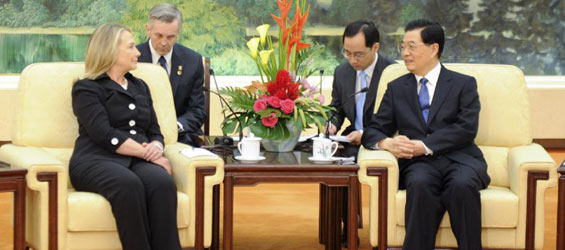
Chinese president meets U.S. Secretary of State

President Hu Jintao met with U.S. Secretary of State Hillary Clinton at the Great Hall of the People on Wednesday morning, stressing that China will strengthen dialogue and coordination with the U.S to ensure that the development of bilateral ties heads in the right direction.
Hu recalled Clinton's last seven visits to China as the U.S. Secretary of State, including four visits for the China-U.S. Strategic and Economic Dialogue (S&ED) and another three for the High-Level Consultation on People-to-People Exchanges. He commended Clinton's efforts in promoting the construction of the U.S. Pavilion at the Shanghai World Expo and the program for U.S. students to study in China. The president appreciated Clinton's efforts to push forward relations between the two countries. "The China-U.S. relations have great strategic significance and global influence, and this is worth cherishing and protecting," said Hu. He said China is willing to maintain and strengthen dialogue, communication and coordination with the U.S., and eliminate any disturbance in order to ensure that bilateral ties will forge ahead in the right direction. Clinton said that over the past three and a half years, there has been a great deal of cooperation and consultation between the two countries, including a meeting between President Hu Jintao and President Barack Obama at the G20 summit in Mexico. "We appreciate the in-depth involvement that the S&ED has achieved," she said. Both countries have been able to explore areas of agreement and disagreement in an open manner, which demonstrated the maturity of the relationship, she added. On China-U.S. economic and trade relations, Hu hoped the two countries would make full use of the complementary advantages, explore cooperation potential, push forward cooperation of trade and investment and continuously lift the quality and level of bilateral trade cooperation. He called on both sides to properly handle the frictions and divergences in bilateral economic ties, and avoid any politicization of economic and trade issues. The president hoped the U.S. would firmly resist trade protectionism, ease restrictions on high-tech exports to China and provide a fair environment of competition for Chinese enterprises that invest in the U.S. Clinton said the U.S. is committed to surpassing differences and enhancing cooperation with China, jointly facing global challenges to prove in an unprecedented way that an established power and a rising power can create a bright future for their own people and contribute to world peace and stability. She said the U.S. is ready to work with China on infrastructure construction, new energy, environment protection and to expand trade and investment. Clinton is currently on her second China trip of the year. She attended the fourth round of the China-U.S. Strategic and Economic Dialogue as special representative of President Barack Obama in Beijing last May. The visit is also part of Clinton's ongoing six-nation tour starting Aug. 30, which also takes her to the Cook Islands, Indonesia, East Timor, Brunei and Russia.

Pakistani journalists face threats from Islamists

Deutsche Welle
Religious extremists and security forces continue to intimidate progressive journalists in Pakistan. In a recent incident, a Karachi-based journalist was beaten by fanatics for listening to music in his house. A few days ago, Zainul Abedin, who works at Pakistan's English-language The News daily, was dragged out of his house in the middle of the night and beaten up by four bearded men. Then he was warned that if he watched TV in his house and listened to music, he would be killed. Abedin went to the police station to report the incident, but was met with resistance. This all happened in the heart of Karachi - a relatively liberal city with a population of more than 15 million - and not in one of the restive, semi-governed northwestern tribal areas of Pakistan on the border with Afghanistan."As they (the fanatics) delivered more kicks, slaps and blows, they kept saying: ‘We will not let you go unless you repent,'" Abedin wrote in an email that he sent to the city's journalists' unions. "They went away shouting abuse and threats such as: 'Next time it will be worse. Do not turn on your TV and no songs and qawwalis (mystical songs) here. You will not live if it happens again. You and this house will be no more. We will not break the windows, we will shoot you, kill you.'"
Frightening
Commenting on the harassment of Abedin, Dr. Riaz Ahmed, a political activist and professor at Karachi University, told DW that it was not merely about music and TV but was an organized attempt by the Islamists to intimidate journalists. Ahmed also criticized media owners for compromising with Pakistan’s right-wing groups. He pointed out that Abedin's own newspaper had not taken any notice of the incident for several days. "The message being conveyed by the media owners to journalists like Abedin is: 'If the mullahs beat you up, you should not protest," he said, adding that commercial interests of the Pakistani media and religious groups were closely linked. Ghazi Salahuddin, a senior journalist at the Jang Group of Publication, which also owns The News, told DW that Pakistani journalists had to work under very difficult circumstances. "Many journalists feel scared and threatened. Pakistani politics has been criminalized. It has become very difficult for journalists to perform their tasks freely," he said, adding that journalists' unions should ensure that the rights and lives of people working in the media were protected. Ahmed's point of view was that the journalists' unions were either intimidated themselves or too corrupt to stand up against the media owners.
Intimidating
Observers say that progressive sections of Pakistani society are being systematically intimidated by Islamists. Pakistan's liberals are extremely worried about the growing influence of right-wing groups in their country, and they feel that their freedom is at risk in the Islamic Republic. Pakistani rights activists also complain that the Islamists enjoy state patronage, whereas liberal and progressive voices often have to face the wrath of the country's security agencies. They say that if a progressive journalist working for a big newspaper such as The News is unsafe in Karachi, then the risks faced by journalists in the conflict zones of northwestern Khyber Pakhtunkhwa and the western Balochistan provinces are easily imaginable.
Perilous
A 2012 UNESCO report ranks Pakistan "the second most dangerous country for journalists the world over" after Mexico. According to the South Asian Free Media Association (SAFMA), 17 journalists were killed in South Asia in 2011, 12 of them in Pakistan. Terrorism and Islamism are the most dangerous issues for Pakistani journalists to report on, SAFMA said. Nasir Tufail of Geo TV told DW that the local and foreign media rely on only a few journalists for information about the restive northwestern tribal areas. “Most journalists can’t even enter these areas,” he said. "Therefore, it's impossible to get reliable news about the Taliban and the 'war on terror.'" He added that most journalists would not even think of venturing into "most parts of Balochisan, where the military is operating against separatists. How can you expect independent reporting?" Imtiaz Alam, the secretary general of SAFMA, blamed both state and non-state elements for the situation. "So many journalists in Pakistan have been killed. Yet nobody has ever been brought to justice for their murders."

Safe passage for Taliban discussed in Pakistan

Associated Press
Officials say Pakistan, Afghanistan and the U.S. have held discussions about providing Taliban leaders safe passage to participate in peace negotiations. Pakistan's Foreign Ministry says representatives from the three governments held the inaugural meeting of the Safe Passage Working Group in Islamabad on Wednesday. They agreed to form the group in April. A U.S. official says the group is focused on choosing which Taliban leaders should be provided safe passage, guaranteeing their security and dealing with logistics like visas. The official described the meeting as positive. The official spoke on condition of anonymity because he was not authorized to discuss the meeting with reporters. Many Taliban leaders are believed to be based in Pakistan. Islamabad is seen as key to peace talks because of its historical ties to the Taliban.

Shahbaz’s buffoonery

EDITORIAL:THE FRONTIER POST
One knows not if to laugh or cry, so hilarious but so deceitful is this buffoonery of Shahbaz Sharif, Punjab’s chief minister. Not an hour goes by when he decries “the rulers” of doing this or doing that, as if he himself is no ruler but just the manager of a college canteen. He may be thinking with this buffoonery he is deflecting the public attention from his own poor show of governance in the country’s most populous province. But who will tell this eminence that in the popular estimation he sits very much in the league of the incompetents like Zardaris, Gilanis, Hotis and Riasanis, not in the club of Nitish Kumar, the chief minister of the Indian state of Bihar, and Narenrda Modi, his counterpart of India’s Gujarat state.
Kumar has transformed a chronically lawless backward state into a prospering place, for which the electorate has rewarded him with a fresh mandate for another five years. And Modi has turned a long laggard state of Gujarat into a flourishing economic powerhouse, for which even his staunchest critics, who are unforgiving of him for his diabolical role in Muslim massacres, acknowledge him, even though gingerly, as an excellent development administrator. So much so, both are being viewed by the political pundits as the possible next prime minister of India. But not even the most generous political observers are visualising Shahbaz as the putative candidate for this top job of the country, such an utter failure has he proved in governing the Punjab province and delivering its residents their wants and needs. It is a colluding media that is so lenient on him. But the people’s estimation of him is quite devastating. He may be dancing in the good graces of the flattering bureaucrats and party lackeys who he pampers and patronises. But the citizens’ take on him is very damning. They know him for his abysmal collapses, not for his self-touted successes.
They attribute their riddance from the deadly dengue epidemic to the mercies of the divine powers, not to his any effort as would he have it believed. And they still remember him for the contaminated medication that took scores of lives at a Lahore cardiology medical facility. And they know him not for any daanish schools, but for the wholesale ruination of the state-run schooling he has presided over in Punjab so nonchalantly. There indeed is hardly a spectacular accomplishment for the people weal and wellbeing that he can rightfully boast of.
His every morsel of pork barrel has run into infamy; his every show of populism has raised a storm of disrepute. His sasti roti contrivance turned out a huge hoax and earned him the stinking repute of blowing away billions of the taxpayer’s precious money on feeding the well-off, not the poor, the penniless and the impoverished. His laptop enterprise has drawn flake from across the segments of the polity. The huge moolah that he has expended so recklessly on this patently personal image-building venture, say the well-meaning critics, he should have spent on real educational pursuits like the promotion of science education in schools and colleges. And it is guffaws that his tenting expedition is presently eliciting from every nook and cranny of the province. Shahbaz in fact has nothing grand on his platter to show for performance. Be it governance or development, be it agricultural advancement or industrial progress, be it promotion of trade or commerce, be it law and order or combating crime, indeed be it any walk of public life, he has come a cropper abysmally. And his self-serving prattle is impressing no people at all. They need not him to tell, as he does perennially, how meanly have the Zardari & Co. run an inept, incompetent and corrupt administration. They know it all from their first-hand experiences and observations, of which Shahbaz indeed could have had no taste at all even in his wildest dreams in his tent offices and his palatial residential mansion. But if he thinks that with this telling he is winning the people’s hearts and minds, he is badly mistaken.

Pakistan 124th among 144 economies on Global Competitiveness Ranking

Pakistan has been ranked among bottom 20 of the 144 economies around the world in The Global Competitiveness Report 2012-2013, released Wednesday by the World Economic Forum. According to the Global Competitiveness Report (GCR) 2012-13, Pakistan lacks a long-term view of competitiveness. The level of corruption and poor governance are some of the factors slowing down Pakistan’s economic growth, therefore ranking Pakistan at 124 among 144 other countries on the index. The World Economic Forum ranks countries on more than 100 economic indicators comparing 144 countries. “Persisting divides in competitiveness across regions and within regions, particularly in Europe, are at the origin of the turbulence we are experiencing today, and this is jeopardizing our future prosperity.” said Klaus Schwab, Founder and Executive Chairman, World Economic Forum. “We urge governments to act decisively by adopting long-term measures to enhance competitiveness and return the world to a sustainable growth path.” Pakistan’s secured ranking on 12 pillars: institutions (115), infrastructure (116), macroeconomic environment (139), Health and Primary Education (117) Higher Education and Training (124), Goods Market Efficiency (97), Labor Market Efficiency (130) Financial Market Development (73), Technological Readiness (118), Market Size (30), Business Sophistication (78) and Innovation (77). ‘Pakistan has lost its competitive advantage almost on all the pillars of the competitiveness index except for in Health, Primary Education and Labor market Efficiency’ says Amir Jahangir Chief Executive Officer Mishal Pakistan, country partner for the Center of Global Competitiveness and Performance at the World Economic Forum. Further adding, although Pakistan showed good performance on the innovation and sophistication pillars, but on the factors for basic requirements and efficiency enhancer pillars Pakistan continues to show poor performance. The Pakistani business community has identified Corruption as the most problematic factor for doing business in the country. The report indicates that Pakistan has failed to come up with effective regulations on intellectual property protection, where the country lost its position of 93 to 108 from 2011 to 2012 respectively. Poor governance in terms of favoritism in decision-making (129) and wastefulness of government spending (96) have also shown significant decline in rankings. The Efficiency of Legal Framework in Challenging Regulations has also impacted the competiveness of Pakistan’s economy as it has declined from 79 in 2011 to 97 in 2012. The law and order situation has been a serious threat to the economic activities, with war on terror and other target killing issues impacting throughout the year, the Reliability of Police Service has gone to 127 in the current year as compared to 116 in the last year. On the Macroeconomic Pillar the government’s performance has been weak with the budget balance ranking (% of GDP) deteriorating from 108 to 125 from 2011 to 2012 respectively. The general government debt has also seen poor performance as it has lost 11 points from last year, by being ranked at 107 in the current year. Although Pakistan ranked 41 in 2011 on the Tax Collection Efficiency index, however the economy has lost its competitive advantage due to decline in 2012 by ranking to 59, limitations on the ease of access to loans and venture capital availability, where Pakistan stands at 65 and 55 respectively. Nonetheless, Pakistan has also shown some positive indicators on improving its competitiveness, where the burden of government regulation has improved from 76 in 2011 to 62 this year, similarly the transparency of government policy making has also been improved from ranking of 119 to 109. The country credit rating index has also improved from 123 this year to 116 compared to last year.

Imran Khan as Pakistan’s saviour?

BY:S P Seth
At times it would appear that Pakistan is being torn apart by internal warfare. And its most disturbing manifestation is a string of attacks on military installations to avenge the killings of Osama bin Laden and other terrorist icons for which the Tehreek-e-Taliban Pakistan has often claimed responsibility. The most recent target was the Kamra airbase off Islamabad. The ease with which such attacks have been mounted on some of the most secure military installations would suggest some internal help from extremist elements within the forces. Indeed, there were reports of this when Mehran naval base in Karachi was attacked in May last year. If the Taliban have infiltrated the armed forces, directly or indirectly, the country is in a lot of trouble. In that case, the extremists would have succeeded in capturing the state from within. Pakistan’s other institutions like the government of the day and the judiciary will hardly be able to stem the slide into a Taliban-dominated state. The only other example of this is Afghanistan under Taliban rule, hardly a shining example. It might be worse in Pakistan, which is a large country of an estimated 180 million people. And if a Taliban-run state in Pakistan were to use or allow the country to be used for al Qaeda kind of activities, as the Taliban did in Afghanistan, the world would be a very scary place, with a tremendous destructive potential for Pakistan and its people. Another highly disturbing development is the regularity with which the Shias are being targeted and killed in different parts of the country, with the state apparently unable or unwilling to do much about it, for all sorts of reasons. How much of a nexus there is between extremist Sunni groups and the Taliban behind these killings is not all that clear but it is all part of the culture of violence that is permeating the country. This kind of pattern of killings tends to reinforce the view that the state is almost ceasing to exist in a climate of mindless violence. It is against this backdrop that Imran Khan (and his Pakistan Tehreek-e-Insaf) has staked his claim as the country’s possible saviour. Judging from the attendance at his rallies around the country, Khan appears to be Pakistan’s most popular political leader. There have to be some plausible reasons for this. One reason, of course, is that the country is in such a parlous state that people are desperately looking for a saviour. With their self-serving politicking, Pakistan’s political leaders are compounding the situation. No wonder the Taliban and other extremist elements are growing stronger.
And here comes Imran Khan with his simple message, which is that he will be able to reconcile all competing, contending and conflicting forces in the country by simply opening a dialogue with them, particularly with the Taliban. Though Khan says that he does not approve of the Taliban violence, he however understands it as a reactive response to the army’s anti-terror strategy that targets them.
And why is the Taliban being targeted? Here Khan taps into the widespread anti-American rage in Pakistan across the spectrum that has become even more entrenched after the killing of Osama bin Laden in a US raid. As Khan told Steve Coll of The New Yorker, “The so-called ‘liberals’ [in Pakistan] treat the Taliban as if there were only one way to deal with them — through the military.” He added, “They are cut off from the rest of Pakistan. They look at Pakistan through Western lenses. They actually don’t know what Pakistan is.” This is an extraordinary statement to make that tends to absolve the Taliban of any responsibility for the virtual orgy of terrorist violence enveloping the country. And he promises to end terrorism in Pakistan through negotiations with the Taliban within 90 days. By keeping his message simple and hopeful, Imran Khan is either being terribly naïve or politically smart to bank on his people’s desperation to vote him into power as a messiah waving a magic wand. We know that there is no such thing as a magic wand, even with Khan as the magician. His naivety is on display when asked how he would deal with the Pakistani military that is used to running the country directly or indirectly. He answered that he would discipline them the way he did his cricket team as their captain. They simply will have to fall in line like every other institution in the country, if he were to become the prime minister. In his own words, “...You have to tell them, ‘Look, this is the way it’s going to run now’.” One wonders why nobody else in Pakistan thought of such a simple and straightforward solution. While Khan talks of running the army like his cricket team, there is considerable speculation in Pakistan that Khan himself, as a politician, is a creation of the ISI. In other words, it remains an open question if Khan will do the military’s bidding or the other way around.
And in the larger scheme of the country’s economic development, it is even a bigger challenge of raising enough, indeed huge, resources, but Imran Khan does not see it that way. His solution is again very simple. He will simply ensure that the rich will pay their taxes. Even if it were feasible to make the rich and everyone else into an honest citizen (though it has not happened anywhere else in the world), Pakistan will still need massive resources to make a credible start in lifting the country’s economy. This will require considerable foreign aid and investment that is unlikely to materialise on the scale required without relative peace and stability in Pakistan. But Khan is already set against any US aid regarding it as a “curse”, causing dependency. He might therefore be thinking of tapping into aid and investments from Saudi Arabia and other rich Middle Eastern countries, as well as China, but that still will be exchanging one dependency for another. The point is that Imran Khan has no blueprint on any of the issues facing his country. What he has is a list of simple and pious wishes that will somehow be translated into action as he did with his cricket team, or in his charity work. But a country as complex as Pakistan, with its continuing terrorist violence and an overlay of sectarian and ethnic conflicts, cannot be equated with a cricket team or a charity event. May be Khan will surprise everyone, if he becomes Pakistan’s prime minister in the next election, beyond the reach of human experience!
The writer is a senior journalist and academic based in Sydney, Australia.

When will Rimsha be released?

The Express Tribune
A 12-year-old daughter of Pakistan, Rimsha Masih, is in jail without bail for burning pages of Quranic verses even after the police found she was victimised through a trumped-up charge by a local cleric determined to oust the Christian community from the village of Mehrabad, near Islamabad. She suffers from Downs’s syndrome and may not understand why she is being maltreated. Even after the discovery that the cleric was indulging in a criminal plot against the Christian community, she has not been allowed to return home on bail. A crowd was organised to oust the Christian community upon appeals from mosque loudspeakers. The mob went to the house of Rimsha and started kicking the door asking the parents to hand her over. They finally entered the house and gave a beating to the little girl and her mother. Following this, the police were informed, who immediately took the girl away and put her in jail under the ‘non-bailable’ black law. The Capital Development Authority has reassured those who were evacuated that they will be returned to their homes and their tormentors will be forced under law to relent. The displaced families were made to move to another place where the local inhabitants refused to let them stay temporarily because they feared ‘incidence of crime due to their presence’. The shock administered by this case of blasphemy has been felt inside Pakistan. It has deepened the despair the outside world feels about our country; and the Christian Church is once again appealing to do something about a law that, as now proved beyond all doubt, is causing harm to Pakistan and its reputation. This happened on August 16, on the 27th of Ramazan, thus further raising suspicions as to when Rimsha was put in confinement. A few days ago, even after a witness alerted the authorities that the cleric had cooked up the story of burning the Holy Quran by putting scarred pages in a bag that Rimsha was carrying, the police have still not released her. The judiciary is silent so far but the Supreme Court should take suo-motu notice and get the girl placed in a better environment which her age, her health and her innocence deserve. What people have always said about the law and are still saying is this: “In blasphemy cases, the state institutions just try to defuse the pressure of accusers by registering a case against the accused”. Both the police and the judiciary take the side of the accuser. During the last two decades or so, more than 1,000 cases of blasphemy have been registered and it is believed that a vast majority of these cases were fake. Not even a single accuser in these fake cases has been convicted, implying that the state patronises the accusers at some level. Laws are usually made after criminal acts are observed in society. In this case, criminal acts have followed the enforcement of the law. The victimisation follows a familiar pattern. In February 1997, the twin villages of Shantinagar-Tibba Colony, 12 kilometres east of Khanewal, in Multan division, were looted and burnt by 20,000 Muslim citizens and 500 policemen. The police first evacuated the Christian population of 15,000, then helped the raiders use battlefield explosives to blow up their houses and property. In November 2005, the Christian community of Sangla Hill in Nankana district in Punjab experienced a most hair-raising day of violence and vandalism. Three churches, a missionary-run school, two hostels and several houses belonging to the Christian community were destroyed by an enraged mob of some 3,000 people. The Supreme Court must act to save Rimsha Masih and, thereafter, declare the blatant misuse and abuse of the blasphemy law against the spirit of Islam and against the ‘grundnorm’ of the Constitution. Or, is it true that like the politicians, the institutions of the state are too scared to act?

No amendments in blasphemy law despite recommendations

DAILY TIMES
Recommendations by the Council of Islamic Ideology of Pakistan (CIIP) on the country’s most discussed blasphemy law which have been presented to parliament await the government’s response for the last several years. Apparently the government is reluctant to give a final nod due to unknown reasons. Some believe that clerics are pressing the government not to consider these recommendations. The CIIP has made these recommendations on a reference sent by the federal government in the wake of increasing complaints about the misuse of the law. According to religious scholars, the misuse of the blasphemy law was tantamount to blasphemy, and therefore a person who was guilty of misuse of this law should be punished under the same law. The council has recommended death penalty for anybody misusing the blasphemy law. “The incorrect complainant and witnesses in a blasphemy case should be handed similar punishment (capital punishment) as a guilty person,” the recommendations read. “The government should not allow anyone to misuse the blasphemy law and it should take all appropriate measures whether administrative, procedural or legislative to stop incidents of mishandling the blasphemy law.” It has also recommended only the judges of the Federal Shariat Court (FSC) hold proceedings in blasphemy cases (The FSC consists of five permanent judges and three renowned Islamic scholars). The council has recommended that police should investigate the complaint systematically before registering a case. It is also proposed that the complainant should produce concrete evidence to substantiate charges while lodging a first information report (FIR), adding that the accused should be given the right to defend himself or herself through a legal adviser. It also adds that a first-class magistrate should supervise the police investigations prior to the registration of the case. However, the council strongly opposed any amendment in the blasphemy law, particularly in Section 295-C, a far as the penalties are concerned. The proposals also authenticate the capital punishment in the light of the holy Quran and Sunnah for blasphemy. Sources said the CIIP had given several reminders to the Interior and Religious Affairs ministries in this regard, but the successive governments had not even cited reason (s) for delaying the recommendations. The National Assembly sources said the recommendations consisted of volumes of books and the lawmakers usually did not have enough time to read these books in detail. CIIP Secretary Ilyas Khan said the recommendations were always in detail, as these could only be understood in “their reference to context”. “The court judges pen down a detailed verdict to justify their decisions even on a simple matter, these are valuable proposals related to prestige of Islam and the legislators should spare some time for them,” he remarked. Talking about the validity of the proposals, he said recommendations would remain valid until and unless they were rejected by parliament. He said the recommendations were tabled in 2001 when religious scholars Dr SM Zaman, Rafi Usmani and Mufti Munibur Rehman were in the council. The council also enjoyed the support of religious scholars of all schools of thought at that time, he added. Some people, however, have different opinion and they say it is the most sensitive issue that has claimed several lives, including two top political figures. The international community was pressing the government to bring reforms in the law, but the PPP-led government seemed careful due to threats by religious parties and upcoming general elections, they added.

Interfaith harmony: Waziristan’s lesser known tale

In the public imagination, South Waziristan is at the heart of a battle against Taliban militants. But Wana, the largest town in the tribal agency, has another, lesser-known story to tell. Manga Masih, a 99-year-old Christian resident of Wana recalls pre-partition times when, “apart from Christians, there were Hindu and Sikh families in Wana. The Hindus and Sikhs migrated to India during partition, but it was of their own free will. A jirga of the local Ahmadzai tribe had requested them to stay, and assured them of protection of their life, honour and property.” While both communities chose to decline the invitation, many Christians decided to remain in the place they called home. “Khan Chand, a Hindu hakim, had a treatment centre at the Kari Kot village in Wana and was highly respected by the locals. Although the Hindus and Sikhs migrated, Khan Chand and many others maintained contact with their friends back home via letters. God bless them, all these people must be dead now,” Manga says nostalgically. The-99-year-old resident was born in 1913 in Sail Kot, Punjab and came to Wana in 1935. He now lives in Wana Scouts Camp with the rest of his family. Malik Sardar Khan, another elderly resident, points out that when the Hindus and Sikhs migrated, local tribesmen paid them for the land they left behind. According to statistics collected by Al-Khidmath Christian Welfare Society Wana, there are 1,200 Christians living in Wana – most of them live either in the Scouts camp or in the tehsil building. While many do low-end janitorial jobs, others have now set up small businesses in Wana Bazaar. Contrary to what one might think, the minority community feels completely safe in their homes. Jawad Masih, a tailor in the bazaar says, “There is no interference from the local Taliban in my business.” He adds that over the years, he has trained many young men of the Ahmadzai tribe in tailoring. Jawad says, “I often go on the invitation of my pupils to their homes and we participate in each other’s religious rituals.” Danish Masih, 17, is a medical student at the Wana Government Degree College. Praising his fellow students, Danish says, “The other tribal students sometime fight with each other, but since my school days, no one has ever fought with me … There is no hatred on the basis of religion.” The flip side President of the Al-Khidmath Christian Welfare Society Wana Jehanzeb Masih told The Express Tribune: “The local Taliban take our complaints seriously and address them but the local political administration is a big hurdle in our progress. Political Administration officials are denying us our basic civil and political rights. Christian boys and girls cannot get education after Matriculation because a domicile is required for admission. We appealed time and again, but the local political administration won’t give us domiciles.” Jehanzeb added that Danish was admitted to the Wana Government Degree College on the condition that he eventually provides the college with a domicile, since he cannot appear in board exams without it. The college principal admitted him on goodwill alone. “I myself was put in jail by the political administration,” he adds. Jehanzeb explains he was imprisoned after demanding funds that the Political Administration received specifically for the Christian community but which they never distributed. He adds that while the Christian community voted for a Jamiat Ulema-e-Islam-Fazl (JUI-F) candidate in the 2008 elections, their concerns about domiciles were never addressed. Jehanzeb also made an appeal to the late minority affairs minister, Shahbaz Bhatti. The assistant political agent of Wana, Shoaib Khan, told The Express Tribune that the domicile issue is under consideration, but did not explain why the domiciles were being denied in the first place. Interestingly, the spokesperson of the Mullah Nazir Taliban Group, Lala Wazir, told The Express Tribune: “Christians have been living in Wana for centuries. They are the people of this land and free in their religious activities, but the domicile issue is between them and the government.” Regardless of the administration’s discrimination, it appears that the Christian community in Wana may be safer than the locals: Both the tribesmen and the Taliban are their guardians.

Balochistan: LOCALS DENIED JOBS.. Ministers selling Jobs?

Jobless and educated youth had staged a noisy demonstration outside the Gwadar Press Club accusing the Ministers and officials of various department of auctioning all jobs to highest bidders, all non locals and none of them was from Gwadar as the people are poor and no money to buy a job. All Government jobs were sold in public knowing that no one dares to take action against the Ministers and officials. The protesters specifically blamed the Provincial Forest Department where Minister was accused of directly selling the Government jobs to highest bidders. The Second Department is the Industrial Estates of Gwadar where more than 200 people were recruited and all sold to the highest bidders to given to their close relatives and political constituents. It is a serious allegation against the Government Ministers and their Department for indulging in massive corruption. On the one hand top Government leaders, from President of Pakistan to the Prime Minister, had assured the educated youth of Balochistan of suitable jobs. But on the contrary, all the jobs were sold and auctioned with complete impunity as the Government lacked the courage to take action against its strategic political allies at the time of election year. The protesters were carrying banners and posters condemning the corrupt Ministers and officials for their dare-devil corruption in public violating all rules and laws of the Government. For the past many years, were demanding that the powers of the Ministers should be curtailed drastically reducing their chances of massive corruption, including sale of Government jobs. The Cabinet should only oversee the performance of the Government and not dictate orders. It is true in case of Government spending on development so that there is no massive leakage of public money or public exchequer plundered by various means.

FBI investigating Peshawar suicide blast: Ventrell

US condemned suicide attack in Peshawar and expressed his deep grief and sorrow over the incident. During a daily press briefing, US State Department’s spokesperson Patrick Ventrell said on Tuesday that Federal Bureau of Investigation (FBI) was leading the probe of the suicide blast that occurred in Peshawar at a vehicle of US consulate. Ventrell said that whenever US personnel are involved in the attacks US does their own investigation and it is collaborating with its Pakistani partners. He also thanked Pakistani government and law enforcement agencies, saying “we commend the Pakistani security officials who saved lives, including the lives of our two personnel.” The spokesperson said that no one has yet claimed responsibility for the attack and US is not going to speculate on who may be responsible. FBI is probing the matter.

Quotes from Michelle Obama's convention speech

http://www.boston.com/
Quotes from first lady Michelle Obama’s speech Tuesday to the Democratic National Convention: ____ ‘‘Our life before moving to Washington was filled with simple joys. Saturdays at soccer games, Sundays at grandma’s house and a date night for Barack and me was either dinner or a movie, because as an exhausted mom, I couldn’t stay awake for both. And the truth is, I loved the life we had built for our girls and I deeply loved the man I had built that life with and I didn’t want that to change if he became president. I loved Barack just the way he was.’’ ____ ‘‘You see, even though back then Barack was a senator and a presidential candidate, to me, he was still the guy who'd picked me up for our dates in a car that was so rusted out, I could actually see the pavement going by in a hole in the passenger side door. He was the guy whose proudest possession was a coffee table he'd found in a dumpster, and whose only pair of decent shoes was half a size too small.’’ ____ ‘‘Well, today, after so many struggles and triumphs and moments that have tested my husband in ways I never could have imagined, I have seen firsthand that being president doesn’t change who you are. No, it reveals who you are.’’ ____ ‘‘And as president, you are going to get all kinds of advice from all kinds of people. But at the end of the day, when it comes time to make that decision, as president, all you have to guide you are your values, and your vision, and the life experiences that make you who you are.’’ ____ ‘‘When it comes to the health of our families, Barack refused to listen to all those folks who told him to leave health reform for another day, another president. He didn’t care whether it was the easy thing to do politically. No, that’s not how he was raised — he cared that it was the right thing to do.’’ ____ ‘‘And believe it or not, when we were first married, our combined monthly student loan bill was actually higher than our mortgage. We were so young, so in love, and so in debt. That’s why Barack has fought so hard to increase student aid and keep interest rates down, because he wants every young person to fulfill their promise and be able to attend college without a mountain of debt.’’ ____ ‘‘Barack knows the American Dream because he’s lived it, and he wants everyone in this country to have the same opportunity, no matter who we are, or where we’re from, or what we look like, or who we love.’’ ____ ‘‘So when people ask me whether being in the White House has changed my husband, I can honestly say that when it comes to his character, and his convictions, and his heart, Barack Obama is still the same man I fell in love with all those years ago.’’ ____ ‘‘For Barack, success isn’t about how much money you make, it’s about the differences you make in people’s lives.’’ ____ ‘‘He’s the same man who, when our girls were first born, would anxiously check their cribs every few minutes to ensure they were still breathing, proudly showing them off to everyone we knew. You see, that’s the man who sits down with me and our girls for dinner nearly every night, patiently answering questions about issues in the news, strategizing about middle school friendships.’’ ____ ‘‘And I didn’t think that it was possible, but let me tell you today, I love my husband even more than I did four years ago, even more than I did 23 years ago, when we first met.’’

First lady Michelle Obama addresses DNC

Visit NBCNews.com for breaking news, world news, and news about the economy

Tuesday, September 4, 2012

Obama’s Speech Will Be Outdoors, Unless Safety Is an Issue, Aides Say

If the Carolina Panthers can play in the rain, President Obama can speak in the rain. That is the guiding principle behind one of the biggest questions here at the Democratic National Convention: Will the weather allow Mr. Obama to carry through with delivering his acceptance speech on Thursday evening to an outdoor stadium crowd of about 65,000 people? Jim Messina, the president’s campaign manager, has a quick answer to that question. “We plan to be there rain or shine — unless there’s a safety issue,” Mr. Messina said, speaking to reporters at a Bloomberg News breakfast here on Tuesday. “We’ll continue to monitor the weather. It’s going to be a special moment, and we’re really excited about it.” A week after Tropical Storm Isaac forced Republicans to cancel the first day of their convention, storms are also threatening Charlotte. A driving rain here on Monday afternoon and evening welcomed the convention delegates as they arrived. The threat of storm is not a concern for the first two days of the convention, which will be held indoors here at the Time Warner Cable Arena. But the president is reprising a move from the Democratic convention four years ago and taking his acceptance speech outdoors to Bank of America Stadium. Convention organizers are checking weather reports on the hour. Some forecasts for Thursday call for a 30 percent chance of rain. If that comes true, the president will speak. His aides note that he has delivered some of his best speeches in the rain. If lightning or tornadoes threaten the area on Thursday, plans may change, since supporters will begin arriving about 10 hours before the speech to clear security. But campaign officials are turning to local officials for guidance with this overriding thought in mind: If the weather would be good enough for the Carolina Panthers to play in the rain, it will be good enough for the president.

Better off? You bet, top Democrats say

Democratic leaders including Rep. Debbie Wasserman Schultz and Obama economic advisor Austan Goolsbee tell Robert Wolf that the economy has made significant progress since President Obama took office. In a Google+ Hangout, the two and other party officials also talk healthcare and women’s issues with the Reuters TV Impact Players host.

Romney lacks ‘economic patriotism’

YAHOO.COM
Former Ohio Gov. Ted Strickland offered up one of the most blistering critiques of the night against Mitt Romney's bid for the presidency, accusing him of lacking "economic patriotism" for investing his money overseas and being an "outsourcing pioneer" while he was head of Bain Capital. "Mitt Romney, he lives by a different code," Strickland said in his speech at the Democratic National Convention. "To him, American workers are just numbers on a spreadsheet. To him, all profits are created equal, whether made on our shores or off." Strickland slammed Romney for opposing the bailout of the auto industry in Detroit, insisting that if Romney had gotten his way "devastation" would have "cascaded" across the nation. "Mitt Romney never saw the point of building something when he could profit from tearing it down. If Mitt was Santa Claus, he'd fire the reindeer and outsource the elves," the Democratic governor said. But Strickland saved his toughest critique for Romney's overseas investments, telling Democrats the Republican nominee "has so little economic patriotism that even his money needs a passport." Citing Scripture, Strickland said "where your treasure is, there will your heart be also." "Any man who aspires to be our president should keep both his treasure and his heart in the United States of America," Strickland said. He called the upcoming election "a true choice." "Barack Obama is betting on the American worker. Mitt Romney is betting on a Bermuda shell corporation," Strickland said. "Barack Obama saved the American auto industry. Mitt Romney saved on his taxes. Barack Obama is an economic patriot. Mitt Romney is an outsourcing pioneer."

Michelle Obama: ‘Barack knows the American dream because he’s lived it’

http://news.yahoo.com
First Lady Michelle Obama never once mentioned Mitt Romney's name. But in her speech before the Democratic National Convention speech Monday night, she offered a dramatic contrast between her husband, Barack Obama, and his Republican opponent, insisting he understands the struggles of average Americans because he's lived through those tough times, too. "Barack knows the American Dream because he's lived it, and he wants everyone in this country to have that same opportunity, no matter who we are, or where we're from, or what we look like, or who we love," Michelle Obama said. "He believes that when you've worked hard, and done well, and walked through that doorway of opportunity, you do not slam it shut behind you. You reach back, and you give other folks the same chances that helped you succeed." It was a speech meant to bolster her husband's legislative accomplishments — and it did, as the first lady touted the president's push for health care reform, the auto industry bailout and efforts to keep down student loan interest rates. But not unlike Ann Romney's speech on behalf of her husband at last week's Republican National Convention, Michelle Obama also sought to humanize the president, and to remind voters of the working class background she and her husband came from. With tears in her eyes, she spoke of her father, a pump operator at a Chicago water plant, and how her husband was raised by a single mother and by his grandparents. "We learned about dignity and decency -- that how hard you work matters more than how much you make, that helping others means more than just getting ahead yourself. We learned about honesty and integrity; that the truth matters; that you don't take shortcuts or play by your own set of rules, and success doesn't count unless you earn it fair and square," she said. "We learned about gratitude and humility; that so many people had a hand in our success, from the teachers who inspired us to the janitors who kept our school clean, and we were taught to value everyone's contribution and treat everyone with respect." Those are the values they are trying to pass on to their own children — and values that inform her husband's job as president, she said. "After so many struggles and triumphs and moments that have tested my husband in ways I never could have imagined, I have seen firsthand that being president doesn't change who you are -- it reveals who you are," said Michelle Obama. "As president, you can get all kinds of advice from all kinds of people. But at the end of the day, when it comes time to make that decision, as president, all you have to guide you are your values, and your vision, and the life experiences that make you who you are." Her husband, she said, "is thinking about folks like my dad and his grandmother" and is "thinking about the pride that comes from a hard day's work." It was a line meant to push back against Romney's claims that Obama doesn't understand how to create jobs because he's never worked in the private sector. But it also offered a subtle contrast between her husband and Romney, who came from a well-off background. She spoke of the student loan debts they incurred as a young married couple: "We were so young, so in love, and so in debt," she said. And she spoke of her husband's skills as a father — which she insisted have been unchanged even despite the pressures of the presidency. "People ask me whether being in the White House has changed my husband, I can honestly say that when it comes to his character, and his convictions, and his heart, Barack Obama is still the same man I fell in love with all those years ago," she said, her eyes wet with tears. Pushing back against GOP charges that her husband is driven by politics, Obama insisted there is no "us and them" for the president, that "he doesn't care whether you're a Democrat, a Republican or none of the above." She told voters her husband never lets himself "get distracted by the chatter and the noise." He just keeps "getting up and moving forward," she said. "He reminds me that we are playing a long game here, and that change is hard, and change is slow, and it never happens all at once," she said. "Many of us stand here tonight because of their sacrifice, and longing, and steadfast love because time and again, they swallowed their fears and doubts and did what was hard." That has been the story of the American dream, the first lady said. "That is what has made my story, and Barack's story, and so many other American stories possible."

Violence Cripples Pakistan's Economic Hub

VOICE OF AMERICA
Pakistan’s southern port city of Karachi is the country’s economic engine and home to some 20 million people. It is also the country’s most violent city, where gangs aligned with local political parties settle scores with shoot-outs. The violence is taking a toll on the country's commercial hub. Political killings, honor killings, kidnappings and gang warfare are not uncommon in this city. Violence taking a toll According to the Human Rights Commission of Pakistan, more than 1,450 people including children were killed in Karachi in the first six months of this year. That’s an average of about 6 people a day. Karachi produces more than 50 percent of Pakistan’s revenue. Businessmen like Naeem Ahmed, a member of the Karachi Chamber of Commerce, say the daily violence is impacting the country’s economy. “If Karachi is not working well, it does not just mean that Karachi is not working, it means Pakistan is not working,” he explained. Police say they don’t have the manpower to secure such a large city, where there is high unemployment and poverty-driven crime. Beyond law enforcement Businessmen say political parties also are also using violence to gain economic power. Police chief Ahmed Farooqi says political violence is beyond law enforcement's ability to control. “Police can stop them for a little while, [stop] this violence to happen, but for larger stability, and a larger improvement in the law and order situation, the political forces must come into play,” he said. There is also a lot of wealth in Karachi. And people want protection. Despite strict licensing procedures, gun sales are up. And not only among men, says shop manager Mahmoud Salim. “Besides hunting and paper target shooting at the range, people also buy guns for personal protection, and that also includes women, even young women," he added. "They come and they want to have a license, they want to have a weapon for their personal security.” Businessmen say the only solution will come from political parties joining forces, and tackling the problems, rather than being a part of them.

China to take charge of Pakistan’s Gwadar Port

Ahead of Pakistan's Premier Raja Pervez Ashraf's visit, China on Tuesday tacitly confirmed reports that it was taking over the strategic Gwadar deep water port in Balochistan, which it may convert into an oil pipeline hub to augment its energy supplies from the Gulf. Talking about Pakistan's Shipping Minister Babar Khan Ghauri's remarks that China may take over the port operations with USD 10 billion investment following pullout of Singapore Port Authority (SPA); Foreign Ministry spokesman Hong Lei said both countries are engaged in cooperation to build infrastructure projects. "China and Pakistan are neighbours of traditional friendship. Over the years, China and Pakistan have engaged in wide-ranging cooperation in all fields including infrastructure construction with a view to helping Pakistan improve people's well-being and promote social and economic development," Hong said in a written response to a query. "Such cooperation is also beneficial to regional stability and development," he said, without directly referring to Babar's comments. He also did not say whether the issue would be discussed during Ashraf's visit to attend the World Economic Forum 2012, also known as Summer Davos, starting from September 11 at Tianjin city. The forum would be inaugurated by Chinese Premier Wen Jiabao, who is expected to hold talks with Ashraf on its sidelines.

First Lady Headlines Democratic Convention Opening

VOA.COM
U.S. first lady Michelle Obama is set to make the case for her husband's re-election Tuesday as Democrats open their national convention to nominate President Barack Obama for a second White House term. Obama is the headline speaker on the opening night of the three-day Democratic National Convention in Charlotte, North Carolina. Party officials say she will present a behind-the-scenes look at the Obamas' life in the White House. In addition, she plans to recount how the president's early background, and his relatives' employment setbacks, helped shape his governing policies as president. Obama told a campaign rally at a college in Norfolk, Virginia, that his Republican challenger, Mitt Romney, "did not offer a single new idea" at last week's Republican National Convention about restoring the U.S. economy. The president recounted his version of the Republican gathering. "First of all, everything's bad. And it's Obama's fault. And Governor Romney knows the secret to creating jobs and growing the economy. The only problem was, he kept it secret. There was a lot of talk about hard truths and bold choices. But they never bothered to tell you what they were," he said. Former president Bill Clinton will formally place Obama's name up for nomination on Wednesday night. Obama will accept his nomination Thursday night during a nationally-televised speech held at the city's 74,000-seat outdoor football stadium, as will his running mate, Vice President Joe Biden. A rising Hispanic figure in the Democratic party, Julian Castro, the mayor of the southwestern city of San Antonio, Texas, is giving the convention's keynote address. The party staged a pre-convention festival Monday in downtown Charlotte that featured Grammy-nominated R&B singer Janelle Monae and Oscar-winning actor Jeff Bridges. The November 6 presidential election pits Obama against Republican nominee Mitt Romney. Recent voter surveys show the two are virtually tied.

Obama aide: ‘The country is better off’

http://news.yahoo.com
As the Democratic National Convention opens on the heels of some of President Barack Obama's surrogates fumbling when asked if the country is better off than it was four years ago, Obama campaign aides took the question head-on Tuesday morning. "The country is better off," the president's deputy campaign manager Stephanie Cutter declared. Joined by fellow Obama campaign architects Ben LaBolt and Jim Messina, Cutter sat down with Yahoo News' Olivier Knox and ABC News' Diane Sawyer and Jake Tapper for a live "Newsmakers" broadcast. Summing up their point, Obama's aides reinforced the "bumper sticker" line credited to Vice President Joe Biden: "Osama bin Laden is dead, GM is alive." "We broke the back of al Qaida," Cutter said. "The auto industry was on the verge of bankruptcy…and now they're creating hundreds of thousands of jobs." Cutter also hit back at a Mitt Romney campaign aide's contention during last week's "Newsmakers" at the Republican National Convention that "we're not going let our campaign be dictated by fact-checkers." "We do care about fact checks. We do care about the honesty of our ads," she said.
At the RNC last week, Romney's wife, Ann, took the stage tasked with humanizing her husband, and the role is no different for Obama's wife, Michelle, who speaks tonight. "I think that what the first lady can do better than anybody else is give a lens into the values that drive the president," Cutter said.
And, like their Romney counterparts, the Obama advisers were mum on yet another convention-speaker mystery: who will introduce the president on Thursday night at the Bank of America Stadium--a venue with nearly 74,000 seats that Team Obama said again on Tuesday they will be able to fill up amid questions about enthusiasm and weather. Looking toward November, Obama's aides agreed that it's going to be a tight race that they're careful to characterize as a "choice" for voters. "We're confident in the choice, and we're confident when people understand that choice that we're going to win this election," Messina said. "Confident," Cutter said. "Ditto," LaBolt agreed.

Michelle Obama’s convention task: Reach out to women without seeming too partisan

WASHINGTON POST
Michelle Obama comes to the 2012 Democratic National Convention with a delicate task: helping her husband’s campaign reach out to women, who are a vital part of his coalition, without veering too far into an increasingly polarized battle over women’s issues. The first lady, who is scheduled to speak Tuesday night, has been circumspect about what liberals call the Republican “war on women.” She did not participate in the Obama campaign’s “Romney/Ryan: Wrong for Women” tour last week, which condemned the Republican ticket’s positions on abortion. When she appeared on David Letterman’s show Wednesday as a bit of counterprogramming to the GOP convention, she responded to a question about Rep. Todd Akin (R) — the Senate candidate in Missouri who said that women who are raped are unlikely to get pregnant — by allowing that “dumb guys” say “dumb things.” But that was it.As she prepares for the convention, Obama is one of the most popular political figures in the country, viewed favorably by nearly seven in 10 Americans. That means she can sell her husband, who is considerably less popular, rather than having to sell herself, as she did four years ago, when she was the less liked of the two. But she must be careful to advocate for him without appearing too partisan. The 2008 convention “was very much about introducing her and in many ways the president to the country through an unfiltered lens,” said Stephanie Cutter, deputy manager of the Obama campaign. “This convention is more about just reminding people about the values and vision that drive the president every day and some of the decisions that have been made over the last four years that have moved us forward.” But refreshing the public’s memory of the man behind the presidency is a more challenging task than the one Obama faced last time, when she acknowledged Barack Obama’s “funny name” while vouching for his values. In her convention speech Tuesday night, advisers said, she will try to speak to her husband’s disaffected supporters, giving them, as she says on the campaign trail, “the chance to see up close and personal what being president looks like . . . the problems with no easy solutions, the judgment calls where the stakes are so high and there is no margin for error.” She will have to find new anecdotes that give insight into the president’s character to reach those people — particularly women, said Jennifer Lawless, director of American University’s Women and Politics Institute. “The fact that she is pretty honest about him and calls attention to some of his flaws and makes him seem like a real person is appealing,” Lawless said. At the same time, she will be tasked with bringing attention to Barack Obama the family man, trotting out onstage with perfectly styled first daughters Sasha, 11, and Malia, 14. In the campaign speech the first lady gives as she rallies supporters across the country, she talks about the “brilliant” women sitting on the Supreme Court because of her husband, about his administration’s support for equal pay for women in the workplace, and about how “Barack Obama believes women should be able to make our own choices about our health care.” At a moment when women’s reproductive health has unexpectedly become one of the highest-profile issues of the campaign, and when women’s votes are expected to be critical to deciding the tight race, Michelle Obama will have to step gingerly, discussing the issue without seeming overly partisan. The tougher talk about abortion rights has come from the president, who said recently that “we shouldn’t have a bunch of politicians, a majority of whom are men, making health-care decisions on behalf of women.”Michelle Obama’s appeal to voters has been shaped more by television interviews, magazine covers and her best-selling gardening book, “American Grown.” During the 2008 campaign, her favorability ratings took a hit when she said that “for the first time” in her adult life, she was proud of her country. Conservatives repeatedly brought up the statement and called her unpatriotic. But since moving into the White House and adopting her role as mom in chief, her popularity has soared. “The good news is her likability factor is high, so she doesn’t have to sell herself as a likable, good person. She can sell the idea of ‘why you need to reelect my husband,’ ” said Elizabeth Mehren, a professor of journalism at Boston University who has written extensively about first ladies. “This is her moment to step forward and talk about the fundamental concerns that working women have with the economy.” Obama has not directly tackled such concerns. Instead, she recently acted as “guest editor” of iVillage, a Web site that caters to women. In an extensive interview there, the first lady kicked off her shoes and curled her bare feet up on the couch in her East Wing office. She gave tips for healthy eating, discussed the ways she talks to her daughters about body image and talked about how her husband quit smoking. “His ability to ultimately kick the habit was because of the girls, because they’re at the age now where you can’t hide,” Obama told iVillage. “I think that he didn’t want to look his girls in the eye and tell them that they shouldn’t do something that he was still doing.” Michelle Obama is less well-liked by Republicans. Only 38 percent of them give her a favorable rating, and conservative commentators have accused her of advocating a “nanny state” in her push for healthier school lunches. But the approach has made Obama a public figure in her own right, with “a popularity that transcends partisanship to a certain degree,” said Carl Sferrazza Anthony, a historian who studies first ladies and presidential families. “What she brings to her [convention] speech is not just her role as the wife of the candidate, the partisan, the spokesman, but also almost a certain rational objectivity [and] this larger-than-life charismatic public personality,” Anthony said. “She has a real credibility, and she comes to that podium with those factors intact. Whether the campaign will seek to maximize that, we’ll have to see.” Obama’s appeal seems aimed squarely at women — mothers in particular — who will be key decision-makers in this election. The Romney campaign acknowledged the importance of moms last week as well, with Ann Romney using her remarks at the Republican National Convention to talk about love and give a shout-out to “the moms of this nation — single, married, widowed — who really hold this country together.” On Wednesday, while Republicans were making their case in Tampa, the first lady used part of her time on Letterman’s show to talk about parenting. The interview kicked off with Obama and Letterman chatting about summer sleep-away camp and healthier school-lunch standards. Pizza “is going to be served on a whole-wheat crust” with strips of green peppers or carrots on the side, she said. She stuck to the approach that Obama campaign aides have called “relentlessly positive.” In response to Letterman’s question about whether the close race is stressing out her husband, she said: “Barack is so — the levelheadedness that you see is real. He doesn’t bring that energy home.” Camille Johnston, the first lady’s former communications director, said the convention speech will show Obama’s fun-loving personality while making the case for her husband’s administration. “The speech that she will give will be something that she has crafted in her own voice and with her own attention to detail and with her own style,” Johnston said. “She prepares diligently for important moments.” On Letterman’s show, the first lady said her convention speech will be serious, adding that she will not be cracking any jokes. “I’m still taking it in,” she said of her prepared remarks. “So over the next couple of days, I’ll just get the words and understand. . . . “You know, it’s feeling what I’m saying,” Obama said, closing her eyes, “not just learning the words.”