Monday, September 3, 2012

Obama eyes future with convention speech

The Greek columns may be banished and the "hope" and "change" signs gone, but President Barack Obama's
pitch to American voters at the Democratic National Convention this week will have echoes of his 2008 speech, when he cast himself as a visionary leader in touch with the nation's priorities. Dogged by a sluggish economy and in a tight race with Republican rival Mitt Romney, Obama will use his time in the spotlight on Thursday to focus on education, tax cuts for those making less than $250,000, energy, immigration and social issues, his advisers indicated. By talking in more specific terms than Romney did last week, Obama's team hopes to draw a contrast between the two men. The president's team believes that Romney missed a big chance during the Republican convention to lay out a blueprint for fixing the U.S. economy. Romney called for fewer government regulations and lower taxes but offered few details in a speech that emphasized his biography and amounted to a rebuttal of months of attacks from Obama's team. The Obama campaign has cast the former private equity executive as an aloof tycoon who is out of touch with middle-class America. Unlike the former Massachusetts governor, Obama needs no re-introduction to the American public, his campaign advisers say. So as Romney's campaign casts Obama as a failure in improving the economy, the president - trying to become the first since World War II to be re-elected with an unemployment rate above 8 percent - will argue that he has better ideas to help the country recover from the recession that began under Republican George W. Bush. "This Thursday night, I will offer you what I believe is a better path forward - a path that grows this economy, creates more good jobs, strengthens the middle class," Obama said in a preview of his remarks at a campaign stop in Iowa. "The good news is, you get to choose which path we take. We can take their path or we can take the path that I'm going to present." Obama's team aims to fill the nearly 74,000-seat Bank of America stadium in Charlotte, North Carolina, where the president will deliver his speech, and produce a populist feel that contrasts with Romney's convention. RECAPTURING MOMENTUM With tens of thousands in the stadium and millions watching on television, the prime time speech will be Obama's most prominent opportunity to date to make his case for re-election. Advisers and outside analysts said the president will use the opportunity to highlight elements from his campaign speeches: his support of a bailout that saved the U.S. auto industry, ending the war in Iraq, presiding over the death of Osama bin Laden, and championing women's rights. "Most Americans aren't hearing his stump speech except in little bits and pieces," said Jeff Shesol, a former speechwriter for Bill Clinton who worked on convention speeches in 2000, 2004, and 2008. "He absolutely shouldn't come up with a brand new message, a brand new take on who he is, where he comes from, what he's been doing and what he plans to do in the next term," Shesol said. Obama vaulted onto the national stage as an Illinois state senator in 2004, when he gave a well-received address for the Democratic presidential nominee that year, Massachusetts Senator John Kerry. Four years later in Denver, Obama delivered his own acceptance speech, drawing criticism from Republicans for the setting - a stage adorned with faux Greek columns. Still, Obama basked in the energy of a huge stadium crowd, a symbol of the momentum that helped propel him to victory that year. A lot of that momentum is gone now. Unemployment is at 8.3 percent, raising questions about whether Obama can match the huge support he received among minorities and young people four years ago. Meanwhile, new Republican-backed voter ID laws in several states could undermine turnout for minority and low-income voters in particular, as they are among the groups most likely to have difficulty obtaining the required identification. MAKING HIS CASE In Charlotte, Obama will have some significant help in making his case. His popular wife, Michelle, former president Bill Clinton and others will offer testimonials with forward-looking themes. Clark Judge, a former speechwriter for Republican President Ronald Reagan, said Obama was unlikely to dwell on the themes of "hope" and "change" because that would require him to defend promises he did not keep from 2008. "The problem with doing too much of that is he's then got to explain failure, and I'm not sure that they want to get into that," Judge said. He added that he expects Obama to keep on attacking Romney's plan to revamp Social Security and Medicare, popular safety net programs for the elderly. Obama's advisers watched the Republican convention closely but said they will not change their plans for Charlotte in response. "In terms of rebutting Republicans or altering what we're going to achieve (this) week, really, there's no impact" on the Democrats' convention strategy, said Obama deputy campaign manager Stephanie Cutter. "I think the American people are smarter than that." David Axelrod, Obama's chief campaign strategist, said Romney's speech was filled with "snarky lines" and "gauzy reminiscences of the past." He said Obama's address would be markedly different. "This speech is going to reflect the thinking of a leader who has great confidence in this country and a ... clear sense of what we need to do to continue to repair the damage that was done by the recession and to reclaim the economic security that many Americans have lost," Axelrod said.

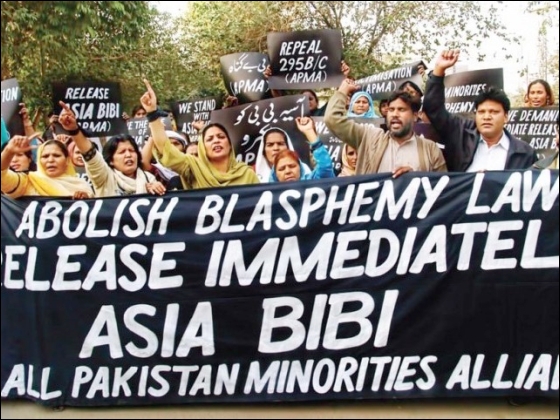
Blasphemy case: Still no bail for Rimsha

The Express Tribune
A young Pakistani Christian girl accused of blasphemy in a case that has prompted international concern will stay in jail until at least Friday, after a bail hearing on Monday was adjourned. Rimsha has been in custody since being arrested in a poor Islamabad suburb, Mehrabadia, two and a half weeks ago, accused of burning papers containing verses from the Holy Quran, in breach of Pakistan’s strict blasphemy laws. Judge Muhammad Azam Khan adjourned the case until September 7 because of a lawyers’ strike, following a request from the lawyer for Rimsha’s neighbour Hammad Malik, who filed the original complaint against her. Police on Saturday arrested Hafiz Mohammed Khalid Chishti, the imam of the mosque in Rimsha’s area who first submitted the burnt papers as evidence against her, after his deputy told the police that he had tampered with the evidence. Chishti’s deputy Maulvi Hafiz Mohammad Zubair and two others, Mohammad Shahzad and Awais Ahmed, told a magistrate the cleric added pages from the Holy Quran to the burnt pages brought to him by a witness to beef up the case against her. A medical report last week said Rimsha appeared to be around 14 years old, which would make her a minor, and had a mental age below her true age, but the court has yet to decide whether to accept the assessment. Some reports have said Rimsha has Down’s Syndrome and her case has prompted concern from Western governments and anger from rights groups, who warn the blasphemy legislation is often abused to settle personal vendettas.

No American killed in Peshawar blast: US embassy

The US embassy in Islamabad Monday denied reports that two Americans had been killed in a suicide car bomb attack in Pakistan s northwestern city of Peshawar. An embassy spokesman said they had no reports of any Americans killed in the blast, after provincial information minister Mian Iftikhar Hussain said two had died. "The blast killed two Americans. This is a dangerous move from the terrorists -- they want to terrorise the foreigners," Mian Iftikhar Hussain told AFP, adding that two Americans were also wounded in the blast. Police have recovered a half-burnt US passport from a car badly damaged in the blast, officials said. The blast took place near residential quarters for the US consulate and foreign aid organisations, senior police officer Tahir Ayub said, adding that at least five people were killed. "The car targeted was a US consulate vehicle," one intelligence official said.

PPP to continue working for people's welfare

Pakistan People's Party is taking solid measures to improve the life of common man by providing all the basic necessities of life. Member of the PPP central executive committee Ch. Manzoor Ahmed said this while addressing a gathering after inaugurating Sui gas connections here in Gulberg colony on Monday. He assured the public gathering that PPP led government was making efforts to ease out power crisis. However, he criticised that Nawaz Sharif government disbanded the project initiated by former Prime Minister Benazir Bhutto to create 40,000 MW electricity with the cooperation of France. Ch Manzoor further criticised PML-N for politicising the loadshedding situation. However, he re-affirmed his party's resolve to continue working for democracy in the country and people's welfare.

Pakistani cleric faces possible blasphemy charge

http://www.boston.com
Pakistani police say they are investigating whether a Muslim cleric who allegedly tried to frame a Christian girl for blasphemy should be charged with insulting Islam himself. Police officer Munir Jafferi says officials registered the blasphemy case against Khalid Chisti on Monday. Police arrested Chisti on Saturday after a member of the cleric’s mosque accused him of stashing pages of a Quran in a Christian girl’s bag to make it seem like she burned the Islamic holy book. He has denied the allegation. Jafferi says Chisti could be sentenced to life in prison if he is convicted of desecrating the Quran. The Christian girl’s lawyer, Tahir Naveed Chaudhry, says his client will remain in prison until at least Friday after her bail hearing was delayed for the second time Monday.

Car bomb hits US vehicle in Pakistan

Journalist Shaukat Paracha reports on an explosion in Peshawar, Pakistan, in which an American vehicle was targeted.

Afghan refugees

The problem with being a refugee anywhere is that sooner or later — and it could be a lot later — it will be time to go home. The Afghans living in Pakistan, still the largest population of refugees anywhere in the world, now face the difficulty of leaving what for many is ‘home’ and returning to their own country — which for many is not home at all. Broadly speaking, Afghan refugees in Pakistan fall into two categories: registered and unregistered. Many of them are second-generation and were born here. Those that remain are mostly in Khyber Pakhtunkhwa, but they are scattered across the entire country to a greater or lesser degree. There may be as many as three million, and Pakistan has decided it is time for them to go home. Those that wanted to go home already have, which leaves a significant population of Afghans who have little or no desire to return to their home country.
Those registered have a valid status only until December 31 2012, those unregistered have no status whatsoever. The Khyber Pakhtunkhwa government had directed all unregistered Afghans to leave by August 31, a deadline now past. The statement is unequivocal in saying that all Afghans, registered and unregistered have to leave by December 31 2012 and a humanitarian crisis is before us. There are reports that other provinces have already been moving to clear their Afghan refugee populations, deporting them via Torkham. Those with businesses — and there are many — are being advised to pack up, liquidate their assets and move back whence they came. The statement flies in the face of that made by the United Nations High Commission for Refugees (UNHCR) last month. The UNHCR was quick to deny a report in a foreign newspaper that Pakistan was planning to repatriate the Afghans by the end of the year, a denial now clearly at variance with ground realities. There is going to be no happy or tidy end to the story and persuading — or forcing — nearly three million people back across the border in the next four months is going to be a huge logistical task. The government and the UNHCR need to be reading off the same page which is apparently not the case at the moment; and a joint statement defining the true nature and future of Afghan refugees in Pakistan would be greatly welcomed. This issue must be handled with maturity and with proper planning and resources else it turns into a major source of disturbance and violence in an already troubled situation.

US to fund Torkham road reconstruction

DAWN.COM
The US government has agreed to finance construction of Peshawar-Torkham Highway, which serves as main supply route for Nato forces in Afghanistan. According to an official statement issued here on Sunday, the US government will provide Rs5.60 billion for construction of the 45-kilometre road. Khyber Pakhtunkhwa Governor Barrister Masood Kausar has directed the quarters concerned to start work on this vital project immediately. The project, to be started this year, will be completed within 18 months. The statement said that Frontier Works Organisation, a subsidiary of army, would construct the road as National Highway Authority (NHA) would work as executing agency. To ensure timely completion of the project, Fata Secretariat would play a lead role. Work on the highway will be started on war footing as staff has been hired for the purpose. The statement said that principal agreement with United States Assistance for International Development (USAID) had been reached and an accord with the donor agency would be signed in the second week of September. After the agreement, work would be starred on the much delayed project immediately. The USAID is already helping Khyber Pakhtunkhwa government in Expansion and Refurbishing of Ring Road Project and provided Rs2 billion for the scheme that according to officials would be completed soon. Construction of Peshawar-Torkham Highway is perhaps the first major development project to be financed by the US government following melting of ice after Salala attack for which Islamabad was demanding an apology from Washington for killing its 24 officers and soldiers. The government said that transportation of supplies for Nato forces in Afghanistan was damaging road network, asking the US to rehabilitate those major highways. Officials said that roughly 10,000 small and heavy vehicles were passing through Peshawar-Torkham Highway daily. The construction of highway that passes through Khyber Agency and also serves as a trade route for Afghanistan and Central Asian Republics has been under consideration since 2001. Work on the project could not be started because of financial constraints. An official said that NHA had already completed PC-1 and conducted environmental impact assessment survey of the project. He said that the government had allocated Rs120 million for land acquisition. Initially it was planned to construct an alternate dual carriageway between Peshawar and Torkham that was to pass through Malagori and Loi Shalman. Asian Development Bank had made commitment to bear 60 per cent of the total cost of the project and Pakistan government pledged 40 per cent share. Pre-feasibility study of the proposed carriageway was carried out in 2007-08 while detailed survey was dropped. Sources in NHA that carried out pre-feasibility survey said that estimated length of the carriageway was 90 kilometres through Malagori and Shalman, while distance of existing Peshawar-Torkham Highway was about 50 kilometres.

Peshawar: Two Americans killed in blast

Two Americans were killed in a suicide car bomb attack targeting a US consulate vehicle in Peshawar on Monday, the provincial information minister said. "The blast killed two Americans. This is a dangerous move from the terrorists -- they want to terrorise the foreigners," Mian Iftikhar Hussain told AFP, adding that two Americans were also wounded in the blast.

Afghan commanders defy night operations

Frontier post
Afghan commanders have refused more than a dozen times within the past two months to act on U.S. intelligence regarding high-level insurgents, arguing that night-time operations to target the men would result in civilian casualties, Afghan officials say.The defiance highlights the shift underway in Afghanistan as Afghan commanders make use of their newfound power to veto operations proposed by their NATO counterparts.For much of the past decade, NATO commanders have dictated most aspects of the allied war strategy, with Afghan military officers playing a far more marginal role. But with the signing of an agreement last month, Afghans have now inherited responsibility for so-called night raids - a crucial feature of the war effort.To Afghan leaders, the decisions made by their commanders reflect growing Afghan autonomy from Western forces as NATO draws down, and prove that Afghan forces are willing to exercise more caution than foreign troops when civilian lives are at stake, The Washington Post reported."In the last two months, 14 to 16 [night] operations have been rejected by the Afghans," said Gen. Sher Mohammad Karimi, the top Afghan army officer. "The U.S. has said, 'This operation better be conducted. It's a high-value target.' Then my people said, 'It's a high-value target. I agree with you. But there are so many civilian children and women [in the area].' "Many of the rejected night operations are later conducted once civilians are no longer in the vicinity of the targets, Karimi said.U.S. officials point to progress they have made in their own efforts to reduce civilian casualties, and say that while the Afghans occasionally choose not to act on American intelligence, night operations are nonetheless frequently conducted. Americans continue to provide logistical support and backup, U.S. officials say, using their aircraft to deposit Afghan soldiers at the targets."The Afghans are the ones who give final say on whether or not the mission gets conducted. That's how the process works now," said a U.S. official who spoke on the condition of anonymity to discuss a sensitive issue. "The operational tempo hasn't been affected by this. I don't think there's been a night when they haven't conducted a good number of operations."But the resistance to American guidance on night operations represents the clearest indication to date that Afghan military commanders are heeding a directive from President Hamid Karzai last month. Just a day after signing a 10-year bilateral agreement with the United States, Karzai said Afghan soldiers should discard questionable information provided by the U.S. military. "If you have any doubt about an American intelligence report, do not conduct any operation based on it," he told officials at the Interior Ministry.The Afghan president grew even more disenchanted over the last week, when separate NATO airstrikes killed 18 civilians in Logar, Kapisa, Badghis and Helmand provinces, according to Afghan officials. The president and his advisers said the attacks raise questions about the newly minted partnership agreement."Karzai signed the strategic pact with the United States to avoid such incidents and if Afghans do not feel safe, the strategic partnership loses its meaning," said a presidential statement.In the past, such complaints would have been unlikely to affect military operations. But the transition to greater Afghan control of security has left Karzai and his military in a stronger position to stymie the American strategy.The transition will continue in the coming months. This summer, a number of districts and provinces will be formally entrusted to Afghan security forces, the third round of regional transitions. In September, Afghans will assume responsibility for the U.S. military prison at Bagram, with about 3,000 detainees.In the past, Western officials questioned whether Karzai's opposition to night raids and other U.S.-led operations was politically driven - aimed at proving to his people that he was capable of resisting American demands.Now, with more transitional milestones looming, Afghan political and military leaders say their growing responsibility has made the issue of civilian casualties even more delicate."Most of the people will say, 'I don't blame the foreigners if they kill us, but why do you kill me?' " Karimi said. "We have to be concerned. We have to have people on our side."Each time civilians are killed in either a NATO or Afghan operation, Karzai or one of his advisers calls the Defense Ministry for an explanation. Karimi said the president's involvement in military affairs centers largely on reducing civilian casualties rather than on dictating troop levels or strategy.NATO officials say they have greatly reduced the number of civilians killed in operations in recent years. The United Nations last year attributed 400 civilian deaths to NATO and Afghan forces, a slight decrease from 2010."We have significantly improved attention to detail when it comes to targeting," a U.S. official said.Human rights organizations say they fear that the methods and institutions developed by NATO to both track and prevent civilian casualties will not be replicated by the Afghan security forces."Right now, Afghan forces don't have systems in place to prevent and respond to civilian casualties they may cause. International forces evolved their thinking over a decade, realizing they needed a civilian casualty tracking team and policies to investigate civilian harm caused by their own forces," said Sarah Holewinski, executive director of the Campaign for Innocent Victims in Conflict. "Without those systems in place, verbal commitments from the Afghan government to not harm civilians are likely to fall flat as Afghan forces take over."

Smith contradicts Karzai over deadly Afghan raid

Defence Minister Stephen Smith has directly contradicted claims by Afghanistan's president Hamid Karzai that a deadly Australian raid on suspected insurgents was carried out without proper approvals. Two men - identified by the Afghan government as 70-year-old imam Haji Raz Mohammad and his 30-year-old son Abdul Jalil - were killed during the raid, which was carried out as part of the search for a rogue Afghan soldier who shot dead three Australians last week. Twelve other people were detained during Friday night's raid in Uruzgan province, although 11 have since been released.Mr Karzai has issued a statement strongly condemning the deaths, describing Australia's actions as a "unilateral military operation" that was carried out "without any prior coordination or approval of the provincial authorities". "The President condemns the operation as a breach of the Memorandum of Understanding signed between Afghanistan and NATO on the special military operations," the Afghan government statement says. But Mr Smith has strongly rejected the accusations, saying the partnered raid was fully authorised by the Uruzgan chief of police and the local governor. Mr Smith said the raid involved 60 Australian Defence Force personnel and 80 Afghan National Army soldiers, and the two men who were killed have been confirmed as insurgents by both Australian and Afghan sources. "The statement which has been issued by president Karzai's palace over the weekend in Kabul that this operation was not authorised is wrong," Mr Smith told reporters in Perth this morning. "That is not factually correct, and this point has been made strongly by Australia's ambassador to Afghanistan to palace and presidential officials." The raid was part of a wider search for rogue Afghan soldier Hek Matullah, who killed three Australians in a so-called green on blue attack last week. Lance Corporal Stjepan Milosevic, Sapper James Martin and Private Robert Poate were shot dead, and two other Australians were wounded, when Matullah turned his gun on them at a patrol base in Uruzgan province last Wednesday. The shooting has heightened concerns among coalition forces about the threat of insider attacks, and has prompted the International Security Assistance Force (ISAF) to suspend training for 1,000 Afghan Local Police recruits. ISAF says the move is a "precautionary measure" that will allow for an intensive re-vetting process to take place for the 16,300 current members of the local police force. Australian troops are not involved in training Afghan police, and so are not affected by the suspension. The 11,000 members of the recently inaugurated Afghan National Army Special Operations Division are also having their vetting status checked, but are continuing to carry out their duties. Mr Smith says that means partnered operations between Australian and Afghan forces will continue. The bodies of the Brisbane-based soldiers are now returning to Australia, along with those of two other diggers who died in a helicopter crash the same day. Matullah is still at large but is being hunted by Coalition and Afghan troops. A suspected insurgent leader who is accused of helping him evade the manhunt was captured during the raid. In a statement posted online, the International Security Assistance Force said: "The insurgent leader who was detained by the combined Afghan-Coalition operation in Uruzgan early on Saturday morning is confirmed to be an "IED emplacer" and was previously involved in kidnapping, murder and attacks on Afghan National Security Forces". "At the time of his capture, he was attempting to support and move the insider threat shooter who killed three Australian soldiers and wounded two on Aug[ust] 29."

Afghanistan condems Australian military for killing alleged civilians

http://www.radioaustralia.net.au
Afghanistan's President Hamid Karzai has condemned the Australian military over a raid in which two Afghan men were killed. Australian soldiers had been searching for the rogue Afghan sergeant who shot dead three Australian soldiers last week, and during their mission they captured a suspected insurgent leader who is thought to have helped the killer to escape. The Australian Defence Department says the two men who died during that operation were also suspected insurgents, but villagers have told the media they were civilians. The bodies of the five soldiers who died last week in the deadliest day for Australian forces since Vietnam are returning home. They were farewelled by their comrades in a ceremony at Tarin Kowt. Capturing Sergeant Hek Matullah, the Afghan soldier suspected of shooting Lance Corporal Stjepan Milosevic, Sapper James Martin and Private Robert Poate, remains a high priority. Sergeant Hek Matullah escaped from the patrol base straight after the killings and he's suspected to have been aided by the Taliban. After an extensive search Australian troops aided by Afghan forces have detained a suspected insurgent they say helped with the escape. But the raid has come at a cost. Two Afghan men were killed by Australian troops. The ADF says all the proper rules of engagement were followed but Afghanistan's president Hamid Karzai is furious. Local reports say those killed were a 70 year old Imam and his son. It's also been reported that the Australian troops detained a number of locals, including a woman, during the operation. President Karzai says the Australian forces acted unilaterally and he wants a full inquiry into the situation. The latest incidents have highlighted the problems "green on blue" killings are causing for western forces in Afghanistan. At least 45 Western soldiers have died at the hands of Afghan allies this year. Now ISAF has suspended the training of new recruits to the Afghan local police. NATO spokesman Colonel Thomas Collins: THOMAS COLLINS: As you know we've had a problem here with some security challenges. Eventually there will be a tightening of the vetting procedures across the force and we've already begun working with the Afghan government on how we can make the vetting process better. MICHAEL EDWARDS: Complaints about Afghan local police range from corruption within its ranks to allegations its members rape and kill innocent civilians. Heather Barr from Human Rights Watch in Afghanistan says it's a program with a range of serious problems. HEATHER BARR: First is with the vetting, which is the issue that's come up today and has finally caused a reaction. There are also serious problems with the command and control structures for the Afghan local police as well as in terms of accountability mechanisms for what's in place when something goes wrong. MICHAEL EDWARDS: ISAF has high hopes that the Afghan local police will be an effective force against the Taliban at a local level after 2014. But Heather Barr is sceptical that it can be turned into an efficient and reliable counterbalance to the insurgents. HEATHER BARR: It's really difficult to repair a program at this stage and especially with this 2014 deadline looming. So it's certainly big news that the US has seen that there are issues and is working to resolve them. But it's frustrating indeed that it took so long and that there are so many abuses and lives that have been lost in the process. MICHAEL EDWARDS: ISAF says it could take a couple of months before training of Afghan local police recruits resumes. It says training of other Afghan security forces - including the army - continues.

Peshawar: Car bomb hits US vehicle, 3 killed

Three people died while five others injured with a blast in a UNO van on Peshawar University Road. Police say a car filled with explosives rammed into a U.S. government vehicle in northwest Pakistan, killing three people and wounding ten others. Police officer Pervez Khan says the vehicle was attacked in the northwest city of Peshawar on Monday after it left the U.S. Consulate. Khan said some of the wounded were foreigners. The identities of those killed were unclear. The attack occurred in an area of Peshawar hosting several foreign organizations, including the United Nations. Local TV footage showed an SUV at the site that was completely destroyed and burned. U.S. officials could not immediately be reached for comment.

Sunday, September 2, 2012

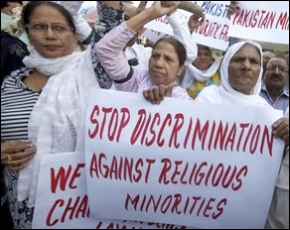
Pakistan: State against minorities

BY: Chaudhry Faisal Hussain
THE concept of a Muslim state vis-à-vis its minorities, as envisaged by those that oversaw the creation of Pakistan and the members of the first Constituent Assembly, is hardly understood today. In his Aug 11, 1947 speech, Mohammad Ali Jinnah delivered a message of freedom to not just Muslims but also the minorities living in the country.
Assuring them of equal status, he said famously: “You are free; you are free to go to your temples, you are free to go to your mosques or to any other place or worship in this state of Pakistan. You may belong to any religion or caste or creed — that has nothing to do with the business of the state.… We are starting in the days where there is no discrimination, no distinction between one community and another, no discrimination between one caste or creed and another. We are starting with this fundamental principle: that we are all citizens, and equal citizens, of one state.” Following this vision, the first Constituent Assembly adopted the Objectives Resolution which said that “adequate provision shall be made for the minorities to profess and practise their religions and develop their cultures.”
It added that there would be “guaranteed fundamental rights, including equality of status, of opportunity and before law, social, economic and political justice, and freedom of thought, expression, belief, faith, worship and association, subject to law and public morality”. There were meant to be “adequate provisions … to safeguard the legitimate interests of minorities and backward and depressed classes”. Was it sufficient to merely pass a resolution and include the rights of minorities in the constitution while doing little to actually put such ideals into practice? What steps did the state take to make the nation aware of the rights of those who are in fewer numbers? The hard fact is that constitutions or laws cannot change societies or deliver on intentions unless they have social acceptance and the full backing of the state. This is what has led Pakistan to the current pass in terms of its minorities. The bitter reality is that the state machinery has, since its creation, miserably failed to protect minorities’ rights. While on the one hand governments have been enacting rosy-looking legislation, on the other they have failed in practice to create a consensus policy agenda on minorities’ status within Pakistan that would create a more conducive national mindset. In fact, they have remained involved in painting and treating minorities as unequal. Article 5 of the constitution states that loyalty and adherence to the constitution is the basic responsibility of every Pakistani citizen. Not only does the constitution extend equality to citizens regardless of caste or creed, under Article 36 it also imposes upon citizens and the government the responsibility of safeguarding the legitimate interests of minorities. This includes due representation in the federal and provincial services as well as social and economic justice and equality for minorities in the eyes of the law. Practically, however, minorities are disempowered. Contrary to the Quaid-i-Azam’s vision and constitutional bindings, the state has been unable to ensure minorities’ vibrant participation in state affairs. How many non-Muslims have been promoted to higher bureaucratic posts? How many non-Muslim police chiefs or chief secretaries and secretaries have there been during the past 65 years? How many members of minority communities have been inducted into the Pakistan Army and promoted to top ranks? What additional qualities do our Muslim politicians possess so that the prime minister and president of Pakistan can be chosen from amongst them, and amongst them alone? At the moment, there is not one judge from the minorities amongst the superior judiciary in any of the four provinces, the Islamabad High Court or the Supreme Court. Does Article 36 of the constitution not apply to the courts? Pakistan needs reminding that its proud judicial history includes people such as Justice A.R. Cornelius and Justice Dorab Patel. The buck doesn’t stop with the state. A lack of tolerance of other sects and belief systems has seeped into not just the minds of state functionaries, but also of private citizens. The extent to which most of the population is discriminatory towards minorities is nothing short of amazing. The electronic, print and social media, too, particularly in Urdu and the regional languages that most of the citizenry taps into, have by and large served to entrench intolerance and foment religious hatred. Cases involving minorities or religious matters, especially allegations of blasphemy, are often misreported or reported with sensationalist overtones. An issue as serious as sectarian killings is treated as newsflashes to be followed by spice-laden gossip masquerading as informed analysis. The sum effect of such influences was encapsulated in the murder in broad daylight of a governor in office by a man on his own security detail. Where does the answer lie? A reasonable place to start is the education sector: everyone should have access and the curriculum should be cleansed of anything that gives rise to prejudice against religious or other minorities. Religious and sectarian tolerance needs to be taught as a school subject and in military and judicial academies. Concurrently, Pakistan needs strict state action whenever cases of forced conversions come up and in incidents of religious and sectarian hatred. The state must adopt basic measures and teach people how to live in harmony in the true sense with people belonging to other castes and creeds.

'Afghan Taliban comeback will be bad for Pakistan'

South Asian News Agency (SANA)
United Kingdom High Commissioner in Pakistan Adam Thompson has said that the return of Taliban in Afghanistan will be a bad news for Pakistan. He said that the point of view of UK on drone strikes clear, adding that this is matter between Pakistan and US and UK want to see good relations between Pakistan and US. In an interview with a private TV channel, Thompson said Afghan people had experienced Taliban atrocities in the past and if Taliban make a comeback there, it would be bad for them and for Pakistan as well. “Pakistan is a key partner in Afghanistan peace and we would like to contribute in a political settlement of Afghan issue in a positive way,” he said. To a question he said United States had its own stakes in the region and its own policies and priorities. Though we are allies but we have our own priorities, he added. Emphasizing the importance of peace and stability in Afghanistan he said Pakistan can play a key role in it. “We cannot claim to understand Afghans as closely as Pakistanis can,” he said, adding UK would love to contribute in the process of Afghan peace positively. He said UK forces will be withdrawn from Afghanistan in 2014. Dispelling the impression of UK involvement in Balochistan he said it was a fantasy. When asked some Baloch separatist leaders were living in UK and operating from there, he said all kinds of foreigners live in Britain and British government has nothing to do with their political affiliations. He categorically said that Britain would never like to harm Pakistan in any way. “Impression that UK is associated with Balochistan separatists is only a fantasy,” he said. Thompson said United Kingdom was helping Pakistan in various sectors. He strongly rejected the impression the UK was in anyway linked with Balochistan unrest. He said he always tried to convince the British community that Pakistan was not as scary a place as portrayed in the international media. Thomson said United Kingdom was helping Pakistan in education sector more than any other country, both on primary and higher education level. “We prefer Pakistan in education to any other state,” he said, adding there is research collaboration between UK and Pakistan universities.

Islamic conspiracy theory revealed in Rimsha Masih blasphemy case

http://www.pakistanchristianpost.com
Dr. Nazir S Bhatti, President of Pakistan Christian Congress PCC have paid homage to Hafiz Mohammad Zubair on takeing a very daring step to come forward to reveal truth in Rimsha Masih blasphemy case to upheld true Hafiz Mohammad Zubair to told media after recording his statement before area magistrate “The Imam of a Mosque in Mehrabad, a slum of capital city Islamabad, Khalid Jadoon, manipulated the evidence against Rimsha Masih case of blasphemy”                                                                                                  The Imam of mosque in Mehrabad slum of Islamabad urged Mohammad Ammad to lodge a complaint in Ramna Police Station on August 17, 2012, that a Christian girl have set on fire pages of Holy Quran and committed blasphemy, The Ramna Police Station Islamabad, lodged a report under Section 295 B PPC against minor disabled girl Rimsha Masih. The complainant Mohammad Ammad with collaboration of Imam Khalid Jadoon, announced on mosque loudspeaker to punish blasphemer Rimsha Masih on which area Muslim women attacked Christian girl and his mother and tortured them while Muslim men started burning homes of Christians and a Church on which hundreds of Christians fled from area to save their lives.
Minor disabled Christian girl was rescued by Police and charged under blasphemy on report of Islamic cleric and sent to Adiala jail Rawalpindi on 14 days judicial remand. Hafiz Mohammad Zubair (Who teaches Quran in mosque to children) told media “Ammad, the complainant in the case, handed over the ashes of Quranic verses to the Imam of the mosque Khalid Jadoon, who also added more verses to it and put in trash where Rimsha Masih have thrown her home garbage” The Ramna Police arrested Imam Khalid Jadoon today after statement of Hafiz Zubair and other eye witnesses and a new turn took in Rimsha Masih blasphemy case in Pakistan. The eyewitness further said in his statement that he himself along with two more Motakif protested against the manipulation of the evidences. He said that he and other eyewitnesses had asked Khalid Jadoon to present the real evidences against Rimsha. Meanwhile, the religious scholar Tahir Ashrafi has asked the Ulema as to what kind of punishment Imams like Khalid Jadoon deserved. Dr. Nazir Bhatti urged Pakistan government to immediately announce procedural amendment in lodging FIR in blasphemy cases as this Islamic law is being widely misused to settle personal scores in Pakistan against Christians and Ahamadiyya communities.

President Zardari: Govt can no more afford persistent load shedding

Radio Pakistan
The President has directed concerned departments to take coordinated steps to end electricity and gas load-shedding
President Asif Ali Zardari has urged Ministries of Petroleum‚ Finance and Water and Power to work in unison and take concerted and coordinated steps to end electricity and gas load shedding in the country. He was chairing a meeting in Karachi on Sunday to review current energy situation and the progress on various measures being taken to overcome the power shortage in the country. The President said the government can no more afford persistent loashedding as it was adversely impacting the country's economy. The President directed that he should regularly be updated about the power situation adding that the government accords high priority to improve energy situation before up-coming elections. He said local bodies elections will be held this year at all cost before general elections. He said a bill relating to local body system will be passed by the Sindh Provincial Assembly within two months. President Zardari said PPP will form alliance with the allied parties to contest the up-coming general elections hoping that it will again emerge as the majority party and form new government at centre and the provinces. He said PPP has given sacrifices for democracy and it will continue policy of reconciliation to further strengthen it. Minister for Water and Power Chaudhry Ahmad Mukhtar briefed the meeting about the latest power situation in the country and said that various immediate measures taken by the government resulted in reducing the supply and demand gap. He informed the meeting that the power situation is steadily improving and expressed the hope that with the rising water levels in reservoirs as a result of recent rains‚ the situation will improve further. Chairman WAPDA briefed the meeting on various hydel power projects. The meeting was briefed about the progress made so far in the construction of Diamir Bhasha Dam and the efforts being made to garner finances for the project. The meeting was informed that Tarbela Dam was likely to be filled soon while Mangla Dam has been filled to a level of over 1180 feet against a level of 1230 feet. Advisor to PM on Petroleum‚ Dr. Asim Hussain briefed the meeting about the availability of gas and fuel for the power generation.

Obama leadership saved auto plants

http://news.yahoo.com
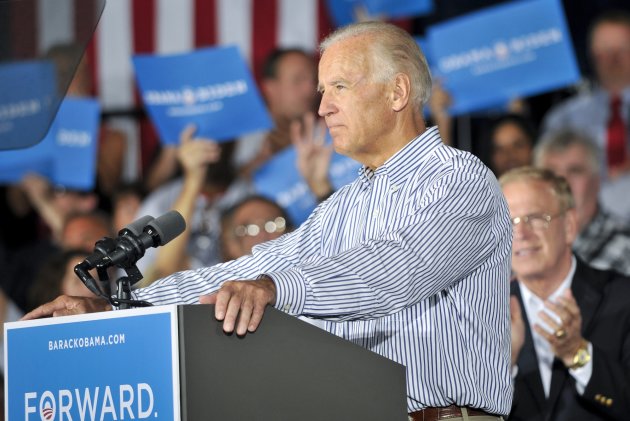
Vice President Joe Biden
mounted the Democratic counterpoint to the Republican presidential ticket Friday, drawing attention to the Obama administration's rescue of the auto industry and portraying GOP presidential challenger Mitt Romney as a foe of government efforts to save jobs. Laying out President Barack Obama's indictment of Republican polices, Biden said that Rep. Paul Ryan, Romney's running mate, has voted in Congress for measures that caused massive federal debts, including two wars, a prescription drug benefit and tax cuts for the wealthy that were not paid for. "They call their plan new, bold and gutsy," Biden told about 200 supporters in a union hall. "There is nothing gutsy about giving another trillion dollars in tax cuts to millionaires; there is nothing bold about turning Medicare into a voucher system. There is nothing bold about kicking 19 million kids and elderly off of Medicaid with no place else to go." Biden spoke about two miles from the sprawling GM plant in Lordstown in an event meant to emphasize the importance of the auto bailout to Ohio. The recoveries of GM and Chrysler have been recurrent themes in Obama's re-election campaign, particularly in states such as Michigan and the battleground of Ohio. Biden criticized Romney for opposing a taxpayer rescue of GM and Chrysler. "What they didn't acknowledge is Governor Romney's position was 'let Detroit go bankrupt,'" he said, quoting the headline on a 2008 Romney opinion piece in the New York Times. Ryan campaign spokesman Brendan Buck responded that Obama inherited a troubled economy but has made it worse. "Like many towns across America, Janesville, Wis., is still waiting for the recovery the president promised," Buck said, referring to Ryan's hometown, where a GM auto plant was idled in 2008. Biden's remarks came as Romney and Ryan left their Republican National Convention in Tampa seeking the votes of former Obama supporters who have grown disenchanted with his presidency. Obama traveled to Texas on Friday, where addressed military families on the second anniversary of the end of combat operations in Iraq.

How world opinion kidnapped by West's 'int'l community' rhetoric

Since the Industrial Revolution in Britain, the self-centered way of thinking that long formed in Western powers has been swelling with the constantly consolidated powers. One of the performances is that some Western politicians often make improper comments in the name of "international community" when they talk about the international affairs or in the Western media reports. In their eyes, they are the "international community." For example, the European and American media including the French media often make speeches on behalf of the international community, suggesting implementing more stringent sanctions on the Syrian authority, and criticize Russia and China who have a different stance on the Syrian issue in the name of "international community" for their "running counter to the international community" and "failing to join them to manage the world." In their opinion, China and Russia which have a population of over 1 billion are not included in the "international community." Moreover, Western media always criticize and attack China in the name of "international community." The author of the article has worked in Europe for more than 20 years and can often see and hear how the Western media accuse, distort and even demonize China for no reason. They criticize any things that they think "offending, untrue and disobedient" in the name of "international community." As what a very popular word in France has said, "It does not need to consider the facts and justices to criticize China because it is the 'right politics' to do so." Due to such misleading opinions, many innocent Westerners began misunderstanding China and giving birth to a bias against the state, regarding it "an oddity in international community". Thereby, some people certainly will get anxious and question about the rapid development of China. Now, the Western media dominates the international opinion, so the phenomenon of deceiving and misleading the world public opinion in the name of "international community" may have to continue for some time and is difficult to be corrected. Therefore, we must keep a clear mind about the "international community" quoted by Western media and distinguish the true "international community" from the false one.

Stop the terrorists, Pakistan tells Kabul

The Times of India
Interior Minister Rehman Malik has told the Afghan government to stop terrorists from entering Pakistan, a media report said on Sunday. Stressing that terrorists had again started their activities in Khyber Pakhtunkhwa, Quetta and Karachi after Eid, Malik said Saturday that forces wanting to destabilise Pakistan would never succeed. The Dawn newspaper quoted him as saying that attempts were being made to instigate sectarian violence in Pakistan by killing innocent people. The minister said the Taliban come into Pakistan from Afghanistan, and urged Afghan President Hamid Karzai to take effective steps to stop them from crossing over. The Taliban even had the capacity to carry out a major terrorist act in Islamabad.

Pakistani imam accused of framing Christian girl

Deutsche Welle
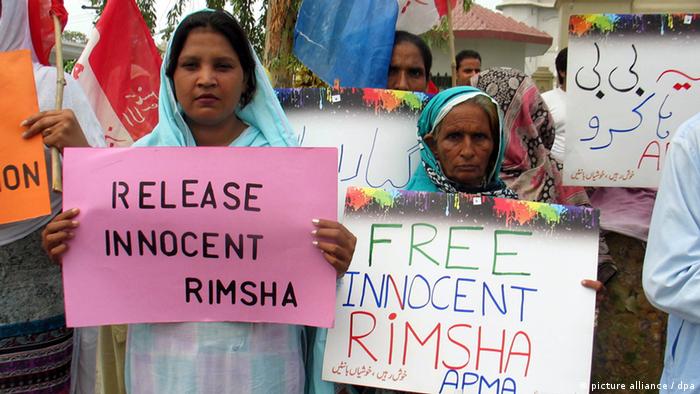
Police in Pakistan have arrested a Muslim cleric on charges of planting evidence against a young Christian girl detained under the country's anti-blasphemy law. The girl is accused of burning verses from the Koran. Pakistani police on Sunday said that Hafiz Mohammed Khalid Chishti had been arrested after his assistants turned him in for allegedly trying to frame the young Christian girl.Chishti supposedly added pages from the Koran to the pages that the young Christian girl, Rimsha Masih, allegedly burned. He filed the original evidence against Masih and serves as the imam at the mosque in her poor Islamabad suburb, Mehrabad. "Witnesses complained that he had torn pages from a Koran and placed them in her bag which had burned papers," police official Munir Hussain Jafri told the Reuters news agency.
'Conspiracy, not a mistake' Chishti claims that he originally received reports from villagers that Rimsha had burned Koranic verses and subsequently turned the girl in to police in order to avoid a violent incident. "People were demanding to burn their house," he said. "But I went to police and called them to avoid a major incident." Chishti has claimed that Rimsha was aware of what she did and had confessed. "She did it knowingly, this is a conspiracy and not a mistake," he said. "She confessed to what she did." Anti-blasphemy law Rimsha was arrested on August 16 on blasphemy charges after she was allegedly caught holding burnt pages of Koranic verses in public. There are conflicting reports regarding Rimsha's age and mental state. She is reportedly between 11 and 14 years old. Some media reports say she has Down's Syndrome. Under Pakistan's blasphemy law, anyone who defames Islam or the Prophet Mohammad commits a crime and can face the death penalty. Convictions under the law are common, but the death penalty has never been used in a blasphemy case. Critics of the law say it is often used to settle personal vendettas. Interreligious tension The reports that Rimsha had violated the anti-blasphemy law sparked anger among Muslims in Mehrabad, leading to public demonstrations demanding her punishment. Many Christians initially fled the suburb for fear of reprisals. Pakistani President Asif Ali Zadari had previously said that he took "serious note" of the case and called for the interior minister to submit a report on it. Zadari's government has been criticized by Western nations for not reforming the anti-blasphemy law. Pakistan's population of 190 million people is 95 percent Muslim, with a small minority population of Hindus and Christians.

Archbishop Desmond Tutu the 'moral compass'

Nelson Mandela once called Archbishop Desmond Tutu 'South Africa's moral compass' and he is. The other day he refused to share platform with Tony Blair, Labour Party's longest-serving prime minister - if that is a credit anymore - accusing him of prompting illegal and immoral invasion of Iraq in 2003. Blair's support for the US-led invasion was basic on doctored information, therefore "it would be inappropriate and untenable for the Archbishop to share a platform with Blair, according to Nobel Prize-winning priest". Ironically, however, the one-day conference was on 'leadership which could not be separated from morality'. Indeed, Blair's participation as speaker was a joke with history, for he was the principal inciter of the campaign to dislodge Saddam Hussain accusing the Iraqi leader of possessing weapons of mass destruction (WMD). That was never the case as after destruction in a surprise attack by Israeli airforce Iraq had permanently jettisoned its nuclear ambitions. But the oil-thirsty and pro-Israel governments in the West were out to capture Iraqi oil by hook or by crook. Having failed to convince international opinion that a minor explosion near Baghdad was 'incident in one of the Iraqi nuclear facilities' they led Saddam Hussain on to invade neighbouring Kuwait and then punished him for the adventure. But a clear victory over Saddam was required, hence the Blair's conspiratorial role and his fabricated information over Iraqi WMD stockpiles - so eagerly lapped up by the then US military chief General Colin Powell. And for the hypercritical gloss over invasion touted as a move to bring democracy to the people of Iraq, how much of it is on the ground at the cost of a quarter of a million lives and lingering instability and insecurity. One would have expected Blair was not invited to the moot given its high-sounding rubric of moralising the world leaderships. No other country in modern history has suffered at the hands of colonial oppression as of Archbishop Tutu's South Africa. And the natives' struggle against the notorious 'apartheid' policy of the colonial masters was perhaps the longest. But it was also a saga of human endurance and tolerance; it produced men like Mandela and Tutu who decided to overlook the gloomy past for a better future both for the South Africa's European and non-European segments of population. But for the Truth and Reconciliation Commission created by Bishop Tutu and others on both sides of the racial divide the 'apartheid' would have been still there taking its bloody toll. So sincere the effort on his part was that the sinners walked in without shame and embarrassment to confess their crimes and helped obtain a people at peace with their conscience. That moral compass of South Africa is the need of the hour in many parts of the world where ethnic, racial and sectarian conflicts are now raging in full fury causing immense human pain and misery. Instead of coming to the leadership conference Blair should have come to Tutu's Truth and Reconciliation Commission and confessed his crime of consigning millions of innocent Iraqis to unending war - that may have lost its military dimension but not of the Blair mischief that tends to foment insecurity and violence. Iraq today has a semblance of democracy, but it's definitely more volatile and unsafe than under the undemocratic rule of Saddam Hussain. And what kind of that war was that in the end removed from the scene one of the United States' strongest allies against its regional nemesis, Iran. Archbishop Tutu has indeed deserved world's praise for his frank 'no' to what was once known as 'Bush's poodle'.

Peshawar: Failed administrations

The thugs have struck Peshawar for the umpteenth time and yet again lethally, exacting a heavy toll on innocent lives as before. At least 11 people lay dead on the spot while another 17 were wounded, several of them critically. But where is the administration and what its security apparatus is doing? The wicked terrorists carried their deadly arsenal of explosives on a double-cabin vehicle. Obviously, that combustible vehicle had not travelled through some underground tunnel. Irrefutably, it had plied on the city's public thoroughfares in the full public view. And yet quite appallingly it went undetected and without being intercepted all the way when most of the city roads are cluttered with check posts and security barricades.This speaks volumes how meanly are the administrations failing in facing up to the monstrosity of terrorism and how culpably are their security apparatuses putting up a demeaning show of incompetence and feebleness in meeting the challenge of terrorists. After every terrorist strike, you hear the top echelons of the administration making a brave talk. Never ever would they bow down before the terrorists, they chant. But who wants them to bow down. The citizens want them to stand up and take firm steps to deal with the thugs, which they do not. They merely talk, not act. Almost the whole of the country is in the lap of terrorism and extremism and the state is virtually at war with the practitioners of this vile thuggery.But from the act of all the administrations, both the federal and the provincial, you don't get the sense if they are feeling to be in a condition of war. No strategies have they evolved to fight out this menace, even as it palpably makes up the biggest internal threat to the nation's security and the country's stability. No action plans have they put in place to take on the terrorist thugs proactively and aggressively, to snuff out the extremist outfits operating freely and finish off their lairs and sleeper cells in the urban centres. Karachi has veritably become a killing field, where no less than half a dozen people minimally are done in brutally every day in targeted killings and terrorist attacks. Quetta knows not when it would be free, if at all, from the butchery of roaming thuggish guns and the murderers for pleasure. Punjab has become the huge den of extremist and sectarian outfits, while the Khyber-Pakhtunkhwa lives on in the lengthening shadows of terrorism perpetrators and suicide bombers unremittingly. But as yet none of the provincial administrations has an answer to this rampaging monstrosity of terrorism and extremism. The only answer they have is that they would not bow down before the terrorists. But the people give a damn if they bow down or not. They want riddance from a monstrosity which is bloodying them horribly. And they are flabbergasted as much at the inertness of these administrations as at the ineptitude and incompetence of their subordinate security apparatuses. If the top echelons of these out-of-the-depth administrations are entertaining the citizens with a brave talk hogwash, their security apparatuses are amusing them with their own theatrics. After every terrorist assaults, they appear on the scene to cordon off the hit spot and harass the innocent citizens instead of going after the thugs. And instantly they start giving out the weight of the explosives used as if their task is only to give this information, not to prevent the terrorist strike.Certainly, the time has come that the administrations should get out of their stupors and get their acts together. Visibly, terrorists are in ascendancy, feeling no inhibitions at all in striking whatever they want, wherever they want and whenever they want. Palpably, they fear no resistance from the administrations and their security apparatuses; they indeed meet no such challenge in carrying out their devilish tasks. If it continues like this, the state will be in retreat everywhere and they will be on the offensive everywhere. The ultimate consequences of this nerve-wrecking phenomenon can well be imagined. The military cannot fight terrorists everywhere. Urban terrorism is fought out primarily by the civilian administrations and their security apparatuses everywhere the world over. And so has it to be here in this land, too. For a change, the civilian administrations have to pull up their socks and get cracking on their security apparatuses to do this fighting. Otherwise, we will have a Peshawar, Quetta or Karachi every other day to the nation's ultimate great gore.

Balochistan killings: Death toll rises to 8, strike observed

Another victim who was admitted in hospital in the aftermath of a firing incident that killed seven Hazaras succumbed to his injuries, taking the death toll to eight, Express News reported Sunday. A shutter-down strike is being observed in Quetta against the targeted sectarian killings carried out in different parts of Balochistan. The strike was called by Hazara Democratic Party, chief of the Hazara tribe Sardar Saadat and Azadari Council. Different political and trade unions also backed the strike. Special security arrangements have been done in order to avert any untoward incident. On Saturday, seven members of the Hazara community were killed in two apparently coordinated drive-by shooting incidents on the outskirts of the provincial capital. Gunmen riding on motorcycles had fired a volley of gunshots at a bus stop in the Hazar Ganji neighbourhood near a vegetable market, while in a separate incident, two intending pilgrims from the Hazara community were killed, while they were waiting at the bus stop to catch a bus for the Pak-Iran border town of Taftan. Soon after the first attack, a heavy contingent of police and paramilitary Frontier Corps cordoned off the area and mounted a manhunt for the killers. The senseless killings sparked violence in some neighbourhoods of the city where members of the Hazara community took to the streets. Protesters went berserk, allegedly barged into houses and harassed residents.

US halts some Afghan forces training after attacks

The U.S. military has halted the training of Afghan government-backed militias for at least a month in order to redo the vetting of new recruits after a string of attacks by Afghan soldiers and police on their international allies, officials said Sunday. There have been 34 insider attacks this year — at least 12 in August alone — that have killed 45 international troops, throwing doubt on the ability of Afghan and coalition forces to live and work together during a key time in the transition to Afghan control of security. One of the pillars of the international troop drawdown is for allied forces to hand over responsibility for the country's security to Afghans by the end of 2014. Lt. Col. John Harrell, a spokesman for U.S. special operations forces in Afghanistan, said the pause in training affects about 1,000 trainees of the Afghan Local Police, a militia backed by the government in Kabul. "The training of the ALP recruits has been paused while we go through this re-vetting process, to take a look at this process to see if there's anything that we can improve," Harrell said. "It may take a month, it may take two months, we don't know." Afghan Local Police forces that have already been trained will continue to operate, and the government will continue to recruit new members, Harrell said. Col. Tom Collins, a spokesman for the international military coalition in Afghanistan, also said there was no set date for the training of the local police to resume. The pause in training for the government-backed militias was first reported by the Washington Post. Harrell said the Americans last month also put a two-week pause on operations by the Afghan special forces last month to re-vet those soldiers for any potential ties to insurgents. He did not say whether any suspicious links were uncovered. The international forces in Afghanistan have been revisiting both security for their forces and re-examining the backgrounds of the Afghan forces in the wake of the recent attacks on international troops. The Post also reported that training of special operations forces had been halted, but a spokesman for the NATO training mission in Afghanistan, or NTM-A, which oversees this training said there has been no such pause. "There has been no halt in training with NTM-A assets as they relate to special forces," said Maj. Steve Neta of the Canadian military. He also said no other training programs involving the traditional military or police have been halted for re-vetting. The head of the Afghan special operations forces said there has been no pause to the training of his forces. The program to train Afghan special operations forces had already been on break for the Muslim holy month of Ramadan and had been scheduled to restart in mid-September. "It will continue. It is not ended at all. After the 15th of September we restart," Brig. Gen. Sayed Karim said. The most recent insider attack attack took place last week when an Afghan army soldier turned his gun on Australian soldiers, killing three of them. Over the weekend, the U.S.-led NATO coalition traded barbs with President Hamid Karzai over a joint operation carried out by Afghan and Australian troops to catch the insurgents responsible for the shooting in Uruzgan province. In the attack, an Afghan soldier opened fire on Australian soldiers, killing three and wounding two, according to the Australian military. He later fled. In a statement issued late Saturday, Karzai's office condemned an operation by international troops to go after the shooter, describing it as unilateral and saying it resulted in the deaths of a 70-year-old man his 30-year-old son. Karzai's office said the operation took place without the coordination or approval of provincial authorities and violated an agreement that calls on Afghan troops to lead night raids. The U.S.-led international coalition responded by saying that Afghan officials approved and supported the strike. Prior to the two most recent attacks, coalition authorities said they believed that 25 percent of this year's attacks had confirmed or suspected links to the Taliban, which sometimes has infiltrated the ranks of the Afghan army and police and in other cases is believed to have coerced or otherwise persuaded legitimate members of the Afghan forces to turn on their coalition partners. ___

Saturday, September 1, 2012

No court can summon Zardari till he is President

Senior PPP leader Senator Chaudhry Aitzaz Ahsan has said that as long as Asif Ali Zardari is President, no court can summon him and there was no question of his summoning in the Lahore High Court for holding two offices. In an interview, Chaudhry Aitzaz Ahsan said that there has been no change in PPP policy regarding writing of letter to the Swiss officials and according to his (Aitzaz) opinion, Prime minister Raja Pervez Ashraf would meet the same fate as was faced by Syed Yusuf Raza Gilani. He said President Asif Ali Zardari enjoys immunity under the constitution. Regarding constitution of a two member bench in the Lahore High Court he said under the constitution neither the President can be issued any notice nor summoned. Aitzaz Ahsan said that democracy has been restored in the country after numerous and great sacrifices and no step should be taken which could be dangerous for democracy. He said all institutions of the State including the Judiciary should remain within their constitutionally mandated limit.

Free advice for Imran Khan

BY:Irfan Husain
FAMOUSLY, and to much acclaim from his devoted fans, Imran Khan has declared that he will end corruption in either 19 or 90 days, depending on which version you believe. But in either case, he is sure he will root out this evil in a very short period. In this desire, he is in good company: Ayub Khan, Yahya Khan, Zia and Musharraf all promised to clean up the system. We all know how that went for them and for us. It’s not that I doubt Imran Khan’s intentions, or that I would like to see him fail should the improbable happen, and he actually comes to power. As a Pakistani, there’s nothing I would rather like to see than a country free of corruption. But as somebody who has spent most of his working life in the bureaucracy, I can say with some authority that the whole system is now so steeped in venality that I doubt any one ruler has the power to eradicate it in a single lifetime. And this is not the cynic in me speaking, but the practical ex-civil servant. I know Imran Khan is surrounded by many bright advisers, but this column is intended as a free input into his ongoing policymaking exercise. Let me start with a personal example. After I took early retirement from the civil service to head a private university whose lovely campus was nearing completion on the outskirts of Karachi, the electrical contractor complained that a provincial inspector was demanding a bribe to issue a certificate. Without this piece of paper, we could not get power from the grid. I happened to have a friend who was a provincial minister, so I called her to report this complaint. In a couple of days, she rang back to say that she had had the inspector transferred to Thatta, and I passed on the good news to the contractor. A day later, he came to me in a state of great distress, and asked me to have the transfer cancelled. When I asked him why, he replied that the inspector’s successor and friends in other departments would make it impossible for him to work in the area. “The bureaucracy’s a mafia,” he explained. “You target one member, and the rest of the gang goes for you.” In the event, I refused to call my friend again, and have no idea how things worked out for the contractor. Here’s another example: when I took over as accountant general Sindh in the mid-1980s, I was aware the office had a reputation for corruption, especially in its pension section. After immediately changing the entire staff there, I put an ad in the newspapers announcing that an officer would record any complaints between 11 and 12 every day. Often I would join the officer as we waited for complaints to come pouring in. In one month, not a single person came forward. Disappointed and puzzled, I discussed this failure with colleagues. One of them explained, as though to a naïve child, that people knew that if they complained against an official, they would incur the ire of all his colleagues. They would then settle scores after my tenure ended. These are only some of the realities of corruption. Our businessmen are fond of sitting in their drawing rooms and cursing crooked officials. What they leave unsaid is that mostly, they benefit from this system as they pay bribes to either speed up their cases, or cut corners that allow them to make greater profits. In short, they are partners in crime with the officials they bribe. And corruption is not restricted to the state sector. Senior executives of large corporations are well aware of how their procurement staff skim off a percentage on the items they buy. Bank managers are not above charging clients a percentage of the loans they disburse. Elected members of well-known clubs are known to make money on contracts and kitchen expenses. The military is Pakistan’s biggest department in terms of money spent, and given the size of defence contracts, the alleged bribes in this area are huge. But the opaque nature of these transactions, and the clout of those in charge, makes it difficult to quantify the extent of the graft. At the field level, I have heard of at least one commanding officer of a battalion who regularly siphoned off a part of his unit’s food allowance. Turning to political corruption, the rules of business make it difficult for ministers to accept payoffs without the connivance of the bureaucrats reporting to them. Thus, if a minister demands (or is offered) a bribe for a contract, it is his underlings who will have to make the case and sign the agreement. Thus, politicians have every incentive to ensure they have pliable officers in their departments. It is this deepening corruption, as well as its social acceptance, that has caused such demoralisation in the higher echelons of the bureaucracy. Incidentally, when Imran Khan says he will clean up the system when he comes to power, does he think his party will win at the centre and the provinces simultaneously? He needs to remember that the sprawling provincial bureaucracies do not fall under Islamabad’s control. One problem Imran Khan and his team do not seem to have grasped is that low government salaries are one of the prime factors behind the widespread corruption. If I am honest, I will have to concede that I was easily able to resist temptation because I had only one child to educate, and my parents did not need my financial support. Also, my writing brought in a little extra income to pay for books. Most civil servants do not fall into this narrow category. None of this is to suggest that it is impossible to at least reduce corruption, but it needs a sustained effort, not just empty slogans. Over the years, we have heard plenty of those. Somehow, the bureaucracy needs to be trimmed as it is far larger than our needs. And pay scales need to be brought into step with financial and social reality. Above all, we must realise that corruption is a fact of life in the developing world. Even industrialised countries have their share of it. So a sense of proportion is needed while tackling this ancient evil.
The writer is the author of Fatal Faultlines: Pakistan, Islam and the West.

Pakistan's Judiciary One-man commission

EDITORIAL
The Supreme Court (SC) two-member bench hearing the Arsalan Iftikhar versus Malik Riaz Hussain case has come up with a most surprising judgement regarding the investigation into the alleged Rs 342 million business deal between the two parties. It may be recalled that when these allegations against the son of Chief Justice (CJ) Iftikhar Mohammad Chaudhry surfaced some months ago, and the SC, taking suo motu notice, constituted a three-member bench headed by none other than the CJ himself to hear the case, this caused considerable consternation amongst legal circles and the public regarding the appropriateness of the CJ heading a bench in a case involving his own son. Wisdom mercifully quickly set in when adverse opinion was voiced against this decision, and the CJ wisely, albeit belatedly, decided to recuse himself from said bench. On June 14 the residual two-member bench had announced a reserved judgement referring the matter to the Attorney General (AG) to set the state machinery in motion for an investigation into the matter. The AG then wrote to the National Accountability Bureau (NAB) to initiate the investigation. NAB constituted a Joint Investigation Team (JIT) for the purpose. Prima facie this seems perfectly reasonable, legal, and within the rules. The SC however, in its latest judgement on August 30 has found grave flaws in the procedure adopted by the AG. He has been put on notice by the bench to explain his handling of the matter, which in the court’s opinion went far beyond the scope of its June 14 order. The SC has also castigated the AG for not revealing before the bench that he had at some point represented Malik Riaz Hussain in his professional capacity as a lawyer. It should also be recalled that the SC had stopped the JIT from proceeding in the case on the grounds that the senior police officers who had been inducted into the JIT, SP Faisal Bashir Memon and DSP Tahir Malik, stood accused by the court of in one case providing undue ‘protocol’ to Malik Riaz Hussain on the occasion of his appearance before the SC, and generally of submitting false, dishonest or deliberately misleading statements during the proceedings or inquiries ordered by the court. On this basis, the SC wants disciplinary action taken against these officers. Not only that, the SC labels NAB ‘biased’, therefore unable to conduct the probe free of the perception of partiality or lack of competence. The case investigation has therefore, including all the record in NAB’s possession, been transferred by the SC to a one-man commission comprising Dr Shoaib Suddle. Now issue can be taken with this judgement at a number of levels and on a number of contentious decisions contained therein. First and foremost, the SC seems to have taken recourse to speculative opinion about NAB’s bias or competence before the fact has been established in any reasonable manner. The AG’s representing one party professionally is hardly conclusive proof of bias. The judgement’s castigation of the police officers in question seems to be based purely on behaviour or ‘body language’ evident in video evidence placed before the court by Arsalan’s lawyers taken from the SC’s CCTV cameras. The placing of this video evidence by a party to the case aroused a great deal of concern even then as to how one party could get hold of internal SC footage not normally available to any member of the public. Second, did the footage establish beyond reasonable doubt or at least contention that the police officers betrayed bias or sympathy towards the other party, Malik Riaz Hussain? Could it not be argued, for example, that they were simply showing courtesy to one of the litigants or even ensuring their safety? On the other hand, the setting up of another (one-man this time) commission to investigate will again become controversial just as the setting up of the Memo Commission by the SC troubled many legal minds. Fingers may now be pointed that this is another case of the SC assuming to itself the powers of an investigation agency, which it is not mandated to do, and which is the exclusive preserve of the executive. Such commissions of inquiry are normally set up by the government under the Commissions of Inquiry Act. This new ‘jurisprudence' by the apex court is bound to arouse controversy, possibly face legal challenges, and reinforce the opinion that holds that the SC is either unable, or seen to be unable, to do impartial justice in a case involving the CJ’s son. For this negative perception, the SC has no one to blame but itself.

Former diplomats hail President Zardari's speech at NAM Summit

RADIO PAKISTAN
Former diplomats say the President effectively highlighted Pakistan's viewpoint on regional and international issues Former diplomats appreciating President Zardari's speech at NAM Summit said the President effectively highlighted Pakistan's viewpoint on regional and international issues. Talking to PTV‚ they said NAM summit provided an opportunity to Pakistani leadership to interact with international community‚ which will definitely help the country to further promote trade and economic ties. Ex-ambassador Iqbal Ahmad Khan said Pakistan invited world leaders for investment and trade to help cope with the issue of poverty‚ which is root cause of terrorism in the region. Ex-ambassador Shahid Amin said that NAM Summit provided an opportunity to Pakistani leadership to hold meetings with world leaders to further improve relations. He said meeting between Indian and Pakistani leadership in Tehran on the sidelines of NAM is significant for bilateral relations. Replying to a question‚ he said Pakistan reiterated its viewpoint that it wants stable and peaceful Afghanistan in its neighborhood and supports diplomatic efforts for durable and peaceful solution to Afghan issue.

PAK PREPARES TO HAND OVER GWADAR PORT TO CHINA

Pakistan has reached an agreement with Singapore’s PSA International to transfer operational control of their Gwadar deep-water port to a Chinese company, The Financial Times reported. The port, which was built in part with a loan from China, is close to the Strait of Hormuz and the Pakistan-Iran boarder, and as such the deal will be closely watched by the US. The port, which was also built by China Harbor Engineering Company, had a total investment of US$248 million, US$198 million of which came from China. PSA began running the port five years ago as part of a 40-year contract. Part of the reason for the transfer has been Pakistan’s inability to follow through on some of its promises to PSA, including building a road to the port to aid in service operations

Over 900 Pakistani Hindus eligible for Indian citizenship

Officials in India’s western state of Rajhasthan say around 919 Pakistani Hindus there have become eligible to apply for Indian citizenship, according to a report published by the Deccan Chronicle on Friday. The administration from Rajhasthan’s Jodhpur area says the Pakistanis have become eligible for Indian citizenship after spending seven years in the country. The people included in the list are those Pakistanis who had traveled to India prior to December 31, 2004 and refused return to their home country. “As per our record, these 919 Pakistani Hindu nationals have completed seven years of their stay in India, the basic eligibility to apply for citizenship,” the newspaper quoted additional magistrate of Jodhpur, Rajendra Singh Rathore. “We have asked them to follow the procedure and if they fulfill all conditions, including fees, they will be granted citizenship.” The news follows media reports earlier this month of hundreds of Pakistani Hindu nationals from Sindh allegedly migrating to India on concerns of religious persecution and security fears. A committee was formed by President Asif Ali Zardari to look into the reports of mass migration. However, the committee rejected the claims that members of the minority community were leaving Sindh. Hindu Singh Sodha, president of the Seemant Lok Sangthan, an organisation for Hindus from Pakistan settled in India, told the BBCUrdu that the list issued by the Indian government was “too short”. “According to our information, there are 7,000 Pakistani Hindus in Rajasthan, who came from Pakistan on valid travel papers and refused to return,” he said. In March 2005, Indian authorities had granted citizenship to over 8,000 Pakistani Hindu nationals settled in Rajasthan and Gujarat states. According to reports, the Hindus included those who had came to India on valid travel papers from Pakistan, citing ill-treatment on religious grounds as the reason for their refusal to go back.

Wrong politics of Nawaz isolates PML-N

FRONTIER POST
Provincial Minister for Information Sharjeel Inam Memon has said that judiciary can do nothing without democracy. Constitution and judiciary are performing their role because of democracy, if there is not democracy in the country, there may not be independent judiciary and it would never be restored. This is wrong perception that democracy exists because of judiciary. This he said in a statement issued here on Friday. He said Pervaiz Musharraf took off his uniform after NRO and Nawaz Sharif's return to Pakistan was the out come of NRO and he was getting benefit of NRO. Although in agreement there was a condition that Nawaz Sharif would not be able to come in Pakistan before ten years but he came because of NRO. He also said that followers of Shaheed Zulfiqar Ali Bhutto gave the country constitution in its original shape. PCO Judges took oath to be loyal with Parvaiz Musharraf now they should be loyal with constitution of Pakistan. PCO Judges have become stigmatized for the country. Supreme Court Bench have given a verdict with objectionable remarks regarding deputation but they have forgotten a person named Arsalan Iftikhar Choudhry son of Iftikhar Muhammad Chaundhry who was a medical officer and he got deputation in home department then FIA and then got training in Police. This is a point of lament and it should be considered by those who believed in true democratic norms and wanted justice irrespective of status. He added. He said, 'PML (N) has isolated itself politically, the reason of this isolation is that PML (N) has negative approach towards issue, while Pakistan Peoples Party is the Political Party which respects the masses and follow democratic ethics. Provincial Minister said that Nawaz Sharif was working on anti democratic agenda. He should work to strengthen the democracy in the country and avoid to criticise the government for nothing. Sharjeel Memon requested all democracy loving forces to take notice of anti democratic behaviour of Sharif brothers.

PML-Q supports South Punjab and Hazara provinces: Elahi

www.pakistantoday.com
Deputy Prime Minister Parvez Elahi said that the government is struggling for the creation of a Southern Punjab province on an administrative basis. He said this while talking to the National Assembly Deputy Speaker Faisal Karim Kundi who called on him at his residence on Friday. The two leaders exchanged views regarding the prevailing political situation in the country and the next general elections. Parvez said that in order to remove backwardness and a sense of deprivation in the people of Southern Punjab, they had provided record funds during their tenure and powers were devolved down to the lowest level. He said that theirs was the first national party which had approved the resolution for the Southern Punjab province and then on May 5, 2010 a grand rally under his leadership was carried out in Multan. He said that with the creation of the new province, problems of the people of Southern Punjab would be resolved immediately and effectively. He said that along with the Southern Punjab province, they were also in favor of making a Hazara province and Pakistan Muslim League-Quaid would continue its efforts in this regard.

Seven shiites Killed in Quetta

Gunmen shot dead seven shiite muslims in two separate incidents in Pakistan's troubled southwestern province of Baluchistan on Saturday, police said. The incidents took place near Quetta, the capital of the oil and gas rich province, which is plagued by target killings and violence. "Four gunmen riding two motorbikes, intercepted a bus near Hazarganji area, pulled five shiite vegetable sellers off the vehicle and shot them dead," senior local police official Wazir Khan Nasir told AFP. He said in a second incident, two motorbike riders sprayed bullets at two shiites in Hazarganji area, on the outskirts of Quetta, killing both of them. Another local police official Mukhtar Musakhel confirmed the incident and casualties. Nobody has so far claimed responsibility for the attacks.

US drone strike kills 5 militants in Pakistan

Associated Press
U.S. drones fired a barrage of missiles at a vehicle and a house in a Pakistani tribal area bordering Afghanistan Saturday, killing at least five suspected militants, Pakistani officials said. The strikes in the North Waziristan tribal area were the first since news that a top commander of the powerful Haqqani militant network was killed in a drone strike late last month, also in the tribal region. Two intelligence officials, speaking on condition of anonymity because they are not authorized to brief the media, said U.S. drones fired seven missiles at targets in the village of Degan in an area of North Waziristan close to the Afghan border. They said the area is dominated by anti-American militant commander Hafiz Gul Bahadur, but they did not know whether the men killed belonged to his group. Bahadur's faction is alleged to have been involved in frequent attacks on U.S. troops in Afghanistan, but generally shies away from carrying out operations inside Pakistan. Several recent drone strikes have killed militants affiliated with Bahadur's group. The CIA-run drone program is controversial in Pakistan. Many Pakistanis call it an infringement on the nation's sovereignty and maintain that it causes a high number of civilian casualties, a charge the U.S. denies. Washington maintains the program is a necessary and effective tool in combatting militants. A drone strike a week ago in North Waziristan killed Badruddin Haqqani, one of the sons of the founder of the Haqqani network. The U.S. has blamed the group for a number of high-profile attacks in Afghanistan and considers it one of the key factors in undermining security there. Badruddin was considered the organization's day-to-day operations commander, and was labeled as a terrorist by the U.S. State Department, along with his father and two of his brothers. The presence of the mostly Afghan Haqqani network in North Waziristan has been a major source of friction between Pakistan and the U.S. The Obama administration has repeatedly demanded that Pakistan prevent the group from using its territory to launch attacks in Afghanistan, but Islamabad has refused — a stance many analysts believe is driven by the country's strong historical ties to the Haqqani network's founder, Jalaluddin Haqqani. North Waziristan, where many of the U.S. drone strikes occur, is the one tribal area where Pakistani forces have yet to carry out a military offensive against militants. The U.S. has been pushing Islamabad to move against militants in the area but so far, there's been no sign the Pakistani military is preparing to launch a major offensive. Meanwhile, a group of gunmen on motorcycles in the southwestern province of Baluchistan killed seven Shiite Muslims, as violence against the minority sect continues to escalate. Senior police officer Wazir Khan Nasir said four gunmen riding two motorcycles stopped a local bus near the central vegetable market of Quetta, the capital of Baluchistan. The gunmen identified seven people belong to the Shiite Hazara community, forced them off the bus and shot five of them dead. Two tried to run away but the gunmen chased them down and killed them in a nearby street, Nasir said. Hazaras are an ethnic group found in Afghanistan and Pakistan and are predominantly Shiite. They've often been persecuted by Sunni hardliners who consider Shiites to be heretics. There was no immediate claim of responsibility for the attack. Baluchistan is the scene of an insurgency by nationalist groups who demand more rights and a greater share of the income generated through natural gas and minerals extracted from the province. Islamist militants and the al-Qaida-affiliated sectarian group Lashker-e-Jhangvi is also operating in the province.

Pakistan 'blasphemy' girl case adjourned

AFP
A young Pakistani Christian girl accused of blasphemy must wait until at least Monday to learn if she will be given bail, after a judge adjourned her case on Saturday amid doubts over legal paperwork. Rimsha has been in custody since she was arrested in a poor Islamabad suburb more than two weeks ago accused of burning papers containing verses from the Koran, in breach of Pakistan's strict blasphemy laws. Judge Muhammad Azam Khan adjourned the case to Monday and asked police to investigate a bail application made on Rimsha's behalf after prosecutors claimed paperwork had not been signed by the girl or her mother. Speaking to reporters outside the court, Rimsha's lawyer Tahir Naveed Chaudhry accused prosecutors and lawyers for her accuser of delaying tactics. "The medical report has declared her an underage person with low IQ. How can she commit blasphemy? She is innocent and should be released," he said. A medical report earlier this week said Rimsha appeared to be around 14 years old, which would make her a minor, and had a mental age below her true age, but the court has yet to decide whether to accept the assessment. Some reports have said Rimsha has Down's Syndrome and her case has prompted concern from Western governments and anger from rights groups, who warn the blasphemy legislation is often abused to settle personal vendettas. Blasphemy is a very sensitive subject in the Pakistan, where 97 percent of the 180 million population are Muslims, and allegations of insulting Islam or the prophet Mohammad often prompt a furious public reaction.