Friday, August 10, 2012

New York: Sharp Rise in Homelessness

By AARON EDWARDS
The homeless population in New York City has jumped sharply over the last year, causing a record number of people to enter the shelter system. The increase has forced the Bloomberg administration to open nine more shelters in just the last two months — sometimes with only a few weeks’ notice to surrounding neighborhoods. The administration said the increase stemmed in part from the end of the city’s main rent-subsidy program for homeless families. But the new shelters — five in the Bronx, two in Manhattan and two in Brooklyn — have provoked criticism from local officials who say they were blindsided by the decisions to open them. The city, for example, relied upon its emergency authority to turn two residential buildings on 95th Street on the Upper West Side of Manhattan into shelters that will eventually house about 200 adult couples, officials said. The buildings had recently been used as illegal hotels before they were shut down, and they still have some long-term tenants. The city’s Department of Homeless Services told the community board about its plan in mid-July, only two weeks before people began moving in. The commissioner of homeless services, Seth Diamond, said in an interview that the city had no choice but to open the shelters, given the demand. The city recorded 43,731 homeless people (25,475 adults and 18,256 children) in the shelter system this week, up 18 percent from the 37,143 (21,807 adults and 15,336 children) a year ago, officials said. “We do have to move quickly, and we have to always make sure that we have enough capacity,” Mr. Diamond said. “The one thing we cannot do is have families come in and not have a place for them.” Mr. Diamond said he did not believe that his department had deceived neighborhoods by opening shelters with little notice, saying the process for picking the sites had been done “always with community communication.” The administration is not legally obligated to get the approval of community boards before opening shelters, but its policy requires it to tell them of its plans ahead of time. Of the nine new shelters, the city opened three, including the two in Manhattan, under its emergency authority, giving little notice before proceeding. Several of the other shelters were opened under normal practices but officials had moved quickly. The city told a community board in the Bronx this week that a 50-unit homeless shelter would open within days. By law, the city is obligated to supply shelter to people who have nowhere else to go, though there are limits to how long they can stay. The current shelter census is the highest ever, officials said; the number does not represent the total homeless population in the city, because some people avoid the shelter system. Local officials and neighborhood leaders acknowledged the need for the shelters, but said the Bloomberg administration had moved too abruptly. Several elected officials sponsored a protest this week in front of the 95th Street buildings, which are side by side between West End Avenue and Riverside Drive. The buildings are privately owned, and the city is paying roughly $3,300 a unit a month, with two or three people living in each unit. Manhattan’s borough president, Scott M. Stringer, said, “This is no way to meet the needs of vulnerable citizens in this city by simply packing in hundreds and hundreds of people in the dead of night without a long-range plan.” Asked what the alternative should be, Mr. Stringer, a Democrat who is likely to run for mayor next year, said, “Well, that is the conundrum.” He added: “You still need to come to various constituencies to support a long-term policy to meet a need that is expanding. It’s easy to throw 400 people in a community without doing your homework.” Other community leaders said they feared that the administration was rushing to find beds for homeless people without first ensuring that there were adequate social services for them. If not properly supervised, they said, the shelters can become rife with drugs and crime. “It isn’t because we don’t want them in our backyard,” said Mark N. Diller, who is chairman of Community Board 7 on the Upper West Side. “It’s that we don’t want a failure in our backyard.” A 10-year resident of one of the buildings, Masako Koga, 48, said she noticed new security guards on Monday and was then informed for the first time that homeless people would soon be moving in. “There are so many vacant rooms, though, so I knew it would be coming soon,” Ms. Koga said. Patrick Markee, a senior policy analyst with the Coalition for the Homeless, said a weak economy and rising housing costs were major factors underlying the rise in homelessness, particularly for black and Hispanic families. “We’re facing the prospect of more and more shelters opening in the city,” Mr. Markee said, “and that creates bad incentives for landlords to push out low-income tenants in favor of doing deals with D.H.S.” There are 228 homeless shelters in the city, up from 211 in June 2010. A vast majority of them are privately run and financed by the Department of Homeless Services. The Bloomberg administration acknowledged that the end of Advantage, which was the city’s signature program to combat homelessness, had played a significant role in the increase in homelessness. The program gave subsidies to homeless families for up to two years to help pay for their apartments if they were employed. Some families who exhausted their Advantage benefits are now back in the shelter system. The city said last year that it was discontinuing the program because the state was dropping its financial support. “We are in a very difficult environment with a very successful program that ended very abruptly,” Mr. Diamond, the homeless services commissioner, said. “At that point, we said the result would be a significant increase in the homeless population. The tragedy of losing Advantage was not just that we lost it, but that we lost it at a time when money was so tight that it was almost impossible to get it back.” Tayna Munoz, 29, said that she had had an Advantage subsidy for two years, and that once her eligibility ended, she continued in her job as an assistant in a dentist’s office. But a few months later, she lost her position, leaving her unable to afford all the rent and support her 8-year-old daughter. Evicted from their apartment, she went to the Homelessness Department’s Prevention Assistance and Temporary Housing office in the Bronx to apply for shelter. “My plan was to get help and save to get my own apartment,” Ms. Munoz said outside the office. “Right now, it’s not easy.”

Nazia Hassan will be remembered on her 12th death anniversary

http://www.radio.gov.pk
She was born on 3rd April 1965 in Karachi.Nazia Hassan began her singing career during the late 1970s‚ when she appeared on several television shows on PTV as a child artist. Her professional career started at the age of fifteen when she provided the lead vocals for the song Aap Jaisa Koi from the 1980 film Qurbani and in 1981 won Filmfare award for it. In 1981‚ Nazia Hassan became the first playback singer to release an album after the release of her first album‚ Disco Deewane. Nazia's second album Star/Boom Boom was released in 1982. The soundtrack of the album was used in the movie Star. Nazia's third album‚ Young Tarang was released in 1984. The album sold 40 million copies which set the record of most-selling video album of all times. Nazia's fourth album‚ Hotline was released in 1987. In 1988‚ Nazia and her brother Zoheb appeared with music expert Sohail Rana in his television program‚ Sung Sung. In the following year‚ Nazia and Zoheb hosted the groundbreaking show Music '89. Nazia hosted another show‚ Dhanak on PTV in the same year‚ 1989. In 1991‚ Nazia and her brother Zoheb recorded her fifth album‚ Camera Camera. The album was released in 1992. Nazia was married on March 30‚ 1995 to Mirza Ishtiaq Baig. They had a son born on April 7‚ 1997 named Arez. Nazia's marriage with Mirza Ishtiaq Baig was a complete failure and she got divorced on August 4‚ 2000. Nazia died of lung cancer in London on August 13‚ 2000 at the age of 35. The Government of Pakistan has conferred upon Nazia Hassan the highest civilian award ‘Pride of Performance'.

Harassed Hindus flee Pakistan

Hindus are fleeing Pakistan after their shops were looted, houses raided and women were converted to Islam, a media report said.Rehman Malik, advisor to Pakistani Prime Minister on interior affairs, however, said that visas being issued to 250 Hindu families by the Indian high commission was a conspiracy, reported Dawn. Malik was responding to a query on migration of Hindu families to India from Sindh and Balochistan after complaining that their shops had been looted, houses raided and women forced to embrace Islam. Rehman Malik said in Lahore that the government had stopped the Hindus of Jacobabad from leaving for India. They would be allowed to leave after complete verification. "The Indian high commission should say why it has issued visas to them," he was quoted as saying. The government has decided to beef up security for religious minorities following large-scale migration of Hindu families to India. Seven Hindu families comprising 90 men, women and children from Jacobabad left for India Wednesday night, citing lack of safety and security in Sindh. They left by train and were seen off by relatives and a large number of people of the community at the Jacobabad railway station. After reaching Lahore, they intended to enter India at the Wagah border. The move comes just six months after 52 Hindu families from the same area migrated to India. Jacobabad police official Muhammad Younus Chandio maintained that complete security was being provided to the community and said the families were not migrating but were going to India to perform religious rites and would return soon.

Nawaz is a puppet in Chaudhry Nisar's hands, claims Javed Hashmi

The Express Tribune
Continuing with the diatribe against the Pakistan Muslim League-Nawaz (PML-N), Pakistan Tehreek-e-Insaf (PTI) President Javed Hashmi accused PML-N chief Nawaz Sharif of being a puppet in the hands of Chaudhry Nisar Ali Khan. Addressing a press conference in Multan on Friday, Hashmi added that Nisar is causing harm to Pakistan and his own party. “Chaudhry Nisar is responsible for the imposition of martial law in the past and he was also against the nuclear tests,” Hashmi said. Repeating the allegations levelled against Nawaz by PTI Chairman Imran Khan just a few days ago, Hashmi questioned why doesn’t he take the writer, who accused him of corruption, to court? Hashmi said that the PML-N, a party to which he had dedicated a long part of his political career before switching to the PTI, is now ‘surrounded’ by pretenders. He added that Nawaz has been enveloped by members who had left the party in difficult times and are now acting as party’s frontmen. Praising himself for fighting for the supremacy of the judiciary, Hashmi alleged that both “Bhutto and Nawaz Sharif had always tried to usurp its rights.”

US alerts its citizens in Pakistan

The United States Embassy has issued a security alert for the citizens living in Pakistan cautioning them to avoid visiting public places on Eid and August 14, a local television reported. The security message reminds US citizens of potential threat posed by the presence of Al-Qaeda, Taliban and many related indigenous groups. According to the report, these groups seek the opportunities to attack US citizens at locations where they might congregate during occasion like Eid and August 14.

Thursday, August 9, 2012

Pakistan: Persecution forces 60 Hindu families to migrate to India

Amid increasing cases of violence and lack of security against their community, 60 Hindu families from Balochistan and Sindh have decided to migrate to India, Express News reported on Thursday. Four out of the 60 families left for India during midday via Samjhota Express from Lahore Railway Station. The rest of the families are expected to travel by today. According to Express News correspondent Aftab Bukhari, five families residing in Aatma Raam Haweli – joint residence – vacated it this morning in order to move out to India. Bukhari said that the families had complaints that their shops were looted, their houses were raided by unknown men and their women were forcefully converted. He said that the visas on their passports were not permanent, however, he said that chances of them coming back to Pakistan were slim. A resident in the locality informed Express News that the families who have vacated their houses had to sell them off at half price. Express News’ correspondent from Lahore, Naeem Qaiser, reported that the families have been planning on leaving since the last 6-8 months. Qaiser said that the members of the four families who left for India had refused to talk to the media. However, when their relatives were approached by Express News they said that they could not endure the violence and that even moving to another province was not an option. Migration reports just propaganda: Malik Responding to news reports that Pakistani Hindus were being driven out of Pakistan, Interior Minister Rehman Malik dismissed the reports of migrations as propaganda. He said that propaganda is being made at the international level about the migration of Hindus from Pakistan. In an interview‚ he said Indian High Commission has been asked to explain why it issued visas to 250 Hindu citizens of Pakistan. Strangely enough, Mukesh Chawla, a member of the Sindh Provincial Assembly on a Pakistan Peoples Party ticket – much like Rehman Malik, had dismissed the travel of the Hindus and explained their visas as 40 day pilgrimage travel permits. Malik added that the DG FIA has been instructed to pursue the matter. CM takes notice Sindh Chief Minister Qaim Ali Shah took notice of the pleas of Hindu community and formulated a three-member committee comprising minority ministers to look into the matter. Babu Mahesh, the representative of Hindu community in Jacobabad, has also expressed concern over the migration. He appealed to the Hindu families to take back their decision and stay in Sindh which is their “motherland”. He added that he will hold a conference in the evening to talk to the families. Human rights activist Farzana Bari, talking to Express News, said that the issue is of a very serious nature and that the religious minorities in Pakistan do not get enough security. “It is not easy to leave your settled life and move somewhere else. They are really afraid and this is a continuous phenomenon which we have been seeing in Sindh,” she said. Bari maintained that it is the responsibility of the state to provide protection to its people. “What if this starts happening with Muslims in India and they migrate to Pakistan? Will we be able to give them adequate protection?”she questioned. ‘Families not migrating’ Sindh Minister for Excise and taxation Mukesh Kumar Chawla, who’s also heading the committee formed by the chief minister, denied reports that Hindu families in large numbers are migrating to India. Talking to Express News, Chawla said, “I want to clarify this: Around 200-250 of the people leaving are going for a pilgrimage. They will come back after their 30-40 day stay.” He admitted that there was a poor law and order situation in Sindh but the government has done everything to get rid of the problems. When asked about families who leave on a visit visa, but apply for residence in India and stay over there, Chawla said that it was true and people did it for business purposes, “but 99% of the people come back”. He added that the three-member committee will go to Jacobabad tomorrow to investigate the matter and will present a report within 2-3 days. “Security is being provided to the minorities,” he maintained.

Arsalan case hearing yet in doldrums

Malik Riaz’s counsel Zahid Bukhari has said that there is no progress in Arsalan Iftikhar case.It is wrong impression to say that the investigation is underway, said Bukhari. Talking to the media in Islamabad, he said that Arsalan Iftikhar has not appeared before the investigation officer even once. The officers objected by Arsalan were excluded from the investigation, said Counsel for Malik Riaz. He further said that the investigation should not be stopped after the statement of the Prosecutor General. Zahid argued that this is wrong impression that he wanted to put off hearing of Arsalan Iftikhar and Malik Riaz case for long period; rather he is desirous that decision of the case should be made as soon as possible.

Top Afghan Peace Negotiator Cancels Visit To Pakistan

Top Afghan peace negotiator Salahuddin Rabbani has cancelled a visit to Pakistan. Zardasht Shams, the Afghan embassy spokesman in Islamabad, confirmed to the DPA press agency that Rabbani had cancelled his visit but refused to give a reason. Officials said he was to meet Pakistan's civil and military leadership to seek assistance in negotiations with the Taliban. Rabbani was also expected to demand the release of Taliban leader Mullah Abdul Ghani Baradar, who Afghans believe could aid the reconciliation process. Rabbani was invited to Pakistan by Prime Minister Raja Pervez Ashraf, who was in Kabul in July. Rabbani was named the head of the High Peace Council after the assassination of the former chief, also his father, Burhanuddin Rabbani, last year.

Pakistan: Two new polio cases take national count to 29

It is a little too soon for Pakistan to be bragging about a decline in the number of polio cases. With the confirmation of two new cases on Wednesday, the country’s national polio case count has risen to 29 so far this year. The new polio victims are 19-month-old Safina, daughter of Omar Zada, and 8-month-old Basituallah, son of Hussain Sher. The children belong to Charsadda and Peshawar, respectively. Unless all remaining challenges are tackled with an iron hand, particularly in the three major poliovirus transmission zones in Pakistan — Fata, Quetta and adjoining districts, and parts of Karachi — it would be premature to celebrate the successes achieved so far. Similar sentiments were expressed by the WHO Regional Director Dr. Ala Alwan who briefly visited Pakistan on Tuesday to take stock of the country’s polio situation. According to a press release issued by WHO here on Wednesday, Dr. Alwan underscored that polio eradication cannot be achieved in Pakistan until the children in Khyber Agency, particularly Bara, who have been inaccessible to the programme since 2009, are reached and vaccinated. “Pakistan has turned the corner through its Emergency Action Plan,” said Dr Alwan, “Nevertheless, the deteriorating security situation in Karachi, impaired access in Bara in Khyber Agency and the recent ban in North and South Waziristan Agencies constitute a substantial risk to all the efforts.” The Regional Director put special emphasis on reaching and vaccinating high-risk and highly mobile groups. The common denominator linking the main transmission zones are communities which are under-served by health services: 73% of polio cases this year are from Fata and Khyber-Pakhtunkhwa. Dr. Alwan raised the alarm over the situation in North and South Waziristan agencies where a locally announced ban on vaccination has put more than 200,000 children at immediate and escalating risk of polio. If not addressed, this ban will seriously jeopardise the efforts of the government and partner organisations. On Quetta and surrounding districts, Dr Alwan noted that although remarkable efforts made by the provincial administrative leadership have resulted in recent gains, ongoing managerial weaknesses, particularly in Pishin, endanger the gains. Later in the day, the Regional Director met President Asif Ali Zardari to discuss the progress and the challenges to the polio programme in Pakistan. He urged the government to make additional substantial financial contributions, similar to those made by the governments of India and Nigeria. Dr. Alwan informed the president that he was very encouraged by the growing interest among countries of the Organisation of Islamic Cooperation to support polio eradication activities in Pakistan and Afghanistan through the Islamic Development Bank.

Khyber IDPs struggling to survive

DAILY TIMES
Save the Children, on Wednesday, said that the internally displaced families of Khyber Agency were struggling to survive as they continued to live in cramped conditions with very little food to go around. Islamabad Save the Children Emergency Response and Recovery Program (ERRP) Media and Communication Coordinator Muhammad Farouk said that the humanitarian needs of the IDP population were increasing. He said that the access to basic services and facilities was challenging for many vulnerable families who had been displaced. Local authorities have requested support from the humanitarian community to assist in meeting the unmet needs, he added. “The recent food shortages have resulted in World Food Programme (WFP) announcing that food baskets given out as part of their food distribution initiatives will decrease,” he added.

Khyber Pakhtunkhwa's Industrial growth slows down

For a decade industrial growth in war-torn Khyber Pakhtunkhwa has steadily slowed down. The economic and industrial activities had remained at standstill amid the growing disparity of natural resources, which was not only caused acute shortage of electricity and gas for manufacturing and exporting units in the province, but also generated huge unemployment over past a decade. The energy sector is lifeline for accelerating industrial development with taming unemployment. Nevertheless, the indigenous potential resources neither support commercial nor industrial consumers in the KP as the current imbalanced share under present policy framework, mere benefiting to other provinces instead of this province. For the last three decades in war situation, the KP industrial stagnation had not only dwindling its' economy, but has also lowering the ratio of internal and external investment comparatively with other provinces. Almost 70 to 80 percent of KP industries either shifted to other provinces or abroad, while most of units turned to standstill in prevailing energy crisis and militancy situation, resulting downgrading the economy of the province. In the unfavourable environment, local investors in generally and foreign in particularly were reluctant to invest in the current circumstances. These facts and finding have been revealed in a report prepared by Sarhad Chamber of Commerce and Industry (SCCI) on Economic Stagnation of Khyber Pakhtunkhwa: Specifically with primarily focusing of "Energy and Banking Perspective Part-I". The report formally launched by the SCCI president Afan Aziz in a ceremony held here at the chamber. On the occasion, the chamber vice president, Ziaul Haq Sarhadi, former presidents, Riaz Arshad, Usman Ahmad Bilour, member of executive committee, industrialists, and businessmen were present. The report said that the highly centralised regulatory and institutional framework at federal regarding control its direct and indirect natural resources of the provinces has not offered any leeway to take fully exploiting from their potential ambit by the industrial and commercial consumers. Differentiating statistics on natural gas consumption with other provinces, the document said the KP has net consumption of gas domestic, commercial, general industries transports CNG, remains 60, seven, 35 and 49 MMCFD respectively during 2011-12. Of the total gas consumption of 3,400, the Punjab consumes 1,807 MMCFD, Sindh 1,200 MMCFD, Balochistan 242 MMCFD, and KPK mere 151 MMCFD during the period. As per statistics data of gas consumption and production from July-2011 to March-2012, the Khyber Pakhtunkhwa province has consumed less against its actual production ratio as compared to other provinces. The data showed that the Sindh province produces 2,849 MMCFD with 67.3 percent share, followed by KPK 369 MMCFD with 8.7 percent share, Punjab 205 MMCFD with 4.8 percent share, and Balochistan 813 MMCFD with 19.2 percent share of the total production of the country in the period. A whopping volume of 924MMCFD of natural gas was consumed for power generation during 2010-11, whereas an accumulated total of 1, 432,014 MCFT consumed for power generation during 2004-12, the document said. The figures further revealed that the industrial power, gas and electricity consumption has increased from 1,508 to 2,527 MMCFD during last a decade. The document also disclosed that the policy is being pursued to import Liquefied Nature Gas (LNG), which can be revised pricing and provincial distribution of the company. The plan would ultimate increase prices of gas, which could be equal enforce in the country, and business community would strongly resist any such plan, the document said. Despite the additional production of gas against the demand, the document said that the ban has been imposed to use additional industrial gas and new connections, and to tame the increasing industrial unemployment in the province. A 22,000 long pipeline has installed in past couple years with recent addition of 18,000 completing soon in Punjab province, which can lead immense shortage of gas in the province, the document disclosed, added that there was needed to establish a gas distribution company in the current circumstances. Comparing the energy consumption with rest of the country, the document said that a total electricity consumption of KPK has remained at 2,184 with mere 33 percent growth rate, whereas Punjab province has significantly increased growth at 20,605 consumption, followed by Balochistan 2,226 with share of 122 percent growth, Sindh 5,672 with growth ratio of 56 percent, and Azad Jammu Kashmir (AJK) with marginal growth of 825 during the 2010-11. According to province wise data, a total of capita electricity consumption stands at 435 per kilo watt, out of which Punjab province with 439KWh, Balochistan 446KWh, Sindh 376 KWh, KPK 367 KWh, and Fata 196 KWh. The document suggested that a nature resource management should be framed to extend full benefits of the natural potential resources to all provinces. The traditional approaches should also be avoided for provision of all those benefits to business community and other relevant stakeholders, he document added. The post 18th constitutional amendments, the document proposed that natural resources management structure by Khyber Pakhtunkhwa for fast track development of its potential resources. "A new paradigm needs to develop natural endowment of KP and to makes sure pass on the economic benefits to industrial community to strengthen their competitiveness and reduce their cost of businesses", the document added. The new paradigm should focus for maximum extension of benefits of indigenous natural resources to local business community, then contribute their due share to the national supply pool after their need fulfilment, the document suggested.

Seminar on Balochistan: ‘Absence of political will behind crisis’

The Express Tribune
An absence of political will is behind the bleak situation in Balochistan, was the consensus of participants at a discussion forum organised on Tuesday by the Centre for Research and Security Studies (CRSS) on ‘Balochistan: Beyond Government Claims’. A number of ex-military men, former ambassadors, academics and journalists were part of the forum, chaired by analyst Lt Gen (retd) Talat Masood. Participants called for free and fair elections in the volatile province as the only hope, according to a press release. Masood, in his opening remarks, outlined how from the enforced accession of Kalat state to Pakistan to the current insurgency in Balochistan, the government never took serious step to tackle the Baloch problem. He added that the government blamed foreign actors for fuelling the insurgency, but it was obvious that foreign powers would play a hand only if provided with the opportunity. Senator Mir Hasil Bizenjo of Balochistan’s National Party said that everyone was aware of the gravity of the situation in Balochistan but a lack of will and sincerity – both in civilian and military leadership – remains the biggest obstruction. Taking a swipe at Interior Minister Rehman Malik’s recent claims in Senate about the root-causes of the Baloch insurgency, Bizenjo said official thinking was frozen in the 1970s, when Moscow-inspired socialists were leading a nationalist movement in Balochistan.

Wednesday, August 8, 2012

Pakistan: 100 insecure Hindu families migrate to India

One hundred Hindu families have migrated to India due to rise in abduction for ransom cases. According to sources, these families had been residing in different areas of Balochistan and Sindh including Jackobabad, Khuzdar, Osta Muhammad for centuries. They had been victims of abduction and other crimes time and again. Scared by these atrocities, more than 500 people have migrated to India leaving their mercantile activities and sources of income at the mercy of looters and plunders. They left by trains to India where they deem themselves more secure. The affected families were of the view that nobody is secure in Balochistan. “Although, we belong to weak section of the society; we would not like to leave our houses but circumstances have compelled us to do so for security and survival of our lives,” an affected Hindu said.

Pakistan: Dismissing another PM will create anarchy

Federal Information Minister Qamar Zaman Kaira says dismissing another PM would create anarchy. Talking to the media in Islamabad, he said that no institution is entitled to meddle with the legislation; it is only right of the parliament. If another prime minister is sent home, it would create confusion, said Qamar Zaman Kaira. He said that Contempt of Court Law has been made with consensus of the parliament which has right of legislation. “Ultimate decision would be taken in consultation with law experts that either Raja Pervaiz would appear before the Supreme Court or not. If another prime minister is sent to home by the court, it would create anarchy and lawlessness in the country, said federal minister. Kaira opined that the attitude of institutions in any society does not dramatically change, adding that institutions don’t change; rather it is societies which bring transformation n their attitude. He said that the institutions and societies are to run shoulder to shoulder; all the politicians and institutions should learn from the past. He said that the PPP government has maintained traditions of the past; we accept the courts’ decisions at every cost whether we appreciate the or not.

Oman jails 12 for "illegal gathering"

An Omani court sentenced 12 people on Wednesday to up to a year in jail for "illegal gathering", their lawyer said, in a further move against unrest inspired by last year's Arab Spring revolts. Recent protests in Oman, which fronts the Gulf sea lane through which much of the world's oil trade is shipped, point to difficulties in implementing a strategy of defusing discontent by creating tens of thousands of public sector jobs. On Monday, another court in Muscat sentenced eight people to a year in jail over Internet posts it called "incitement" against the government, a court official said. The verdicts in both cases can be appealed. The 12 defendants, who included a television presenter and a lawyer, were also fined 200 Omani rial ($520) each, their lawyer Badr al-Bahri told Reuters. "The 12, who have been convicted of illegal gathering, are now arranging to pay a bail of 1,000 rials ($2,600) each since they say they want to appeal against the sentencing," a court official told Reuters, declining to be identified. In the case of those convicted of "incitement", the court official said the defendants had criticised the government for perceived inefficiency in creating jobs and a clampdown on protests that recently flared anew. Ten other people were sentenced last month to up to 18 months in jail over comments directed against the longtime Omani ruler, Sultan Qaboos, on social media websites and during protests in late May that grew out of strikes in the oil sector - which accounts for most state revenue. Sultan Qaboos - in power for 42 years and now the longest-serving Arab head of state following the fall of Libya's Muammar Gaddafi last year - promised thousands of jobs and unemployment benefits in response to last year's disturbances. Perceived failures and delays in making good on such promises were rallying cries in the recent protests, which saw anger directed against the once-sacrosanct figure of the sultan. Oman's public prosecutor pledged to prosecute such statements under its information technology law, which formed the basis of the latest rulings as well as the earlier verdicts. ($1 = 0.3850 Omani rials)

PPP to resist new centres of legislative power

Daily Times
The Pakistan People’s Party expressed its determination to resist, within the bounds of law and constitution, the emergence of new centres of legislative power other than parliament. It said lawmaking is the sacred responsibility of legislature, which will not be abandoned at any cost. This was expressed during a meeting of federal ministers and senior PPP leaders, co-chaired by President Asif Ali Zardari and Prime Minister Raja Pervez Ashraf, at the Presidency on Tuesday. PPP Chairman Bilawal Bhutto Zardari, former prime minister Yousaf Raza Gilani, Commerce Minister Makhdoom Amin Fahim, Deefence Minister Naveed Qamar, Interior Minister Rehman Malik, Law Minister Farooq Naek, Religious Affairs Minister Syed Khursheed Shah, Information and Broadcasting Minister Qamar Zaman Kaira, former health minister Makhdoom Shahabuddin, Water and Power Minister Chaudhry Ahmed Mukhtar, Senator Mian Raza Rabbani, leader of the House in the Senate Jahangir Badr and Sardar Ali Khan attended the meeting. The president’s spokesman Senator Farhatullah Babar said the meeting discussed the current situation of the country with focus on preparation for elections, overcoming energy crisis and the legal challenges the government was faced with. He said the president called upon the party leadership to step up preparations for the upcoming elections, which the president emphasised, would be held on time in accordance with the constitutional and legal dictates and in consultation with coalition partners. He said the Election Commission of Pakistan had announced completion of electoral rolls that were on display, and advised the party leadership to ensure every MNA, MPA and ticket-holder thoroughly checked the voter lists so that no one was left out, and to report any discrepancy to the ECP for rectification. The president said the PPP believes in the people’s power and was never shy of reverting to the people for endorsement of its policies. He said the party believed in free, fair and transparent elections for which it was important that electoral rolls should be devoid of errors and no eligible voter was left out. The president said holding of next general elections on time by the present assemblies would be another important milestone in the nation's journey towards strengthening of democracy, and further strengthening of the political process. He also asked the party leaders to reach out to masses and address their problems. The spokesman said Water and Power Minister Chaudhry Ahmed Mukhtar briefed the meeting on the energy situation in the country. He said in view of the critical nature of the power issue and the problems faced by the people, repair work of high-voltage pylons in Muzzaffargarh was done on war footing and the suspended power restored to the national grid. He said power generation would further improve with necessary financial resources being utilised for fuel and expected rise in water level in the dams. The meeting was informed about the progress with regards to implementation of the cabinet’s decision about zero duty on the import of solar panels. He said solar energy would significantly reduce pressure on the power sector. In addition to this, work on small dams in various parts of the country was also being done on priority basis. Law Minister Farooq H Naek also briefed the meeting about various legal challenges and the strategy adopted to confront the challenges. The meeting expressed satisfaction with the strategy. The meeting also reposed full confidence in the leadership of President Asif Ali Zardari and Prime Minister Raja Pervez Ashraf.

Pakistan court: PM must appear in corruption case

Pakistan's Supreme Court ordered the prime minister Wednesday to appear before it to explain why he has not followed their instructions to reopen an old corruption case against the president. The order is likely to further escalate tensions between the court and the government. The ongoing conflict has dominated Pakistan's political scene this year, stoking instability at a time when many say the country's leaders should be more focused on issues like the energy crisis and the Taliban insurgency. The court wants Prime Minister Raja Pervaiz Ashraf to write a letter to Swiss authorities asking them to reopen a graft case against President Asif Ali Zardari dating back to the late 1990s. The government maintains that Zardari has immunity from prosecution while in office and so far has resisted writing the letter. The previous prime minister, Yousuf Raza Gilani, lost his job in June in a similar showdown with the court after refusing to write the letter. The head of a five-judge panel, Asif Saeed Khosa, said Wednesday that Ashraf must appear before the court on Aug. 27. The judge said it was unfortunate that the prime minister had failed to comply with the court order already. If Ashraf fails to appear in court or continues to refuse to write the letter, he could be charged with contempt of court, the judge added. A prominent Pakistani lawyer Abdul Hafeez Pirzada said he didn't expect Ashraf to write the letter to the Swiss, which could result in him being disqualified from office. "I don't think they (the government) are in a mood to write the letter," Pirzada said. An adviser to the prime minister, Fawad Chaudhry, said Ashraf had been informed about Wednesday's ruling and would consult with his political allies before making any decision. Chaudhry said the ruling could further deepen political instability at a time when the country is facing multiple challenges. However, Zardari is not in immediate danger of being put on trial. The Swiss have indicated they have no plans to reopen the case while Zardari is in office because he enjoys immunity as head of state. The court has been aggressive in using its clout to investigate the government as well as Pakistan's security agencies, and appears to consider it unacceptable for the government to ignore its orders. The ruling Pakistan People's Party views the court with suspicion, and supporters have questioned whether the court is becoming too powerful. The high court convicted Ashraf's predecessor Gilani of contempt in April and ousted him from office two months later. The PPP rallied support to elect a new premier and has continued to reject the court's decision. The PPP also tried to outmaneuver the high court by passing a law designed to protect the prime minister from being charged with contempt of court. But the Supreme Court last week struck down that legislation. The court could keep dismissing prime ministers over the issue, undermining the government and forcing an early national election. Meanwhile, two guards who were transporting six militant prisoners in a vehicle were killed when the detainees overpowered them, grabbed their weapons and opened fire, Pakistani officials said Wednesday. The incident happened Tuesday in the frontier city of Peshawar, a security official said. Three of the militants were later killed in a shootout with police, while the others escaped, a police official said. In a statement, the Taliban claimed their fighters killed five security personnel, but the insurgents often inflate the casualty toll to bolster their positions. The Pakistani officials all spoke on condition of anonymity because they were not authorized to speak to the media.

Tuesday, August 7, 2012

U.S. Immigration program could legalize 1.8 million people

http://news.yahoo.com
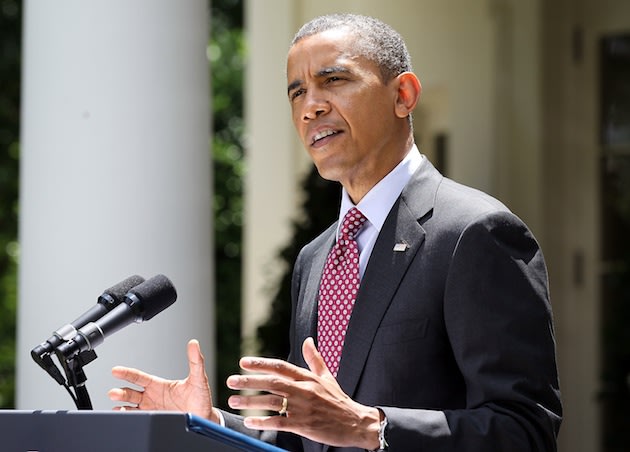
As many as 1.76 million young illegal immigrants could qualify for temporary legal status under President Obama's
deferred action program, says a new report from the Migration Policy Institute. That's more than double the Obama administration's initial estimate of 800,000 people who would benefit from the program. The new number reflects the Obama administration's updated guidelines released last Friday depicting who qualifies for the temporary legal status. Initially, only young illegal immigrants under 30 who entered the country as children, graduated from high school and had no criminal record would make the cut. Now, young people who didn't graduate or receive their G.E.D. can still apply for the legal status as long as they re-enroll in high school by the time they apply. The government will begin accepting applications online on August 15, and administration officials said the nearly $500 application fee will completely pay for the administrative costs of reviewing the applications. Those accepted will also get work permits, and will have to renew their legal status every two years.

Only parliament has the right to legislate

PPP says lawmaking is the right of the Parliament which will not be abandoned at any cost. President Asif Ali Zardari and Prime Minister Raja Pervez Ashraf on Tuesday chaired a meeting of some federal ministers and senior leaders of Pakistan Peoples Party in Islamabad to discuss preparation for elections‚ overcoming energy crisis and the legal challenges before the government. The president called upon the party leadership to gear up for the elections which would be held on time in accordance with the constitutional and legal dictates and in consultation with coalition partners. He advised the party leadership to ensure that every MNA‚ MPA and ticket holder thoroughly checks the voters lists so that no one was left out and report any discrepancy to ECP for rectification. The President said that Pakistan Peoples Party believes in the power of the people and is never shy of going to the people for endorsement of its policies. He said that the party believes in free‚ fair and transparent elections for which it is important that the electoral rolls should be free of errors and no eligible voter is left out of the list. The president also asked the party leaders to reach out to the masses and address their problems. The meeting said lawmaking is the sacred responsibility of legislature which will not be abandoned at any cost.

Bahrain protesters demand release of women prisoners

Bahraini people have staged protest rallies across the tiny Persian Gulf kingdom in a show of solidarity with female political prisoners.
On Monday night, Bahraini protesters took to the streets in more than 21 districts across the country, and condemned the Al Khalifa regime’s crackdown on peaceful protests. Shouting slogans in support of political prisoners, they demanded an immediate and unconditional release of women protesters held in jail, including senior human rights activist Zainab al-Khawaja. They also condemned Bahrain's Supreme Council for Women for its silence for the continued detention of female activists and the violation of their rights. The demonstrators blocked main streets by burning tires and called for unity among the Bahraini nation. Our might lies in our solidarity, they chanted. Bahraini security forces rushed to disperse the protests by firing teargas, rubber bullets and birdshot pellets at the demonstrators. The Saudi-backed regime forces also attacked civilian houses. A large number of demonstrators were injured in the attacks. Opposition activists published photos of the protesters who were injured on social networking websites. Anti-regime protests in Bahrain continue despite the heavy-handed crackdown by the Western-backed monarchy. Scores of people have been killed and many others injured or arrested in the suppression of popular protests since they erupted in February 2011 in demand of the Al Khalifa regime's downfall. The anti-regime demonstrators hold King Hamad bin Isa Al Khalifa responsible for the deaths of the protesters during the popular uprising.

Pakistan: 'Too free' Judiciary is overstepping

Aitzaz says Gilaini’s dismissal was wrong, ‘too strong’ judiciary oversteps at times. Talking to BBC News Tuesday Senator Aitzaz Ahsan defended the former Prime Minister Yousuf Raza Gilani against his dismissal by the Supreme Court. He says the country s judiciary is ‘too powerful’ and has, at times, overstepped its limits. Supreme Court cannot terminate a law that is passed by the parliament with two-third majority, he said. Aitzaz said there was no doubt that democracy was strengthened when Chief Justice of Pakistan took bold stand against General Pervaiz Musharraf but now some the Supreme Court decisions are being questioned and people are pointing fingers at these decisions. He said Pakistan People’s Party would be able to form the government after the next elections as President Asif Ali Zardari had good experience of forming coalition governments. He said Supreme Court decisions have blocked the way Martial Law. There is a tense power struggle in Pakistan. The Supreme Court has forced out one prime minister and put the current one on notice.

HOCKEY: Dutch top pool, Aussies rout Pakistan

The Netherlands defeated South Korea 4-2 Tuesday to top their Olympic Games hockey pool with a fifth successive win which also allowed defending champions Germany to enter the semi-finals. World champions Australia also advanced to the last four by hammering Pakistan 7-0 to move to the top of Pool A.
The other spot from this group will be decided after the match between hosts Great Britain and Spain, who were silver medallists in the 2008 Olympics. Britain, who have eight points, need just a draw to advance, but a Spanish victory will put them in second position in the pool with 10 points. Netherlands, assured of a semi-final spot before Tuesday's game, spiked a late rally from Asia Cup holders South Korea to complete an all-win record in the preliminary round-robin league. The Dutch emulated their women's team, which on Monday stormed into the semi-finals by winning all five matches. Netherlands finished with 15 points, while the defeat shattered South Korea's hopes of staying in contention. The Koreans finished on six points from five matches. South Korea's loss meant Germany, who have nine points from four games, will finish second in the group irrespective of the result in their last pool match against New Zealand later in the day. "We are happy, we feel strong and I have told the boys that I am proud to have 15 points," said Dutch coach Paul van Ass. "The semi-final is a new tournament, we want to reach the final," he said. "I am very confident with the way we are playing. The penalty corners are going very smoothly and the attack is doing well as we like it." Young penalty corner shooter Mink van der Weerden became the tournament's top scorer with six goals when he opened the Netherlands scoring in the 17th minute with a rising flick into the top corner. Valentin Verga fired from top of the circle in the 26th minute to make it 2-0 at half-time. Roderick Weusthof was obstructed inside the circle and he then converted the penalty stroke in the 47th. South Korea than came back strongly, pulling two goals back through penalty corner conversions by Nam Hyun-Woo in the 53rd minute and Lee Nam-Yong in the 62nd. The Koreans went all out looking for an equaliser when Billy Bakker scored for the Dutch in a breakaway move that saw him shoot into an open goal in the 64th minute when goalkeeper Lee Myung-Ho was caught out of position. Pakistan had no answer for the pace set by Australia for whom six players featured among the scorers. Liam de Young opened the scoring with a penalty corner in the second minute, followed by a deft penalty stroke by Mark Knowles that put Australia 2-0 up in the sixth minute. Christopher Ciriello then scored twice with a 29th minute penalty corner conversion and a field goal in the 34th as Australia seized a 4-0 lead at half-time. The second session saw Russell Ford (42nd), Jamie Dwyer (48th) and Glenn Turner (70th) shoot on target to complete Pakistan's rout. "We had plans to defend and counter-attack, but early goals opened up the game for us," said Australian coach Ric Charlesworth. "The finishing needs to be clinical and crisp. It needs more work even though I'm happy with the improvement."

Pakistan: Education targets remain elusive

Pakistan needs a strong literacy movement to achieve its targets of increasing the literacy rate up to 86 percent by the year 2015, and ensuring that every child had access to education, according to the report of United Nations Educational, Scientific and Cultural Organization (UNESCO). The present government successfully achieved the targets of formulating a National Education Policy 2009, inserting Article 25-A in the constitution under 18th amendment and achieving tremendous progress in the higher education sector to realize the dream of becoming a literate nation, and yet a lot of work still has to be done. The recently passed ‘Right to Free Education Bill’ was a landmark initiative for educating around 68,000 school children in the federal capital. This bill will ensure their access to the right to free education, making ICT a model for all provinces to follow. Talking to sources, renowned education expert, Professor Fateh Malik said that it was the responsibility of the state to provide free education to every citizen. He lauded the efforts of senators towards the implementation of the Article 25-A, for the betterment of future generations. "It was only Zulfikar Bhutto who brought revolutionary reforms in the education sector by making education free and compulsory for all the children," Malik said. "Private institutes were nationalized by Bhutto and salaries of teachers of private institutes were made equal to the salaries of government teachers," he said. Education was the backbone of any country and Article 25-A would provide free education to those children who were deprived of education due to poverty and had to resort to child labor, he said. According to the UNESCO report, 54 percent women in the country are still illiterate among of which, 64 percent rural women are from Punjab, 69 percent from Khyber Pakhtunkhwa, 78 percent from Sindh and 87 percent of rural women belong to Balochistan. The report says that the country had 18.64 million illiterate people in the year 1951, 22.08 million in 1961, 33.59 million in 1972, 42.69 million in 1981, 50.38 million in 1998 and 55.24 million in the year 2010. With a reported literacy rate of 56 percent in the year 2010 according to the Pakistan Social and Living Standards Measurement (PSLM) 2010, Pakistan is among the least literate nations of the world. According to the UNDP's International Human Development Indicators database, Pakistan ranks 130 among 141 reporting countries and territories in terms of adult literacy. The hurdles include lack of political will, leadership and a clear strong policy on literacy and Non Formal Basic Education (NFBE), absence of permanent organizational structure for Literacy and NFBE in provinces leading to coordination gap, meager and inconsistent financial assistance and capacity gap.

Veena Malik back as host on special Ramzan show

Pakistani model-actress Veena Malik is back as the host of the special show prepared for the holy month of Ramzan.
The channel had previously decided to cancel the show featuring the Malik following a public outcry.
The 28-year-old, who rose to prominence in India after participating in reality TV show Bigg Boss will host Hero TV's 'Astaghfar'."I am very happy that my show 'Astaghfar' is going to be on air I thank Allah for giving me such opportunity to host this show. It is the love of the people there that has brought me back on the show," Malik said in a statement. The show is already getting high TRP's and the audience has started appreciating the show.

Pakistan: Preparedness ahead of predicted floods

The recent heavy rains have inundated 13 villages and destroyed standing seasonal crops on hundreds of acres of land near Bajwat and Chaprar in Sialkot due to floods in Chenab and its tributary, Tavi. In addition, five villages of Hafizabad were also inundated. Luckily, there were no reported flood-related casualties. As of August 2, the website of National Disaster Management Authority (NDMA), quoting Pakistan Meteorological Department's summer monsoon outlook 2012, reveals that "there is a strong likelihood that total amount of precipitation......is +05 to +15 above normal of the long-term average. However, erratic spread of monsoon on temporal and spatial scale is likely to be a prevalent feature, as such the possibility of very heavy localised rains, at times resulting in flash flooding, may not be ruled out." Given Pakistan's unique geographical context the NDMA's focus has been on floods, earthquakes, landslides, cyclones, droughts and Glacial Lake Outburst Floods. As is fairly well known, Pakistan is now particularly vulnerable to floods; the floods of 2010 and 2011 are a case in point. The NDMA plausibly argues: "Pakistan is experiencing a gradual shift in the monsoon pattern and the last twenty years' data has indicated that monsoon precipitation impact zones are gradually shifting 80 to 100 kilometers westwards of Indus and Kabul basins in Khyber Pakhtunkhwa (PK) and Punjab from the traditional Kashmir catchment areas." This national agency in a National Monsoon Contingency plan 2012 (July-September) forecast localised flooding and carried out research to identify latent vulnerabilities which include: (i) the 2010 floods led to pronounced changes in rivers morphology in northern regions particularly River Swat which accounts for erosion, widened spans and unregulated flows likely to cause humanitarian consequences even in moderate flood situations; (ii) detailed flood plains mapping covering the entire Indus river system, its tributaries and tertiary rivers, nullah is still to be done even though NDMA has identified such mapping as the way forward; (iii) deferred allocation of irrigation and flood infrastructure due to inadequate operation and maintenance funds in provincial budgets, and (iv) population pressures leading to encroachment on river flood plains. Prime Minister Raja Parvez Ashraf chaired a meeting on 2nd July to review nation-wide preparedness for 2012 monsoon season and a detailed contingency plan was presented that included the release of funds to ensure that the country's preparedness for the monsoons was up to par. The planning assumed the worst case scenario and each provincial government in co-ordination with the NDMA came up with a plan to deal with its unique flood situation. Punjab allocated 287 million rupees to strengthen the NDMA's Punjab chapter, allocated 2 billion rupees to strengthen embankments and 2 billion rupees for water and sanitation authority for effective management of urban sanitation, completion and restoration of all bunds after 2010 floods, removal of encroachments, vaccination of livestock, procurement of medicines and dewatering pumps, shifting of wheat stocks to safe places and desilting of 6000 kilometers of drains, including in Lai Nullah Rawalpindi. The money thins allocated has turned out to be grossly insufficient as is evident and the challenges that remain are identified as early rehabilitation of main road link breaches, mitigation of hill torrent floods through construction of dams, timely and accurate information on river flows and provision of flash flood forecasting and early warning systems. Sindh has formed district and taluka committees for risk management, evacuation, relief, transport, health, sanitation, food and hygiene, and undertook inventory of existing machinery for example bulldozers, tractors, dewatering machines, and mapping all resources including tents, mosquito nets etc. The challenges that remain are insufficient flood protection infrastructure on Indus river system, inadequate protective infrastructure, and deteriorating security situation in many monsoon-prone regions. Khyber Pakhtunkhwa, however, implemented flood protection works including restoration of 2010 flood damaged infrastructure and the provincial DMA has not identified challenges though one may safely assume many continue to pose a tough challenge to federal and provincial governments' ability and capacity. Balochistan too has been facing many challenges including encroachments on flood plains, limited design capacity of critical road bridges, inadequate forecasting capacity, poor management of cross-border irrigation system and weak data management at district level. The NDMA set up a system of countrywide monitoring of flood works with a request to India to issue advance warning in the eastern rivers, a 10-year flood management plan, flood communication cell established with Wapda tasked to ensure up-to-date flood telemetry, raising Mangla dam up to 1242 ft and rerouting floods to desert areas through Rainee canal in Thar desert at Guddu. A Pakistan army corps has been tasked to reinforce flood protective infrastructure in co-ordination with provincial irrigation departments. The foregoing reveals that scarce federal and provincial resources remain the major reason behind the failure to implement identified contingency plans in letter and in spirit. However, critics may well argue, with a great degree of credibility, that the actual fault lies with the low priority given by both the federal and the provincial governments to flood mitigating measures.

'CM Punjab in office due to stay order'

Advisor to Prime Minister on Interior Affairs, Rehman Malik Monday said Chief Minister Punjab Shahbaz Sharif has been in office for the last four years by courtesy of a legal stay order. Talking to media men at Karachi airport, Rehman Malik denied having any role in Zulfiqar Khosa's differences with Pakistan Muslim League-N and that Pakistan People's Party had not invited him to join hands with it but 'the doors are open for everyone'. To a question, the Advisor said 26 accused had been arrested for extorting money in Karachi. Measures are being adopted to uproot extortion in the provincial capital, adding every incident of killing in the city should not be labeled as targeted killing. With reference to Balchistan situation, he said the people of the province have become well aware of the fact that the foreign conspiracy was responsible for the ongoing unrest there. "I would reveal the names of some more countries involved in causing disturbance in Balochistan in the next in-camera briefing," he said. He said the Baloch people themselves were becoming victims of the atrocities and terrorism of Balochistan Liberation Army (BLA). The people of Balochistan love Pakistan and the unrest in the province was a result of a pre-conceived conspiracy, he added.

Peshawar: Our melancholy booksellers

Blasé, borrowed from French, refers to the deadening of sensibilities or a state of tiredness induced by too much exposure to enjoyment or pleasure. A good example of blasé is the over prevalence of the modern and varied means of entertainment and their facile accessibility, which has rather than curbing boredom accentuated it. Reading, howsoever showy it may sound, is one eternally charming activity that is entertaining its pursuers for eons without enervating their senses in any manner whatsoever. The solidity of this argument could be judged from the fact that centuries old tomes like ‘War and Peace,’ ‘Anna Karenina,’ ‘Les Miserables,’ ‘Vanity Fair,’ ‘David Copperfield’ so on and so forth are still being printed with an increased frequency and read with an astonishing appetite in this fast-paced world. If one were asked for a fair opinion, there is an added pleasure in reading the timeless classics in their oldest editions. Dipped in the essence and fragrance of times, these books could be found at the oddest places. During a reading session at the residence of a respectable lady in Peshawar one had the good luck of seeing one of the oldest editions of Victor Hugo’s ‘Les Miserables’ adorning the shelf conspicuously like a trophy, and an even more fruitful encounter with luck by reading Leo Tolstoy’s 1936 edition of ‘Anna Karenina’ found in a library in the murky alleys of Balamari in the old city of Peshawar. Peshawar now looks to be coming out of the shock forced by the closure of one of its biggest bookshops, and the owners shifting to Islamabad, lock, stock and barrel. One recently spotted one of the owners, not far from his sprawling shop, coming out of a mosque in the Jinnah Super Market. He looked to be more lost, and indeed more forlorn than what he used to be in his previous quarters of Peshawar. ‘Why did you betray Peshawar?’ one just couldn’t help stop asking the bookseller bluntly after an exchange of pleasantries. ‘Our sales had gone down below the level of sustaining them any longer,’ he came up with the not quite unexpected reply. There was little fun in taking the issue beyond that point despite the existence of sufficient grounds to do so. The wherewithal for the huge books empire in Islamabad was all garnered from Peshawar. The bookseller is just one more addition to the list of scores of politicians and bureaucrats who have over the years used Khyber Pakhtunkhwa for the furtherance of their materialistic designs and ambitions and left it in the lurch for the fashionable addresses of Islamabad as their ultimate goals. There are still some booksellers who are resolutely clinging on to their avocation in the Khyber Pakhtunkhwa. One could literally bump into one’s favourite and much sought titles at nearly half a dozen bookshops, or their charitable replications, in Peshawar and Abbottabad. One was recently looking for Kazuo Ishiguro’s ‘Never Let Me Go,’ and one was about to make a request to a friend in England after a fruitless search in Islamabad. Lo and behold! Ishiguro’s latest title was lying there on a long log panel, peering at its pursuer from under heaps of books at a roadside bookstall in Abbottabad, for just one hundred and twenty five rupees, and an original paperback. The bookseller, dim and withdrawn, accepted the cash from his rickety chair, without being wary of the value of his ware he was Our melancholy booksellers dispensing for a paltry sum. One wonders if old or secondhand bookshop is not a misnomer or at least not relevant anymore for quite a few of these shops have been found out to be selling out brand new paperbacks and indeed even hardbacks for unimaginably low prices. One literally pounced on a wonderful foursome in one such bookshop at a backstreet in the Peshawar Cantonment. The catch included two books ‘The Notebooks of Don Rigoberto’ and ‘The New Life’ by the two Nobel laureates Mario Vargas Llosa and Orhan Pamuk respectively and ‘The Bone People’ by the Booker Prize winner Keri Hulme in addition to Zadie Smith’s ‘White Teeth;’ the first and the third mentioned in hard covers and in immaculate condition, all for rupees eight hundred only. One couldn’t have hoped for a better deal on a dull and listless day and with a dealer whose growing business from the buyer of old newspapers to being a veritable bookseller has done stupendous harm to his manners and temperament. A short and dark complexioned man, perhaps in his early thirties, this bookseller does not like repeating the price scribbled in pencil on each book by him in his own handwriting. He keeps glancing furtively at his customers rummaging through his stocks with visible scowls on his sharp featured face. He seems to have gained a fair amount of knowledge about what sells, and in no case would sell a Gabriel Garcia title for a song. It is good that the poor chap has not been caught singing high praises of Salman Rushdie’s ‘The Midnight Children,’ which he proudly claims to have got hold of and sold to an unsuspecting reader, and thus missing an edict for his scalp by the breadth of a hair. One found and bought several titles of Booker Prize winner Ian McEvan, Nobel laureate Nadine Gordimer, Roald Dahl and two of the Raj Quartets by Paul Scott at a discount book point located in a basement in the Supply Bazaar Abbottabad. One’s heart really goes out to those great authors buying their great works for sums as little as rupees fifty. But even sadder is the specter of nearly all famous works produced by the pirates and splashed on the tables in this basement shop. All original copies have been consigned to the ground shelves where it is quite an arduous job to search while squatting on the haunches. The owner is rarely if ever seen in the shop to be requested for the better placement of the valued books leaving the job to his assistant who is almost always, as if of a habit or some compulsion, found gloomy and reflecting perhaps on his poor circumstances. It was in this particular shop where one excitedly put into the bucket ‘My Uncle Oswald’ by Roald Dahl, for consumption by the children craving for reading in the summer vacation. Dahl is a celebrated children’s writer, and one had mistakenly thought him to be restricted to that field. ‘My Uncle Oswald’ is strictly for adults as one discovered upon reading the back cover and the kind of work that allows no two moments of sobriety to the readers leaving them in splits after the nearly three hour long irresistible nonstop reading. Dahl’s naughtiest work was recently spotted at Kamran’s secondhand bookstore in Jinnah Super Market Islamabad, brandished prominently as a weapon of mass laughter perhaps to provide much needed relief to the people in these sad days of their life. Despite his perennially sad disposition, Kamran is one fine bookseller who sells his great collection of books virtually for any price indicated by his customers. He seems to be groomed in the mood of Milan Kundera whose works he flaunts as his most prized assets. It was here where one found Doris Lessing’s ‘The Good Terrorist’ and so many other of the octogenarian Nobel winner’s great works for pitifully low prices. Peshawar may have lost its biggest bookshop, the British and the US library services, but there is no stopping the earnest booklovers find the books of their choices, courtesy their considerate and sad-looking booksellers.

Feudalism continues to haunt Pakistan

BY:Dr Saulat Nagi
Daily Times
The state, being a representative of the capitalist class, develops the means to protect the dominance of capital by maintaining its hegemony over the means of production The tide is turning and history is unfolding and redefining itself for those who just two decades ago euphorically interred it forever. The rule of capitalism, the grand finale of the cold war, after causing lethal blows to humankind, has come full circle only to be condemned as a system based on greed and expropriation. Despite a lack of familiarity with its dynamics, humanity has come to realise the anarchy and brazen appropriation inherent in it. Hence, unrelenting protests are unleashing everywhere. Its apologists are unconvincingly advocating the introduction of accountability. For a system based on greed to embrace accountability as one of its tenets is nothing but an expression of marked naivety. While all of this is happening, in Pakistan the prevalent mode of production remains a subject of controversy. However, this ambiguity is not Pakistan-specific. In fact, it plagues most of the Third World. In the post-colonial era, the emerging nation-states inherited a strong state structure from their colonial rulers, but socio-economic development remained uneven largely due to longstanding oppression. This paved the way for co-prevalence of different modes of production within the same state. In Pakistan too, multiple modes of production exist in simultaneity. Balochistan is groaning under tribal ties. The conditions are hardly congenial for cultivation, albeit the land has the capacity to feed at least its people provided the means are available. Mining, a very primitive though still an extremely lucrative industry, is in the doldrums due to insurgency for which the high-handedness and villainy of the state are equally to blame. In the Khyber Pakhtunkhwa, Gilgit Baltistan and FATA, besides other pre-capitalist modes of production, trade in the form of smuggling continues to dominate. Sindh and southern Punjab, the centres of power, have large landholdings, whereas in the central and northern parts of Punjab, the land has undergone multiple divisions. By 1999, 88 percent of cultivated land in Pakistan was in farm size below 12.5 acres with just over half the total farms less than five acres in size. But the question remains: who holds how much land? The answer is that only 2.5 percent of the households own 48 percent of the land, whereas only 37 percent of the rural households own any land. The two land reforms conducted by the ruling elite of Pakistan were as farcical as their conviction to empower the people. Around 4.5 percent of the cultivable land was resumed by Ayub Khan and an even smaller amount was distributed. Bhutto’s reforms actually increased the holdings of his own class, hence it was a very conscious decision that sent a clarion call of reunion to his annoyed class. While Ayub had fixed the landholding ceiling at 36,000 units per family, Bhutto changed it to 15,000 units per person, i.e. 150 acres. This way, even a small family of, say, three people could hold up to 45,000 units of land. It was an exercise in deceit, reinforcing the power of the feudal elite and its iron-fisted control on the execution of social functions, which they continue to exercise with impunity. According to Engels, “It is the execution of social functions which is the basis of political supremacy.” Feudalism apart from being an economic relationship is a structure of power too, given that feudal landholding is not only a source of income, but also a symbol of power. In Pakistan, even the weak bourgeoisie imitating the feudal manifests its hegemony not through the machine, but through land. The bulk of our agricultural sector is still subjected to feudal sway. The salient features of this mode include bonded labour; the miserable condition of the hari (land worker); the coercive behaviour of the feudal; the political rule of the Junker class; a subsistence economy and the continued process of its simple reproduction. Pakistan is certainly an integral part of the global capitalist economy. To be a part of that is one thing, to have a capitalist mode of production is another. Bhutan, or for that matter, Nauru (a tiny country in the Australian continent that has neither an official capital nor a currency of its own), is also a part of the same globalised economy. After all, there is a consumer class in these countries as well and they relish Coca Cola just as much. Can the economies of such states be categorised as capitalist? Prior to the British Raj, the subcontinent had a despotic Asiatic mode of production named jagirdari (estate ownership). India was fettered by feudalism after the peasant war of 1857 when the British Empire decided to create its hegemony by allotting land to its loyalists on permanent basis. However, an agrarian social structure that existed in medieval France, or the particular feudal formation that existed in Western Europe during the 15th century — forms considered to be ideal feudalism — never developed in the Indian subcontinent. This does not mean that the peasants in Pakistan are not subjected to pre-capitalist exploitation and the domination of the landholding class; nor does it follow that the relation between a hari and a landlord is bourgeois just because Pakistan is a part of the world capitalist market and relations here are predominantly financial. The thesis on the development of the capitalist mode of production in Pakistan is bleary. If we accept the premise that in Pakistan a change in the means of production has already taken place, then it leaves a quandary unresolved: why such a change has not been followed by alteration in the relations of production (a necessary change in the workers’ relations with the conditions of production)? Technology may have taken over, but without ameliorating the condition of peasants. Any change in relations would have heralded the end of primitive accumulation and guaranteed an expropriated but free worker. The old bonded relations and the private jails would have become a story of the past. The state, being a representative of the capitalist class, develops the means to protect the dominance of capital by maintaining its hegemony over the means of production. Had the modes of production been predominantly capitalist, at least the Pakistani state would had ensured a permanent supply of electricity and gas to the industrial class even at the cost of the ordinary folk. However, in this case both the classes are sailing in the same boat. Due to an anaemic bourgeoisie, the working class is frail. That is why religion — a passive residue of social formations eclipsed by history — remains a dominant force. Pakistan is a capitalist socio-economic formation of the periphery. Its ruling class is composed of pre-capitalist landowners. Their political and economic power has the backing of the army and clergy. One wonders, despite the insistence of the IMF, which otherwise has the last laugh in our affairs, not to mention the dismal economic squalor that we wallow in, land-tax has never been imposed on this parasitic class. Unlike India, we do not even have any class-conscious peasantry that can challenge this aristocratic hierarchy. The Maoist phenomenon may be a diversion from classical Marxism, but it still carries a shimmer of hope. In India, at least, they do not end up elevating pirs as premiers. If this ruling class alongside the dominant mode of production is not feudal, then what species does it deserve to be named after?
The writer is based in Australia and has authored books on socialism and history. He can be reached at saulatnagi@hotmail.com

Afghan capital,Roadside blast kills eight

The bomb was placed under a bridge and the blast occurred at around 7 a.m. A militant detonated a remote-control bomb Tuesday morning, killing at least eight Afghan civilians who were traveling in a bus just northwest of the Afghan capital, police said. The bomb was placed under a bridge and was detonated when the bus traveled over the span, said Mohammad Zahir, the criminal director for Kabul police. Five other people were wounded in the bombing, which occurred at around 7 a.m. in Paghman district of Kabul province as Afghans were making their way to work. "The person who pushed the button on the remote-controlled bomb was captured by villagers who saw him running," said Abdul Razaq, an Afghan police official in the Kabul area. Initial reports were that the bus was ferrying government employees to an Afghan ministry, but those reports could not be confirmed. Police speculated that the bomber might have been targeting a bus full of government workers, but blew up a civilian bus by mistake.

Monday, August 6, 2012

DRONES ARE ''LIFE SAVERS'' STUPID...!!!

BY: Mwaqar
Drama Queen of Pakistani politics, Imran Talib Fake Khan is going to stage a new drama,this time he is going to demonstrate against unmanned predators conducting airstrikes in Pakistan.Drama Queen is going to lead a 100,000-strong rally from various parts of the world to Waziristan in its protest against remotely-controlled airstrikes in Pakistan’s tribal region,this is a wrong choice and will endanger many people, but In Pakistan, Politicians don't think about the consequences.Although I am sure that Imran Talib Fake Khan and his top party men would be getting fool proof protection from all militant groups including Al Qaida who are stationed in NWA.I am not sure whether this (mis)adventure would translate into more votes for PTI,but one wonders who is sponsoring this march…your guess is as good as mine, desperate Khan, I bet won’t be able to stop the Drones, but just another political gimmick to get his vote bank stronger. Unfortunately Pakistanis are very Simple,they can be fooled by these idiots easily,it will be just another political stunt by imran fake khan and his jihadi buddies sponsored by their big bosses in the GHQ.Majority of locals in Waziristan support the attacks and see the drones as their ‘liberators’ from the clutches of Taliban and Pakistan’s Intelligence agencies. The people of Waziristan are suffering a brutal kind of occupation under the Taliban and al Qaeda. It is in this context that they would welcome anyone, Americans, Israelis, Indians or even the devil, to rid them of the Taliban and al Qaeda.We need to wake up to the reality that the enemy has grown very strong in the years we temporized and tried to do deals with them. Clearly, we need allies in this fight. Howling at the moon is not going to get us the cooperation we so desperately need. A solid case can be made for more drone attacks, not less.Most people in FATA think, the drone attacks were accurate and did not lead to anti-American sentiment and were effective in damaging the militants. In addition the locals wanted the Pakistani forces to also target the militants but the problem is the Pakistani forces play double game and don’t target many jihadi groups who are on ISI payroll, locals usually appreciate drone attacks when they compare it with the Pakistan Army’s attacks.So instead of protesting against life savers,pro-taliban Imran fake khan should protest against his buddies in the ranks of Taliban,Opposition to American policies in the region does not mean, however, that the people of FATA embrace either Al-Qaeda or the Taliban. More than three-quarters of FATA residents oppose the presence inside their region of Al-Qaeda and over two-thirds the Pakistan Taliban (60 percent oppose the Afghan Taliban led by Mullah Omar).But the problem is,Pakistani Govt does not have any writ in those areas,Pakistani security forces are living in denial and not taking strong action against these religious Islamist who are making lives of poor Pashtoons miserable then there is only one option left and that is Drone strikes in that region where Islamist hiding in their rat holes. If you happen to talk to the people from the Federally Administered Tribal Areas (FATA), you will find that most of them actually favour drone attacks, because lets accept it, most of the time they do manage to get the enemies who have disrupted their peace.Drone strikes are very successive against these ignorant militants, it is undeniable that many lives are being saved by eliminating terrorists one after the other.Drones are doing a better job than Pakistani military.The fact is,The tribal people fear the Pakistan Army’s aerial bombardment in FATA. The IDPs from all over FATA accuse the Pakistan Army of deliberately bombing innocent civilians while avoiding Taliban centres,so this means,Drone strikes are better. The rising support for Imran Khan, especially among the youth, might be a good thing but the way Imran Khan has been supporting the Taliban and tribal justice is dangerous for future politics in Pakistan. This all seems like Imran will disappoint the people ,the youth and there will be no change in Pakistan

LOHAR Sharif brothers to be summoned BY NAB

Sharif brothers to be summoned if NAB reference restored: Judge
Judge Abdul Haq says that Sharif brothers will be summoned if reference was restored. The judge of Rawalpindi’s accountability court, Chaudhry Abdul Haq, heard the application of chairman NAB for reopening of corruption references against Sharif brothers. The three references, under consideration, include the alleged corruption cases of Hudaibia paper mills, Ittefaq Foundry and Raiwind farm. During the proceedings, Sharif brothers’ lawyer Chaudhry Hassan said that the reference doesn’t qualify to be heard. After hearing to the arguments, Chaudhry Abdulhaq said that the accused can be declared proclaimed offender if he doesn’t appear bedore the court in criminal proceedings. Adjourning the hearing till September 15, the court directed all the respondents to prepare arguments for the case.

Polio virus found in test of sewage samples from Rawalpindi, other cities

Sewage samples from Rawalpindi and Lahore in Punjab, Sukkur and Hyderabad in Sindh and Peshawar in Khyber Pakhtunkhwa have shown presence of polio virus, the World Health Organisation (WHO) has informed through a press release issued here on Sunday. Poliovirus has also been found in sewage water samples collected from Gaddap Town, Karachi, after a gap of about four months. Gaddap Town is one of the country’s key poliovirus reservoirs where a lot of efforts were made over the last six months to reach every child during every polio campaign. However, during the last campaign in mid-July, all children could not be reached due to deteriorated security situation and incidents targeting polio workers. Similarly, sewage samples from Baldia Town, Karachi, have also shown the presence of polio virus for the first time this year after 12 samples did not have poliovirus earlier this year. Pakistan has reported 27 polio cases this year so far; 13 from Fata, 6 from Khyber Pakhtunkhwa, 3 each from Sindh and Punjab and 2 from Balochistan. These polio cases come from 15 districts. Recent unfortunate facts are the banning of polio campaigns in North and South Waziristan Agencies, depriving more than 200,000 children of polio vaccination. This is in addition to Bara Tehsil of Khyber Agency, which has been inaccessible to vaccination teams since September 2009. It is pertinent to mention that 10 of the 13 polio cases in Fata this year have been reported from Bara. If the recently imposed ban on polio vaccination is not reversed and access in Bara is not gained, the goal of the National Emergency Action Plan will be at serious risk, WHO has warned.

The Baloch youth

THE FRONTIER POST
Amazingly, at this point in time when everything about the Balochistan problem is being talked out, what is not being talked about is what in fact must be spoken the most: the commoner Baloch youth. He is the jewel of a human being, bubbling with enormous talent, vitality and energy, but living suppressed in the captivity of the sardars and in the indifference of the state. But whenever luckily he has broken this unbreakable shackle, he has proved his tremendous mettle to turn out into an acknowledged doctor, engineer, lawyer, civil servant, diplomat and general of sterling quality. Such a promising youth in fact is he. Yet he is being laid to waste by the conspiracy of his circumstances. He needs to be protected, nourished and promoted. But he has no patrons. To help him fructify his huge wealth of innate talent and energy, he should have the opportunities to grow and advance. But he remains largely denied of them — even now. To make up for this denial over the past six decades or so, education up to the university level should have been made free for him. But what to talk of this, he doesn’t have access even to adequate schooling. Can you imagine that even at this time there are as many as 1,000 schools in the region that are simply ghost schools that exist merely on papers, not on the ground. And amazingly not even those self-styled champions of the Baloch people have made an issue of it. Indeed, while they tire not of chanting of Baloch ownership of the province’s natural resources, never ever have they asked for a top-class university of mineralogy in Balochistan to produce trained Baloch engineers to run the crucial sector of mineralogy indigenously. Nor have they ever asked for technical institutes to produce skilled and semi-skilled manpower locally for the sector. Isn’t it shameful that the initiative to this end has been taken by the army, not by the overbearing sardars, the self-touted Baloch nationalists or the civilian administration of the province? To them, the ownership of natural resources in reality only means the ownership by sardars to their own fullest benefit, not of the commoner Balochs and their youths. Couldn’t the billions of rupees that have over these years poured into the provincial treasury from the centre be spent on laying out first-class educational facilities in diverse fields and disciplines for the commoner Baloch youth, rather than landing in privileged private pockets? This much for the concern of tribal sardars by inheritance, the so-called Baloch nationalists and the provincial civil administrations for the Baloch people and the commoner Baloch youth. But no better has ever been the centre under successive military and civilian rulers. It has been ever out to mollycoddle collusive sardars and chieftains and local power-wielders and ever spurning of the Baloch commoners, particularly their youth. Can anyone deny in all honesty that the Balochistan package of this PPP-led central government too is all tuned to fattening the financial and muscle powers of the local power-wielders and power-brokers, not to emancipate and empower the commoner Baloch youth to become a fuller human being and give vent to his potentials to advance in life and make a mark on the national scene? When Pakistan came into being, all the candidates from then East Pakistan who qualified in the first examination of central superior services were taken in, irrespective of quota to make up for the near absence of officers of that area in those services in the pre-partition days. Why never ever has a similar treatment been given to the common Baloch youths? Not even once, not even now? Lately, the army has lowered its criterion for recruitment of Baloch youths to its ranks and the officer corps. But no such relaxation has been made by the civilian leadership for recruiting the Baloch youth to the civil services or civilian jobs. In the given conditions, if some unsuspecting Baloch youths fall prey to the poaching of foreign agencies or the overseas-based dissidents, who is to blame if not the state itself? Let all and sundry know that for the state’s raw deal, the common Baloch youth is very disgruntled, very angry and in a very nasty mood. It is he who needs to be cajoled, pacified and appeased, not the scions of sardars working on aliens’ agendas. Invest in him to be a proud Pakistani. Give him the opportunities to grow and flourish. In it lies the real key to the Balochistan problem. Everything else is a mere ruse.

Gunmen kill NATO driver in Pakistan

Gunmen on Monday killed a driver of a
NATO supply truck in Pakistan's northwestern tribal belt on the Afghan border, according to officials. It was the second fatal shooting in two weeks in the Jamrud area in Khyber district, where Taliban and local Islamist militia are active. After the first shooting on July 24, Pakistan closed the Torkham border crossing, the quickest route from Pakistan's port of Karachi to the Afghan capital, for nine days. "Three gunmen in a jeep fired at a NATO truck, killing its driver," local government official Bakhtiar Khan told AFP. NATO traffic was suspended for a few hours after the incident. Sameen Jan, a doctor at the local hospital, said the driver was shot twice, once in the head and once in the chest. Pakistan reopened the Torkham crossing on Saturday, having signed a deal with the United States last Tuesday allowing NATO convoys to travel into Afghanistan until the end of 2015. Islamabad in July lifted a seven-month blockade on NATO goods passing overland through Pakistan, imposed after botched US air raids killed 24 Pakistani troops in November.