
Wednesday, June 27, 2012
Pakistan's Supreme Court sets collision course with new prime minister
Salute to Swat's Gul-e-Khandana: Brave woman who stood up to the Taliban

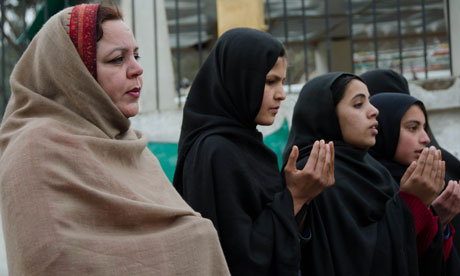
Pakistan rebuilds its education network after Taliban are driven out of Swat A government operation to drive out militants has seen a gradual return to the classrooms in a district where more than 400 schools were destroyed, 70% of them girls' schoolsIn a rundown building in the mountain village of Sijban, girls sit at their desks, hair loosely covered in white or black scarves, staring raptly at their teacher. They say they want to become either doctors or teachers when they grow up. This is the one government primary school for girls in the Swat valley that was spared destruction by the Taliban. Their headteacher, Gul-e-Khandana,
Balochistan: GWADAR WITHOUT WATER

Quetta’s Carnage Spells Trouble For Balochistan
http://www.thebalochhal.com

PAKAF: Cross-border attack imperils Pakistani-Afghan peace efforts



CJ Iftikhar Chaudhry should be asked to appear before Parliamentary Committee on Rules of Procedure and Privileges
In the light of recent commentaries by leading Pakistani and international lawyers including but not limited to Asma Jahangir, Justice Markandey Katju (Indian Supreme Court), Saroop Ijaz etc, it is evident that Supreme Court of Pakistan has violated not only national constitution but also attacked the very foundation of parliamentary democracy in Pakistan. Former Indian Supreme Court judge Justice Markandey Katju, writing in The Hindu recently, questioned what he said was the “lack of restraint” on the part of Pakistan’s superior judiciary. I regret to say that the Pakistani Supreme Court, particularly its Chief Justice, has been showing utter lack of restraint. This is not expected of superior courts. In fact the court and its Chief Justice have been playing to the galleries for long. It has clearly gone overboard and flouted all canons of constitutional jurisprudence. Justice Katju noted that Article 248, Clause 2 of the Pakistani Constitution very clearly states: “No criminal proceedings whatsoever shall be instituted or continued against the President or governor in any court during his (or her) terms of office”. He then went on to ask that if this is the case, how could a court approach what is a settled provision in the “garb of interpretation”? The Pakistan Constitution draws its basic structure from Anglo-Saxon laws, which establishes a delicate balance of power among the three organs of the state — the legislature, the executive and the judiciary. However, in recent past, particularly since April 2012, Pakistan’s top judiciary led by Chief Justice Iftikhar Chaudhry has encroached into the elected parliament’s domain. This situation is not only a violation of Pakistan’s constitution but violates privilege of the elected parliament. In his obsession to become a saviour of the nation and hero of Pakistani media, CJ Chaudhry has become a tool in the hands of right-wing dominated politicians and media, and is through his actions and verdicts hurting Pakistan’s very security and stability. Lawyer Saroop Ijaz writes: The Pakistan Supreme Court has sent an elected prime minister home. This in itself is disturbing, however, permissible it may be under some circumstances. What is infinitely more worrying is the fact that the Supreme Court did not feel itself constrained by the procedure of law. The argument that the order of the Speaker cannot overrule the Court is a very decent one, yet does not explain why the Court ignored the clear provisions of the Constitution to send the matter to the Election Commission of Pakistan. There is also the issue of the three-member bench making a mockery of the seven-member bench. However, there is a vaguely linear progression to all of this. The Supreme Court terminated the employment of “PCO” judges without reference to the Supreme Judicial Council, which was allowed to go unexamined. More recently, when memberships of members of parliament were suspended for dual nationality, again without reference to the Election Commission of Pakistan, not enough noise was created. Demagogy has a tendency of being incremental sometimes; they have tested the waters and now found it appropriate for a splash. It is likely to get worse now, it always does. Even now there is a curious reluctance to unequivocally condemn, or mildly speaking, criticise the judgment of the Supreme Court. Yousaf Raza Gilani and his maladministration is not the issue here, the issue is considerably more fundamental, namely the right of the people to elect their representatives and also to send them home. The Supreme Court does not represent the will of the people and the Courtrepeatedly saying so to the contrary would not change that. Let me also say this about the law of contempt, if the Court in fact does believe that it represents the will of the people then it will have to make its peace with the fact, that people talk and also talk back. It is high time that Pakistan’s parliament, not only ruling PPP but also other parties (PML-Q, ANP, MQM, JUI-F etc), require Chief Justice Iftikhar Chaudhry to appear before the Parliamentary Committee on Rules of Procedure and Privileges to explain his position on supremacy of elected parliament. According to Section 227 of the Rules of Procedures: “A Committee shall have power to require the attendance of persons …. if such course is considered necessary for discharge of its duties.” CJ must be asked to explain why he is insisting on violation of Pakistan’s constitution and also why he is insulting the mandate given by the people of Pakistan to their elected parliament. The Committee should ask CJ why he wants elected Prime Minister to violate Article 248 of Pakistan’s Constitution (related to President immunity). http://criticalppp.com/archives/9123 The Parliamentary Committee on Rules of Procedure and Privileges must ask Justice Jawad S. Khwaja & other judges of the SC to explain their alleged past and present links with Hamid Khan Group of PTI who was a petitioner in PM Gilani’s disqualification case. The Parliamentary Committee should require CJ to assure he won’t force Pakistan’s current Prime Minister (Raja Pervez Ashraf) and other members of the executive to violate Pakistan’s constitution. He must also assure that Supreme Court will refrain from further trespassing into the parliament’s domain. In case, CJ is unable to satisfy the Parliamentary Committee on Rules of Procedure and Privileges, SC may be dissolved and reformed as per the Charter of Democracy (CoD) signed by late Benazir Bhutto and Nawaz Sharif. There are precedences in other countries where elected parliament had to intervene in order to remove a corrupt or trespassing judge or chief justice. Recently in May 2012, parliament in Philippine voted to remove the country’s Chief Justice of Supreme Court. On 29 May 2012, the Philippine Senate voted to remove the country’s top judge for failing to disclose his wealth, a landmark victory in a country wide campaign to root out endemic corruption in the Southeast Asian nation. More than two-thirds of the 23 senators voted to oust Supreme Court Chief Justice Renato Corona, who becomes the first official in the country to be removed by an impeachment court. The decision bars him permanently from public office. The ruling is likely to be welcomed by investors amid concern that the four-month-long trial was distracting the government from policy matters at a time when the Philippines is seeing a resurgence of interest in its long-underperforming economy. (Source) The following extract from the CoD describes the formation of superior judiciary: 3. (a) The recommendations for appointment of judges to superior judiciary shall be formulated through a commission, which shall comprise of the following: i. The chairman shall be a chief justice, who has never previously taken oath under the PCO. ii. The members of the commission shall be the chief justices of the provincial high courts who have not taken oath under the PCO, failing which the senior most judge of that high court who has not taken oath shall be the member iii. Vice-Chairmen of Pakistan and Vice-Chairmen of Provincial Bar Association with respect to the appointment of judges to their concerned province iv. President of Supreme Court Bar Association v. Presidents of High Court Bar Associations of Karachi, Lahore, Peshawar, and Quetta with respect to the appointment of judges to their concerned province vi. Federal Minister for Law and Justice vii. Attorney General of Pakistan (a-i) The commission shall forward a panel of three names for each vacancy to the prime minister, who shall forward one name for confirmation to joint parliamentary committee for confirmation of the nomination through a transparent public hearing process. (a-ii) The joint parliamentary committee shall comprise of 50 per cent members from the treasury benches and the remaining 50 per cent from opposition parties based on their strength in the parliament nominated by respective parliamentary leaders. (b) No judge shall take oath under any Provisional Constitutional Order or any other oath that is contradictory to the exact language of the original oath prescribed in the Constitution of 1973. (c) Administrative mechanism will be instituted for the prevention of misconduct, implementation of code of ethics, and removal of judges on such charges brought to its attention by any citizen through the proposed commission for appointment of Judges. (d) All special courts including anti-terrorism and accountability courts shall be abolished and such cases be tried in ordinary courts. Further to create a set of rules and procedures whereby, the arbitrary powers of the chief justices over the assignment of cases to various judges and the transfer of judges to various benches such powers shall be exercised by the Chief Justice and two senior most judges sitting together. The CoD offers best path to reconstitute the Supreme Court consistent with the essence of parliamentary democracy. In such a scenario, Pakistan’s Supreme Court may be reconstituted just like Senate, assuring equal representation of all ethnic groups (not domiciles), also making sure that no PCO judge (i.e., one who has in the past validated a military coup or endorsed dictator’s actions) is a Chief Justice of the Supreme Court or High Courts in provinces.Let Us Build Pakistan
‘Sharif brothers working on mullahs’ agenda’
Dunya NewsPPP MNA Rubina Qaimkhani said Sharif brothers were working on mullahs agenda. The Sharif brothers are allegedly working on mullahs’ agenda and pushing party’s parliamentarians in the provincial assembly to harass women legislators belonging to PML-Q and PPP. This was stated by the Parliamentary Secretary on Human Rights and Member National Assembly (MNA) Rubina Saadat Qaimkhani while addressing a news conference on Tuesday. She condemned the vulgar words used by the MPAs Sheikh Allauddin and Abdul Rehman Dhilu against women parliamentarians. She alleged that MPA’s of PML (N) time and again harassed the women parliamentarians on directions of the Chief Minister (CM) Shehbaz Sharif. She said that human rights cell of PPP submitted an application in Lahore to register FIR against Mr. Sheikh but the CM stopped the police from launching the FIR. She added that ten-day suspension from membership of the alleged violators of harassment bill was not enough to discontinue such incidents again. “We have serious concerns over such incidents and working hard to ensure implementation on harassment of women at workplace bill 2010”, she maintained. On the occasion, a renowned social activist Dr. Fouzia Saeed demanded proper legislation in all provincial assemblies including National Assembly to guarantee protection of women parliamentarians. Meanwhile, Ms. Qaimkhani demanded of the Chief Justice to take suo moto action of the incident. She requested the Speaker Punjab Assembly Rana Iqbal to order disqualification of MPA’s Mr. Sheikh and Mr. Dhillu. A number of civil society workers and media persons were also present on the occasion.
Gen. John Allen to reach Pakistan today

POLIO IN PAKISTAN: Grappling with polio threat


$30b worth of drugs transit through Pakistan
The Express TribuneAt the International Day Against Drug Abuse and Illicit Trafficking 2012, Pakistan may be free of poppy cultivation, but the country still provides a vital transit route for smuggling of drugs worth $30 billion from neighbouring Afghanistan. Speaking at the launch of the World Drug Report 2012 on Tuesday, officials from the United Nations welcomed the decline in poppy cultivation in Pakistan. In the same breath, however, they added that the country is a major route for the smuggling of drugs cultivated in Afghanistan, primarily through Khyber-Pakhtunkhwa and Balochistan, and that drug cultivation can resurface in these areas if the Anti-Narcotics Force is not strict in its surveillance. One-third of drugs produced in Afghanistan are smuggled to other countries via the coastal areas of Balochistan, the UN officials added. Global numbers The UN Office on Drugs and Crime (UNODC) released the annual report about the state of drug cultivation, production, usage and transport in New York on Tuesday. According to the report, at least 5% of the world’s adult population, or about 230 million people, are estimated to have used an illicit drug at least once in 2010. Some $68 billion is generated globally from illicit drugs annually, and is mainly used in terrorist activities, human trafficking and the smuggling of arms. According to the UNODC, $27 to $30 billion worth of drugs are smuggled from Afghanistan, via Pakistan, to other parts of the world annually; of this, drugs worth $1.5 billion stay in Pakistan. Drug abuse and illicit trafficking continue to have a profoundly negative impact on development and stability across the world, the report says. Heroin, cocaine and other drugs continue to kill around 200,000 people a year, bringing misery to thousands of other peoples, insecurity and the spread of HIV, the report adds. Drug cultivation Global opium production amounted at 7,000 tonnes in 2011, up from the low levels of 2010 when diseases wiped out almost half of the crop yield. Afghanistan maintained its position as the largest producer and the country’s opium production increased by 61%, from 3,600 toms in 2010 to 5,800 tonnes in 2011. High prices and increase in demand are making opium production more attractive to farmers in South East Asia, the report says. Poppy cultivation in South East Asia jumped 16% – from 41,000 hectares in 2010 to almost 48,000 hectares in 2011. Overall cultivation of opium doubled in South East Asia. Externalities Illicit drugs and related criminal networks undermine the rule of law, the report says. Central America, for instance, faces rising levels of violence fuelled by transnational organised crime and drug trafficking. The region is now home to the highest homicide rates in the world. Meanwhile, development in Afghanistan is being hindered by the highest rates of opiate prevalence in the world. In parts of Myanmar, farmers are trapped by food insecurity compelling them to grow poppies as a cash crop. The challenge is also greatly testing West and Central Africa, which lies along one of the main drug trafficking routes to Europe. Moreover, transit countries are no longer simply links in the chain of supply. About half of the cocaine trafficked through West and Central Africa now remains in the region. Solutions The drug, crime and corruption conventions of the UN form a solid basis for global solutions to these challenges, the report states, adding that these instruments offer a balanced approach to halt trafficking, promote viable alternatives to the farmers of cash crops, and offer drug users their health and human rights.
Pakistan: Justice or revenge?

Let Us Build Pakistan

Tuesday, June 26, 2012
Afghan Mela commemorates World Refugee Day
 The Society for Human Rights and Prisoner’s Aid (SHARP) organised a one-day festival for Afghan refugees residing in Lahore as a part of the World Refugee Day events. The SHARP Afghan Mela was arranged near an Afghan locality in Manzoor Park. The main objective was to provide entertainment for the less fortune segment of society which does not get a chance to enjoy life due to limited resources. A large number of refugees from scattered localities throughout Lahore and its adjacent areas participated in the Afghan Festival. During the event, Dettol Warriors gave a lecture on hygiene and also distributed swords among the children. Godh, a local NGO, presented a puppet show to spread awareness about education and health. A magic show and a performance by Pashto singer Ansar Abbas was also organised. GRAP Gender Specialist Memoona Batool Khan emphasised the importance of educating Afghan women. SHARP Lahore Field Manager Sher Afgan Khan said Pakistan had always welcomed the Afghans. He said SHARP had organised the programme to commemorate the World Refugee day with Afghan nationals.
Pakistan media plays down Abu Jindal arrest
http://ibnlive.in.com/In complete contrast to the Indian media, the Pakistani media Tuesday appeared to play down the dramatic arrest of a key mastermind of the Mumbai terror attack. Most newspapers carried New Delhi-datelined stories by AFP on Sayyad Zabiuddin alias Abu Jindal Hamza, an Indian who was deported to India from Saudi Arabia despite carrying a Pakistani passport. A Geo TV report quoted the Indian media as saying that the Special Cell of Delhi Police had made the arrest at the Indira Gandhi International Airport in New Delhi.Quoting police sources, the report said the man "is believed to have provided assistance to 26/11 terrorists. He is reported to be involved with the Indian Mujahideen and Lashkar-e-Taiba terror groups. "The suspect had been on the run since 2006 when he went to Pakistan, Indian media claimed." The Daily Times, The Nation, The News and the Dawn newspapers carried AFP stories. Abu Hamza, an Indian-born member of the Lashkar-e-Tayyaba, was allegedly one of the handlers who from Karachi instructed by telephone the 10 gunmen as they went on a killing spree in Mumbai in November 2008. The Mumbai carnage left 166 people dead and led to major tensions between India and Pakistan.
India makes key arrest in Mumbai terror plot

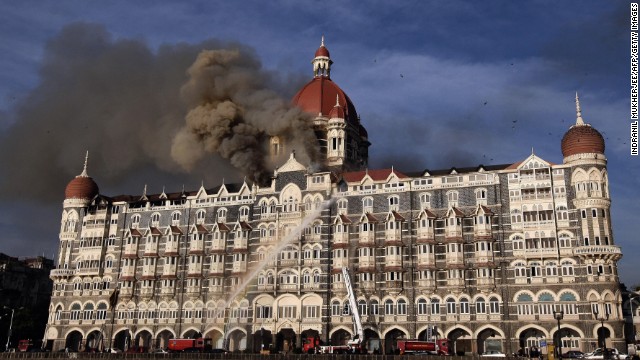 A key suspect in the 2008 Mumbai terror attacks that killed more than 160 people has been apprehended, Indian authorities said Tuesday.
The Indian-born man, known as Abu Jundal, was recently arrested in New Delhi, said public prosecutor Ujjwal Nikam.
"He was a key conspirator, who abetted the attack and carried out the planning," according to Nikam, who did not say when the arrest was made.
Investigators believe Jundal was on the phone coordinating the attack from Pakistan as 10 gunmen staged the bloody three-day siege throughout India's commercial capital."He was there in the terror control room," Nikam said. "His voice was intercepted here."
While New Delhi police refused Tuesday to comment on the arrest, the Mumbai court handling the case has issued a warrant asking that Jundal appear before it.
The attacks targeted Mumbai's Taj Mahal Palace and Tower and Oberoi-Trident hotels, the city's historic Victoria Terminus train station and the Jewish cultural center, Chabad House.
India blamed the attacks on Lashkar-e-Tayyiba, a Pakistan-based terror group allied with al Qaeda. The group denied responsibility.
Indian forces killed nine of the 10 gunmen and later put the lone survivor on trial.
In May 2010, Mohammed Ajmal Kasab, a Pakistani who was photographed holding an assault weapon during the siege, was convicted of murder, conspiracy and waging war on India.
Two Indian nationals accused of conspiracy in the case -- Fahim Ansari and Sabauddin Ahmed -- were acquitted by the court in Mumbai.
More than 160 people were killed in November 2008, as the 10 men attacked Mumbai buildings including the Taj Mahal Palace and Tower and Oberoi-Trident hotels, the city's historic Victoria Terminus train station, and the Jewish cultural center, Chabad House.
India blamed the attacks on the Lashkar-e-Tayyiba, a Pakistan-based terror group allied with al Qaeda.
Authorities said Kasab was trained by the organization, which was banned in Pakistan in 2002 after an attack on India's parliament.
The development derailed a fragile peace process between the nuclear-armed neighbors for about 15 months.
Under American pressure, the two arch-rivals resumed their full spectrum of dialogue last year in their bid to build trust.
The news of Jundal's arrest comes ahead of next month's meeting in New Delhi between Indian and Pakistani foreign secretaries.
Pakistani diplomats said they will continue to cooperate with India on such matters.
"Pakistan has been in the forefront in the campaign against terror," a statement from the Pakistani high commission in New Delhi said. "As agreed at the highest level between Pakistan and India, terrorism is a common concern and counter-terrorism cooperation is in the mutual interest of both countries."
KARACHI: Uncontrolled target killing claims six more lives in Karachi
 At least six persons including an officer of Karachi Electric Supply Company (KESC) were killed and five others injured in fresh spate of target killings in different localities of the city on Tuesday. According to police, armed motorcyclists opened fire at the car of KESC Deputy Manager Syed Imran Jafferi in North Nazimabad area near Saifi College while he was on his way to office, killing him on the spot and fled the scene. In 5-D area of Sarjani Town, unidentified gunmen kidnapped and shot dead one man named Naseer. The deceased was running a tyre shop in the area. Unidentified persons opened fire and killed a 28-year-old man in Godhra area when he was sitting outside his house. Police said that the deceased belonged to a banned organization. In Khawaja Ajmernagri, motorcyclists opened fire and killed a Special Investigation Unit official identified as Nisar Abbasi. In yet another incident of firing, a man named Muhammad Ali was shot dead in Chakiwara area. Police have termed the incident result of an old enmity while some unidentified persons killed a man in Manzoor Colony. Meanwhile, the police rescued injured Sheraz Baloch from Gul Muhammad Line in critically condition. He was kidnapped a couple of days earlier from Bahar Colony. He was shifted to Civil Hospital Karachi for treatment. At least four persons were injured in separate firing incidents in Sohrab Goth, Pak Colony and other areas of the city.
Pak Taliban claims to be using Afghan soil
Press Trust of IndiaThe banned Tehrik-e-Taliban Pakistan has admitted for the first time that it is using Afghan soil as a springboard for launching attacks on Pakistani security forces. A spokesman for the group said Maulana Fazlullah, who earlier led Taliban fighters in Swat Valley, was currently leading the attacks from Afghan soil. Fazlullah, also known as Mullah Radio, escaped to Afghanistan when the Pakistan Army launched an operation in Swat in 2009."Maulana Fazlullah is leading TTP attacks from Afghanistan's border provinces and is in touch with fighters in Malakand division," Sirajuddin, the spokesman for the Pakistani Taliban chapter in Malakand area of Khyber-Pakhtunkhwa, said on phone from an undisclosed location. "We regularly move across the porous border," Sirajuddin said. He claimed Fazlullah was leading over 1,000 diehard fighters. Pakistani officials believe top Taliban commanders, including Fazlullah, Maulvi Faqir and Waliur Rehman, and hundreds of their loyalists fled military offensives in Swat and Bajaur and Mohmand Agencies to seek shelter in Afghanistan. Contrary to Pakistani claims that the Taliban cadres escaped to Afghanistan over the past few years, Sirajuddin said the commanders and fighters fled to Afghanistan in recent months and were now settled in that country's border regions. Till recently, the government of President Hamid Karzai was in denial about the Pakistani Taliban's bases in Afghanistan. However, Kabul has now conceded the presence of "some TTP militants" in the border regions, according to a senior Pakistani official. Thirteen Pakistani soldiers were killed in a cross-border attack launched by Taliban fighters in Upper Dir area on Sunday. Seven soldiers were beheaded by the Taliban fighters. Pakistan's Foreign Office called in the Afghan Deputy Chief of Mission yesterday and lodged a strong protest over the incident.
China says it will ‘firmly support’ new Pakistan PM
 China on Monday said it would “firmly support” Pakistan amid political uncertainties in the country, pledging to work with the newly appointed Prime Minister to strengthen the two countries' “all-weather partnership”.
"As a close and friendly neighbour of Pakistan, we will firmly support its efforts to realise social stability and to boost national development and economic and social progress,” Foreign Ministry spokesman Hong Lei told a regular briefing, when asked about the appointment of Raja Pervez Ashraf as Prime Minister following the removal of Syed Yusuf Raza Gilani.
"We are willing to continue strengthening our all-weather partnership with Pakistan,” Mr. Hong said.
The State-run Xinhua news agency highlighted the fact that Mr. Ashraf had, in his first major speech to parliament, pledged to enhance ties with China, declaring that “Pakistan's friendship with China is higher than mountains and China has helped us in every hour of need and we would further enhance it.”
"The prime minister referred exclusively to Pakistan's historic and time-tested relations with China and praised Beijing for siding with Islamabad in all difficult times,” Xinhua reported. “Ashraf’s comments on China received applause in parliament at a time when Islamabad is struggling to put on track its relations with the United States.”
Dhaka to honour Indian Colonel who rescued Hasina
http://www.thehindu.comBangladesh will confer the Friends of Bangladesh Award on a retired Indian Army officer for his outstanding contributions in the 1971 war. Colonel Ashok Tara, now retired from service, rescued Sheikh Hasina, who is now Prime Minister, her mother Begum Fajilatunnesa Mujib, her sister Sheikh Rehana and her brother Sheikh Rasel from a house in Dhaka’s Dhanmondi where they were held captive by Pakistani military throughout the nine months of the country’s liberation war. A team led by Colonel Tara rescued them on December 17, a day after the Pakistani Army surrendered to the joint Bangladesh-India command in Dhaka. Cabinet Secretary Musharraf Hossain Bhuyan said the award was decided on Monday at a Cabinet meeting chaired by Prime Minister Hasina. Earlier this year, the Hasina government prepared a list of 561 “foreign friends” to be honoured. The highest national award, the ‘Bangladesh Freedom Honour’, was awarded to Indira Gandhi for her role in the country’s liberation. In March this year, the government conferred awards to a total of 83 individuals, institutions and organisations in two categories — the Bangladesh Liberation War Honour and the Friends of Liberation War Honour. The maximum number of individual awardees, 31, were from India followed by 15 from the United States, seven from the former Soviet Union, five from the United Kingdom, three from Japan, two from Germany and one each from Nepal, Bhutan, the former Yugoslavia, Italy, Sweden, Ireland and Denmark.
Prime Minister Ashraf invites Baloch leaders for talks
The Express TribuneChairing his first cabinet meeting, Prime Minister Raja Pervez Ashraf said on Tuesday that Balochistan was the government’s priority and invited Baloch leaders to come and sit across the table in finding an amicable solution to the province’s issues. Speaking at the Prime Minister’s Secretariat, Ashraf said that the coalition government was committed to resolving the energy crisis as their top priority. “Our government would like to see the agriculture sector growing and will not let electricity constrains hit this sector.” Addressing the federal cabinet, Ashraf paid tribute to former prime minister Yousaf Raza Gilani for his stand to protect the Constitution. The prime minister also invited all political parties to join hands in the service of country. Ashraf urged the management of Pakistan International Airlines (PIA), Water and Power Development Authority (Wapda), Pakistan Railways (PR), Pakistan Steel Mills (PSM) and other state-run enterprises to focus on their operational efficiency. He said, “Pakistan values its relations with the Islamic states, United States, China, European Union, Japan and all its neighbours including India and Afghanistan.”
Pakistan cricket stars warned on tax evasion
 Pakistan on Tuesday warned
 cricket stars against submitting tardy tax returns, rubbing salt in their wounds after they lost the first Test to Sri Lanka.
The Federal Board of Revenue (FBR) issued notices to Test and one-day captain Misbah-ul Haq, Twenty20 captain Mohammad Hafeez, Azhar Ali, Taufeeq Umar, Umar Akmal and Wahab Riaz.
"We have issued notices to six cricketers who have either not given correct statements or have not filed their returns and directed them to do so within 30 days," Riffat Shaheen, FBR spokeswoman, told AFP.
Misbah missed the first Test owing to a suspension following the fifth one day against Sri Lanka earlier this month, while Akmal and Riaz are not in the Test squad.
Pakistan's tax revenues are among the lowest in the world at just 9.8 percent of GDP in fiscal year 2010-2011, says the Asian Development Bank, and less than two percent of the population pays tax on their income.
The country has long defied Western pressure to end tax-dodging and the IMF in 2010 halted a $11.3 billion assistance package over a lack of progress on reforms, principally on tax.
The FBR says Riaz does not have an national tax number while Hafeez, Akmal and Taufeeq failed to submit their tax returns for 2010-2011. Misbah submitted statements only for 2010 and Ali did not declare his complete earnings.
Cricketers earn tens of thousands of dollars in contracts, endorsements and match fees.
Since the Pakistan Cricket Board raised pay last month, players earn between $3,400 and $1,300 a month depending on their category.
Those who appear in the three formats of the game also get a match-fee, with the top eight players getting $4,000 a Test, $3,800 for a one-day and $2,900 for a Twenty20 international.
U.S. Supreme Court splits its verdict on Arizona immigration law
 The Supreme Court on Monday upheld the main provision of Arizona's crackdown on illegal immigrants but threw out three other parts, handing partial victories to President Barack Obama in his challenge to the law and to the measure's conservative supporters.
In an important test of whether federal or state governments have the power to enforce immigration laws, the top U.S. court unanimously upheld the statute's most controversial aspect, a requirement that police officers check the immigration status of people they stop, even for minor offenses such as jay-walking.
But in a split ruling, the court also struck down other provisions of the southwestern U.S. state's 2010 law, the first of its kind in the country, that the Obama administration had challenged in court. The votes on those provisions were 5-3 or 6-2, with the more conservative justices in dissent.
These three provisions required immigrants to carry immigration papers at all times, banned illegal immigrants from soliciting work in public places, and allowed police arrests of immigrants without warrants if officers believed they committed crimes that would make them deportable.
Critics have argued that the law could lead to illegal racial or ethnic profiling of Hispanics in Arizona. Hispanics are the largest U.S. minority group, representing 16 percent of the population. Most U.S. illegal immigrants are Hispanics.
In the court's majority opinion, Justice Anthony Kennedy left open the possibility that constitutional or other challenges to the law, including claims it will lead to profiling, can proceed once it takes effect.
"I am pleased that the Supreme Court has struck down key provisions of Arizona's immigration law," Obama said in a statement. His administration had argued in court that the federal government has sole power over immigration, not states.
The court still dealt a setback to Obama by preserving the key part of the law months before he seeks re-election on November 6 against Republican challenger Mitt Romney, who has taken a tough stance against illegal immigration. But it was less of a setback than had been envisioned after oral arguments before the justices in April.
Conservatives also took heart. Arizona Republican Governor Jan Brewer, who has championed the measure, called the decision to preserve the heart of the statute "a victory for the rule of law" and said her state will implement it fairly and without resorting to racial profiling.
The immigration dispute was viewed as the second most important case in the Supreme Court's 2011-12 term, behind only the historic legal battle over Obama's healthcare overhaul law. A ruling in that case is expected on Thursday.
CONCERN FROM MEXICO
Arizona borders Mexico, where the foreign ministry issued a statement assailing the high political costs it said were attached to such laws and voicing concern for the civil rights of Mexicans living in or visiting U.S. states with such laws.
Kennedy cited safeguards and limits written into the law.
He said an immigrant is presumed to be in the United States lawfully if a valid driver's license or similar identification can be produced. If an immigrant lacks such identification, the officer then checks with the federal government on the immigrant's status.
Kennedy said the federal government has significant power to regulate immigration, pointing to how federal policy could affect trade, investment, tourism and diplomatic relations.
"Arizona may have understandable frustrations with the problems caused by illegal immigration ... but the state may not pursue policies that undermine federal law," he said.
The majority that struck down three challenged parts of the Arizona law also included Chief Justice John Roberts, as well as the more liberal justices Ruth Bader Ginsburg, Stephen Breyer and Sonia Sotomayor, the nation's first Hispanic justice.
The court's ninth member, liberal Justice Elena Kagan, did not take part in the immigration ruling - believed to be because she worked on the case in her prior job as Obama's solicitor general.
The decision went to the heart of a fierce national debate between Democrats and Republicans over the 11.5 million illegal immigrants the U.S. government estimates to be in the country.
OBAMA EXPRESSES CONCERNS
In his reaction to the ruling, Obama alluded to fears about racial profiling of Hispanics in Arizona.
"No American should ever live under a cloud of suspicion just because of what they look like," Obama added. "Going forward, we must ensure that Arizona law enforcement officials do not enforce this law in a manner that undermines the civil rights of Americans, as the court's decision recognizes."
In upholding the police checks, Kennedy said their mandatory nature did not interfere with the federal immigration scheme, and found unpersuasive the Obama administration argument that federal law preempted this part of the law at this stage.
He said it was improper to block that provision before state courts had an opportunity to review it, and without some showing that its enforcement conflicted with federal immigration law.
Romney had opposed the federal challenge to the Arizona law. "Today's decision underscores the need for a president who will lead on this critical issue and work in a bipartisan fashion to pursue a national immigration strategy," he said in a statement.
SCALIA ANGRILY DISSENTS
Justice Antonin Scalia read an angry dissent from the bench, saying he would have upheld the entire Arizona law.
It "boggles the mind" that the president might decline to enforce federal immigration law, Scalia said, referring to Obama's June 15 executive order stopping deportation for certain young people in the United States illegally.
Obama has vowed to push for comprehensive immigration legislation if re-elected. Opinion polls show Hispanic voters overwhelmingly support Obama.
Arizona became the first of half a dozen U.S. states to adopt laws to drive illegal immigrants out. About 360,000 of the country's illegal immigrants, or 3 percent, reside in Arizona. Most of the state's nearly 2 million Hispanics are in the country legally.
The majority opinion's sweeping rhetoric could cloud state efforts to try to curb illegal immigration.
After the ruling, the U.S. Department of Homeland Security rescinded the authority a joint state-federal task force had given Arizona to enforce federal immigration laws, senior administration officials said.
This means that even if Arizona police hold illegal immigrants, they cannot deport them unless they also broke a state law, said Evelyn Cruz, an immigration law professor at Arizona State University.
The Arizona governor's office issued a statement critical of the Homeland Security action, saying that 68 law enforcement entities in 24 states had such agreements but only Arizona's was eliminated on Monday.
Roberts said from the bench that the court's last day of the term will be Thursday, and that all remaining opinions are expected to be issued that day.
Last year, the court upheld a different Arizona law that penalizes businesses for hiring illegal immigrants.
Pakistan: A list of 19 journalists allegedly bribed by Malik Riaz
 A record of payments allegedly made to 19 senior-journalists of Pakistan, by the Bahria Town owner Malik Riaz has surfaced on the social networking site Twitter, Aaj News reported.
 UPDATE: Mubasher Lucman finally speaks out; resigns via YouTube.
UPDATE: Hamid Mir ready to present himself for accountability
UPDATE: Hassan Nisar says that SC has taken on too many powerful enemies and that they should have finished the job when they had the chance to.
UPDATE: Talat Hussain shreds Media-Gate issue to pieces; Mazhar Abbas questions the authenticity of the list.
UPDATE: Dr. Shahid Masood’s quirky response to Bahria Town List accusations.
UPDATE: Meher Bokhari explains the leaked footage; denies bribery allegations.
UPDATE: Kamran Khan has denied the allegations brought forward against him.
UPDATE: Nusrat Javed and Mushtaq Minhas deny bribery allegations. Nusrat claims Pakistan Tehreek-e-Insaaf (PTI) is planning a conspiracy against him.
 Renowned names of various news television anchors and journalists like Dr. Shahid Masood, Najam Sethi, Kamran Khan, Nusrat Javed, Meher Bokhari, Mubasher Lucman, Hamid Mir, Javed Chaudhry, Sana Bucha, Sohail Waraich and Asma Shirazi among a few others, are present in the lists below.
 An account of favors allegedly given to these journalists in shapes of money, cars and property etc is recorded in these trademarked letterheads of Bahria Town.

 Up till now, almost every accused journalist has questioned the authenticity of the list below, claiming its a fake document.
Afghans sing again—of love and war
DAWN.COMIn a country where music was silenced in the name of God for five years, the beat is back and even rock shares the airwaves with the romantic strains of traditional Afghan songs.
 The Taliban, who banned all music as sinful while they were in power between 1996 and 2001, are now waging an insurgency against the Western-backed government—but they can’t stop the music.
They have even developed an acapella style of their own, chanting religious poems to the glory of suicide bombers and their fighters waging war on government forces and some 130,000 Nato troops.
The Central Asian nation has an ancient tradition of songs built on its rich culture of poetry, ranging from war, heroism and epic tales of life in this harsh land, to delicate love stories.
But there is a vast difference between traditional lyrics and those of the Taliban.
Traditional: “Last night I stole a quick glance at your moon-like face through your dark hair,” goes a famous Afghan song performed in the 1970s by celebrity Abdul Rahim Sarban.
“Your half-open crimson dress was prettier than a hundred roses in the garden… a narcissus shies away before the beauty of your seducing eyes.”
Taliban: “The youth is out on a fedayee (suicide) mission, his heart filled with passion for his religion.
“The youth is out on fedayee mission, the angels are watching him, the paradise houris (pure companions) are watching when the suicide bomber strikes.”
Even in the new forms of pop and rock, imported along with the Nato troops, the war is never far away.
In a makeshift studio in their apartment in west Kabul, four young men have formed a band called Morcha (Ants), which they describe as Afghanistan’s first rock band.
Vocalist Shekib Musadeq, drummer Shafiq Najafi and two bass players Hassanzada and Behroz Shujahi gather daily for practice, rocking their building—and their neighbours—with Western beats.
“Music has been part of the people’s life ever since history remembers,” says Hassanzada.
He describes their lyrics as “neither about love, nor Taliban hatred” but about current realities in their war-shattered country: a deadly insurgency, corruption, the illicit drugs trade and natural disasters.
“Fifteen died in Helmand, the drought ended in Herat… Nato conducted a rapid air strike on a wedding party,” the band sings against the beat of drum and bass guitar while practising for a big concert in Kabul.
“The Taliban peace plan on the president’s desk, the elders of Paktika endorsed it… The headlines from Afghanistan, thanks to the world are all about these.”
But love songs accompanied by traditional tabla drums and elegant, lute-like rubab strings, remain a staple of the old style:
“I’m a worshipper of flowers, drunk without drinking (because) tonight I’m with a flower,” sings Sarban.
And in a country where many women still wear the all-enveloping blue burqa that was enforced by the Taliban, lyrics are not short of erotic elements.
“I still smell your scent in my bed, feeling your sweet lips all over me,” sang the late Ahmad Zahir, who was nicknamed “Afghanistan’s Elvis”.
The Taliban, who shunned modernity while in power, now use video and the Internet to get their message across.
As a background to a video posted on their website showing dozens of Taliban fighters attacking a US military base in Paktika province, they chant:
“The lion cubs can’t be tamed… you’ll be crying, lost, unable to find your way home, your child will never see you again… leave our home before it’s too late or Afghanistan will become your second Vietnam.”
The Taliban chants are sometimes used as mobile phone ring tunes across southern Afghanistan, the heartland of the insurgency—where they can be a passport through any trouble with the militants.
But the rest of the range of musical styles can be heard on dozens of radio and television channels, and drifting though open car windows as drivers negotiate the chaotic streets of the once silent capital, Kabul.
Abdul Satar Qasimi, a professional rubab player and singer who runs a musical instrument shop in Kabul’s “Musician Street”, says Western-style music has pushed many classical performers to the sidelines.
Qasimi, 45, fled to Pakistan when the Taliban took Kabul in 1996, and his music store was destroyed by the militants. He returned after the Taliban were toppled in a US-led invasion in late 2001.
“Now music has flourished but not for us. More and more people are listening to the new music, rock, pop and all these new forms of music,” he said.
President, PM condemn attack on Aaj TV office
AAJ TVPresident Asif Ali Zardari and Prime Minister Raja Pervaiz Ashraf condemned the attack on Aaj TV office late on Monday. The President made an official statement condemning the miserable event in which two employees of Aaj TV were injured. Prime Minister Raja Pervaiz Ashraf, along with his condemnation, stated that proper measure would be taken to provide protection to media personnel within the country. The PM further ordered the apprehension of the miscreants by the earliest possible time. Chief Minister Qaim Ali Shah on the contrary, has ordered a detailed investigation into the horrible incident further ensuring that security would be provided at the Aaj TV office.
Gunmen open fire on Pakistan television station
Gunmen opened fire on a local television station in Pakistan's largest city, injuring a guard and an employee, police and TV officials said late Monday evening.
"Four men on two motorcycles attacked our station in Karachi with automatic guns," Rashid Mehmood, local Aaj News TV's director of news told AFP.
"They also damaged some cars and fled," he said, adding that the guard's injuries were serious.
Police official Asghar Ali confirmed the report.
"The two injured men have been shifted to a local hospital and we are on the lookout for the culprits of the attack," he said.
Mehmood said there had been no threats made from any militant group to the television station.
"We had no threat whatsoever, from any militant group," he said.
Ehsanullah Ehsan, spokesman for the Pakistani Taliban, claimed responsibility for Monday's attack, threatening that the militants could attack again if coverage of their stance "is not given equal to that of government and the army".
"We should be given the coverage equal to what media gives to the government and the army," he said.
"We had called the Aaj News TV and asked them to hear us as well, but they turned down our plea.
"We have attacked them today and can go far if our stance is kept unheard."
The shooting was the second attack on Aaj TV in five years. The channel was previously attacked amid a frenzy of political violence in May 2007.
Pakistan: Micro-finance credit bureau
State Bank of Pakistan has been stressing the importance of micro-finance for the last few years. On Wednesday, the 20th June, 2012, it went a step further by setting up micro-finance-exclusive credit information bureau (MF-CIB) in its organisational structure to give a boost to the micro-finance sector. Highlighting the importance of this sector in Pakistan's economy, Governor, SBP, Yaseen Anwar stated that the bureau would help micro-finance banks and micro-finance institutions in developing a robust risk management system, which in turn would reduce the risk of multiple borrowings and loan defaults. As such, the MF-CIB would open access to credit for millions of potential poor borrowers and reduce the credit risk cost of the lenders, besides lowering the loan price for borrowers. At present, even the creditworthy borrowers of micro-finance institutions face difficulties in accessing larger loans due to non-availability of their history of past loans and timely repayments to a micro-finance institution. The MF-CIB could facilitate the "graduation" of such livelihood-based workers into small entrepreneurs. SBP, according to the Governor, had played a sterling role in the development of micro-finance sector as an alternative to conventional banking to serve the lower end of the market. Financial inclusion, which was a core component of SBP's financial sector development strategy, envisages transferring the financial market into an equitable system with efficient market-based financial services to the otherwise excluded - poor and marginalised - population, including women and young people. Pakistan had one of the lowest financial penetration levels in the world, with 56 percent adult population totally excluded, and another 32 percent informally served. We totally agree with the basic idea of State Bank establishing the MF-CIB but are also aware of its limitations. As in the case of existing credit bureau in the SBP, the new bureau would also certainly serve a very useful purpose by identifying the habitual loan defaulters in the micro-finance sector. The raising of red flag in these cases would not only help the micro-finance institutions in refusing loans to applicants with a dubious history but would also oblige these institutions to open access to potential creditworthy borrowers who could play a really useful role in reviving economic activities in the country. The opening of MF-CIB, could also have an indirect impact on alleviation of poverty and creation of more employment opportunities. Since the ratio of loan default in micro-finance in Pakistan is usually higher than in conventional lending, the establishment of such a facility in the SBP was of course long overdue. However, while commending the usefulness of MF-CIB, it needs to be kept in view that State Bank, as a matter of policy, should not be so much concerned about equitable distribution of credit or helping the poorer or marginalised sections of society. While assistance to the poor is a noble idea, it is the proper management of fiscal policy which should carry the burden of a welfare regime and ensuing equity, bank credit must be facilitated to flow to business activities which yield the highest returns to ensure its use in an optimal fashion. Also, the situation, at present, demands that the State Bank must continue to concentrate on ensuring price stability and persuading the government to borrow less from the banking system in order to spare more resources for the private sector credit expansion including for the micro-finance sector. Nobody can refute the importance of micro-finance in the country's economy and the need to remove impediments to its free flow but the nation will be served better if the State Bank continues to accord priority to its primary responsibility of reducing inflationary pressures on the economy and checking sub-optimal use of bank credit.
Polio vaccination banned in South Waziristan
The Express TribuneIn yet another setback to the polio eradication campaign in the country, the Mullah Nazir group in Wana subdivision of South Waziristan banned polio vaccination in the agency on Monday till the United States halts all drone strikes in the tribal region. According to the Taliban pamphlets distributed in Wana, Western powers were running a spy network in the region in the garb of immunisation. The leaflet went on to cite the example of Dr Shakil Afridi, the doctor who helped the CIA hunt down Osama bin Laden by conducting a fake polio vaccination programme in Abbottabad. Earlier, warlord Hafiz Gul Bahadur banned the administration of oral polio vaccine to children in North Waziristan, also demanding cessation of US drone attacks. The pamphlet went on to compare polio drops to sugar-coated poison, adding that Western powers had never been loyal to Muslims. “If they [the United States and its allies] were so sincere with the Muslims, then why did they bomb us so mercilessly,” the pamphlet said. The distributed message also gauged US sincerity, questioning why two million children had suffered in Iraq due to the lack of medicines in the 90s, referring to US sanctions on the Saddam Hussein regime. Furthermore, the leaflet also discussed the psychological effect drone strikes have had on children in the tribal region. “On the one hand, they are killing innocent children in drone strikes, while on the other hand they are saving their lives by vaccinating them … it’s like a wolf in sheep’s clothing,” the pamphlet said. The decision to ban polio vaccination was taken by the higher council of North Waziristan Mujahideen, according to the pamphlet, which also warned all polio teams to bring their campaign to a close or accept responsibility for any future mishap. A local resident, requesting anonymity, told The Express Tribune, that the pamphlet requested parents to avoid the vaccination of their children till drone strikes continued in Waziristan. There has been no official reaction from the political administration or security forces till the filing of this report.
Pakistan: Govt schools facing shortage of books
Frontier PostDespite the lapse of three months government schools in Dir Lower are still facing shortage of course books for students. Talking to local journalists here on Monday, school teachers and parents complained that schools in the district needed course books. They said that new academic session had been started since April, 8 but required books had not been provided to schools despite repeated demands. "Whenever we contacted school administration we were told that books are coming," said a father, adding that still his son needed three course books. The Khyber Pakhtunkhwa government had provided free of cost course books to students of state run schools in the province in March, sources told, adding that the government had stopped supply of some books after the opposition especially religious parties protested against changes in Islamic studies and other books. The schools' administration had been asked to send its report about shortage, sources said, adding that majority of high schools both male and female had the shortage of three books and they had sent the report to the EDO education office well in time but to no avail. The parents said that their children had been without books for three months how they would be able to appear in examination, they asked and demanded of the Khyber Pakhtunkhwa government to ensure immediate supply of books to schools in Dir Lower.
GWADAR WITHOUT WATER, ANKARA KAUR DAM RESERVOIR DRIED
 Balohistan’s future economical and port city is facing the problem of drinking water and the Ankara kaur Dam is empty now which was build in 1993. Thanks the wrong and defective designing and architect by the NESPAK.
Balochistan National Party (BNP- Awami) leader Kahuda Babar told this scribe that leaders from federal government had always made tall claims that Gwadar is on its way for development but they cant see the local people of the Gwadar are facing acute shortage of drinking water. “The Ankara Kaur Dam is empty now there is no more water is available for drinking. If the positive steps are not taken than there will be the loss of a large number of the human life,” he said and adding that the former district Government had taken the water issue and they made the tube wells for local people but it is not fulfilling the full demand of the port city.
He demanded from the federal government to take immediate steps in this issue and bring water from Mirani Dam. If these steps are not taken than the Gwadar city will be a ghost town in near future and people search for water or migrate to other human settlements.
The Ankara Kaur Dam, built in 1993 and stretching over an area of 17,000 acres, remains the sole source of water supply to the local inhabitants. The crisis worsened in 2006 as population increased following construction of the Deep Water Port.
Gwadar town and Jiwani are constituting 50 per cent of the total population of Gwadar district, they rely on the Ankara Kaur Dam reservior for all their water needs. Residents of the other three coastal towns of Pasni, Ormara and Sunt Sar are dependent upon seasonal rivers for meeting their demand.
The citizens decried the utter failure of authorities to come up with a viable solution to the problem.
“There are always making tall claims about developing Gwadar city, but in reality we are deprived of basic necessities,” says a local journalist Dilshad Diyani. “The government is doing nothing except making false claims. Gwadar has been suffering from an acute water shortage for the past decade, but no concrete steps have been taken to overcome this problem.”
The incumbent provincial government, however, remains optimistic that they can overcome the crisis.
“We have taken up this issue with the Chief Minister who visited Gwadar recently. He not only approved several water projects but also directed authorities concerned to expedite their efforts,” says Hamal Kalmati, Provincial Minister for Fisheries, elected to the Provincial Assembly from Gwadar.
According to Kalmati, the Balochistan government has approved Rs 4 billion for Shadi Kaur Dam and another Rs 2 billion for Sawar Dam, both of which are currently under construction.
To avert the crisis in the short term, a plan to connect Gwadar with the Mirani Dam in Kech district is also being done round the clock. However, according to Kalmati, the political administration in Kech is against the move.
The crisis of water for Gwadar was expected when the wrong planning and designing of the Ankara Kaur Dam was prepared by the NESPAK. The storage are of the Dam had silted up in less than 25 years while it was designed for half century.
The Government should start desilting the storage ground of the dam and also carrying out raising the dam on the pattern of Mangla Dam, local engineers and independent economists suggested.
Pakistan: Time to Rethink
EDITORIAL:DAILY TIMESWith the removal of PM Gilani retrospectively from office on June 19, the fate of dozens of orders passed and decisions made by him from April 26, when he was convicted for contempt of court, hung in the air. This constitutional vacuum had the potential to destabilize the democratic process already rocked by the unprecedented rift between the judiciary and the executive. The void was therefore hurriedly filled by the passing of the Validation Ordinance 2012 by President Zardari, with the insight to mitigate the destabilising factors as soon as possible. Providing legal cover to the Budget 2012-13 passed by Gilani’s government was the biggest challenge facing the government. Similarly the appointments and confirmation of some judges and protocols signed with foreign countries needed a legal shield to keep the wheels of the state moving. A petition has already been filed in the Supreme Court for declaring void all the acts by Gilani after his disqualification on April 26 and putting his name on the exit control list. The detailed judgment of the three-member bench that declared Yousuf Raza Gilani defunct is still awaitedj it may or may not protect all the legal acts of Mr Gilani between April 26 and June 19. However, given the charged political atmosphere, the ordinance was deemed urgent for the continuity of state business. Many believe that the statement issued by the Chief Justice on June 23 about parliament not being allowed to enact any law repugnant to the constitution, fundamental rights and Islamic provisions, geared up the government for the swift issuance of the Ordinance. Exercising extra caution, the Presidential Ordinance hence restrains the courts, including the Supreme Court, from accepting any challenge against it. Chances are that the forces bent on seeing the back of the government may still challenge the Ordinance, creating a new fissure in the political set up. The removal of Gilani was unprecedented given the role of the judiciary rather than parliament in sacking him. The controversial letter to the Swiss authorities seems to have acquired outsized importance against the grave issues afflicting the country. Now that the polity appears to be inching towards new elections, spanners in the works, whether coated in judicial activism or other approaches may derail democracy rather than allowing it a chance to survive. There is no gainsaying the fact that the government has performed poorly. Nevertheless, the politics of rift and stigmatization would further complicate the situation. Until now the PPP has remained unprovoked by the orders of the court in the case of Yousuf Raza Gilani and has amicably acceded to his removal. This time round, however, chances are that if Raja Pervez is implicated in the letter issue, the PPP would pursue the legal fight to the finish. This might open up a new saga of confrontation, harming the cause of the judiciary as well as democracy. No one doubts the importance of freeing the nation from the clutches of corruption and holding politicians accountable, but that should not be done at the cost of political stability carrying huge economic costs. Should the CJ revisit his statement that he issued on Saturday: “No one can claim supremacy over and above the law,” the political temperature would come down leaving some breathing space to think clearly. Widely seen as the last hope by many in the country to close the door to any extra-constitutional development, it is fervently believed that in the wake of any attempt to oust the present set up unconstitutionally, the CJ would always throw his support behind the constitution.
Subscribe to:
Posts (Atom)