The Washington Post
Seven foreigners have been kidnapped in Pakistan in the last six months, four in January alone, highlighting the security threat in the country and hampering aid efforts.
Islamist militants, separatist rebels or regular criminals are suspected in the abductions, with motives ranging from ransom, publicity or concessions from the U.S. or Pakistani governments such as prisoner releases or a halt to army operations.Development workers who have been helping victims of flooding or those affected by military campaigns against militants in the northwest close to Afghanistan have been the primary targets, although two Swiss tourists also have been seized.
Large ransoms have reportedly been paid in the past to secure the freedom of foreign and Pakistani hostages, while the kidnappers have killed others.
On Jan. 5, armed men kidnapped a British man working for the Red Cross in Quetta, the capital of southwestern Baluchistan, which is home to separatist insurgents and Islamic militants. City police say they believe he is no longer in the city, but otherwise have no information about who is holding him.
Last year, a pair of Swiss tourists were seized in the same province. The man and woman appeared in a video released by their captors, the Pakistani Taliban, who they said had threatened to kill them.
Gunmen bundled two European aid workers — one Italian and one German — into a car in the Pakistani city of Multan in central Punjab province last week. A Kenyan, also working for an international group, disappeared Monday as he drove from the city of Sukkur, in Sindh province.
All three men were working on relief projects following floods in 2010 and 2011 that destroyed or damaged hundreds of thousands of homes in Sindh and Punjab provinces, triggering a major international aid effort. While many projects have wound up, others are continuing, employing Pakistanis and foreigners.
In one of the highest-profile cases, a 70-year-old American humanitarian aid worker was kidnapped from his house in the Punjabi city of Lahore in August.
Al-Qaida claimed to be holding the man, Warren Weinstein, and said in a video he would be released if the United States stopped airstrikes in Afghanistan, Pakistan, Somalia and Yemen. Unusually, the video did not contain footage, photos or any other evidence that Weinstein was alive or even in al-Qaida’s custody.
Pakistan has been plagued by militant violence since 2007, and international agencies were already operating under severe security restrictions.
Pakistani employees, who make up the vast majority of international agencies staff, have also been frequently targeted for abduction.
“We are concerned for the people who have been kidnapped and the ability of NGOs to carry out the work,” said Aine Fay, chairman of the Pakistan Humanitarian Forum, which represents 42 international aid groups in the country. “There are people in need out there. It’s people on the ground that suffer.”
As well as threats from militants, humanitarian workers have complained about harassment from Pakistani intelligence agencies in the wake of the unilateral American raid that killed Osama bin Laden in May 2011. The CIA ran a vaccination campaign in the town where bin Laden was living ahead of the raid to try and get information about him.
The army was infuriated by the raid and whipped up already strong anti-Western sentiment in the country. It continues to subject foreigners in the country to intense scrutiny, the implication being that they maybe spies.
One development worker, who declined to be identified because he didn’t want to draw unnecessary attention his employer in the media, said his colleagues had been told to keep a much lower profile but faced no extra restrictions.
“Everyone is a keeping close eye on it. The big question is whether this is banditry or something more sinister,” he said, referring to concerns that foreigners maybe targeted by criminal gangs, then “sold on” to militants.
Saturday, January 28, 2012
Peshawar Airport renamed after Bacha Khan

Peshawar International airport renamed after founder Khudai Khidmatgar Movement Bach Khan.A ceremony was held in executive lounge regarding changing the name of Peshawar International Airport in which senior leadership of ANP was present.
After unanimous resolution passed by KP Assembly, the prime minister gave approval of renaming Peshawar Airport after name of Bacha Khan.
France to withdraw from Afghanistan early, Sarkozy announces
President Nicolas Sarkozy
said Friday that France would pull its forces out of Afghanistan a year earlier than planned, a week after the killing of four French servicemen by a renegade Afghan soldier.
After meeting Afghan President Hamid Karzai in Paris, Sarkozy said France had decided to transfer security in the eastern Kapisa province, where most of the 3,600-strong French contingent is based and the scene of the shooting, to Afghan forces from March of this year.
“The pursuit of the transition and this gradual transfer of combat responsibilities will allow us to plan for a return of all our combat forces by the end of 2013,” Sarkozy said, adding that 1,000 troops would return in 2012.
“President Karzai has assured us that Kapisa province where the French contingent is based will pass under Afghan responsibility from March,” he said.
This decision was made “in agreement with president Karzai and in agreement with our allies, in an organized and reasonable way,” Sarkozy added.
“A few hundred” French troops would stay on after 2013 to train Afghan troops, Sarkozy said.
End to frontline military operations
While the French decision was not an outright retreat, the move effectively brings an end to Paris’ frontline military operations, a decision that could prove a boost to Sarkozy ahead of a presidential election.
Sarkozy said he would encourage NATO to consider transferring all its combat operations to Afghan forces in 2013, instead of the scheduled deadline of end-2014.
French training operations in Afghanistan, suspended after the shooting, would resume on Saturday, the French president added.
Sarkozy said he would speak to U.S President Barack Obama on Saturday..
U.S. State Department spokeswoman Victoria Nuland said the French announcement was part of the “managed effort” to withdraw from Afghanistan.
“This was not precipitous ... this was worked through carefully with NATO, with the Afghans and in consultation with all of us,” she told reporters.
“There were some concerns expressed in NATO countries... as well as in Afghanistan that whatever was done needed to be done in a consultative fashion, needed to be done in a managed fashion,” Nuland said.
“And what we see now is just that, a consulted and managed effort.”
A NATO spokeswoman said only: “We take note of the French statement.”
Karzai is on a five-day European trip to sign long-term strategic partnership agreements aimed at bolstering support for Afghanistan’s reconstruction and development.
He was next to travel to London to meet Prime Minister David Cameron.
In time for elections
Most French -- 84 percent of them -- want their troops back home by the end of 2012, according to an opinion poll published this week.
Socialist presidential candidate Francois Hollande, tipped to beat Sarkozy in elections in three months, pledged Thursday to withdraw French troops from Afghanistan this year if he becomes president.
After the deaths of the four soldiers, Sarkozy sent Defense Minister Gerard Longuet to Kabul to evaluate ways to improve the security of French troops training the Afghan army.
Foreign Minister Alain Juppe has ruled out a “hasty” retreat and most analysts believe it will technically be difficult for Paris to drop out of the NATO-led coalition so quickly.
“Announcing a French withdrawal could set off panic among other European countries in Afghanistan,” said military analyst Jean-Dominique Merchet.
Sarkozy warned after the attacks that he may accelerate France’s withdrawal from Afghanistan, prompting NATO’s chief to call on contributing nations to remain committed to the security transition.
Secretary General Anders Fogh Rasmussen said he understood French concerns, but noted that NATO nations had agreed on a 2014 date to withdraw combat forces and transfer security to Afghans.
Longuet said he was told the killer was a Taliban infiltrator in the Afghan army, but Afghan security sources said he opened fire because of a video showing U.S. Marines urinating on the dead bodies of Taliban insurgents.
The United States, Britain, Germany and Italy are the main contributors to the NATO-led force of some 130,000 troops fighting a 10-year insurgency by hardline Islamist Taliban forces ousted from power after the 9/11 attacks.
More than 2,500 foreign soldiers have died in Afghanistan since 2001. The latest killings take the French toll to 82.
Bahrain fired 3,000 employees in 2011

The Al Khalifa regime in Bahrain has dismissed more than 3,000 employees on charges of participating in anti-regime demonstrations over the past year.
The regime has fired Shia and even Sunni employees over months of peaceful protests in the country.
The government has, instead, hired its own military forces and foreign nationals in state offices, with the purpose of reducing the number of Shia employees to less than 50 percent of the total work force.
Al Khalifa regime has recently granted Bahraini nationality to a number of Iraqi Ba'athists and of former Iraqi dictator Saddam Hussein loyalists who had fled their country.
The Bahraini government arrests civilians who participate in peaceful demonstrations and tortures them in different ways every day. Even children have been killed by security forces during protests.
However, the US and Britain continue supporting the Bahraini regime.
The US Navy's Fifth Fleet is stationed in the Bahraini capital and has provided support for the Al Khalifa regime during months of crackdown on peaceful protesters in the Persian Gulf state.
Bahrain has been hit by a wave of anti-regime protests since mid-February 2011.
Dozens of demonstrators have been killed and hundreds wounded in the popular uprising in the Persian Gulf nation.
Bahrain criticised over 'inappropriate' use of tear gas
BBC

Amnesty International has called for an investigation into what it says is the misuse of tear gas by Bahraini security forces.
The organisation says that more than a dozen deaths may have resulted from the heavy use of tear gas in residential areas.
Police are struggling to contain a growing wave of protests in the gulf island kingdom.
The most recent death attributed by activists to tear gas was on Wednesday.
Saeed Ali Hasan al-Sakri, 65-years-old, is said by his family to have collapsed after a heavy volley of tear gas was unleashed near their home in a Shia village on Tuesday.
Shia in Bahrain have long complained of discrimination at the hands of the Sunni ruling family. Pro-democracy protesters briefly occupied a prominent traffic roundabout in February of last year.
Since being driven out of Pearl Roundabout in mid-March, mainly Shia demonstrators have continued to agitate against the government.
'Police abuses'
An independent panel of human rights experts was appointed by King Hamad after growing international condemnation of human rights abuses.
Continue reading the main story
“Start Quote
The security forces must be instructed on how to use tear gas in line with international policing standards”
End Quote Amnesty International
The report published in November confirmed excessive use of force and systematic torture of prisoners in detention by security forces.
But according to both activists in the country and international human rights organisations little has been done to curb the police.
Eye witnesses have told the BBC of stun grenades and tear gas canisters being fired into houses in violation of international standards that Bahrain has signed up to. Amnesty International has called for an investigation into the deaths, adding: "The security forces must be instructed on how to use tear gas in line with international policing standards."
Amnesty International says that in some cases death seems to have resulted from an adverse reaction because of pre-existing health conditions such as asthma.
Rising death toll
This week, four deaths have been attributed by activists to the actions of the security forces.
That brings the death toll since unrest began last year to at least 50, including four security officers.
In addition to Mr Sakri, activists say that 24 year old Abbas Jaffar al-Shaikh died Wednesday of complications after being hit in the back with birdshot nearly two months ago.
A spokesperson for the government said he was being treated for cancer when he died.
The spokesperson said that Mr Sakri had died after a fall in his bathroom, adding "the Public Prosecutor ordered forensic examination to test blood but no results have been released yet".
Muntadher Saeed Fakhr was said by the Ministry of the Interior to have died in a traffic accident on Wednesday afternoon. Activists say he was deliberately run off the road by police.
The BBC has seen a picture that is said to be of Mr Fakrh handcuffed and bleeding in a police vehicle.Mohamed Ibrahim Yaqoob died in hospital late Wednesday night. The BBC has seen two videos, one that appears to show the 19-year-old being chased and run down by a police vehicle in the village of Sitra.
The second released by the police shows him in custody in a police car, apparently unhurt.
A source told the BBC that Mr Yaqoob was first taken to a police station, and held for two hours before being admitted to hospital. The source says he died of internal bleeding four hours later.
The Ministry of Interior is responsible for the security forces.
On its website it says that Mr Yaqoob died of what it called "natural causes" after being taken to Salmaniya Hospital immediately after informing arresting officers that he suffered from sickle cell anaemia.
But the BBC has seen photographic evidence of cuts and bruises on his body.
The ministry has not yet commented on the call by Amnesty International to investigate deaths said to be related to the use of tear gas by its security forces.
Russia Clashes with Europeans, Arabs Over Syria UN Resolution
European and Arab nations are calling on the U.N. Security Council to back a resolution supporting the Arab League’s plan to end the 10-month-old political crisis in Syria. But, Russia has expressed concerns about the new text.
Following a lengthy closed-door discussion Friday afternoon on a draft resolution proposed by council members Morocco, Britain and France, Russia’s Ambassador Vitaly Churkin
told reporters that the new text ignores what he called Moscow’s “red lines” where they could not go.
“The red lines included any indications of sanctions, the red lines included any sort of imposition of arms embargo - because we know how in real life arms embargo means you supply arms to illegal groups but you cannot supply weapons to the government - we cannot accept that," he said. "Unfortunately, the draft we saw today did not only ignore our red lines but also added some new elements which we find unacceptable as a matter of principle.”
The Russian envoy said the Arab League plan, which includes the transfer of power from President Bashar al-Assad to a deputy in preparation for multi-party elections, imposes a certain outcome of political dialogue before that dialogue even starts.
“We need to concentrate on establishing political dialogue," he said. "The Arab League may have its ideas about where that political dialogue should go, they are free to express those ideas, but certainly the Security Council cannot be a tool to impose specific solutions on countries, including in this particular situation, Syria.”
He said Moscow does not see the new draft text as one on which they could agree, but said they would be willing to engage in negotiations.
British Ambassador Mark Lyall Grant rejected his colleague's objections, saying the proposed text does not include an arms embargo or sanctions, nor does it call for regime change. He noted that it also includes some language from an earlier Russian proposed draft resolution on the subject. Essentially, Lyall Grant said, the new resolution simply supports the Arab League’s efforts to end the crisis.
“Frankly, the time has come where we should be supporting the Arab League’s efforts," he said. "They took a very strong, binding decision on the Arab League members at the weekend. They have come with a credible plan that involves dialogue, a political transition, and we believe that we should support it.”
Lyall Grant said negotiations on the text would begin Monday and he hoped to have a vote on the measure next week, possibly as early as Wednesday.
On Tuesday afternoon the Arab League Secretary-General Nabil ElAraby and the Prime Minister of Qatar will brief the 15-member Security Council on the League’s month-long monitoring mission in Syria, which was plagued by difficulties.
Syria has rejected the Arab League’s plan of January 22nd, but has said the League’s observer mission may remain in the country for another month.
The United Nations estimates that more than 5,000 people have been killed during the 10-month-long crackdown on anti-government dissenters. On Friday, the U.N. children’s agency, UNICEF, said nearly 400 children have been killed during the crisis.
CM Punjab must resign

Around 100 tragic deaths of heart patients due to the medicines supplied at the Punjab Institute of Cardiology (PIC) have occurred. This is yet another blunder by Chief Minister (CM) Punjab Shahbaz Sharif. For three weeks, he was waiting for more deaths, which is exactly what he did while responding to the dengue epidemic. In March 2011, the National Institute of Health (NIH) Islamabad and the federal government had requested the Punjab government to take necessary steps against an impending dengue outbreak again. NIH is Pakistan's leading scientific research institute, as it plays an important role in diseases, the biological effects of environmental contamination and provision of vaccines. It also has an early warning of disease system. NIH had warned the Punjab government about possible consequences but they paid no heed and as the dengue outbreak took place, Mr Sharif's response was poor. Late fumigation and the lack of a public awareness campaign led to the dengue epidemic in Punjab. Moreover, the most effective way to control dengue virus transmission is a biological method. Dengue fever took around 1,000 lives.
Shahbaz Sharif must resign over the current death casualties due to substandard lifesaving drugs because PIC is the largest cardiac centre in Pakistan. It is the first ISO-certified hospital in the government sector. During his four years' administration, PIC has been put into dubious deals with unauthorised local pharmaceutical companies. According to the Drug Act 1976, the quality control system at the federal and provincial level is supported by the professionally competent drug inspectorates and laboratory services. This is absolutely criminal negligence on the part of the Punjab government — it is another faux pas within 10 months. It is quite incredible that instead of tendering his resignation, Shahbaz Sharif is still trying to fool the nation that substandard lifesaving drugs are of imported brand. In my opinion, such an incompetent chief minister must be removed by a no-confidence motion in the Punjab Assembly without any delay so that the institutions in Punjab are made safe once again and such tragic incidents are averted in the future.
Lahore: Death toll from PIC drug reaction reaches 109


Three more died on Saturday from reaction of spurious drugs, taking the death toll to 109.More than hundred cardiac patients have died after contaminated drugs intake provided by Punjab Institute of Cardiology (PIC) and dozens more are in a critical condition in the hospitals.
Today, three more patients including two women passed away at Services Hospital in Lahore.
According to report, around 400 patients have been admitted in different hospitals across the city after reaction from faulty medicines.
In another development,A petition has been filed in the LHC against CM Shahbaz for retaining 18 ministries with him.A petition filed by Advocate Naushab Khan maintained that Punjab Chief Minister is an administrative authority but his act of holding other ministries is unconstitutional.The petitioner also requested the Lahore High Court to take suo motu notice of criminal negligence resulting in deaths of more than hundred cardiac patients due to faulty PIC drug intake.
Chief Minister Shahbaz Sharif should be summoned in the court for written clarification into PIC deaths, the petitioner wrote.
FATA: A welcome change
EDITORIAL: Frontier Post
In a welcome move, party chief Asfandyar Wali Khan has appreciably signalled renunciation of his ANP’s long-held stance of merging the Federally-Administered Tribal Areas (FATA) with Khyber-Pakhtunkhwa and acceptance of the tribal people’s inalienable right to decide if to become this province’s part or a separate province of their own. And there is no ambiguity whatsoever about their will. Never ever have the tribal people asked for any such merger. It is only the ANP that has been pressing for it, and that too quite untenably, rather irrationally. Indeed, the very basis of ethnicity and linguistic affinity that the party had been flaunting to advance its case on FATA has now landed it into hot water. This very criterion now the Hazara region’s residents are touting up to be partitioned off from KP and turned into a separate province.The tribal people are, verily, a very wronged people to the point of utter degradation and deprivation. Volitionally and happily, they had thrown their lot with Pakistan, owing full allegiance to the Pakistani State and expecting to be treated as equally as their compatriots in rest of the country. But the snooty officialdom of the Pakistani State had other ideas in its brain. For reasons best known to it, it quarantined them as some kind of a wild people, not amenable to civilised ways and unfit to modernity and progress. For decades, they were kept denied of development, thus depriving them of the means to grow economically and consequently advance socially and politically. The brief break in this long spell of official neglect on Zulfikar Ali Bhutto’s watch was not much of it as he too latterly lost much of his steam in introducing the tribal people to economic development. As such, for them it has been more or less a colonial dispensation for the most part, with just a change in the complexion of rulers’ faces from the white of the British to the brown of the natives. Even now, there is not much of a change. The fiddling with the Frontier Crimes Regulations (FCR), of which the incumbent hierarchy is making so much, is really no big deal. Of course, the draconian law has been their great tormentor. And sour they are over it. But it is not just tinkering with this law that had been their dying aspiration. It could be of an uninformed officialdom and an ignorant civil society. Their cherished dream goes far beyond. What they actually have been aspiring for is to be the masters of a system where they make their laws in accordance with their particular needs, demands and hopes, formulate programmes, schemes and plans for their economic advancement and social emancipation, and execute their laws and development agendas as do their rest of the compatriots.Nor were they ever hankering for any political parties act’s extension to their region. That indeed was the political parties’ demand. Not theirs. Of course, this restriction had played to the rightist parties’ advantage and to the others’ disadvantage. Despite the restriction, the rightists for their religious garb had a free access to the region’s pulpit to peddle their religiosity, which some blame, perhaps not wrongly, no lesser for the deeply-ingrained conservatism in the area. But had they been sucked into the national mainstream, the tribal people would have forked out into a multiplicity of political hues and stripes like their other compatriots, and in all probability had formed up their own political parties and groups. But since they were denied entry into the mainstream, they have remained captive to their own firebrand rabble-rousers and guests using their pulpit. Their own grandees who make to the parliament could by no stretch be construed political substitutes for them. These eminences all know buy out their memberships and then set out to recoup their investments and make hefty returns on their capital. But the time has certainly come when instead of playing hanky-panky with them, their citizenship of this country as equal, no lesser, compatriots should be recognised in substance and respected in content. A province they should become forthwith at any rate. Once they are a province, an inspiring sense of ownership and a creative sense of responsibility will add up to impel them to chart out their lives anew to move forward politically and give their region a new shape economically and socially, no lesser by exploiting its tremendous natural wealth, particularly its believably immense mineral, oil and gas riches. The army may presently be engaged appreciably in developing the region. But it is no there to stay for ever. Once it is done with its pacification campaign, it will be gone back to its barracks. It is the tribal people who are to stay there for ever, generations after generations. And it is they alone who can give permanence to the region’s rebuilding and reshaping. Let them become a province, with their own elected assembly, elected government, own governor and bureaucracy, and then do the miracle. Yet, appallingly, when there is so much of contentious noise about new provinces, there is not even whimper for a legitimate FATA province. No parliamentary resolution has been tabled for its creation. Will the mindset of our opportunist politicos and snooty officialdom ever change?
In a welcome move, party chief Asfandyar Wali Khan has appreciably signalled renunciation of his ANP’s long-held stance of merging the Federally-Administered Tribal Areas (FATA) with Khyber-Pakhtunkhwa and acceptance of the tribal people’s inalienable right to decide if to become this province’s part or a separate province of their own. And there is no ambiguity whatsoever about their will. Never ever have the tribal people asked for any such merger. It is only the ANP that has been pressing for it, and that too quite untenably, rather irrationally. Indeed, the very basis of ethnicity and linguistic affinity that the party had been flaunting to advance its case on FATA has now landed it into hot water. This very criterion now the Hazara region’s residents are touting up to be partitioned off from KP and turned into a separate province.The tribal people are, verily, a very wronged people to the point of utter degradation and deprivation. Volitionally and happily, they had thrown their lot with Pakistan, owing full allegiance to the Pakistani State and expecting to be treated as equally as their compatriots in rest of the country. But the snooty officialdom of the Pakistani State had other ideas in its brain. For reasons best known to it, it quarantined them as some kind of a wild people, not amenable to civilised ways and unfit to modernity and progress. For decades, they were kept denied of development, thus depriving them of the means to grow economically and consequently advance socially and politically. The brief break in this long spell of official neglect on Zulfikar Ali Bhutto’s watch was not much of it as he too latterly lost much of his steam in introducing the tribal people to economic development. As such, for them it has been more or less a colonial dispensation for the most part, with just a change in the complexion of rulers’ faces from the white of the British to the brown of the natives. Even now, there is not much of a change. The fiddling with the Frontier Crimes Regulations (FCR), of which the incumbent hierarchy is making so much, is really no big deal. Of course, the draconian law has been their great tormentor. And sour they are over it. But it is not just tinkering with this law that had been their dying aspiration. It could be of an uninformed officialdom and an ignorant civil society. Their cherished dream goes far beyond. What they actually have been aspiring for is to be the masters of a system where they make their laws in accordance with their particular needs, demands and hopes, formulate programmes, schemes and plans for their economic advancement and social emancipation, and execute their laws and development agendas as do their rest of the compatriots.Nor were they ever hankering for any political parties act’s extension to their region. That indeed was the political parties’ demand. Not theirs. Of course, this restriction had played to the rightist parties’ advantage and to the others’ disadvantage. Despite the restriction, the rightists for their religious garb had a free access to the region’s pulpit to peddle their religiosity, which some blame, perhaps not wrongly, no lesser for the deeply-ingrained conservatism in the area. But had they been sucked into the national mainstream, the tribal people would have forked out into a multiplicity of political hues and stripes like their other compatriots, and in all probability had formed up their own political parties and groups. But since they were denied entry into the mainstream, they have remained captive to their own firebrand rabble-rousers and guests using their pulpit. Their own grandees who make to the parliament could by no stretch be construed political substitutes for them. These eminences all know buy out their memberships and then set out to recoup their investments and make hefty returns on their capital. But the time has certainly come when instead of playing hanky-panky with them, their citizenship of this country as equal, no lesser, compatriots should be recognised in substance and respected in content. A province they should become forthwith at any rate. Once they are a province, an inspiring sense of ownership and a creative sense of responsibility will add up to impel them to chart out their lives anew to move forward politically and give their region a new shape economically and socially, no lesser by exploiting its tremendous natural wealth, particularly its believably immense mineral, oil and gas riches. The army may presently be engaged appreciably in developing the region. But it is no there to stay for ever. Once it is done with its pacification campaign, it will be gone back to its barracks. It is the tribal people who are to stay there for ever, generations after generations. And it is they alone who can give permanence to the region’s rebuilding and reshaping. Let them become a province, with their own elected assembly, elected government, own governor and bureaucracy, and then do the miracle. Yet, appallingly, when there is so much of contentious noise about new provinces, there is not even whimper for a legitimate FATA province. No parliamentary resolution has been tabled for its creation. Will the mindset of our opportunist politicos and snooty officialdom ever change?
Low IQ & Conservative Beliefs Linked to Prejudice

There's no gentle way to put it: People who give in to racism and prejudice may simply be dumb, according to a new study that is bound to stir public controversy.
The research finds that children with low intelligence are more likely to hold prejudiced attitudes as adults. These findings point to a vicious cycle, according to lead researcher Gordon Hodson, a psychologist at Brock University in Ontario. Low-intelligence adults tend to gravitate toward socially conservative ideologies, the study found. Those ideologies, in turn, stress hierarchy and resistance to change, attitudes that can contribute to prejudice, Hodson wrote in an email to LiveScience.
"Prejudice is extremely complex and multifaceted, making it critical that any factors contributing to bias are uncovered and understood," he said.
Controversy ahead
The findings combine three hot-button topics.
"They've pulled off the trifecta of controversial topics," said Brian Nosek, a social and cognitive psychologist at the University of Virginia who was not involved in the study. "When one selects intelligence, political ideology and racism and looks at any of the relationships between those three variables, it's bound to upset somebody."
Polling data and social and political science research do show that prejudice is more common in those who hold right-wing ideals that those of other political persuasions, Nosek told LiveScience. [7 Thoughts That Are Bad For You]
"The unique contribution here is trying to make some progress on the most challenging aspect of this," Nosek said, referring to the new study. "It's not that a relationship like that exists, but why it exists."
Brains and bias
Earlier studies have found links between low levels of education and higher levels of prejudice, Hodson said, so studying intelligence seemed a logical next step. The researchers turned to two studies of citizens in the United Kingdom, one that has followed babies since their births in March 1958, and another that did the same for babies born in April 1970. The children in the studies had their intelligence assessed at age 10 or 11; as adults ages 30 or 33, their levels of social conservatism and racism were measured. [Life's Extremes: Democrat vs. Republican]
In the first study, verbal and nonverbal intelligence was measured using tests that asked people to find similarities and differences between words, shapes and symbols. The second study measured cognitive abilities in four ways, including number recall, shape-drawing tasks, defining words and identifying patterns and similarities among words. Average IQ is set at 100.
Social conservatives were defined as people who agreed with a laundry list of statements such as "Family life suffers if mum is working full-time," and "Schools should teach children to obey authority." Attitudes toward other races were captured by measuring agreement with statements such as "I wouldn't mind working with people from other races." (These questions measured overt prejudiced attitudes, but most people, no matter how egalitarian, do hold unconscious racial biases; Hodson's work can't speak to this "underground" racism.)
As suspected, low intelligence in childhood corresponded with racism in adulthood. But the factor that explained the relationship between these two variables was political: When researchers included social conservatism in the analysis, those ideologies accounted for much of the link between brains and bias.
People with lower cognitive abilities also had less contact with people of other races.
"This finding is consistent with recent research demonstrating that intergroup contact is mentally challenging and cognitively draining, and consistent with findings that contact reduces prejudice," said Hodson, who along with his colleagues published these results online Jan. 5 in the journal Psychological Science.
A study of averages
Hodson was quick to note that the despite the link found between low intelligence and social conservatism, the researchers aren't implying that all liberals are brilliant and all conservatives stupid. The research is a study of averages over large groups, he said.
"There are multiple examples of very bright conservatives and not-so-bright liberals, and many examples of very principled conservatives and very intolerant liberals," Hodson said.
Nosek gave another example to illustrate the dangers of taking the findings too literally.
"We can say definitively men are taller than women on average," he said. "But you can't say if you take a random man and you take a random woman that the man is going to be taller. There's plenty of overlap."
Nonetheless, there is reason to believe that strict right-wing ideology might appeal to those who have trouble grasping the complexity of the world.
"Socially conservative ideologies tend to offer structure and order," Hodson said, explaining why these beliefs might draw those with low intelligence. "Unfortunately, many of these features can also contribute to prejudice."
In another study, this one in the United States, Hodson and Busseri compared 254 people with the same amount of education but different levels of ability in abstract reasoning. They found that what applies to racism may also apply to homophobia. People who were poorer at abstract reasoning were more likely to exhibit prejudice against gays. As in the U.K. citizens, a lack of contact with gays and more acceptance of right-wing authoritarianism explained the link. [5 Myths About Gay People Debunked]
Simple viewpoints
Hodson and Busseri's explanation of their findings is reasonable, Nosek said, but it is correlational. That means the researchers didn't conclusively prove that the low intelligence caused the later prejudice. To do that, you'd have to somehow randomly assign otherwise identical people to be smart or dumb, liberal or conservative. Those sorts of studies obviously aren't possible.
The researchers controlled for factors such as education and socioeconomic status, making their case stronger, Nosek said. But there are other possible explanations that fit the data. For example, Nosek said, a study of left-wing liberals with stereotypically naïve views like "every kid is a genius in his or her own way," might find that people who hold these attitudes are also less bright. In other words, it might not be a particular ideology that is linked to stupidity, but extremist views in general.
"My speculation is that it's not as simple as their model presents it," Nosek said. "I think that lower cognitive capacity can lead to multiple simple ways to represent the world, and one of those can be embodied in a right-wing ideology where 'People I don't know are threats' and 'The world is a dangerous place'. ... Another simple way would be to just assume everybody is wonderful."
Prejudice is of particular interest because understanding the roots of racism and bias could help eliminate them, Hodson said. For example, he said, many anti-prejudice programs encourage participants to see things from another group's point of view. That mental exercise may be too taxing for people of low IQ.
"There may be cognitive limits in the ability to take the perspective of others, particularly foreigners," Hodson said. "Much of the present research literature suggests that our prejudices are primarily emotional in origin rather than cognitive. These two pieces of information suggest that it might be particularly fruitful for researchers to consider strategies to change feelings toward outgroups," rather than thoughts.
In Michigan, Obama Calls for Overhaul of Financial Aid

President Obama

called on Congress to approve a financial-aid overhaul that for the first time would tie federal financing to colleges and universities to the success of these institutions in improving affordability and value for students.
Wrapping up a three-day post State of the Union tour that has forecast Mr. Obama’s narrative for his re-election battle with Republicans, Mr. Obama said it was the government’s obligation to narrow the gap between rich and poor. He proposed a $1 billion grant competition to reward states that take action to keep college costs down, and a separate $55 million competition for colleges to increase their value and efficiency.
“I am only standing here because scholarships and student loans gave me a shot at a decent education,” Mr. Obama told the crowd at the Ann Arbor campus of the University of Michigan, where students braved early-morning snow to stand in line to see the president.
“Your president and your first lady were in your shoes just a few years ago,” Mr. Obama said. “We didn’t come from wealthy families. The only reason we were able to achieve what we achieved was because of education.”
Mr. Obama’s proposal would also require colleges and universities to offer students a comparison that shows postgraduate and employment records for their institutions.
As is typically the case when the president speaks on a college campus, the event was high energy, complete with a marching band playing fight songs to warm the crowd up beforehand. And Mr. Obama, who is clearly already in campaign mode, was revved up. He further lit up the crowd with the obligatory “Go Blue” cheer.
“Easy applause line,” he acknowledged.
“We want this to be a big bold generous country where everybody gets a shot,” Mr. Obama told the crowd in the Al Glick Field House. “If there’s anywhere that can teach us about how to bring back manufacturing, it’s the great state of Michigan.”
One night after a Republican debate that saw Newt Gingrich and Mitt Romney beating each other up on everything from immigration to personal finances, the president, without mentioning either man, still sought to draw a comparison between his vision for the country and the Republican vision, which he painted as more of a fend-for-yourself one.
Panetta believes Pakistan knew Osama hideout
DAWN.COM
US Defence Secretary Leon Panetta is acknowledging publicly for the first time that a Pakistani doctor provided key information to the US in advance of the successful Navy SEAL assault on Osama bin Laden’s compound last May.
Panetta told CBS’s ”60 Minutes,” in a profile to be broadcast on Sunday, that Shakil Afridi helped provide intelligence for the raid on bin Laden’s compound in Abbottabad.
Afridi ran a vaccination program for the CIA to collect DNA and verify bin Laden’s presence in the compound. He has since been charged by Pakistan with treason. Panetta said he is ”very concerned” for the doctor.
Panetta still believes someone in authority in Pakistan knew where Osama bin Laden was hiding before US forces went in to find him.
Intelligence reports found Pakistani military helicopters had passed over the compound in Abbottabad where US Navy SEALs discovered and killed bin Laden last year, according to excerpts of Panetta’s interview.
“I personally have always felt that somebody must have had some sense of what was happening at this compound. Don’t forget, this compound had 18-foot walls… It was the largest compound in the area.
“So you would have thought that somebody would have asked the question, ‘What the hell’s going on there?’” Panetta told CBS.
The Pentagon chief said that concern played a significant factor in Washington not warning Pakistani officials of the impending raid: “It concerned us that, if we, in fact, brought (Pakistan) into it, that — they might…give bin Laden a heads up,” he said.
Panetta acknowledged he did not have “hard evidence” Pakistan knew of the Al-Qaeda leader’s whereabouts.
US Navy SEALs killed Bin Laden on May 2 in a raid on a compound in the Pakistani garrison town of Abbottabad, north of Islamabad, and later buried the 9/11 mastermind at sea.
Biden dishes on bin Laden decision

The mission to get Osama bin Laden seems to be the raid that keeps on giving for the Obama White House. Whether it is a mention at the top and bottom of the State of the Union address or a highlight in a campaign speech, the president frequently references to the mission as evidence of the his leadership and foreign policy strength.
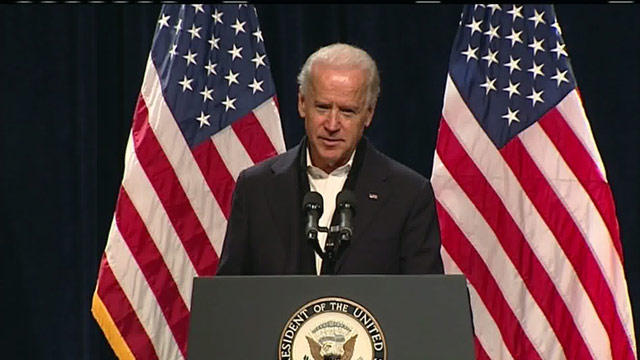
Vice President Joe Biden jumped on the Obama leadership bandwagon Friday when he revealed that he cautioned the president against signing off on the raid on Osama bin Laden's hideaway. Despite his reservations, Biden said the President made the gutsy decision all alone.
Speaking to a meeting of congressional Democrats in Maryland, Biden shared a few new details about the tense decision making process preceding the president giving the go ahead for the daring Pakistan raid by Special Operations forces.
Biden said that for a four-to-six week period in early 2011 only six people knew that bin Laden might be hiding in the military town of Abbotobad, Pakistan. When enough information finally surfaced, the president convened his national security staff on April 28th.
“The president, he went around the table, with all the senior people, including the Joint Chiefs of Staff, and he said I have to make a decision, what is your opinion. He started with the National Security Advisor, the Secretary of State, and he ended with me. Every single person in that room hedged their bet, except [then CIA director] Leon Panetta. Leon said go," said Biden.
Biden told the president "my suggestion is don't go," saying there were more details that had to be checked to truly ascertain if bin Laden was indeed in the compound.
"You end up having to make decisions based on the moon, will there be enough light. And we had to make a decision,” said Biden.
According to the Vice President Obama left that meeting and said he would make the decision.
"The next morning he came down to the diplomatic entrance, getting in a helicopter I believe to go to Michigan, I'm not positive for that. He turned to Tom Donilon and said "go," Biden related.
In fact, Obama was leaving for Alabama that morning, not Michigan. CNN previously reported that Obama gave the order at 820aET. Obama boarded the helicopter at 830aET, according to the White House schedule that day.
Obama’s Counterterrorism Advisor John Brennan told reporters last May how the inner circle "debated across the board," so the President could ensure "at the end that he had the views of all the principals."
"He goes around the room and he wants to hear people’s views. And so you have a circumstantial intelligence case. And so people will see that either there is insufficient circumstantial evidence to go forward with something like this, which involves a unilateral operation in another country to go after somebody you believe is Osama bin Laden - and there were differences of views that were discussed. That’s what the President wanted to know," said Brennan.
The Vice President isn’t the only who had second thoughts about pulling the trigger. Former Secretary of Defense Robert Gates has also admitted he had reservations about the raid.
PTI criticises PML-N claims to provide security to Mansoor
Pakistan Tehrik-Insaf (PTI) Lahore President Mahmood-ur-Rashid on Friday criticised the Pakistan Muslim League – Nawaz (PML-N) leaders for claiming to provide security to Mansoor Ijaz but could not capture the American consulate’s vehicle that had crushed Abad-ur-Rahman last year.
The PTI Lahore president was addressing a press conference, when the former PML-N member provincial assembly (MPA) Peter Gill announced his decision to join the PTI.
Mahmood-ur-Rashid said that it was a tragedy that the PML-N leaders were claiming to provide security to Mansoor Ijaz, while the family members of Abad-ur-Rehman were begging for justice.
Friday, January 27, 2012
Egyptians protest army to mark "Friday of Rage"
www.cbsnews.com
Large marches of protesters chanting antimilitary
slogans streamed from mosques around Cairo to join tens of thousands massed in central Tahrir Square in a new uprising anniversary rally Friday, with many demanding an early transfer of power by the ruling military and the trial of generals for the killing of protesters.
Tensions erupted when one march of hundreds of protesters headed toward the Defense Ministry building and was met by dozens of supporters of the military who chanted "the army and people are one hand." The pro-military group formed a human chain across an intersection, but the protesters pushed through them, shouting "down with military rule."
Outside barbed wire and armored vehicles guarding the ministry, the protesters chanted against the generals. Protester Ahmed Alish said the rally was to deliver a message to the military, "You must go." Later, several loud booms sent the crowd scattering. Alish said he saw a pro-military protester throw what looked like a homemade percussion grenade.
The protests, which included mass rallies in other Egyptian cities, commemorated the first anniversary of the "Friday of Rage," one of the bloodiest days of the 18-day wave of protests a year ago that ousted President Hosni Mubarak.In last year's "Friday of Rage," Mubarak's security forces fired on protesters marching toward Tahrir from around the capital, killing and wounding hundreds. Protesters battled back for hours until Mubarak's widely hated police forces collapsed and withdrew from the streets.
A year later, protesters' focus is now on demands that the military, which has ruled since Mubarak's Feb. 11 ouster, leave power. But Islamists and liberal, secular-leaning "revolutionary" protesters are divided. The revolutionaries want the generals out immediately, while the Muslim Brotherhood, which is now the most powerful bloc in parliament, is willing to wait for the military's promises to step aside by the end of June.
The leftists and secular groups accuse the military of being as dictatorial as Mubarak and of seeking to preserve their power even after handing over their authority to civilians. Regardless of the timetable, there is widespread resentment that little has been done to dismantle Mubarak's regime and prosecute security officers for the deaths of hundreds of protesters during and after the anti-Mubarak uprising. They call for more protests, while the Brotherhood wants to focus power on parliament. At the same time, there is also significant weariness over the continuing turmoil among Egyptians who are struggling with a worsening economy.
The differing tone was visible in Tahrir. Brotherhood supporters treated the day as a celebration of the victory of the "revolution," while non-Islamists insist there can be no celebrations when so many demands are unmet.
Some in the square shouted against the Brotherhood, chanting at them, "Get off the stage." Brotherhood supporters on a stage they have set up in the square tried to drown them out, blaring the national anthem and religious songs from multiple loudspeakers.
Amid the crowds in Tahrir, a Muslim cleric delivered a boisterous Friday sermon, proclaiming that the protesters, not the military, have the right to determine the country's course.
"Our right is to dictate the decisions of the revolution," said the cleric, Muzhar Shahine, speaking from a stage set up by leftist and secular groups, as the crowd cheered and cried, "God is great."
He gave a litany of the unrealized changes sought by the revolution.
"A year later, has State Security really been dissolved," he said, referring to Mubarak's feared internal security force that was the backbone of his police state. "Has our land been freed?" He said state media, a key mouthpiece for Mubarak and now the military, must be purged, a constitution must be written that is "shared by all political parties and that gives rights for all of Egypt's children," and Christians must be given the same rights as Muslims.
Rallies of thousands of protesters moved from main mosques all around Cairo toward Tahrir, chanting "we want civilian, not military." Some young men had shaved the words "down with military rule" in their hair cuts. In one rally from Cairo's Shubra neighborhood, a young man representing a slain protester was carried on other men's shoulders as a long Egyptian flag was unfurled down the boulevard.
Some were critical of the Muslim Brotherhood, which many suspect will not push for real reforms now that it has won a dominant place in parliament and which they fear is willing to strike a deal with the military that would give the general's some continued power. The Brotherhood denies any deal.
"We can't celebrate when there's no justice for those killed," 30-year-old protester Amr Sayyed said. "The Muslim Brotherhood is talking about justice, but not how or when."
"This is a day of mourning, not celebration," said Abdel-Hady el-Ninny, the father of a slain protester, Alaa Abdel-Hady. He and his family carried large posters of his son around Tahrir.
Balochistan Assembly backs Zardari, Gilani
Lawmakers of the Balochistan Assembly Thursday passed a resolution in the assembly urging the state institutions to avoid confrontation as it would harm democracy.
BA Speaker Muhammad Aslam Bhootani chaired the assembly session. Minister for Works and Deputy Parliamentary leader of the PPP in the provincial assembly Haji Ali Madad Jatak moved the resolution.
"The assembly reposes its trust in the leadership of President Asif Ali Zardari and Prime Minister Yusuf Raza Gilani and fully support their efforts being put to strengthen democracy," the resolution said.
The resolution underlined the need to maintain principle of division of powers and that no state institution would interfere into the affairs of other institution. It said the bright future of the country and welfare of masses depended on smooth flourishing of democracy.
In his speech, Jatak said Asif and Gilani have been playing significant role for strengthening democracy. "Masses had given mandate to the incumbent government to complete five year tenure," he said adding that supremacy of the parliament should be recognised.
Health Minister Aainullah Shams said the government should be given chance to complete its five years tenure as masses had elected it. He stressed formation of a committee of political parties to review that who violated Constitution and who endorsed such act.
Minister for Sports Mir Shah Nawaz Marri, Minister for Quetta Development Authority (QDA) and PPP leader Haji Ismail Gujjar, MPA Ghulam Jan Baloch, MPA Nasreen Khaitran, PML-Q MPA Sheikh Jaffar Mandokhel, Minister for Law and Parliamentary Affairs and PML-Q leader Shama Perveen Magsi, Minister for Local Government and Jamiat Ulema-i-Islam-Nazriati (JUI-N) leader Abdul Khaliq Bashar Dost also addressed the session.
The chair put the resolution to the house which passed it unanimously. Later, after completion of other proceedings of the assembly, the Speaker adjourned the house until January 28.
Punjab Deaths exposed incompetence, says governor
PUNJAB Governor Sardar Latif Khan Khosa has said that loss of around 100 precious lives because of reaction of medicines is a big tragedy which has exposed the Punjab government’s incompetence.
Talking to reporters after inaugurating two-day international conference on toxicology at University of Veterinary and Animal Sciences (UVAS) here on Thursday he demanded formation of a judicial commission to investigate the serious issue. He said holding of several portfolios by the Punjab chief minister was beyond comprehension.
The governor, while referring to meetings chaired by the CM Shahbaz Sharif on daily basis, said instead of holding meetings all the day, practical work should be focused. He said on the one hand the chief minister considered himself as Khadim-e-Aala but on the other hand he was holding portfolios of several ministries. “It is necessary to trust others instead of merely becoming a preacher of democracy”, he added.
Latif Khosa said the CM even did not bother to come to Punjab Assembly, adding that if the same attitude of the Punjab government continued, the PML-N would be unable to find candidates for the coming general elections.
He also said local bodies elections were being delayed for the last four years. Earlier speaking at the conference, the governor said there was a need to evolve a comprehensive strategy to protect environment from pollution and to keep it clean.
Don't give us fish, teach us how to fish, Zardari asks world leaders
The Express Tribune
''ZARDARI...A great visionary leader misread and misunderstood by most of the Pakistani urban middle class due to a biased media trial of him. He is heading a party which, if allowed, can bring unity with diversity.''
President Asif Ali Zardari said on Friday that he has always asked world leaders to “teach us [Pakistan] how to fish rather than giving us a fish.”
Zardari was speaking in Karachi at the inauguration ceremony of Waseela-e-Haq-Sindh program. He said that during his meetings with international players, he talked about “trade and not aid.”
Speaking about the currency swap arrangement with Russia, China and Turkey, Zardari said he convinced countries to trade with Pakistan in local currency.
“My own state bank, however, was sceptical about the idea because it has the mindset of getting aid and preventing new approach,” he said.
BISP to create new middle class
According to the President, the Benazir Income Support Programme (BISP) will help raising the living standard of poor people and will create a new middle class.
“I was told that there are people who had earlier received money through BISP and are now in a position to return that amount,” Zardari said.
Foil conspiracies against govt everyday: Zardari
Zardari said that new conspiracies are hatched against govt everyday but we foiled all of them.
Addressing the inaugural ceremony of ‘Waseela-e-Haq Sindh Programme’ in Karachi, Co-Chairman Pakistan Peoples Party and President of Pakistan Asif Ali Zardari, said that everyday a new conspiracy is hatched against us but, by the grace of God, we defused every conspiracy.
PPP government is creating a new middle class in Sindh through this programme, Zardari said. He said that we want that new generation would not face hardships which we have faced. He said that right from the first day of presidency, I talked about trade instead of aid. Zardari also suggested the beneficiaries of WHSP to establish dairy farms.
Politics is our worship, he said, adding that we are in politics for the service of the people. Our politics is not dependent on votes, he said.
While talking about BISP, he said that we strengthened the economy through Benazir Income Support Programme (BISP).
When we designed this programme, he said, people criticized and showed their concern but now this programme is running successfully.
The president also asked CM Sindh Syed Qaim Ali Shah to solve the problems of PPP workers and to provide them jobs.
Judicial probe in spurious drugs case
DAWN.COM
Interior Minister Rehman Malik on Friday hinted at setting up a judicial commission to probe the issue pertaining to spurious drugs that have claimed the lives of around 104 people in Punjab.
“I will discuss the matter with the top leadership and suggest the setting up of a judicial commission to bring the real culprits to task. I will recommend the inclusion of a representative of the media as a member in the commission,” he said.
Speaking to media representatives here today, he said that clear directives had been given to the Federal Investigation Agency (FIA) to arrest whosoever was found involved in the drugs case.
He criticised the Punjab government for not checking up on the substandard medicines even when it had around 500 drugs inspectors.
Commenting on a statement from Punjab Chief Minister Shahbaz Sharif regarding provision of security to Mansoor Ijaz in Punjab, the interior minister said that it was tantamount to contempt of court.
The minister said that the chief minister was attempting to divert the public’s attention from the spurious drugs case by issuing such statements.
He was of the view that Shahbaz Sharif, who also held the portfolio of provincial health minister, should at least have resigned from the minister’s slot after the deaths of 104 people.
LAHORE: Mass phobia grips city over local medicines


Patients with different ailments, especially heart-related, are in a fix over whether to purchase local medicines or not after scores of heart patients lost their lives after using medicines dispersed by the Punjab Institute of Cardiology (PIC), Pakistan Today has learnt.
People at large are panicking and are unable to decide if local medicines can be trusted at all, including even those which are not related to heart diseases. Many patients are scared and are refusing to use even simple painkillers as Ponstan.
Talking to Pakistan Today, Imran Syed, an expatriate from UK who is a heart patient said, “I’m a heart patient and I have come back to spend my vacations with my relatives…usually I buy medicines from here if I need them but this time I’ve been advised by my wife an kids to not to purchase medicines from here since they could be poisonous…my wife will be coming over from UK in a few days and will bring my medicines from there. It is a shame that we cannot even purchase medicines with peace of mind from here…what will the rest of the world think of us?” The panic is not just limited to patients. Even pharmacists have stopped buying large stocks of locally manufactured drugs with one of them saying, “When the government has not spared the factory owners, we are small fries and stand no where…it’s better not to purchase huge stocks because we might get booked somehow too.” Even doctors have started prescribing foreign manufactured drugs which are a lot more expensive. A senior doctor at PIC seeking anonymity said doctors are also afraid of the entire scenario. “The doctor only prescribes medicines, but if the drug is not effective or is spurious, it is not a doctor’s fault…but in current scenario the doctors are scared too and hesitate from prescribing even Paracetamol which is a very common drug, but they just don’t want to take the risk,” he added.
PIC Medical Superintendent Dr Salim Jaffar said, “people should take medicines for cure as God gives relief and man should not lose hope…one incident should not stop people from buying local medicines.”
Pakistan's unregulated drug industry
Contaminated medicines have killed 100 people, exposing a lack of regulation in the pharmaceutical sector.
Pakistan's government is being criticised for not doing enough to control the country's pharmaceutical industry. A hundred people have died, and 400 others are in hospital, after taking contaminated heart medicine.
Pakistan has a number of domestic pharmaceutical manufacturers, making generic versions of drugs and selling them at prices that are more affordable than their overseas counterparts.
While they are supposed to be regulated by the government, a recent devolution of the health ministries to the provincial level has meant that most are not monitored at all.
'Occupy arrest count in US tops 6000'
The anti-corporatism Occupy movement has reportedly had more than 6,000 of its protesters arrested across the United States since the campaign's evolution in September 2011.
Occupyarrests.com, a website, which keeps track of the apprehensions, says the US police have so far laid at least 6020 Occupy protesters under arrest.
The figure includes 37 people, who were arrested in New York City on Thursday, while demonstrating among others against an auction of foreclosed homes at Brooklyn Supreme Court. The protesters had begun chanting when the bidding started.
At least three Occupy Minneapolis protesters were also arrested at the headquarters of the US Bank in the city on Tuesday. The protesters were demanding talks between bank officials and two people whose homes were being subjected to foreclosure.
The Occupy movement emerged after a group of demonstrators gathered in New York's financial district of Wall Street on September 17, 2011 to protest against the excessive influence of big corporations on the US policies and the high-level corruption in the country.
Despite police crackdown and mass arrests, the Occupy movement has now spread to many major US cities as well as to Australia, Britain, Germany, Italy, Spain, Ireland, Portugal as well as other countries.
Saudi forces kill another protester
Press TV
Saudi security forces have shot dead another protester in the town of Awamiyah in the east of the country, as anti-regime demonstrations continue in the kingdom, Press TV reports.
On Thursday, a protester, identified as Montazar Sa'eed Al-Abdel, was shot dead and two others were injured by Saudi regime forces in the Eastern Province.
At least seven anti-government protesters have been killed by Saudi forces since November 2011. Human rights groups have slammed the Saudi government, urging it to probe into the deaths.
Saudis have held peaceful demonstrations since February last year on an almost regular basis in the eastern region, demanding reforms, freedom of expression and the release of political prisoners.
The protesters also want an end to economic and religious discrimination as well as their government's involvement in brutal crackdown on pro-democracy protests in neighboring Bahrain.
The peaceful demonstrations have turned into protest rallies against the House of Saud since November when Saudi security forces killed five protesters and injured many others in the Eastern Province.
This month, the Saudi regime again stepped up its brutal crackdown on the protesters.
On Tuesday, Saudi security forces opened fire on demonstrators in the Qatif region of the Eastern Province, injuring many people. Some of the wounded are reportedly in critical condition.
Nine protesters were also arrested for their involvement in anti-regime demonstrations.
On Monday, Saudi security forces detained Zaher al-Zaher, a social activist, in Awamiyah.
Regime forces also killed 22-year-old protester Essam Mohamed Abu Abdellah and wounded three others in Awamiyah on January 12.
FIA to check if Punjab govt followed rules
Investigating the spurious drugs case that recently surfaced in Punjab, Federal Investigation Agency (FIA) has focused its investigations that how the Punjab Government awarded contracts to six pharmaceutical companies who are facing allegations of manufacturing these suspected drugs, a source in the Interior Ministry informed.
It has revealed during the early investigations of FIA that these companies were providing supplies only to Punjab, a source aware of the development informed adding that FIA would ascertain in the probe that whether the provincial government properly followed Public Procurement Regulatory Authority (PPRA) rules in award of contracts to these companies. He further said that it had also come into light during the probe that one of these companies was based in Sindh and it was only proving medicines to Punjab and not any other federating unit including Sindh.
According to an official document of the Ministry of Interior, FIA has raided three pharmaceutical companies based in Lahore i.e. Pharma Wise Laboratories (Pvt) Limited, Al-Falah Pharma (Pvt) Limited and Mega Pharmaceutical Limited.
FIA in its investigations has transpired that Al-Falah Pharma purchased inactive raw material from local market but failed to produce any evidence of the source of purchase and other specifications of the raw material. In addition to that, the drug formulation licence of the company was found expired in April 2011 and the company failed to provide any revalidation of the license.
An official communication of FIA Punjab, Lahore office with the Interior Ministry shows that Pharma Wise Laboratories has been purchasing active and inactive raw material from local market against the prevailing Drug Act. Further more, the company failed to provide, before the investigators, particulars of manufacturer of the raw material and its specifications along with drug analysis report.
FIA investigations also show that Mega Pharmaceutical had been procuring the active raw material from a Chinese company Zhejiang Jiangbei Pharmaceutical Company (Ltd), China that is further being verified by the Agency. However, the company had been purchasing inactive raw material from local market against the existing law.
Meanwhile, Interior Minister Rehman Malik while briefing journalists on Thursday informed that FIA would jointly conduct investigations with the Punjab Government in the case to dispel the impression that Authority was probing the case with some political motivations. He said that six pharmaceutical companies were allegedly involved in the spurious drugs case, out of which chief executive officers of three companies namely Muhammad Waseem Chaudhry, Chaudhry Nadir Khan and Dr. Muhammad Tahir Azam had been arrested. “FIA during raids on three pharmaceutical companies including Pharma Wise Laboratories, Al-Falah Pharma (Pvt) and Mega Pharmaceutical Limited in Lahore has seized allegedly spurious drugs (Alfagril tablets, Solprin tablets and Carovatin tablets) from their stores,” he added.
The minister said all the relevant record pertaining to procurement of raw material used in manufacturing of the drugs has also been confiscated, which is being analysed.
Rehman Malik said these companies had supplied the alleged spurious drugs to Punjab Institute of Cardiology (PIC), which paid their bills after test reports from Drug Testing Laboratory, Lahore. “The relevant testing reports have been requisitioned from the laboratory,” he further informed. He said the samples of spurious drugs have been sent to the Central Drug Testing Laboratory Karachi for independent test reports through Federal Drug Inspectors. He said that post-mortem of one of the victims of the fake drugs could also be carried out, if required to ascertain the facts.
Commenting on the recent firing incidents in Karachi and Quetta, he said some elements, third forces, wanted to fan sectarianism especially to destabilize
Karachi, which is the hub of economic activities of the country. “According to some investigation reports, no religious party or outfit is involved in this sectarian violence,” he further said.
Replying to a question, Malik said 13 people were arrested over allegedly getting the copy of his (Malik’s) computerised national identity card illegally from the data bank of National Database Registration Authority. One of the arrested people has confessed the crime, he added.
Substandard drugs: Punjab government trying to escape duties by shifting responsibility to Centre

Federal Information and Broadcasting Minister Dr Firdous Ashiq Awan has blamed Chief Minister Punjab Shahbaz Sharif that he is exhibiting one-man show in the province which has resulted in killing of several innocent people after taking sub-standard drugs.
Firdous was addressing a press conference here on Thursday.
She said that unfortunately Punjab government is trying to escape its duties by shifting responsibility to the federal government.
"It is responsibility of the provinces to check the quality and ingredients of the drugs before purchase", she emphasised.
She added that following the passage of 18th amendment health has become a provincial subject and the federal government is now only responsible for registering the medicine companies.
She said that the Punjab government should expose elements involved in killing of innocent people, which have taken spurious drugs.
"Mian Shahbaz Sharif and the PML-N leadership must take stern action against those involved in death of around hundred heart patients and should not play politics on this sad incident by taking effective action against the responsible, she said.
Firdous highlighted that the federal government and PPP leadership in Punjab are ready to extend all out assistance to Punjab government for exposing elements involved in the business of counterfeit drugs." Awan said that Punjab has around 500 drug inspectors and it is responsibly of the provincial government to check and monitor the standard of the medicines.
"In presence of independent media no one can cheat and misguide the people", she noted and added that suspension of the Medical Superintendent (MS) is not the solution of the problem.
The minister said that federal government is also serious to look into this matter as under its directives, Federal Investigating Agency (FIA) is also probing the issue and its findings will be made public.
President Zardari takes note of Lahore contaminated drug deaths
President Asif Ali Zardari expressed concern over the reports of deaths due to spurious drugs in Lahore and called for a report from the health ministry in this regard.
Presidential spokesperson Farhatullah Babar said Thursday that the president also directed the Managing Director of Baitul Maal to visit the affected families and extend all possible assistance to the victims of spurious drugs.
He said that the president had asked the MD Baitul Maal to specially look after the poor children who have been rendered orphans as a result of this mishap.
The mishap of spurious drugs has a humanitarian side and the Baitul Maal must gear itself to look after the victim families, the president said.
Over a 100 cardiac patients in Lahore lost their lives due to the use of contaminated medication provided by the PIC.
France agrees to two decades of support in Afghanistan, despite attack on its troops
The Washington Post
One week after four French troops were killed by a rogue Afghan soldier, prompting President Nicolas Sarkozy to suspend military operations in Afghanistan, France will sign a bilateral agreement outlining its commitment here over the next two decades.
French troops will continue to train their Afghan counterparts well beyond 2014, when combat operations are due to conclude, according to the agreement described by Afghan and French officials.Afghan President Hamid Karzai will sign similar agreements with Britain and Italy during a trip to Europe this week, securing commitments from key NATO members as the alliance’s formal military campaign winds down. Karzai has long expressed concern that a lack of international support after 2014 could threaten the tenuous progress of the past decade.
Despite about a year of negotiations, the United States has been unable to secure its own strategic partnership agreement, which would govern the country’s military and diplomatic presence after the majority of its troops have withdrawn.
Karzai has said that he won’t sign such an agreement until “NATO-led night raids,” as he refers to targeted night operations, are halted.
Even though Karzai often refers to the operations publicly as “NATO-led,” he holds the United States alone responsible for the civilian casualties caused by the operations, according to Afghan officials. So, while the operations continue, Karzai felt comfortable signing partnership agreements with the three European countries, but not the United States, the officials said.
Efforts to bridge the gap between the two countries’ long-term demands have been steeped in mutual suspicion, with the United States balking at Karzai’s demands for an end to night operations and a prompt handover of U.S. detention facilities. The ease with which European partnership agreements were crafted highlights the relative scope and complexity of Afghan-American relations, and the commensurate tension.
“The U.S. is our largest and most important ally. What’s important for Afghanistan is the quality of the document, not how fast we can rush the signature,” said Janan Musazai, a spokesman for the Afghan Foreign Ministry.
France’s bilateral agreement with Afghanistan was crafted before last week’s attack on the French soldiers in Kapissa province, northeast of Kabul. Despite Sarkozy’s initial suspension of military operations — and his threat to withdraw from Afghanistan earlier than planned — the strategic partnership was not affected by the incident, according to French officials.
Afghan authorities have launched an investigation into the motives of the attacker, a 21-year-old man who joined the army less than three months ago, according to Afghan officials.
Britain’s partnership agreement, which will last through 2022, describes the role the British troops will play in training Afghan military officers and offers a commitment to economic development and cultural exchange, according to Afghan officials. Italy’s agreement, which also focuses on the country’s economy and security forces, was described as “long-term past 2014” in a statement from Karzai’s office.
In a Wednesday meeting with Italian President Giorgio Napolitano, Karzai described Italy’s contribution in Afghanistan as “unforgettable.”
All three pacts must be approved by Afghanistan’s parliament before they become official.
“These agreements reference the continued need for the training of Afghan security forces and acknowledge the long-term commitment of each of the three countries,” according to Musazai.
Although the partnership agreements provide few specific details about the character of bilateral cooperation beyond 2014, they carry symbolic weight in Kabul, affirming to Karzai that despite public opposition in much of Europe, major powers will contribute financially and militarily in Afghanistan for years to come.
None of the agreements details the number of foreign troops that will remain in Afghanistan after 2014 or NATO’s financial obligation to the country after its combat operations conclude. The maintenance of Afghanistan’s military and police forces probably will cost between $4 billion and $6 billion annually, according to Afghan Defense Minister Abdul Rahim Wardak. Some Western officials have expressed concerns about those costs.
Rockets hit Pakistan academy near bin Laden home

Attackers on Friday fired rockets at Pakistan's top military academy, damaging its outer wall in a major security breach near the home where Osama bin Laden lived for years, officials said.
No one was hurt in the pre-dawn attack and it was unclear who fired the nine rockets from behind a mosque in mountains overlooking the Kakul academy, Pakistan's equivalent of West Point 30 miles (50 kilometres) from the capital.
The garrison city of Abbottabad was considered one of the safest parts of nuclear-armed Pakistan until American special forces on May 2 found and killed the Al-Qaeda founder in a compound where he apparently lived for five years.
The bin Laden raid humiliated Pakistan's powerful military, exposing it to charges of complicity or incompetence after it emerged that the world's most wanted man had lived on the doorstep of its premier academy for years.
Three rockets on Friday damaged the outer wall of the academy, which is just 500 metres (yards) from the site of the US Navy SEALs raid that seriously damaged already turbulent relations between Pakistan and the United States.
"Nine rockets were fired. Three rockets hit the boundary wall of the military academy and damaged it. No one was hurt in the attack," Imtiaz Hussain Shah, a top local government official in Abbottabad told AFP.
"We have launched a search operation," Shah added.
Mohammad Karim Khan, Abbottabad police chief, confirmed the attack.
"Three rockets hit the boundary wall. Three others landed in an open area and three others landed in a field," he said.
Officials blamed terrorists for the attack.
Shah told TV channel Geo that police had recovered nine rocket-launching pads behind a mosque, about 500 metres from the academy.
"We have a security system and checkpoints on the roads, but the place they used as a launch pad is accessible from all sides and there are mountains at the back of this place," he said.
"At this stage we cannot say who was involved, but they are terrorists and we are investigating how they managed to reach this place."
Taliban and other Islamist militants are fighting an insurgency against the army, although there has been a marked decline in violence in recent months.
Considered one of the quietest towns in the northwest, nestled in pine-dotted hills and popular with day-trippers from the capital, Abbottabad is listed on Pakistan's official tourism website as a "popular summer resort".
But although it is mainly tranquil, it is close to more troubled areas.
A judicial commission is investigating how bin Laden managed to live undetected in Pakistan for so long, and whether there was any government or military collusion.
Pakistani-US ties have since reached a new low over US air strikes that killed 24 Pakistani soldiers last November, leading Pakistan to shut its Afghan border to NATO supplies and conduct a review of its alliance with Washington.
Killing members of the Shia community---Crush sectarianism!
EDITORIAL:DAILY TIMES
The fanaticism of sectarian groups killing members of the Shia community has been a bane in Pakistan flourishing in its magnitude with each passing day and will continue to do so owing to the lax response of the law enforcers. On Wednesday, six men belonging to the Shia Muslim community became their targets in Karachi and Quetta, gunned down in a similar way. Three of the deceased in Karachi were lawyers and members of the Legal Aid Committee while the other three murdered in Quetta belonged to the peaceful Shia Hazara community. They included an inspector of the Federal Investigation Agency (FIA), a television artist and a poet. The killings took place only a day after two activists of the Ahle Sunnat Wal Jamaat (ASWJ) — a re-organised version of the banned militant group Sipah-e-Sahaba Pakistan (SSP) — were shot dead in Karachi. There is speculation that the Karachi killings were in response to the murders of ASWJ activists. However, this should not be treated as a ‘tit-for-tat’ response in the face of the mounting death toll of Shias being killed every other day around the country.
Thousands of Shia Muslims have been killed during the last three decades across the country after General Zia in collaboration with Saudi Arabia endorsed the Deobandi militants and sowed the ugly seeds of sectarianism in society. Since then, the country has been witnessing sectarian violence and bloodshed. Sectarian groups have gained so much strength that it seems almost impossible to control their terrorist activities. Unfortunately, there are several lacunae in the country’s legal system and the prosecution regime is full of flaws, which in turn facilitates the terrorists even if some of them are captured. The same happened in the case of Malik Ishaq, the chief of defunct sectarian group Lashkar-e-Jhangvi (LeJ) who has been released by a court despite the fact that his group had claimed responsibility for the Mastung deadly attack on Iran-bound innocent Hazara pilgrims last year. It is even more unfortunate that Ishaq enjoys a soft corner in the heart of the Punjab government. The presence of these extremist elements can be easily felt in the state institutions, which is another reason for the government’s helplessness against them. The situation indeed reflects the paralysis of political will to take a stern action against these gory murderers.
The time has come that the government decide the fate of these religious fanatics and use all force to crush them otherwise this contagion will spread and invite retaliation from the victim community. There is also an urgent need to improve the faulty Anti-Terrorism Act and criminal laws or replace them with specially made effective laws so that justice can be served. To fight these saboteurs of peace and religious harmony, the government has to act decisively.
Contaminated drugs: Punjab death toll reaches 105
The number of people killed from contaminated heart drugs in Punjab has reached 105 on Friday.
President Asif Ali Zardari, taking notice of the deaths, directed Bail ul Mal MD to help the affected families.
Meanwhile, Lahore High Court (LHC) has asked for reply from all parties involved by January 30.
The issue of contaminated medicine is worsening after every passing day as death continue continues to rise.
Despite all measures taken by Punjab Government, there seems be to no end to killings. Sampling of suspected drugs has been sent local and foreign laboratories.
The provincial government says it is a complicated matter and culprits could not be identified before completion of probe.
Shahbaz statement on memo is contempt of court
/tribune.com.pk
Interior Minister Rehman Malik has termed Shahbaz Sharif’s statements on providing security to Mansoor Ijaz as ‘contempt of court’, Express News reported on Friday.
Malik said that he will file a request for a ‘contempt of court’ notice against the chief minister.
Shahbaz Sharif, on Thursday, said that he will take personal responsibility of providing complete security to Ijaz during his visit to Pakistan.
He said that he will welcome Ijaz and will provide him security till the last moment he is in Pakistan, and also offered the judicial commission probing the controversial memo to come to the province to record Ijaz’s statements.
In response to Shahbaz’s statements, Rehman Malik also said that the ‘cat is out of the bag’ now and that it was clear why Nawaz Sharif went to court for the Mansoor Ijaz case.
JI slams PML-N on ‘medicine poisoning’
The Jamaat-e-Islami has joined other political parties, like PPP and PML-Q, in blaming Punjab chief minister for the deaths caused by contaminated medicine, which were provided by the Punjab Institute of Cardiology .
The party slammed Pakistan Muslim League-Nawaz government for its alleged negligence and has demanded the resignation of Shahbaz Sharif on the grounds that he holds the portfolio of Punjab’s Health Ministry. JI Punjab General Secretary Nazir Ahmed Janjua expressed his deep sorrow over the deaths of dozens of people at PIC.
He held Punjab chief minister responsible for the deaths and said stern action should be taken against those responsible so that such incidents never happen again.
Janjua said the government should ban the sale of heart medicines like Cardiovestin, Isotab, Corcont, Zafnol and Solprin in the interest of public safety and destroy all available stock of these medicines. He said three Lahore-based pharmaceutical companies are supplying substandard medicine to Punjab hospitals and medicals stores are selling these medicines without any record.
Janjua said cash assistance of Rs 1 million should be given to each victim’s family while Rs 0.5 million compensation should be given to the patients who suffered medicine reaction and that the government should bear the expenses for their treatment.
Call for governor’s rule in Punjab
THE NEWS
LABOUR Party Pakistan will stage a demonstration against the Punjab government over deaths in the PIC medicine reaction. The demonstration will be held outside the Lahore Press Club in which senior members of the party, including Farooq Tariq, will participate.
Meanwhile, in a statement issued on Thursday, former MNA and PML-Q (Likeminded) Punjab Secretary Information Mian Muhammed Asif demanded imposition of Governor’s Rule in Punjab for a period of at least two weeks to ensure fair probe into the matter.
PPP: President PPP Punjab Imtiaz Safdar Warraich has demanded the resignation of Chief Minister Punjab over the deaths at the Punjab Institute of Cardiology. Talking to media at the PPP Punjab Secretariat on Thursday, the party’s provincial President said that the Punjab government and the CM were responsible for the loss of innocent lives at the PIC.
PTI demands Shahbaz resignation
PAKISTAN Tehreek-e-Insaf (PTI) has held Punjab Chief Minister Mian Shahbaz Sharif in the capacity of health minister responsible for the deaths of 100 cardiac patients after reaction from substandard medicines at the Punjab Institute of Cardiology (PIC), Lahore, and demanded his immediate resignation in conformity with democratic traditions.
Addressing a press conference at a local hall on Thursday, PTI Central Information Secretary Shafqat Mahmood, General Secretary Punjab Dr Yasmin Rashid, Information Secretary Punjab Andleeb Abbas and Women Wing Punjab President Saloni Bukhari requested the Lahore High Court to take suo motu of this criminal negligence resulting in deaths of 100 patients and leaving hundreds other in a critical condition. They demanded immediate appointing of a judicial commission to investigate and bring to trial all government officials and the companies involved in this scandal.
The PTI leadership observed that Punjab government should take full responsibility of these deaths and since the chief minister was personally heading the health ministry, therefore he was fully accountable for the deaths of these patients.
Shafqat Mahmood strongly condemned the negligence and incompetence of both the federal government and the Punjab government. Due to the corruption in the federal government, he said, licences had been issued to substandard drugs manufacturing companies and medicines manufactured by them were neither monitored nor tested. As regards the PML-N government in Punjab, he said, it has made no attempt to scrutinise the quality of medicines being purchased by hospitals.
He said that, after a summer that witnessed over 400 deaths of innocent people through mismanagement of dengue, the government continued to show its complete lack of governance by letting the spurious medicines kill another hundred people and perhaps more. “In fact there are reports that politics and corruption both played a part in the choice of these substandard medicines,” he added.
Dr Yasmin Rashid, while highlighting the mismanagement of the whole debacle, said that medicines being supplied in PIC to the poor patients who suffered the adverse reaction did not carry the manufacturing date and the expiry date. Clearance by Drug Testing Laboratory is totally erroneous and dishonest. These medicines are only available in PIC and not in any pharmacy outside.
She further claimed that the first patient reported was admitted to Services Hospital on December 15, 2011; the conclusion about the drug reaction was diagnosed on January 12, 2012; while the notification by Punjab government on stopping use and procurement of drugs causing serious adverse reaction came out on January 18. Regarding the awareness campaign, she claimed, it had been delayed to date and only print media had been involved although majority of the patients might not read those newspapers. The electronic media has not been involved in its true spirit.
She said that there was no proper data on the number of patients affected or who had died due to reaction was available, adding that the chief minister had given the number which was different from the heath department information. “This is a conservative figure because we don’t yet have information of the mortality rate in other government hospitals of Punjab,” she added.
She criticised that the chief minister was now blaming the federal government for this tragedy, and questioned why the chief minister not played his opposition role properly if he thought that the registration of drugs was faulty. “Why is it that only after the death of 100 people does he come up with this allegation,” she questioned.
The PTI leadership believed that if the guilty were not punished then this scenario of people losing their lives due to mismanagement and poor governance of the Punjab government would continue and the poor people would continue to suffer.
“We have previous experience that no punishment was meted out to the people involved in the dengue scandal,” they said, adding that Lahore High Court must step in to protect the lives of the people of Punjab.
The PTI leadership warned that if the responsible were not brought to justice and this ‘deadly wrong’ was not rectified immediately to save lives of other patients, the PTI would stand with the people of Punjab and would continue fighting to get the rights of the people.
Peshawar airport to be named after Bacha Khan
THE NEWS
The Federal Government has agreed in principal to rename Peshawar International Airport after the name of Khudai Khidmatgar Khan Abdul Ghaffar alias Baacha Khan in recognition to his services for the Muslims of sub continent and struggle as preacher of non-violence.

The jubilant President of Awami National Party Asfandyar Wali Khan announced this at a public meeting held in connection with the 24th death anniversary of Baacha Khan and 6th death anniversary of Rehbr e Tehrik Khan Abdul Wali Khan held here at Tehmas Khan Stadium.
Amid clapping he announced that Peshawar International Airport would be renamed as Baacha Khan International Airport as the Federal Government has explicitly agreed in this regard. "The Federal government has accepted our demand", he said.
Chief Minister Khyber-Pakthunkhaw Amir Haider Khan Hoti and Provincial President of ANP KP Senator Afrasiab Khattak also addressed the public meeting.
The parliamentarians, provincial ministers and MPAs belonging to ANP were present on the occasion.
The Federal Government has agreed in principal to rename Peshawar International Airport after the name of Khudai Khidmatgar Khan Abdul Ghaffar alias Baacha Khan in recognition to his services for the Muslims of sub continent and struggle as preacher of non-violence.
The jubilant President of Awami National Party Asfandyar Wali Khan announced this at a public meeting held in connection with the 24th death anniversary of Baacha Khan and 6th death anniversary of Rehbr e Tehrik Khan Abdul Wali Khan held here at Tehmas Khan Stadium.
Amid clapping he announced that Peshawar International Airport would be renamed as Baacha Khan International Airport as the Federal Government has explicitly agreed in this regard. "The Federal government has accepted our demand", he said.
Chief Minister Khyber-Pakthunkhaw Amir Haider Khan Hoti and Provincial President of ANP KP Senator Afrasiab Khattak also addressed the public meeting.
The parliamentarians, provincial ministers and MPAs belonging to ANP were present on the occasion.
Faulty drugs toll reaches 104
Death toll from PIC drug reaction reaches 104 as another patient die today.
More than hundred heart patients have died after spurious drugs intake provided by Punjab Institute of Cardiology (PIC) and dozens more are in a critical condition in hospital.
Today, a patient named Muhammad Gulab, 60, passed away at Meo Hospital in Lahore.
Punjab Chief Ministers Sharif has ordered autopsies of the drug victims and samples of the suspect drugs have been sent to laboratories for tests.
Meanwhile, the Pakistan Medical Association’s Lahore chapter has asked the Punjab government to establish a drug regulatory authority, change the policy of purchase of free medicines in the public-sector health facilities and upgrade the drug testing laboratory.
One-man show in Punjab must end: Firdous
Federal Information Minister Firdous Ashiq Awan said one-man show should end in Punjab.Crticising Punjab CM Shahbaz Sharif over casualties of nearly 100 people due to fake medicines given by the Punjab Institute of Cardiology, Lahore, the federal minister said that the CM should resign from his office after the deadly mismanagement.She said that people are losing lives while the CM is so stubborn that he is not taking pain to attend the Punjab Assembly session.
Interior Minister Rehman Malik said that casualties of 100 people is not a trivial matter; stern action should be taken against the people responsible in this regard.
He said that the government of Punjab is responsible for the death caused by spurious medicines.
Subscribe to:
Posts (Atom)