Pakistan repeatedly urged Afghanistan and US-led forces there to go after notorious Taliban cleric Maulvi Fazlullah, whose fighters took part in cross-border raids that killed about 100 members of Pakistan’s security forces in recent months, but no action was taken, an army spokesman said on Monday.“The problem refuses to go away,” the Pakistani spokesman, Major-General Athar Abbas, told Reuters.
The complaint could deepen tension between Pakistan and Afghanistan over cross-border attacks by militants on targets in both countries.
Monday, October 17, 2011
People won't elect PML-N in next elections
PPP leader and former federal law minister, Senator Dr Babar Awan, on Sunday said the people would not elect the PML-N in the next general election because of their animosity towards democracy and said the PPP would complete its five-year constitutional term and form the government after the 2013 general polls.
Addressing a public meeting at Dhanda near New Muree, he strongly criticised the Pakistan Muslim League-Nawaz (PML-N) and Punjab government, saying their leadership was upset due to an imminent defeat in the Senate and general elections and were thus talking about the dissolution of the provincial assembly.
Awan said leaders of the "Naraz League," which held a sit-in against the democratic government, had gone to Jeddah under a deal with Musharraf and remained silent during his regime. He said the princes of Takht-i-Lahore would once again leave for Jeddah, Saudi Arabia, after their defeat in the 2013 election.
Awan asked why the so-called lovers of democracy had not staged a single sit-in during the nine-year-long tenure of Musharraf. He added that the Senate election would be held in March next year and no assembly would be dissolved before then.
Awan said the talk of dissolving the assembly was "mere propaganda by the loyalists of PML-N leaders to hoodwink the people," but they would not succeed in their designs. Awan said the PML-N had cheated the parties of the APDM (All Parties Democratic Movement) by contesting the election in 2008. "The PML-N leadership backed away from its words and left Pakistan Tehrik-i-Insaf, Jamaat-i-Islami and Mahmood Achakzai in the lurch," Awan said.
"Sharifs' plan to dissolve the Punjab Assembly is a bid to break the electoral college of Senate but this plan has miserably failed. "The people will not elect them in the next general election because of their animosity towards democracy."
Babar Awan said that the rulers of Takhat-i-Lahore had created a number of problems in the Punjab province and embezzled huge funds in the name of 'Sasti Roti', development, Ashiana Housing Scheme and anti-dengue spray. "This entire drama is being staged to loot public money and the government's financial resources," he added.
Pakistanis spurn polio vaccines


Pakistan is one of four countries where polio is deemed endemic. Eradication of the disease is made more difficult by rumors linking vaccination campaigns to Western plots.
Whenever Safa sees her father readying the brace, she fidgets and sobs. It's not very comfortable and already too small, but without it the 2-year-old Pakistani girl would crumple to the floor.
Safa's right leg is paralyzed, and Tahir Wali now realizes his daughter's plight was wholly avoidable. The girl's grandmother repeatedly turned away polio vaccination teams from the family's front door, convinced that the vaccine sterilizes girls. Like many Pakistanis, she bought into rumors spun by fundamentalist imams who denounce polio vaccination campaigns as a Western plot.
"My mother believed there was a conspiracy to use polio vaccines to keep population growth down by suppressing the fertility rate," Wali says, cradling Safa in his arms inside his family's tiny two-room house in the northwestern city of Peshawar. "I should have intervened, but I didn't."
In the Western world, polio is largely a forgotten disease, an anachronism that conjures up images of iron lungs and March of Dimes posters. In Pakistan, however, polio remains a scourge that international health organizations have failed to eradicate.

As of Oct. 13, 111 cases of polio had been recorded this year in Pakistan — second only to the African nation of Chad, where 114 cases have been reported this year. Last year, Pakistan logged 144 cases of polio. Today, Pakistan is one of just four countries where polio is deemed endemic; the other three are Afghanistan, India and Nigeria.

Several factors have stood in the way of eradication. In the country's volatile tribal areas along the Afghan border, the war against Islamic militants has made it difficult for vaccination teams to make the rounds in villages and towns, where cases of polio continue to spread. The migration of Pakistanis from the country's northwest to densely populated cities such as Karachi and Quetta has further spread the disease.

Underlying those factors, however, is an intense mistrust among some Pakistanis for the vaccines and the people who supply and administer them. Radical clerics seed rumors that vaccines are un-Islamic because they are made from substances derived from pigs, or that they cause infertility. Some clerics try to convince parents that polio vaccines are made from the urine of Satan.
The reluctance by some Pakistanis to trust polio vaccination programs is also driven by a belief that the U.S. is behind the campaigns. Anti-American sentiments are more fervent than ever in the country, stoked this year by the case of CIA contractor Raymond Davis, who shot to death two Pakistanis in Lahore in January, as well as by President Obama's decision to not inform Pakistani leaders in advance about the U.S. operation against Osama bin Laden in the city of Abbottabad in May.
Parents' fears about polio immunization drives were compounded by a CIA-orchestrated phony vaccination campaign aimed at obtaining DNA evidence from Bin Laden's compound in Abbottabad in the weeks before the U.S. commando raid that killed him.
"People were already suspicious of the objectives of these polio vaccination drives," says Zaid Khan, 33, a shopkeeper who sells tea leaves in the Peshawar neighborhood of Rashid Garhi, where the refusal rate is high. "The fake campaign in Abbottabad strengthened parents' resolve against the polio drives. It gave them proof that America's intentions are bad."
Most Pakistanis recognize the value of vaccination and allow their children to be immunized. But a stubborn minority of parents, most of them impoverished and poorly educated, refuse to permit immunization teams to step into their house.
"Pakistan used to have numbers in the thousands in the 1990s, but because we are in eradication mode, even one case is too many for us," says Elias Durry, senior coordinator for the World Health Organization's polio eradication effort in Pakistan. "So having more than 100 cases doesn't help.... Our aim is not just to do things better. Our aim is to finish the job."
Up until the mid-20th century, polio had been one of the world's most feared diseases. In the early 1950s, the highly communicable virus, which attacks the nervous system, paralyzed 22,000 Americans each year. The development of a vaccine brought the disease under control in the industrialized world, and in recent decades about $8.2 billion, with significant donations from Microsoft founder Bill Gates, has been spent on immunizing 2.5 billion children throughout the developing world.
In Pakistan, however, eradication is faltering. Peshawar city officials have threatened to arrest parents who consistently bar their children from being vaccinated.
"We try to tell them there's nothing wrong with the vaccines, that they're good for their children," says Irfan Ali Shah, a senior Peshawar health official.
Peshawar shopkeeper Raza Farooq explains why he won't allow local health workers to vaccinate his 4-year-old daughter and 2-year-old son. "I believe God has given me my children and that God will protect them — I don't trust these vaccinators. They give me assurances, but they can't prove these drops are good for health or that they aren't expired, or that they won't produce any side effects."
Wali, Safa's father, says the girl's grandmother has changed her mind about the value of polio vaccinations — though it took the sight of her granddaughter's lifeless leg to bring her to that realization. Since Safa contracted polio, other children in the family have been immunized.
"She admits what she did was wrong, but she also knows she can't do anything about it," Wali says. "Now she doesn't refuse the drops."
U.S. steps up drone strikes in Pakistan against Haqqani network
www.washingtonpost.com
A U.S. drone strike left four people dead Friday in northwestern Pakistan a day after a similar attack killed the most senior figure struck to date in an escalating campaign against Afghanistan’s Haqqani network.
The four, whose identities were not immediately known, were riding in a car near Miran Shah, the capital of the North Waziristan region and the main base of the Haqqani network. Pakistani officials said the vehicle was struck by two missiles from a U.S. drone, the Associated Press reported.
On Thursday, a CIA drone strike killed Janbaz Zadran, a trusted deputy of network leader Sirajuddin Haqqani and a “close aide” to Haqqani’s brother Badruddin, the group’s top operational commander, a U.S. official said. Zadran “played key roles in resupplying the Haqqani network and insuring the fighters in Afghanistan had access” to the group’s Pakistan-based leadership, the official said.
“It’s probably the most senior death of any Haqqani network member in Pakistan to date, if it’s true,” said Jeffrey Dressler of the Washington-based Institute for the Study of War. “He’s on everybody’s radar.” Dressler and other experts said Zadran was not an active fighter but was in charge of group’s finances and arms shipments.
Before Friday’s drone strike, two militants killed alongside Zadran were buried in the town of Lakki Marwat, AP reported. The funeral of one of the men, Maulana Iftikhar, the head of an Islamic school in Miran Shah, drew 2,000 mourners, including Arab militants and Munawar Khan, a Pakistani lawmaker from the opposition party of former prime minister Nawaz Sharif, the news agency said.
The strikes followed several tense weeks in the U.S.-Pakistan relationship, as the Obama administration publicly alleged direct ties between the Haqqani network and Pakistan’s Inter-Services Intelligence agency.
The United States has said that the Haqqani network is the most significant threat to U.S. and coalition forces in eastern Afghanistan and has warned of increasingly direct action against the militant group’s haven in the Pakistani tribal area of North Waziristan if Pakistan does not move against it.
Pakistani officials said the Thursday attack occurred in Dande Darpa Khel, an area just west of Miran Shah.
The area was the site of several earlier drone strikes, including one in September 2008 that reportedly killed the wife, sister and eight grandchildren of Jalaluddin Haqqani, the founder and patriarch of the group. A drone attack in February 2010 killed Jalaluddin’s youngest son, Mohammad, reportedly a student of religion with no direct involvement in the Afghanistan war.
U.S. officials confirmed that a second drone-fired missile Thursday struck a border town in neighboring South Waziristan. A Pakistani official in the area said the strike killed four militants who were planting explosives.
The strikes came as the U.S. special envoy to Afghanistan and Pakistan, Marc Grossman, arrived in Islamabad, the Pakistani capital, to try to calm rising tensions.
“We tried to think about the future,” Grossman said at a joint news conference with Pakistani Foreign Minister Hina Rabbani Khar. “We also talked about how we can continue in a systematic way to identify the interests we share with Pakistan — and they are many — and then find ways to act on them jointly.”
Pakistan’s relationship with the Haqqanis stretches back to the 1980s, when Islamabad and Washington aided the Afghan group as it fought against the Soviet Union’s military occupation of Afghanistan. Jalaluddin Haqqani became an official in the Taliban government that took over Afghanistan in 1996, and he fled to the Pakistani tribal region, along with al-Qaeda, after the Taliban was overthrown with U.S. assistance in 2001.
Haqqani fighters regrouped and began fighting U.S. and coalition forces across the border in Afghanistan. Pakistan denies U.S. charges that it helps the group but has repeatedly refused to take military action against it. The Haqqani network is separate from, but claims allegiance to, the broader Afghan Taliban movement that is based in Quetta, in southern Pakistan.
In reporting the drone strike early Thursday, a Pakistani intelligence official initially said that the target killed, along with two unnamed Haqqani fighters, was a guard named Jalil Haqqani. The official described him as a “trusted” member of the organization not directly related to the Haqqani family.
But U.S. officials, who were not authorized to discuss intelligence matters, said later that Zadran was the target of the drone strike in North Waziristan and confirmed that he was killed. One official said the apparent confusion may have arisen because Zadran was sometimes known as “Jamil.”
Pakistan’s tribal region, where a stew of militant groups are based, is off-limits to foreigners and dangerous for outsiders, making it difficult to independently verify the details of CIA drone strikes in the area.
Sunday, October 16, 2011
'Occupy Wall Street': A media blackout?
Protesters take on Wall Street and battle to get themselves heard in the mainstream media.
It started in Lower Manhattan. A handful of protesters descended on Wall Street calling themselves representatives of 'the 99 per cent' – the majority of Americans who feel unfairly treated by an economic system in which wealth accrues to the already rich.
Despite an initial lack of coverage, the protests spread country-wide and the crowds grew. The coverage however was disappointing. Protesters accused media outlets of marginalising the demonstrations and not representing public interest. They pointed to the deep connections between the corporate system the demonstrations aimed to change and the mainstream media.
Afghan Symbol of Identity Is Subject to Search

Straight-backed, his bearing almost regal, Malik Niaz, 82, entered the Afghan president’s compound this month, proudly wearing his best turban: a silk one from Turkestan in the north of the country, gray and black and white, its long tail draped gracefully over his shoulder
He watched in disbelief as the guard asked the elder ahead of him to remove his turban
and lay it on the table. Mr. Niaz, who had journeyed more than eight hours on rugged roads, shuddered.
“That made us so embarrassed, and it made me so sad,” he said. “I felt dishonored when the guard said,” he hesitated, as if even recalling the words made him upset, “ ‘undo your turban.’ ”
“I had wanted to see the president,” he added, “but after that search, I thought it would have been better if I had not come.”
The turban-searching rule at President Hamid Karzai’s presidential palace has been rigorously enforced since the assassination of the head of Afghanistan’s peace process, Burhanuddin Rabbani, who was killed by a bomb hidden in the attacker’s turban. It was the third such killing in four months, leading youths in Kabul to coin the word “Turbanator” and American soldiers to invent the new acronym TBIED, for turban-borne improvised explosive device.
The other two instances were the killing in July of Kandahar’s senior cleric as he prayed in a mosque, and a few weeks later the killing of Kandahar’s mayor.
The searches are deeply disturbing for most Afghan men, as the turban here at once signifies one’s religious faith and is a national dress — not to mention being something of a fashion statement.
Turbans are worn across the Muslim world because the Prophet Muhammad was believed to have worn one, and they are especially favored by imams and mullahs. In Afghanistan, which is a deeply pious country, usage is broader, with dozens of styles and colors. There are ones made of synthetics from Pakistan that cost about $20, silk ones from Herat that cost twice as much and ones made of more luxuriant silks from the north of Afghanistan that cost still more.
The people of southeastern Afghanistan wind the cloth large and loose so it looks as if the whole structure might topple off; Kabul residents prefer a smaller, tighter look. Those in eastern Afghanistan tuck the last bit of cloth so it sticks up out of the turban like a cockscomb, known as a “shimla,” and its size has something to do, loosely, with a person’s view of his own standing. The Taliban were known for wearing turbans made of a very soft cotton that had especially long tails and were either black or white; the former signifies that the wearer’s family members are descendants of Muhammad.
However, most turbans in Afghanistan now — and in the pre-Taliban era — are subtle grays and charcoals, deep olive greens, lighter soft greens and browns.
“I have four or five turbans,” said Hajji Mohammad Zaman Ahmadi, a 57-year-old Kabul resident who was in a bazaar to buy a white skullcap for wearing at home but had his turban on for the workday. He had just gotten a miniature turban for his 2-year-old nephew, he said.
“It is made out of the softest of our country’s wool,” he said.
Mr. Ahmadi, like Mr. Niaz, believes that bombers who use their turbans to hide explosives are committing an offense not just against Islam, but against the nation. They are trying to “defame the Afghan turbans and chase the Afghans from their ancient traditions and try to scare them into not wearing their turbans,” he said.
On the back streets of Kabul’s central bazaar, where the turbans are sold neatly folded, thin as a pamphlet and wrapped in torn pages from old glossy magazines, many turban wearers are so angry about the situation that they blame the Americans. Before their arrival, intrusive searches were unknown.
“My father, my grandfather, my great-grandfather, my prophet wore a turban, and that’s why I wear it,” said an older man, looking irritable at the question, adding: “Who brought these turban bombers and turban searchers? You did,” he said angrily, referring to Westerners, which many Afghans feel are agents of the decline of the society.
Many clerics take a more contemplative view. Faith transcends costume, and a man can pray in any outfit as long as the prayer comes from the heart, but it is an honor to God to dress properly, said Abdul Raouf Nafee, the mullah at the Herati mosque in central Kabul.
As an example, he talked about butchers: “Even if their clothes are dirty with blood, they can pray and God will accept their prayers, but it’s kind of disrespectful. God likes beauty and organization, but he will accept your prayers,” Mr. Nafee said.
Sitting on a floor cushion as he read the Koran early one morning in a small room just off his mosque’s prayer hall, Mr. Nafee wore a simple white cap. His turban was neatly prepared and waiting on a couch for the midday prayer when he would don it. A man of both poetry and pragmatism, he views the turban as a link between the holy life and people’s physical needs.
The turban, like the traditional blanket or shawl worn by men and the chador worn by women, is practical as well as religious and cultural, he said. “You are covered to keep off the dust — and now the pollution,” he said. “If you are cold, you can wrap it around you for warmth, you can sit on it, you can use it to tie an animal, a sheep or a goat, and you can use the turban’s cap to carry water.”
There is also a darker view of turban attacks: that the bombers were so distraught that their turbans’ holiness no longer mattered, and that they were forced to use any means available to take revenge on the Americans.
“Is it wrong to respond to the killings of the civilians that you do with your drones, that shoot from the air and do not even have pilots?” asked Hajji Ahmad Farid, a mullah and a conservative member of Parliament from an insurgent-dominated area of Kapisa Province, near Kabul. “Think about why a man blows himself up: Some foreign soldiers go to his house and accuse him and tie his hands and dishonor him and search his wife and his daughters, and this poor man is just watching and can do nothing.
“When a man has lost his dignity, he does not care about his shawl or his turban.”
US decides to go after Haqqanis
daily times
The Obama administration has decided to go all-out against the Haqqani network, which it blames for the September attack on the US embassy in Kabul, Washington Post reported on Saturday.
As part of the latest efforts to cripple the group, a CIA drone strike Thursday killed three of its members, including a senior official, and additional strikes Friday left four dead. The attacks in Pakistan were carried out near Miranshah, capital of North Waziristan Agency, a city rarely targeted in the past because of the difficulty of finding well-concealed insurgent leaders and the possibility of civilian deaths in an urban area.
“The Obama administration has launched the opening salvos of a new, more aggressive approach towards an Afghan insurgent group it asserts is supported by Pakistan’s government,” the newspaper quoted senior US administration officials. “The decision to strike Miranshah was made at a National Security Council meeting chaired by President Obama two weeks ago and was intended to ‘send a signal’ that the United States would no longer tolerate a safe haven for the most lethal enemy of US forces in Afghanistan, or Pakistan’s backing for it,” the paper quoted one of several US officials who spoke about internal deliberations on the condition of anonymity.
The strikes were made possible by focusing intelligence collection to “allow us to pursue certain priorities,” the official said. Senior Haqqani figure Janbaz Zadran was selected along with other targets to “demonstrate how seriously we take the Miranshah” threat, he elaborated.
“Military options debated at the September 29 meeting were set aside for now,” officials said, including the possibility of a ground operation against Haqqani leaders similar to the raid that killed Osama bin Laden in May. Although the administration has left the raid option on the table, the potential negatives of such an operation — including the possible collapse of Pakistan’s military leadership and civilian government — are seen as far outweighing its benefits.
The Washington Post report says that in a series of meetings with the national security team, the White House reviewed long-standing options in Pakistan, ranging from outright attack to diplomacy, along with the likely ramifications of each, a process that culminated in the Sept. 29 NSC meeting.
The report quotes officials as saying that Obama had gradually lost faith in Pakistan and its weak civilian leadership. But the core goal of their efforts, the president reminded his team, was the elimination of “Pakistan-based al Qaeda”. It was important, he warned them, that “nobody takes their eye off the ball.”
An additional outcome of the NSC meeting, officials said, was an order for various players – the Defence Department, the CIA, the State Department, and the White House itself – to stop sending mixed messages to Pakistan and others about the administration’s war policies.
The report further reveals that Obama’s National Security Adviser, Thomas E Donilon, conveyed administration resolve to Chief of Army Staff Gen Ashfaq Kayani at a secret meeting in Saudi Arabia. The United States wanted a relationship with Pakistan, officials said Donilon told Kayani, but it also wanted the Haqqani attacks to stop. Pakistani officials said Donilon offered Kayani three choices: kill the Haqqani leadership, help us kill them, or persuade them to join a peaceful, democratic Afghan government.
Occupy protests spread around the world; 70 injured in Rome

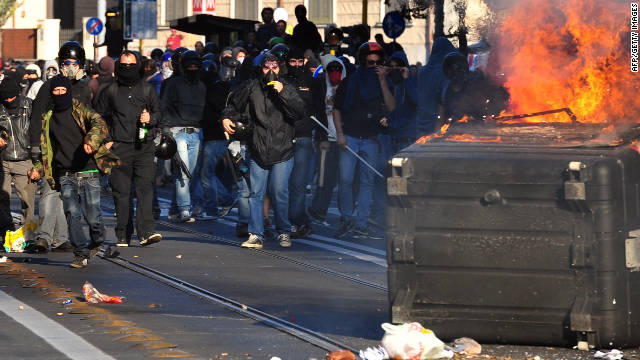
Thousands of people across the world railed against corporate power, grinding poverty and government cuts Saturday as the Occupy Wall Street movement spread to the streets of Europe, Asia and Australia -- and took a particularly violent turn in Rome.
Firefighters battled a blaze at an Interior Ministry building near Porta San Giovanni in Rome, the main gathering site of the Italian protesters taking part in the Occupy movement Saturday, said eyewitnesses who reported seeing a Molotov cocktail thrown near the building.
A spokesman for Mayor Gianni Alemanno, who condemned the violence, confirmed 70 people were injured, 40 of them police officers. No arrest numbers were available late Saturday.
Police said hundreds of anarchists in Rome moved in where peaceful demonstrators had gathered as part of the global Occupy movement. The anarchists -- some wearing ski masks and belonging to a group termed "Black Bloc" -- torched cars, broke windows and clashed with police.
"It's been completely hijacked by these violent factions, and the police are nervous, and the situation is very tense," Barbie Nadeau, a Newsweek correspondent, told CNN. "I myself saw at least -- I would say -- a dozen people who probably needed some hospitalization or some care -- some stitches certainly."
Two police officers were seriously injured and two young men lost parts of their hands in explosions when protesters torched cars, she said.
In London, protester Peter Vaughn, reflecting the mood of many in the crowd there, said people criticized financial institutions that have "gambled away our money."
"We're giving people a real voice against a government that just ignored us," he said.
One protester in Belleville, France, referring to the country's leaders, said government isn't listening to the people and dialogue with them is impossible.
"You are not listening to us, whatever we do, however we vote, however we demonstrate. It does not give any result. Quite the opposite, as poverty and austerity plans continue. So we can't go on like this so we are getting out and showing ourselves," he said.
The protests spread amid the growing financial crises for several Western countries. Finance ministers with the Group of 20, meeting in Paris, pledged Saturday to take "all necessary actions" to stabilize global markets and ensure that banks are well capitalized.
Europeans turned out amid debt troubles and austerity plans in Greece, Belgium, Italy, Spain, Ireland, Portugal and Germany.
United for Global Change -- the central site for the movement organizing worldwide protests -- said 951 cities in 82 countries were to take part in the demonstrations after online organizers called for a worldwide rally.
More than 10,000 demonstrators of all ages gathered peacefully in Madrid's spacious Plaza de Cibeles on Saturday and than walked uphill to Puerta del Sol. The "May 15 Movement" started five months ago to the day over austerity measures and high unemployment. Some demonstrators said they felt Spain's protest had gone global and that the world had joined the movement started in their country. The newspaper El Pais said tens of thousands of protesters turned out in Barcelona.
Around the world, protesters marched, listened to speeches, and displayed banners reading anti-corporate slogans, including the now ubiquitous "we are the 99%," "Banks are cancer" and tax the rich 1%."
The vandalism that erupted in Rome angered peaceful protesters. There were car fires and masked people breaking windows at banks and stores, where many thousands faced a large police presence. Firefighters were working to contain the blaze and the tensions calmed down in the evening hours. But the echo of Molotov cocktails could be heard and a lingering cloud of black smoke could be seen, Nadeau told CNN.
In Germany, police used pepper spray on two protesters who crossed beyond police lines.
Still, the demonstrations across the world were peaceful overall, inspired by the protests in the United States. In London, WikiLeaks founder Julian Assange spoke to demonstrators. The demonstrations are contained to an area in front of St. Paul's Cathedral. There have also been three arrests, two for assault on police.
"What is happening here today is a culmination of greed that many people all over the world have worked towards from Cairo to London," Assange said.
Tens of thousands demonstrated in German cities, witnesses said. Peaceful protests with a festive atmosphere blended with a mood of anger toward big business, where demonstrators carried signs saying "Goldman Sucks," "Eat Cash," "People should not be afraid of their government," and "The government should be afraid of their people."
"They are stealing our rights," one banner read at a demonstration of several thousand people in Madrid.
Canadians turned out in Toronto, with placards jutting up from a crowd saying "Arrest the 1%" and "Stop ignoring the youth, we are your tomorrow." A sign on a dog said "99% against (corporate) fat cats."
Retired businessman Wong Chi Keung, in Hong Kong, said, "We should not let the banks get away with being big bullies."
Debbie Chen works for a group protesting against Apple's treatment of its workers in China.
"As the world's most valuable company they earn the lion's share while the workers on the production line earn only 1% of the selling price of an iPhone. We hope there can be more even distribution of profits," she said.
About 200 people marched through Tokyo carrying various signs, including "No More Nukes and "Free Tibet." The crowd included children jumping and skipping behind the adults. Some protesters wore costumes -- including a giant panda.
"I'm here because young Japanese people are suffering for losing their jobs, but not many speak out their issue to the public," said Kesao Murakami. "I really want young people to appeal forcefully to the public saying, 'We are in trouble.' "
In the Indonesian capital of Jakarta, about two dozen people -- some wearing masks -- gathered near the U.S. Embassy.
"We wanted to show that the American regime, its system of imperialism needs to be destroyed," said Rudi Daman, leader of the International League of Peoples' Struggle.
The group urged its chapters to stage a global day of action against "imperialist plunder, repression and war."
Australian cities of Melbourne and Sydney joined rallies against "corporate greed" as protesters aligned themselves with the global movement.
"Our protests are to show our solidarity with Occupy Wall Street and also protest various problems -- from indigenous issues in this country to government problems," said Alex Gard, one of the Melbourne organizers. "We know we have it better than the protesters in the States ... but there are still problems in this country."
Organizers urged protesters to bring sleeping bags and other soft items to sleep on.
"I've heard people say they plan to be there for days, even months," Gard said.
Organizers worldwide started social media pages on Facebook and Twitter devoted to "October 15" — #O15 on Twitter — urging protesters to join the global call for protests.
The worldwide movement is galvanized by the Occupy Wall Street movement started last month as a backlash against the economy and what demonstrators say is an out-of-touch corporate, financial and political elite.
Occupy Wall Street organizers say they are inspired by the Arab Spring that led to the toppling of regimes in Tunisia and Egypt.
The founding movement in the United States has spread to other major cities in the nation.
Thousands of protesters fill NYC's Times Square


Thousands of demonstrators protesting corporate greed filled Times Square on Saturday night, mixing with gawkers, Broadway showgoers, tourists and police to create a chaotic scene in the midst of Manhattan.
"Banks got bailed out, we got sold out!" protesters chanted from within police barricades. Police, some in riot gear and mounted on horses, tried to push them out of the square and onto the sidewalks in an attempt to funnel the crowds away.
Sandy Peterson of Salt Lake City, who was in Times Square after seeing "The Book of Mormon" musical on Broadway, got caught up in the disorder.
"We're getting out of here before this gets ugly," she said.
Sandra Fox, 69, of Baton Rouge, La., stood, confused, on 46th Street with a ticket for "Anything Goes" in her hand as riot police pushed a knot of about 200 shouting protesters toward her.
"I think it's horrible what they're doing," she said of the protesters. "These people need to go get jobs."
The Occupy Wall Street demonstrators had marched north through Manhattan from Washington Square Park earlier in the afternoon. Once in Times Square, they held a rally for several hours before dispersing. Over the course of the day, more than 80 people were arrested.

After midnight, about 10 people were loaded into a police van after refusing to leave Washington Square Park, where protesters had returned to convene a meeting following the Times Square rally. The police had warned protesters that the park had closed, and began massing in riot gear and on horses a few minutes before then; most people had left by then.

Police spokesman Paul Browne said 42 people were arrested in Times Square on Saturday night after being warned repeatedly to disperse; three others were arrested while trying to take down police barriers.
Two police officers were injured during the protest and had to be hospitalized. One suffered a head injury, the other a foot injury, Browne said.
Five people wearing masks were arrested earlier in the day, and two dozen were arrested on charges of criminal trespass when demonstrators entered a Citibank bank branch near Washington Square Park and refused to leave, police said. One protester was arrested on a charge of resisting arrest.
Citibank said in a statement that police asked the branch to close until the protesters could be taken away. "One person asked to close an account and was accommodated," Citibank said.
Earlier in the day, demonstrators paraded to a Chase bank branch, banging drums, blowing horns and carrying signs decrying corporate greed. Marchers throughout the country emulated them in protests that ranged from about 50 people in Jackson, Miss., to about 2,000 in the larger city of Pittsburgh.
"Banks got bailed out. We got sold out," the crowd of as many as 1,000 in Manhattan chanted. A few protesters went inside the bank to close their accounts, but the group didn't stop other customers from getting inside or seek to blockade the business.
Police told the marchers to stay on the sidewalk, and the demonstration appeared to be fairly orderly as it wound through downtown streets.
Overseas, violence broke out in Rome, where police fired tear gas and water cannons at some protesters who broke away from the main demonstration, smashing shop and bank windows, torching cars and hurling bottles. Dozens were injured.
Tens of thousands nicknamed "the indignant" marched in cities across Europe, as the protests that began in New York linked up with long-running demonstrations against government cost-cutting and failed financial policies in Europe. Protesters also turned out in Australia and Asia.
Across the Atlantic, hundreds protested in the heart of Toronto's financial district. Some of the protesters announced plans to camp out indefinitely in St. James Park. Protests were also held in other cities across Canada from Halifax, Nova Scotia, to Vancouver, British Columbia.
In the U.S., among the demonstrators in New York withdrawing their money from Chase was Lily Paulina, 29, an organizer with the United Auto Workers union who lives in Brooklyn. She said she was taking her money out because she was upset that JPMorgan Chase was making billions, while its customers struggled with bank fees and home foreclosures.
"Chase bank is making tons of money off of everyone ... while people in the working class are fighting just to keep a living wage in their neighborhood," she said.
Other demonstrations in the city Saturday included an anti-war march to mark the 10th anniversary of the Afghanistan War.
Among the people participating in that march was Sergio Jimenez, 25, who said he quit his job in Texas to come to New York to protest.
"These wars in Afghanistan and Iraq were all based on lies," Jimenez said. "And if we're such an intelligent country, we should figure out other ways to respond to terror, instead of with terror."
Elsewhere in the country, nearly 1,500 gathered Saturday for a march past banks in downtown Orlando. About 50 people met in a park in downtown Jackson, Miss., carrying signs calling for "Health Care Not Warfare."
Some made more considerable commitments to try to get their voices heard. Nearly 200 spent a cold night in tents in Grand Circus Park in Detroit, donning gloves, scarves and heavy coats to keep warm, said Helen Stockton, a 34-year-old certified midwife from Ypsilanti, and plan to remain there "as long as it takes to effect change."
"It's easy to ignore us," Stockton said. Then she referred to the financial institutions, saying, "But we are not going to ignore them. Every shiver in our bones reminds us of why we are here."
Hundreds more converged near the Michigan's Capitol in Lansing with the same message, the Lansing State Journal reported.
Rallies drew young and old, laborers and retirees. In Pittsburgh, marchers also included parents with children in strollers and even a doctor. The peaceful crowd of 1,500 to 2,000 stretched for two or three blocks.
"I see our members losing jobs. People are angry," said Janet Hill, 49, who works for the United Steelworkers, which she said hosted a sign-making event before the march.
Retired teacher Albert Siemsen of Milwaukee said at a demonstration there that he'd grown angry watching school funding get cut at the same time that banks and corporations gained more influence in government. The 81-year-old wants to see tighter Wall Street regulation.
Around him, protesters held signs reading, "Keep your corporate hands off my government," and "Mr. Obama, Tear Down That Wall Street."
Massachusetts Gov. Deval Patrick visited protesters in Boston's Dewey Square for the first time. He said after walking through the camp that he better understands the range of views and was sympathetic to concerns about unemployment, health care and the influence of money in politics.
In Denver, about 1,000 people came to a rally in downtown Denver to support the movement.
The Rev. Al Sharpton led a march in Washington that was not affiliated with the Occupy movement but shared similar goals. His rally was aimed at drumming up support for President Barack Obama's jobs plan. Thousands of demonstrators packed the lawn in the shadow of the Washington Monument to hear labor, education and civil rights leaders speak.
___
Associated Press
Saturday, October 15, 2011
Wall Street sit-in goes global Saturday


How many will show up, let alone stay to camp out to disrupt city centers for days, or months, to come, is anyone's guess. The hundreds at Manhattan's Zuccotti Park were calling for back-up on Friday, fearing imminent eviction. Rome expects tens of thousands at a national protest of more traditional stamp.

Few other police forces expect more than a few thousand to turn out on the day for what is billed as an exercise in social media-spread, Arab Spring-inspired, grassroots democracy with an emphasis on peaceful, homespun debate, as seen among Madrid's "indignados" in June or at the current Wall Street park sit-in.
Blogs and Facebook pages devoted to "October 15" - #O15 on Twitter - abound with exhortations to keep the peace, bring an open mind, a sleeping bag, food and warm clothing; in Britain, "Occupy London Stock Exchange" is at pains to stress it does not plan to actually, well, occupy the stock exchange.

That may turn off those with a taste for the kind of anarchic violence seen in London in August, at anti-capitalism protests of the past decade and at some rallies against spending cuts in Europe this year. But, as Karlin Younger of consultancy Control Risks said: "When there's a protest by an organization that's very grassroots, you can't be sure who will show up."
Concrete demands are few from those who proclaim "We are the 99 percent," other than a general sense that the other 1 percent - the "greedy and corrupt" rich, and especially banks - should pay more, and that elected governments are not listening.
"It's time for us to unite; it's time for them to listen; people of the world, rise up!" proclaims the Web site United for #GlobalChange. "We are not goods in the hands of politicians and bankers who do not represent us ... We will peacefully demonstrate, talk and organize until we make it happen."
By doing so peacefully, many hope for a wider political impact, by amplifying the chord their ideas strike with millions of voters in wealthy countries who feel ever more squeezed by the global financial crisis while the rich seem to get richer.
"ENOUGH IS ENOUGH"
"We have people from all walks of life joining us every day," said Spyro, one of those behind a Facebook page in London which has grown to have some 12,000 followers in a few weeks, enthused by Occupy Wall Street. Some 5,000 have posted that they will turn out, though even some activists expect fewer will.
Spyro, a 28-year-old graduate who has a well-paid job and did not want his family name published, summed up the main target of the global protests as "the financial system."
Angry at taxpayer bailouts of banks since crisis hit in 2008 and at big bonuses still paid to some who work in them while unemployment blights the lives of many young Britons, he said: "People all over the world, we are saying 'Enough is enough'."
What the remedy would be, Spyro said, was not for him to say but should emerge from public debate - a common theme for those camping out off Wall Street since mid-September, who have stirred up U.S. political debate and, a Reuters poll found, won sympathy from over a third of Americans.
A suggestions log posted at http://15october.net ("This space is ready for YOUR idea for the revolution") range from a mass cutting up of credit cards ("hit the banks where it counts") to "use technology to make education free."
For all such utopianism, the possibility that peaceful mass action, helped by new technologies, can bring real change has been reinforced by the success of Arab uprisings this year.
"I've been waiting for this protest for a long time, since 2008," said Daniel Schreiber, 28, an editor in Berlin. "I was always wondering why people aren't outraged and why nothing has happened and finally, three years later, it's happening."
Quite what is happening, though, is hard to say. The biggest turnouts are expected where local conditions are most acute.
Italian police are preparing for tens of thousands to march in Rome against austerity measures planned by the beleaguered government of Prime Minister Silvio Berlusconi.
Yet in crisis-ravaged Athens, where big protests have seen violence at times of late, a sense of fatigue and futility may limit numbers on Saturday. In Madrid, where thousands of young "indignados," or "angry ones," camped out for weeks, many also feel the movement has run out of steam since the summer.
Germans, where sympathy for southern Europe's debt troubles is patchy, the financial center of Frankfurt, and the European Central Bank in particular, is expected to be a focus of marches calling by the Spanish-inspired Real Democracy Now movement.
Complicating German sentiments, however, a series of small bombs found on trains has stirred memories of the left-wing guerrilla attacks that grew in the 1970s from frustration at a lack of change after the student protests of 1968.
CITY OF LONDON
British student protests a year ago were marked by some acts of violence by what authorities say were hard-core anarchists. Days of looting in London in August were put down to motives that mingled political discontent with criminal opportunism.
As an international center of finance, the City of London is key target. But organizers know strong police powers make setting up a Wall Street-style protest camp there far from easy.
"There's quite a bit of fatigue setting in," said one young veteran of last year's protests against higher university fees. "But if it's still going by Monday or Tuesday, I think that will excite students and they will head down. The City is much more the focus of people's anger now, compared to a year ago."
A long Saturday of rallies may start in New Zealand, where the Occupy Auckland Facebook page provides links recommending "suitable clothing ... a sleeping bag, a tent, food" -- but, in a family-friendly spirit, strictly no drugs or alcohol.
Asian authorities and businesses may have less to fear, since most of their economies are still growing strongly.
Tracking across the time zones, through towns large and small ("Occupy Norwich!" reads a website from the picturesque English city), the New York example has also prompted calls for similar occupations in dozens of U.S. cities from Saturday.
In Houston, protesters plan to tap into anger at big oil companies. As the world's day ends, hardy souls will be marching in Fairbanks. "We will be obeying traffic lights," insist the authors of OccupyAlaska.org, and they "will be dressed warm."
History suggests such actions are unlikely, of themselves, to change the world. As one anonymous poster at 15october.net writes, "Fleshing out ideas into living reality has always been the bugbear of radical politics." And while anger at corporate greed is widespread, there are plenty of voters who would agree with the Australian who posted on the OccupySydney site that those marching will be "the lazy, the paranoid, the confused."
But some analysts do see a potential for political change.
Jeff Madrick, a prominent economics writer, speaks warmly of the serious and reasonable debate he found at Zuccotti Park. Revolutions may be rare, but the protests could push lawmakers to act on some of the demands, he said last week: "It may begin to change public opinion enough to give Congress, people in Washington, the courage of their own convictions."
Punjab leads in crimes against women
The Punjab left far behind the other provinces in incidents of violence against women as the highest number of rape cases have been reported in the province, National Assembly was informed on Thursday.
On a calling attention notice moved by MNA Yasmeen Rahman, Advisor to Prime Minister on Human Rights Mustafa Nawaz Khokhar told the house that in year 2010, 2,581 rape cases were reported in Punjab followed by Sindh with 290 and Balochistan 33.
‘No rape case was reported in Khyber Pakhtunkhwa during the year under review’, Khokhar said. However hastened to add that this might be due to cultural restrictions in the KPK society of not registering these cases.
Advisor to premier pointed out that Punjab also recorded highest number of murder cases in 2010 as 6,242 murder were reported in the province whereas number of reported murder cases came to 3,290 in Sindh, 2,501 in KPK and Balochistan 54.
Advisor further revealed that cases of abduction and kidnapping for ransom incidents were also highest in the Punjab, however he didn’t provide the data of these crimes.
Khokhar maintained that government is fully cognizant of the situation viz-a-viz the human rights situation but deplored that provinces have failed to play their due role to check the violation of human rights and women rights.
He particularly focused on Punjab, which he blamed of having worst track record of dealing with the human right issues and curb the incidents of violence.
Advisor said that joint efforts are needed to tackle the growing tendencies of militancy when Yasmeen Rahman diverted the attention of the house towards Rawalpindi incident where a brigade of militant people attacked a girl’s school.
Khokhar also identified the flaws in the investigation procedure conducted by Police in these crimes. He also laid National Commission for women Bill 2011 in the house to set up national commission for women.
PML-N govt’s actions bankrupted country in 1999, claims APML
All Pakistan Muslim League (APML) has claimed that PML-N government actions in 1999 drifting the country to a bankruptcy, which compelled Pervez Musharraf to intervene to save the country from complete destruction.
Fawad Chaudhary, APML general secretary made this claim while talking to Musharraf loyalists at party office after chairing a meeting on Wednesday.
He further claimed that Pervez Musharraf restored country’s economy and generated a lot economic activity through his wise and efficient team taking reign of power from PML-N.
Fawad maintained that fragile economy, deteriorating law and order and power outages have become hallmark of PPP-led ruling coalition since Musharraf left his office in 2008.
He alleged that PML-N regime in 1999 was the worst example of civil-dictatorship, which damaged the basic fabric of democratic values in the country. He while saying that German Nazi dictator Hitler also assumed power through public vote alleged that Nawaz Sharif has the same mindset and he led the country in the marsh of crises through his autocratic trends.
APML activists Imran Shamsi, Mubassar Ahmed, Saad Malik, AbdullAh Sardar, Waris Khokar, Jalal Zaidi, Rida Zehra, Shahida Naseer and Arifa Irfan attended the meeting.
Afghan police break up politician's hunger strike

Afghan police have taken a woman politician to hospital and dismantled the tent where she observed a 12-day hunger strike to protest against being disqualified from parliament, officials said Friday.

Semin Barakzai, a 30-year-old mother of three and one of nine MPs expelled from the national assembly over vote-rigging claims, had refused to eat until she is reinstated to her parliamentary seat or her case is re-investigated.
But there had been growing concerns for her health even as a woman MP and four students joined Barakzai in her hunger strike on Wednesday.
"Afghan police forces last night removed the tent of the ousted lawmaker from parliament, Semin Barakzai, to call off her strike," Kabul police spokesman Hashmat Stanikzai told AFP.
Barakzai was taken to hospital by ambulance late Thursday and was in a stable condition, added the spokesman.
Hunger strikes, particularly by women, are unusual in Afghanistan, a deeply conservative male-dominated society.
Police went into her tent unarmed and asked Barakzai to go to the hospital, before removing the tent "without facing any negative response from Barakzai and her relatives", Stanikzai added.
Neither Barakzai nor her relatives were immediately reachable for comment.
She and eight other members of the Wolesi Jirga were kicked out by the Independent Election Commission last August in an attempt to resolve nearly a year of disputes over widespread graft in September 2010 parliamentary polls.
The powerful council of Afghanistan's Islamic clerics issued a fatwa saying that rejecting food was against Islam.
Fazil Ahmad Manawi, the head of the Independent Election Commission also called on Barakzai to end the hunger strike, saying the body was not authorised to return her to the parliament.
Wall Street protesters thwart eviction attempt
Anti-Wall Street protesters exulted Friday after beating back a plan to clear them from the park they have occupied for the past month, saying the victory will embolden the movement across the U.S. and beyond.

"We are going to piggy-back off the success of today, and it's going to be bigger than we ever imagined," said protester Daniel Zetah.
The showdown in New York came as tensions were rising in several U.S. cities over the spreading protests, with several arrests and scattered clashes between demonstrators and police.
The owners of Zuccotti Park in lower Manhattan had announced plans to temporarily evict the hundreds of protesters at 7 a.m. Friday so that the grounds could be power-washed. But the protesters feared it was a pretext to break up the demonstration, and they vowed to stand their ground, raising the prospect of clashes with police.

Just minutes before the appointed hour, the word came down that the park's owners, Brookfield Office Properties, had postponed the cleanup. A boisterous cheer went up among the demonstrators, whose numbers had swelled to about 2,000 before daybreak in response to a call for help in fending off the police.
In a statement, Brookfield said it decided to delay the cleaning "for a short period of time" at the request of "a number of local political leaders." It gave no details.
State Sen. Daniel Squadron, a Democrat who represents lower Manhattan and Brooklyn, said he had conversations late into the night urging Brookfield's CEO to wait.
"The stakeholders must come together to find a solution that respects the protesters' fundamental rights, while addressing the legitimate quality-of-life concerns in this growing residential neighborhood," Squadron said in a statement.
Brookfield said it would negotiate with protesters about how the park may be used. But it was unclear when those discussions would occur.
Over the past month, the protest against corporate greed and economic inequality has spread to cities across the U.S. and around the world. Several demonstrations are planned this weekend in the U.S., Canada and Europe, as well as in Asia and Africa.
In Denver, police in riot gear herded hundreds of protesters away from the Colorado state Capitol early Friday, arresting about two dozen people and dismantling their encampment. In Trenton, N.J., protesters were ordered to remove tents near a war memorial. San Diego police used pepper spray to break up a human chain formed around a tent by anti-Wall Street demonstrators.
In New York City, police arrested 15 people, including protesters who obstructed traffic by standing or sitting in the street and others who turned over trash baskets and hurled bottles. A deputy inspector was sprayed in the face with an unknown liquid.
In one case, an observer with the National Lawyers Guild who was marching with the group refused to move off the street for police, and the tip of his foot was run over by an officer's scooter. He fell to the ground screaming and writhing and kicked over the scooter before police flipped him over and arrested him.
And a video posted online showed a police officer punching a protester in the side of the head on a crowded street. Police said the altercation occurred after the man tried to elbow the officer in the face and other people in the crowd jumped on the officer, who was sprayed with a liquid coming from the man's direction. Police said the man, who escaped and was wanted for attempted assault on an officer, later said in an online interview he's HIV positive and the officer should be tested medically.
A man who identified himself as the protester, Felix Rivera-Pitre, said in a statement posted online that he didn't provoke the officer. "I was just doing what everyone else was doing in the march," he said. "It felt like he was taking his frustrations out on me."
Organizers in Des Moines, Iowa, accepted an offer Friday night from the mayor to move from the state Capitol where they were prohibited from staying overnight to a city park blocks away, averting a possible showdown.
Though the park in New York is privately owned, it is required to be open to the public 24 hours per day.
Brookfield, a publicly traded real estate firm, had announced plans to power-wash the plaza section by section over 12 hours and then allow the protesters to return. But it said it would begin enforcing the park's rules against tents, tarps and sleeping bags, complaining the grounds had become unsanitary and unsafe.
The New York Police Department had said it would make arrests if Brookfield requested it and laws were broken.
As the morning deadline drew near, some protesters rushed to scrub and sweep the park and pick up trash in hopes of preventing a crackdown.
Mayor Michael Bloomberg, whose girlfriend is on Brookfield's board of directors, said his staff was under strict orders not to pressure the company one way or the other. He noted that Brookfield can still go ahead with the cleanup at some point.
"My understanding is that Brookfield got lots of calls from many elected officials threatening them and saying, ... 'We're going to make your life more difficult,'" he said on his weekly radio show.
In Philadelphia, protester Matt Monk, a freelance writer, was cheered by the news out of New York.
"That means at the very least, the powers-that-be, wherever they are, know that they have to contend with us in a less heavy-handed way," he said.
Thursday, October 13, 2011
Nawaz wanted a puppet army chief
Claiming that he had disappointed former prime minister Nawaz Sharif by refusing to become a puppet army chief, former military ruler Pervez Musharraf said Sharif had lost his marbles and his statement of “saving the army and the country” was a lie, a private TV channel reported on Wednesday.
He said even Nawaz’s brother Shahbaz Sharif did not know what Nawaz was up to and that his intentions were twisted from day one, adding that he (Musharraf) would never plunder the nation’s wealth.
He said “Nawaz conspired against me and left for America a day before the scheduled meeting on Kargil issue,” adding that he was not in contact with those who carried out the operation on October 12.
He also accused Nawaz Sharif’s government of ‘losing the Kashmir cause’, adding that it was impossible for Sharif to work with anyone.
“I only see hopelessness in Pakistan,” he said.
Wednesday, October 12, 2011
Most Americans aware of Wall Street protests
A strong majority of Americans are aware of the "Occupy Wall Street" protests against U.S. economic inequality and a majority either view them favorably or do not have an opinion about them, a Reuters/Ipsos poll said on Wednesday.

Eighty-two percent of Americans have heard of the protest movement, and 38 percent feel favorably toward it, the poll found. Thirty-five percent are undecided, and about one-fourth -- 24 percent -- are unfavorable.
Ipsos research director Chris Jackson said the large number of people who were positive or undecided reflected the mood of the country.
"People are just sort of angry," he said. "They aren't necessarily sure what they are angry about, and the protest captures that to a certain extent."
Democrats and Republicans were equally familiar with the protests, at 84 percent and 82 percent, respectively, but only 73 percent of independents were aware.
But their views are sharply divided by party. Fifty-one percent of Democrats viewed the protests favorably, versus just 11 percent who saw them unfavorably. Among independents, 37 percent had a positive view, compared with 14 percent who felt negative.
Just 22 percent of Republicans said they had a favorable view, compared with 44 percent who were unfavorable.
According to Occupy Together, which has become an online hub for protest activity, the Occupy Wall Street movement has sparked rallies in more than 1,300 cities throughout the United States and around the world.
The Reuters/Ipsos poll of 1,113 adults, including 934 registered voters, was conducted October 6-10. It surveyed 536 Democrats, 410 Republicans and 167 independents.
The margin of error was 3.0 percentage points for all respondents, 3.2 points for registered voters, 4.2 points for Democrats, 4.8 points for Republicans and 7.6 points for independents.
Occupy Wall Street protest hits closer to home


The Founding Fathers would be on the side of the "Occupy Wall Street" protesters and would show up to support the actions against corporations who make their money through the New York Stock Exchange, a retired Army command sergeant major said Sunday.
Although he only would give his first name - Joe - the Vietnam War veteran said those who created the United States more than 200 years ago did not envision corporations having more rights than American citizens.
Appropriately, the Bisbee Occupy Wall Street event, a phenomena which is happening across the nation, was held at Goar Park in the city's Brewery Gulch, outside a building which was the Bisbee Stock Exchange in the late 1800s and early 1900s. Today it is a bar, where some of the old exchange boards can still be seen behind glass.
Although many would think because of Joe's military service he would be conservative in his views, his comments to the Herald/Review proved somewhat different.
As more than 90 people gathered for the 5 p.m. start of the hour-long event, the retired senior noncommissioned officer - on his hat was a pin indicating he was awarded a Silver Star - brought a large American flag which was put up near a rendition of the Statue of Liberty with a sign stating "Help America. Tax Wall Street."
A woman held a sign stating "America, Land of the Fee$, Home of the $lave$."
Joe said his problem with the greed emanating from Wall Street, and corporate board rooms is, "A corporation doesn't bleed, doesn't die for the country," as members of America's armed forces are called upon to do.
And, "Corporations should not have more rights, than citizens," the retired soldier added.
The Rev. Rod Richards, pastor of the Unitarian Universalist Church of Southeast Arizona in Sierra Vista, read a statement put out by the Occupy Wall Street organizers in New York.
"This statement was voted on and approved by the general assembly of protesters at Liberty Square on Sept. 29," he said.
The statement outlined a number of grievances "to express a feeling of mass injustice," Richards said.
The protests began in and around New York's Wall Street with small numbers but growing, leading to increasing arrests, with nearly 700 taken into custody the first weekend of this month.
The movement is spreading across the nation, including in Arizona, with one held in Prescott last week. One is scheduled to be held in Tucson on Saturday morning.
The Occupy Wall Street statement has a list of grievances, reading much like the Declaration of Independence in which the reason for seeking freedom from Great Britain in 1776 outlined the founders' rationale for severing ties.
However the statement seeks redress in their list, which Richards read, and includes:
"They (the corporations,) have taken our houses through illegal foreclosure process, despite not having the original mortgage.
"They have taken bailouts from taxpayers with impunity, and continue to give executives exorbitant bonuses.
"They have perpetuated inequality and discrimination in the workplace based on age, the color of ones skin, sex, gender identity and sexual orientation.
"They have poisoned the food supply through negligence and undermined the farming system through monopolization.
"They have sold our privacy as a commodity.
"They have continuously sought to strip employees of the right to negotiate for better pay an safer working conditions.
"They have held students hostage with tens of thousands of dollars of debt on education, which is itself a human right.
"They have consistently outsourced labor and used that outsourcing as leverage to cut workers' healthcare and pay."
The list continues accusing "they," the corporations, of influencing the judicial system, finding ways out of providing health insurance, being too directly involved in determining national economic policies "despite catastrophic failure" and donating money to politicians who are suppose to regulate corporations and other complaints in the statement, read by Richards.
For Alice Hamers, of McNeal, a self-confessed left progressive Democrat, she believes the unions are involved in the protest and sees no problem with that because of their organizational capabilities.
However, for her the majority of those who take to the streets must be individuals who have been badly impacted by corporation and politicians, of both parties.
Saying when President Barack Obama ran for president, before being selected by the Democratic Party to carry the banner in the 2008 election, she supported Dennis Kucinich.
But once Obama received the party's nomination she voted for him because she could not give her ballot of Republican Arizona U.S. Sen. John McCain.
But, Obama has failed and is on the wrong path, she said.
The street protests, which are growing throughout the country, is as much is a warning to both major parties and to the technically unofficial Tea Party, Hamers said.
The politicians, of both parties "are to blame" for the nation's economic woes which can be seen by the horrendous deficit Congress and administrations created in the budget process, she said.
What is needed is a "people's budget," on from 2 p.m. to 4 p.m. on Saturday, Andrea Witte will outline the "American Dream Budget, aka The People's Budget," at the Sierra Vista Library, Hamers said of the free public meeting, Hamers said.
Joe said during his career, as an Army Ranger, he briefed retired Army Gen. Norman Schwartzkopf, when he was a lieutenant colonel battalion commander in Vietnam. Schwartzkopf led Operations Desert Shield/Storm against Iraq. The retired command sergeant major also worked with retired Gen. Colin Powell, when he was secretary of state.
With the growing unhappiness concerning the nation's political arena, he said if some of the founding leaders of the country were still alive he has no doubt they would support the Occupy Wall Street protests.
Saying he wished he brought his grandchild to the Bisbee event and believes children need to see American democracy at work, Joe said, "Benjamin Franklin, Thomas Jefferson and Paul Revere would be at the (current) protests, serving food."
Kim Kardashian: I'm obsessed with Dubai

“Just touched down in Dubai! I’m so happy to be here!” tweeted Kim Kardashian on Wednesday morning.
Yes, she’s finally here.
The reality star landed in Dubai on an Emirates flight from New York, tweeting of the flight, “Serious Sex & The City swag going on, on this airplane to Dubai! The best plane I’ve ever been on!!! Dubai are u ready???”.

She was quickly whisked through the VIP area of Dubai International Airport and headed straight to her hotel, Atlantis, which she had specifically requested for her visit.
Shahbaz Sharif think we are a bunch of idiots?
LETTER PUBLISHED IN http://paktribune.com
Does the Punjab chief minister (CM) think we are a bunch of idiots? What sort of 'effective' mechanism against the curse of dengue is a Facebook page? Amidst much fanfare and press coverage, Shahbaz Sharif unveiled his masterstroke: to teach the people how to protect themselves against dengue by logging onto a Facebook page that details how one can take precautions! Do I need to remind the CM that most people in Pakistan are not computer literate? Most of them are not even literate!
The need of the day is not pomp and show. What we need is effective utilisation of all resources to combat this plague, including education drives, funding for potent fumigation, biological agents and foreign expertise. Facebook pages are designed for little else but self-promotion.
AHMAD SAJID Lahore
Nawaz Sharif, is it really load shedding or something else?


With an adventurous October settling in, the battle lines are being drawn between bitter rivals and old foes - the central ruling party Pakistan People’s Party (PPP) and the Punjabi rulers - the Pakistan Muslim League-Nawaz (PML-N).
The dust was still settling after the crucial All Parties Conference (APC) but surprisingly, the elder Sharif, playing on the masses’ demonstrations over long hours of load-shedding, rose to the occasion and announced a series of demonstrations - possibly after the failure of the Punjab government to control the damage done by dengue across Punjab, especially in Lahore, the home of the Sharifs, which is slipping fast out of their control and landing in the lap of Pakistan Tehreek-e-Insaaf - the brainchild of macho man Imran Khan.

On the other hand, smelling a severe government-bashing move by the PML-N against the prolonged hours of load-shedding across the country, the Mutahidda Qaumi Movement (MQM) also launched a preemptive rant in the national assembly at the government’s failure to handle the situation which has triggered violent protests in Punjab. However, this tirade soon lost its fire as Haider Abbas Rizvi said on the same evening that his party may return to the treasury benches as soon as peace returned to Karachi. Political analyst Hasan Askari Rizvi sees the PML-N outburst against the government as a bid to cash in on the wave of anti-government sentiment and push the government to neutralise the gains made by the government at the APC as well as to overthrow the government’s remaining popularity.

“I think that the PML-N, a bit late, has realised that the PPP-led government has made significant gains with the successful APC. They also want to remove the public impression that the PML-N and the PPP are riding the same boat,” he said, adding that after realising the bitter realities, now the PML-N leadership wanted to neutralise these gains.
“Secondly, the time margin for the PML-N is tightening as the March polls for the Senate are getting nearer and they would do anything to stop the PPP from getting the majority vote in the Senate after a long time. Now they are hell-bent to do anything to avert this achievement. The magnitude of the countrywide protests suggest that they will even be happy if the government is overthrown by the military,” added Rizvi.

He also opposed the view that parliamentary resolutions to reshape the country’s foreign policy were binding on the government.
“Neither the joint resolution by the APC nor the parliamentary resolutions can influence the country’s foreign policy. There is no point to talking about reshaping the foreign policy as the foreign policy has been shaped up by the military. The government only wants to get the support from all smaller and major players of the country to achieve two objectives - to tell the world Pakistan stands united at this critical juncture; and sending a message to every Pakistani to forget everything and gel together against the US’ hegemonic designs,” he said.
When asked whether the APC resolution was a success, Rizvi said every political party agreed on a minimum agenda – “anti-Americanism”. “Whether you are a mullah, democrat or even an atheist, everyone feels that the US is beating about the bush after its failure in Afghan war. So the APC has domestic implications and the resolution would help give a surge to anti-Americanism across the country,” he added.
When questioned whether in his analysis the US might attack Pakistan, Rizvi said that the US would not attack Pakistan but it could increase the drone strikes inside Pakistan. He said it was also a possibility that one or two incidents of air space violations by the US helicopters would occur which would not disrupt the bilateral ties. However, he added, a surgical operation or boots on ground would definitely bring about a total breakdown of these ties which would have negative consequences.
Nevertheless, it is very unfortunate to note that the coalition government leadership conducted so many foreign trips to ‘friendly countries’, spending billions of rupees from the national exchequer, but could not muster the support of friends who could have asked the US not to threaten a country whose people and armed forced had suffered most, whose economy was almost paralysed as people on its streets pondered on why they voted for the so-called democratic leaders who had brought the country to this stage.
On the other hand, the opposition parties are also making mockery of the democracy by playing on popular public sentiment for political gains. It is even more devastating to note that the politicians are happy to overthrow the government even if its costs the country a democratic process.
This is why the man on the street is saying, “The Dictator’s rule was really better- electricity, petrol, sugar, grain- we had everything and there was less of this pillage and looting... why did we vote for these people if all General Musharraf’s policies were to be followed and even the government had to follow what the army thinks is right. Where is the political vision?”
Sharifs’ plan of dissolving PA failed
Former federal law minister Babar Awan said on Wednesday that Sharifs' plan of dissolving the Punjab Assembly (PA) has completely failed.
Awan, while talking to media at Islamabad High Court, said that PML-N during its tenure never generated even a single megawatt of power, while PPP has started more than two dozen large and medium scale dam projects to enhance power production.
Moreover, he accused the Punjab government of the embezzlement of Rs 1.6 billion in the name of dengue spray.
Awan accused PML-N of practicing negative tactics for personal interests and making the job harder for President Asif Ali Zardari, who is struggling hard to steer the country out from the challenges it confronts.
Subscribe to:
Posts (Atom)