Friday, September 23, 2011

Humaima Malik, A role model for the Pakistani youth


In India she’s known as ‘Wasim Akram’s girlfriend’. The tag isn’t welcome: “I don’t have to be known as anyone’s girlfriend, I’m talented enough to be known as Humaima Malik.” Wasim may be a super cricketer, she points out, but she’s “a supermodel too” with brands like Lux and Sunsilk, and after her film Bol, “a superstar”. “Wasim is a friend,” she says. “The Indian media misinterpreted my statement that our friendship could never lessen but only go further to refer to something more.”
After the release of Bol, on June 24, she’s become a role model for the Pakistani youth, the women in particular, with everyone wanting to be another Zainub, raise her voice against what’s wrong and fight for her rights. “They’ve learnt that there’s more to life than just delivering babies. There’s a line in the film where I say, ‘Agar paal nahin sakte toh paida kyun karte ho?’ (why give birth if you can’t raise them?) That and other dialogues have become catchlines. I’ve become the ‘Face of Pakistan’… A national heroine,” she exults.

She admits that when director Shoaib Mansoor approached her for the lead, she was flattered because after Khuda Ke Liye (2007), everyone wanted to work with him. “But he told me I couldn’t wear any make-up and for a second I hesitated,” Humaima reminisces. “But a Bol happens once in a lifetime and I knew it would work for me 50 years from now. I don’t know if any other model would have accepted it but the film made box-office history with a gross of PKR 22 million in six days, surpassing the records of My Name Is Khan (2010) and Dabangg (2010) in Pakistan.”

Bol is gearing up for an Eid release in India. Humaima is hopeful she’ll be just as appreciated here. Lucky to get out of a bad marriage, she lived the character of Zainub for three months, from 5 am, through sleepless, teary nights. “It was a traumatic shoot, particularly the last scene when I’m hanged. It was filmed from 7 pm to 7am in Lahore with the temperature dipping to minus 2 degree,” she reminices. “Another scene left me with a ‘sooja hua sar’ (a swollen forehead) because Shoaib insisted that my father (Manzar Sehbai) bang my head hard against the wall to make it look convincing. But it was worth it. I’m sure like Khuda Ke Liye, Bol will also do wonders across the world.”

Pakistani actors like Zeba Bakhtiyar, Meera and Veena Malik have travelled to India. So does Humaima have Bollywood aspirations? She says, “As an actor, my job is to entertain. If I get a good script, I’m ready to work in Bollywood and Hollywood. Heena (1991) gave the beautiful Zeba a lot of respect but that was 20 years ago. I don’t understand what Meera and Veena do, so I can only wish them the best. India made them feel special.”

Thursday, September 22, 2011

ISI ‘exporting’ violence: US

The US military’s top officer bluntly accused Pakistan on Thursday of “exporting” violent extremism to Afghanistan by backing militants that attack American and NATO troops.

In a scathing and unprecedented public condemnation of Pakistan, Admiral Mike Mullen said the country’s main intelligence agency ISI was actively supporting Haqqani network militants blamed for an assault on the US embassy in Kabul last week.

“The Haqqani network, for one, acts as a veritable arm of Pakistan’s Inter-Services Intelligence agency,” Mullen told the US Senate Armed Services Committee.

Haqqani militants this month carried out a truck bombing on a NATO base in Afghanistan that wounded 77 Americans; assaulted the US embassy and NATO headquarters in the Afghan capital; and in June staged an attack on the Inter-Continental Hotel in Kabul.

“In choosing to use violent extremism as an instrument of policy, the government of Pakistan - and most especially the Pakistani Army and ISI - jeopardises not only the prospect of our strategic partnership, but also Pakistan’s opportunity to be a respected nation with legitimate regional influence,” he said.

“By exporting violence, they have eroded their internal security and their position in the region. They have undermined their international credibility and threatened their economic well-being.”

His tough language follows a series of stern warnings from top US officials on Pakistan’s failure to crack down on the Haqqani network, raising the possibility of unilateral US action.

The Central Intelligence Agency already carries out drone bombing raids on al Qaeda and other militants in the Tribal Areas, strikes which US officials do not explicitly acknowledge.

Washington’s relations have deteriorated with Pakistan, which was angered and embarrassed by a US raid on May 2 that killed Osama bin Laden in Abbottabad.

US leaders did not notify their Islamabad counterparts in advance of the nighttime operation by US Navy SEAL commandos deep inside Pakistan, fearing that officials might tip off bin Laden’s circle.

Defence Secretary Leon Panetta, appearing at the same Senate hearing, decried ‘Pakistani support’ for the Haqqani network, saying the Pakistani authorities have been told in unequivocal terms that the US will not tolerate a continuation of the group’s cross-border attacks.

But when asked by Senator Carl Levin to elaborate, Panetta declined to say what steps the government might take.

Mullen, who is due to step down at the end of the month as chairman of the US Joint Chiefs of Staff after four years, defended his efforts to build a dialogue with the Pakistani military.

He said more than a dozen meetings with army chief General Ashfaq Kayani were crucial despite Islamabad’s refusal to meet Washington’s demands.

“Some may argue I have wasted my time, that Pakistan is no closer to us than before - and may now have drifted even further away. I disagree,” he said.

“Indeed, I think we would be in a far tougher situation today, in the wake of the frostiness which fell over us after the bin Laden raid, were it not for the groundwork General Kayani and I had laid - were it not for the fact that we could at least have a conversation about the way ahead, however difficult that conversation might be.”

While Pakistan has maintained ties to some militants as a hedge to counter its arch-foe India, the gamble has proved a failure, Mullen said.

“They may believe that by using these proxies they are hedging their bets, or redressing what they feel is an imbalance of regional power. But in reality, they have already lost that bet,” he said.

Khyber Pakhtunkhwa's Dengue fever cases on the rise


Dengue fever cases are recording a gradual rise in Khyber Pakhtunkhwa as the number of patients who tested positive increased to 109 with five deaths so far.

The officials in Health Department on Wednesday said that 216 patients were suspected of contracting the disease while 56 confirmed patients were under treatment at various hospitals of the province.

The officials said that 158 patients had been discharged after undergoing complete treatment.

Talking to The News, Director General Health Services (DGHS) Dr Mohammad Sharif said the situation was under control and the department had taken all precautionary measures. He said that all the district hospitals as well as tertiary care hospitals had diagnostic facilities for the disease.

The official urged the people not to get panicked as the virus could be tackled by adopting proper precautionary measure. He said the disease was not a new one though it was one of the highly contagious diseases. He said it had seasonal distribution affiliated with rain and had one percent death rate.

The health official said that to prevent the bite of the mosquito, which carries dengue virus, people should take extra care in early morning before sunrise as well as soon after the sunset. He said people should use insect repellents, fully cover the body avoiding shorts and sleeveless shirts as well as limit exposure to mosquitoes by avoiding stagnant water. He urged people to empty stagnant water from old tires, trashcans and flowerpots.

Our correspondent adds from Kohat: Two persons affected by dengue virus in Darra Adamkhel were shifted to a hospital in Peshawar on Wednesday, a health official said. Talking to The News, Agency Surgeon Frontier Region Kohat Dr Fahim Khan said that Wasim, 25, and Ilyas, 28, residents of Zarghunkhel in Darra Adamkhel, were suffering from fever that showed the symptoms of dengue fever. He said after diagnosis of dengue fever, both of them were shifted to the Hayatabad Medical Complex for further treatment. He said the medicines and other equipment required for the treatment of dengue fever were not available in the Darra Adamkhel hospital.

Shias Of Mastung killings

Editorial:The News
September has proven the cruellest month for the Hazara tribe in Balochistan. This Tuesday, a bus carrying Shia pilgrims to Iran was intercepted by armed men who lined up the travellers and shot 26 of them dead in cold blood in Mastung. In September last year, 65 Shias were killed in Quetta when a procession became the target of a bomb blast. This May 6, six members of the Hazara Shia community were gunned down while another seven were killed on May 18. In June a Hazara policeman was killed only two days before Olympian boxer Syed Abrar Hussain was shot dead. The list of attacks is long but only one group has claimed responsibility: Lashkar-e-Jhangvi. In the ever-deteriorating security conditions in Balochistan, sectarian outfits have found the perfect playground. The Hazara community has been the target of violence since the mid-1980s though the attacks have intensified since 2000 when their top leader Sardar Nisar Ali Hazara was gunned down in Quetta.

According to confessions of arrested LeJ activists, independent experts as well as the Hazara Shias themselves, the violence against them is not ethnic but sect-based. The Hazaras, divided between the Alamdar Road in the east and Hazara Town in the west of the city, feel cut-off and besieged in the wake of the violent attacks on them. Representatives of the Hazara Democratic Party have repeatedly informed the provincial home department and the IG police that extremists are planning to step up attacks against them. But not much action seems to have been taken. All Hazara killings during May and June this year took place only a small distance from security check posts. The LeJ has given the Hazaras an open deadline to leave the province by 2012 and has warned of further attacks. But the police have still remained helpless, leaving the Hazara community to believe that the security establishment is protecting the perpetrators. The mysterious escape of the local head of the LeJ, Usman Saifullah, and a key leader, Shafiq Rind, from a very well guarded Anti-Terrorist Force jail in Quetta Cantonment, is a case in point. A deadly pattern is emerging: terrorists are on a murderous rampage against Pakistan’s minority sects while authorities have failed to prove themselves capable of taking them on.

Mastung sectarian killings: Committee formed to probe massacre

http://tribune.com.pk

Chief Minister of Balochistan Nawab Aslam Raisani formed a committee on Thursday to probe the killing of 26 pilgrims in the Ganjidori area of Mastung on September 20.
The committee comprises Interior Secretary Major (R) Chaudhry Qamar Zaman, Inspector General (IG) Balochistan Police Rao Mohammad Amin Hashim, Commissioner of Quetta and Khuzdar Division Naseem Lehri, Capital City Police Officer (CCPO) Quetta Ehsan Mahboob, Deputy Commissioner (DC) of Quetta Shaukat Ali Maraghzani and Mastung DC Noorul Haq Baloch.
(Read: Yes, Muslims kill Muslims)
The committee has been asked to present its report in 15 days.
Meanwhile, Home Minister Mir Zafarullah Zehri chaired a meeting in which he ordered the cancellation of routes of the company which was transporting the pilgrims.
The decision was taken because the company had not informed the authorities about its itinerary, which resulted in the authorities failing to provide security to the pilgrims.
It was also decided that two levies force squads will assist pilgrims during their future journeys. Transporters will now have to obtain a No Objection Certificate (NOC) from the concerned authorities before travelling.
Background
At least 26 people were killed and six others injured in Ganjidori area of Mastung, about 30 kilometres southeast of Quetta, when a group of armed men attacked a passenger bus carrying Shia pilgrims from Quetta to Iran.
Hours later, three more people, hailing from the Hazara community, were gunned down near Akhtarabad area of Quetta as their rescue team made its way to the site of the bus attack. Two others were also shot.

Pakistan's holocaust :An official act in ruins ,Shias slaughtered

Editorial:The Frontier Post
As 26 unfortunate Iran-bound pilgrims lay slaughtered in terrorist attack on their bus in Mastung and another three murdered in an ambulance targeted thuggishly while rushing to the holocaust spot to transport the injured to hospital, lying prostrate flatly was the official counterterrorism act, if any. The terrible carnage followed in close heel the deadly terrorist strike on a senior counterterrorism police officer’s residence in Karachi that snuffed out as many as eight lives, including six policemen’s, and a murderous blast in Peshawar that killed at least five innocent people and left many more injured just a day earlier. Those too were no solitary or sporadic terrorist assaults. Lately, the thugs who have never shut down their murder shop have gone on a stepped-up slaughter spree. They evidently are on the offensive. And, more worryingly, the state is palpably in retreat. Appallingly, over there no nerves are perceptibly even in jitters. And this official unconcern is unsettlingly astonishing, to say the least. One indeed gets the troubling sense that the officialdom doesn’t even appear to realise that what the vile phenomenon the nation is confronted with is a hydra-headed monstrosity that cannot be grappled with and beheaded by condemnatory messages and brave talk. It needs no-nonsense meticulous strategies, imaginative plans and robust actions to prostrate. But the ruling echelons are yet to demonstrate if they have even an inclination for this kind of activity, leave alone the extraordinary capability that the tough fight against this stubborn blood-thirst monstrosity necessarily entails.It is a multifaceted evil and accordingly calls for a multidimensional campaign to curb. And about two yeas ago the prime minister chaired a top-level inter-provincial security conclave that did hammer out an all-embracing counterterrorism strategy. It indeed was a comprehensive charter, laying down elaborate systems and mechanism for collaboration and cooperation among the federal and provincial security and intelligence agencies as well as spelled out far-reaching administrative, security, political and reformatory initiatives to weed out militancy and extremism from the country. But, bluntly, the ruling echelons have not given even a passing shot to this strategy, which apparently has been pushed into some obscure official shelf to gather dust. Had the strategy been donned the apparels of execution, the nation in all probability would have not been so pathetically placed as is it now. But so insouciant have been the ruling hierarchies that a draft bill to amend the anti-terrorism law to rid it off some debilitating lacunas and toughen it up has been left to cool in some parliamentary chamber for over a year because of the clerical orders whose religiosity come to them first and foremost. And yet the officialdom cries that for those holes in the law terrorism suspects walk out free from courts without being punished. And more than a year has passed since the bill for the establishment of a national counterterrorism authority is idling on the federal cabinet’s table for a mere footling if the authority should be headed by the prime minister or the interior minister. And yet the authority is contemplated to be the nodal point for the whole of the counterterrorism effort all over the country. Indeed had these draft enactments not been left to official stealth and secrecy and had been exposed to public light, the public pressure would have acted like a cudgel on the recalcitrant and broken the pockets of resistance for their quick passage by the lawmakers. It is this cudgel that the ruling hierarchies, say in Britain and the United States, have employed for enactment of terrorism-related laws. Even though very contentious and divisive, the heat of public pressure forced the partisans to soften up their hard positions, smoothen their ruffles and reach compromises for the passage of those enactments within days, not even months. But such promptness comes where the ruling clans are moved intensely by the concerns for public safety and weal. The tardiness swaying our officialdom is a tell-tale of its lack of concern on that score.Had indeed the officialdom been any alert, it would have not left the pilgrims’ bus all unescorted, especially when the sectarian thugs are waging a bloody war in parts of Balochistan and are prowling the province for quarries of their thuggery. An unsecured bus was just a sitting duck for them, which the vile souls made of it actually. Had the provincial security apparatus been an agile and vigilant, it could have certainly averted this massacre at the vile hands. The rulers must understand that the military can fight the organised militancy. Fighting urban terrorism, in whose lap we are so bloodily, is essentially the civil security apparatus’s job. And they have to shake it up to do this job. Even now, the shelved counterterrorism strategy may be dusted off and put to implementation. Otherwise, the urban terrorism is getting increasingly entrenched; and once it gets dug in, it would be hard to dislodge. And the nation may eventually then hit a rock, whose consequences one shudders even to think of.

SHIA worshippers Killed:The forgotten war

EDITORIAL:PAKISTAN TODAY

The horror. The Shia worshippers on their way to a pilgrimage, who were intercepted and murdered in Mastung, were all taken out of a bus, lined up and shot mercilessly. Bombing places of worship is no less stark a barbarity. But somehow Tuesday’s viciousness is a reminder of the point-blank rage that sectarian divides fuel in the radicalised.

The Lashkar-e-Jhangvi has claimed responsibility for the attack. This is Pakistan’s forgotten war. The turf war in Karachi gets enough media attention. So do the Taliban up north. And so does (sparingly, albeit) the Baloch insurgency. But it is the dragon’s teeth of militant networks that make themselves visible from time to time in the form of sectarian violence that have constantly been evading attention. As opposed to those who lord over Karachi or the bulk of the TTP, these networks are present all over the country. Much has been made of the presence of militants in South Punjab but that would mean to imply, erroneously, they aren’t active in north and central parts of the province.

In terms of constituency realpolitik, the campaigns of election candidates can be absolutely gutted if they manage to get on the wrong side of these networks. The political class, open always to debate, discussions and, usually, the maintenance of inclusive values, might make it to the chambers of legislature and even local executive positions, but in vast swathes of the land, it is these seminaries and their allied militant wings that call the shots; they are increasingly making those who are elected to power irrelevant. For those Pakistani hypernationalists who chuckle at India’s Naxalite red corridor, perhaps a look at Pakistan’s own soft underbelly would be in order.

That is indeed a depressing answer to the question that members of the Hazara community have been asking of late: where is the state?

This war, when it is finally fought, just might turn out to be bloodier than the ones we are currently engaged in. But it is one that cannot be avoided. Be it in Balochistan or the Punjab.

Wednesday, September 21, 2011

FBI head visits Pakistan amid tensions

FBI Director Robert Mueller is visiting Pakistan as tensions between the two countries spike over U.S. demands that Islamabad crack down on Afghan militants it says get shelter on Pakistani soil.
A Pakistani government statement says that Mueller met with Pakistani Interior Minister Rehman Malik for talks Wednesday in the capital.
U.S. officials declined to discuss the visit.
Already uneasy relations between the U.S. and Pakistan have soured over the last year, with the unilateral American raid on Osama bin Laden on May 2 bringing ties to a fresh low.
U.S. officials have recently accused Islamabad of maintaining links with the Haqqani network, a band of Islamist fighters Washington says is behind attacks in Afghanistan, including last week's strike on the U.S. embassy in Kabul.

U.S. says Pakistani spies using group for "proxy war"

http://www.reuters.com
The United States has accused Pakistan's intelligence agency of using the Haqqani Network to wage a "proxy war," hardening its criticism of Islamabad's ties with Taliban-allied factions fighting NATO and Afghan troops in Afghanistan.

Admiral Mike Mullen, chairman of the Joint Chiefs of Staff, said that in a discussion with Pakistan's army chief that lasted about four hours, he had pressed Pakistan to break its links with the militant group.

"We covered ... the need for the Haqqani Network to disengage, specifically the need for the ISI to disconnect from Haqqani and from this proxy war that they're fighting," he said in a speech to the Carnegie Endowment for International Peace on Tuesday.

"The ISI has been doing this - working for - supporting proxies for an extended period of time. It is a strategy in the country and I think that strategic approach has to shift in the future."

Washington blames the Haqqani Network, one of the most feared Taliban-linked groups fighting in Afghanistan, for last week's attack on the U.S. embassy and other targets in Kabul.

It has in the past suggested that Pakistan's powerful Directorate of Inter-Services Intelligence (ISI) maintains ties to the network to guarantee itself a stake in any political settlement in Afghanistan when American troops withdraw.

Accusing the ISI of using the Haqqanis to wage a "proxy war" goes further, and risks fuelling tension between Islamabad and Washington, which have been running high since al Qaeda leader Osama bin Laden was killed in a surprise U.S. Navy SEALs raid in Pakistan in May.

"In the past, they have been saying that Pakistan is looking the other way with the Haqqanis, but this term - using them as proxies for Pakistani interests - that is something new," said Rahimullah Yusufzai, editor of the Peshawar edition of the News daily and an expert on Afghanistan.

The Haqqani network is perhaps the most divisive issue between Pakistan and the United States. Washington has repeatedly pressed Pakistan to go after the network, which it believes enjoys sanctuaries in Pakistan's unruly ethnic Pashtun tribal region of North Waziristan on the Afghan border.

The group's patriarch, Jalaluddin Haqqani, gained notoriety as an anti-Soviet mujahideen commander in Afghanistan in the 1980s. His bravery and ability to organize mujahideen fighters won him funding and weapons from U.S. and Pakistani intelligence services and Saudi Arabia.

Pakistan denies that it still has ties to the Haqqanis.

"The Haqqanis are the product of the Soviet Union and Afghan war, and we were partners and they are sons of the soil," Interior Minister Rehman Malik told reporters after a meeting with U.S. Federal Bureau of Investigation (FBI) Director Robert Mueller in Islamabad on Wednesday.

"But I assured him (Mueller) they are not on the Pakistani side, but if there is any intelligence which is provided by the U.S., we will definitely take action."

"VERY FRUSTRATED"

The Washington Post reported that U.S. officials had delivered an ultimatum to Islamabad in recent days, warning that if it did not cut ties with the Haqqani Network and help eliminate its leaders then "the United States will act unilaterally."

"Look at the language, it's clear the Americans are very frustrated with the Pakistanis. I think they are preparing the ground for more action against the Haqqanis," Yusufzai said.

He said the United States could step up drone attacks from Afghanistan in North Waziristan or launch long-range attacks on Haqqani hideouts as they did in their helicopter raid on bin Laden in a town just two hours up the road from Islamabad.

Launching a larger military operation would be extremely difficult in the mountainous terrain of North Waziristan and would risk hardening anti-American sentiment in Pakistan.

There has been no public statement suggesting that the United States might itself mount a full-scale offensive against the Haqqanis in North Waziristan, and the official line in background briefings is only that all options are on the table.

A U.S. Military Academy report published in July said the Haqqani Network was believed to be made up of several hundred core members who can draw on a pool of roughly 10,000 to 15,000 fighters.

The group's leader, Sirajuddin Haqqani, told Reuters last week that it no longer had sanctuaries in Pakistan, and instead felt secure inside eastern Afghanistan.

While keeping the pressure on Pakistan over its links to insurgent groups, U.S. officials are also trying to shore up relations with a nuclear-armed country it considers a strategic ally in the fight against Islamist militancy.

"What I believe is the relationship with Pakistan is critical," Mullen said. "We walked away from them in the past and ... I think that cut-off has a lot do with where we are."

A senior U.S. official told Reuters on Tuesday that, despite the strains over last week's attack in Kabul, there had been incremental improvements in the relationship in recent weeks.

"I don't have a sense right now that it's falling off the cliff again," he said.

Warren Buffett to headline Obama campaign event

Billionaire investor Warren Buffett will help raise money for President Barack Obama's re-election effort at a $35,800-a-ticket fundraiser next month in Chicago, an Obama campaign official said on Wednesday.

Buffett will attend the October 27 event at a private home on Chicago's North Shore that is expected to include major donors to Obama's 2008 presidential run. The Democratic president, who is not expected to attend, is running for re-election in 2012.

Buffett, the legendary chairman of Berkshire Hathaway Inc., has landed in the center of a growing political battle over Obama's proposal to raise taxes on the wealthy by inspiring the so-called "Buffett Rule."

Buffett wrote a column last month saying rich people like him often pay less in taxes than those who work for them because of loopholes in the tax code, and can afford to pay more.

Obama cited Buffett on Monday in proposing a minimum tax rate for people earning more than $1 million a year. Republicans have condemned the plan as class warfare.

Obama seeks to save Mideast policy from U.N. debacle


President Barack Obama pressed Israel and the Palestinians on Wednesday to relaunch peace talks as he made a last-ditch attempt to avert a U.N. crisis over Palestinian statehood and pull his Middle East policy back from the brink of diplomatic disaster.

Addressing world leaders at the opening of a U.N. General Assembly session, Obama -- whose earlier peace initiatives accomplished little -- put the onus on the two sides to break a yearlong impasse and get back to the negotiating table.

"There is no short cut to the end of a conflict that has endured for decades. Peace is hard work. Peace will not come through statements and resolutions at the United Nations," Obama said.

Grappling with economic woes and low poll numbers at home and growing doubts about his leadership abroad, Obama is wading into Middle East diplomacy at a critical juncture for his presidency and America's credibility around the globe.

He faces the daunting challenge of reasserting Washington's influence in the region by dissuading the Palestinians from going ahead with a push for statehood in the U.N. Security Council this week in defiance of Israeli objections and a U.S. veto threat.

There was widespread skepticism about Obama's chances for success -- not least because of deeply entrenched differences between the two sides -- and he may not be able to do much more than contain the damage.

The Obama administration and Israel both say that only direct peace talks can lead to peace with the Palestinians, who in turn say almost two decades of fruitless negotiation has left them no choice but to turn to the world body.

The drama over the Palestinian U.N. bid is playing out as U.S., Israeli and Palestinian leaders all struggle with the fallout from Arab uprisings that are raising new political tensions across the Middle East.

It also comes as Israel finds itself more isolated than it has been in decades and confronts Washington with the risk that, by again shielding its close ally, the United States will inflame Arab distrust when Obama's outreach to the Muslim world is already faltering.

Obama will hold separate talks with Palestinian President Mahmoud Abbas and Israeli Prime Minister Benjamin Netanyahu on the U.N. sidelines.

Taking note of deep frustrations over lack of progress on the Israeli-Palestinian front, he said: "Israelis must know that any agreement provides assurances for their security. Palestinians deserve to know the territorial basis of their state."

With the looming showdown overshadowing the rest of Obama's U.N. agenda, failure to defuse the situation will not only mark a diplomatic debacle for Obama but also serve as a stark sign of the new limits of American clout in the Middle East.

Obama also used his wide-ranging speech to tout his support for democratic change sweeping the Arab world, urge further U.N. sanctions against Syrian leader Bashar al-Assad and call on Iran and North Korea to meet their nuclear obligations -- twin standoffs that have eluded his efforts at resolution.

Pakistan slammed over sectarian killings

ahram.org

The Pakistani government faces tough criticism from Shiite Muslims and human rights watchdog after 29 pilgrims died in the worst attacks on the Shiite minority for a year

In a brutal assault, gunmen ordered Shiite pilgrims out of their bus, lined them up and assassinated 26 in a hail of gunfire in Mastung, a district 50 kilometres (30 miles) south of Quetta, the capital of Baluchistan province.

Gunmen then killed another three Shiites on the outskirts of Quetta whom police said were going to collect relatives killed in the first incident. Both attacks occured on Tuesday.

Pakistan's Shiite community declared three days of mourning and more than 3,500 faithful gathered in Quetta on Wednesday for a mass funeral, chanting slogans against the government and demanding protection.

Hundreds of women and children armed with placards and banners staged a protest after funeral prayers in the southwestern city, police said.

Markets closed in the city's Shiite-dominated neighbourhoods and dozens of protestors blocked a main road by setting fire to tyres, police said.

Nazir Ahmad Kurd, another senior police officer, said 85 people had been taken into custody during a search operation to find the attackers.

"These people have been taken into custody for questioning. Those proven innocent will be released later," Kurd told AFP.

Pakistan's independent rights watchdog said the killers had been emboldened by a persistent lack of action against sectarian militant groups, which have been implicated in thousands of deaths in past years.

Tuesday's attack "exposes once again the diminishing writ of the state," warned the Human Rights Commission of Pakistan (HRCP).

"Continued sectarian bloodshed across the country... is a direct consequence of the authorities’ perpetual failure to take note of sectarian killings in Quetta which have been going on for many years," it added.

It was the deadliest attack on Shiites in Pakistan since 4 September 2010 when a suicide bomber killed at least 57 people at a rally in Quetta.

"The government must move beyond rhetoric and its current casual and reactive approach to law and order challenges and start functioning as a responsible authority," said the HRCP.

Baluchistan has become an increasing flashpoint for sectarian violence between Pakistan's majority Sunni Muslims and minority Shiites, who account for around a fifth of the country's 167 million population.

Sunni Islamic Terrorists of Lashkar-e-Jhangvi claims Balochistan attack

The sectarian militant outfit, Lashkar-e-Jhangvi, has accepted responsibility for Tuesday's gun attacks on Shiite Muslim pilgrims in Pakistan's Baluchistan province which left 29 people dead.

The bus carrying 45 pilgrims to the town of Taftan in Iran was attacked by militants in Baluchistan's Mastung district, about 50 km from Quetta, the provincial capital.

The attackers first stopped the bus and killed 26 Shia pilgrims. They later attacked an ambulance carrying injured people to hospital, killing three more.

The sectarian militant group Lashkar-e-Jhangvi was banned by former military ruler Pervez Musharraf in 2001.

Panetta, Mullen hammer Pakistan over Haqqani network

DAWN.COM

The United States on Tuesday renewed blunt demands that Pakistan crack down on Haqqani militants allegedly based in the country, saying the network posed a serious threat to US forces in Afghanistan.

Defence Secretary Leon Panetta told reporters that Washington would “put as much pressure as possible on the Pakistanis to exercise control from their side of the border.”

“We’ve continued to state that this cannot happen, we cannot have the Haqqanis coming across the border, attacking our forces, attacking Afghanistan…and then disappearing back into a safe haven. That is not tolerable,” Panetta said.

He added: “I think they’ve heard the message, but we’ll see.”

Panetta’s comments reflect a tougher public US line in recent days amid growing frustration in President Barack Obama’s administration over the role of the Haqqani network.

The stern warnings also coincide with increasingly strained relations with Pakistan.

The Americans blame the Haqqani network for a recent bombing attack that wounded 77 US troops at a base in Wardak province and for an elaborate assault on September 13 on the US embassy and Nato headquarters in Kabul.

Admiral Mike Mullen, chairman of the Joint Chiefs of Staff, said at an earlier event Tuesday the presence of the Haqqani sanctuaries potentially jeopardised the outcome of the war.

“Without that (Pakistani action), we can’t succeed in the overall effort,” he said.

Mullen said Pakistan’s ISI intelligence agency had to sever all ties with the Haqqani militants, who allegedly operate out of sanctuaries in the country’s northwest.

“I think that the ISI has to make the decision to strategically disengage. The ISI has been doing this, supporting proxies for an extended period of time,” he told an audience at the Carnegie Endowment for International Peace.

Mullen met with his Pakistani counterpart over the weekend in Spain, General Ashfaq Kayani, and repeated Washington’s impatience on the Haqqani militants.

At the Pentagon press conference, Mullen — who has held numerous talks with Kayani during his four year tenure — said there was no doubt about “the clarity with which I addressed this issue” in the meeting with the Pakistani general.

Polio strain spreads to China from Pakistan

BBC.COM
Polio has spread to China for the first time since 1999 after being imported from Pakistan, the World Health Organization (WHO) has confirmed.

It said a strain of polio (WPV1) found in China was genetically linked with the type now circulating in Pakistan.

At least seven cases have now been confirmed in China's western Xinjiang province, which borders Pakistan.

The WHO warned there was a high risk of the crippling virus spreading further during Muslim pilgrimages to Mecca.

Polio (also called poliomyelitis) is highly infectious and affects the nervous system, sometimes resulting in paralysis.

It is transmitted through contaminated food, drinking water and faeces.

'Right things done'
On Tuesday, the WHO said the polio cases in Xinjiang had been detected in the past two months.

The Chinese authorities are now investigating the cases, and a mass vaccination campaign has been launched in the region.

"So far all the right things are being done," WHO spokesman Oliver Rosenbauer told Reuters news agency.

Polio was last brought into China from India in 1999. China's last indigenous case was in 1994.

Pakistan is one of a handful of countries where polio remains endemic.

WHO officials had been warning for some time that the virus was spreading within the country to previously uninfected areas.

The UN's children fund, Unicef, has said that eradicating polio from Pakistan depends on delivering oral vaccines to each and every child, including the most vulnerable and the hardest to reach.

Polio was virtually eliminated from the Western hemisphere in the 20th Century.

Shiite Pilgrams Headed to Iran Gunned Down on Bus in Pakistan

Protests over killing of SHIA pilgrims BY Sunni MILITANTS in Balochistan

Scores of people took to the streets on Tuesday evening in protest against the killing of some 26 pilgrims in a terrorist attack in a Balochistan district.

Gunmen attacked a bus carrying more than 50 pilgrims near Mastung town, around 50km from the provincial capital of Quetta.

Three more people were killed when assailants opened fire on an ambulance near Quetta as it headed to the attack site in Mastung.

The protesters emerged in different city areas including Jaffer Tayyar Society in Malir, Ancholi in Federal B Area, Abbas Town, Rizvia Society and Numaish and criticised the government and security institutions for failing to protect the life of innocent people.

At a few places, charged youths blocked roads for vehicular traffic and lit bonfires.

The protesters termed the attack an attempt to destroy sectarian harmony.

“The government has failed to end violence against a particular community and no credible action is seen on the ground against banned outfits,” said Allama Abbas Kumaili and Maulana Hasan Zafar Naqvi in a joint statement issued by the Jafria Alliance and Majlis-e-Wahdat-e-Muslimeen.

Afghans protest peace broker's assassination


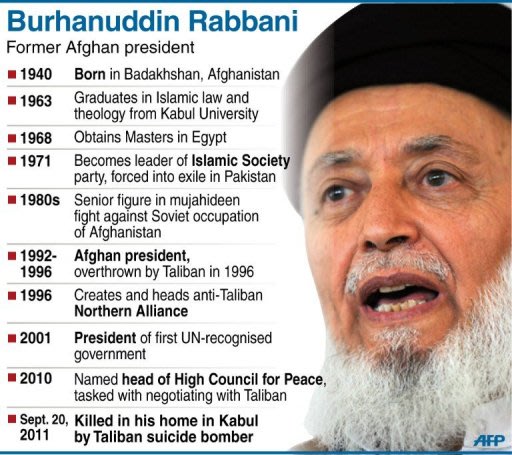
Hundreds of Afghans protested against the assassination of Burhanuddin Rabbani, chairman of the government's peace council whose murder threatens to fling the country into further turmoil.
President during Afghanistan's bloody 1992-96 civil war and a warlord with a chequered human rights record, the 71-year-old Rabbani was killed at home by a Taliban suicide bomber wearing explosives in his turban, police said.


Although there has been no official word from the Taliban, his killing deals a heavy blow to already remote hopes of an imminent end to 10 years of fighting between Islamist insurgents and the Afghan government backed by Western troops.
President Hamid Karzai was Wednesday rushing back to Afghanistan, cutting short a visit to the UN General Assembly in New York after meeting US President Barack Obama as preparations were being made for Rabbani's funeral.
It was arguably the most high-profile political assassination since the 2001 US-led invasion dislodged the Taliban, two months after President Hamid Karzai's younger brother was killed in the Taliban's southern heartland.Head of Karzai's High Council for Peace for 11 months, Rabbani fronted the government's attempts to broker peace with the Taliban, but his efforts so far appeared to come to little despite growing US interest in a settlement.
Nevertheless the assassination of such a high-profile Karzai ally, at his home close to the US embassy in allegedly the most protected part of the capital, underscores the sharp deterioration in security in Afghanistan.
Regardless of whether Rabbani was even capable of brokering peace in a country ripped apart by three decades of war, his killing is a deep symbolic blow to the government's efforts and highlights the perceived strength of the insurgency.
As a Tajik, Rabbani's killing may also further upset the delicate and at times increasingly fraught relations between Afghanistan's different minority ethnic groups and the dominant Pashtun community.
On Wednesday, several hundred people carrying pictures of Rabbani and banners gathered near his house to remember him and protest against his killing, an AFP photographer said. Many wore black headbands in mourning.
Government forces stepped up security in the diplomatic zone where Rabbani?s house is located, with cars barred from entering the area and police stopping and searching many people on foot.
People gathered at the gate of Rabbani?s house to sit and recite the Koran. A stream of government officials also attended to pay their respects.
It was not immediately clear whether the funeral would be in Kabul or Rabbani's home province of Badakhshan in northeast Afghanistan.Karzai, whose relations with the West have soured drastically since his 2009 re-election mired in fraud, insisted that Rabbani's assassination "will not deter us from continuing down the path we have started".
Obama, who wants all American combat troops out of Afghanistan in the next three years, said Afghans must be allowed to live "in freedom, safety, security and prosperity".
NATO's Anders Fogh Rasmussen, who heads up the alliance leading much of the foreign military effort to reverse the Taliban momentum, said those behind the killing "will not prevail".
UN Secretary General Ban Ki-moon expressed shock over the killing and underscored the world body's commitment to "supporting Afghanistan and its people attaining peace and stability"Members of his entourage said the attacker and an accomplice were invited to the villa as emissaries bringing "special messages" from the Taliban.
The bomber hugged Rabbani in greeting and detonated his explosives.
Although there were conflicting reports of who brought in the bombers, one source said they arrived with Mohammad Massom Stanikzai, one of Rabbani's deputies, who was one of four people wounded in the attack.
Peace Council member Fazel Karim Aymaq said the two visitors claimed to have "special messages" from the Taliban and were thought to be "very trusted".
"One of them put his head on the shoulder of Rabbani and detonated the explosives hidden in his turban, martyring Rabbani," Aymaq added.
An anonymous source said Rabbani had just returned from Dubai especially to meet the two, seemingly senior Taliban leaders.
It was the second high-profile attack in a week in central Kabul, following a 20-hour siege targeting the US embassy that killed 14 people on September 13.
The 140,000 US-led foreign troops in Afghanistan have another three years to try to reverse the Taliban insurgency before the last of them are scheduled to withdraw in 2014.
The US military's top officer Admiral Mike Mullen insisted assassinations would not force a change in war strategy.
The High Council for Peace, Karzai's brainchild, was intended to open a dialogue with insurgents who have been trying to bring down his government since the US-led invasion overthrew their regime, but has seen little success.
The 68-member council was inaugurated in October 2010. At the time, Rabbani said he was "confident" that peace was possible.
But according to Human Rights Watch, Rabbani was among prominent Afghans implicated in war crimes during the brutal fighting that killed or displaced hundreds of thousands of Afghans in the early 1990s.

Tuesday, September 20, 2011

Shia pilgrims killed in two attacks

The Baloch Hal News
At least twenty-nine Shia pilgrims have been killed in what appeared to be a case of sectarian attack orchestrated by Sunni militant groups in Balochistan’s Mastung District, officials confirmed.
According Shah Nawaz, the Assistant Commissioner of Mastung, unidentified people fired shots at a passenger bus which was carrying Shia pilgrims to Iran. The attack resulted in the immediate killing of at least twenty-nine people. The attackers firstly opened fire at the bus but then entered inside the bus and killed more people.
The incident took place in Ganj Dori area of Mastung, authorities said.
Eyewitnesses told The Baloch Hal that the attackers also opened fire at the ambulances which were carrying the injured people to the hospital. Hence, three more people were killed in the attacks on the ambulences.
Most of the injured people have been shifted to Quetta for further medical treatment.
A Sunni militant group Lashkar-e-Jhangvi (LeJ), which has killed hundreds of followers of Shia Islam in the past, accepted responsibility for the attack. The LeJ wants to convert Pakistan into a complete Sunni state and has repeatedly warned Shias to leave Balochistan and Pakistan.
The BBC Urdu Service quoted Balochistan’s Home Minister Naseebullah Bazai as saying that the pilgrims had not informed the government of Balochistan about their trip. “Otherwise, the government does have a plan to safeguard the pilgrims,” he claimed.

The human cost of chocolate


It may be unthinkable that the chocolate we enjoy could come from the hands of children working as slaves. Ten years after a protocol was introduced to end child labor in the cocoa industry, little has changed.

Polio cases in Balochistan rise to 37

With two more polio cases reported each in Loralai and Pishin districts their number has risen to 37 in the province.

The toll of confirmed polio cases detected in various districts of the Balochistan during 2011 has risen to 37. Qilla Abdullah District has been declared the worst affected area where as many as 13 cases have so far been reported.

While giving the details of the polio cases detected in Balochistan, Dr Jawahir Habib Communication for development Officer Polio said that as many as 13 children were victimized by the crippling disease of polio in Qila Abdullah district, 9 in Pishin, 5 in Quetta, 3 each in Noshki and Khuzdar and one each in Kohlu, Dera Bugti, Kalat and Lorali during the last couple of months.

"The parents in rural areas of the province are either reluctant or ignorant to immunize their children against the disease which has increased the number of polio cases in parts of Balochistan, she lamented.

When contacted, the Provincial Manager of Expanded Program on immunization (EPI) Dr Yousaf Bizinjo said that Balochistan government was keen to eradicate the menace of polio from the province.

"High level meetings chaired by the CM Balochistan Nawab Mohammad Aslam Raisani and Chief Secretary Ahmed Baksh Lehir have taken serious notice of the issue and directed the officials to make necessary arrangements for the campaign launched today. "Teams have been constituted to administer Oral Polio Vaccine (OPV) to 5 lakh 24 thousands children below the age of five in Balochistan" he said adding that health department in collaboration with the district administration, UNICEF and World Health Organisation had made full arrangements to make the three-day campaign a success. He urged the parents to immunize their children against polio as it is the only preventive measure to save children from the attack of crippling disease.

"The polio teams will launch door to door activity in the 13 districts of the province", he said, adding, the political parties including PML-N, PPP, Pashtunkhwa Milia Awami Party, ANP and JUI have also assured their cooperation and their representatives will also visit each and every house in their respective localities to administer oral drops to the children. "Provincial government had devised a concerted strategy to supervise the work of polio teams and to ensure that the team members had access to each house, he noted. Dr Bijinjo also called for the role of print and electronic media to get maximum results from the drive.

"Taking notice of the refusal of the parents, Balochistan government has issued directives to lodge FIR against them, he noted. He stressed that an awareness campaign through the religious scholars, tribal notables and other opinion makers should be started to educate public about importance of vaccination of children.

ANP welcomes Altaf's retraction

Senior leader of the Awami National Party (ANP) Haji Adeel has welcomed the decision of MQM Chief Altaf Hussain to retract his statement against ANP Chief Asfandyar Wali Khan.

Hussain during his press conference had alleged that Asfandyar had received millions from the US to win the 2008 elections.

Speaking to Geo News Adeel said that if Hussain wanted to end differences he should hold dialogue with Pakhtuns and other ethnic groups that live in Karachi.

Adeel added that everyone's hard work was involved in the prosperity of Karachi and not one but all ethnic groups were stakeholders in the city.

Haqqani network backed by ISI: US think-tank


The Haqqani network, which is blamed for the recent attack on American embassy in Kabul, receives protection and support from the Pakistani spy agency ISI, an influential think-tank has told US lawmakers.
"They receive protection and support from facets of Pakistan's intelligence agency ISI, which continues to drag its feet on taking action against the Haqqanis because they see the network as a useful proxy to expand their influence and establish footholds in Afghanistan," said Frank J Cilluffo, Director of the Homeland Security Policy Institute at the George Washington University.
"Because the Haqqani network is seen by parts of Pakistan's government as a valuable ally, the government has refused to take action in the tribal regions of Waziristan which creates safe havens, not only for the Haqqanis but for al-Qaeda and other terrorist groups, with which the Haqqanis are intimately involved," Cilluffo told lawmakers at a Congressional hearing last week.Noting that the network poses a significant threat to US and India, he observed that "strangely, and inadvisably" it has not been designated a foreign terrorist group.
It is believed that the group is a powerful insurgent force in Afghanistan, one that targets coalition forces as well as Indian investments and interests in the country, he said.
Siraj Haqqani, the son of the famous anti-Soviet fighter Jalaluddin Haqqani, is the current leader of the network. The group originated in the 1970s and has formed significant ties with al-Qaeda and Taliban in the years since its inception.
Today, it is operationally based in North Waziristan, the remote border region between Pakistan and Afghanistan.
Cilluffo said Lashkar-e-Taiba too receives support from the Pakistani establishment.
"Before the United States can take actions to assume a lighter footprint (especially in Afghanistan), it is paramount that we hold Pakistan accountable to take action against the extremist forces festering under their watch," he said.
"The litmus test here is whether Pakistan will sever its historic ties to its proxies, namely LeT in India and the Haqqani Network in Afghanistan. While we acknowledge the fact that there are some factions in Pakistan that will never cut these ties, we must also realize that some in Pakistan recognize the threat these groups pose," he said.
"Those individuals are motivated to cooperate with the US, and we should continue to do all we reasonably can to encourage and support their efforts. This is not only in the best interests of the US and India, but also of Pakistan," Cilluffo added.

Terrorist elements against Pak, Afghan, US interest: Khar


Pakistan Foreign Minister Hina Rabbani Khar said that Pakistan is fighting against terrorism to save its own interest. She was speaking to the media here after meeting with the foreign ministers of England, France and Italy.

While addressing a press conference, the foreign minister said that Pakistan will continue to favour the reconciliation process in Afghanistan and will continue to play its role as a neighboring country.

Khar described her meeting with the US Secretary of State Hillary Clinton as ‘very constructive’ and told that they had an extensive discussions on ‘all facets’ of US-Pakistan relations.

“It went very well,” Khar said after the three-and-half hour meeting.

The two top diplomats are in New York for the 66th session of the UN General Assembly. The foreign minister, in a brief interaction with reporters, also stressed the importance of ‘deeper understanding’ when her attention was drawn to points of differences between the two sides.

She also told that the foreign ministers of different countries agreed on helping the flood victims of Pakistan.

The Pakistan Foreign Minister said that there is complete convergence of interests in counterterrorism goals between Pakistan and the US. She said that terrorist elements are against the mutual interest of Pakistan, Afghanistan and the US.

Monday, September 19, 2011

Yemen violence

Yemeni security forces have killed at least 26 people and wounded more than 100 on a second day of violence across the country.

Gunmen loyal to President Ali Abdullah Saleh were continuing to fire upon anti-government demonstrators in Sanaa, with hospital sources saying the total death toll since Monday was now more than 50.

Government troops and snipers in nearby buildings opened fire on Monday at peaceful demonstrators and passers-by in the capital's Change Square, where they have camped since February demanding regime change, witnesses said.

Protesters were sprayed by water cannons and tear gas, and also baton charged, before the security forces opened fire with machine guns, they said.

Additional deaths were reported in the southwestern city of Taiz, where two people were killed and 10 were injured by gunfire from Saleh loyalists, Al Jazeera journalists stationed in Yemen said.

Despite the casualties, mass demonstrations continued on Monday in towns near Taiz - in Ibb, Dhamar and Shabwa - and in the northwestern province of Saada.

Abdu al-Janadi, Yemen's deputy information minister, rejected accusations that the government had planned attacks on the protesters, and accused what he described as "unknown assailants" of carrying out the acts.

"This attack was prepared so as to kill as many people as they could ... This is a plot against all the Yemeni people," al-Janadi told a British broadcaster.

Power transfer

Monday's clashes come a day after security forces opened fire at tens of thousands of civilian protesters marching for an end to Saleh's 33-year rule, killing 26 people.

The violence ended a weeks-long stand-off between the two sides, becoming Yemen's worst incident of bloodshed since a similar massacre killed 52 people in mid-March.The renewed crackdown on protesters came amid reports that Abdrabuh Mansur Hadi, Yemen's vice-president, would sign a Gulf Arab initiative to arrange for a transfer of power in Yemen "within a week".
"Within a week, the vice-president will sign the Gulf Initiative in the name of the president," a high-ranking Saudi official, who requested anonymity, told reporters.

Last week, Saleh authorised Hadi to negotiate a power transfer with the opposition.

The initiative was proposed by the six-nation Gulf Co-operation Council and sets the path for a peaceful transition of power from Saleh, who has ruled Yemen since 1978.

According to the Saudi official, "among the guarantees demanded by Saleh are that his son be kept in the next government".

Saleh left the country three months ago for Saudi Arabia where he has been recovering from a June 3 attack on his presidential compound.

The president has since January faced protests over nepotism and corruption from reform activists inspired by the Arab Spring.

Condemnation

The US, the European Union and other member states of the United Nations Human Rights Council condemned the violent unrest in Yemen during a meeting in Geneva on Monday.

The US was concerned at "increasingly disturbing reports about violence'' and urged the Yemeni government to rein in the security forces, Eileen Chamberlain Donahoe, US envoy to the council, said.

"The United States believes that now is the time for an immediate, peaceful and orderly transition," Donahoe said, adding that those responsible for abuses against civilians needed to be brought to justice as part of the reform process in the Arab nation.

Abubakr al-Qirbi, the Yemeni foreign minister, rejected claims of excessive force by the police and pro-government armed groups, by pledging his government's commitment to political reforms and accusing some opposition groups of terrorist activity.

"We have presented evidence proving that many accusation made against security organisations are baseless," al-Qirbi told the meeting.

He expressed "sorrow and condemnation" for Sunday's violence and bloodshed in Sanaa, but rejected calls for an independent international investigation into the crackdown, saying they were "inconsistent with the recommendations calling for dialogue between Yemeni political parties to solve the crisis".

Source: Al Jazeera and agencies

Obama to propose $1.5 trillion in new tax revenue


President Barack Obama will propose $1.5 trillion in new taxes as part of a plan to identify more than $3 trillion in long-term deficit reduction and slow the nation's escalating national debt.
Obama's tax plan is aimed predominantly at the wealthy and draws sharp contrasts with congressional Republicans.
It comes just days after House Speaker John Boehner ruled out tax increases to lower deficits. It also comes amid a clamor in his own Democratic Party for Obama to take a tougher stance against Republicans. And while the plan stands little chance of passing Congress, its populist pitch is one that the White House believes the public can support.
The core of the president's plan totals just more than $2 trillion in deficit reduction over 10 years. It combines the new taxes with $580 billion in cuts to mandatory benefit programs, including $248 billion from Medicare.
The administration also counts savings of $1 trillion over 10 years from the withdrawal of troops from Iraq and Afghanistan.
The deficit reduction plan represents an economic bookend to the $447 billion in tax cuts and new public works spending that Obama has proposed as a short-term measure to stimulate the economy and create jobs. He's submitting his deficit fighting plan to a special joint committee of Congress that is charged with recommending deficit reductions of up to $1.5 trillion over 10 years.
In a defiant note, administration officials made clear Sunday that Obama would veto any Medicare benefit cuts that aren't paired with tax increases on upper-income people.
Officials cast Obama's plan as his vision for deficit reduction, and distinguished it from the negotiations he had with Boehner in July as Obama sought to avoid a government default.
As a result, it includes no changes in Social Security and no increase in the Medicare eligibility age, which the president had been willing to accept this summer.
Moreover, the new tax revenue Obama is seeking is nearly double the $800 billion that Boehner had been willing to consider in July. Republicans were already lining up against the president's tax proposal before they even knew the magnitude of what he intended to recommend.
"Class warfare may make for really good politics but it makes for rotten economics," GOP Rep. Paul Ryan of Wisconsin, the House Budget Committee chairman, said Sunday in reaction to one Obama tax proposal to impose a minimum tax rate on wealthy filers.
Former President Bill Clinton on Monday dismissed GOP claims that the tax on the wealthy would discourage jobs creation and hamper economic growth.
"Republicans in Washington always say the same thing," Clinton said on NBC's "Today" show. He called their argument an insult to wealthy Americans, including many who don't mind paying more.
Key features of Obama's plan, as described by senior administration officials Sunday evening:
—$1.5 trillion in new revenue, which would include about $800 billion realized over 10 years from repealing the Bush-era tax rates for couples making more than $250,000. It also would place limits on deductions for wealthy filers and end certain corporate loopholes and subsidies for oil and gas companies.
—$580 billion in cuts in mandatory benefit programs, including $248 billion in Medicare and $72 billion in Medicaid and other health programs. Other mandatory benefit programs include farm subsidies.
—$430 billion in savings from lower interest payment on the national debt.
By adding about $1 trillion in spending cuts already enacted by Congress and counting about $1 trillion in savings from the drawdown of military forces from Iraq and Afghanistan, the combined deficit reduction would total more than $4 trillion over 10 years, senior administration officials said.
Republicans have ridiculed the war savings as gimmicky, but House Republicans included them in their budget proposal this year and Boehner had agreed to count them as savings during debt ceiling negotiations with the president this summer.
Obama backed away from proposing sweeping changes to Medicare, following the advice of fellow Democrats that it would only give political cover to a privatization plan supported by House Republicans that turned to be unpopular with older Americans.
Administration officials said 90 percent of the $248 billion in 10-year Medicare cuts would be squeezed from service providers. The plan does shift some additional costs to beneficiaries, but those changes would not start until 2017.
Illustrating Obama's populist pitch on tax revenue, one proposal would set a minimum tax on taxpayers making $1 million or more in income. The measure — Obama is going to call it the "Buffett Rule" for billionaire investor Warren Buffett — is designed to prevent millionaires from taking advantage of lower tax rates on investment earnings than what middle-income taxpayers pay on their wages.
At issue is the difference between a taxpayer's tax bracket and the effective tax rate that taxpayer pays. Millionaires face a 35 percent tax bracket, while middle income filers fall in the 15 or 25 percent bracket. But investment income is taxed at 15 percent and Buffett has complained that he and other wealthy people have been "coddled long enough" and shouldn't be paying a smaller share of their income in federal taxes than middle-class taxpayers.

ANP rally for ban on terrorist parties

The Awami National Party held a protest demonstration here in front Lahore Press Club on Sunday against the lawlessness in Karachi and demanded banning of political parties involved in terrorism.
The demonstration was organized by ANP’s City chapter and led by its local president Qurban Khan Kakar, while central General Secretary Ehsan Wayne and provincial leader Arif Azhar participated in it.
The protestors were carrying placards and banners inscribed with slogans in favour of their demands and chanted slogans against the political forces alleged to be involved in Karachi’s target killing. ANP leaders also demanded that for the restoration of ‘Commissionary System’ in Sindh.
The leaders of the ANP while addressing the participants claimed that MQM chief, Altaf Hussain media conference from London was a poor bid to pressure the judiciary against the backdrop of Supreme Court’s suo moto notice of the Karachi’s situation. They also claimed that MQM has trained militants at her disposal, as Altaf Hussain offered his support to the army in terms of manpower.

Report argues that Afghan night raids make more enemies than they catch

http://www.washingtonpost.com
Increased nighttime military raids by international military forces in Afghanistan have created a resentment that has undercut any battlefield gains from the tactic, according to a report released Monday by a U.S. think tank.

The New York-based Open Society Foundations, founded by liberal billionaire George Soros, said in its report that NATO and U.S. troops have made important improvements in the way they conduct night raids following complaints from the Afghan government that its citizens were being treated unfairly or rudely. Civilian casualties are down, and the operations are better targeted.However, the report says even nighttime raids conducted with the best practices breed discontentment and mistrust among both ordinary Afghans — who feel less secure knowing that men in uniform might burst into their homes at any time. The Afghan government has repeatedly called for a reduction in nighttime operations over which it has little control and said such raids undermine efforts to reconcile with those who open to leaving the insurgency, according to the report.

The findings are potentially troubling for an international mission that is likely to depend even more on quick-strike operations like night raids as the U.S. and other troop-contributing nations draw down forces over the next few years.

Afghan President Hamid Karzai has publicly denouced nighttime raids in speeches and interviews, saying that the operations — in which a small group of soldiers push into a compound and search the premises and the residents — treat too many civilians as if they are insurgents and violate citizens’ privacy in an intensely closed society. Troops on night raids are also regularly accused of mistreating women or defiling copies of the Quran. Though the allegations often turn out to be specious, they still damage the reputation of NATO troops.International troops conducted an average of 19 raids a night between December 2010 and February 2011, according to NATO figures cited in the report. More up-to-date figures were not available but the researchers interviewed a NATO official in April who said that as many as 40 raids might take place on any given night in Afghanistan. That represents a sharp increase over the past two years, the report says.

“The escalation in raids has taken the battlefield more directly into Afghan homes, sparking tremendous backlash among the Afghan population,” the report argues, adding, “Complaints over night raids have marred Afghan relations with international partners, particularly the United States, and have complicated long-term strategic partnership discussions.”

A spokesman for NATO forces in Kabul said that night operations are always conducted along with Afghan forces and approved by Afghan officials. He said that the tactic continues to be one of the most effective ways to combat the Taliban insurgency.

“Night operations are an effective method of maintaining the pressure on the enemy while minimizing risk to innocent civilians,” Lt. Col. Jimmie Cummings said. “Eighty-five percent of night operations are conducted without a shot being fired and account for less than 1 percent of civilian casualties.”

Cummings said, however, that NATO forces are reviewing the report and is open to implementing any recommendations that will improve their operations in Afghanistan. He did not say if NATO was willing to sharply reduce raids.

The author of the report, Erica Gaston, said the increase in raids has come alongside an increase in insurgent attacks, meaning that Afghan citizens are not feeling any of security benefits from the operations.

“Afghan civilians are bearing the brunt of the surge in raids, without seeing security improvements,” Gaston said in a statement.

Eight killed as Pakistan anti-terror cop targeted


A car-borne Taliban suicide bomber flattened the house of a senior counter-terrorism police officer in Pakistan's financial capital Karachi on Monday, killing eight people including six policemen.
Senior Superintendent Aslam Khan, who was unhurt in the attack but whose home was destroyed, told AFP he had been threatened by the Pakistani Taliban -- which is allied to Al-Qaeda -- and that he was the target.
"It was a car bomb attack on my house," he said. "I was receiving threats from Tehreek-e-Taliban. Taliban are involved in this attack."
Khan heads the counter-terrorism unit of the Police Crime Investigation Department in Karachi, investigating Islamist militant cells in the city.
Several neighbouring houses were also wrecked in the attack, private Pakistan TV channels showed, with four cars being badly damaged and a two-metre (six feet) deep crater left in front of Khan's home.
An AFP reporter at scene saw rubble, mud and pieces of glass scattered over a large area in the upscale residential neighbourhood.
"Eight people including six policemen have been killed and several others were wounded," Shoukat Hussain, another senior police officer, told AFP. "A child and a woman were also killed.
"It was a car suicide attack," Hussain added.
Speaking to reporters outside the remains of his one-storey bungalow, Khan said: "I woke up from sleep and saw fire around. I ran towards the other rooms of the house and saw my family safe but bewildered.
"This was a cowardly act of Taliban. I am not scared of Taliban. Let me tell you that I will not spare them in future."
Saud Mirza, another senior police officer, confirmed that Khan had previously been threatened by the Pakistani Taliban and had recently received a written threat.
Witness Naeem Shaikh said he was taking his children to school when he heard a huge explosion.
"I went across a lane and saw this house destroyed and huge flames around it," said Shaikh, who lives in the area.
He saw the bodies of a boy, later identified as a second-year school pupil, and his mother lying near the house. "The boy's schoolbag was lying shattered nearby," Shaikh said, choking.
There was no immediate claim of responsibility for the bombing.
Nearly 4,700 people have been killed across Pakistan in attacks blamed on Taliban and Al-Qaeda-linked networks based in the country's northwestern tribal belt since government troops stormed a radical mosque in Islamabad in 2007.
On Thursday, a bomber killed 46 people when he blew himself up in a crowd of mourners as they gathered for prayers in the northwestern town of Jandol, 100 kilometres (60 miles) from the once Taliban-infested Swat Valley.
Karachi, Pakistan's economic hub, is currently undergoing its worst ethnic- and politically-linked unrest in 16 years, with more than 100 people killed in one week alone last month.
The gang wars have been linked to ethnic tensions between the Mohajirs, the Urdu-speaking majority represented by the Muttahida Qaumi Movement (MQM), and Pashtun migrants affiliated to the rival Awami National Party (ANP).
The nationally ruling Pakistan People's Party, which was elected in 2008 after nine years of military rule, insists that civilian authorities are capable of controlling the bloodshed, despite calls for military intervention.

Sunday, September 18, 2011

PML-N, PTI wrangle on dengue issue

Pakistan Today

In a critical time when dengue has created serious problems for people and all political forces should coordinate and unite, Pakistan Muslim League-Nawaz (PML-N) and Pakistan Tehreek-e-Insaaf (PTI) have chosen the warpath to gain political mileage on the dengue issue and have therefore created mistrust among people who are desperately seeking relief instead of a political brawl.
The PML-N-led Punjab government sealed two labs of the Shaukat Khanam Hospital which is being run by PTI Chairman Imran Khan to inflict political and financial damage to him. To this, Khan announced that the Punjab government would be dragged to court to settle the score. The PML-N government had raided all private labs which were found involved in charging over Rs 90 as test fee for detection of dengue.
Raids were conducted right after the CM had announced the low fee on Saturday and proper time to implement the instructions was not given to hospitals. PTI Secretary Information Omer Cheema told Pakistan Today that the party would go to the court against this injustice. “In order to hide its own criminal neglect and to extract political mileage out of a matter which is strictly human, the Punjab government has harassed functionaries of Shaukat Khanum Laboratory Collection Centers and has even arrested some of them,” he said.
He said this tyrant act was done despite the fact that Shaukat Khanam had reduced fee of the basic CBC test to Rs 80 against the government’s announced ceiling of Rs 90. He said this was a condemnable attempt, aimed at stopping the most acclaimed humanitarian organisation, nationally and internationally, from serving the poor of this country.
“The Shaukat Khanam funds are not spent on buying properties and building businesses in London, France and elsewhere in the world. They are, instead, meant for free treatment of people, thousands of whom have been cured of cancer,” he said. Khan, who is in London to launch his book “Pakistan: a personal history” in the UK, when contacted, condemned the act in strongest words and described it as the beginning of the end of a corrupt and anti-people leadership of PML-N.
He urged his party workers and functionaries to stay calm and to serve people in this hour of need. Punjab government spokesman Senator Pervaiz Rashid said Khan had announced to go to the court if action was taken against his laboratories for overcharging the dengue tests. He said Khan must go to the court and the Punjab government was ready to provide him services of the best lawyer at its own expense. However, he said Khan would not go to the court where he would be declared dishonest.
Rashid reminded Khan that there was also a court of the people where his claims of being pro-poor and people-friendly had been fully exposed. He said the Punjab government had fixed Rs 90 as fee for the dengue test in private hospitals and laboratories. He said Khan leveled baseless allegations against the Ittefaq Hospital and Sharif City Hospital as both had opened their doors for dengue patients. He said further that Khan should sympathise with the people instead of supporting the dengue mosquito.

Altaf takes his words back about Asfandyar Wali

MQM Chief Altaf Hussain on Monday took his words back about Asfandyar Wali, saying he was ashamed on hurting Asfandyar and ANP workers, Geo News reported.

Bill Clinton: Cheney trying to cause 2012 mischief

Former President Bill Clinton says he has high regard for Dick Cheney's political skills even if the former vice president tries to cause mischief for Democrats.
Cheney recently praised Secretary of State Hillary Rodham Clinton as one of the Obama administration's "most competent" members and said it would be "interesting to speculate" how she might be as president.
Cheney suggested, tongue in cheek, she might want to challenge Barack Obama in 2012, and said he wouldn't discourage a primary fight.
Bill Clinton tells CBS' "Face the Nation" he's "gratified whenever anyone says anything nice" about his wife, but one of Cheney's skills "is sowing discord among the opposition" and he doesn't want to help Cheney's strategy succeed.
Clinton did elbow Cheney, saying, "I admire that he's still out there hitting the ball."

Tumult of Arab Spring Prompts Worries in Washington


While the popular uprisings of the Arab Spring created new opportunities for American diplomacy, the tumult has also presented the United States with challenges — and worst-case scenarios — that would have once been almost unimaginable.

What if the Palestinians’ quest for recognition of a state at the United Nations, despite American pleas otherwise, lands Israel in the International Criminal Court, fuels deeper resentment of the United States, or touches off a new convulsion of violence in the West Bank and Gaza?

Or if Egypt, emerging from decades of autocratic rule under President Hosni Mubarak, responds to anti-Israeli sentiments on the street and abrogates the Camp David peace treaty, a bulwark of Arab-Israeli stability for three decades?

“We’re facing an Arab awakening that nobody could have imagined and few predicted just a few years ago,” Secretary of State Hillary Rodham Clinton said in a recent interview with reporters and editors of The New York Times. “And it’s sweeping aside a lot of the old preconceptions.”

It may also sweep aside, or at least diminish, American influence in the region. The bold vow on Friday by the Palestinian president, Mahmoud Abbas, to seek full membership at the United Nations amounted to a public rebuff of weeks of feverish American diplomacy. His vow came on top of a rapid and worrisome deterioration of relations between Egypt and Israel and between Israel and Turkey, the three countries that have been the strongest American allies in the region.

Diplomacy has never been easy in the Middle East, but the recent events have so roiled the region that the United States fears being forced to take sides in diplomatic or, worse, military disputes among its friends. Hypothetical outcomes seem chillingly present. What would happen if Turkey, a NATO ally that the United States is bound by treaty to defend, sent warships to escort ships to Gaza in defiance of Israel’s blockade, as Prime Minister Recep Tayyip Erdogan has threatened to do?

Crises like the expulsion of Israel’s ambassador in Turkey, the storming of the Israeli Embassy in Cairo and protests outside the one in Amman, Jordan, have compounded a sense of urgency and forced the Obama administration to reassess some of this country’s fundamental assumptions, and to do so on the fly.

“The region has come unglued,” said Robert Malley, a senior analyst in Washington for the International Crisis Group. “And all the tools the United States has marshaled in the past are no longer as effective.”

The United States, as a global power and permanent member of the United Nations Security Council, still has significant ability to shape events in the region. This was underscored by the flurry of telephone calls that President Obama, Mrs. Clinton and Defense Secretary Leon E. Panetta made to their Egyptian and Israeli counterparts to diffuse tensions after the siege of Israeli Embassy in Cairo this month.

At the same time, the toppling of leaders who preserved a stable, if strained, status quo for decades — Mr. Mubarak, Col. Muammar el-Qaddafi of Libya and Zine el-Abidine Ben Ali of Tunisia — has unleashed powerful and still unpredictable forces that the United States has only begun to grapple with and is likely to be doing so for years.

In the process, diplomats worry, the actions of the United States could even nudge the Arab Spring toward radicalism by angering newly enfranchised citizens of democratic nations.

In the case of Egypt, the administration has promised millions of dollars in aid to support a democratic transition, only to see the military council ruling the country object to how and where it is spent, according to two administration officials, who spoke on the condition of anonymity to discuss diplomatic matters. The objection echoed similar ones that came from Mr. Mubarak’s government. The government and the political parties vying for support before new elections there have also intensified anti-American talk. The officials privately warned of the emergence of an outwardly hostile government, dominated by the Muslim Brotherhood and remnants of Mr. Mubarak’s party.

The upheaval in Egypt has even raised the prospect that it might break its Camp David peace treaty with Israel, with Egypt’s prime minister, Essam Sharaf, telling a Turkish television channel last week that the deal was “not a sacred thing and is always open to discussion.”

The administration, especially Mrs. Clinton, also spent months trying to mediate between Turkey and Israel over the response to the Israeli military operation last year that killed nine passengers aboard a ship trying to deliver aid to Gaza despite an Israeli embargo — only to see both sides harden their views after a United Nations report on the episode became public.

Unflinching support for Israel has, of course, been a constant of American foreign policy for years, often at the cost of political and diplomatic support elsewhere in the region, but the Obama administration has also sought to improve ties with Turkey after the chill that followed the invasion of Iraq in 2003.

Turkey, which aspires to broaden its own influence in the region, has been a crucial if imperfect partner, from the administration’s point of view, in the international response to the fighting in Libya and the diplomatic efforts to isolate Syria’s president, Bashar al-Assad.

The administration deferred to Turkey’s request last month to delay new sanctions on Mr. Assad’s government to give diplomacy another chance.

This month, only days before expelling Israel’s ambassador, Turkey agreed to install an American radar system that is part of a new NATO missile defense system, underscoring its importance to a policy goal of the last two administrations.

Mrs. Clinton, in the interview, expressed hope that the United States would be able to support the democratic aspirations of the Arab uprisings. She also acknowledged the constraints that the administration faced at home, given the country’s budget crisis and Republican calls in Congress to cut foreign aid, especially to the Palestinians and others seen as hostile to Israel.

“It’s a great opportunity for the United States, but we are constrained by budget and to some extent constrained by political obstacles,” she said. “I’m determined that we’re going to do as much as we can within those constraints to deal with the opportunities that I see from Tunisia to Libya and Egypt and beyond.”

The administration has faced criticism from all quarters — that it has not done enough to support Israel or has done too much, that it has supported some Arab uprisings, while remaining silent on the repression in Bahrain. That in itself illustrates how tumultuous the region has become and how the United States has had to scramble to keep up with events that are still unfolding.

“Things are so fluid,” said Robert Danin, a senior fellow at the Council on Foreign Relations. “They’re not driving the train. They’re reacting to the train, and no one knows where the train is going.”

Pakistan has Haqqani links: U.S. official


The U.S. ambassador to Pakistan accused the government there of having links to the Haqqani network, a pro-Taliban militant group that U.S. officials blame for this week's attack on the U.S. Embassy and NATO command center in Kabul, Afghanistan.
Speaking to Radio Pakistan, Ambassador Cameron Munter said relations between the United States and Pakistan "need a lot of work" and urged closer cooperation. The interview was available Saturday on the Radio Pakistan website.
A Taliban assault on the U.S. Embassy and NATO command center in central Kabul was brought to a bloody end Wednesday with the deaths of half a dozen militants. Four policemen and two civilians were killed and 27 injured in that attack and a handful of other incidents across Kabul, according to Afghan government figures.
"The attack that took place in Kabul a few days ago -- that was the work of the Haqqani network," Munter told Radio Pakistan. "There is evidence linking the Haqqani network to the Pakistani government. This is something that must stop. We have to make sure that we work together to fight terrorism."
U.S. officials have previously blamed this week's attack on the Haqqani network, a pro-Taliban militant group based in Pakistan's North Waziristan region. They have also previously accused the Pakistani government of maintaining a relationship with that network.Still, Munter's comments are noteworthy for their timing, amid heightened tensions between Pakistan and the United States, and because of their blunt nature.
They came one day after U.S. Chairman of the Joint Chiefs of Staff Adm. Michael Mullen told his Pakistani counterpart he was deeply concerned about the brazenness of attacks being staged by operatives loyal to the Haqqani network.
During a lengthy one-on-one meeting in Seville, Spain, Mullen "conveyed his deep concerns about the increasing -- and increasingly brazen -- activities of the Haqqani network and restated his strong desire to see the Pakistani military take action against them and their safe havens in North Waziristan," Capt. John Kirby, Mullen's spokesman, told CNN.
Mullen believes that "elements" of Pakistan's Inter-Services Intelligence agency, known as the ISI, "directly support" the Haqqani network, Kirby said.
The Haqqani network is aligned with the Taliban and al Qaeda and is considered one the most significant threats to stability in Afghanistan. U.S. officials believe Haqqani operatives are moving unfettered across the Afghanistan-Pakistan border and are responsible for several recent high-profile attacks in Kabul, including this week's assault.
In late April, Mullen said on Pakistan's Geo TV that the ISI has a "long-standing relationship" with the Haqqani network.
Pakistani officials have denied the existence of such a relationship.
Mullen, who is retiring at the end of this month, met with Pakistan's army chief, Gen. Ashfaq Kayani, for more than two hours in what was their final official meeting. Both men were in Spain to attend a high-level NATO military meeting.
"They agreed that the relationship between our two countries remained vital to the region and that both sides had taken positive steps to improve that relationship over the past few months. They also discussed the state of military-to-military cooperation and pledged to continue to find ways to make it better," Kirby said.
Meanwhile, Afghanistan's Interior Minister Bismillah Muhammadi avoided blaming Pakistan directly for this week's attack in Kabul. However, he used the phase "across the borders of Afghanistan," a typical way of referring to Pakistan in connection to the recovered phones of the attackers.
"The six cell phones we found on them, and the evidence we got on them all shows that this plot was made across the borders of Afghanistan," he said. "Without doubt they are across the borders of Afghanistan. They get equipped, they get trained there, and then they get sent here for killing of our people."

US drone crashes in Pakistan: security officials


An unmanned United States drone aircraft crashed in Pakistan's lawless northwestern tribal district on Sunday after suffering a technical fault, local security officials said.
The drone, the second to crash in Pakistan within the last month, went down in South Waziristan, part of the lawless tribal belt on the Afghan border that Washington calls a global headquarters of Al-Qaeda.
"The American drone crashed in Zangara village of South Waziristan, apparently because of some technical faults," a security official in Peshawar, the main town in Pakistan's northwest, told AFP.
Two intelligence officials in Wana, the main town of South Waziristan, confirmed the incident. It was an armed Predator drone, they said.
The United States uses unmanned surveillance aircraft in its war against the Taliban in Afghanistan to monitor militants in Pakistan, from where Al-Qaeda and Taliban-linked fighters launch attacks in Afghanistan.
It also uses Predator armed drones to launch missile attacks aimed at militants in Pakistan's unstable northwestern border areas.
US drone crashes are very rare in Pakistan, but a surveillance drone equipped with a camera crashed in southwestern Pakistan on August 25.
In September 2008, tribesmen in South Waziristan claimed to have shot down another surveillance drone in Jalal village, near the Afghan border.
The Pakistani army said at the time that it was investigating that incident but did not make the results of the probe public.
The US drone campaign is deeply unpopular among an anti-American Pakistani public and the government has publicly demanded an end to the attacks.
However, in private, Pakistani military and civilian leaders are thought to co-operate with the programme and Washington says it has been successful in eliminating a number of Al-Qaeda- and Taliban-linked militants in Pakistan.
Around two dozen drone strikes have been reported in Pakistan since elite US forces killed Al-Qaeda chief Osama bin Laden in a suburban home near Pakistan's main military academy in Abbottabad, close to the capital, on May 2.
The raid humiliated Pakistan and prompted allegations of incompetence and complicity in sheltering bin Laden.
Pakistan is seen as a key ally for the United States in its fight against Islamist militancy, but relations soured after the bin Laden raid, which both countries say was carried out without Islamabad being warned.

Human Right situation in Baluchistan quite bleak: HRCP

Human Rights Commission of Pakistan (HRCP) Baluchistan chapter’s leader Tahir Hussain Advocate has said that some 143 people were killed and about 180 were injured in the incidents of target killings, bomb blasts and other terrorists’ activities in Balochistan province.

Hussain expressed his apprehension during a press conference at Quetta Press Club here on Saturday. He said that HRCP had always raised its voice against human rights violation in the province. He said that extra judicial arrests, non-recovery of missing persons, targeted killings, kidnapping for ransom, religious terrorism and highway robberies have become a daily routine in Balochistan.

He said that political workers and people form other walks of life are disappearing , which is the violation of the law .Commission constituted for recovery of missing persons has also filed a writ petition in this regard, but no recovery could not be made so far.

He said that the incidents of finding defaced dead bodies are on the rise. He said that last year 50 people from Hindu community were kidnapped, returned after paying ransom. The minorities have stopped their children from going to school due to sense of insecurity in Balochistan. Similarly two people were killed in the name of religious terrorism during last month in the province.

He said that during last few years some 188 mutilated dead bodies were recovered , in addition to this some 83 people were killed in 50 incidents of targeted killings., whereas 58 lost their lives and 174 injured in 12 big blasts, whereas 26 people were kidnapped for ransom.

He severely condemned the incidents of acid throwing on the female teachers and demanded the government to provide security to them in the province.