Sunday, August 14, 2011
AUGUST 14, That enduring shame

TODAY is officially a day of celebration — of sorts — for the ruling clique and a sizeable portion of the 180-plus million who inhabit this unfortunate republic.
The latter have little (if anything) to celebrate in their lives, so rushing around on mutilated motorbikes, one must suppose, is better than nothing.
On this 64th anniversary of the birth of what was Jinnah’s Pakistan one can only be repetitive — as repetition is the name of the game as far as our governments, who ceaselessly repeat the mistakes made over the decades, are concerned. What all should be asking themselves today is should we be celebrating or tearing out our hair in sorrow and shame?
The sole celebration that springs to mind is that the country Pakistan still exists, though in truncated state, despite the best efforts of the string of governments that have done their best to run it into the ground. But then, what is left, bears no resemblance to the country envisaged by Mr Jinnah.
Internationally somewhat isolated, internally strife-ridden and at odds with itself, the nation somehow manages to trundle on albeit each and every pillar of state and institution is tarnished (including the mighty armed forces) and battered (including the judiciary).
Religiosity has spawned dangerous discord which stalks the land. The founder’s aim was a modern, free-thinking liberal, secular state (the word ‘secular’ now regarded as being almost treasonous when applied to Pakistan).
Three months prior to partition, in an interview with Doon Campbell of Reuters, Jinnah said: “The new state will be a modern democratic state with sovereignty resting in the people and the members of the new nation having equal rights of citizenship regardless of religion, caste or creed.” This was repeated in no mean terms three days before the country’s birth to the members of the constituent assembly. The speech bears repetition continually, and Jinnah’s words were prominently highlighted in the press this Aug 11.
He could not have been more explicit; he stressed two factors which can make or break a country — that religion is not the business of the state and that the primary duty of any government is to impose and maintain law and order, both factors having been negated by successive governments.From Day Two, which followed Jinnah’s death, the mullah faction, which has always had the upper hand (other than for a brief period in the 1960s) over the politicians, however clad, and the so-called self-styled intellectual fraternity, has sown dispute and divergence of views, disagreement and differences. All that Jinnah stood for has been firmly repudiated.
We are as shameless as the men and women we have allowed to ‘lead’ (in the wrong direction), or misrule or misgovern, we are as guilty as they for having brought the country to the impasse in which it now stands. We have allowed ourselves to be led by the nose, even acquiesced, whilst those who have been shot to power through various means have collectively and dissolutely danced along the way, down 64 years, whilst dipping at will into the national exchequer, promulgating constitutions and making and breaking laws to suit their individual purposes.
We have accepted kings of straw, decked out in the colour of the time, and with them have denied and abrogated the founder’s creed. Where stand we now?
Democracy has by this present regime been declared a form of revenge — not that it ever was anything else when wielded by those who have sneaked in through the ballot box, voted in by a minority of the millions who have purposefully and with intent been kept in a state of illiteracy, ignorance and poverty, all whilst being brainwashed into the practice and application of a brand of religion peculiar to this country.
We are rent by sectarian and ethnic killings, by intolerance and bigotry, and by discriminatory laws (which no one has the guts to do away with) that murder and maim. Corruption and mendacity have become a way of life.
Are any of those who sit atop the powerhouses of the capital and its neighbouring city worrying about what they should be worrying about? No. They are intent on keeping themselves where they are, an intent they do not even bother to pretend to cover. The politicians’ every act is geared towards the next election, and the military that runs them cannot shake off an ingrained mindset.
How stands the population growth? In dire straits if statistics are anything to go by. Successive governments have refused to even consider a curb, so some 40 per cent of the 180-plus million exist beneath the poverty line, and, frighteningly, almost 70 per cent is below the age of 25. What is their future? Literacy is at a standstill — thinking realistically it would seem that a mere 20 per cent are actually literate. Literacy frightens the feudal mindset which cannot come to terms with a 21st-century world, which believes in murder in the name of honour and many other antiquated practices. So until we are rid of the old and in with something new, the millions are doomed.
Do we celebrate the anarchy that reigns in the northern border areas and in our southern port city, or do we repent? And in what form should be that repentance? Or do we give up, and merely hang our heads in shame at the betrayal of what could have been a perfectly viable country?
After Britain riots, many ask 'Why,' but find no clear answers

Outside a London court last week, as those accused of looting and rioting in the most destructive and widespread violence in recent British history faced justice, a mother turned to her 11-year-old son, accused of theft, and asked simply, "Why?"

That question has been at the heart of a fraught national debate as Britons puzzle over what drove even some previously law-abiding people to steal, sometimes risking arrest for nothing more than bottles of water. The debate has often divided people into predictable camps.
The Conservative Prime Minister, David Cameron, stood up in Parliament as Britain smoldered around him on Thursday and railed against "mindless violence and thuggery." His critics on the left blame deep mistrust of the police in poor communities, and income inequality they say will worsen as his government pursues sweeping cuts in spending and social welfare.
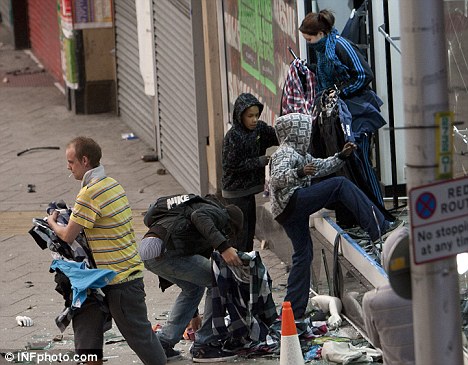
Some commentators have blamed modern society at large. The Daily Telegraph struck a popular chord when it blamed a "culture of greed and impunity" that it said extended to corporate boardrooms and the government itself. Many politicians, meanwhile, have lashed out at technology - including the instant messaging that encouraged looting - for whipping up the crowds.
But as more details of the crimes emerge, the picture has become infinitely more complicated, and confusing. In some of the more shocking cases, the crimes seemed to be rooted in nothing more than split-second decisions made by normally orderly people seduced by the disorder around them.
An aspiring social worker, Natasha Reid, 24, turned herself in after stealing a $500 television. Nicolas Robinson, a young engineering student who had never been in trouble with the law, grabbed bottles of water because, his lawyer said, he was thirsty.
The 11-year-old, the youngest looter arrested, stole a trash can.

At several of the riots last week, those perpetrating the violence had no ready explanation for their behaviour. One young man, kicking trash cans into the street, shrugged when asked why. And the atmosphere in Hackney's Pembury Road low-income housing projects was sometimes one of adrenaline-driven glee. Looters whooped as they stripped a convenience store bare, yards from the police.
Even some Londoners who had initially condemned the riotous behaviour joined in. Bystanders had watched in shock as rioters lined up against police officers on Tottenham's main street last weekend, setting fires and looting. The mood shifted dramatically, though, after officers moved in, dogs barking and horses charging. One man, suddenly emboldened, grabbed a box of pears from outside a convenience store. A woman carried off an armful of coconuts. Another man, seemingly conflicted, sprinted, then turned back briefly to snatch a crate of bottled water.
Clifford Stott, a social psychologist at the University of Liverpool who studies riots, says that behaviour, at least, is not unusual. Bystanders, he said, often turn against the police when they themselves get swept up in a broad crackdown. "That confrontation makes them start to think that the police are wrong, not the rioters," he said.
But he added that crowd dynamics are incredibly complex and cannot be readily reduced to blame people, or to explain away their behaviour.
The condemnation of social media, said Pamela Rutledge, who studies the intersection of the media and human psychology, is equally glib. It is true, she said, that social media "accelerates behaviours because it creates social modelling - people see that other people are involved and they're encouraged." But, she said, these "tools" are not only in the hands of the rioters; the police, for instance, have used social media to inform worried local residents about the state of rioting in their areas. "You can use a hammer to build something or destroy it," Dr. Rutledge said. "It's just a tool."
Especially difficult to explain, both psychologists said, are the rapid-fire decisions behind the snatching of small and often cheap goods.
In Wood Green last weekend, where looters were allowed a free rein for four hours before the police arrived, some rioters set upon an eyeglass shop. And three men stood just outside a GNC, debating whether stealing the vitamins and food supplements was worth the trouble. "Shall I take this?" asked one as he lifted a tub of a nutritional supplement. "Nah, man, don't bother," his friends replied. He took it anyway.
So far, the police say more than 1,200 people have been arrested in connection with "violence, disorder and looting." Of those, 725 have been charged and some are being handed stringent sentences by courts that run 24 hours in some areas. Many have prior convictions, and court records reveal that some were armed, or carrying quantities of drugs when arrested - the "criminals" that many political figures have blamed for the riots.
Others, like Ms. Reid and Mr. Robinson, are not so readily pigeonholed. Ms. Reid is a university graduate. She put her head in her hands in court, and her mother told reporters that she had been sobbing in her bedroom since her arrest over the stolen television. "She didn't want a TV," her mother said. "She doesn't even know why she took it. She doesn't need a telly."
Mr. Robinson, the engineering student, was walking home at 2:40 a.m. on Monday when he looted a supermarket in Brixton. Mr. Robinson, the court heard from his lawyer, "got caught up in the moment" and was now "incredibly ashamed." He was sentenced to six months.
The story of Chelsea Ives, an 18-year-old athlete who had been chosen to be one of the faces of London's coming Olympic Games, has dominated the front pages of newspapers in Britain. She has been accused of burglary, violent disorder and throwing bricks at a police car, according to media reports. She was turned in by her mother, Adrienne. "I had to do what was right," her mother told reporters.
Another woman listed on court documents was accused of stealing "six bottles of nail varnish" and a tin of food.
Dr. Rutledge said that in times of unrest, people craved clarity. "In the same way we want to blame social media, we want an answer to this. But individuals are individual," she said. "So what if these people didn't have criminal records? We can't know what they were feeling."
Dr. Stott said that people, in a rush to judgment, often latch on to the idea that a mob mentality has taken hold. "There's an excitement and an intensity to those situations that are really quite profound," he said, "and the tendency is to say, 'Well, these people are upstanding citizens, like me, something must have gone wrong with their brains. It must be mob mentality.' "
But he said the theory that people in mobs become mindless had been widely discredited, and he warned that focusing on such a simplistic explanation would prevent an important national discussion about the underlying causes of the riots.
When faced with difficult questions about the role that policing, government policies, and societal ills might have played, Dr. Stott said: "You can see it becomes very useful to portray it all as just mindless. Why did that young man steal bottles of water? We may never know."
President Obama sends best wishes on Pakistan’s independence day anniversary
The US ambassador in Pakistan Cameron Munter, on behalf of President Obama, has sent best wishes on the joyous anniversary of Pakistan’s independence on August 14. In his statement on the occasion of Pakistan’s independence day (August 14) the US ambassador said, “ On behalf of President Obama, I send best wishes on the joyous anniversary of Pakistan’s independence on August 14. May you continue to build on the great legacy of your founder Quaid-e-Azam Muhammad Ali Jinnah and realize his vision for a strong, stable, and secure country.”
Training Afghan soldiers a tough mission
There's no let-up in the violence in Afghanistan. On Friday, a U.S. service member was killed by a roadside bomb. Forty Americans have died this past week -- most in last Saturday's Chinook helicopter crash. At least 51 have died this month.
For the U.S., the way out of Afghanistan depends on training Afghans to fight their own battles. American taxpayers have already spent more than $27 billion on that training. CBS News correspondent Seth Doane went to violent Kandahar province to see if it's working.
On the front lines, there's more than just fighting. Training the 170,000 soldiers in the Afghan National Army is essential -- as President Obama hopes Afghanistan will add an additional 100,000 Afghan troops by 2015 to create an army of more than a quarter million that can stand on its own.
"What have you learned from the U.S. Army?" Doane asked an Afghan trainee.
"I learned how to shoot, how to search a compound, and how to go on missions," he said.
On publicity posters and at checkpoints, the effort is to make Afghans the face of security -- even if coalition forces are usually right behind them, like U.S. Army Lt. John Cote.
"They're the locals, they can distinguish who is who," he said. "And if we have a positive influence on them, then they can assist us."
The frequent Afghan saying in the region is "shona-ba-shona" or "shoulder to shoulder." But while working on the story, CBS News saw a number of cases where the U.S. seemed to have to prod the Afghan forces, whether it was to just show up on time or to stay at their posts. In some cases, they would leave checkpoints after our cameras turned off.
So it begs the question: Are these two forces really standing side-by-side, or are the Afghans leaning too much on the Americans?
"What people tend to forget is they're never going to be the United States Army," said U.S. Army Maj. Brian Ducote, "and we should stop expecting them to be that. They're going to be the Afghan National Army. It's going to be an army that is capable of defeating the insurgency."
But building an army with that capability is a tough mission. Fewer than half of the Afghan soldiers can read and write. Their basic pay is only about $165 a month. And roughly one in four quit after their three-year hitch ends.
Still, Afghan forces add manpower to most every mission. And on average, three are killed in this war everyday -- sharing the sacrifices with the Americans training them, shoulder-to-shoulder.
August 14,1947 Sixty-four years of slavish independence

DAILY TIMES
BY:LAL KHAN


There was not one but two national liberation struggles. Their aims and interests were diametrically opposed. One was led by the local elites and the other was that of the workers, peasants and youth. The first wanted to keep the system intact and the other’s inspiration was a revolutionary transformation of the system of the imperialists

Sixty-four years after the bloody partition in 1947 the plight of about a quarter of the human race that inhabits this South Asian subcontinent is excruciating and awful. More than 40 percent of the world’s poverty torments this tragic land. While the ruling elites continue to multiply their billions, the rest of the population is in a dire state of existence. The condition of the masses has continuously been in a downward spiral and now life has become a living hell for the working classes. Living conditions today are even worse than under the British colonial rule for the vast majority of the population. In these six and a half decades the ruling classes of Pakistan, India, Bangladesh and other states of the region have failed to solve any single problem of society. The agrarian revolution is far from accomplished, parliamentary democracy is a farce and a deception. It is a democracy of the rich by the rich and for the rich. Instead of creating unified nation states, national and ethnic strife rages on with centrifugal forces tearing society apart. The Indian ruling elite boasts of a secular constitution and yet India has more religious riots and killings than perhaps any other country of the world. Pakistan, a country that was supposed to protect the rights of a certain religious community, today is being pillaged by the very same religious ideologies. The social and physical infrastructure is crumbling and the access to basic needs like water, electricity, health and education for the ordinary people is in a despicable state. The masses are bewildered and in anguish at this pathetic notion of independence.
This so-called independence and very hasty withdrawal of the British Raj was achieved through a conscious compromise and a negotiated agreement between the imperialists and the local Hindu and Muslim elites who were trained and propped up by the Raj. They manipulated the mass revolt by bringing religion into politics, in connivance with their imperial masters. It was to produce a cleavage in the national liberation movement that was rapidly moving onto the path of class struggle. The callous attitude of Gandhi and other leaders of the local elite to the assassination of Bhagat Singh in 1931 is a glaring proof of this treachery. With the red storm raging in China and throughout Asia, the imperialists were terrified of a national liberation that would have very quickly moved on to social and economic liberation. They were extremely fearsome of the class struggle that would overthrow capitalism and put an end to imperialist exploitation and extortion.
The mouthpiece of the British ruling class, the London Times, wrote in its editorial of January 29, 1928, “There is no real connection between these two unrests, labour and the congress opposition. But their very existence and coexistence, explains and fully justifies the attention, which Lord Irwin gave to the labour problems.”
There was not one but two national liberation struggles. Their aims and interests were diametrically opposed. One was led by the local elites and the other was that of the workers, peasants and youth. The first wanted to keep the system intact and the other’s inspiration was a revolutionary transformation of the system of the imperialists. The proletarian struggle was derailed by its traditional leadership at the helm of the Communist Party of India in the early 1940s. Their criminal blunder of capitulating to the British in the name of the anti-fascist war and supporting the imperialists was due to their slavish submission to the dictates of Moscow that prioritised its own national interests to those of proletarian internationalism. In this act, they handed over the movement on a platter to the bourgeois nationalists.
But such was the momentum of the movement that these bourgeois leaders could not control the raging struggle and ultimately tried to divide it on religious and ethnic lines. Despite this reactionary policy imposed on the national liberation struggle, there was the historic revolt of the sailors in the British Indian Navy in February 1946. It not only shook the British imperial military establishment in British India but gave rise to a militant strike wave of the workers in textile, railways and other sectors from Karachi to Madras, paralysing the whole subcontinent. The imperial Raj was shaken and the commander in chief of the British Indian Army General Claude Auchinleck sent a wire to Whitehall in London saying that if they were not given freedom in three days they will take it themselves. The Raj was stunned. The native bourgeois leaders again intervened to save the British by acting as scabs and strike-breakers.
The new reformist Labour government of Clement Attlee, which had come to power after defeating the Conservatives led by Churchill, were terrified of the bloodshed and massacres that would result in the wake of a partition. They sent the Cabinet Mission in March 1946 that convinced Jinnah against partition and settle for a confederation. But Nehru provoked Jinnah at the behest of Churchill, who manipulated him through Edwina Mountbatten and wrecked the deal.
As the elitist leaders in India and Pakistan were celebrating this moth-eaten independence, hundreds of thousands of innocent people were being slaughtered, especially in Punjab and Bengal in this ethnic frenzy. More than two million lives perished in this madness. Much more have been the victims of poverty, starvation, misery and disease ever since. They lost their lives long before their time. They were the victims of another economic genocide, which is going on unabated. The imperialists dictate every policy. The ruling elites, acting as their comprador agents, have their share of the plunder. In their extreme suffering, the toiling masses are being asked to celebrate this independence, the independence of the elite to repress and plunder, where the masses suffer and toil. The rulers celebrate their vulgar luxury; the masses have only their woes and misery to curse.
Ustad Daman expressed the plight of the ordinary people after partition in his famous verse:
“The freedoms that devastated us alike,
The redness of our eyes betrays, that wept we too have alike.”
The genuine independence of the masses can only be achieved through a socialist revolution. It was treacherously crushed in 1946. Conditions are intolerable for the masses in both India and Pakistan. The differences are superficial and secondary. Capitalist exploitation and the problems of the masses are the same. A mass upheaval can erupt instantaneously. Today if there is a revolutionary victory in any country of the subcontinent, like the Arab revolution; it will spread throughout the region. Victorious socialist revolutions do not only transform the state and society, they change the course of history and the divisions of geography.
FATA reforms
EDITORIAL: Daily Times

President Asif Ali Zardari on Friday signed two decrees: Amendments to the Frontier Crimes Regulation (FCR), 2011 and Extension of the Political Parties Order 2002 to the Tribal Areas. The reforms in FCR carry immense importance for the people of FATA to bring the tribal areas into the national mainstream. The more than a century-old FCR is a remnant of the British Raj. Since then, the tribal areas have been administered through political agents (PAs). The amendments to the FCR have brought an end to the practice of collective responsibility and collective punishment for children, women and people over the age of 65. The people of FATA can now appeal against the decisions of the PAs. Under the old system, if an individual was accused of committing a crime, the entire tribe was penalised. It was, therefore, imperative to introduce political reforms in the tribal areas, as the tribal people are very much citizens and entitled to the same rights and privileges as enjoyed by people living in other parts of the country. The Political Parties Order 2002 will allow political parties to operate in FATA. There is weight in the argument that had FATA been part of mainstream politics throughout, the extremist elements would not have been able to create problems for Pakistan. Though the amendments in the FCR can be seen as a first step towards promoting moderate trends to prevail over extremism, the next step is to abolish this traditionally conservative system. The British, facing problems during the colonial era on the Frontier, imposed a special governance and administrative system by creating tribal agencies and appointing PAs under the governor of Khyber Pakhtunkhwa. As part of this arrangement of tribal autonomy, the maliks (local chiefs/elders) were bought off with money and asked to keep lawlessness in check.
It has finally dawned on the government after a century to correct the anomalies left by our colonial masters. Since that system worked for the British, it was portrayed as being the wishes of the tribal people whereas the truth is that the colonial authorities were indifferent to the public’s views. Maliks had a vested interest in the previous system, which is why it continued till now. There is a consensus that the FCR must be completely abolished but so far the government has done it haltingly by only partially amending the FCR.
The people of FATA do not have representation in any provincial assembly. Either they should be made part of Khyber Pakhtunkhwa or a new province should be formed, but only through the free and democratic expression of the people’s will, i.e. through a referendum. Other tiers of governance like local governments and the advantages of development should then be provided to the long deprived people of FATA.
Another question that needs to be addressed is that of the jihadi networks operating in the tribal belt. The cover to the jihadi networks like the Haqqanis is embedded in the tribal system. With the military going into the tribal areas from 2004 onwards, it became a very important player there as well. Whether this seemingly hesitant approach of the government is a purely well thought through incremental process of reforms or is intended to avoid ruffling the feathers of some very powerful institutions remains to be seen. There are obviously some pressures in the way of a wholesale, complete, consistent reform package. But if the Haqqanis are shifted to Kurram Agency, if they have not been already, will the military welcome these reforms is an important question. It is hoped that the government would not bow to any pressures as the people of FATA need complete mainstreaming, freedom, transparency and democratic expression.
McCain seeks end to NoC curb on US diplomats
US Senator John McCain met Prime Minister Syed Yusuf Raza Gilani her on Saturday and demanded withdrawal of NoC requirement on US diplomats.McCain, accompanied by US ambassador to Pakistan Cameron Munter, said it would be against American interests to not have ties with Pakistan. He said relationalship with Pakistan is important. He said Pakistan should allow US diplomats to move freely without the curb of No-Objection Certificate.“Pakistan is a main ally of the US in war on terror. It should restore the old traveling system in mutual cooperation,” the US senator said.PM Gilani assured McCain and Munter of looking into the restriction on the movement of American diplomats. He also said stable, sovereign and prosper Afghanistan is in the interest of Pakistan.Recently, US diplomats were barred from entering Peshawar because they didn’t have NoCs. Syed Yusuf Raza Gilani said Pakistan wants to have an enduring partnership with the United States and the relationship should go beyond cooperation on terrorism.The Prime Minister said that he would welcome the visit by the US Secretary of State Mrs. Hilary Clinton. We look forward to a deeper level of engagement with the US in all areas of our bilateral relations including energy, social sector and economic cooperation, the Prime Minister said. He also appreciated Senator John McCain’s continued support to Pakistan in the US Congress.Senator McCain who is a Ranking Member of US Senate Armed Services Committee, acknowledged that relations between US and Pakistan had seen difficult times in the past. US considers Pakistan as an important country. He said it is not in the US national interest to abandon Pakistan once again. He assured the Prime Minister of the United States’ continued support to the people of Pakistan in their endeavour to secure a stable and prosperous future.Minister for Interior, Rehman Malik, Senator, Syeda Sughra Imam and other senior officials were also present in the meeting.Senator John McCain, former presidential candidate and Republican senator from Arizona, also called on President Asif Ali Zardari.He was accompanied by Cameron P. Munter, US Ambassador in Islamabad, Christine Brose, Vance Serchuk and Ms. Maggie Goodlander. Pak side included A. Rehman Malik, Federal Minister for Interior, M. Salman Faruqui, Secretary General to the President, Senator Syeda Sughra Imam and other officials. Matters concerning Pak-US relations, war against terror and the regional situation were discussed during the meeting. Briefing the media Spokesperson to the President Farhatullah Babar said that the President during the meeting reiterated his call for both the countries to work more closely in institutionalizing the mutual cooperation and cement bilateral relations based on mutual interest and mutual respect. The President reiterated call for specifying clear and unambiguous terms of engagements in the war against the militants in order to avoid adverse impacts on bilateral relations owing to difference of opinion and stances on various issues. We need to build framework for an enduring strategic partnership, he added.The President said that Pakistan wanted to build a long-term, sustainable and multidimensional relationship with the US that was marked by mutual understanding of each others’ interest, mutual trust and respect. The President said that a stable, long-term and multifaceted relationship of the two countries was not only in the mutual interests of the two countries but would also serve the purpose of stability for region. The President said that the war against terror was a long drawn war. He said that it was important that root causes of militancy and reasons for drift towards extremism were also addressed. He said that a multi-pronged strategy encompassing socio-economic, political and educational measures besides judicious use of power could address the challenge of militancy and militant mindset. He said that Pakistan has been the worst sufferer of this scourge and has suffered losses that exceed in quantum to any other nation. He said that with direct and indirect economic losses equalling to $68 billion and 35000 martyrs behind us, we were determined to pursue this war till its logical conclusion. Our commitment remains above-board and without even slightest shadow of doubt, the President emphasized. The President said that besides the economic losses, the impacts of the war on our social fabric were equally devastating. He said that the Government, despite tremendous losses and toll, was committed to the uplift of the people especially of those who have been worst hit by the menace of militancy. The President said that he had been continuously pleading before the international the case for socio-economic development of the people of the hard hit areas especially that of tribal areas. FATA remains our top most priority, the President emphasized. He said that the Government was committed to bring about qualitative change in the lives of the people of tribal areas by bringing socio-economic development in the tribal areas. Through good education and providing the youth better economic opportunities we can effectively wean them away falling into the traps of militants, the President said. The President also raised the issue of recent moves in the Congress to reduce assistance under Kerry-Lugar-Berman. The issue of delays in flow of assistance, ROZ legislation and Enterprise Fund was also discussed during the meeting. Discussing regional situation, the President reiterated Pakistan support for efforts to contribute towards lasting peace in Afghanistan and helping in the development of the country. Senator McCain thanked the President for meeting the delegation and appreciated Pakistan’s countless sacrifices and struggle against the militants.
Climbers scale Afghanistan's highest peak
Foreign and local climbers have recently scaled Afghanistan's highest mountain, indicating that some areas of the war-torn country are ready for a revival of international tourism.
An expedition member says the summit of Mount Noshaq,
located in the Wakhan Corridor of northeastern Afghanistan, was reached by a team on Aug. 4.
Anthony Simms of the New York-based Wildlife Conservation Society says foreign tourists are already visiting the region — an oasis of peace but which suffers grinding poverty.
Simms said Sunday that the Noshaq expedition involved two Australians, including himself, two Afghan climbers and two Afghan support personnel. The 24,580-foot (7,492-meter) mountain was first climbed in 1960 by a Japanese team.
Obama, Cameron and Saudi King urge Syria end violence
President Barack Obama spoke with the leaders of Saudi Arabia and Britain on Saturday and all three called for an immediate end to the Syrian government's crackdown on protests against President Bashar al-Assad, the White House said.
Obama and Saudi King Abdullah "agreed that the Syrian regime's brutal campaign of violence against the Syrian people must end immediately, and to continue close consultations about the situation in the days ahead," the White House said in a statement.
Similar language was used in a statement after a separate Obama conversation with British Prime Minister David Cameron.
That statement also noted that the two leaders "agreed to closely monitor the actions that the Syrian government is taking and to consult on further steps in the days ahead."
Syrian troops killed three people as tanks swept into a coastal city on Saturday, activists said, the latest action in a military campaign that activists say has killed 1,700 civilians in five months.
The United States has stopped short of calling for Assad to step down from power, but it slapped additional sanctions on Syria earlier this week and urged countries to stop buying Syrian oil and gas.
King Abdullah on Monday called for an end to the bloodshed in Syria and recalled the Saudi ambassador from Damascus.
European U.N. Security Council members including Britain warned Syria on Wednesday that it could face tougher U.N. action if it continued the crackdown.
Saturday's killing in the Syrian seaside city of Latakia came a day after security forces shot dead 20 people during nationwide marches demanding that Assad surrender power.
Obama sets sights on rural America to talk jobs

Trading Washington's hot house for states critical to his re-election prospects, President Barack Obama

is headed to the Midwest after a summer of discontent over a protracted debt showdown with Republicans and the downgrade in the nation's credit rating.
Obama's bus tour, his first as president, begins Monday and will take him to prairie communities in Minnesota and through Iowa and Illinois, with stops in the farmland and rural towns that launched his first White House bid.
The former Illinois senator is expected to tell audiences that he agrees with their frustrations about a dysfunctional federal government.
"What we've seen in Washington the last few months has been the worst kind of partisanship, the worst kind of gridlock — and that gridlock has undermined public confidence and impeded our efforts to take the steps we need for our economy," Obama said Thursday in Michigan. "It's made things worse instead of better."
Obama won a clean sweep in 2008 of Iowa, Minnesota, Wisconsin, Illinois and Michigan, a region that has supported Democratic presidential candidates since 2000, except for President George W. Bush's narrow victory in Iowa in 2004.
But Obama's standing in these states, like elsewhere, has grown precarious as the economy has slumped.
Republican governors are now in charge in three of those five states and Obama's approval rating, as measured by Gallup, is hovering around 50 percent in most of the region.
"We got a president who got a decrease in the credit rating of our nation, and that's because our president simply doesn't understand how to lead and how to grow an economy," Republican hopeful Mitt Romney said in Thursday's Iowa debate.
Romney and his GOP rivals blamed Obama for the growth of the federal deficit and the credit downgrade by Standard and Poor's, the first in the nation's history.
The GOP race intensified with Texas Gov. Rick Perry's entry Saturday. When Obama arrives at a town hall meeting in Decorah, Iowa, on Monday afternoon, Perry intends to meet with voters in eastern Iowa, about 100 miles away.
Nationally, Obama's approval rating is comparable to President Ronald Reagan's ratings in August 1983. But recent Gallup polls found that Obama's approval rating was hovering between 44 percent and 49 percent in 10 states closely watched by his political advisers. Those states include Iowa, Pennsylvania, Virginia and Florida.
Obama's standing with independents, who helped him win in traditionally Republican states such as Indiana and North Carolina, has fallen, too.
"The country is in an unbelievably angry mood," said Democratic pollster Stan Greenberg.
Most presidents like to get away from the nations' capital, and this excursion couldn't come at a better time.
As a candidate, Obama said he would tame Washington's gridlock. Yet it was political paralysis that scuttled his quest for a "grand bargain" with congressional Republicans on increasing the country's borrowing limit and forced him to agree to smaller spending cuts without higher taxes on the rich, as he demanded.
Days later, Standard & Poor's downgraded the U.S. credit rating and stocks on Wall Street plummeted, undermining confidence in an economic turnaround. The Federal Reserve said Tuesday that economic growth had been "considerably slower" than expected this year and outlined a glum forecast.
Obama will have a tough sales job on the road. Unemployment is high, foreclosures are rampant and Wall Street is jittery.
While considered official White House travel, the bus tour will put Obama in campaign-like settings with small-business owners and workers in rural areas.
If 2008 was about hope and change, 2012 may be about hard-knuckle politics. Behind the scenes, Obama advisers are planning to draw sharp contrasts with some of the leading Republicans.
Yet Obama also finds himself under pressure from the left to generate jobs and raise taxes on the wealthy.
Most Democrats, said MoveOn.org's Justin Ruben, "have not been offering a clear prescription for actually getting the economy moving."
Obama told workers in Michigan that he plans to roll out more economic plans "that will help businesses hire and put people back to work." That's an approach Democrats hope will set the tone for next year's election in the Midwest and beyond.
Saturday, August 13, 2011
David Cameron is sounding a lot like Hosni Mubarak

David Cameron doesn't look like Hosni Mubarak -- hated scourge of Egyptians. That would be Robert De Niro.
Nor does dapper Dave look like Tunisia's ousted strongman Zine El Abidine Ben Ali, or Syria's aptly-onomatopoeaic Bashar al-Assad, or any other tyrant from Pyongyang to Minsk.
But in making a reflexive call to curtail social media, Cameron sure is sounding a lot like a potentate, and perhaps forgetting, in a moment of madness, his place in history, as an encourager-in-chief of this year's democratic uprisings across the Middle East.
Cameron's call, made to British parliamentarians in the wake of this past week's appalling riots, seems to echo the very tactics deployed by Mubarak and his ilk to stay in power -- and we know what happened there.
And it would be wrong, as everyone from academics, technologists and anarcho-bloggers in bedsits have been quick to remind him. Curtailing social media won't stop people rioting. Effective policing, perhaps organized via social media, might be a better idea.That also seems to be the view from the millions across the deserts of North Africa and the Middle East who secured their liberty from dictatorship in large part by artful deployment of Twitter, Facebook, Flickr et al and, yes, BlackBerry Messenger. And still are, as they secure their revolutionary accomplishments.
On communal TVs in poor villages across the sprawling Nile Delta or the sweltering backstreets of teeming Cairo, Egyptians watched the violence from London and were as appalled and flummoxed as any right-minded folk from England's gentle shires.
Poor, desperate, burdened by a future uncertain and a sclerotic, rudderless government -- if anyone could be excused a bit of cathartic anarchy, it's Egyptians.
But unfailingly polite and good-natured, they can't understand why people in the rich West, possessed of worldly items beyond their dreams, would trash and steal.These are people who think that Facebook helped deliver them from tyranny. That has elevated social media in the Middle East to a status it probably doesn't yet deserve, as some magical panacea to deliver just about everything -- a voice, hope and much-needed prosperity.In some places, it is taking over government function. Access to the new administration in Tunis is best done by Facebook these heady post-revolutionary days. Tunisian civil servants seem to barely pick up their mobiles to speak or text these days, so absorbed are they by Facebook. For a few months, there was even a blogger in the cabinet, until he fell out with his colleagues because he was live-tweeting their meetings.
With the Mubaraks and their cronies blamed for Egypt's poverty, and as fingers are pointed at corruptors embedded inside Cairo's dysfunctional government, Egypt's apprentice democrats promise that with plurality will come a meritorious economy with jobs, healthy incomes, hope for the future.
In this, they are egged on by Western leaders. Indeed, David Cameron was the first world leader to visit Cairo after the revolution, just 10 days after Mubarak stepped down in February.
That's all very well, but for all the talk of "Facebook Revolutions," penetration and connectedness to the net and even to mobiles is still very limited in Egypt, beyond the big cities.
But the surprising outcome of the revolution sent Egyptians a subliminal message that being connected -- whatever that meant to people who weren't -- can deliver extraordinary results.
So more Egyptians than ever are now spending larger portions of their limited incomes to get online, because they think -- misguidedly perhaps -- that being online is an automatic way out of grinding poverty.
In the main, it is very encouraging. And democratic.
But wait! On that village TV, beaming from the place Egyptians now know as the mother of parliaments, the same man who rushed to their capital to tell them their digitally-inspired revolution was a wonderful thing for them and humanity, is now saying that the facilitating medium that helped them make history should be curtailed?
How very Mubarak.
USAID initiates project on MAP sector in KP

The United States Agency for International Development (USAID)is providing $900,000 support to a local NGO Human Development Organization Doaba (HDOD) based in Khyber Pakhtunkhwa, to help improve the Medicinal and Aromatic Plant (MAP) sector.
The funding support is provided through a sub-award by the USAID Pakistan Entrepreneurs project. Agnes G Luz, Chief of Party Entrepreneurs and Yousuf Jan, Executive Director HDOD signed the sub-agreement on July 12, 2011 in Islamabad to carry out the project titled "Value Chain Development of Medicinal and Aromatic Plants" in various districts of Khyber Pakhtunkhwa including Dir Upper, Swat and Shangla.
The initiative will help local MAP collectors in many ways and is expected to increase their income by at least 50% in the course of the project.
Value Chain work is a crucial step in ensuring that the 5000 MAP collectors who were supported in terms of training and toolkits under the Post Flood Livelihood Recovery project by USAID and HDOD and 7000 more MAP collectors, get connected to better buyers from viable and more sustainable markets at the local, national and international levels. Interventions will include technical trainings to MAP collectors, business and marketing training for sales agents, development of linkages with alternative markets and relevant business service providers, and collectors' mobilization and capacity building.
These interventions are expected to result in at least 50% increase in incomes of 12,000 MAP collectors, amounting to $1.68 million shortly after end of the project.
Pushto channel
PROVIDED the government comes up with the requisite funding, a new Pushto TV channel by the name of Abaseen TV is set to be launched by the end of the year, a report in this paper says. A PTV project, the channel has been on the drawing board for the past five years, the rationale for its existence being that since the Taliban are using satellite TV to spread their propaganda, the state has to fight back with a Pushto channel of its own. However, there are a few issues that need to be considered. Firstly, official media has credibility issues, as people take what is broadcast on official channels with a grain of salt. Ideally, countering extremist propaganda is best left to the independent media, which enjoys a better standing with the public. Also, in this particular case, the dynamics of the target region need to be considered: Fata and those parts of Khyber Pakhtunkhwa the state wants to target have very little terrestrial TV penetration, with cable`s presence even less. Here it is radio that rules, and perhaps that`s where the state`s attention should be focused.
One recalls the `radio insurgency` carried out not too long ago by militant mullahs using crude FM transmitters. There were at one time nearly 150 pirate FM stations in operation. But far from playing Top 40 hits or hosting peppy talk shows, most of the stations were used as platforms for anti-state propaganda and the preaching of extremist ideology. Until 2009, Mullah Fazlullah, better known as `Mullah Radio`, was something of an FM personality in Taliban-ruled Swat, while recent reports indicate that militant commander Faqir Mohammad has resumed radio broadcasts, reportedly from Afghanistan. Perhaps the state should concentrate on preventing these extremist radio stars from starting up again and ensuring that the airwaves are not misused to spread hate.
FATA people welcome FCR reforms, extension of Political Parties Act
Parliamentarians and members of civil society hailed political, legal and administrative reforms brought about with amendments in FCR and allowing of activities by political parties in FATA.They congratulated President Asif Ali Zardari, Prime Minister Yusuf Raza Gilani and other PPP leadership of taking these bold decisions for the betterment of the people of Federally Administered Tribal Areas (FATA).The two important and historic documents, including Amendments in Frontier Crimes Regulation (FCR) and Extension of the Political Parties Order 2002 to the Tribal areas were signed by President Asif Ali Zardari here at Aiwan-e-Sadr on Friday.
Chief Minister of Khyber Pakhtunkhwa (KPK) Ameer Haider Hoti while welcoming the signing ceremony of two important documents at the President House said it will not only impact on KPK and FATA but it will have positive effect throughout the country.
He said it was an old standing demand of the people of FATA and after signing these documents, the people of FATA would have been satisfied.
Oxfam flood aid to Pakistan embezzled, report finds
http://www.telegraph.co.uk/
An independent financial investigation found invoices had been falsified and cheques manipulated to divert funds in two projects managed by a Pakistani agency working with the charity.
The unnamed culprit identified by the investigation had been fired and the British charity had cut all financial ties with the agency.
Oxfam said it hoped to recover all the missing money.
Neva Khan, Oxfam GB's country director in Pakistan, said: "We will recover every penny of this money and continue to ensure that donors' funds reach the people who need it most.
"Oxfam has a zero-tolerance policy towards corruption and we, and all our partners, share a commitment to high legal, ethical and moral standards." "Corruption is never acceptable. It, literally, takes away food from peoples' mouths; takes away clean water to give them life; and takes money away that could provide people with better hygiene and shelter."The investigation by accounting firm PwC had been ordered by Oxfam after its own checks found suspicions of fraud.
A spokeswoman said the missing money had not come from public donations, but had been taxpayers' money from the Department for International Development.
The fraud took place during a period from September 2010 to March 2011 from funds covering operating expenses, overheads and human resources in two aid programmes managed by the Pirbhat Women's Development Society.
Pirbhat was delivering water and sanitation goods to temporary camp sites in Shahdadkot and Larkana, in upper Sindh, and distributing cheques to flood-victims to meet their basic daily needs.
It said the senior official identified in the report as a perpetrator and beneficiary of fraud was fired in May.
A statement from Pirbhat said: "We feel that our good work and our name has been blackened because of the action of one senior individual who has badly let us down as well as the communities we work with.
"We have already taken steps to tighten up our policies and practices to ensure something like this never happens again".
Oxfam raised more than £39 million to help victims of what the United Nations said was the worst natural disaster it had ever seen.
More than 1,750 died and more than 18 million were affected by last summer's floods.
Floodwaters first swept away houses and roads in the north east, before surging south and submerging large swathes of farmland for weeks as rivers burst their banks.
The crisis was made worse by a slow response from the Pakistan government and from the start there were widespread allegations of corruption.
UK police and courts under fire for handling of riots

In Britain there have been more arrests and more deaths following the mob riots in London and other cities.
A 22-year-old man has been charged with the murder of a pensioner.
And a teenager was arrested over a text message she'd allegedly sent inciting others to riot.
The latest developments come as police defend their role in dealing with the riots.
And the courts too are now under fire for handing down sentences which some say are too harsh; others see as too soft.
ANNE BARKER: In the days since the mob violence spiralled out of control, British police, almost as much as the rioters, have come in for a pasting.
DAVID CAMERON: Initially the police treated the situation too much as a public order issue rather than essentially one of crime.
ANNE BARKER: The Prime Minister David Cameron told Parliament on Thursday that police chiefs had admitted to tactical mistakes that allowed the riots to spread and that it was only when he and other government leaders returned from leave that thousands more police went onto the streets and the violence was brought under control.
The criticisms were put to the Government's Committee on Civil Emergencies, after which police from the very top down to the rank and file were forced to defend their role.
Some officers described unacceptable working conditions that left them powerless against the mobs, including one station which ran out of handcuffs.
POLICEWOMAN: We were having missiles thrown at us, in reality I was wearing what I'm wearing today, so my protection was the hat that I've got on and the Mc Vest.
POLICEMAN: The moment that the cavalry arrived and more officers coming in with more kits and the larger shields, of course there was a sense of relief.
ANNE BARKER: Others, like John Graham from the Police Foundation say the politicians have got it wrong.
JOHN GRAHAM: I don't believe actually that they can or should take the credit for the way in which the police, albeit later than most people would have preferred, the extent to which the police did eventually gain control of the streets in London.
ANNE BARKER: Now, as hundreds of suspects are hauled into court, the justice system too has come under fire.
Magistrates face intense public pressure to come down hard on convicted looters, which has seen jail terms handed to some youngsters who may have done nothing more than steal a couple of tee-shirts or in one case, six months gaol for a man who stole a few bottles of water.
Others, like Derrick Campbell, a former adviser to the government on gang related crime say the courts aren't going in hard enough.
DERRICK CAMPBELL: There has been a high level of disgust and frustration at some of the mealy-mouthed sentences that we've seen dished out. It's just not acceptable and people are still very angry. We've seen individuals getting a day; three weeks; two days.
ANNE BARKER: Already around 800 people have appeared in court charged over the riots.
But with nearly double that number arrested and many referred to higher courts, it could be months yet before they're dealt with.
U.S., Afghan presidents discuss security responsibility transitions
U.S. President Barack Obama and his Afghan counterpart Hamid Karzai on Friday discussed progress in handing over security responsibility towards a full Afghan lead in 2014.
The White House said in a statement on Friday that the two leaders spoke via video teleconference for about 30 minutes on a number of topics, including "progress by coalition and Afghan national security forces as security responsibility transitions towards a full Afghan lead in 2014," and their work together to forge "a long-term strategic partnership."
They also discussed "their shared commitment to Afghan-led reconciliation and support for a strategy of regional engagement," the White House said.
It said the two leaders looked ahead to a regional summit slated for Nov. in Istanbul, Turkey and an international conference on Afghanistan in Bonn, Germany in Dec., and agreed to maintain their close consultations going forward.
Obama and Karzai reaffirmed their commitment to the mission in Afghanistan in a phone conversation on Sunday, one day after a helicopter crash killed 30 American service members, the largest single-day loss of U.S. forces in the decade-long Afghan war.
On Thursday, Obama and his national security team were briefed via video conference by U.S. Ambassador to Afghanistan Ryan Crocker and Commander of NATO's International Security Assistance Force General John Allen about the situation in Afghanistan.
New political era dawns in Fata

The federation on Friday unveiled a major plan of political reforms and development in Federally Administered Tribal Areas (Fata) as part of efforts to blunt the appeal for militancy by allowing greater political activities through key amendments in the relatively tough federal laws and initiating comprehensive development projects.
President Asif Ali Zardari signed

the decree that allows political parties to operate freely in Fata. Prime Minister Yousuf Raza Gilani was also present who announced development projects for Fata. The law amendments include changes in Frontier Crimes Regulation (FCR) and extension of Political Parties Order 2002 to tribal areas. The Fata has been in the international focus since 9/11 terrorist attacks and later the US-led international war against terror, as the area is not only has strongholds of defunct TTP, headquartered in Waziristan, but is also considered by the US as the global headquarters of al-Qaeda. In his speech at a ceremony at the President House, President Zardari declared: “In the long run we must defeat the militant mindset to defend our country, our democracy, our institutions and our way of life,” Zardari said, describing the system of justice in the tribal belt as ‘obsolete’. The president also accepted the demand to set up a hospital in Fata and assured that it will be constructed on fast track.
The two orders signed by the president will set into motion the far reaching administrative, judicial and political reforms in the tribal areas he had announced on the eve of Independence Day two years ago but the implementation of which had been stalled for various reasons.
“Henceforth the political parties, subject to appropriate regulations to be framed, will be freely allowed to operate in the tribal areas and present their socio-economic programmes,” the Presidential Spokesman Farhatullah Babar said. Babar said that by allowing political parties to operate freely means ‘a vacuum has been filled’ and that parties would now liaise with tribal elders in order to carry out their activities in a peaceful manner.
Under the reforms, an accused has to be produced before an authority within 24 hours of his arrest and has the right to bail. The practice of arresting tribesmen under the notion of ‘collective responsibility’ will also be softened, said Babar.
Prime Minister Gilani in his remarks said the government had launched the second cadet college in Wana, South Waziristan, and three more such colleges would be constructed. Similarly, the government has started work on two highways of international standard and work on two more is about to start, he added. The PM said, “We shall ensure that all traditional routes of the historical passes are brought up to international standards to facilitate trade with Afghanistan, Central Asian States and beyond.”
The Pakistani security forces have been fighting against foreign and homegrown militants in much of the tribal belt, but because of long porous border they have been enjoying a fair degree of freedom of movement, despite action against them on the both sides of the border over the past decade.
Security experts believe that this was largely due to the lesser number of security checkpoints set up either by the Nato/ Isaf forces and lack of will and action on part of the Afghan government that led to increase in cross-border incursions in Pakistan from the Afghanistan side. In past few months, even those local militants who had fled operations by Pakistani military and slipped into Afghanistan, have been returning to mount major attacks on the security forces and police in Fata.
Afp ads:Talking to the media explaining the salient features of the reforms package Babar said contrary to past practice an accused shall have right to bail and it will be mandatory to produce him before the concerned authority within 24 hours of arrest. Women, children below 16 and aged above 65 shall not be arrested or detained under collective responsibility.
He said that henceforth the whole tribe will not be arrested under the collective responsibility clause. Step-wise action will be taken, at first immediate male members of family will be arrested followed by sub-tribe and then by other sections of the tribe, he said.
Cases will now be disposed of in a fixed timeframe and checks placed on arbitrary power of arrest under the notorious Section 40-A of the FCR.
Appeals will lie before appellate authority comprising of commissioner and a dedicated additional commissioner (judicial) to be notified by the governor.
The reforms envisage setting of a Fata tribunal headed by chairman and two other members out of whom one shall be a person who has been civil servant of not less than BPS 20 having experience of tribal administration and other member shall be a person qualified to be appointed as judge of high court well conversant with Rewaj.
The FATA tribunal shall exercise power of revision against orders/judgments of appellate authority and shall have powers similar to high court under Article 199 of the Constitution.
A new section has been added for action against false prosecution in civil and criminal matters. Under it the defendant will be entitled to adequate compensation in criminal matters and compensatory costs in civil matters.
He said that no person shall be deprived of his property without adequate compensation as per prevailing market value in accordance with the procedure laid down in the Land Acquisition Act, 1894 procedure in settled areas.
For the first time the funds at the disposal of the political agent shall be audited by Auditor General of Pakistan, the spokesperson said.
Section 58-A has been added to make provision for jail inspections by FATA tribunal, appellate authority and political agent. Rules will be framed for regulating the Agency Welfare Fund.
The political reforms are expected to gradually help Pakistani government to tighten its writ through political means and purge Fata of terrorism and extremism. The observers also opined that this development might lead to creation of another province for administrative purposes.
Local tribesmen were alienated as result of US-imposed war against terror on Pakistan a decade ago, making it easier for militant networks to recruit young men to take up arms to fight the Pakistani government and avenge a covert American drone war. During this course thousands of Pakistani civilians and security personal embraced martyrdom.
Held in the jam packed hall of the Presidency the signing ceremony was witnessed by tribal elders drawn from all the seven tribal agencies, five frontier regions, Fata parliamentarians, KPK governor, provincial cabinet of KPK, diplomats, civil society members, media persons and representatives of a number of NGOs.
Farhatullah Babar said representatives of various political parties who had earlier formed a multi parties Joint Committee on FATA Reforms and had called on the president in March this year calling for early implementation of the promised reforms also witnessed the signing ceremony.
The political parties represented included ANP, PML-N, JI, PPP-S, PML-Q, MQM-S, NP, PKMAP and JUI (F). The prime minister, federal ministers, secretaries and diplomats also attended the function.
Tribal elders, FATA parliamentarians and representatives of political parties behind the President’s desk signalled the broad based consensus of all stakeholders as the driving force behind the reforms package, he said.
Speaking on the occasion the President said that his head bowed in gratitude before Allah for having fulfilled yet another promise made with the people of FATA. He congratulated the tribesmen for harmonising reforms with their tribal customs and traditions.
He said that the legal and political reforms would rid the tribal people from a century of bondage and usher them into mainstream of national life while respecting local customs and traditions.
Some may say that the reforms are not enough and much more needs to be done, he said adding “let it also not be forgotten that no one took even a single step in the last one hundred years to reform the FCR and give political rights to the people”.
The president said that the door had been unlocked and it is for the people of tribal areas to decide how much reforms they wanted in their system of governance. Any system imposed on them from outside would be counterproductive, the president cautioned.
Babar said the reforms hammered out in consultation with all stakeholders approved in principle on August 12, 2009 in a meeting in the Presidency that was also attended by the prime minister. The meeting had left it to the president to announce it any time he deemed fit.
Although the president had announced the reforms two days later on the eve of 63rd Independence Day, its implementation was stalled for a variety of reasons, Babar said.
The signing today has made the process of reforms irreversible, he said. Any attempt to undo it will require dismantling of consensus among the stakeholders and another order to be signed by the president, Babar said.
The century old Frontier Crimes Regulation (FCR) will be tamed to make it responsive to the human rights of the people, he said.
The permission to political parties to sell their programs in tribal areas will counter the pernicious one-sided campaign of militants to impose their ideological agenda on the people rejecting the state, the Constitution, democracy and indeed our very way of life, he said.
President Zardari said the law had been changed in accordance with the aspirations of the people and democratic principles while respecting local customs and traditions.
Babar said after the amendments in the law the arbitrary powers of arrest and detention without the right to bail had been curtailed.
He said that the FCR was a draconian law under which there is no provision of appeal, wakeel or daleel (no right to appeal, or engaging lawyer or reliance on reasoning) against the orders of the executive. The tribesmen were subjected to the whims of administration officials. People have been arrested and kept in jail for long years without trial under the FCR. Under it, a person could be sent to jail for three years without trial. The jail term could be extended indefinitely in installments of three years and under the territorial responsibility women and children had been arrested and sent to jail in the past.
The amendments have changed the most obnoxious provisions of FCR, Babar maintained.
Giving background of the efforts made in the past to bring about the changes, Babar said, in November 2004, the Senate passed a unanimous PPP resolution calling for changes in the FCR.
In 2004, the former prime minister Mohtarma Benazir Bhutto formed a special committee of the PPP called the Fata Reforms Committee.
Subsequently, she also filed a petition in the Supreme Court for political reforms in the tribal areas.
In November 2004, the Senate adopted a PPP resolution for reforms in Fata.
In August 2005 the Senate adopted the report of its Committee of Human Rights that called for changes in the FCR.
In August 2008, the Bhutto Foundation invited hundreds of tribesmen from all tribal agencies to solicit their views on the FCR and on political reforms in the tribal areas who unanimously recommended a minimum set of reforms.
In January 2009, the President invited Fata tribesmen to the Presidency and heard them say what they had to about the FCR and political reforms. The cabinet committee on FCR under Farooq Naek considered all of these and other previous reports that had recommended changes in the law in accordance with the wishes of the people.
Next month the Cabinet approved the report of the cabinet committee on FCR which were also approved by the President, he said.
In March 2011, representatives of major political parties called on the President in the Presidency demanding an early implementation of the reforms package.
Swat returns to normality
By Zofeen T. Ebrahim | DAWN.COM
Something died within the people after the militants fled and the military took control of the place, says Zubair Torwali, a civil society activist in Behrain, upper Swat.
As the 64th Independence Day of the country approaches, while there could be many reasons for the people of Swat valley to celebrate – freedom from Taliban rule and the worst of the floods now behind them with signs of rebuilding everywhere, Torwali feels “something is amiss”.
“The people of Swat used to enthusiastically decorate their homes and the bazaar with flags and there was an air of patriotism. That feeling is missing today, probably because it’s now being forced on to them,” he commented.
One reason could be the army presence that is not doing much to warming the locals to them. Apart from the countless mesh of military and paramilitary check-posts and pickets spread across Swat, there are slogans painted on walls thanking the army for saving the people of the valley. A vast majority of shops have shutters painted white and green and a crescent — the Pakistan flag – with ‘Long Live Pakistan Army’ written on many. Local shopkeepers say all this is the work of the army.

Ironically, despite the daily harassment they have to tolerate, many in Swat prefer the gun-toting soldiers to the militant butchers. “Lesser of the two evils,” says Torwali wryly.Today, despite memories of bomb blasts and public display of dead bodies, Swat, with its population of 1.8 million, seems to be tottering back to its feet. The place is getting ready to receive visitors and authorities and hopes that the alpine beauty of the valley with its archaeological sites and trout fishing can beckon back travellers.
Stuck in a traffic jam with all manner of vehicles snaking their way about the bazaars of both Saidu Sharif and Mingora, which just two years ago were ghost towns, hints at life returning to normality.
While waiting, you get a kaleidoscope of local sights and sounds. Men with and without beards, men pushing hand-held wooden carts, jostle for space with brightly painted vans and a few video and CD shops are an added surprise. The local parchoon (grocery) shops with dandasa (bark used to clean teeth), spices and dry fruits in open gunny bags vie for a place between the tandoor wala, chicken shop and the chai wala with a string of kettles in different colours hanging for dear life.
One cannot help but marvel at the resilience of the people of Swat. The Green Chowk in Mingora, once dubbed Khooni Chowk, and where among many a young artist Shabana, who used to earn a living by singing and dancing was shot in the head, was like any other square – abuzz with people.“But you won’t see as many women on the road,” points out Falaknaz Asfandyar, whose husband Asfandyar Amirzeb, grandson of the waali (ruler) of Swat (a princely state till 1969 when it merged with Pakistan), was killed in a bomb attack. “Even we don’t venture out to the bazaar,” she said. She comes to Swat every summer with her children and continues “so that they never forget their roots” but her youngest, 10-year old Khadija, and her two older siblings remain housebound. In the good old days, before the Taliban came, the Asfandyar family would play host all summer to guests from other parts of the country. “That is all in the past.”
Now when friends ask her if it’s safe to visit, she says she really can’t give them a clear response.
“It probably is safe now, with the militants having fled, but don’t forget they have only fled and not been caught, not the top leadership,” points out Asfandyar adding that perhaps the fear remains in the minds of the people.
But time seems to have stood in good stead for the children of Swat who survived both the physical and mental trauma of insurgency, followed by military operation and then the floods.
Cricket, volleyball, jumping in the ice-cold water of a canal, fishing or floating lazily with the help of black giant tyres in the swift River Swat are some of the sights that one encounters.
The security situation may have improved, however, with road network and telecommunication being hardest hit by the militancy and then the floods, and gas and electricity in short supply, few tourists will be willing to head to the valley.The road to Malam Jabba, a popular ski resort, is in a shambles and the only hotel run by the Pakistan Tourism Development Corporation, was bombed by the army in a bid to weed out the militants occupying it.
“For almost five years the infrastructure remained in a state of disrepair and thus the condition of roads,” acknowledged a van driver.
“No doubt road network, telecommunication, proper supply of gas and electricity are essential for any tourism destination, but most of the roads are under construction and they will be ready by next summer,” explains Aftab Rana, tourism development consultant with United States Agency for International Development’s (USAID’s) Firms Project.
The USAID is supporting the Provincial Relief and Rehabilitation Settlement Authority of the Khyber Pakhtunkhwa province prop up the tourism industry in Swat.
Rana also said that the damage due to flood was so huge that it cannot be “restored in just few months; it needs lot of funds and a lot of efforts,” he said.
Something died within the people after the militants fled and the military took control of the place, says Zubair Torwali, a civil society activist in Behrain, upper Swat.
As the 64th Independence Day of the country approaches, while there could be many reasons for the people of Swat valley to celebrate – freedom from Taliban rule and the worst of the floods now behind them with signs of rebuilding everywhere, Torwali feels “something is amiss”.
“The people of Swat used to enthusiastically decorate their homes and the bazaar with flags and there was an air of patriotism. That feeling is missing today, probably because it’s now being forced on to them,” he commented.
One reason could be the army presence that is not doing much to warming the locals to them. Apart from the countless mesh of military and paramilitary check-posts and pickets spread across Swat, there are slogans painted on walls thanking the army for saving the people of the valley. A vast majority of shops have shutters painted white and green and a crescent — the Pakistan flag – with ‘Long Live Pakistan Army’ written on many. Local shopkeepers say all this is the work of the army.
Ironically, despite the daily harassment they have to tolerate, many in Swat prefer the gun-toting soldiers to the militant butchers. “Lesser of the two evils,” says Torwali wryly.Today, despite memories of bomb blasts and public display of dead bodies, Swat, with its population of 1.8 million, seems to be tottering back to its feet. The place is getting ready to receive visitors and authorities and hopes that the alpine beauty of the valley with its archaeological sites and trout fishing can beckon back travellers.
Stuck in a traffic jam with all manner of vehicles snaking their way about the bazaars of both Saidu Sharif and Mingora, which just two years ago were ghost towns, hints at life returning to normality.
While waiting, you get a kaleidoscope of local sights and sounds. Men with and without beards, men pushing hand-held wooden carts, jostle for space with brightly painted vans and a few video and CD shops are an added surprise. The local parchoon (grocery) shops with dandasa (bark used to clean teeth), spices and dry fruits in open gunny bags vie for a place between the tandoor wala, chicken shop and the chai wala with a string of kettles in different colours hanging for dear life.
One cannot help but marvel at the resilience of the people of Swat. The Green Chowk in Mingora, once dubbed Khooni Chowk, and where among many a young artist Shabana, who used to earn a living by singing and dancing was shot in the head, was like any other square – abuzz with people.“But you won’t see as many women on the road,” points out Falaknaz Asfandyar, whose husband Asfandyar Amirzeb, grandson of the waali (ruler) of Swat (a princely state till 1969 when it merged with Pakistan), was killed in a bomb attack. “Even we don’t venture out to the bazaar,” she said. She comes to Swat every summer with her children and continues “so that they never forget their roots” but her youngest, 10-year old Khadija, and her two older siblings remain housebound. In the good old days, before the Taliban came, the Asfandyar family would play host all summer to guests from other parts of the country. “That is all in the past.”
Now when friends ask her if it’s safe to visit, she says she really can’t give them a clear response.
“It probably is safe now, with the militants having fled, but don’t forget they have only fled and not been caught, not the top leadership,” points out Asfandyar adding that perhaps the fear remains in the minds of the people.
But time seems to have stood in good stead for the children of Swat who survived both the physical and mental trauma of insurgency, followed by military operation and then the floods.
Cricket, volleyball, jumping in the ice-cold water of a canal, fishing or floating lazily with the help of black giant tyres in the swift River Swat are some of the sights that one encounters.
The security situation may have improved, however, with road network and telecommunication being hardest hit by the militancy and then the floods, and gas and electricity in short supply, few tourists will be willing to head to the valley.The road to Malam Jabba, a popular ski resort, is in a shambles and the only hotel run by the Pakistan Tourism Development Corporation, was bombed by the army in a bid to weed out the militants occupying it.
“For almost five years the infrastructure remained in a state of disrepair and thus the condition of roads,” acknowledged a van driver.
“No doubt road network, telecommunication, proper supply of gas and electricity are essential for any tourism destination, but most of the roads are under construction and they will be ready by next summer,” explains Aftab Rana, tourism development consultant with United States Agency for International Development’s (USAID’s) Firms Project.
The USAID is supporting the Provincial Relief and Rehabilitation Settlement Authority of the Khyber Pakhtunkhwa province prop up the tourism industry in Swat.
Rana also said that the damage due to flood was so huge that it cannot be “restored in just few months; it needs lot of funds and a lot of efforts,” he said.
9 troops die in two days in Afghanistan


Insurgent attacks have killed nine NATO service members in the past two days in Afghanistan, where the U.S.-led coalition is mourning the deaths of 30 American troops and eight Afghans in a helicopter crash last week, military officials said Friday.
The Aug. 6 crash was the single deadliest loss for U.S. forces in the nearly decade-long war.
The crash victims' remains were flown to a mortuary at Dover Air Force Base in Delaware. The Pentagon said Friday that the military's medical examiner's office had positively identified all 30 U.S. troops and two of the eight Afghans, as well as the U.S. military dog that died in the crash. Identification work continues on the other six Afghans, the Pentagon said.
The identification team comprised 10 forensic pathologists, two forensic anthropologists, six odontologists (forensic dentists) and dentists, three FBI fingerprint experts, three forensic investigators, two tissue technicians and a three-person DNA team. To make the identifications, medical examiners used forensic techniques, including fingerprints, dental examination, radiology and DNA matching — techniques that were not available in Afghanistan.
The coalition has said that the chopper was apparently shot down in Wardak province by a rocket-propelled grenade, but is investigating whether other causes contributed to the crash. The victims were: 17 members of the elite Navy SEALs, five Naval Special Warfare personnel who support the SEALs, three Air Force Special Operations personnel, an Army helicopter crew of five, seven Afghan commandos and an Afghan interpreter.
The crash comes amid fears that the country is far from stable even though U.S. and NATO forces have begun to leave Afghanistan. U.S. military officials have tried to counter those fears, saying that while the downing of the Chinook helicopter was a tragic setback, one crash will not determine the course of the war. Still, it was a psychological victory for the Taliban, which claimed responsibility for the crash and is relentlessly pursuing its campaign of intimidation and violence.
Eight of the nine NATO service members who died on Thursday and Friday were killed by roadside bombs, the insurgents' weapon of choice.
Two died Friday in separate blasts in the south, the coalition said. Their nationalities have not been disclosed.
On Thursday, a roadside bomb killed five U.S. troops in the south, American military officials said.
Also on Thursday, a roadside blast killed a French soldier 4 miles (7 kilometers) south of Tagab in Kapisa province in the east, the French Defense Ministry said in a statement. Four other French soldiers were wounded in the attack.
Another NATO service member died Thursday in an insurgent attack in the south, according to the U.S.-led coalition.
NATO did not disclose any further information about the deaths.
So far this year, 378 American and other NATO service members have died in the war in Afghanistan.
Tahrir protesters call for civil state, end to military rule
A few hundred protesters gathered Friday in Cairo's Tahrir Square, calling for a civil state and an end to military rule.
The rally began after iftar, the evening meal that marks the breaking of the fast during the Islamic holy month of Ramadan, and was organized by Egyptian activists, political groups and a few of the country's Sufi orders.
It was a protest meant not only to highlight the importance of unity, but also to contrast the message of a massive demonstration that took place in the same location in late July -- one that had brought out tens of thousands of Islamists demanding the implementation of Islamic law in Egypt.
During Friday's rally, many participants chanted slogans such as, "No terrorism, no sectarianism, Egypt is a civil state," "Peaceful, peaceful", and "Down with military rule."
Egyptian Sufi leader Alaa Eddin Abu el-Azayem, who addressed the crowd later in the evening, told his audience, "An Egyptian civil state is the only choice for Egypt." Sufism is a mystical branch of Islam.
Brief clashes broke out earlier between protesters and security forces -- at one point both sides were throwing rocks and bottles at one another. Calm was restored a few moments later.
Last Friday, a non-violent protest in Tahrir Square quickly turned chaotic, as the demonstrators were chased by military through surrounding streets.
Nawaz Sharif's Unacceptable conduct
Editorial
THE FRONTIER POST
The matter couldn’t be dismissed as innocuous or small as it involved a serious breach of rules of transacting the official business. Mian Nawaz Sharif
may be the autocratic supremo of his faction of the Muslim League. His faction, the PML (N), may be in rule in the province of Punjab. But he had had no right whatsoever to take an official meeting on the Murree development projects, as he did the other day. That prerogative exclusively rests with his younger sibling, Shahbaz Sharif, who is heading the provincial administration. It is he who is the chief minister of Punjab. And it is he who alone can call officials’ meetings and transact official businesses. Nawaz has no locus standi at all to directly intervene in official matters. The province, after all, is his no personal real estate; nor his family’s. It has to be run and ruled in accordance with the stipulations of the constitution and in line with the laid down rules of conducting the official business. Can he or any of his acolytes tell what constitutional provision entitles him to interfere in official matters when he occupies no official position in the official hierarchy of Punjab? Or can they even pinpoint the rule that permitted him to call the official meeting to review the progress on the Murree projects? If he was not satisfied with the work on the projects, he could have conveyed his dismay to his younger brother who could have acted remedially. His direct intervention is an unacceptable indefensible gross misconduct out-and-out. Indeed, with this implausible behaviour he has not just undermined the official position of Shahbaz, who actually holds the official position of the province’s chief minister, by virtue of which the provincial officialdom is accountable to him alone, not to Nawaz. Yet more revealingly, he has demonstrated how spurious and specious are his much-touted professions of commitment to constitutionalism and the rule of law, with which he is regaling the nation’s ears ad nauseam for so long. Not that very many have been taking his pious vows any seriously. It is only his own loyalists and sidekicks, together with a section of palmed-off media, who are building him up as a reinvented man. On the street, his professions are falling on deaf ears. His past is too blemished for his vows of piety to carry conviction any easily.He, after all, is no Sonia Gandhi. She is palpably a very powerful figure in the party and a very decisive influence on the government policies. But she maintains all the niceties, proprieties and decorums meticulously. In the party, she goes through the laid down consultative mills for evolving the party lines on issues. Never ever she presides over cabinet meetings or calls the officials for a dressing down. She heads the coordination committee of the leaders of the coalition partners of the government that her party leads. The committee hammers out broad guidelines for the government, and then leaves it to Manmohan Singh, the prime minister, to work those into policies, plans and programmes. No leader interferes with his functioning. And even as Singh may be under Sonia’s thumb, she too refrains from meddling with the government’s working. But then Nawaz is a different breed. He is no real but fake. He poses to be a democrat, but is an autocrat temperamentally and practically. He runs his faction as his personal fiefdom and only an incorrigible idolater would testify that the party election he held recently were not a ruse and if were not mere nominations under the cloak of elections. And the political grandees from across the spectrum he had assembled in his wilderness in London under the banner of All Parties Democratic Movement (APDM) are still smarting from the wounds he inflicted on them by ditching them shabbily at the eleventh hour.The conclave had unanimously decided not to participate in the election under the dictator, Pervez Musharraf. He threw his hat in the electoral ring unabashedly, leaving them licking their wounds. And the pundits say the real test of his loud avowals of independence of judiciary will come if and when verdicts come out from the judicial floors on the cases pending there against him and his family members. In any case, all that is between him and the people. But spare he must the official businesses from his atrocious unlawful interventions.
Friday, August 12, 2011
A black widow in Peshawar
EDITORIAL:DAILY TIMES
The ‘piety’ of terrorism’s holy warriors has shown its true colours — the sanctity of the holy month of Ramzan seems irrelevant to them as evidenced by the latest attack against the citizens of Pakistan. On Thursday, two bomb blasts struck the police in Peshawar when, first, a police van was targeted by a remote controlled device (planted in a handcart) that went off when the van was passing through the Lahori Gate area. Five policemen were killed in the attack and many others wounded. A second blast took place in the same vicinity two hours later when bystanders, media crews and medical services thronged the site. It is obvious that the attacker was looking to maximise the damage and casualties by this second strike, possibly to include senior police and other officials, a tactic increasingly in use by the terrorists. Luckily, the suicide bomber was stopped at a check post a little distance from where the crowds had gathered and after throwing a grenade at the check post, exploded her suicide jacket just short of the first bomb blast site. The woman suicide bomber was killed and in all, 42 people, mostly policemen, were injured in both blasts.
It is interesting that the suicide bomber was a woman. The last time a female suicide bomber was employed was when a husband and wife duo blew themselves up near a World Food Programme centre in Bajaur in late June. Does this imply an emerging pattern of recruiting women as suicide bombers? It is no secret that women in our culture, especially in a conservative society like Khyber Pakhtunkhwa, are hardly ever frisked or searched when it comes to security checks. Where a woman in a burqa is concerned, any chances of being frisked by male police officers are reduced to nil. It seems that the very culture that the terrorists claim to uphold — of keeping a woman untouched by male hands and covered in a burqa as well — is exactly what these monsters are using against us. If women are the new lethal weapons against the citizens and the state then counter-measures must be drawn up to face this threat. Women, especially those in the baggy burqa, need to be searched without exception. For that, female police officers must be stationed at check posts and security stations throughout the country.
Pakistan is in the throes of a convulsion that is eating it up from the inside. The spectre of terrorism is a phenomenon that its perpetrators claim is a struggle in the name of Islam but is, in fact, a bloody stain on the faith it claims to uphold. These murderers will go to any lengths to achieve the mayhem they desire to overthrow the existing order in the country and replace it with an antediluvian return to a historically moribund idea of khilafat (caliphate). They make no distinction between men, women, or children, either as human bombs or victims. Apart from the emerging use of women, they recruit children as young as nine years old for suicide bombings and do not hesitate to attack in cold blood during the holy month. This is not a movement looking to impose a sacred way of life; it is a group bent on domination through terror and blood. The only way to effectively counter this threat is to increase the effectiveness of our intelligence work so that any attacks in the pipeline can hopefully be nipped in the bud. From infiltration into these terror groups to increased monitoring and surveillance, the entire range of intelligence methods and expertise can help slash, if not roll back, the incidence of these attacks
Subscribe to:
Posts (Atom)