Friday, August 12, 2011

U.S. denies report alleging drone strikes kill 160 kids in Pakistan


A senior U.S. official is dismissing a report that says covert American drone strikes in Pakistan have killed 385 civilians, nearly half of them children, saying the findings by the London-based Bureau for Investigative Journalism are faulty and uncorroborated.
The response by the official late Thursday follows a report released this week by the nonprofit group, which includes British and Pakistani journalists, that found CIA covert drone strikes since 2004 killed at least 2,292 people. Of those killed in the strikes, the group said it had credible reports of at least 385 civilians, including 160 children.
"The numbers cited by this organization are way off the mark," the official told CNN. The official spoke on condition of anonymity because of the sensitivity of the drone program.
According to the senior U.S. official, an estimated 2,000 militants and 50 civilians have been killed in strikes since 2001. Since May 2010, the strikes have killed 600 militants, the official said.
"In that same period of time, we can't confirm any noncombatant casualties," the official said.
The Bureau of Investigative Journalism defended its report in a statement to CNN on Friday, calling it "the most accurate public record yet of the CIA's drone strikes."
"All of our sources are credible and transparent, and where contradictory information exists, we make that clear," its editor, Iain Overton, said. "It is unfortunate that instead of engaging with our work, the CIA sees fit to smear it."
2010: Pakistan drone victims sue U.S. Deadly bombs jolt northwest Pakistan
RELATED TOPICS
Drone Attacks
Pakistan
The U.S. official's figures echo similar ones cited in June by White House counterterrorism adviser John Brennan.
American drone strikes in Pakistan have inflamed tensions between the two countries, especially after attacks in which civilians were killed.
A drone strike March 17 reportedly hit a community council meeting in North Waziristan, one of the seven districts of Pakistan's volatile tribal region bordering Afghanistan. It killed 44 people -- mostly civilians, two Pakistani sources have said. That strike prompted protests in Pakistan, and the United States temporarily suspended its drone attacks.
U.S. officials rarely discuss publicly the CIA's drone program in Pakistan, though privately, officials have said the covert strikes are legal and an effective tactic in the fights against extremists.
But the allegations by the Bureau of Investigative Journalism spurred reaction from U.S. officials, who are mindful of often violent reaction in the region to allegations of civilian casualties.
The State Department also disputed the group's findings, saying the United States goes to "enormous lengths to avoid killing or injuring innocent civilians."
"To that end, President (Barack) Obama has directed that we be exceptionally precise and surgical in addressing the terrorist threat, relying both on rigorous review procedures and all of the technological tools at our disposal to ensure that innocent civilians are protected," said Victoria Nuland, a State Department spokeswoman.
"We try to ensure that we only use force against those individuals who threaten us."
The Bureau for Investigative Journalism findings are published in a 22,000-word database that lists details of each drone strike as compiled from news reports, researchers and lawyers examining drone attacks and leaked U.S. intelligence reports and diplomatic cables. Among the group's findings: More than 1,100 people were injured in the 291 drone strikes known to have taken place since 2004.
The group also reported that of the 291 drone attacks, at least 236 have been ordered since Obama was named president. Of the at least 2,292 people reported killed, at least 1,842 were killed in strikes since Obama took office.
Based on a count by CNN's Islamabad bureau, there have been at least 238 drone strikes since 2008 -- with 45 this year, 111 in 2010, 52 in 2009 and at least 30 in 2008.
Brennan, the counterterrorism adviser, has said the Obama administration wants to follow a strategy of drone strikes and targeted raids against terrorists to avoid prolonged wars.
But the senior U.S. official said the research was suspect in part because it relied on information from a questionable source.
"One of the loudest voices claiming all these civilian casualties is a Pakistani lawyer who's pushing a lawsuit to stop operations against some of the most dangerous terrorists on the planet," the official said.
"His evidence, if you can call it that, comes from a press release. His publicity is designed to put targets on the backs of Americans serving in Pakistan and Afghanistan. His agenda is crystal clear."
While the official did not name the Pakistani lawyer, it was believed to be Shahzad Akbar -- who is suing the CIA to stop the drone strikes. But the journalism organization called Akbar "a single source among many on only 10 strikes of some 291 the Bureau examines."
"Where Mr. Akbar's information is contradicted by other sources, we make that overtly clear in our research," Overton said. "To suggest, as U.S. counterterrorism officials are, that he is a 'major source' for our data is simply untrue."
Akbar told CNN on Friday that he met three times with one of the group's journalists, who reached out to him to cross-check statistics on drone strikes. He dismissed allegations that his work was suspect.
"My complaint is not against Americans serving in Pakistan and Afghanistan. My concern is that we must have some accountability for civilian deaths," Akbar said.
"I am not saying that drone strikes must stop. My complaint is that you have to be accountable for civilian deaths. There are no checks on how many civilians are killed. This is what concerns me and other Pakistanis who want to end fundamentalism in Pakistan. Civilian deaths in drone strikes are fueling extremism."
Akbar drew the ire of U.S. officials in December when he released the name of the CIA's station chief in Pakistan, part of his campaign to end the drone strikes.
"I didn't do anything wrong by naming the CIA station chief in Islamabad," Akbar told CNN. "I don't care that the Pakistani government gave him consent to come here. They don't have the authority to give them consent."

President Zardari signs FATA Political Parties Order 2002 extension

President Asif Ali Zardari signed the extension of Federally Administered Tribal Areas (FATA) Political Parties Order 2002 in Islamabad on Friday.
The extension, which was signed at the President House, allows political parties to operate in the tribal regions.
Prime Minister Yousaf Raza Gilani, federal ministers, Khyber-Pakhtunkhwa (K-P) Governor Barrister Masood Kausar and FATA members of the parliament were present on the occasion.
The extension of the act binds all political parties in the tribal agencies to inform political agents at least seven days in advance before organising any meeting or inviting their central or provincial leaders to the areas.
The government has taken all major political parties into confidence over the extension of the order.

Clinton calls for countries to join US Syria sanctions

The American Secretary of State, Hillary Clinton, has called on other countries to join US sanctions against Syria, in response to the authority's continued crackdown on anti-government protesters.

America has already announced sanctions on Syria's largest commercial bank and biggest mobile phone operator, in a bid to hit President Assad's financial resources.

Opposition activists in Syria say the security forces killed at least 12 civilians on Thursday.

UK's Cameron under pressure over cuts after riots


Prime Minister David Cameron risks his government's austerity drive, particularly its plans to cut police funding, becoming the focus of Britons' fears about the future after the worst looting and rioting in decades hit English cities this week.

The Conservative party leader took a hardline approach to the violence on Thursday, vowing "the lawless minority" would be hunted down and punished, and blaming the police for their initial response.

Now that the violence has died down, Cameron is under growing pressure to abandon plans to cut police numbers after trouble spread from the capital to several other cities over four chaotic nights, severely stretching police resources.

The country is divided over what caused the looting and arson, but many fear the reductions in police numbers implicit in the government's deep public spending cuts could leave the country exposed if more trouble erupts.

Community leaders and some commentators say poverty, unemployment and a bitter sense of exclusion among many young people cannot be ignored, and public sector cuts are likely to hit the poorest in society hardest.

Ed Miliband, leader of the opposition Labor party, took care not to blame the government's planned cuts directly for the violence, but told the BBC: "The cuts that are being made are very bad for our society."

Cameron blamed the violence on a minority of opportunistic criminals and on society's failings. "When you have deep moral failures you don't hit them with a wall of money," he told parliament in an emergency debate.

Police chiefs were unimpressed with Cameron's criticism of their officers' initial response. "The police faced an unprecedented situation, unique circumstances," said Hugh Orde, president of the Association of Chief Police Officers.

Orde said "honest conversations" were needed with the government about its spending plans. "It's the 20 percent cuts in the present spending period that will lead to less police officers, we should be very clear about that."

Cameron's center-right Conservatives took power in May 2010 in coalition with the smaller, centrist Liberal Democrats, promising to cut spending to reduce a budget deficit that peaked at more than 10 percent of gross domestic product.

Finance minister George Osborne said on Thursday that Britain's deficit reduction measures were an example to the rest of Europe, but many fear job losses, benefit cuts and reduced services.

Labor, in power for 13 years until May 2010 under Tony Blair and Gordon Brown, have repeatedly said the coalition's planned cuts are too big, too soon, and will stunt the economy.

"The events of the last few days have been a stark reminder to us all that police on our streets make our communities safer and make the public feel safer," Miliband told parliament.

UNEASY PEACE

Britons were appalled at the scenes on their streets, from the televised mugging of a badly beaten Malaysian teenager by people pretending to help him, to a Polish woman photographed leaping from a burning building.

The scale and ferocity of the rioting -- not only in inner-city areas but also in some middle-class suburbs -- battered Britain's image as a civilized and peaceful society.

Footage of looters kicking in shop windows and stealing everything from baby clothes to food and large television sets was repeated for days on rolling news channels around the world.

The unrest flared first in north London after police shot dead a black man and refused to give his relatives information about the incident. A local protest then developed into widespread looting and violence.

But social strains have been growing in Britain for some time, with the economy struggling to clamber out of an 18-month recession, one in five young people out of work and high inflation squeezing incomes and hitting the poor hardest.

Some of the looters spoke of taking a stand against "the system" and picked out the recent scandal of lawmakers' fraudulent expenses claims and huge bonuses paid to bankers.

Morale in London's police force has been dented by the loss of its leader and other senior figures in recent weeks in the fallout from the phone-hacking and bribery allegations at Rupert Murdoch's British newspapers.

As courts stayed open through the night to deal with the hundreds of people charged over the violence, police flooded the streets to maintain an uneasy peace.

Steve Kavanagh, deputy assistant commissioner of the Metropolitan Police, said 16,000 officers would remain on duty in the capital on Friday. That is their biggest peacetime deployment and compares with a normal figure of around 2,500.

"London has remained calm for the last two nights and I certainly hope and pray it stays that way," he said in a statement on Thursday evening.

British unrest: Police ignited,Analyst

Amid the worsening and spreading unrest throughout Britain, an analyst says the incident was sparked by police forces that were heavily armed.


The whole incident was "sparked by the police carrying fire arms" that they never used to carry in the past across Britain, said Ian Williams, of Foreign Policy in Focus, in a Wednesday interview with Press TV.

"The fact that they had the fire arms and they were prepared to use them, in very dubious circumstances, shows the reduction in the civility of British life over the last few decades,” he underlined.

British analysts condemned Prime Minister David Cameron for authorizing the use of rubber bullets and water cannons to suppress the widespread protests, contrary to his earlier claims of being a strong defender of protesters all over the world, particularly in Libya and Syria.

The unprecedented protests and violence broke out last week when peaceful demonstrators took to the streets in Tottenham, London.

However, violent protests soon spread to other major cities like Birmingham, Liverpool, and Bristol, creating trouble for the British government and the Metropolitan Police. Protest outbreaks were also reported in Leeds, Manchester, Nottingham, Reading, and Oxford.

Williams pointed out that many images of protesters posted on internet sites showed “people standing around talking.”

The main root of the problem to the unrest is the disappearing of skilled manual jobs and the increase in tuition fees and "there is nothing now between having a university degree and being a bank clerk.... the gates have slammed shut at them [the people] at every level,” he said.

The analyst noted that the UK police were not facing freedom fighters but a group of people marginalized “by government policies, by economic circumstances, and by the galloping greed of the ruling classes.”

“There has been a total deterioration of civil societies and living standards” in the country, he emphasized.

Fata province to be formally demanded today


The Fata Parliamentarians (MPs) are likely to formally recommend to President Zardari that provincial status be given to the tribal areas. The Fata or tribal province is proposed to be established in a phased programme so as to avoid complications and after getting input of its people, Fata MPs told The News.

“The MPs and the tribal leaders are to float the demand of a province after forming an elected council and then have their own assembly, chief minister, governor on the pattern of Gilgit-Baltistan, once Northern Areas (NAs).”

The MPs and the tribesmen, they added, are against the ANP’s demand for including Fata in Khyber-Pakhtunkhwa. The MPs said, “Our funds are already being misused by the KP government because we come under KP governor’s administration.”

President Zardari, tribal MPs and two leaders from each agency will discuss Fata issues on Friday at an Iftar-cum-dinner at the Presidency.

To a question, they said that the thorny points related to implementation of Political Parties Act (PPA), and amendments in FCRs and alterations in recently promulgated regulation are key areas where the government agreed with the MPs and all matters are to be finalized.

“The MPs have no objection over the PPA’s extension to tribal belt, and, in the similar way, the government has incorporated in the FCRs our demands before formal issuance,” they said. Asked about difference in implementation and non-implementation of the PPA, the MPs explained that earlier all the election contestants were bound to submit before the Election Commission of Pakistan (ECP) a declaration that they had no link with any political party. Now this restriction would stand lifted allowing the political parties to campaign and field their own candidates.

A high level meeting was also held between the governor Khyber Pakhtunkhwa and the MPs plus tribal elders here on Thursday at the KP House to chalk out a strategy before meeting the president in the evening.

“Yes, we demand a province for the Fata areas just on the pattern of Northern Areas so that the elected members are part and parcel of each and every decision taking these areas towards a province,” endorsed Hamidullah Jan Afridi, a prominent Fata MNA and a former federal ministers, when The News contacted.

He elaborated that his parliamentary group, led by Munir Orakzai, wants an elected council to be set up immediately with Fata MNAs and senators as its members to look after the development work etc. “And then the council’s proposals should be followed till formally the tribal area is declared as a province.”

Pakistan’s first communications satellite launched in China

Pakistan’s first Communications Satellite PAKSAT-1R, as a part of Pakistan’s Space Programme-2040, was launched on Thursday at 2117 hrs on board China’s Satellite Launch Vehicle from the Xichang Satellite Launch Centre.
Besides others, launch was witnessed by Secretary Defence Lt Gen Syed Athar Ali (R), Secretary Foreign Affairs, Salman Bashir, Director General, Strategic Plans Division Lt Gen Khalid Ahmed Kidwai (r) and Ambassador of Pakistan to China, Muhammad Masood Khan, said a Press release issued here.
PAKSAT-1R has a total of 30 transponders, 12 in C-band and 18 in Ku-band. The satellite will be deployed at 380E in the eo-stationary orbit and it will replace the existing satellite PAKSAT-1.
PAKSAT-1R has a design life of 15 years and will provide TV broadcasting, Internet and data communication services across South and Central Asia, Eastern Europe, East Africa and the Far East. This satellite now enables extending of communication services to all areas of Pakistan.
It may be recalled that the National Command Authority (NCA) recently approved Pakistan’s Space Programme-2040 during its meeting at the Strategic Plans Division (SPD) on 14 July 2011.
Earlier, the contract for the development of PAKSAT-1R was signed between Pakistan Space and Upper Atmosphere Research Commission (SUPARCO) and China Great Wall Industry Corporation (CGWIC) in October 2008 during the visit of the President of Pakistan to China.
Pakistani engineers have worked closely with their Chinese counterparts during all stages of development of the satellite in China. Some experimental units developed at SUPARCO have also been integrated on the satellite for technology evaluation.
China and Pakistan have enjoyed more than 20 years of cooperation in Space Science, Technology and Applications.
The launch of Paksat-1R Satellite is a major milestone for both countries towards strengthening of this cooperation. SUPARCO will continue its efforts for launching of other satellites including Remote Sensing Satellites, to ensure that the space technology applications fully contribute to socio-economic development and national security in Pakistan.

Balochistan: Story of continued neglect

BY:By: Azhar Masood
Founder of Pakistan, Quaid-e-Azam Muhammad Ali Jinnah loved Balochistan so much that he spent his last days at a beautiful residency of Ziarat - a hill resort of Baluchistan. It’s a common story how his remains were treated by his successors. Nawabzada Liaquat Ali Khan just paid no attention towards Balochistan.
Malik Feroz Khan Noon who became prime Minister of Pakistan on Dec 16, 1957 as 7th prime minister of Pakistan was concerned about Balochistan. Such a long neglect. Still Balochistan was not given the status of a Province of Pakistan.
Aminnuddin very famous for Lahore and a relative of Mian Salahuddin Salli became the agent to the Governor General of Pakistan. His son Usman Aminuddin having oil fame was federal petroleum minister during Pervez Musharraf’s era.
Many people have been critical of Feroz Khan Noon’s tenure in Foreign Office. Especially, during Suez crisis, he failed to sympathise Egypt against invasion of France, Britain and Israel’s combined forces. Mazhar Ali Khan, in an editorial of Pakistan Times (dated: November 14, 1956), titled ‘Darkness at High Noon’, wrote “it would appear from Mr Noon’s strange words and deeds, that he is still living in the dim past-the days when service to the British was accepted by men of his class as the high road to advancement”. Mazhar A Khan: Pakistan; The First Twelve Years. The Pakistan Times editorials of Mazahar Ali Khan (page 472-473).
During my third trip to Gwadar with other participants of the National Defence College in 2004, Malik Amjad Noon informed the participants, “It was Malik Feroz Khan Noon who bought back mushroom-shaped port city of Gawadar from Sultan of Oman”. Khan of Kalat Nawab Ahmad Yar Khan had gifted port of Gawadar to Sultan of Oman.
Many people from Turbat, Punjgur, Jeevni, Pasni and Gawadar hold double nationalities. They work in Oman and live in Balochistan.
Earlier in 2001, I had gone there to produce a documentary on oil exploration off Gawadar-Pasni shore by Ocean Energy-a giant US oil company which was represented in Pakistan by Kamil Lodhi – a brother of journalist-turned diplomat Maleeha Ladhi. As the Ocean Energy had hardly drilled two wells and tracked traces of hydro-carbon there, came 9/11 which qualitatively changed the entire scenario of the region. Ocean Energy packed up when US Naval Flotilla moved to Haft Lar near Balochistan’s coastal belt. I revisited Gwadar when it was formally inaugurated by military President Pervez Musharraf. “We will hold referendum in Pakistan”, Musharraf told curious media men in Gwadar for the first time. There I also came to know one Hamid Hamza who had established a beautiful motel. Hamid Hamza is son of first Baloch General Hamza.
The Gwadar deep-sea port project was announced in 2002, when former Pakistani president General Pervez Musharraf promised to transform Balochistan’s destiny by an equitable distribution of resources. Inaugurating it in March 2007, the autocratic leader not only ensured the timely completion of the mega project, but also got the Chinese government provide the financial resources and execute the development of the port’s facilities.
So far, an estimated Rs5 billion ($264 million) have been poured into the project for the construction of three multi-purpose berths with a capacity to handle ships of up to 50,000 deadweight tonnage. But when I visited the port, I saw the cranes lying idle and deserted. A port official informed me that the cargo handling cranes received a large fertiliser shipment some five months back. Nothing much has moved since. Instead, the harbour has become a hub of oil smuggling thanks to the absence of regulated petroleum products in the city. Launches from Iran arrive at the harbour loaded with cheap petrol and diesel.
The cheap Iranian oil provides livelihood to thousands of people who fetch the shipments from the Iranian border and dispatch it to other parts of Balochistan. This inferior oil’s popularity is soaring thanks to the increasing petroleum prices in Pakistan. According to Wasim (not his real name), an oil smuggler, the Pakistani Coast Guard, Pakistan Customs, Levies and other border control agencies are involved in the game. “All a smuggler needs to do is to grease the palms of the ‘law-enforcement’ officers to get their shipments smuggled anywhere without hassle,” he claimed, pointing out large yellow petroleum cans that were being off-loaded from a launch.
Most of the locals in the area are fishermen, but they face a two-pronged challenge: first, they have to deal with the smugglers who pollute the water by plying oil in their launches, and secondly they have to deal with poachers who trawl illegally in Pakistan’s maritime waters, denying local fishermen their catch. “The local fishermen are suffering terribly due to illegal foreign launches trawling in their waters and snatching away their livelihood,” says Qambar Nisar, a fisheries department officer. “We don’t have the means to defend our coast. Sometimes we carry fake weapons and limited fuel to ward off attacks by well-equipped invaders. We fear for our lives.” The mega development of Gwadar offered mega dreams on sale. Not long after the deep-sea port project was announced, the property market boomed with Gwadar’s prime land up for grabs.
Locals sold their land at throwaway prices to real estate developers who rebranded the estates and sold them to investors from other provinces at many times the original price.
The elite lined up to purchase acres of residential and commercial land in what was termed ‘Pakistan’s future Dubai’. People including Pir Sahib of Pagara, Nawaz Sharif, Asif Zardari, Musharraf, Saddaruddin Hashwani, elite of Karachi and Lahore purchased big chunks of land in Gawadar at control rates.
During falling days of Zulfikar Ali Bhutto, he had promised Gwadar Port to the former Soviet Union as Moscow’s next Naval Base in Arabian Sea. Bhutto could not live to see his promise fulfilled. Perhaps his flirtation with the USSR was one of the causes of his down fall.
Port of Gwadar today invites international players to upset the status quo in Mekran’s Coastal Belt. Peace loving people of Mekran with no agenda are if not supportive of Dr Allah Nazar ,an agent of RAW, are silently watching the game.
US having no more status the holder of triple A ratings at the New York Stock Exchange has made people realise in restive parts of Mekran Coast, ”flow of dollars could be stopped”. But the game is not yet finished. According to an important source the CIA has planned a game in Balochistan.–(To be continued)

Twin blasts kill seven in Peshawar

Daily Times
At least seven persons were killed and 35 others wounded in twin blasts targeting Peshawar police on Thursday.

The dead included five policemen and the suicide bomber, who was a woman. The attacks occurred in the heart of old Peshawar city, officials said. In the first attack, a remote-controlled bomb, concealed in a handcart, went off when a police van carrying 20 policemen was passing through the Lahori Gate on Circular Road. The blast caused the death of four policemen on the spot while hours later a wounded cop died at hospital, city police chief Imtiaz Altaf told reporters.

AIG Bomb Disposal Squad Shafqat Malik said a female suicide bomber tried to target a police checkpost metres away from the site of the bomb blast. “She first lobbed a hand grenade and then tried to blow herself up in which she was half successful,” Shafqat told media after visiting the two sites. Police said the bomber appeared to be 25 years old and was wearing a suicide vest. A total of 42 people, mostly policemen, were injured in the two attacks, which took place within two hours of each other. The injured persons were shifted to the Lady Reading Hospital. The suicide attack caused no loss of life as the bomber could not detonate the explosives fully, police said.

Khyber Pakhtunkhwa Information Minister Mian Iftikhar Hussain said the two attacks could be a reaction to Wednesday night operation in the suburbs of Peshawar in which a senior Taliban commander was reportedly wounded. SSP (Operations) Ijaz Khan said around eight kilogrammes of explosives were used in the first explosion.

The suicide bomber is believe to have been deployed to target senior police and government officials who were expected at the site of the first bomb explosion, Iftikhar said. Chief Minister Ameer Haider Khan Hoti, while saluting the police bravery, said that terrorists “planned” a major terrorist attack in Peshawar, which local police foiled. The failed suicide attack is the first since June 11 when twin bombings had killed 11 people, including two young journalists.

Awami National Party chief Asfandyar Wali Khan and Provincial President Afrasiab Khattak strongly condemned the blasts and expressed grief over the loss of innocent lives. ANP leaders termed the blasts acts of cowardice, saying that terrorists were frustrated and browbeaten by the unity of people against their nefarious designs. staff report/agencies

Wednesday, August 10, 2011

London Riots Put Spotlight on Troubled, Unemployed Youths in Britain


“

I came here to get my penny’s worth,” said a man who gave his name as Louis James, 19, a slightly built participant in the widening riots that have shaken London to its core. With a touch of guilt on Tuesday, Mr. James showed off what he described as a $195 designer sweater that he said he took during looting in Camden Town, a gentrified area of north London. In recent days, young rioters and looters like Mr. James have dominated front pages and television reports around the world, prompted a recall of Parliament to a special session and forced the deployment of thousands of police officers.

Widespread antisocial and criminal behavior by young and usually unemployed people has long troubled Britain. Attacks and vandalism by gangs of young people are “a blight on the lives of millions,” said a 2010 government report commissioned in the aftermath of several deaths related to such gangs. They signal, it said, “the decline of whole towns and city areas.”

The government investigation revealed that though only a quarter of such incidents were reported, 3.5 million complaints were nonetheless made to the police. An iPhone app is available to track attacks, and one enterprising inventor marketed a device, called the mosquito, that emits a high-pitched noise that can be heard only by young people as a means for store owners to keep gangs away.

Politicians from both the right and the left, the police and most residents of the areas hit by violence nearly unanimously describe the most recent riots as criminal and anarchic, lacking even a hint of the antigovernment, anti-austerity message that has driven many of the violent protests in other European countries.

But the riots also reflect the alienation and resentment of many young people in Britain, where one million people from the ages of 16 to 24 are officially unemployed, the most since the deep recession of the mid-1980s.

The riots in London began when protesters gathered outside a north London police station after the shooting of a local man by officers. The police have long had troubled relations with racial and ethnic minorities in Britain and have sought to repair these relations, although the protesters have come from all backgrounds. Days later, in Hackney, where some of the fiercest riots took place, a young man in a gray hooded sweatshirt shouted directly into the faces of riot police officers: “You know you all racist! You know it.”

The combination of economic despair, racial tension and thuggery has “a devastating effect on communities,” said Graham Beech, an official at the crime-prevention charity Nacro. “It’s something that ordinary people see on their walks to work — street drunkenness, vandalism, intimidation — and that affects the general fear of crime.” As the British government’s austerity measures begin to take effect, young people will also see their chances of employment dwindling and their financial and community support cut, Mr. Beech said. “Boredom, alienation and isolation are going to be factors,” he said.

In many ways, Mr. James’s circumstances are typical. He lives in a government-subsidized apartment in northern London and receives $125 in jobless benefits every two weeks, even though he says he has largely given up looking for work. He says he has never had a proper job and learned to read only three years ago. His mother can barely support herself and his stepbrothers and sisters. His father, who was a heroin addict, is dead.

He says he has been in and out of too many schools to count and left the educational system for good when he was 15.

“No one has ever given me a chance; I am just angry at how the whole system works,” Mr. James said. He would like to get a job at a retail store, but admits that he spends most days watching television and just trying to get by. “That is the way they want it,” he said, without specifying exactly who “they” were. “They give me just enough money so that I can eat and watch TV all day. I don’t even pay my bills anymore.”

Jonathan Portes, the director of the National Institute of Economic and Social Research in London, says that Mr. James’s plight reflects a broader trend here. More challenging students, Mr. Portes says, have not been receiving the attention they should as teachers, under pressure to meet educational goals, focus on children from more stable homes and those with greater abilities and social skills. Disillusioned, those who cannot keep up just drop out.

Headlines here, which often describe the young people as “feral,” have been dominated in recent years by the gangs’ turn toward bullying the most vulnerable. Almost 30 percent of the victims of antisocial behavior surveyed in the government report said they had “longstanding illness, disability or infirmity.”

In one incident typical of those described in the report, in 2007 Fiona Pilkington, 38, pulled her car to the side of a secluded highway. Inside, her learning-disabled daughter, Francesca, 18, watched as Ms. Pilkington doused a pile of old clothes in the back seat with gasoline and set them on fire. The two burned to death.

She was driven by a campaign of intimidation that stretched back over a decade. A gang, with some members as young as 10, pushed dog excrement through the letterbox of their modest home, beat her son and threatened to kill Francesca, who had the learning ability of a 3-year-old. The mother said she made 33 requests for help to the police, to no effect.

It was this culture of impunity that forms one context for the current riots. The most vulnerable people feel trapped, said Margo Milne, 49, who uses a wheelchair part time because she has multiple sclerosis. A disabled friend of hers reported looting in a neighborhood convulsed by rioting. “But she is worried that if she reports them to the police they will come for her,” Ms. Milne said. “And what would she do?”

In a low-income housing complex in Hackney on Monday, an elderly woman was hospitalized after a riot in which as many as 300 people rampaged, setting fire to cars and looting stores. Two priests, one in full robes, were brought in by the police to persuade rioters to allow an ambulance to take her to safety. “We need to get these people out,” one of the priests was heard telling a police officer. But as soon as the ambulance left, officers abandoned the neighborhood and looters struck up in earnest once more.

Later, when one young man, kicking a trash can into the street nearby, was asked why he was rioting, he just shrugged.

London is burning

EDITORIAL:Daily Times

The seemingly impossible began when a police arrest went horribly wrong some five days ago. Although clouded in uncertainty and speculation, the police shot dead a coloured man, Mark Duggan, last Thursday in Tottenham, north London, for reasons that could range from his being a drug dealer to resisting arrest or to firing at the police after which they shot back. In the wake of this one man’s death, it really does seem as though London is burning. What began as a ‘peaceful’ protest by some 300 people at the Tottenham police station has, since then, transformed into an avalanche of rage, looting and violence. The police and government officials are calling these rioters nothing more than “anarchic” or “criminal” elements bent upon taking advantage of a disturbed situation. The government of the Conservatives-Liberal Democrats seems to smugly be dismissing these ‘thugs’ who are storming the streets, calling the protests mere acts of criminality. If this is so, then they are criminals — but against a system that has marginalised them and left them bereft of hope for the future.

Ever since Prime Minister David Cameron’s Conservative-Liberal Democratic coalition came to power, it has slashed social and welfare funding. In the past couple of years, unemployment has surged, resulting in an unprecedented increase in disenfranchised youngsters without jobs or hopes of getting one. Couple this with the global recession and you have a recipe for disaster — one that seems to have exploded in the faces of the British ruling class. Unemployment in the UK stands at 2.45 million today; this is not ‘criminality’ or madness but a response to the increasingly despondent economic and social situation of so many young people who have no stake in the future opportunities of their country. Protests that started off in Tottenham have spread like wildfire to Croydon, Ealing, central London and now to Birmingham, Liverpool, Ilford and other cities. While it may be easy to dismiss the rioters as nothing more than ‘yobs’ stealing all they can get in this disturbance, there is definitely more at play than meets the eye.

In what can only be termed as Orwellian by its very nature, London boasts one CCTV camera for every 14 people. With precautions and monitoring systems such as these in place, with the police shooting dead a man and then handling the aftermath poorly, and baton-wielding riot police marching out to counter the swelling discontent, does it not seem as though the UK now carries all the markers of a rising police state? It seems to be this rage against the machine that is giving rise to the anarchy we see taking over the streets of London and other British cities. The frustration and anger that is out in full force today has been seething under the surface for a while and has leapt forth now spontaneously and vigorously. Eerily similar to the events in Tahrir Square, these riots have also used online social forums to organise the mass protests in guerrilla fashion.

One cannot help but use this opportunity to remind the complacent ruling elite in Pakistan that if such mass uprisings can occur in a place as well-guarded and safe as the UK, what is to stop them from happening here where despair, anger and misery are at boiling point? The youth in Pakistan are at tipping point and can ignite the flames of discontent at a moment’s notice. If the British ruling class can have its nonchalance punctured in such an emphatic manner, imagine what could happen here where the arrogance and indifference of this corruption-riddled ruling elite knows no bounds. It is time for our rulers to wake up lest the fires of anarchy lick too close for comfort.

Punjab govt inaction on art gallery incident slammed

Daily Times
By Afnan Khan

LAHORE: Human rights activists slammed the Punjab government for not taking any action against the Shadman police station’s Station House Officer (SHO), Rana Zulfiqar, who manhandled and misbehaved with the female curator, staffers and customers of the Nairang Art Gallery.

The incident took place a few days before Ramazan, when the SHO entered the famous Nairang Art Gallery situated on the Jail Road and started abusing the customers, including females. He also physically tortured the female curator of the gallery for wearing a sleeveless shirt and interacting with men as an administrator of the place.

He not only physically abused the young curator but also accused the gallery’s administration of spreading obscenity. Also, he abused the customers, including young females, for visiting the gallery to have meals or to watch the artworks on display in the gallery.

However, Punjab government’s spokesperson Senator Pervaiz Rashid told Daily Times that the government has taken strict notice of the incident by issuing a show cause notice to the concerned SHO. He said that the government was not directing the cops to do such things and these were their individual actions.

Meanwhile, sources from within the Shadman Police Station told Daily Times that the said SHO was freely enjoying his powers in the police station and he had also been recently appointed by the government to ensure security in the Ashiana Housing Scheme (AHS).

Separately, a senior lawyer, rights activist and founding member of the Human Rights Commission of Pakistan, Hina Jilani, told Daily Times that such activities were aimed at crushing the barely surviving cultural scene in the country, adding that the rulers of Punjab had inherited this phenomenon from Ziaul Haq’s reign. “If they (cops) had done the same thing with Shahbaz Sharif’s daughter, would they only be issuing a show cause notice to the SHO?” Hina questioned, adding that there should have been a criminal inquiry against Rana Zulfiqar and he should have been terminated from the job.

Hina added that the incident was a clear example of how the politicians were using police to suppress the public and execute their own agendas.

She said that Ziaul Haq’s legacy had already made us a horrible nation and the provincial rulers were trying to discourage the remaining few who were still associated with their culture and civilisation by harassing them.

Centre for Human Rights Education Director Samson Salamat told Daily Times that the SHO had violated the right of recreation and privacy of the citizens, which are promised to the citizens in both the Constitution of Pakistan and in the international law and he should have been held under criminal charges for doing so. The incident again exposed the presence of religious extremism in police, which led to the assassination of former Punjab governor Salmaan Taseer a few months ago when his own guard from the Elite Force sprayed bullets on him, he said.

“There must be an independent inquiry of the incident because the citizens do not believe in the impartiality of the Punjab government,” Salamat said.

Art galleries and other such cultural outlets are places where intellectuals and liberals join together to create art and to think about the problems our country is facing and this kind of police harassment was only aimed at keeping the students and intellectuals away from art and culture, he added.

Talking to Daily Times, owner of the gallery, Nayyer Ali Dada, said that he had written letters to the CM, Inspector General of Punjab Police and the CCPO to take notice of the incident but none of them had taken any concrete action against the SHO and his accomplices so far.

He said that he was still in shock and could not understand why a cop would go to such lengths to beat a female curator and harass others, including his own son, by raiding the art gallery. The employees in the art gallery also told Daily Times that the female curator was so frightened after the incident that she was neither coming to the job nor responding to any phone calls.

Meanwhile, SHO Rana Zulfiqar abstained from commenting on the issue despite several attempts of contact. His subordinates responded to one of the phone calls, saying that the SHO was taking rest after a hectic day’s duty.

The Human Rights Commission of Pakistan had also issued a statement regarding the incident, terming it as “alarming” and sought tough action against the SHO.

“Excesses by policemen are hardly an anomaly in Pakistan but since when have the policemen assumed the responsibility of the Taliban?” the commission’s statement questioned.

British violence toll reach 4

ritish police have launched a murder probe into the death of three men, who were killed in a road accident in Birmingham, West Midlands during forth night of unrest.


The three pedestrians were hit by a car in the Winson Green area of the city at 1am and one critically injured, the Daily Telegraph reported.

Police said one man had been arrested in connection with the deaths and a car had been recovered, according to the report.

"Two men have died following a road traffic collision in the Winson Green area of Birmingham which detectives are treating as murder”, said a spokesman for West Midlands Police.

"The incident occurred just after 1am in Dudley Road. Three men were taken to hospital where two subsequently died from their injuries. A third male remains in a critical condition”, he added.

"West Midlands Police have launched a murder inquiry, arrested one man in connection with the incident and recovered a vehicle from near the scene which will be examined by forensics experts", said the spokesman.

In central London, Prime Minister David Cameron and senior minister called for a second meeting of emergency committee with police chiefs to review the impact of the beefed-up security operation in the streets of London.

Lahore High Court restrains police from arresting Murree contractor

GEO Pakistan
LHC restrains police from arresting Murree contractor LAHORE: Lahore High Court (LHC) Chief Justice, Justice Ijaz Ahmad Chaudhry has restrained the police from arresting a Murree contractor against whom FIRs were registered at the behest of the Punjab Chief Minister Shahbaz Sharif and directed Rawalpindi SSP Investigation to investigate into the matter.

The court during the hearing told the IG police that in case of a murder, the killer was not caught, whether the contractor was a great criminal that the entire police force has been deployed to arrest him.

The chief Justice directed the IG police to make an example of those responsible for getting the fake FIR registered against the contractor whether it was Chairman Tourism, RPO or any other personality. All the SHOs of Murree police were also present in the court.

Advocate General Khawaja Haris told the court that the cases were registered against the contractor on the directive of the Punjab chief minister for non-completion of the work and drawing over-payment allegations.

The contractor said that if he has drawn any over-payment, he was ready to reimburse the amount.

Chief Justice enquired from the Advocate General, “What would you gain by sending the contactor to jail, its good that the money comes back, why do you want to throw an educated architect behind the bar?

Advocate General requested for time, which the court acceding adjourned the hearing until September 13.

As violence in Syria mounts, U.S. could call for al-Assad to step down


The international cries for Syria's government to end a bloody crackdown on civilians could intensify Wednesday as activist groups reported fresh onslaughts in several cities.

The United Nations Security Council is expected Wednesday to follow up on a statement last week that condemned the Syrian regime for attacks on peaceful protesters and called for both sides to end the violence.

Meanwhile, the United States is moving toward issuing an explicit call for Syrian President Bashar al-Assad to step down, U.S. government sources told CNN Tuesday.

The move is expected to be announced in coming days after U.S. officials consult with the United Nations Security Council, the sources said. They said the question of whether to call for al-Assad to step down has been under discussion over the past few weeks, the sources said.

While international leaders mull their next steps, heavy gunfire, explosions and tanks permeated the eastern city of Deir Ezzor on Wednesday, an activist group and a resident said.

Businesses and homes belonging to known opposition organizers have been destroyed, said the resident, who did not want to be identified for safety reasons. He said at least 20 motorcycles belonging to residents were burned -- a move he suspects was an effort by security forces to hamper residents' resources.

Security forces were impounding and burning motorcycles in the Damascus suburbs of Zamalka, Irbeen and Hammouriya as well, the London-based Syrian Observatory for Human Rights said.

"There are also large scale arrests in those areas as mobile service and landline communications have been completely cut out in the areas since the start of the military operation" Wednesday morning, the observatory said in a statement.

The group also said gunfire from security forces killed one woman and injured three people in the northwestern town of Sirmeen Wednesday.

The conflict in Syria was fueled five months ago when Syrian forces swiftly suppressed protests in the southern city of Daraa. Anti-government fervor caught on nationwide as more protests were met with tougher crackdowns.

While activists blame government security forces for the violence and casualties, the al-Assad regime has consistently said "armed groups" are responsible.

By Wednesday, the death toll had reached 2,417 -- including more than 2,000 civilians, said the Local Coordination Committees of Syria, a network of activists.

The number includes 84 deaths in the city of Deir Ezzor alone since Saturday, when pro-government forces began a military campaign in the area, the LCC said.

Syria has restricted international journalists' access to the country, and CNN was unable to independently confirm the death toll and details of the situation.

On Tuesday, Turkish Foreign Minister Ahmet Davutoglu and al-Assad engaged in more than six hours of talks in Damascus.

"Our primary target is the bloodshed to stop," Davutoglu told reporters after the meetings. "We shared what needs to be done for the bloodshed to stop, for the civilian losses to end and for the political reform process, in line with the people's demands, to take place."

The Turkish diplomat added, "We discussed concrete issues that would not be right for me to give details of."

Al-Assad told Davutoglu that his country won't relent in chasing down the "armed terrorist groups" it blames for the violence that has engulfed the nation, the state-run Syrian Arab News Agency reported.

Al-Assad briefed Davutoglu on the killing and terrorizing in some Syrian cities by the purported groups. At the same time, he indicated that Syria is committed to reform and is open to help from other countries, the news agency said.

Indian, South African and Brazilian envoys are also planning to meet with Syrian officials to deal with the crisis.

The Arab League and the Gulf Cooperation Council have publicly spoken out against the crackdown, and Kuwait, Saudi Arabia and Bahrain have recalled their ambassadors from Damascus.

Russia called on the Syrian government Tuesday "to stop the violence and to introduce deep political changes," the Russian Foreign Ministry reported on its website.

And Saudi Arabia's King Abdullah has condemned violence in Syria in a rare rebuke directed at a fellow Arab leader, who leads a majority Sunni Muslim nation with a government dominated by minority Alawites, whose faith is a spinoff of Shiite Islam. Abdullah demanded an end "to the killing machine and the bloodshed."

Amnesty International urged world leaders to take more concrete action before a Wednesday Security Council debate at which Secretary-General Ban Ki-moon is to deliver a report on Syria.

Many groups and countries viewed last week's Security Council statement as ineffectual.

"Any honest examination of the facts of the horrific situation in Syria should be more than sufficient to persuade the Security Council to come up with a legally binding resolution, not just a meek statement," said Malcolm Smart, Amnesty International's director for the Middle East and North Africa.

"A mere diplomatic appeal to the Syrian authorities to end the ongoing violence against civilians will fall far short of what the situation demands."

Is FATA a forbidden word?

The Frontier Post
In the ongoing dinning discourse on new provinces, what is stunningly missing is the name Federally-Administered Tribal Areas. What? Is it a forbidden word? Why is this word not being spoken up loudly and resoundingly when the region merits a provincial status by every canon, unquestioningly? Bring up any criterion and the region emphatically makes for a compact province area-wise, population-wise, resources-wise, administration-wise, as well as ethnically and linguistically. Indeed, its credentials to become a fully-fledged province are so clear-cut, strong and decisive that it needs not even a national commission to decide the issue. Various demands presently being voiced for new provinces may be suffering from some debility. But the FATA’s case is very sound and incontrovertible. And if in spite of that the name FATA is not figuring up in the debate on creating new provinces, that makes a damning statement on the political partisans and the intellectual elites alike. It contemptibly bespeaks of their puritanical aversion of sucking the crucially-strategically-located region into the mainstream and keeping it out of their thoughts in the country’s political configurations. The political class is haggling over creation or non-creation of new provinces clearly with their political considerations dominating their minds. Those campaigning for new provinces obviously feel that that would stand in good stead politically. Those resisting or dithering think that this would hurt them politically one way or the other. But since FATA doesn’t occur at all in their discourse, that culpably states that this crucial region has astoundingly doesn’t exist even in their political calculuses. Indeed, the inanities they mumble out off and on about the region are a mere footling that would stand not for a minute in the broader picture of the region functioning as a province. Had it been a province, the contentious Frontier Crimes Regulations (FCR) definitely would been long buried in some ancient graveyard as its provincial legislature would have enacted the laws to govern the region in keeping with the wishes of its residents and in consonance with the codes, norms, customs and traditions of their collective lives. And there would have been no need at all for the extension of any enactments to enable the political parties to function there. The tribal people would have either floated the regional chapters of the mainstream parties; or they would have formed up their own political parties, which indeed appears a far potent possibility. But since the political class has throughout treated the region as an unworthy outcaste, such niceties cannot come any feelingly to it and it thus nonchalantly keeps blurting out such meaningless and inconsequential utterances about the region unthinkingly. True, the Quaid-e-Azam had pledged to the tribal people full respect to their tribal codes, customs, traditions and norms. But he had not decreed that they would be kept at bay from the national mainstream and away from modernity, development and advancement. His successors in fact latched on to what he had actually not envisioned about them at all. Had indeed they read into his pledge correctly, they would have made the region a province long time ago, where its legislators would have enacted laws in conformity with their social lives and fully responsive to their needs for economic development and advancement. That would have given not just an alleviating shape to the region but helped enormously in tapping its hugely untapped natural wealth for its people’s economic good. And that in turn would have given impetus to the social uplift of the region, as economic advancement admittedly works as a marvellous catalyst for social emancipation. The overall impact would have been the spawning of a polity wholly immune from alien influences and completely at peace with itself. Resultantly, it would have been a secure, calm and tranquil part of the country. Still, that is quite possible even now; not all is yet lost; only the region and its residents are to be given what is their due in every manner. FATA should become a fully-fledged province, at once. It is too precious a region to be thrown out like an unwanted burden to become part of the Khyber-Pakhtunkhwa, as some charlatans suggest.

Afghan president: Courts cannot change election

Afghanistan's president has issued a decree stating that the country's courts do not have the power to alter election results.

The ruling issued Wednesday by President Hamid Karzai appears to put an end to months of uncertainty about this year's parliamentary election. A special tribunal had called for the removal of 62 sitting parliamentarians, saying that they won their seats through fraud.

The decree says the Independent Election Commission holds the final authority on deciding vote counts and results. It says this commission will evaluate the court's findings and will decide if any candidates should be removed.

Baluchistan: ‘Pakistan needs to find political solution’


The Pakistan government needs to find a non-violent and political solution to the separatist problem of Baluchistan, experts attending a discussion on Baluchistan held on Tuesday in the national capital stated. They also advised the Indian government to not get involved in the struggle by proxy.

The discussion was held on the occasion of the launch of an autobiography of secretary-general of Pakistan Peace Coalition (PPC) B.M. Kutty, 60 Years in Self Exile: No Regrets, which profiles his life and times and political activism across the border. The book was released by former foreign minister K. Natwar Singh at the India Islamic Cultural Centre late on Tuesday evening.
Speaking on the occasion, Congress MP Mani Shankar Aiyar said that the people in India supported a non-violent and political solution to the Baluchistan problem. “No one here can suggest any other means of obtaining a solution to the issue,” Mr Aiyar said. He also called for cooperation between the two nations in resolving all the pending issues.
Presenting the Pakistani government viewpoint, Pakistani high commissioner Shahid Malik said that the government had already initiated the process of devolution of power to the provinces. “We have also changed the resource allocation pattern from population-based to other parameters like backwardness and poverty as was demanded by several provinces,” Mr Malik said.
He stated high powered commissions had been established to look into the allegations of human rights violations in the region.
Meanwhile, calling for a further dialogue between the two countries, the author of the book stated that the citizens of both the countries wanted to communicate with each other. “The common people were never against each other. Some vested interests and external forces have kept us from mingling freely,” said 81-year-old Kutty.
The Kerala-born octogenarian migrated to Karachi 60 years ago and has since been actively involved in Pakistani politics and peace-building between the two countries. Calling it an autobiography of a political worker, Kutty termed the book as a truthful account of political events that have been witnessed by him over the past six decades in Pakistan. “Being a political activist and not a politician I am able to write the things more truthfully,” Kutty added.

Police calm London, but riots flare across UK


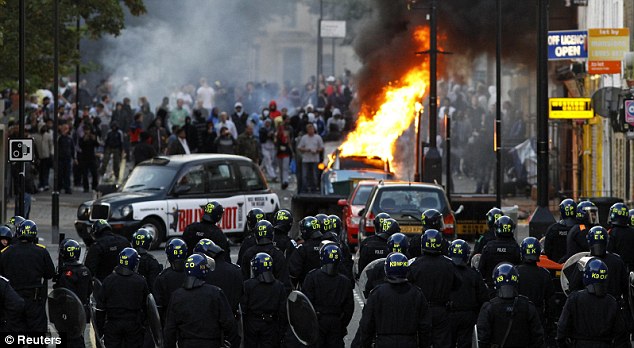
Thousands of extra police officers flooded into London Wednesday in a bid to end Britain's worst rioting in a generation. An eerie calm prevailed in the capital, but unrest spread across England on a fourth night of violence driven by diverse and brazen crowds of young people.

Scenes of ransacked stores, torched cars and blackened buildings frightened and outraged Britons just a year before their country is to host the summer Olympic Games, bringing demands for a tougher response from law enforcement. Police across the country have made more than 1,100 arrests since the violence broke out over the weekend.

In London, where armored vehicles and convoys of police vans patrolled the streets, authorities said there would be 16,000 officers on duty — almost triple the number present Monday. They said a large presence would remain in the city through the next 24 hours at least.

The show of force seems to have worked.

"Without wishing to speak too soon it's been reasonably quiet for us so far tonight," London's Fire Brigade said in a message posted to Twitter earlier in the evening. "Let's hope it stays that way."

But outside the capital, chaos was spreading.

In the northwestern city of Manchester, hundreds of youths — some looking as young as 10 — rampaged through the city center, hurling bottles and stones at police and vandalizing stores. A women's clothing store on the city's main shopping street was set ablaze, along with a disused library in nearby Salford.

Manchester's assistant chief constable Garry Shewan said looting and arson had taken place there on an unprecedented scale.

"We want to make it absolutely clear — they have nothing to protest against," he said. "There is nothing in a sense of injustice and there has been no spark that has led to this."

Britain's riots began Saturday when an initially peaceful protest over a police shooting in London's Tottenham neighborhood turned violent. That clash has morphed into a general lawlessness in London and several other cities that police have struggled to halt.

While the rioters have run off with sneakers, bikes, electronics and leather goods, they also have torched stores apparently just for the fun of seeing something burn. They were left virtually unchallenged in several neighborhoods, and when police did arrive they often were able to flee quickly and regroup.

With police struggling to control the violence, some residents stood guard to protect their neighborhoods. Outside a Sikh temple in Southall, west London, residents stood guard and vowed to defend their place of worship if mobs of young rioters appeared. Another group marched through Enfield, in north London, aiming to deter looters.

In a potentially troublesome development, one far-right group said that about 1,000 of its members around the country were taking to the streets to deter rioters.

"We're going to stop the riots — police obviously can't handle it," Stephen Lennon, leader of the far-right English Defense League, told The Associated Press. He warned that he couldn't guarantee there wouldn't be violent clashes with rioting youths.

Anders Behring Breivik, who has confessed to the bombing and massacre that killed 77 people in Norway last month, has cited the EDL as an inspiration.

Meanwhile virtually every major city in England was seeing some form of unrest.

In the central England city of Nottingham, police said rioters hurled firebombs though the window of a police station, and set fire to a school and a vehicle outside a second police station — but there were no reports of injuries. A total of 90 people were arrested in attacks on stores, a college, a community center and cars.

Some 250 people were arrested after two days of violence in Birmingham — where police were investigating reports of shots fired in a restive inner-city neighborhood. "Officers are on the scene but there have been no injuries reported," the city's police department said in a statement.

In the northern city of Liverpool, about 200 youths hurled missiles at police and firefighters in a second night of unrest, and the area's police force reported 44 arrests.

There also were minor clashes for the first time in the central and western England locations of Leicester, Wolverhampton, West Bromwich, Bristol, and the western city of Gloucester — where police and firefighters tackled a blaze and disturbance in the city's Brunswick district.

In London, stores, offices and nursery schools had closed early Tuesday evening amid fears of fresh rioting. Several usually busy streets were quiet as cafes, restaurants and pubs also decided to shut down for the night.

Many shops had their metal blinds pulled down, while other business owners rushed to secure plywood over their windows before nightfall.

In east London's Bethnal Green district, convenience store owner Adnan Butt, 28, said the situation was still tense.

"People are all at home — they're scared," he said.

Senior officers said they were considering the possible use of plastic bullets — blunt-nosed projectiles designed to deal punishing blows to rioters without penetrating the skin. Such weapons, formally called baton rounds, still are used to quell riots in Northern Ireland but have never been used by police on Britain's mainland.

Prime Minister David Cameron's government rejected calls by Conservative lawmaker Patrick Mercer and some members of the public for strong-arm riot measures that British police generally avoid, such as tear gas and water cannons.

"They should have the tools available and they should use them if the commander on the ground thinks it's necessary," Mercer said.

The disorder has caused heartache for Londoners whose businesses and homes were torched or ransacked, and a crisis for police and politicians already staggering from a spluttering economy and a scandal over illegal phone hacking by a tabloid newspaper that has dragged in senior politicians and police.

"The public wanted to see tough action. They wanted to see it sooner and there is a degree of frustration," said Andrew Silke, head of the criminology department at the University of East London.

So far 768 people have been arrested in London and 167 charged — including an 11-year-old boy — and the capital's prison cells were overflowing. Britain's Crown Prosecution Service said it had teams of lawyers working 24 hours a day to help police decide whether to charge suspects, allowing them quickly clear police station cells.

A total of 111 officers and 14 members of the public have been hurt so far in the rioting, including a man in his 60s who was attacked as he attempted to put out a fire started by members of a mob.

Police said the injured man had been tackling a blaze in a garbage bin, when he was set upon by several rioters. "It was quite a grave assault and his condition is causing us some concern," said police commander Simon Foy.

The unrest has been Britain's worst since race riots set London ablaze in the 1980s.

A soccer match scheduled for Wednesday between England and the Netherlands at London's Wembley stadium was canceled to free up police officers for riot duty. Britain's soccer authorities said they were in talks with police to see whether this weekend's season-opening matches of the Premier League could still go ahead in London.

Prime Minister David Cameron cut short a holiday in Italy to deal with the crisis, reversing an earlier decision to remain on his vacation. He recalled Parliament from its summer recess for an emergency debate on the riots Thursday.

Cameron described the scenes of burning buildings and smashed windows as "sickening," but refrained from tougher measures such as calling in the military to help restore order.

"People should be in no doubt that we will do everything necessary to restore order to Britain's streets and to make them safe for the law-abiding," Cameron told reporters after a crisis meeting at his Downing Street office.

Other politicians visited riot sites Tuesday — but for many residents it was too little, too late.

Deputy Prime Minister Nick Clegg was booed by crowds who shouted "Go home!" in Birmingham, while London Mayor Boris Johnson — who flew back overnight from his summer vacation — was heckled on a shattered shopping street in Clapham, south London.

Johnson said the riots would not stop London from "welcoming the world to our city" for the Olympics.

"We have time in the next 12 months to rebuild, to repair the damage that has been done," he said. "I'm not saying it will be done overnight, but this is what we are going to do."

The violence had its genesis in the fatal police shooting of Mark Duggan, a 29-year-old father of four who was gunned down in Tottenham on Thursday under disputed circumstances.

Police said Duggan was shot dead when officers from Operation Trident — the unit that investigates gun crime in the black community — stopped a cab he was riding in. A protest demanding justice on Saturday devolved into a riot, which spread to neighboring parts of London on Sunday and by Monday had spread across the capital.

Duggan's death resonated in part because it stirred memories of the 1980s, when many black Londoners felt they were disproportionately stopped and searched by police. Their frustration erupted in violent riots in 1985.

But the rioters who've taken to the streets since Sunday have been extremely diverse — those in central England appeared to be mostly white and working class.

The Independent Police Complaints Commission, which is investigating Duggan's shooting, said a "non-police firearm" was recovered at the scene, but that there was no evidence it had been fired, or that Duggan had fired a weapon at police. An inquest into Duggan's death was opened Tuesday, but a full hearing will likely take several months.

Seeking explanations for the unrest, some pointed to rising social tensions in Britain as the government slashes 80 billion pounds ($130 billion) from public spending by 2015 to reduce the country's huge budget deficit, swollen after the country spent billions bailing out its foundering banks.

But many rioters appeared simply to relish the opportunity for unchecked violence Monday night. "Come join the fun!" shouted one youth as looters hit the east London suburb of Hackney.

Monday, August 8, 2011

Protest movements teach economics to bankers

Al Jazeera

In order to avoid continued economic malaise, the European Central Bank should raise inflation rate targets.
The European Central Bank (ECB) is run by people who are not very good at economics. They continue to adhere to a fundamentally wrongheaded view of the economy and the central bank's role within it.

Unfortunately, there is no internal pressure for change because, like the Communist Party in the Soviet Union, acceptance of the ideology is the price for admission into the clique of economists who can influence the ECB.
The central tenet of ECB dogma is that the central bank should target a low inflation rate - two per cent - and pretty much ignore everything else in the economy.

In the past decade, this meant ignoring the massive housing bubbles that were driving the economies of Ireland and Spain. The bank was happy all through the period in which the bubbles were growing to ever-more-dangerous levels because it was hitting its inflation targets.

More recently, the ECB has been raising interest rates even as most of the eurozone economies remain mired in high unemployment. These interest rate hikes slow growth and job creation. Higher interest rates also exacerbate the fiscal problems facing heavily indebted countries, since they make it more expensive for them to service their debt.

In the firing line

In other lines of work, the disastrous consequences of the ECB's recent and current policies would get people fired. However, no one is really in a position to fire the ECB bank president and top staff, so they could in principle continue their failed policy approach indefinitely.

But there is hope. Because the people running the ECB are not very good at economics, they keep running into difficulty with their plans to "rescue" Greece, Spain, and the other eurozone countries facing fiscal crises. As a result, they have to continually run back to these countries and work out new loan packages. Each package involves new and more onerous conditions for the debtor countries.

What the ECB has failed to recognise is that its own policies are making it more difficult for these countries to make their loan payments. This is due both to the fact that the policies are contractionary for the eurozone as a whole, and also because the conditions imposed on debtor countries slow growth. With weaker growth, tax collections fall and more money is paid out in unemployment insurance and other transfers to the unemployed. The result is higher deficits.

This is where the popular movements like 15-M in Spain come in. While the governments may be willing to inflict upon their population whatever pain the ECB requests, the popular movements are making this an increasingly difficult process. The governments of these countries are being forced to recognise that they must consider public opinion and not just accept the dictates of the ECB.

The default position

In fact, since the ECB would never want to see one of the eurozone countries default, the popular movements could find themselves in a situation where they are effectively negotiating with the ECB, since they can set bounds on the conditions that their governments can accept. This will allow them to teach the ECB crew some basic economics.

First on the list of lessons is to tell the ECB that the days of worshipping two per cent inflation targets is over. That may have been cute policy before the downturn, but everyone knows now that it was boneheaded. Central banks have to take greater responsibility for maintaining stability and high levels of employment. Furthermore, a low rate of inflation - like two per cent - provides insufficient room for the adjustments that must be made in the sort of crisis the world economy now faces. The popular movements can assign the ECB staff this excellent paper on the topic by Olivier Blanchard, the IMF's chief economist.

The second item, which would be especially relevant to Spain, would be a requirement that governments take strong measures to get vacant homes back on the market. According to government data, Spain's building boom left the country with more than 1m vacant units. This is pure waste - what economists call "deadweight loss".

The government can give the builders or banks that own these properties a strong incentive to sell or rent them by imposing a large tax (eg five per cent of value) on units that are vacant for long periods of time. If the tax isn't paid, then it could seize the property and then make it available directly. It could even use sound free-market principles, like allowing people to take possession of property and then become the owners if they live in and maintain it for a long enough period of time. This would follow the example of the Homestead Act in the United States.

Finally, governments can take the lead from the United States in another area and adopt bankruptcy laws that make it easier to shed debt. As it stands, many people who bought homes at bubble-inflated prices stand to spend the rest of their working lives paying off their debts. In addition to being cruel to people who made a mistake, it also creates enormous disincentive to work or to work in the underground economy.

If a person has to commit 15 per cent of their income to paying off debt, it has the same effect on incentives as a 15 percentage point increase in the income tax. Economists understand that taxes can have a disincentive effect. They should be able to understand that debt repayments can also have a large disincentive effect.

This would be the start of a good economics lesson for the ECB. It will mean better policy, and maybe it can even help turn the people running the ECB into competent economists.

Dean Baker is an American macroeconomist and co-founder if the Center for Economic and Policy Research.

U.K. riots spread to 4th city

Violence and looting raged across London and spread to three other major British cities on Tuesday, as authorities struggled to contain the country's most serious unrest since race riots set the capital ablaze in the 1980s.

In London, a third straight night of disorder saw buildings, vehicles and garbage dumps set alight, stores looted and police officers pelted with bottles and fireworks, as groups of young people rampaged through neighborhoods. It was an unwelcome reminder of London's volatility for leaders organizing the 2012 Summer Olympics in less than a year.

As authorities struggled to keep pace with unrest unfolding at flashpoints across London, the violence spread to the central city of Birmingham, the western city of Bristol and the northwestern city of Liverpool. Prime Minister David Cameron cut short his summer vacation in Italy and was headed home for a meeting of the national crisis committee on Tuesday morning.

The riots appeared to have little unifying cause - though some involved in the violence claimed to be motivated by government cuts to public spending.

The government was aiming to toughen its stance against the violence, as some communities complained that stretched police were struggling to contain the unrest with rioters plundering from stores at will, menacing shocked customers at restaurants and attempting to invade homes. Stores shut early across London, fearful of violence and looting.

Violence first broke out late Saturday in London's northern Tottenham district when a peaceful protest over the fatal police shooting of Mark Duggan, a 29-year-old father of four who was gunned down in disputed circumstances Thursday, turned violent.

Two police cars and a double-decker bus were set alight, stores were looted and several buildings along Tottenham's main street - five miles (eight kilometers) from the site of the 2012 Olympics - were reduced to smoldering shells.

Duggan's death stirred old animosities and racial tensions which prompted riots in the 1980s, despite efforts by London police to build better relations with the city's ethnic communities after high-profile cases of racism in recent decades.

As the unrest spread, some pointed to rising social tensions in Britain as the government slashes 80 billion pounds ($130 billion) from public spending by 2015 to reduce the huge deficit, swollen after the country spent billions bailing out its foundering banks.

In south London, a massive blaze swept through a 100-year-old family run furniture store in the borough of Croydon and sent thick plumes of smoke into the air, forcing nearby homes to be evacuated. Police also confirmed they were investigating a nonfatal shooting in Croydon, but were unable to say whether the incident was linked to the chaos.

Dozens of people attacked shops in Birmingham's main retail district, and clashed with police in Liverpool and Bristol - spreading the chaos beyond London for the first time.

In the Hackney area of east London, hundreds of youths attacked shops and set fire to cars, leaving a trail of burning trash and shattered glass. Looters ducked into a small convenience store as the blackened shells of two cars burned nearby, filling plastic shopping bags with alcohol, cigarettes, candy and toilet paper.

"This is the uprising of the working class. We're redistributing the wealth," said Bryn Phillips, a 28-year-old self-described anarchist, as young people emerged from the store with chocolate bars and ice cream cones.

Phillips claimed rioters were motivated by distrust of the police, and drew a link between the rage on London's street and insurgent right-wing politics in the United States. "In America you have the tea party, in England you've got this," he said.

Police acknowledged Tuesday that major new bouts of violence had flared in at least five locations, badly stretching their resources. Many more neighborhoods saw mobs vandalize commercial streets or break into buildings - some acting with virtual impunity, as authorities struggled to deploy officers to every scene of unrest.

"The violence we have seen is simply inexcusable. Ordinary people have had their lives turned upside down by this mindless thuggery," police commander Christine Jones said, as she confirmed that 239 people had been arrested and 45 people charged with offenses.Though the unrest escalated through Sunday as disorder spread among neighboring areas, the crisis worsened Monday - with violence touching areas in the east and south of London previously untroubled by the chaos.

"There is significant disorder breaking out in a number of our communities across London," Tim Godwin, the acting London police commissioner said Monday, acknowledging that 1,700 extra officers had been deployed across London, but were struggling to halt the unrest.

Some residents called for police to deploy water cannons to disperse rioters, or call on the military for support.

About 100 young people clashed early Tuesday with police in the Camden and Chalk Farm areas of north London, while others tore through a department store in the busy south London suburb of Clapham.

The small groups of youths - most with their heads and faces covered - used SMS messages, instant messaging on BlackBerry smartphones and social media such as Twitter to coordinate their attacks and stay ahead of the police.

Once the preserve of businesspeople, BlackBerry handsets are popular with teenagers, thanks to their free, fast instant messaging system. Blackberry's manufacturer, Research in Motion, said in a statement that it was assisting authorities in their investigation and "feel for those impacted by the riots in London."

Police were also monitoring Twitter, and warned that those who posted messages inciting the violence could face arrest.

In the Peckham district of south London, where a building was set ablaze along with a bus - which was not carrying passengers - onlookers said the scene resembled a conflict zone. Cars were torched in nearby Lewisham, and shops looted in south London's Clapham district.

"There's been tension for a long time. The kids aren't happy. They hate the police," said Matthew Yeoland, a 43-year-old teacher watching the unrest in Peckham. "It's like a war zone and the police weren't doing anything. There were too many people and not enough police."

Police said Duggan was shot dead last week when police from Operation Trident - the unit that investigates gun crime in the black community - stopped a cab he was riding in.

The Independent Police Complaints Commission, which is investigating the shooting, said a "non-police firearm" was recovered at the scene, and media reports said a bullet had been found in an officer's radio. However, the Guardian newspaper reported that the bullet in the radio was police-issue, indicating Duggan may not have fired at the officer.

Duggan's partner, Semone Wilson, insisted Monday that her fiance was not connected to gang violence and urged police to offer more information about his death. But she said the riots appeared to be no longer linked to the initial protests. "It got out of hand. It's not connected to this anymore. This is out of control," she said.

London riots: Violence erupts for third day

Violence has broken out for a third consecutive day in London, with riot police deployed and firefighters tackling blazes across the capital.

Shops were looted and buildings, among them a furniture store in Croydon, set alight as police clashed with youths.


Trouble first flared on Saturday after a peaceful protest in Tottenham over the fatal shooting of a man by police.

The prime minister is returning early from holiday to chair a meeting of the government's emergency committee Cobra.

Saturday, August 6, 2011

China tells U.S. "good old days" of borrowing are over


China bluntly criticized the United States on Saturday one day after the superpower's credit rating was downgraded, saying the "good old days" of borrowing were over.

Standard & Poor's cut the U.S. long-term credit rating from top-tier AAA by a notch to AA-plus on Friday over concerns about the nation's budget deficits and climbing debt burden.

China -- the United States' biggest creditor -- said Washington only had itself to blame for its plight and called for a new stable global reserve currency.

"The U.S. government has to come to terms with the painful fact that the good old days when it could just borrow its way out of messes of its own making are finally gone," China's official Xinhua news agency said in a commentary.

After a week which saw $2.5 trillion wiped off global markets, the move deepened investors' concerns of an impending recession in the United States and over the euro zone crisis.

Finance ministers and central bankers of the Group of Seven major industrialized nations will confer by telephone later on Saturday or on Sunday, a senior European diplomatic source said.

The source said the credit rating downgrade had added a global dimension on top of the euro zone debt issue, raising the need for international coordination.

"The G7 will confer by telephone. It's not yet confirmed whether it will be in one stage or in two stages, tonight and tomorrow," the source said.

French Finance Minister Francois Baroin, who would chair such a meeting under France's G7 and G20 presidency, said it was too early to say whether there would be an early G7 gathering.

In the Xinhua commentary, China scorned the United States for its "debt addiction" and "short sighted" political wrangling.

"China, the largest creditor of the world's sole superpower, has every right now to demand the United States address its structural debt problems and ensure the safety of China's dollar assets," it said.

It urged the United States to cut military and social welfare expenditure. Further credit downgrades would very likely undermine the world economic recovery and trigger new rounds of financial turmoil, it said.

"International supervision over the issue of U.S. dollars should be introduced and a new, stable and secured global reserve currency may also be an option to avert a catastrophe caused by any single country," Xinhua said.

In Washington, President Barack Obama urged lawmakers on Saturday to set aside partisan politics after the debt battle, saying they must work to put the United States' fiscal house in order and refocus on stimulating its stagnant economy.

S&P blamed the downgrade in part on the political gridlock in Washington, saying politics was preventing the United States from addressing its deficit and debt problems.

Obama called on Congress to back measures to give tax relief to the middle class, extend jobless benefits and pass long-delayed international trade pacts.

"Both parties are going to have to work together on a larger plan to get our nation's finances in order," he said.

"In the long term, the health of our economy depends on it...in the short term, our urgent mission has to be getting this economy growing faster and creating jobs."

STAY COOL

In contrast to the Chinese criticism, France's Baroin said France had faith in the United States' ability to get out of this "difficult period."

Friday's U.S. unemployment numbers were better than expected and so things were heading in the right direction, he said.

"Therefore, one should not dramatise, one needs to remain cool-headed, one should look at the fundamentals," he told France's iTele.

While the impact of the rating cut on financial markets when they reopen on Monday may be modest because the decision was expected, the shift may have a long-term impact for U.S. standing in the world, the dollar's status, and the global financial system.

"I think even if it was half-expected, the consequence will be far reaching," said Ciaran O'Hagan, fixed income strategist at Societe Generale in Paris.

"It will weigh on secure assets. The bigger reaction will be on risky assets, including equities and on agencies (Freddie Mac, Fannie Mae) and states backed directly by the federal government."

But he added: "U.S. Treasuries will remain a benchmark. This is a ship which takes a long time to turn around."

Norbert Barthle, a budget expert for German Chancellor Angela Merkel's conservatives said the downgrade would certainly provoke further turbulence in markets.

"I'm not surprised about the U.S. rating downgrade, rather I am astonished that for weeks, international rating agencies have focused their attention on the European debt situation but not the American one. For a while, there have been clear worries about America's economic woes but also the fact the U.S. is heavily indebted."

NO EARLY ITALIAN ELECTION

In Europe, Italian Prime Minister Silvio Berlusconi on Saturday ruled out calling early elections to stem market panic that has pounded Italian assets and forced his government to bring forward austerity measures.

Italy buckled on Friday to world pressure by pledging to bring forward cuts to balance the budget in 2013 in return for European Central Bank help with funding.

European policy makers are concerned that a debt emergency in the euro zone's third largest economy could completely overwhelm bailout mechanisms set up to help smaller troubled countries like Greece or Ireland.

Italy is due to go to the polls in 2013 but Berlusconi dismissed any suggestion of emulating Spain, where Prime Minister Jose Luis Rodriguez Zapatero has called an early election to tackle the crisis.

"This has absolutely not been talked about," Berlusconi told reporters. "This has never been an option."

The European Union's top economic official praised Italy's decision to accelerate budget-balancing measures and structural economic reforms and said swift implementation was now crucial.

"I strongly support this announcement and call on the authorities to quickly translate it into concrete measures," European Economic and Monetary Affairs Commissioner Olli Rehn told Reuters in a telephone interview.

"This will help to boost potential growth, secure budgetary retrenchment and bolster market confidence," Rehn said.

The European Central Bank sources said the bank remains divided over whether to buy Italian government bonds but even some of those who favor the move say Italy should do more to front-load austerity measures.

Two sources said they expected ECB President Jean-Claude Trichet to hold a teleconference of the bank's policy-setting Governing Council over the weekend to discuss how to respond to turmoil in financial markets and Italy's latest measures.

China and Japan have called for coordinated action to avert a new worldwide financial crisis. India's finance minister Pranab Mukherjee told reporters: "There is no need to unnecessarily press the panic button."

Friday, August 5, 2011

Four People Killed During Anti-NATO Protest In Afghanistan

Afghan officials say Taliban fighters opened fire on Afghan police at an anti-NATO rally in southern Afghanistan today, sparking a gunbattle that killed three civilians and a police officer.

Officials said the insurgents infiltrated the protest in the town of Qalat in the southern province of Zabul and fired at police.

Police responded by firing at the insurgents in the crowd.

The demonstrators had gathered to protest the reported deaths of civilians during a NATO operation overnight.

2011 is bloodiest year for Karachi since 1995


At least 800 people have been killed in ethnic clashes and politically linked violence in Karachi this year, the bloodiest since 1995, Pakistan's human rights commission said Friday.

Zohra Yousuf who heads the Human Rights Commission of Pakistan (HRCP) said the 800 people were victims of often targeted and violent shootings in the last seven months.

“The figures are a cause of great concern for every law abiding Pakistani," she said.

Previously the HRCP had put the figure of those killed in the violence in Karachi in the first six months of the year to around 500 but in one of the bloodiest months witnessed by the city another 300 people were killed in July.

Yousuf said the figures compiled by the HRCP staff also through police records showed that around 300 people were killed in July.

The figures represent a big challenge for the government which has already deployed an additional force of 1000 Frontier Constabulary (FC) soldiers in the city to assist the police and para-military rangers to control the violence.

'Baloch madrassa students cultivating poppy in Afghanistan'

Hundreds of madrassa students from Chaman and the adjoining tribal regions of Balochistan are reportedly being engaged by Afghan farmers for poppy cultivation in the two major heroin-producing provinces of Helmand and Kandahar for the past three months.

Local sources said these Pakistani madrassa students make a beeline for Taliban strongholds to make some money during their summer holidays, which start from the first week of June.

“It is a source of easy money for madrassa students,” a local social worker of Ziarat who is well acquainted with many in the poppy harvesting workforce, said, adding: Each student makes around15 to 20 dollars a day. They are being paid in the local Afghani currency which has gained strength against the Pakistani rupee in recent months.”

“Most students returned home with 1,500 to 2,000 dollars after the harvesting season last year,” The Express Tribune quoted him, as saying.

Gunman killed near Saudi prince's palace

Saudi security forces killed a gunman on Saturday morning after he fired at a checkpoint near the Interior Minister's palace in Jeddah, the state news agency said.

"At 1 a.m. on Saturday, a person carrying a gun fired at a checkpoint in Abdulrahman Al-Malki Street in Jeddah. He was dealt with swiftly and was killed. The event is still under investigation," the statement said.

Around the same time two years ago the Interior Minister's son, Prince Mohammed bin Nayef Al-Saud, who oversees the country's counter-terrorism program, survived an attempt on his life by a suicide bomber posing as a repentant militant.

Interior Ministry spokesperson Mansour al-Turki referred a call for comment to Jeddah police spokesperson Mesfer Aljoayed, who was not immediately available.

The world's biggest oil producer, Saudi Arabia, is an absolute monarchy without an elected parliament or political parties.

Interior Minister Prince Nayef, who is believed to be in his late 70s, was appointed as second deputy prime minister in 2009. He spearheaded the country's crackdown on al-Qaeda militants who aimed to destabilize the country between 2003- 2006.

US urges citizens to leave Syria immediately


State Department warns that given the "ongoing uncertainty and volatility" American citizens are urged to leave immediately while transportation is still available.
Americans in Syria are encouraged to leave and travel to the country should be postponed, the US State Department said on Friday following widespread violence that has pitted thousands of protesters against the government.

The State Department warned that given the "ongoing uncertainty and volatility" US citizens are urged to leave immediately while transportation is still available. The advisory also encouraged Americans who remain to limit any nonessential travel within the country.The advisory expands a travel warning issued in late April that ordered eligible family members of US government employees and certain non-emergency personnel to leave.

Syrian security forces on Friday killed at least 18 protesters in attacks on tens of thousands of protesters who poured into the streets to demonstrate against the rule of President Bashar Assad on the first Friday of the Muslim fasting month of Ramadan.The four-month-old uprising has grown increasingly violent in recent days as tanks have launched an attack on the central city of Hama in an effort to quell pro-democracy protesters. An estimated 300 people have been killed since the military assault began on Sunday on the city of 700,000 people in central Syria.

The Syrian protesters are defying a bloody military crackdown on uprisings that began in March against some 41 years of Assad family domination.

The White House said US President Barack Obama and leaders from France and Germany have agreed to take measures to pressure Assad over his crackdown, but so far they have not outlined what those steps might be.