M WAQAR..... "A man's ethical behavior should be based effectually on sympathy, education, and social ties; no religious basis is necessary.Man would indeed be in a poor way if he had to be restrained by fear of punishment and hope of reward after death." --Albert Einstein !!! NEWS,ARTICLES,EDITORIALS,MUSIC... Ze chi pe mayeen yum da agha pukhtunistan de.....(Liberal,Progressive,Secular World.)''Secularism is not against religion; it is the message of humanity.'' تل ده وی پثتونستآن
Saturday, January 29, 2011
Thousands in Cairo defy curfew
Tens of thousands of people in the Egyptian capital Cairo have gathered on the streets, in continued protests demanding an end to Hosni Mubaraks's 30-year presidency.
The demonstrations continue in defiance of an extended cufew on Saturday, where state television reported will be in place from 4pm to 8am local time.
A military presence also remains, and the army warned the crowds in Tahrir Square that if they defy the curfew, they would be in danger.
Al Jazeera's Ayman Mohyeldin, reporting from Cairo, said that soldiers deployed to central Cairo are not intervening in the protests.
"Some of the soldiers here have said that the only way for peace to come to the streets of Cairo is for Mubarak to step down," he said.
Similar crowds were gathering in the cities of Alexandria and Suez, Al Jazeera's correspondents reported.
Reports have also emerged that at least three people have been killed, as protesters attempted to storm the interior ministry in Cairo.
Fears of looting have also risen, and the army on Saturday warned local residents to "protect their property and possessions".
In the city of Alexandria, residents called on the army to protect them against looting, as well as organising their own committees in defence.
Cabinet resigns
The Egyptian cabinet meanwhile have formally resigned in response to the protests, and Ahmed Ezz, a businessman and senior figure in the ruling National Democratic Party (NDP) also resigned from his post as chairman of the Planning and Budget Committee.
Protesters ransacked and burned one of his company's main offices in Mohandiseen, an area of Cairo.
State media reported on Saturday that some protesters held up posters with a cross marked over the face of Ezz, who is chairman of Ezz Steel.
Overnight protests were also held on Friday in cities across the country, in what has been viewed as unprecedented anger on the part of the Egyptian people.
In Alexandria, Al Jazeera's Rawya Rageh reported that scores of marchers were calling on Hosni Mubarak to step down.
"They are calling for regime change, not cabinet change," Rageh said.
She said that they were blocking traffic and shouting "Illegitimate, illegitimate!"The Reuters news agency reported that police had fired live ammunition at protesters, but there is no independent confirmation of that report.In Suez, Al Jazeera's Jamal ElShayyal reported that 1,000-2,000 protesters had gathered, and that the military was not confronting them.
ElShayyal quoted a military officer as saying that troops would "not fire a single bullet on Egyptians".
ElShayyal said that 1,700 public workers in Suez had gone on an indefinite strike seeking Mubarak's resignation.
The latest protests reflected popular discontent with Mubarak's midnight address, where he announced that he was dismissing his government but remaining in power.
The several hundred protesters in Tahrir Square demonstrated in full view of the army, which had been deployed in the city to quell the popular unrest sweeping the Middle East's most populous Muslim country since January 25.
They repeatedly shouted that their intentions were peaceful.
According to the Associated Press, the road leading from Tahrir Square to the parliament and cabinet buildings has been blocked by the military.
Al Jazeera's Jane Dutton, reporting from Cairo, said the normally bustling city looked more like a warzone early on Saturday morning.
Tanks have been patrolling the streets of the capital since early in the morning, and a statement from the Egyptian armed forces asked citizens to respect the curfew and to avoid congregating in large groups.
An extended curfew has now been ordered by the military, running from 4pm to 8am local time, in Cairo and other major cities.
State television is also reporting that all school and university exams have been postponed.
The officer also said the only solution to the current unrest was "for Mubarak to leave".
Source: Al Jazeera and agencies
Arab people's 'Revolution'
By Salman Shaikh, Special to CNN
We are in the midst of a brave new world.
The uprisings raging from Tunisia to Egypt to Yemen are heralding a new Arab, post-Islamist revolution.
Today's events across Egypt illustrate the futility of a dictatorial Mubarak regime seeking to push back the tides of history with mere repression and brutality. They will not succeed.
President Hosni Mubarak's days, like those of deposed Tunisian President Zine El-Abidine Ben Ali, are numbered. The effects on the region were, until today, unthinkable.
Today's Arab revolution is no less significant than those that preceded it in recent decades in Eastern Europe and Latin America. This time, Arabs are not being led by their leaders -- from colonialism to pan-Arabism or Islamism or any other "ism" -- as was the case in the past.Instead, they have turned on those leaders who have failed to provide them their dignity, justice and a better life. Make no mistake, we are witnessing today an Arab people's revolution.
Like those before them, today's Arab revolution will transform the region's politics. What is happening today is nothing short of what the respected Arab commentator, Rami Khouri, prophetically described late last year as the birth of Arab politics. He was right. Politics in the region will never be the same again.
Propelled by the young and the digital revolution, citizens will demand nothing less than the right to choose and change their representatives in the future.
To glimpse the nature of what can emerge, we should understand the rapidly changing social structure of Arab societies. Those societies are more educated, urban and connected than ever before. Due to the phenomenal growth of secondary and university-level education, literacy rates among the region's youths have skyrocketed in the past 40 years. The percentage of people living in Arab cities has risen by 50% in the same period.
The number of mobile phone users and internet users has proliferated to hundreds of thousands since the technology was introduced to the region 10 or 15 years ago. No wonder, then, that the people have finally snapped at the lack of opportunity and representation and the high levels of corruption and control that characterize their lives.
Most tellingly, more has united the protesting people than divided them. Notable has been the absence of a clear, emerging leader of the protests, particularly from Islamist party leadership.
The call for dignity, justice and a better life has been a universal value -- not the domain of any one particular opposing party or movement. Instead, the national movements, which these conditions have spawned, will continue to demand a political system that is more pluralistic, democratic and produces effective and competent governments sensitive to the legitimate aspirations of all the society's people.
Crucially, the unfolding events will also require a new set of calculations from the old regimes' main backers: the United States and its allies. The long-term changes for Western policy in the region should be profound. Gone should be the reflex to side with those who willfully subvert the democratic and constitutional process out of fear of the Islamist boogeyman.
The binary calculation between supporting stability on the one hand and the risks of unprecedented regime change, particularly the rise to power of Islamist parties, no longer holds. The people of the region are deciding.
The irony is that while U.S. policymakers have been playing catch-up, it has largely been U.S.-created technology -- the internet, particularly Facebook and Twitter -- that has sustained the spread of the Arab revolution.
Now is the time for policymakers to suggest an appropriate response to support a peaceful political transition in each country. Western policymakers must strike a careful balance between ensuring key interests (including support for a comprehensive peace in the Arab-Israeli conflict and Israel's security) and respecting the wishes of the region's people. In this regard, support for the peace process and Israel's interests will best be ensured by real and tangible progress over the next year.
In the case of Egypt, the most populated Arab nation and symbol of Arab leadership, the transition will be particularly important. If managed well, it will provide a useful example for all in the days and weeks ahead. The U.S. in particular has a role in persuading Mubarak to outline a peaceful transition of power to an interim administration that will manage the process to a new democratic constitution and elections.
There should also be a role for international and regional organizations such as the United Nations, the European Union, the Gulf Council and the Organization of the Islamic Conference to lend technical and material support to the transition.
It has not been lost on many that the U.S. and other Western governments have been trying to catch up to the unfolding events -- attempting to balance support for old friends and allies with a call for restraint and urgent economic and political reforms.
This will not do. It is time to break through the past fears that have guided Western policy with fresh hope for a better future for the people of the region. It is time to choose change.
Egypt's government resigns as thousands take to streets again
Egyptian President Hosni Mubarak's cabinet resigned Saturday as anti-government ferment spurred thousands of demonstrators to take to the streets again to demand change.
At least 38 people have died in the demonstrations, including 10 members of the security forces, the state-run Nile TV said."I understand these legitimate demands of the people and I truly understand the depth of their worries and burdens, and I will not part from them ever and I will work for them everyday," he said. "But regardless of what problems we face, this does not justify violence or lawlessness."
As Mubarak spoke overnight, protesters burned police stations in Cairo and Alexandria, and overturned and torched police vehicles.
U.S. President Barack Obama said he spoke with Mubarak after he broke his silence.
"I just spoke to him after his speech, and told him he has a responsibility to give meaning to those words, to take concrete steps and actions that deliver on that promise," Obama said in a televised appearance.
"Violence will not address the grievances of the Egyptian people," Obama said. "Suppressing ideas never succeeds in making them go away."
A senior Obama administration official, meanwhile, said Friday evening that Mubarak's speech was "hardly conciliatory and highly disappointing, but what did you expect?"
It's clear, the official said -- speaking on condition of anonymity because of the sensitivity of the matter -- that Mubarak believes he can ride this out, "and this time, we're not so sure that is the right assumption."
People gathered, expecting an announcement of resignation from Mubarak. When that did not happen, a celebratory mood quickly turned back into anger.
Earlier, protesters ransacked the headquarters of the ruling National Democratic Party and set it afire. On Saturday afternoon, thousands of chanting demonstrators filed passed the smoldering building.
As they approached the state-run television building, soldiers linked arms, forming a human chain to hold back the protesters. The crowd stopped respectfully in front of the troops, and continued chanting "Down, down, Hosni Mubarak" and "the people want to bring down the regime."
"We will not stop until we get a new president," said Mustafa, who wouldn't give his full name for fear of reprisal.
The Egyptian crisis reverberated across the world, with stocks plunging on news of unrest and airlines cancelling flights.
The unprecedented protests in Egypt come weeks after similar disturbances sparked a revolution in Tunisia, forcing then-president Zine El Abidine Ben Ali to flee the country. Similar Tunisia-inspired demonstrations have taken place in Algeria, Yemen and Jordan.
Tension reigned in Cairo's central Tahrir Square, which has been the focal point of Cairo's protests since they erupted Tuesday. On Saturday, people chanted: "Down with Mubarak" and "We are all Egyptians." People posed for snapshots with tanks and soldiers providing security.
The powerful Egyptian army, deployed to the streets for the first time since the mid-1980s, is much more respected than the police and many protesters embraced their presence. Whether the 450,000-strong armed forces will remain loyal to Mubarak is key for the nation's future.
The government imposed another nighttime curfew from 4 p.m. to 8 a.m. Sunday in Cairo, Alexandria and Suez, the cities where the largest protests have unfolded. A previous curfew had been in place nationwide Friday night into Saturday morning but it failed to keep people off the streets.Meanwhile, the consequences of the unrest started becoming apparent Saturday as Egypt's Central Bank announced the closure of all banks as well as the stock market on Sunday, state-run television reported. And mid-year university examinations were postponed.
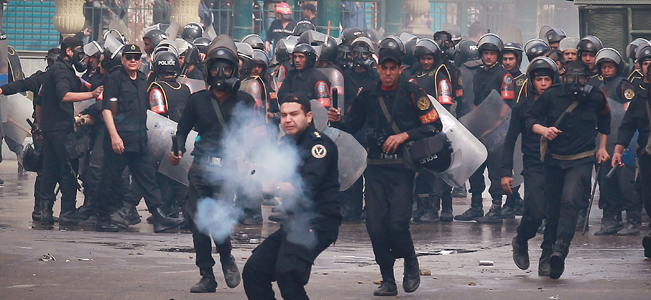
That followed a brutal crackdown throughout Friday when thousands of riot and plainclothes police clashed violently with the protesters, firing water cannons, rubber bullets and tear gas with force and impunity.
Undeterred, people ran, screamed, hurled rocks and accosted walls of security as they tried to make their way to central Cairo.
Police again fired stinging tear gas Saturday on the crowds that rumbled towards the nation's Interior Ministry building, where police are based. But that appeared to be an isolated incident and most of the demonstrations proceeded peacefully.
In Alexandria, at least 2,000 protesters gathered in Raml Square. There was no sign of police, and protests appeared peaceful.
People smiled and shook hands with troops patrolling the area. One soldier cradled a baby and posed for a picture.
People chanted: "No for Mubarak and his dynasty" and "the military and the people together will change the regime."
After darkness on mobile networks Friday, cellular service appeared to have been restored Saturday morning. Text messaging is one of the most common modes of communication for Egyptians and it was cut off amid calls for intensified dissent.
Mubarak, 82, who has not been seen in public for some time, addressed the nation in a televised speech early Saturday. He said he asked his government to step down but he intended to stay in power.
"I asked the government to resign today and I will commission a new government to take over tomorrow," Mubarak said in a national address shortly after midnight.
The aging president has ruled Egypt with an iron fist for three decades and it was widely believed he was grooming his son, Gamal, as his successor, a plan that could be complicated by demands for democracy.
Mubarak said "these protests arose to express a legitimate demand for more democracy, need for a greater social safety net, and the improvement of living standards, fighting poverty and rampant corruption."I understand these legitimate demands of the people and I truly understand the depth of their worries and burdens, and I will not part from them ever and I will work for them everyday," he said. "But regardless of what problems we face, this does not justify violence or lawlessness."
As Mubarak spoke overnight, protesters burned police stations in Cairo and Alexandria, and overturned and torched police vehicles.
U.S. President Barack Obama said he spoke with Mubarak after he broke his silence.
"I just spoke to him after his speech, and told him he has a responsibility to give meaning to those words, to take concrete steps and actions that deliver on that promise," Obama said in a televised appearance.
"Violence will not address the grievances of the Egyptian people," Obama said. "Suppressing ideas never succeeds in making them go away."
A senior Obama administration official, meanwhile, said Friday evening that Mubarak's speech was "hardly conciliatory and highly disappointing, but what did you expect?"
It's clear, the official said -- speaking on condition of anonymity because of the sensitivity of the matter -- that Mubarak believes he can ride this out, "and this time, we're not so sure that is the right assumption."
People gathered, expecting an announcement of resignation from Mubarak. When that did not happen, a celebratory mood quickly turned back into anger.
Earlier, protesters ransacked the headquarters of the ruling National Democratic Party and set it afire. On Saturday afternoon, thousands of chanting demonstrators filed passed the smoldering building.
As they approached the state-run television building, soldiers linked arms, forming a human chain to hold back the protesters. The crowd stopped respectfully in front of the troops, and continued chanting "Down, down, Hosni Mubarak" and "the people want to bring down the regime."
"We will not stop until we get a new president," said Mustafa, who wouldn't give his full name for fear of reprisal.
The Egyptian crisis reverberated across the world, with stocks plunging on news of unrest and airlines cancelling flights.
The unprecedented protests in Egypt come weeks after similar disturbances sparked a revolution in Tunisia, forcing then-president Zine El Abidine Ben Ali to flee the country. Similar Tunisia-inspired demonstrations have taken place in Algeria, Yemen and Jordan.
Massive demonstration swells in downtown Cairo
A massive crowd of tens of thousands calling for the ouster of President Hosni Mubarak was gathering in the streets and squares of downtown Cairo Saturday afternoon, with protesters making clear they reject promises of reform and a new government offered by the embattled leader trying to hang on to power.
Dozens of tanks and armored personnel carriers fanned out across the city of 18 million, guarding key government building a day after large, violent confrontations emboldened the movement demanding a change of leadership. There was rampant looting across the sprawling city of 18 million and a growing feeling of fear and insecurity.
In the city's main Tahrir Square, at the center of Saturday's massive demonstration, there was only a light military presence — a few tanks — and soldiers are not intervening. Few police were seen in the crowds and the protest began peacefully but then police opened fire on some people in the crowd near the Interior Ministry and a number of them were wounded by gunshots. It was not clear whether they used rubber bullets or live ammunition.
One army captain joined the demonstrators, who hoisted him on their shoulders while chanting slogans against Mubarak. The officer ripped a picture of the president.
"We don't want him! We will go after him!" demonstrators shouted. They decried looting and sabotage, saying: "Those who love Egypt should not sabotage Egypt!"
The death toll since the largest anti-government protests in decades began Tuesday rose to 45, according to medical and security officials, 38 of them killed since Friday. Some 2,000 injuries have been reported.
Dozens of military armored personnel carriers and tanks as well as soldiers on foot deployed around a number of key government buildings in the capital, including state television and the Foreign Ministry after thousands of protesters besieged the two offices in Friday's riots.
The military was protecting important tourist and archaeological sites such as the Egyptian Museum, home to some of the country's most treasured antiquities, as well as the Cabinet building. The pyramids on the outskirts of Cairo — Egypt's premiere tourist site — were closed by the military to tourists.
On Friday, protesters burned down the ruling party's headquarters complex along the Nile in one of the more dramatic scenes in a day of utter chaos.
The demonstrators did not appear satisfied with Mubarak's actions to address the discontent. The president of 30 years fired his Cabinet late Friday night and promised reforms, which many doubt he will deliver.
"What we want is for Mubarak to leave, not just his government," Mohammed Mahmoud, a demonstrator in the city's main Tahrir Square, said Saturday. "We will not stop protesting until he goes."
As the protests entered their fifth straight day, the military extended a night curfew imposed Friday in the three major cities where the worst violence has been seen — Cairo, Alexandria and Suez. State television reported the curfew would now begin at 4 p.m. and last until 8 a.m., longer than the 6 p.m. to 7 a.m. ban Friday night that appeared to not have been enforced.
Internet appeared blocked for a second day to hamper protesters who use social networking sites to organize. And after cell phone service was cut for a day Friday, two of the country's major providers were up and running Saturday.
In the capital on Friday night, hundreds of young men carted away televisions, fans and stereo equipment looted from the ruling National Democratic Party, near the Egyptian Museum. Young men formed a human barricade in front of the museum to protect one of Egypt's most important tourist attractions.
Others around the city looted banks, smashed cars, tore down street signs and pelted armored riot police vehicles with paving stones torn from roadways.
After years of simmering discontent in this nation where protests are generally limited, Egyptians were emboldened to take to the streets by the uprising in Tunisia — another North African Arab nation.
But a police crackdown drew harsh criticism from the Obama administration and even a threat Friday to reduce a $1.5 billion foreign aid program if Washington's most important Arab ally escalates the use of force.
Stepping up the pressure, President Barack Obama told a news conference he called Mubarak immediately after his TV address and urged the Egyptian leader to take "concrete steps" to expand rights and refrain from violence against protesters.
"The United States will continue to stand up for the rights of the Egyptian people and work with their government in pursuit of a future that is more just, more free and more hopeful," Obama said.
Sen. John Kerry, a Democrat and chairman of the Senate Foreign Relations Committee, speaking on the sidelines of the World Economic Forum in Davos Switzerland, said Saturday he believes Mubarak must address the issues that matter to the people of Egypt.
"Dismissing the government doesn't speak to some of those challenges," he said. "I think he's got to speak more to the real issues that people feel," he said. "Dismissing the government doesn't speak to some of those challenges."
On Friday massive crowds numbering in the tens of thousands overwhelmed police forces in Cairo and other cities around the nation with their numbers, attacking them with rocks and firebombs. Police have primarily used countless canisters of tear gas to disperse the crowds and beat them back with batons and sticks. They have also fired rubber bullets and used water cannons.
In a clear sign that things had spiraled out of police control, Mubarak called in the military by Friday night to enforce the night curfew. Late at night, there were scenes of armored personnel carriers filled with troops rolling slowly down the picturesque corniche along the Nile, thronged by cheering crowds who showed them affection.
There have been no clashes reported between the military and the protesters and many of them seem to feel the army is with them. Some even scrawled black graffiti on a tank that read: "Down with Mubarak."
In contrast, protesters have shown scorn to police, who are hated for their brutality.
In Tahrir Square, streets were littered with debris, glass, rocks and garbage and what appeared to be bullet casings. Charred fire engines and police trucks still smoldered. Fire engines tried to extinguish a fire in the building housing the government press monitor next to the Egyptian Museum.
Protesters attacked riot police with stones as they tried to enter the square, and officers responded with a barrage of tear gas and rubber bullets.
Some protesters were wearing T-shirts with "Down with Mubarak" emblazoned on their fronts. Others chanted: "The people want to topple the regime."
Not far from the square, the army sealed off the road leading to the parliament and Cabinet buildings.
Along the Nile, smoke was still billowing from the ruling party's headquarters, which protesters set ablaze during Friday's unrest, the most dramatic day of protests since the unrest began on Tuesday.
Friday, January 28, 2011
Cairo in near anarchy as protesters push to oust president
The Egyptian capital descended into near anarchy Friday night, as the government sent riot police, and then the army, to quell protests by tens of thousands of demonstrators determined to push President Hosni Mubarak from office.By the end of the day-long battle, the protesters were still standing and the police were nowhere to be seen. Mubarak - who had not spoken publicly since the protests began Tuesday - made a televised speech after midnight, announcing that he had asked his Cabinet to resign. The move fell far short of protesters' demands, and seemed likely to ensure that the anti-government demonstrations that have erupted here would continue.
President Obama said a short time later that he had talked with the Egyptian president after his speech and pressed Mubarak to make long-promised reforms. "What is needed are concrete steps to advance the rights of the Egyptian people," Obama said.
It remained unclear late Friday night what role the Egyptian military might play. Mubarak, a former air force officer, draws much of his strength from the military, and any decision by the armed forces to withdraw support would mean the certain end of his reign.
But unlike the police, which unleashed an arsenal of weapons against the demonstrators, the military did not take any immediate action, and protesters gleefully welcomed the soldiers' arrival in a thundering of personnel carriers.
Protesters were honking their horns in celebration and roaming freely through central parts of the city late in the evening, in defiance of a strict curfew. The night air was thick with black smoke, and the sounds of explosions, gunshots, sirens, cries and occasional cheers echoed through the darkness.
The protests, which were launched in cities nationwide but were largest in Cairo, were the most serious in Egypt's modern history. Protesters have called for Mubarak, who at 82 has ruled this country with an iron fist for 30 years, to give up his position, leave the country and allow fresh elections.Success in ousting Mubarak would be a remarkable achievement for a group of demonstrators who have no charismatic leaders, little organization, and few clear objectives beyond removing this nation's autocratic president and other members of his ruling clique.
Before this week, few thought a mass anti-government movement was possible in Egypt, a country that has little experience with democracy. But after Friday's protests, the campaign to oust Mubarak only seems to be gathering strength.
Egyptian demonstrators are hoping to replicate the success of pro-democracy advocates in Tunisia, who earlier this month ousted their autocratic president and sparked a wave of imitators across the region. Because Egypt has long been seen as the center of the Arab world, the end of Mubarak's reign would reverberate particularly deeply.
The government had worked assiduously to keep the protests from even happening. It took extraordinary measures to block communications, cutting all Internet connections and mobile phone networks. Overnight Thursday, dozens of opposition leaders were rounded up and arrested. At dawn Friday, thousands of riot police filled the streets of Cairo.
Mohamed ElBaradei, a political reform advocate and Nobel Peace Prize laureate who returned to Egypt from abroad to participate, was soaked with a water cannon and later placed under house arrest, the Associated Press reported. ElBaradei, the former chief of the International Atomic Energy Agency, has said he wants to lead Egypt in a peaceful transition to democratic government.The protests were launched after midday prayers. They started small, with police moving in immediately to try to suppress them. But the gatherings soon swelled, and the police tactics escalated. Throughout afternoon and evening, security services fired hundreds of teargas shells, gunned down unarmed protesters and beat them with clubs. Despite those efforts, the protesters continued to surge toward downtown Cairo and, after dark, began setting fire to police vehicles and government buildings, as well as the headquarters of the ruling National Democratic Party.Until then, the protesters had largely refrained from initiating violence, choosing instead to chant slogans and wave the Egyptian flag. When teargas canisters sailed toward them, protesters swooped in and tried to either throw them back or to cast them into the waters of the Nile.
Protesters vowed to continue their demonstrations until Mubarak leaves office. "This is no longer a time of fear. It's a time of change," said Mohammed Nabil, a 35-year-old doctor who, like many, said he was participating in his first protest. "We want Mubarak to leave and end 30 years of oppression."
Despite calls by Egypt's main opposition party, the Muslim Brotherhood, for members to join the movement, this week's protests have been decidedly secular. Demonstrators, most of whom appear to be members of the nation's middle class, said their campaign has little to do with religion.
"We need a just government. It doesn't matter whether it's Islamic or secular. The issue is justice," said Mustafa Reda, a 22-year-old whose eyes were bloodshot and throat raw from choking down teargas.
Reda said he only took to the streets after friends were killed earlier in the week in demonstrations in the eastern city of Suez. Protests there, in Alexandria, and in cities across Egypt, continued Friday.It was unclear how many protesters were killed or injured during Friday's mayhem. At one point in Cairo, an armored personnel carrier steered directly into a swarm of demonstrators. A police officer firing from a hatch in the roof gunned down at least two men. When fellow protesters tried to drive the wounded men away, police stopped their vehicle, forced all able-bodied occupants out, and relentlessly beat them in the middle of the street.
Throughout the afternoon, protesters and police waged pitched battles from either side of three majestic bridges that span the Nile. Police would send teargas canisters soaring from one end of the bridge to the other, and temporarily force the protesters to flee. But each time, the protesters surged back, and, just after dusk, they forced the police into a full retreat across one of the spans.
In addition to calling for the ouster of their president, protesters also demanded that the U.S. government support their cause. Osama el-Ghazi Harb, a prominent Egyptian writer, held aloft an empty tear gas canister that only minutes earlier had been fired at him and several hundred other protesters.
"I'm very sorry to say that it was made in the U.S.A.," Harb said. "The U.S. must condemn this use of force and, at the proper moment, tell Mubarak to get out."
Many journalists who attempted to report on the demonstrations were attacked by plainclothes security officers who smashed cameras and bloodied the face of at least one BBC reporter. The journalist later went on the air to report the assault.
Many of those injured in the protests said they would not go to hospitals for fear of being arrested, and instead went home or simply stayed in the street.
The ranks of the protesters included a significant number of government employees, who their used their day off from work to call for their president to go. "All the Egyptian people are oppressed, and their time has come. Enough is enough," said a man who identified himself as a diplomat with the nation's foreign ministry, but would only give his first name, Ahmed. "I know Egyptians, and they will not stop until Mubarak is gone."
Egyptian Embassy in Venezuela Briefly Taken Over, Chavez Says
Demonstrators briefly took over Egypt’s Embassy in Caracas today in a bid to show support for protests taking place in the North African country against the regime of President Hosni Mubarak, Venezuelan President Hugo Chavez said.
The protesters entered peacefully under the pretext of collecting documents and once inside took over the building, Chavez said. They were persuaded to leave after speaking with Venezuela’s Foreign Minister Nicolas Maduro, he said.
“The wanted to protest, of course, but they shouldn’t have done that because we are obliged to protect all of the embassies, which are sovereign territory,” Chavez said in comments carried on state television during a military event.
Analysis: Egypt’s Army Seen As Decisive
VOA.COM
Analysts of the situation in Egypt say the regime of President Hosni Mubarak is under real threat, and that the army will determine whether he stays or goes.
Steven Cook, an Egypt expert with the U.S.-based Council on Foreign Relations says the use of the Egyptian army’s force is the last resort for Mr. Mubarak to quell the protests and stay in power. "Clearly, the interior ministry could not handle it and that is why we have seen the army on the streets of Egypt today. And there is precedence for this. In 1977, the army put down the bread riots, in 1986, they put down the central security forces riots, so this is not unusual. What is unusual is the size and scale of these riots," he said.
A professor at the University of Cairo, Howayda Mostafa, agrees these protests are unprecedented in recent Egyptian history. "The objective is change, social reform and political reform. I mean this time it is totally different than for the other demonstrations we saw before," Mostafa said.
Cook says Egyptian protesters were inspired by the people power movement in Tunisia, which led to the recent ouster of the more than two-decade former president Zine el Abidine Ben Ali. Cook says the decisive moment there was when the army stopped following the longtime president’s orders, and that the same could happen to Mr. Mubarak. "They could either defend (Mr.) Mubarak and the regime and help him preside over a more repressive state apparatus or they can see this 82-year-old guy who has made a mess of things due to little more than hubris and arrogance and push him aside but essentially reconstitute the regime under new leadership, because they are the beneficiaries of this regime," Cook said.
Cook says the ouster scenario could lead to more protests like in Tunisia, calling for a transitional government less tied to the former regime and quick elections.
Analysts say the number two Egyptian military officer, Lieutenant General Sami Anan, who headed back to Egypt Friday after previously scheduled meetings in Washington should be watched very closely, as he could sway the situation in a decisive direction
Pakistan hosts ski tournament in former Taliban area
bbc.com
Pakistan is hosting its first skiing tournament since 2009 in the Swat valley - the area previously controlled by the Taleban.
Six Pakistani teams are taking part in the competition near the village of Malam Jabba, in the north-west.
The army-run resort - which had been popular with local and foreign tourists - fell under the sway of the Taliban in 2006 and was later blown up.
The army routed the militants in 2009, but clashes continued last year.
The country's only ski resort has now been rebuilt and is fully operational.
'Haven for tourists'
"We had invited teams from across Pakistan but all of them could not take part," Matiullah Khan, President of Pakistan's Skiing Federation, told the BBC.
"At the moment, six teams from the Khyber Pakhtoonkhwa province are participating. Teams from Lahore and Rawalpindi have said they will reach the venue soon."
An official from Khyber Pakhtoonkhwa's government said the aim of organising the skiing festival was to show the rest of Pakistan and the world that peace had been established in Swat.
"We hope the valley will once again become the haven for tourists that it once was," he said.
Twin bombings in Kohat tunnel; 4 dead
At least four people including two women were killed and 19 others wounded in twin truck bombings that targeted a key Kohat tunnel late Friday, officials said Saturday.
The attacks took place late Friday night in and outside the tunnel which connects the main city of Peshawar in Khyber Pakhtunkhwa province to the city of Kohat.
In the first attack, "an explosive-laden truck entered the tunnel and blew up, badly damaging another truck behind it, wounding five people," top administration official in Kohat, Shahidullah, told media.
Security officials said the attack aimed to damage the Japanese-built tunnel, which had been recently reopened to 24-hour vehicle traffic after being open during the day only because of the risk of militant attacks.
Shahidullah said that in the second incident, an oil tanker packed with explosives hit a joint paramilitary Frontier Corps and army checkpoint outside the tunnel.
"The checkpoint was empty but four civilians, including two women who were travelling in a passenger van behind the tanker, were killed and 14 others wounded in the attack," he added.
The checkpoint is located in the lawless tribal town of Darra Adam Khel, which is known for its weapons bazaar and illegal arms factories.
A local police spokesman confirmed the two attacks and casualties, and said that at least 500 kilograms of explosives were used in the first attack.
He said that the security forces cordoned off the tunnel immediately after the incidents and closed it to traffic.
Pakistan's northwest and tribal areas have been wracked by violence since hundreds of Taliban and Al-Qaeda fighters sought refuge there after the US-led invasion of Afghanistan in 2001.
The government has claimed a number of military successes against the Islamist hardliners during the last two years, but attacks continue across the country and are concentrated in the northwest.
Pakistan launched its most ambitious military offensive yet against Taliban militants in South Waziristan in 2009, expanding the campaign to many of the other seven semi-autonomous tribal districts along the border.
Egypt's dictator Mubarak sends in army, resists demands to quit
Egyptian dictator Hosni Mubarak refused on Saturday to bow demands that he resign, after ordering troops and tanks into cities in an attempt to quell an explosion of street protest against his 30-year rule.
Mubarak dismissed his government and called for national dialogue to avert chaos following a day of battles between police and protesters angry over poverty and political repression.
The unprecedented unrest has sent shock waves through the Middle East, and unsettled global financial markets on Friday.
Shortly after midnight, the army took control of Cairo's central Tahrir Square, which had been the focus for thousands of protesters trying to force their way to parliament.
More than 20 military vehicles moved into the square, blanketing the area. Protesters, who had earlier been fired at with teargas and rubber bullets, fled into side streets leaving the square empty except for the military.
"It is not by setting fire and by attacking private and public property that we achieve the aspirations of Egypt and its sons, but they will be achieved through dialogue, awareness and effort," said Mubarak, in his first public appearance, on state television, since unrest broke out four days ago.
Shots were heard in the evening near parliament and the headquarters of the ruling National Democratic Party was in flames, the blaze lighting up the night sky.
Mubarak said he was dismissing his government -- a move unlikely to placate many of the thousands who defied a nighttime curfew after a day of running battles with police.
The president made clear he had no intention to resign over the protests, triggered by the overthrow two weeks ago of Tunisian President Zine al-Abidine Ben Al Ben Ali after demonstrations over similar issues of poverty and liberty.
"There will be new steps toward democracy and freedoms and new steps to face unemployment and increase the standard of living and services, and there will be new steps to help the poor and those with limited income," he said.
"There is a fine line between freedom and chaos and I lean toward freedom for the people in expressing their opinions as much as I hold on to the need to maintain Egypt's safety and stability," Mubarak said.
REMINISCENT OF TUNISIA
"Mubarak is showing he is still there for now and he is trying to deflect some of the force of the process away from himself by sacking the Cabinet. In some ways, it is reminiscent of what Ben Ali did in Tunisia before he was forced out," Anthony Skinner, Associate Director of political risk consultancy Maplecroft, said.
"We will have to see how people react but I don't think it will be enough at all. I wouldn't want to put a number on his chances of survival -- we really are in uncharted territory."
Markets were hit by the uncertainty. U.S. stocks suffered their biggest one-day loss in nearly six months, crude oil prices surged and the dollar and U.S. Treasury debt gained as investors looked to safe havens.
"I think the next two to three weeks, the crisis in Egypt and potentially across the Middle East, might be an excuse for a big selloff of 5 to 10 percent," said Keith Wirtz, president and chief investment officer at Fifth Third Asset Management in Cincinnati, Ohio.
Medical sources said at least five protesters had been killed and 1,030 wounded in Cairo on a day that saw security forces using rubber bullets, tear gas and water cannon to disperse crowds. Thirteen were killed in Suez and six in Alexandria.
Many protesters are young men and women. Two thirds of Egypt's 80 million people are below 30 and many have no jobs. About 40 percent of Egyptians live on less than $2 a day.
Elections were due to be held in September and until now few had doubted that Mubarak would remain in control or bring in a successor in the shape of his 47-year-old son Gamal.
Father and son deny that Gamal is being groomed for the job.
Egypt’s youth leading protests
THE FRONTIER POST
Ahdaf Soueif
Patience is a virtue - maybe even the supreme one in Egypt’s popular hierarchy of values, but patience also has its limits and, now, at last, it seems as if we’ve arrived at ours. And fittingly, it’s the young of the country who are leading us. They’ve had enough of unemployment, deteriorating education, corruption, police brutality and political impotence. As is now well known, they organised Tuesday’s protests over Facebook and in closed virtual and actual meetings. Talk about grassroots! “They” is some 20 groups that have sprung up over the last five years. The question has always been how and when will they coalesce? They did on Tuesday; they fused, and with them multitudes of Egyptians young and old - inspired by what happened in Tunis. They organised protests from Assiut in the south, to Sheikh Zuwayyid in Sinai, and Alexandria, Suez and other cities the length and breadth of Egypt. For Cairo they chose three locations: Shubra, Matariyya and Arab League Street. These were strategic choices: naturally crowded neighbourhoods, with lots of side streets off the main road. Young activists started their march in nearby areas, collected a following and by the time they reached, for example, Arab League Street, they were 20,000 marching. The Central Security Forces were in chaos; when they formed cordons the people just broke through them. When they raised their riot shields and batons the young people walked right up to them with their hands up chanting “Silmiyyah! [Peaceable] Silmiyyah!” In Tahrir Square, in the centre of Cairo, on Tuesday night Egypt refound and celebrated its diversity. The activists formed a minor part of the gathering, what was there was The People. Young people of every background and social class marched and sang together. Older, respected figures went round with food and blankets. Cigarette-smoking women in jeans sat next to their niqab-wearing sisters on the pavement. Old comrades from the student movement of the 1970s met for the first time in decades. Young people went round collecting litter. People who stayed at home phoned nearby restaurants with orders to deliver food to the protesters. Not one religious or sectarian slogan was heard. The solidarity was palpable. And if this sounds romantic, well, it was and is. Then, at1am, Central Security attacked. Ferociously. Within five minutes more than 40 canisters of teargas were thrown into the crowd. When they did not disperse, the special forces went in with batons, water cannon and finally rubber bullets. People were grabbed and thrown into police trucks. Hundreds were driven off to police stations and detention centres. Private cars chased round after the police trucks to keep track of where they were taking people. The phone lines set up by legal aid and humanitarian organisations started to ring. Lawyers on standby headed for the detention centres. The government started to block the emergency lines and interfere with the net. Blocking communications. This continues today. For some time, Egypt has felt as though it is under occupation. Today, downtown Cairo was under siege. Appropriately, it was the legal and media area that was clearly worrying the regime most. Twenty personnel carriers lined Rameses Street, and lines of security forces were three deep around the lawyers’ syndicate, the judges’ club and the journalists’ syndicate. About 100 protesters were standing on the steps of the journalists’ syndicate, with banners. A young woman with a mic was addressing the soldiers: “Relax!” she called, “Relax! We’re not the enemy!” The protest strategy since the 26th has been flash demonstrations that gather quickly and disperse when attacked. Their aim is to keep the security forces on their toes and not allow them to rest - until today. Friday, after prayers, is the classic protest time and everyone is waiting. There is a level of organisation springing up here that can best be described as solidarity in action. At various centres round the capital young activists are manning phones, documenting injuries, setting up impromptu clinics. At the Hisham Mubarak (no relation to the president) legal centre people have not slept for 48 hours. They have documented, since 25th January, eight people killed, 24 injured and more than 800 detained. But the hotlines published on the websites have now all been blocked so fewer calls are coming in. But information keeps coming: they detained a 90-year-old man in Suez. He used to be a leader of the resistance in 1956. And he’s in the protests now. Courtesy: Guardian
Silencing Online Dissent in the Middle East
When Tunisia’s “Jasmine Revolution” took the country by storm in January, one of the region’s most sophisticated censorsorship regimes came to an end. The wave of unrest that followed underscored the power of social media and the tools governments use to counter them.
Before the uprising, Tunisia was tied with China as the world's second worst online performer, in the2009 Freedom on the Net report, according to Robert Guerra, Director of the Internet Freedom Project at Freedom House.
Many Middle Eastern governments cite the need to preserve morality and traditional ways of life to justify censorship of religious and adult sites. But activists say censorship often extends to political content.The Weapons of Silence
The Committee to Protect Journalists’ (CPJ) Internet Advocacy Coordinator Danny O'Brian describes the online situation in the region as an arms race between those who wish to curtail information and those seeking to spread it. This high-tech war employs increasingly sophisticated technical and non-technical tools to block information on the Internet.
"There's widespread surveillance, there's cyber warfare and technical attacks ... launched against Internet users, against some of the companies that are providing services in the region,"said Robert Guerra of Freedom House. "And some of it is just old fashioned repression that's taking place."
Depending on the extent of censorship, says Guerra, countries in the region range from bad to worse. There are those that filter or block websites like Saudi Arabia, or engage in harassing and arresting activists like Egypt, Bahrain, Syria and others.
In the case of Egypt, activist and blogger Mohamed Khaled says police engaged in kidnapping and brutality of new and aspiring bloggers to deter them. The Committee to Protect Journalists confirms that police watched or threatened bloggers in rural areas or outside the main cities
Online advocacy groups and bloggers say that, in extreme cases, authorities steal online user names and passwords and delete blogs - something Tunisian censors engaged in extensively before the recent ouster of the country’s former President and his government.
Blocking and filtering
The simplest censorship tools include monitoring and blocking of posts or entire websites like Facebook and Twitter.
When the Saudis started blocking content a decade ago, they blocked entire websites. In some Gulf countries, users would get a message informing them that the government had deemed the site in question inappropriate. In other countries, users get no warning and can't tell if their own computer or Internet connection is malfunctioning.
But CPJ’s O’Brian says censorship has become stealthier and more sophisticated in many Middle Eastern countries.
"That means you can pluck out one video from YouTube rather than banning YouTube entirely. "So now the question here is: Is that better censorship or not?" O'Brian asked. "At least in Turkey, individual Turkish users are aware that what they're seeing has been censored by the authorities. If you have a very subtle level of blocking, that means you might never ever realize that there's a huge swath of the Net that you're forbidding from being seen."
Filtering is done by keyword, IP address and domain name to intercept undesirable chatter and block access to external sites. Countries like Egypt did not filter and only blocked websites temporarily - until recently.
Faced with massive protests demanding the ouster of President Hosni Mubarak and his government, Egyptian authorities shut down social media sites and mobile SMS communication. Other countries followed suit as the protests spread to Yemen and Jordan.
Syrian bloggers writing to Global Voices, a global online community of bloggers, note that the official media has all but kept Syrians in the dark about the turmoil outside their borders.
Libyan authorities don't bother to block internal websites. Instead, they block Internet Protocol (IP) addresses that link citizens to external servers like Google's, effectively insolating them from the world.
Morocco does very little blocking and maintains a more open online environment than most in the region. Lebanon does not filter, according to Jillian York, OpenNet Initiative Project Coordinator at the Berkman Center for Internet & Society, while Saudi Arabia does less filtering than Syria. Most Gulf countries filter out pornography and social content deemed offensive to Islam.
Much of the filtering is done using U.S.-made software.
"One of the more popular tools is SmartFilter, which is owned by McAfee, which is also now owned by Intel," said York. "And SmartFilter provides [a] Web database with over 25 million websites that can be blocked in over 90 categories ... so internet service providers (ISPs) can also create user-defined categories that then allow them to block websites that aren't in the provided database."
According to York, SmartFilter is used in Tunisia, Sudan, Oman, UAE, Kuwait, Bahrain and Saudi Arabia.
When asked about the use of SmartFilter in the region, a McAfee statement said the company "has no control over, or visibility into how an organization implements its own filtering policy," The company added that "we do not provide any categories that would allow someone to discriminate on the bases of race, religion, political persuasion, gender, sexual orientation, or any other personal characteristic."
McAfee says its software does not include categories that would allow someone to differentiate and censor political speech. Questions regarding the use of SmartFilter in Tunisia were unanswered.
York says these programs were originally meant for home use or school use to block websites from being accessed by children.
“But when they are used by a government, these governments can then use them to block any sort of material. And so ... these companies are essentially deciding what is acceptable content … and then by selling their software to governments, they are essentially deciding that for the citizens of those countries," said York.
Websense is another filtering software used in Yemen to block websites and political content. York says when OpenNet Initiative inquired about this, Websense responded that “they do not sell to ISPs for any sort of government-imposed censorship," and " would not allow the government of Yemen to update their software."
But York argued that once the software is out there, it becomes easy for governments to find a way to update it.
When asked about the use of the software in Yemen, Websense unequivocally stated that if the Yemeni government is using Websense products to restrict internet activity, “they are doing so without a valid license and therefore are doing so without permission and illegally.”
Websense says if its products are being used in such a manner, it will actively seek to terminate any such activity.
Internet laws
Laws are becoming the weapon of choice in the Middle East’s Internet censorship arsenal, with several countries adding online publishing to their existing media laws, including Lebanon, Jordan and Saudi Arabia.
This growing trend, says CPJ's O'Brian, is being treated as an extension of existing media laws, which require newspapers and TV stations to register to acquire licenses, file mission statements and the like with the government. He says these laws are occasionally used to shut down or ban media outlets that publish content authorities dislike.
"The same goes ten-fold for … requiring people to register their blogs or their forums. Ninety percent of the people simply aren’t going to do it. And that means that effectively you suddenly develop the capability to shut down or declare illegal 90 percent of the communications that you’re seeing in your country online," O'Brian added.
Recent legislation passed in Saudi Arabia requires Saudi nationals to have a license before blogging, and prohibits non-Saudis from blogging. “These extreme restrictions,” says York, “apply to blogging about anything, not just politics or religion.”
Guerra of Freedom House says "governments in the region want to control how technologies are being used.” He says authorities recognize that technology is great for business, but are uncomfortable when average users start using it for organizing protests.
In truth, the Internet has taken the region's governments by surprise, exposing their often closed societies to the world. Libyan leader Moammar Gadhafi’s recent description of the Internet as a "vacuum cleaner," that sucks everyone in best reflects the official frustration in the region as more people go online to vent off about domestic problems. The Internet, added Gadhafi, "is laughing at us and damaging our countries."
Blocking online activities retards development and socioeconomic opportunities. The absence of the free flow of information, says Guerra, prevents understanding of the region and perpetuates stereotypes about the Middle East abroad. “In today’s world, it’s all about people connecting with each other,” he said. “And so there’s a great deal of potential for us to get a sense of what’s happening in the region.”
Number of dead rises to 16, 11 in Suez, in Egypt protests
The number of people killed in the latest day of anti-government protests in Egypt rose to 16 on Friday, with 11 people killed in the port city of Suez, al-Jazeera reported.
Nearly 20 people were also reportedly injured in the protests in Suez, with over 900 people injured throughout the country.Earlier, five people were confirmed dead in protests in Cairo.
As night fell, several government officials and businessmen fled Egypt in private jets, reported Reuters.
Meanwhile, Egyptian authorities were reportedly holding talks to establish a "transitional government," following the series of deadly protests against President Hosni Mubarak's regime.
Earlier Friday, Egyptian state television said Mubarak imposed a curfew on Cairo, Alexandria, and Suez after violent demonstrations there.
Egypt's military was also deployed on the streets of Cairo for the first time since the protests began four days ago.
Parts of the ruling party headquarters in Cairo were going up in flames apparently set by enraged protesters demanding Mubarak's ouster.
Friday's protests saw tens of thousands of anti-government demonstrators pouring into the streets, stoning and confronting police who fired back with rubber bullets and tear gas in the most violent and chaotic scenes yet in the challenge to Mubarak's 30-year rule.
Groups of thousands of protesters, some chanting "out, out, out," gathered at different venues across Cairo, some marching toward major squares and across scenic Nile bridges. Security officials said there were protests in at least 11 of the country's 28 provinces.
The protesters have said they are emboldened by the uprising in Tunisia, another north African Arab nation. Egypt is Washington's closest Arab ally, but Mubarak may be losing US support. The Obama administration has publicly counseled Mubarak to introduce reforms and refrain from using violence against the protesters.
The United States said the situation in Egypt is of "deep concern" and called on Egyptian authorities to enact reforms and allow peaceful protests and open communication as anti-government street protests swell.
An Obama administration official said that the US will review its $1.5 billion in aid to Egypt based on events unfolding in the country.
The US also warned citizens to avoid non-essential travel to Egypt and urged Americans in the country to stay put.
The official spoke on condition of anonymity because of the delicacy of the situation. Egypt has been a key US ally in the volatile region. US officials are now increasing calls on Mubarak to respond with restraint and reverse steps taken to cut off the protesters' ability to communicate.
Protesters across Egypt defy curfew
Thousands of protesters in the Egyptian cities of Cairo, Alexandria and Suez have defied a nighttime curfew and continued with demonstrations demanding an end to Hosni Mubarak's 30-year presidency.
Military armoured vehicles rolled onto the streets of the capital on Friday night in a bid to quell the protests, but buildings have been set alight, and violent clashes continue after a day of unprecedented anger.
A building belonging to the ruling National Democratic Party (NDP) was torched, and reports of looting have also emerged in numerous government buildings.
Al Jazeera's Ayman Mohyeldin, reporting from Cairo said that several police vehicles were also set ablaze, and firefighters did not appear to be on the streets.
Friday's demonstrations involving tens of thousands of people were the biggest and bloodiest in four consecutive days of protests against Hosni Mubarak's government.
Correspondent Rawya Rageh, reporting from the port city of Alexandria, said that protesters there were also defying the curfew.
In the eastern city of Suez, at least 11 people were killed and 170 wounded.
At least 1,030 people were wounded during Friday's protests some in a serious condition with bullet wounds, medical sources said.
Police officers were also wounded, but numbers were not immediately clear, the sources told Reuters news agency. There was no official confirmation of the figures.
As darkness fell, tracked armoured cars took up positions in key cities.
"The armed forces started to deploy forces in the governorates of Cairo, Alexandria and Suez as a first stage in implementing the decree...imposing a curfew starting from 6pm," state media reported.
Some 2,000-3,000 people thronged around a military vehicle near Cairo's Tahrir square, a Reuters witness said. They climbed on it, shaking hands with the soldiers, and chanted: "The army and the people are united" and "The revolution has come".
Thousands protest in Jordan
Thousands of people in Jordan have taken to the streets in protests, demanding the country's prime minister step down, and the government curb rising prices, inflation and unemployment.
In the third consecutive Friday of protests, about 3,500 opposition activists from Jordan's main Islamist opposition group, trade unions and leftist organisations gathered in the capital, waving colourful banners reading: "Send the corrupt guys to court".
The crowd denounced Samir Rifai's, the prime minister, and his unpopular policies.
Many shouted: "Rifai go away, prices are on fire and so are the Jordanians.''
Another 2,500 people also took to the streets in six other cities across the country after the noon prayers. Those protests also called for Rifai's ouster.
Members of the Islamic Action Front, the political wing of the Muslim Brotherhood and Jordan's largest opposition party, swelled the ranks of the demonstrators, massing outside the al-Husseini mosque in Amman and filling the downtown streets with their prayer lines.
King Abdullah has promised some reforms, particularly on a controversial election law. But many believe it is unlikely he will bow to demands for the election of the prime minister and Cabinet officials, traditionally appointed by the king.
Rifai also announced a $550 million package of new subsidies in the last two weeks for fuel and staple products like rice, sugar, livestock and liquefied gas used for heating and cooking. It also includes a raise for civil servants and security personnel.
Record deficit
However, Jordan's economy continues to struggle, weighed down by a record deficit of $2bn this year.
Inflation has also risen by 1.5 per cent to 6.1 per cent just last month, unemployment and poverty are rampant - estimated at 12 and 25 per cent respectively.
Ibrahim Alloush, a university professor, told the Associated Press that it was not a question of changing faces or replacing one prime minister with another.
"We're demanding changes on how the country is now run," he said.
He also accused the government of impoverishing the working class with regressive tax codes which forced the poor to pay a higher proportion of their income as tax.
He also accused parliament as serving as a "rubber stamp'' to the executive branch.
"This is what has led people to protest in the streets because they don't have venues for venting how they feel through legal means," Alloush said.
Egypt supporters rally worldwide
Demonstrations are taking place around the world in a show of unity with protesters fighting for political change in Egypt.
In Turkey between 200 and 400 protesters held a demonstration outside the Fatih Mosque in central Istanbul after Friday prayers to lend their voices to the Egyptian cause.
Anita McNaught, Al Jazeera's correspondent in Turkey, said the mosque had become a focal point for activism since Israeli commandos raided a Turkish ship headed to Gaza last year.
"It is very much the organisations that we saw rise to prominence following the Israeli attack on the Mavi Marmara that have taken on the streets today to lend their voices in solidarity with the Egyptians," she said.
A simultaneous rally of about 50 people was also held in Ankara, the Turkish capital, where up to 50 people gathered outside the Egyptian embassy.
Tunisian solidarity
In London, Britain's capital, around 50 protesters are gathering outside the Egyptian embassy to add their voices to those calling for Hosni Mubarak, the president, and his government, to step down.
Abdullah Ali, a 26-year-old demonstrator at the rally in London, told Al Jazeera they were asking for "free democratic elections".
"I think the Egyptian population have had enough. They've seen what happened in Tunisia and how you can bring about a change. What we are asking for is Mubarak, father and son, to leave."
Many Tunisians, who saw major and violent protests topple the leadership of its president earlier this month, have also expressed solidarity with Egypt, saying that they hoped their revolution would spark events around the Arab world.
Around 50 people are holding a demonstration outside the Egyptian embassy in Tunis, the capital, brandishing placards with slogans reading "Mubarak Out!" and "Freedom".
"We are here to say that the Tunisian people are behind the Egyptian people. They have suffered in the way that we suffered. It's time for change," Monia Mechri, one of the protesters, was quoted by the AFP news agency.
The Progressive Democratic Party, a former opposition group that has now joined Tunisia's interim government, said Egypt had "called in the hour of change for an end to injustice and dictatorship".
"The Egyptian people supported the Tunisian people's revolution. Our heart is with you and our voices never cease to pray for victory," it added in a statement.
Ahmed, a blogger and activist at the rally told Al Jazeera that what has happened in Egypt is "very great".
"Now democracy will be ... one effect in the Arabic world," he said.
He said activists in Tunisia had used Facebook to message people in Egypt with advice on how to tackle police tactics during their protests.
Demonstrations have also been held outside the Egyptian embassy in Doha, the Qatari capital, where political demonstrations are a rare event.
Egyptians defy curfew
A nighttime curfew has begun in the Egyptian cities of Cairo, Alexandria and Suez, after a day where thousands of protesters took the streets, demanding an end to Husni Mubarak's 30-year presidency.
The curfew was implemented on Friday on the orders of the president, along with an order that the military take charge of security, amid violent clashes occurred between police and protesters.
Mubarak, "as commander in chief, has declared a curfew in the governorates of Greater Cairo, Alexandria and Suez from 6pm to 7am starting on Friday until further notice," state television announced.
The president "has asked the armed forces, in cooperation with the police, to implement the decision, and maintain security and secure public establishments and private property," it said.
Al Jazeera's Ayman Mohyeldin, reporting from Cairo said that a building belonging to the ruling National Democratic Party was set ablaze along with several police vehicles.
Rawya Rageh, reporting from the port city of Alexandria, said that protesters were defying the curfew.
"The situation remains very tense, and many are still out here, openly defying this curfew."
ElBaradei held as thousands pour on to streets in biggest protests yet
Egyptian authorities have held Mohamed ElBaradei, the Nobel peace laureate leading protests against President Hosni Mubarak's authoritarian regime.Mr ElBaradei was among thousands of protesters who have poured on to the streets of Egypt's towns and cities at the end of noon prayers on Friday, in are expected to be the biggest demonstrations yet in the attempted revolution against Mr Mubarak
Egypt's authorities responded to the growing threat to the regime by shutting down access to the internet and launching a fresh wave of arrests.
Their focus this time was the outlawed Muslim Brotherhood, Egypt's largest opposition group, after it threw its support behind the protest movement. Leaders of the group, as well as ordinary supporters, were rounded up on Thursday night and in the early hours of Friday morning.
But, despite a ban on all forms of political protest, there was little to suggest that the crackdown was working.
In mosques across the country, imams had been instructed to tell their followers not to take to the streets.
Egyptian military deploys in Cairo under curfew
Egypt's military has deployed on the streets of Cairo for the first time since anti-government protesters took up their challenge to the regime of President Hosni Mubarak four days ago.
Parts of the ruling party headquarters in Cairo were going up in flames apparently set by enraged protesters demanding Mubarak's ouster.
THIS IS A BREAKING NEWS UPDATE. Check back soon for further information. AP's earlier story is below.
CAIRO (AP) — Thousands of anti-government protesters wielding rocks, glass and sticks chased hundreds of riot police away from the main square in downtown Cairo and several of the policemen stripped off their uniforms and badges and joined the demonstrators.
An Associated Press reporter saw the protesters cheering the police who joined them and hoisting them on their shoulders in one of the many dramatic and chaotic scenes across Egypt on Friday.
After chasing the police, thousands of protesters were able to flood into the huge Tahrir Square downtown after being kept out most of the day by a very heavy police presence. Few police could be seen around the square after the confrontation.
Thursday, January 27, 2011
Yemenis demand change in government
Tens of thousands of Yemenis demanded the president step down in nationwide protests Thursday, taking inspiration from the popular revolt in Tunisia and vowing to continue until their U.S.-backed government falls.
Yemen is the latest Arab state to be hit by mass anti-government protests, joining Tunisia and Egypt in calls for revolutionary change. The demonstrations pose a new threat to the stability of Yemen, the Arab world's most impoverished nation, which has become a haven for al-Qaida militants.
"No delays, no delays, the time for departure has come!" shouted protesters, calling for the ouster of President Ali Abdullah Saleh, who has ruled for nearly 32 years. Saleh's government is riddled with corruption, has little control outside the capital, and its main source of income — oil — could run dry in a decade.
The protesters were led by opposition members and youth activists in four parts of the capital, Sanaa. In the southern provinces of Dali and Shabwa, riot police used batons to disperse people, while thousands took to the streets in al-Hudaydah province, an al-Qaida stronghold along the Red Sea coast.
In the southern port city of Aden, a 28-year-old unemployed man set himself on fire to protest the economic troubles in the country. The man, identified as Fouad Sabri, was rushed to the hospital in critical condition, medical officials said. The act is the latest in a wave of attempts at self-immolation across the Arab world, which appear to be inspired by events in Tunisia.
A few hundred pro-government supporters held a counter-protest in Sanaa, but they were greatly outnumbered. There were no immediate reports of violence or major unrest in the capital.
The protests calmed by early evening, but organizers said there was more to come Friday.
"We are pleased to announce that no major clashes or arrests occurred, and the police presence was minimal," said Mohammed Al-Basha, a spokesman for the Yemeni Embassy in Washington. "The government of the Republic of Yemen strongly respects the democratic right for a peaceful assembly."Saleh has tried to defuse simmering tensions by raising salaries for the army and by denying opponents' claims he plans to install his son as his successor.
After the Tunisian revolt, which forced that country's president to flee into exile, Saleh ordered income taxes slashed in half and instructed his government to control prices. He deployed anti-riot police and soldiers to several key areas in the capital and its surroundings to prevent riots.
That hasn't stopped critics of his rule from taking to the streets in days of protests calling for Saleh to step down, a red line that few dissenters had previously dared to cross.
"We will not accept anything less than the president leaving," said independent parliamentarian Ahmed Hashid. "We'll only be happy when we hear the words 'I understand you' from the president," invoking a statement issued by Tunisian President Zine El Abidine Ben Ali before he fled the country.
Nearly half of Yemen's population lives below the poverty line of $2 a day and doesn't have access to proper sanitation. Less than a tenth of the roads are paved. Tens of thousands have been displaced from their homes by conflict, flooding the cities.
The country is enduring a rebellion in the north and a secessionist movement in the south.
Saleh's current term in office expires in 2013 but proposed amendments to the constitution could let him remain in power for two additional terms of ten years.
U.S. Secretary of State Hillary Rodham Clinton urged Yemen to step up security cooperation with the United States during an unannounced visit this month.
Following the Obama administration's pattern in Afghanistan and Pakistan, Clinton also emphasized that the United States wanted a broader relationship with Yemen beyond the fight against violent extremists. Clinton was the first U.S. secretary of state to visit Yemen in two decades.
Radicals have used the country as a base for launching attacks on the U.S. The radical cleric Anwar al-Awlaki, thought to be hiding in Yemen, is suspected of having inspired some of those attacks.
Clinton said the U.S. supports efforts to address the underlying causes of extremism: poverty, corruption, social inequality and political divisions that have boiled into an insurgency. She said Yemen must stop the practice of child marriage and enact reforms.
In the past five years, U.S. military assistance to Yemen has totaled about $250 million. In 2010, military and civilian aid was almost evenly split and combined for about $300 million.
Military aid to Yemen would reach $250 million in 2011 alone, U.S. officials said, and Clinton said there will be additional development aid.
Yemen has been the site of numerous anti-U.S. attacks dating back to the 2000 bombing of the USS Cole in Aden harbor, which killed 17 American sailors
Last month, several CIA operatives were the targets of a failed bombing at a restaurant in a Sanaa suburb, and Al-Qaida in the Arabian Peninsula was thought to be behind the attempted bombing of an American airliner landing in Detroit on Christmas Day 2009.
Al-Awlaki is thought also to have inspired the deadly 2009 shooting rampage at Fort Hood, Texas. The al-Qaida group's fighters attacked the U.S. Embassy in Sanaa twice in 2008.
With the help of U.S. money and training by elite U.S. commandos, Yemen is setting up provincial anti-terrorism units to confront al-Qaida in its heartland.
Protests in Egypt...The scent of jasmine spreads
TUNISIA has a mere 10m-plus people and Egypt around 84m. But as the yearning for democracy stirs in the Arab world, a wave set off in tiny Tunisia, travelling east through the Maghreb, is now rocking giant Egypt. The past few days have seen angry demonstrations in at least a score of Egyptian towns. Some 30,000 people have jammed Cairo’s most famous square. Such astonishing events, in the heart of the Arab world’s most populous country, have not been witnessed in the 30 years since Hosni Mubarak, its ailing 82-year-old dictator, took power.
First Tunisia, next Egypt? The scent of the jasmine revolution, as Tunisians are calling their national upheaval, has certainly spread. Satellite television, mobile telephones, the internet and Twitter continue to relay the giddy news across the Maghreb, along the Mediterranean’s southern coast, and on even through Saudi Arabia to the Gulf and Yemen. Plainly, the dictators are nervous. But that does not mean that they are about to fall like dominoes.
No one can be sure even how events in Tunisia will unfold. The country has a long way to go before calm can resume or a stable new order emerge. A unity government could take the country along an evolutionary path towards democracy, pluralism and tolerance. Or more radical elements, so far secular rather than Islamist, could drive it in a harsher direction, ridding it of every vestige of the old regime, including those of its number in the fragile new government (see article). Or the army might step in. The hope is that, with its educated people and its moderation, Tunisia could yet provide a hopeful beacon for Arabs looking for democracy.
But Egypt would be a far bigger prize. It is the most populous country in the Arab world, Cairo its biggest city. Egypt is a strategic pivot. America sees it as a vital ally in the war against international jihadism and in the search for peace between Arabs and Jews. Its 32-year-old peace treaty with Israel remains the main bulwark against a wider war between the Jewish state and the Arab world. Egypt’s leading Muslim institutions are generally a force for moderation.
Yet the country is also often considered a powder keg. Nearly half of its people live on less than $2 a day. Most of them are under 30. The mood is often resentful and sour. The ruling party is arrogant, nepotistic and corrupt. It allows other parties to exist only provided they do not pose a real threat. The press is afforded a measure of freedom, as a safety-valve, but is quickly choked off if it steps out of line. A general election late last year was blatantly rigged, even by the low standards of the past. Open politics is paralysed. Mr Mubarak’s son Gamal is often tipped as the old man’s successor.
The main opposition, the Muslim Brotherhood, lost all its seats in parliament in the general election. Hundreds of its members are in prison, detained under widely abused emergency laws that have been in force for more than 40 years. In the recent turmoil in the streets, the Brothers kept a noticeably low profile, perhaps waiting to see how things would unfold. If there were fair elections, they would probably do well, perhaps even win. Yet many secular-minded, democratic and liberal Egyptians feel queasy about letting the Brotherhood have its head, fearing that if it won power at the ballot box it would never let it go. Others worry that the Brothers would rescind the peace treaty with Israel. The fiercer of the Palestinian movements, Hamas, is an offshoot of the Brotherhood.
Jump before you are pushed
Mr Mubarak, like the rest of the Arab world’s autocrats, will be pondering the despot’s eternal dilemma. Is it better to loosen controls in order to satisfy their people with a whiff of freedom, or to tighten them in an effort to ensure their docility?
The fate of Tunisia’s strongman, Zine el-Abidine Ben Ali, suggests that an angry people will be satisfied with neither. If Mr Mubarak truly put his country’s interests first, he would immediately promise to retire before the next presidential election, due in September. At the very least he would ensure that the contest is a genuinely open one, not another farce.
The latest unrest may yet die down. The security services and police may manage to contain it. But it is sure to bubble up again before too long. And one day the powder keg may explode. In the long run, the real question for Mr Mubarak is whether he wants to leave his country with a chance of peaceful change, or to leave it ablaze.
Subscribe to:
Posts (Atom)