Saturday, March 14, 2020
#Pakistan - Media mogul’s arrest
THE arrest of Jang Group owner Mir Shakilur Rehman by NAB has once again highlighted the anti-graft watchdog’s high-handedness and propensity to target critics.
In a move that bears all the telltale signs of a witch-hunt, the bureau called Mr Rahman to appear before it and then proceeded to arrest him for allegedly acquiring land through illegal means.
The probe relates to property of almost seven acres that Mr Rahman is said to have acquired 34 years ago during the tenure of the then Punjab chief minister Nawaz Sharif.
According to NAB, since Mr Rahman could not satisfactorily answer its questions, an arrest warrant was served on him and he was detained in the bureau’s lockup.
That the bureau decided to investigate a three-decade old matter at this time would be baffling had its modus operandi not been clearly established.Time and again, NAB has been accused of political victimisation and of pursuing cases against those critical of the incumbent government or the bureau.It is no secret that NAB has targeted opposition politicians by initiating probes, arresting them and then holding them in custody for extended periods — remands which have often ended in bail when courts found no reasonable justification to support the prolonged detention of suspects.
The Jang Group’s revelation that NAB officials have threatened the closure of its channels and asked its journalists to ‘slow down’ or stop stories may offer some explanation as to why NAB felt compelled to suddenly take up this case which for all these years did not appear to be on the anti-graft body’s radar.
If there is to be an investigation, it must be conducted in a professional, equitable manner and on the basis of sound evidence.
The bureau has earned a reputation for arbitrarily arresting people and exerting pressure on them despite their cooperation with investigators.
In fact, it is this very notion of ‘arrest first, investigate later’ that the Islamabad High Court criticised when it chastised NAB in the cases of Ahsan Iqbal and Shahid Khaqan Abbasi for failing to produce compelling reasons to arrest individuals.
In a separate case, the court remarked that NAB appeared to be more interested in arresting individuals than investigating them. Mr Rahman’s arrest, as in so many other NAB cases, smacks of deliberate harassment.
This case comes across as a way of silencing a free media that is exercising its rise to criticise the flawed accountability exercise.
https://www.dawn.com/news/1540801/media-moguls-arrest#comments
#Pakistan: Release Media Group Editor - HRW
Pakistani authorities should release from custody an editor who may be facing charges as a form of political harassment, Human Rights Watch said today.
On March 12, 2020, Mir Shakilur Rehman, the editor-in-chief of the Jang group, the largest media group in Pakistan, was arrested in Lahore by the National Accountability Bureau (NAB), an anti-corruption watchdog, on charges relating to a 34-year-old property transaction. The NAB had summoned Rehman to their offices to give a statement. Jang Group alleges that in the past 18 months, the NAB has sent more than a dozen threatening letters to its reporters, editors, and producers for critical reporting of the NAB.
“The space for dissent in Pakistan is shrinking fast, and anyone who criticizes government actions can become a target,” said Brad Adams, Asia director at Human Rights Watch. “Detaining Mir Shakilur Rehman is just the latest case of harassment against Pakistan’s beleaguered media.”
The United Nations Human Rights Committee, the international expert body that monitors state compliance with the International Covenant on Civil and Political Rights, has stated that “pretrial detention should be an exception and as short as possible.” Pretrial detention should not be used as a form of punishment.
Pakistan’s media operates in a climate of fear, Human Rights Watch said. Media outlets are under pressure from authorities not to criticize the government. In July 2019, the Pakistan Electronic Media Regulatory Authority (PEMRA) blocked three television news channels – Capital TV, 24 News HD, and Abbtakk News Network – after they broadcast speeches by opposition leaders. The Pakistan Broadcasters Association, a private industry association, contended that the channels were taken off air without giving them a reason or a hearing.
In some cases, regulatory agencies have blocked cable operators from broadcasting networks that aired critical programs. GEO TV, a private television channel that is part of Jang Group, was temporarily forced off the air and audience access was restricted as punishment for editorials criticizing the government. In July 2019, the Media Regulatory Authority terminated a live interview with opposition leader and former President Asif Ali Zardari on GEO TV, shortly after it began.
In October, Steven Butler, the Asia coordinator for the New York-based Committee to Protect Journalists, was denied entry into Pakistan even though he had a valid visa.
Human Rights Watch has received credible reports of intimidation, harassment, and surveillance by government officials against various nongovernmental organizations and their staff. The government uses the Policy for Regulation of INGOs (International Nongovernmental Organizations) to impede the registration and functioning of international humanitarian and human rights organizations.
The NAB has been widely criticized for being used for political purposes. In March 2020, the chief justice of the Islamabad High Court ruled the NAB had made arbitrary use of its arrest powers. In February, the Supreme Court Bar Association and the Pakistan Bar Council, the top elected bodies of lawyers in the country, “strongly condemned” the summons issued to opposition leader Bilawal Bhutto, calling it an “act of personal victimization.”
“The Pakistan government is failing in its international legal obligation to ensure an environment permitting free expression and dissent,” Adams said. “The authorities should take all measures necessary to stop the intimidation and harassment of the media and dissenting voices.”
#Pakistan - Freedom of press in the age of Imran Khan
Mazhar Abbas
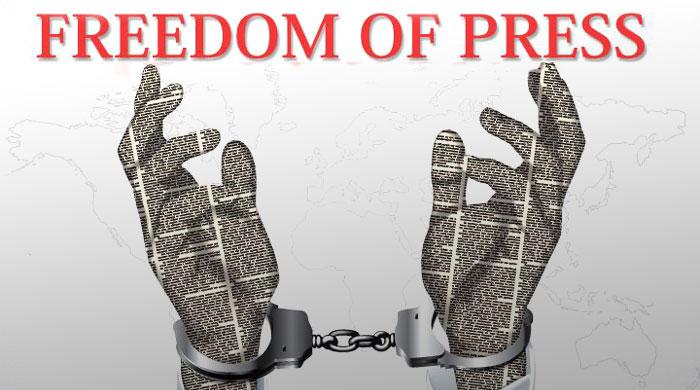
The present administration of Pakistan Tehreek-e-Insaf (PTI), led by Prime Minister Imran Khan, is the third consecutive elected government to come to power, as a result of national polls.
For a political party that was bolstered by the media, in its early days, one would have expected it to further push for the freedom of press. But, it hasn’t.
The arrest of Mir Shakil ur Rehman, the editor-in-chief of Pakistan's largest media group Jang and GEO, by the anti-graft body, the National Accountability Bureau, should not be seen in isolation. There was a pattern on display in the last 20 months, since the PTI came to power, to vilify journalists, especially those associated with the Jang group.
If Prime Minister Imran Khan ever believed in the freedom of press, he has now taken a U-turn.
International media watchdogs, the Committee to Protect Journalists, Reporters Without Borders, the Human Rights Commission of Pakistan, and others have strongly condemned the attempt to silence independent press in the country.
Since the past few years, journalists in Pakistan have been facing a relentless onslaught. The attack has been on social media and on the ground. Television and print reporters would at times find notices from the Federal Investigation Agency (FIA) or gag orders from the Pakistan Electronic Media Regulatory Authority (PEMRA). Now, the NAB has also joined the bandwagon, to please the premier.In January, while in Davos, the prime minister told a gathered audience that he does not read the newspapers or watch evening TV shows. “I am used to the criticism,” he added, “but the last one and half years I’ve been hammered in the media.”
Now, it seems, the prime minister doesn’t want anyone in the country to read or watch the news.
Not too long back, the same Khan waxed lyrical about the press and even credited it for bringing him to his current position, as prime minister. Once, he even promised to abolish the ministry of information and to make PTV and Radio Pakistan autonomous bodies which would run on the BBC pattern. Khan also went as far as to suggest that Pakistan have an independent advertising policy.
But when he came to power, he forgot his promises. His political party targeted even those talk show heads and reporters who once stood up for Khan.
Mir Shakil ur Rehman was arrested this week in a case that dates back to 1986. That the NAB had to dig out papers of an over 30-year-old property shows that the government was struggling to bring any other case against the editor. Imran Khan had once accused Rehman of being involved in acquiring foreign funds through wrongful means. But as fate has it, Khan’s own party is facing those charges in a case taken up by the Election Commission of Pakistan.
Even before Imran Khan and the PTI made it to office, Geo and Jang reporters were being targeted by him and his political party. In 2014, while covering Khan’s 100-day rally, Geo reporters and cameramen were physically attacked and its DSNG’s trashed by supporters of the PTI.
After winning the election, the PTI-led government first stopped state advertisements of two leading media houses, DAWN and Geo/Jang. Both, Khan’s government believes, are critical of his policies. As a result the two organisations faced a massive financial crisis and had to lay off staff and delay salaries.
Meanwhile, bloggers and journalists were being arrested or harassed in contrived cases by the FIA, under a draconic 2016 electronic crimes act. None of the charges could hold up in a Pakistani court.
Furthermore, hashtag and social media campaigns are routinely launched against TV anchors and reporters by Twitter users who claim to be supporters of the PTI.More recently, the ruling party also proposed to merge PEMRA and the Press Council under a new body, the Pakistan Media Regulatory Authority, to give it overarching powers. The idea was later dropped.Last month, the prime minister and his media team formulated social media rules, without consulting the stakeholders. The rules had to be yanked, after a public outrage and after international social media companies warned that they would have to reevaluate their plans to work in the country.
And when nothing else worked, the PTI took the route often traveled by military dictators: use PEMRA to shut down news channels.
Some media house were left with no other choice but to convince strong dissenting voices to stop writing their widely-read articles, for fear of upsetting the men in power.
Due to the lack of options, many out-of-job journalists have turned to social media and YouTube to make their voice heard.
Once I asked the former director general FIA Bashir Memon why his organisation only targets journalists, rights activists and bloggers critical of government policies, he said: “Under the Prevention of Electronic Crimes Act, 2016, whenever we [the FIA] receives a complaint from the ministry of interior, we have to comply immediately.”Journalists in Pakistan have struggled for a long time and come a long way. In the last 72 years, reporters were flogged, convicted and jailed. The rights, they fought to achieve, are in danger of being rolled back.Imran Khan and his political party’s vitriol could result in violence against journalists. Reporters and editors, Mr. Khan, are citizens of this country. They too deserve protection and safety from their government.
As for the media, the only option left is to unite and fight a united battle for freedom of press. Because, it maybe us today, it could be you tomorrow.
What the sanitisation of Haqqanis means for Pakistan-US relations

By Fahd Humayun
For many in Pakistan, no other group better exemplifies the US's long history of playing sides to suit its own ends.On February 20, days before the signing of a landmark deal between the US and the Taliban in Qatar's capital, Doha, American "paper of record" The New York Times published an opinion editorial by Haqqani Network leader Sirajuddin Haqqani. Haqqani, who is also the deputy leader of the Taliban, was labelled a "specially designated global terrorist" by the US in 2008. The State Department is still offering a reward of up to $5m for information directly leading to his arrest.
The timing of the piece was not a coincidence - it appeared as the US was readying a partial truce with the Taliban that could set in motion a potential end to America's longest war.
The newspaper's decision to publish the article, provocatively titled "What We, the Taliban, Want," jolted not only ordinary readers and US foreign policy hawks, but also Washington's biggest detractors abroad. As the criticism mounted, The Times' opinion editors issued a statement to try and justify their decision to give a platform to Haqqani.
"Our mission at Times Opinion is to tackle big ideas from a range of newsworthy viewpoints," they stated. "We've actively solicited voices from all sides of the Afghanistan conflict, the government, the Taliban and from citizens. Sirajuddin Haqqani is the second in command of the Taliban at a time when its negotiators are hammering out an agreement with American officials in Doha that could result in American troops leaving Afghanistan. That makes his perspective relevant at this particular moment."
What the Times did not mention, however, was the extent to which the Haqqani question has prickled the relationship between the US and Pakistan - a major non-NATO ally historically accused by many in Washington of not doing enough to facilitate American objectives in neighbouring Afghanistan.
Back in 2011, following an attack on the US embassy in Kabul believed to be perpetrated by the Haqqanis, the then chairman of the Joint Chiefs of Staff, Mike Mullen, called the network a "veritable arm" of Pakistan's Inter-Services Intelligence (ISI), ratcheting up pressure on Pakistan to eliminate the network and paving the way for more American drone strikes in the country.
Mullen's assertion caused widespread anger and disappointment in Pakistan. In the years that followed, consecutive civilian governments in Pakistan maintained that the infrastructure supporting the network had shifted to Afghanistan and that scapegoating Pakistan for American failures in an interminable war next door was disingenuous and unjust.
For many in Pakistan, no other political group better exemplifies America's long history of playing sides to suit its own strategic objectives. Few American diplomats today care to recount that the Haqqanis started as Washington's closest allies in Afghanistan; that the network's founder Jalaluddin Haqqani was a CIA darling kept flush with money and weaponry, including shoulder-fired Stinger missiles that would ultimately down Soviet aircraft. Fewer still have any compunction over the diplomatic arm-twisting meted out to Pakistan, including the cutting off of vital Coalition Support Fund aid, for allegedly not doing enough to combat the group.
As the US continued to pressure Pakistan for not doing enough to curtail the Haqqani Network's activities in Afghanistan, the grievances against Washington's regional policies started to pile up in in the country. Many in Pakistan came to believe that the US was scapegoating Islamabad to camouflage the deeper contradictions in its military strategy against the Taliban. And they had ample reason to hold this view. In 2015, for example, the US and the Haqqanis came face-to-face during the ill-fated "Murree talks" between the Taliban and the Afghan government. Conveniently, the US raised no objections to the Haqqanis being in the meeting.
For the past decade and a half, the Pakistan-US relationship has been bedevilled by a host of structural difficulties; chief among them an American tendency to use progress on the Afghan battlefield as a barometer for the costs to be imposed on Pakistan for failing to "do more". All that time, the Haqqani Network had been the primary subject of countless rancorous conversations between successive US administrations and Pakistani governments, even as US drone strikes claimed the lives of Pakistani civilians, and Pakistan argued that expecting it to do the heavy lifting to suit US objectives was unrealistic.
This is why many in Pakistan today find the slick public rehabilitation of Sirajuddin Haqqani to be a distasteful reminder of how easily the US has managed this past decade to burden Pakistan with the costs of non-compliance, while staging a war on Pakistan's front-lines when it suited them, and locating the bilateral relationship in apathetic conditionalities that ignored Pakistan's own strategic concerns.
Going forward, peace in Afghanistan and gains made in recent years including on rights and the status of Afghanistan's women are far from guaranteed. Days after the US-Taliban peace agreement in Doha, a suicide attack on a ceremony in Kabul killed at least 29 people, injuring dozens more. While the attack was claimed by the Islamic State of Iraq and the Levant (ISIL, also known as ISIS), it aptly demonstrated the extent to which spoilers litter the Afghan battlefield.
The worry in Islamabad is that the US, in its rush to reach a deal in light of domestic compulsions at home, may be guided by short-term intent rather than a long-term strategy, and will consequently short-change on brokering regional stability.
For instance, whether the US can achieve its counterterrorism objectives with a reduced military footprint is an unanswered question. It is almost certain that Taliban commanders now view the signing of a peace deal with the Americans as a resounding validation of a 19-year-long struggle to end an illegal foreign occupation. This is already proving to have major implications for the intra-Afghan negotiations, which are shrouded by a deepening and fractious power struggle in Kabul.
Following an election recount and a delay of nearly five months, both Ashraf Ghani and Abdullah Abdullah declared themselves president at rival inauguration ceremonies. Pakistan's concern is that political insolvency in Kabul will trigger further regional instability and potentially a war of attrition, after the US's exit from the country. US envoy Zalmay Khalilzad is, meanwhile, trying to work out a power-sharing arrangement between the two camps.
As for Pakistan-US relations, the big question is whether a future strategic equilibrium can emerge from the mistrust engendered by years of fraught, at times toxic conversations, including on the Haqqani Network. There is a keen desire in Islamabad for a broader, stronger relationship with the US, and there are signs that under President Trump and Prime Minister Imran Khan, this might be possible.
On his recent visit to India, President Trump took a softer line on Pakistan, reflecting the hard work that both sides have put into resuscitating the relationship from its worst days. Indeed, Washington's listing of the separatist Balochistan Liberation Army as a terrorist group and the recent targeting of Pakistani Taliban commanders in eastern Afghanistan speaks to a gradually changing equation - one that, for once, optimises both parties' strategic interests.
For Pakistanis, that alone is a welcome shift, even if an official public apology for taking the flak for the Haqqanis, takes time.
Friday, March 13, 2020
For 20 yrs, Imran Khan had a dream. When he became PM, we got goats, cows & broken economy

NAILA INAYAT
Blaming Pakistan’s former leaders for the problems of the last 19 months makes for good prime-time news, but in reality, Imran Khan's rhetoric is slowly dying.
Pakistan Prime Minister Imran Khan announced last month that the country’s economic apocalypse was ending. Earlier this week, he promised that the electricity and gas tariffs will not be hiked. But even as the prime minister made such tall claims, a series of negative developments unfolded soon after: the Pakistan Stock Exchange recorded the biggest decline in 10 years Monday, the US dollar jumped to Rs 158 and the prices of gold skyrocketed. Not to forget the food inflation that has been adversely impacting people on a daily basis for months now.
So, whenever your PM says things are getting back on track, aapne ghabrana nahin hai because more difficulties are on their way.
After all, other than Pakistan, there is no country in the world that has been blessed with 12 seasons, according to PM Khan. I feel bad for the rest of the world, though, that only gets to enjoy quarter of what we have or not. The eight extra seasons in Naya Pakistan are the seasons of cluelessness. Regardless, barra mausam is a breakthrough worth considering PM Khan for the Nobel Prize.
Not so-good times ahead
Khan’s reassurance that good times are ahead don’t impact even the employees of Pakistan Secretariat who work right next to the PM. The government secretariat staff observed a pen-down strike last week at the Constitution Avenue over the delay in pay raises. They complain that the staff of PM Office and civil servants in other departments get higher salaries than them. Only if they knew the prime minister himself can’t run his house with his salary.
Ever since Imran Khan has been on the trail of becoming the prime minister, all that we’ve heard are the promises of rivers of milk and honey flowing in Pakistan. But how those rivers were to flow, even Khan’s selectors didn’t know. One would have expected that if for 20 years Imran Khan’s dream was to become the prime minister, then some homework on how to run the country would have been done. But that’s the thing about dharna politics, it doesn’t necessarily mean that your half-baked ideas and political sloganeering can help you run the country. The two ‘Cs’ — cricket and charity — haven’t worked wonders for the selectors either.
Everything, even rhetoric, has a shelf life
The question is: For how long the rhetoric against former prime minister Nawaz Sharif, former president Asif Zardari and the prominent leaders of Pakistan Muslim League-Nawaz (PML-N) and Pakistan Peoples Party (PPP) would work for PM Imran Khan? There is a shelf life for everything, even political rhetoric.
To call your political rivals corrupt, to make promises of bringing back looted money of the awam worked well during Khan’s kaptaan days on top of a shipping container but not anymore. You jailed them, you couldn’t prove a thing against the likes of ex-PM Shahid Khaqan Abbasi or ex-interior minister Ahsan Iqbal. What’s more is that the Imran Khan government did not bring even one rupee of the looted money back.
PM Khan can continue to call his rivals chor, daku, ‘corrupt’ but the bad news is, it isn’t working anymore. The common man doesn’t care about the chors of the past but just wants the current PM to deliver on all his promises. He/she wants to know why there is a sugar and wheat crisis in the country, something which benefits politicians on PM Khan’s team.
Blaming Pakistan’s former leaders for the problems of the last 19 months makes for good prime-time TV news, but in the real world the rhetoric is dying a slow death and PM Khan will take any opportunity to revive it. So, the latest desire of the PM to bring back Nawaz Sharif from London is another attempt at diverging from the issue of the government’s incompetence and how it tanked the country’s financial system. PM Khan’s obsession with media optics is more important than delivery in office.
Goats and charas can’t revive economy
To be fair, Khan has tried everything in his playbook to revive Pakistan’s economy. He waited for a miracle discovery of gas and oil treasures in Pakistan, but that didn’t happen. He relied on sheep, buffaloes and goats for an economic revolution in the country.
Just a few days back, PM Khan rolled out a new scheme under which every woman will be given one cow, one buffalo and three goats. But did the PM, before announcing this move, ever ask himself if there are enough cows, buffaloes and goats in Pakistan for every family? On to the latest endeavour of relying on honeybees, berry plants and now olive gardens, Imran Khan thinks these measures can make him provide 10 million jobs his government once promised.
When it comes to entrepreneurial flop shows, Imran Khan and his ministers are high on talent. Science and Technology Minister Fawad Chaudhry wants to transform the Prime Minister House into a state-of-the-art university, fulfilling the PTI election promise. Then there is Narcotics Control Minister Shehryar Afridi who recently announced that PM Khan wishes to open a factory in Tirah, Khyber Pakhtunkhwa that will turns charas into medicines. Well, he actually said it. This is the planning of 20 years that secured Imran Khan’s place on the prime minister’s seat.
پاکستانی ڈراموں میں ہندو یا مسیحی کردار کیوں نہیں؟

پاکستان کے ڈرامہ نگار اگر کرشن، جے، رادھا، جون، جگجیت، امریتا اور کرشنا کے کردار تخلیق کریں تو ہمارے معاشرے کے اندر موجود امتیاز ختم ہو سکتا ہے۔
#Pakistan - Imran cracks down on media
Pakistan Prime Minister Imran Khan, who never tires of exulting virtues of U-turns, has turned against his biggest supporter – the Pakistan media. During his 22-year struggle in opposition, Imran was used to the darling of media, now in power he sees the same media as the villain of the piece. The arrest of editor-in-chief of Jang Group Mir Shakilur Rahman by National Accountability Bureau (NAB) on Thursday (March 12) in 34-year-old land case shows that Imran, unhappy with media criticism of his policies, has trained his guns on the
messenger.
messenger.
As far as the Jang-Geo group is concerned, Imran has a long history of turbulent relationship. Even during his days in opposition, Imran had accused the Jang group of being pro-Nawaz Sharif.
In 2017, Imran’s Pakistan Tehreek-e-Insaf (PTI) had announced a boycott of the Jang-Geo media group, accusing it of “biased, one-sided coverage of the ongoing investigations into Panamagate case”.
While withdrawing its representation from all forums run by the group, Imran told a news
conference that the Jang-Geo group was misleading the public with its ‘biased coverage’ of the case. He called Mir Shakil-ur-Rehman, the owner of Jang- Geo Group, ‘godfather of media’ who, he alleged, was trying to hide the financial corruption of the Sharif family. In return, he alleged the PML-N regime was doling out advertisements worth billions of rupees to the Jang-Geo group. He had even said that his party has prepared a case against Shakilur Rahman, which he will present to NAB.
conference that the Jang-Geo group was misleading the public with its ‘biased coverage’ of the case. He called Mir Shakil-ur-Rehman, the owner of Jang- Geo Group, ‘godfather of media’ who, he alleged, was trying to hide the financial corruption of the Sharif family. In return, he alleged the PML-N regime was doling out advertisements worth billions of rupees to the Jang-Geo group. He had even said that his party has prepared a case against Shakilur Rahman, which he will present to NAB.
However, even after Imran came to power the Jang-Geo group did not change its stand against Imran. Some of the talk show hosts were severe on Imran for the economic mess and the way he has unleashed a vendetta campaign against opposition leaders in the name of accountability and anti-corruption drive. They repeatedly questioned why the anti-
corruption drive just targeted the opposition leaders, who were arrested on flimsy grounds, while no action was taken against members of his cabinet, who already were facing charges before joining his government. People say media censorship, intimidation and suppression of voices of dissent under Imran’s regime is worst than seen during the rule of the military dictator, Gen Zia-ul Haq. Mohammed Rizwan, a Canada-based journalist of Pakistani origin, told India Legal that like all other things, it is the military establishment which controls the media.
“Anybody refusing to toe the line of the GHQ has to face the consequences” he said. A Lahore-based journalist, who does not want to be named, told India Legal that main reason behind the crackdown on the media is that Imran’s PTI is seen as army’s party. “Although all previous governments had the blessings of the generals, it is the first that the military’s role is so visible in resurrecting Imran to power. It was the army which triggered defections
in major opposition parties to clobber his coalition government. Army chief Gen Qamar Javed Bajwa accompanied him on important visits to Saudi Arabia, the UAE, the US and China” he told India Legal.
corruption drive just targeted the opposition leaders, who were arrested on flimsy grounds, while no action was taken against members of his cabinet, who already were facing charges before joining his government. People say media censorship, intimidation and suppression of voices of dissent under Imran’s regime is worst than seen during the rule of the military dictator, Gen Zia-ul Haq. Mohammed Rizwan, a Canada-based journalist of Pakistani origin, told India Legal that like all other things, it is the military establishment which controls the media.
“Anybody refusing to toe the line of the GHQ has to face the consequences” he said. A Lahore-based journalist, who does not want to be named, told India Legal that main reason behind the crackdown on the media is that Imran’s PTI is seen as army’s party. “Although all previous governments had the blessings of the generals, it is the first that the military’s role is so visible in resurrecting Imran to power. It was the army which triggered defections
in major opposition parties to clobber his coalition government. Army chief Gen Qamar Javed Bajwa accompanied him on important visits to Saudi Arabia, the UAE, the US and China” he told India Legal.
Earlier, he said, the foreign and defence policy used to be military's domain but now it’s running the entire show. “Some of the key appointments to his cabinet like Hafeez Sheikh as finance adviser and Firdous Ashiq Awan as information adviser have done at the
behest of the army. So, any criticism of the Imran government is seen as direct indictment or failure of the military” he told India Legal.
behest of the army. So, any criticism of the Imran government is seen as direct indictment or failure of the military” he told India Legal.
Why a media mogul was arrested in Pakistan
https://www.bbc.com/news/world-asia-51870596
#PAKISTAN #PPP - Bilawal Bhutto announces to visit #Balochistan soon

Pakistan People’s Party Chairman Bilawal Bhutto Zardari on Friday announced that he would soon visit Balochistan province, ARY NEWS reported.
Addressing a public gathering in Quetta via telephone, the PPP chairman said that the party would form the federal government next time and it is during the PPP tenure that the province was given its due rights.
“Only PPP has the capability to resolve the issues of the province,” he said and added that if returned to power again, they would serve the people of the province as nobody else did.
He said that the incumbent government wants to suppress the dissenting voices and they would topple them with the power of masses.
Earlier on February 09, Chairman Pakistan People’s Party (PPP) Bilawal Bhutto Zardari talking to the media in Islamabad said that he and his political party will not sit idly by as Pakistanis are dealing with rising inflation, ARY News reported.
The PPP chairman said that the opposition party demands that the Prime Minister of Pakistan Imran Khan tears away the written agreement between the government and the International Monetary Fund (IMF).
The politician said that he was ready to work alongside the federal government to alleviate the burden of inflation from the masses.
Answering a question with regards to the whereabouts of the leader of the opposition of the national assembly, Bilawal Bhutto said that he was hopeful for Shehbaz Sharif’s triumphant return soon enough.
While answering another question with regards to Pakistan Muslim League Nawaz’s Vice-President Maryam Nawaz’s persistent demand for flying abroad to meet his ailing father who battles life and death circumstances, the PPP chairman said that she should be allowed to travel and there should be no hindrance between a daughter and her sick father.
Thursday, March 12, 2020
In Afghanistan, a new ‘great game’ with ISIS, ISK and Pakistan is on with a vengeance

TARA KARTHA
To understand Pakistan’s undoubtedly brilliant strategy in Afghanistan, the West only needs to study Kashmir without the usual self-limiting blinkers.
Just days after a hugely publicised US-Taliban ‘peace’ deal, renewed violence ripped through Afghanistan — 76 attacks across 24 provinces — as the Taliban lifted its week-long commitment on ‘reduction of violence’. The Islamic State in Afghanistan claimed responsibility for two of these attacks, while the Taliban — as has been the case earlier — denied all involvement. Amid all this violence, Kabul and Herat witnessed sporadic anti-India protests, in development that both surprising and unprecedented. Clearly, a ‘great game’ of local proportions seems to be back with a vengeance. The country has also witnessed protests against Pakistan.
The ISIS in Afghanistan
Some aspects of the new game is apparent in the attacks claimed by the Islamic State (IS). In Afghanistan, the ISIS is represented by the Islamic State in Khorasan (ISK), a group that declared allegiance to it in 2015. Claims of attacks on Afghan soil are sometimes made by the ISIS and at other times by the ISK. The attacks last week, identical to the one in July 2019, was carried out by a Tajik and an unidentified foreign fighter, which fits in well with the ISIS’s Salafi and Takfiri beliefs. Takfir is the practice by which a Muslim may declare another as an apostate, and dates back to at least the 7th century. This was revived by Muhammad Ibn Abd al -Wahab, founder of Wahabism in Saudi Arabia, who encouraged the stringent Salafist beliefs, and the excommunication of those who did not abide by their beliefs. In later years, takfir was used to justify violence against fellow Muslims, particularly those in power.
But unlike the ISIS, the ISK is a creature of many parts, sometimes acting with the Taliban, sometimes violently against it, sometimes prioritising business operations, and at all times, opaque about who it takes orders from. Some aspects of this Janus-faced organisation have been recently detailed in a publication of the Afghan Institute of Strategic Studies (AISS).
The AISS paper paints a picture of a disparate group — largely made up of Pakistani cadres formerly of the Tehrik-e-Taliban Pakistan (TTP). The TTP relocated to Afghanistan after the Pakistan Army carried out operations in its tribal areas sometime in the middle of 2015. Other cadres include some Kashmir-specific groups like Tehreek ul-Mujahideen and various Central Asian divisions.
Deconstructing the ISK
Between then and 2018, however, the ISK was targeted in unusually precise US operations, indicating the availability of solid ground intelligence. The result was the destruction of its top leadership and some 548 of its commanders.
The original group then evolved into its present amoeba-like formation. One division is active around Kabul and colludes actively with the Taliban. Another is based around the Pak-Afghan border, funding itself by trafficking gems, talc, and timber even as it is violently pitched against the Taliban for control of this lucrative trade. A third group operates in the north, and is largely made up of Central Asian and foreign cadres, who while being ideologically stronger, cooperate in keeping the Pakistan-Central Asia route open. A fourth operates along the Iranian border in Herat, clearly with support from Tehran.
ISK’s Indian ambitions
As the AISS report notes, nearly 90 per cent of the group is made up of Pakistanis. It is armed with Pakistani weapons and, barring one incident against the Hazaras in 2019, no longer attacks Pakistan. It has also managed to get a batch of Indian cadres. Intelligence assessments indicate that it had planned a large-scale attack in India, but failed to carry it out.
Both Delhi and the US began to take the ISK very seriously, especially after it announced a Wilayat of Hind, a “province” in India. It’s a different matter that the ISK rather belatedly announced a “province” in Pakistan as well, to which there was no response from Islamabad at all. By the end of 2019, India had negotiated with Kabul for the extradition of Indians serving in the ISK back to their home country.
In a fresh development, a new ISIS digital publication called Sawt ul Hind has emerged. Notably, it carried pictures and stories on the Delhi riots, with the clear aim of inciting Indian Muslims. Earlier, similar publications had largely targeted Kashmiris, using mostly fake videos used to drum up support against India.
There is, however, a curious anomaly between the AISS report and other sources. While the AISS report shows a very poor, almost non-existent link between the ISK and the ISIS, a UN-appointed group reports that the ISK’s leadership was changed as recently as July 2019, after a visit by the ISIS’ core leadership. But one would go with the ground assessment of a fractured group whose loyalties depend on who’s paying it.
India’s headache
The anti-India protests in Herat were led by a prayer leader at a local mosque and come close on the heels of statements made by Iranian leaders, including Ayatollah Khamenei, who have condemned violence against Muslims under the Narendra Modi government’s rule. Given the size of the crowds, some outside encouragement is entirely likely. A smaller protest was reported in Kabul, primarily by Turkish and Pakistani media sources. Added to this heady brew is the ISIS attack that could have killed Afghanistan’s presidential candidate Abdullah Abdullah, a leader known to be sympathetic to India. While New Delhi has only itself to blame for providing prime ammunition to anti-India elements everywhere, Afghans themselves need to take note that Pakistan is again moving to strengthen its hold on Afghanistan, as the US moves out lock, stock, and barrel.
It appears the US intel reports are right. The Taliban have no intention of honouring the peace deal signed with the Americans. Neither does their sponsor Pakistan. As a very wise diplomat recently noted, unlike all the other actors involved in the Afghan drama, which includes Russia, the US, India, Saudi Arabia among others, Pakistan alone has never wavered in its Afghan policy, which is to exert complete domination using multiple groups as balancing levers. To understand its undoubtedly brilliant strategy, Western diplomats only need to study Kashmir without the usual self-limiting blinkers.
Subscribe to:
Posts (Atom)