Tuesday, November 11, 2014
Who will make the Middle East’s new map?

Correct perception key to China-US ties

Poland: Flares vs water cannon in Warsaw as nationalists march on Independence Day
 At least 215 people were arrested after clashes broke out in Warsaw. Some Polish nationalists, who took to the streets to mark the country’s National Independence Day, threw flares and stones at police. Law enforcers responded with water cannon.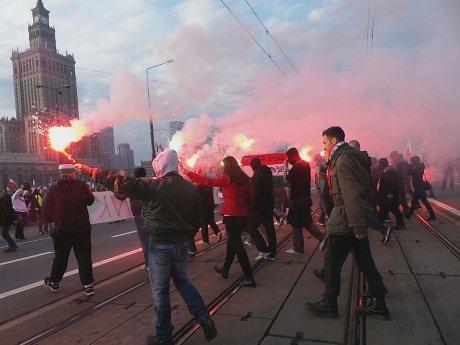
Officers in riot gear formed a cordon around the building, as young shaven-headed demonstrators waving red-and-white flags tried to push through. The crowd shouted slogans directed against Russia, Poland’s eastern neighbor, which the demonstrators blamed for World War II atrocities and occupation during the Soviet era.Poland's foreign ministry criticized the action, saying "there is no justification for hooliganism." National Independence Day has been celebrated since November 11, 1918, when the country gained independence after being partitioned between Russia, Prussia and the Hapsburg Empire.
Mr. Obama’s Message to Myanmar
http://www.nytimes.com/President Obama was ebullient during his historic visit to Myanmar in November 2012, the first by an American president to a nation that appeared on the cusp of a democratic transformation after five decades of authoritarian rule. But, in the two years since, the military-dominated, quasi-civilian government in Yangon has moved far too slowly on the commitments to reforms it made to the United States when the two nations pledged to begin a new relationship. On his second visit to Myanmar, which begins Wednesday, Mr. Obama might be tempted to be circumspect about the dispiriting state of change in Myanmar. That would be a mistake. Officials in Myanmar saw the importance of engaging with the United States to put behind an era of sanctions and international isolation. Mr. Obama should firmly remind them that his administration still has tools to accelerate, or delay, that process. Between now and next fall, when Myanmar is scheduled to hold a general election, there is time to press forcefully for meaningful democratic reforms and an end to the persecution of the Rohingya Muslims. The political shifts this year have not been promising. President Thein Sein vowed early this year that “any citizen” would be allowed to run for the presidency. Yet a parliamentary committee in June voted against a constitutional amendment to fix a rule that forbids the country’s leading opposition leader, Daw Aung San Suu Kyi, a Nobel Peace Prize laureate, from being eligible for that office because her children hold British citizenship. Besides disqualifying Ms. Aung San Suu Kyi from becoming president, officials in Myanmar appear to be laying the groundwork for an electoral system that would prevent her party, the National League for Democracy, from ever holding a majority by reserving seats for military officers and representatives of ethnic minorities. Ms. Aung San Suu Kyi deserves a shot at leading the nation. This would happen only if the country’s Constitution is amended substantively to give political parties equal footing in future elections. Beyond the dismal state of political reforms, Myanmar’s leaders have been callous in their response to a crisis sparked by the slaughter in 2012 of hundreds of Rohingya Muslims in Rakhine State. The government has done little to prosecute the perpetrators of a campaign that human rights activists say amounted to ethnic cleansing. Now the authorities appear intent on further marginalizing the Rohingya through a naturalization policy most would be ineligible for, a tactic that appears designed to drive more into exile. More than 100,000 Rohingya are now confined to miserable camps. No one expected that Myanmar would become a model democracy overnight. And there have been some remarkable changes. Most political prisoners have been released; brutality by security forces has ebbed; and the media is less censored. Mr. Thein Sein may argue that his government needs more time to make good on the promises he made when Mr. Obama visited in 2012. Some may reasonably take years to carry out; others won’t. Mr. Obama should not mince words when he evaluates the progress on those promises.
http://www.nytimes.com/2014/11/11/opinion/mr-obamas-message-to-myanmar.html
Obama, Putin circle each other warily in China

 On the surface, President Barack Obama and Russian President Vladimir Putin were all niceties — a pat on the back here, a pleasantry there. But away from the cameras, the two leaders circled each other warily at a global summit in China, coming face to face while relations between their countries continue to deteriorate.
The White House said Obama and Putin spoke three times Tuesday on the sidelines of an Asia-Pacific economic meeting, tackling some of the tough issues that have strained their relationship, including Russia's provocations in Ukraine and support for Syria's embattled government. They also discussed the fast-approaching deadline in nuclear talks with Iran, in which the U.S. and Russia find themselves on the same negotiating team.
Unlike at some of their past meetings, Obama and Putin kept their deep-seated policy disagreements behind the scenes. But their public encounters suggested their relationship remains tense.
Picturesque Yanqi Lake, just outside of Beijing, became the venue for an awkward pas de deux between two of the most powerful leaders in the world. Entering an ornate, wood-paneled room for the start of the summit, Obama and Putin looked a bit like sidekicks to Chinese President Xi Jinping. The summit's host led the way, with the American on one side and the Russian on the other.
On the surface, President Barack Obama and Russian President Vladimir Putin were all niceties — a pat on the back here, a pleasantry there. But away from the cameras, the two leaders circled each other warily at a global summit in China, coming face to face while relations between their countries continue to deteriorate.
The White House said Obama and Putin spoke three times Tuesday on the sidelines of an Asia-Pacific economic meeting, tackling some of the tough issues that have strained their relationship, including Russia's provocations in Ukraine and support for Syria's embattled government. They also discussed the fast-approaching deadline in nuclear talks with Iran, in which the U.S. and Russia find themselves on the same negotiating team.
Unlike at some of their past meetings, Obama and Putin kept their deep-seated policy disagreements behind the scenes. But their public encounters suggested their relationship remains tense.
Picturesque Yanqi Lake, just outside of Beijing, became the venue for an awkward pas de deux between two of the most powerful leaders in the world. Entering an ornate, wood-paneled room for the start of the summit, Obama and Putin looked a bit like sidekicks to Chinese President Xi Jinping. The summit's host led the way, with the American on one side and the Russian on the other.
 "It's beautiful, isn't it?" Putin said in Obama's direction. Yes, it is, concurred a reticent Obama, avoiding eye contact with Putin and addressing his response to no one in particular.
As the three presidents came to a stop at the head of the table, Putin reached out to give Obama a slap on the back. But Obama had turned in a different direction, and it didn't appear that the Putin's hand landed on its intended target.
A few hours later, the two again found themselves in close quarters under an overcast sky as leaders planted trees in honor of their counties. Putin strode confidently up to his tree, ahead of Obama, who clasped his hands behind his back before picking up a shovel and greeting a Spanish TV crew with a wave.
Neither the White House nor the Kremlin offered much in the way of detail about the policy conversations Obama and Putin had on the sidelines of the summit. Putin's spokesman said only that the two had spoken a few times, touching on "bilateral relations, the situation around Ukraine, Syria and Iran."
The U.S. is furious over Russia's presumed role in fueling pro-Russian rebels in neighboring Ukraine. White House officials have accused Russia of sending heavy weapons to the separatists and shelling Ukrainian troops, and have denounced Russia's buildup of forces along the border.
A truce reached in September between the rebels and Ukraine's government is teetering, destabilized by what the White House calls a "blatant escalation" by Russia and rebel-organized elections in eastern Ukraine that the U.S. condemned as a "sham." Vice President Joe Biden, in a phone call last week with Ukraine's president, vowed further U.S. sanctions against Moscow "if Russia continued to willfully violate the terms" of the cease-fire.
Russia's economy has taken a major hit following U.S. and EU sanctions — the ruble has plunged by a third this year and hit an all-time low last week — but Putin has dismissed the notion that he's hurting at the hands of the West. Addressing the Asia-Pacific economic summit here Monday, Putin said his government had the resources to stabilize its currency without taking any emergency measures.
"We want Russia to play a different role," Ben Rhodes, Obama's deputy national security adviser, said Tuesday. "We want Russia to be a stabilizing force on issues that we care about. But they're not going to be able to do that ... if they're violating the sovereignty of a country next door."
Rhodes said Obama wouldn't not be seeking out a meeting with Putin while in Beijing — nor in Brisbane, Australia, where the leaders will once again run into each other during a Group of 20 economic summit this weekend. "Putin knows where we stand," Rhodes said, adding that Obama may discuss Russia's actions with other G-20 leaders.
For Obama and Putin, awkward encounters at international gatherings have become almost expected. But the optics have gained even greater attention as the Ukraine crisis has taken center stage.
In June, on the sidelines of D-Day anniversary commemorations in Normandy, France, Obama and Putin avoided each other during a group photo, with Obama even using Britain's Queen Elizabeth II as a buffer. The two later spoke briefly during a private leaders' lunch.
And during a formal meeting last year during a summit in Northern Ireland, Putin slumped in his chair and sat stone-faced as Obama tried to joke about the Russian leader's athletic ability. Obama later said Putin frequently looks like "the bored kid in the back of the classroom."
"It's beautiful, isn't it?" Putin said in Obama's direction. Yes, it is, concurred a reticent Obama, avoiding eye contact with Putin and addressing his response to no one in particular.
As the three presidents came to a stop at the head of the table, Putin reached out to give Obama a slap on the back. But Obama had turned in a different direction, and it didn't appear that the Putin's hand landed on its intended target.
A few hours later, the two again found themselves in close quarters under an overcast sky as leaders planted trees in honor of their counties. Putin strode confidently up to his tree, ahead of Obama, who clasped his hands behind his back before picking up a shovel and greeting a Spanish TV crew with a wave.
Neither the White House nor the Kremlin offered much in the way of detail about the policy conversations Obama and Putin had on the sidelines of the summit. Putin's spokesman said only that the two had spoken a few times, touching on "bilateral relations, the situation around Ukraine, Syria and Iran."
The U.S. is furious over Russia's presumed role in fueling pro-Russian rebels in neighboring Ukraine. White House officials have accused Russia of sending heavy weapons to the separatists and shelling Ukrainian troops, and have denounced Russia's buildup of forces along the border.
A truce reached in September between the rebels and Ukraine's government is teetering, destabilized by what the White House calls a "blatant escalation" by Russia and rebel-organized elections in eastern Ukraine that the U.S. condemned as a "sham." Vice President Joe Biden, in a phone call last week with Ukraine's president, vowed further U.S. sanctions against Moscow "if Russia continued to willfully violate the terms" of the cease-fire.
Russia's economy has taken a major hit following U.S. and EU sanctions — the ruble has plunged by a third this year and hit an all-time low last week — but Putin has dismissed the notion that he's hurting at the hands of the West. Addressing the Asia-Pacific economic summit here Monday, Putin said his government had the resources to stabilize its currency without taking any emergency measures.
"We want Russia to play a different role," Ben Rhodes, Obama's deputy national security adviser, said Tuesday. "We want Russia to be a stabilizing force on issues that we care about. But they're not going to be able to do that ... if they're violating the sovereignty of a country next door."
Rhodes said Obama wouldn't not be seeking out a meeting with Putin while in Beijing — nor in Brisbane, Australia, where the leaders will once again run into each other during a Group of 20 economic summit this weekend. "Putin knows where we stand," Rhodes said, adding that Obama may discuss Russia's actions with other G-20 leaders.
For Obama and Putin, awkward encounters at international gatherings have become almost expected. But the optics have gained even greater attention as the Ukraine crisis has taken center stage.
In June, on the sidelines of D-Day anniversary commemorations in Normandy, France, Obama and Putin avoided each other during a group photo, with Obama even using Britain's Queen Elizabeth II as a buffer. The two later spoke briefly during a private leaders' lunch.
And during a formal meeting last year during a summit in Northern Ireland, Putin slumped in his chair and sat stone-faced as Obama tried to joke about the Russian leader's athletic ability. Obama later said Putin frequently looks like "the bored kid in the back of the classroom."
Pakistan: US drone kills six in North Waziristan


A US drone fired missiles in Pakistan’s northwestern tribal region on Tuesday, killing six people, official sources said. The sources said that the latest attack took place in Data Khel area of North Waziristan Agency. They said that the unmanned aircraft targeted a moving vehicle in the tribal area. The sources said that some foreign militants were also among the dead and the injured. However, it was yet to be known as to how many people got injured in the attack.
India Chooses Israel Over US for Latest Defense Purchase
India has decided to buy anti-tank weaponry from Israel instead of the United States in a $525 million dollar deal. Back in August, The Diplomat reported that U.S. Secretary of Defense Chuck Hagel visited India and suggested that the U.S. and India jointly develop and produce the next generation of Lockheed Martin’s Javelin missile in India. Hagel was reported to have again pitched the Javelin missiles to India’s Prime Minister Narendra Modi in September during Modi’s visit to the United States. However, India eventually chose Israel’s Rafael Advanced Defense Systems’ Spike anti-tank missile. The Spike missiles are portable anti-tank missiles that lock on to targets before firing. One reason for this purchase decision may be because the United States was not willing to go through with jointly producing the missiles in India. However, U.S. officials have said that they are still discussing the Javelin order in the context of a broader push to strengthen defense ties between India and the United States. Additionally, India may have purchased 8,356 Spike missiles from Israel for various other reasons. Besides technical reasons, India may have acted out of a desire to diversify its purchases while improving Israel-India relations. India-Israeli relations have been growing stronger since the Bharatiya Janata Party (BJP) came to power in May. Modi met Israeli Prime Minister Benjamin Netanyahu in New York in September during the United Nations General Assembly session and India’s Home Minister Rajnath Singh is expected to visit Israel next month. India is Israel’s largest defense equipment customer and Israel is the second largest arms supplier to India after Russia. In addition to the Spike missiles, India has purchased other military technology from Israel recently, as New Delhi has now cleared projects worth $13.1 billion to modernize its military. For example, the Northern Command of the Indian Army recently purchased 49 Israeli miniature unmanned aerial vehicles to assist in monitoring and patrolling India’s borders with Pakistan and China. These surveillance drones will be used to monitor terrorist infiltration from Pakistan and Chinese troop incursions.By Akhilesh Pillalamarri

Pakistan’s ISI chief Gen. Rizwan Akhtar visits Kabul

Three security men escorting polio workers killed in Pakistan
http://www.thehindu.com/At least three security personnel who were guarding a polio vaccination team were killed on Tuesday in a bomb blast in Pakistan’s northwestern tribal region. The officials were guarding a polio vaccination team in Salarzai area of Bajaur tribal region near Afghan border. Three security personnel were killed and three persons, including two levies men and one civilian official, were injured in the attack, an official from the office of political chief of the district said. A three-day-long polio campaign is going on in the agency and security was on high alert in the area. At least 1,600 workers are taking part in the drive to provide medicine to 2,24,000 children in the district. No one has taken responsibility yet but the country faces massive resistance to its anti-polio efforts by Taliban militants, who consider the vaccines a conspiracy to sterile Muslims and regularly attack polio workers and their police escorts to discourage immunisation campaigns. Last month three levies personnel were wounded in similar attack in Bajaur during a polio campaign. Militants have killed at least 64 health workers and their escorts as Pakistan suffered record 235 polio cases this year. Pakistan, along with Afghanistan and Nigeria, are the only three countries in the world where polio remains endemic. The WHO in May imposed travel restrictions on people travelling from Pakistan to other countries.
Pakistan : Fanatic Pakistani Muslims Broke Christian couple's Legs So They Would Not Be Able To Run Away
Pakistan - Bombings, militant attacks in FATA, Quetta: Six dead
 Two bombings and a militant attack on a checkpoint in Pakistan killed six people Tuesday, officials said.
The deadliest attack struck the security checkpoint in the northwestern Orakzai tribal region, killing three paramilitary soldiers, government official Naeem Khan said.
He said other soldiers at the checkpoint chased and killed several militants.
In the town of Salarzai in the northwestern Bajur tribal area, a roadside bomb killed two police officers who were preparing to supervise a polio vaccine campaign that’s to start Wednesday, government administrator Sohail Khan said. Pakistani militants oppose the campaign, alleging that western governments would use it to spy on insurgents after the killing of al-Qaida leader Osama bin Laden.
Another bomb planted along a road in southwestern Quetta city exploded when a local court judge passed by, killing a boy and wounding 25, police officer Abdur Razzaq Cheema said.
No one immediately claimed responsibility for any of the attacks, which come amid a military push against insurgents in the country’s tribal regions. Suspicion likely will fall on the Pakistani Taliban, who want to enforce their own harsh brand of Islamic system in the country.
Two bombings and a militant attack on a checkpoint in Pakistan killed six people Tuesday, officials said.
The deadliest attack struck the security checkpoint in the northwestern Orakzai tribal region, killing three paramilitary soldiers, government official Naeem Khan said.
He said other soldiers at the checkpoint chased and killed several militants.
In the town of Salarzai in the northwestern Bajur tribal area, a roadside bomb killed two police officers who were preparing to supervise a polio vaccine campaign that’s to start Wednesday, government administrator Sohail Khan said. Pakistani militants oppose the campaign, alleging that western governments would use it to spy on insurgents after the killing of al-Qaida leader Osama bin Laden.
Another bomb planted along a road in southwestern Quetta city exploded when a local court judge passed by, killing a boy and wounding 25, police officer Abdur Razzaq Cheema said.
No one immediately claimed responsibility for any of the attacks, which come amid a military push against insurgents in the country’s tribal regions. Suspicion likely will fall on the Pakistani Taliban, who want to enforce their own harsh brand of Islamic system in the country.
Pakistan : Imrans forbidden fancies

Stuck between the rock of knowing his protest is going nowhere and the hard place of not wanting to admit defeat, Imran Khan has straddled the line between articulating a commitment to democratic norms and calling for them to be violated. His latest demand should leave no doubt that Imran is less concerned with democracy than ensuring the best possible outcome for himself personally. Having called for the Supreme Court to investigate last year’s elections – a proposal Nawaz Sharif himself had agreed to more than three months ago – Imran has now modified that by saying that the ISI and MI should be part of the judicial commission. This, it should go without saying, is an audacious and dangerous proposal. The intelligence agencies have clearly defined roles and adjudicating on election results isn’t one of them. They are already busy trying to protect us from internal militant threats and hostile foreign powers. Where investigating allegations of rigging would fit in with their line of work is not something Imran can explain. Moreover, the ISPR had clearly stated that it would not involve itself in domestic political disputes; thanks to Imran’s absurd proposal it may have to reiterate its commitment to strengthening democracy. Imran’s demand is even odder when one considers that the Supreme Court is currently showing itself to be a neutral umpire – to use one of the PTI chief’s favoured phrases – in the prime minister’s disqualification case. And, as Ishaq Dar pointed out, the government can only request the Supreme Court to form a commission, as it has already promised to do. It cannot even ask for certain judges to be appointed, let alone insist on the intelligence agencies being part of the commission. Dar rightly rejected the PTI’s new proposal since it would require violation of the constitution, drag the military into civilian affairs and create a precedent that any aggrieved party can appeal to the armed forces after losing an election. Imran must have known his latest demand would be rejected but he seems to be at a dead end. Every day he backtracks, makes a new curious statement and then forgets all about it. Previously he had insisted Nawaz resign immediately; now in his Rahimyar Khan speech he wants the resignation only if the commission proves rigging took place. He also wants those guilty – and in Imran’s mind there is no question of innocence – to be tried for treason. There seems to be no end game for Imran, just a constant shifting of the goalposts as he bides his time. But for what? He can’t still be hoping a ‘neutral umpire’ comes to his rescue. Or can he?
Pakistan: PTI - Saving face
 After months of labouring under the illusion that his word is law, Imran Khan withdrew his demand that Prime Minister (PM) Nawaz Sharif resign at a rally in Rahimyar Khan on Sunday. Imran admitted that the PM was no closer to resigning today than he was before the Pakistan Tehreek-e-Insaaf’s (PTI’s) agitation started. This did not however keep him from continuing to make outlandish demands or amend his pattern of slander, threats, half-truths and improbable ‘facts’ when announcing his decision. Imran said he would accept an inquiry by a Supreme Court (SC) commission to investigate rigging in the 2013 elections so long as it included members of Military Intelligence (MI) and Inter-Services Intelligence (ISI) (one more in a long series of attempts to drag the military into politics). Pursuant to the Commissions of Inquiry Act 1956, the federal government is the only authority to appoint a commission, the members of which are decided by the government and can include any person it deems fit. The SC does not have the power to form inquiry commissions. The SC late last month rejected the PTI’s petition that the 2013 elections be annulled on the grounds of rigging, because of a lack of evidence.
Though the record shows otherwise, Imran Khan said that the government was responsible for bringing negotiations to a standstill and ran his now usual gamut of accusations of corruption, malfeasance and vested interests. Information Minister Pervaiz Rashid responded by saying that the government had never closed the door to talks but that Khan should cease making baseless allegations against the PM that might hurt the country. Imran condescendingly described the SC as “independent but not impartial” even while demanding the formation of a commission and refused to accept former Chief Justice (CJ) Tassaduq Hussain Jillani as the new Chief Election Commissioner (CEC) because he ‘does not trust him’. Whether this is a reflection of Khan’s poor ability to judge character or simply because as CJ, Justice Jillani did not favour his cause during the agitation is debatable. Certainly Justice Jillani distinguished himself during his brief tenure with notable rulings on the rights of minorities and women, while largely ignoring the political fracas at D-Chowk. It is little wonder then that Imran rejected his nomination. Khan said the commission must be formed by November 30 or his planned protest in Islamabad “would not necessarily be peaceful”.
It seems that Imran Khan is heading from disturbed to dangerously sociopathic. After the sit-in, far from isolating the PM, Imran found himself isolated by every political party represented in parliament by his attempt to de-legitimise parliament as a whole with appeals to popular sovereignty, which fell flat in the face of his limited popularity. His rallies have been well attended but meaningless yet he still felt he has the power to demand the PM agree to resign if the proposed inquiry found evidence of rigging. He failed to specify whether he meant localised instances of rigging of the type that has occurred in several Pakistani elections, or organised and institutionalised rigging. Given his past statements the expectation is the latter, but it would not be the first time that he has reversed his stance at a moment’s notice. Without the oxygen of publicity for his nightly soap-opera, his agitation is effectively over and the PTI has been looking for a face-saving exit ever since this became apparent. Yesterday PTI Vice-President Shah Mehmood Qureshi said the protests had achieved their task of raising awareness. For obvious reasons the party is trying to spin its embarrassing failure into an apparent victory by claiming this was their goal all along. The planned November 30 protest appeared from the beginning as a last roll of the dice to force concessions from the government, but in making threats of violence Imran is again overplaying his hand. If his last demonstration was ‘peaceful’ it is disturbing to imagine what a violent agitation might look like. His threat of violence raises the question of whether he can be considered a responsible leader, let alone one to whom the country’s fortunes could be entrusted.
After months of labouring under the illusion that his word is law, Imran Khan withdrew his demand that Prime Minister (PM) Nawaz Sharif resign at a rally in Rahimyar Khan on Sunday. Imran admitted that the PM was no closer to resigning today than he was before the Pakistan Tehreek-e-Insaaf’s (PTI’s) agitation started. This did not however keep him from continuing to make outlandish demands or amend his pattern of slander, threats, half-truths and improbable ‘facts’ when announcing his decision. Imran said he would accept an inquiry by a Supreme Court (SC) commission to investigate rigging in the 2013 elections so long as it included members of Military Intelligence (MI) and Inter-Services Intelligence (ISI) (one more in a long series of attempts to drag the military into politics). Pursuant to the Commissions of Inquiry Act 1956, the federal government is the only authority to appoint a commission, the members of which are decided by the government and can include any person it deems fit. The SC does not have the power to form inquiry commissions. The SC late last month rejected the PTI’s petition that the 2013 elections be annulled on the grounds of rigging, because of a lack of evidence.
Though the record shows otherwise, Imran Khan said that the government was responsible for bringing negotiations to a standstill and ran his now usual gamut of accusations of corruption, malfeasance and vested interests. Information Minister Pervaiz Rashid responded by saying that the government had never closed the door to talks but that Khan should cease making baseless allegations against the PM that might hurt the country. Imran condescendingly described the SC as “independent but not impartial” even while demanding the formation of a commission and refused to accept former Chief Justice (CJ) Tassaduq Hussain Jillani as the new Chief Election Commissioner (CEC) because he ‘does not trust him’. Whether this is a reflection of Khan’s poor ability to judge character or simply because as CJ, Justice Jillani did not favour his cause during the agitation is debatable. Certainly Justice Jillani distinguished himself during his brief tenure with notable rulings on the rights of minorities and women, while largely ignoring the political fracas at D-Chowk. It is little wonder then that Imran rejected his nomination. Khan said the commission must be formed by November 30 or his planned protest in Islamabad “would not necessarily be peaceful”.
It seems that Imran Khan is heading from disturbed to dangerously sociopathic. After the sit-in, far from isolating the PM, Imran found himself isolated by every political party represented in parliament by his attempt to de-legitimise parliament as a whole with appeals to popular sovereignty, which fell flat in the face of his limited popularity. His rallies have been well attended but meaningless yet he still felt he has the power to demand the PM agree to resign if the proposed inquiry found evidence of rigging. He failed to specify whether he meant localised instances of rigging of the type that has occurred in several Pakistani elections, or organised and institutionalised rigging. Given his past statements the expectation is the latter, but it would not be the first time that he has reversed his stance at a moment’s notice. Without the oxygen of publicity for his nightly soap-opera, his agitation is effectively over and the PTI has been looking for a face-saving exit ever since this became apparent. Yesterday PTI Vice-President Shah Mehmood Qureshi said the protests had achieved their task of raising awareness. For obvious reasons the party is trying to spin its embarrassing failure into an apparent victory by claiming this was their goal all along. The planned November 30 protest appeared from the beginning as a last roll of the dice to force concessions from the government, but in making threats of violence Imran is again overplaying his hand. If his last demonstration was ‘peaceful’ it is disturbing to imagine what a violent agitation might look like. His threat of violence raises the question of whether he can be considered a responsible leader, let alone one to whom the country’s fortunes could be entrusted.
Pakistan: Forces Of Darkness
 For decades, they have colluded with misguided elements of the state to impose their medieval mindset on Pakistan through manipulation, exploitation and sheer force, where necessary. They have spearheaded witch hunts of minorities, created and defended laws that allow blatant victimisation and promote violence, kept women locked up and shut out from public lives and national discourse and stood in opposition to reforms which are necessary to rescue this country and its people from the clutches of ignorance and hypocrisy. And they have done it all in the name of religion, of culture, of values. When they hear calls being made in favour of emancipation of women, protection of minorities and removal of discriminatory laws from the constitution, they feel threatened and find themselves prompted to form an alliance to fight back.
During a meeting held in Lahore on Sunday, a decision was made to unite all Deobandi groups on a single platform in light of recent developments. What are those significant developments that seem to have irked the Maulanas? Obscenity (read presence of women in public affairs), protection of blasphemy laws (read ensuring continued persecution of innocent people) and protection of constitutional provisions declaring Ahmadis non-Muslims (read permission to kill them by playing God). Look at the illustrious line-up. Khadim Hussain Dhillon of ASWJ, an extremist group dedicated to spreading sectarian violence, Hafiz Hussain of JUI, a party considerably angry these days due to the presence of women in PTI’s sit-ins and Maulana Allah Wasaya of Aalmi Majlis Khatam-i-Nabuwat, another group with expertise in victimisation of Ahmadis – to name a few. It has been decided that a seminar will be held on 18 November in Islamabad. Maulana Sami-ul-Haq, whose students have earned laurels in the fields of suicide bombing and other forms of violence; Maulana Ahmad Ludhianvi, whose claim to fame is anti-Shia politics; and Maulana Fazl-ur-Rehman, who finds rape far less deplorable than DNA testing, are expected to attend.
It is important to understand that these groups are not overreacting. Each minor step towards moderation and enlightenment presents a real threat to entities whose politics is based on demonising people and ideals. Through relentless indoctrination, religious and otherwise, they instill fear within common people against perceived dangers, and then present themselves as saviours, all the while contributing absolutely nothing on real issues. It ought to be clarified that the Deobandi school of thought, as a whole, doesn’t hold a monopoly over bad ideas. The rot is deep and spread across the landscape. Regardless, it is perhaps a positive development that they have come forward openly so that people can easily identify and subsequently deal with the problem. The struggle against agents of bigotry and sexism has to be relentless and vocal, and it must come from all quarters who value freedom.
For decades, they have colluded with misguided elements of the state to impose their medieval mindset on Pakistan through manipulation, exploitation and sheer force, where necessary. They have spearheaded witch hunts of minorities, created and defended laws that allow blatant victimisation and promote violence, kept women locked up and shut out from public lives and national discourse and stood in opposition to reforms which are necessary to rescue this country and its people from the clutches of ignorance and hypocrisy. And they have done it all in the name of religion, of culture, of values. When they hear calls being made in favour of emancipation of women, protection of minorities and removal of discriminatory laws from the constitution, they feel threatened and find themselves prompted to form an alliance to fight back.
During a meeting held in Lahore on Sunday, a decision was made to unite all Deobandi groups on a single platform in light of recent developments. What are those significant developments that seem to have irked the Maulanas? Obscenity (read presence of women in public affairs), protection of blasphemy laws (read ensuring continued persecution of innocent people) and protection of constitutional provisions declaring Ahmadis non-Muslims (read permission to kill them by playing God). Look at the illustrious line-up. Khadim Hussain Dhillon of ASWJ, an extremist group dedicated to spreading sectarian violence, Hafiz Hussain of JUI, a party considerably angry these days due to the presence of women in PTI’s sit-ins and Maulana Allah Wasaya of Aalmi Majlis Khatam-i-Nabuwat, another group with expertise in victimisation of Ahmadis – to name a few. It has been decided that a seminar will be held on 18 November in Islamabad. Maulana Sami-ul-Haq, whose students have earned laurels in the fields of suicide bombing and other forms of violence; Maulana Ahmad Ludhianvi, whose claim to fame is anti-Shia politics; and Maulana Fazl-ur-Rehman, who finds rape far less deplorable than DNA testing, are expected to attend.
It is important to understand that these groups are not overreacting. Each minor step towards moderation and enlightenment presents a real threat to entities whose politics is based on demonising people and ideals. Through relentless indoctrination, religious and otherwise, they instill fear within common people against perceived dangers, and then present themselves as saviours, all the while contributing absolutely nothing on real issues. It ought to be clarified that the Deobandi school of thought, as a whole, doesn’t hold a monopoly over bad ideas. The rot is deep and spread across the landscape. Regardless, it is perhaps a positive development that they have come forward openly so that people can easily identify and subsequently deal with the problem. The struggle against agents of bigotry and sexism has to be relentless and vocal, and it must come from all quarters who value freedom.
Pakistan: ISIS appears in Lahore
http://nation.com.pk/
Lahore police have launched a manhunt to track down the elements behind an “ISIS campaign” after discovering distribution of pamphlets and display of posters on the boundary walls in some parts of the city. “We are investigating the matter. This is a very serious issue. A criminal case has been lodged against unidentified persons with Nawab Town police,” a senior official told this reporter, seeking anonymity. Sources revealed that the Punjab Chief Minister Shahbaz Sharif also took notice of the campaign after looking at some intelligence inputs. The Punjab Inspector General of Police has been directed to submit report to the CM Secretariat within days. Police are investigating the development, which shook the security agencies too, after ISIS pamphlets and flags appeared in some parts of Lahore. Another official said the pamphlets were being distributed by an unidentified group and some ISIS graffiti also appeared on the walls of the buildings. A police officer said a few youngsters carrying ISIS flags at a crossing were seen but they were yet to be identified. Security experts say it must be investigated whether the ultra-radical Islamist group is trying to inspire miscreants in the provincial metropolis. Police and intelligence operatives are also investigating where the pamphlets were printed and who distributed the banned material. The pamphlet’s logo features an AK-47 assault rifle and calls on youngsters to support the militant group, said an official, who is familiar with the development. ISIS stickers have also been spotted in some educational institutions, he added. A splinter group of the Taliban insurgents, Jamat-ul Ahrar, recently declared its support for the ruthless Islamic State of Iraq and Syria fighters, who have captured large swathes of territory in Iraq and Syria in a drive to set up a self-declared caliphate. Country’s security agencies have already warned the government about the increasing threat from the ISIS militant group. Most recently, a classified report by the provincial government of Balochistan conveyed to the federal government and law enforcement agencies warning of increased footprints of the terrorist group ISIS or Daish. The report says that the ISIS has claimed to have recruited 10,000 to 12,000 followers from the Hangu district of Khyber Pakhtunkhwa and Kurram tribal district. The ISIS’s presence has not been officially established so far. The Balochistan chief minister however said he had no information about the presence of ISIS in the volatile province. The report also states that the ISIS plans to attack military installations and government buildings in Khyber Pakhtunkhwa in retaliation to military operation Zarb-i-Azb in North Waziristan. The provincial government has called for heightened vigilance and security measures in the province to avert any attempt of sabotage. Monitoring Desk adds: According to America’s NBC News channel, the ISIS has created a 10-man ‘strategic planning wing’ with a master plan on how to wage war against the Pakistani military, and is trying to join forces with local militants, according to a government memo obtained by NBC News. “They are now planning to inflict casualties to Pakistan Army outfits who are taking part in operation Zarb-e-Azb,” says the alert, referring to the military offensive against the Pakistani Taliban and other militants that was launched in June in a tribal region near the Afghan border. The document suggests that ISIS has Pakistan in its cross-hairs, warning that the group aims to stir up sectarian unrest by dispatching the local militant group Lashkar-e-Jhangvi on offensives against Shiites. ISIS has seized large areas of Syria and Iraq. It claims to have recruited 10,000 to 12,000 followers in tribal areas on the Afghan border, including in Hangu, which is known for hostility between Shiites and Sunnis, the memo says. The memo recommended “strict monitoring” of militants and “extreme vigilance” to ward off any attacks. There have been other signs of ISIS flexing its muscles in the region. In late September, a pamphlet apparently made by the self-proclaimed caliphate was distributed among Afghan refugees in Pakistan exhorting them to pledge allegiance and lashing out against America. http://nation.com.pk/national/11-Nov-2014/isis-appears-in-lahore
Pakistan: 'Leave your faith or leave your country'
Manesh Kumar
“We are not Muslim, we are not Hindu, but first and foremost, we are Sindhi. There is a conspiracy to force Sindhi Hindus to leave Sindh, but we will not allow nefarious elements to succeed,” a political activist was sloganeering in English outside the Hyderabad Press Club.Like most nationalists, he was hoping his message would be heard not only everywhere in Pakistan but also all across the world. But the sad reality is, all these protests are of no use; the messages all fruitless. Despite their community's strong resistance, the situation is very much the same as it was yesterday. Hindu girls were converted in the past, are being converted today, and I’m sure, will be converted down to the very last Hindu remaining on the soil of Sindh. It is true that whenever a Hindu girl in Sindh is kidnapped or converted, a large number of Sindhi Hindus – in the face of fear and hopelessness – are forced to migrate to India. After the alleged kidnapping of Anjali Bai Meghwar from Daharki, Kajul Bheel from Matiari district and Karin from Nawabshah (most people not aware of these names), many people including my dear friend Ajeet Kumar are forced to consider the idea of migration. “As a last resort we have decided to migrate to India," Ajeet told me a few days ago. "We are completely insecure here. We are looted but our voice is not heard by the people in the saddle, our temples are attacked in broad daylight but no one takes action, our girls are kidnapped and forcibly converted only to hear more empty promises of justice. "Nothing happened in the last 65 years and we don’t expect any improvement in future. Things will only become wore.” All the political parties have condemned and protested the forced conversion of 12 year-old Anjali and subsequent marriage to a young man. But while Bilawal Bhutto, the ruling party’s chairman, has taken cognizance of it, most PPP leaders have kept mum as they know there is no way to turn the situation around. Intolerance of faith differentials has gone so far in this country that not only Hindus but Christians, Ahmadis and Shias are equally targeted every now and then. The situation is chilling. In a place where Khursheed Shah was recently charged with religious contempt just because of his usage of the word “Muhajir”; where naming a road after Bhagat Singh, a true Pakistani, can cause so much trouble; where murderers, like Mumtaz Qadri, are welcomed with roses; people being forced to leave their faith and embrace the dominating one does not look odd at all. “In the coming few months we will leave our motherland," said Ajeet. "See, they have brought conditions to this point; they want us to give up the faith or leave the country." What can one do in these circumstances? Every new incident of forced conversion increases the feeling of trepidation and insecurity, and the desperateness to flee this land. Even well-heeled families are migrating as they think there is no other option left. Ramesh Kumar Vankwani, member of PML-N told National Assembly that over 5,000 Hindus are migrating from Sindh to India every year. Hindus constitute five per cent of Sindh's population. Vankwani's figure suggests that 22.22 per cent of the total Hindu community of the province migrate to India every year. How many years before Sindhi Hindus are completely expelled? Everyone knows that the Sindh government passed a law last year which criminalised underage marriages. But has the government taken any action against those who have converted Anjali? Or even just against those who forced an underage Anjali to marry someone? Anjali Meghwar’s father Kundan Lal has presented her NADRA and school documents in the court before the authorities. These documents certify her age as 12. But much like the inertia of previous PPP governments, I think this incident will lead to zero action as well. I mean, PPP has not even managed to oust people like Mian Mithu (allegedly involved in Rinkle Kumari and Anjali Meghwar's cases) from its ranks. Everyone and everything from the police, the courts and the elected assembly members can be controlled with astonishing ease, as it happened in the case of Rinkle Kumari – a girl from the same district converted by the same people last year. A video was released showing assailants brandishing weapons inside the court. Back then, MPAs and MNAs from the district did not utter a single word in support of the victims. Nor have they done so now. So when people like Ajeet give up all hopes of improvement, they are very much in the right; because when a state cannot even pass the Hindu Marriage Act, how can it protect them and their assets? How can it prevent their girls from being forcibly converted? It can’t. This is the sorriest state for a state. "It is indeed difficult to leave Sindh. It is our homeland, it has borne us. But we also can’t stop subscribing to our faith. So leaving is the only option left." Good bye, Ajeet.
Pakistan - Quetta blast - One died, 30 injured
 At least person died while thirty others sustained injuries in a blast on Double Road in Quetta on Tuesday.
According to initial report, an alleged suicide explosion took place in a car damaging several cars and shops whereas remote control was used to explode the car.
According to details, blast took place when the Civil Judge of Anti-terrorism Court (ATC) Nazir Ahmad and Deputy Superintendent of Police (DSP) Shafqat Janjua were passing through the place however, both officials are safe.
While talking to media, Senior Superindent of Police Operations (SSP) Aitzaz Hussain said that investigation is underway and revealed that 40 to 50 kiligrams explosive material has been used.
Police and rescue teams reached at the spot and shifted the injured to Civil Hospital.
At least person died while thirty others sustained injuries in a blast on Double Road in Quetta on Tuesday.
According to initial report, an alleged suicide explosion took place in a car damaging several cars and shops whereas remote control was used to explode the car.
According to details, blast took place when the Civil Judge of Anti-terrorism Court (ATC) Nazir Ahmad and Deputy Superintendent of Police (DSP) Shafqat Janjua were passing through the place however, both officials are safe.
While talking to media, Senior Superindent of Police Operations (SSP) Aitzaz Hussain said that investigation is underway and revealed that 40 to 50 kiligrams explosive material has been used.
Police and rescue teams reached at the spot and shifted the injured to Civil Hospital.
ISIS: Nation, Terrorists or a Strategy?
http://www.internationalpolicydigest.org/
by Syed Taha Salman2014 saw a phenomenal event unfold; ISIS mushroomed into existence and terrified the wider Middle East, most importantly Syria and Iraq. How did intelligence agencies like the CIA and others fail to comprehend the enormity of ISIS? In October, ISIS declared war against China and India, why? In the case of China, there has been violence against the Uyghur Muslim minority in its Xinjiang province, but major massacres have taken place in Nepal where approximately 250 Muslims were slaughtered by Buddhists. Similar violence can be seen in Sri Lanka where four Muslims were left dead while hundreds of shops and homes were destroyed. ISIS is picking and choosing its targets based on what theory? In October, ISIS leaflets and banners appeared in parts of Pakistan and Afghanistan. Pakistan, which is already engaged in a war with the Taliban, has a strong political network and a powerful army to back the government. However, Kabul does not. After 13 years, the War against Terror still continues. Osama Bin Laden is dead, but Al-Qaeda still exists and is now being supplanted by ISIS which is recruiting radicals from North America, Europe and Australia. ISIS, which initially seemed to be a Sunni organization that was killing or imprisoning anyone but Sunnis, has as of November 2014 started attacks against the Sunnis in Iraq. The so-called caliphate is trying to infiltrate areas that seem strategically important for the United States. A pre-occupied China, an emerging India and a strategic Pakistan and Afghanistan will leave a region engaged in a destructive battle against a regime which is receiving over 30 million dollars a month and have access to military grade ammunitions. Where are the funds coming from and how is ISIS acquiring such equipment? The Taliban and Al-Qaeda, which are based in Afghanistan, enjoyed much more immunity in the region. They heavily relied on weapons left behind from the Afghan-Soviet war or those smuggled through its rough terrain. The Taliban, renowned for their atrocities against women do not compare to ISIS and their treatment of women. Recently it has been reported that ISIS is selling Yazidi women for ammunition. These women are priced according to age and appearance. It seems the bigger losers in the grand scheme of things are the Muslim nations and the Ummat, which has been falsely represented by a 0.02 percent of its population as a people who endorse violence as a form of religion. More so, it seems the hidden ISIS agenda is further highlighted by the silence of Muslim countries. While the debate over ISIS’ origins will continue for some times, it is the right time to address this regional and potentially global threat.
ISIS Has Master Plan for Pakistan
SIS has created a 10-man "strategic planning wing" with a master plan on how to wage war against the Pakistani military, and is trying to join forces with local militants, according to a government memo obtained by NBC News.BY MUJEEB AHMED
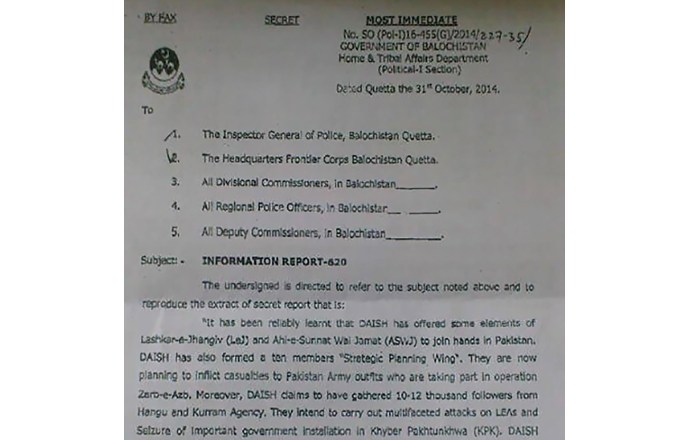 "They are now planning to inflict casualties to Pakistan Army outfits who are taking part in operation Zarb-e-Azb," says the alert, referring to the military offensive against the Pakistani Taliban and other militants that was launched in June in a tribal region near the Afghan border.
Labeled "secret," the memo was sent by the government of Balochistan, a southwestern province that borders Afghanistan, to authorities and intelligence officials across Pakistan last week. Akber Durrani, the province's home secretary, called it "routine" and said Sunni militant group and its sympathizers do not have a stronghold there. .
But the document suggests that ISIS has Pakistan in its cross-hairs, warning that the group aims to stir up sectarian unrest by dispatching the local militant group Lashkar-e-Jhangvi on offensives against Pakistan's minority Shiite Muslim community, further destabilizing a country already battling Taliban and al Qaeda elements. Most Pakistanis are Sunni Muslims. Mistrust has existed between Shiites and Sunnis for around 1,400 years.
ISIS has seized large areas of Syria and Iraq. It claims to have recruited 10,000 to 12,000 followers in tribal areas on the Afghan border, including in Hangu, which is known for hostility between Shiites and Sunnis, the memo says.
Lashkar-e-Jhangvi, which has claimed responsibility for violence against Shiites, and Sipa-e Muhammed, which has struck against Sunnis, were banned after 9/11.
Just days ago, the chief minister of Balochistan, Dr. Malik Baloch, told journalists he had no information about the presence of ISIS in the province. "However, there are fundamentalists whose approach is similar to that of ISIS," he said.
The memo recommended "strict monitoring" of militants and "extreme vigilance" to ward off any attacks.
There have been other signs of ISIS flexing its muscles in the region. In late September, a pamphlet apparently made by the self-proclaimed caliphate was distributed among Afghan refugees in Pakistan exhorting them to pledge allegiance and and lashing out against "America and the rest of the infidels."
In late September, ISIS-aligned militants launched a brutal offensive in Afghanistan alongside Taliban fighters that has left more than 100 people dead. Fifteen family members of local police officers were beheaded and at least 60 homes were set ablaze, officials said.
"They are now planning to inflict casualties to Pakistan Army outfits who are taking part in operation Zarb-e-Azb," says the alert, referring to the military offensive against the Pakistani Taliban and other militants that was launched in June in a tribal region near the Afghan border.
Labeled "secret," the memo was sent by the government of Balochistan, a southwestern province that borders Afghanistan, to authorities and intelligence officials across Pakistan last week. Akber Durrani, the province's home secretary, called it "routine" and said Sunni militant group and its sympathizers do not have a stronghold there. .
But the document suggests that ISIS has Pakistan in its cross-hairs, warning that the group aims to stir up sectarian unrest by dispatching the local militant group Lashkar-e-Jhangvi on offensives against Pakistan's minority Shiite Muslim community, further destabilizing a country already battling Taliban and al Qaeda elements. Most Pakistanis are Sunni Muslims. Mistrust has existed between Shiites and Sunnis for around 1,400 years.
ISIS has seized large areas of Syria and Iraq. It claims to have recruited 10,000 to 12,000 followers in tribal areas on the Afghan border, including in Hangu, which is known for hostility between Shiites and Sunnis, the memo says.
Lashkar-e-Jhangvi, which has claimed responsibility for violence against Shiites, and Sipa-e Muhammed, which has struck against Sunnis, were banned after 9/11.
Just days ago, the chief minister of Balochistan, Dr. Malik Baloch, told journalists he had no information about the presence of ISIS in the province. "However, there are fundamentalists whose approach is similar to that of ISIS," he said.
The memo recommended "strict monitoring" of militants and "extreme vigilance" to ward off any attacks.
There have been other signs of ISIS flexing its muscles in the region. In late September, a pamphlet apparently made by the self-proclaimed caliphate was distributed among Afghan refugees in Pakistan exhorting them to pledge allegiance and and lashing out against "America and the rest of the infidels."
In late September, ISIS-aligned militants launched a brutal offensive in Afghanistan alongside Taliban fighters that has left more than 100 people dead. Fifteen family members of local police officers were beheaded and at least 60 homes were set ablaze, officials said.
Pakistan: Plight of minorities
It seems no manner of inhumanity can push authorities, in the centre and provinces, to move on the issue of minority rights. For decades religious extremists have persecute religious, sectarian and ethnic minorities, with the government unable, rather unwilling, to take the bull by the horns. Ruthless murders of the Shi’a community have, unfortunately, become as commonplace as lynching of helpless Christians, as was witnessed recently. And the Hindus of Sindh, never forgiven for sharing religion with the ‘enemy’, have been victimised since partition itself. The years since Zia, of course, saw their harassment worsen just like other minorities that the ‘land of the pure’ could not tolerate anymore.
Kidnapping and forceful conversions of young, under-age Hindu girls has become common practice in Sindh. Things seemed moving in the right direction finally with the arrival of Bilawal Bhutto in the lead position of the PPP. When he recently addressed Larkana’s Hindus on one of their more prominent religious gatherings, the province’s shrinking liberal circles finally breathed a sigh of relief. But hopefully his position on minorities is more enduring than some of his other initiatives. His show-cause notice to the CM was also appreciated – there was hope for Thar after the huge, recurring tragedy – but soon the notice was retracted. So much for draught, famine and deaths, it seems, when national and family politics is at play.
It doesn’t help, also, that the PPP has a long history of not honouring promises to minorities during its long reign in Sindh. Party lawmakers have made a habit of promising the moon, especially to Hindus each time their little girls are taken away, forcibly converted, and married off without consent. Yet there is hardly a precedent when they turned their words into action, or even cared to. The Sindh government even passed a law last year that criminalises under-age marriages. Yet the law is helpless in face of the more enduring custom of hatred, persecution, kidnapping, etc. The Sharifs, of course, are not interested in such matters. And the PPP, losing ground everywhere, will find Sindh a rapidly shrinking plate too if it does not pull its socks up. If the deaths of Thar are not enough to haunt them, the Hindus of the province will not forgive them either. It’s little surprise that Hindus are migrating to India. Their lives in Pakistan are unbearable, and unless relevant authorities arrest this trend, they too will be pushed out of their comfortable thrones.
Monday, November 10, 2014
'Game of Thrones' banned in Turkey's military schools

The fiercely secular Turkish armed forces will also offer Islamic education in its schools for the first time.Turkey's armed forces have introduced new regulations for the country's military schools, according to which classes on Islam will be taught for the first time – and the blockbuster U.S. television series “Game of Thrones” is now banned. The aim of the new rules is to “protect” students from “sexual exploitation, pornography, exhibitionism, abuse, harassment and all negative behaviors,” according to Hurriyet Daily News. Four military officers were discharged from the army in 2012 for allowing their students to watch “Game of Thrones” in an Istanbul military school. It was not specified whether the screening was recreational or part of the school curriculum. Military schools will now function according to an updated set of education regulations drafted by the armed forces. One chapter of the new regulations, reportedly titled “the protection of students,” bans the screening of certain content. In addition, the fiercely secular military will allow elective classes on Islam, including “basic religious education, the Quran and the life of the Prophet Muhammad.”
Israel, India successfully test advanced missile system

New Delhi defense official says development marks ‘significant milestone’ in relationskIsrael’s national aerospace and aviation arms manufacturer conducted the first full and successful test of the Barak-8 air and naval defense missile system on Monday morning, Israel Aerospace Industries announced in a press release.
 The test, conducted with the Defense Ministry and India’s Defence Research and Development Organization, validated all components of the weapons system, from radar detection to interception and detonation of the incoming projectile.
“The system’s impressive, advanced capabilities proven today in this complex test, are another testimony of IAI’s resilience, advanced and groundbreaking capabilities,” said Israel Aircraft Industries president and CEO Joseph Weiss.
Dr. Avinash Chander, the head of India’s DRDO and an adviser to the defense minister, called the test “an important milestone in the cooperation between India and Israel.”
The test came days after Indian Home Minister Rajnath Singh visited Israel, in the highest-level official trip ever for Delhi.
“Israel and India are at the cusp of a new era of increased cooperation in a wide variety of fields,” Prime Minister Benjamin Netanyahu said while meeting Singh on November 6.
In September, Netanyahu met Indian Prime Minister Narendra Modi in New York on the sidelines of the UN Gereral Assembly to discuss nuclear developments in Iran and expanding bilateral ties between Jerusalem and Delhi.
The meeting was the first between the Israeli and Indian premiers in over a decade, according to the Israeli Prime Minister’s Office.
Netanyahu reportedly invited India to participate in a joint effort on cyber-defense, a project that will aim to be a link between civilian and military authorities in both countries.
In October, India reportedly agreed to a $525 million deal to buy Israel’s guided Spike missiles, which were widely used during Operation Protective Edge.
An earlier Barak system, already in use guarding Israel’s natural gas platforms in the Mediterranean Sea, is deployed on missile boats, where it can intercept sea-skimming missiles, among other threats.
During the Second Lebanon War, the Barak system was disabled shortly before Hezbollah fired a surface-to-sea missile that nearly sank one of the Israeli Navy’s most advanced warships, the INS Hanit.
Read more: Israel, India successfully test advanced missile system | The Times of Israel http://www.timesofisrael.com/israel-india-successfully-test-advanced-missile-system/#ixzz3IhTxxgdx
Follow us: @timesofisrael on Twitter | timesofisrael on Facebook
The test, conducted with the Defense Ministry and India’s Defence Research and Development Organization, validated all components of the weapons system, from radar detection to interception and detonation of the incoming projectile.
“The system’s impressive, advanced capabilities proven today in this complex test, are another testimony of IAI’s resilience, advanced and groundbreaking capabilities,” said Israel Aircraft Industries president and CEO Joseph Weiss.
Dr. Avinash Chander, the head of India’s DRDO and an adviser to the defense minister, called the test “an important milestone in the cooperation between India and Israel.”
The test came days after Indian Home Minister Rajnath Singh visited Israel, in the highest-level official trip ever for Delhi.
“Israel and India are at the cusp of a new era of increased cooperation in a wide variety of fields,” Prime Minister Benjamin Netanyahu said while meeting Singh on November 6.
In September, Netanyahu met Indian Prime Minister Narendra Modi in New York on the sidelines of the UN Gereral Assembly to discuss nuclear developments in Iran and expanding bilateral ties between Jerusalem and Delhi.
The meeting was the first between the Israeli and Indian premiers in over a decade, according to the Israeli Prime Minister’s Office.
Netanyahu reportedly invited India to participate in a joint effort on cyber-defense, a project that will aim to be a link between civilian and military authorities in both countries.
In October, India reportedly agreed to a $525 million deal to buy Israel’s guided Spike missiles, which were widely used during Operation Protective Edge.
An earlier Barak system, already in use guarding Israel’s natural gas platforms in the Mediterranean Sea, is deployed on missile boats, where it can intercept sea-skimming missiles, among other threats.
During the Second Lebanon War, the Barak system was disabled shortly before Hezbollah fired a surface-to-sea missile that nearly sank one of the Israeli Navy’s most advanced warships, the INS Hanit.
Read more: Israel, India successfully test advanced missile system | The Times of Israel http://www.timesofisrael.com/israel-india-successfully-test-advanced-missile-system/#ixzz3IhTxxgdx
Follow us: @timesofisrael on Twitter | timesofisrael on Facebook
The Middle East destroys itself
BY GARY ACKERMAN
Blame Israel; it's the cool thing to doWhat a mess. The world needs someone to blame. Hey, why not the Jews? After all, it’s all Israel’s fault. Everyone else knows that all the problems in the region would be solved if only the Middle East had just one more Muslim country. What could possibly go wrong? A quick review. After the passing of Muhammed in 632 A.D., his adherents, having left no sons, broke into a family feud over who were the real heirs apparent, the true followers. The ensuing Shia-vs.-Sunni split rages on today and erupts throughout much of the 1.6 billion Muslim world, with seemingly more violence every day. The rage is about piety, purity, politics, power, personality, territory, legitimacy and, of course, religion. Take just a partial tour of the recent region. Saddam Hussein, with his Sunni-minority Baathist party, brutally ruled over Iraq’s majority Shia country, until we toppled him. He was replaced by Nouri al Maliki, whose Shia government (backed by Shia Iran) got even by encouraging extreme violence against the country’s Sunnis and excluding them from any meaningful role in governance or life. Iran meddles everywhere, sponsoring terrorist Hamas in Gaza, arming terrorist Hezbollah in Lebanon by way of Damascus, having backed the Muslim Brotherhood in Egypt, and now supporting the Houthies who are progressing in the overthrow of Yemen (If only Iran became a nuclear state, I’m sure their behavior would improve!). Al Qaeda and its allies are Sunni extremists who hate and want to destroy moderate Sunni governments for being, well, moderate. They despise the West as well. ISIS, ISIL, ISEverywhere is an Islamic group so nasty they were thrown out of Al Qaeda for bad manners. They want to violently overthrow existing governments and establish an extreme religious Sharia Law Caliphate that recognizes no national boundaries. Among other things, they make rather violent home videos. Then there’s the terrorist Nusra Front trying to dislodge the Alawite minority rulers in Syria (as are IS, and separately, scores of independent liberation groups as well as additional terrorist types. On the terror roster, these groups are metastasizing and taking the field so fast you need a new score card every day). They are so brutal they almost create sympathy for the Assad dynasty of assassins who murdered hundreds of thousands of their own citizens with poison gas. (Interesting how one minute Assad is elected with 98% of the popular vote, and the next minute more people are trying to kill him than voted against him.) In Turkey, there has been a reluctance to stem the genocidal slaughter of Kurds by ISIS on the Syrian side of their mutual border. This, out of fear those Syrian Kurds would like to join the Kurds on the Turkish side of their border and declare their own separate state. Egypt, Turkey and Saudi Arabia each understandably despise Shia Iran (whose operatives tried to assassinate the Saudi Ambassador in D.C.), but are each other’s rivals for influence in the region. Lebanon, whose prime minister was blown up, allegedly of course, by the Syrians, is wracked by Sunni-Shia-Christian strife and seems to struggle in finding a formula to govern. Libya, never a bed of roses, has devolved into an ungovernable failed state since the killing of its hated tyrant, Moammar Khaddafy. And Palestinian Fatah and Hamas seem to hate each other without a state. The region is on fire. Violence, murder and mayhem prevail. Things must settle down. Of the 22 Arab states, almost all are simmering, if not at full boil. The world knows where the problem lies, and upon whose doorstep to lay the blame: The UN is focused like a laser on the Jewish nation. Things would be wonderful if only Israel would get out of the way, and allow for a 23-State Solution.
Islamic extremists infiltrating schools, university campuses and scout groups across the UK in 'unprecedented scale', report warns
Islamic extremists are infiltrating schools, university campuses and scout groups across the UK, a new report has claimed. Hardline groups, blamed for radicalising young British Muslims, have posted invitations on social media sites and at university campuses to public talks in an 'unprecedented scale', according to Sharia Watch UK. The group, which monitors Islamic extremists, will publish its report highlighting the operations of 15 people it claims hold 'extremist views' who were allowed to give public talks or lectures at 20 institutions. They include the Islamic Education and Research Academy (iERA), whose speakers have been accused of advocating anti-Semitic and homophobic views, the Sunday Telegraph reports. The iERA is currently under investigation by the Charity Commission over regulatory issues in its 'policies for organising events and inviting external speakers'. But leading members of the group have given talks at universities, a school and a south London scout group, according to the Sharia Watch UK report. Among those addressing the lectures was chairman and founder Abdur Raheem Green, a British Muslim convert who is reported to believe that beating women will ‘bring them to goodness’. It is also claimed that he has said that adultery is punishable by a 'slow and painful death', and has been seen on a YouTube video demanding that a Jewish man is removed form his sight while giving a talk at Hyde Park Corner. According to the report he was booked to address an Islamic event at Acklam Grange Secondary School in Middlesbrough. Students from across the North East were also invited to attend. Activist Hamza Tzortzis is also named in the report, which states that he has claimed that anyone fighting against the Muslim community 'should be killed', adding that the punishment should be 'beheading'. The report, entitled Learning Jihad: Islamists in British Universities, claims that he has been scheduled to give talks to the Universities of Dundee, Cardiff and Surrey and also the School of Oriental and African Studies in the six months leading to July. He is descriebd on the iERA website as a 'popular speaker' at UK universities. Figures supplied to the report's authors by Students Rights revealed there were 233 events of 'concern' posted on social media. An iERA spokesman told the Sunday Telegraph the group had no plans to infiltrate universities. They added: 'We are an educational academy and run open debates and educational talks and campaigns around the UK and overseas.' The spokesman went on to deny the group's members promoted anti-Semitism, homophobia, or violence against women. In September Home Secretary Theresa May announced sweeping new powers banning preachers of hate from public speaking or spreading their poison on social media. The Extremist Disruption Orders – which have been dubbed Asbos for hate clerics – will also include anybody who seeks to ‘overthrow democracy’. In the past, the rules could have applied to spokesmen for Sinn Fein, such as Gerry Adams. The restrictions placed on the hate preachers will be backed by criminal punishments and a possible jail term. They could include a ban on speaking at public events. Anything they want to put on social media would have to be cleared by the authorities in advance, and the fanatics could also be banned from attending specific events and told who they can associate with, in powers that are similar to the now defunct control orders. Read more: http://www.dailymail.co.uk/news/article-2827762/Islamic-extremists-infiltrating-schools-university-campuses-scout-groups-UK-unprecedented-scale-report-warns.html#ixzz3Igr9V0Ph Follow us: @MailOnline on Twitter | DailyMail on FacebookBy AMANDA WILLIAMS
China, U.S. to extend validity of business, tourist and student visas
 China and the United States will grant each other's citizens a business or tourist visa with multiple entries and the maximum validity of ten years, China's Foreign Ministry announced on Monday.
The student visa will also be extended to five years of validity at most with multiple entries, said Qin Gang, the ministry spokesman, in a press release.
The two governments have reached the agreement and will finalize the arrangement soon, he said.
The visa extension policies will facilitate people-to-people exchanges and benefit cooperation in all areas between the two countries, he said.
According to the ministry, China has signed mutual visa exemption agreements with nearly 90 countries and reached 53 visa simplification agreements with 39 countries.
A total of 37 countries and regions have agreed to grant Chinese citizens visas on arrival, while eight countries and regions unilaterally allow Chinese citizens to enter without a visa.
China and the United States will grant each other's citizens a business or tourist visa with multiple entries and the maximum validity of ten years, China's Foreign Ministry announced on Monday.
The student visa will also be extended to five years of validity at most with multiple entries, said Qin Gang, the ministry spokesman, in a press release.
The two governments have reached the agreement and will finalize the arrangement soon, he said.
The visa extension policies will facilitate people-to-people exchanges and benefit cooperation in all areas between the two countries, he said.
According to the ministry, China has signed mutual visa exemption agreements with nearly 90 countries and reached 53 visa simplification agreements with 39 countries.
A total of 37 countries and regions have agreed to grant Chinese citizens visas on arrival, while eight countries and regions unilaterally allow Chinese citizens to enter without a visa.
Obama urges China to be partner in ensuring world order
U.S. President Barack Obama said on Monday a successful China was in the interests of the United States and the world but Beijing had to be a partner in underwriting international order, and not undermine it. Speaking to growing concerns among U.S. and other companies about the Chinese business environment after arriving in Beijing, Obama also urged China to reject the use of cyber theft for commercial gain and create a more level playing field where policy is not used for the benefit of some firms over others. Obama's trip to China for an Asia-Pacific summit comes at a time of growing China-U.S. friction with Washington trying to expand American interests in Asia while Chinese President Xi Jinping demonstrates more willingness than his predecessors to demonstrate Beijing's clout on regional issues. The two countries have disagreed in recent months on a range of topics, including trade, maritime issues and cyber security, while the United States has lobbied against the setting up of a multilateral infrastructure investment bank sponsored by China. "Our message is that we want to see China successful," Obama told a news conference. "But, as they grow, we want them to be a partner in underwriting the international order, not undermining it." Obama and Xi will meet over dinner on Tuesday night and then for bilateral talks as part of an official state visit on Wednesday. In a deal that he said would improve trade and business ties between the world's two largest economies, Obama announced that China and the United States agreed to significantly extend the length of short-term visas. But he also urged Beijing's leaders to create a fair market place for foreign firms. "We look to China to create a more level playing field on which foreign companies are treated fairly, so that they can compete fairly with Chinese companies," he said in a speech to business leaders at the Asia-Pacific Economic Cooperation (APEC) forum. "We look to China to become an innovative economy that values the protection of intellectual property rights, and rejects cyber theft of trade secrets for commercial gain." Dozens of foreign firms, including U.S. companies such as Qualcomm Inc and Microsoft Corp, have come under scrutiny as China seeks to enforce a 2008 anti-monopoly law that some critics say is being used to unfairly target overseas businesses, raising protectionism concerns. Chinese regulators have defended their antitrust policies, saying foreign firms are not being targeted. SUSTAINABLE GROWTH, OPEN INTERNET Obama's focus on Asia business ties on the first day of his visit underscored his efforts to strike a balance between seeking deeper economic cooperation with a rising China while also challenging Beijing with the U.S. pursuit of a trans-Pacific trade pact that for now excludes the world's second largest economy. Earlier, Obama said momentum was building on the ambitious 12-country Trans-Pacific Partnership (TPP), although U.S officials had ruled out a major announcement on the pact in Beijing. He urged China to move "definitively" to a more market-based exchange rate and to stand up for human rights and freedom of the press. Under the visa deal, which will take effect on Nov. 12, both countries would extend the terms of multiple entry short-term tourist and business visas to 10 years from one year, the White House said in a statement accompanying Obama's announcement. Student visas would be extended to five years from one year. "As a result of this arrangement, the United States hopes to welcome a growing share of eligible Chinese travelers, inject billions (of dollars) in the U.S. economy and create enough demand to support hundreds of thousands of additional U.S. jobs," the White House statement said. The extension of some visas for Chinese nationals to 10 years matches what is currently allowed for citizens of nations with close relations with the United States, such as European countries and Brazil. A senior U.S. official said the visa agreement would allow the United States to tap into the fast-growing market of Chinese tourists traveling abroad. The United States now attracts only 2 percent of Chinese tourism. "We see this as a really big win," the official said, estimating that the United States could gain 440,000 jobs by 2021 and receive an $85 billion annual infusion into the American economy as a result of the new policy. It will also make it easier for Chinese businesses and investors to get involved in U.S. projects.BY MATT SPETALNICK AND MICHAEL MARTINA
Afghanistan’s Complex Peace Calculus
Afghanistan’s long-term stability, prosperity and unity depend on a clear, sustainable, and sustained peace process. A “quick fix” deal could jeopardize the investment in blood and treasure that the international community has made in the region over the past decade and a half. Former American President John F. Kennedy pithily described a peace process in words that fit the Afghan context well: “Peace is a daily, a weekly, a monthly process, gradually changing opinions, slowly eroding old barriers, quietly building new structures. And however undramatic the pursuit of peace, that pursuit must go on.” And Afghanistan’s own history demonstrates that any peace process must come from a position of strength, or else it will lead only to renewed instability. The new Afghan Government of National Unity under the leadership of President Ashraf Ghani and CEO Abdullah Abdullah represents an opportunity to reset and reinvigorate the Afghan peace process, this time in a more systematic, organized and objective way with a roadmap featuring clearly defined objectives and a division of labor amongst the various stakeholders. We look at some of the issues – and some of the stakeholders – that will play a major role in the peace process in the months and years to come. The Definition Problem: Who Are the Taliban? There is little consensus as to who the Taliban actually are. Former President Hamid Karzai has often referred to them as disgruntled sons of the soil, while Afghan security institutions and analysts consider them to be a conglomerate of core ideological Taliban, field commanders, and foot soldiers who comprise elements of the former Taliban regime, aggrieved individuals and tribal elders, victims of collateral damage, criminal networks, drug lords, foreign fighters (including Punjabis, Arabs, Chechens, and Uzbeks), and finally some elements of the Pakistan’s notorious Inter-Services Intelligence. Which of these elements are open to reconciliation is an important question for Afghans and the international community. The enemy needs to be clearly defined and a distinction made between those elements who might be brought into the fold and those who need to be dealt with by force. A Roadmap for Peace: Process Versus Deal The Afghan government and opposition lack both a cohesive and systematic approach and the necessary capacity to undertake a comprehensive peace process in Afghanistan. The Taliban has meanwhile shied away from publicly supporting or engaging with the peace process. A first important step would thus be for the new Afghan government to chart a clear roadmap for the Afghan peace process, identifying objectives before, during and after negotiations, processes, red lines, and issues that are negotiable. The government should make it very clear that it is focused on a process and not on any deal that will inevitably be short lived. Too Many Commissions, Too Few Achievements Afghanistan is hardly new to peacemaking. During the Soviet War in Afghanistan, and then again during the internal turmoil of the 1990s, dozens of peace initiatives were undertaken by different rival parties, some brokered by neighbors, others by the UN, and still others by the Gulf States. Former President Hamid Karzai established Afghanistan’s first National Independent Peace and Reconciliation Commission headed by former Afghan President Sibghatullah Mojaddedi. The sole significant achievement of this commission was to release a few prisoners. Later, in August 2007, a three-day joint Afghanistan-Pakistan peace jirga was convened, calling for cross border and bilateral cooperation to bring peace in Afghanistan. This was during the peak of Taliban resurgence and increased guerilla activity across the country. That was followed by the formation of another commission and peace jirga on June 2, 2010, which approved the government’s plan to launch a comprehensive dialogue with the Taliban, with the result that the Afghan High Peace Council was formed. None of the declarations and resolutions of these jirgas were successfully implemented, and Afghanistan was left with an ever increasing number of jirgas, resolutions, commissions and staff, all lacking a clear mandate. Pakistan’s Card All roads to peace in Afghanistan pass through Rawalpindi and Islamabad. Pakistan holds the key to the Afghan peace process, but is smart enough to hold its cards close to its chest. The question of Taliban sanctuaries, safe havens, training camps, and the provision of logistical and military support has always been the main concern of the Afghan government, but little has been done to address these issues, except when they posed a direct threat to the coalition. Pakistan understands full well that the Taliban is its dog in the fight and it will only give it up as an instrument of foreign policy under pressure and in exchange for a deal that addresses its territorial insecurities, specifically the Durand line, and its strategic interests in Afghanistan. At this point it is unclear what kind of deal this might be, but Ghani and Abdullah have a chance to negotiate one with Pakistan in exchange for peace. Gulf States: Business and Financial Hub The Taliban finances its activities through opium, gems, extortion, and kidnapping, among other sources, but many of the dollars financing the Taliban insurgencies can be traced to the Gulf States. The Gulf States have traditionally been the business and financial hub for the Taliban and Haqqani network. It is no secret that former Taliban officials are involved in businesses in Dubai, Abu Dhabi, and other Gulf cities. The U.S. Treasury Department has long been monitoring the hawala system and has blacklisted a number of businesses linked to the Taliban. Assisted by the U.S. and other international actors, the new Afghan government should seek to squeeze the Taliban financing network. This ought to include intelligence cooperation and systems to counter financing in the Gulf States. For their own security, the Gulf States themselves have reason enough to go after these networks and dismantle them. The Neglected Roles of Iran and Central Asia The ranks of the Taliban are filled with fighters from the Central Asian states of Uzbekistan, Tajikistan, Turkmenistan, and Kyrgyzstan, in addition to Chechens and others. The Taliban maintains close ties with the Islamic Movement of Uzbekistan (IMU), Chechen terrorist groups, and Chinese Uyghurs. Meanwhile, Iran has been accused by the West of providing medical, financial and logistical support to the Taliban in the volatile southern province of Nimroz. Unlike the previous Karzai administration, Ghani and Abdullah have a golden opportunity to engage in a constructive dialogue with Central Asian states and Iran to cut the inflow of fighters and logistical support to the Taliban through a meaningful mechanism. This will require patience, foresight, and a strong foreign policy machinery. Distant Collaborators: India, Russia and Turkey The hijacking of Indian Airlines Flight 814 in December 1999, the recent pronouncements of jihad against India by the al-Qaeda leader Ayman Al Zawahiri, and the dozens of attacks on Indian diplomatic missions across Afghanistan all underscore the strategic importance of Afghanistan for India’s security. India has an important role to play in using its international influence, leverage and above all its intelligence expertise to help Afghanistan reach a piece deal. Meanwhile, the Chechen problem is an important internal security threat for Russia. Moscow has traditionally been an important supporter of the former Northern Alliance and can still be a relevant factor. The Russians have vital security and regional interests in Afghanistan and any political, diplomatic and military investment in the Afghan peace process will be an investment in the security of the Russian Federation. Turkey has important business and strategic interests in Central Asia and Afghanistan. Turkey’s status in the Islamic world and particularly Ankara’s influence over Pakistan could be important factors in helping the peace process along in Afghanistan. The trilateral talks between Afghanistan, Pakistan and Turkey have been an important venue for exchanging information and improving coordination, even if they have yet to produce tangible results. As a longtime ally and friend of both Pakistan and Afghanistan, Turkey could serve as an honest broker in peace talks. The Taliban as Hezbollah Times have changed, and the Taliban now has no choice but to relinquish its dream of returning to power and instead engage in a constructive and meaningful peace process with the Afghan government. Still, the question remains: What sort of Taliban would be acceptable to the people and government of Afghanistan? Former President Hamid Karzai repeatedly urged the Taliban to lay down its arms in exchange for immunity and participate in the mainstream political process and run for election. This suggests that the Taliban has the option to mold itself either into a political party with an armed wing. This would suggest a Hezbollah-type party, which would not be conducive to long term stability and unity. Great Power Politics: U.S., U.K. and China The U.S. and U.K. wield considerable economic, political and military influence over Pakistan. Both countries have also held dialogues with the Taliban through backdoor channels and intelligence contacts. In his last speech, Karzai reiterated that the key to Afghan peace lies with the Americans and Pakistan. Admittedly, much of Karzai’s rhetoric is for domestic political purposes, but he does have a point. But the United States has its own long-term relationship with the Pakistan army and interests in the security of its nuclear arsenal, which outweigh the Afghan peace process. Meanwhile, there is a considerable Pakistani community in Britain and the U.K. has strategic military and geopolitical interests in Pakistan which again probably outweigh the Afghan reconciliation process. All of which points to one fact: In the great power politics of the region, Pakistan’s strategic importance to the U.K. and the U.S. exceeds that of Afghanistan. The new Afghan government has a difficult task ahead dealing with this geopolitical calculus. Finally, China has a vital security interest in the Afghan peace process giving the rising insecurity in Xinjiang and the resurgence of the Uyghur insurgency. There is much in political, military and economic terms that China could do to help reach Afghans reach a peace deal sooner than later. Clearly, the road to peace in Afghanistan will be long and difficult, but with a good faith effort by each of the stakeholders the country can at least start the journey.By Tamim Asey
A new government brings hope of change in Afghanistan

Optimism - not a word you have heard a lot in Afghanistan of late.
But in Kabul right now, you hear it.Maybe it is because there is a deep sigh of relief that the country has survived a months-long political crisis over a presidential election torn by fraud and two powerful camps adamant that they had won. On Kabul roundabouts, alongside the huge billboards of mujahideen leaders and commanders assassinated through the years, official hoardings that announced Hamid Karzai's presence have been replaced by President Ashraf Ghani. Even that is more than cosmetic in a country where power has rarely transferred peacefully. Some voices still warn of a "legitimacy crisis" over the final power sharing deal between President Ghani and Abdullah Abdullah which seemed to render a massive voting exercise irrelevant. Maybe there is optimism because this is another new beginning in a country where all too many new starts have led to yet another time of violence and hardship. "We can't afford not to be optimistic after living with war for so long," an Afghan friend tells me. A new political order is being installed and the country awaits promised action on many pressing challenges confronting this nation as foreign troops pull out, aid levels drop and Taliban attacks are on the rise. Vibrant election This time the generation that has come of age in the last decade of international engagement have new weapons to hold their leaders to account. Among them, a website called Sad Roz is tracking the progress of political pledges made in the heat of vibrant election campaigns and urges Afghans to "submit a missing promise". Kabul's chattering classes swap stories of a new president who sleeps only three hours a night, devours every document searching for essential details and schedules his diary so tightly that a senior official who arrived five minutes late was told he had missed his moment. Afghans, with a brand of humour honed through decades of war, tell tales of turbaned tribal elders ushered out of the presidential office, protesting their tea is still warm. "I'll give you an important piece of information, " one of his aides whispers to me. "President Ghani is meeting Chief Executive Officer Dr Abdullah every week, one on one, for more than an hour to discuss important matters." In animated conversation, Afghans discuss who sides with Ghani, who with Abullah, and there are still those who say they remain with Karzai - a player who will still remain in the game. But the transition is underway. For the first time for as long as anyone can remember, there is an office of the First Lady of Afghanistan. Lebanese-born Rula Ghani is now in "listening mode" receiving delegations from all walks of life. Ashraf Ghani's public acknowledgement of his wife during his inauguration was mentioned to me by many Afghan women during a visit to the capital. A simple gesture sent a powerful signal in a deeply conservative culture. "He recognised that women exist," one Afghan aid worker exclaimed. And yet, whatever change will come will still sit, sometimes uneasily, with the stubborn realities of more traditional ethnic based politics. Anxious questions On a not too unusual day in Kabul, traffic was slowed along the main avenue of government buildings by gaggles of turbaned men in long cloaks sauntering down the road and young men in pickups revving their engines outside a well guarded gate. Visitors from northern Uzbek areas had come to call on their leader - Uzbek strongman Abdul Rashid Dostum who now presides as vice president, and has his own promises to keep. Afghan optimism is still wrapped in anxious questions. Young Afghans who threw their energies and aspirations into the presidential race now ask whether the political space will stay open for them, or if they will be sidelined by men of guns and greed. Supporters of rival camps wonder which posts in the new cabinet will go to which side, and who will take up the jobs. For all the exhilaration of a new beginning, the fundamentals of the old have not changed. Afghanistan is still a country on the brink of bankruptcy, threatened by instability. But in the absence of clear evidence about which way this new beginning will turn, some Afghans allow themselves to hope this chapter will be different. In Afghanistan, any optimism is cautious, but for the moment it is there.
Subscribe to:
Posts (Atom)