Thursday, January 6, 2022

Video Report - #Kazakhstan amid the ongoing crisis

Video Report - #January6th #Jan6thCommittee - Never-before-seen January 6 footage from our photographer

Video Report - #January6th #January6thInsurrection - See Jake Tapper's plea to #Republicans

Video Report - #January6th #January6thInsurrection - 'I am embarrassed. I am in shame': Alleged Capitol rioter after sentence

Video - #January6th #January6thInsurrection - President Biden and Vice President Harris Deliver Remarks to Mark One Year Since the January 6th Deadly Assault on the Capitol

Video - پاکستان سپریم کورٹ میں تاریخ بن گئی، پہلی خاتون جج جسٹس عائشہ ملک نامزد

Video - Chairman PPP Bilawal Bhutto Zardari’s media talk after the Core Committee meeting in Lahore

بلدیاتی انتخابات سے قبل صوبہ پنجاب کے 9 اضلاع سے 80 سے زائد بلدیاتی نمائندوں نے پاکستان پیپلز پارٹی میں شمولیت اختیار کر لی

 پنجاب میں بلدیاتی انتخابات سے قبل صوبہ پنجاب کے 9 اضلاع سے 80 سے زائد بلدیاتی نمائندوں نے پاکستان پیپلز پارٹی میں شمولیت اختیار کر لی ہے۔ ان نمائندوں کا تعلق پنجاب کے اضلاع قصور، اوکاڑہ، وہاڑی، ساہیوال، ملتان، جھنگ، لیہ اور لودھراں سے ہے۔ پیپلز پارٹی میں شامل ہونے والوں میں میونسپل کمیٹیوں اور یونین کونسلوں کے سابق چیئرمین، سابق جنرل کونسلرز، کسان اتحاد کے اراکین اور تاجر برادری کی اہم شخصیات شامل ہیں۔چیئرمین پیپلز پارٹی بلاول بھٹو زرداری نے پارٹی میں نئے شامل ہونے والوں کے اعزاز میں بلاول ہاؤس لاہور میں ظہرانہ دیا۔ ان سے خطاب کرتے ہوئے چیئرمین بلاول بھٹو زرداری نے کہا کہ پیپلز پارٹی ہمیشہ نچلی سطح کی جماعت رہی ہے۔ یہ اب بھی گراس روٹ کی پارٹی ہے اور ہمیشہ گراس روٹس کی پارٹی رہے گی۔


پارٹی میں نئے شامل ہونے والوں سے خطاب کرتے ہوئے انہوں نے کہا کہ پیپلز پارٹی نے ہمیشہ مشکل وقت میں ملک کو مستحکم کیا ہے۔ پاکستان اس وقت مشکل دور سے گزر رہا ہے۔ موجودہ حکومت عوام دشمن ہے۔ پیپلز پارٹی نے ہمیشہ غریب عوام کا خیال رکھا ہے۔ اس نے ہمیشہ لوگوں کو روزگار فراہم کیا ہے اور ہمارا نعرہ تھا کہ ’’بے نظیر آئے گی، روزگار لائے گی‘‘۔ 1970

 کی دہائی میں شہید ذوالفقار علی بھٹو کی حکومت میں ہم نے 5 مرلہ سکیم متعارف کروائی اور 1990 کی دہائی میں شہید بینظیر بھٹو نے 7 مرلہ سکیم متعارف کروائی۔ اب یہ منتخب حکومت جس نے 50 لاکھ گھروں کا وعدہ کیا تھا اس نے اس ملک کے غریبوں سے چھت چھین لی ہے۔ سلیکٹڈ حکومت نے ایک کروڑ نوکریوں کا وعدہ کیا تھا لیکن ہزاروں کو بے روزگار کر دیا گیا۔ عوام اس حکومت سے نجات چاہتے ہیں۔ مجھے اس ملک کو صحیح راستے پر ڈالنے کے لیے آپ کی مدد کی ضرورت ہے،چیئرمین بلاول بھٹو زرداری نے کہا کہ پیپلز پارٹی نے ہمیشہ پاکستانی عوام کو بااختیار بنایا۔ صدر زرداری نے جو اس ملک کے سب سے طاقتور سول صدر تھے، اپنے تمام اختیارات پاکستان کے عوام کے نمائندوں یعنی پارلیمنٹ کو منتقل کر دیئے۔ ہم نے ہمیشہ صوبوں اور مقامی حکومتوں کو بااختیار بنانے کی خواہش کی۔ یہی وجہ ہے کہ سندھ میں پیپلز پارٹی نے سندھ اسمبلی کے ذریعے بلدیاتی نظام متعارف کرایا ہے جو مقامی حکومتوں کو بااختیار بناتا ہے۔ سندھ کے وزیر اعلیٰ سید مراد علی شاہ مقامی حکومتوں کو خود اپنی آمدنی پیدا کرنے کے قابل بنا کر طاقتور بنا رہے ہیں۔ میئر کو واٹر بورڈ کا چیئرمین بنا دیا گیا ہے۔ کچرے کے انتظام کی مشترکہ صدارت میئر کرتے ہیں۔ مقامی حکومتوں کو پولیس، تعلیم اور صحت کے محکموں سے ہفتہ وار رپورٹس وصول کرنے کا اختیار دیا گیا ہے۔ ہم مقامی حکومتوں کو مضبوط کرنا چاہتے ہیں۔ وفاقی دارالحکومت اسلام آباد اور پنجاب میں بلدیاتی نظام آرڈیننس کے ذریعے نافذ کر دیا گیا ہے۔


چیئرمین بلاول بھٹو نے پارٹی میں آنے والے تمام نئے آنے والوں کا خیرمقدم کرتے ہوئے کہا کہ پیپلز پارٹی نہ صرف ایک سیاسی جماعت ہے بلکہ ایک ایسا خاندان ہے جہاں ہم خوشی و غم، کامیابیوں اور ناکامیوں میں ساتھ ہیں۔پیپلز پارٹی میں شامل ہونے والے سابق بلدیاتی نمائندوں میں قصور یونین کونسل کے سابق چیئرمین رانجھا بلوچ، چوہدری عبدالجبار، چوہدری محمد جمیل، حاجی عبدالستار، چوہدری لیاقت علی ساندہ، قصور یونین کونسل کے سابق چیئرمین چوہدری مشتاق احمد، اسلم میو، نجیب اللہ خان، شبیر احمد بھٹی، ڈاکٹر اشرف چوہان نے شرکت کی۔ ،، قصور کے جنرل کونسلر رانا محمد علی، اشتیاق احمد، ارشد بھٹی، سرفراز احمد، فواد رشید، حافظ ایم ارشد ملک، قصور کے جنرل کونسلر احمد علی اولکھ، محمد جہانگیر، چوہدری شہادت علی جٹ، سردار رفیق ڈوگر، ذوالفقار علی ، قصور کے جنرل کونسلر علی ڈوگر، امتیاز احمد بھٹی، ذوالفقار مسیح، ملک افضال احمد، شبنم خان، سابق ممبر ضلع کونسل قصور، زیب النساء، قصور کے سابق ممبر یونین کونسل سمیر رفیق، نرگس ریاض کھرل، سابق نائب صدر ،قصور یونین کونسل کے چیئرمین رانا محمد یونس، قصور کے سابق وائس چیئرمین فتح محمد نمبردار، کمیونٹی رہنمائوں منظور احمد کھوکھر، عزیز خالد، شرافت علی، تاجر شاہد انجم اور سابق چوہدری نثار علی خان ، قصور میونسپل کمیٹی کے چئیر مین سردار فیصل عطا ڈوگر اور سابق جنرل کونسلر اوکاڑہ میاں ادریس بھٹی، چوہدری اعجاز احمد گل صدر کسان اتحاد پنجاب، ملک جہانزیب کالس صدر لاہور ڈویژن سردار سعید احمد ڈوگر، بااثر شخصیات سردار داؤد احمد، ملک فہد احمد اور دیگر نے شرکت کی۔ حسین اعوان، لاہور بار کونسل کے ممبر رانا انتظار احمد، سابق چیئرمین وہاڑی یونین کونسل شبیر حسین، ملک ناصر محمود اعوان، نعیم اعجاز، وہاڑی یونین کونسل کے سابق وائس چیئرمین اسحاق محمد، زاہد محمود، وہاڑی کے جنرل کونسلرزیونین کونسل اسحاق محمد، زاہد محمود، وہاڑی کے جنرل کونسلرز فیصل حمید، محمد افضل، عبدالرشید، محمد یوسف، نسرین بی بی، زاہد پرویز، سابق یونین کونسل ناظم رانا محمد اقبال، رانا شرافت علی خان، نوید اختر، چوہدری شہزاد اور دیگر نے شرکت کی۔پرویز، راؤ محمد جاوید، ملک محمد اشفاق، قصور کے سابق نائب ناظم مہر محمد سرور، ساہیوال میونسپل کارپوریشن کی سابق رکن فرزانہ عباس، ملتان میونسپل کارپوریشن کی سابق رکن حنا شاہد، جھنگ،میونسپل کارپوریشن کی سابق رکن زرینہ شیخ، سابق جنرل کونسلر محمد سرور اور دیگر نے شرکت کی۔ جھنگ ارم اعجاز، شگفتہ حسین سابق ممبر ضلع کونسل لیہ، اقبال بی بی، شبانہ عامر سابق ممبر ضلع کونسل اوکاڑہ، سابق تحصیل ناظم لودھراں اور سابق یوسی چیئرمین سید اصغر شاہ نے بھی خطاب کیا۔


پیپلز پارٹی کا حکومت کے خلاف لانگ مارچ کا اعلان

پاکستان پیپلز پارٹی نے حکومت کے خلاف لانگ مارچ کا اعلان کردیا۔ بلاول بھٹو زرداری نے کہا کہ 27 فروری سے مزارِ قائد کراچی سے مارچ شروع کریں گے،  لانگ مارچ کراچی سے اسلام آباد تک ہوگا۔
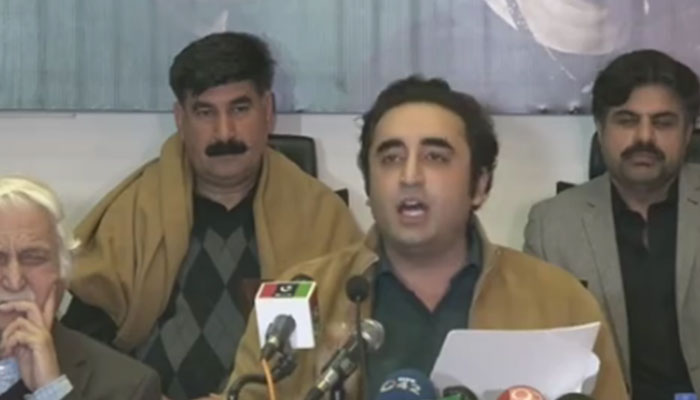

لاہور میں پیپلز پارٹی کی کور کمیٹی اجلاس کے بعد پریس کانفرنس کرتے ہوئے بلاول بھٹو زرداری نے  پی ڈی ایم سے پہلے حکومت مخالف مارچ کرنے کا اعلان کیا۔

بلاول بھٹو زرداری نے کہا کہ چاہتے ہیں کہ سارے ادارے نیوٹرل رہیں، امید ہے کہ ہماری جدوجہد میں کسی ادارے کی طرف سے کوئی رکاوٹ پیدا نہیں کی جائے گی۔

پی پی چیئرمین نے کہا کہ لاہور میں پیپلز پارٹی کی بنیاد رکھی گئی تھی، اسی شہر سے موجودہ حکومت کے خاتمے کی تحریک کا آغاز کریں گے۔

بلاول بھٹو زرداری نے ملک میں فوری، صاف اور شفاف انتخابات کروانے کا مطالبہ بھی کیا۔

انہوں نے کہا کہ سپریم کورٹ اپنے اوپر لگا بھٹو کے عدالتی قتل کا داغ دھوئے۔

پی پی چیئرمین نے کہا کہ حکومت نے ملک میں زرعی اور گیس بحران پیدا کیا، اس کی مذمت کرتے ہیں، کھاد کے بحران سے  ملک کی پوری زرعی معیشت کو نقصان پہنچایا جارہا ہے، کھاد کا بحران موجودہ حکومت کا پیدا کردہ ہے۔

پی پی چیئرمین نے کہا کہ ملک کے مسائل کا حل صرف جمہوریت، جمہوریت اور جمہوریت میں ہے۔

 بلاول بھٹو زرداری نے کہا کہ پی ٹی آئی نے سات سال فارن فنڈنگ چھپائی، اس کی مذمت کرتے ہیں، الیکشن کمیشن پی ٹی آئی کی فارن فنڈنگ کی مزید تحقیقات کرے۔

انہوں نے کہا کہ کم از کم تنخواہ 25 ہزار کے سندھ حکومت کے فیصلے پر سپریم کورٹ کا حکمِ امتناع ہٹایا جائے، ایکسپائر ہوچکے آرڈیننسز کی دوبارہ توسیع کو عدالت میں چیلنج کریں گے۔

 بلاول بھٹو زرداری نے کہا کہ ظالم حکومت عوام سے روزگار چھین رہی ہے، سلیکٹڈ حکومت کی نااہلی پر تیار وائٹ پیپر جلد الیکشن کمیشن کے سامنے پیش کیا جائے گا۔

https://jang.com.pk/news/1033813


پی ڈی ایم ہمارے جانے کے بعد ختم ہوگئی، قمر زمان کائرہ

 پاکستان پیپلز پارٹی (پی پی پی) کے رہنما قمر زمان کائرہ نے کہا ہے کہ پاکستان
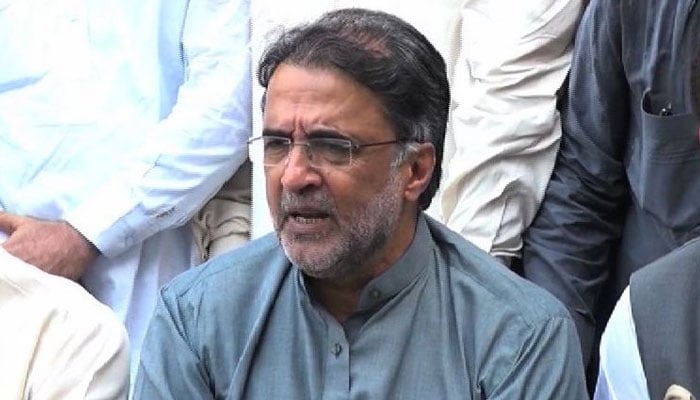

ڈیموکریٹک موومنٹ (پی ڈی ایم) ہمارے جانے کے بعد ختم ہوگئی ہے۔ 

جیونیوز کے پروگرام 'آج شاہ زیب خانزادہ کے ساتھ' میں میزبان شاہزیب خانزادہ سے گفتگو کرتے ہوئے قمر زمان کائرہ کا کہنا تھا کہ موجودہ حکومت سے جان چھڑانی چاہیے۔

انہوں نے کہا کہ پہلے بھی کہا تھا کہ مسئلے کا فوری حل حکومت کو چلتا کرنے میں ہے، پی ڈی ایم میں کچھ دوستوں کو ہمیں اور اے این پی کو باہر کرنے کی جلدی تھی۔

قمر زمان کائرہ کا یہ بھی کہنا تھا کہ اسمبلی میں ہمارا قائدہ حزب اختلاف کے ساتھ تعاون ہے اور رہے گا، ہمارے نکلنے سے پی ڈی ایم کو نقصان ہوا۔

https://jang.com.pk/news/1033847

Wednesday, January 5, 2022

Video Report - #Kazakhstan Kazakhstan government resigns amid massive protests over high fuel prices

Video Report - #January6 - Garland vows to hold all January 6th perpetrators accountable under the law

Video Report - Lessons From The Insurrection: Where Are We Now? Citizen by CNN

Video Report - Jen Psaki finally DEMOLISHES Ted Cruz at press briefing

Video Report -White House press secretary Psaki holds news conference

Video Report - Mai Baghi Hoon (Jeyay Bhutto) | Alamdar Khan

Video Report - Media talk by PPP leaders outside Bilawal House, Lahore

Video Report -: PPP Media Briefing following Hybrid CEC Meeting at Bilawal House Lahore

#Pakistan #PPP - Bilawal, Zardari pay tributes to ZAB


Pakistan Peoples Party Chairman Bilawal Bhutto Zardari has said Zulfikar Ali Bhutto is now an unforgettable history and an invincible movement, while the slogan of Jiye Bhutto is the mirror every dictatorial and anti-people individual is afraid to face.
"I pay tribute to Shaheed Zulfikar Ali Bhutto whose style of politics and governance provided Pakistanis with the opportunity to come close to the state for the first time and take the reins of the country in their own hands,” he said in his message on the 94th birth anniversary of the first elected prime minister of Pakistan and PPP founder Zulfikar Ali Bhutto. He said Zulfikar Ali Bhutto was the first leader to declare people the source of power and laid the foundation of a democratic ideological party which defended the rights and interests of the people of Pakistan. “Bhutto Shaheed was and will always be a source of encouragement to the oppressed,” he added.
Bilawal said that after the Quaid-i-Azam, if anyone gave most sacrifices for the country, it was Shaheed Zulfikar Ali Bhutto. “He used his political savvy and diplomatic skills to lift a broken country, put it back on its feet, got freed 93,000 Prisoners of War (PoWs) and reclaimed 5,000 square miles of land from the enemy occupation,” he said, adding that ZAB gave the first unanimous constitution to the war-torn country, launched a nuclear programme to make the national defence invincible and laid strong foundations for the economy and industries.
“During the rule of the Quaid-e-Awam, significant progress was made in every sector of Pakistan.”
The PPP chairman said the best way to pay homage to ZAB is to remember his sacrifices and ideology and work together for the prosperity, security and bright future of the country. He reiterated his commitment that the PPP will continue to safeguard the gift given by its founding chairman, the unanimous Constitution of 1973.
“Moreover, the PPP will continue to strive to make Pakistan a true federal democratic country and a greater and stronger state,” he said.
Meanwhile, former president and PPP Co-chairman Asif Ali Zardari paid tributes to Zulfikar Ali Bhutto and said ZAB helped people realize and express their political consciousness.
“Zulfikar Ali Bhutto Shaheed rebuilt a devastated country,” he said in his message on the 94th birth anniversary of the first elected prime minister of Pakistan. He said Zulfikar Ali Bhutto honourably repatriated 93,000 army officers and soldiers from the captivity of the enemy, while recovering thousands of square meters of land from the enemy.
https://www.thenews.com.pk/print/922641-bilawal-zardari-pay-tributes-to-zab

#HappyBirthdaySZAB - Zulfikar Ali Bhutto!!!! - (January 5, 1928-April 4, 1979)


By M Waqar 


January 5, we celebrate birthday of Z A Bhutto, a leader, politician, revolutionary, who after his execution in Pakistan on April 4, 1979, still lives on in the hearts and minds of millions of Pakistanis, and the party that he founded still possesses the largest permanent voting bank in Pakistan. 

The possibility of the secular, democratic Pakistan that he had in mind, like Pakistan 's founder, Jinnah has earned ZAB the title of Quaid-i-Awam . Z. A. Bhutto has still more charisma than any politician in Pakistan. Mr Bhutto was inducted into office as the President of Pakistan in 1971 and was removed in 1977, both events took place around midnight; one in the wake of a war and the other in the shadow of a civil war. In between he gave the country what even his sympathizers and admirers would concede was a 'strong' government, he mobilized his country's first mass-based political party around a socialist ideology and highly independent foreign policy. Pakistan's modernizer Zulfikar Ali Bhutto left deep footprints in the sands of history.
To his lasting credit remains the 1973 Constitution of the country, the Shimla Accord of 1972 which brought the longest peace between India and Pakistan, the social reforms to build an egalitarian society, the non-aligned foreign policy, the nuclear programme and the building of the social, economic and military infrastructure of the country. He was a thinker, author and orator. He was deliberate, discreet, and competent; honest, upright and keeper of his covenants. He was a friend of the poor, downtrodden and oppressed. Fearless in his beliefs he refused to bow before any man or power other than the Almighty. His courage was such that he preferred to face death for his beliefs and embraced martyrdom. He had profound faith in freedom and the liberation of humanity. Under his government, Pakistan gave overt and covert support to the African nations than under apartheid and minority rule. He rejected fanaticism. He gave pride to the poor.
He gave voice to the voiceless and power to the powerless of the country. He helped them shape their own destiny and the destiny of their country. He was a man of honour who gave honour and raised the honour of his country and his people. He was able to do this because the people of the country from Khyber to the shores of the Arabian sea in Karachi loved him and supported him. Bhutto brought back 90,000 prisoners of war, prevented their war crime trials and also restored the territory lost on the battlefield. As leader of the Third World he spoke boldly against racism, colonialism and imperialism. He fearlessly defended the right of nations to independence. When the 1973 Ramazan war broke out, he sent Pakistan's military to defend the borders of the Muslim countries, including the Golan Heights of Syria. ZAB's short life of 50 years was spent in the service of many international, regional and national causes. The most important and the most enduring legacy of the Quaid-i-Awam was raising the consciousness of the people for democracy. He awakened the masses, making them realise they were the legitimate fountainhead of political power. He enlightened the farmer, the industrial worker, the student, the woman and the rest of the common people of their importance and of their right of franchise, which is the definite means of bringing changes for the betterment of the lives of the common people. Z. A. Bhutto's rule brought a transformation of Pakistan's rules of the game, a new populist style of governance, a new governmentality, he favoured a much more active role of the state in relation to society, he reshaped the economic and political landscape of Pakistan. He reached out to masses, aroused their feelings and disciplined their minds. The role of Bhutto family in the uplifting of the poor is unforgettable.
Z A Bhutto is the first person in Pakistan who has given voice to the common people. Z. A. Bhutto remains alive in hearts of millions of Pakistanis. It was a miracle that in less than half a decade a defeated nation had become a significant entity in the comity of nations. Pakistan had friends all around the globe from Africa to the far corner of Asia and from Europe to South America. We were regarded as a nation which had proved itself. Pakistani manpower was exported in the Middle East and the statesmanship of Shaheed Zulfikar Ali Bhutto had started bearing fruit. Under Z A Bhutto's rule, a new vision of Pakistan was born. Within a few years of the defeat in 1971, Pakistan began to see itself not as some beleaguered non-entity in South Asia, as the Indian establishment was prone to see it, but as a strategically located middle-sized power straddling the two worlds of South and West Asia, uniquely poised to take advantage of a host of geopolitical possibilities and enjoying widespread support among the Islamic states. He is one of the few Pakistani leaders that energized the nation and gave it a sense of optimism. Z A Bhutto, saw the future of Pakistan.
Like Jinnah he outwitted Indira Gandhi at Shimla and formed alliances with various world leaders, from Sadaat, to Boumediene to Qaddafi to Faisal. Pakistan survives today because of those alliances that enabled him to build the Nuclear bomb. Zulfikar Ali Bhutto understood the geo-political realities of the region. Zulfikar Ali Bhutto has earned a place in the pantheon of leaders from the Third World who earned everlasting fame in the struggle against colonialism and imperialism. He had the privilege of interacting with many of those leaders who played a great role in the epic struggle for national independence in the 20th century, including Mao Tse Tung, Ahmed Soekarno, Chou-en Lai, Gamal Abdel Nasser and Salvador Allende. During the period between the end of the Second World War and the end of the Cold War, the world was divided into two blocs: The Capitalist West and the Socialist East. All these leaders aspired to aspects of a socialist pattern of economy. Bhutto shared their faith in a leading role for the public sector as an instrument of self-reliance. Bhutto's foundation of the PPP was a setback for the reactionary forces in a country long dominated by the Right. The slogan of "Food, Shelter and Clothing" shifted the focus of Pakistan politics from theological to economic issues. Zulfikar Ali Bhutto had the courage of his conviction to decide to lay down his life rather than compromise or seek appeasement.
The last chapter of his life is a glorious example of martyrdom for the cause of resurrection of democracy. At the time of his overthrow, Bhutto was emerging as a spokesman of the World of Islam and the leader of the Third World. The age of Bhutto was an Age of Revolution, he was the architect of the China Policy, Pakistan Steel Mill, Agriculture Reforms. Although his life and career were cruelly terminated, Zulfikar Ali Bhutto will forever shine in history as one of the Great leaders who took part in the liberation of the Third World from the yoke of Imperialism and Neo Colonialism during the Twentieth Century. He could have easily entered into a deal, as others did, at the cost of principles, to save his life and move out. How cruel it strikes to bring down such a sincere leader like Bhutto with rare caliber, competence and integrity, Bhutto never colluded with generals, he confronted them. Mr. Bhutto remains a memorable figure . He commanded the allegiance of millions of people inside Pakistan, across the Muslim world and in the Third World as a hero of the people. His leadership gave pride to his followers, to his Nation and to oppressed people everywhere. He conquered the hearts of a Nation through supreme qualities of leadership, vision, intellectual breadth, charisma, dauntlessness, bravery, boldness and a programme for political redemption of an exploited people, he built the foundations of education and industrialization in the country. He liberated the small farmers and peasants from the repression and cruelty of big landlords and banished the jagirdari and sardari system declaring that all citizens are born equal and must live with equal rights. The Taliban, the terrorist groups and the new war against terror are the direct result of the overthrow of the modernizing government of Z. A. Bhutto and its replacement by a clique of military officers that cynically used the name of religion to promote their own illegal stay in power. Quaid e Awam was murdered but his memory lives on in the monuments he built. It lives on in his ideas. And it lives on in the hearts of all men and women who believe that humanity can only progress when there is tolerance, freedom, dignity and equal opportunity for all. Pakistan survived due to the leadership of a bold and courageous leader, a people's leader, who had the vision to break the shackles of poverty to emancipate his people and lead them into a new decade of glory, strength and achievement. Quaid e Awam built the most modern schools, colleges, universities, professional colleges, vocational training institutes, including Quaid-e-Azam University, Allama Iqbal Open University, Chandka Medical College and many others. He built hospitals to take care of the sick and poor. He opened the way for the middle classes to develop and prosper in the fields of medicine, engineering , law and other specialist studies. He introduced peaceful nuclear energy to help treat cancer setting up the first cancer treating institutes in the four provinces of Pakistan. He built roads in the tribal areas and the Northern areas knowing how poor and oppressed people in the distant areas of Pakistan were. Internationally, using his experience as Foreign Minister, he hosted the Islamic Summit Conference in Lahore. It was at this conference that the Palestinian Liberation Organization was recognized as the authentic voice of the Muslims. He advocated closer relations with the Muslim countries arguing for a common economic bloc with banking and other financial institutions long before regional blocs became identified as the economic way forward. Bhutto pushed politics out of the posh drawing rooms into real Pakistan - into the muddy lanes and villages of the poor. Bhutto's inspiring leadership filled Pakistanis with hope, energy and strength.
There was a sense of purpose and direction in the country in pursuit of peace and prosperity. The economic growth rate increased and money poured in from expatriates who got the universal right to passport. The Muslim countries donated roughly $500 million annually to Pakistan, freeing it of international financial institutions. The people got jobs and opportunities. Women of the country were emancipated entering the police force, Foreign, Civil Service and subordinate judiciary for the first time in the country's history. There is a story that the American President John F. Kennedy was much impressed with the then Foreign Minister Zulfikar Ali Bhutto. When they met, Kennedy walked with him in the Rose Garden and said, "Bhutto, if you were an American, you would be in my Cabinet". To which Zulfikar Ali Bhutto smilingly replied, "No, Mr. President. If I were an American, you would be in my cabinet". Z A Bhutto, was highly skilled negotiator and an international statesman, he secured the agreement between USSR and Pakistan, he signed an agreement with China on demarcation of the Sino-Pak boundary. When he became President, Pakistan had innumerable problems, but he was not a man to be cowed down by knotty problems, he was in fact, a dynamo of inexhaustible and boundless creative energy, he was born to solve problems , he had to tackle the problems of shattered country by a methodical system of fixing priorities. Bhutto the adroit politician and statesman tackled the difficult problems of his country one by one with devotion, determination and patriotic zeal and solved them successfully. Since his assumption of power this great man of vision and destiny, equipped with resolute will, extraordinary intelligence and seething patriotic zeal fought successfully against the landlords, capitalists, industrialists, religious fanatics, corrupt bureaucrats, saboteurs, foreign intriguers and spies, he stood like a rock against all odds and achieved national unity, he worked hard for the emancipation of the exploited working class and illiterate masses. His cruel and barbaric murder by military despots caused revulsion across the globe, Z A Bhutto dedicated his life to remove the sorrows from the hearts of the poor and the oppressed, to remove the tears from the children of his poor nation. He lived consciously to make history and to leave a legacy in the form of the development of his nation, his fight was a fight against the policies of IMF, which serve to perpetuate the backwardness of the developing nations.

Bhutto is rightfully credited with saving Pakistan at this dark moment in its history, as French President Giscard d'Estaing said, "he was the man who incarnated Pakistan at a dramatic hour of its history. Tolstoy in the last volume of his War and Peace expressed that history is a movement of ideas in which political leaders play a minor role. Sometimes the movement of ideas is indeed rapid. Yet, at times, the movement of ideas is slower than the melting of the glaciers. The movement of ideas is facilitated in a vibrant political and democratic culture, which gives room for dissent and disagreement. In dictatorial societies, history remains static in a cold freeze. And so it was in Pakistan before Quaid-i-Awam. He was the one who converted that static and decayed dictatorial polity into a vibrant and dynamic democratic society; the cost of which he paid with his own life. He who gave his blood, and the blood of his sons and daughter,
Shaheed Mohtarma Benazir Bhutto, knew that there can be no sacrifice greater than the sacrifice for the people whose respect, honour and dignity is the respect and dignity of the Nation. Quaid e Awam made the people proud of themselves and of their Nation. The 20th century has seen many great leaders, Zulfikar Ali Bhutto is one of them. Due to his glorious achievements, Mr. Bhutto rules the hearts of the Pakistani people from his grave. He was not only the leader of Pakistan, he was the leader of an Islamic world, the leader of Third World. He will forever be remembered by his countrymen as Quaid-e-Awam. As his followers say, "Zinda Hai Bhutto, Zinda Hai"--Bhutto lives, he lives. Indeed he does, in the hearts of all those who dream of a better tomorrow.

Long Live Bhuttoism….

Tuesday, January 4, 2022

Video Report - Record 4.5 million Americans quit their jobs in Great Resignation

Video Report - Biden speaks on fight against COVID and announces doubling of antiviral pill order

Video Report - #USA #Omicron #Coronavirus 1 million daily cases: Why does the US fail to curb omicron?

Video Report - 'Glimmer of hope': US Surgeon General on how Omicron may be different

Video Report - NYC Mayor Eric Adams: It’s time to open up

کل بھی بھٹو زندہ تھا،آج بھی بھٹو زندہ ھے

#Pakistan - The day Salman Taseer fell silent


His killing adds another bloodstained chapter to the history of a country that's been held hostage by agents of hatred.
“I remember Bhutto saying history is written in the blood of martyrs,” Salman Taseer said while giving an interview to monthly Herald in 2008, two years before he was gunned down by his security guard in Islamabad.
His violent death adds another bloodstained chapter to the history of a country that has been frequently held hostage by agents of hatred. Taseer was born in 1946.
His father Mohammad Deen Taseer (famously known as M.D. Taseer) was a poet and guides to legends like Faiz Ahmed Faiz as well as being one of the founders of the Progressive Writers’ Movement in the 1930s.
His mother Christabel (Bilquees) was a British leftist activist and elder sister of Alys, later Alys Faiz. The two sisters had left their homes and come to India where they met their future husbands.Taseer studied at Saint Anthony’s School and the Government College Lahore — institutions where he was a few years senior to Nawaz Sharif.In the 1960s, he went to England to study accountancy. Early in his professional career, he successfully set up two chartered accountancy and management consultancy firms in the UAE and Pakistan.In 1994, he established First Capital Securities Corporation Limited (FCSC), a full service brokerage house and had been actively involved in establishing other companies in the financial services sector as well as the telecommunications, media, insurance and real estate/property development sectors in Pakistan.
Taseer authored a number of articles on investment and financial subjects.
When he picked up the pen to write on politics, there was little surprise that he chose Zulfikar Ali Bhutto as his topic. The outcome was ‘Bhutto: A political biography’.
Taseers’s association with the Pakistan People’s Party went way back in time. In his maiden speech after taking charge as governor of Punjab in 2008, he declared that he wanted to turn Lahore into another Larkana for the PPP.
He was elected to the Punjab Assembly from Lahore in the 1988 election. That was his only electoral victory and he lost the elections in 1990, 1993 and then in 1997.Taseer was among the PPP stalwarts who were drawn to Gen Pervez Musharraf, even though he did not formally join the general’s establishment until agreeing to be a federal minister for commerce and industry in the caretaker set-up of Muhammadmian Soomro in 2007-08.While the caretakers wrapped up after overseeing the general election in 2008, the tag of being a Musharraf associate stuck to Taseer until his death.The Pakistan Muslim League-Nawaz strongly criticised his appointment as governor in May 2008. The PML-N called him a Musharraf’s man “installed to destabilise its government in Punjab”.
Over the next two and a half years, Taseer was involved in a war of words with the PML-N, especially Shahbaz Sharif’s law minister Rana Sanaullah.
The worst in the series came when Sanaullah targeted the Taseers in a malicious campaign that found the law minister distributing ‘objectionable’ pictures of the governor’s family among media personnel and MPAs outside the Punjab Assembly.
Salman Taseer was not known to take any accusation levelled against him lying down and would react with anger to anything that was thrown his way.
And he was not averse to initiating a few attacks and a few controversies of his own. He was perhaps the only man from his party to have raised voice for the construction of Kalabagh dam. He said the dam was the “need of the hour”. As governor, he frequently clashed with the Sharifs. He invoked his experience as a fortune-maker as he sought to win over Punjab’s trading community and applying his own ideology to paint the Sharifs as the supporters of extremist groups. He was severe on both Shahbaz Sharif and Rana Sanaullah after some photographs which made it to the newspaper pages showed the provincial law minister currying favour with leaders of a banned outfit in the run-up to a by-election in Jhang last year. Later on in the year, Sanaullah targeted the governor for disappearing and going on a clandestine visit abroad, leaving the province without its constitutional head.
Taseer remained defiant in the face of punches thrown at him. Some time later he turned up in person at a Lahore photo exhibition to prove his detractors wrong after a section of the media had reported that he had gone on another of his foreign missions.
Taseer never made any secret of his take on the Sharifs with whom he had long and unsuccessfully contested power in Lahore and Punjab. It appeared as if he was eager to use his position as the governor to press his case. Taseer was also tortured by police in November 1992 when Nawaz Sharif was the prime minister — an incident which he later remarked had rid him of all fears about his person.
In what could have led to his assassination, he also followed a line on the blasphemy law which was independent of the PPP. He spoke with passion about the case of Aasia Bibi who had been sentenced to death by a lower court, and even committed to seeking a presidential pardon for her.
This landed Taseer in trouble with a group of people who accused him of trying to protect a blasphemer. There were protests outside the Governor’s House in Lahore and rallies in other parts of the country. Some relatively less known clerics issued edicts calling for his head. This led to concerns being expressed about his safety, something he himself was not always too bothered about. Governor Taseer was all too keen to steal a few moments for himself, his family and friends from the hectic itinerary he had to follow as the constitutional head of the province of Punjab.
Farrukh Shah, his media adviser, said Taseer would often “prefer to move without security” and would say he was not afraid of death. A couple of messages Salman Taseer sent out during his last days sum up his views on what turned out to be the last of his many battles. The son of a poet, he quoted Faiz in a television interview: ‘Rakht-i-dil baandh lo, dil figaro chalo / Phir hameen qatl ho aayen yaaro chalo’ (Let’s charge our bruised hearts and go; Come friends, let it be our heads again). As a man keen to stay abreast with times, he tweeted on the Internet only days before his assassination: “I was under huge pressure sure 2 cow down b4 rightist pressure on blasphemy. Refused. Even if I’m the last man standing.”

https://www.dawn.com/news/1230498/the-day-salman-taseer-fell-silent

Z A Bhutto's letter to Jinnah before Pakistan's independence
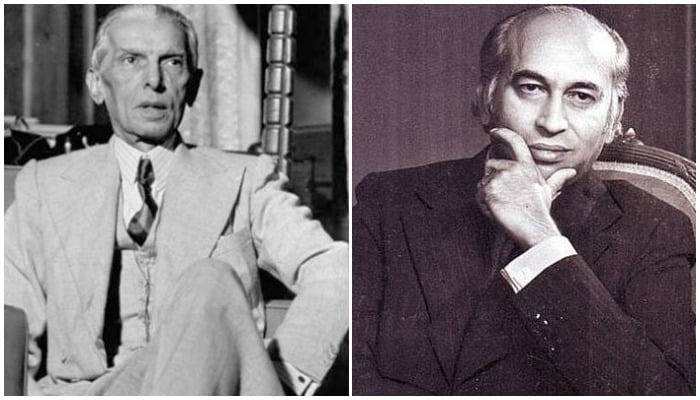


  • Former President of Pakistan Zulfikar Ali Bhutto wrote a letter to Quaid-e-Azam Muhammad Ali Jinnah back in 1945.
  • Bhutto wrote the letter at the age of 17 in which he talked about his interest in politics.
  • Jinnah advised Bhutto to study politics and not neglect education.


Former President and Prime Minister of Pakistan Zulfikar Ali Bhutto wrote a letter to Quaid-e-Azam Muhammad Ali Jinnah back in 1945 on April 26 when Pakistan hadn’t come into existence yet.

Bhutto wrote the letter at the age of 17 in which talked about his interest in politics and admired the efforts of Quaid-e-Azam for an independent country, to which Jinnah gave him a piece of advice.

Bhutto wrote in the letter: “You have brought us under one platform. Every Muslim should have a wish for an independent Pakistan as Pakistan is our destiny and aim.”

“No one can stop us from being an independent country. We are a nation and you have united us,” Bhutto continued.

He further stated in the letter that he is unable to play a significant role towards the creation of Pakistan as he is still a student, adding that a time will come when he will sacrifice his life for Pakistan. 

Jinnah replied to the letter on May 1, 1945. 

The letter stated: "I am happy to read your letter and to know that you have been taking part in political events."

He continued the letter by giving him the advice to study politics and to not neglect education. 

Quaid-e-Azam further said that he believes that Bhutto will be a successful person if he studies the political issues of India. 

https://www.geo.tv/latest/389779-bhuttos-letter-to-jinnah-in-before-pakistans-independence

قائدعوام شہید نے ملک کو ایٹمی قوت بنایا,1973ءکا آئین دیا، ایٹمی پروگرام اور 1973ءکا آئین قوم کے پاس شہید بھٹو کی امانت ہیں۔ سابق صدر پاکستان اور صدر پاکستان پیپلزپارٹی پارلیمنٹیرینز آصف علی زرداری


سابق صدر پاکستان اور پاکستان پیپلزپارٹی پارلیمنٹیرینز کے صدر آصف علی زرداری نے پاکستان پیپلزپارٹی کے بانی چیئرمین قائد عوام ذوالفقار علی بھٹو شہید کے یوم ولادت کے موقع پر انہیں خراج عقیدت پیش کرتے ہوئے اس عہد کی تجدید کی ہے کہ شہید قائد عوام کے بلند کئے ہوئے پرچم کو سربلند رکھیں گے۔

 انہوں نے کہا کہ ذوالفقار علی بھٹو شہید نے 1971ءمیں جنگ سے تباہ ہونے والے ملک کی دوبارہ تعمیر کی، شکست خوردہ قوم کو باوقار قوموں میں شامل کیا، دشمن کی قید سے 93ہزار فوجی جوانوں کو باعزت طریقے سے واپس لئے، بھارت کے قبضے میں گئی ہوئی زمین ہزاروں مربع زمین واپس لی۔

 آصف علی زرداری نے کہا کہ قائدعوام شہید نے ملک کو ایٹمی قوت بنایا,1973ءکا آئین دیا، ایٹمی پروگرام اور 1973ءکا آئین قوم کے پاس شہید بھٹو کی امانت ہیں۔ 

انہوں نے کہا کہ شہید ذوالفقار علی بھٹو نے عوام کو سیاسی شعور دے کر بولنے کا ڈھنگ سکھایا تھا۔ وہ دنیا بھر میں چلنے والی جمہوری تحریکوں کے حامی تھے اور اسلامی دنیا کے باہمی اتحاد کے بانی تھے۔ انہوں نے کہا کہ قائد عوام شہید کے فلسفے کے مطابق پاکستان پیپلزپارٹی ملک کو مشکلات سے نکالے گی۔ پاکستان پیپلزپارٹی پارلیمنٹ کی بالادستی اور آئین کی حکمرانی کے اصولوں پر قائم ہے۔ انہوں نے کہا کہ غربت، جہالت اور عوام کا استحصال کرنے والوں کے خلاف جنگ جاری رہے گی۔

https://www.ppp.org.pk/pr/26016/

Chairman PPP Bilawal Bhutto Zardari describes Shaheed Zulfikar Ali Bhutto as an invincible movement of people of Pakistan


Chairman Bilawal Bhutto Zardari has said that Zulfikar Ali Bhutto is now an unforgettable history and invincible movement, while the slogan of Jiye Bhutto is the mirror, every dictatorial and anti-people thinking individual is afraid to face.
In his message on the 94th anniversary of the first elected Prime Minister of Pakistan and the Founder Chairman of the Pakistan Peoples Party, the Chairman PPP Bilawal Bhutto Zardari said, “I pay tribute to Shaheed Zulfikar Ali Bhutto, whose style of politics and governance provided Pakistanis with the opportunity to come close to the state for the first time and take the reins of the country in their own hands.
He said that the Quaid-e-Awam was the first leader to declare the people as the source of power and laid the foundation of a democratic ideological party which defended the rights and interests of the people of Pakistan. “Bhutto Shaheed was and will always be a source of encouragement to the oppressed, and deprived people of the country” he added.
Chairman Bilawal Bhutto Zardari said that after Quaid-e-Azam, if anyone has given the most service and sacrifices for the country and the nation, it is Shaheed Zulfikar Ali Bhutto. He used his political savvy and diplomatic skills to lift a broken country, put it back on its feet, got freed 93,000 Prisoners of War (PoWs) and reclaimed 5,000 square miles of land from enemy occupation.
He said that Shaheed Zulfikar Ali Bhutto gave the first unanimous Constitution to the war-torn country, launched a nuclear program to make the national defense invincible, and laid strong foundations for the economy and industries. Steps such as universal suffrage, agrarian reform, equality, elimination of all forms of discrimination, empowerment of women and the weaker sections of society are the hallmarks of Shaheed Zulfikar Ali Bhutto. During the rule of Quaid-e-Awam, significant progress was made in every sector of Pakistan.
He further said that unparalleled services and uncompromising ideals are the reasons why Bhutto is still alive in the hearts and minds of the people.
Chairman PPP Bilawal Bhutto Zardari further said that the best way to pay homage to Shaheed Zulfikar Ali Bhutto is to remember his sacrifices and ideology and work together for the growth of prosperity, security and a bright future of the country.
The Chairman PPP reiterated his commitment that the PPP will continue to safeguard the gift given by its founding Chairman Shaheed Zulfikar Ali Bhutto, the unanimous Constitution of 1973, which is the assurance of our national unity and harmony. Moreover, PPP will continue to strive to make Pakistan a true federal democratic country and a greater and stronger state.
Chairman Bilawal Bhutto Zardari also reiterated that his party would continue to provide political, moral and ethical support to the legitimate independence movement of the people of Occupied Kashmir, as the Quaid-e-Awam had laid the foundation of his party on the Kashmir issue. “I am sure that the day is not far when Indian domination will end and our Kashmiri brothers will get back their land,” said Chairman Bilawal Bhutto Zardari.

https://www.ppp.org.pk/pr/26014/

Monday, January 3, 2022

Video Report - Turkey's inflation soars to 36% as Erdogan stays the course

Video Report - FDA speaks after authorizing Pfizer's COVID boosters for kids | full audio

Video report - University of Chicago professor studying January 6 says "what we're seeing is a mainstream moveme…

Video Report - Omicron Doesn't DISCRIMINATE, CDC HALVES Iso Time At CEO Request, Ghislaine Maxwell Found GUILTY

Video Report - Twitter suspends Marjorie Taylor Greene account over Covid-19 misinformation

Video Report - #MJtv LIVE: جسٹس عائشہ کی سپریم کورٹ میں مجوزہ تقرری پر وکلا کا کھڑاک، لائیو پریس کانفرنس

What is driving Pakistan's alarming diabetes surge?

Pakistan is in the midst of a growing diabetes crisis, a recent report has revealed. Over 19 million people in the South Asian nation are living with diabetes and the numbers continue to rise.
Health experts in Pakistan have expressed grave concerns over surging cases of diabetes in the South Asian nation, warning that the situation could spiral out of control if the government fails to take immediate action.
A recent report from the International Diabetic Federation (IDF) ranking the world's highest number of diabetic cases has put Pakistan in third place with a total of 19.4 million cases recorded in 2019.Pakistan has seen a 70% increase in diabetes in the last two years, and the disease was responsible for at least 400,000 deaths in 2021, according to the report.In addition, the report revealed that one in four adults in Pakistan is living with diabetes, the highest national prevalence in the world (26.7%).
The IDF found that an additional 11 million adults in Pakistan have Impaired Glucose Tolerance (IGT), which puts them at higher risk of developing type-2 diabetes.
The report noted that more than a quarter (26.9%) of adults living with diabetes in Pakistan are undiagnosed.
The findings made headlines across Pakistani media. Health experts have called on the government to inject more funds into its national health budget to combat the problem. Pakistan spends less than 1% of its GDP on health.
What is fueling Pakistan's diabetes rise?
Abdul Ghafoor Shoro, a doctor at the Pakistan Medical Association, says the country's decreasing health budget has forced public hospitals to shut down a wide array of health care services, including those for treating diabetes.
Diabetes health care and medicine, including insulin, used to be more affordable, Shoro said. However, in the last four years, costs have skyrocketed, steering away patients.Karachi-based doctor Fatema Jawad says diabetes medicine and insulin cost between 2,000 rupees (€10, $11) and 7,000 rupees in Pakistan. But in a country where the majority live on less than $3 a day, "it's not possible to get proper treatment," she told DW.
"Only a few hospitals in Sindh province provide free medicine," she added.
Jawad said that poverty also plays an important role in diabetes.
About 22% of Pakistan's population live below the national poverty line, according to the latest available data from the World Bank.
Millions of women and more than 40% of children are malnourished across the country, Jawad said. These women give birth to malnourished babies, increasing the risk of childhood diabetes, she added.
Lack of education access
A lack of access to affordable education in Pakistan also plays a role in growing diabetes cases. Many Pakistanis living in rural areas are illiterate."They do not understand that diabetes is a silent killer," Jawad explained. Many only seek medical advice when their health status has declined to the point of diabetes-related complications, some of which would require amputation, she said.Rising health care costs and poverty also prompt some diabetes sufferers to seek alternative help from mystics or traditional healers, doctor Shoro told DW.
Furthermore, Tipu Sultan, the former principal of Dow Medical College in Karachi, says candies and snacks high in sugar content are also widely distributed throughout Pakistan's many religious festivals.
Clerics tell people that eating sweets is a tradition of Prophet Mohammad, which might lead some people to pay less attention to the impacts of sugar on their health, Sultan told DW.Pakistani schools see shrinking outdoor spaces Ashraf Nizami, a Lahore-based medical expert, believes that lack of exercise, dietary habits and rising obesity are contributing to Pakistan's diabetes surge. He also attributes the problem to the country's lack of sporting facilities, as well as limited public spaces for exercise, particularly in schools.
Nizami said tens of thousands of schools have been established on small plots measuring 120 to 600 square yards. Some schools do not have any playgrounds, depriving students of physical exercise, and thereby increasing the risks of obesity and diabetes in the long run, he said. How is the government dealing with the problem?
The Pakistani government is paying attention to the diabetes health crisis, reassures Senator Sana Jamali, a member of the Senate National Health Services, Regulations and Coordination Committee. Islamabad is making efforts to tackle the problem, Jamali told DW. "The prime minister has recently launched health insurance cards in Punjab, which will go a long way in reducing diabetic cases besides making treatment easy for poor people," she said.
But according to Jamali, the government cannot solve the country's health problem alone.
"Unless people change their lifestyle and dietary habits, this problem will continue to haunt us and millions of more people will suffer from it," she maintained, adding that more awareness of the disease needs to be raised nationwide.
https://www.dw.com/en/what-is-driving-pakistans-alarming-diabetes-surge/a-60318409

Imran Khan fighting blasphemy is Joker protecting Gotham: Here is why Pakistan will remain a hell hole


The way Joker in Batman wanted to watch the world burn, Pakistan, too wanted to do that till hell came home and their own country started feeling the burn. Which is why it has turned into the hell hole that it is.
As Pakistan sinks further into the abyss of Islamism, will it ever rise from the grave and address the elephant in the room that ‘blasphemy’ is?
Earlier last week, a Sri Lankan man Priyantha Kumara was burnt alive by a murderous mob in Pakistan’s Sialkot on allegations of blasphemy. Disturbing visuals of Kumara’s body burning even as the mob gathered around to take selfies and video with the burning man had gone viral on social media.
The mob can be heard chanting ‘Gustakh e Nabi ki ek hi saza, sar tan se juda, sar tan se juda’ chants. This chant loosely means the only acceptable punishment for saying anything audacious about Prophet Muhammad is beheading.
What is unfortunate is that this kind of barbarity coming from Pakistan has become so common that it does not shock one anymore. What is even worse is that Pakistan is playing down the horrifying incident. Let us analyse Pakistan government’s response to this barbarity.On December 3, 2021, Pakistan Prime Minister Imran Khan referred to the attack on Priyantha Kumara as ‘vigilante attack’.
The mob that was chanting and calling for beheading of Kumara was ‘vigilante attack’. Khan, very curiously, skipped the part that Kumara was burnt alive on allegations of blasphemy. The police had admitted that the so-called vigilante mob had brutalized and tortured the Sri Lankan man before setting him on fire. Arman Maqt said that Priyantha Kumar was beaten to death by the mob on the Wazirabad Road before his body was set on fire. The SHO Maqt said that the police lacked staff and was ‘helpless’ in front of the mob of hundreds of fanatics. The police stood mute spectator as mob chanting and calling for beheading of a man burnt him alive for ‘blasphemy’ because they were ‘helpless’. The post mortem report said that most of the body of Priyantha Kumara was burnt, and several bones were broken due to the torture by the mob.
Here is what Pakistan’s Foreign Minister said.
Shah Mahmood Qureshi, too, condemned the ‘killing of a Sri Lankan national’. Like his boss, he, too, skipped the part that Kumara was killed over allegations of blasphemy.
Dictionary defines blasphemy as “the action or offence of speaking sacrilegiously about God or sacred things; profane talk.” In Pakistan, ‘blasphemy’ is punishable by beheading/being burnt alive, while a murderous mob which believes this is just takes videos and selfies with the burning body.
Pakistan and blasphemy
Pakistan has stringent laws against blasphemy with punishment ranging from jail term to death penalty.
In October 2020, Pakistani bots had decided to boycott French products over French President Emmanuel Macron’s allegedly ‘Islamophobic’ comments. Subsequently, in a video statement at the UNGA, Imran Khan tried to justify what was happening back home. He had said, “The Prophet lives in our hearts. When he is ridiculed, when he is insulted, it hurts… We human beings understand one thing: The pain of the heart is far, far, far more hurtful than physical pain. And that’s why the Muslims react to this.”
He further added that people from the west do not understand the sentiments attached to the Prophet. He also compared the pain suffered by the Jewish during the holocaust to the pain induced in Muslims by insulting Prophet Muhammad. Khan had thereby insinuated that killing of non-Muslims is justified if they ‘insult’ Prophet Muhammad because it hurts the sentiments of Muslims. In April this year, workers and activists of Islamist group Tehreek-i-Labbaik Pakistan (TLP) ran riots in Pakistan on non-fulfilment of four demands it had put up for Imran Khan government. The demands were originally made in November last year, following the beheading of 46-year-old Samuel Paty by a teenage Jihadi terrorist in France and the subsequent criticism of Islamists by French President Emmanuel Macron. TLP also took offence to the display of caricatures of Prophet Muhammad in public in one city in France. Islamists in Pakistan had taken to protesting against the French in Karachi. The former Ameer Allama Khadim Hussain Rizvi had even asked the Imran Khan government to launch a jihad against France. At that time, Imran Khan had said how there needs to be a worldwide campaign for more stringent blasphemy laws against Prophet Muhammad. “Inshallah, there will come a time that even in Western countries, people will fear making the mistake the insult the Prophet. A worldwide campaign is needed to achieve this,” he had said.
As recent as October 2021, at least four Pakistani policemen were killed after TLP rioters who were armed with AK47 rifles, running riots on street of Lahore during anti-blasphemy protests. TLP, a banned Islamists outfit in Pakistan, has been protesting against the Charlie Hebdo cartoon depicting Prophet Muhammad and have been demanding expulsion of France’s ambassador and release of their leader. This was part of their ongoing protests since 2017. The cartoon was first published by French satirical magazine Charlie Hebdo in 2006. In 2015 January, Islamists led a suicide attack on their office for the caricature/blasphemy.
Pakistan: A nightmare for minorities and sane, non-radical individuals
Tales of atrocities against non-Muslims in Pakistan are as old as time. The country was established on the principle of two nation theory that Hindus and Muslims cannot live together peacefully. In 1876, Aligarh Muslim University founder Syed Ahmed Khan said, “I am convinced now that Hindus and Muslims could never become one nation as their religion and way of life was quite distinct from each other.”
In 1929, Mahashay Rajpal was murdered for publishing Rangeela Rasool, a satirical take on the domestic life of prophet Mohammed. Mahashay Rajpal ji in 1912 started “Rajpal and Sons” from Lahore. He would publish Hindi, English, Urdu and Punjabi books on social, political and religious topics. The pamphlet was originally published anonymously under the name “doodh ka doodh aur panee ka panee”. On the surface, Rangeela Rasool had a laudatory tone of Mohammed’s life but at the same time pointing out uncomfortable truths about his domestic life.
Muslims of modern day Lahore, then a part of British India, were outraged at Rangeela Rasool. When Mahashay Rajpal was acquitted of his charges three years later, Jinnah was upset. In a provocative speech at the Jama Masjid in July 1927 Jinnah warned that should the judgement not be reversed, Muslims would be compelled to take the law in their own hands. Even avowed secularists like Motilal Nehru remarked to his son that “the Musslmans of India have all gone mad”.
In 1927, the same year he was acquitted, there were two unsuccessful attempts on Mahashay Rajpal’s life — a wrestler named Khuda Baksh attacked him in September 1927 when he was sitting in his shop but Khatri Rajpal ji caught him and handed him over to the authorities. Khuda Baksh was convicted and sentenced to ten years in prison.The next month, a Muslim man named Aziz Ahmed attacked Swami Satyanand ji mistaking him to Khatri Rajpal. Luckily, the attack was not fatal and Swami ji recovered after a couple of months. On April 6th, 1929 a 19 year old carpenter named Ilm ud din stabbed Mahashay Rajpal on his chest eight times while he was seated in the outer verandah of his shop. Mahashay Rajpal did not survive the attack succumbed to the injuries.
His murderer was defended in Court by Jinnah himself and Muhammad Iqbal, a raging favourite among Indian liberals today, eulogised him. Today his grave is a religious site in Pakistan and Pakistani textbooks eulogize him with the title of “Ghazi”.
In 2011, Pakistani leader Governor of Punjab in Pakistan, Salman Taseer was assassinated for having ‘liberal’ views on blasphemy. Salman Taseer was murdered because he believed a hapless Christian woman should not be executed for alleged blasphemy. He believed that the woman is innocent of the charge and came out strongly in her support in public. Except, on 4th of January, 2011, Salman Taseer was assassinated by his bodyguard Mumtaz Qadri for his position on Pakistan’s blasphemy law.
The assassination instantly turned Qadri into a hero, as one would expect from a Jihadist state. He was showered with rose petals as he was dragged into the Court. “Death is acceptable for Muhammad’s slave,” his many supporters chanted.
Qadri had significant support from the Pakistani masses. The ordinary citizens of Pakistan were baying for Asia Bibi’s blood. Some offered rewards for anyone who could summon the courage to murder her, others wondered why she hadn’t been murdered yet. Others wept with joy when the Pakistani court awarded her the death sentence, the first woman to receive the death penalty in the country. One Maulvi said, “We had been worried the court would award a lesser sentence. So the entire village celebrated.”
When a seemingly moderate Salman Taseer decided to put human life above ‘blasphemy’, he paid for it with his own life.
Pakistan has become even more radical than it has ever been It has been almost 100 years to that day and in the year 2021 in Pakistan a man was burnt alive because he ‘blasphemed’. What is unfortunate is that the godforsaken country seems to have reached a point of no return as far as radical Islamism has concerned. We have all seen how Imran Khan, who was once the poster boy of liberals especially in India for his ‘good looks’ and ‘cricketing charm’, has ended up being a sidekick of radical elements in the country.
When Islamist group Taliban took over Afghanistan, things became much clear when Pakistanis cheered for the ummah. Over the years, after Taliban regime was toppled by US invasion, it was Pakistan that gave shelter to the leaders of radical group and nourished them so that when US pulled out of Afghanistan, the Taliban, with reinforced strength, can take over. Pakistan has been harbouring terrorists, some of who have ‘kill the ones who drink cow urine’ as sole purpose in life. ‘Cow urine drinker’ is the jibe often used to refer to Hindus because they consider cows holy.
The level of radicalisation is so staggering that now even the Pakistani leadership is too afraid to call out radicals for their radical views on blasphemy.
The way Joker in Batman wanted to watch the world burn, Pakistan, too wanted to do that till hell came home and their own country started feeling the burn. Which is why it has turned into the hell hole that it is.
https://www.opindia.com/2021/12/imran-khan-pakistan-blasphemy-rangeela-rasool-sialkot-radical-islamists/

EDITORIAL: #Pakistan - Same Taliban, Different Times

Leopards never change their spots. With a seemingly unstoppable onslaught of gender-specific restrictions and a notorious obsession with meddling into the everyday affairs of Afghans, the Taliban have clearly picked up where they had left two decades ago. Or had they ever gone missing, the elusive question hangs heavy in the air. While international agencies keep ringing the bells to warn of the impending starvation of over a million children, the new Kabul has decided to focus on a rather different issue: barbershops. 

New guidelines regarding the trimming of beards have been issued where the government spokespersons are hell-bent on making parallels with the Sunnah. Facial hair is the new fault line as the young generation is finding it increasingly hard to comply with the new normal. Meanwhile, restrictions on soap operas and slapping the guardianship requirement on females are ushering in a terrifying deja vu of the nineties marked by a tightened noose around the necks of anyone who dared defy the patriarchal order. Disturbing revelations about summary killings and forced disappearances made by Human Rights Watch have already smeared egg all over the Taliban’s claims of turning a new leaf over. But there appears no sign of any steps designed to take care of the optics problem. Failing to deliver on promises, especially those pertaining to an inclusive, gender-balanced government and bringing Afghanistan into the 21st century, would land Kabul in a sticky spot, considering the underway deliberations with the US.

Clearly, the West is in no mood to release its grasp over the frozen assets, paying no heed to unprecedented hunger levels, raging drought conditions amid lingering nonpayment of salaries.

But the grand scheme to force the Taliban to mend their ways through the hard bargain is to date gross failure because they do not plan to give even the Afghan men–let alone women and minorities–a chance at leading a free life.

Defeating a superpower at its own game so crushingly that President Biden hung his head in resignation in his response to questions about $2.3 trillion and 6,500 American lives gone to waste was a phenomenal, almost magical, feat. However, a country cannot be run on bravery alone. It needs finances, and that is something Afghanistan needs the West for. The sooner Kabul wakes up to its reality, the better, because war-hardened Taliban might know a thing or two about surviving on pennies, but what about the 3.5 million pushed under open skies and millions more praying for a single loaf of bread? 

https://dailytimes.com.pk/862756/same-taliban-different-times/

PPP Chairman Bilawal Bhutto Zardari pays tribute to Shaheed Salman Taseer

Chairman Pakistan Peoples Party Bilawal Bhutto Zardari has paid a rich tribute to the party leader and former Punjab Governor Shaheed Salman Taseer on his 11th martyrdom anniversary.
According to a statement issued from the Media Cell Bilawal House, Chairman PPP in his message stated that Shaheed Salman Taseer had sacrificed his life for the promotion of tolerance and rights of minorities in the country.He further said that the political struggle of Shaheed Salman Taseer is incomparable to any other and he is a true hero of the nation. Chairman Bilawal Bhutto Zardari also said that Shaheed Salman Taseer believed in the unity of the Pakistani people.
He said that the day of martyrdom of Shaheed Salman Taseer reminds us that we have to save Pakistan from the fire of extremism and terrorism. “We have to stop the misuse of laws,” said Chairman PPP.
Chairman PPP further reiterated his commitment to make Pakistan a society based on equality and a progressive federal democratic state in the light of the ideas of Quaid-e-Azam Muhammad Ali Jinnah. This was the cause for which Shaheed Zulfikar Ali Bhutto, Shaheed Mohtarma Benazir Bhutto, Shaheed Salman Taseer, and many other jiyalas embraced martyrdom.
https://www.ppp.org.pk/pr/26010/

Sunday, January 2, 2022

Video Report - Can the COVID-19 pandemic be defeated in 2022?

Video Report - #AnthonyFauci CDC guidance 'under consideration' on testing for asymptomatic people: Fauci

Video Report - Omicron Doesn't DISCRIMINATE, CDC HALVES Iso Time At CEO Request, Ghislaine Maxwell Found GUILTY

Video Report - Twitter suspends Republican Representative Marjorie Taylor Greene's personal account

Video Report - Liz Cheney issues bad news for Trump live on air

Video Report - کراچۍ کې د ورکو بلوڅانو د موندلو لپاره مظاهره شوې

Video Report - ای او ام افغانانو ته د عاجلو بشري مرستو غوښتنه کړې

Pakistan: Climate Change, Food, and Geopolitics

By Osama Rizvi
The country’s vulnerability to natural disasters and adverse effects on labor productivity will add to its existing challenges and concerns.
A recent report by the Office of National Intelligence (U.S.) has identified the 11 countries most vulnerable to sociopolitical and geopolitical instability due to climate change – and Pakistan is one of them.
According to different estimates, climate change could cost Pakistan a staggering $3.8 billion annually. Given the importance of agriculture in Pakistan – it contributes 22 percent of its GDP and provides employment for almost 39 percent of its workforce – along with soaring food price inflation, exacerbating climate change can jeopardize its energy, food and national security.
Drawing attention to the asymmetrical effects of climate change on the Global South in his book “The Divide: A Brief Guide to Global Inequality and its Solutions,” economic anthropologist Jason Hickel points out that 83 percent of deaths related to climate change happened in countries with the lowest carbon emissions, whereas out of 588 billion tons of carbon emissions (figures until 2017), 70 percent came from industrial economies. Pakistan is illustrative of this.
The future holds some tough choices for the country. On the one hand, the need to shift to cleaner sources of energy is necessary and extraordinarily important. On the other, as I have argued elsewhere, the inherent limitations of these systems make such a shift challenging, to say the least.
Reality jeers at the ideal. More than 40 million of Pakistan’s population lack electricity and more than 50 percent are deprived of “clean cooking facilities.” Unemployment is worrisome as one out of 10 people in Pakistan is unemployed with a total rate of around 4.65 percent in 2020. Pakistan’s per capita income was $1,465 in 2020. Recently, the country’s total liabilities reached $283 billion (2021), the highest ever recorded. Finally, a reality check: fossil fuels still account for 64 percent of Pakistan’s energy mix with renewables providing a paltry 4 percent. 

The exacerbating climate situation underscores the need for Pakistan to pay urgent attention to several issues. One such issue is that of food. Recently, the U.N.’s Food and Agriculture World Food Price Index touched 134.4, the highest since 2011. People in Pakistan spend almost 39 percent of their income on food and 24 percent on other basic provisions such as rent, gas, and water. According to a 2017 estimate, around 68 percent of households receive inadequate nutrition. This recent rise in food prices will only exacerbate this situation as the Sensitive Price Index registered a 37 week high with an increase of 17.4 percent, while food is roughly 48 percent more costly than in 2018.
This rise in food prices, inter alia, has a direct correlation with social unrest and political instability. Research shows that between 2005 and 2011, food riots jumped 250 percent, triggering protests in Egypt, Libya, and Syria. The Arab Spring was also a result of rise in food prices.
This issue spills over to the geopolitical domain as well. It is instructive to note here that India is building a food corridor, called the India-Middle East Food Corridor, under the auspices of a wider India to Europe Arab-Mediterranean Corridor. According to recent study by the Singapore-based Institute of South Asia Studies, Saudi Arabia and the UAE are providing billion dollar investments to help India create integration in the whole value chain from technologies to food production. There is already in place a platform, Agriota, which is assisting Indian farmers link up with companies in the UAE.
The food corridor is expected to create 200,000 jobs with more than 2 million Indian farmers as beneficiaries. The overall aim remains to build higher value added production that integrates farms to retail outlets. As pointed out above, given the extreme significance of agriculture in Pakistan’s economy and the threat to food security, which can easily trigger social unrest or become a geopolitical flashpoint, the need for Pakistan to work on a similar corridor is both obvious and logical.
While financial and administrative help by the UAE and Saudi Arabia to India seemingly violates its principle of identity, however, it makes perfect diplomatic and strategic sense. Pakistan has a palette of other options – Turkey, Qatar, China, and Russia, for example, with whom it has stable or friendly relations – to build a similar corridor. A food corridor with Russia and China could be especially beneficial to us in terms of volume, technological assistance, and knowledge transfer. Such an initiative could help Pakistan to be food secure.
Besides this dimension, there are steps to be taken on the domestic front too. There is a need to introduce congestion charges for vehicles entering busy areas. Improving the public transport system is also required. Tree plantations are good; making factories energy efficient is better. Brick kilns need to go. Climate change should be taught in schools.
Studies show a drastically negative impact on Pakistan’s crop yields as temperatures continue to rise. Pakistan’s vulnerability to disasters and the adverse effects on labor productivity will add to the already existing worries. As always, the suffering of the poor will be highly asymmetrical to that of the upper class.
Research says that the average temperature in Pakistan is already at such high levels that any further increase in consumption will adversely affect standards of living owing to the environmental consequences.
Finally, South Asia is expected to deal with 36 million “internal climate migrants” in the wake of climate crisis by 2050. This would increase the existing migrant/refugee burden on Pakistan.
There is a need to prioritize climate change. The issue goes beyond improving the air quality index and being able to enjoy al fresco dinners; it relates to social unrest, political instability, and geopolitical issues feeding into a country’s foreign policy, and diplomatic and economic prowess.

Tough Days Ahead for #Pakistan’s Ruling Party

By Umair Jamal
The Pakistan Tehreek-e-Insaf’s defeat in its traditional stronghold of Khyber Pakhtunkhwa does not bode well for its electoral prospects in other parts of the country.
The Pakistan Tehreek-e-Insaf (PTI) has suffered a humiliating defeat in the first phase of elections to local bodies in the Khyber Pakhtunkhwa (KP) province. KP is a traditional stronghold of the PTI and its rout in the province has raised questions about the party’s electoral prospects in other parts of the country. Following his party’s defeat, Prime Minister Imran Khan claimed that wrong candidate selection was a major cause for the defeat. “From now on I will personally be overseeing PTI’s LG [local government] election strategy in 2nd phase of KP LG elections & LG elections across Pakistan,” he tweeted.
Khan has dissolved the party’s organizational structure and reorganized it to activate it at the grassroots level for the second phase of local body elections in KP and Punjab.
This was the first time since 2018 that the PTI fought an election without the support of the country’s security elite. The elections were relatively fair and the PTI’s defeat raises questions over the party’s ability to win against other political parties without the military’s support.
PTI has been accused of relying on the military leadership to manage its troubles in the past. From handling politics in Punjab to keeping a check on unruly and ambitious political allies, the party has long benefited from the army’s support.
However, Prime Minister Khan’s well-wishers within the national security establishment may not have any appetite left for convincing others around them that supporting his rule is a good idea. The party has failed to govern effectively and appears to have become a liability for its patrons in the military. It does seem that the generals are looking beyond the PTI.
In this regard, the recent controversy over the appointment of the director general Inter-Services Intelligence (DG-ISI) was perhaps an important trigger to the military’s realization that that it was time to open space for other political parties.
Without the military’s support, the prospects of the PTI winning the local government polls in Punjab and elsewhere are bleak. It is important to note here that the PTI has lost most of the by-elections in Punjab over the past three years to the Pakistan Muslim League-Nawaz (PML-N). The recent cantonment board elections in Punjab also saw the ruling party lose to its main political foe in the province.
If the PTI loses to the PML-N in Punjab, which appears likely, it will find it hard to hold its flock together. Across the country, it will suffer internal revolts and divisions heading into general elections in 2023.
One of the reasons for the PTI’s defeat in KP was that many political heavyweights, who remain in the party, didn’t support it. Some of the provincial and national assembly members openly backed the opposition parties and undermined their own party’s candidates. This trend is reflective of the shifting priorities of the military leadership, which is not interested in intervening on behalf of the ruling party anymore – something that is being recognized by opportunistic politicians across the country. For instance, in Sindh, a National Assembly member of the PTI has called on the government to hold talks with the Muttahida Qaumi Movement leader Altaf Hussain, who remains banned from the country’s politics. PTI’s Punjab Minister for Prisons, Fayyaz-ul-Hassan Chohan recently visited Liaqat Bagh, the site of Pakistan People’s Party (PPP) leader Benazir Bhutto’s assassination, and directed authorities to complete its repair work, saying that she was a representative of all Pakistanis.
It appears that political leaders who were nudged by the military establishment to join the PTI during the last general election may jump ship in the coming days as the military retracts its support for the ruling party.
If the recent local government elections are any indication of what’s to come, then PTI’s electoral loss in KP is set to extend beyond its traditional stronghold.
https://thediplomat.com/2021/12/tough-days-ahead-for-pakistans-ruling-party/