Wednesday, February 10, 2021
#Balochistan: The lesser children of God
By: Munaj Gul Muhammad
Visiting Quetta city (The capital of Balochistan) in the end of December_2020 and on the Eve of new year_2021 left a cloud of confusions in my mind as after coming across to a child almost aged 13 to 14 appealing to every passer-by to give him a small amount of money to have a living. His eyes were shedding tears, but no one could deep feel pity on him. Although, everyone was busy in his own life. He seemed very hapless. There was no-one to lead him a happy life filled with pleasures and happiness. The sheer bliss of God no more remained an option for him. He was dwelling with troubles and sufferings in the richest province of Pakistan_ Balochistan.

In confronting the small boy near Saleem Complex Quetta, was the day that left a myriad of questions which remained unanswered until today. Being the sons of the most blessed soil; they (poor children) are yet living a hard-time in the twenty first century. He is not the only boy who I confronted in Quetta, but there are also a lot of such ignored children who everyone confronts in many places in the province; and they witness that the innocent children, in the province, are always left in the lurch in diverse circumstances.
Almost, the 13-year-old boy, was wearing torn clothes and shoes. Having a good jacket in the month of January (the coldest month in Quetta city) was out of his access owing to poverty leaving out other needed facilities.
There are a handful number of such children who are having nothing to wear_ in covering their bodies in the winter season.He (the innocent and small boy) is still in the same condition. For the government-in-run would never pay the attention to the issues faced by the paupers. It pinpoints the fact that the province is blessed with most of the natural resources like gas, gold, silver, coil and etc, but the residents of the province are deprived of a single living.
Gwadar: CPEC is another project towards the development of Balochistan, but in reality, CPEC has not given a single benefit to the locals of the city-port. There are legion children in the city who are working as labour and their dreams of future in reaching good positions are squashed. CPEC has never been a beneficial project for Baloch. Baloch are ignored in the project.
Tracing back to the year_2018, I had a visit to Gwadar and seeing the worst living conditions of locals left me tearful.
Analogously, I confronted a star-crossed boy whose bright dreams were buried alive. Other than being ignored from the government, the poor children are abused, beaten and neglected in every place wherever they visit in begging money to save their lives as there are no other option for them to opt.
Karim Baloch, 32, a resident of Turbat says, ” There are many children who are busy in complaining to God. For the loved creatures human of Lord are brutally killing one another, ignoring every single pauper and most importantly, are abusing others one way to other. “I no more wish to remain alive in such a society where right of every downtrodden child is snatched.” He said in having tears in his beautiful eyes.
Albeit, the Article 11 of Pakistan Constitution 1973 says,” Slavery is non-existent and forbidden and no law shall permit or facilitate its introduction into Pakistan in any form. All forms of forced labour and traffic in human beings are prohibited and no child below the age of fourteen years shall be engaged in any factory, mine or any other hazardous employment. ” Besides the said statement in shape of the constitutional article, there is seen no law implemented to provide the basic rights to the citizens.
The federal and provincial government had better implement the laws of the country to protect the residents to face no violation in the country. The children are the amiable person who can help the country out in any form of development.
#Balochistan: large scale military offensives, six killed, several including women and children abducted
Pakistani military has been carrying out large scale offensives in Kohlu-Sibbi and Harnai bordering regions since Monday morning.
Sources informed Balochwarna News that at least six helicopters took part in latest offensives on Monday in mountainous regions of Koh-e-Dungan, Gullo Shah, Koryak, Beji Kaor and Bareli regions.
The ground forces backed by helicopters have indiscriminately shelled the houses of Marri Baloch nomads as a result at least six persons have been killed and several others wounded.
Pakistan military has also arrested several people including women and children, loaded their hundreds of livestock on military trucks and took them to military bases in Harnai.
Two men killed during military offensives on Monday have been named a Maoran Kalwani Marri and Mureed Kalwani Marri, the identity of the other victims and the exact number of casualties could not be confirmed at the time of filing this report due to lack of communication system as the affected areas remain under the siege of Pakistani forces.
Pakistani armed forces also abducted several people including women and children during Monday’s aggression and shifted them to Harnai.
Two of abducted men have been named as Deen Hamd Marri and Hamo Marri who were critically injured due to the indiscriminate shelling by Pakistani forces.
Sources also reported that two more helicopters have been seen flying toward Koh-e-Dungan on Tuesday morning and the ground forces remained stationed in the areas.
There have also been reports of clashes between Baloch freedom fighters and Pakistani forces after the military offensives against unarmed civilian populations.
https://balochwarna.com/2021/02/09/balochistan-large-scale-military-offensives-six-killed-several-including-women-and-children-abducted/
Did Iran Carry Out a ‘Surgical Strike’ Inside Pakistan?

By Umair Jamal
A recent news report is unlikely to be accurate, not the least because it goes against established patterns of behavior by both countries.
Over the past week, media has been rife with reports of an Iranian operation inside Pakistan’s territory to free Iranian soldiers. The news, which was first reported by the Anadolu Agency (AA) and later picked up by Pakistani and Indian media, claimed that Iran freed two soldiers in an intelligence-led operation inside Pakistan’s territory.
“A successful operation was carried out last Tuesday night to rescue two kidnapped border guards who were taken as hostages by Jaish ul-Adl organization two and a half years ago,” AA said citing Iran’s elite Islamic Revolutionary Guard Corps (IRGC) as a source. The statement further noted that the freed soldiers were successfully transferred back to Iran.
India’s top news outlets, including Hindustan Times, India Today and Times of India, portrayed the said report as a “surgical strike” inside Pakistan. However, in Pakistan, not too many news outlets covered the story.
There are many reasons to believe that the reported military operation by Iran didn’t take place. For years, active communication channels between the two countries’ militaries and civilian authorities have ensured that such a situation does not eventuate.
To begin with, Iran’s government has not officially said anything about the reported military operation. Pakistan, on the other hand, has denied all such reports by terming them mere propaganda. On Monday, the spokesperson of Pakistan’s military categorically said: “The news regarding Iran [conducting a military operation in Pakistan] is absolutely false.”
Over the years, Pakistan and Iran have blamed each other for not doing enough to root out militants allegedly hiding across the border between the two countries. Iran on its part has usually conveyed its frustration over militant groups, particularly Jaish al-Adl’s hideouts in Pakistan’s Balochistan province. In some cases, Pakistan’s military has freed Iranian soldiers in Balochistan. In 2019, for instance, Pakistan’s military recovered four Iranian soldiers who were abducted by Jaish al-Adl.
Over the years, Iran has warned of a military operation in Pakistan. However, these threats appear to be for domestic political consumption while also signaling Tehran’s concerns. Following the abduction of Iranian soldiers in 2014, Tehran warned that it could send troops to Pakistan to free its soldiers. Back then, Iran also summoned Pakistan’s charge d’affaires to demand Islamabad “act firmly against the leaders and members of the terrorist group who have fled into Pakistan.” In 2019, Iran warned that Pakistan would “pay a heavy price” for allegedly harboring militants who killed 27 of its elite Revolutionary Guards in a suicide bombing.
In Pakistan, these threats have drawn serious response, indicating that Islamabad is not going to accept them at any cost. Pakistan has condemned such statements from Iran and has made it clear that Iran cannot carry out military operations in Pakistan. In 2017, Pakistan’s foreign office summoned Iran’s ambassador after the head of the Iranian armed forces threatened to carry out raids inside Pakistan.
Apparently, efforts have been in place to contain the situation posed by militants on Pakistan-Iran border region and shield it from leaving an impact on the bilateral relationship. In 2019, Pakistan’s Prime Minister Imran Khan visited Iran in an attempt to find a solution for the lingering militancy problem on the border region. “We agreed to increase the security cooperation of the two countries, our border forces, our intelligence forces,” Iran’s President Hassan Rouhani said after meeting Khan, adding the two sides will also “form a joint quick reaction force on the border of the two countries for fighting terrorism.”
Khan, in his remarks, said that “We trust that both countries will not have terrorist activities from their soil… We will not allow any damage to your country from our soil.”
“The most important reason why I’m here, Mr. President,” Khan said, addressing Rouhani, “is because I felt that the issue of terrorism was going to … increase differences between our countries.”
In June 2020, Pakistan carried out a massive military operation against terrorists near the country’s border with Iran. Pakistan is also fencing its 900-kilometer long border with Iran in an effort to control cross-border incursion of terrorists. In 2020, Pakistan’s army chief, General Qamar Javed Bajwa, phoned his Iranian counterpart Major General Mohammad Bagheri to discuss the fencing of the border and the recent attacks on Pakistan’s security forces near Iran’s border.
Meanwhile, complaints of cross-border attacks go both ways. Following an attack in Balochistan in April 2020, Pakistan’s Foreign Minister Shah Mahmood Qureshi noted that the militants behind the attack came from Iran. Over the last few months, militant attacks on Pakistan’s security forces in Balochistan have increased significantly.
Despite the alarming situation in the border region, apparently a status quo has prevailed whereby both countries have tried to contain the situation while conveying their mutual frustration to each other. Under such circumstances, it is unlikely that Iran would carry out a unilateral military operation inside Pakistan as that would upset the delicate situation. Moreover, it makes sense that Tehran would share intelligence with Pakistan, as in the past. It’s possible that shared intelligence led to the Iranian soldiers being freed by Pakistan’s military.
https://thediplomat.com/2021/02/did-iran-carry-out-a-surgical-strike-inside-pakistan/
#Pakistan - Justice Isa questions PM Imran’s position on uplift grants for legislators
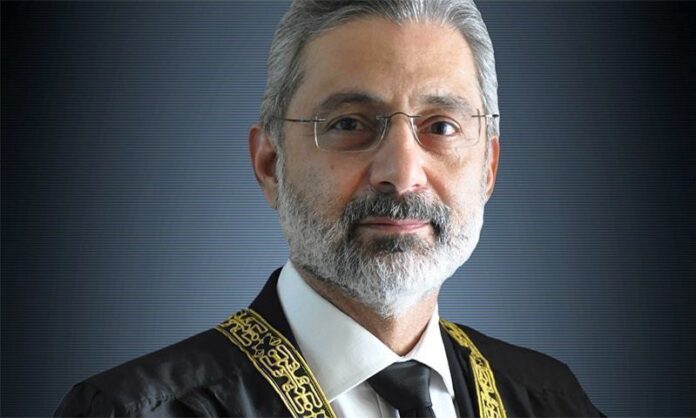
On Tuesday, the apex court constituted a five-judge bench, headed by Chief Justice of Pakistan (CJP) Gulzar Ahmed, and served notices on the prime minister’s principal secretary, Cabinet Division secretary, finance secretary, federal and provincial advocate generals, and provincial chief secretaries.
However, Justice Isa on Wednesday noted that a letter submitted by the premier’s principal secretary to the top judicial forum “did not contain the answers to the court’s questions”.
“The letter does not have answers to the court’s questions. It seems the prime minister has not read the court’s order properly,” the judge said.
In January, Prime Minister Imran announced a grant of Rs500 million for each member of the national and provincial assemblies under sustainable development goals to enable them to carry out development schemes for their voters.
However, last week, Justice Isa took notice of the development, warning of legal proceedings if the move was found to be in contravention of the Constitution.
On the occasion, he had asked Attorney General Khalid Jawed Khan to update the court on the issue based on the government’s response.
However, Khan responded he would update the court after receiving instructions from the government and further reassured that “whatever action is taken will be in the light of the law, Constitution and legal precedent.”
Subsequently, Justice Isa referred the matter to the top judge for the formation of a bench.
On Wednesday, all provinces submitted written replies to the court except for Sindh. When asked, the Sindh government’s counsel informed the court the provincial government had not given development funds to any lawmakers.
“Sindh government should have submitted a written answer,” CJP Gulzdar replied.
Meanwhile, AG Khan told the court the grant of development funds was “linked to the Constitution”, adding that the prime minister knew that “government funds cannot be used wrongly”.
“No member of the National Assembly will be given money [directly],” he added.
According to the procedure, the funds do not get issued to the individual MP or MPA. They get assigned to a project through a robust mechanism.
Justice Isa questioned who had drafted the reply submitted by Principal Secretary Azam Khan. To this, Khan replied that it was “a matter between the lawyer and his client”.
“The letter does not have proper English, it does not answer the court’s questions. It seems like the prime minister has tried to keep the door open for [granting] funds,” Justice Isa said.
He also remarked that there was a “storm of information” from the Ministry of Information and Broadcasting every day.
“Either the prime minister should remain firm on what he said or admit he had made a mistake. Why is the prime minister hiding behind his secretary? The entire media published the news and the prime minister is silent,” the judge said.
Khan replied if the prime minister “started refuting every news himself, he would not be able to do any other work”.
The court ordered the Sindh government to submit its reply today.
The bench also ordered the finance secretary to submit a clear answer to the court, directing that the report should also have the premier’s signature on it.
The case was adjourned till Thursday.
https://www.pakistantoday.com.pk/2021/02/10/justice-isa-questions-pm-imrans-position-on-uplift-grants-for-legislators/
Bilawal Bhutto condemned the arrests and "violence of the Law Enforcement Agencies against government employees


PPP Chairman Bilawal Bhutto condemned the arrests and "violence of the Law Enforcement Agencies against government employees".
In a statement issued by PPP's media cell, the party chairman demanded the "selected government" to accept the legitimate demands of the government employees and release all arrested individuals.
"Instead of listening to the demands of poor employees, the state has resorted to using power against them," he said, adding that the PPP had “doubled” employees’ salaries during its term.
Claiming that the incumbent government has made a record increase in the electricity prices instead of giving incentives to employees, he said that he "stands in solidarity with the protesters."
Condemning the attack on protesters, former president Asif Ali Zardari also said that PM Imran Khan "cannot do anything for the masses except exploiting them."
https://www.geo.tv/latest/334261-police-fire-teargas-at-protesting-govt-employees-in-islamabad
Chairman PPP Bilawal Bhutto Zardari condemns shelling and arrests of protesting government employees in Islamabad

Bilawal Bhutto Zardari expressed solidarity with the protesting employees and asked the government to accept their genuine demands without any delay.
Tuesday, February 9, 2021
Israel-Saudi Arabia peace: What would the benefits be? - opinion
Jailed Saudi activist Loujain al-Hathloul set to be released, sister says

The decline in the US birth rate is not about moral failure, it's about economics

Declining birth rates in the United States are a longstanding trend, consistent with similar phenomena in nations where women have gained greater economic independence and greater control over their own bodies. And the sharp downturn in fertility in the wake of the coronavirus pandemic is not unique to the United States, as the trend has also been seen in among women in European countries that were hit hard by the virus. The acute downturn in American fertility is likely temporary: sharp declines in births, followed by rapid increases, have been typical in the midst of historic events that caused mass disruptions to family life, such as the second world war. It’s likely that if life ever goes back to something like what it was before the pandemic, birth rates will go back to their previous levels, too.
But the longer-term trend of smaller American families and more adult women living childless lives is likely to continue. And it is this observation, perennially made by thinktanks and statisticians, which perennially sets off a minor moral panic among economists, pundits and observers of American political life. How will social services be paid for if America does not keep producing new generations of taxpayers? What will the social life and moral character of the nation look like if the childrearing nuclear family collapses as the primary social unit? What will America become, these thinkers ask, if women don’t start having babies again?
The reality of why American families are smaller is not about a failing national character or a decline in women’s femininity
Pro-natalism arguments such as these are never entirely devoid of sentimentality about family life, and they tend to make assumptions about women’s roles and responsibilities that are grounded in regressive, sexist and simple-minded ideas. When the trend of women having fewer babies is spoken about on the national scale, the old assertion that it is women’s role to bear children can advance from an item of moralizing paternalism to one of civic duty. In the minds of male pundits, fears of low birth rates can transform a woman’s fertility from a personal choice into an obligation of citizenship, something she has to do for her country, and theirs. Whose country, and whose babies, is always the unaddressed question in these conversations, and it is notable that those who think that America’s declining birth rates will cause problems as a result of a shrinking population do not usually offer increased immigration as a possible remedy. This focus on women’s choices makes the conversation around birth rates regressive and sexist, infused with a nationalism that exudes völkisch creepiness.
But the reality of why American families are smaller is not about a failing national character or a decline in women’s femininity. It’s about money. Because while many more women are choosing to have no children or fewer children, others are having fewer children than they would like. And for these women, their own smaller families are the result not of their own personal selfishness or moral degradation, but of economic constraints. For all of the pro-natalist handwringing over America’s shrinking tax base, the United States has spent shockingly little of its annual tax revenues on creating accessible and effective support for mothers. For years, the US has made domestic policy that has punished women for becoming mothers, and by extension, de-incentivized those who want to have as many children as they would like. This is one reason why the birth rate has declined so much: women are not given enough material support by the state to be able to raise children while still leading prosperous, economically productive lives.
Women, after all, are paid notably less than men, a trend that is especially dramatic when women of color are compared with their white male peers, and the gaps in compensation often begin early in women’s careers, even before they have begun raising families. Those pay gaps become larger as careers progress, making it harder for women to begin their families and harder for them to provide for the families that policymakers want them to grow.
Women are not given enough material support by the state to be able to raise children while still leading prosperous, economically productive lives
But once a worker becomes pregnant, there is little protection to enable her to have both her baby and her job. Pregnancy discrimination is rampant and laws against it are enforced laxly when they are enforced at all, meaning that many women, when they become pregnant, are demoted or fired by employers who assume that she will be less productive after she becomes a mother.
Even if she manages to keep her job through her pregnancy, there is no guarantee she will be able to keep it once she gives birth. The United States is unique among its peer nations in having no mandatory paid maternity leave, meaning that when a woman leaves work to have her child, she often has to choose between staying with her baby in the vulnerable and tender early months, or rushing back to work while she heals.
That is all assuming that the pregnancy and birth go well. Because due to public neglect of women’s health, the United States has some of the highest maternal mortality rates in the developed world, and those rates are dramatically, devastatingly higher for Black women.
There is no universal childcare in the United States, and the cost of childcare can be staggeringly high, meaning that mothers frequently have to choose between keeping their jobs, sending their children to substandard facilities, or allowing an acceptable childcare provider to eat a substantial chunk of her paycheck.
Male partners help, but not enough: women still do a disproportionate amount of the unpaid domestic labor of childcare, eldercare and housework. If a mother is owed child support by her children’s father, there’s a good chance that she’s not receiving it: less than half of custodial parents who are owed child support receive the full amount.
And now, all of these circumstances have been exacerbated by the pandemic, one in which most of the job losses have been borne by women, and where the childcare once provided by public schools has now been converted into yet another obligation for mothers – that of supervising online learning. As the writer Lyz Lenz put it in a piece responding to the Brookings report, “Now, with no schools, no daycare, no social support, and probably no job … now women are supposed to just suddenly feel in the mood to have babies because America’s tax base is eroding? Go to hell.”
The truth is that American policy has not treated childrearing and childcare as essential infrastructure, the kind of thing that workers need to have access to in able to keep the economy going. Instead, America has treated the raising and maintaining of children – and the care and support of pregnant women – as private issues, sentimentalized as labors of love. And of course, mothers do love their children, and many of them find that love rewarding and personally sustaining. But love does not pay the bills. The state has abdicated its responsibility to help women raise families, meaning that this burden has been borne by women alone. In light of these profound obstacles to child-rearing in the US, the question that comes to mind is not why so many American women are not having children. The question is why so many of them still are.
https://www.theguardian.com/commentisfree/2021/feb/09/us-birth-rate-decline-one-economics-coronavirus
Time for Pakistan's Christian TV channels to raise their voices
While the Church is embracing the digital age like never before, it needs to address national issues to escape its bubbleThe year 2020 will go down in history as the year of coronavirus, but for the Catholic Church in Pakistan, it marked a revival of the media ministry. When the Covid-19 pandemic forced the closure of churches last March, many priests were forced to train in social media and take their parishes online by celebrating Masses on Facebook Live and initiating WhatsApp groups.Archbishop Sebastian Shaw of Lahore dedicated the conference hall of the bishop’s house for a studio-cum-chapel, while Radio Veritas Asia (RVA) Urdu Service revamped its format to launch a news program — the first of its kind in Pakistan.I revived the YouTube channel of Caritas Pakistan. Islamabad-Rawalpindi Diocese became a YouTuber last November with the launch of Ave Maria Catholic TV under the theme of “A journey of peace and hope.”The efforts to spread spiritual awakening through electronic media are continuing. During an RVA board meeting on Feb. 8, Archbishop Joseph Arshad, chairman of the National Commission for Social Communications, approved sample TikTok videos based on hymns, Bible verses and quotes of the saints for evaluation. For the first time, a session on media has been added in the ongoing formation of 75 young priests (five years into their priesthood) in Lahore Archdiocese. “This is the biggest number we ever had in the history of the local Church,” Archbishop Arshad told me. “Diocesan directors of the Commission for Social Communications will be instructed to activate existing channels. The Church cannot afford to lose the media competition.” About 16 Christian TV channels are operating in Pakistan. All share the common goal of evangelization, broadcasting prayers and church activities as well as dispelling misconceptions regarding Christianity. Their presenters use Urdu, the national language. Few of them report minority rights. Many are being managed by resourceful ministries. Their founder pastors can be commonly seen in colorful coats on the stage at healing crusades with wives wearing heavy makeup. “It is a fact that most issues related to minorities are highlighted by the foreign media, and they reach Pakistan mostly through social media and are discussed in mainstream media,” said Peter Jacob, executive director of the Centre for Social Justice. To check the facts about minorities’ complaints regarding Urdu media, UK-based Minority Concern Pakistan (MCP) followed two national Urdu newspapers’ front pages in June 2020. The survey revealed that not even a single news story regarding minority issues or their activities appeared on those pages.
Smaller news items about non-Muslims were found in the middle pages. Although minority coverage is better in English newspapers, Urdu media is the main opinion maker. Christian TV channels in Pakistan are struggling, but they face challenges of mostly untrained communicators and sub-quality content. As a result, the community doesn’t rely on them,” MCP founder Aftab Mughal told a recent talk show. Fear of blasphemy allegations and lack of interaction with Christian professionals in mainstream media further constrain their freedom of expression, according to other speakers.The solutions Mughal, a former executive secretary of the Justice and Peace Commission of the Major Superiors Leadership Conference of Pakistan, suggested Christian TV channels in Pakistan raise their voices about national issues and contribute to national movements to escape their ghettoized situation.The Pakistan Church addresses the misuse of blasphemy laws and persecution only through the National Commission for Justice and Peace (NCJP), its human rights body.Other commissions have adopted a non-controversial approach. The National Commission for Interreligious Dialogue and Ecumenism condemns misuse of blasphemy laws, but only if it occurs in other countries. The media ministry highlights good news, while Caritas Pakistan deals with development, and so on.All these commissions can establish a platform with the cooperation of mainstream media organizations to hold seminars, discussions and debates on interfaith harmony. The new year offers them another chance to mend their broken ties with liberal civil society, human rights defenders and free thinkers, creating more space for church groups. Punjab’s recently launched draft policy on interfaith harmony, the first of its kind in Pakistan, recommends the Punjab government use the Punjab Information Department and Directorate General of Press Information to motivate the media to be part of the "Harmonious, Tolerance and Safe Punjab for Everyone" campaign. The survival of Christian media in Pakistan depends on the country’s complete transformation to a democratic state. More provinces should develop and ensure implementation of policies on interfaith harmony. Protection of minorities and journalists can help soften the image of our country. Right now, it is a dangerous place for them. https://www.ucanews.com/news/time-for-pakistans-christian-tv-channels-to-raise-their-voices/91331
Why Most Pakistanis Can't See The Film Pakistan Is Submitting For An Oscar Nod

Religious events where he once starred as an esteemed singer are now off limits – he is literally pushed out of one event by other performers who are enraged by his wedding performance. He finds his face plastered across tawdry memes on the internet. Children who once loved him for the sweets he handed out in their crowded alley call him a pig and a pimp. A cleric threatens to accuse him of blasphemy – which can be a deadly accusation in Pakistan. Worse, his beloved daughter turns against him.The film was banned in Pakistan after an extremist religious group watched the trailer and became enraged at its portrayal of the cleric in the movie. Not only does he loosely hurl accusations of blasphemy against the protagonist, the cleric is painted as a sneering, arrogant man who turns a blind eye to child sex abuse in his seminary, even as he leads the charge to shame the protagonist. And the group rallied against the director. "Who are you to talk against scholars?" demanded Khadim Hussain Rizvi, the then-leader of Tehreek-e-Labbaik Pakistan at a rally last February against the movie, which gathered thousands of angry, chanting protesters. "The prophet did not delegate the faith to you!" he said, referring to the film's director, Sarmad Khoosat. So just like the protagonist of Zindagi Tamasha, Khoosat faced a whirlwind of hatred. "I would be added to these WhatsApp groups where mysterious people would just send me messages with gross, horrifying images of beheaded people," he tells NPR. "On social media, Twitter was on fire with 'ban Zindagi Tamasha' and 'kill this bastard.' " He says other users accused of him of blasphemy, which can trigger vigilante attacks and even lynchings in Pakistan. Following the outcry by Tehreek-e-Labbaik Pakistan, the Pakistani government postponed Zindagi Tamasha's release. They also asked the country's Islamic advisory body to conduct a "critical review" — effectively shelving the film. The shelving of the film reflects a decades-long trend of Pakistani authorities appeasing the religious right, says Raza Rumi, the director of the Park Center for Independent Media at Ithaca College, and the editor of a liberal outlet called Naya Daur."This is a trend that has been there for a long time, and it's been growing over the decades, with more and more pressure from the religious lobbies," Rumi says. "Every government attempts to appease them, because it's a risk to anger the mullahs." "The mullahs have street power in Pakistan," he adds. But critics argue that the current ruling coalition of the prime minister Imran Khan appears even more obsequious than previous governments. That's because of a perception among some Pakistanis that it is indebted to the country's powerful military establishment for being propelled to power."This government has the unique distinction that it is probably the weakest civilian government in a long time," says Murtaza Solangi, a colleague of Rumi at Naya Daur. "It's easier to blackmail them and put them under pressure."In response to a request from NPR for an interview about the shelving of Zindagi Tamasha, and the banning of other media products, the information minister Shibli Faraz denied the government was in the business of censorship. In a statement, he wrote: "The government neither believes nor practices any kind of censorship or press advice. What it does believe in is encouragement of self-regulation by all forms of media. Further, it strongly believes in the preservation of our cultural and moral values." Faraz declined to answer specific questions. In any case, the government is sensitive to the criticisms of turbaned preachers, conservative viewers – and even an influential newspaper editor, Ansar Abbasi. He successfully demanded a jaunty biscuit advertisement be banned for showing an actress performing folk dances. "Wasn't Pakistan built in the name of Islam?" demanded Abbasi, as he complained in October about a Gala Biscuit advertisement to his 1.7 million Twitter followers. "Will biscuits be sold through mujra dancing now?" he demanded, a pejorative that refers to sexualized dancing.Within hours, Abbasi's tweet was shared thousands of times, and the ad was taken down for review by Pakistan's Electronic Media Regulatory Authority. "We received tons of complaints," Muhammad Tahir, a regulatory authority official, tells NPR. "A certain segment of our society definitely thinks dances are vulgar."Zindagi Tamasha and the biscuit ad are among the flurry of items that were banned or prevented from circulation over the past year. They include books, social media apps, television shows and even video games.As the triggers of offense appear to broaden, content makers have been left uncertain of how to work. The Gala Biscuit advertisement was a case in point: the director Asad ul Haq said it was meant to be family-friendly, celebrating local folk traditions. The actress who danced in the ad, "was fully layered up, there was no skin showing." The fear is that the country is creeping back to a repeat of its darkest days, under dictator General Muhammad Zia-ul-Haq, who tried to reshape Pakistan in his stern image after he seized power in the late 70s. He stopped movies from being screened and effectively choked the local film industry. Actors stopped finding work. Movie houses shut down. Musicians who provided their scores packed away their instruments. The military dictator Zia-ul-Haq died in 1988 in a plane crash, and it has taken years for the industry to recover. It was only in 2013 that Pakistan submitted a film for Oscar consideration: Zinda Bhaag, which followed the path of three young men who try smuggle themselves to Europe to start a new life. The committee responsible for picking the entry has submitted a film for consideration every year since. One committee member, Hamza Bangash, told NPR that Zindagi Tamasha was selected in November because it "really kind of upends a lot of hypocrisy within our society," he says. "It does so with humor and it's so gentle." But Bangash says he doesn't expect the nomination to change anything — in fact he calls Zindagi Tamasha "a cautionary tale, because it tells you you can pour your heart and soul into a film," he says, "and you might face death threats at the end of that." https://www.npr.org/sections/goatsandsoda/2021/02/08/965328189/why-most-pakistanis-cant-see-the-film-pakistan-is-submitting-for-an-oscar-nod
Imran Khan attempting to make Senate elections controversial like the 2018 general elections and conceal his farcical majority: Chairman PPP Bilawal Bhutto Zardari

Addressing a press conference at Media Cell Bilawal House, the PPP chairman said that we are ready to contest the Senate elections against the government even through open ballot, and angry members of the ruling party will vote against the regime despite the open ballot. “However, every citizen has the constitutional right to the secret ballot so that he can exercise his right to vote with complete privacy and without any pressure. This fundamental right is exercised in every election, but now the same right of the Assembly members is being attacked,” he added.
Bilawal Bhutto Zardari said that the reference regarding the Senate election is under hearing in the court, but the PPP will also challenge the Presidential Ordinance through the Sindh government, while Senator Mian Raza Rabbani and the provincial government will take a stand on the reference.
He said that there could be some rotten eggs who have sold their votes, but the majority of the members of the Assembly vote on the basis of their conscience. “If the PTI government wanted electoral reforms it had ample time during last three years to consult other parties for Constitutional amendments but now by using unconstitutional means it has exposed its bad intentions,” he added.
PPP Chairman further said that the selected government had hoped that they would also be given open concessions in the Senate elections like in the last general elections, but when Imran Khan saw that the PDM was ready to contest and his members were also angry, he first filed a judicial reference and then tried to impose a constitutional amendment bill through the committee without any discussion.
Bilawal Bhutto Zardari said that if the conspiracy regarding the Senate elections was successful, it would be a major attack on democracy, Parliament and the electoral system. “if the Constitution of Pakistan is violated to satisfy the ego of a party and an individual, then it would make all the institutions controversial as the democratic parties want to stay with the system and struggle,” he stated.
PPP Chairman said that everyone knows that Imran Khan and PTI has no organic majority but these puppets have been imposed on us by undermining democracy and this key mistake is now dragging the economy of the country to destruction. “Imran Khan wants to conceal his farcical majority by trampling the Constitution and electoral laws, which won’t be allowed by the people of Pakistan,” he added.
He said that the PDM public meeting in Hyderabad would let the people of the country know what the people of Sindh wanted as they have already fought and given sacrifices during the popular movements of MRD and ARD.
Provincial Ministers Nasir Hussain Shah and Saeed Ghani, MNA Shazia Ata Marri and Jamil Soomro were also present on the occasion.
https://www.ppp.org.pk/pr/24362/
Monday, February 8, 2021
Malala Yousafzai calls for more support for girls in education in literature festival speech
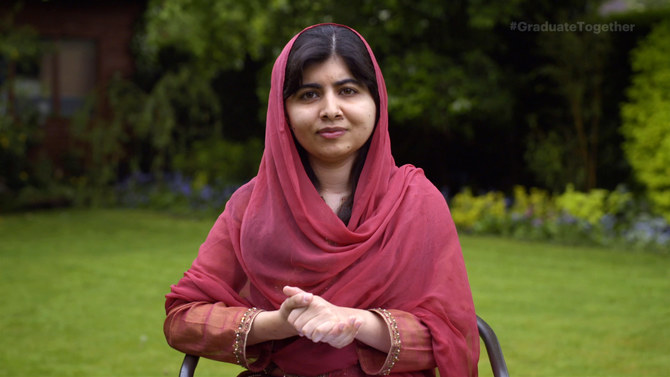
Fortunately, she survived and did not falter in her mission to promote access to education. Yousafzai has since traveled the world to give inspirational speeches, written a best-selling book and become the youngest person to win a Nobel Peace Prize at just 17.
She has continued to use her influence to enact change via the non-profit Malala Fund, that advocates for girls’ education through helping build schools in rural areas, offering programs to advance secondary education and providing school supplies for those who need them most.
The activist, 23, took the opportunity to speak at the 2021 Emirates Airline Festival of Literature over the weekend to discuss why we should prioritize the right to education and to highlight the current issues making it difficult for females around the world to attend school.
Speaking virtually, the Oxford University graduate said: “Every girl should have the right to complete 12 years of education.”
She also touched on the effects that the ongoing coronavirus disease (COVID-19) pandemic has had on schooling.
“Millions of girls are being taken out of schools, which is a serious cause of concern,” Yousafzai said.
https://www.arabnews.com/node/1805766/lifestyle