Thursday, January 27, 2022

پاکستان میں احمدی برادری کی کم ہوتی آبادی

ریاض سہیل

صوبائی دارالحکومت پشاور کے نواحی علاقے بازی خیل میں دوپہر کا وقت تھا۔ معمولات زندگی جاری تھے جب ایک نجی کلینک میں 16، 17 سال کا لڑکا داخل ہوا اور متجسس نظروں سے اِدھر اُدھر دیکھتا رہا۔ جب سٹاف نے اس لڑکے سے آنے کا مقصد پوچھا تو اس نے جواب دیا کہ ’میں مریض ہوں، بڑے ڈاکٹر سے دوائی لینی ہے۔‘

وہ ’بڑے ڈاکٹر‘ ڈاکٹر عبدالقادر تھے جو اسی وقت عبادت سے فارغ ہو کر کلینک میں واقع اپنے کمرے میں آ کر بیٹھے ہی تھے۔ نوجوان اُن کے کمرے میں داخل ہوا اور پستول نکال کر فائرنگ شروع کر دی۔ اپنے ہی خون میں شرابور ڈاکٹر عبدالقادر وہیں ڈھیر ہو گئے۔

یہ واقعہ گذشتہ سال 11 فروری کو پیش آیا تھا۔

ڈاکٹر عبدالقادر کے بیٹے کے مطابق اُن کے والد کو قریبی ہسپتال لے جایا گیا لیکن وہ جانبر نہ ہو سکے البتہ حملہ آور کو ہسپتال کے گارڈز نے پکڑ لیا۔

سنہ 2021 میں ڈاکٹر عبدالقادر احمدی برادری سے تعلق رکھنے والے چوتھے ایسے فرد تھے جنھیں ٹارگٹ کلنگ کا نشانہ بن کر ہلاک کیا گیا۔ احمدی برداری پر حملوں کی اس لہر کے بعد کئی احمدی خاندان پشاور سے نقل مکانی کر گئے ہیں، جن میں سے کچھ پاکستان کے دیگر شہروں اور کچھ بیرون ملک چلے گئے ہیں۔

پاکستان میں احمدی برادری کی آبادی میں نصف سے زیادہ کمی

پاکستان میں سنہ 2017 کی مردم شماری کا اگر سنہ 1998 کی مردم شماری سے موازانہ کیا جائے تو ملک میں احمدی برادری کی آبادی میں واضح کمی نظر آتی ہے۔

گذشتہ برس جاری کیے گئے مردم شماری کے اعداد و شمار کے مطابق احمدی برادری پاکستان کی مجموعی آبادی کا لگ بھگ 0.09 فیصد ہے۔ جبکہ سنہ 1998 میں ہونے والی مردم شماری کے مطابق احمدی برادری کی آبادی 0.22 فیصد تھی۔

جماعت احمدیہ کے ترجمان حکومتی اعداد و شمار سے اتفاق نہیں کرتے۔

اُن کا کہنا ہے کہ یقیناً ظلم و ستم کی وجہ سے لوگ نقل مکانی کر رہے ہیں لیکن یہ سلسلہ 1980 سے جاری ہے۔ ان کا کہنا تھا کہ آبادی میں جو فطری اضافہ ہوتا ہے اس حساب سے بھی دیکھا جائے تو یہ تعداد بہت کم ہے۔ ان کے اندازے کے مطابق پاکستان میں احمدی برادری کی آبادی فی الحال چار سے پانچ لاکھ کے قریب ہے۔

واضح رہے کہ پاکستان الیکشن کمیشن نے سنہ 2018 میں احمدی ووٹرز کی تعداد ایک لاکھ 67 ہزار بتائی تھی جن کی اکثریت بالترتیب پنجاب اور سندھ میں آباد تھی۔

کیا احمدی برادری اپنی شناخت چھپا رہی ہے؟

وزیر اعظم عمران خان کے مذہبی ہم آہنگی کے بارے میں معاون اور پاکستان علما کاؤنسل کے چیئرمین حافظ طاہر محمود اشرفی کا کہنا ہے کہ وہ یہ نہیں تسلیم کرتے کہ احمدی برادری کی آبادی میں وقت کے ساتھ اتنی بڑی کمی واقع ہوئی ہے۔

بی بی سی سے بات کرتے ہوئے انھوں نے دعویٰ کیا کہ ان کی ذاتی معلومات کے مطابق جن علاقوں میں احمدی برادری سے تعلق رکھنے والے افراد موجود ہیں وہ کاروبار و تجارت کے علاوہ پاکستان میں اچھے منصبوں پر بھی فائز ہیں اور ان میں سے بیشتر اپنی شناخت مخفی رکھتے ہیں۔

’اگر انھیں کہیں بیرون ملک جانے کا موقع ملتا ہے تو وہ یہ موقع حاصل کرتے ہیں جس میں ان کی جماعت ان کی مدد کرتی ہے۔ میں ایسے کچھ لوگوں کو ذاتی طور پر جانتا ہوں جنھوں نے بیرون ملک جانے کے لیے خود اپنے خلاف ایف آئی آرز کروائیں تھیں۔‘

فضل اللہ قریشی سابق وفاقی سیکریٹری برائے منصوبہ بندی اور مردم شماری کے حوالے سے حکومت پاکستان کے معاون رہے ہیں۔ ان کا کہنا ہے کہ احمدی برادری پابندیوں کے باعث اپنی مذہبی شناخت نہیں کرواتے۔

’آج سے پہلے حالات مختلف تھے، موجودہ صورتحال مختلف ہے۔ انسانی غلطی کی گنجائش نہیں ہے کیونکہ جو شہری معلومات فراہم کرتا ہے وہی لکھی جاتی ہے۔ اگر کوئی اپنا مذہب اسلام بتاتا ہے تو عملہ اسلام لکھتا ہے کیونکہ احمدی برادری سے تعلق رکھنے والے کافی افراد خود کو اسلام سے وابستہ کرتے ہیں اور اپنی شناخت چھپاتے ہیں۔ دوسرا یہ کہ کچھ بیرون ملک بھی ہجرت ہوئی ہے جیسے دیگر کمیونٹیز کی ہوئی ہے۔‘

فضل اللہ قریشی کا کہنا تھا کہ احمدی برادری کسی ایک گھر یا علاقے میں تو نہیں رہتی اور دانستہ طور پر کسی کو نظر انداز کرنا ممکن نہیں ہے۔ انھوں نے کہا کہ کافی لوگوں میں یہ تاثر پایا جاتا ہے لیکن ایسا درست نہیں ہے اور مردم شماری کی تین مرحلوں میں نگرانی ہوتی ہے۔

دوسری جانب لاہور یونیورسٹی آف مینجمنٹ سائنسز کے ایسوسی ایٹ پروفیسر ڈاکٹر علی عثمان قاسمی کا کہنا ہے کہ مردم شماری کے نتائج پر مجموعی طور پر صوبوں اور مذہبی اقلیتوں کا اعتراض ہے۔ ان کا کہنا تھا کہ احمدی برادری سے تعلق رکھنے والے کئی افراد اپنی شناخت مخفی رکھتے ہیں کیونکہ انھیں جان کا خطرہ ہوتا ہے جن میں خاص طور پر وہ جو ربوہ سے باہر رہتے ہیں وہاں عدم تحفظ کا احساس زیادہ ہے۔

ان کا مزید کہنا ہے کہ ’آبادی میں کمی کی بڑی وجہ نقل مکانی بھی ہے جس میں گذشتہ 15 برسوں میں اضافہ ہوا ہے، پڑھے لکھے افراد پہلے کینیڈا، امریکہ، جرمنی چلے جاتے تھے، اب تھائی لینڈ، سری لنکا جیسے ممالک جہاں ویزے کی ضرورت نہیں وہاں جانا شروع کر دیا ہے۔ یہ ایسا رجحان ہے جو اس سے پہلے موجود نہیں تھا۔ یورپ اور امریکہ کی طرف جو ہجرت کا ریکارڈ ہے اس کے بجائے ان ملکوں کی طرف دیکھنا چاہیے جو عام غریب احمدی کی دسترس میں ہیں۔‘

جماعت احمدیہ کے ترجمان نقل مکانی سے انکار تو نہیں کرتے لیکن انھوں نے کہا کہ ان کے پاس اعداد و شمار دستیاب نہیں ہیں۔ البتہ شناخت چھپانے کے دعوؤں سے وہ اتفاق نہیں کرتے۔ ان کا کہنا ہے کہ اگر فیملی ٹری میں سنہ 1974 سے شناخت بطور مسلم چل رہی ہو اور کسی نے تبدیل نہ کرائی ہو تو یہ صرف اسی صورت میں ممکن ہو سکتا ہے۔

انھوں نے مزید کہا کہ شناخت کے لیے ایک حلف نامہ دینا ہوتا ہے اور اگر نہ بتائیں تو بھی جرم سمجھا جاتا ہے۔

احمدیوں پر حملہ، خیبرپختونخوا ہاٹ سپاٹ

پشاور کے نواحی علاقے بازی خیل میں ڈاکٹر عبدالقادر پر ہونے والا یہ حملہ کوئی پہلا واقعہ نہیں تھا۔

اُن کے بیٹے نے بتایا کہ جنوری 2009 میں کالعدم تنظیم ’لشکر اسلام‘ منگل باغ گروپ نے اُن کے گھر پر حملہ کیا اور ان کے ایک ڈاکٹر کزن کو گھسیٹ کر لے جانے کی کوشش کی تھی۔ انھوں نے بتایا کہ اس موقع پر ڈاکٹر عبدالقادر اور محافظوں نے مزاحمت کی جس کے دوران ایک گولی ان کی ران میں لگی تھی لیکن وہ کزن کو بچانے میں کامیاب ہو گئے، تاہم اس جھڑپ میں ان کا ایک محافظ مارا گیا تھا۔

ڈاکٹر عبدالقادر کے بیٹے نے بتایا کہ ان کے کزن کا کلینک گھر کے اندر ہی تھا جس پر ماضی میں ایک بار خودکش حملہ بھی کیا گیا تھا جس میں ایک عورت ہلاک ہوئی تھی اور اس سنگین صورتحال کی وجہ سے انھیں محفوظ مقام پر منتقل ہونا پڑا جس کے باعث ان کی تعلیم اور ان کے والد کی پریکٹس متاثر ہوئی۔

پاکستان کے سابق آمر جنرل ضیا الحق کے دورِ حکومت میں 26 اپریل 1984 کو حکومتِ پاکستان نے آرڈیننس 20 کا نفاذ کیا جس کے تحت 1974 میں غیر مسلم قرار دیے جانے والے احمدی افراد پر اسلامی شعائر اپنانا اور ان پر عمل کرنا بھی قابل تعزیر جرم قرار پایا اور احمدی برادری کے افراد پر خود کو مسلمان کہلانے پر بھی پابندی عائد کر دی گئی۔

جماعت احمدیہ کے دعویٰ کے مطابق احمدی کمیونٹی کی ہلاکتوں کا سلسلہ یکم مئی 1984 سے شروع ہوا تھا۔ جماعت احمدیہ کے مطابق گذشتہ 38 برس میں احمدی برادری کے 273 افراد ہلاک ہو چکے ہیں جن میں سب سے زیادہ ہلاکتیں پنجاب میں ہوئیں جو کل ہلاکتوں کا 69 فیصد ہے۔

دوسرے نمبر پر سندھ ہے جہاں 23 فیصد ہلاکتیں ہوئیں ہیں۔ اس کے بعد خیبرپختونخوا میں پانچ فیصد اور بلوچستان میں تین فیصد ہلاکتیں ہوئیں۔ البتہ گذشتہ کچھ عرصے میں خیبر پختونخوا میں حملے اور ہلاکتیں زیادہ دیکھے گئے ہیں۔

پشاور میں احمدی برادری کے امیر ایک سابق ریٹائرڈ کرنل ہیں۔ بی بی سی سے بات کرتے ہوئے اُن کا کہنا ہے کہ ابتدا میں سندھ اور پنجاب کے مقابلے میں خیبرپختونخوا میں صورتحال کافی بہتر تھی۔

انھوں نے بتایا کہ سنہ 1984 میں اُن کے گاؤں سمیت متعدد علاقوں میں ان کی برادری پر حملے ہوئے اور فصلیں جلائی گئیں جس کے بعد احمدی برادری کے لوگ نقل مکانی کر کے پشاور شہر آ گئے جہاں ان کے مطابق عدم برداشت اور حقارت و تعصب تو تھا لیکن ہلاکتوں تک بات نہیں آئی تھی۔

’گذشتہ ایک ڈیڑھ برس کے دوران منصوبہ بندی کے تحت کارروائیاں کی گئیں۔ پہلے ایسا ماحول بنایا گیا کہ احمدی وکلا پریکٹس چھوڑ دیں، اس مہم کی وجہ سے۔ ان کے پاس جو کیسز تھے وہ واپس ہو گئے۔‘

انھوں نے مزید بتایا کہ احمدی ڈاکٹرز کے خلاف ایک پمفلٹ شائع ہوا جس میں ان کے نام اور جن ہسپتالوں میں وہ پریکٹس کرتے تھے ان کی تفصیلات فراہم کی گئیں اور لوگوں سے اپیل کی گئی کہ ان سے علاج نہ کرایا جائے۔

’صرف پشاور شہر میں 20 سے 25 احمدی ڈاکٹر تھے۔ اس صورتحال میں جو سرکاری اساتذہ تھے اور دوسرے ملازمین تھے، انھوں نے طویل چھٹی لے لی یا پھر دیگر علاقوں میں تبادلے کرانے پر مجبور ہو گئے۔‘

’والدین شکایت کر رہے ہیں کہ احمدی ٹیچر سے ہمارے بچے نہیں پڑھیں گے‘

مقتول ڈاکٹر عبدالقادر کے بیٹے کے مطابق اُن کے والد پر پہلے حملے کے بعد پشاور میں جب صورتحال بہتر ہوئی تو وہ واپس آ گئے اور دوسری جگہ پر گھر لے لیا۔

’والد صاحب نے دوبارہ پریکٹس شروع کی لیکن پھر جلوس نکلتے اور نعرے بازی ہوتی اور گالیاں دی جاتیں۔ سیاسی جماعتوں کے رہنما اور منتخب نمائندے ان عناصر کے ساتھ کھڑے ہوتے ہیں کیونکہ ان سے ووٹ لینا ہوتا ہے اور اگر وہ ساتھ کھڑے نہ ہوں تو انھیں کہا جاتا ہے کہ آپ ’قادیانیوں‘ کے ساتھ کھڑے ہوئے ہیں۔ انھیں خوف ہوتا ہے کہ آئندہ ووٹ نہیں ملیں گے۔’

انھوں نے کہا کہ وہ درس و تدریس کے شعبے سے منسلک تھے لیکن انھیں کئی بار ’قادیانی‘ ہونے کے باعث نوکری سے نکال دیا گیا۔

’کوئی نہ کوئی شاگرد نشاندہی کر دیتا۔ اس کے بعد انتظامیہ کہتی کہ آپ اچھا پڑھا رہے ہیں لیکن والدین شکایت کر رہے ہیں کہ ’قادیانی ٹیچر‘ سے ہمارے بچے نہیں پڑھیں گے۔‘

انھوں نے بتایا کہ کئی بار ایسا ہوا کہ انھوں نے نئی نوکری شروع کی اور اس میں معمول بنایا، لیکن پھر ان شکایات کی بنا پر سب ختم ہو جاتا۔ ’پھر میں دور کے کسی علاقے میں جا کر دوبارہ ٹیچنگ شروع کر دیتا اور والد بھی گھر بیٹھ جاتے اور کبھی کبھی چھوٹا موٹا کلینک شروع کر دیتے تھے انھیں نوٹس آ جاتا کہ عمارت خالی کر دو۔ معاشی طور پر مسلسل ہم نیچے جا رہے تھے۔‘

ڈاکٹر عبدالقادر کے بیٹے نے کہا کہ ان کی چھوٹی بہن کو ان کا ٹیچر گالیاں دیتا تھا اور کہتا کہ ’یہ کافروں سے بھی بدتر ہیں‘۔

’صبح کو ابو اگر تندور پر روٹی لینے جاتے تو وہ کہتے کہ ڈاکٹر صاحب آج تو آپ آئے ہیں آئندہ آئے تو اچھا نہیں ہو گا۔‘

’اس کو لے جاؤ اور زہر کا ٹیکا لگا دو‘

ڈاکٹر عبدالقادر کی بیوہ نے بتایا کہ صورتحال کی سنگینی کی وجہ سے انھوں نے گذشتہ ڈیڑھ سال میں آٹھ مرتبہ گھر تبدیل کیے۔

’لوگ تعلقات نہیں رکھتے۔ جب باہر نکلتے تو ایک دوسرے کو اشارے سے بتاتے تھے کہ یہ احمدی ہیں، ان سے بات نہ کریں۔ اگر بات کریں گے تو منھ پلیت ہو جائے گا۔ گھر میں اگر پانی نہ ہو تو پانی تک نہیں دیتے تھے۔ کہتے تھے کہ یہ مذہب چھوڑ دیں ورنہ ہمارے ساتھ تعلقات نہ رکھیں۔‘

بی بی سی سے بات کرتے ہوئے انھوں نے بتایا کہ کئی مواقع پر ان کے مالک مکان ان سے کہتے کہ ’ہم مجبور ہیں کیونکہ آپ کے محلے والوں کے شکایت آئی ہے، وہ دھمکا رہے ہیں کہ آپ کے گھر کو آگ لگا دیں گے اس لیے مجبوری میں ہم یہ سب کر رہے ہیں۔‘

ڈاکٹر قادر کی بیوہ بتاتی ہیں کہ ان کا چھوٹا بیٹا اچھا خاصا پڑھا لکھا تھا لیکن بیٹھے بیٹھے گم صم ہو جاتا تھا اور پھر مکمل طور پر خاموش ہو گیا۔

وہ بتاتی ہیں کہ ’اس کو ذہنی امراض کے بحالی سینٹر لے گئے۔ کچھ دن وہاں زیر علاج بھی رہا پھر پتا نہیں کیسے وہاں عملے کو علم ہوا کہ یہ احمدی ہے، جس پر سینٹر کے انچارج، جو ریٹائرڈ بریگیڈیئر تھے، نے انھیں کہا کہ اس کو لے جاؤ اور زہر کا ٹیکا لگا دو۔ کیا کوئی ماں کو ایسا کہہ سکتا ہے؟‘

انھوں نے کہا کہ اُن کے شوہر کی گذشتہ برس فروری میں ہلاکت کے بعد مئی میں ان کا بیٹا بھی لاپتہ ہو گیا۔ ’اس نے سینٹر میں یہ کہا کہ بھائی کے پاس جا رہا ہوں، لیکن اس کے بعد پتہ نہیں کہاں چلا گیا۔ ہم نے پولیس کے پاس پرچہ بھی کرایا۔ مجھے نہیں معلوم ہے کہ میرا بیٹا زندہ ہے یا نہیں۔ جب کھانے کے لیے بیٹھتی ہوں یا پانی پیتی ہوں تو اس کی شکل میرے سامنے گھومنے لگتی ہے۔‘

’ماتحت ملازمین نے یہ کہہ کر ساتھ میں کام کرنے سے انکار کر دیا کہ یہ احمدی ہے‘

پشاور میں احمدیہ جماعت کے رہنما فوج سے کرنل کی حیثیت سے ریٹائر ہوئے ہیں۔

اُن کا کہنا ہے کہ فوج میں ملازمت کے دوران ان کے ساتھ ایک دو بار امتیازی سلوک ہوا جس میں کچھ افسران کا کہنا تھا کہ ’احمدی برادری سے تعلق رکھنے والے اس شخص کے برتن الگ ہونے چاہییں۔ لیکن دیگر افسران، جو اکثریت میں تھے، نے مزاحمت کی اور کہا کہ آپ لوگ اپنے برتن الگ کر لیں لیکن ہم ان کے ساتھ ان ہی برتنوں میں کھائیں گے۔‘

وہ بتاتے ہیں کہ ’ریٹائرمنٹ کے بعد امتیازی سلوک کا زیادہ سامنا کرنا پڑا۔ جس کمپنی میں کام کرتا ہوں اس میں ماتحت ملازمین نے یہ کہہ کر ساتھ میں کام کرنے سے انکار کر دیا کہ یہ احمدی ہے۔ اس کے بعد اسلام آباد سے میرے باس پشاور آئے اور انھوں نے مفتی سے کیے گئے ایک مشورے کے متعلق ملازمین کو بتایا کہ مفتی کا کہنا ہے کہ اگر وہ اپنے پروفیشن میں مہارت رکھتا ہے اور کام سے کام رکھتا ہے تو اس میں کوئی حرج نہیں ہے جس کے بعد ماتحت مزید کام کرنے پر راضی ہوئے۔‘

احمدیہ جماعت کے ترجمان کا کہنا ہے کہ خیبرپختونخوا میں کوہاٹ، ڈی آئی خان، بنوں، پارہ چنار، سرائے نورنگ میں احمدی آبادی تھی جو بہت کم رہ گئی ہے اور پشاور میں بھی کم ہو گئے ہیں۔

’اب ربوہ بھی محفوظ نہیں ہے‘

پنجاب میں ضلع چنیوٹ کے علاقے ربوہ میں جماعت احمدیہ کا مرکز واقع ہے جس کو اب انتظامی طور پر ’چناب نگر‘ کہا جاتا ہے۔ جماعت احمدیہ کے ترجمان کے مطابق سنہ 1948 میں غیر آباد اور ویران اراضی میں یہ مرکز بنایا گیا تھا جس کی موجودہ 70 ہزار کے قریب آبادی ہے جن میں سے نوے فیصد احمدی ہیں۔

ربوہ میں سکیورٹی کا کوئی غیر معمولی انتظام نظر نہیں آتا۔ احمدیہ مرکز کے قریب سیمنٹ کے کچھ بلاک رکھے گئے ہیں جبکہ صرف ایک پولیس موبائل کونے پر کھڑی ہوئی نظر آتی ہے۔ داخلی راستے پر احمدیہ جماعت کے غیر مسلح رضاکار سکیورٹی کے فرائص سرانجام دیتے ہیں۔

دوسری جانب وزیر اعظم عمران خان کے مذہبی ہم آہنگی سے متعلق معاون حافظ طاہر اشرفی نے دعویٰ کیا کہ ’قادیانیوں‘ کا جو علاقہ ہے وہاں کوئی مسلمان بھی ان كى اجازت كے بغير نہیں جا سکتا اور حتیٰ کہ پولیس بھی داخل ہونے کے لیے ان سے پوچھتی ہے۔

پاکستان میں ہلاکتوں اور حملوں سے متاثرہ احمدی کمیونٹی کے افراد کی عارضی پناہ گاہ ربوہ ہی ہوتی ہے۔ لیکن جماعت کے ترجمان کا کہنا ہے کہ اب ربوہ بھی محفوظ نہیں ہے۔

‘یہاں شہری سہولیات نہیں ہیں۔ ترقیاتی کام نہیں ہوتے کیونکہ ہم سیاسی جماعتوں کے ووٹرز نہیں ہیں حالانکہ یہ ضلع میں سب سے زیادہ ٹیکس دینے والا ٹاؤن ہو گا۔ یہاں کوئی صنعت نہیں ہے۔ ملازمتوں کے لیے باہر جانا پڑتا ہے اور جب پتہ چلتا ہے کہ احمدی ہے تو نوکری نہیں دیتے۔‘

ربوہ میں احمدی کمیونٹی کے اپنے دو ہسپتال ہیں جبکہ آٹھ کے قریب سکول، ایک کالج اور یونیورسٹی ہے۔ ترجمان کے مطابق پروفیشنل تعلیم کے لیے باہر جانا ہوتا ہے، جہاں شناخت دینی پڑتی ہے۔ ربوہ میں ہاسٹل کی طرح کے فلیٹس بنے ہوئے ہیں جہاں عارضی رہائش کا انتظام کیا جاتا ہے جبکہ شہر میں کرائے کے محدود مکانات دستیاب ہوتے ہیں۔

علی مراد ( فرضی نام) لالہ موسیٰ میں کاروبار کرتے تھے۔ گذشتہ سال اگست میں ان پر جان لیوا حملہ کیا گیا جس کے بعد وہ ربوہ منتقل ہو گئے۔ وہ بتاتے ہیں کہ اس کے بعد ان کا کاروبار ختم ہو گیا اور زندگی جیسے تھم سی گئی۔

‘گھر بند ہے۔ بچے سکول جا نہیں سکتے۔ لگتا ہے جیسے وہ بند گلی میں ہیں اور آگے اندھیرا ہے۔ کچھ سمجھ میں نہیں آتا کیا کریں۔ چاہے کوئی بھی کہیں پیدا ہوا ہو، پلا بڑھا ہو، اب وہاں واپس نہیں جا سکتا۔ حتی کہ یہاں ربوہ میں بھی کرائے کے لیے جگہ نہیں ملتی۔‘

’شہریوں کا بھی فرض ہے کہ وہ آئین اور قانون کی بالادستی کو تسلیم کریں‘

تاہم دوسری جانب وزیر اعظم عمران خان کے مذہبی ہم آہنگی کے معاون حافظ طاہر اشرفی کا دعویٰ ہے کہ گذشتہ چھ ماہ سے کسی احمدی پر کوئی حملہ نہیں ہوا۔

انھوں نے کہا کہ پشاور اور ننکانہ میں ہونے والے دونوں واقعات کے ملزمان کو گرفتار کر لیا گیا ہے اور ایسا پہلی بار ہوا ہے کہ نہ صرف حکومت بلکہ علمائے دین نے بھی اس کی مذمت کی ہے۔ ان کا کہنا تھا کہ ریاست اپنے شہریوں کے تحفظ کی ذمہ داری ادا کرتی رہے گی اور جو آئين و قانون ان كو حق ديتا ہے وہ ملے گا۔

’پاکستان کا آئین اور قانون جو ہر شہری کو حق دیتا ہے وہ حقوق قادیانیوں کو بھی حاصل ہیں۔ شہریوں کا بھی فرض ہے کہ وہ آئین اور قانون کی بالادستی کو تسلیم کریں اور اس کی پیروی کریں۔ قادیانی علانیہ اپنی شناخت مخفی رکھتے ہیں، وہ آئین اور قانون كو جو ان كے متعلق نہیں مانتے خود کو رجسٹرڈ نہیں کراتے۔‘

پشاور میں احمدی کمیونٹی کے امیر کا کہنا ہے کہ قتل کے مقدمات کی پیروی میں بھی دشواری ہوتی ہے کیونکہ مدعی خوف میں آ جاتے ہیں جس کی وجہ سے سماعت ملتوی ہو جاتی ہے اس طرح سے جو ملزم ہے اس کو ہی فائدہ ہوتا ہے۔

لمز یونیورسٹی لاہور کے پروفیسر ڈاکٹر علی عثمان قاسمی کا کہنا ہے کہ جہاں احمدیوں کا معاملہ آتا ہے وہاں پر حکومت مشینری نظر آتی ہی نہیں ہے۔

وہ کہتے ہیں کہ ’قانون، اس کی زبان اور اس ضمن میں عدالتی فیصلے اس طرح کے ہیں کہ کوئی بھی احمدی اگر اپنے عقیدے کا اظہار کرتا ہے تو اس کو سلمان رشدی تصور کیا جاتا ہے۔ اس کو اگر کوئی مارنا چاہے تو ہمارا قانون اس کو نہ صرف فطری عمل قرار دیتا ہے بلکہ اس کی ستائش کرتا ہے۔‘

انھوں نے کہا کہ اگر قانونی کارروائی کی بھی جائے تو میڈیا یا کورٹ میں ماحول ایسا بن جاتا ہے کہ ملزم کے حامی جمع ہو جاتے ہیں، علما آجاتے ہیں یا وکلا کا گروہ جمع ہو جاتا۔

وہ کہتے ہیں کہ ’پورا انصاف کا نظام اس طرح کام کرتا ہے کہ اگر اس میں حکومت چاہے بھی اس نفرت انگیزی کی روک تھام نہیں کر پاتی۔‘

’یہ حقیقت ہے کہ اگر میں فوج میں نہ ہوتا تو آج یہاں سروائیو نہیں کرتا‘

پشاور میں احمدی کمیونٹی کے امیر ریٹائرڈ کرنل کے خاندان کے دو درجن کے قریبی رشتے دار بیرون ملک جا چکے ہیں۔

ان کا کہنا ہے کہ انھیں اپنے بچوں کی فکر ہے کہ وہ یہاں کسی شعبے میں جائیں گے، وہ اس صورتحال کا سامنے کیسے کریں گے اور کیا وہ یہ دباؤ برداشت کر سکیں گے یا ٹوٹ جائیں۔

‘میری بیٹی اور بیٹا یونیورسٹی میں ہیں۔ میری خواہش ہے کہ وہ بیرون ملک چلے جائیں۔ وہ ایک اچھا آپشن ہے میں نہیں چاہوں گا کہ وہ یہاں رہیں۔ چھوٹا بیٹا اگر پاکستان میں رہنا چاہتا ہے تو فوج میں جانا بہتر آپشن ہے، کیونکہ یہ حقیقت ہے کہ اگر میں فوج میں نہ ہوتا تو آج یہاں نہیں سروائیو کرتا۔‘

مقتول ڈاکٹر عبدالقادر کی بیوہ کہتی ہیں کہ ان کی کوشش ہے کہ وہ اپنے بچوں کو باہر بھیج دیں۔ ’اپنا ملک چھوڑنے کا کسی کا بھی دل نہیں کرتا لیکن ان بچوں کو ان ظالموں کے رحم و کرم پر نہیں چھوڑا جا سکتا۔ جہاں انسان پیدا ہوا، بڑا ہوا ہو، تو وہ صرف مجبوری میں اپنا ملک چھوڑتا ہے۔‘

ڈاکٹر عبدالقادر کا پانچ افراد پر مشتمل خاندان اب بیرون ملک جانے کا منتظر ہے جس کے لیے وہ تگ و دو کر رہے ہیں۔ اگر وہ اس کوشش میں کامیاب ہو جاتے ہیں تو پاکستان کی اقلیتی آبادی میں سے ایک اور احمدی گھرانے کی کمی ہو جائے گی۔

https://www.humsub.com.pk/440984/bbc-2250/ 

Afghanistan and Pakistan’s Troubles Won’t End With the Taliban Victory

By Kunwar Khuldune Shahid
The Durand Line continues to bedevil Af-Pak relations. One doesn’t recognize it; the other ignores it when convenient.
On January 2, Taliban Ministry of Defense spokesman Enayatullah Khwarazmi condemned Pakistan’s fencing of its border with Afghanistan as “illegal.” Khwarazmi said Pakistan has “no right” to separate the Pashtun tribes that live on either side of the Durand Line.
The statement came two weeks after Taliban fighters damaged parts of the border fence erected by the Pakistan army. While Pakistan Foreign Minister Shah Mehmood Qureshi vowed to “resolve the issues diplomatically,” Taliban Information Minister Zabihullah Mujahid insisted that the Durand Line “has divided one nation on both sides,” which the Taliban “do not want.”
Despite retaking Kabul in August with support from Islamabad, the Taliban are loudly reiterating the official stance that all Afghan regimes have maintained since Pakistan’s inception: The Durand Line is an artificial border imposed by the former British Empire.
Formalized in 1893 following the Second Anglo-Afghan War, the 2,670-km Durand Line was designed to separate British India and the Emirate of Afghanistan, at a time when the foreign affairs of the latter were being run from London. The 1919 Anglo-Afghan Treaty, which established the independence of Afghanistan, hinged on the recognition of the Durand Line as an official border, which was then inherited by Pakistan in 1947, when it was carved out as a separate country in British India.
“If we pay heed to Afghanistan’s claims then India can also claim all of Pakistan as its historical territory,” Pakistan’s former Foreign Secretary and Ambassador to the United Nations Shamshad Ahmad told The Diplomat.
“Afghanistan’s border issues are historical and have been with past empires. Pakistan has legal right over its territory. Even China has border issues with… its neighbors, the same is true for India – this doesn’t mean they would break themselves.”
While the Kashmir conflict rages as a legacy of the Partition, the separations of the historical Punjab and Bengal territories have been officially accepted, with parts of each joining the separate Muslim homeland in British India. With Pakistan’s creation owing itself to, among other geopolitical factors, the British need to make the next move in the “Great Game” with Russia, the newly formed state conveniently used the colonial apparatus for its own experiments.
Among these was the Federally Administered Tribal Areas (FATA) along the Durand Line, which served as a buffer between British India and the Emirate of Afghanistan and was run by the draconian Frontier Crimes Regulations (FCR). The lawlessness in FATA, formally merged into Khyber Pakhtunkha in 2018, has been maintained and used by the Pakistani establishment to influence matters in Afghanistan, which the military elite has long considered a source of strategic depth against India.“They say the Afghan rulers don’t recognize the Durand Line, but the actual problem is that Pakistan’s rulers don’t recognize the Durand Line. [Former military dictator] Zia-ul-Haq used to say ‘Afghanistan is our fifth province’ and that his how the country continues to be treated by Pakistan,” maintains Abdullah Nangyal, a leader of the National Democratic Movement and formerly a member of the Pashtun Tahaffuz Movement (PTM).“It is because of this policy that the Pakistani Taliban are now increasingly launching terrorist attacks as well, and have completely taken over the tribal areas,” he further told The Diplomat.Resurfacing in synchrony with their Afghan counterparts, the Tehrik-e-Taliban Pakistan (TTP) increased their terror raids in Pakistan following the Taliban’s Kabul takeover, even carrying out a gun attack in Islamabad last week. Instead of consolidating on the counterterror gains that pushed the TTP into the periphery, Prime Minister Imran Khan opened negotiations with the group, before the Pakistani Taliban ended a ceasefire last month.
The Pakistani military establishment has used jihadist groups domestically to help clamp down on nationalist movements, such as Baloch and Pashtun separatism, in addition to spearheading radical Islamization in the region, notably in Afghanistan and Kashmir. That has required keeping the Durand Line porous, which helped Pakistan maintain Afghanistan as its backyard for regional jihadi assets.
Under the Ashraf Ghani regime, Islamabad and Kabul regularly accused each other of shielding jihadist groups that targeted the other country’s territory. In 2018, Army Chief Qamar Javed Bajwa inaugurated the fencing of the Af-Pak border. The move was met with objections from the Ghani regime, which are now being repeated by the Afghan Taliban. “The leadership of the Taliban would possibly accept the line as border in front of the Pakistani establishment, but they are afraid of the reaction of the [Afghan population] as well as their low ranks. The new dispute [over the] border is considered by some Afghans as drama by the Taliban to show the Afghans that they are not linked with Pakistani establishment,” Afghanistan-based activist Shafi Atal told The Diplomat.
Many locals believe that the Taliban is looking to woo the masses and gain legitimacy as rulers of Afghanistan with their statements on the border, since the vast majority of Afghans do not consider the Durand Line to be legitimate.
Under the British Empire, and then for the first seven decades of Pakistan’s existence, the Durand Line being upheld in international law meant little to the population living on either side of the border, since their movement continued unhindered. While this allowed the locals to engage in trade and other commercial activities to sustain themselves, in addition to maintaining familial and tribal roots on both sides without having to relocate, the unregulated channels also facilitated smuggling and drug trafficking. However, locals maintain that any policy that restricts their movement will be detrimental to their sustenance and hence unacceptable to the vast majority of Pashtuns on both sides of the border.In interviews with The Diplomat, many locals urged both the Afghan and Pakistani governments to put the validity of the Durand Line to a referendum and ask the locals what its status should be and whether they want to stay with Pakistan or join Afghanistan. They maintain that the border dispute could flare into a major crisis, which could have consequences far beyond the tribal belt. The locals continue to be deprived of basic human rights even while they face the gory menace of the Taliban. Many living in the region perceive Pakistan’s move to fence the border as an attempt to target their Pashtun identity.
“The ex-FATA population has a very pragmatic view about the Pak-Afghan border. They recognize it as a border, which supports their ethnic bonds and source of livelihood. However they would want it as fluid and easy for both sides,” tribal activist and blogger Mona Aurangzeb told The Diplomat.
The U.S. withdrawal from Afghanistan meant that the past stream of billions of dollars from Washington to Islamabad is no longer there, and an increasingly micromanaging China is seeking to take charge. As a result, the Pakistani military establishment has coupled the botched FATA merger with unilateral border fencing in a bid to artificially prop up a semblance of stability. Therefore, the volatility, which has roots stretching back centuries, is cloaked by an iron fist, with complete disregard to the human development of the area, without which no progress is possible.
“Pakistan’s rulers only look at the Afghan border, and Af-Pak relations, in terms of security, in terms of the spillover effect. They have never thought of building the belt, improving its economy, giving the locals basic human rights, trying to create a situation where they are politically more integrated with Pakistan – the current superficial integration is detrimental for Pakistan’s interests,” Lieutenant-General Talat Masood, former secretary of Pakistan’s Ministry of Defense Production told The Diplomat.
While uplifting the local population would help develop the cumulative human capital, it would also result in further resistance toward totalitarian hegemons, whether indigenous or alien. Pakistan, still basking in its status as the kingmaker, continues to fail to fathom a truly independent Afghanistan and a democratically governed tribal belt. For, while Afghanistan was partly the cause of Pakistan’s creation, it has largely been the reason behind the Western aid that sustains Pakistan today.
https://thediplomat.com/2022/01/afghanistan-and-pakistans-troubles-wont-end-with-the-taliban-victory/

Wednesday, January 26, 2022

Video Report - #Colbert #TheReidOut #JoyReid T**** Led The Party Of Reagan Into The Arms Of Russian Propaganda - Joy Reid On The GOP

Video Report - #Colbert #Comedy #Monologue Son Of A Deuce! Pres. Biden Is Giving Zero Malarkeys | Is Tucker In The Bag For Russia?

Video Report - Brianna Keilar rolls the tape on Fox’s Covid-19 vaccine misinformation

#Ukraine #Russia #NATO Ukraine conflict: US and allies won't budge over fears of Russian invasion | DW News

Video Report - 'NATO Expansion Was a Big Mistake' - Fmr Austrian FM to RT

Music Video - Noor Jehan -Concert At Fountain House Lahore | Sanu Nehar Wale Pul Te Bula Ke

جسٹس عائشہ ملک پہلی خاتون جج کی حلف برداری کی تقریب سے پہلے کا احوال، سپریم کورٹ آف پاکستان #mjtv

#Pakistan - Pakistan: Is PM Khan's government more corrupt than previous administrations?

By Haroon Janjua
Transparency International has ranked Pakistan 140th out of 180 countries in its latest Corruption Perceptions Index report. This deals a blow to Imran Khan, whose party promised to eradicate corruption from the country.

The perception of corruption in Pakistan has worsened since Imran Khan came to power in 2018, according to Transparency International (TI).

In its Corruption Perceptions Index (CPI) 2021, the Berlin-based watchdog ranked the South Asian country 140th out of 180 countries, with 180th being the most corrupt country in the world.

Pakistan was ranked 124th in 2020, 120th in 2019, and 117th in 2018.

TI has been compiling the corruption index since 1995. It is based on 13 different sources that depict perceptions of corruption within the public sector, including experts and business people.

The sources also include the World Bank, the World Economic Forum, and private risk and consulting firms.

According to the CPI 2021, the "deteriorating rule of law" and "state capture" are the main reasons behind a significant rise of corruption in Pakistan.

Before coming to power in 2018, Khan, a populist politician, regularly cited TI's CPI as an "evidence" to malign his political opponents, mainly former Prime Minister Nawaz Sharif.

Khan's politics continue to revolve around punishing "corrupt politicians," who, according to him, are impeding Pakistan's progress.

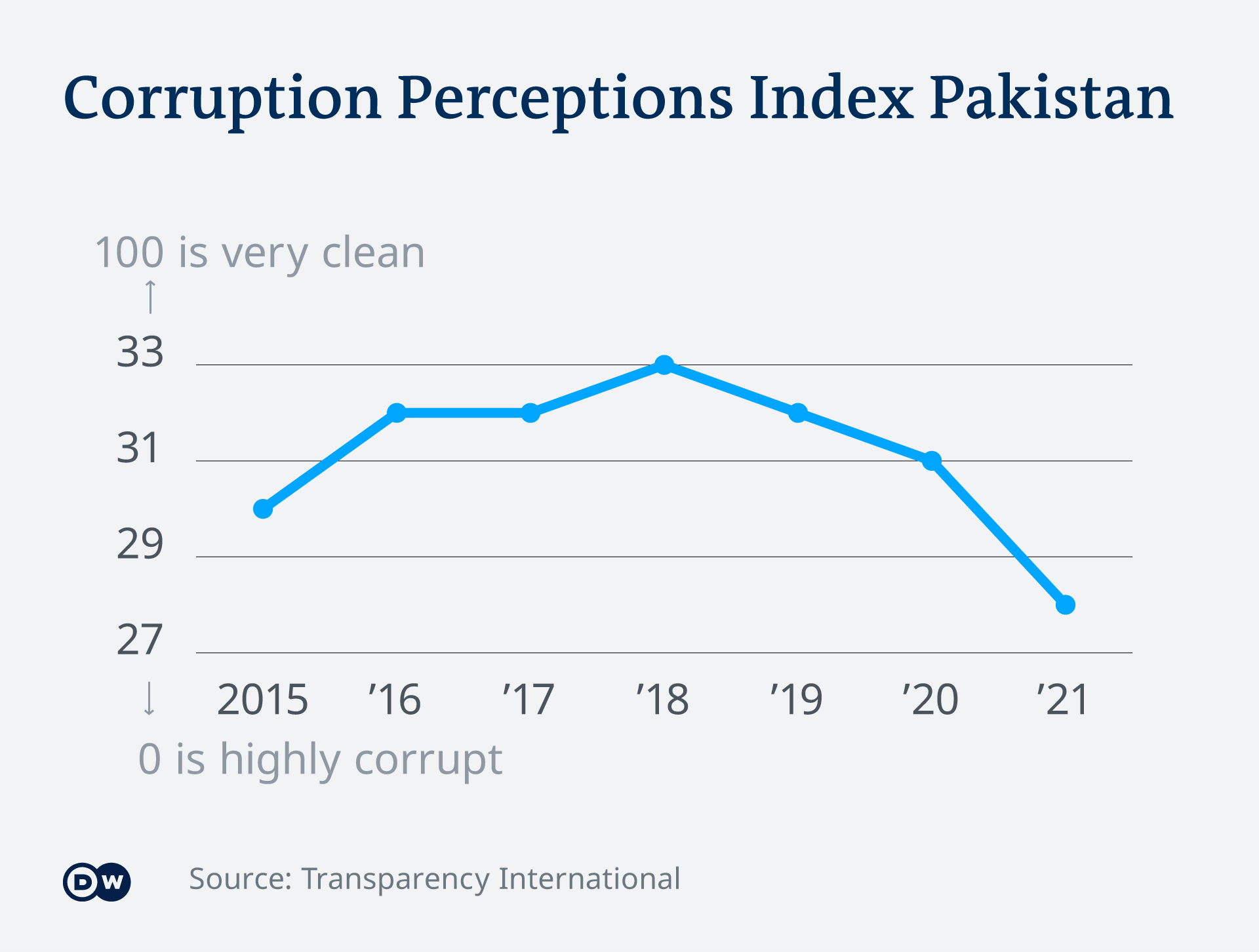
Corruption Preceptions Index Pakistan

Tables have turned

But the corruption perception has become starker since Khan took the reins. Thus, the latest TI report presents a chance for opposition leaders to mock Khan.

Shehbaz Sharif, opposition leader in the National Assembly (Pakistan's lower house of parliament), said in a tweet that Khan's government "has broken all records of corruption in the last 20 years," adding that when his brother Nawaz was in power, corruption had decreased in the country.

Shahid Khaqan Abbasi, a former prime minister associated with the opposition Pakistan Muslim League (Nawaz) party, told DW that corruption is all-time high under Khan's government.

He dubbed it "unprecedented" in Pakistan's history.

Zulfiqar Ali Bader, a spokesperson for the Pakistan People's Party chairman Bilawal Bhutto Zardari, said the prime minister must step down after the publication of the CPI report.


But Information Minister Fawad Chaudhry played down the seriousness of the issue and told DW that Pakistan's low CPI score was not due to financial corruption in the country. Still he admitted, "Yes, we need reforms in the areas of the rule of law and state capture as mentioned in the report."
Why is corruption increasing in Pakistan?
Analysts cite a myriad of reasons behind rising corruption in Pakistan.
"Transparency International makes a strong case that one can't divorce anti-corruption issues from the broader issue of democracy. When democracy takes a hit, anti-corruption efforts struggle because it's in strong and robust democracies where you can most expect to see transparency and probity," Michael Kugelman, a South Asia expert at the Washington-based Woodrow Wilson Center for Scholars, told DW.
"Pakistan's democratic backsliding, in effect for quite some time, has constrained anti-corruption," he added.
Elaborating on the issue of democratic backsliding, Amber Shamsi, a political analyst and journalist, said the CPI reflects the perceptions related to human rights violations, attacks on journalists and deteriorating rule of law in the country.
"There is no across-the-board accountability in Pakistan. Dozens of opposition figures were accused of corruption and put behind bars, but they have not been prosecuted," she told DW.
Learning the hard way
Regardless, the Transparency International report has done a lot of damage to PM Khan's reputation as an "anti-graft crusader." Experts say it could even hurt him in the 2023 general elections. "Khan's political identity is interwoven with the anti-corruption issue. The new TI report, in that regard, is problematic," according to Kugelman. "The premier and his allies will seek to shrug off the TI rankings as an anomaly, or as a foreign conspiracy to malign Pakistan. In an ideal world, though, he and his party allies would introspect on the implications of these rankings. They say a lot not just about Pakistan's corruption challenge, but also about the democratic backsliding that exacerbates the corruption challenge," he added. Khan's failure to revive the country's economy is already causing him political problems. Along with tax increases and higher energy prices, Pakistanis are also facing rising inflation, as the purchasing power of the rupee decreases. Pakistan's inflation rate hit 11.5% last November. The rupee also is also trading at record lows against the dollar.
"Khan's government has failed to deliver. There is no rule of the law [in the country], and he is suppressing opposition parties and curbing civil freedoms," said former PM Abbasi.
But Kugelman says there are no quick fixes to Pakistan's economic problems.
https://www.dw.com/en/pakistan-is-pm-khans-government-more-corrupt-than-previous-administrations/a-60559804
"Khan may have a genuine commitment to combat corruption, but the sheer scale of the problem — not to mention the power of vested interests that don't want a change in the status quo — underscores that this continues to be an uphill battle. Anti-corruption is one of those goals that is so much easier to envision when in the opposition than inside the system. Khan has learned that the hard way," he said.

#Pakistan - Prime Minister Imran Khan on the warpath

Zahid Hussain
The outburst may not have been the first time that Prime Minister Imran Khan lost his cool but his tenor during a live TV session the other day was not one expected from a leader who is in control of the situation. A threatening tone betrayed his deep frustration and vulnerability.
He not only vented his anger against the opposition but also targeted the judiciary and media. They were blamed for everything that has gone wrong with his government. He seemed to be fighting a losing battle but is not prepared to give up. His fall may not be inevitable but the unfolding events raise questions about his government’s survival.
The prime minister also delivered a warning that he could be more dangerous when out of power. One is not sure at whom the threat was directed. It reminds one of the words attributed to Louis XV of France: “Après moi, le deluge”. It may not be the endgame but the prime minister’s words have certainly reinforced the widespread impression about his government’s increasingly untenable situation. Unfortunately, there seems to be little willingness on his part to see where the government has gone wrong. There are always others to be blamed for the problems. It is either the misrule of previous regimes or the mafias that are held responsible for the country’s predicament. The prime minister’s frustration seems to have arisen with the collapse of the PTI government’s ‘anti-corruption’ drive that had mainly targeted the opposition leaders. He blamed the judiciary and media for the failure.

It is evident that he is under a lot of pressure as public discontent grows over the rising cost of living and the government fails to deliver on its promises to bring about change. The argument about inflation being entirely driven by external factors is not convincing. There is no denial of global linkages but misgovernance and flawed economic policies have also been the reason for spiralling commodity prices in the country. Blaming mafias and cartels for the problem cannot satisfy the people who are directly affected by the galloping food prices.

The prime minister appears to be fighting a losing battle.

It has cost the ruling party hugely in terms of political support. The upset in the KP local bodies’ elections is indicative of the party’s shrinking political base. It has brought to the surface the widening rift within party ranks. The move to reorganise the party in the midst of the crisis has added to the confusion at a time when the opposition has stepped up its campaign to bring down the government.

Speculations about a deal between the security establishment and the opposition groups seem to have increased the government’s worries. The widespread rumours about a possible deal seem to have triggered the PM’s angst. His reference to the speculations indicated his unease. For a government which has been largely dependent on the security establishment for its survival such a possibility would obviously be disturbing. In Pakistani politics, such back room deals are not unusual. The growing confidence in the ranks of the opposition and the latter’s plan to march on Islamabad has given currency to the rumours that the security establishment has distanced itself from the government.

That could also mark the weakening of the hybrid power arrangement. Not surprisingly, the prime minister’s remarks that he could be more dangerous if ousted from power is seen by many as a threat to the opposition as well as a message to the establishment. But such a stance could also be seen as sign of weakness. That may lead to the unravelling of the fragile coalition. Such messaging could have a demoralising effect on the PTI. An authoritarian and irrational approach can harm his government more than the opposition’s campaign.

A refusal to interact with the opposition on even critical national issues has weakened the democratic process in the country. There is little realisation on the prime minister’s part that a weakened system has made his government more vulnerable. The prime minister might call himself a democratically elected leader, but a demonstration of respect for parliament is still lacking, while contempt for elected representatives was more strongly evident in his remarks.

It has been asked why the prime minister is not ready to interact with the leader of the opposition whom he calls a criminal, but is willing to talk with terrorist groups like the TTP, who have now called off the ceasefire and stepped up attacks on Pakistani security forces. Of late, the group has carried out terrorist attacks in Islamabad and other places. Confronting the opposition and having a policy of appeasement towards outlawed militant groups has created a very dangerous situation for the democratic process in the country.

https://www.dawn.com/news/1671561/pm-on-the-warpath

Pakistani PM's Attempt For Afghan Fund Faces Backlashes Over Fears Of Sanctions

This is the first time the State Bank of Pakistan has stood against the government's relief fund plan for Afghanistan since legislation was tabled towards making it more independent, said a report.
The Imran Khan government's recent bid to raise funds for the new rulers in Kabul has been shot down by the State Bank of Pakistan (SBP) amid fears that financing of the Taliban regime could invite international sanctions, according to a media report. Pakistan's Finance Ministry has been advised by the SBP against domestic and foreign donations to the government of Afghanistan Relief Fund that funnelling funds to the Afghan government without involving "international organizations of repute" could result in sanctions from the Financial Action Task Force (FATF), an international anti-money laundering and terror finance watchdog, reported Asia Times.
FATF is set to review Pakistan's performance on various metrics next month. Notably, Pakistan has been on the Paris-based watchdog's "grey list" since June 2018. So far, two key FATF action items have not been met by Pakistan which are necessary to get the country removed from the grey list. It includes the prosecution and confiscation of assets of UN-designated terrorists.
This is the first time that Pakistan's autonomous central bank SBP has stood against the government's relief fund plan since legislation was tabled towards making it more independent, said Asia Times. Pakistan's central bank is undergoing some autonomy-enhancing reforms under a deal with the International Monetary Fund (IMF) for a $6 billion extended fund facility.
The SBP in late December was approached by the Pakistan government through its finance division to open a collection account for its Afghanistan Relief Fund. It proposed that disbursements from the new fund to the Taliban could be made through banking channels.
However, the SBP countered that the transfer of funds directly to Afghanistan "through banking channels could be challenging". The central bank proposed that instead of that disbursement from the fund could be made through international relief organizations or extended by the government as "in-kind" support to help Afghans who now face acute food shortages, according to Asia Times.
The SBP also conveyed to the government that opening fund accounts at overseas bank branches would require the authorization of foreign regulatory bodies, a time-consuming and cumbersome process - particularly in light of Pakistan's FATF "grey list" designation.
The Imran Khan government has continuously tried to soften the world's stance on the Taliban and has urged countries to recognise the new government in Kabul. But the countries have declined to give formal recognition.
https://www.ndtv.com/world-news/pakistan-pm-imran-khans-attempt-for-afghanistan-relief-fund-faces-backlashes-over-fears-of-fatf-sanctions-2731050

Tuesday, January 25, 2022

Video Report - #ukraine #russia #nato War at what price? Russia, NATO, weigh cost of Ukraine showdown

Video Report - Putin: If Nukes Head Towards Russia We Are Going to Paradise But They Won't Have Time To Repent

Video Report - #Kremlin #Washington #Ukraine Kremlin says watching US actions over Ukraine with great concern

Video Report - White House affirms ties with NATO; Congress pursues January 6 probe

Video Report - President Joe Biden talks with European leaders as Ukraine fears intensify

Video Report - پریس کلب الیکشن گروپ جاگو نےصحافیوں کو خبردار کر دیا، پریس کلب سرکاری میڈیا کے کنٹرول میں جا رہا ہے۔

آخری قہقہہ کس کا؟ - عاصمہ شیرازی -

کیا خوف کا شکار شخص کبھی یہ کہے گا کہ وہ خوفزدہ ہے؟ نہیں بلکہ وہ اور اونچی آوازیں لگائے گا، چلائے گا تاکہ اُس کے اندر کا خوف دب جائے۔ ہاری ہوئی جنگ کے سپاہی اپنی ناکامی کی ذمہ داری کبھی دشمن توپوں اور کبھی دشمن کی پیش قدمی کی حکمت عملی پر عائد کرتے ہیں۔ جب شکست کا خوف پہلے حملہ کرنے پر مجبور کر دے تو دشمن کو آدھی نفسیاتی کامیابی حاصل ہو جاتی ہے اور اگر حریف اپنے تمام تیر ایک دم آزما لے تو ترکش جلد خالی ہو جاتا ہے۔ کچھ یہی حال تبدیلی کے ان ساڑھے تین سالوں میں احتساب کے اُس بیانیے کا ہوا ہے جس کی پنیری 22 برسوں میں تیار ہوئی مگر پذیرائی اُسی وقت حاصل ہوئی جب محکمۂ زراعت نے مناسب آب و ہوا اور کھاد کا بندوبست کیا۔ بہرحال عظیم مملکت کے واحد صادق اور امین رہنما کو عوام کے 70 برسوں کے خوابوں کا محور بنا کر یوں پیش کیا گیا کہ گویا یہ مسیحا قوم کے ہر زخم پر مرہم رکھے گا۔ کوئی نہ جانتا تھا کہ محض تین برسوں میں 22 سالہ ’جدوجہد‘ کی کہانی میں یہ موڑ بھی آئے گا جو کپتان کے اس وقت سامنے ہے۔ احتساب کے بیانیے کا بھاؤ بھی بہت اور چاؤ بھی بہت۔ میڈیا کی آنکھوں کے تارے راج دلارے جناب کپتان کے ہر موضوع پر بیانات اور فصیحانہ انقلابی نظریات نے میڈیا کے ساتھ ساتھ دانشوروں کو بھی کسی حد تک سحر زدہ کر رکھا تھا۔ طالبان سے محبت کی پینگوں اور اپنی واحد صوبائی حکومت خیبر پختونخوا میں اُنھیں دفاتر قائم کر کے دینے سے لے کر نوجوانوں کے روشن مستقبل کی امیدوں تک۔۔۔ متضاد خوابوں کی وہ دکان سجائی گئی جہاں قیمت محض آنکھیں تھیں۔ خوابوں کے اس سفر میں نوجوان ہمسفر تھے اور کچھ ابھی بھی ہوں گے مگر تعبیریں چھن جانے کا خوف اور اندیشے اُس سے کہیں زیادہ ہیں۔ احتساب کا بیانیہ چور، ڈاکو اور لٹیروں کی صداؤں میں تراشا گیا، ہر کسی کو ایک ہی ترازو میں تولا گیا تاکہ سیاست دانوں اور سیاسی نظام سے نفرت کا انتقام نظام سے لیا جائے۔ احتساب کا بیانیہ، کبھی چین کی طرح پھانسی گھاٹ پر لٹکتے بدعنوانوں، کبھی ایران کے خونی انقلاب، کبھی سعودی عرب کے بدعنوانی کے خلاف سفاکانہ نظام اور کبھی ملائیشیا اور ترکی کی مثالوں کو کارآمد بنا کر پیش کیا گیا۔ نہیں آزمایا گیا تو صرف انصاف، آئین اور جمہوریت کا نظام۔ گذشتہ ساڑھے تین برسوں کے سینکڑوں شب و روز میں صرف وعدے گنے جائیں تو گنتی بھول جائیں مگر وزیراعظم اور اُن کی کابینہ ہر روز جس نئے جذبے کے ساتھ عوام کے سامنے آتے ہیں اُن کے اعتماد کی بہرحال داد تو بنتی ہے۔ احتساب کا بیانیہ جس طرح پایہ ناکامی تک پہنچا ہے اُس پر فقط آہ ہی بھری جا سکتی ہے۔ شکوہ کس سے کیا جائے کہ جن کے سر لانے کا الزام ہے وہ بھی اب دھمکیوں کی زد میں ہیں۔ خوف کے ماحول میں خوف ہی کو ہتھیار بنایا گیا ہے اور اعصاب کی یہ جنگ بہر حال ہر شے داؤ پر لگانے والا ہی جیتتا ہے۔ کپتان کھیل کے اس حصے میں اعصاب کا داؤ آزما رہا ہے جبکہ کھیل کے اس گُر سے انھیں لانے والے بھی واقف نہیں۔ ابھی گذشتہ خطاب میں وزیراعظم نے جس اعتماد سے ’اگر مجھے نکالا‘ کے نتائج سے آگاہ کیا اُسے ہلکا مت لیں۔ آخری قہقہہ کس کا ہو گا یہ دیکھنا ابھی باقی ہے۔ https://www.humsub.com.pk/440655/asma-sherazi-146/

ٹرانسپیرنسی رپورٹ، بھارت بھی پاکستان سے بہتر نکلا - وزیراعظم عمران خان کی حکومت کے کرپشن ختم کرنے کے دعوے دھرے کے دھرے رہ گئے۔

ٹرانسپیرنسی انٹرنیشنل کی کرپشن پر سیپشن انڈکس میں بھارت بھی پاکستان سے بہتر نکلا۔

وزیراعظم عمران خان کی حکومت کے کرپشن ختم کرنے کے دعوے دھرے کے دھرے رہ گئے۔

پی ٹی آئی حکومت نے کرپشن کے معاملے آصف زرداری اور نواز شریف دورِ حکومت کو بھی مات دے دی ہے۔

ٹرانسپیرنسی انٹرنیشنل کی رپورٹ کے مطابق 180 ممالک کی فہرست میں پاکستان کا پہلے 124واں نمبر تھا جو اب ترقی کرتے ہوئے 140ویں نمبر پر آگیا ہے۔

ٹرانسپیرنسی کی رپورٹ میں بھارت بھی پاکستان سے بہتر نکلا ہے، جو فہرست میں 85ویں نمبر پر ہے۔

ٹرانسپرنسی انٹرنیشنل کے مطابق ایسا صرف میڈیا آؤٹ لیٹس، این جی اوز کو بند کرنا اور انسانی حقوق کے کارکنوں کا قتل سبب ہوا ہے۔

رپورٹ کے مطابق صحافیوں اور سیاستدانوں کی جاسوسی کرنا پاکستان کی کرپشن پرسیپشن انڈکس 2021ء کو بہتر نہیں بناسکتا، حکومتیں اس کے برعکس کام کرنے کی کوشش کریں۔

https://jang.com.pk/news/1041856 

#Pakistan - #PTI govt broke all records of corruption - Pakistan slides 16 spots, ranks 140th on CPI

 In TI's Corruption Perceptions Index 2021, Pakistan scores 28 out of 100


The absence of a central agency to coordinate action against corruption was a core factor in driving Pakistan to its lowest in recent years on a global perceived corruption index in 2020, watchdog Transparency International said on Tuesday.

The group’s annual report on business leaders’ perceptions of corruption — which gave Pakistan a score of 28 out of 100, down from 31 in 2020 — also cited the “failure” of the state to uphold rights and consult citizens.

That put Pakistan, at 140, behind India in 85th place, while Bangladesh stood at 147 with a Corruption Perceptions Index (CPI) of 26.

The 2021 index ranks 180 countries by their perceived levels of public sector corruption. The index assigns scores of between one and 100, one being highly corrupt and 100 clean.

The score is derived from a range of 13 sources measuring corruption perceived by experts and business executives. It measures the use of public office for private gain, nepotism, bribery, the diversion of public money and state capture.

The score is also a reflection of the strength of integrity and anti-corruption systems, including “the existence of adequate laws on financial disclosure, conflict of interest prevention and access to information”.

Transparency trumpets the CPI as “the most widely used indicator of corruption worldwide”. But the high-profile and widely reported index has amassed its fair share of critics over the last two decades.

A Guardian report attacked the CPI’s reliance on the opinions of a small group of experts and business people. “This embeds a powerful and misleading elite bias in popular perceptions of corruption and can lead to inappropriate policy responses,” it said.

Pakistan is among two-thirds of nations across the world that are either stagnating or showing signs of deterioration in their anti-corruption efforts.

Under the government of Pakistan Tehreek-i-Insaf (PTI), which came to power on an anti-corruption platform, Pakistan’s ranking has gradually slid. In 2019, it was 120 out of 180 nations, 124 in the following year, and in 2021, it slipped further to 140.

In contrast, in 2018, the last year of the Pakistan Muslim League-Nawaz (PML-N) government, the rating stood at 117 out of 180 governments.

Commenting on the report, the vice chairperson of the Berlin-based agency’s Pakistan chapter, retired Justice Nasira Javed Iqbal, observed there was no change in CPI scores of India and Bangladesh from 2020.

The top performers in the Asia Pacific are New Zealand (88), Singapore (85) and Hong Kong (76).

However, most countries sit firmly below the global average of 43. This includes three countries — Cambodia (23), Afghanistan (16) and North Korea (16) — with some of the lowest scores in the world.

“While countries in the Asia Pacific have made great strides in controlling bribery for public services, an average score of 45 out of 100 on the 2021 CPI shows much more needs to be done to solve the region’s corruption problems,” a Transparency report said.

The government is also battling to improve the regulations to avert being blacklisted by the global financial body, the Financial Action Task Force (FATF), in what could be a bitter blow to an economy already beset by a weakening currency, rising inflation and slower growth.

Many have urged the State Bank of Pakistan (SBP) to push banks to improve anti-money laundering systems and information sharing across the sector.

RESIGNATION OF GOVT SOUGHT

Commenting on the contents of the report, PML-N President Shehbaz Sharif declared Transparency International testified for the second time the PTI government “has broken all records of corruption in the last 20 years”.

In a statement, Sharif, who is facing a plethora of corruption cases, claimed corruption had “decreased” during his party’s government as a result of “transparency, good governance and legal reforms”.

Under deposed prime minister Nawaz Sharif’s “transparency [and] good governance”, corruption had declined as legal reforms of PML-N improved the ranking of Pakistan in the corruption index by 23 points and the country’s image improved in the world.

https://www.pakistantoday.com.pk/2022/01/25/pakistan-ranks-140-out-of-180-on-global-corruption-index/

#Pakistan - There are difficulties in regularizing the population of Gujjar Nala, but there is no obstacle in the regularization of Bani Gala – Chairman Bilawal Bhutto Zardari

 Chairman Pakistan Peoples Party Bilawal Bhutto Zardari has said that he will save the Katchi Abadis across Sindh, and will give property rights to the residents there. He added that PPP has never opposed giving plots to any judge, bureaucrat, or anyone else, hopefully, no one will object to the poor getting their due share either.


Addressing an initial leasing ceremony for 150 people under a scheme to give property rights to residents of more than 8,000 houses in 19 mahallas of Larkana, Chairman PPP said that the first thing the incumbent Prime Minister had done after being elected was to regularize his Bani Gala home for a small fee. We hoped that when the Prime Minister was regularizing his house, the same policy would be applied to the slums across the country.
“Instead, one slum after another was demolished,” said Chairman PPP. “And it seemed as if all the forces of the country were united in snatching away roofs from atop the heads of the poor.”
Chairman Bilawal Bhutto Zardari further said that it is tragic that we face difficulties in regularizing the population of Gujjar Nala, but there is no obstacle in the regularization of Bani Gala.

“There are difficulties in regularizing the slums of Orangi Town, but Bahria Town is regularized,” said Chairman Bilawal Bhutto Zardari.

Chairman PPP said that he was proud of the people of Larkana who had formed organizations to save their homes and started a movement. Today, that movement has been successful. He said that a new journey begins today. Ownership rights will be given to slum dwellers across Sindh, where they have been living for forty years. He further said that the task of rescuing the slums will be intensified from February. We will do our best to give the poor people their rights.

Chairman Bilawal Bhutto Zardari said that this is the difference of perception and opinion as to what kind of Pakistan you want to see. A Pakistan where a common man, a job seeker, a middle-class man, invests the savings of his whole life in projects like Nasla Tower. There are many other such oppressive examples. Or a Pakistan that is the Pakistan of Quaid-e-Awam and Shaheed Mohtarma Benazir Bhutto, where every man from every class gets his due share.
“If the people support us, we will create a Pakistan where everyone is provided with the rights they deserve,” said Chairman PPP. “The journey that has started today from the slums of Larkana will start in the whole of Sindh, including Karachi.” He said that after the next general election, we will give property rights to the citizens living in slums all over Pakistan.

Meanwhile, Chairman Bilawal Bhutto Zardari handed over lease certificates to 150 people in the first phase of the project to give property rights to the slum dwellers of Larkana.

Present on the occasion were Special Assistant to Chief Minister Sindh Liaquat Ali Askani, Members of Assembly and other leaders.

https://www.ppp.org.pk/pr/26167/

Monday, January 24, 2022

Video Report - Why is #Ukraine the West's Fault? Featuring John Mearsheimer

Video Report - Russia Sends Military Vehicles to Belarus Ahead of Joint Drills

Video Report - ‘Playing With Fire’: Fmr Foreign Secretary of India on NATO Expansion

Video - Pentagon holds news conference

Video Report - U.S. preps troops for potential deployment to Ukraine

Music Video - Lokan Do Do Yar Banaye Afshan Zaibi Tune pk

Video Report - Senator Sherry Rehman expresses her views in Senate

Video Report - Chairman PPP Bilawal Bhutto Zardari addresses the Kissan March rally in Hyderabad

OPINION: Why Pakistan’s Army Wants the U.S. Back in the Region

By Arif Rafiq


For years, Chinese and Pakistani leaders have described their relationship, forged by a common rivalry with their neighbor India, as “sweeter than honey.” But the Pakistani Army’s view of the relationship with China appears to be souring — and diverging from the political leadership’s.
Last month, after Prime Minister Imran Khan declined the Biden administration’s invitation to its Summit for Democracy, the Pakistani television news anchor Kamran Khan posted a video on social media denouncing the “wrong decision,” one he declared was made at China’s behest. (China was not invited to — or happy about — the summit.) The journalist lamented that, with that move, the prime minister had “put Pakistan openly in China’s lap.” He alleged that Beijing’s loans had “entrapped” Islamabad, and he even called for an “audit” of the pros and cons of the China-Pakistan Economic Corridor, which has brought billions of dollars in debt-driven energy and infrastructure investment to Pakistan.
In Pakistan, press freedom and politics lie in a gray area, with red lines carefully managed by the army. With a mere phone call or WhatsApp message, colonels can whip a transgressive editor or lawmaker into line.
So the explicit call to reconsider relations with China by one of Pakistan’s most prominent media voices is no random hot take. It reflects the consent, if not the orders, of the country’s khaki masters. Indeed, Pakistan’s praetorian army would have preferred, according to a retired U.S. diplomat, that Prime Minister Khan had attended President Biden’s summit — to reinvigorate a relationship with a superpower that’s been giving it the cold shoulder.
The generals, of course, have little love for democracy or, for that matter, America. What they do have is a sharp sense of realism and a firm belief that the army is the guardian of the national interest. (The army has directly ruled or commanded strong indirect political influence for most of Pakistan’s history.)
The army leadership must know it has no permanent friends among political forces at home or abroad. It constantly seeks strategic maneuverability, balancing domestic and foreign forces in response to changing realities and to avoid dependence on a single patron, proxy or ally.The historically on-again-off-again U.S.-Pakistan relationship is a perfect example. The 9/11 attacks and subsequent U.S. invasion of Afghanistan brought Islamabad and Washington closer. Army-ruled Pakistan had no choice but to accept a slew of U.S. demands, including aiding the overthrow of a Taliban regime it saw as friendly.
But by the mid-2000s, Pakistan resumed covert support for the Taliban, aiming to force a negotiated U.S. withdrawal. Last year, Pakistan got what it wanted. But now, after spending two decades working to push America out of Afghanistan, the Pakistani Army appears to want it back in the region.
Because as U.S.-China competition intensifies, Pakistan’s army fears getting trapped in a cul-de-sac with Beijing. So it seeks to balance the two great powers by grasping on to areas of cooperation, including counterterrorism and trade, that could salvage relations with Washington.
The prime minister, in contrast, appears to be more driven by personal sentiments. He admires China’s political system, especially its gains against poverty and its ruthless anti-corruption measures. And he has an anti-American streak, which helps explain why he might be more receptive to Chinese pressure.
The army, though, doesn’t seem to hold such grudges. Its focus is the present and the future, which seem foreboding. Pakistan’s economy is sputtering, which could be a recipe for social and political unrest, as well as cuts in military spending.As the tap from China dries up — given Beijing’s growing aversion to lend to high-risk countries — and Pakistan’s economic woes worsen, much of the army command see Mr. Khan’s hypernationalism as counterproductive truculence, and the military leaders increasingly view him as more of a liability than an asset. This helps explain the overtures to Washington, which include not just the democracy summit messaging but also granting a U.S. diplomat rare access into the tightly controlled, Chinese-operated port of Gwadar.But the attempted pivot back to America most likely won’t go far. Goodwill in Washington has dried up, especially given Pakistani intelligence’s support for the Taliban. And Islamabad’s sins aren’t the sole driver of the U.S.-Pakistan divorce. Washington has wholeheartedly embraced India, seeking to advance its rise as a global power, even as that country moves toward Hindu nationalist authoritarianism. Time after time, Washington has allowed an “India exception” in its human rights or nuclear proliferation policies, emboldening New Delhi and endangering Islamabad.
While Pakistan has in recent years grown ties with Russia and Turkey, China has become the obvious choice for a meaningful alternative to the United States.
With relations with Washington at a nadir in 2011, Islamabad turned to Beijing to obtain military hardware it couldn’t get from America, including drones and advanced aircraft. China and Pakistan accelerated their joint manufacturing of a low-cost fighter jet that forms the backbone of Pakistan’s air force. And Pakistan became the only foreign country with access to the military version of China’s Beidou satellite navigation service.
While Pakistan’s generals appear irked by the prospects of being trapped on China’s side in a new cold war, they also have benefited from Beijing’s new muscularity — like when India last year was forced to divert troops from the front lines with Pakistan toward the border with China.
Fears of a two-front war with China and Pakistan have restrained New Delhi’s posture toward Islamabad for now. But they also tighten the Indo-American embrace. Paradoxically, Pakistan’s partnership with China may be paying off too well.To counter China, India is overcoming its inhibitions to align with the Americans, dilute its “strategic autonomy” and deepen bilateral defense cooperation. This in turn increases Pakistan’s dependence on China, its largest arms supplier and bilateral creditor. And that compounds the Pakistani Army’s fears of being strategically boxed in.
Meanwhile, Pakistan has learned the hard way that when it comes to trade and lending, its special relationship with China isn’t so special.
Islamabad in 2020 started trying to renegotiate the expensive electric power contracts it recklessly entered into with Chinese companies. Beijing not only refused to do so, but it insists that Islamabad repay $1.4 billion in arrears owed to Chinese power producers. Pakistan put nearly all of its eggs into one basket and is learning the limits of what it means to be an “ally” of China. Its predicament offers lessons for other smaller countries on navigating a new era of the U.S.-China rivalry: Don’t blindly pursue China as an alternative to the United States. In commerce and trade, China’s approach is mercantilist for friends and foes alike.
And so while Pakistan’s army appears to be trying to distance itself, it might already be too late.

Pakistan’s farmers, agriculture and economy can only be protected after the puppet Prime Minister is ousted – Chairman PPP Bilawal Bhutto Zardari

Pakistan People’s Party Chairman Bilawal Bhutto Zardari has said that Pakistan’s farmers, agriculture and economy can only be protected after the puppet Prime Minister Imran Khan is all set to leave for home. He has ruined the country. However, his removal should be quite through lawful and democratic measures.

He was addressing to the participants of the country’s longest “Tractor March” in history which was organised by farmers on the ongoing fertilizer crisis in the country over non-receipt of fair and equitable prices of crops and PPP’s appeal against inflation.
The PPP chairman said that people’s rule has to be established by removing the selected government.
Bilawal Bhutto Zardari said that the ineligible government that lacks everything to run the country has left country’s agricultural economy in a devastated condition while the people especially the crops growers are pinned to wall.
The ineligibility of this incumbent poor government has brought multiple crises and each only inflicted irreparable loss to country’s backbone sectors.
He said that the cash crops are not getting a fair price while the farmers have been left on mercy of the nature. In addition, cash crops are being damaged due to unfair distribution of water.
He further said that the wrong policies of the government have not only ruined the agricultural economy but also endangered food security.
He said that a few days ago farmers staged protests in districts of Punjab and Sindh as in Sahiwal, Layyah and Larkana. We are leaving the villages and standing in the city center to convince the rulers to solve the problems of the farmers.
He was of the view that that the prosperity of the farmers is equal to the prosperity of the entire nation.
Bilawal Bhutto Zardari reminded that when PPP was in power, it worked positively for the betterment of all sectors especially the agriculture. However, farmers are anxious to get a bag of fertilizer by standing in long queues for fertilizer today.
The PPP chairman pointed out that the country was suffering from problems even under President Pervez Musharraf. The crisis was overcome and we were able to export surplus wheat abroad. “Farmers are being killed economically today, which we will not tolerate,” he said.
Today the farmer goes to bed empty stomy, and it is feared that the food insecurity will drive the entire nation to devastation. At present, inflation and unemployment in the country have reached historic levels. We are tired of pointing out problems in the National Assembly but no action is being taken by the government. The selected government has no concern for the farmers.
Bilawal Bilawal Bhutto Zardari said that if any government had any sympathy towards the farmers and the people in the country, it was the PPP leadership.
Shaheed Zulfikar Ali Bhutto, Shaheed Mohtarma Benazir Bhutto, and former President Asif Ali Zardari had deep concern of the people. Shaheed Zulfikar Ali Bhutto rebelled against the system of the country and gave rights to farmers, carried out historic land reforms, gave land ownership rights to farmers, while Shaheed Benazir Bhutto also loved farmers immensely.
The PPP chairman said that if Pakistan’s economy is to be saved then Imran Khan has to be ousted peacefully, lawfully and by all democratic norms and values. We have decided that we will leave Karachi on February 27. The people of Hyderabad will also join us and the people there. We will send this government home in a democratic, legal and constitutional way with the support of the nation.
He while criticising the ruling coalition said that the facilitators of the selected government belonging to Sindh are conspiring to harm Sindh. They are trying to harm the peace of Sindh. The ethnicity-based artificial conflicts deeply impede our struggle for the rights.
“I will not allow any injustice to be done to any Sindhi speaker, Urdu speaker or Pashto speaker.”
“Let the people thwart the conspiracy of these ethnic groups by maintaining their unity.
The PPP chairman said that those who call the new local body system introduced by Sindh Chief Minister a black law will have a remorseful impacts on minds. The people of Sindh will reject these rejected elements.
Addressing the people, he said that he wants the mayor of Hyderabad from PPP, a Jiayala.
He promised that he will work with the Jiala mayor to resolve the problems of the people.
Chairman Bilawal Bhutto Zardari said that those who could not be faithful to their leader would not be faithful to anyone else. Those who used to applaud slogans against Pakistan are the enemies of this city.
Sindh Chief Minister Syed Murad Ali Shah, provincial ministers, lawmakers and party dignitaries were present.

https://www.ppp.org.pk/pr/26155/