https://www.wsj.com/articles/george-w-bush-mark-milley-and-violent-extremists-11631667584?mod=hp_opin_pos_2#cxrecs_s
Wednesday, September 15, 2021
George W. Bush, Mark Milley and Violent Extremists - What are America’s domestic threats?
By James Freeman
Pundits have widely interpreted former President George W. Bush’s Saturday remarks to be a condemnation of participants in last January’s Capitol Riot. But recent news brings other possibilities. Last weekend Mr. Bush said at a 9/11 memorial service for the heroes of Flight 93:
And we have seen growing evidence that the dangers to our country can come not only across borders, but from violence that gathers within. There is little cultural overlap between violent extremists abroad and violent extremists at home. But in their disdain for pluralism, in their disregard for human life, in their determination to defile national symbols, they are children of the same foul spirit. And it is our continuing duty to confront them.Monday’s column noted that Byron York is among those interpreting the remarks as an endorsement of the idea “that an equivalence exists between the plane-hijacking, murderous terrorists of Sept. 11, 2001, and the Capitol rioters of Jan. 6, 2021 — a comparison that has no basis in fact but has done much to sour the national debate.”
Reader Paul Goldbeck responds:
It struck me that those Bush noted as destroying things in his speech could have included Antifa and others as well as the Capitol rioters. What did I miss?
This column asked Bush spokesman Freddy Ford to whom President Bush was referring when he talked about “violent extremists at home” on Saturday. Mr. Ford responds via email:
He refers to anyone who would take up violence against fellow Americans to advance a belief — inclusive of, but not exclusive to, those who would attack synagogues, nightclubs, churches, people of color, national symbols, institutions, the government, etc.
Two days before Mr. Bush delivered his Saturday address, the Associated Press reported from Seattle:
A second defendant has been convicted of sabotaging railroad tracks near the U.S.-Canada border in Washington state just before a train carrying crude oil was due to pass through — apparently part of a campaign to protest construction of a pipeline across British Columbia.
Following a two-day trial and three hours of deliberation, a federal jury in Seattle on Thursday convicted Ellen Brennan Reiche, 28, of Bellingham, of violence against a railroad carrier. Her co-defendant, Samantha Frances Brooks, 24, pleaded guilty in July.
A press release from the U.S. Department of Justice states:
According to records in the case and testimony at trial, on the night of November 28, 2020, Reiche and co-defendant Samantha Frances Brooks, 24, were observed on video surveillance walking on the tracks near a crossing in Bellingham. Whatcom County Sheriff’s deputies responded to the scene. The defendants were detained for trespassing, and a shunt was found on the tracks near where the deputies had first encountered them. Reiche was carrying a paper bag containing wire, a drill with a brush head, a magnetic adhesive and gloves... The shunt that was placed on the tracks could have interfered with the railroad crossing guard at Cliffside Drive in Bellingham. A train carrying crude oil, among other cargo, was scheduled to come through that area soon after this incident.
In her closing argument, Assistant United States Attorney Sok Jiang told the jury, Reiche “disrupted the signal system designed to stop trains from crashing into each other or crashing into cars…. A car driving through the intersection (near the shunt) would not have warning that a train was coming.”
There are of course different types of domestic threats. Today the Washington Post’s Isaac Stanley-Becker writes about his Post colleagues’ allegation that in the final months of the Trump administration, America’s senior military officer delivered a remarkable message to China:
In a pair of secret phone calls, Gen. Mark A. Milley, the chairman of the Joint Chiefs of Staff, assured his Chinese counterpart, Gen. Li Zuocheng of the People’s Liberation Army, that the United States would not strike, according to a new book by Washington Post associate editor Bob Woodward and national political reporter Robert Costa...
“General Li, I want to assure you that the American government is stable and everything is going to be okay,” Milley told him. “We are not going to attack or conduct any kinetic operations against you.”
In the book’s account, Milley went so far as to pledge he would alert his counterpart in the event of a U.S. attack, stressing the rapport they’d established through a backchannel. “General Li, you and I have known each other for now five years. If we’re going to attack, I’m going to call you ahead of time. It’s not going to be a surprise.”
Strategists can debate whether assuring Gen. Li should ever be a U.S. strategic priority, but if this story is true it’s hard to see how Gen. Milley could have been effective. Promising to provide warning of an attack right after one has just promised that such an attack won’t occur isn’t a good way to assure anybody.
Not reassuring at all to Americans who treasure our Constitution and the role of the duly-elected President as commander-in-chief is the following passage in which The Post claims:
Milley also summoned senior officers to review the procedures for launching nuclear weapons, saying the president alone could give the order — but, crucially, that he, Milley, also had to be involved. Looking each in the eye, Milley asked the officers to affirm that they had understood, the authors write, in what he considered an “oath.”
Alexander Vindman, one of the country’s foremost experts in the field of undermining presidential authority, responds on Twitter to the Post claims about communications with China:
If this is true GEN Milley must resign. He usurped civilian authority, broke Chain of Command, and violated the sacrosanct principle of civilian control over the military. It’s an extremely dangerous precedent. You can’t simply walk away from that.
Initial Taliban Moves Fail To Convince Afghanistan’s Neighbors – Analysis
By James M. Dorsey
The Taliban’s record in recent weeks on making good on promises to respect human and women’s rights as well as uphold freedom of the press is mixed at best. Afghanistan’s neighbours and near-neighbours are not holding their breath even if some are willing to give the Central Asian country’s new rulers the benefit of the doubt.
A litmus test of Taliban willingness to compromise may come sooner than later.
It’s most likely only a matter of time before China knocks on newly appointed Afghan acting interior minister Sirajuddin Haqqani’s door demanding the extradition of Uighur fighters.The Chinese demand would be challenging not only because of the Taliban’s consistent rejection, no matter the cost, of requests for the expulsion of militants who have helped them in their battles.
The Taliban already made that clear two decades ago when they accepted the risk of a US invasion of Afghanistan in the wake of 9/11 by refusing for the umpteenth time to hand over Al-Qaeda leader Osama bin Laden. There is little in Taliban 2.0 that suggests that this has changed.
If Haneef Atamar, the foreign minister in the US-backed Afghan government of former president Ashraf Ghani, is to be believed, Uighurs, including one-time fighters in Syria, contributed significantly to the Taliban’s most recent battlefield successes in northern Afghanistan.
A demand to extradite Uighurs to China would also be challenging because Mr Haqqani himself, the Afghan official in charge of internal security, is a wanted man with a $5 million US bounty on his head. Moreover, the United Nations has sanctioned Mr Haqqani’s prime minister, Mullah Hasan Akhund, and several other members of the caretaker government.
“It’s hard to see a wanted man turning over someone who is wanted for similar reasons,” said a Western diplomat.
Moreover, honouring extradition requests could threaten unity within the Taliban’s ranks. “Taliban actions against foreign jihadist groups to appease neighbouring countries would be especially controversial, because there is quite a widespread sense of solidarity and comradeship with those who fought alongside the Taliban for so long,” said Afghanistan scholar Antonio Giustozzi.
Unanswered is the question of whether China would go along with what seems to be an unspoken international consensus that it may be best not to seek extraditions if the Taliban keep their word and prevent militants from striking at targets beyond Afghanistan.
Counterterrorism experts and diplomats argue that if forced, the Taliban would quietly let foreign militants leave their country rather than hand them over. That would make it difficult to monitor these individuals.
China has in recent years successfully demanded the extradition of its Turkish Muslim citizens from countries like Egypt, Malaysia, and Thailand and has pressured many more to do so even though they were not suspected of being foreign fighters and/or members of the Turkestan Islamic Party (TIP). The United Nations Security Council has designated TIP’s predecessor, the East Turkestan Islamic Movement (ETIM) as a terrorist organisation.
There is little reason to assume that China would make Afghanistan, a refuge from Syria for Uighur fighters, the exception.
Chinese foreign minister Wang Yi made that clear when he hinted at possible extradition requests during talks in July in China with Mullah Abdul Ghani Baradar, a co-founder of the Taliban and the new government’s first deputy prime minister. Mr Wang demanded that the Taliban break relations with all militant groups and take resolute action against the TIP.
Moreover, the Taliban may have destroyed any chance of Chinese reliance on them by demonstrating early on that they and the international community may be speaking different languages even if they use the same words.
The Taliban made clear that their definition of inclusivity, a term the group and the international community, including China, Russia and India, appeared to agree on, was very different. The Taliban formed an overwhelming ethnic, all-male government that was anything but inclusive by the universally agreed meaning of the word.Similarly, Mr Haqqani and his colleagues, including Qari Fasihuddin Badakhshani, the Afghan military’s new Taliban chief of staff, a Tajik and one of only three non-Pashtuns in the new 33-member government structure, is believed to have close ties to Uighur, Pakistani and other militants. As a result, they are likely to be equally reticent about entertaining Chinese-backed Pakistan requests for the transfer of members of the Tehrik-i-Taliban Pakistan (TTP), more commonly known as the Pakistani Taliban.
The TTP is a coalition of Pashtun Islamist groups with close ties to the Afghan Taliban that last year joined forces with several other militant Pakistani groups, including Lashkar-e-Jhangvi, a violently anti-Shiite Sunni Muslim supremacist organization.
Hazara Shiites, who account for 20 per cent of the Afghan population were not included in the newly appointed Afghan government even though the Taliban made a point of last month protecting Shiite religious celebrations. Nonetheless, the Taliban’s notion of inclusivity has already troubled relations with Iran and could persuade the Islamic republic to covertly support resistance to the group’s rule.
China fears that the fallout of the Taliban’s sweep across Afghanistan could affect China beyond Afghanistan’s borders, perhaps no more so than in Pakistan, a major focus of the People’s Republic’s single largest Belt-and Road (BRI)-related investment.
The killing in July of nine Chinese nationals in an attack on a bus transporting Chinese workers to the construction site of a dam in the northern mountains of Pakistan raised the spectre of Afghanistan-based religious militants jihadists targeting China. Until now, it was mainly Baloch nationalists who targeted the Chinese in Pakistan.
The attack occurred amid fears that the Taliban victory would bolster ultra-conservative religious sentiment in Pakistan where many celebrated the group’s success in the hope that it would boost chances for austere religious rule in the world’s second-most populous Muslim-majority state.
“Our jihadis will be emboldened. They will say that ‘if America can be beaten, what is the Pakistan army to stand in our way?’” said a senior Pakistani official.
Indicating concern in Beijing, China has delayed the signing of a framework agreement on industrial cooperation that would have accelerated the implementation of projects that are part of the China Pakistan Economic Corridor (CPEC), a crown jewel of the People’s Republic’s transportation, telecommunications and energy-driven BRI.
Taliban spokesman Zabihullah Mujahid recently kept the Taliban’s relationship with the TTP ambiguous.
“The issue of the TTP is one that Pakistan will have to deal with, not Afghanistan. It is up to Pakistan, and Pakistani Islamic scholars and religious figures, not the Taliban, to decide on the legitimacy or illegitimacy of their war and to formulate a strategy in response,” Mr Mujahid said during an interview on a Pakistani television program. The spokesman stopped short of saying the Taliban would abide by a decision of the scholars.
Afghan sources suggest that the Taliban advised the TTP to restrict their fight to Pakistani soil and have offered to negotiate with the Pakistan government an amnesty and the return of the Pakistani militants to the South Asian nation.
Uncertainty about where the Taliban may be taking Afghanistan has also cast a shadow over Indian hopes that the Iranian port of Chabahar would facilitate trade with Afghanistan and Central Asia and counterbalance the Chinese-supported Pakistani port of Gwadar.
Eager to maintain leverage in its relations with Pakistan as well as China, Taliban official Sher Mohammed Abbas Stanekzai chose his words carefully by stressing that economics should be at the centre of Afghan-Indian relations. “We give due importance to our political, economic and trade ties with India and we want these ties to continue. We are looking forward to working with India in this regard,” Mr Stanekzai said.
Mr. Stanekzai’s business-focused approach coupled with the pressure on Taliban to police militants on Afghan soil, some of whom have attacked India in the past, dovetails with Islamic scholars in the Deobandi alma mater in the Uttar Pradesh town of Deoband stressing the divide between themselves and their Afghan and Pakistani brethren.
The Indian Deobandi posture created an opportunity that the government of Prime Minister Narendra Modi has yet to grasp to involve them in India’s backchannel and direct contacts with the Taliban. India invested US$3 billion over the last 20 years in building Afghan roads, girls’ schools and health clinics. Mr. Stanekzai’s remarks indicate that the Taliban would like India to continue its investments in the country.
The Taliban as well as a significant number of Pakistani ultra-conservatives root their worldview in Deobandism, a strand of Islam that emerged in India in the mid-19th century to oppose British colonial rule by propagating an austere interpretation of the faith. Deobandism became prevalent among Pashtuns even if Deobandis in Pakistan, Afghanistan and India went their separate ways after the 1947 partition of the subcontinent.
Arshad Madani, the principal of the Darul Uloom Deoband, the original Deobandi madrassa established in 1886, recently welcomed a decision by India’s Anti-Terrorist Squad (ATS) to set up a training centre in Deoband.
“There is nothing wrong with what we teach, and we welcome the ATS staff to be a part of our classes whenever they like,” Mr. Madani said. A spokesman for the madrassa added that “we are a religious school, but we are also Indians. To doubt our integrity every time the Taliban spread terror is shameful.”
Mr. Madani’s posture should serve as an incentive for the Modi government to work with Indian Deobandis in the hope that the Taliban may be more willing to listen to religious figures with whom they share a history.
Mr. Madani has never had contact with the Taliban nor has he ever visited Afghanistan. “I’m weak and old,” says the 80-year-old cleric. “But if given the chance, I would go to Afghanistan.”
https://www.eurasiareview.com/15092021-initial-taliban-moves-fail-to-convince-afghanistans-neighbors-analysis/
China, Afghanistan, and the Belt and Road Initiative: Diplomacy and Reality
By Magnus Marsden
China will face a number of difficulties in implementing the BRI in Afghanistan.A series of diplomatic statements by China has indicated a “cautious alliance” between the country and the Taliban. On their part, the Taliban have declared China to be Afghanistan’s “main partner.” In the wake of the violent return to power of the Taliban, international leaders have made much of China’s potential role in Afghanistan. Most statements emphasize the possible dividends of growing levels of Chinese investment in Afghanistan in the framework of the Belt and Road Initiative (BRI) – China’s central foreign policy scheme that seeks to create land and sea infrastructural links designed to facilitate economic activity within and beyond Asia. Serious questions remain, however, about Afghanistan’s incorporation within the Belt and Road project. Most obviously, the security situation in Afghanistan will hamper China’s ability to invest in it. The Taliban have publicly stated they will not interfere in China’s affairs, yet there remains an important question mark over the ability and willingness of their new and internally divided administration to reign in Islamist movements hostile to neighboring states — including China. At the same time, opposition to Taliban rule — both in the form of street protests and in the military activities of the National Resistance Front led by Ahmad Masood — will be a source of further caution in China. Various groups have targeted Chinese personnel in Pakistan in recent months; comparable incidents in Afghanistan would bring the country’s cautious alliance with the Taliban under yet more scrutiny in China itself. It is also important to go beyond the sphere of bilateral relations and formal diplomacy to understand the difficulties that China will face in implementing the BRI in Afghanistan. An understanding of Afghanistan’s relationships with its neighbors, especially those with expansive geopolitical ambitions, requires recognition also of the role played by informal forms of diplomacy. Afghan populations who reside beyond the country’s territorial borders play an especially key role in informally contributing to Afghanistan’s relationships with its neighbors. Afghan communities in the wider region are a complex and layered mixture of exiles, traders, and labor migrants. Millions of Afghans have lived in Iran and Pakistan, for example, over the course of several generations. In these countries, Afghan communities have established sustainable businesses, and long-standing social, political, and cultural relationships, even if many do not have access to citizenship or even stable residency rights. Afghans living in the former Soviet states, including the Muslim majority republics of Central Asia, as well as Russia and Ukraine, constitute sizeable communities, too. Afghans across these settings are especially active in trade, yet they have also established vibrant cultural and political associations through which they organize events as well as interact with local and national authorities. These social institutions play an important role in informing the nature of debate in Eurasia about Afghanistan, enabling the countries of the region to keep pace with the changing dynamics of Afghanistan beyond. Similar processes are available elsewhere, most notably in the Gulf States (especially the UAE and Saudi Arabia) and in Turkey. Countries in Afghanistan’s neighborhood exert a range of forms of power on the spectrum between “soft” and “hard” in Afghanistan by way of their interactions with Afghan communities. China’s position is different in important respects from that of other countries in Afghanistan’s neighborhood. Historically, China has not accepted refugees from Afghanistan. Afghans living in the country are either students or individuals active in the trade in Chinese commodities, both in Afghanistan and also with other countries in which Afghans reside and are engaged in the commodity trade. The vast majority of the few thousand Afghans living in China reside in the country by way of short-term visas; authorities in China usually issue such visas for one year and, exceptionally, a maximum of five years. Affordable schooling is hard to access for foreigners in China: The majority of Afghans living in the country reside, then, in communities predominantly made of men. The families of Afghan traders based in China mostly live in Afghanistan or in other countries in the region (especially Turkey) where visas and residency permits are (for wealthier businesspeople) relatively easier to come by. Chinese government officials are highly sensitive to migrant communities that seek to establish cultural and political associations in the country. Even to hold community-oriented events, migrants must contend with various levels of bureaucracy. Afghan communities across Asia emphasize the inherently perilous circumstances of their lives and their working activities. A combination of uncertainty about their future legal status in China, and the difficulties they face in establishing meaningful social institutions in the country, means that the scope for Afghans in China to play informal diplomatic roles is considerably narrower than is the case elsewhere in the region. Elsewhere in the region the BRI has empowered large transnational companies and marginalized smaller-scale trading communities. The fragility of the Taliban-led Afghan state, and the ongoing significance of informal institutions to the country’s economy, mean that successful Chinese investment in the country will depend to a significant degree on the mediating role played by Afghan traders and businesspeople. Beyond the diplomatic portrayal of the smooth flow of Chinese investment in Afghanistan via the BRI lies a far more rocky and uncertain reality. Political instability, the ongoing presence of militant Islamist organizations pursuing transnational objectives, and the comparative weakness of pre-existing social ties and bonds of trust between the two countries are just some of the issues that policymakers will face in the days, months, and years to come. https://thediplomat.com/2021/09/china-afghanistan-and-the-belt-and-road-initiative-diplomacy-and-reality/
#Pakistan: How 'blood money' laws allow murderers to be pardoned

Medical student Asma Rani was shot and killed in 2018. But Pakistan's forgiveness laws might allow the convicted murderer to walk away from his sentence.In January 2018, Asma Rani, a medical student in her third year, was on a semester break in her hometown of Kohat in the province of Khyber Pakhtunkhwa. Asma and her sister-in-law were on their way back to their house when two men opened fire. Three bullets hit Asma. Before her death, she identified her attacker as Mujahidullah Afridi, a man from the same city whose marriage proposal she had refused. A manhunt was launched against Afridi, who had fled the country shortly after the attack. He was arrested in the United Arab Emirates, extradited and tried in Pakistan. The case ran for three years. In June 2021, a court in Peshawar in the province of Khyber Pakhtunkhwa handed him the death sentence. But it now looks like Afridi can avoid serving his sentence. Spiraling violence and impunity Recently, local news media reported that Asma Rani's family had "pardoned" him in an event held in Lakki Marwat in the district of Kohat. The pardon was overseen by a "jirga" — a council of village or town elders that acts as an unofficial justice system and mediates settlement in conflicts. Asma's family's lawyer Syed Abdul Fayyaz, advocate of Pakistan's Supreme Court, confirmed to DW that the pardon has been recorded and submitted by Asma's parents to the court. When the court accepts the plea he can be acquitted, the lawyer explained.
"I find that there's a lot of impunity as far as violence against women is concerned, people can — as we say — get away with murder," said Khawar Mumtaz, women's rights activist and former Chairperson of the National Commission of the Status of Women, part of the Human Rights Ministry of Pakistan.She also told DW that Pakistani society has become very violent, and the easy availability of guns has contributed to this escalation.But the country's forgiveness laws also play a key role. They are rooted in the Islamic concept of "Qisas" or retributive justice, which means "an eye for an eye." According to this principle, a murderer can be punished with a death sentence. However, there is an option: "Diyat" is compensation or blood money that can be paid to the victim's family for the damage and suffering caused. The pardon received in exchange for compensation can be as effective as the law if the courts accept it, and is part of Pakistan's legal justice system. The amount for the compensation can be determined by law or by the parties themselves. A decision made under duress? Pakistan's legal and penal system is directly influenced by Shariah law. The criminal code has provisions that allow pardons for the accused without compensation as well. Often families pardon and forgive in the name of Allah. The final choice rests with the family of the victim. But, as in the case of Asma Rani, there is often suspicion that families grant pardons under duress. "We've seen that often the pardon or compromise comes from pressure, coercion, blackmail and threats," Mumtaz told DW. "And even when there's an actual conviction, that doesn't mean it's the end of the case, the culprit or his family can still threaten or blackmail to get a pardon." Many have been freed this way, she explained. "It is an escape route for them being able to pay your way out of it." In Khyber Pakhtunkhwa, where Asma Rani lived, a pardon is granted in most cases when a death sentence is given for murder, said advocate Fayyaz. The provision is only used in cases where intent is personal. It is not possible to apply it to cases of terrorism or honor killing, as per Pakistan's anti-honor killing bill of 2016. Yet the provision for compensation is often misused, Mumtaz told DW. Long tradition of pardons Still, since this law is part of Shariah law, it will remain part of Pakistan's legal system, and jirgas encourage people to use the principle to settle cases privately. But recent years have seen a number of controversial high-profile cases hit the headlines.
https://www.dw.com/en/pakistan-how-blood-money-laws-allow-murderers-to-be-pardoned/a-59173115
Tuesday, September 14, 2021
‘US to look at Pakistan’s role in last 20 years’, Blinken says bilateral ties under review

Pakistan should worry about consequences of Taliban’s success in Afghanistan, former ambassador says
Saheli Roy Choudhury
Pakistan was one of the first countries to welcome the Taliban’s return to power in Afghanistan last month, following the collapse of the U.S.-backed civilian government.Now, Islamabad has to worry about some of the consequences of the Taliban’s success next door, former diplomats and political analysts said.
The main issue that experts point to is the security risk posed by the domestic terror group Tehrik-e-Taliban Pakistan (TTP), also known as the Pakistani Taliban.“The Pakistani Taliban would like to replicate what happened in Afghanistan in at least the Pashtun areas of Pakistan — so, that’s one problem,” said Husain Haqqani, a former Pakistan ambassador to the U.S.
Pakistan was one of the first countries to welcome the Taliban’s return to power in Afghanistan last month, following the collapse of the U.S.-backed civilian government. Now, Islamabad has to worry about some of the consequences of the Taliban’s success next door, former diplomats and political analysts said.
“It may not be as easy for Pakistan as its leaders may have thought,” Husain Haqqani, who was Pakistan’s ambassador to the U.S. between 2008 and 2011, told CNBC in a recent interview.
Prime Minister Imran Khan reportedly said that Afghans had “broken the shackles of slavery.” Foreign Minister Shah Mahmood Qureshi and Pakistan’s national security advisor Moeed Yusuf publicly urged the international community to engage with Afghanistan — which, in essence, now means the Taliban.
Pakistan, despite being an U.S. ally, had long been accused of covertly aiding the Taliban during their 20-year insurgency in Afghanistan — a charge that Islamabad denies.
What are the issues?
The main issue that Haqqani and others point to is the security risk posed by the domestic terror group Tehrik-e-Taliban Pakistan, also known as the Pakistani Taliban — the group is separate from the Afghan Taliban. Last week, the TTP reportedly claimed responsibility for a suicide attack in Pakistan that killed at least three people and left 20 wounded.
The group will “definitely be encouraged by the success of their brethren in Afghanistan,” Haqqani said. “The Pakistani Taliban would like to replicate what happened in Afghanistan in at least the Pashtun areas of Pakistan — so, that’s one problem.”
It would be very difficult for Pakistan not to recognize the Taliban.
Husain Haqqani
FORMER PAKISTAN AMBASSADOR TO THE U.S.
Pashtuns are an ethnic group native to Afghanistan and northwest Pakistan. The contested colonial-era Durand Line, which forms the international land border between the countries, separates Pakistani Pashtun-dominated territories from Afghanistan. The latter claims those territories as part of a traditional Pashtun homeland.According to the Council on Foreign Relations, Islamabad believes that the Afghan Taliban’s ideology emphasizes Islam over Pashtun identity. Both the Afghan Taliban and the TTP are predominantly Pashtun.“Given the Afghan Taliban’s links with the Pakistani Taliban — both operational and ideological — Pakistan really has to worry about the risks a resurgent TTP poses to Pakistan,” Madiha Afzal, a David M. Rubenstein fellow in the foreign policy program at Brookings Institution, told CNBC.
https://www.cnbc.com/2021/09/14/afghanistan-pakistans-strategy-in-kabul-and-what-happens-next.html
The selected government’s attempt to suppress and gag every dissenting voice aims to weaken democracy – Chairman PPP Bilawal Bhutto Zardari
Chairman Pakistan Peoples Party (PPP) Bilawal Bhutto Zardari has termed democracy as an unquestionable guarantee of security and progress of the country adding that two Pakistans, instead of one, will continue to exist unless the Constitution is not followed as per its spirit besides maintaining the supremacy of Parliament.

In a statement issued from Media Cell Bilawal House on the occasion of International Day of Democracy, PPP chairman said that in a multicultural society like Pakistan, federal democracy is the only system of governance that upholds civil and political rights and nurtures a balanced society. “There are no two opinions that a strong democracy and a strong Pakistan are inseparable”, he maintained.
Chairman Bilawal Bhutto Zardari said that Pakistan Peoples Party has made a long and historic struggle for democracy in Pakistan, and its governments have taken revolutionary steps to strengthen democracy. PPP’s founding chairman Shaheed Zulfikar Ali Bhutto gifted the nation a consensus constitution based on democracy, adding that Shaheed Mohtarma Benazir Bhutto fought against the two dictators for the restoration of democracy in the country, strengthened democratic institutions and opened avenues for the oppressed classes of the society to represent themselves in the corridors of the power. “Mard-e-Hur President Asif Ali Zardari restored the constitution to its original shape, surrendered his presidential powers to the Parliament, and formed an inclusive government through adopting the reconciliation policy.”
Chairman Bilawal Bhutto Zardari said that the third generation of the PPP leadership is standing on the struggle-ground holding the banner of, “Taqat Ka Sarchashma Awam Hy” (people are the source of power).
He pledged that the PPP would neither allow the illegitimate and failed PTI-government to rob the public of their rights nor to encroach upon any pillar of the state. “Attempting to suppress and gag every dissenting voice by the selected government are aimed at to weaken democracy as the puppets have bifurcated Pakistanis into two groups in a Pakistan, which was established as a singular country by its founders.”
https://www.ppp.org.pk/pr/25495/
Monday, September 13, 2021
Germany: Free Balochistan Movement held a protest rally in Hanover
The Free Balochistan Movement, Germany Branch, staged a protest rally on Saturday against the murder of previously disappeared Baloch in fake encounters at the hands of the so call “Counter-Terrorism Department” (CTD) of Pakistani forces in Balochistan.
The protest began at 2:00 pm German time in front of the Hannover Central Station in Germany after the protesters marched through various busy streets to George Platz.
The rally participants held banners and placards with slogans against torture, human rights abuses and illegal occupation of Balochistan by Pakistan and Iran.
Participants also carried pictures of enforced disappeared people who were killed in staged encounters by the CTD.
Participants chanted slogans during the demonstration and distributed hundreds of pamphlets to spread awareness among the people.
The protesters were addressed by Mahgonag Baloch, Mohammad Baloch, Najib Baloch, Abdul Jabbar Baloch, Abdul Wajid Baloch, Khuda Dad Baloch and Abu Bakar Baloch who exposed the atrocities of Pakistan and Iran in occupied Balochistan.
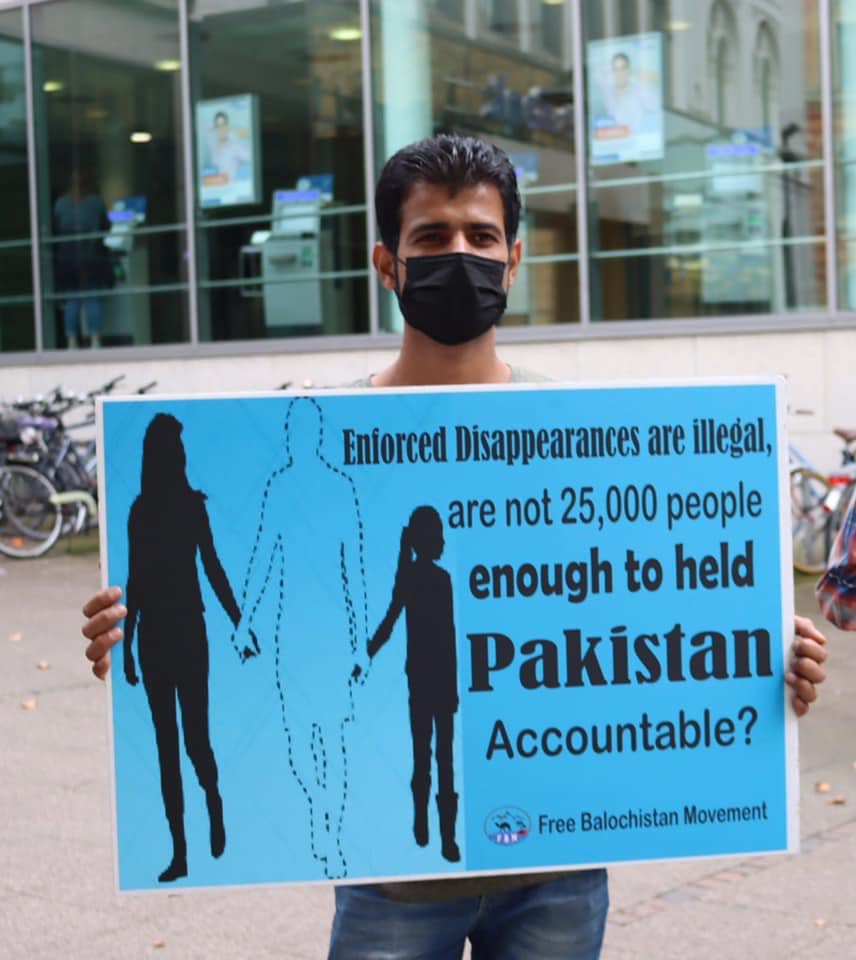 The speakers said that Pakistan was pursuing its earlier infamous “kill and dump” policy of forcibly disappearing Baloch, it continued the same process by killing the disappeared Baloch and burying them in mass graves.
The speakers explained that now the Pakistan state forces have adopted a new policy under which the victims of enforced disappearances are fake encounters. The murder of more than 20 Baloch youth in fake encounters in a single month is a question mark for organisations that claim to protect human rights.
The Free Balochistan Movement in its statement further said that Pakistan has changed the method of Baloch genocide to misled the world. Pakistan is trying to give the impression to the world that it is taking action against the terrorists by killing the Baloch in its custody in the name of encounters by its “terrorist force CTD”.
The statement emphatically clarified that the people killed in CTD’s encounters were previously abducted and disappeared by Pakistani forces and they were being killed in staged encounters to cover up Pakistan’s crimes against humanity in Balochistan.
The speakers further said that while Pakistan is trying to deceive the world and unsuccessfully trying to prove that the victims of enforced disappearances in its custody are terrorists, we, Baloch, should inform the world with the same intensity about the crimes that Pakistan is committing in occupied Balochistan.
https://balochwarna.com/2021/09/12/germany-free-balochistan-movement-held-a-protest-rally-in-hanover/
چیئرمین پاکستان پیپلز پارٹی بلاول بھٹو زرداری کی کنٹونمنٹ بورڈز کے انتخابات جیتنے والے پاکستان پیپلز پارٹی کے امیدواروں اور پاکستان پیپلز پارٹی کے حمایت یافتہ امیدواروں کو مبارکباد
چیئرمین پاکستان پیپلز پارٹی بلاول بھٹو زرداری نے کنٹونمنٹ بورڈز کے انتخابات جیتنے والے پی پی پی

امیدواروں کو مبارکباد دی ہے۔ چیئرمین پیپلزپارٹی نے پی پی پی کی حمایت یافتہ آزاد امیدواروں کو بھی کامیابی پر مبارکباد دی ہے۔ ایک بیان میں چیئرمین پیپلزپارٹی نے کہا کہ پشاور کے کنٹونمنٹ بورڈ نے ماضی کی ایک نشست کے مقابلے میں پاکستان پیپلزپارٹی کو دو نشستوں پر کامیابی ہوئی۔
پی ٹی آئی کا گڑھ کہلائے جانے والے پشاور کنٹونمنٹ میں جو نشستیں دوسری جماعتوں نے جیتیں وہاں بھی پیپلزپارٹی کے امیدوار میدان میں رہے۔ چیئرمین پیپلزپارٹی نے کہا کہ ایبٹ آباد کنٹونمنٹ سے جیالے امیدوار کی کامیابی ملک میں بھٹوازم کی مقبولیت کا منہ بولتا ثبوت ہے۔ چیئرمین پیپلزپارٹی نے لاہور، اوکاڑہ، کوہاٹ اور پنو عاقل کنٹونمنٹ کے انتخابات کی مخصوص نشستوں پر حریف امیدوار کو کم ووٹوں کی برتری پر جتوائے جانے پر تحفظات کا اظہار کیا ہے۔
چیئرمین پیپلزپارٹی نے کراچی سے پشاور اور ایبٹ آباد تک کنٹونمنٹ انتخابات میں کامیاب ہونے والے اور رنر اپ رہنے والے پی پی پی کے امیدواروں کو شاباش کا مستحق قرار دیا۔ بلاول بھٹو زرداری نے کہا کہ کنٹونمنٹ انتخابات میں ماضی کی تین نشستوں کے مقابلے میں پاکستان پیپلزپارٹی نے کراچی میں 11نشستیں حاصل کیں۔ پیپلزپارٹی وہ واحد سیاسی جماعت ہے جس نے کراچی کے تمام کنٹونمنٹ بورڈ سے نشستیں حاصل کی ہیں اور پیپلزپارٹی کو تمام سیاسی پارٹیوں کے مقابلے میں سب سے زیادہ ووٹ ملے ہیں۔
چیئرمین پیپلزپارٹی نے کہا کہ پی ٹی آئی کے ہوم گراﺅنڈ کہلانے والے کلفٹن کنٹونمنٹ سے پیپلزپارٹی کو سب سے زیادہ ووٹ ملے۔ صدر مملکت اور گورنر سندھ کے انتخابی حلقے کلفٹن کنٹونمنٹ میں پیپلزپارٹی کی جیت سے 2018ءکے انتخابات کے دھاندلی کے تمام خدشات درست ثابت ہوگئے ہیں۔
Sunday, September 12, 2021
پنجاب میں سلیکٹڈ کو فری ہینڈ دینے والے دوست ہم سے ناراض ہیں، بلاول بھٹو
پاکستان پیپلز پارٹی کے چیئر مین بلاول بھٹو نے کہا ہے کہ میدان چھوڑ کر
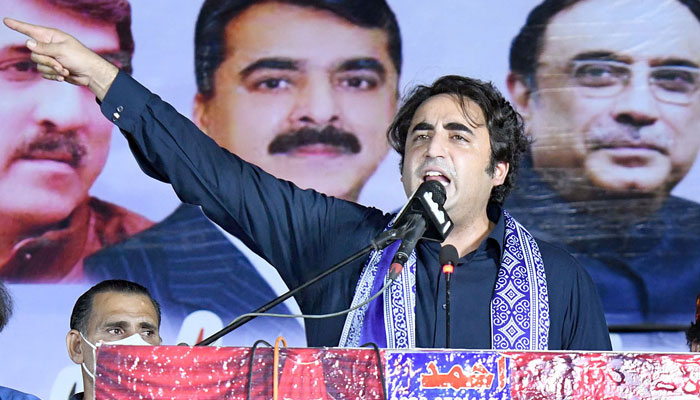
پنجاب میں سلیکٹڈ کو فری ہینڈ دینے والے دوست بھی ہماری سرگرمیوں سے خوش نہیں، ہماری اتحادی جماعتیں سیاسی میدان چھوڑ چکی ہیں۔
عوام اب سلیکٹڈ کا راج بھگت رہے ہیں، عوام کو لاوارث نہیں چھوڑ سکتے، عوام کو تاریخی بے روزگاری اور مہنگائی کا سامنا ہے، اگرمولانا فضل الرحمان،(ن)لیگ چاہے توہم کل ان کوگراسکتے ہیں، عوام پیپلز پارٹی کا ساتھ دیں، عمران خان کو گھر بھیج دیں گے۔
بلاول بھٹوکروڑ لعل عیسن لیہ میں ورکرز کنونشن سے خطاب کررہے تھے، اس دوران بہادر خان سیہڑ باضابطہ طور پر پاکستان پیپلزپارٹی کا حصہ بن گئے، بہادر خان سیہڑ دو مرتبہ رکن قومی اسمبلی منتخب ہوئے، وفاقی کابینہ میں وزیر بھی رہے۔
ورکرز کنونشن سے خطاب کرتے ہوئے پیپلز پارٹی کے چیئرمین بلاول بھٹو زرداری نے کہا کہ ہمارے سیاسی دوستوں نے پنجاب میں عمران خان کو فری ہینڈ دیا ہوا ہے بلاول بھٹو نے کہا کہ پیپلز پارٹی پنجاب کے عوام کو لاوارث نہیں چھوڑ سکتی، پنجاب کے عوام کے ساتھ تاریخی ظلم ہو رہا ہے، موجودہ حکومت چینی، چاول اور گندم درآمد کر رہی ہے۔
ہر روز مہنگائی کا بم پھٹتا ہے، حکومت نے ٹیکسز بڑھا کر عوام کا جینا محال کر دیا ہے، عوام عوامی حکومت کو ترس رہے ہیں۔چیئرمین پیپلز پارٹی نے کہا کہ عوام تاریخی بے روزگاری اور مہنگائی کا سامنا کر رہے ہیں، کبھی بجلی، کبھی گیس تو کبھی پیٹرول کی قیمت میں اضافہ ہو رہا ہے۔
انہوں نے کہا کہ پیپلزپارٹی نے کسانوں اور مزدوروں کو حقوق دلوائے، غریب مزدور اور کسان کے لیے بینظیر بھٹو کے منشور کا نفاذ کریں گے، بینظیر بھٹو ایک ماں کی طرح عوام کا خیال رکھتی تھی، بلاول بھٹو کا کہنا تھا کہ سینیٹ میں ہم نے یوسف رضا گیلانی کو منتخب کراکرثابت کردیا عمران کے پاس میجورٹی نہیں، ساتھیوں سے مطالبہ ہے اٹھو شیر بنو، نکلو، جدوجہد کرو، ہم نے ساتھیوں کو راستہ دکھادیا ہے۔
پی ڈی ایم کی طرف اشارہ کرتے ہوئے انہوں نے کہا کہ عثمان بزدارکے خلاف عدم اعتماد لیکر آ، ہم پنجاب کے عوام کو لاوارث نہیں چھوڑ سکتے، پہلے عثمان بزدار پھر عمران کے خلاف عدم اعتماد لا۔
ہم نے یوسف رضا گیلانی کوجتوا کرثابت کردیا عمران کو گراسکتے ہیں، اگر مولانا فضل الرحمان، (ن)لیگ چاہے توہم کل ان کوگراسکتے ہیں،ایک کروڑ نوکریاں دینے کا وعدہ کرنے والے کا بتائیں لیہ میں کتنی نوکریاں دی گئی ہیں،دس ہزار خاندان کو سٹیل ملز سے بے روزگار کر دیا یے۔
شہید بی بی نے 90کی دہا ئی میں جن بیس ہزار خاندانوں کو روزگار دیا تھا ان سب کو ایک بار پھر بے روزگار کردیا گیا۔ہم مذمت کرتے ہیں۔شہید بی بی کا دیا ہوا روزگار ہے ہم یہ ظلم نہیں کرنے دیں گے۔
https://jang.com.pk/news/983505
#Pakistan #PPP - Historical oppression taking place with people of Punjab: Bilawal

https://dunyanews.tv/en/Pakistan/619307-Historical-oppression-taking-place-with-people-of-Punjab-Bilawal
#Pakistan - Takht-e-Raiwind has no room in politics: Bilawal

https://www.thenews.com.pk/print/891574-takht-e-raiwind-has-no-room-in-politics-bilawal
Saturday, September 11, 2021
The U.S. branded the Haqqanis terrorists and issued $5 million bounties. Now they’re in power in the Taliban government.

By Sudarsan Raghavan
Twenty years after al-Qaeda attacked the United States — a plot hatched in Afghanistan — its loyalists hold senior positions in the Taliban's new transitional government. There is one name that stands out: Haqqani. A U.N. report in June described the Haqqani network as the “primary liaison between the Taliban and Al-Qaida.” Its leader, Sirajuddin Haqqani — a brutal insurgent commander known for dispatching suicide bombers who’ve killed or maimed hundreds of civilians — was “assessed to be a member of the wider Al-Qaida leadership, but not of the Al-Qaida core leadership.” Today, he is Afghanistan’s acting interior minister, overseeing the nation’s police, intelligence services and other security forces. He is also in charge of combating terrorism. “It’s a major concern,” said Colin P. Clarke, director of policy and research at The Soufan Group, an intelligence and security consulting firm. “You are one step removed from having the group that attacked us on 9/11 running the country.”The appointment of Haqqani, as well as relatives and members of his network, underscores his immense influence inside the Taliban. It also raises concerns that the new government will pursue a hard line agenda, even as Taliban leaders publicly claim to be gentler and more moderate than their brutal image in an effort to curry favor with donors and foreign governments.
Haqqani's political rise puts the Biden administration and other Western governments in a precarious position, particularly in countering terrorist threats. They are forced to have relationships with people they have sanctioned, many with bounties on their heads, for committing or sponsoring terrorism — or targeting Americans. In the interim government, at least 14 of the 33 cabinet members are on U.N. sanctions lists.
A Taliban spokesman did not immediately respond to questions about the Haqqani’s alleged al-Qaeda ties and concerns it could complicate much-needed relationships with foreign governments, the United Nations and international donors.Sirajuddin Haqqani is on the FBI’s most wanted list with a $5 million reward for information leading to his arrest. The State Department, through its Rewards For Justice Program, is offering $10 million, describing him as “a specially designated global terrorist.”He is wanted for “questioning in connection with” a January 2008 attack on a Kabul hotel that killed six people, including a U.S. citizen. He is also believed to have orchestrated attacks against U.S. and coalition forces and in planning an assassination attempt of former Afghan president Hamid Karzai, the State Department says.Khalil Haqqani, the uncle of Sirajuddin, is the acting Taliban minister for refugees. The State Department is offering up to $5 million for his capture, in part because he “acted on behalf of al-Qaida and has been linked to al-Qaida terrorist operations.” In 2012, the United States designated the Haqqani network as a foreign terrorist organization. Secretary of State of Antony Blinken told reporters at Ramstein Airbase in Germany on Wednesday that the Taliban interim government “does not meet the test of inclusivity and it includes people who have very challenging track records.” “Our engagement with the Taliban and with the government — interim or longer — will be for purposes of advancing the national interest, our national interest and that of our partners,” said Blinken. “We have and we will find ways to engage the Taliban, the interim government, a future government, to do just that and to do it in ways that are fully consistent with our laws.”
On Thursday, the Taliban demanded that the United States and the United Nationsremove the Haqqanis and other cabinet members from their “blacklists,” declaring that they violated the agreements of a peace deal signed in Doha. The movement also criticized Pentagon officials for noting that the Haqqanis were still targets. “That America and other countries are making such provocative statements and trying to meddle the internal affairs of Afghanistan, the Islamic Emirate condemns it in the strongest terms,” the Taliban said in a statement. “Such remarks by U.S. officials are a repetition of past failed experiments and such positions are detrimental for America.” “It’s a pretty difficult spot for the Biden administration,” Clarke said. “If you deal with the Taliban in these confines, you are essentially dealing with a terrorist group or members of a terrorist organization. And if you don’t, you have no leverage and no influence to control events in Afghanistan.”The Haqqanis trace their roots to the Soviet Cold War occupation of the 1980s and the Afghan mujahideen struggle to liberate their nation. Sirajuddin’s father, Jalaluddin, was a famed commander and CIA asset who forged a close alliance with Osama bin Laden and other foreign Islamist militants who arrived to push the Soviet troops out of Afghanistan.In 1996, the elder Haqqani aligned with the Taliban, helping the movement seize the country for the first time. He served as a cabinet minister and a provincial governor. When the Taliban was toppled in 2001 following the September 11th attacks, the Haqqanis became an integral part of the insurgency against U.S.-led NATO forces. In 2018, the Taliban announced the death of Jalaluddin due to an undisclosed illness. By then, Sirajuddin was already in charge of the Haqqani network, which was based in eastern Afghanistan as well as in bases inside Pakistan’s Northwest Territories; three years earlier the Taliban had appointed him as a deputy leader. The Haqqanis became known as “the most lethal and sophisticated insurgent group targeting US, Coalition and Afghans forces,” often attacking with small-arms, rocket, suicide bombers and bomb-laden vehicles, according to the National Counterterrorism Center. The network orchestrated some of the highest-profile attacks in the past two decades of war. This included a June 2011 assault on Kabul’s Intercontinental hotel, two suicide bombings against the Indian embassy and a day-long assault on the U.S. Embassy and other high profile targets in Kabul a decade ago. “People must be both reassured and terrified by the fact that an entity seen as responsible for some of the worst crimes of the war is now in charge of securing the population,” said Ashley Jackson, an expert on the Taliban at the Overseas Development Institute. “But there is a certain logic from inside the Taliban … if anyone can bring security, one assumes it’s the Haqqani network.” But that could also pose a threat to Sirajuddin Haqqani’s influence inside the movement, where he has several rivals, including Mohammad Yaqoob, the acting defense minister and son of the Taliban’s late founder Mohammad Omar. One of Haqqani's primary challenges will be to prevent large-scale bombings by the Islamic State and other militant groups that are against the Taliban — like the attack on Kabul's airport last month that killed 13 U.S. service members and more than 170 Afghans. The flights to a new life were in sight: Portraits of Afghans lost in the airport bombing. “Since he’s number one now, it’s his responsibility to prevent these urban attacks,” said Vanda Felbab-Brown, director of the Initiative on Nonstate Armed Actors at the Brookings Institution. “If he doesn’t, there’s going to be people unhappy, including within the Taliban. They will say ‘you have this important portfolio, what the hell are you doing?’” Haqqani has also shown he can think strategically off the battlefield. Last year, he shared his visions in an op-ed in the New York Times with the headline: “What We, the Taliban, Want.” Many analysts viewed it as a shrewd tactical move to soothe the concerns of the United States and the international community following the withdrawal of U.S. troops. “Everyone is tired of war,” the op-ed from the brutal warlord read. “I am convinced that the killing and the maiming must stop.” “We are committed to working with other parties in a consultative manner of genuine respect to agree on a new, inclusive political system in which the voice of every Afghan is reflected and where no Afghan feels excluded,” the op-ed continued. Today, the acting Taliban government is anything but inclusive. And there are already signs that Haqqani’s interior ministry will not tolerate dissent. Protests by women seeking basic rights have been broken up by Taliban fighters firing weapons and assaulting local journalists. An interior ministry statement this week decreed that all protests must be approved by the government at the risk of arrests. “The Haqqani network is the kind of hammer that comes back down and doesn’t allow the Taliban to be perceived as moderate,” Clarke said. “That’s part of the reason why the Haqqanis are stacked in the government. It’s to make sure there is no deviation from what they have been working on for the past two decades.” A key concern for the United States is whether Haqqani’s rising profile will open the gateway for al-Qaeda to resurrect itself in Afghanistan. In the U.N. report, investigators found that the Taliban and al-Qaeda “remain closely aligned and show no signs of breaking ties.” Al-Qaeda members live in at least 15 provinces. At the moment, said both Jackson and Clarke, the Haqqanis appear more interested in growing their influence in the country, the region and within the Taliban movement rather than waging global jihad. “They waited 20 years to get back into power,” Clarke said. “Now, they are, and they want to hold on to that power.” Karen DeYoung in Washington and Haq Nawaz Khan in Peshawar, Pakistan, contributed to this report.
https://www.washingtonpost.com/world/asia_pacific/haqqanis-afghanistan-taliban/2021/09/10/71f82620-123b-11ec-baca-86b144fc8a2d_story.html
#September11 - 9/11 IN ISLAMABAD: THE FIRST 72 HOURS
DAVID O. SMITH


It was a typical late summer day at the U.S. embassy in Islamabad — oppressively hot when the sun was out with a twinge of cool air in the evening that brought momentary relief. The weekly “Pol-Core” meeting was called to order at 0915 by recently arrived Amb. Wendy Chamberlin. This group included the deputy chief of mission, the political counselor, the chief of station, the chief of the Office of the Defense Representative to Pakistan, the regional security officer, and me as the senior Defense Attaché Office representative. I was the Army attaché at the embassy. The defense attaché was out of the country and remained so for weeks. The agenda included the ambassador’s credentialing ceremony two days later on Sept. 13, the forthcoming visit of the commander of U.S. Central Command, and the Bush administration’s plan to begin lifting the decade-long sanctions regime that had failed to halt Pakistan’s nuclear program. The ambassador emphasized it was time to move on to issues like counter-terrorism cooperation in which the United States needed Pakistan as a friend, not an adversary.
Routine embassy business filled the remainder of the day on Tuesday, Sept. 11, 2001. I had scarcely returned home when the telephone rang. “Turn on the news, right now!” our office administrative non-commissioned officer shouted and hung up. I complied immediately. On CNN, a reporter was standing on a New York City rooftop with a burning World Trade Center tower in the distant background. Shocked, I sat down to watch, wondering what had happened. Within minutes, the answer came when an airliner struck the building’s second tower. For two hours, I watched with a mixture of fascination and horror as more news trickled in: A third plane had struck the Pentagon, a fourth was not responding to air traffic control instructions and later crashed in Pennsylvania. My wife and I fell silent when one tower collapsed, then the second.
The phone rang to notify me that the ambassador would convene the embassy emergency action committee in thirty minutes. At the residence, we went upstairs to her office suite where she was on the phone while we quietly filed in and took our seats. There was no doubt in my mind that Osama bin Laden in Afghanistan was responsible for the day’s events. He and his al-Qaeda organization had long been the focus of the chief of station’s intelligence collection efforts. It dawned on me that America would soon be a nation at war and we would be the frontline embassy in the war effort.
The ambassador hung up the phone and said this meeting had been expressly directed by the State Department. Pakistan’s foreign minister had just called to express “shock and horror” at what had happened. He hoped the United States would be able to trace the perpetrators and take action against them, and said President Pervez Musharraf would be on television soon to say the same thing. The State Department Operations Center, she continued, was warning of attacks on overseas diplomatic missions and many embassies had decided to close until the situation clarified. “What should we do?” she asked. I replied immediately that closing the embassy was absolutely the wrong message to send. If we hunkered down in place, Pakistanis would interpret this as a sign of fear. We should project strength and confidence by remaining open for regular business and attend all scheduled social functions to “show the flag.” The others agreed. The meeting was interrupted by a call from Secretary of State Colin Powell. She hung up, paused briefly to collect her thoughts, and turned to us. The crisis, she emphasized, was in Washington, not overseas. We needed cool heads and not to let our emotions get away from us.
I wore my uniform to the embassy the next day for a later call at General Headquarters with Maj. Gen. Tariq Majid, the director general for military intelligence and my classmate from the Pakistan Army Staff College course I took in 1982. I had prepared a lengthy list of talking points and questions. I began by mentioning the condolence calls from a wide variety of Pakistanis that had lit up the embassy switchboard all morning. But what was most needed now, I continued, was not condolences, but genuine cooperation from Pakistan in tracking down the perpetrators. Not since the Civil War, I emphasized, had Americans witnessed such destruction on their soil and the level of emotion in the country was as great if not greater than after Pearl Harbor. I then read off my long list of questions and asked for his response. Tariq first offered his personal condolences and said that everyone in Pakistan condemned the acts, even the anti-western Urdu press. He admitted bin Laden was the most likely suspect, but opined it was wise to look in all directions rather than concentrate solely on the most likely. In any case, he added, there was obviously a complete intelligence breakdown on the U.S. side. That four hijackings could take place within one hour with three targets hit simultaneously indicated a high degree of sophistication. “We’ve been hurt as well,” he complained, “our strategic interests have likewise been damaged.” As Tariq deftly segued into the familiar Pakistan-as-victim theme I had grown used to hearing, I realized that no decision on U.S.-Pakistani cooperation had yet been made by Musharraf. I politely thanked him for his time and departed.
Sept. 13 began with a Defense Attaché Office staff meeting to apportion our growing workload. Urgent requests for information had flowed in steadily for the past 36 hours. The majority came through the Defense Human Intelligence Service, but others came from the service’s support elements in the regional commands and still others came from the National Military Joint Intelligence Center in the Pentagon and other intelligence centers: How stable was Musharraf’s government? Would the rank and file in the Pakistan Army support a decision to abandon the Taliban? What was the domestic reaction? Were nine corps commanders — influential players in the Pakistan Army — fully on board with a decision to cooperate? How much sympathy for the Taliban was there within the army? Was there any possibility of a coup against Musharraf? Were Pakistan’s nuclear weapons safe and under positive control? Who precisely were the Taliban? What were the names of key leaders? Which ones were more important than others? Did anyone have a picture of Mullah Omar? How well equipped and supplied were the Taliban armed forces? How was their military campaign against the Northern Alliance going? Could we work with the Northern Alliance? Who could be trusted? Who could not? What would India do? What would the -stans do (the neighboring countries of Central Asia)? What about Iran? China? Russia? Was the embassy at risk?
Dozens of similar requests arrived hourly from other U.S. agencies and headquarters by encrypted telephone. Just answering the telephone, let alone the questions, was a time-consuming task.
Securing Pakistan’s Cooperation
I decided to skip the pageantry of the ambassador’s credentialing ceremony and send the Navy attaché instead. Later that afternoon, she hastily convened a meeting to disseminate what had transpired at her brief one-on-one meeting with Musharraf that followed. Like my meeting with the director general for military intelligence the day before, it was a disappointment. She opined that Musharraf was still pondering his response to seven specific demands made on Pakistan by the U.S. government. The seven demands were (1) stop al-Qaeda operatives at the border (Durand Line) if they tried to enter Pakistan, and end all logistical support to al-Qaeda; (2) give blanket overflight and landing rights for all necessary military and intelligence operations; (3) provide territorial access to U.S. and allied military intelligence and other personnel to conduct operations against al-Qaeda; (4) provide any requested intelligence information; (5) publicly condemn terrorist acts; (6) cut off all shipments of fuel to the Taliban government and stop any Pakistani recruits from going to Afghanistan; and (7), if the evidence implicated bin Laden and al-Qaeda in the 9/11 attacks and the Taliban continued to harbor them, sever all relations with the Taliban government.
When the “with us or against us” demand was raised, Musharraf deflected it by raising the familiar trope of repeated American betrayals of Pakistan that had become the staple of Pakistan’s diplomacy ever since sanctions had been imposed in 1990. Brushing this aside, the ambassador bluntly told him this was a past issue and Pakistan now had to choose to become an ally of the United States or an enemy. She reminded him that in the 1980s when Pakistan last played the role of a frontline state on Afghanistan, many good things had flowed from the United States. Sanctions relief might happen if Pakistan made the right decision, and perhaps other things like support in international financial institutions, debt relief, and the resumption of military and economic assistance. Musharraf complained it was difficult to sign up to cooperate in a military operation without knowing the details of what was being planned, and that India was equating Pakistan with the Taliban because of its earlier recognition of their regime. Cutting him off abruptly, the ambassador snapped that “9/11 changed all that, and there will be no dialogue EVER with the Taliban.” Their meeting ended on that sour note.
The next day — Friday — I met again with the director general for military intelligence while Chamberlin met with Musharraf. I asked Tariq straightaway if the chief executive had made a decision about the seven U.S. demands. Tariq replied obliquely, “The answer is very much there.” He said there should not be any confusion about it, but he cautioned that “precise modalities of cooperation” needed to be worked out. This was the sort of non-response that Pentagon action officers for decades had derisively termed “the usual humma-humma.” I had no time for it. I interrupted Tariq and asked him to respond to specific questions: What if U.S. actions were oriented solely on bin Laden and al-Qaeda? This would likely not be viewed unfavorably by the ranks, he replied. What actions had been taken to prepare the public and the army for cooperation with the United States? The Inter-services Public Relations directorate had already begun this work, he replied, but the United States must also publicly support Pakistan. Tariq did not answer any questions fully, but pledged Pakistani cooperation while emphasizing that certain “modalities” — he used that word several times — must still be worked out. When I returned to the embassy, Chamberlin had returned from a ninety-minute meeting with Musharraf. At an impromptu Pol-Core meeting, she disclosed the specific reservations about cooperation about which Tariq had hinted.
Her meeting apparently was more cordial than mine. The president began by stating he accepted all seven U.S. requests, joking that Pakistan was “in for penny, in for a pound.” The corps commanders, he stressed, were in “total agreement” with the decision, but several things required clarification and a number of Pakistani concerns had to be addressed. He quickly ticked off the seven requests and voiced several concerns: Sealing the 2,500-kilometer border with Afghanistan was “totally impossible” due to the difficulty of the terrain, but pledged Pakistan would do its best. Blanket overflight of Pakistani territory was “no problem” as long as no-fly zones over strategic areas — Pakistan’s nuclear sites — were established and honored. The use of Pakistani ports was fine although Karachi should not be used because it was too public and the city was not completely safe. Similarly, the use of major air bases should be avoided in favor of rarely used bases in remote areas of Balochistan. Intelligence sharing was fine so long as neither India nor Israel received any of the information provided by Pakistan and that nothing should involve Kashmir — “we will handle that.” Pakistan agreed to condemn terrorism if Kashmir was not included in the definition. On the fuel cut-off to the Taliban, Pakistan provided only kerosene to the Afghan government and that would be stopped. Breaking diplomatic relations with the Taliban was already in progress and Pakistan had recalled its ambassador in Kabul.
Musharraf emphasized his concern that the longer any military campaign went on, the greater was the possibility of negative feelings. A quick action and extraction of U.S. troops was in both countries’ interests. It would also be good to have a U.N. Security Council resolution authorizing the operation, buy-in from the Organization of Islamic Cooperation, and diplomatic support from Islamic countries like Turkey and Saudi Arabia. When the ambassador interrupted to ask if he was setting conditions on Pakistani cooperation, he assured her that all seven demands were accepted unconditionally and that he wished only to point out things that perhaps were not fully understood in Washington about the risk Pakistan (and he personally) was taking. “We’re compromising a hell of a lot [for you]. This will undermine my personal standing.” As for India, “Tell the Indians to lay off and stay off,” was the blunt message he wanted conveyed to New Delhi. He ended their conversation by restating a third time that he accepted all U.S. demands and advised the ambassador, “We both need to review our rusty knowledge of how to work with each other.”
The last event on my schedule that day was an evening reception at Joint Staff Headquarters where I had a long conversation with the director of the Joint Staff, the second-ranking officer in that headquarters. Lt. Gen. S.P. Shahid was a friendly and approachable officer, always with a broad smile on his face. It helped that he had once studied at the U.S. Army Command and General Staff College at Fort Leavenworth, Kansas, and knew American military jargon and which buttons to press when talking with American officers. He stressed the need for both the United States and Pakistan to work together to change the negative perceptions each country had about the other. He stated he would be the point of contact for future cooperation with the U.S. armed forces and that he looked forward to working together once more.
Pakistan and the Taliban
It had taken three days to convince Pakistan to cooperate with the United States and many in the embassy remained skeptical that Musharraf and the senior generals were fully on board. This was signaled at an embassy briefing ten days later for a team of officers from the Joint Staff headed by Maj. Gen. Kevin Chilton. At this briefing, Lt. Gen. Mahmud Ahmed, the director general of Pakistan’s Inter-Services Intelligence Directorate, made an impassioned plea to the ambassador and the team not to attack the Taliban, but to let Pakistan work with them to hand over bin Laden. This was bluntly rejected by the ambassador and in the next few days, the Joint Staff team worked with Pakistani counterparts to nail down logistic support for Operation Enduring Freedom, which began on Oct. 7.
It didn’t take long to validate the embassy’s concern that Pakistan would prove to be a duplicitous ally. The Pakistan Army deployed troops to the Durand Line for the first time in history, and was assiduous in capturing and turning over foreign al-Qaeda fighters fleeing the mountains of Tora Bora. However, it allowed Taliban fighters to seek sanctuary with tribal kinsmen in the Federally Administered Tribal Areas and relocated senior leaders to Quetta, the capital of neighboring Balochistan province.
Why did they do this? Pakistani support for the Taliban was rooted in a hostile relationship with Kabul for three decades after 1947. No government in Kabul has ever accepted the Durand Line imposed as a de facto border by Britain in 1893 that split the Pashtun-dominated area between Afghanistan and British India, the so-called Pashtunistan region. On Pakistan’s creation in 1947, Afghanistan refused to accept it as Britain’s successor and sought to redraw the boundary further east. The 1979 Soviet invasion afforded Pakistan the opportunity to reshape Afghanistan and end 30 years of hostility.
Every Pakistani government since then has sought a stable Afghanistan. It defines stability as having a government in Kabul not overtly hostile to Pakistan; that is Pashtun-dominated (so that Pashtuns have a divided loyalty between Afghanistan and Pakistan); and that keeps Indian influence to an absolute minimum to ensure that a future war with India is confined to Pakistan’s eastern border. Only the Taliban government ever met this definition. This failure to acknowledge — much less understand —Pakistan’s strategic imperatives was America’s first major mistake.
The second, perceived at the time by several in the embassy, was the December 2001 Bonn Agreement. Having largely accomplished America’s announced military objectives in Afghanistan, the United States put in place a government whose military and intelligence services were dominated by non-Pashtuns who ignored Pakistani concerns, was totally corrupt, and was inevitably doomed to fail. The United States ought to have learned from the abrupt collapse of the South Vietnamese armed forces in 1975 and the Lebanese Army in 1984 that soldiers will not fight and die for corrupt and faction-ridden governments no matter how much U.S. training and equipment they receive. Things might have turned out much better from the standpoint of U.S. security interests if the United States had withdrawn its troops from Afghanistan at the end of 2001 instead of embarking on a two-decade experiment in nation building.
The United States and Pakistan After the Taliban Takeover
With the Taliban now in charge in Kabul, where does this leave the United States and Pakistan? Both sides may indulge in a period of finger pointing for the social and humanitarian disasters sure to follow, and the temptation will be great to cut Pakistan adrift. The United States walked away from Pakistan before — in 1965 and 1971 after two wars with India and in 1990 after the Soviet Union left Afghanistan — but these were grave mistakes that should not be repeated.
U.S. officials should understand two key things going forward. First, the bilateral relationship with Pakistan needs to be confined solely to areas of agreed mutual interest. There is absolutely no basis for rebuilding the close military relationship that all but collapsed in 2011 after a series of events that alienated the Pakistani government and military: the special forces raid to kill bin Laden in Abbottabad which was considered to be a gross violation of Pakistan’s sovereignty, a series of Wikileaks disclosures that embarrassed the Army chief, the shooting death of two Pakistanis by CIA contractor Raymond Davis, and the Salala border post incident in which U.S. airstrikes killed 28 Pakistani soldiers. Second, the United States has three key interests connected to Pakistan: the continuing risk of terrorism directed against the United States by al-Qaeda and the Islamic State in Afghanistan, the safety and security of Pakistan’s nuclear arsenal, and preventing a future war between India and Pakistan that could escalate to the nuclear level. Prioritizing these interests will provide focus to a relationship that has often gone off the rails.
What then does a limited relationship look like? It means that the era of generous U.S. military and economic assistance is over. Future assistance should be limited solely to modest economic investments, humanitarian aid, and counternarcotics programs. The United States and Pakistan have a shared interest in stability in Afghanistan and limiting future Taliban excesses, and Pakistan might cooperate in leveraging its influence with the Taliban government to deliver humanitarian assistance to displaced Afghans. Intelligence sharing is possible if limited to al-Qaeda and the Islamic State and groups like Tehrik-i-Taliban Pakistan on Afghan soil that attack the Pakistani state. And finally, there are abundant opportunities to stabilize Pakistan’s shaky economy because the last thing the region needs is another failed state possessing hundreds of nuclear weapons. To that end a constructive blueprint published last year by the Middle East Institute contains several initiatives that both sides can beneficially pursue.
No one could possibly have foreseen that the 20th year observation of the events of 9/11 would be bookended by Taliban governments in power in Kabul. What is needed now is less recrimination about the causes of this catastrophic outcome and more careful, somber — and humble — reflection on the limits of U.S. power and America’s inability to understand the social, political, and cultural dynamics in this and other volatile regions of the world.
https://warontherocks.com/2021/09/9-11-in-islamabad-the-first-72-hours/
Subscribe to:
Posts (Atom)