Friday, February 12, 2021

Turkey, Pakistan: Inside the Ankara-Islamabad axis


By JONATHAN SPYER
BEHIND THE LINES: Turkey and Pakistan’s growing closeness has deep foundations. These are two countries following a similar trajectory.
A joint military exercise involving Turkish and Pakistani Special Forces commenced this week in Pakistan’s Khyber Pakhtunkhwa Province, which borders Afghanistan. The exercise, dubbed “Ataturk XI-2021,” is to focus on counter-terrorist operations. It is the latest manifestation of an emergent strategic alliance of these two countries, with significant implications – both for the Middle East, and for south Asia.Turkey and Pakistan’s growing closeness has deep foundations. These are two countries following a similar trajectory. Both were allies and assets of the US and the West during the Cold War. Both have moved far from this position in the last two decades, and are increasingly estranged from Washington. Both are medium-sized powers, governed today by a type of Islamic nationalist outlook. Both, importantly, are seeking an alternative alignment to their former ties with the West, which in a time of growing global polarization is leading both Islamabad and Ankara toward greater closeness with China.
So what form are the increased ties taking? Arms purchasing is a significant indicator. Turkey is now Pakistan’s fourth largest source of arms, as Islamabad seeks alternatives to the West for its source of weaponry (the main exporter of arms to Pakistan is now China). Pakistan is in the process of purchasing four Turkish-built MILGEM corvette ships from the Turkish state-owned defense contractor ASFAT. It has also placed an order for 30 T-129 ATAK helicopters. The total cost of orders placed by Pakistan for the purchase of Turkish weapons systems is now in excess of $3 billion. However, the importance of this relationship goes beyond economic and commercial factors. Both Pakistan and Turkey have justified concerns regarding the possibility of Western sanctions as a result of the policy directions they wish to pursue. Reducing dependence on Western weapons systems is a way of broadening options.
The growing closeness is also reflected in the diplomatic sphere. Pakistani senior officials have expressed support for Turkey in its disputes over gas exploration in the Eastern Mediterranean. A series of joint naval exercises in the Mediterranean, involving the navies of both countries and including violations of Cypriot and Greek territorial waters and airspace, took place over the last year. Similar joint exercises have also been held in the Indian Ocean.
Turkey, in turn, in a development causing concern in New Delhi, has begun to support Pakistani claims in Kashmir. Turkish President Recep Tayyip Erdogan said in February 2020 that the issue was as important to Turkey as it is to Pakistan. Referencing the events of the Turkish War of Independence, Erdogan said, “And now, we feel the same about Kashmir today. It was Çanakkale yesterday and Kashmir today; there is no difference between the two.” Turkey raised the issue of Kashmir at the UN General Assembly in September 2019, shifting from a policy of non-interference on an issue that India regards as an internal matter.In this regard, recent reports in regional media (Syrian Observatory for Human Rights, Hawar News) suggesting that Turkey is in the process of deploying its Syrian Islamist client militias in Kashmir have raised concerns, though no concrete evidence for these allegations has yet emerged.
THE STRATEGIC partnership between Ankara and Islamabad is also raising concerns in the nuclear realm. Pakistan is a nuclear power, with 160 deployed warheads. Erdogan, in a September 2019 speech quoted by Reuters, said, “Some countries have missiles with nuclear warheads, not one or two. But [they tell us] we can’t have them. This, I cannot accept.”
He continued, “We have Israel nearby, as almost neighbors. They scare [other nations] by possessing these. No one can touch them.” Turkey currently possesses two nuclear reactors, Tr-1 and Tr-2, maintained by the Turkish Atomic Energy Authority. The country has rich uranium deposits. It thus possesses both the will and the raw materials to develop a nuclear capacity. It currently lacks only the required knowledge to do so. Pakistan, which is not a signatory to the nuclear non-proliferation treaty, possesses this knowledge. While no concrete evidence of active cooperation in this regard has yet emerged, it is worth recalling that Turkey was a covert hub for the activities of the rogue Pakistani nuclear scientist Abdul Qadeer Khan 20 years ago.
The alliance between Pakistan and Turkey is coming into being in a rapidly shifting strategic landscape. The old post-Cold War US-led security architecture, and the assumptions that surrounded it can no longer be relied upon. In the major events of the region over the last decade – the Syrian civil war, the revolution and counter-revolution in Egypt, the competition over gas resources in the Eastern Mediterranean – the US has been notably absent as it recalibrates its priorities and modes of engagement.
As a result of this absence, new connections and new power nexuses are emerging. From this point of view, the coming together of two mid-sized states inclined toward versions of Sunni political Islam and seeking major revisions of the current power balance in their respective neighborhoods, in their favor, makes logical sense.Both Turkey and Pakistan are also eager to connect their ambitions to the strategic advance of China. Turkey is of importance to Beijing as a transportation hub on the way to the Mediterranean and to Europe, and as a priority country for investment in infrastructure. Turkey is an observer country at the Shanghai Cooperation Organization. It is noteworthy that Erdogan’s efforts to present himself as a leader of the world’s Muslims and of all peoples ethnically associated with the Turks does not extend to solidarity with the Turkic Muslim Uighurs, on whose fate he has been notably silent.
Pakistan’s relations with China are deep and of long standing, related to the joint geopolitical rivalry with India. Pakistan has been the recipient of investments worth $11 billion, in the framework of China’s Belt and Road Initiative. These have centered mainly on modernizing the country’s rail system. A project to build a direct rail link from China via Pakistan and Iran to Turkey is in the process of being revived. The ITI (Istanbul, Tehran, Islamabad) line would be the first regular rail link between China and Turkey. It is expected to begin operating in 2026, according to a recent report in Nikkei Asia.
A joint declaration by the foreign ministers of Turkey, Pakistan and Azerbaijan signed in Islamabad on January 13 referenced the joint stances on Kashmir, the Aegean dispute, Cyprus and the Armenia-Azerbaijan conflict. The document is a useful summing up of the current reality of Turkish and Pakistani synergy. The Ankara-Islamabad axis looks set to form a significant and powerful presence on the complicated geopolitical chessboard of West and South Asia. https://www.jpost.com/middle-east/turkey-pakistan-inside-the-ankara-islamabad-axis-658710

Bilawal Bhutto Engineering College in Lyari to finally see the light of day

After a lapse of six years, the Sindh government has finally approved the construction of the Bilawal Bhutto Engineering College in Lyari on a proposed land of 7.5 acres located on Mirza Adam Khan Road near Dhobi Ghat.
The construction of the engineering college in Lyari was announced in 2015 by former Pakistan president and Pakistan Peoples Party (PPP) Co-Chairman Asif Ali Zardari while addressing a ceremony in the Kakri Ground, where a development package was announced for the people of Lyari. On September 10 that year, the provincial government formed a five-member committee to execute the project. The body was constituted to conduct the site inspection to finalise the location for the establishment of the engineering college. The capital cost reflected in ADP (Annual Development Programme) No. 499 was around Rs1.302 billion. However, the committee could not find any appropriate space for the institute’s construction.
In 2016 the provincial government formed a six-member committee and tasked it with selecting a site for establishing the college. The body proposed a family park located in front of the Lyari General Hospital, but some of the community members opposed the proposal and took the matter to court.
The government, however, has been allocating funds for the project since the 2016-17 budget. According to the approved project profile, the revenue cost has now increased to Rs541.98 million, while the total cost stands at around 1.844 billion.
Capacity of college
According to the establishment plan of the Bilawal Bhutto Engineering College Lyari, the institute is initially assumed to be able to accommodate 60 students in each of the four departments: civil, mechanical, electrical and software engineering. The college will gradually expand to reach its full capacity of 960 students. Initially, the administration and academic blocks, a gymnasium, an auditorium and a playground will be constructed.
After 2018 elections
In the general elections 2018, the ruling PPP suffered a major setback by losing three important seats in Lyari, a long-time stronghold of the party. The Jamaat-e-Islami’s Syed Abdul Rasheed won the PS-108 (South-II) constituency, while Mohammad Younus Soomro secured the PS-107 (South-I) seat. PPP Chairman Bilawal Bhutto Zardari, who had also contested the election, barely managed to bag the third-highest votes in NA-246. This constituency was the most favoured by his party because they had been winning this seat since the 1970s. After losing the elections, however, the PPP-led provincial government continued to complete the announced projects, including the Bilawal Bhutto Engineering College Lyari. “The provincial government has been quite intent on developing Lyari, but the local PPP leaders have been creating hurdles in the completion of projects,” claimed Rasheed.
Local politics
The JI lawmaker said that Lyari’s people have been in desperate need of an engineering college. “Rather than working at mechanic shops, it will be the best option for our children to study engineering.” He said that it was his team that identified an empty piece of land where the college is supposed to be constructed. The chief minister has approved the proposed land, but some local PPP leaders have been creating hurdles to regain their political influence in Lyari, he added.
Earlier this year, Rasheed had raised a calling-attention notice in the Sindh Assembly for the construction of the engineering college. “Finally, our voice was heard, and this year it is expected that the government will start the construction of the college.”
https://www.thenews.com.pk/print/788816-bilawal-bhutto-engineering-college-in-lyari-to-finally-see-the-light-of-day

6.4-magnitude earthquake jolts several cities in Pakistan


Earthquake tremors measuring a magnitude of 6.4 on the Richter's scale were felt across several cities of Pakistan at 10:02 pm late Friday night, with Tajikistan's Murghab city reportedly being the epicentre. 

According to reports, tremors were felt in Islamabad, Peshawar, Rawalpindi, Mardan, North Waziristan, Swat, Multan, Sargodha, Faisalabad, and Lahore.

The tremors were also felt in Killa Abdullah, Pishin, Toba Achakzai, Shangla, Buner, Malakand, Dir, and Chitral.

According to the Seismological Centre, the depth of the earthquake was measured at 80km. Citizens have been advised to be careful as the aftershocks of the earthquake are expected.

It is pertinent to mention here that such a high-intensity earthquake jolted Pakistan after 1.5 years, and during the previous incident, Azad Jammu and Kashmir suffered significant damages.

The U.S Geological Survey put the quake's magnitude at 5.9 and centred 35 km (55 miles) west of Tajikistan in central Asia.

Read more: Pakistan expresses 'strong solidarity' with Turkey after massive 7.0-magnitude earthquake

Punjab 

Meanwhile, Rescue Punjab, speaking to Geo News, said that despite such a high-intensity earthquake, no casualties have so far been reported

Director-General Rescue Punjab has issued a high-alert, according to a spokesperson.

Khyber Pakhtunkhwa

Similarly, in Khyber Pakhtunkhwa, rescue officials said that citizens could call 1700 to inform the authorities of any losses, adding that a few injuries were reported, but there have been no deaths.

Azad Jammu and Kashmir

In the adjacent areas of Muzaffarabad, the intensity of the tremors was intense, including Neelum, Jehlum, Bagh, Poonch, Mirpur, and other areas.

Police and rescue officials said that two people were injured so far in Bagh, however, no life losses were reported. 

In Muzaffarabad, where a 2005 earthquake wreaked serious destruction, there was mass panic, according to witnesses and many rushed out of their homes in fear.

"I thought it's the same like what had hit us in 2005. My children started crying," said Asif Maqbool, a resident in Madina Market, a neighbourhood of Muzaffarabad that was almost flattened in the 2005 quake.

Gilgit-Baltistan

In Gilgit-Baltistan, Astore, Diamer, Hunza, and all four district of Baltistan were hit by the earthquake. People came out of their house and began prayers.

NDMA puts serves on alert

The National Disaster Management Authority (NDMA) spokesperson said the institution was in contact with all the Provincial Disaster Management Authorities (PDMA).

"NDMA is in contact with all PDMAs and getting updates from across Pakistan," the spokesperson said, adding that no loss of life had been reported so far.

The NDMA, furthermore, said that it had put its emergency services on alert as well.

Prayers for the nation

Responding to the development, PML-N Vice-President Maryam Nawaz prayed for people's safety and "hoped" that everyone was safe.

The Ministry of Overseas Pakistanis also prayed for everyone's safety.

Earthquake in India

Meanwhile, in India, an earthquake of 6.1-magnitude struck Punjab at 10:34pm on Friday, sending tremors across north India, including Delhi-and parts of Uttar Pradesh.

However, there was no immediate report of property losses or casualties.

Cracks were reported in some homes in northern Occupied Kashmir, the Indian Meteorological Department (IMD) said. A witness also reported a wall collapse near the northern Indian city of Amritsar, but there were no reports of casualties.

G. Suresh, a senior scientist at the IMD, told Reuters there were two earthquakes within 10 minutes in Tajikistan and Sichuan, China. An Indian government monitor had earlier said the quake was centred near Amritsar.

"The seismic waves have been mixed up in data monitoring," he said.

Tremors were felt across Pakistan including the capital, Islamabad, and northwestern Peshawar, and even as far as the eastern city of Lahore, which borders India.

https://www.geo.tv/latest/334726-earthquake-tremors-felt-in-several-pakistan-cities

Thursday, February 11, 2021

Arabic Music Video - Belly Dance - Sara Guirado

Video Report - What does Biden’s foreign policy ‘reset’ mean? | The Bottom Line

Video Report - #Impeachment - House managers rest case against Trump, argue for conviction

Video - 02/11/21: Press Briefing by Press Secretary Jen Psaki

Video Report - President Biden Delivers Remarks to the National Institutes of Health Staff

Music Video - Nashenas _ Za Kho Sharabi yom.

Video - Remembering Asma Jahangir, Pakistan's Most Fearless Rights Defender

Behind Pakistan’s talks offer to India lies a Khan-Bajwa plan


This is an old ploy that the Pakistanis have tried ever since 9/11, first with the Bush administration, then with Obama and now with Biden.

February 2021 started off with a somewhat unnecessary, if also short-lived, flutter over the possibility of some forward movement in the bitter and frozen bilateral relationship between India and Pakistan. On 2 February, while addressing an army graduation ceremony, Pakistan Army Chief, Gen Qamar Bajwa, said, “It is time to extend hand of peace in all directions.” In the same speech, he also said, “Pakistan and India must also resolve the longstanding issue of Jammu and Kashmir in a dignified and peaceful manner as per the aspirations of the people of Jammu and Kashmir and bring this human tragedy to its logical conclusion,” and then added the standard warning (repeated ad nauseam over the last seven decades) that Pakistan’s desire for peace shouldn’t be taken as a sign of weakness.

Three days later, Pakistan’s ‘selected’ Prime Minister, Imran Khan, addressed a rally in Kotli in Pakistan-occupied Jammu and Kashmir on the occasion of ‘Kashmir Solidarity Day’. After heaping all sorts of abuse on India and the Indian Prime Minister, Narendra Modi, Imran softened his hard line on India—this is the Pakistani interpretation—and asked India to “resolve this issue—Kashmir—through meaningful dialogue because there is no way out other than this…. but before that you will have to restore the pre-Aug 5, 2019 status of the occupied territory.” Almost as if he had vanquished India on the battlefield and India was desperately seeking a face-saving from him, Imran very magnanimously offered a seat on the dialogue table, but with a caveat. He hectored India, “Agree to give the Kashmiris the right that was promised to them by the world community, and we are ready to talk to you”. And quite like his ‘selector’ Bajwa, Imran too added the standard line that his offer should not be misconstrued as Pakistan’s weakness, “It’s not because of any fear that we want friendship with you”.


As is their wont, the media in both India and Pakistan picked a sentence or two from what Bajwa and Imran said and ran with it. In the process, they not only conveniently glossed over everything else that was said in the very same speech/statement, but also ignored the background, context, and, most of all, the ground reality in which the speeches were made. Questions put by Indian journalists to the Ministry of External Affairs spokesman focussed only on ‘hand of peace’, call for ‘coexistence’ and some even saw it as a ‘peace initiative’. Meanwhile, TV programmes and news analyses started speculating on what was behind the ‘hand of peace’ and the proverbial ‘olive branch’ that was extended to India by the Pakistani Army Chief and Prime Minister. If only the media had not been so quick to jump the gun and bite the bait, it would have realised that there was neither anything new nor novel in what Bajwa and his appointee had said, nor was there any seriousness, much less sincerity, in the so-called ‘olive branch’ or ‘hand of peace’ being extended to India. If anything, the olive branch was laced with poison ivy and the hand of peace was more of a sleight of hand.
The statements emanating from Pakistan need to be analysed from four standpoints: Firstly, is there some new ground being broken, or is something being said that hasn’t been said before? Secondly, can a speech or statement be quoted selectively, thereby inadvertently and perhaps unwittingly obfuscating the message, which in turn leads to faulty conclusions? Thirdly, does what is being said have any congruity with actions on ground? And finally, is there a broader context (either domestic or international) in which a statement is made? On all these standpoints, it is clear that the media has misread, misinterpreted, even misrepresented, the latest statements of Bajwa and Imran.
February 2nd wasn’t the first time Gen Bajwa spoke about relations with India. In April 2018, while addressing the passing out parade at the Pakistan Military Academy, Bajwa said, “It is our sincere belief that the route to peaceful resolution of Pak-India disputes—including the core issue of Kashmir—runs through comprehensive and meaningful dialogue”. Having said this, Bajwa sought international intervention to bring peace in the subcontinent. He said that Pakistan remained committed to a dialogue with India, but only on the basis of sovereign equality, dignity, and honour. The context of this speech was in part to push the envelope with the US, which was seeking to get things moving in Afghanistan. At the same time, Bajwa was signalling to Russia that it was ready to reduce tensions with India and in exchange expected the Russians to get over their reluctance to supply weapon systems to Pakistan. On the ground, however, there was nothing to indicate that Pakistan actually was ready to end its inimical behaviour towards India, or crackdown on Pakistan-based, India-focused terrorist groups that were once again becoming very active.
During a visit to London in January 2015, Bajwa’s predecessor Raheel Sharif, who enjoyed an unsavoury reputation of being rabidly anti-India, also held out an ‘olive branch’. Speaking at the IISS, Raheel Sharif “stressed the need for regional peace and better ties with India” and urged “negotiations between both the countries on an equal level.” He repeated the standard Pakistani line about how “Kashmir issue has to be resolved for long-term peace, stability in the region, Pakistan wants peace, but with dignity and honour.” Six months later, addressing the National Defence University, Raheel Sharif reiterated Pakistan’s long held position and said that Kashmir was part of the unfinished agenda of Partition and that Pakistan and Kashmir are inseparable. He qualified the terms of peace with India and said, “While we wish peace, stability in region, we want Kashmir’s just resolution in the light of the United Nations resolutions and as per the aspirations of Kashmiris to bring a lasting peace in the region.” In London, Raheel was projecting Pakistan’s reasonable face and took one line, but back in Pakistan he reverted to type.
Go back further, and there is Raheel’s predecessor, Ashfaq Kiyani. Again, a man reputed to have visceral hatred for India. But in April 2012, after an avalanche killed 140 Pakistani soldiers in the Siachen sector, an emotional Kiyani said, “Peaceful coexistence between the two neighbours is very important so that everybody can concentrate on the well-being of the people,” and then repeated what all his successors have regurgitated ever so often: Pakistan’s desire for peace “should not be misread as weakness.” Kayani also spoke in favour of resolving India-Pakistan issues through negotiations, and added the factor of environmental damage being caused by troop deployments in the Siachen sector as an urgent issue. Incidentally, the slain Pakistani journalist, Syed Saleem Shahzad, had revealed in his article in Asia Times that the plan for the 26/11 attacks in Mumbai was originally hatched by the ISI under Kiyani’s watch as Army Chief. Later, Shahzad claimed, the plot was ‘hijacked’ by Al-Qaeda and executed by Lashkar-e-Taiba. Even so, given the short memories of the media, Kiyani’s remarks created some stir. But in the end, it didn’t amount to anything because on the ground nothing had changed.
Before Kiyani, both Gen Jehangir Karamat and Pervez Musharraf as army chiefs made similar statements. Musharraf and Kiyani even said that the internal threat was more serious than any threat Pakistan faced from India. But both of them pussyfooted around the internal threat from terrorism and focused on what was often called the strategic threat from India. Some tactical changes and adjustments were, however, made in relation to India. As President, Musharraf even tried some out-of-the-box thinking to resolve the Kashmir issue—the four point formula—but it was at best a temporary solution. After Musharraf’s exit, his plan on Kashmir was thrown in the rubbish bin by his successor, Kiyani. The bottom line is that Pakistan’s security calculus has always remained India-centric. And that hasn’t changed even now.
The thing is that, every ‘peace offer’ from Pakistan follows a pattern. For one, it is either made to tide over some domestic crisis, or to exploit, or at times evade, some international pressure. For another, it is never unconditional. If anything, the conditions are invariably maximalist, and therefore, a non-starter. It is almost as if Pakistan thinks India is so desperate that she will clutch at whatever straw Pakistan throws towards her. The Pakistanis also never fail to emphasise that there will be no peace in South Asia unless Kashmir is resolved. The assumptions underlying this message are a) peace is something India needs more than Pakistan, and the latter will be doing India a favour through a peace deal; and b) any resolution of Kashmir has to be as per Pakistan’s terms. Clearly, both are fallacious.
As far as India is concerned, what should matter are not Pakistan’s words but its actions. In recent years, while there isn’t a single action of Pakistan that would indicate its genuine desire for peace, even the language being used by Imran Khan, his cronies and his ‘selectors’ against the Indian Prime Minister, government and people is utterly vile and vituperative. Clearly, under these circumstances, it is nothing short of a flight of fancy to take a sentence or two uttered by either Imran Khan or Bajwa and imagine that it is indicative of a softening of stand or even a thaw in the bilateral relationship.
What is more likely is that Pakistan’s ‘peace and dialogue offer’ to India was aimed more at the new US administration. Imran Khan and Bajwa were trying to project themselves as reasonable people who were ready to talk peace with India, and then use this to portray India as being obdurate. The Pakistani game plan is to exploit the negative coverage of India in the Western press and public opinion in the hope of bringing US pressure on India to make some concessions to Pakistan. In return, the Pakistanis will offer some assurances to the Biden administration on Afghanistan and Taliban. This is an old ploy that the Pakistanis have tried ever since 9/11, first with the Bush administration, then with Obama and now with Biden. They even tried it with Trump, but got very little traction.
India needs to stick to the red lines she has drawn and not only reject Pakistan’s self-serving ‘hand of peace’, but also resist any gratuitous advice to hold talks with Pakistan. At the same time, India must lay out clear metrics that Pakistan must meet before clasping its ‘hand of peace’. And even after India does this, she must keep counting her fingers, because with Pakistan one can never be sure.

#Pakistan: Persecution of #Ahmadis must end as authorities attempt shutdown of US website

 The Pakistani authorities must end their ongoing persecution of the Ahmadiyya religious minority, which is now extending across borders, said Amnesty International, Human Rights Watch and the International Commission of Jurists (ICJ), following an attempt by the Pakistan Telecommunications Authority (PTA) to shut down the website of the Ahmadis’ US-based community.

On 24 December 2020, the PTA sent a legal notice to the administrators of trueislam.com, stating that the site was in violation of Pakistan's Constitution, and warning they could be charged with blasphemy - a charge potentially carrying the death penalty - for referring to themselves as Muslims. The site’s administrators have also been threatened with a fine of 500 million PKR (US$3.1 million) if they fail to take the website down.

Digitally policing Ahmadis on what they can or can't preach, no matter where they are, is a flagrant violation of Pakistan's legal obligations under the International Covenant on Civil and Political Rights 
Samira Hamidi, Deputy Regional Director at Amnesty International

The trueislam.com website provides general information about Ahmadi history and beliefs, details the work carried out by the Ahmadi community in the US, including blood drives and veterans’ support, and features interviews with prominent community members such as the actor Mahershala Ali.

“Ahmadis in Pakistan have long been the target of systematic attacks, and successive Pakistani governments have failed to respect, protect and promote their human rights, forcing many to flee to other countries. The PTA’s efforts to close down their US website shows that even then, a life free from discrimination can be out of reach,” said Samira Hamidi, Deputy Regional Director at Amnesty International.  

“Digitally policing Ahmadis on what they can or can't preach, no matter where they are, is a flagrant violation of Pakistan's legal obligations under the International Covenant on Civil and Political Rights to which the country is a state party. We urge the PTA to desist from its targeted campaign against Ahmadis and to ensure that everyone in Pakistan is able to express themselves and profess their religion freely, without fear of reprisals or discrimination.”

According to a PTA press release on 22 January 2021, access to trueislam.com has now been blocked in Pakistan. Amnesty International has been shown an email sent by the head of the PTA on 27 December 2020 to various servers in the country, instructing them to remove access to the website, along with three others related to the Ahmadi community.

“Pakistan has an obligation to protect the rights to freedom of expression and religion online every bit as much as in places of worship or in public spaces. Far from facilitating such protection, the PTA is extending its long arm to violate the rights of persons well beyond Pakistan’s own borders,” said Ian Seiderman, ICJ Legal and Policy Director.    

The administrators of the website told Amnesty International that prior to receiving the notice, they received emails from various sources filled with hate speech.

“I was suddenly inundated with hate-filled messages from extremists on my email.  And then a few days later, on December 24, the PTA emailed me a notice threatening criminal prosecution and fines for blasphemy and giving 24 hours to remove the trueislam.com website,” said Amjad Mahmood Khan, a US-based Ahmadi lawyer who was targeted.

The attempt to extend Pakistan’s persecution of Ahmadis to other jurisdictions is a dangerous escalation 
Brad Adams, Asia director at Human Rights Watch

“It’s obvious the PTA seeks to prosecute US citizens operating a US-based website.  This is an unprecedented act to extend the reach of Pakistan’s abominable blasphemy laws to US citizens, and it’s a new frontier in persecution for Ahmadis worldwide,” Khan said.

The legal notice to trueislam.com is part of a broader pattern of state overreach by the PTA in recent months, which has included issuing notices to Google and Wikipedia to remove "sacrilegious content".

“The attempt to extend Pakistan’s persecution of Ahmadis to other jurisdictions is a dangerous escalation. The Pakistani government should end its policing of Ahmadi speech outside the country and focus on providing an enabling environment for free speech, expression, and freedom of religion inside Pakistan,” said Brad Adams, Asia director at Human Rights Watch.

Background

The Pakistani penal code explicitly discriminates against religious minorities and targets Ahmadis by prohibiting them from “indirectly or directly posing as a Muslim.” Ahmadis are banned from declaring or propagating their faith publicly, building mosques, or making the Muslim call for prayer. For more information on the persecution of the Ahmadiyya community in Pakistan, see here.

On 25 December 2020, the Pakistan Telecommunications Authority issued a press release saying that Google and Wikipedia had been issued notices. On 28 December 2020, the Lahore High Court Chief Justice Qasim Khan ordered the Federal Investigative Agency to issue notices to Google, stating that shutting down websites was not enough.

https://www.amnesty.org/en/latest/news/2021/02/pakistan-persecution-of-ahmadis-must-end-as-authorities-attempt-shutdown-of-us-website/

Spokesman: Sunni Muslim youth kills Ahmadi (Muslim )physician in #Pakistan

A Pakistani Muslim youth shot and killed an Ahmadi homeopathic doctor at his clinic in the northwestern city of Peshawar on Thursday, the police and a spokesman for the minority group said.
The attacker on Dr. Abdul Qadir, 65, was immediately caught by residents and handed over to the local police.
Saleem Uddin, a spokesman for Ahmadi community, released a statement condemning the attack and saying that members of their community were being constantly targeted because of their faith.
Raiz Khan, a police official, said they were still questioning the man who shot and killed the physician. The motive behind the killing was still not known.
The Ahmadi faith was established on the Indian subcontinent in the 19th century by Mirza Ghulam Ahmad, whose followers believe he was the messiah that was promised by the Prophet Muhammad. Pakistan’s parliament declared Ahmadis non-Muslims in 1974. An Ahmadi can get 10 years in prison for claiming to be a Muslim.
Since then, members of the community have repeatedly been targeted by Islamic extremists in the Muslim-majority nation.
https://www.seattletimes.com/nation-world/spokesman-muslim-youth-kills-ahmadi-physician-in-pakistan/

Wednesday, February 10, 2021

Video Report - #Saudi women's rights activist Hathloul freed from jail

Video Report - President Biden announces US sanctions on Myanmar military over coup

Video Report - #Trump - How will Donald Trump's second impeachment affect US politics?

Video Report - #TrumpImpeachment - Neguse: Rioters believed they were following Trump's orders

Video Report - Jake Tapper reacts to video of officer rushing Mitt Romney to safety

Pashto Music Video "تول عمر" از غزال عنایت

Video Report - جج ویڈیو سکینڈل سے سیاستدان ویڈیو سکینڈل تک: کیا سپریم کورٹ دونوں ویڈیوز کا نوٹس لے گی؟

Video Report - #KhabarSayAagay #NayaDaur #Protest Govt - Employees Protest In Islamabad, And Senate Elections Video Leak

Video Report - #NayaDaur - 'Imran Khan Is The Biggest Thief': Govt Employees Stage Sit-in

#Balochistan: The lesser children of God

 By: Munaj Gul Muhammad

 Visiting Quetta city (The capital of Balochistan) in the end of December_2020 and on the Eve of new year_2021 left a cloud of confusions in my mind as after coming across to a child almost aged 13 to 14 appealing to every passer-by to give him a small amount of money to have a living. His eyes were shedding tears, but no one could deep feel pity on him. Although, everyone was busy in his own life. He seemed very hapless. There was no-one to lead him a happy life filled with pleasures and happiness. The sheer bliss of God no more remained an option for him. He was dwelling with troubles and sufferings in the richest province of Pakistan_ Balochistan. 


In confronting the small boy near Saleem Complex Quetta, was the day that left a myriad of questions which remained unanswered until today. Being the sons of the most blessed soil; they (poor children) are yet living a hard-time in the twenty first century. He is not the only boy who I confronted in Quetta, but there are also a lot of such ignored children who everyone confronts in many places in the province; and they witness that the innocent children, in the province, are always left in the lurch in diverse circumstances.

Almost, the 13-year-old boy, was wearing torn clothes and shoes. Having a good jacket in the month of January (the coldest month in Quetta city) was out of his access owing to poverty leaving out other needed facilities.

There are a handful number of such children who are having nothing to wear_ in covering their bodies in the winter season.He (the innocent and small boy) is still in the same condition. For the government-in-run would never pay the attention to the issues faced by the paupers. It pinpoints the fact that the province is blessed with most of the natural resources like gas, gold, silver, coil and etc, but the residents of the province are deprived of a single living.

Gwadar: CPEC is another project towards the development of Balochistan, but in reality, CPEC has not given a single benefit to the locals of the city-port. There are legion children in the city who are working as labour and their dreams of future in reaching good positions are squashed. CPEC has never been a beneficial project for Baloch. Baloch are ignored in the project.

Tracing back to the year_2018, I had a visit to Gwadar and seeing the worst living conditions of locals left me tearful.

Analogously, I confronted a star-crossed boy whose bright dreams were buried alive. Other than being ignored from the government, the poor children are abused, beaten and neglected in every place wherever they visit in begging money to save their lives as there are no other option for them to opt.

Karim Baloch, 32, a resident of Turbat says, ” There are many children who are busy in complaining to God. For the loved creatures human of Lord are brutally killing one another, ignoring  every single pauper and most importantly, are abusing others one way to other. “I no more wish to remain alive in such a society where right of every downtrodden child is snatched.” He said in having tears in his beautiful eyes.

Albeit, the Article 11 of Pakistan Constitution 1973 says,” Slavery is non-existent and forbidden and no law shall permit or facilitate its introduction into Pakistan in any form. All forms of forced labour and traffic in human beings are prohibited and no child below the age of fourteen years shall be engaged in any factory, mine or any other hazardous employment. ” Besides the said statement in shape of the constitutional article, there is seen no law implemented to provide the basic rights to the citizens.

The federal and provincial government had better implement the laws of the country to protect the residents to face no violation in the country. The children are the amiable person who can help the country out in any form of development.

#Balochistan: large scale military offensives, six killed, several including women and children abducted

 Pakistani military has been carrying out large scale offensives in Kohlu-Sibbi and Harnai bordering regions since Monday morning.  

Sources informed Balochwarna News that at least six helicopters took part in latest offensives on Monday in mountainous regions of Koh-e-Dungan, Gullo Shah, Koryak, Beji Kaor and Bareli regions.

The ground forces backed by helicopters have indiscriminately shelled the houses of Marri Baloch nomads as a result at least six persons have been killed and several others wounded.

Pakistan military has also arrested several people including women and children, loaded their hundreds of livestock on military trucks and took them to military bases in Harnai.

Two men killed during military offensives on Monday have been named a Maoran Kalwani Marri and Mureed Kalwani Marri, the identity of the other victims and the exact number of casualties could not be confirmed at the time of filing this report due to lack of communication system as the affected areas remain under the siege of Pakistani forces.

Pakistani armed forces also abducted several people including women and children during Monday’s aggression and shifted them to Harnai.

Two of abducted men have been named as Deen Hamd Marri and Hamo Marri who were critically injured due to the indiscriminate shelling by Pakistani forces.

 Sources also reported that two more helicopters have been seen flying toward Koh-e-Dungan on Tuesday morning and the ground forces remained stationed in the areas.

There have also been reports of clashes between Baloch freedom fighters and Pakistani forces after the military offensives against unarmed civilian populations.

https://balochwarna.com/2021/02/09/balochistan-large-scale-military-offensives-six-killed-several-including-women-and-children-abducted/

Did Iran Carry Out a ‘Surgical Strike’ Inside Pakistan?


By 

A recent news report is unlikely to be accurate, not the least because it goes against established patterns of behavior by both countries.

Over the past week, media has been rife with reports of an Iranian operation inside Pakistan’s territory to free Iranian soldiers. The news, which was first reported by the Anadolu Agency (AA) and later picked up by Pakistani and Indian media, claimed that Iran freed two soldiers in an intelligence-led operation inside Pakistan’s territory.

“A successful operation was carried out last Tuesday night to rescue two kidnapped border guards who were taken as hostages by Jaish ul-Adl organization two and a half years ago,” AA said citing Iran’s elite Islamic Revolutionary Guard Corps (IRGC) as a source. The statement further noted that the freed soldiers were successfully transferred back to Iran.

India’s top news outlets, including Hindustan Times, India Today and Times of India, portrayed the said report as a “surgical strike” inside Pakistan. However, in Pakistan, not too many news outlets covered the story.

There are many reasons to believe that the reported military operation by Iran didn’t take place. For years, active communication channels between the two countries’ militaries and civilian authorities have ensured that such a situation does not eventuate.

To begin with, Iran’s government has not officially said anything about the reported military operation. Pakistan, on the other hand, has denied all such reports by terming them mere propaganda. On Monday, the spokesperson of Pakistan’s military categorically said: “The news regarding Iran [conducting a military operation in Pakistan] is absolutely false.”

 “It could not have happened, it didn’t happen,” he emphasized.

Over the years, Pakistan and Iran have blamed each other for not doing enough to root out militants allegedly hiding across the border between the two countries. Iran on its part has usually conveyed  its frustration over militant groups, particularly Jaish al-Adl’s hideouts in Pakistan’s Balochistan province. In some cases, Pakistan’s military has freed Iranian soldiers in Balochistan. In 2019, for instance, Pakistan’s military recovered four Iranian soldiers who were abducted by Jaish al-Adl.

Over the years, Iran has warned of a military operation in Pakistan. However, these threats appear to be for domestic political consumption while also signaling Tehran’s concerns. Following the abduction of Iranian soldiers in 2014, Tehran warned that it could send troops to Pakistan to free its soldiers. Back then, Iran also summoned Pakistan’s charge d’affaires to demand Islamabad “act firmly against the leaders and members of the terrorist group who have fled into Pakistan.” In 2019, Iran warned that Pakistan would “pay a heavy price” for allegedly harboring militants who killed 27 of its elite Revolutionary Guards in a suicide bombing.

In Pakistan, these threats have drawn serious response, indicating that Islamabad is not going to accept them at any cost. Pakistan has condemned such statements from Iran and has made it clear that Iran cannot carry out military operations in Pakistan. In 2017, Pakistan’s foreign office summoned Iran’s ambassador after the head of the Iranian armed forces threatened to carry out raids inside Pakistan.

Apparently, efforts have been in place to contain the situation posed by militants on Pakistan-Iran border region and shield it from leaving an impact on the bilateral relationship. In 2019, Pakistan’s Prime Minister Imran Khan visited Iran in an attempt to find a solution for the lingering militancy problem on the border region. “We agreed to increase the security cooperation of the two countries, our border forces, our intelligence forces,” Iran’s President Hassan Rouhani said after meeting Khan, adding the two sides will also “form a joint quick reaction force on the border of the two countries for fighting terrorism.”

Khan, in his remarks, said that “We trust that both countries will not have terrorist activities from their soil… We will not allow any damage to your country from our soil.”

“The most important reason why I’m here, Mr. President,” Khan said, addressing Rouhani, “is because I felt that the issue of terrorism was going to … increase differences between our countries.”

In June 2020, Pakistan carried out a massive military operation against terrorists near the country’s border with Iran. Pakistan is also fencing its 900-kilometer long border with Iran in an effort to control cross-border incursion of terrorists. In 2020, Pakistan’s army chief, General Qamar Javed Bajwa, phoned his Iranian counterpart Major General Mohammad Bagheri to discuss the fencing of the border and the recent attacks on Pakistan’s security forces near Iran’s border.

Meanwhile, complaints of cross-border attacks go both ways. Following an attack in Balochistan in April 2020, Pakistan’s Foreign Minister Shah Mahmood Qureshi noted that the militants behind the attack came from Iran. Over the last few months, militant attacks on Pakistan’s security forces in Balochistan have increased significantly.

Despite the alarming situation in the border region, apparently a status quo has prevailed whereby both countries have tried to contain the situation while conveying their mutual frustration to each other. Under such circumstances, it is unlikely that Iran would carry out a unilateral military operation inside Pakistan as that would upset the delicate situation. Moreover, it makes sense that Tehran would share intelligence with Pakistan, as in the past. It’s possible that shared intelligence led to the Iranian soldiers being freed by Pakistan’s military.

https://thediplomat.com/2021/02/did-iran-carry-out-a-surgical-strike-inside-pakistan/

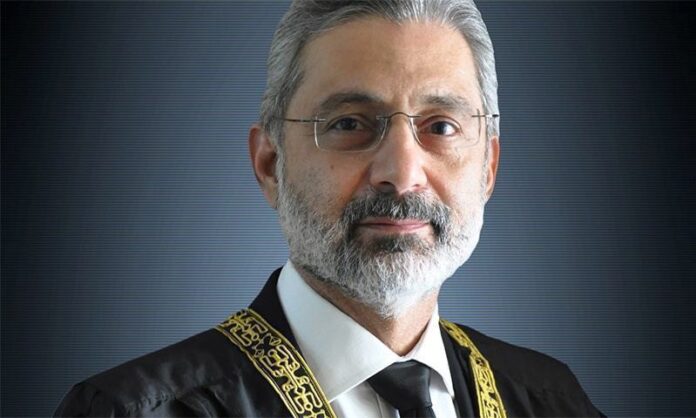
#Pakistan - Justice Isa questions PM Imran’s position on uplift grants for legislators


Justice Qazi Faez Isa on Wednesday questioned Prime Minister Imran Khan’s stance on the grant of development funds to members of the national and provincial assemblies as the Supreme Court (SC) took up a suo motu case to determine the Constitutional status of the move.

On Tuesday, the apex court constituted a five-judge bench, headed by Chief Justice of Pakistan (CJP) Gulzar Ahmed, and served notices on the prime minister’s principal secretary, Cabinet Division secretary, finance secretary, federal and provincial advocate generals, and provincial chief secretaries.

However, Justice Isa on Wednesday noted that a letter submitted by the premier’s principal secretary to the top judicial forum “did not contain the answers to the court’s questions”.

“The letter does not have answers to the court’s questions. It seems the prime minister has not read the court’s order properly,” the judge said.

In January, Prime Minister Imran announced a grant of Rs500 million for each member of the national and provincial assemblies under sustainable development goals to enable them to carry out development schemes for their voters.

However, last week, Justice Isa took notice of the development, warning of legal proceedings if the move was found to be in contravention of the Constitution.

On the occasion, he had asked Attorney General Khalid Jawed Khan to update the court on the issue based on the government’s response.

However, Khan responded he would update the court after receiving instructions from the government and further reassured that “whatever action is taken will be in the light of the law, Constitution and legal precedent.”

Subsequently, Justice Isa referred the matter to the top judge for the formation of a bench.

On Wednesday, all provinces submitted written replies to the court except for Sindh. When asked, the Sindh government’s counsel informed the court the provincial government had not given development funds to any lawmakers.

“Sindh government should have submitted a written answer,” CJP Gulzdar replied.

Meanwhile, AG Khan told the court the grant of development funds was “linked to the Constitution”, adding that the prime minister knew that “government funds cannot be used wrongly”.

“No member of the National Assembly will be given money [directly],” he added.

According to the procedure, the funds do not get issued to the individual MP or MPA. They get assigned to a project through a robust mechanism.

Justice Isa questioned who had drafted the reply submitted by Principal Secretary Azam Khan. To this, Khan replied that it was “a matter between the lawyer and his client”.

“The letter does not have proper English, it does not answer the court’s questions. It seems like the prime minister has tried to keep the door open for [granting] funds,” Justice Isa said.

He also remarked that there was a “storm of information” from the Ministry of Information and Broadcasting every day.

“Either the prime minister should remain firm on what he said or admit he had made a mistake. Why is the prime minister hiding behind his secretary? The entire media published the news and the prime minister is silent,” the judge said.

Khan replied if the prime minister “started refuting every news himself, he would not be able to do any other work”.

The court ordered the Sindh government to submit its reply today.

The bench also ordered the finance secretary to submit a clear answer to the court, directing that the report should also have the premier’s signature on it.

The case was adjourned till Thursday.

https://www.pakistantoday.com.pk/2021/02/10/justice-isa-questions-pm-imrans-position-on-uplift-grants-for-legislators/

Bilawal Bhutto condemned the arrests and "violence of the Law Enforcement Agencies against government employees

 PPP stands in solidarity 

PPP Chairman Bilawal Bhutto condemned the arrests and "violence of the Law Enforcement Agencies against government employees".

In a statement issued by PPP's media cell, the party chairman demanded the "selected government" to accept the legitimate demands of the government employees and release all arrested individuals.

"Instead of listening to the demands of poor employees, the state has resorted to using power against them," he said, adding that the PPP had “doubled” employees’ salaries during its term.

Claiming that the incumbent government has made a record increase in the electricity prices instead of giving incentives to employees, he said that he "stands in solidarity with the protesters."

Condemning the attack on protesters, former president Asif Ali Zardari also said that PM Imran Khan "cannot do anything for the masses except  exploiting them."

https://www.geo.tv/latest/334261-police-fire-teargas-at-protesting-govt-employees-in-islamabad

Chairman PPP Bilawal Bhutto Zardari condemns shelling and arrests of protesting government employees in Islamabad

 Chairman Pakistan Peoples Party Bilawal Bhutto Zardari has condemned shelling on and arrests of protesting government employees in Islamabad and asked the selected government to accept their genuine demands and release all the arrested employees.

In a statement issued here, the PPP Chairman said that the PTI regime has resorted to highhandedness against the employees instead of listening to their genuine grievances. PPP government had doubled the salaries of the government employees but the PTI government has destroyed the economy through unprecedented inflation instead of giving incentives to the government employees, he added.
Bilawal Bhutto Zardari expressed solidarity with the protesting employees and asked the government to accept their genuine demands without any delay.

https://www.ppp.org.pk/pr/24371/