Tuesday, September 8, 2020

I am Asim Bajwa, I brought pizza, digital army to #Pakistan. But you call me Gen Papa Johnny


 Retired Lt Gen Asim Bajwa and his family have been under the scanner for their pizza empire, but no one can take away his ‘contribution’ to Pakistan’s digital propaganda.


They are now calling me General Papa Johnny. Do you know why? Because I, retired Lt Gen. Asim Saleem Bajwa, committed a sin by introducing this poor Pakistani nation to heavenly pepperoni pizzas. Blame me, best hang me, but you can’t deny my great service to the country. Yes, it is personal and it is about my pizza valour.
Retiring as lieutenant-general of the ‘Number 1’ military in the world, I saw many ups and downs but none like what I am facing now. I know that you’ve heard about my secret global economic escapades in the last few days — 99 companies, 133 pizza joints, some 13 commercial properties in the US including two shopping malls — don’t we all love malls. To all those complaining I say: Mehnat kar dost, hasad na kar (work hard my friend, don’t be jealous). Truth be told, it is no mean achievement to build an empire like mine in a poor country like Pakistan.

My cars and pizzas
Those who say that other countries have armies and the Pakistan army has a country are deeply conflicted. We are the only rich men stuck in a poor country. Why don’t you see our misery? You think it all came easy? I climbed my way up by kneading dough, that too yeast-free. Have a heart and imagine my struggle.
My bank balance, my properties, my corner plots, my pizza restaurants, even my swanky Toyota ZX 2016 are all in the greater national interest of Pakistan. If hypocrisy had a face it would be mine, but you still want me to give you my money trail. You call it corruption? Do remember the 101 of our national narrative: the only corrupt in this great nation are the politicians, those of civilian variety, not like me. Repeat it a hundred times, better yet, hang it by your bedside.
If you don’t know me then you don’t need to know more than you know already. Apologies, but trying to hold me accountable for my retirement benefits won’t change anything.
Thorough professional
This brings me to the other part of my life in which I act as a politician. Though my friends tell me that my bad luck began when I joined Prime Minister Imran Khan, because everything he touches turns to trash.
I am now special assistant to the prime minister on information. That is due to my previous excellent work as director-general (DG) of Inter-Services Public Relations (ISPR). Those who came after me couldn’t match my charm. While those before had no idea how to run ISPR.
At ISPR, Pakistan’s information revolution began with me, I was the real deal. The digital troll armies, the hashtags, the branding of then army chief Gen. Raheel Sharif — I was the game-changer then and I am here now. You’d all remember my famous hashtag #ThankYouRaheelSharif, it was in honour of my boss. When Raheel slept I trended ‘thanks’, when he walked I trended ‘thanks’, when he prayed I trended ‘thanks’. The face of my boss was on trucks, car bonnets, and banners in the streets. My biggest achievement? I was the first to bring any Pakistani army chief’s face on a baniyan — such is my power in making military men great. My stint as DG ended soon, otherwise, Sharif underwear was next on the cards.
Making Bajwas great again
I understand the pain of the people too.
I made hit songs such as Bada Dushman Bana Phirta Jo Bachon Se Ladta Hai, right after the Taliban killed 140 children in the Peshawar army school in December 2014. On the massacre’s first anniversary, I came up with Mujhe Dushman Ki Bachon Ko Parhana Hai. I gave special tuitions to the children of the dushman, and it was with that tuition fee that I built my multimillion empire. Just like that, I finished terrorism in Pakistan. No one seems to remember that.
When I left ISPR, I took with me my 3 million Twitter followers. I never handed over the official account to your favourite incoming DG Asif Ghafoor. Why should have I thrown away my hard work? Don’t judge me, it was all in the greater good of the nation.
My purpose is to serve. I did so as commander of the 111-Brigade, a brigade notorious for helping military coups — yet, I myself did no such thing. I was known as the dharna innovator in 2014, because many think I was helping Imran Khan put up a DJ show in Islamabad’s D Chowk.
These are the qualities that have left even senior Bajwa with no option but to trust me. People like to call me Chota Bajwa, but big or small, together we both can both make Bajwas great again!
As you know, I am a man of talents. I am also chairman of the China-Pakistan Economic Corridor (CPEC). I trust myself and there is no reason for the Chinese not to trust me. That is why I insist anyone who as much says a word about my corruption is liable of high treason. You question Bajwa, you question your existence. You question Bajwa over business with the United States and not China, you are an agent and conspirator of the dushman.
https://theprint.in/opinion/gen-papa-johnny-asim-bajwa-brought-pizza-digital-army-to-pakistan/491556/

Monday, September 7, 2020

#NajamSethiOfficial Sethi Sey Sawal | Najam Sethi Speaks on Asim Bajwa Revelations

Exposé On Former General's Vast Wealth Spurs Debate About Military Privilege In Pakistan

Pakistan’s powerful generals have for decades cited political corruption as a leading problem in the country that justified the toppling of governments through repeated coups and the military's manipulation of power.
But a recent report about the vast family business of a former army general who is a senior government adviser has prompted debate about alleged corruption among military elites and the apparent impunity they enjoy in contrast to civilian elites – both of which have taken turns ruling the country during its 73-year history.
Just days after independent journalist Ahmad Noorani published his August 27 article linking former Lieutenant General Asim Saleem Bajwa’s rise through the military to his family’s estimated $100 million fortune, Pakistani officials were scrambling to come up with a response amid public pressure.
Bajwa declared the report a “malicious propaganda story” and government supporters and former army officers have called it a conspiracy against their country as well as the Chinese investments Bajwa oversees. Late on September 3, Bajwa issued a detailed press release to counter Noorani’s report.
Noorani, a fellow at the Missouri School of Journalism, says the wealth of Bajwa’s family grew “unbelievably” after he joined the staff of military dictator Pervez Musharraf in 2002 and later headed the military’s public relations wing. He eventually led troops in the restive southwestern Balochistan Province until retiring in September 2019.
“The narrative about corruption is changing in Pakistan after my investigation came to light,” he told RFE/RL’s Gandhara website. “The corruption debate was limited only to graft allegations about politicians, but now people are discussing this issue in relation to the military and its powerful officers.”Noorani says he hopes his exposé will break the atmosphere of fear in Pakistan, where the military is frequently accused of blanket censorship and severe intimidation of activists and journalists.“My story proves that while [the military does] not allow anyone to investigate their dealings and most of their dealings are not part of the public domain, it is possible many similar stories are out there,” he said.
He argues that the financial dealings of officers should be made public.
“You can bar reporting on some [sensitive] national-security issues but allow the press and government accountability organizations to look into the financial dealings of top officers,” he said. “It will establish transparency.”
But Pakistan’s current accountability laws exclude the military and the judiciary.
Senior military figures have maintained they do not need external oversight because they have internal accountability mechanisms. They point to the many sackings and punishment of officers as evidence of the system’s effectiveness.
Author Ayesha Siddiqa, a research associate at London’s School of Oriental and African Studies, says Noorani’s investigation is the first of its kind to attempt to undo a decades-old narrative about corruption in public life in Pakistan.
“What this story has done is at least partly puncture the myth that military generals are honest and that they shouldn’t be accountable,” she told Gandhara. “There is a case to be made for their accountability.”Siddiqa’s 2007 book, Military Inc: Inside Pakistan’s Military Economy, argues that decades of political dominance have turned Pakistani generals into a privileged class with the lion’s share of power, wealth, and privileges.She says corruption and anti-corruption have dominated politics ever since military dictator General Ziaul Haq dissolved a civilian government over corruption allegations in 1988.In the 1990s, the two leading political parties -- the Pakistan Muslim League (PML-N) and Pakistan Peoples Party (PPP) -- accused each other of graft and targeted each other’s leaders over the issue. Corruption allegations figured prominently in General Pervez Musharraf’s military coup in 1999.
He later formed the National Accountability Bureau (NAB), an antigraft body focused on politicians and civil bureaucrats.
“In recent years, the main political rhetoric has been that there is no left-wing or right-wing ideology and the main struggle is over corruption and anti-corruption,” she noted.
“The [Pakistan Tehreek-e Isnaf] took benefit of this and made it to power,” she said, referring to Prime Minister Imran Khan’s PTI party, which campaigned against alleged corruption by the PPP and PML-N to eventually win parliamentary elections in July 2018 by incorporating many turncoat leaders from the two parties. Opposition leaders blamed the military for orchestrating the PTI’s win through rigging and manipulation.
As chairman of the China-Pakistan Economic Corridor Authority and Khan’s media adviser, Bajwa holds an important position within Khan’s administration.
But minutes after Noorani’s story was posted on his website, Factfocus.com, Bajwa rejected the report. “A malicious propaganda story published on an unknown site, against me and my family, (just uploaded on social media) is strongly rebutted,” he tweeted.
In a detailed response issued late on September 3, Bajwa called Noorani’s report “incorrect and false.” He denied his wife is a shareholder in the family business or that the family business is linked to his rise in the military ranks. “If one were to look at the actual figures, the inescapable conclusion would be that the news item has been spread with a view to malign my reputation,” he wrote in a four-page press release.
Amjad Shoaib, a former army general, declared the exposé a conspiracy against Pakistan hatched by Islamabad's archrival, India, and others.
“Has Noorani conducted any investigative story about many megacorruption cases in this country?” he asked.
As a leading investigative reporter, Noorani has distinguished himself by probing sensitive stories. He says his reporting led to years of harassment by the military, which culminated in a violent attack by unknown men in October 2017 that left him with head injuries.
In a statement on September 1, the global media watchdog Committee to Protect Journalists condemned threats against Noorani after he published his report.
Opposition politicians stung by the government’s accountability drive through NAB cases are gradually raising questions about Bajwa’s alleged fortune. "Allegations have been made against him [Bajwa] and he should answer them," PML-N Vice President Maryam Nawaz said.
Nawaz is seen as the heir apparent of former Prime Minister Nawaz Sharif.
In July 2017, the Supreme Court ousted him from office over undeclared assets. But Sharif insisted his removal was part of an effort to undermine democracy and civilian supremacy.
"If you have been appointed to a government post on taxpayers' money and allegations are made against you and evidence is presented, you should face them," she said. The PPP has also called for a probe of the alleged wealth of Bajwa’s family. On September 1, a Pakistani court gave Sharif a “chance to surrender” if he returned home within 10 days or else risk being declared a fugitive from justice. The court wants him to appear for a corruption hearing. Sharif has been in London since being allowed by the court in November to fly there for medical treatment.

https://gandhara.rferl.org/a/expos%C3%A9-on-former-general-s-vast-wealth-spurs-debate-about-military-privilege-in-pakistan/30819120.html

Civilians Accuse #Pakistani Military Of Mass Arrests, Beatings After Taliban Attack

Civilians in a remote area of western Pakistan have accused the country’s powerful army of mass arrests and torture after the Taliban claimed a bomb attack that killed and injured members of the army.
Residents of Shaktoi, a rural mountainous area of South Waziristan district, say security forces imposed a curfew, arrested local men, and conducted aggressive home searches after a roadside bomb killed three soldiers and injured four others last week.
Officials in the region, however, have rejected accusations of military abuses.
“We faced abuses and arrests after the attack,” Abdul Mutalib, an eyewitness, told Radio Mashaal. “They beat many people in their homes during a search operation and arrested many locals and some 100 laborers working on a road,” he added. “They broke the arms and legs of some of them during torture.”
Mutalib said some 40 soldiers conducted aggressive house searches in Anakhel, a village close to the site of the September 3 attack on the Pakistani Army. “They arrested men who were at home or just walking down the street. Some of them are still being detained at a local school used by the army,” he said.
Shaktoi is administratively part of South Waziristan but is approached from a road in neighboring North Waziristan. Most residents of the region are members of the Mehsud, a Pashtun tribe. Nearly half a million Mehsuds were displaced for a decade after a large-scale 2008 Pakistani military operation against the Tehreek-e Taliban Pakistan (TTP), the umbrella organization of the Pakistani Taliban.
Activists in Waziristan say the displacement and abuses by the Taliban and the military led to the emergence of the Pashtun Tahafuz Movement (PTM), a movement for the protection of Pashtuns, in February 2018. Since then, the supporters of the civil rights movement have protested military abuses and Taliban attacks in their homeland. Ending aggressive searches and collective punishments is a key PTM demand.
In a protest in Tank, a city adjoining South Waziristan to the east, and in the southern seaport city of Karachi, PTM members protested the alleged abuses in Shaktoi on September 7.
“We are demanding the immediate release of detained civilians,” Alamzeb Mahsud, a PTM leader, told Radio Mashaal at the protest in Tank. “We can no longer tolerate such treatment,” he said. The army is “still imposing collective punishment years after claiming to clear our homeland from terrorists.”
Hayat Preghal, another PTM activist, says civilians are helpless in the face of seemingly unending hostilities between the army and the Taliban. “We feel sandwiched between these two forces,” he told Radio Mashaal. “Ultimately, we will have no choice but to abandon Waziristan altogether to protest against the two and protect our people from their reprisals and infighting.”
But Shaukat Ali, the police chief in South Waziristan, says they have received no report of abuses even though search operations are common in the region in response to a recent uptick in Taliban attacks.
“I find it strange that people begin protests against abuses before lodging an official complaint,” he told Radio Mashaal. “If they complained about innocent civilians being detained, I could have asked the army and the police to release them.”
In a September 3 statement, the Pakistani military’s media wing said an officer and two soldiers had been killed while four others were injured by improvised explosives while they were providing protection to a road construction crew in Waziristan. “Security forces cordoned off the area,” the statement said. “Search operation being carried out for area clearance.”
The PTM plans to hold more protests against the alleged army abuses.

صحتمند و تعلیم یافتہ نسل کی پرورش ہی ایک پرامن، خوشحال اور مضبوط ملک کی ضمانت ہوتی ہے۔ چیئرمین پاکستان پیپلز پارٹی بلاول بھٹوزرداری

  پاکستان پیپلز پارٹی کے چیئرمین بلاول بھٹو زرداری نے کہا ہے کہ پاکستان ان
ممالک میں دوسرے نمبر پر ہے، جہاں سب سے زیادہ بچے اسکولوں سے باہر ہیں۔ پاکستان میں تقریباً 22.8 ملین بچے اسکولوں سے باہر ہیں۔ انہوں نے شرحِ خواندگی میں اضافے کے لئے اجتماعی کوششوں اور ذمہ داریوں پر زور دیا ہے۔

 یونیسیف کی جانب سے عالمی یوم خواندگی کے موقع پر جاری کردہ اپنے پیغام میں پی پی پی چیئرمین نے کہا کہ ہم آہنگی سے محروم معاشروں کے لیئے ناخواندگی ایک زرخیز میدان ہے، اور قوم کو اس بات کا نوٹس لینا چاہئے کہ اسکولوں سے باہر بچوں کی تعداد میں فی صد اضافہ ہورہا ہے۔ بلاول بھٹو زرداری نے کہا کہ تعلیم ہر بچے کا بنیادی حق ہے اور جو قومیں یہ حق دینے میں ناکام ہوتی ہیں، انہیں اس کا خمیازہ بھگتنا پڑتا ہے، کیونکہ صحتمند و تعلیم یافتہ نسل کی پرورش ہی ایک پرامن، خوشحال اور مضبوط ملک کی ضمانت ہوتی ہے۔ 

 انہوں نے کہا کہ پاکستان پیپلز پارٹی نے ہمیشہ خواندگی اور تعلیم کی بہتری کے لئے جدوجہد کی ہے، کیونکہ اس جماعت کو پاکستان میں سب سے زیادہ تعلیمی ادارے قائم کرنے کا اعزاز حاصل ہے، جبکہ آمرانہ حکومتوں کے دوران تعلیمی سرگرمیوں کو بہت زیادہ نقصان اٹھانا پڑا، جب سیاسی بے اصول افراد و کٹھ پتلیوں کی حمایت حاصل کرنے کے لیئے گھوسٹ اسکول کی عمارتوں کو بطور سیاسی رشوت متعارف کرایا گیا۔ بلاول بھٹو زرداری نے نشاندہی کی کہ پاکستان پیپلز پارٹی کی سندھ حکومت نے اپنے صوبائی بجٹ کا ایک چوتھائی سے زیادہ حصہ تعلیم کے لیئے مختص کر رکھا ہے اور اُن بچوں کو تعلیم کی جانب راغب کرنے کے لیئے مختلف پروگرام بنائے جا رہے ہیں، جو اسکولوں سے باہر ہیں۔ https://www.ppp.org.pk/pr/23709/

#Pakistan - Chairman #PPP Bilawal Bhutto Zardari’s Message on International #LiteracyDay

Chairman Pakistan Peoples Party Bilawal Bhutto Zardari has said that Pakistan is home to the world’s second-highest number of out-of-school children with an estimated 22.8 million children and stressed for collective efforts and responsibilities to improve the literacy rate in the country. 

In his message on the International Literacy Day is observed tomorrow under the aegis of Unicef, the PPP Chairman said that illiteracy is the fertile ground for disharmonious and intolerant societies and the nation should take notice that the number of out-of-school children was growing per cent-wise.
Bilawal Bhutto Zardari said that every child has the basic right to education and nations who fail to provide this right ultimately suffer because nurturing a healthy and educated generation was the only guarantee for a peaceful, prosperous and strong country. He said that PPP has always struggled for improvement in literacy and education as it has the distinction of establishing the largest number of educational institutions in Pakistan while academic activities suffered a lot during dictatorial regimes when ghost school buildings were introduced as a political bribe for free-wheeling political puppets in exchange for their support.
Bilawal Bhutto Zardari pointed out that PPP’s Sindh government has earmarked more than a quarter of its provincial budget on education and the province was planning programs to attract out-of-school children to attend schools.

 https://www.ppp.org.pk/pr/23707/

Sunday, September 6, 2020

Video Report - San Francisco | BLM activists march against Trump and police brutality

Video Report - #BlackLivesMatter What will halt Black Lives Matter protests in US?

Video Report - Kamala Harris visits Howard University, her alma mater, with CNN

Video Report - CNN Exclusive interview with Sen. Kamala Harris (part 1-2)

Opinion: The Strange Grief of Losing My Sense of TasteMany symptoms of Covid-19 were difficult, but losing my ability to taste hurt the most.


By Krista Diamond
After I tested positive for Covid-19, I ordered Panang curry. When the food arrived, I lifted the plastic lid, expecting the scent of makrut lime, lemongrass and ginger. But there was nothing. I plucked a forkful of tofu from the sauce. It was flavorless. My abilities to smell and taste had suddenly evaporated. And in the month since I’ve been sick, they have yet to return.
Earlier in the pandemic, my husband and I developed a ritual of ordering comfort food every Friday. We live in Las Vegas — a city that has been hit hard by the virus — and found meals from beloved local restaurants to be small but crucial gifts in a glittering landscape that was losing its luster. In March, my husband was laid off from a casino, and I lost a majority of my clients as a freelance writer. In June, the Strip reopened to unmasked tourists drunk on margaritas and the falsehood of a world without disease. By August, we were sick.
Unable to get out of bed days later, I sent out a tweet bemoaning Covid-19. Someone replied, “Whatever you do, don’t Google ‘When will I get my smell and taste back.’” I did exactly that and was met with article after article about anosmia — smell blindness — many of which suggested its impact could be long-term.
My existing symptoms worsened while new ones appeared: body aches, paralyzing nausea, 12-hour headaches, difficulty breathing and exhaustion that lingered like a hangover. But despite the physical pain of the illness, losing my ability to taste hurt the most. For months before I got the virus, I was locked inside my house. I saw friends and family through my computer screen. I watched the lights of downtown Las Vegas flicker off from my bedroom window. I felt the heartbeat of my career flatline.
Throughout this sea change, my only sense of joy was the taste of food. The red velvet cake I ate on my birthday in lieu of a canceled California vacation. The balsamic roasted brussels sprouts I cooked after I lost another client. The spicy bourbon fried chicken from the sun-drenched cafe where I used to read on leisurely Sundays.
Las Vegas is a city-centered around pleasure, and so much of that pleasure is taste — the bright citrus of champagne, the brine of fresh oysters, the impossible luxury of Kobe beef. And what is Las Vegas without pleasure? A desert.
The ability to taste was my connection to life before the coronavirus. And suddenly it was — and still is — gone.
My first week without taste and smell, I searched constantly for flashes of my lost senses. I sniffed candles, opened leftovers in my refrigerator, buried my face in my dog’s fur in search of that puppy smell. Even spoonfuls of hot sauce, pinches of salt, amounted to nothing. I worried — if I ate spoiled food, would I know? If there was a gas leak in my house, would it kill me?
In desperation, I turned to a Facebook group for people with Covid-19 experiencing smell and taste loss. It had more than 5,000 members.
“Today marks exactly 5 months since losing my taste/smell completely,” someone reported.
“There is hope,” another said, sharing that she had regained the ability to smell.
Some expressed sadness over seeing friends enjoying meals. Others floated conspiracies — had masks caused this? Many discussed smell training, a method requiring anosmia sufferers to sniff scents like eucalyptus, lemon and rose every day in hopes of turning the memory of them into reality.
Occasionally, someone would celebrate the return of taste and smell only to lose the sensations again or find that they had changed. Suddenly sugar was unbearably sweet, wine intolerably bitter. Phantom scents filled their nostrils — cleaning chemicals, gas.
I read the group’s Facebook posts for hours, commiserating with strangers around the world who shared this one strange loss. In a way, it felt frivolous. After all, many of us have already recovered and will avoid panicking emergency rooms. We will continue to live our lives — even if they are lives where chocolate tastes like chalk and whiskey taste like water.
But what is life without taste, without smell? If I never regain these abilities, will the question “What do you want for dinner” mean anything? Will a nice restaurant still have value? How will it feel when someone cooks for me, watches me take the first bite, and waits for my reaction? What is the point of perfume, of piney mountain air?
In a way, anosmia is the perfect metaphor for the world during Covid-19: devoid of pleasures we didn’t realize we might not always have.
But still, I try. I lift my husband’s shirt to my nose and breathe in. I cook meals — seared ahi tuna, pasta carbonara, strawberry pastries — and eat them, closing my eyes and trying to remember what they taste like.
Each day I hope for the familiar aromas and flavors to come back. I wait like the rest of us, for the things I love to return.
https://www.nytimes.com/2020/09/06/opinion/coronavirus-covid-symptoms-taste.html

جنرل ریٹائرڈ عاصم باجوہ کےاثاثوں سے متعلق احمد نورانی کی کہانی-اسکے پیچھے کیا کہانی؟ خصوصی انٹرویو

اسلام آباد سے اغوا ساجد گوندل کے بچے سڑکوں پر ۔ احتجاج - BringBackSajidGondal#

#KhabarSayAagay #NayaDaur #Politics Bhang Ke Rang | Pakistan's Politics, Culture, And Media

Meet Kanwal Ahmed, Pakistani woman who has given a ‘safe space’ to women to talk about taboos


On the Facebook page 'Soul Sisters Pakistan', started by 31-year-old Kanwal Ahmed, several South Asian women discuss topics such as sex, abuse, marriage, and abortion.

Sex, divorce, abortion, domestic violence — these are some of the ‘taboo’ topics that are discussed on ‘Soul Sisters Pakistan’, a women-only online space created by a 31-year-old Pakistani woman, Kanwal Ahmed.
The community page on Facebook has over 2,64,000 members, and women from across South Asia share their experiences, grievances, fears and ambitions in this “safe space”, according to Kanwal, a former makeup artist. She noted that most members of the group are from India and Pakistan.
“It is known how oppressed women of South Asian countries are. No matter what the background is, women are just not able to break the shackles of patriarchy. I created this community so that women can talk about things which they otherwise aren’t supposed to speak about or discuss — sex, divorce, physical and mental abuse, abortion and miscarriage,” Ahmed told ThePrint.
“Pakistani and Indian women are extremely strong, we just don’t have the right spaces, avenues to voice ourselves. It’s unsafe for women to confide in strangers or to take a break from the cumbersome daily lives. I wanted the group to be a place where women really opened up without the fear of being attacked or harassed or judged,” she added.
‘Safe space’ for women to discuss personal problems
Born in Pakistan’s Karachi, Ahmed, who now lives in Canada, got married at the age of 22 and is a mother of a 4-year-old child. She said the need to create a free and safe space for women struck her while she was working as a makeup artist.“I came across women who really needed someone to confide in. As I was growing up, I could see the agony and plight of women, there were live examples around me of those being ill-treated, subjected to different forms of domestic violence. This urged me to create this free space for women so that they can finally speak their heart out,” Ahmed said.
Soul Sisters Pakistan is a closed group on Facebook, with admittance regulated by Ahmed and the members, to ensure that it continues to be a female-only, safe space. It was established in 2013 and over the years has gained a lot of popularity.
In 2018, Ahmed was chosen as one of Facebook’s 115 ‘community leaders’, and received a grant from the social media giant to cultivate her project.
According to Ahmed, her page’s sole purpose is to provide a “safe space” for women to discuss “personal problems” which otherwise go unheard or are deemed “inappropriate and shameful”.“I don’t counsel anyone, I and other women in the group only listen. Listening to someone’s agony soothes them and offers them mental strength,” Kanwal said.Women in the group, who call themselves ‘Soulies’, offer each other emotional and mental support and advice on various issues.
One thread on the page discusses — ‘How many of you changed yourself after marriage? Do you miss what you were before?’. It has over 6,000 comments from members sharing their experiences on marriage and marital relationships.
In another thread, a community member posted about her troubled married life, talking about how she and her husband started having issues within two months of their marriage. The comments section was filled with words of encouragement and support. There are also threads where women post pictures of their hobbies, their artwork and also photography.
Domestic abuse most discussed topic
One of the most discussed topics on the page is domestic abuse — both emotional and physical. Narrating an instance, Ahmed told ThePrint how one of the community members informed the group about her helper’s sister who was being regularly beaten up by her husband.
“The husband had a gun and would shoot in the air if the villagers tried to stop him. The woman was constantly abused. When the topic came up on our platform, another member who had good contacts with the police of another village called them up and reported the incident. The woman was rescued and brought to Karachi,” Ahmed said.
She highlighted how the journey of Soul Sisters Pakistan has also been full of inspiring moments.
“Once a member had told us how she had left her partner and was on her way to become a single parent. She was anxious, worried and paranoid as she didn’t have a job. I remember how the network was filled with messages full of love, so many single mothers came down to share their experiences. Two women even offered her a job.”
Offline events and a talk show
Besides the community page, Ahmed has also hosted offline events where women come and meet each other, make friends and talk about their issues.
“We arrange a sitting for about 500 women in one event. Here, they can confide in one another without having the fear of being judged or being laughed at. Nobody is belittled,” she said. These events were held in Karachi, where she previously lived.
Ahmed also hosts a talk show ‘Conversations with Kanwal’ on YouTube, where she interacts with women and men on various issues ranging from single parenthood, childbirth, pregnancy, emotional abuse, family pressures, female foeticide among many others.
Ahmed says 46 per cent of her audience was Indian and that her series got a “lot of love from India”.
“God bless you aunty… Be happy always. Lots of love from India,” one viewer, Koyela Chakrabarti from India, commented on her YouTube channel, which has over 78,000 subscribers.

“Waiting for a new video. It’s so inspiring, I got goosebumps watching the videos. Love from India,” another user, Shristi Chettri, commented.
https://theprint.in/features/meet-kanwal-ahmed-pakistani-woman-who-has-given-a-safe-space-to-women-to-talk-about-taboos/496857/


گلگت بلتستان الیکشن: بلاول نے امیدواروں کے ورچوئل انٹرویوز لیے

گلگت بلتستان الیکشن کےلیے پیپلز پارٹی کے امیدواروں کے ورچوئل انٹرویوز لیے گئے۔
اعلامیے کے مطابق چیئرمین بلاول بھٹو کی سربراہی میں پیپلز پارٹی کے الیکشن بورڈ نے امیدواروں کے انٹرویوز لیے۔
پیپلز پارٹی کے اعلامیے کے مطابق دوسرے مرحلے میں دیا مر ڈویژن کے ضلع استور کی 2 سیٹوں کےلیے انٹرویوز لیے جائیں گے۔
اعلامیے کے مطابق انٹرویوز کےد وران بلاول بھٹو زرداری نے امیدواروں سے جیت کی صورت میں ترجیحات دریافت کیں۔
بلاول بھٹو نے امیدوارو سے گفتگو میں کہاکہ گلگت بلتستان الیکشن جیت کر پیپلز پارٹی سندھ کی طرز کےاسپتال بنائےگی۔
انہوں نے مزید کہاکہ گلگت بلتستان پیپلز پارٹی کا مضبوط قلعہ ہے، جیالے بھرپور الیکشن مہم چلائیں ۔
https://jang.com.pk/news/817310

Saturday, September 5, 2020

Video Report - #NajamSethi #AsimSaleemBajwa #NajamSethiOfficial Sethi Sey Sawal | Bajwa ki Kahani Sethi ki Zubani

Video Report - #NayaDaur #AsmaShirazi Asma Shirazi on Imran Khan's Claim: Pakistan's Media Enjoys More Freedom Than The British

Pizza corruption scandal risks dragging China into Pakistan’s domestic affairs

Pakistan's Foreign Minister Shah Mehmood Qureshi, centre, unveils the country’s updated official map which for the first time includes large parts of Indian-administered Kashmir. Photo: EPAPakistan's Foreign Minister Shah Mehmood Qureshi, centre, unveils the country’s updated official map which for the first time includes large parts of Indian-administered Kashmir.
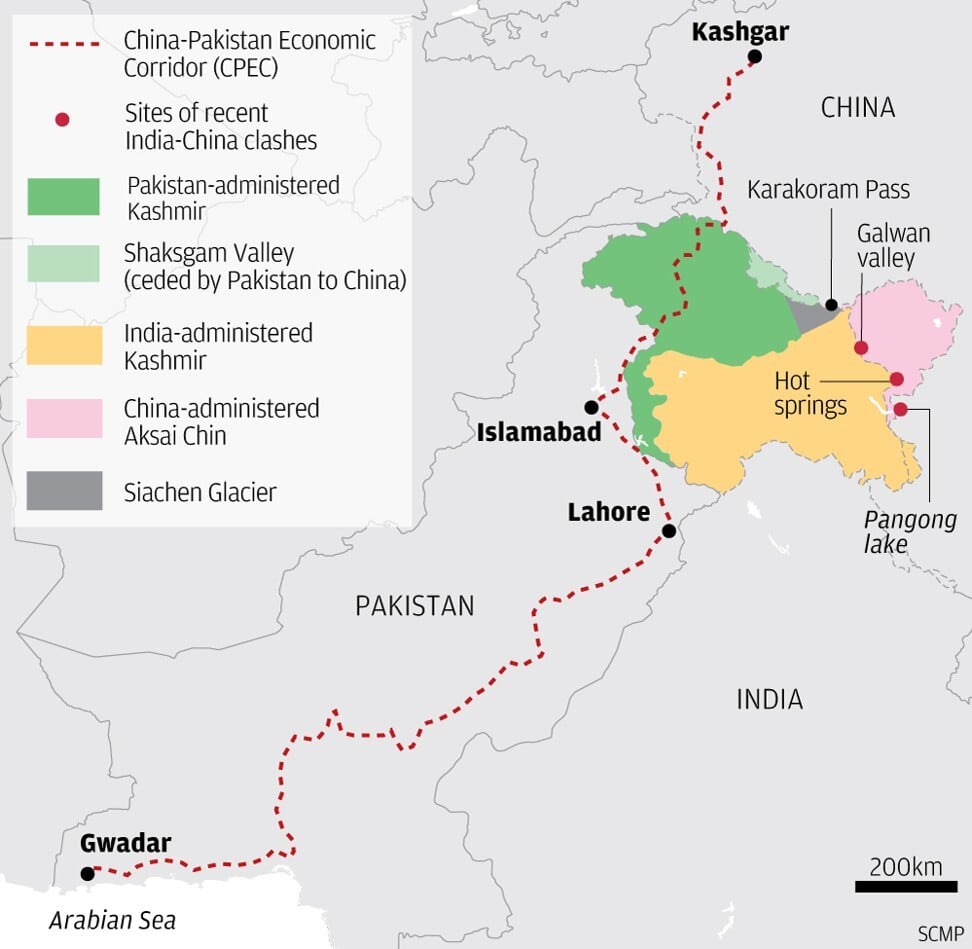
Pakistan’s move to unveil a new political map reasserting its claim to all of Indian-administered Kashmir – minus the parts claimed by China – is fuelling New Delhi’s fears of a two-front conflict with its neighbours, despite a lack of evidence that such a move is in the works. But the release of the map is the latest in a series of conflicts born from cartography which have broken out in the Himalayas since May – from a deadly scuffle between Indian and Chinese soldiers in mid-June to a war of words that began earlier in the summer when New Delhi opened a road through territory claimed by Nepal.
Pakistan’s new map – unveiled almost exactly a year to the day since India’s unilateral decision to strip the part of Kashmir it controls of its semi-autonomy – extends Islamabad’s territorial claim north-eastward up to the Chinese-held Karakoram Pass. On paper, the map links Pakistan with Chinese-administered territory via the Shaksgam Valley, a part of the Gilgit-Baltistan region ceded to China by Pakistan under their 1963 border settlement. To the east is the Aksai Chin region – the limit of China’s claims in Kashmir which it has controlled since a 1962 war with India.
Between the two lies the Siachen Glacier, an undefined area at the northern extreme of the de facto border between Pakistani- and Indian-administered Kashmir known as the Line of Control – not to be confused with the Line of Actual Control, which separates Indian- and Chinese-controlled territory in the region.India, like Pakistan, claims Kashmir in its entirety and has no interest in pursuing a United Nations-supervised plebiscite, supported by Islamabad, for the region’s residents to decide which country they should join. The recent incursions by China across the disputed Line of Actual Control into Indian-administered Kashmir have given Beijing the ability to impede India’s military traffic along roads approaching the Siachen Glacier from the east.
To this extent, Pakistan’s new map does hint at the possibility of coordinated operations with China if Islamabad ever attempts to forcibly take the glacier, which would create a land bridge between Gilgit-Baltistan and Chinese-administered Aksai Chin.
Since Chinese and Indian forces clashed in the Ladakh region this summer, Indian media have speculated about China’s strategic intentions in the area, including the possibility of it seeking to seize territory – fuelling fears of a future war with both China and Pakistan.
“This certainly reinforces the Indian perception of a two-front theatre that its military planners are increasingly taking into account,” said Harsh V. Pant, a professor of international relations at King’s College London.
But as Ejaz Haider – a Lahore-based South Asian strategic affairs analyst – points out, a highway connecting Tibet to Xinjiang already exists “so the Chinese don’t need a route through the Karakoram Pass to reach Xinjiang”. That being said, if Pakistan’s new map were to become reality, it would represent a “net strategic gain” for both Islamabad and Beijing, the former Ford Scholar with the University of Illinois’ programme on arms control, disarmament and international security said.
In a rare four-way dialogue with his counterparts from Pakistan, Afghanistan and Nepal last month, China’s Foreign Minister Wang Yi again pushed plans for a trans-Himalayan economic corridor connecting Nepal to Pakistan via Tibet and Xinjiang, from where it would join the estimated US$60 billion China-Pakistan Economic Corridor (CPEC) culminating at the Chinese operated port of Gwadar on the Arabian Sea. Wang also called for the extension of the CPEC into Afghanistan.

 
This [map] is presumably meant to be a defence of the Belt and Road Initiative, which India opposes because it runs through disputed territory that it claims Michael Kugelman, Wilson Centre

Michael Kugelman, senior South Asia associate at the Washington-based Wilson Centre think tank, said the strategic value of Pakistan’s new map, for Beijing, may lie in the additional political cover it provides to belt and road projects being built in Pakistan-administered Kashmir and Gilgit-Baltistan.
The new map is significant because “it recognises large areas of Indian territory as Pakistan’s”, he said. “This is presumably meant to be a defence of the Belt and Road Initiative, which India opposes because it runs through disputed territory that it claims.” In June, Pakistan awarded contracts for the construction of three major hydropower projects along the Neelum River to Chinese state-owned enterprises under the CPEC programme.
The Neelum River marks the divide between Indian- and Pakistani-administered territory in western Kashmir, before it merges with the Jhelum River, a major tributary of the Indus. This in turn supplies water from Himalayan glaciers to an estimated 270 million people in Pakistan and northwest India.Asma Khan Lone, author of an upcoming book on the history and the geopolitics of the region called The Great Gilgit Game, drew a parallel between Pakistan’s new cartographic claim to the Indian-held Siachen Glacier – a huge source of fresh water – and China’s efforts to “weaponise water” in Ladakh by building dykes for what she described as “tactical flooding”.
Previously vacant because of its extreme altitude, the Siachen Glacier was occupied by Indian forces in 1984, prompting years of intermittent fighting between India and Pakistan at an average elevation of more than 5,400 metres above sea level until a ceasefire was agreed in 2003. The glacier is notorious for killing far more soldiers with its extreme environment than enemy artillery shells ever did: in April 2012, 129 soldiers and 11 civilian contractors were killed after an avalanche buried a Pakistani military base in the nearby Gayari sector. The huge cost of waging war on the glacier, both in terms of finances and human lives, has so far prevented skirmishes breaking out there in the same way they have done elsewhere along the Line of Control since 2016.
But tensions are on the rise. In February last year, Indian warplanes crossed into Pakistani air space near the glacier. Delhi has also recently started reasserting its claims to Pakistan-administered Gilgit-Baltistan and Kashmir by including both in the country’s official weather forecasts since May, while Indian military chiefs have declared their forces ready to seize the territory if so ordered. Kugelman of the Wilson Centre said Pakistan’s new political map is “presumably meant to push back” against such threats – but like India’s bombast, he said it is driven more by domestic politics than long term strategic plans.
“I don’t think we should read too much into this map,” he said. “It is just the latest subcontinental case of using cartography to appeal to nationalism at home, while taking a shot at the enemy next door.”
Zhou Rong, a senior fellow at Renmin University’s Chongyang Institute for Financial Studies who has researched Pakistan and Afghanistan, said the risk of a fourth war between Delhi and Islamabad over Kashmir was very real. “India also realises that ties between Pakistan and the US has become less important over the years, and that Washington has stood on its side during its conflicts with Pakistan,” he said. “This has enabled India to become even more confident.”
He added that “many countries are unwilling to offend India” as they are “increasingly reliant” on it economically. “Many traditionally Islamic countries have also forged better relationships with [New] Delhi, seeing it as an important market for their energy exports,” he said. https://www.scmp.com/week-asia/politics/article/3096308/pakistans-new-kashmir-map-links-it-china-fuelling-indias-fears

Ahead of #FATF Plenary, New Document Reveals Hizb Chief Syed Salahuddin's Direct Links to Pakistan's ISI

As Pakistan’s performance in implementation of the Financial Action Task Force Action Plan comes up for review next month, there is mounting evidence of Islamabad’s support to terrorism in general and active connivance in financing terrorism in particular.
 As Pakistan’s performance in implementation of the Financial Action Task Force (FATF) Action Plan comes up for review in October, there is mounting evidence of Islamabad’s continuing support to terrorism in general and active connivance in financing terrorism in particular. A new document accessed by security agencies confirms links of one of its proxies with Pakistan’s Inter-Services Intelligence (ISI), which is likely to further muddy the waters as its Grey Listing is taken up at the FATF plenary.
One of the important terrorist groups that have been used by Pakistan to foment terrorism in India is Hizbul Mujahideen (HM), headed by Mohammad Yusuf Shah, also known as Syed Salahuddin. He is also the head of the United Jihad Council (UJC), an umbrella organisation of terror outfits such as Lashkar-e-Taiba (LeT) and Jaish-e-Mohammed (JeM).
Acting on the instructions of his Pakistan masters, Salahuddin has been instrumental in carrying out anti-India propaganda and terror activities in Jammu and Kashmir. He has time and again accepted Pakistan’s role in funding terrorist and secessionist activities in Kashmir. In an interview in June 2012, Salahuddin had admitted that he was fighting Pakistan’s war in Kashmir, even threatening to take the war to Islamabad if it withdrew support to him.
Salahuddin had also announced that "the Mujahideen struggle serves as a defence line for Pakistan". The arrest of his sons Syed Shakeel Yousuf and Syed Shahid Yousuf and the recent killing of two of his close associates Riyaz Naikoo and Adil Ahmed by Indian security forces (on May 6) seemed to have rattled Salahuddin, making him increasingly desperate.
Salahuddin supports terrorist activities on Indian soil through a number of proxy NGOs and charities supported by the ISI and other Pakistan-based entities. Among the most prominent of these is the Jammu and Kashmir Affectees Relief Trust (JKART).
The JKART is used by Salahuddin to find recruits by offering them financial incentives and promising to take care of their family members once they are "martyred". JKART’s head office is in Rawalpindi with branches in Islamabad, Muzaffarabad (PoJK), among others.
Indian security agencies recently obtained specific evidence of direct links between ISI and Salahuddin. A letter issued in the name of Mohammad Yusuf Shah alias Syed Salahuddin certified that he is a bonafide official of the Directorate of Intelligence and is working for the ISI. The letter even suggested that he has been “security cleared” and should not be “unnecessarily stopped”. The certificate is valid up to December 31, 2020. The letter issued Shah is important for the FATF to see before taking a decision.
It may be mentioned that it is not Salahuddin alone who enjoys VIP treatment from the Pakistani establishment. It is estimated that Pakistan shelters around 130 terrorists sanctioned by the United Nations Security Council (UNSC). It has also been disclosed that Pakistan has provided access to these terror outfits to its banking system for carrying out nefarious terror activities in India and elsewhere. Recent chargesheets filed by the Enforcement Directorate (ED) and the National Investigation Agency (NIA) bring out the linkages between terrorists and the Deep State in Pakistan. This is likely to be viewed seriously by the FATF as it reviews Pakistan’s Action Plan next month.
https://www.news18.com/news/world/ahead-of-fatf-plenary-new-document-reveals-hizb-chief-syed-salahuddins-direct-links-to-pakistans-isi-2852545.html

#Pakistan #PPP - Chairman PPP Bilawal Bhutto Zardari demands postponement of NA session

Chairman Pakistan Peoples Party, Bilawal Bhutto Zardari has demanded the postponement of the session of the National Assembly due to the situation caused by torrential rain all over the country as the members are busy in relief activities for the people of their constituencies.
Chairman PPP said that the members need to be with their people at this time of need. Former Prime Minister Raja Pervaiz Ashraf has already requested the Speaker National Assembly for this postponement. Bilawal Bhutto Zardari said that the situation is very serious in several part of the country due to heavy rainfall.
Bilawal Bhutto Zardari said that in the current situation, all the government and opposition political parties should aim for relief work for the victims of torrential rain.
https://www.ppp.org.pk/pr/23701/

Friday, September 4, 2020

Music Video - Naheed Akhtar - Teri Ulfat Mein Sanam

Imran Khan's #Tinder and #Grindr ban in #Pakistan criticised as 'hypocrisy'

Hannah Ellis-Petersen and Shah Meer Baloch
Dating app ban is move to appease conservative factions and sign of weakness, say, critics. For Hamza Baloch, Grindr was a life-changer. As a gay man in Pakistan, an Islamic republic where homosexuality carries a sentence of up to 10 years in prison, his means of meeting others in the LGBT community had always been shrouded in secrecy and risk and kept within known safe spaces.
But the arrival of dating apps such as Grindr and Tinder in Pakistan about four years ago brought with it a small revolution among young people across the spectrum of sexuality. Here they could connect and meet people on their own terms, with an honesty about their sexuality that was previously taboo and dangerous. The apps proved popular: Tinder has been downloaded 440,000 times in Pakistan in the last 13 months.
“I used Grindr a lot for dating, sometimes just so I could meet up with someone over a cup or tea or dinner, or sometimes for more casual hookups,” said Baloch, who is an LGBT activist in Karachi. He emphasised that Grindr was not just the preserve of upper- and middle-class people in cities, and said he had seen the app used by gay and trans people even in remote rural communities in Sindh province, for example.
But this week the Pakistan government announced it was imposed a sweeping ban on dating apps, accusing them of hosting “immoral and indecent content”. It is part of what has been seen as a move by the prime minister, Imran Khan, to appease the conservative religious factions who wield enormous amounts of power and influence in Pakistan.
In response, Grindr, which describes itself as the world’s largest social networking app for gay, bisexual, transgender and queer people, said it was “exploring ways that we can be of service to the LGBTQ community in the region”.
Homosexuality is still widely perceived to bring shame to families in Pakistan, and has led to so-called “honour” killings. But the apps have also been met with disapproval over heterosexual meetups, particularly for women from more conservative households who are discouraged from dating on their own terms and instead are expected to enter into an arranged marriage with someone selected by their family.
“What sane government in 2020 stops its citizens from dating?” said Baloch. “Even those who call themselves religious and practising people of faith used these apps for their private life to fulfil their desires and human needs, which they didn’t want to do publicly or visibly.”
He added: “No matter which strata of society they belong to, be it a university grad or a shopkeeper at some village, these apps provided a great and a safe platform to the queer community to connect and interact with each other, without putting themselves at risk.”
The apps were not without their dangers. After an incident in 2016 in which a 20-year-old man killed three gay men he had lured from LGBT Facebook pages, claiming to be stopping the spread of evil, the LGBT community was warned to avoid anonymous meetings with people through apps and social media. In order to protect their identities, LGBT people often did not post identifying photos on their Tinder and Grindr profiles.
The decision by Khan’s government to bring in the ban on dating apps has led to accusations of hypocrisy against the prime minister, who before entering politics was a Test cricketer with something of a lothario reputation. Many criticised the move as further evidence of the weakness of Khan’s government in the face of the powerful religious right, while others wryly commented that Khan would be the “playboy that brought in sharia [Islamic law according to the Qur’an]”.
Neesha*, 20, an LGBT student at Habib University in Karachi, said apps like Tinder had taken the fear out of dating, whichwould now return after the ban. While small groups and communities of LGBT people had existed long before the apps arrived in Pakistan, Tinder and Grindr had opened up the opportunity to meet people who might be less comfortable attending LGBT meetups or who were still exploring their sexuality.
Neesha spoke of two university friends who had not known the other was gay, both too fearful to speak openly about it, until they saw each other on Tinder. They subsequently began a relationship. “People say these apps aren’t for countries like ours but I think it’s to the contrary, we need them more because we can’t be public about who we are,” she said, describing the ban as “pure hypocrisy”.
The impact of banning the apps was not only felt in the LGBT community. “Going on dates is considered wrong in our society and so honestly Tinder has made it easier for people in Pakistan to communicate with each other and meet each other,” said a 25-year-old student studying at Shaheed Zulfikar Ali Bhutto Institute of Science and Technology, Islamabad. “Banning these apps is absurd.”
Minahil, a student and activist at Iqra University, Karachi, said the apps had “definitely made it easier for gay people in Pakistan to find love” and she feared that the ban was part of a wider crackdown on the gay community that would once again ensure “people in Pakistan stay in the closet forever”.
“By blocking these apps, Imran Khan is trying to win the hearts of conservatives and hide his own past,” she said. “But we can all see the hypocrisy.”
https://www.theguardian.com/world/2020/sep/04/imran-khans-tinder-and-grindr-ban-in-pakistan-is-hypocrisy

How can #Balochistan prosper if its poor children are out-of-school and uneducated?


By: Munaj Gul Muhammad
Tariq Baloch, 13, gets up early in the morning and moves to the nearby garage in Turbat city every day so as to earn a little sum of money for the family. He uses the work tools at a very young age rather than picking up books to be at school. And schooling has not been a daydream for him since his childhood besides having the constitutional rights.
”School is not for us.” Says Tariq Baloch in tears before I put a question. “Who could buy clothes and shoes for my younger sister if I were in school? How can we survive without the basic facilities like, food-stuffs, lodging and other indispensable necessities? No one can measure the problems we are going through.” Thought-provoking, indeed.
  The expensive fee structure of the education and negligence of the government constrained the boy to work in this garage instead of securing education to lodge a comfy living. He is as poor as sometimes his family members sleep without taking a loaf of bread.
 Balochistan, a resource-rich province, is confronted with a staid challenge to ensure all children to be at school and thwarting out-of-school children is another quandary in the province.
60 to 70 percent children in the province are out-of-school according to a report by UNICEF. Among which, 78% girls and 67% boys of school going age are out-of-school, the sole reason why Balochistan always has a handful number of out of school children is because Balochistan governments-in-rule have always snubbed the decades-long education emergency.
  1.8 million Children in Balochistan do not attend school, over half of whom are girls, a report by the Academy for Educational Planning and Management (AEPAM) says.
In Balochistan mainly girls are out-of-school owing to the gender-based discrimination and regressive societal norms. The dismal state of education, expensive fee structure, and apathy of the government are the other reasons for the great drop-out of the students in the province.
“If my daughters were able to be enrolled in any school in the area someday, it could be the happiest day of my life.” Says Mahtab Baloch. “A fraction of unfortunate and indigent daughters of the soil end their lives up without stepping into schools.”
Correspondingly, the non-functional schools and absence of ultimate amenities in the schools are the main drives behind the rife unenrollment of the school-going children; therefore, the province has been home to the highest proportion of illiteracy among girls. Getting the out-of-school children into school is the constitutional duty of the government which remains unaddressed.
 1, 1627 primary schools are registered in Balochistan, of which 1,271 are middle schools and 947 are high schools as per as a study by Alif Ailaan. The study highlights that each year 165,869 girls are enrolled in the primary section, of which the number drops to 44,076 in the middle section and 20,015 in the higher section.
The absence of rudimentary education always impedes progress of the society so as the province grieves from the plagues.
” Whenever I see children going towards schools having bags and wearing uniforms, I wish to get my children enrolled in a school, but forlornly, we cannot go to a lot of expenses to educate our children well since we are paupers,” complains Bibi Gangi.
Her children are out of school and have no other options besides opting work tools at a very young age. They are abused and beaten.
According to the annual report citizen-led household ASER Survey 2018,“In Baluchistan, the proportion of out-of-school children has improved as compared to 2016 but 28% children are still not going to school and the province has recorded overall 7% increase in enrollment.”
Visiting a friend in Mand, district Kech, a few months ago, I was dazed to see the government primary schools in scruffy state. The education minister of Balochistan has on no occasion taken decent steps to bring out-of-school children into school and address the longstanding education crisis in the province.
The education crisis in Balochistan would not come to an end until and unless a basic education is accessible for all. The government had better show its commitment to tackle the problem of ghost teachers and absenteeism of teachers by applying biometric system and ensure that all children are provided with free textbooks and uniforms besides basic amenities in schools.

MNA Mohsin Dawar says stopped at Quetta airport, barred from entering city

Lawmaker Mohsin Dawar said he was barred from leaving Quetta airport on Friday by authorities upon arrival in Balochistan's capital.
"I have just landed in Quetta and I have been stopped from leaving the airport by security agencies," said Dawar via a tweet. "I have been told that my entry to Balochistan has been barred again for 90 days. The state thinks it can break our resolve with such petty tactics. They can’t."
He also posted a notice on his Twitter account, which said that the entry of Dawar and fellow lawmaker Ali Wazir in Balochistan was banned for 90 days under the Balochistan Maintenance of Public Order Ordinance, 1960.
Speaking to DawnNewsTV, Dawar said he was speaking to government officials and added that he was being accompanied by workers and supporters of the group.
“The officials informed Mohsin that the deputy commissioner was in Islamabad. The additional deputy commissioner has reached the airport to talk with Mohsin,” Khalil Ahmed, a PTM worker present at the airport said. Khalil further said that the MNA had come to Balochistan to offer condolences to families whose members had been killed in a firing incident at Chaman border.
Dawar and his supporters had flown in from Islamabad. According to an official at the airport, the last flight from Quetta to Islamabad took off earlier in the day and no other flights are scheduled to other cities today.
Members of the group's Quetta chapter gathered outside the airport as news of the development reached them and threatened to stage a protest against the government over the move.
In November 2018, Dawar and Wazir were offloaded from a flight bound from Peshawar to Dubai by officials of security agencies and were told that they could not travel abroad because their names were on the Exit Control List.
In December of the same year, the federal cabinet directed the interior ministry to scrap the PTM leaders' names off the list.
Earlier this year in March, Dawar and Wazir were stopped from boarding a Kabul-bound flight, as officials said that their names were on no fly list. They were going to Afghanistan to attend President Ashraf Ghani's oath-taking ceremony.
At the time, Firdous Ashiq Awan, the then special assistant to the prime minister on information and broadcasting, had said that the names of both MNAs were on the ECL and they "did not ask for permission to go to Afghanistan".
https://www.dawn.com/news/1577902/mna-mohsin-dawar-says-stopped-at-quetta-airport-barred-from-entering-city

#Baluchistan : At least 4 injured in blast outside mosque in #Quetta

At least four people were injured in a blast outside a mosque on Quetta's Sariab Road on Friday, police said.
The wounded were shifted to the Civil Hospital for treatment. The incident took place after Friday prayers.
A video showed worshippers coming out of the mosque as an explosion was heard and plumes of smoke rose from a motorcycle on fire.
Quetta Deputy Inspector General Abdul Razzaq Cheema said the nature of the explosion could not be immediately ascertained and police were investigating if explosives were planted on a bike or if the vehicle caught fire.
But another police official told DawnNewsTV that 1-1.5 kilogrammes of explosive material was left in a bag next to a motorcycle parked outside the mosque. He said the blast was caused after the detonator blew up but the explosives themselves didn't catch fire.
More destruction would have been caused if the explosive material had gone off, the official added.
Police cordoned off the area as the probe into the blast went underway.
According to a state-run APP news agency, shops were shut down as panic gripped the area following the blast. Rescue services were also dispatched to the site. https://www.dawn.com/news/1577897/at-least-4-injured-in-suspected-blast-in-quetta