Sunday, February 3, 2019

#Pakistan - Supreme Court decision on Aasia Bibi - Politics and persecution


By 


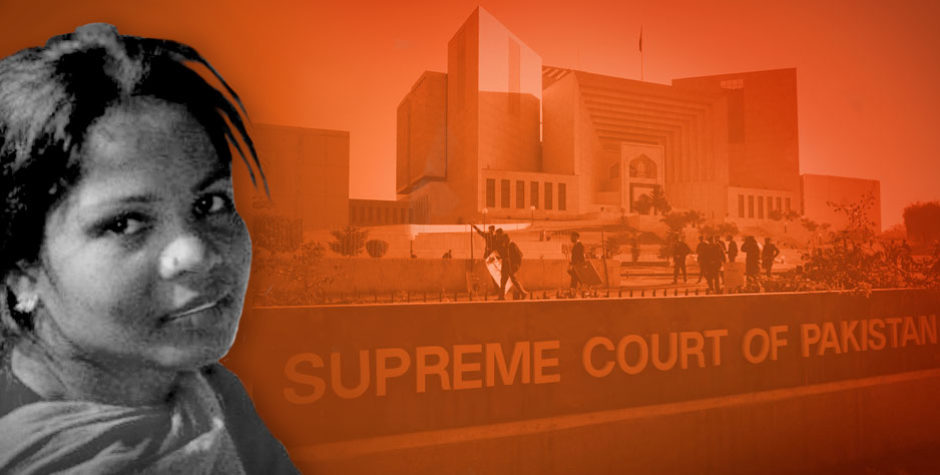
While the Supreme Court decision on Aasia Bibi was a courageous step on the part of the judiciary which had hitherto delayed making any decision, its jurisprudential value is sadly weak.
On January 29, 2019 the Supreme Court affirmed the acquittal of Aasia Bibi. She had been sentenced to death on a false charge of blasphemy following a row over a cup of water. The Supreme Court acquitted her in early November 2018 but following mass protests by right wing groups the government ceded to demands that she would not be let free until a review petition was filed by the complainant. And thus an innocent woman continued her ninth year in prison because certain pressure groups felt it was more important that she should be punished on a false charge of blasphemy than acquitted through a free and fair trial.
Globally the decision was viewed as a progressive step in a country otherwise awash with mullahs baying for the blood of religious minorities. The blasphemy laws were introduced by General Zia in 1986 when he ushered in rapid Islamisation to appease the mullahs while quashing existing political parties. He promulgated five provisions relating to blasphemy and other offences against religion, and made various changes to the Pakistan Penal Code and the Law of Evidence to the detriment of non-Muslims and women.
Over sixty years of state appeasement and the patronage of the military and the judiciary have emboldened Pakistan’s religious groups. While their electoral support has not increased the religious right wing have a clear strategy to infiltrate every sphere of civil life and spread fear through the threat of religious sanctions.
For example in a large proportion of blasphemy cases, the complainants are religious scholars, leaders of mosques or members of religious parties. One man, an executive member of Anjuman-e-Khatam-e-Nabuwat, has been the complainant in six cases. In the Aasia Bibi case, again, the complaint is filed by an Imam from the local mosque. As is noted in the judgment, since 1990, 62 people have been murdered, Christian communities have been set afire and various riots have taken place as a result of blasphemy allegations. While there is no accurate data on the number of blasphemy-related cases registered in Pakistan since 1986, data provided by human rights organisations show that around 1500 people have been charged under blasphemy laws from which nearly half are non-Muslims, even though they are only 3 percent of the population. Prior to 1986, only 14 cases pertaining to blasphemy were reported.
While the Supreme Court decision was a courageous step on the part of the judiciary which had hitherto delayed making any decision, its jurisprudential value is sadly weak. The judgment does not only deal with whether Aasia Bibi was guilty or not. It went further. The main author, Hon Justice Mian Saqib Nisar, spent a large part of the judgment in pointing out the utility of blasphemy laws in protecting the sentiments of Muslims. When reading the judgment, there is an inescapable feeling that in order to appease the bigots, the judgment justifies the current laws on blasphemy and also couches the law within the wrong historical context.
The Aasia Bibi judgment makes an attempt to provide some historical context to the origin of blasphemy laws. In 1927, a Hindu publisher Raj Pal, published a pamphlet offending the Muslim community. He was initially convicted under section 153-A of the Indian Penal Code for causing “enmity” between “different [religious] groups” but was later acquitted by the High Court. Following this decision, there was an outbreak of violence. In order to pacify the protesters, the British government enacted section 295-A of the Indian Penal Code. The law punished “deliberate and malicious acts” to “insult” religious beliefs. The object declared that the “act is the outcome of the present day Hindu Muslim tension.” The British government enacted legislation as a way to overcome communal tensions but restricted the law to be invoked by the administration alone to prevent its misuse.
These pacifying legislative measures by the British did not put an end to the anger of those who vowed to take revenge from Raj Pal. Two attempts were made on his life. Finally in 1929, a young man, Ilam Din, stabbed Raj Pal to death. Ilam Din was convicted and awarded death penalty. Muslims of the subcontinent are often urged by Muslim clerics to follow Ghazi Ilam Din Shaheed (the martyr) by killing those who say something offensive about the Holy Prophet (PBUH).
At the time of the creation of Pakistan almost 23 percent of Pakistan’s population was non-Muslim. Today, the proportion of non-Muslims has declined to approximately 3 percent.
The Aasia Bibi judgment contains a glorifying reference to Ilam Din as “Ghazi” and “Shaheed” which is worrying in the current climate. What comes to mind is the recent lynching to death of Mashal Khan by college students, the murder of Governor Taseer by his own bodyguard, the murder of pregnant Shama and Shahzad Masih who were burnt alive and the TLP calling upon its followers to claim martyrdom by shooting down the judges who acquitted Aasia Bibi.
The most urgent need at this time is to quell the atmosphere of impunity and cruelty against those who are already marginalised. In describing the origin of section 295C, the main judgment states:
The Muslim communities that exist around the globe have always acted against any such act of contempt and have openly reacted to such, followed by serious repercussions. That is why anything which in any way attacks any aspect of his sacred life, infuriates Muslims to an intolerable limit, resulting in extremely serious law and order situation, with grievous, disastrous consequences. That is why Section 295-C had to be enacted to bring such contemners before the Court of Law.”
The judgment reasons that Section 295-C was promulgated so that contemnors are brought before a court of law and so arguably not lynched to death. Clearly this is not the case. Prior to 1986 there were only a handful of reported cases relating to blasphemy and no such incidents of mass lynching, murder and rioting as we see every few months now. The law has become an instrument of persecution not protection.
While the judgment fairly criticises those who attempt to misuse the law, the fact that the law itself is a precursor to the strategy of fear is ignored. The note by Justice Khosa is hard on those who misuse the law but again is quiet about the law itself — it only describes blasphemy as a “serious offence”.
The idea that Pakistan was created to allow a religious minority of India greater freedoms is ironic given the treatment meted out to religious minorities since its creation. The persecution and migration of religious minorities not only reflects Pakistan as an intolerant society but also diminishes the vibrancy and progression of a society that comes with religious and ethnic diversity. The atmosphere of fear stifles any debate. Eventually, one can hope that the political leadership of Pakistan also musters the courage and honesty to address the atmosphere of cruelty and dread that religious minorities have to live in.

#Pakistan - #ArmanLoni - Silence over rights’ activist death - #StateKilledArmanLoni

Barring the exception of the Pakistan Peoples Party, the country’s political leadership has remained silent over the suspicious circumstances surrounding the death of Ibrahim Arman Loni, a rights activist.
This is condemnable, particularly on the part of the ruling Pakistan Tehreek-e-Insaf (PTI).
Loni was a senior leader of civil rights group Pashtun Tahaffuz Movement. He and others had staged a sit-in in Loralai against unabated incidents of violence in the region as well as alleged attempts by the authorities to force locals to vacate their homes and leave the area in the wake of the January 29 attack on the office complex of the Zhob Range DIG that claimed nine lives, including that of three policemen.
The protest had just ended when, according to MNA Mohsin Dawar, a police team raided the site and tried to arrest Loni and others. In the ensuing confrontation, the police party allegedly resorted to violence, leading to Loni’s death.
Early last year, PTM had emerged as a movement of young Pashtun activists, including Loni, after the extrajudicial killing of Naqeebullah Mehsud. These youngsters have since organised multiple gatherings, where they have put forth their grievances, some of which concern alleged excesses committed by state personnel. It is unfortunate for this country that even after the passage of a year, the elected leadership has made no serious efforts to engage these youngsters in a dialogue. Two PTM leaders who have made it to the National Assembly are frequently seen as raising their voice on extrajudicial killings and alleged highhandedness of security and law enforcement personnel during raids among other issues. However, neither the ruling party nor the mainstream opposition is ever seen making a concerted effort to engage with them. The policeman accused of extra judicially killing Naqeebullah has yet to be indicted of charges.
In these circumstances, the death of a senior member of the civil rights group was not an occasion that should have been treated lightly by the elected leadership. By Sunday evening, Pakistan Peoples Party chairman Bilalwal Bhutto Zardari was the only mainstream politician to have expressed his condolences to the aggrieved family and to condemn the suspicious circumstances surrounding Loni’s death. No one from the central leadership of the PTI or the Pakistan Muslim League-Nawaz (PML-N) came forward with a similar statement.
This has rightly enraged many on social media platforms, including Pashtun youngsters who have complained that alleged excesses of law enforcement agencies are noticed when they take place in cities of the Punjab or urban Sindh, but not when committed in Baloch or Pashtun populated remote areas of Balochistan and Khyber-Pukhtunkhwa. The elected leadership must understand that the burden to prove this perception as incorrect lies on them. They have expressed extreme insensitivity and lack of empathy by not having noticed the incident. They must not waste any more time, and order an inquiry which must be to the satisfaction of the aggrieved party. The policemen accused of the crime must be suspended until the inquiry has been completed. Notice must also be taken of attempts by state personnel to prevent PTM leaders from attending Loni’s funeral prayer on Sunday. These are the bare minimum efforts the elected leadership needs to undertake to restore its trust in the eyes of all those who are grieving the loss of the activist’s life.
The absolute lack of coverage of events surrounding Loni’s death by the electronic media is also highly condemnable. It has once again raised serious question marks over the integrity of TV journalism as well as the claims of a free press by Information Minister Fawad Chaudhry. How can a free press ignore the death of an activist allegedly from police assault?

EDITORIAL: #Pakistan - Extremism hasn’t gone away


The authorities in Islamabad must not forget that they have been able to return Asia Bibi her freedom, after an unjust incarceration of nine years, at the cost of her security. She got back her freedom on the condition that she would have to leave her homeland, and live in exile for the rest of her life. That’s a failure of state institutions designated with the task of providing security to the citizens.
Meanwhile, the flawed set of laws under which Bibi was denied her freedom, and that have been responsible for the plight of many other Pakistani citizens remain unreformed. Alongside, the extremist mindset that dehumanizes others who may have different opinions and beliefs, leading to perpetuation of violence against marginalised social groups also continues to flourish. Despite the fact that state institutions have managed to crack down on the top leadership of the Barelvi extremist outfit Tehrik-e-Labbaik Pakistan (TLP), the popularity of the group and the organisational capabilities of its middle-tier leadership remain intact. This was on display last week in protests in Karachi following the Supreme Court’s dismissal of the review petition. Several arrests were made after the participants turned to violence, damaging private as well as public property.
The Pakistan Tehrik-e-Insaf (PTI) government has yet to come up with a plan to deal with barelvi strand of extremism, and the worrying aspect of its popularity among a segment of the country’s population. Perhaps, the problem is that the leadership of the ruling party, like other mainstream parties, has yet to fully recognise extremism as a problem. This was evident in PTI leaders posturing during the election campaign. Taking a leaf from other mainstream parties’ books, PTI chairman Imran Khan, who now holds the office of Prime Minister, had attended a gathering organised by barelvi extremists in the hope of wooing votes. In the past few months, even the top leadership of unelected state institutions was seen photographed with extremists in private gatherings.
This raises serious question marks over the presence of political will to tackle the challenge posed by extremism. Ostensibly, it seems that the state has come to terms with the social support of the far-right religious lobby, whose political narrative revolves entirely around the country’s blasphemy laws. Even though it should have no bearing on the state’s duty to prevent the law’s abuse, but it must be reiterated that this law dates back to the days of the colonial administration, and has no grounding in classical Islamic jurisprudence. Thus, the state concerns itself with the barelvi far-right, it seems, only in moments when the group/s pose a threat to its sovereignty. This is a deeply flawed approach because it ignores the fact that those momentarily challenges become possible only because the group/s has free rein to spread its extremist ideology in the society. An effective approach will be to regulate activities of religious groups, including those of the barelvis, and not letting them indulge in hate speech against minority communities, or glorify terrorists like Mumtaz Qadri. Alongside, blasphemy law will have to be reformed to prevent its abuse.
The state also needs to rethink its strategy in dealing with the top TLP leadership. Instead of keeping them on remand, it would be more effective to bring charges against them and to get them punished for incitement to sedition and violence. This will send a clear message to the extremists, and set a precedent to be followed if the need arises in future.

Asia Bibi’s lawyer Saif-ul-Mulook fears for his life and is seeking European passport to escape Islamist protesters


  • Mulook fled to the Netherlands last November after violent protests erupted over the Pakistani Supreme Court’s decision to overturn Bibi’s death sentence from 2010.
The Pakistani lawyer who secured the acquittal of a Christian woman facing the death sentence for blasphemy is himself seeking protection from European governments, his French lawyer said on Friday.
 Saif-ul-Mulook has been targeted by death threats since his the spectacular acquittal of his client Asia Bibi, a labourer from central Punjab province on death row since 2010.
“He is hoping that people will take into account his heroic actions in defending Ms Bibi, given the current circumstances in Pakistan, which led him to exchange his freedom for hers,” Mulook’s lawyer Francois Zimeray said.
“He does not want to seek asylum, but rather to ask for European nationality,” Zimeray said.
Mulook fled to the Netherlands last November after violent protests erupted over the Pakistani Supreme Court’s decision to overturn Bibi’s death sentence from 2010.
He returned to Islamabad on January 26 to defend Bibi as she faced another appeal of the Supreme Court’s decision, which was rejected on Tuesday.
Bibi, who has been detained in protective custody, is expected to leave Pakistan as well to seek asylum in a North American or European country, and unconfirmed reports have said her children are already in Canada.
The country’s foreign ministry confirmed on Thursday that Bibi was free to leave the country after her years-long legal ordeal, which drew worldwide attention to religious extremism in Pakistan.
Even unproven accusations of blasphemy in Pakistan have caused lynchings and murders.
Religious groups have said “they would kill her despite the judgment of the Supreme Court,” Mulook said after the court’s decision Tuesday. “Therefore, I think she should leave the country.”

After reaching out to Mirwaiz, Pakistan foreign minister now calls Hurriyat’s Geelani


Foreign Minister Qureshi and the Hurriyat leader discussed an international conference to be held in London to express solidarity with the people in Kashmir.
In yet another provocative move, Pakistan Foreign Minister Shah Mahmood Qureshi spoke to hardline Hurriyat Conference chairman Syed Ali Shah Geelani and discussed the Kashmir issue, the Foreign Office said here on Sunday, days after he made a similar phone call to a separatist leader that angered India.
The Foreign Office in a statement said that Qureshi and Geelani discussed about an international conference to be held in London to “express solidarity with the Kashmiri people”.
“Foreign Minister Qureshi spoke to the senior leadership of the All Parties Hurriyat Conference on telephone before his departure for London to attend international activities to be held there in connection with the Kashmir Day, the statement said.
Qureshi on Tuesday telephoned Hurriyat leader Mirwaiz Umar Farooq and discussed with him Islamabad’s efforts to highlight the Kashmir issue.
India Wednesday summoned Pakistan envoy Sohail Mahmood and categorically told him that Qureshi’s telephonic conversation with Mirwaiz was a “brazen attempt” to subvert India’s unity and violate its sovereignty and territorial integrity.
India said that Qureshi’s telephonic conversation with a separatist leader reflected the duplicity in Pakistani leadership’s approach on ties with India.
The Pakistan Foreign Office on Sunday said Qureshi exchanged views with Geelani about the programmes to be held in London.
The foreign minister will speak at the International Kashmir Conference at the British Parliament on Monday. On Tuesday he will also attend the exhibition at the Park Lane in connection with the Kashmir Day, it said.
Talking to media in Multan on Saturday, Qureshi said Pakistan has no intention to interfere in India’s internal matters and New Delhi should not make an issue out of his telephonic conversation with Kashmiri separatist leader Mirwaiz.
Qureshi said that Pakistan has no intention to interfere in the internal matters of India, but New Delhi should also stop blaming Islamabad for its problems.
“We want to resolve the Kashmir dispute through dialogue but India is making undue hue and cry,” Qureshi said.
“Issues are emerging in India but Pakistan has no role in that,” he said.
Qureshi said that he would highlight Pakistan’s view point on Kashmir issue at an event in the House of Common in London this week.
The Foreign Office also issued Qureshi’s statement before his departure to London in which he was quoted as saying that Kashmir is an “important pillar” of Pakistan’s foreign policy.
Pakistan will continue its support for the oppressed Kashmiris on political, moral and foreign levels and want resolution of the Kashmir dispute in accordance with the UN resolution, he said.
India gets annoyed if the Kashmir issue is highlighted despite the fact that it is a resolvable issue. The real face of India would be exposed by presenting Pakistan’s point of view on the issue in the international conference being held on Kashmir in London at the House of Commons, he said.
He said regardless of the political party winning the next election in India, Pakistan would reciprocate to the new government’s good gesture in New Delhi.
India has made it clear to Pakistan that talks and terrorism cannot go together. -PTI

Saturday, February 2, 2019

Video Report - #YellowVests #LesGiletsJaunes #Macron ‘Bad joke?’ Macron says he’s a Yellow Vest too...

Video Report - - #YellowVests #France #GiletsJaunes ‘Gilets jaunes' hold 12th weekend of protests, denounce police violence

Video Report - #YellowVests #France #GiletsJaunes Act 12: Yellow Vests march through Paris honoring injured protesters

Video Report - #VirginiaGovernor - Lemon: This is more than dumb, this is racist

Video Report - Erin Burnett: One of these people is the governor of Virginia

Music Video - Inhi Logo Ne Le Liya Dupatta Mera

Music Video - Chalte Chalte Yunhi Koi Mil Gaya Tha ( Pakeezah)

#Afghanistan - Peace Talks with Taliban from a realistic perspective


By Ahmad Shah Katawazai 

False hopes and beautiful but artificial news cannot win the war. War can only be won by facing the reality and embracing the unavoidable risks. Afghanistan with the current complexity of the war, United States impatience to remain in the country, competing interests of the major powers and its neighbors, lack of balance of power, and its important but fragile geo-strategic location, is faced with dangerous situation ever.
Afghan government and some idealist have been beating the drums of harbinger of peace, citing the three days ceasefire in June, 2018, and the current peace efforts. But, the fact is that peace still seems too distant. On one hand Taliban don’t have a united front, rather they are divided into various factions while on the other hand both Afghan government and International Community has been raising concerns about the presence of around 20 different terrorist groups in the country. As of now there has been conversation about starting peace negotiations with one insurgent group, i.e. the Taliban. Thus, Peace talks are not likely to yield long term result or an end to the ongoing insurgency. Terrorist groups like ISIS, hardcore Taliban, and other terrorist groups present in the country will continue fighting.
Unfortunately, strategists and politicians have failed to grasp the precision and reality found in the chemistry of the country. Afghanistan lavish mineral resources worth trillions of dollars are important for the world. Countries like China, U.S. and Russia have eyes on these resources. Russia in the 1970’s and the US recently surveyed Afghanistan’s mineral resources, where both found that the country has widespread untapped resources. While China signed a million’s dollars agreement to mine copper in the east of Kabul.
Similarly, Afghanistan geo-strategic location is important for influence and control of the region for various countries particularly major powers like China, Russia, and the United States. Due to its strategic location, the country has been used by various empires of the time for influence and invasions. Currently, major powers like China, Russia, and the United States have maintained their rivalry in the region in order to increase their influence especially since September 11.
Hobbesian culture defines international system in anarchical terms; it implies power competition and a perpetuation of the images of mutual enmity held by neighbors. Afghanistan has been fighting an undeclared war by Pakistan from decades while on the other hand the country has been fighting neighbor imported or transferred wars too. For instance, India and Pakistan have been able to transfer its Kashmir war into Afghanistan. Pakistan and India have been fighting each other in Afghanistan through their proxies. With the emergence of ISIS, Afghan war has stretched to Syria and Middle East. Where fighters are imported from Middle East. Most of ISIS attacks on Shittie minority in Afghanistan are linked to war in Syria. Iran has been perpetuating its agenda of instability by providing weapons to the Taliban insurgents, in order to give tough time to the U.S. in Afghanistan.
Afghanistan situation is best defined by the Greek historian Thucydides statement “the strong do what they can and the weak suffer what they must.” As long as Afghanistan remains weak, the country will be faced with competing and often conflicting interests of various powers.
Afghanistan needs a long-term strategy and a rational approach through which peace could be achieved from a position of strength and force by bringing a relative balance of power. So better the peace process is kept on the back burner and more focus is made on strengthening the country security situation, armed forces, institutions, and economy.
It is time the self-proclaimed patriots come out of their ivory tower and learn to make a realistic appraisal of the ground realities. The country needs to rely on a balanced diplomacy aimed at reducing enemies rather than increasing them. Considering the dangers on the horizon, Afghanistan should have a more successful long-term strategy. With the presence of the U.S. and NATO forces and majority of the world countries supporting Afghanistan, here is the widest window of opportunity to stabilize the country. Realism is about “if you want peace, prepare for war,” mindset. Afghanistan being in the conflict zone should be more realistic in its policies. National interest of the country should comprehend hard security terms and maneuvering for its stability, irrespective of normative concerns like morality.
The current Afghanistan security apparatus outlook is a classic case of the tail wagging the dog. Security sector has been in the hands of incapable leadership that further add to the problem. Security policy drives overall foreign policy rather than the other way around. Only a strong and committed security sector leadership that can stabilize and help the ANDSF stand on its feet in accordance to the need of the day will result in a long-term stability, thus boosting economic development and prosperity of the country.
This week two experienced and professional’s individuals Assadullah Khalid and Amrullah Saleh were nominated as Defense and Interior Ministers respectively. Though critics have linked their nomination as a setback to the peace talks because of their anti-Pakistan and anti-Taliban stance and a presidential campaign tactic by President Ghani. However, long-term peace can’t be achieved from a position of weakness. If not victims of short-term politics and are left for a long term in the security sector, both Khalid and Saleh can bring robust reforms and garner the support of donor countries especially the United States, where their links are deep rooted. Hope the leadership leaves the security sector up to its business independent of politics and neighbor influence.

When America gives up on Afghanistan, its women will pay


 By Phyllis Chesler
President Trump’s call for a withdrawal from Afghanistan raises a troubling question: Is the West morally obliged to persist in a struggle that can’t be won? How much blood and treasure must we spend to save the victims of barbarism?
No one, after all, has ever been able to conquer or transform Afghanistan. It’s a losing game. But once the United States leaves, young girls and women will be at the mercy of ruthless religious fanatics.
I should know: I was once a bride, trapped in Kabul in the early 1960s. I saw great natural beauty there and experienced uncommon graciousness. But I also saw gender and religious apartheid up close.Although I lived in fairly posh purdah (seclusion) in a home with servants, I’d entered a medieval world of women in burqas, polygamy, child marriage, honor-based violence, honor killing, epidemic but denied pederasty, heartbreaking poverty, infidel-hatred and religious fanaticism. Back then, despite some extraordinary books about Afghanistan, Westerners knew virtually nothing about the country’s warrior culture, continuous feuds, vigilantism and woman-hatred.With the rise of the Taliban, particularly after 9/11, Americans learned that Afghan women were publicly beaten if their burqas slipped and an ankle or a strand of hair showed and stoned to death for alleged adultery when raped.Husbands and mothers-in-law humiliated and enslaved wives and sometimes tortured them to death. We saw that violent domestic abuse was considered normal and women routinely committed suicide as their only way out.American women felt compelled to speak out. Former first lady Laura Bush cited “the brutal treatment of Afghan women shuttered in their homes, forbidden to go outside.” Women, she noted, “were punished for laughing. Girls were forbidden to attend school.”Feminists took to the airwaves and organized rallies denouncing the Taliban. Western social workers, physicians, aid workers, activists and authors flocked to Afghanistan. Some were assassinated.
Yet Afghan lives were also saved — and improved. According to Mrs. Bush, enrollment of girls in primary school had jumped from 5,000 under the Taliban to nearly 2.5 million by 2016. More than 120,000 have graduated from secondary school. There are now over 3,000 women-owned businesses. Women hold important positions in local and national government.
Women for Afghan Women, too, reports that since 2001 it has educated and protected more than 1 million Afghan women.
Of course, America and our allies did not invade Afghanistan for the sake of women’s rights. It did so in our pursuit of Osama bin Laden, who had been given shelter by the Taliban. Now bin Laden is dead, yet we are still in Afghanistan.Too many American soldiers have been killed (2,400) and wounded (20,320) — not to mention the more than 100,000 Afghan civilians dead and wounded. Trillions have been spent on this new kind of religious war, which has us fighting soldiers without uniforms who hide behind civilians and propping up corrupt and incompetent leaders who cannot unite their own warlords.
It can’t go on. Trump now seems determined to withdraw, though the country remains divided, chaotic, corrupt, volatile and a haven for terrorists. Lingering to forge and implement a peace treaty with the Taliban is probably a lost cause, no different than brokering a treaty with ISIS, Boko Haram, Hezbollah or the Palestinian Authority.

I’m no military strategist. But I do fear for the Afghan people, particularly women and young girls, if and when America leaves — especially those who have shown so much courage in standing up for themselves against incredible odds.
We simply aren’t going to be able to airlift every last girl, woman and dissident to freedom. (Would they all even want to leave?) Nor is there any nearby safe enclave to which they could flee.
No, America’s departure will be a monumental tragedy for Afghan girls and women. The moment the last boot-on-the-ground departs, the Taliban and assorted paramilitary groups will torch every existing shelter for battered women and school for girls. Unrelenting fear will become the order of the day.
Still, there may yet be some way to find at least a measure of safety and dignity for those left behind. Pray we do: It might be our greatest triumph there of all.

Video - StateKilledArmanLoni - Rights activist Wranga Lonai on the killing of her brother & human rights defender #ArmanLoni

Amnesty International Calls On #Pakistan To Disclose Location Of #Pashtun Rights Campaigner

Global rights watchdog Amnesty International has called on the Pakistani authorities to disclose the whereabouts of a Pakistani human rights campaigner documenting grave rights abuses in northwestern Pakistan’s Pashtun belt, where the military fought a long war against Islamist militants.
“We are concerned about reports of the disappearance of PTM activist Alamzaid Khan Mehsud,” Amnesty International Deputy South Asia Director Omar Waraich said on January 21. “His whereabouts must be disclosed immediately. Either produce him in court or release him without delay.”
Waraich said Mehsud was picked up at Pakistan’s southern seaport city of Karachi early on January 21.
“Other PTM activists with him were allegedly beaten up,” Waraich said while referring to the Pashtun Tahafuz Movement, a civil rights movement demanding security and rights for Pakistan’s more than 30 million ethnic Pashtuns, who make up the largest ethnic minority in the country of 200 million people.
“Freedom of peaceful assembly must be protected. Activists must never be attacked,” he said.
Mehsud was a prominent PTM activist. He often shared videos and posts on his Twitter and Facebook accounts that documented human rights abuses such as enforced disappearances, illegal killings, and landmines.
#ReleaseAlamZaib emerged as a top Twitter trend in Pakistan on January 21.
Karachi police have not commented on Mehsud’s disappearance, but a widely circulated video on social media showed him talking to uniformed and plainclothed police officers, some of them drawing handguns, before his detention.
Police and other government officials in Karachi could not be immediately reached for comment.
A January 20 police report in Karachi, however, nominated Mehsud and 15 other PTM activists to be investigated under terrorism laws after holding a major protest in Karachi the same day.
The PTM, active for almost a year now, has held dozens of major protests across Pakistan to demand that Pakistani security forces probe alleged extrajudicial killings, present thousands of victims of enforced disappearances before courts, and end harassment and aggressive searches at check posts and in the restive Pashtun homeland along Pakistan’s western border with Afghanistan.
Mehsud particularly focused on the victims of landmines. Clearing the unexploded ordinances from North and South Waziristan tribal districts and other regions of northwestern Khyber Pakhtunkhwa Province is a major PTM demand.
The movement has also called for a truth and reconciliation commission to probe Islamabad’s role in the country’s more than decade-long domestic war on terrorism.
More than 50,000 Pashtun civilians were killed and more than 6 million were displaced in militant attacks and military operations that first began in 2003.

د پښتون ژغورنې غورځنګ مرکزي غړی ارمان لوڼی ووژل شو #StateKilledArmanLoni


د فرورۍ د دویمې په ماښام د بلوچستان په لورالايي کې د پښتون ژغورنې غورځنګ د مرکزي کمېټۍ غړی ارمان لوڼی د پولیس په مبینه تشدد کې وژل شوی دی.
نوموړی په یاد ښار ګوټي کې له څلور ورځنۍ دهرنې ختمېدو وروسته له ملګرو سره روان وو چې په لاره ورته پولیس ولاړ وو او دی یې ونیوه.
له ارمان لوڼي سره په دغه وخت موجود قیوم اتمانخیل مشال راډیو ته د سترګو لیدلی حال داسې بیان کړ ، “ په لاره راته ایس پي (د پولیسو ضلعي مشر) ولاړ وو چې ورسره ګڼ شمېر پولیس واله وو او سپینو جامو کې ورسره د نورو ریاستي ادارو اهلکار هم موجود وو. کاغذونه ورسره وو، ارمان ته یې ګوته ونیوله او وې ویل چې دغه دی. پولیس واله د مشین په بټ (کونداغ) ارمان په سټ وواهه، هغه په سړک ولویده، موږ ورته غږونه وکړل چې ارمانه څه درباندې وشو خو هغه خبرې نه شوې کولای. بیا مو په موټر کې هسپتال ته یوړه خو هغه وفات شوی وو.”
محمد ابراهیم ارمان د وړانګې لوڼۍ ورور وو او د کوټې په ډګري کالج کې د پښتو ژبې استاد وو.
ارمان او وړانګه دواړو د پښتون ژغورنې غورځنګ په هلو ځلو او جلسو کې د ګډون لپاره د هېواد د بېلا بېلو سېمو سفرونه کړي. ارمان لوڼي د دې غورځنګ د جوړیدو راهیسې په دې کې فعاله ونډه درلوده.
نوموړی د پښتونخوا ملي عوامي ګوند فعال غړی وو.
د پښتون د ژغورنې غورځنګ مشر منظور احمد پشتین بیګا د فېس بک په خپله رسمي پاڼه د دې پېښې تصدیق وکړ او لیکلي یې دي چې ارمان لوڼی د پولیس د تشدد پر مهال ژوند له لاسه ورکړ.
مشال رېډیو په دې لړ کې د لورلاي ضلعې د پولیسو له مشر عطاء الرحمان سره رابطه وکړه خو هغه په دې اړه له څه ویلو ډډه وکړه.
په لورالايي کې د پښتون د ژغورنې غورځنګ یو مشر اېډووکېټ صادق خان علیزی وايي د خالي په ماښام دوی خپله څلور ورځنۍ درنا یا پرلت ختم کړ خو له دې وړاندې هم څو وارې پولیسو په زور د دوی د احتجاج ختمولو هڅه وکړه. نوموړی وايي:
ده وویل ، “ موږ دا مطالبه کوو چې ایف آيي ار دې وشي او په دې کې ککړ کسان دې ګرفتار کړل شي. په هغوي دې په یوه هفته کې دننه مقدمه وچلول شي او سزا دې ورکړل شي. موږ د خپلو مشرانو سره په رابطه کې یو. ځايي قبایلي او سیاسي مشران به هم راغونډیږي او بیا به مشوره کوو. باقي کسان معلوم دي چې په دغه موقع د پولیس کوم اهلکاران موجود وو نو هغوي دا کار کړی دی.”
د یادونې ده چې پښتون د ژغورنې غورځنګ په لورالايي کې دا پرلت د جنورۍ پر ۲۹مههلته د پولیسو د ډي آی جي پر دفتر د هغه برید پرضد پیل کړی وو چې نهه کسان پکې وژل شوي او ۲۱ نور ژوبل شوي وو. د برید زمه واري بیا تحریک طالبان منلې وه.
د هغه برید ضد روان پرلت والو غوښتنه کوله چې د دې برید حقایق دې معلوم او په ډاګه کړل شي او په اینده کې د ترهګر بریدونو د مخنیوي لپاره دې کوټلي ګامونه پورته کړل شي

پشتون تحفظ موومنٹ کے رہنما ارمان لونی پولیس گرفتاری کی کوشش کے دوران ہلاک #StateKilledArmanLoni

پاکستان کے صوبہ بلوچستان کے علاقے لورالائی میں پشتون تحفظ موومنٹ کے ایک رہنما ابراہیم ارمان لونی پولیس کی گرفتاری کی کوشش کے دوران ہلاک ہو گئے ہیں۔
پشتون تحفظ موومنٹ لورالائی کے رہنما جلیل افغان نے فون پر بی بی سی سے بات کرتے ہوئے الزام عائد کیا کہ وہ پولیس کے تشدد کی وجہ سے ہلاک ہوئے۔
ان کا کہنا تھا کہ لورالائی میں ڈپٹی انسپیکٹرجنرل پولیس کے دفتر پر شدت پسندی کے واقعے کے خلاف پشتون تحفظ موومنٹ کے کارکنوں چار دن سے پریس کلب لورالائی کے باہر دھرنا دیا ہوا تھا ۔
جلیل افغان کے مطابق دھرنے کے بعد ابراہیم ارمان لونی دوسرے ساتھیوں کے ہمراہ پارک میں چائے پی رہے تھے کہ وہاں پولیس اہلکار آئے ۔
انہوں نے دعویٰ کیا کہ انہوں نے پولیس اہلکاروں کو بتایا کہ وہ جتنے بھی کارکنوں کو گرفتار کرنا چاہتے ہیں ان کے بارے میں بتائیں وہ خود گرفتاری دینے آئیں گے لیکن پولیس اہلکاروں نے ابراہیم ارمان لونی پر تشدد کیا ۔
ان کا کہنا تھا کہ پولیس کے تشدد کی وجہ سے ابراہیم ارمان لونی کے سر پر چوٹ آئی جس کے نتیجے میں وہ ہلاک ہو گئے۔
تاہم رابطہ کرنے پر لورالائی پولیس کے ایک سینئر اہلکار نے بتایا کہ پوسٹ مارٹم رپورٹ آنے کے بعد یہ معلوم ہوسکے گا کہ ان پر تشدد ہوا ہے یا نہیں ۔
درایں اثناء کوئٹہ سے گرفتار ہونے والے پشتون تحفظ موومنٹ کے چھ کارکنوں کو سات یوم کے ریمانڈ پر پولیس کے حوالے کیا گیا ہے ۔
پشتون تحفظ موومنٹ کے چھ کارکنوں کو کوئٹہ شہر میں لورالائی میں شدت پسندی کے واقعے کے خلاف مظاہرے کے دوران گرفتار کیا گیا تھا ۔
ان کے خلاف لوگوں کو ریاست کے خلاف اکسانے، مختلف طبقات کے درمیان نفرت پیدا کرنے اور کار سرکار میں مداخلت سمیت دیگر دفعات کے تحت مقدمہ درج کیا گیا ہے۔
https://www.bbc.com/urdu/pakistan-47104197

Asia Bibi ruling to send message to all of Pakistan


   By Marcus Jones

It's hoped the Supreme Court's refusal to back down in its decision to acquit Asia Bibi will send out a strong message across Pakistan.
The Christian mother was told this week she was free to leave the country, several months after she was cleared of blasphemy.
Extremists, unhappy at her acquittal last year, had petitioned the court to overturn its verdict and send her back to prison for execution.

Pakistan's Chief Justice Asif Saeed Khan Khosa said in court that Ms Bibi's accusers were guilty of perjury and if the case had not been so sensitive, they should have been jailed for life.
"The image of Islam we are showing to the world gives me much grief and sorrow," Mr Khosa said.
Welcoming the verdict in an interview with charity Aid to the Chruch in Need, Father Emmanuel 'Mani' Yousaf (pictured below), National Director of the Church-run National Commission for Justice and Peace, which provides legal for blasphemy victims called on legal professionals across Pakistan to take note.
"The decision by the Supreme Court means that the lower courts should have the courage now to think twice about handing down the death sentence," he said. "God bless the judges. They had received threats and yet they knew that Asia Bibi was falsely accused and were strong enough to say so."
Asia Bibi, who was in prison for almost a decade, has reportedly fled Pakistan.
"Every one of us is so happy for her," Father Emmanuel said. "Especially when the attention of the world is focused on Pakistan, it is wonderful to see the country stand up for justice."
https://www.premier.org.uk/News/World/Asia-Bibi-ruling-to-send-message-to-all-of-Pakistan

Imran Khan cannot play Trump in #Pakistan. - Imran Khan and parliamentary system


  • A square peg in a round hole creates problems
Imran Khan wants to rule like President Trump who is not obliged to attend the Congress and is free to induct or kick out heads of government  departments  at will.  Imran Khan  is required instead to act like the PM in a parliamentary democracy who along with his ministers is answerable to Parliament. This irks the PTI chief.
The way the PTI government is functioning exposes Imran Khan’s disdain for parliamentary form of government. He remains mostly absent from NA sittings despite an earlier undertking to respond to MNAs’ questions every week during what was supposed to be the “PM’s hour.”
Imran Khan holds cabinet meetings too frequently which  the ministers are obliged to attend even if  they have to  neglect parliamentary committees where they are required to defend government policies.  In the latest incident   of the sort Asad Umar and the entire team of the finance and revenue  divisions absented themselves from a scheduled meeting of the Senate Standing Committee on Finance. This led  the Senate panel to reject three key proposals in the  finance second amendment bill 2019.
The country  is being run by the PM and his kitchen cabinet from Islamabad. The Punjab and KP are  being micromanaged by the PM with the help another team of confidants directly from Banigala. The parliament and two  provincial  assemblies have thus been made redundant. Attempts are now in the offing to conquer Sindh that remains outside the kingdom. PTI MPs are being told to demand  the resignation of chief minister Murad Ali Shah despite the PPP enjoying an overwhelming majority in Sindh Assembly. Attempts are being made to create a forward bock in the PPP’s  lawmakers. Meanwhile ways and means are under consideration to somehow or other get the 18th amendment revoked so that the center can have access to a major chunk of funds by reducing the shares of the provinces.
This has sent alarm bells ringing in Sindh. Bilawal has threatened with a long march while Zardari who  initially wanted  the PTI government to complete its tenure is predicting  the end of Imran Khan’s rule in next six months. Imran Khan cannot play Trump in Pakistan.

#PPP - Bilawal Bhutto unwilling to separate personal life from politics


Pakistan Peoples Party (PPP) chairman Bilawal Bhutto Zardari on Saturday made candid remarks over his future plans for tying the knot, saying his marriage’s impact on election results would likely decide when he would get married.
“I am considering how my marriage can help the party’s election campaign,” he said in response to a question, while addressing the media at the Karachi Press Club.
Without naming anyone, the PPP chairman said consultations were underway to decide the right time for his wedding. “Meetings are being held; should I get married once or four times one each in all four provinces … consultations is also under way to decide whether I should get married before or during election campaign.” Will marry once, unlike some other politicians: Bilawal Bhutto
Bilawal said the final decision about his marriage will be taken after receiving the findings of a report on “impact of his marriage on election results.”
This is not the first instance when the PPP chief spoke about his wedding plans. Last year, he had said that he would tie the knot just once, unlike some other politicians, who are “habitual grooms”. “I don’t wish to get married one after another like some other politicians,” he said in an apparent reference to Prime Minister Imran Khan.
Besides the tongue-in-cheek comments on political rivals, serious topics were also touched upon during his address to the journalists. The PPP chairman said the 18th Constitutional Amendment was being attacked which was “dangerous” for democracy in the country.
The amendment, made during the PPP’s last tenure at the Centre from 2008 to 2013, aimed at provincial autonomy. “We’ll use every platform to protect the 18th Amendment,” said Bilawal and vowed to stage a “long march” to protect the Constitution.

#Modi should know #Pakistan’s political parties are united on Kashmir: Zardari

Pakistan Peoples Party President Asif Ali Zardari sent a clear message to Indian Prime Minister Narendra Modi while addressing the Kashmir conference here on Saturday.
“Modi should understand that all political forces have the same stance on Kashmir,” Zardari said.
The PPP president emphasized that the government’s stance on Kashmir was also the stance of the entire nation. “I hope to see Kashmir free in my lifetime.”
“We will never forget Kashmir, we will never leave Kashmir,” he added.
During the weekly news briefing on Thursday, Foreign Office spokesman Dr Muhammad Faisal termed the summoning of Pakistan’s high commissioner political gimmickry and electioneering. “Kashmir is an unresolved issue between Pakistan and India and summoning the Pakistani high commissioner is political gimmickry,” Dr Faisal said. 
https://www.geo.tv/latest/227049-modi-should-know-pakistans-political-parties-are-united-on-kashmir-zardari

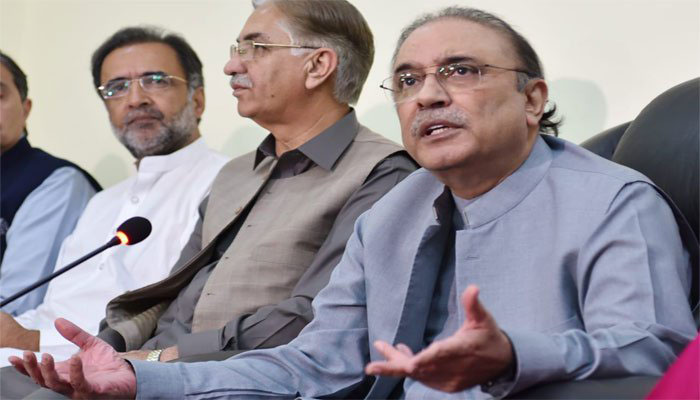
#Pakistan - #PPP - Former President Zardari called on ANP leader Ghulam Ahmed Bilore

 Former President and President Pakistan Peoples Party Parliamentarians Asif Ali Zardari called on Awami National Party leader Ghulam Ahmed Bilore at his residence in Islamabad.
Both leaders discussed political situation of the country and government’s designs with regard to 18th amendment of the constitution.
Former President said that people will suffer from the anti-people policies of PTI government. Everyone in the country is at unease due to the economic situation of the country. People are worried with the increasing cost of living, he said.
ANP leader Mian Iftekhar Hussain, Secretary General PPPP Farhatullah Babar, Secretary General PPP Syed Nayyar Hussain Bukhari and Spokesman to the former President Amir Fida Paracha, Dr. Qayyum Soomro and Humayun Khan were also present on the occasion.

Bilawal Bhutto Zardari visits Karachi Press Club and addresses ‘Meet The Press’ programme

Chairman Pakistan People Party (PPP) Bilawal Bhutto Zardari visited Karachi Press Club and addressed Meet The Press programme. Besides the office-bearers and members of the KPC and journalists, Sindh Chief Minister Murad Ali Shah, Waqar Mahdi, Murtaza Wahab, Saeed Ghani, Senator Anwer Lal Deen, Rashid Rabbani, Surendar Valasai, Aijaz Durrani, Sardar Nazakat, Shakeel Chaudhry and other party leaders were also present.

Chairman Bilawal Bhutto Zardari was awarded lifetime membership of the Pakistan’s largest and oldest Press Club by its Governing Body.


Video - Chairman PPP Bilawal Bhutto speech at an event in Karachi Press Club