Friday, November 2, 2018

#AasiaBibiVerdict - In Asia Bibi blasphemy violence, Imran Khan faces the Frankenstein’s monster


By GUL BUKHARI

 Not too long ago, Imran Khan had actively supported the violent protests against the Nawaz Sharif government.
Blasphemy accused Asia Bibi’s acquittal and final release, after more than nine years in prison, by the Supreme Court has plunged Pakistan into chaos.
The Tehreek-e-Labbaik Pakistan, a Barelvi group led by cleric Khadim Hussain Rizvi who is known for his extremely profane language and the 22-day long Faizabad Dharna of 2017, mounted protests in every major city to oppose the verdict. In video messages, the TLP leaders called for murder of the three judges on the bench that acquitted Asia Bibi, and urged Muslim generals to rebel against the ‘Qadiani’ Bajwa, a derogatory term for Ahmadis, and oust the ‘Jew’ Imran Khan.
It has been a long wait for Asia Bibi, a poor Christian woman who worked as a farm picker in Nankana, Punjab. She was accused of blasphemy and swiftly imprisoned in June 2009. In 2010, a trial court convicted her and handed out death sentence for disrespecting Prophet Muhammad. Mother of five young children, she has languished in prison since then. Her appeal was rejected by the Lahore High Court in 2014, but she finally got justice from the Supreme Court Wednesday.


Asia’s case gained international spotlight because of Pakistan’s human rights record. Just this year, the European Union tied trade access to her case.
The protests turned into grotesque rioting and arson. Schools had to shut down and many children in different cities were stuck because half of the roads were blocked by the TLP and the other half by local police.
In Karachi and two other cities in Sindh, the violence snowballed into Shia-Sunni fight with two dead in Karachi by night. Government ministers and Pakistan Prime Minister Imran Khan remained conspicuous by their absence the entire day.
Clerics of other religious parties joined the chorus with all the Deobandi, Ahle Hadees, and Barelvi groups denouncing the judgment and announcing that they will join the protests Friday onwards. These groups were joined by two major religio-political parties, the Jamiat Ulema-e-Islam (F) and the Jamaat-e-Islami.
There was no statement from the military or its Twitter-happy spokesman either. Media had been given instructions the previous night on ‘no coverage’ of any protests – and it complied. There was a complete media blackout in Pakistan for the last 48 hours. However, social media was flooded with details.
At nightfall, finally, PM Imran Khan addressed the nation. Within two months of coming to power, his five years of politics of dharna, incitement to violence, blasphemy campaigns, civil disobedience, disruption to traffic and closing down of different cities had come to bite him back. He first appealed and then threatened the TLP for its actions. Not too long ago, Imran had actively supported the TLP’s violent protests against the Nawaz Sharif government.
Social media reacted immediately, putting out clips of Imran and his ministers’ past videos of violent speeches, incitement to violence, and their supporters rampaging the Pakistan Television building and Parliament.


They asked: Has all this dawned on you only now because you are PM? Next came the video of President of Pakistan Arif Alvi. A year ago, he too was on the roads of Karachi saying, “sara karachi band hoga, koi gari nahi chalaygi”.
Ironically, Imran Khan in his seven-minute address to nation Wednesday said exactly what his government was trying to hide from the Pakistani public. In the video, the PM ended up saying what the TLP leaders had been saying all day, the things that the media had blacked out: that General Bajwa was a ‘Qadiani’ and the army should rebel, and that protesters had called for the murder of the judges. But interestingly, Imran Khan skipped any mention of him being called a ‘Jew’ and demands for his ouster.
After going MIA the whole day, Imran Khan was now threatening use of force and promised protection of life and property. But even after his speech, violence, loss of life, mayhem in schools, colleges, and markets continued all night and well into Thursday. At the time of writing this piece, the situation remains volatile with one more death reported on the Lahore-Islamabad motorway.
The politics around the issue of blasphemy that Imran Khan used incessantly during his days in the opposition has now turned into the proverbial Frankenstein’s monster. His opposition politics was clearly supported by the establishment then – clear from the way the army chief refused to come to the aid of government to control the TLP in 2017, and how a military general distributed money among the goons at the end of the ‘protest’. Imran’s opposition politics inevitably emboldened these radical voices. At that time, all the sane voices had warned against this fire of dangerous politics – but none heeded. But the fact that it would come back to haunt the nation so soon was entirely unexpected.
A reading of the historic judgment by the Supreme Court vindicates everything that human rights campaigners have asserted for years: that she was falsely accused and it was a malicious suit arising out of a dispute between a Muslim farm picker and her. The fight was over the Muslim woman refusing to drink water brought by her because she was a Christian.


None of the earlier judgments had focused on the dispute itself, overlooking the countless holes and contradictions in the prosecution’s case. Justice Asif Saeed Khosa went far enough to say that the Muslim women committed blasphemy by disparaging Asia Bibi’s religion, book and God. For the first time any member of the legal community, no less a judge, has not only focused on this point, but also made it a part of his judgment – a point I had made in my article in 2011.
While we heave a sigh of relief over the verdict, Pakistan risks burning in the fire of religious hatred, use of religion for politics, and the clear prospect of sectarian wars.
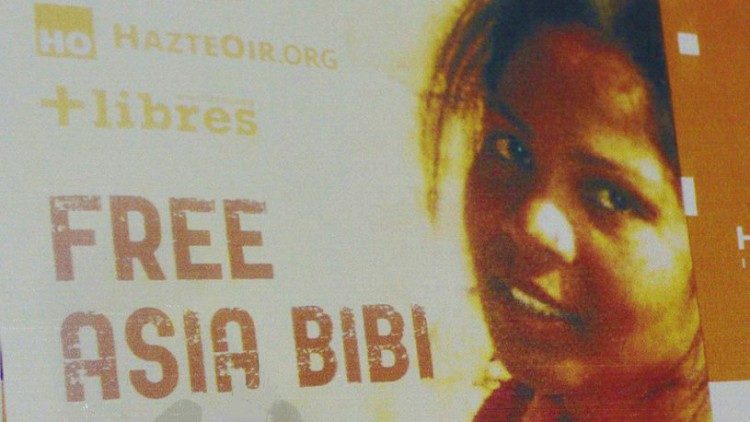
Brother says Asia won’t be safe in Pakistan

Asia Bibi, the Christian woman acquitted after eight years on death row for blasphemy, plans to leave Pakistan, her family said on Thursday.
The development followed a landmark move by the Supreme Court on Wednesday that overturned the 2010 conviction against her.
Asia remained at an undisclosed location on Thursday where the 54-year-old mother of five was being held for security reasons, awaiting her formal release, her brother, James Masih said.
Anyone can kill me, fears her lawyer
He said Asia simply would not be safe in Pakistan. “She has no other option and she will leave the country soon,” he said. Masih would not disclose the country of her destination but both France and Spain have offered asylum.
Asia’s husband, Ashiq Masih, had returned from Britain with their children in mid-October and was waiting for her to join them, the brother added.
The family is in hiding for fear of attacks by those angry at the court’s ruling, and still waiting to be reunited with Asia.
“You know my two youngest daughters were below the age of 10 when their mother went away ... They don’t remember spending much time with her,” Ashiq said.
The family has four daughters and one son, he said. “We are thankful to the court that it decided the case considering us human beings instead of any discrimination on the base of faith or religion.” He said Asia, who is about 50, has not been released from prison pending arrangements for her safety.
“She can’t be safe here,” brother-in-law Nadeem said. “You know what’s going on outside. We want things to settle down before we go ahead for her release.”
With Asia soon to be free, her family is struggling to make plans. They would prefer to leave the country to be safe, but there are plans in place.
“We haven’t got any contact yet either from Pakistani authorities or anyone from outside,” Nadeem said.
Yet, Ashiq Masih said he would be sad to be forced to leave his homeland. “We’re also part of Pakistan,” he said. “This is our country. We love it.”

Lawyer Saiful Mulook

After saving condemned Christian Asia Bibi from the gallows, her lawyer says he is facing the wrath of extremists — and wonders who will save him.
But despite the threats against him, Saiful Mulook says he regrets nothing, and will continue his legal fight against intolerance.
“The verdict has shown that the poor, the minorities and the lowest segments of society can get justice in this country despite its shortcomings,” he said after the verdict. “This is the biggest and happiest day of my life.”
Mulook said he feels he is now a sitting duck with no security or escape plan. “I think I have absolutely no safety. No security and I am the easiest target... anybody can kill me,” he said.
The defence of Asia was just the latest in a long line of controversial cases taken up by the barrister.
In 2011, Mulook was the lead prosecutor against Mumtaz Qadri over the assassination of Punjab governor Salman Taseer.
Qadri — one of Taseer’s bodyguards — gunned down his boss in broad daylight, citing the governor’s calls for reform of the blasphemy laws as his motive.
Mulook said he took on the case as others cowered, fearing reprisals from extremists. His prosecution resulted in the conviction and subsequent execution of Qadri.
Mulook says his life has not been the same since; he rarely socialises, lives in a constant state of hyper-vigilance and has been inundated with threats.
“If you conduct such cases you should be ready for the results and the consequences,” the greying 62-year-old explains.
But Mulook said the risks have been worth the reward.
“I think it’s better to die as a brave and strong man than to die as a mouse and fearful person,” he said.
“I extend my legal help to all people.”
https://www.dawn.com/news/1443017/brother-says-aasia-wont-be-safe-in-pakistan

#MaulanaSamiulHaq - خس کم جہاں پاک - Pukhtunkhwa Times Celebrates the death of a Pig, named SAMI HAQ - Nan Pah De Hujra Ke Khushali

Bilawal Bhutto's message on the International Day to End Impunity for Crimes Against Journalists

Chairman Pakistan People’s Party (PPP) Bilawal Bhutto Zardari has said that impunity for crimes against journalists was an international issue as undemocratic regimes, extremist and anti-people forces are bent upon to wipe out press freedom from the globe.
In his message on the International Day to End Impunity for Crimes Against Journalists being observed on Friday, the PPP Chairman said that no single nation can eliminate this cruel injustice and solution in this regard is linked in serious, coordinated and practical steps by the international community.
He said, on the one hand, previous government of the rightists promoted paid journalism while current selected government has squeezed the space for bona fide and independent journalists on the other.
Bilawal Bhutto Zardari expressed concern over the perception that professional bodies of journalists were declaring Pakistan as dangerous country for media persons but rulers and corporate media was portraying everything alright.
The PPP Chairman pointed out that all the PPP governments had been burying the dark laws imposed by dictatorial regimes against press and media but rightist forces installed as rulers always start gagging them.
Bilawal Bhutto Zardari said journalists and media persons were still facing insecurity and media institutions are fighting the war of survival.
“Democracy and press are deeply interlinked. PPP considers struggle for freedom of press as key part for the movement of strengthening of democracy,” he asserted.

https://mediacellppp.wordpress.com/2018/11/01/bilawal-bhutto-zardaris-message-on-the-international-day-to-end-impunity-for-crimes-against-journalists/

Thursday, November 1, 2018

Video - PPPP President Asif Ali Zardari exclusive interview with Hamid Mir in Capital Talk at Geo News

PPP supports supremacy of democracy, law: Bilawal Bhutto

 Pakistan Peoples party (PPP) Chairman Bilawal Bhutto on Thursday has said that his party believes in the supremacy of democracy and law. 

While addressing the National Assembly (NA) session, Bilawal said that joint strategy is required in current situation and asked what steps have been taken by the government to maintain law and order in the country after the court verdict.

He said that Prime Minister (PM) Imran Khan and other political parties should show serious and responsible attitude by fulfilling their duties.

Earlier during the session, PPP leader Syed Khursheed Shah stated that it would have been better if PM Khan had attended today’s session of NA. “I condemn PM’s speech as because of it whole world knew what was happening in the country,” he claimed .

Shah invited stakeholders from all political outfits to sit together and ponder over whatever is happening with the state. 

https://dunyanews.tv/en/Pakistan/464714-PPP-supremacy-democracy-law-Bilawal-Bhutto

#Pakistan - #PPP - Bilawal Bhutto watched Donkey King in cinema

On Tuesday, Pakistan People’s Party leader Bilawal Bhutto Zardari reached cinema to watch animated film Donkey King in Islamabad. Several party members including Senator Sherry Rehman, Senator Saleem Mandviwalla, Jamil Soomro and Mustafa Nawaz Khokar accompanied Bilawal Bhutto to the cinema.
Donkey King was released on October 13th under the banner of Geo films. The movie has broken all the previous records of profits earned by any animated movie in Pakistan. So far, Donkey King has earned the Rs.40 million on the box office. It has broken all the records of the 3 Bahadur: 3 Bahadur: The Revenge of Baba Balaam that was previously the highest grossing Pakistani animated movie.
The movie with its relatable and interesting storyline is equally popular among children and adults.
Afzal Khan, also known as Jan Rambo has voiced lead character Jan Mangu, Hina Dilpazeer has voiced Miss Fitna and legendary actor Ghulam Mohiuddin as Badshah Khan. The film has been written by Aziz Jindani and Kamran Khirani.
Celebrities like Ali Zafar, Humayun Saeed have praised the movie and urged the people to watch the movie in the cinema.
The film revolves around a Donkey (Mangu) who dreams to rules animals one day but since he is a donkey nobody gives importance to his thoughts. One thing leads to another and Mangu becomes the chosen leader of the animals. Mangu gets criticized for not knowing anything about the government. But once he gets the hang of it he rules better than the previous leaders.
Besides Jan Rambo, actors including Javed Sheikh, Mani, Adeel Hashmi, Shabbir Jan, Ahsan Rahim, and Ismail Tara have voiced over the characters in the movie. The storyline is relatable since it matches the current political scenario of Pakistan.
With phenomenal animation, the movie is a good package for entertainment for the viewers.
https://www.globalvillagespace.com/bilawal-bhutto-watched-donkey-king-in-cinema/


#AsiaBibi #AsiaBibiVerdict #AsiaBibiFreed - The release of Asia Bibi is a small step towards a more open Pakistan


Kunwar Khuldune Shahid
Her acquittal could signal a relaxation of strict blasphemy laws and create a better country in the process.

On Tuesday, Pakistan’s supreme court acquitted Asia Bibi in an historic verdict, overturning the death sentence meted out to her over charges of blasphemy.
The court established that Bibi, a Christian, was falsely accused by Muslim women picking fruit with her on 14 June, 2009. The allegation stemmed from a quarrel over the fact that she had taken a sip of water from a cup she had fetched for them, which in the eyes of her accusers she wasn’t allowed to touch.
Bibi’s acquittal generates hope that non-Muslim minorities will one day have the same rights as their Muslim compatriots – whether to drink water, to worship as they please or to speak their minds. Today, we can more easily imagine a tolerant and progressive Pakistan of the future.
The radical Islamists, to whom religious pluralism is an anathema, are hellbent on ensuring that this change does not happen. Spearheaded by the Tehreek-e Labbaik Pakistan (TLP), violent mobs are threatening to lock downthe entire country, while calling for the heads of the judges who announced the verdict and demanding the government be dissolved.
TLP was formed as a pressure group to prevent the judicial execution of Mumtaz Qadri, who was hanged in 2016 for the murder of former Punjab governor Salmaan Taseer. Qadri had accused Taseer of blasphemy for the latter’s defence of Bibi and his criticism of the blasphemy law.
Today, Taseer’s position on Bibi’s innocence has been vindicated. Now his call for reform of the blasphemy law should also be heeded.
Of course that reform remains a daunting task when the TLP is no longer a fringe movement, but one that can choke the capital for weeks, force the government to withdraw the appointment of a member of Pakistan’s economic advisory council for his Ahmadi Muslim faith (considered heretical by some Islamists), and dictate foreign policy.
It is also a party that won over two million votes in this year’s general elections. Similarly, the popularity of Qadri – whose face adorns TLP’s campaign posters despite his having been executed as a terrorist by the state – can be gauged by the attendance at his funeral or the shrine in the capital in his name, which are visited by many, including government officials.
Pakistan’s blasphemy law has been used to relentlessly persecute religious minorities since the Islamist-inspired Article 295c was added to the penal code, mandating the death penalty for blasphemy against Islam. Blasphemy allegations have increased massively since the introduction of the Islam-specific clause in 1987, reaching 1,335 by 2015 (between 1927 and 1986 there were only seven accusations of blasphemy).
Personal scores are often settled under the guise of piety – something that was clearly established by the supreme court in Asia Bibi’s case. And Islamist mobs undertake vigilante justice in protest that no one has yet been executed under the blasphemy law. As a result, there are concerns that Bibi’s release could inspire further mob violence.
The long-term solution is of course to reform – if not repeal – the blasphemy law. Any law that seeks to punish a victimless thought crime is a direct breach of freedom of religion and conscience in a civilised society.
While Pakistan might be a long way from embracing free speech that encompasses critiques of Islam, the verdict in Bibi’s favour has edged it closer to the removal of capital punishment in such cases. Incorporating reformist interpretations of Islam might make this possible.
A reformed blasphemy law would not only reduce the number of accusations – in turn reducing mob violence – it could pave the way for secular legislation. This would not only safeguard religious minorities, but also give Pakistan a much-needed national identity that isn’t limited to Islam or anti-Indianism.
Furthermore, after successfully reducing terror attacks by countering the militant threat, Pakistan has an opportunity to firmly uproot jihadism by defeating it ideologically.
This would require resolve on the part of the government and state institutions – especially the all-powerful military establishment that has historically utilised Islamist groups to serve its domestic and regional interests. The task is a huge one, but Asia Bibi’s freedom might well help unshackle Pakistan from the darker aspects of its religious inheritance.

#AsiaBibi - #Pakistani Christian woman's blasphemy ordeal highlights plight of minorities

By Asif Shahzad, Kay Johnson
Until one sweltering day in 2009, Asia Bibi led a simple life with her husband and children in rural Pakistan. Hers was one of only three Christian families in her village but they’d never had much trouble from Muslim neighbors, relatives say. “She was an innocent, loving and caring ordinary woman,” said Bibi’s brother-in-law, Joseph Nadeem. “She and her husband both were farm workers. They had five kids and a happy life.”
Then, a dispute over a cup of water with fellow field laborers led to Bibi being sentenced to death for blasphemy against Islam. She spent eight years on death row before Pakistan’s Supreme Court overturned her conviction this week and ordered her freed.
Bibi’s ordeal has become symbolic of the difficulties that Pakistan’s tiny Christian population, only 2.6 percent of the country of 208 million, faces along with other religious minorities as hard-line Islamist movements grow stronger.
Her family is now in hiding for fear of attacks by Islamists angry at the ruling, and still waiting to be reunited with Bibi
“You know my two youngest daughters were below age of 10 when their mother went away ... They don’t remember spending much time with her,” Bibi’s husband, Ashiq Masih, told Reuters by telephone.
The family has four daughters and one son, he said.


“We are thankful to the court that it decided the case considering us human beings instead of any discrimination on the base of faith or religion.”
He said Bibi, who is about 50, has not been released from prison pending arrangements for her safety.
Thousands of members of a hardline Islamist party have blockaded roads for two days in major Pakistani cities to protest against the Supreme Court’s decision, even calling for the assassination of the judges who made the ruling. “She can’t be safe here,” brother-in-law Nadeem said. “You know what’s going on outside. We want things to settle down before we go ahead for her release.”
DISCRIMINATION
The rise of Islamist parties such as Tehreek-e-Labaik (TLP), which has made “death to blasphemers” its main rallying cry, has many of Pakistan’s religious minorities worried.
Though the TLP gained no National Assembly seats in a general election this year, it won 2.2 million votes nationwide. The party’s fiery rhetoric also pulled much of the political discourse to the right in this deeply conservative country. Pakistan is about 96 percent Sunni and Shi’ite Muslim, with Christians, Hindus and members the Ahmadi faith making up tiny minorities. Christians in Pakistan are often targeted in attacks by militants, including a pre-Christmas suicide bomb attack last year on a Methodist church that killed more than 50 people in the southwestern city of Quetta. The attack was claimed by Islamic State’s local affiliate. Christians are also frequent targets of discrimination and violence. In 2013, a mob burned down more than 125 Christian homes in a neighborhood of Lahore after rumors spread that a Christian resident had insulted the Prophet Mohammad.
Religious minorities are also far more likely to be charged with blasphemy than Muslims.
Despite their tiny percentage of the population, Christians, Hindus and Ahmadis made up half of the 1,549 cases of blasphemy filed over three decades through 2017, according to Peter Jacobs, the Christian head of the Centre for Social Justice, which compiled the numbers. Pakistan’s constitution guarantees freedom of religion and - as the Supreme Court’s ruling Wednesday stressed - Islam’s holy Koran stresses tolerance and fighting injustice. The ruling said that evidence against Bibi was insufficient to convict her.Bibi’s family says that for years, they lived side by side with Muslim neighbors in the village of Ikkawali, in the bread-basket province of Punjab.“You know, the society we live in, we are often discriminated against as Christians but she was living a happy life,” said Nadeem.
‘ENEMY’
That all changed on June 14, 2009, when Bibi offered a cup of water to her Muslim fellow field workers. A woman refused, saying anything from the hand of a Christian was unclean, according to the Supreme Court ruling.The incident led to harsh words and a police complaint several days later, then the court case that saw Bibi sentenced to death.“Just sipping water from a mug made the whole village her enemy,” said Nadeem.With Bibi soon to be free, her family is struggling to make plans. They would prefer to leave the country to be safe, but there are plans in place.
“We haven’t got any contact yet either from Pakistani authorities or anyone from outside,” Nadeem said.
Yet, despite all the family has been through, Bibi’s husband Masih said he would be sad to be forced to leave his homeland.
“We’re also part of Pakistan,” he said.
“This is our country. We love it.”

#AsiaBibi #AsiaBibiVerdict #Christian woman acquitted of blasphemy to leave #Pakistan


A Christian woman acquitted in Pakistan after eight years on death row for blasphemy plans to leave the country soon, her family said Thursday, and authorities said they arrested two prisoners last month for conspiring to kill her.

Radical Islamists mounted rallies across the country for a second day after Pakistan’s Supreme Court in a landmark ruling overturned the 2010 conviction against Asia Bibi for insulting Islam’s Prophet Muhammad. The charge of blasphemy carries the death penalty in this majority Muslim nation.
Bibi’s acquittal posed a challenge to the government of Pakistan’s new Prime Minister Imran Khan, who came to power this summer partly by pursuing the Islamist agenda. He asked protesters not to “test the patience of the state.”
On Thursday, Information Minister Fawad Chaudhry said the government was avoiding the use of force against demonstrators to resolve the issue peacefully.
Bibi remained at an undisclosed location Thursday, where the 54-year-old mother of five was being held for security reasons, awaiting her formal release, her brother James Masih told The Associated Press.
Masih said his sister simply would not be safe in Pakistan.
“She has no other option and she will leave the country soon,” he said. Masih would not disclose the country of her destination but both France and Spain have offered asylum.
Also on Thursday, jail officials said two inmates were arrested last month at an undisclosed detention facility for planning to kill Bibi by strangling her. They said the men were still being questioned.
The officials spoke on condition of anonymity because they were not authorized to speak to the media.
A female commando who is part of a team of police and paramilitary troops deployed to protect Bibi, told The Associated Press that Bibi was reading a Bible when the news about her acquittal was conveyed to her.
Bibi was wearing green and orange traditional Pakistani dress and a scarf when an AP reporter saw her at the facility.
According to the female commando, who asked to remain unidentified as she was not authorized to speak to media, Bibi upon hearing news of her release said the judges gave her a new life and she was grateful to them.


Officials said Bibi is at a safe facility but that she still fears for her life and has trouble sleeping, fearing someone might harm her.
Bibi’s husband, Ashiq Masih, had returned from Britain with their children in mid-October and was waiting for her to join them, the brother said.
Meanwhile, more than 1,000 Islamists blocked a key road linking the capital Islamabad with the garrison city of Rawalpindi on Thursday, demanding Bibi be publicly hanged. Authorities deployed paramilitary troops, signaling they could move in to clear the roads.
Hundreds also blocked another key motorway, linking Islamabad with major cities such as Lahore and Peshawar, chanting slogans against Bibi and demanding her execution.
Later on Thursday, lawyer Ghulam Mustafa filed a petition in the Supreme Court requesting the judges review the acquittal as the government began talks with rally organizers to end their protests, which led to dozens of vehicles being torched.
Meanwhile, opposition lawmakers in parliament called Thursday for reforming the judicial system and Pakistan’s controversial blasphemy law — so that innocents like Bibi wouldn’t spent years languishing in jail.
Hafiz Saeed, a radical cleric wanted by the United States, urged followers to hold rallies across Pakistan on Friday to condemn Bibi’s release. Saeed is the founder of the outlawed Lashkar-e-Taiba group, which was blamed for the 2008 Mumbai attacks that killed 166 people.
Protesters, rallied by firebrand cleric Khadim Hussain Rizvi, also set up roadblocks and burned tires in the southern port city of Karachi while hundreds clashed Thursday with police in various parts of eastern Punjab province.
Many parents kept their children from school, fearing more violence.
The Islamists also called for the killing of the three judges, including Chief Justice Mian Saqib Nisar, who acquitted Bibi.
The three are on the hit list of Rizvi’s Tehreek-e-Labbaik party, which has demanded a public execution for Bibi. Rizvi has managed to turn out tens of thousands of supporters in the past, often forcing authorities to bow to his demands on religious matters.
Tehreek-e-Labbaik claimed Thursday that two of its supporters were killed by police fire during overnight clashes in Karachi. No government official could immediately confirm any casualties.
In his televised speech, Prime Minister Khan warned the Islamists: “Let me make it very clear to you that the state will fulfill its responsibility.”
Bibi’s lawyer, Saiful Malook, has gone into hiding as the extremists had threatened his life as well.
On Wednesday, cleric Afzal Qadri, with Rizvi by his side, urged a crowd of supporters outside the Punjab provincial parliament in the city of Lahore to revolt against army chief Gen. Qamar Javed Bajwa and overthrow Khan’s government.
Bibi’s acquittal, however, has been seen as a hopeful sign by Christians in Pakistan, where the mere rumor of blasphemy can spark lynchings. Religious minorities, who have been repeatedly targeted by extremists, fear the law because it is often used to settle scores and to pressure minorities.
Bibi was arrested in 2009 after she was accused of blasphemy following a quarrel with two fellow female farm workers who refused to drink from a water container used by a Christian. A few days later, a mob accused her of insulting Islam’s prophet, leading to her 2010 conviction.
Bibi’s family has always maintained her innocence and says she never insulted the prophet.

https://www.pbs.org/newshour/world/christian-woman-acquitted-of-blasphemy-to-leave-pakistan

US asks Pakistan to enact legislation to renew ban on Hafiz Saeed’s JuD, FIF outfits


US also said that if Pakistan does not enact the legislation, it would run counter to Islamabad’s commitment to FATF in its fight against terrorism & money laundering. 
Washington: The US has asked Pakistan to swiftly enact a legislation that formally proscribes both Hafiz Saeed-led JuD and FIF, even as it criticised the recent removal of the ban on the two outfits which it said runs counter to Islamabad’s commitment to the FATF to fight terrorism.
The US said the removal of the ban on the Jamaat-ud-Dawa and Falah-i-Insaniyat Foundation would jeopardise Pakistan’s ability to meet its commitments to fight terrorism under the UN Security Council resolution.
“The expiration of the ban on JuD and FIF runs counter to Pakistan’s commitment to work with the Financial Action Task Force (FATF) to address weaknesses in its counter-terrorism financing regime,” a State Department spokesperson told PTI.
The spokesperson was responding to a question on the recent lapse of an ordinance issued by Pakistan’s president that led to lifting of the ban on the two outfits.
Mumbai attack mastermind Saeed’s JuD and FIF are no longer on the list of banned outfits in Pakistan as the ordinance that proscribed them under a UN resolution has lapsed and the new Imran Khan-led government did not extend it, a Pakistani media report said last week.
“As we have said before, the United States is deeply concerned that this development will jeopardise Pakistan’s ability to meet its commitments under UN Security Council Resolution 1267 to freeze and prevent the raising and moving of funds belonging to or associated with UN-designated terrorist groups,” the spokesperson said.
The development underscores the importance of Pakistan “urgently enacting legislation that formally proscribes” both JuD and FIF, the spokesperson said.
India has been pushing Pakistan to bring to justice the planners of the 2008 Mumbai attacks. Saeed is the co-founder of the Lashkar-e-Taiba, which was responsible for the attacks in which 166 people were killed. –PTI

#AsiaBibi #AsiaBibiVerdict #AsiaBibiFreed - آسیہ فیصلہ، تمام اداروں کو سپریم کورٹ کے ساتھ کھڑا ہونا چاہئے، بلاول بھٹو

پاکستان پیپلز پارٹی (پی پی پی) کے چیئرمین بلاول بھٹو زرداری نے کہا ہے کہ آسیہ بی بی سے متعلق فیصلے کے بعد قومی اسمبلی سمیت ملک کے تمام اداروں کو سپریم کورٹ کے ساتھ کھڑا ہونا چاہئے ، ہم سڑکوں سے ملک کو نہیں چلا سکتے،اس دن کے انتظار میں ہوں جب پورا ملک قانون کے تحت چلے گا۔ اسلام آباد میں میڈیا سے بات کرتے ہوئے بلاول بھٹو زرداری نے کہا کہ ʼانتہا پسندی ہمارا بڑا مسئلہ ہے، تمام جماعتوں نے مل بیٹھ کر نیشنل ایکشن پلان بنایا تھا لیکن بدقسمتی سے سابقہ حکومت اور نہ ہی موجودہ حکومت اس پر عمل درآمد کر رہی ہے۔ʼانہوں نے کہا کہ ʼسپریم کورٹ ہمارا قومی ادارہ ہے، قومی اسمبلی سمیت تمام ادارے سپریم کورٹ کے ساتھ کھڑے ہونے چاہیے، ہم سڑکوں سے ملک کو نہیں چلا سکتے اور آئین اور قانون کے تحت ہی ملک چل سکتا ہے۔ʼان کا کہنا تھا کہ ʼاس دن کے انتظار میں ہوں جب پورا ملک قانون کے تحت چلے گا، دھمکی سے نہیں۔
https://jang.com.pk/news/570680-topstory

#AsiaBibi #AsiaBibiVerdict #AsiaBibiFreed - “How can the court punish someone in the absence of proof,” CJP comments on Asia Bibi’s acquittal

Chief Justice of Pakistan Justice Mian Saqib Nisar has commented after the landmark verdict in Asia Bibi’s appeal case. On October 31, a three-member bench of Supreme Court acquitted Asia Bibi; cancelling her death sentence.
Following the verdict, protests erupted in several cities of Pakistan. Situation aggravated as protestors took to the streets and blocked roads. Chief Justice while commenting on the situation, commented today saying that how can the court punish someone in the absence of proofs.
Chief Justice remarked about this situation while he was hearing Islamabad Police Inspector General Police appointment case. “We can sacrifice our lives for the sanctity of Prophet Muhammad (Peace be Upon Him),” he said. Chief Justice said that nobody can bear blasphemy of the Prophet (PBUH). “We are ready to sacrifice our lives for him. But, how can we punish someone when there is no ground to build a case against them”.
He said that “nobody is less devout than others. We are not only the judges of Muslims.” He continued that “Several judges on the bench keep reciting Darood Sharif”. He said that the verdict started with Kalma and Islam was discussed in detail.
“Our faith is not complete without believing in the Holy Prophet (Peace Be Upon Him). We have known Allah through the Prophet (PBUH). At the same time, Chief Justice said that the government must fulfill its responsibility to control the situation and maintain law and order.
“I can’t believe what I am hearing, will I go out now? Will they let me out, really?” Asia Bibi responded with disbelief while talking to APF. “I just don’t know what to say, I am very happy, I can’t believe it.”
https://www.christiansinpakistan.com/how-can-the-court-punish-someone-in-the-absence-of-proof-cjp-comments-on-asia-bibis-acquittal/

I can’t believe what I am hearing: Asia Bibi’s reaction to SC verdict

After knowing about the landmark verdict of the Supreme Court of Pakistan, 53-year-old Asia Noreen Bibi was struck by disbelief. Chief Justice of Pakistan Mian Saqib Nisar headed a three-member bench that quashed her death sentence and ordered her release.
Pakistani Christian woman convicted of blasphemy
“I can’t believe what I am hearing, will I go out now? Will they let me out, really?” Asia Bibi responded with disbelief while talking to APF. “I just don’t know what to say, I am very happy, I can’t believe it.”
Asia Bibi was accused of committing blasphemy by her co-workers back in 2009. Later on, in 2010, a court in district Nankana awarded her capital punishment, which was later challenged and upheld by a two-member bench of Lahore High Court in 2014. Her appeal case is currently pending with the Supreme Court of Pakistan.
Supposedly her final appeal hearing on October 13 was meant to wind up the most high profile case of the country, however, it was delayed as one of the judges refused to be a part of the three member bench that was to hear the case.
“….this appeal is allowed. The judgments of the High Court as well as the Trial Court are reversed. Consequently, the conviction as also the sentence of death awarded to the appellant is set aside and she is acquitted of the charge. She be released from jail forthwith, if not required in any other criminal case,” historic verdict said.