Monday, April 3, 2023

Video - DAUD KHAN AND ZULFIKAR ALI BHUTTO IN KABUL 1975

Video - 19-9-73 NIXON MEETS BHUTTO

کل بھی بھٹو زندہ تھا،آج بھی بھٹو زندہ ھے

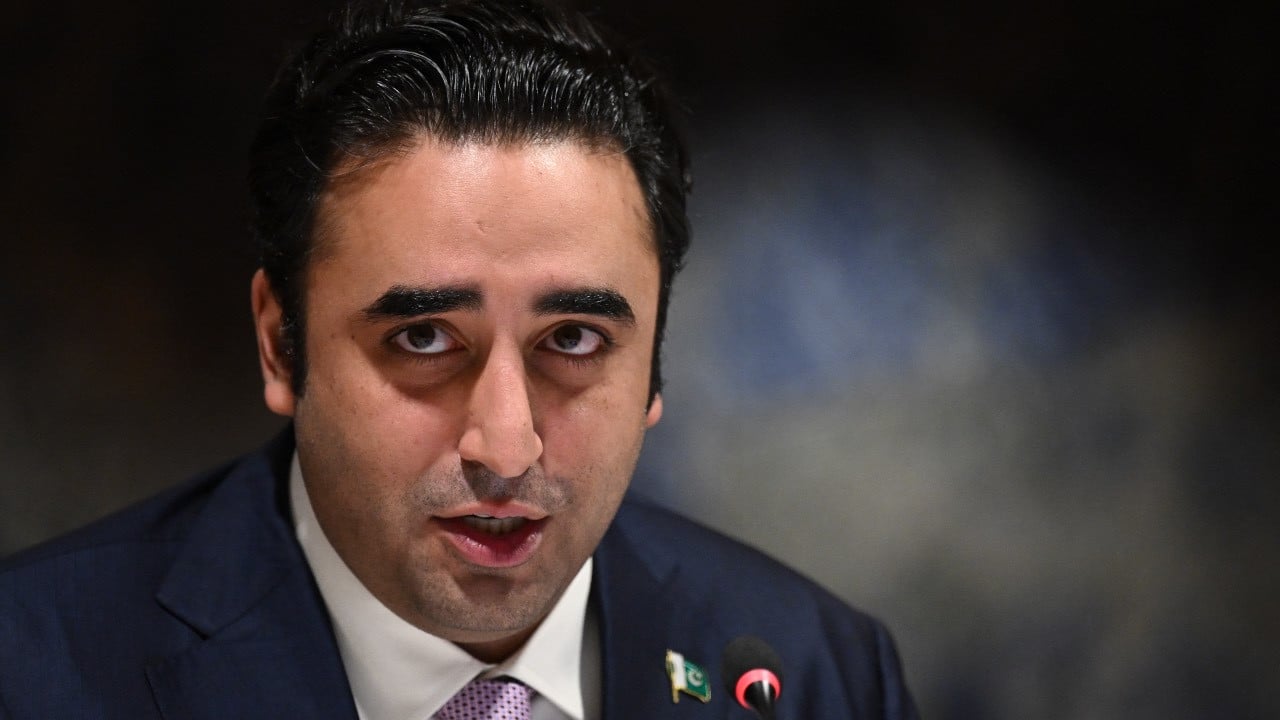
وزیر خارجہ اور چیئرمین پاکستان پیپلز پارٹی بلاول بھٹو زرداری کی لاڑکانو میں میڈیا کے نمائندوں سے گفتگو

SALUTE TO Z A BHUTTO - April 4, 1979

By M.Waqar

Zulfikar Ali Bhutto was executed on April 4, 1979, a darkest day in the history of Pakistan. Bhutto

wrote a book from his death cell, Titled "If I am assassinated," its last pages contained a quote from Russian author Nikolai Dostoevsky: "Man's dearest possession is his life, and since it is given to him to live but once, he must so live as not to be scared with the shame of a cowardly and trivial past, so as not to be tortured for years without purpose, that dying he can say, 'All my life and my strength were given to the first cause in the world - the liberation of mankind.' " As death stared the Z.A Bhutto in the face, he stared back. His past has no shame of cowardice. His daughter, too, gave her life in courage. "If India builds the bomb we will eat grass or leaves, we will go hungry. But we will get one of our own." This statement by Zulfiar Ali Bhutto should open up our eyes and bring back the passion of patriotism, unity and love for each others for the sake of Pakistan. I would like to express that this man is and was hero of Pakistan. 
Historians, Retired Judges of the Superior Courts and eminent lawyers have now unanimously admitted that Mr. Z.A Bhutto was hanged by a military dictator General Zia-Ul Haq by orchestrating a judicial trial to get rid of a popular leader. He gave Pakistan its first constitution, nuclear programme, held peace talks with India and brought 90,000 POW who were in Indian prison and were going to face war crimes. He liberated the small farmers and peasants from the repression and cruelty of big landlords and banished the jagirdari and sardari system declaring that all citizens are born equal and must live with equal rights.
Z.A Bhutto was a Legend, who lived and died like a hero with courage, determination and devotion to his principles, when cruel dictator Zia was going to kill him, Z.A Bhutto could sign few papers and could live in exile but he was a real man, he was not a coward. He too could have made a deal and lived to fight another day; but only great men with principles sacrifice their life for their cause. Zulfikar Ali Bhutto earned everlasting fame in the pantheon of leaders from the Third World in the struggle against colonialism and imperialism. He had the privilege of interacting with many of those leaders who played a great role in the epic struggle for national independence in the 20th Century including Mao Tse Tung, Soekarno, Chou-en Lai, and Gamal Abdel Nasser. He belonged to a category of anti-imperialist leaders who included Jamal Nasir of Egypt and Jawahir Lal Nehru of India. He was a brilliant Diplomat who negotiated some of Pakistan's most enduring diplomatic policies as well as bargaining from a position of weakness against Indira Gandhi in Simla. He was a great diplomat; there is a story that the American President John F. Kennedy was much impressed with then Foreign Minister Zulfikar Ali Bhutto. When they met, Kennedy walked with him in the Rose Garden and said, "Bhutto, if you were an American, you would be in my Cabinet". To which Zulfikar Ali Bhutto smilingly replied, "No, Mr. President. If I were an American, you would be in my cabinet". A Pan Islamic socialist who weakened the Feudal and tribal system.. He also pushed through Pakistan's nuclear programme despite enormous International pressure. He was also a brilliant politician whose popularity and powerful speeches impressed even his worst opponents. It took a great man to get Pakistan out of the 71 trauma. A dynamic leader, who stood up against imperialism and looked to China and other progressive countries for an alliance. When he was Prime Minister, the country prospered and was set on a course of industrial and agricultural development. He gained popularity in villages and poor industrial areas. 


Bhutto was the only true leader in our history who gave us constitution, identity in international relations. You will be surprised to know when Bhutto became as Foreign Minister, at that time; we did not have ambassador level relations with so many big countries of the world like Indonesia etc. He empowers the poor of his country.
Such people like Z.A BHUTTO are born rarely, who will forget his capabilities as an extempore speaker, as an writer, as an diplomat, as an leader and above all as lover of poor. On the day of his martyrdom his opponents called him as a culprit but same are now calling him as an innocent. The simple reason for this is that Zia tried his best to create divisions among people in order to finish the popularity of Bhutto. The irony is all those who hatched conspiracy against him are no more in this mortal world, all of them died a horrible death. Bhutto was the greatest leader we can think in the modern history. In his book "If I Am Assassinated", Bhutto clearly mentions his fear of 120 million Pakistanis under a defenseless sky in comparison to a nuclear India. What a vision! India could have swallowed Pakistan long ago if thanks to Bhutto we were not an atomic power. On the economic front Bhutto vision for nationalization was that Pakistanis will work hard like Chinese, but here Pakistanis failed him. The labor and the management of nationalized industry had no interest to take advantage of this opportunity. Using this as a golden opportunity, the industrialists, bureaucrats, and above all corrupt army declared him as an unsuccessful leader. Bhutto loved poor and poor loved Bhutto. This relationship is ever lasting. The first leader who legislated labor laws and enforced in Pakistan and nobody could do it till now. This is the reason of his popularity among labors. He tried to unite the Islamic world. The Pakistan is still under developing country because Bhutto is not alive.
Z.A Bhutto is the first person in Pakistan who has given the voice to the common people. Z.A Bhutto was great charismatic leader, man of masses, top class negotiator, excellent communicator, a visionary, known for mercurial brilliance, wit and a highly well read person. He attracted mammoth crowds where ever he addressed public meetings even in remote regions of the country. He was a man of masses because of his personal charm and charisma and the one who spoke in the language of workers, laborers, peasants and the people in the streets. He would make the people feel that he was one of them, understood them, had solutions to their problems and give them roti, kapra aur makan. He might have given all these things to them if his government had not become target of the establishment's conspiracies.
ZA Bhutto's Powerful Political Legacy Cannot be eliminated. In no time Bhutto had made a tremendous impact all around. As Minister for Fuel and Power, he had diverse explorers tapping into Pakistan's underground hidden energy resources. For the first time Russians were involved in oil and gas exploration. His time as Minister for Science and Technology was well spent. He could measure the advancements made by India in the atomic field. I can't help grieving the tragic death of a Hero who paid with his life to set an ultimate example of principled politics. I hope we honor Shaheed Bhutto by giving to the weak and less fortunate people of Pakistan the gift of unconditional empowerment through democracy and moral governance and not trade his dream for our illusions. Bourgeois battled Bhutto's populist economic and political enforcement, the bourgeois and the petty-bourgeois became ready instruments in carrying out their social propaganda against Bhutto. He was the man behind introducing democracy in the country by kicking out the dictatorial rule and finally gave a consensus constitution of 1973 with guarantees to basic human rights under the supremacy of parliament. Cruel dictators like Zia and Musharraf are responsible for bringing fundamentalists into the corridor of power, Mush, who is now trumping against them just an eye wash. Political Leaders must posses' qualities of power, vision, ethics, courage, knowledge, decision making, integrity, enthusiasms and devotion and should have principles, Z.A BHUTTO had all those qualities.
Mr. Bhutto lived consciously to make history and to leave a legacy in the form of the development of his nation. He is right credited with saving Pakistan at the darkest moment of its history, as French President Giscardd' Estaing said he was the man,'' who incarnated Pakistan at a dramatic hour of its history''.
Z A BHUTTO was indeed a great leader, a leader we must salute today; who gave voice to the voiceless and helped them shape their own destiny. It was under his leadership that every Pakistani given the right to passport. Education was nationalized and made available to every child. Scores of Universities were built to turn the children of the discriminated and downtrodden into lawyers, doctors and engineers liberating them from a destiny of backwardness. Bhutto pushed politics out of the posh drawing rooms into real Pakistan-into the muddy lanes and villages of the poor. The ever-lasting contribution of Bhutto was to raise the consciousness of the people for democracy. He awakened the masses, making them realize they were the legitimate fountainhead of political power. He enlightened the peasants, the industrial workers, the students, the women and the rest of the common people of their importance and of their right of franchise, which is the definite means of bringing changes and improvement in the lives of the common people. He deeply cherished democracy and democratic values and in the end gave his life for the cause of freedom. In the case of Pakistan, he viewed military rule as a negation of the very genesis of the country that came into being as a result of a democratic process and a vote. Today as the Nation pays tribute to one of its greatest sons; it is destined to move forward in the spirit of Federalism, Democracy, Autonomy and Egalitarianism which he lit through his example of courage in the defense of principles and ideals. Z.A BHUTTO was a people leader, a legend and a poet and he remained so till the last breath in his body. He was a true revolutionary; his revolution was against imperialism, against bourgeois. He was a charismatic leader and his charisma still rules the nation.
Z.A Bhutto ruled the hearts of people when he was alive and till date he rules their hearts.
Z.A Bhutto was a principled friend to the poor, downtrodden and oppressed. He was fearless in his beliefs and refused to bow before any man or power other than the Almighty. His contributions to an impregnable Pakistan are seen in the Kamra Aeronautical factory, Heavy Mechanical Complex at Taxila, modernization of Karachi Shipyard, creation of precision engineering works, Pakistan Steel Mills, Port Qasim, Pakistan Automobile Corporation to name a few. By signing the Simla Accord of 1972 he negotiated longest peace between India and Pakistan. His social reforms laid the foundation of an egalitarian society, his non-aligned foreign policy earned Pakistan respect in the comity of nations. He lifted the nation drowning in a sea of despair to Himalayan heights. The death cell in which his killers kept him failed to break his will or his determination to challenge military rule and stand up as the leader of the people. Bhutto was a modernizer and saw nationalism as the key to unity. He rejected fanaticism. He gave pride to the poor.
As leader of the Third World he spoke boldly against racism, colonialism and imperialism. He fearlessly defended the right of nations to independence. When the 1973 Ramadan War broke out, he sent Pakistan's military to defend the borders of the Muslim countries including the Golan Heights of Syria. Bhutto's short life of fifty years was spent in the service of many international, regional and national causes. Today Pakistan is at the crossroads. Its policies relating to Nuclear, Taliban, India, Militancy, Religious Parties, Democracy and Economy are in shambles. Shaheed Bhutto believed that the army could protect its institutional competence by keeping out of politics. He said, "Those soldiers who leave the barracks to move into Government mansions lose wars and become prisoners of war as happened in 1971; his words reverberate as a warning and a guide to the country to save its honor, respect, pride and position by reverting to the golden principles that gave it birth.
Z.A Bhutto was born in 1928. He was martyred in 1979. Yet he lives in the hearts and minds of the people still shining like a star that brightens the sky motivating those caught in the prisons of oppression. No doubt, the age of Bhutto was an age of revolution. At the time of his over throw; Bhutto was emerging as a spokesman of the world of Islam and the leader of the third world. Although his life and political career were cruelly terminated, Zulfikar Ali Bhutto will always be remembered as one of the great leaders who took part in the liberation of the third world from the yoke of Imperialism and Neo Colonialism during the twentieth century.
"It is better to live like a lion for one day than to live like a jackal for a thousand." Z.A.BHUTTO''. Long Live Bhuttoism!

Sunday, March 19, 2023

Video - Bernie Sanders addresses Oxford University

Video Report - 20 years on, should George W. Bush be on trial for Iraq? | The Mehdi Hasan Show

Video Report - UBS seals Credit Suisse takeover deal in bid to stabilise markets

Video Report - Iran proposes locations to Saudi Arabia for ministerial meeting

Video Report - Xi Jinping to make state visit to Moscow in support of Putin

Ghazal - Sharab Cheez He Aisi Hai - Pankaj Udhas -Jashn-

Video - Bilawal Bhutto Zardari - The "Perfect Storm" Pakistan Is Facing | The Daily Show

#Pakistan #PPP - Bilawal briefs OIC Contact Group on IIOJK


Foreign Minister Bilawal Bhutto Zardari on Friday briefed the Contact Group of Organization of Islamic Cooperation (OIC) on the humanitarian and human rights situation in the Indian Illegally Occupied Jammu and Kashmir (IIOJK).

The minister was participating in the meeting of the OIC Contact Group on Jammu and Kashmir on the sidelines of the 49th OIC Council of Foreign Ministers meeting in Nouakchott, Mauritania.

Chaired by OIC Secretary General Hissein Brahim Taha, the meeting was attended by Saudi Arabia, Turkiye, Niger, Azerbaijan and true representative of Kashmiris and OIC’s Independent Permanent Human Rights Commission (IPHRC).

He explained that the situation in IIOJK had deteriorated with India’s illegal and unilateral actions of August 5, 2019 and the subsequent attempts at demographic changes in the occupied territory.

“By issuing millions of fake domiciles to non-Kashmiris and enacting laws that allow non-residents to buy and own land in IIOJK, India is trying to convert Kashmiris into a disempowered minority in their own land.”

These steps, he said, were in flagrant violation of the international law, especially the Fourth Geneva Convention, which interdicted an occupying power from taking such measures.

The Contact Group expressed alarm at the situation in IIOJK and adopted a Joint Communique reaffirming OIC’s position on the Jammu and Kashmir dispute and reiterating its firm rejection of India’s unilateral and illegal actions of August 5, 2019.

It requested the OIC secretary general and member states to raise their voices for the just cause of Kashmir at the international fora and hold India accountable for its oppression of the Kashmiri people.

The Contact Group also called upon India for immediate cessation of the human rights violations in IIOJK and taking steps for the resolution of the Jammu and Kashmir dispute in accordance with the relevant UNSC resolutions and the wishes of the Kashmiri people. 

https://tribune.com.pk/story/2406786/bilawal-briefs-oic-contact-group-on-iiojk

Federal Minister & Chairperson Benazir Income Support Program, Shazia Marri inaugurates the Benazir Nashonuma Center at Narowal

 Narowal- Federal Minister/Chairperson Benazir Income Support Program Ms Shazia Marri along with Federal Minister for Planning, Development and Special Initiatives Ms Ahsan Iqbal inaugurated the Benazir Nashonuma Center at District Headquarters Hospital Narowal. Ms. Marri also interacted with the women present there. On this occasion, Dr. Amara khan, representative of World Food Programme, also gave a briefing to both the ministers. Federal Minister Shazia Marri termed the program as very important and said lack of food in a children has profound effects on its mental and physical development. Talking about the Benazir Nashonuma Program, the Federal Minister said that under this program, special food and quarterly financial stipends are also given to the pregnant and lactating women who benefit from the Benazir Kafaalat programme. The stpend is 2000 for the mother of a baby boy and 2500 for the mother of the girl child. Ms. Shazia Marri further said that more than 400 unique Nashonuma centers have been established across the country for this purpose.

In This occasion Parliamentary Secretary MNA Mr Khursheed Junejo, MNA Syed Ibrar Shah, MNA Syed Tariq Shah, PPP Punjab Leaders Faisal Mir and Rashid Khan Advocate were also present.

https://ppp.org.pk/pr/29077/

Saudi Arabia tells Pakistan: No more easy money

Saudi Arabia and the IMF are both demanding economic reforms from Pakistan, with the kingdom no longer prepared to bailout Islamabad.

Saudi Arabia's decision to refuse to provide any further bailouts or interest-free loans to Pakistan has left the government in Islamabad in shock and has prompted the finance minister to complain that even friendly countries aren’t keen on helping Pakistan out of its economic emergency. 

Pakistan is in dire need of sustained US dollar inflows to avoid defaulting on nearly $80bn of international loan repayments over the next three and a half years. The country is currently sitting on just $3bn in foreign exchange reserves. 

'Saudi Arabia is on a different course now. They've reset their relationship with other countries...'

- Kamal Alam, Atlantic Council

Pakistan is also locked in difficult negotiations with the International Monetary Fund (IMF) over its 13th bailout package since the 1980s.

If an agreement isn’t struck soon, Pakistan will find it increasingly difficult to secure international loans, as its credit rating has been downgraded to junk. 

Analysts privy to recent developments have told Middle East Eye that Saudi Arabia has conditioned fresh interest-bearing loans and investment on Pakistan implementing strict monetary and fiscal reforms along with a drastic reduction in its current account deficit - conditions similar to those set by the IMF. 

Umar Karim, associate fellow at the King Faisal Center for Research and Islamic Studies, said Pakistani authorities are in a state of shock.

“While previously Saudi Arabia and other Gulf countries would bail Pakistan out off the back of a phone call from the foreign minister or the prime minister, this time around they are really being put through the mill,” Karim told MEE.

It is believed that on a recent trip, even the Pakistani military chief couldn't convince Saudi Crown Prince Mohammed bin Salman to release emergency funding for the country.

Karim believes this sets a new precedent. “The Pakistani military chiefs have previously been a source of assurance to friendly countries, but the Saudis have now had enough of Pakistan's civilian authorities squandering away these handouts,” he said.

New world order

At the World Economic Forum in Davos in January, the Saudi finance minister made the kingdom's new policy very clear.

Mohammed al-Jadaan said: “We used to give direct grants and deposits without strings attached and we are changing that. We are working with multilateral institutions to actually say we need to see reforms.”

“We are taxing our people, we are expecting also others to do the same, to do their efforts. We want to help but we want you also to do your part.”

'There is also a major trust deficit between the Pakistani government and the IMF'

- Khaqan Najeeb, former government adviser

Kamal Alam, senior fellow at the Atlantic Council, said that Pakistani authorities should have read the pattern.

“Saudi Arabia is on a different course now. They've reset their relationship with other countries and refused to give financial handouts to namely: Jordan, Morocco and even Egypt. However, Pakistan, which is far more dysfunctional than all of the others, should have seen it coming,” Alam told MEE.

“Pakistan's been lulled by a false sense of security”, the analyst said, “that with a population of over 220 million and a comprehensive nuclear weapons programme, it’s too big for the world to let it fail. This has bred complacency across successive governments and the country's military leadership of easy loans or bailouts.”
 
Khaqan Najeeb, former adviser to Pakistan’s finance ministry, said the Saudis want Pakistan to sign a deal with the IMF and only then will they see any loans or investment. 

“The Pakistani government's delay in implementing essential monetary and fiscal policies, as demanded by the IMF, has hurt the economic situation,” Najeeb said. 

“There is also a major trust deficit between the government and the IMF and that's why the Fund is making sure Pakistan implements these policies before it receives any further funding or the important stamp of approval."

Meanwhile, the rate of inflation in Pakistan is set to hit 33 percent in the coming months and the country's currency has devalued nearly 65 percent in the last 12 months. 

Nearly six months ago, in a bid to stem the outflow of foreign exchange, the Pakistani government stopped almost all imports, leading to a raw materials shortage across manufacturing sectors and a temporary shutdown of several automobile manufacturing plants and textile factories. 

Najeeb argues that with high inflation, slow growth and high interest rates around the world, there is less money available for emerging markets like Pakistan, and that without the IMF's “stamp of approval” even friendly Gulf kingdoms will remain shy of investing in the country.

“Friendly countries too want to see reforms in Pakistan, however this time they are going for an investment model as opposed to previously when they would simply deposit a few billion dollars in Pakistan's state bank. This might turn out to be better for the country,” Najeeb told MEE.  

What to reform and what follows that? 

Kamal Alam told MEE that it was “very obvious” that “the delay in implementing IMF reforms is because the political elite wants to avoid them - deep-set corruption in government is at the heart of it.” 

Alam said that a culture of “zero accountability has completely wrecked trust in Pakistani leadership, at home and abroad”.

Pakistan is ranked 140 on Transparency International's Corruption Perceptions Index for 2022, not a favourable ranking, Alam said, if the country wants to attract foreign investment. Najeeb, who worked in government, said that just attracting foreign investment will not solve Pakistan's problems in the long-term and that the country needs to expand its tax base and improve tax collection.

“Pakistan's agriculture sector contributes 23 percent of total GDP, while tax collection across the sector is very poor,” he said. “Similarly Pakistan's retail and real estate sectors also contribute heavily to the GDP but almost completely avoid taxation.”   

The Saudis are also unhappy with the way Islamabad is behaving these days, said Umar Karim.

“The current prime minister has a 77-member ministerial cabinet, the largest in the world; they all receive full perks and privileges. Why would the Saudis help you if you continue to afford yourself such luxuries while they are putting themselves through a cost-cutting drive?” he told MEE.

Karim believes the Saudis are interested in investing in Pakistan's energy sector - both fossil fuels and renewables – and that they are also interested in investing in the country's booming IT sector. But this investment, he said, would only happen after Pakistan implemented economic reforms. 

While Pakistan is besotten with a crippling power crisis, Saudi investment in the renewable energy sector could be crucial. A 2020 report from the World Bank suggests Pakistan has immense potential for generating power through solar energy.

“Utilising just 0.071 percent of the country's area for solar power generation would meet Pakistan's current electricity demand,” the report said. 

In 2019, however, the Saudi government expressed interest in setting up an oil refinery and in making other investments totalling $10bn in Pakistan. But, Najeeb said, Pakistan would need to “revamp its board of investment” and bring in “specialist human resources and incentives” in order to take advantage of this opening.

The former finance ministry adviser said that a reset in relations with Saudi Arabia would be good for Pakistan and could prove to be a wake-up call.

For Pakistan, the days of easy money are over. 

https://www.middleeasteye.net/news/saudi-arabia-pakistan-shape-up-easy-money-end
 

Sunday, March 12, 2023

Urdu Music Video - KHWAISH - By Sofia Kaif

Video Report - Jinnah: His Successes, Failures and Role in History | Dr. Ishtiaq Ahmed

#Pakistan - Why Care for the #Baloch Women?


Tahira Khan
@TahiraGhilzai
Balochistan is a notorious place. It is a place where people are killed and disappeared on daily basis. More recently, women are found dead, targeted, tortured, detained, and killed owing to many known and unknown reasons. It has further led to many conspiracy theories and blame games to deflect responsibility.
In this context, where are we heading as a society? What is our stance at a point where women are disappearing, killed, and tortured and where civil society feels to not raise their voices? However, there are few voices from society and women’s organizations who are raising voices in favor of Baloch women but there is a lot more skepticism, nonsense, and unethical arguments.
In every society, the bond of relationships is ethics. Institutions may not feel to regard ethics of the society but society has to. These ethics and moral philosophies revolve around care. During times of conflict, civil society may not uphold the values of humanity but it can show some care. Care bonds people regardless of their nationality, ethnicity, and religion. It is also one of the pertinent features of many feminist discourses and moral theories like that of Ethics of care. The same goes for Baloch women, in particular, and the context of civil society, in general.
What’s the point of all this education if all we get blame games or conspiracy theories to define any mishap in society?  Aren’t we educated enough to show some concern when women are faced with violence and death threats? Certainly, care is not about our personal lives only. It is more like a practice and value embedded in the values and traditions of any society. According to many feminist discourses, it goes beyond private lives and encompasses far more realms such as the social, political, and legal framework of any society. It may also cover the arena of war and international relations.
Owing to the ethics of care, civil society should show some emotions toward the ongoing critical situation of Baloch women. This argument may seem irrational but empathy, sensitivity, and responsiveness are the need of the hour. These features are the foundational basis of any society and may also help to cultivate any reasoned stance at a time of crisis. Moreover, it is the only to diffuse the ongoing moral crisis in the province.
On the other hand, Baloch, as a nation, may show anger at this critical juncture where Baloch women are not only harassed but kidnapped and targeted as well. This is also a case of moral indignation because they are feeling humiliated and disrespected in so many ways. Besides, they have repeatedly argued how institutions and authorities have treated them inhumanely and unjustly. More importantly, this is how human beings react and feel when they are treated inhumanely and unjustly.
It is pertinent to note that anger of Baloch is not just a raw emotion. These sentiments have been cultivated for a very long period. It can’t go in a day. Accordingly, these emotions need appropriate reflection and if necessary some education as well. Therefore, many feminist thinkers argue that the rationalist perspective to define any emotional response is not sufficient to make sense of the overall situation.
In contrast, there are arguments for how emotional responses become irrational when it carries elements of vengeance and aggressiveness. In the context of Balochistan, these emotions carry a kind of plausible view because of the already beleaguered situation of Baloch women. Perhaps, it is not the proper time to decide rationality in the anger of people protesting for the respect and dignity of their women.
In addition to that, these women are already facing patriarchal structure and tribal ethos. Tribalism is a kind of conservative setup where women have less than fewer opportunities to excel in every walk of life. Moreover, men have dominated almost every good and bad aspect of tribal society.  According to the predominant tribal narrative, women’s respect lies at home where she is expected to do homely jobs. It is also suggested that these homely jobs require less hard work and are better suited for women.
Owing to these hard circumstances, women are still striving hard in every field of life. They are good wives along with being a good doctor, engineer, teacher, civil servant, etc. Whatever the profession is, women can excel in it and the world doesn’t doubt this fact. The same goes for the women of Balochistan. Baloch women have put every effort to uplift their conditions in the context of the political, economic, and social environment. All their efforts are commendable and must be appreciated at every level. And, there is no space for any kind of insensitive remark or statement.
Following that, there are some extreme values in our society. In particular, the moral standards of any society must not be stuck between extremes. In the case of Baloch women, these extremes may account for the egoistic standards of individuals, such as tribal leaders or state institutions, powerful security forces, and universal moral standards of humanity. Accordingly, society may seem to understand what are the standards of selfish individuals and what is humanity. Somehow both extremes are hard to handle and managed especially in cases of conflict zones or war-torn areas. Thereupon, the solution lies in other moral perceptions such as care for the fellow being. Civil society just needs to show some empathy, response, and sensitivity.
At this point, this debate also does not mean to forge or promote relationships but to have a collective sense of care for ourselves and Baloch women. There is a need to regard and respect Baloch women to value their honor and dignity. It is not a time to fuel more ethnic sensitivities or historical discord or ask unnecessary questions. It is also not the right the inquire about rationality in their emotional response. It’s time to show care for fellow human beings and regards their pain. That’s it.
https://www.balochistanvoices.com/2023/02/why-care-for-the-baloch-women/

Religious minorities in Pakistan face problems in obtaining national ID card: Report


A study into the legal barriers faced by religious minorities living in Pakistan revealed that a significant number of religious minorities have been reported as facing difficulty in obtaining computerised national identity cards (CNIC) or being unable to obtain one at all.

Numerous basic rights of citizenship in Pakistan are linked to having CNIC, The News International reported.


The findings of the study were discussed at the Access to Justice Conference organised by the Legal Aid Society, in collaboration with the National Commission of Human Rights. The study has called for updating outdated laws, bridging legal gaps, establishing systems of accountability to facilitate and improve investigation and formation of a statutory commission to protect, promote, and uphold the constitutional rights of RMCs, as per The News International report.

In February, the Human Rights Commission of Pakistan (HRCP) raised concerns over the continued marginalization of religious minorities in the country, Dawn reported. In its report titled A Breach of Faith: Freedom of Religion or Belief in 2021-22, HRCP has observed with considerable alarm developments during 2021/22 that belie the state’s commitment to freedom of religion or belief.

The incidence of forced conversions in Sindh has remained worryingly consistent, according to the report. Reports of religious minorities’ sites of worship being desecrated have continued. However, no response from the state has been reported when such incidents involve sites associated with the Ahmadiyya community, according to the Dawn report.

The HRCP has called for a representative and autonomous statutory national commission for minorities in the spirit of the 2014 Supreme Court judgement of Justice Tassaduq Jillani. The HRCP has also said that urgent legislation is needed to criminalise forced conversions, as per the news report.

Furthermore, the HRCP has demanded that the state makes a concerted effort to counter sectarian violence by implementing the National Action Plan (NAP) and developing a national narrative that unambiguously eschews religious extremism and majoritarianism.

The HRCP called for a re-evaluation of quotas for religious minorities in education, employment and accountability mechanisms to ensure that these quotas are implemented, as per the Dawn report. According to HRCP, Pakistan will continue to foster a climate of impunity for perpetrators of faith-based discrimination and violence unless these measures do not come into effect immediately. 

U.S. arms left in #Afghanistan surface in #Pakistan Taliban insurgency

ZIA UR REHMAN
Advanced sniper rifles and night vision goggles used in attacks on police.
Modern weapons and sophisticated night vision devices left behind by U.S.-led coalition forces withdrawing from Afghanistan and fleeing Afghan troops are being used by Pakistani Taliban militants to intensify attacks on law enforcement, police and experts say. Plagued by an economic crisis, plunging currency and political polarization, Islamabad is also scrambling to contain the Tehreek-e-Taliban Pakistan (TTP), a banned militant group. Emboldened by the Afghan Taliban's victory, the TTP has essentially gone to war against the Pakistani government. The group was responsible for 89 attacks across Pakistan in 2022, mainly in Khyber Pakhtunkhwa province, according to the Pakistan Institute of Peace Studies, an Islamabad-based think tank. That was up slightly from 87 in 2021 despite a roughly four-month cease-fire with Islamabad that was scrapped by the militants late last year. In some attacks, police in Khyber Pakhtunkhwa determined that the TTP militants used advanced weapons and gadgets that had belonged to U.S. or Afghan forces to carry out nighttime ambushes. After one such attack in the suburbs of Peshawar on Jan. 14, Moazzam Jah Ansari, the provincial police chief at the time, revealed that the TTP had conducted a "coordinated" strike using high-tech equipment like thermal weapon sights. The attackers killed three police officers, including a senior official.
Ansari said that TTP militants had used similar equipment in ambushes in Dera Ismail Khan, Bannu and Lakki Marwat, the most volatile districts in the province. Police statistics show 118 officers were killed in terror attacks in the province in 2022 alone. U.S.-funded military equipment valued at $7.12 billion was in the possession of the former Afghan government when it fell to the Taliban in August 2021, according to a U.S. Department of Defense report last year.After February 2022 attacks on two Pakistani military camps in Balochistan province, Pakistan's then-Interior Minister Sheikh Rasheed Ahmad also claimed that Baloch Liberation Army separatists had used modern weapons left by the U.S. and coalition forces in Afghanistan.
The Taliban regime in Kabul issued several denials that the TTP and other militant groups had access to the abandoned equipment. Yet recent TTP propaganda shows militants practicing with modern American-made weapons apparently from the Afghan army, noted War Noir, a weapons and conflict research group. They include M24 sniper rifles, M4 carbines with Trijicon ACOG scopes, and M16A4 rifles with thermal scopes.
Security experts and police officials say that the sophisticated weaponry puts cash-strapped law enforcement agencies at a disadvantage. "By using night vision devices TTP militants can see easily and target police personnel, performing their duties in the dark while policemen cannot see them coming," said a midlevel police officer in the Dera Ismail Khan district, who requested anonymity because he was not authorized to speak to the media.
He suggested that the Afghan Taliban may have given some of the spoils of war to the TTP in return for the Pakistani group's help in recapturing most of Afghanistan in 2021.
In late January, the Khyber Pakhtunkhwa government provided a few dozen night vision devices to police in some volatile districts, in an attempt to counter raids under the cover of darkness. But resources are limited. Ihsan Ghani, a security expert and former provincial police chief, said that after declaring a successful crackdown on the TTP and other violent groups in 2017, the Pakistani state had reduced the funding and capacity-building of law enforcement agencies. "Terrorism and counterterrorism measures are like quickly shifting sand," Ghani told Nikkei Asia. He said terrorists will fight with "at-hand technology." Muhammad Feyyaz, a security expert and academic associated with the University of Management and Technology, Lahore, agreed that groups like the TTP are quick to adapt. Since 2002, militants in Pakistan have used weapons ranging from remote-controlled explosives, improvised explosive devices and suicide vests to Kalashnikov rifles and rockets.
But Feyyaz said the more modern arms enhance the "TTP's capability to undertake operations under all visibility conditions and give the terror group an edge over poorly equipped law enforcement agencies, which are struggling even to [fill ranks] and have a morale problem." Experts draw parallels between the departures from Afghanistan by Soviet troops in 1989 and the Western coalition in 2021. In both cases, they say, leftover weapons have ended up with myriad insurgent groups in other countries, particularly Pakistan.
Abdul Basit, a research fellow at the S. Rajaratnam School of International Studies in Singapore, said the TTP as well as Baloch separatist groups and Jihadi outfits in Indian-administrated Kashmir have obtained small quantities of modern arms and devices, including long-range sniper rifles and night vision goggles, that the U.S. had provided to Afghan forces.
"Usage of these weapons has increased the lethality and accuracy of the terrorist attacks in Pakistan," Basit said.
https://asia.nikkei.com/Politics/Terrorism/U.S.-arms-left-in-Afghanistan-surface-in-Pakistan-Taliban-insurgency

Saturday, March 11, 2023

Music Video - One Night In Bangkok - REMIX DJ R&B

Video Report - What's next for Xi Jinping's China at home and abroad? | Inside Story

Video Report - Can China's economy outpace the US? | Counting the Cost

Video Report - What are the implications of Saudi-Iranian diplomatic deal?

Video Report - Up to 1 million protesters expected on seventh day of #French pension demonstrations

#PPP Music Video - Long Live Bhuttoism! - Dila Teer Bija

Video - Live: FM Bilawal Bhutto Zardari chairing the Conference on “Women in Islam:

Video Report - Concluding remarks by FM Bilawal Bhutto Zardari in Conference on “Women in Islam”

Video Report - Chairman PPP & FM Bilawal Bhutto Zardari’s media talk in New York

Video Report - Press Conference: Foreign Minister Bilawal Bhutto Zardari on the outcome of Women in Islam Conference and Commemoration of First Islamophobia Day on the sidelines of CSW

Saturday, March 4, 2023

زه خو شرابي يم، زه خو شرابي يم شیخه څه راسره جنګ کړې برخې ازلي دي، کاشکې ما د ځان په رنګ کړې زه خو شرابي يم شيخه ته راسره جنګ کړې برخې ازلي دي، کاشکې ما د ځان په رنګ کړې زه خو شرابي يم

Video Report - د حفيظ الله امين زوی ببری امين د خپل پلار په اړه ننګونکې پوښتنې ځوابوي

A Dangerous Game: Pakistan’s Ruling Class Plays Politics as Terrorism Brews

By Ali Malik
It is time for Pakistan’s political and military establishment to wake up and reconcile with the fact that they can’t negotiate their way to peace.
The grandstanding of Pakistani politicians and their inability to negotiate are consistent elements of the nation’s politics. But the elites’ penchant for prioritizing political gain over the welfare of the state threatens to impose more self-inflicted pain on Pakistan’s most significant asset: its provincial security infrastructure.
While Pakistan’s municipal and provincial security forces are resilient, no institution can be expected to heal, much less thrive, as it encounters one devastating trauma after another. As if biblical floods, cyclical debt, and an energy crisis weren’t enough, an old enemy has reared its head once more to threaten Pakistan’s precarious security situation: the Pakistani Taliban (TTP). It is time for Pakistan’s political and military establishment to wake up and reconcile with the fact that they can’t negotiate their way to peace. The state must wage war against the Pakistani Taliban and their ideology before they inflict more violence on Pakistan.
On January 30, an estimated 100 people, primarily police officers, lost their lives at the hands of a TTP suicide bomber in the Pakistani city of Peshawar, with over 217 injured. On February 17, the TTP targeted the office of the Karachi police chief; four people were killed and 19 were injured. This new wave of bold terrorist activity follows a breakdown in talks between the Pakistani political and security establishment and the TTP last November. The decision to negotiate rather than destroy the Pakistani Taliban was undertaken under the auspices of both the former Prime Minister Imran Khan, and, as new rumors indicate, former Army Chief Qamar Javed Bajwa. Khan and Bajwa’s rationale for engaging with the TTP is excruciatingly simple: They are Pakistani citizens and would like to come back to the country.
In a recent address, Khan outlined that “when the Afghan war ended… some 30,000 to 40,000 Pakistani tribal fighters wanted to come back… The PTI government had two options: either kill all of them or reach an agreement with them and allow them to settle in the province.”While this policy holds a veneer of practicality, it was doomed to fail. The TTP, emboldened by their peers’ victory in Afghanistan, would not accept anything less than their own Shariah haven. The group is both fundamentally opposed to and ideologically driven to eradicate the concept of a constitutional Pakistan. Yet the Pakistani military apparatus and the former PTI government under Khan believed that they could overlook this philosophy and attempted to engage the terrorist group in dialogue.Predictably, talks between the government and the TTP broke down as the TTP refused to drop its extreme demands, calling for revoking the merger of Pakistan’s tribal areas (the former FATA) with Pakistan’s Khyber Pakhtunkhwa (KP) province, along with releasing jailed TTP members and enforcing Shariah law within their historical areas of influence along the Afghan border. The Pakistani state refused, and talks were placed on hold as Khan’s government was ousted from office. It is precisely this cycle of pointless negotiations that not only entertains the far-fetched demands of terrorist groups but emboldens and legitimizes them as valid political entities.
As the never-ending political power struggle took place in Islamabad, the TTP capitalized on the distraction and leveraged its clout to increase the size of its ranks and, subsequently, its lethality. The TTP found a willing partner in Pakistan’s separatist Baloch insurgency, raising the number of groups that have merged under its ever-growing umbrella to 22. As the old adage goes, “the enemy of my enemy is my friend.” Last year, the group and its affiliates were responsible for at least 150 attacks in Pakistan, primarily in the northwest of the country.
The current coalition government has taken a different approach to the TTP but is burdened with power politics and lacks an electoral mandate. During an interview last month, Pakistan’s Federal Human Rights Minister Riaz Pirzada claimed that the current government and military are divided on continuing negotiations with the TTP. The ruling coalition’s leadership is reluctant to continue to engage the militant group the same way as before, but has no power to command the generals in Rawalpindi to fight them. Islamabad is burdened with myriad challenges and, as of now, has only been capable of laying the blame on the former PTI government for allowing the TTP to resettle in Pakistan in the first place. The TTP’s recent attacks on provincial police forces indicate a dangerous shift in their political strategy. The group has now realized that if it were to attack military institutions, it would face the full might of the Pakistani military as opposed to their preferred approach that prioritizes negotiations. But in an effort to gain leverage and force the government to restart negotiations with the state, the TTP has resolved to target police institutions instead. This not only damages local law enforcement infrastructure but erodes the morale of a desperately underfunded public good.
While the military has faced its fair share of terrorist violence, it is municipal and provincial police forces that are bearing the brunt of such attacks. Shortly after the deadly bombing in Peshawar, a rare protest was staged by the Peshawar police force requesting that the state do more to protect them and to fully investigate the lapse in security.
Islamabad and Rawalpindi must be united in both mission and resolve to eliminate the Pakistani Taliban. The two disparate entities must send a signal to the terrorists that their efforts are futile. But most importantly, the center must signal to municipal and provincial police forces that they are supported by the state and that those responsible for these attacks will be held accountable.
It is only the military that has the capacity to eliminate this threat. But the military will not willingly wage this war nor listen to the politicians in Islamabad unless the political elites unite in calling for eliminating the TTP. A united political front, backed by the will of the people, has the potential to compel the generals in Rawalpindi to act. Pakistan will only have a chance at pursuing prosperity when both the political and military elite realize that serving the interests of the state is in their personal interests.
https://thediplomat.com/2023/03/a-dangerous-game-pakistans-ruling-class-plays-politics-as-terrorism-brews/

#Pakistan - The Biden administration’s two-track Pakistan policy misses the mark

Madiha Afzal

The U.S.-Pakistan relationship has weathered several bumps in the road over the past two years, including, most prominently, the fallout from the Afghanistan withdrawal and the Taliban takeover. The Biden administration has now settled on a bureaucratic division of labor in its policy toward Pakistan: a lack of engagement from the White House; robust, well-defined engagement from the State Department; and a continuation of long-standing military and defense ties. The new equilibrium is different from the past: President Joe Biden is the only U.S. president in recent memory not to have engaged with a Pakistani prime minister (neither Imran Khan nor his successor, Shehbaz Sharif). The bilateral relationship is also notably no longer centered solely around America’s interests in Afghanistan, as it was prior to August 2021: there is an effort by both sides to broaden its base.

Unfortunately, the overall relationship is weak at best. Here are the factors that have shaped the relationship over the last two years:

THE AFGHANISTAN FACTOR

At the beginning of the Biden administration, Pakistan recognized the need to redefine the bilateral relationship, until then focused on Afghanistan, as the U.S. withdrawal from that country drew close. Prime Minister Imran Khan’s government pitched the need for a comprehensive relationship with the United States, one based on “geo-economics” — Pakistan’s catch-all for trade, investment, and connectivity — as opposed to a relationship focused on security concerns. The Biden administration wasn’t responsive, and the relationship got off to a cold start. At the time, the United States was focused on Afghanistan and the need for Pakistan to exercise pressure on the Taliban to push it toward an intra-Afghan peace. Then, as the Taliban undertook a systematic military takeover of Afghanistan while the United States withdrew, the relationship cooled further. In the months afterward, although Pakistan helped in evacuations from Kabul and in taking in Afghan refugees, the ignominy of the withdrawal — that the war ended with a clear Taliban victory and in view of Pakistan’s close relationship with the Taliban — pushed relations to a relative low point.

NO PHONE CALL

Biden has not called a Pakistani prime minister in his more than two years in office. Biden neither mentioned Pakistan during the withdrawal from Afghanistan, nor showed any interest in engaging with the country at that point. The lack of a phone call drew considerable attention in Pakistan during Biden’s first year in office, and was ostensibly one of the reasons Khan declined the administration’s invitation to attend the first Summit for Democracy in December 2021. Even Pakistan’s catastrophic summer flooding in 2022, which elicited a robust U.S. government response, did not prompt a Biden call. Yet in October 2022, seemingly out of the blue, Biden mentioned Pakistan in strongly negative terms at a Democratic Congressional Campaign Committee reception, describing it as “what I think is maybe one of the most dangerous nations in the world: Pakistan. Nuclear weapons without any cohesion.” This statement did not go over well in Pakistan, prompting a bit of a walk back from the administration, though Biden may have really meant what he said.

Initially, the complete lack of White House engagement with Pakistan was somewhat of a puzzle. Now though, it seems it’s White House policy — reflecting the fact that Pakistan is not a priority. For Biden, it might draw from a desire to put Afghanistan behind him — and with it, its neighbor. Throughout Biden’s many years of watching the Afghanistan war from the Senate and then as vice president, Pakistan’s relationship with the Taliban had always been a source of tension.

PAKISTANI POLITICS

In the spring of 2022, America was drawn into Pakistan’s domestic politics in a sudden, unfavorable manner: Khan blamed his ouster via a vote of no confidence on a U.S. “regime change” conspiracy, without evidence — a narrative that stuck among his supporters. In recent months, Khan has stepped back from the U.S. conspiracy narrative and has more directly blamed the Pakistani military for the fall of his government — the actual story. Still, the narrative complicated the U.S. relationship with Pakistan for months in 2022, as Khan’s supporters considered any engagement between the United States and the new government in Islamabad to be confirmation of the conspiracy.

TIES WITH STATE, AND BROADENING THE RELATIONSHIP

Although the White House remained silent, Secretary of State Antony Blinken and Khan’s foreign minister, Shah Mahmood Qureshi, spoke several times and met in New York in September 2021. Spring 2022 began a period of robust engagement from the State Department, a mini reset of sorts that has focused on expanding the relationship. In March 2022, the United States and Pakistan launched a year-long campaign marking 75 years of relations. In April, the new U.S. ambassador to Pakistan, Donald Blome, was sworn in. In May, Pakistan’s new foreign minister, Bilawal Bhutto Zardari, met Blinken in New York. The U.S. special representative for Commercial and Business Affairs, Dilawar Syed, visited Pakistan in July to “strengthen the economic partnership and bilateral trade” between both countries. Also in July, the two governments launched a health dialogue. Soon after Pakistan’s flooding disaster hit in August, U.S. Agency for International Development Administrator Samantha Power visited the country, documenting both the catastrophe as well as U.S. relief assistance; the United States has announced more than $200 million in flood assistance. Bhutto Zardari and Blinken met again in September when the 75th anniversary of U.S.-Pakistan relations was officially celebrated at the State Department. The relationship between the two counterparts appears constructive; it has focused on relief and recovery after Pakistan’s calamitous summer of flooding and increasing cooperation on economic matters.

Engagement and diplomacy continue apace on other fronts: State Department Counselor Derek Chollet and a delegation of senior U.S. government officials visited Pakistan in February 2023 in support of the U.S.-Pakistan relationship. The Pakistani commerce minister visited Washington the same month to hold a meeting under the U.S.-Pakistan Trade and Investment Framework — held after seven years — with United States Trade Representative Katherine Tai. Also in February, a U.S. congressional delegation led by Senate Majority Leader Chuck Schumer visited Pakistan to discuss the “broad-based partnership that includes trade, investment, regional security, and flood recovery efforts.” Pakistan has also been the single largest recipient of COVID vaccines from the United States since 2021.

DEFENSE AND MILITARY TIES

The military leadership in Pakistan had a major transition last fall, with the chief of army staff, General Qamar Javed Bajwa, leaving his post after six years (following an extension). He visited Washington in October before his term ended and met Secretary of Defense Lloyd Austin. And the commander of United States Central Command, General Michael Kurilla, traveled to Pakistan to reaffirm security ties after the new chief of army staff, General Asim Munir, was sworn in.

The long-standing defense and security relationship continues (though it is no longer the entirety of the bilateral relationship). In September, the U.S. government notified Congress of a proposed $450 million foreign military sale to maintain Pakistan’s fleet of F-16 fighter jets. The security relationship also includes a key focus on counterterrorism and intelligence that presumably encompasses an over-the-horizon arrangement on Afghanistan — but that specific aspect remains shrouded in secrecy. CIA Director Bill Burns visited Pakistan twice in 2021: once in an unannounced visit in April and then again after the withdrawal in September.

WHAT LIMITS THE RELATIONSHIP

Pakistan is in a very different place than when its government pitched a geo-economic reset in early 2021. It is now mired in a political and economic crisis, veering perilously close to default. For the time being, its spiraling economic situation and domestic problems limit its attractiveness as a U.S. partner.

Distrust born out of the last four decades of the U.S.-Pakistan-Afghanistan triangle will take time to overcome, despite both sides’ attempts in the last year at broadening the relationship. And while Afghanistan no longer defines the U.S. relationship with Pakistan, the Biden administration’s approach to its other neighbors, China and India, does restrict it. The administration’s intense competition with China, Pakistan’s long-standing ally; its growing partnership with India, Pakistan’s foe; and its focus on the Indo-Pacific (which excludes Pakistan) has led to a priority shift away from Pakistan. Pakistan has long said it doesn’t want its relationships with the United States and China to be seen as zero-sum, and the United States has acknowledged that it doesn’t see its relationships with India and Pakistan as zero-sum. Yet, the American approach to these two Pakistani neighbors does seem to, at this point, impose constraints on the bounds of the U.S.-Pakistan relationship.

This need not be the case: As I have long argued, Pakistan, the fifth-largest country in the world and a nuclear-armed nation, ought to be seen by the United States on its own terms and not through the prism of its neighbors. A cold shoulder risks pushing Pakistan further toward China — which is neither an inevitable nor desirable outcome for the United States. What’s more, Pakistan’s multiple crises — political instability, economic malaise, and rising insecurity — warrant greater American engagement, not less, and certainly more than the current administration’s policy of fractured engagement from the United States.

https://www.brookings.edu/blog/order-from-chaos/2023/03/02/the-biden-administrations-two-track-pakistan-policy-misses-the-mark/