Tuesday, October 11, 2022
Monday, October 10, 2022
Sunday, October 9, 2022
Pakistan: Bilawal Bhutto calls for climate justice, rejects Western pressure over Ukraine

Pakistan has witnessed catastrophic flooding over the past few weeks that have affected more than 33 million people — some 15% of the nation's population — and submerged a third of the country.
The natural disaster has killed over 1,500 people and caused damage worth billions of dollars, compounding the woes of an economy already beset by a raft of problems, ranging from a heavy debt burden and ballooning current account deficit to a tumbling currency and skyrocketing inflation, particularly food prices.
Eight million people still remain displaced, and the World Bank said that the loss of jobs, livestock, harvests and houses as well as the spread of disease, among other problems, threaten to throw millions of people into poverty.
Scientists have said the recent devastating flooding in Pakistan was made worse by climate change caused by greenhouse-gas emissions, which is leading to some kinds of extreme weather becoming more frequent and intense.
Pakistan's Foreign Minister Bilawal Bhutto Zardari is currently visiting Berlin, where he held talks with German authorities to gather support for his country's efforts to help flood victims and overcome a worsening economic crisis.
On Friday, Bhutto Zardari met with his German counterpart Annalena Baerbock. In a joint press conference after the meeting, he described the floods in his country as a crisis of "biblical proportions." The German foreign minister told him that Pakistan can count on German solidarity, offering financial support worth €60 million ($58.4 million).
"I'm grateful to Foreign Minister Baerbock for her hospitality," Bhutto Zardari told DW's Richard Walker. "Going forward, we want to work with our partners, including our friends in Germany, on figuring out ways to finance the reconstruction and rehabilitation as a result of the devastation caused by the floods," he added.
'Not a charity'
Some Pakistani government officials, however, have slammed the international response to the climate catastrophe in Pakistan as "inadequate."
But Western countries are currently busy dealing with rising tensions with Russia, which invaded Ukraine in February.
As a result of the war in Ukraine, European countries are facing an energy crisis and record inflation. The German government recently announced that it wanted to spend €200 billion on trying to keep energy prices low in the country.
The Pakistani foreign minister said that he understands the difficulties Europe is facing right now. "We've just faced a pandemic that has affected the economies of countries everywhere. We've also seen the devastation in Ukraine and the sanctions that come along with it. That has resulted in difficulties for the people of Germany, just as it's resulted in difficulties for the people of Pakistan," he said.
Bhutto Zardari, however, pointed out that helping Pakistan deal with the climate crisis is not a "charity" from Western nations.
"It's a question of justice that a country that produces 0.8% of the global carbon footprint is the eighth most climate stressed country on the planet. Some 33 million people are paying with their lives and their livelihoods for the industrialization of richer countries," he said, underlining that "this is a global problem demanding global actions."
"We hope that it also has global solutions despite the incredible difficulties that everybody is facing at this time," the minister added.
Ukraine-Russia conflict: Islamabad refuses to take sides
Former Pakistani Prime Minister Imran Khan was slammed by the West for visiting Moscow at the time when Russian forces began their invasion of Ukraine. Later, Khan accused the US of being involved in a "conspiracy" to oust him from power.
However, the stance of the new government, headed by Prime Minister Shehbaz Sharif, to the Ukraine crisis isn't much different, with Pakistan trying its best to remain neutral.
Pakistan abstained on a UN General Assembly resolution in March condemning Russia's Ukraine war and is likely to do the same when the body votes on a new draft resolution next week.
"We have a principled position to abstain and not be drawn into a new conflict," Bhutto Zardari said. "We had the fall of Kabul just a year ago, and that was for us one conflict after another, decades after decades, as we've confronted war and devastation in our neighborhood," he added.
Bhutto Zardari said that Pakistan is still facing the consequences of the Taliban's seizure of power in Afghanistan, adding that NATO ended the war "without consulting us or without significant engagement with the previous civilian government in Afghanistan."
"We have longstanding ties with Ukraine. We used to import wheat from Ukraine. We still believe that dialogue and diplomacy is absolutely necessary for us to resolve this conflict," he said.
https://www.dw.com/en/pakistan-bilawal-bhutto-calls-for-climate-justice-rejects-western-pressure-over-ukraine/a-63375633
Saturday, October 8, 2022
With India Opting For ‘Strategic Autonomy’ The US Is Back To Wooing rival Pakistan – Analysis

Since the United States is finding India to be a recalcitrant partner, given New Delhi’s penchant for “strategic autonomy”, Washington has reverted to its old policy of cultivating Pakistan, India’s rival in South Asia.But commentators suggest that the US should shed its geostrategic approach and adopt a human-centric perspective if it is to succeed in Pakistan.

In the past, Pakistan had its uses for the US, and it could be useful now, but the South Asian nation will pose new challenges to the US that stem from its domestic situation as well as its international links.
Pakistan is politically unstable and volatile, and is a hotbed of toxic religious schisms and extremism. Its close links with China, manifested in the US$ 62 billion China Pakistan Economic Corridor (CPEC), will make it difficult for the US to ride roughshod over it. China has now supplanted the US as Pakistan’s chief external partner, though in bilateral trade, at US$ 5 billion, the US is number one.
It is for these reasons that commentators on US-Pakistan relations have been advising Washington to reassess old ways and search for new approaches taking into account the changed ground realities.
The US may be having short and long-term plans. At the moment, Washington’s aim is to convey to New Delhi that it can hit where it hurts the most. Although India has been having a long-standing dispute with China over the border, and a geopolitical rivalry has emerged, it is Pakistan that remains the bee in the Indian bonnet. It is Pakistan, and not China, which has primacy in India’s international and domestic politics. India is hell-bent on isolating Pakistan in the international arena on the issue of cross-border terrorism. In the domestic arena, an anti-Pakistan stand and not an anti-China stand that earns electoral dividends. Therefore, what the US does to Pakistan will have a greater impact on Indian thinking than its moves vis-à-vis China.
Bilawal’s Visit
Washington’s lurch towards Pakistan was evident during the recent visit of Pakistan’s Foreign Minister Bilawal Bhutto Zardari to the US. At a function organized by the Pakistani community, on September 27, US Secretary of State Antony Blinken was effusive. Referring to the unprecedented devastation caused by the floods in Pakistan he said: ” We are here for Pakistan just as we’ve been during past natural disasters, both to meet the immediate needs and, as I said, looking ahead to rebuild.” Blinken pointed out that the US has marshaled over US$ 66 million in immediate humanitarian assistance. He also pointed that Pakistani expats and the US business community had together sent US$ 27 million in essential goods and services.
“We will continue to stand by Pakistan, to stand by its people, today and in the days to come, because that’s what we’ve done for each other in both directions through much of our shared history. And we have worked together to confront global threats. We continue to work closely on counterterrorism issues,” Blinken said.
However, he appealed to Bilawal to see the “importance of managing a responsible relationship with India.” Recognizing Islamabad’s close links with Beijing, he asked Bilawal to “engage China on some of the important issues of debt relief and restructure so that Pakistan can more quickly recover from the floods.”
In his reply, Bilawal was equally effusive. “I absolutely agree that the Pakistan-U.S. relationship is not only resilient, we have stood the test of time. And we’ve proved throughout history that when we work together, we achieve great things. And I believe that when we don’t work together, then we fumble, then we falter, then things go wrong,” Bilawal said.
Army Chief’s Weeklong Visit
Bilawal’s visit was followed by a week-long visit to the US of the powerful Pakistani army chief, Gen.Javed Bajwa. This is a critical visit as in Pakistan the army is “The Establishment”, and the ultimate arbiter on domestic and international issues. On October 4, Gen.Bajwa met Secretary of Defense Lloyd Austin in the Pentagon where he was given an “enhanced honor cordon” with the national anthems being played.
Bajwa was slated to meet the National Intelligence Director Avril D Haines, and CIA Director William J Burns and address think tanks. A meeting with Secretary of State Blinken was also on the cards.
Pakistan and the US have been having close military relations since the Cold War when Pakistan was part of the anti-Soviet, US-led pacts like CENTO and SEATO. The US roped Pakistan into its post-9/11 ‘War or Terror’. But the two sides did not see eye to eye on the way the war was conducted. Pakistan’s plea that the war had made Pakistan a victim was ignored by the US which accused Pakistan of clandestinely supporting the Taliban and Al Qaida chief Osama bin Laden while taking millions of dollars from the US for the war against them.
However, even when public opinion in Pakistan turned against the US, the Pakistan army kept its links with the Pentagon. When Prime Minister Imran Khan launched a tirade against the US, accusing it of plotting to overthrow him, army chief Gen. Bajwa did not endorse it.
Washington had recently given Pakistan US$ 460 million to maintain the F-16 fighters it had given earlier. When India protested, State Department spokesman Ned Price said: “These (India and Pakistan) are both partners of ours with different points of emphasis in each,” thus delinking Pakistan and India.
Taking a softer stand on Pakistan’s anti-terrorism cooperation, the US State Department said in August 2022, that Pakistan “has taken some action against militant groups and UN-designated terrorist organizations in accordance with its National Action Plan against terrorism. However, the implementation of UN sanctions against these entities is uneven. The United States continues to urge Pakistan to take decisive action against these groups while seeking opportunities to work together with Pakistan in areas of mutual interest, such as counterterrorism and border security.”
Words of Caution
Writing in New York Times Madiha Afzal of the Brookings Institution said that the US should “disentangle” itself from the Pakistan military. “While Pakistan’s military is perceived as more efficient than its civilian institutions, it has repeatedly shown that its incentives are not aligned with America’s. Pakistan’s dominant military has kept active the specter of potential conflict with India, and its intelligence services have cultivated relationships with an array of dangerous non-state armed actors,” she pointed out.
Afzal argued that a “civilian-focused U.S. policy will help Pakistan begin to shift the balance away from its military and will, in the longer term, bolster Pakistan’s democracy. While that certainly won’t guarantee liberalism in Pakistan, it can in time curb approaches favored by the military — including relationships with jihadists — that have proved harmful for the region and Pakistan itself.”
However, Afzal warns that: “There are risks to this approach. The military and intelligence services in Pakistan won’t be thrilled about this downgrade in their status, and they may choose to retaliate by reducing cooperation in areas like intelligence sharing or by limiting access to Pakistani airspace for counterterrorism operations. Disengagement (with the military) also risks pushing Pakistan further into China’s arms, which is not inevitable.”
In the mater of counter-terrorism cooperation, she pointed out that international watchdogs like the Financial Action Task Force (FATF) would be more useful than unilateral US sanctions. FATF’s gray-listing of Pakistan in 2018 had prompted it to crack down on Lashkar-e-Taiba and other jihadist groups, Afzal pointed out.
Writing in Newslines Dr. Syed Mohammed Ali of Johns Hopkins University said that the US can create a more sustainable relationship with Pakistan if it transcends its “security-dominated bilateral engagements” and focuses on a “more sustainable, human-centric relationship.” The goal should be about “human security” rather more than “geopolitical security”, Dr.Ali said.
China Factor
In an article in Time on May 29, 2022, Oxford scholar Hasan Ali warned that the US would be up against a powerful pro-China factor in Pakistan. He pointed out to Bilawal’s comment: “I am particularly proud that all three generations of my family have been firmly committed to the Pakistan-China friendship.”
According to Hasan Ali, the consensus across the political spectrum is that the future belongs to China, and with it, Pakistan’s own future.
https://www.eurasiareview.com/08102022-with-india-opting-for-strategic-autonomy-the-us-is-back-to-wooing-rival-pakistan-analysis/
Renewed Sectarian Tensions Risk Radicalizing Crisis-hit #Pakistan


https://thediplomat.com/2022/10/renewed-sectarian-tensions-risk-radicalizing-crisis-hit-pakistan/
#Pakistan - Higher food prices fuel weekly inflation

https://www.dawn.com/news/1714027/higher-food-prices-fuel-weekly-inflation
Thursday, October 6, 2022
Waters receded in Pakistan’s worst-flooded province by 50 percent, Bilawal Bhutto Zardari
https://www.pbs.org/newshour/world/floodwaters-have-receded-in-pakistans-worst-hit-province-by-50-foreign-minister-says
Wednesday, October 5, 2022
Tuesday, October 4, 2022
Monday, October 3, 2022
Sunday, October 2, 2022
#Pakistan - TLP cleric calls supporter to carry attack on Ahmadi women
The International Human Rights Committee (IHRC) has taken notice of an incident where a Pakistani cleric belonging to TLP called on supporters to carry out an attack on Ahmadi women.
During his speech to supporters, TLP cleric Muhammad Naeem Chattha Qadri called his supporters to carry out attacks on pregnant Ahmadi women to ensure no Ahmadis are born. The IHRC called out the international community, human rights groups, and the government of Pakistan to take strict notice.
During the public gathering, he also warned police and agencies to not provide protection to the Ahmadi families. He said, DPO, DC, and SHO must understand now that we can’t be stopped.
Muhammad Naeem Chattha in a video circulating on social media from September 13 can be seen threatening and inciting violence against Ahmadis.
#Punjab, the epicentre of hate speech in #Pakistan

The majority of hate speech against Christians, whose minority population is mainly concentrated in Punjab province, also originates from Punjab. The data indicates that most hate speech is recorded against Shi’a, who comprise the second largest group within Islam after the Sunni majority population. Ahmadis, who identify as Muslims but have been declared non-Muslim by the Constitution of Pakistan, are the second most targeted group in terms of hate speech, most of it originating from Punjab province, especially from the cities of Lahore and Rawalpindi. It is not surprising that both Karachi and Lahore are the cities producing the most hate speech, because they are also the two largest cities, and provincial capitals. Yet Rawalpindi is striking in these geospatial analyses in that it generates a considerable amount of hate speech, far higher in relation to its population than comparably sized cities in Pakistan. The findings of this study point towards the need for further research to understand the reasons behind Rawalpindi’s high level of hate speech targeting religious minorities.
https://minorityrights.org/publications/hatefull-places/
Pakistan’s Economy After The Floods – OpEd
When Pakistan received tranche of US$1.2 billion from International Monetary Fund (IMF), it was anticipated that PKR would find solid ground against the US$. However, against expectations, the currency continued depreciation. While the country’s borrowing needs for the year are fully met, the outlook beyond FY23 remains uncertain.As per the latest IMF document, Pakistan’s gross borrowing needs over the next 5 years are expected to top US$180 billion, meeting them or even rolling them over will be an uphill task. In the short term, the country’s borrowing needs may increase further as floods have washed away standing crops in Sindh and lower Punjab. The country will need to import various food items to fulfill local demand and the import bill will be driven by food items. With exports likely to remain lackluster, the onus falls upon inward remittances and FDI to balance the gap between inflows and outflows. However, the remittance inflow, which has picked up of late, has remained largely disappointing. The same can be said for RDA inflows which have also started to dry up over the past few months. The need of the hour is to increase monthly remittances and RDA inflows while stamping out currency smuggling from the country. Pakistan’s monthly current account deficit (CAD) for August 2022 nearly halved to US$0.7 billion, lowest since April 2022, despite hefty oil and food imports amid recent flood damages. Import curtailment gained support from administrative measures, reducing trade deficit to US$2.9 billion (a decline 4%MoM). Remittances also increased during the month to US$2.7 billion, cushioning trade deficit adequately. The month also saw a Balance of Payment surplus owing to US$1.2 billion received from IMF. Going forward, bilateral and multilateral loans and international aid for floods rehabilitation will likely provide external support. Trade deficit has declined by a mere 4%MoM to US$2.9 billion, largely owing to administrative measures on restricting non-essential items and policy rate impact. However, food imports have increased to all-time high of US$1.0 billion up 34%MoM. Petroleum imports have been recovered at US$1.9 billion, up 30%MoM) in August 2022. The month also saw trend reversal in PBS-SBP import difference, which has mostly remained short-lived historically. Resumption of energy supplies amid normalized working days and lack of Eid holidays, led to the rebound in textile exports, up 18%MoM. This has led to overall exports growth of 23%MoM; helping trade deficit to remain under US$3.0 billion level. Remittances recovered during August 2022, increasing to US$2.7 billion, up 8% MoM and cushioning the trade gap. Higher inflows from United States and Saudi Arabia have elevated overall base. Looking ahead, analysts expect decent growth numbers in FY23 backed by increase in Pakistani worker registration in GCC countries. As per Board of Emigration and Overseas Employment (BEOE), around 531,000 Pakistanis have expatriated during 8MFY22 as against 288,000 and 225,000 during FY21 and FY20, respectively. Most of the expatriations have occurred towards Middle East countries which continue to enjoy better macros in a high oil price environment. The overall Balance of Payment (BoP) turned to positive and stood at US$440 million. This is largely owing to US$1.2 billion tranche received from IMF under EFF facility. But to support overall BoP and foreign exchange reserves, Pakistan needs further support from international organizations and friendly countries, the deliberations with these lenders have already started. Analysts believe, the stronger US$ has continued to impact PKR, besides the low foreign exchange liquidity in the country; pushed PKR to near to its all-time low of PKR240/USD. Pakistan has been severely impacted by the recent floods as it has led to massive damage to country’s physical infrastructure including damage to homes, roads, bridges etc. As per National Disaster Management Authority (NDMA) a cumulative loss of 1.76 million houses (partially and fully damaged), 390 bridges and roads (distance of 12,718km) has already taken place till September 14, 2022. Therefore, there is a need to explore cement sector outlook, especially after floods. A brokerage house made an attempt to estimate the impact. The manufacturers cumulatively represent 76% of the total industry size in terms of plant capacity. The survey results show that 75% of the participants expect domestic cement dispatches to fall in the range from 0% to 10%YoY in FY23 as against 2MFY22 fall of 35%. Around 17% of the participants anticipate growth of 10% or above and 8% expect it to increase from 0% to 10%. This likely fall in local sales is better than initial expectation of a larger fall due to floods and economic slowdown. Cement manufacturers anticipate cement demand to pickup next year as 83% of the participants expect demand to remain in the range of 0% to more than 10% in FY24 whereas 17% of the manufacturers believe it will increase from 10% to 20% as construction activity will pick up once relief measures complete and the water starts receding. The survey results also show that rebuilding or reconstruction activity could at least take 3 to 6 months. 42% of the participants expect it to start after 1 to 3 months whereas 42% of the participants believe it will start after 3 to 6 months. On other hand, 17% of the participants anticipate that it will start after 6-9 months. https://www.eurasiareview.com/02102022-pakistans-economy-after-the-floods-oped/
Pakistan would rather 'mediate' between China, US than be 'geopolitical football': Foreign Minister Bilawal Bhutto Zardari

Minister says talk of US, China relations 'absolutely ridiculous' when Pakistan was going through climate catastrophe.Foreign Minister Bilawal Bhutto Zardari on Thursday has said that in times of geopolitical division Pakistan wants to be a ‘bridge by uniting’ the United States and China. The PPP scion’s remarks came during an interview with Foreign Policy, where he maintained that Pakistan’s “unique position as a friend of both the United States and China” could help encourage cooperation between the two countries.Dubbing the claim of China not coming to Pakistan’s aid in its recent time of need as “absolutely incorrect”. He maintained that Islamabad’s relationship with Beijing was not new and had long bipartisan roots.“And I like to say that we wanted to be friends with China when nobody wanted to be friends with China. Now, everybody wants to be friends with China," Bilawal added. Responding to the interviewer's assertation that the US did not want to be friends with China, Bilawal said that “not everything is about the geopolitical conflict of the United States and China”. He stated that it was “preposterous” and “absolutely ridiculous” that a conversation about US and China relations was occurring while talking about Pakistan’s survival and ability to deal with “cataclysmic flooding”. The minister emphasised that climate change could not be confronted if the two superpowers did not work together. Commenting on Beijing’s lack of aid to Colombo during their economic crisis, Bilawal maintained that Pakistan’s context was “completely different” and that while the country was going “through a climate catastrophe”. The interviewer argued that Pakistan was going through both an economic and a climate crisis. “In the sense that that was solely an economic crisis of its own dynamics. But as far as what China does—whether it’s with Sri Lanka or Pakistan—that’s totally China’s decision. Just like it’s 100 per cent America’s decision in either of these circumstances,” the minister replied. He retained that Pakistan would rather continue to play its past role of bridging the gap between the two countries than exacerbate the gap. “Right now, particularly when we’re drowning in floods, I don’t want to play any part in exacerbating any tensions or being a geopolitical football,” he said. Regarding the Russia-Ukraine war, the foreign minister was of the belief that the “broad consensus” within Pakistan had declared that the country did not want to be “dragged into this conflict”.“Particularly because we’re just coming out of a decades-long conflict in Afghanistan, and frankly, we’re exhausted by what war does and the consequences for any one country”.Talking about Pakistan’s level of cooperation for the US operation to kill al Qaeda leader Ayman al-Zawahiri, Bilawal stated that Islamabad was unaware of the location of the individual and the operation to take him out. He further said that Pakistan did not offer its airspace to the US because it was unaware of the operation.“We were not aware of this. I don’t think anybody was,” he said. Climate change FM Bilawal stated that he had proposed a Green Marshall Plan for climate-stressed countries, all of which “contribute negligibly to the global carbon funds”.He furthered that he had talked about climate justice and hoped to see it as a continuation of the “stated position of the president of the United States, and the leaders of many countries in Europe, that we need to invest, get the money together, not only for climate adaptation domestically but also internationally”. He maintained that the “great polluters” who caused the crisis would “fund” the plan. “We have to come up with out-of-the-box solutions, one of which is the proposal of a debt swap for climate, where countries that owe a debt to the great polluters would swap this debt,” he added.Bilawal urged the private sector to invest in climate adaptation and believed that the “public-private partnership model could be adopted not only for green energy but also for green infrastructure”. In response to questions about India, the foreign minister stated that Pakistan had not received nor expected any help from India. The minister had no comments for his Indian counterpart as their help was “their choice, their position”. “I didn’t ask for help from the United States—they volunteered it. Didn’t ask for help from China—they volunteered. Didn’t ask for help from the Middle East—they volunteered. In times of human catastrophe, I think it tests everyone’s humanity,” Bilawal remarked. Military role Discussing the army’s role in Pakistan and its government, Bilawal stated that the army has been “a powerful force” with a “turbulent history with the civilian government”.“But we have long advocated for all institutions within Pakistan conducting themselves within their legal mandate and transitioning away from the more controversial roles that we’ve had in the past,” he contended, adding that a significant development was the removal of former premier Imran Khan through constitutional and democratic means.“All prime ministers who were previously removed were either by being hanged, exiled, or through some sort of judicial verdict. So that’s a significant point in Pakistan’s political history, institutional development, and democracy,” Bilawal said. “If that indicates that our armed forces or our institutions are transitioning from what was a controversial role to a constitutional role, that should be encouraged across the board.”
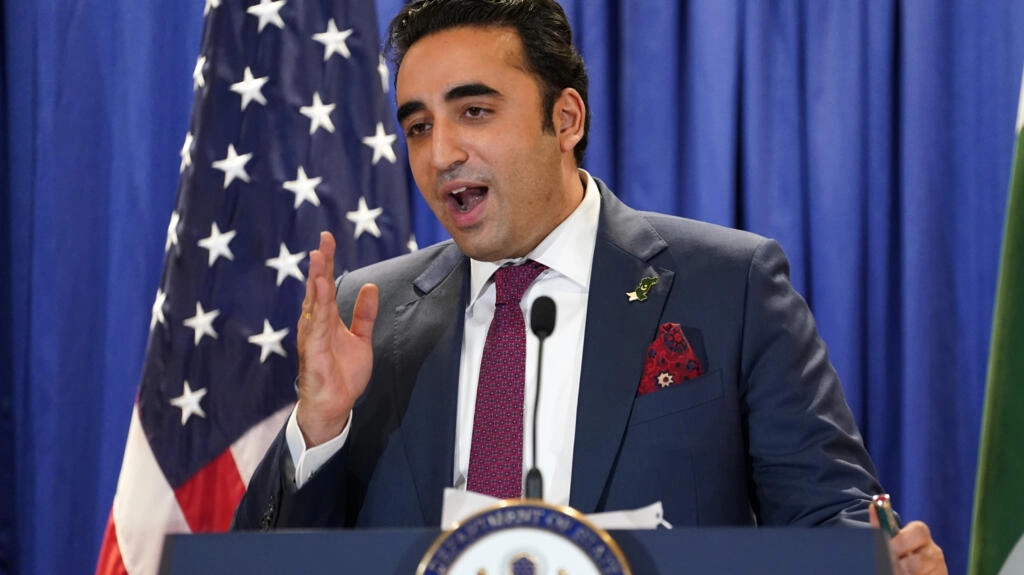
https://tribune.com.pk/story/2379237/pakistan-would-rather-be-bridge-between-china-us-fm-bilawal
Saturday, October 1, 2022
The Supreme Court’s authority within the American political system - Crisis of Trust


A common response to this question is to say the justices shouldn’t care. They aren’t there to satisfy the majority or to be swayed by the shifting winds of public opinion. That is partly true: The court’s most important obligations include safeguarding the constitutional rights of vulnerable minorities who can’t always count on protection from the political process and acting independently of political interests. But in the bigger picture, the court nearly always hews close to where the majority of the American people are. If it does diverge, it should take care to do so in a way that doesn’t appear partisan. That is the basis of the trust given to the court by the public. That trust, in turn, is crucial to the court’s ability to exercise the vast power Americans have granted it. The nine justices have no control over money, as Congress does, or force, as the executive branch does. All they have is their black robes and the public trust. A court that does not keep that trust cannot perform its critical role in American government. And yet as the justices prepare to open a new term on Monday, fewer Americans have confidence in the court than ever before recorded. In a Gallup poll taken in June, before the court overturned Roe v. Wade with Dobbs v. Jackson Women’s Health Organization, only 25 percent of respondents said they had a high degree of confidence in the institution. That number is down from 50 percent in 2001 — just months after the court’s hugely controversial 5-to-4 ruling in Bush v. Gore, in which a majority consisting only of Republican appointees effectively decided the result of the 2000 election in favor of the Republicans. This widespread lack of confidence and trust in the nation’s highest court is a crisis, and rebuilding it is more important than the outcome of any single ruling. Chief Justice John Roberts recently suggested that the court’s low public opinion is nothing more than sour grapes by those on the short end of recent rulings. “Simply because people disagree with an opinion is not a basis for criticizing the legitimacy of the court,” he said in remarks at a judicial conference earlier in September. This is disingenuous. The court’s biggest decisions have always angered one group of people or another. Conservatives were upset, for instance, by the rulings in Brown v. Board of Education, which barred racial segregation in schools, and Obergefell v. Hodges, which established a constitutional right to same-sex marriage. Meanwhile, liberals were infuriated by Bush v. Gore and Citizens United v. Federal Election Commission, which opened the floodgates to dark money in politics. But overall public confidence in the court remained high until recently. The actual cause of its historic unpopularity is no secret. Over the past several years, the court has been transformed into a judicial arm of the Republican Party. This project was taking shape more quietly for decades, but it shifted into high gear in 2016, when Justice Antonin Scalia died and Senate Republicans refused to let Barack Obama choose his successor, obliterating the practice of deferring to presidents to fill vacancies on the court. Within four years, the court had a 6-to-3 right-wing supermajority, supercharging the Republican appointees’ efforts to discard the traditions and processes that have allowed the court to appear fair and nonpartisan. As a result, the court’s legitimacy has been squandered in the service of partisan victories. The Dobbs decision in June, which overturned Roe v. Wade, eliminated American women’s constitutional right to control their own bodies and was a priority of the Republican Party for decades, is only the most glaring example. In cases involving money in politics, partisan gerrymandering and multiple suits challenging the Voting Rights Act, the court has ruled in ways that make it easier for Republicans and harder for Democrats to win elections. In 2018, the court ruled that public sector labor unions violated the First Amendment rights of nonmembers by requiring them to pay fees to support the unions’ work bargaining on their behalf, after decades of rulings in which the court had found the opposite to be true. That ruling further weakened organized labor, another Republican goal. For most of the court’s history, it was difficult to predict how a case would turn out based on the party of the president who nominated the justices. Even into the 21st century, as the country grew more polarized, the court’s rulings remained largely in line with the views of the average American voter. That is no longer the case. The court’s rulings are now in line with the views of the average Republican voter. In the process, the court has unmoored itself from both the Constitution it is sworn to protect and the American people it is privileged to serve. This could not be happening at a worse moment. Election deniers in the Republican Party are undermining the integrity of the American electoral system. Right-wing political violence is a present and growing threat. It is precisely during times like these that the American people need the Supreme Court to play the role Chief Justice Roberts memorably articulated at his own confirmation hearing — that of an umpire calling balls and strikes, ensuring a fair playing field for all. Instead, the court’s right-wingers are calling balls for one team and strikes for the other. As Justice Elena Kagan said in a talk this month at Northwestern University School of Law, “When courts become extensions of the political process, when people see them as extensions of the political process, when people see them as trying just to impose personal preferences on a society irrespective of the law, that’s when there’s a problem — and that’s when there ought to be a problem.” The way the court went about eliminating the federal right to abortion is a prime example of this misuse of its power. First, the right-wing justices used the court’s “shadow docket,” which refers to orders issued in response to emergency applications without open hearings or any public explanation, to allow an obviously unconstitutional anti-abortion law in Texas to stand. They also agreed to hear a separate challenge out of Mississippi, Dobbs v. Jackson Women’s Health Organization, that didn’t formally ask them to overturn Roe v. Wade. When they chose to do so anyway, the majority opinion, by Justice Samuel Alito, cherry-picked its historical examples and dismissed Roe as “egregiously wrong,” disdaining the work of earlier justices who had weighed the same constitutional questions carefully for decades. As the dissent in Dobbs noted: “The majority has overruled Roe and Casey for one and only one reason: because it has always despised them, and now it has the votes to discard them. The majority thereby substitutes a rule by judges for the rule of law.” In the coming months, the court will decide cases on affirmative action, the Voting Rights Act (yet again) and the power of state legislatures to ignore their own constitutions and even their voters. The rulings in these cases could dramatically reshape the country’s politics, and Americans should be able to trust that those rulings will be made by an impartial tribunal. There is no clear solution to this crisis. Legal scholars have put forward many proposals for structural reform — expanding the number of justices, imposing term limits or stripping the court of jurisdiction over certain types of cases — but none are a perfect remedy to the court’s politicization. In the meantime, it is worth remembering that the court heads only one branch of the federal government. Congress has far more power to counteract bad rulings than it generally uses — by doing its job and passing laws. Codifying the right to an abortion would be the most obvious move, but the court has usurped the role of the legislature on a range of issues, including forced arbitration clauses, campaign finance rules and gun laws. What would such a response look like? Here’s an example: On the final day of the last term, the right-wing justices hobbled the Environmental Protection Agency’s ability to fight climate change by requiring reductions in carbon dioxide emissions from power plants. Congress responded in August, adding a provision to the Inflation Reduction Act that reinforced the E.P.A.’s authority in this area. With a few exceptions, the Supreme Court rarely has been at the forefront of making America a more equal place. But we are not consigned to living under the thumb of a reactionary juristocracy. To the contrary, the meaning of the Constitution is far more than what the court decrees; it is the result of an ongoing conversation between the court and the American people. Those who protested the loss of their rights after the Dobbs decision, and those who showed their determination to protect those rights, as voters did in Kansas in August, are speaking directly to the court. When the justices stop listening, as they have at other moments in history, the people’s voices will eventually become too loud for them to ignore.

https://www.nytimes.com/2022/10/01/opinion/supreme-court-legitimacy.html