Wednesday, January 26, 2022
#Pakistan - Pakistan: Is PM Khan's government more corrupt than previous administrations?

Transparency International has ranked Pakistan 140th out of 180 countries in its latest Corruption Perceptions Index report. This deals a blow to Imran Khan, whose party promised to eradicate corruption from the country.

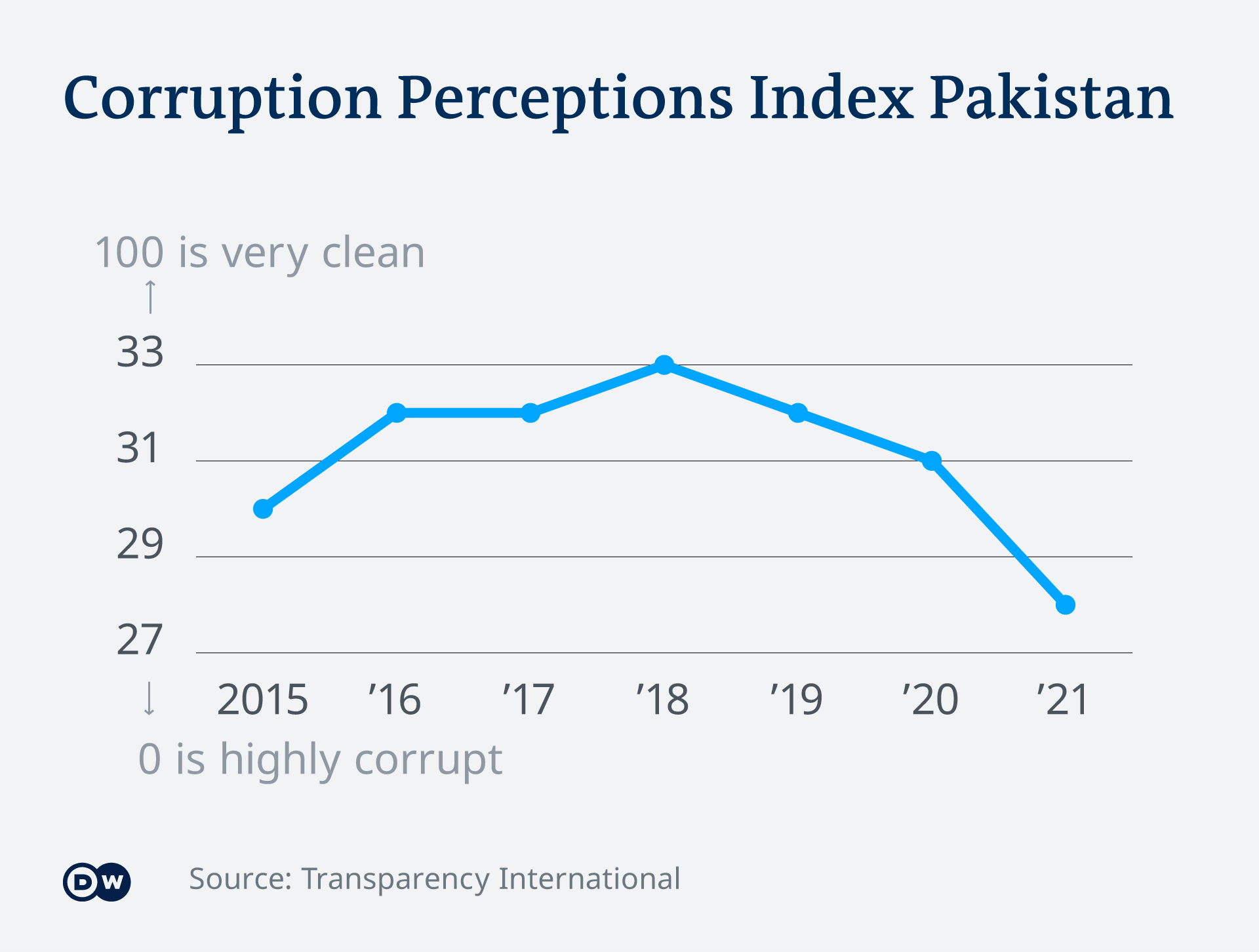
The perception of corruption in Pakistan has worsened since Imran Khan came to power in 2018, according to Transparency International (TI).
In its Corruption Perceptions Index (CPI) 2021, the Berlin-based watchdog ranked the South Asian country 140th out of 180 countries, with 180th being the most corrupt country in the world.
Pakistan was ranked 124th in 2020, 120th in 2019, and 117th in 2018.
TI has been compiling the corruption index since 1995. It is based on 13 different sources that depict perceptions of corruption within the public sector, including experts and business people.
The sources also include the World Bank, the World Economic Forum, and private risk and consulting firms.
According to the CPI 2021, the "deteriorating rule of law" and "state capture" are the main reasons behind a significant rise of corruption in Pakistan.
Before coming to power in 2018, Khan, a populist politician, regularly cited TI's CPI as an "evidence" to malign his political opponents, mainly former Prime Minister Nawaz Sharif.
Khan's politics continue to revolve around punishing "corrupt politicians," who, according to him, are impeding Pakistan's progress.
Tables have turned
But the corruption perception has become starker since Khan took the reins. Thus, the latest TI report presents a chance for opposition leaders to mock Khan.
Shehbaz Sharif, opposition leader in the National Assembly (Pakistan's lower house of parliament), said in a tweet that Khan's government "has broken all records of corruption in the last 20 years," adding that when his brother Nawaz was in power, corruption had decreased in the country.
Shahid Khaqan Abbasi, a former prime minister associated with the opposition Pakistan Muslim League (Nawaz) party, told DW that corruption is all-time high under Khan's government.
He dubbed it "unprecedented" in Pakistan's history.
Zulfiqar Ali Bader, a spokesperson for the Pakistan People's Party chairman Bilawal Bhutto Zardari, said the prime minister must step down after the publication of the CPI report.
But Information Minister Fawad Chaudhry played down the seriousness of the issue and told DW that Pakistan's low CPI score was not due to financial corruption in the country. Still he admitted, "Yes, we need reforms in the areas of the rule of law and state capture as mentioned in the report."Why is corruption increasing in Pakistan? Analysts cite a myriad of reasons behind rising corruption in Pakistan. "Transparency International makes a strong case that one can't divorce anti-corruption issues from the broader issue of democracy. When democracy takes a hit, anti-corruption efforts struggle because it's in strong and robust democracies where you can most expect to see transparency and probity," Michael Kugelman, a South Asia expert at the Washington-based Woodrow Wilson Center for Scholars, told DW. "Pakistan's democratic backsliding, in effect for quite some time, has constrained anti-corruption," he added. Elaborating on the issue of democratic backsliding, Amber Shamsi, a political analyst and journalist, said the CPI reflects the perceptions related to human rights violations, attacks on journalists and deteriorating rule of law in the country. "There is no across-the-board accountability in Pakistan. Dozens of opposition figures were accused of corruption and put behind bars, but they have not been prosecuted," she told DW. Learning the hard way Regardless, the Transparency International report has done a lot of damage to PM Khan's reputation as an "anti-graft crusader." Experts say it could even hurt him in the 2023 general elections. "Khan's political identity is interwoven with the anti-corruption issue. The new TI report, in that regard, is problematic," according to Kugelman. "The premier and his allies will seek to shrug off the TI rankings as an anomaly, or as a foreign conspiracy to malign Pakistan. In an ideal world, though, he and his party allies would introspect on the implications of these rankings. They say a lot not just about Pakistan's corruption challenge, but also about the democratic backsliding that exacerbates the corruption challenge," he added. Khan's failure to revive the country's economy is already causing him political problems. Along with tax increases and higher energy prices, Pakistanis are also facing rising inflation, as the purchasing power of the rupee decreases. Pakistan's inflation rate hit 11.5% last November. The rupee also is also trading at record lows against the dollar. "Khan's government has failed to deliver. There is no rule of the law [in the country], and he is suppressing opposition parties and curbing civil freedoms," said former PM Abbasi. But Kugelman says there are no quick fixes to Pakistan's economic problems.
https://www.dw.com/en/pakistan-is-pm-khans-government-more-corrupt-than-previous-administrations/a-60559804"Khan may have a genuine commitment to combat corruption, but the sheer scale of the problem — not to mention the power of vested interests that don't want a change in the status quo — underscores that this continues to be an uphill battle. Anti-corruption is one of those goals that is so much easier to envision when in the opposition than inside the system. Khan has learned that the hard way," he said.
#Pakistan - Prime Minister Imran Khan on the warpath

It is evident that he is under a lot of pressure as public discontent grows over the rising cost of living and the government fails to deliver on its promises to bring about change. The argument about inflation being entirely driven by external factors is not convincing. There is no denial of global linkages but misgovernance and flawed economic policies have also been the reason for spiralling commodity prices in the country. Blaming mafias and cartels for the problem cannot satisfy the people who are directly affected by the galloping food prices.
The prime minister appears to be fighting a losing battle.
It has cost the ruling party hugely in terms of political support. The upset in the KP local bodies’ elections is indicative of the party’s shrinking political base. It has brought to the surface the widening rift within party ranks. The move to reorganise the party in the midst of the crisis has added to the confusion at a time when the opposition has stepped up its campaign to bring down the government.
Speculations about a deal between the security establishment and the opposition groups seem to have increased the government’s worries. The widespread rumours about a possible deal seem to have triggered the PM’s angst. His reference to the speculations indicated his unease. For a government which has been largely dependent on the security establishment for its survival such a possibility would obviously be disturbing. In Pakistani politics, such back room deals are not unusual. The growing confidence in the ranks of the opposition and the latter’s plan to march on Islamabad has given currency to the rumours that the security establishment has distanced itself from the government.
That could also mark the weakening of the hybrid power arrangement. Not surprisingly, the prime minister’s remarks that he could be more dangerous if ousted from power is seen by many as a threat to the opposition as well as a message to the establishment. But such a stance could also be seen as sign of weakness. That may lead to the unravelling of the fragile coalition. Such messaging could have a demoralising effect on the PTI. An authoritarian and irrational approach can harm his government more than the opposition’s campaign.
A refusal to interact with the opposition on even critical national issues has weakened the democratic process in the country. There is little realisation on the prime minister’s part that a weakened system has made his government more vulnerable. The prime minister might call himself a democratically elected leader, but a demonstration of respect for parliament is still lacking, while contempt for elected representatives was more strongly evident in his remarks.
It has been asked why the prime minister is not ready to interact with the leader of the opposition whom he calls a criminal, but is willing to talk with terrorist groups like the TTP, who have now called off the ceasefire and stepped up attacks on Pakistani security forces. Of late, the group has carried out terrorist attacks in Islamabad and other places. Confronting the opposition and having a policy of appeasement towards outlawed militant groups has created a very dangerous situation for the democratic process in the country.
Pakistani PM's Attempt For Afghan Fund Faces Backlashes Over Fears Of Sanctions
This is the first time the State Bank of Pakistan has stood against the government's relief fund plan for Afghanistan since legislation was tabled towards making it more independent, said a report.The Imran Khan government's recent bid to raise funds for the new rulers in Kabul has been shot down by the State Bank of Pakistan (SBP) amid fears that financing of the Taliban regime could invite international sanctions, according to a media report. Pakistan's Finance Ministry has been advised by the SBP against domestic and foreign donations to the government of Afghanistan Relief Fund that funnelling funds to the Afghan government without involving "international organizations of repute" could result in sanctions from the Financial Action Task Force (FATF), an international anti-money laundering and terror finance watchdog, reported Asia Times. FATF is set to review Pakistan's performance on various metrics next month. Notably, Pakistan has been on the Paris-based watchdog's "grey list" since June 2018. So far, two key FATF action items have not been met by Pakistan which are necessary to get the country removed from the grey list. It includes the prosecution and confiscation of assets of UN-designated terrorists. This is the first time that Pakistan's autonomous central bank SBP has stood against the government's relief fund plan since legislation was tabled towards making it more independent, said Asia Times. Pakistan's central bank is undergoing some autonomy-enhancing reforms under a deal with the International Monetary Fund (IMF) for a $6 billion extended fund facility. The SBP in late December was approached by the Pakistan government through its finance division to open a collection account for its Afghanistan Relief Fund. It proposed that disbursements from the new fund to the Taliban could be made through banking channels. However, the SBP countered that the transfer of funds directly to Afghanistan "through banking channels could be challenging". The central bank proposed that instead of that disbursement from the fund could be made through international relief organizations or extended by the government as "in-kind" support to help Afghans who now face acute food shortages, according to Asia Times. The SBP also conveyed to the government that opening fund accounts at overseas bank branches would require the authorization of foreign regulatory bodies, a time-consuming and cumbersome process - particularly in light of Pakistan's FATF "grey list" designation. The Imran Khan government has continuously tried to soften the world's stance on the Taliban and has urged countries to recognise the new government in Kabul. But the countries have declined to give formal recognition.
https://www.ndtv.com/world-news/pakistan-pm-imran-khans-attempt-for-afghanistan-relief-fund-faces-backlashes-over-fears-of-fatf-sanctions-2731050
Tuesday, January 25, 2022
آخری قہقہہ کس کا؟ - عاصمہ شیرازی -
ٹرانسپیرنسی رپورٹ، بھارت بھی پاکستان سے بہتر نکلا - وزیراعظم عمران خان کی حکومت کے کرپشن ختم کرنے کے دعوے دھرے کے دھرے رہ گئے۔
ٹرانسپیرنسی انٹرنیشنل کی کرپشن پر سیپشن انڈکس میں بھارت بھی پاکستان سے بہتر نکلا۔
وزیراعظم عمران خان کی حکومت کے کرپشن ختم کرنے کے دعوے دھرے کے دھرے رہ گئے۔
پی ٹی آئی حکومت نے کرپشن کے معاملے آصف زرداری اور نواز شریف دورِ حکومت کو بھی مات دے دی ہے۔
ٹرانسپیرنسی انٹرنیشنل کی رپورٹ کے مطابق 180 ممالک کی فہرست میں پاکستان کا پہلے 124واں نمبر تھا جو اب ترقی کرتے ہوئے 140ویں نمبر پر آگیا ہے۔
ٹرانسپیرنسی کی رپورٹ میں بھارت بھی پاکستان سے بہتر نکلا ہے، جو فہرست میں 85ویں نمبر پر ہے۔
ٹرانسپرنسی انٹرنیشنل کے مطابق ایسا صرف میڈیا آؤٹ لیٹس، این جی اوز کو بند کرنا اور انسانی حقوق کے کارکنوں کا قتل سبب ہوا ہے۔
رپورٹ کے مطابق صحافیوں اور سیاستدانوں کی جاسوسی کرنا پاکستان کی کرپشن پرسیپشن انڈکس 2021ء کو بہتر نہیں بناسکتا، حکومتیں اس کے برعکس کام کرنے کی کوشش کریں۔
https://jang.com.pk/news/1041856
#Pakistan - #PTI govt broke all records of corruption - Pakistan slides 16 spots, ranks 140th on CPI
In TI's Corruption Perceptions Index 2021, Pakistan scores 28 out of 100
The absence of a central agency to coordinate action against corruption was a core factor in driving Pakistan to its lowest in recent years on a global perceived corruption index in 2020, watchdog Transparency International said on Tuesday.
The group’s annual report on business leaders’ perceptions of corruption — which gave Pakistan a score of 28 out of 100, down from 31 in 2020 — also cited the “failure” of the state to uphold rights and consult citizens.
That put Pakistan, at 140, behind India in 85th place, while Bangladesh stood at 147 with a Corruption Perceptions Index (CPI) of 26.
The 2021 index ranks 180 countries by their perceived levels of public sector corruption. The index assigns scores of between one and 100, one being highly corrupt and 100 clean.
The score is derived from a range of 13 sources measuring corruption perceived by experts and business executives. It measures the use of public office for private gain, nepotism, bribery, the diversion of public money and state capture.
The score is also a reflection of the strength of integrity and anti-corruption systems, including “the existence of adequate laws on financial disclosure, conflict of interest prevention and access to information”.
Transparency trumpets the CPI as “the most widely used indicator of corruption worldwide”. But the high-profile and widely reported index has amassed its fair share of critics over the last two decades.
A Guardian report attacked the CPI’s reliance on the opinions of a small group of experts and business people. “This embeds a powerful and misleading elite bias in popular perceptions of corruption and can lead to inappropriate policy responses,” it said.
Pakistan is among two-thirds of nations across the world that are either stagnating or showing signs of deterioration in their anti-corruption efforts.
Under the government of Pakistan Tehreek-i-Insaf (PTI), which came to power on an anti-corruption platform, Pakistan’s ranking has gradually slid. In 2019, it was 120 out of 180 nations, 124 in the following year, and in 2021, it slipped further to 140.
In contrast, in 2018, the last year of the Pakistan Muslim League-Nawaz (PML-N) government, the rating stood at 117 out of 180 governments.
Commenting on the report, the vice chairperson of the Berlin-based agency’s Pakistan chapter, retired Justice Nasira Javed Iqbal, observed there was no change in CPI scores of India and Bangladesh from 2020.
The top performers in the Asia Pacific are New Zealand (88), Singapore (85) and Hong Kong (76).
However, most countries sit firmly below the global average of 43. This includes three countries — Cambodia (23), Afghanistan (16) and North Korea (16) — with some of the lowest scores in the world.
“While countries in the Asia Pacific have made great strides in controlling bribery for public services, an average score of 45 out of 100 on the 2021 CPI shows much more needs to be done to solve the region’s corruption problems,” a Transparency report said.
The government is also battling to improve the regulations to avert being blacklisted by the global financial body, the Financial Action Task Force (FATF), in what could be a bitter blow to an economy already beset by a weakening currency, rising inflation and slower growth.
Many have urged the State Bank of Pakistan (SBP) to push banks to improve anti-money laundering systems and information sharing across the sector.
RESIGNATION OF GOVT SOUGHT
Commenting on the contents of the report, PML-N President Shehbaz Sharif declared Transparency International testified for the second time the PTI government “has broken all records of corruption in the last 20 years”.
In a statement, Sharif, who is facing a plethora of corruption cases, claimed corruption had “decreased” during his party’s government as a result of “transparency, good governance and legal reforms”.
Under deposed prime minister Nawaz Sharif’s “transparency [and] good governance”, corruption had declined as legal reforms of PML-N improved the ranking of Pakistan in the corruption index by 23 points and the country’s image improved in the world.
https://www.pakistantoday.com.pk/2022/01/25/pakistan-ranks-140-out-of-180-on-global-corruption-index/
#Pakistan - There are difficulties in regularizing the population of Gujjar Nala, but there is no obstacle in the regularization of Bani Gala – Chairman Bilawal Bhutto Zardari
Chairman Pakistan Peoples Party Bilawal Bhutto Zardari has said that he will save the Katchi Abadis across Sindh, and will give property rights to the residents there. He added that PPP has never opposed giving plots to any judge, bureaucrat, or anyone else, hopefully, no one will object to the poor getting their due share either.

Addressing an initial leasing ceremony for 150 people under a scheme to give property rights to residents of more than 8,000 houses in 19 mahallas of Larkana, Chairman PPP said that the first thing the incumbent Prime Minister had done after being elected was to regularize his Bani Gala home for a small fee. We hoped that when the Prime Minister was regularizing his house, the same policy would be applied to the slums across the country.
“Instead, one slum after another was demolished,” said Chairman PPP. “And it seemed as if all the forces of the country were united in snatching away roofs from atop the heads of the poor.”
Chairman Bilawal Bhutto Zardari further said that it is tragic that we face difficulties in regularizing the population of Gujjar Nala, but there is no obstacle in the regularization of Bani Gala.
“There are difficulties in regularizing the slums of Orangi Town, but Bahria Town is regularized,” said Chairman Bilawal Bhutto Zardari.
Chairman PPP said that he was proud of the people of Larkana who had formed organizations to save their homes and started a movement. Today, that movement has been successful. He said that a new journey begins today. Ownership rights will be given to slum dwellers across Sindh, where they have been living for forty years. He further said that the task of rescuing the slums will be intensified from February. We will do our best to give the poor people their rights.
Chairman Bilawal Bhutto Zardari said that this is the difference of perception and opinion as to what kind of Pakistan you want to see. A Pakistan where a common man, a job seeker, a middle-class man, invests the savings of his whole life in projects like Nasla Tower. There are many other such oppressive examples. Or a Pakistan that is the Pakistan of Quaid-e-Awam and Shaheed Mohtarma Benazir Bhutto, where every man from every class gets his due share.
“If the people support us, we will create a Pakistan where everyone is provided with the rights they deserve,” said Chairman PPP. “The journey that has started today from the slums of Larkana will start in the whole of Sindh, including Karachi.” He said that after the next general election, we will give property rights to the citizens living in slums all over Pakistan.
Meanwhile, Chairman Bilawal Bhutto Zardari handed over lease certificates to 150 people in the first phase of the project to give property rights to the slum dwellers of Larkana.
Present on the occasion were Special Assistant to Chief Minister Sindh Liaquat Ali Askani, Members of Assembly and other leaders.
Monday, January 24, 2022
OPINION: Why Pakistan’s Army Wants the U.S. Back in the Region


For years, Chinese and Pakistani leaders have described their relationship, forged by a common rivalry with their neighbor India, as “sweeter than honey.” But the Pakistani Army’s view of the relationship with China appears to be souring — and diverging from the political leadership’s. Last month, after Prime Minister Imran Khan declined the Biden administration’s invitation to its Summit for Democracy, the Pakistani television news anchor Kamran Khan posted a video on social media denouncing the “wrong decision,” one he declared was made at China’s behest. (China was not invited to — or happy about — the summit.) The journalist lamented that, with that move, the prime minister had “put Pakistan openly in China’s lap.” He alleged that Beijing’s loans had “entrapped” Islamabad, and he even called for an “audit” of the pros and cons of the China-Pakistan Economic Corridor, which has brought billions of dollars in debt-driven energy and infrastructure investment to Pakistan. In Pakistan, press freedom and politics lie in a gray area, with red lines carefully managed by the army. With a mere phone call or WhatsApp message, colonels can whip a transgressive editor or lawmaker into line. So the explicit call to reconsider relations with China by one of Pakistan’s most prominent media voices is no random hot take. It reflects the consent, if not the orders, of the country’s khaki masters. Indeed, Pakistan’s praetorian army would have preferred, according to a retired U.S. diplomat, that Prime Minister Khan had attended President Biden’s summit — to reinvigorate a relationship with a superpower that’s been giving it the cold shoulder. The generals, of course, have little love for democracy or, for that matter, America. What they do have is a sharp sense of realism and a firm belief that the army is the guardian of the national interest. (The army has directly ruled or commanded strong indirect political influence for most of Pakistan’s history.) The army leadership must know it has no permanent friends among political forces at home or abroad. It constantly seeks strategic maneuverability, balancing domestic and foreign forces in response to changing realities and to avoid dependence on a single patron, proxy or ally.The historically on-again-off-again U.S.-Pakistan relationship is a perfect example. The 9/11 attacks and subsequent U.S. invasion of Afghanistan brought Islamabad and Washington closer. Army-ruled Pakistan had no choice but to accept a slew of U.S. demands, including aiding the overthrow of a Taliban regime it saw as friendly. But by the mid-2000s, Pakistan resumed covert support for the Taliban, aiming to force a negotiated U.S. withdrawal. Last year, Pakistan got what it wanted. But now, after spending two decades working to push America out of Afghanistan, the Pakistani Army appears to want it back in the region.
Because as U.S.-China competition intensifies, Pakistan’s army fears getting trapped in a cul-de-sac with Beijing. So it seeks to balance the two great powers by grasping on to areas of cooperation, including counterterrorism and trade, that could salvage relations with Washington. The prime minister, in contrast, appears to be more driven by personal sentiments. He admires China’s political system, especially its gains against poverty and its ruthless anti-corruption measures. And he has an anti-American streak, which helps explain why he might be more receptive to Chinese pressure. The army, though, doesn’t seem to hold such grudges. Its focus is the present and the future, which seem foreboding. Pakistan’s economy is sputtering, which could be a recipe for social and political unrest, as well as cuts in military spending.As the tap from China dries up — given Beijing’s growing aversion to lend to high-risk countries — and Pakistan’s economic woes worsen, much of the army command see Mr. Khan’s hypernationalism as counterproductive truculence, and the military leaders increasingly view him as more of a liability than an asset. This helps explain the overtures to Washington, which include not just the democracy summit messaging but also granting a U.S. diplomat rare access into the tightly controlled, Chinese-operated port of Gwadar.But the attempted pivot back to America most likely won’t go far. Goodwill in Washington has dried up, especially given Pakistani intelligence’s support for the Taliban. And Islamabad’s sins aren’t the sole driver of the U.S.-Pakistan divorce. Washington has wholeheartedly embraced India, seeking to advance its rise as a global power, even as that country moves toward Hindu nationalist authoritarianism. Time after time, Washington has allowed an “India exception” in its human rights or nuclear proliferation policies, emboldening New Delhi and endangering Islamabad. While Pakistan has in recent years grown ties with Russia and Turkey, China has become the obvious choice for a meaningful alternative to the United States. With relations with Washington at a nadir in 2011, Islamabad turned to Beijing to obtain military hardware it couldn’t get from America, including drones and advanced aircraft. China and Pakistan accelerated their joint manufacturing of a low-cost fighter jet that forms the backbone of Pakistan’s air force. And Pakistan became the only foreign country with access to the military version of China’s Beidou satellite navigation service. While Pakistan’s generals appear irked by the prospects of being trapped on China’s side in a new cold war, they also have benefited from Beijing’s new muscularity — like when India last year was forced to divert troops from the front lines with Pakistan toward the border with China. Fears of a two-front war with China and Pakistan have restrained New Delhi’s posture toward Islamabad for now. But they also tighten the Indo-American embrace. Paradoxically, Pakistan’s partnership with China may be paying off too well.To counter China, India is overcoming its inhibitions to align with the Americans, dilute its “strategic autonomy” and deepen bilateral defense cooperation. This in turn increases Pakistan’s dependence on China, its largest arms supplier and bilateral creditor. And that compounds the Pakistani Army’s fears of being strategically boxed in. Meanwhile, Pakistan has learned the hard way that when it comes to trade and lending, its special relationship with China isn’t so special. Islamabad in 2020 started trying to renegotiate the expensive electric power contracts it recklessly entered into with Chinese companies. Beijing not only refused to do so, but it insists that Islamabad repay $1.4 billion in arrears owed to Chinese power producers. Pakistan put nearly all of its eggs into one basket and is learning the limits of what it means to be an “ally” of China. Its predicament offers lessons for other smaller countries on navigating a new era of the U.S.-China rivalry: Don’t blindly pursue China as an alternative to the United States. In commerce and trade, China’s approach is mercantilist for friends and foes alike. And so while Pakistan’s army appears to be trying to distance itself, it might already be too late.
Pakistan’s farmers, agriculture and economy can only be protected after the puppet Prime Minister is ousted – Chairman PPP Bilawal Bhutto Zardari

The PPP chairman said that people’s rule has to be established by removing the selected government.
Bilawal Bhutto Zardari said that the ineligible government that lacks everything to run the country has left country’s agricultural economy in a devastated condition while the people especially the crops growers are pinned to wall.
The ineligibility of this incumbent poor government has brought multiple crises and each only inflicted irreparable loss to country’s backbone sectors.
He said that the cash crops are not getting a fair price while the farmers have been left on mercy of the nature. In addition, cash crops are being damaged due to unfair distribution of water.
He further said that the wrong policies of the government have not only ruined the agricultural economy but also endangered food security.
He said that a few days ago farmers staged protests in districts of Punjab and Sindh as in Sahiwal, Layyah and Larkana. We are leaving the villages and standing in the city center to convince the rulers to solve the problems of the farmers.
He was of the view that that the prosperity of the farmers is equal to the prosperity of the entire nation.
Bilawal Bhutto Zardari reminded that when PPP was in power, it worked positively for the betterment of all sectors especially the agriculture. However, farmers are anxious to get a bag of fertilizer by standing in long queues for fertilizer today.
The PPP chairman pointed out that the country was suffering from problems even under President Pervez Musharraf. The crisis was overcome and we were able to export surplus wheat abroad. “Farmers are being killed economically today, which we will not tolerate,” he said.
Today the farmer goes to bed empty stomy, and it is feared that the food insecurity will drive the entire nation to devastation. At present, inflation and unemployment in the country have reached historic levels. We are tired of pointing out problems in the National Assembly but no action is being taken by the government. The selected government has no concern for the farmers.
Bilawal Bilawal Bhutto Zardari said that if any government had any sympathy towards the farmers and the people in the country, it was the PPP leadership.
Shaheed Zulfikar Ali Bhutto, Shaheed Mohtarma Benazir Bhutto, and former President Asif Ali Zardari had deep concern of the people. Shaheed Zulfikar Ali Bhutto rebelled against the system of the country and gave rights to farmers, carried out historic land reforms, gave land ownership rights to farmers, while Shaheed Benazir Bhutto also loved farmers immensely.
The PPP chairman said that if Pakistan’s economy is to be saved then Imran Khan has to be ousted peacefully, lawfully and by all democratic norms and values. We have decided that we will leave Karachi on February 27. The people of Hyderabad will also join us and the people there. We will send this government home in a democratic, legal and constitutional way with the support of the nation.
He while criticising the ruling coalition said that the facilitators of the selected government belonging to Sindh are conspiring to harm Sindh. They are trying to harm the peace of Sindh. The ethnicity-based artificial conflicts deeply impede our struggle for the rights.
“I will not allow any injustice to be done to any Sindhi speaker, Urdu speaker or Pashto speaker.”
“Let the people thwart the conspiracy of these ethnic groups by maintaining their unity.
The PPP chairman said that those who call the new local body system introduced by Sindh Chief Minister a black law will have a remorseful impacts on minds. The people of Sindh will reject these rejected elements.
Addressing the people, he said that he wants the mayor of Hyderabad from PPP, a Jiayala.
He promised that he will work with the Jiala mayor to resolve the problems of the people.
Chairman Bilawal Bhutto Zardari said that those who could not be faithful to their leader would not be faithful to anyone else. Those who used to applaud slogans against Pakistan are the enemies of this city.
Sindh Chief Minister Syed Murad Ali Shah, provincial ministers, lawmakers and party dignitaries were present.
Sunday, January 23, 2022
#Afghanistan - Taliban 2.0 aren't so different from the first regime, after all
The international community is closely monitoring the Taliban, after the group re-seized power in Afghanistan in August 2021. There is legitimate reason for concern. The Taliban are again ruling through fear and draconian rules.The Taliban's last regime, in the mid-1990s, was marked by human rights violations, including massacres, mass detentions and rape. The regime collapsed on Nov. 14, 2001, shortly after the U.S. launched its global war on terrorism. Even after the Taliban officially fell from power, their subsequent two decades of insurgency produced various gross human rights violations, an encompassing term under international human rights law.When the Taliban regained control over Afghanistan last year, some outside observers speculated that an evolved version of the group might materialize. These spectators assumed that the Taliban recognized it cannot govern merely with fear and bans. Many Afghan people still expressed widespread fear and skepticism about the Taliban's return. Branding Taliban 2.0 The Taliban have now been in power for almost five months. A clearer image of the human rights and personal freedoms situation in Afghanistan is emerging.As political science professors specializing in conflict and violence, we find that the Taliban's changes are limited to international public relations campaigns on social media and other outlets. While promoting a moderate face to the world, with promises of living "peacefully" and respecting women's rights, the regime has continued to systematically violate human rights and strengthen its autocratic grip. Theories about what experts called "Taliban 2.0" continued after the group assumed control over Afghanistan. Representatives from countries such as Turkey and Qatar encouraged the international community to engage with the Taliban. While international donors have frozen about $5 billion in foreign aid to Afghanistan since the Taliban takeover, some Western countries, including the U.S., have announced increases in aid to address the country's humanitarian crisis. Limiting the flow of information The Taliban have undertaken a systematic media crackdown to achieve their contradictory goals of presenting a softer face to the international community while violating Afghans' rights. The group is forcing media to follow two of the Taliban's dogmatic and moral regulatory bodies' guidelines. The Taliban also announced the "11 journalism rules," which include forbidding journalists from publishing or broadcasting stories that are "contrary to Islam" or "insult national figures." About 40% of the country's media sources have shut down, 6,400 journalists lost their jobs, including 84% of female journalists. Violence against media and journalists has again become widespread. Many other journalists have left the country. The media crackdown has a practical reason: limiting the flow of information about the regime's continued rights violations. United Nations human rights experts say they have received credible reports of the Taliban killing civilians, as well as hundreds of former Afghanistan security personnel across the country. The Taliban have shown gruesome hangings of dead bodies and stoning of people to death. An emerging humanitarian crisis Meanwhile, the humanitarian situation has deteriorated under the Taliban. Approximately 23 million Afghans are facing hunger, including 3.2 million children who are suffering from severe malnutrition. The Taliban leadership denies any responsibility for alleviating the looming humanitarian crisis. In November 2021, Taliban Prime Minister Mullah Hasan rejected the regime's responsibility for food insecurity in Afghanistan and asked people to "cry to God to alleviate famine and drought." Anas Haqqani, a senior member of the Taliban negotiation team in Doha, also downplayed the seriousness of the looming hunger crisis by rhetorically asking a BBC reporter if she had ever witnessed someone dying of hunger. Regressing on women's and girls' rights The Taliban's conduct toward girls and women also reveals a return to previous ways.The Taliban has banned women from traveling more than 72 kilometers from home without a male relative.In early December, the Taliban released a decree saying a woman is a "noble and free human being" and should not be forced into a marriage. The international community largely welcomed the announcement.However, a closer look at the decree reveals that the Taliban formalizes the regime's right to determine whether a woman actually consents to a union.The Taliban have systematically reinstated old restrictions on girls education and female employment.While most primary girls schools are closed across the country, secondary and tertiary education remains completely banned for girls.In 2017, U.N. Children's Fund figures showed that 3.7 million Afghan children were out of school, 60% of them girls. This percentage is now likely much greater with the Taliban's ban on girls education. This differs from the Taliban's recent public messaging on girls' and women's "right to education and work." To the domestic audience, the regime's messages are vague. Leaders condition reopening girls education, for example, to unclear economic and moral conditions. Deputy Prime Minister Mullah Abdul Ghani Baradar said recently that once "economic challenges are resolved, we will provide education for all those who want to pursue their studies." The Taliban have also banned most female government workers from returning to their jobs, resulting in a workforce restriction that would result in economic losses totaling $1 billion. The only indication of a "new Taliban" is a much more sophisticated and strategic public relations approach for masking ongoing human rights violations.
https://www.christiantoday.com/article/taliban.2.0.arent.so.different.from.the.first.regime.after.all/138058.htm
#Pakistan - Growing terrorism threat - The Afghan Taliban are not fully cooperating with Pakistan in dealing with the TTP

THE terrorist attack on a police check post in the heart of the federal capital earlier this week was a dangerous happening. It is good that the security agencies have taken the incident very seriously (they should be equally concerned about the security of other cities such as Lahore that witnessed a blast on Thursday). But what is questionable is the state’s penchant for talking to the notorious banned group that claimed the attack. The Tehreek-i-Taliban Pakistan (TTP) has escalated terrorist attacks in Pakistan since the Afghan Taliban took power in Afghanistan, and the interior minister has indicated that the trend may continue in the coming weeks.
Last year too, two terrorist attacks were recorded in Islamabad in which the banned TTP killed three policemen and injured a couple of others. Indeed, the twin cities of Islamabad and Rawalpindi have witnessed sporadic terrorist violence in recent years despite perceptible security. During the last two years, the TTP and its factions have carried out 11 terrorist attacks in Rawalpindi and Islamabad, resulting in the deaths of 13 security, mainly police, officials. This week’s attack in Islamabad also targeted policemen. The second worrying aspect is that in the past the TTP remained active mainly in the outskirts of the federal capital, but the latest attack was reported from a busy sector in the heart of Islamabad.The attack reveals the intention of the terrorist group to create fear. If more such attacks happen, barricades and check posts on the roads of Islamabad will be brought back. Only recently, a sense of security had returned when the number of security check posts was reduced to a minimum. Though Islamabad has a functional safe city mechanism, the security of the federal capital remains critical and security departments can take any measures to counter threats. It will not be surprising if Islamabad comes under increased security surveillance when a so-called pro-Pakistan regime in Kabul is reluctant to hand over or act against terrorists causing insecurity in this country.
The Afghan Taliban are not fully cooperating with Pakistan in dealing with the TTP.
Some media reports indicate that certain Afghan Taliban leaders are trying to restrict the movement of the TTP leaders and impose an arms embargo on the group. But the situation on the ground is different and the TTP’s confidence is gradually improving. Meanwhile, Pakistan has reportedly initiated another round of peace talks with the TTP through a tribal jirga, which can only be interpreted as extending one more olive branch to the terrorists. One wonders why security institutions are obsessed with talking to the TTP, especially when the latter has taken a hard stance on talks and continues its attacks against Pakistan.
The killing of Mufti Khalid Balti, a former spokesperson of the TTP, has further increased the trust deficit between negotiators from both sides and their guarantors. In that context, if the mantra of talks is merely a tactic to create rifts in the TTP leadership then the cost is very high and still may not be enough to eliminate the threat. The TTP will continue to cause damage to Pakistan, and over time, the Taliban regime in Afghanistan will learn the tactics to avert pressure from Pakistan. After all, the TTP is their ideological brigade and shares the same view of establishing an Islamic order of governance.
Security institutions have to carefully craft the approaches to deal with groups like the TTP and Al Qaeda which are under the protection of the Taliban regime. The TTP is not only a major actor of violence in Pakistan, it is also a facilitator of the regional operations of Al Qaeda and the East Turkestan Islamic Movement (ETIM). Al Qaeda has maintained its ties with the Afghan Taliban and has reportedly also helped the TTP recover and regroup in recent years; some Al Qaeda-aligned Pakistani groups even joined the TTP. In April 2021, CNN claimed, based on its interviews with two Al Qaeda operatives, that the group would step up its operations in the region after the US exit from Afghanistan. The report claimed that the group was planning a comeback by relying on its partnership with the Afghan and Pakistani Taliban.
Any probable operational alliance between the TTP and Al Qaeda or with ETIM against Chinese interests in Pakistan can prove lethal and cause a diplomatic crisis. The TTP can overcome its internal differences and restructure its networks. The group has seen many crises but has not lost its sting. It was involved in 87 terrorist attacks in 2021, an 84 per cent increase over its attacks across Pakistan the year before. Apart from these, most of the cross-border attacks from Afghanistan in 2021 (12 out of 14) were also perpetrated by the TTP. The geographical spread and number of TTP attacks in 2021 indicate that while the group carried out most of the assaults in former Fata, it also showed it had a presence in northern Balochistan and the Rawalpindi-Islamabad area.
One can imagine the potential lethality of the group which it has already displayed. Its core strengths include its close association with the Taliban and Al Qaeda, and a narrative that still attracts youth from the peripheries and religious institutions. The Afghan Taliban have proved themselves a liability for Pakistan and have been negatively affecting the country’s counterterrorism policies. They are not fully cooperating with Pakistan in dealing with the TTP, nor are they collaborating with it to secure Pakistan’s western border.
The TTP itself and Pakistan’s tendency to negotiate with it are encouraging other terrorist groups. The militant Islamic State group’s so-called Khorasan chapter has also become active in Pakistan, where it carried out multiple attacks in 2021 on Hazara Shias, alleged Afghan Taliban members and associated religious scholars, as well as political leaders/workers in Balochistan and KP. Several of its associates were arrested from parts of Sindh and Punjab in multiple search operations conducted by law enforcement during the year.
Pakistan has to devise a different approach to deal with the TTP threat. A timely change of course can save many precious lives and damage to the country.
President Asif Ali Zardari’s message on the farmers’ tractor march

In a statement issued from Media Office Islamabad, the former president said that a prosperous farmer is the guarantee of an agriculturally stable Pakistan.
The PPP will uphold its tradition of justice to the farmers and make it easier for the farmers to get their crops to the market. He said that the manifesto of the PPP is an agriculturally strong Pakistan. The former president said that the purpose of the farmers’ tractor march is to raise a voice against injustice with the farmers.
https://www.ppp.org.pk/pr/26142/
#Pakistan - Message of Chairman PPP Bilawal Bhutto Zardari on International Day of Education

In his message on the eve of International Day of Education being observed globally tomorrow, Chairman Bilawal Bhutto Zardari said that education remains top priority of his Party as it believes that the future belongs to our children and youth, and the dream of a bright future without education will remain unfulfilled. PPP governments always increased the education budget, whenever in power and established record number of universities and other technical education institutions in the history of country, he added.
He said that professional and technical education are key to a better future and for this purpose the share of education in budget has to be increased. Bilawal Bhutto Zardari pointed out that expenditure on education has dropped to 1.5% of the GDP during the selected regime of Imran Khan, which shows a sorry state of affairs. After winning the next general elections, PPP government will further increase the education budget, he vowed.
PPP Chairman said those compromising on the educational promotion and making unbearable cuts in the budget of universities and their allied centers are in fact causing great disservice to the nation. “Such approach is extremely hostile to the people, when on the one hand, about 25 million children between the ages of 5 and 16 are out of schools, while on the other, there is a big difference in access to quality education among the children of poor and privileged classes in the country,” he added.
Bilawal Bhutto Zardari pointed out that this is PPP’s manifesto that we will have to move beyond the traditional curriculum and teaching methods to an education system that will inculcate in children creative and critical problem-solving and decision-making skills. He pledged that after winning the next general election, PPP would ensure that, in accordance with the Constitution of Pakistan, the State provides equal access to quality education to all children, adding that, the peoples government will increase expenditure ratio of education to more than 3% of GDP initially and continue to maintaining our own record of establishing more and more universities, colleges and other technical education institutions.
https://www.ppp.org.pk/pr/26140/