Thursday, December 2, 2021
#Pakistan - Silencing opposition - Pakistan must cut away from its royal, colonial and dictatorial legacy.

https://www.dawn.com/news/1661474/silencing-opposition
#Pakistan - The wages of the #IMF

Durdana Najam
IMF, World Bank have been of no use other than exacerbating Pakistan’s economic woes, says American economist.Despite having some of the best internationally recognised minds to manage Pakistan’s financial affairs, why is there no exit from the economic woes? Is there a probability that these able minds have been working as the so-called economic hitmen to keep Pakistan financially bankrupt? This is not an illusion of a conspiratorial mind as the readers might be tempted to think. There are reasons for the doubt. For instance, take the case of the IMF’s six billion dollar package. We have not even received half of the total package as the debt is released in bits and pieces. With every new tranche, a list of dos and don’ts is handed down for compliance. Being negotiated currently is a tranche worth $1 billion. So far, the walk on the tightrope has been made possible with the massive devaluation of the rupee, high electricity and gas tariffs, elimination of Rs350 billion worth of subsidies, the reincarnation of petroleum levy by Rs33, cut in the development budget to the tune of Rs300 billion and imposition of new taxes. Soon a mini-budget will be floated to give a legal cover to these demands. According to experts, this will be one of the biggest mini-budgets in the history of Pakistan. How will this affect a common man? That is not on the agenda of the government economic wizards. What is on their hit list is compliance with the IMF demand. Now let us talk about the illusion part. As compared to the $1billion IMF tranche, which is so far behaving like a sinking boat that may tumble the country with it if not rescued, Pakistan has earned $6 billion from textile export in the first four mounts of the current fiscal year. Juxtapose the part receipts of the IMF package with $6 billion from only four months of textile export, and you will find yourself questioning the justification for the anxiety to keep the IMF boat afloat. With an industrial output sufficient to overcome the so-called current account deficit, why have we tied ourselves to the IMF programme, which for all its purposes is only tightening the noose around common men’s neck? The question is: what justifies our eagerness to meet the IMF unjust demands for a $1 billion tranche, especially when our economy has the potential to wade us out of solvency — if there is any? Recently, Dr Arthur Betz Laffer, an American economist, was in Pakistan to attend Pakistan Prosperity Forum — 2021 arranged by the Prime Institute in Islamabad. During his address, he advised Pakistan’s economic heads to refrain from taking dictation from the IMF and the World Bank. Adding further to his anguish against the lending institutions, he said that the IMF and the World Bank have been of no use other than deliberately exacerbating Pakistan’s economic woes. He reminded us that we were not their slaves and that we should act independently. This advice of acting ‘independently’ brings to mind the ardent opposer of the IMF and the World Bank, Mr Yanis Varoufakis, a Greek-Australian economist and politician. He served as Greek Minister of Finance from January to July 2015. During his stint as finance minister, he refused to bend to the demands of the lending institutions and instead said that “…we are insolvent, and we have to embrace our insolvency.” Varoufakis equated these creditors with terrorists. Like terrorists, they instil fear and trepidation so that their targets bend and give in. The weapons used in this warfare are the economic experts drawn usually from the targeted countries. They deliberately make flawed policies. Each policy digs a hole in the exchequer. Eventually, a time comes when this leaking bucket becomes a burden to the community of greedy and expedient politicians, military personals and businessmen, who had been raised over the period to make this leaking bucket a reality. Later, each hole is patched from the creditor’s debt in return for more taxes, exorbitant utility bills, and inflationary pressures. Varoufakis met Barack Obama at the Greek Independence Day celebration in the East Room of the White House and was asked to “swallow bitter stuff” like he did to survive the 2008 economic crisis. Varoufakis replied, “You inherited a mess when you came to office, but at least you had your central bank behind you. We inherited a mess and we have a central bank” — the European Central Bank — “trying to choke us”. The creditors wanted Greece “to privatize state assets, such as Athens’s port; reform institutions and practices perceived to be inefficient, including its health-care and welfare systems, in ways likely to result in mass dismissals; and adjust its budget through further tax increases and spending cuts, to the point where Greece’s income significantly exceeded its spending on everything but its repayments”. From Laffer to economic experts like Dr Ikramulhaq, government is advised to downgrade income and sales tax to widen the tax net. However, the government has no appetite to hear sane voices. Instead, it is fuelling the 134 non-functioning state-owned organisations with an annual injection of $4 million. How does Pakistan’s economic wizard justify this loss is anybody’s guess.
https://tribune.com.pk/story/2331970/the-wages-of-the-imf
#Pakistan - Chairman #PPP Bilawal Bhutto Zardari’s message on International Day of Persons with Special Abilities

https://www.ppp.org.pk/pr/25863/
Wednesday, December 1, 2021
#Pakistan - #Balochistan’s Students Protest Enforced Disappearances

By Somaiyah Hafeez
@sommulbaloch
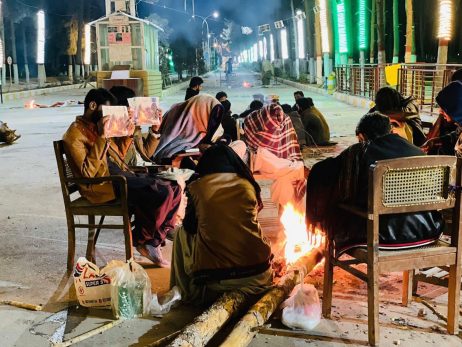
Students at the University of Balochistan in the Pakistani city of Quetta have been staging a sit-in, resulting in all academic activities being halted, for almost three weeks. Protests started on November 7 after the enforced disappearance of two students of the university, who were allegedly abducted from the campus. Faseeh Baloch and Sohail Baloch went missing on November 1. Since then, their fellow students have been protesting, day and night in the biting cold outside the university. The demonstrators say they won’t stop unless the missing students are released. Negotiations between the students and the university administration took place on November 9 but failed to reach a solution. Afterwards, students from the Baloch Student Organization (BSO) locked the gates of the university and announced that all academic activities, including the semester examinations, would be halted until the missing students were recovered. Later, on November 11, a committee formed by the government met with the students with similarly inconclusive results. “We have had two meetings with the representatives of the government,” Zubair Baloch, chairman of BSO Pajjar, a faction of the BSO, told The Diplomat. “In the first sitting, they assured us that the missing students would be recovered by 16 November. We paused our demonstration on 13 November, but in the second meeting, they had no information whatsoever about the whereabouts of the missing students. “Hence we have now resumed our protests, which will only end after the missing students are recovered.” The issue of the disappearances of the students was also raised in the Balochistan Assembly. This isn’t the first time that Baloch students have been abducted; however, the enforced disappearances of Faseeh and Sohail came as a shock as the students went missing from within the university campus, which has a heavy deployment of security forces, including housing a base of the Frontier Corps, a paramilitary force. Balochistan, Pakistan’s geographically largest but poorest province, has been wracked by an insurgent movement for the last two decades. Paramilitary forces are a common sight throughout Balochistan; even educational institutions are not free from the militarization.Enforced disappearances are widely believed to be a part of the state’s counterinsurgency operations. Victims of enforced disappearances range from insurgents and family members of insurgents to political workers and even students. Anyone who is merely suspected of sympathizing with insurgents is at risk of being whisked away.In a recent report titled “Living Ghosts,” the human rights group Amnesty International documented the practice of enforced disappearances in Pakistan and urged Pakistani authorities to end its use as a tool of state policy. The report consists of interviews with 10 family members of victims of enforced disappearances who are still missing to date. The report discusses at length the difficulties faced by the family members in using the legal system to locate their loved ones, the intimidation and threats they faced for their activism against the practice, and the impact of the issue on their mental well-being. As the insurgency has gained momentum over the past few years, there has been an increase in cases of enforced disappearances. Pakistan’s military, however, denies any involvement. In 2019, the director general of Inter-Services Public Relations, the publicity arm of the Pakistani military, tweeted, “Our hearts beat with families of every missing person. We share their pain and we are with them in the process of tracing them.” On November 26, the office of the registrar of University of Balochistan released a notification announcing the closure of the university until the recovery of the two missing students. “All academic and administrative functions will remain suspended,” the notification said, adding that students must vacate all hostels within three days. Baloch Student Activism The missing students are members of the BSO, a student organization that was founded to campaign for the rights of Baloch students in 1967. The BSO has been responsible for birthing many prominent Baloch politicians. Student leaders of the BSO have later gone on to participate in the politics of the country, many being elected to the National Assembly or becoming the chief minister of the province. Dr. Abdul Malik Baloch, the chief minister of Balochistan from June 2013 to December 2015, is a prominent example. Senator Muhammad Akram Dashti, who served as the speaker of the Balochistan Assembly, was also actively involved in student politics. He has raised the issue of the abduction of Baloch students in the Pakistani Senate. He told The Diplomat, “The abduction of Baloch youth, this counterinsurgency tactic, will yield dire negative consequences. Student politics has played a vital role in the politics of Balochistan and has always remained a secular, progressive, and nationalist practice. Balochistan is already a neglected province, this crackdown against the student activists will only further embolden the feelings of alienation and neglect.” “The security establishment hasn’t till date understood how to deal with the issues of Balochistan and how to address the grievances of the province,” Dashti added. “The security establishment often claims that no one is missing or the Baloch students abducted have links with the insurgency movement, but even if that’s the case, enforced disappearances isn’t the answer. If the state has any allegations against any of the students or anyone, they should take the legal procedure against them and present them in front of the courts” Students of Balochistan have been on the forefront of protests in major events in the past few years, on many occasions leading to fruitful results. In 2019, widespread protests by students against a sexual harassment scandal at the University of Balochistan resulted in the resignation of the university’s vice chancellor. The killing of a Baloch student, Hayat Baloch, by FC personnel; the murder of Malik Naz Baloch at the hands of a member of a “death squad”; and the issues with online classes during the pandemic in Balochistan, which lacks internet facilities – these are few examples that led students to mobilize and stage protests for their rights. “If anyone is doing politics that has some impact in Balochistan, then that’s the Baloch students, but they face a lot of issues: There’s [the] academic burden, [and a] lack of facilities,” said Dr. Sabiha Baloch, chairperson of the Baloch Student Action Committee (BSAC). Students undertake political activism to defend their rights, but in doing so, they face a great deal of pressure. “All the students protesting in UoB are threatened, calls are made to their parents with threats,” she said. Baloch Women and Student Politics Balochistan is a highly conservative, tribal, and patriarchal region, where women have restricted rights. However with the recent rise in enforced disappearances of Baloch men, it is the Baloch women who are filling the void created in the province’s political scene, including leading protests against enforced disappearances. Today, Baloch women have a far greater presence in the politics of the province, and much of it comes in the form of activism by Baloch women students. Last month, two young children were allegedly killed in a mortar attack by the Pakistan security forces, which led to protests by the family in Turbat and later on in Quetta, where they staged their protest with the dead bodies. Women were once again at the forefront of these protests: they shouldered the dead bodies of the children when they were finally laid down to rest. In a region where women are confined to their homes, such an act is nothing less than a rebellion. When Karima Baloch, the first women chairperson of the BSO, mysteriously died last year in Canada, Baloch women walked dozens of kilometers to take part in her last rites. Sabiha Baloch is the first female chairperson of the BSAC; however she has had to endure a lot of pressure ever since taking the responsibility. “I belong to a tribal region, and I had to keep my activism a secret for a very long time,” she said. “To date my family is pressurized with constant taunts hurled at my father in our tribe. Everyone says to him ‘your daughter is doing politics.’ They see my activism as a crime because I am a woman.” Baloch women student activists thus bear the brunt of a dual oppression. Collective Punishment Student activists, especially women, fear not only for their own safety but also for the safety of their loved ones. Sabiha’s 19-year-old brother, Shahmir Baloch, a student of Balochistan University of Engineering and Technology Khuzdhar, was abducted from the university premises along with some other students who were later released. “The day my brother was abducted, I had talked to him on call in the morning. He told me he had received a call threatening him that they’ll abduct me and telling him that ‘your sister is a terrorist,’” she recounted. “I asked him not to worry about me. We consoled each other but I had no idea they would abduct my brother – he has never been involved in student politics.” After the abduction of her brother, Sabiha was under a lot of pressure from her family to resign from her position. She said she decided to halt her activism and even offer her resignation if that would mean the safe release of her brother. Despite her efforts, the release of her brother was delayed time and again. Three months later, her cousin, Murtaza Baloch, was abducted too. Murtaza was released last week, but Shahmir is still missing. “When a female student leaves her home, she rebels against the norms of the tribal and patriarchal society,” said Sadia Baloch, a student activist from Balochistan (no relation to Sabiha). “She faces hostile behavior from administration and after all this, when she emerges as a student activist figure, there is oppression from the state and a collective punishment is given.” “Sabiha Baloch’s brother and cousin were abducted solely because she is a student activist. This is to send across a silent message to anyone resisting,” said Sadia. “If silencing myself would bring back my brother I am ready for that, but I know it wouldn’t because this is just a tactic – a collective punishment and a strategy to silence us from speaking for our rights,” Sabiha said. “They are abducting students from areas where they want to develop pressure. Zehri, Khuzdhar, Kharan, Nushki, Panjgur – every day you will receive news of enforced disappearances from these areas. “The cases that are reported on social media are just the tip of the iceberg, the majority of the cases are not even reported.” Back to the Past – or a New Future? Many Baloch student activists express concern on the mass abduction of students, fearing that security forces are looking to undo the progress the movement has made over the last few years. “Once again an atmosphere of fear is being built in Balochistan, much like 2009 times when one would think twice before calling themselves a Baloch out of fear of abduction,” Sabiha said. “From 2018-2021, the progress that was made via the movement to break free from the shackles of fear, whereby we had the hope that our protests would bear fruit in case someone is abducted or for any other issue – those chains of fear are once again being tied.” Still, the official announcement of the closure of the university until the missing students are recovered is a silent acknowledgment from the administration of the resilience of the Baloch students, who remain unshakable, unmovable, and undefeatable. Balochistan has seen a recent wave of protests from Gwadar to Quetta for the rights of the people and against enforced disappearances. Yet the protests and rallies in Balochistan don’t get any coverage in the mainstream media and Pakistani politicians avoid the issues troubling the country’s largest province.In his latest article, “History and Truth,” author Aasim Sajjad Akthar writes, “it may have been said many times but it must be said again: Balochistan continues to be treated little better than a colony in contemporary Pakistan.” In the words of Senator Dashti, “The state must not repeat the mistakes of the past. Instead of a crackdown against student activists, the state must engage with the youth of Balochistan and address their grievances. Balochistan should not be treated as a colony. That’s the only solution to the mistakes of the past – by safeguarding the rights of the future.”For over three weeks, Baloch students in Quetta have been demonstrating against the suspected abduction of two of their own.
https://thediplomat.com/2021/12/balochistans-students-protest-enforced-disappearances/
Video Report - #NayaDaur #AsmaShirazi Long Before Nawaz Sharif And Audio Leaks, History Gave Its Verdict In Bhutto's Favour: Asma Shirazi
#Pakistan: Can Nawaz Sharif Stare Down the Hybrid Regime?
https://thewire.in/south-asia/pakistan-can-nawaz-sharif-stare-down-the-hybrid-regime
Opinion: #Pakistan’s judges need to stop getting involved in politics

The Supreme Court of Pakistan has disqualified sitting prime ministers many times. The judges even decreed the hanging of one prime minister during the reign of a military dictator. There was no public outcry against the judiciary’s dubious actions back then. But society is changing. On Nov. 21, an investigative journalism website released an alleged audio recording on which former chief justice Saqib Nisar can be heard plotting against then-Prime Minister Nawaz Sharif three years ago. On the tape, Nisar can be heard urging his unknown interlocutor to “penalize” Sharif and his daughter, Maryam Nawaz. (Both were under investigation for corruption in 2018, when the recording was apparently made.) “The institutions have asked to do so, whether it is fair or not, it has to be done,” says Nisar at one point. (The journalist Ahmad Noorani, who broke the story, has explained that the term “institutions” refers to the military establishment.) Nisar also notes that they want Imran in power — apparently referring to Imran Khan, the current prime minister — and implies that the judiciary must do what it can to facilitate his rise to power. Nisar immediately claimed that the recording was fabricated. Members of the current government have started defending Nisar, apparently on the instructions of Khan. Nisar’s defenders claim that the audio is part of a campaign launched by Sharif. (Who, it should be noted, used judges against his own opponents in the past.) Some officials say that the audio of the former chief justice is a fake, cobbled together from his old speeches. Noorani says that the tape’s authenticity has been confirmed by an American company that examined it. It’s important to note that Noorani is not living in Pakistan. He is currently living in the United States, where he runs his own website. He was forced to flee his homeland after his journalistic investigations into the corruption of those in power proved too risky. He was attacked in Islamabad, Pakistan in 2017, and the police failed to arrest any of the culprits. He feared for his life due to continuous propaganda against him on some TV channels. Soon after that, he lost his job. No Pakistani newspaper or TV channel was willing to take the risk of hiring him. Just a few days ago, a prominent lawyer, Ali Ahmad Kurd, harshly criticized the judiciary for its past political interference at a conference in Lahore that brought together Indian and Pakistani journalists and activists. Also in attendance at the conference was Chief Justice Gulzar Ahmad, who reacted angrily to Kurd’s remarks: No one should dare to dictate to the judiciary. This is the first time that a prominent lawyer has criticized the judiciary so directly for violating the principle of noninterference in political matters. The Nisar audio leaked a day later. It’s worth noting that Nisar himself has figured in past accusations about political interference by the judiciary. Three years ago, a human rights group, the Women’s Action Forum, filed a reference against the then-chief justice. The complaint, submitted to the Supreme Judicial Council, listed 25 blatant violations that had allegedly been committed by Nisar during his tenure. Yet the complaint was dismissed within weeks of his retirement. Now, two years after his retirement, Nisar is facing a very specific allegation of a different kind. This allegation is not ultimately about a person. It’s about institutions. We urgently need to know the truth about the allegations against Nisar. Larger issues are at stake. Pakistanis want to know why no prime minister in Pakistan has ever completed his or her five-year term. Yet no action has ever been taken against any of the chief justices involved in the corresponding political maneuvers. (Nor, needless to say, against any of the army chiefs who were involved in the same intrigues.) People are not prepared to trust simple denials from institutions. The next audio or video scandal could very well rock Pakistan’s institutions to their core. The country urgently needs an impartial probe of this latest scandal to find out the truth. https://www.washingtonpost.com/opinions/2021/11/24/pakistans-judges-need-stop-getting-involved-politics/An independent judiciary is one of the crucial pillars of any genuine liberal democracy. Here in Pakistan, a new scandal has ignited a firestorm of controversy precisely because it is reminding us that our judicial branch can make no claim to independence. Our country’s senior judges have intervened in politics again and again throughout history.

Tuesday, November 30, 2021
What ‘My Body, My Choice’ Means to the Right

OPINION: MICHELLE GOLDBERG
#Pakistan - Taliban Splintered by Internal Divisions, External Spoilers
Pakistan said to be supporting alternative jihadi groups to undermine the Taliban and maintain leverage over Afghanistan.
The unity that catapulted the Taliban to victory in Afghanistan is splintering under the pressure of internal divisions that could threaten the group’s survival if rivals cannot mend their differences while dealing with the realities of running a troubled country.Against a backdrop of looming economic and humanitarian catastrophe, lines—and swords—have been drawn between two senior Taliban figures: political leader Abdul Ghani Baradar, who co-founded the group with Mullah Mohammad Omar and whose power base is in Kandahar, and sanctioned terrorist Sirajuddin Haqqani, who heads the affiliated Haqqani network and is close to al Qaeda. As Taliban factions battle for bigger slices of the pie, the local branch of the Islamic State is picking up recruits disillusioned with the political direction the Taliban are taking, security and academic sources said.Amid the internal power struggle at the top of the Taliban, and the Islamic State recruitment drive, indications are emerging of an alliance of smaller jihadi groups spearheaded by Pakistan’s Inter-Services Intelligence (ISI), attracting elements dissatisfied with even the most extreme factions currently in control of Afghanistan. The Islamic Invitation Alliance (IIA), funded by the ISI, was formed in early 2020 with the aim of ensuring the Taliban’s victory, according to a document prepared for the previous government of Afghanistan, seen by Foreign Policy. It now aims to destabilize the Taliban by empowering extremism across Afghanistan, said an intelligence source involved in uncovering the group’s existence, who spoke on condition of anonymity. The emergence of the IIA, which sources say is known to the U.S. intelligence community, further complicates Afghanistan’s fractious political landscape as the country’s former allies grapple with how to deal with a government controlled by sanctioned terrorists allied to al Qaeda. The cleavage between Baradar, who cut the so-called peace deal in 2020 with former U.S. President Donald Trump, and Haqqani, who introduced suicide attacks to the Afghan battlefield, is growing wider. Baradar, now interim deputy prime minister, is seen as “America’s man,” while Haqqani, acting interior minister, represents the group’s most strident anti-Western face, which appeals to Pakistan, said Rahmatullah Nabil, the former head of intelligence for the previous Afghan government. He said divisions between the two men, who have an uneasy power-sharing agreement, are pushing Taliban foot soldiers into the arms of the Islamic State, challenging the Taliban’s control of Afghanistan, and risking the country’s stability and potentially regional peace. “Guerrilla fighting with drug smuggling income is easier than running a state,” said Nabil, referring to the Taliban’s control of heroin production and trafficking. “They have already faced several challenges, and their internal divisions are increasing.” Those divisions became public in September, shortly after the Taliban seized control of the country, and could be behind some recent high-casualty attacks attributed to the local Islamic State branch, known as the Islamic State-Khorasan (IS-K), according to Weeda Mehran, a conflict expert at the University of Exeter. “We knew the Taliban was not a homogenous group. Nonetheless, we are seeing violence between rival factions now becoming more public,” she said. The Islamic State is a “convenient scapegoat” for attacks possibly committed in the fratricidal battle for supremacy. A recent attack on a Kabul military hospital, for instance, killed a Haqqani ally, Hamdullah Mukhlis, head of the capital’s military corps. Survivors of the attack told AFP that the attackers chanted “Long live the Taliban” and avoided areas of the hospital where Taliban fighters were being treated. IS-K claimed responsibility. “Baradar’s side can benefit on two fronts—if they are smart enough to play it like that: They can ensure they get their internal rivals with these huge attacks, and they can show the West they are acting against IS-K to get support for dealing with the ‘new’ terrorists,” Mehran said. IS-K’s capabilities concern the U.S. Defense Department, where belief has taken root that it could pose a threat to the United States in under a year. Recruiting experienced fighters will only bolster those worries. Colin Kahl, the U.S. undersecretary of defense for policy, told the Senate Armed Services Committee last month that the United States is fairly certain that both IS-K and al Qaeda have the “intention” to attack the U.S. homeland. Some reports have said IS-K is also absorbing members of the former state security forces as they try to avoid retributive attacks from the Taliban and earn money. Nabil said IS-K offers 30,000 afghanis, or about $300, per month. Former Afghan National Defense and Security Forces personnel, however, have denied the reports. IS-K and al Qaeda are part of an increasingly complicated political mosaic as Pakistan’s ISI continues to ensure it has leverage over the Taliban and control of regional jihad. Both groups have been drawn under the IIA umbrella, according to the research document, which has not been made public. It says the IIA grew out of ISI support for a group called Karwan Abu Obaida (KaO), which splintered from the Haqqani network after the Trump-Taliban agreement was signed in February 2020. KaO was made up of Haqqani followers who were disappointed that the Haqqani network did not take action against Baradar and other Taliban leaders for negotiating with the United States, the document says. “From its inception, KaO focused on targeted attacks against journalists, civil activists, and ‘those who are against Islamic law,’ as well as ‘those who are supporting the agreements with the Americans crusaders’ and their allies in Afghanistan,” the document says, quoting interlocutors. It adds that the ISI initially deployed the KaO to extend the assassination campaign, which had a devastating impact on government, civil society, and media in Afghanistan throughout 2020. The ISI then decided to expand its influence over non-Taliban actors working to topple then-President Ashraf Ghani’s government, the document says, with the aim of building a formidable jihadi force that could be a useful tool of political coercion in the event of a Taliban victory. During 2020, the IIA also became a platform for the return to the battlefield of Gulbuddin Hekmatyar. Hekmatyar, a former warlord who struck a peace deal with Ghani in 2016 to return from exile, became disillusioned and “approached the ISI for help re-engaging with the insurgency,” the document says. The main objectives of the IIA, which numbers an estimated 4,500 fighters, are to “keep the jihad movement in Afghanistan alive” and “act as a tool of ISI pressure” on the Taliban to ensure that Pakistan’s interests are protected, the document says. It adds that the IIA is funneling ISI funding to member groups and giving IS-K a boost by enabling it to claim responsibility for attacks committed by other groups in the coalition. This creates the potential for a self-fulfilling prophecy by allowing IS-K to build an image of itself as an “ascendant organization in Afghanistan.” Requests for comment on the report were made to Pakistan’s foreign ministry spokesperson and, separately, the public relations and information officer, as well as to Islamabad’s embassies in Kabul and London, all without response.
https://foreignpolicy.com/2021/11/12/taliban-afghanistan-pakistan-factions-fighting-division-unity/
#Pakistan: Systematic Annihilation In #Balochistan – Analysis

According to HRCB data, at least 27 persons were disappeared in the month of October 2021. Since January 1, 2021 at least 339 people have been disappeared by the SFs from across Balochistan. Moreover, at least 298 people have been confirmed to have been extra judicially killed in 2021, thus far. Many of those killed were registered as victims of enforced disappearance and had already been in the custody of the forces.
Atrocities in Balochistan in 2021
| Month | Disappearance* | Killed** |
|---|---|---|
| January | 10 | 32 |
| February | 19 | 21 |
| March | 21 | 38 |
| May | 40 | 27 |
| June | 37 | 25 |
| July | 22 | 19 |
| August | 28 | 45 |
| September | 28 | 25 |
| October | 27 | 39 |
| November | 38 | NA |
| Total | 301 | 298 |
According to HRCB data, since 2016, at least 3,738 people have been forcibly disappeared by the SFs. These include 522 in 2016; 1, 225 in 2017; 642 in 2018, 568 in 2019, 480 in 2020, and 301 in 2021 (data till November 10). Of these 3,738, just 453 have been released. But SFs have extrajudicially killed at least 1,553 people since 2016 (data till October 31, 2021).
The Voice for Baloch Missing Persons (VBMP), meanwhile, claims that more than 45 thousand people have been forcibly disappeared by the Pakistan Army, and five thousand missing persons have been ‘killed and dumped’ over the last decade.
According to partial data compiled by the South Asia Terrorism Portal (SATP), of the 4,623 civilian fatalities recorded in Balochistan since March 6, 2000 (data till November 28, 2021), at least 1,449 have been attributable to one or another terrorist/insurgent outfit. Of these, 471 civilian killings (291 in the South and 180 in the North) have been claimed by Baloch separatist formations, while Islamist and sectarian extremist formations – primarily Islamic State, Lashkar-e-Jhangvi (LeJ), Tehreek-e-Taliban Pakistan (TTP) and Ahrar-ul-Hind (Liberators of India) – claimed responsibility for another 978 civilian killings, 895 in the North (mostly in and around Quetta) and 83 in the South. The remaining 3,174 civilian fatalities – 1,760 in the South and 1,414 in the North – remain ‘unattributed’. It is widely believed that these are principally victims of the security agencies’ ‘kill and dump’ operations, particularly in the Southern region, targeting local Baloch dissidents.
Indeed, the systematic campaign of extermination of ethnic Baloch people through enforced disappearances and extrajudicial killings in the South of the Province remains unabated.
VBMP vice chairman, Mama Qadeer Baloch, asserted on April 27, 2021,
Pakistani state has been startled by the widespread popularity and positive reception of the peaceful struggle in Balochistan. In its desperate attempts to quell the struggle, the state formed these inhumane, bloodthirsty ‘death squads’ and gave them a free hand to operate throughout Balochistan. These groups are directly or indirectly involved in the enforced disappearance and liquidation of student leaders, journalists, rights activists and political workers.
Again, on October 27 VBMP asserted that the Pakistani authorities had failed to take any concrete measures to end “enforced disappearances” in Balochistan. VBMP stated that the organisation had asked the Pakistani authorities to criminalize the practice and fix responsibility on the people behind these disappearances. VBMP Chairman Nasrullah Baloch added that those guilty of these crimes should be legally prosecuted, and the families of the missing persons should be supported and compensated by the Government. But the law criminalizing ‘enforced disappearances’ in Pakistan has not been put into practice effectively.
The menace is a reality that Pakistan’s Supreme Court has clearly recognized time and again.
Most recently, on September 30, 2021, the Supreme Court declared the report submitted by the Balochistan Police on five missing persons “unsatisfactory.” Gulzar Ahmed, the Chief Justice of Pakistan, remarked that people had gone missing and the families had to run after the Police to register cases: “You (police) do not know how to investigate cases. A case of disappearance should have been registered by the police which could not be done.” A three-member bench, comprising Chief Justice Ahmed, Justice Ijazul Ahsan and Justice Faisal Arab, was hearing the case at the Supreme Court’s Quetta Registry. The Court had taken suo motu notice of the disappearances.
On November 21, 2021, former Senator Farhatullah Babar stated that the enforced disappearances and extrajudicial killings had been going on for decades, but they were institutionalised during the regime of General Pervez Musharraf who acknowledged this in his book, In the Line of Fire: A Memoir.
Further, a Commission on Enforced Disappearances was formed in in March 2011. According to Pakistan’s Commission of Enquiry on Enforced Disappearances (COIED), it received 8,191 complaints related to enforced disappearances between March 1, 2011 (the date of inception of the Commission) and October 31, 2020. According to the Commission, of these 8,191 persons, 4,879 persons were traced – 227 dead bodies, 582 in prisons, 933 in internment centre and 3,137 returned home. The Commission ‘deleted’ cases of another 1,089 missing persons, claiming that these were “closed due to not being cases of enforced disappearances, incomplete address, withdrawal by complainants, non-prosecution. etc.” Thus, as per the commission, a total of 5,968 cases were ‘disposed of’, leaving another 2,223 cases under investigation.
Earlier, on September 8, 2020, the International Commission of Jurists (ICJ), a legal rights group based in Switzerland, observed that the Commission “has wholly failed to address entrenched impunity” and had not held any perpetrators of the crime to justice, even in cases where the whereabouts of the disappeared had been traced or the person had been released,” by implication, cases in which direct evidence would be available.
Despite this, the Government continues to deny reality. Balochistan Chief Minister Qudoos Bizenjo, in an interview on November 11, 2021, when asked about enforced disappearances in Balochistan, stated evasively that the Home Department was looking into the figures to determine whether the missing persons are actually missing or had fled to some other country, like Afghanistan. He claimed there were several names on the missing persons’ list who were in some foreign country. Bizenjo added that his government was working ‘in concert with other stakeholders’ to make sure that the issue is resolved and that his government was still trying to estimate an “accurate” figure for the Baloch missing persons.
On June 7, 2021, the Government introduced the ‘Criminal Law (Amendment) Bill 2021’ in the National Assembly, criminalising enforced disappearance and imposing a punishment of 10-year imprisonment for anyone found guilty of the offence. The Bill stated that a new section 52-B (enforced disappearance) should be inserted into the Pakistan Penal Code after section 52-A. The proposed section states:
Term enforced disappearance relates to the arrest, detention, abduction or any other form of deprivation of liberty by an agent of the state or by person or group of persons acting with the authorisation, support or acquiescence of the state, followed by a refusal to acknowledge the deprivation of liberty or by concealment of the fate or whereabouts of the disappeared person, which place such a person outside the protection of the law.
Given the background, the Bill against enforced disappearance appears to be no more than an eyewash to contain the rising protests. Indeed, it was only after five months of deliberate delay and continuous campaigning by international and national human rights organisations that the National Assembly passed the Bill on November 8. However, the Bill is yet to be become law, and will now be sent to the Senate for its passage.
As the situation with regard to enforced disappearance and extrajudicial killings worsens, there are reports of near daily and widespread protests. Most recently, protests started in Quetta and the federal capital Islamabad on November 5, after the November 1 incident in the University of Balochistan. The protestors were demanding the safe release of Sohail and Fasih Baloch as well as action against “enforced disappearances” and to stop raids on academic institutions in the province. Following the protests in the University of Balochistan, Baloch students in the Bolan Medical College, Degree College Sariab, Polytechnic College and the Science College also suspended academic activities in protest against the disappearance of their fellow students from Balochistan University.
But Islamabad’s and Rawalpindi’s heavy-handed approach to Baloch dissent and separatism, as well as the relative weakness of judicial institutions in the country, make any reversal of the current and pervasive ‘disappearances’ and ‘kill and dump’ strategy unlikely. Further, the widening footprint of China-Pakistan Economic Corridor (CPEC) projects in the province, the denial of any significant benefits to locals, and the demographic transformation that is being engineered, can only compound the alienation and anger provoked by rising atrocities by SFs and their proxies.
https://www.eurasiareview.com/30112021-pakistan-systematic-annihilation-in-balochistan-analysis/