Thursday, November 18, 2021
#Lahore - "We Thought He Had Covid But It Was Smog": Pakistan's Struggle To Breathe
Lahore with nearly 11 million people near the border with India was once the ancient capital of the Mughal Empire and remains Pakistan's cultural epicentre.
Red-eyed residents cough, everything smells of smoke, and cars shine their headlights in the middle of the day. Smog has again blanketed Pakistan's Lahore, and its citizens are becoming desperate.
The megacity of nearly 11 million people near the border with India was once the ancient capital of the Mughal Empire and remains Pakistan's cultural epicentre.
But now it regularly ranks among the worst cities in the world for air pollution -- a mixture of low-grade diesel fumes, smoke from seasonal crop burn off, and colder winter temperatures coalescing into stagnant clouds.
Syed Hasnain is visibly exhausted as he waits on his four-year-old son who has been admitted at the city's Mayo Hospital.
"He was coughing and not able to breathe properly and had a high temperature. We thought maybe it is coronavirus so we brought him to the hospital. But the doctors told us he has developed pneumonia because of the smog," a visibly exhausted Hasnain tells AFP.
"It's very worrisome," he admits. "I knew that the smog can be bad for health -- but I didn't know it would be so bad that my son would be hospitalised."
Teachers also worry for the children.
"The pollution is a problem even inside class. We see children with red eyes and irritation, others continually cough," Nadia Sarwar, a government school teacher, tells AFP.
One child, who has asthma, has had to stay home for several days because he kept suffering attacks, she says.
Across the border, Delhi has closed schools until the end of the month because of its pollution woes.
But Sarwar says it would be difficult to do the same in Lahore.
The children have already missed so much thanks to the coronavirus pandemic, and to shut schools down now would be making them "pay for a problem they didn't create."
"I feel bad for them," she said. "In the summers it is too hot here for outdoor activities. And in the winters there is pollution and dengue now. What can a child do? Where can he go?"
- 'Nobody cares' -
Adults are also struggling. Rana Bibi, a 39-year-old mother of three who works as a cleaner, uses her dupatta (shawl) as a face mask while waiting for a rickshaw to take her home.
"The smoke hurts my eyes and throat. That's why I have covered my face this way. First they made us do it for corona(virus), but now I am doing it myself," she says.
"When I reach home I am always smelling of smoke; my clothes, my hair, and my hands are dirty. But what can one do? I can't sit at home. I got used to it."
Some of the homes she cleans "have these machines that clean the air. I don't know. That's what they tell me. But there is smoke everywhere here."
In recent years residents have built homemade air purifiers and filed lawsuits against government officials in desperate bids to clean the air.
But authorities have been slow to act, blaming the smog on India or claiming the figures are exaggerated.
"Every year we read in the news that Lahore is the most polluted city or that it had the worst smog in the world. Nothing happens. Nobody cares," says Saira Aslam, who works in the HR department of a tech company.
The 27-year-old is angry: "The government got away with it last year because we were all sitting at home anyway due to the lockdown. But they can't keep acting like nothing is wrong," she says.
"I have elderly people at home who are literally at risk because of the smog. It's a health hazard and needs to be treated like one."
https://www.ndtv.com/world-news/we-thought-he-had-covid-but-it-was-smog-pakistans-struggle-to-breathe-2616239
Pakistan in damage control mode after Bangladesh reacts strongly to hoisting of flag
Wednesday, November 17, 2021
There are 34 reservations expressed by the ECP on Electronic Voting Machines, and we are standing with the ECP – Chairman PPP Bilawal Bhutto Zardari
Chairman Pakistan Peoples Party, Bilawal Bhutto Zardari spent a very busy day in the parliament today. In the morning he called on the opposition leader, Shahbaz Sharif at the later’s chamber. He addressed the joint opposition parliamentary parties.
Addressing the meeting of opposition members he said that due to the unity of opposition, the government was repeatedly defeated. He also stated that we can be successful with this unity. The allied parties had reservations with the government and that has been exposed.“There is news that a government member did not want to attend the session and police was sent to his residence to take him to the session by force and phone calls from several quarters have been made,” he said.
Chairman PPP further thanked all the opposition members present in the meeting stating that the unity of opposition will be a big message for the people of Pakistan and a ray of hope for them. “Speaker of the National Assembly and the Chairman of the Senate have become used to violating procedures of the Parliament. Despite all this we must continue to struggle for the supremacy of parliament. Today we will present the view point of the majority of Pakistan population,” he said.
Bilawal Bhutto Zardari said that government used every tactic to complete its numbers, but if we are united, we can defeat this government. We will strongly oppose the legislations regarding electoral reform and the legislation about Kulbhushan Jadhev. “The last agenda item is about the census in which our reservations are not addressed. This has happened for the first time in the history of CCI meetings where the controversial census was approved not by consensus but by the majority of votes.”
Chairman PPP said that the Sindh government representing the Sindh province wrote a dissenting note. Sindh government also wrote a letter to the Speaker to raise this issue in the joint session. The Speaker or the National Assembly Secretariat did not circulate the letter by the Sindh government. Today this census issue is the last item. Our reservations are on the record and the United Nations agency conducted a survey of housing. The data of this survey contradicts the census. We hope that the united opposition will cooperate with us on this issue. The unity of opposition is the need of the hour and the need of the people of this country.
On the way to the assembly hall in the parliament, responding to questions by the journalists, Bilawal Bhutto Zardari said that opposition has been successful twice in the parliament and today we will strongly oppose the government. “The success of the opposition is that we are united today and will also be in the future. We have exposed the government and shown that their allies are not with the government. Opposition numbers are complete and we will strongly oppose the government today,” he stated.
Later on speaking on the floor of the assembly, Chairman Bilawal Bhutto Zardari emphasised that the Speaker of the assembly should respect his position, his chair and his place as the custodian of the house so that the legislations are carried out according to rules and procedures. He asked him not to become a tool of the government in passing the legislation against the rules, regulations and Constitution. He said that the Speaker had told the opposition that there will be consultation on the government proposed legislation but he went back on his words.
Bilawal Bhutto Zardari said that the treasury members should respect the Parliament, and the government must not tell lies in the Parliament. The government is trying to bring unilateral electoral reforms. Addressing the Speaker, he said that if the government is cheating the parliament then you should not become a part of it. The way this Parliament is being run including this joint session, is undermining the Parliament. “The government wants to bring unilateral electoral reforms and wants to bulldoze them. This was not done by the PML-N government which had two-third majority and we all agreed on electoral reforms in 2017 including the PTI,” stated Chairman PPP.
He said that if the allies of the government had played the role of a bridge between the government and opposition, then today we all would have been legislating together and the next elections would have not been controversial.
Chairman PPP said that we reject EVM’s from today. There are 34 reservations expressed by the ECP on these EVMs and we are standing with the ECP. He said that when there is an electronic voting system in the house, but has never been used, how can the government use EVM’s in thousands of poll booths? The government is making these legislations controversial from today. Creating voting lists is the constitutional job of the ECP and no one can violate the constitution by legislation. We have drafted the constitution and we will approach courts against these legislations which are violating the constitution. As far as voting rights for the overseas Pakistanis are concerned, every party wants them to have this right. We want to give this right to the overseas Kashmiris in Azad Kashmir elections and want the same here in Pakistan. But why does a vote which is cast by a person sitting in Paris and California, impact the result in Multan or Sibbi, he asked. This is to dilute the vote of a person who is facing the historic price-hike, unemployment and poverty.
Chairman PPP also said that the government wants to give relief to the Indian spy, Kulbhushan Jadhev. The government provided the Indian spy relief before as well, but he did not avail the opportunity thus disrespecting this parliament. Now the government wants to give relief to that Indian spy by today’s legislations. We will not let the government to use this parliament to provide relief to Indian spy Jadhev, he pronounced.
Chairman Bilawal Bhutto Zardari said that Imran Khan had said he will commit suicide before approaching IMF. Now the government has become a slave of the IMF, and the Pakistani people are bearing the burden of PTIMF agreement. The people are troubled by the government policies. Now the government wants to bring State bank under IMF instead of the Parliament and the Pakistani judiciary. Parliament is supreme and we will also challenge this effort of the government.
Chairman PPP said that the PPP had expressed reservations on the census and were told to agree on it one time so that elections are held. Afterwards in the meeting of Council of Common Interest, first time in history the issue was resolved by majority vote instead of consensus. The United Nations had conducted a survey which showed discrepancy in the data of the United Nations and the census. Then the Sindh government wrote to the Speaker so that these reservations are circulated among the members but no member received those reservations. There had to be a discussion on the issue of census but no discussions were ever held. This is a robbery on the rights and resources of Sindh, Balochistan and the former tribal areas. We will not let this injustice to take place.
Chairman Bilawal Bhutto Zardari further said that Sindh has also expressed reservations on the energy policy of the government. He said that the census and the energy policy require serious debate in the Parliament. The entire country is looking at the parliament and the politicians to resolve their problems but this government is trying to bulldoze EVM, unilateral electoral reforms and other legislations. “This is a robbery of the people’s vote, pockets and rights,” stated Chairman PPP.
Afterwards he said that it is necessary to pass any bill from a joint session without the majority of the strength of National Assembly and the Senate both. In the joint opposition the legislation cannot be passed by simple majority out of members present in the house. He read out rules and regulations regarding parliamentary principles, section 10 of the 1973 constitution.
[When a bill is passed in joint sitting, with or without amendment, by 6 the votes of the majority of the total membership of the two Houses, an authenticated copy thereof, signed by the Speaker, shall be transmitted, by the Secretary, to the President for assent under article 75.]
On the way back from the Assembly floor, responding to a question by a journalist, the former President Asif Ali Zardari said that the government is using all its energy to sow the seed of this legislation but they will not benefit from its fruit, rather someone else will reap the benefit.
The opposition staged a walk out of the session. Talking to journalists in the opposition’s press conference, Chairman Bilawal said that the entire country should know that the government was defeated today as in the joint session, legislations are passed by the majority of the total strength of the National Assembly and the Senate jointly. This number comes out to be 222 votes which the government failed to muster. He asked the media to make people aware of the fact that the government was defeated today. He said that the opposition is united in the parliament where we can and have, defeated the government. He said that the PPP has a historic stance that every institution must work within its own ambit.
پورے ملک کو یہ جاننا ضروری ہے کہ آج حکومت کو پارلیمان میں شکست ہوگئی ہے کیونکہ مشترکہ اجلاس میں قانون سازی کے لئے حکومت کو 222ووٹوں کی ضرورت ہوتی ہے جو وہ نہیں حاصل کر سکی، چیئرمین پاکستان پیپلز پارٹی بلاول بھٹو زرداری
چیئرمین پاکستان پیپلز پارٹی کے بلاول بھٹو زرداری نے پارلیمنٹ میں آج مصروف دن گزارا۔ صبح کے وقت وہ قائد حزب اختلاف شہباز شریف کے چیمبر میں ملاقات کے لئے گئے اور اس کے بعد اپوزیشن جماعتوں کی پارلیمانی پارٹیوں کے مشترکہ اجلاس سے خطاب کیا۔ اپنے خطاب میں انہوں نے کہا کہ اپوزیشن کے اتحاد کی وجہ سے حکومت کو بار بار شکست کا سامنا کرنا پڑا۔ حکومت کی اتحادی پارٹیوں کو حکومت کی قانون سازی پر اعتراض تھا اور اب خبر یہ ہے کہ ایک حکومتی رکن جو آج کے اجلاس میں نہیں آنا چاہتے تھے انہیں گھر پولیس بھیج کر بلایا گیا ہے اور بہت سارے حکومتی اراکین کو فون بھی کروائے جا رہے ہیں۔ انہوں نے تمام اپوزیشن اراکین کا آج کے اجلاس کے لئے حاضری پر شکریہ ادا کیا۔ انہوں نے کہا کہ اپوزیشن کا یہ اتحاد پاکستانی عوام کے لئے امید کی کرن کا پیغام ہوگا۔ اسپیکر قومی اسمبلی اور چیئرمین سینیٹ پارلیمنٹ کے طریقہ کار کی روگردانی کے عادی ہوگئے ہیں لیکن اس کے باوجود بھی ہمیں پارلیمان کی سپرمیسی کی جدوجہد جاری رکھنی چاہیے۔ آج ہم پاکستانی عوام کے سامنے اپنا نقطہ نظر پیش کریں گے۔
بلاول بھٹو زرداری نے کہا کہ حکومت نے اپنے اراکین کے نمبر پورے کرنے کے لئے تمام حربے آزمائے۔ ہم یکطرفہ انتخابی اصلاحات اور کلبھوشن یادیو کے لئے کی جانے والی قانون سازی کی سخت مخالفت کریں گے۔ انہوں نے کہا کہ پاکستان کی تاریخ میں پہلی مرتبہ ایسا ہوا ہے کہ سی سی آئی کے اجلاس میں فیصلے اتفاق رائے کی بجائے فیصلے اکثریتی بنیاد پر کئے گئے۔ مردم شماری پر سندھ نے اپنے اعتراضات نوٹ کروائے اور سندھ حکومت نے اسپیکر کو خط لکھا کہ پارلیمنٹ میں مردم شماری پر بحث کرائی جائے لیکن اسپیکر نے ایسا نہیں کیا اور کسی بھی رکن کو یہ اعتراضات نہیں بجھوائے۔ انہوں نے کہا کہ اقوام متحدہ نے ایک سروے کرایا تھا جس کے اعدادوشمار مردم شماری کے اعدادوشمار سے مختلف تھے۔
انہوںنے امید ظاہر کی کہ اپوزیشن اراکین اس ایشو پر پیپلزپارٹی کا ساتھ دیں گے۔ انہوں نے کہا کہ اپوزیشن کا اتحاد وقت اور پاکستانی عوام کی ضرورت ہے۔ اسمبلی ہال کی طرف جاتے ہوئے صحافیوں کے سوالات کے جواب دیتے ہوئے انہوں نے کہا کہ متحدہ اپوزیشن پارلیمنٹ میں دو مرتبہ حکومت کو شکست دے چکی ہے اور آج ہم یکطرفہ قانون سازی کا بھرپور مقابلہ کریں گے۔ اپوزیشن کا اتحاد ہی اپوزیشن کی فتح ہے۔ اپوزیشن کے پاس اراکین کی تعداد پوری ہے۔ بعدا زاں اسمبلی کے فلور پر خطاب کرتے ہوئے انہوں نے کہا کہ اسپیکر کو اپنی حیثیت اپنی کرسی اور اپنے مرتبے کی خود عزت کرنی چاہیے۔ انہوں نے اسپیکر سے کہا کہ وہ رولز اور ریگولیشن اور آئین کے خلاف قانون سازی کرکے حکومت کے آلہ کار نہ بنیں۔ انہوں نے کہا کہ اسپیکر نے اپوزیشن سے کہا تھا کہ انتخابی اصلاحات اور قانون سازی پر مشاورت کی جائے گی لیکن وہ اپنے الفاظ سے پھر گئے۔ بلاول بھٹو زرداری نے کہا کہ حکومتی اراکین کو پارلیمان کی عزت کرنی چاہیے اور پارلیمان میں جھوٹ نہیں بولنا چاہیے۔ اسپیکر کو مخاطب کرتے ہوئے انہوں نے کہا کہ اگر حکومت عوام اور پارلیمان کو دھوکہ دے رہی ہے تو انہیں اس کا حصہ نہیں بننا چاہیے۔ اس طرح سے پارلیمان اور یہ مشترکہ اجلاس چلایا جا رہا ہے اس سے پارلیمان کی عزت پر حرف آتا ہے۔ حکومت یکطرفہ انتخابی اصلاحات لا کر انہیں پارلیمان میں بلڈوز کرنا چاہتی ہے۔ ایسا تو پاکستان مسلم لیگ(ن) کی حکومت نے دوتہائی رکھنے کے باوجود بھی نہیں کیا تھا۔
اس حکومت نے بھی 2017ءمیں ہم سب نے مل کر انتخابی اصلاحات کی تھیں جس میں پی ٹی آئی بھی شامل تھی۔ انہوں نے کہا کہ اگر حکومت کی اتحادی جماعتیں حکومت اور اپوزیشن کے درمیان پل کا کردار ادا کرتیں تو ہم سب مل کر قانون سازی کر رہے ہوتے اور آئندہ انتخابات متنازعہ نہ ہوتے۔ حکومت ای وی ایم کو بلڈوز کر رہی ہے لیکن ہم آج ہی اسے مسترد کرنے کا اعلان کرتے ہیں۔ الیکشن کمیشن آف پاکستان نے بھی ای وی ایم پر 34اعتراضات اٹھائے ہیں۔ ہم الیکشن کمیشن کے ساتھ کھڑے ہیں۔ انہوں نے اسپیکر ایک معصومانا سوال پوچھا کہ الیکٹرانک ووٹنگ سسٹم تو ہاﺅس کے اندر بھی موجود ہے لیکن اسے کبھی استعمال نہیں کیا گیا اور اب حکومت چاہتی ہے کہ ہزاروں پولنگ بوتھ پر ای وی ایم استعمال کی جائیں۔ حکومت جو یہ قانون سازی کر رہی ہے وہ آج ہی سے متنازعہ ہوگئی ہے۔ انہوں نے کہا کہ ووٹنگ بنانا آئین کے تحت ای سی پی کا کام ہے اور کوئی بھی قانون سازی آئین سے روگردانی نہیں کر سکتا۔ ہم نے آئین بنایا ہے اور ہم ہی اس کی حفاظت کریں گے۔ اور آئین کے خلاف قانون سازی کو عدالتوں میں چیلنج کریں گے۔ انہوں نے کہا کہ جہاں تک بیرون ملک پاکستانیوں کو ووٹ دینے کے حق کا سوال ہے تو ساری پارٹیوں انہیں یہ حق دینا چاہتی ہیں۔ یہ حق انتخابات میں بیرون ملک پاکستانیوں کو پہلے ہی حاصل ہے۔ ہم اسی طرح پاکستان میں بھی وہی طریقہ استعمال کرنا چاہتے ہیں ۔ پیرس یا کیلے فورنیا میں بیٹھا ہوا ایک شخص کس طرح ملتان یا سبی میں انتخابات کے نتائج پر اثرانداز ہو سکتا ہے۔ یہ عمل ہر اس شخص کے ووٹ کی اہمیت کو کم کرنا ہے جو تاریخی مہنگائی، بیروزگاری اور غربت کا سامنا کر رہا ہے۔ حکومت بھارتی جاسوس کلبھوشن یادیو کو ریلیف فراہم کرنا چاہتی ہے۔
حکومت نے اس سے قبل بھی بھارتی جاسوس کلبھوشن یادیو کو ریلیف دے چکی ہے جس کا فائدہ اس نے نہیں اٹھایا۔ اس نے پاکستان اور پارلیمان کی بے توقیری کی ۔ ہم اس حکومت کو اجازت نہیں دیں گے کہ بھارتی جاسوس کلبھوشن یادیو کو ریلیف دینے کے لئے پارلیمان کو استعمال کرے۔ بلاول بھٹو زرداری نے کہا کہ عمران خان نے وعدہ کیا تھا کہ اگر وہ آئی ایم ایف گئے تو خودکشی کر لیں گے لیکن اب حکومت آئی ایم ایف کی غلام بن گئی ہے۔ پی ٹی آئی ایم ایف کا بوجھ پاکستان کے عوام برداشت کر رہے ہیں۔ پاکستان کے عوام حکومت کی پالیسیوں کو بھگت رہے ہیں۔ اب یہ حکومت چاہتی ہے کہ اسٹیٹ بنک کو آئی ایم ایف کے تحت کر دیا جائے اور وہ پارلیمنٹ اور پاکستانی عدالتوں کو جوابدہ نہ ہو۔ پارلیمنٹ سپریم ہے اور ہم حکومت کے اس عمل کو بھی چیلنج کریں گے۔ چیئرمین پی پی پی نے کہا کہ پی پی پی کو مردم شماری پر تحفظات تھے لیکن ہم سے کہا گیا کہ صرف ایک انتخابات کے لئے اس مردم شماری کو تسلیم کر لیا جائے تاکہ انتخابات ہو سکیں۔ بعد میں سی سی آئی نے اتفاق رائے کی بجائے اکثریتی ووٹ سے یہ مردم شماری تسلیم کر لی گئی۔ اقوام متحدہ نے بھی ایک سروے کرایا تھا جس کے اعدادوشمار مردم شماری کے اعدادوشمار کے برعکس تھے آئین کے تحت سندھ حکومت نے اسپیکر کو ایک خط لکھا کہ سندھ حکومت کے اعتراضات تمام اراکین کو بھیج دئیے جائیں تاکہ آئندہ ہونے والے اجلاس میں مردم شماری پر بحث کی جا سکے۔
انہوں نے کہا کہ غلطیوں سے بھرپور مردم شماری سندھ، بلوچستان اور سابقہ قبائلی علاقوں کے حقوق اور وسائل پر ڈاکہ ہے۔ ہم یہ ناانصافی نہیں ہونے دیں گے۔ بلاول بھٹو زرداری نے کہا کہ حکومت کی انرجی پالیسی پر بھی سندھ کو اعتراضات ہیں۔ انہوں نے کہا کہ مردم شماری اور انرجی پالیسی پر پارلیمنٹ میں سنجیدہ بحث کی ضرورت ہے۔ پورا ملک پارلیمان اور سیاستدانوں کی جانب دیکھ رہا ہے کہ پارلیمان میں ان کے مسائل پر بحث و مباحثہ کرکے انہیں حل کیا جائے گا لیکن حکومت ای وی ایم یکطرفہ انتخابی اصلاحات اور دیگر قانون سازی کرنا چاہتی ہے۔ یہ عوام کے ووٹ ، ان کی جیبوں اور ان کے حق پر ڈاکہ ہے۔ بعدازاں ایک نقطہ اعتراض پر بات کرتے ہوئے انہوں نے کہا کہ مشترکہ اجلاس میں کسی بھی بل کو منظور کرنے کے لئے قومی اسمبلی اور سینیٹ کے اراکین کی کل تعداد کی اکثریت درکار ہوتی ہے۔ مشترکہ اجلاس میں کوئی بھی قانون حاضر اراکین کی اکثریت سے نہیں کیا جا سکتا۔ اس بارے میں انہوں نے اسپیکر کو آئین کے پارلیمانی اصول کے سیکشن 10 کو پڑھ کر سنایا۔
حزب اختلاف کی جانب سے اجلاس کا بائیکاٹ کر کے جاتے ہوئے سابق صدر آصف علی زرداری نے ایک صحافی کے سوال کا جواب دیتے ہوئے کہا کہ حکومت اس قانون سازی کے لئے اپنی ساری توانائیاں صرف کر کے یہ بیج بو رہی ہے لیکن اس کا پھل یہ حکومت نہیں بلکہ کوئی اور کھائے گا۔ بائیکاٹ کے بعد متحدہ اپوزیشن نے ایک پریس کانفرنس کی جس میں بات کرتے ہوئے چیئرمین بلاول بھٹو زرداری نے کہا کہ پورے ملک کو یہ جاننا ضروری ہے کہ آج حکومت کو پارلیمان میں شکست ہوگئی ہے کیونکہ مشترکہ اجلاس میںقانون سازی کے لئے حکومت کو 222ووٹوں کی ضرورت ہوتی ہے جو وہ نہیں حاصل کر سکی۔ ایک اور سوال کا جواب دیتے ہوئے انہوں نے کہا کہ چونکہ حکومت 222ووٹ نہیں لے سکی اس لئے آج اسے شکست کا سامنا کرنا پڑا۔ انہوں نے میڈیا سے بھی کہا کہ وہ عوام کو بتائے کہ آج حکومت کو شکست ہوئی ہے۔ انہوں نے کہا کہ اپوزیشن پارلیمنٹ میں متحد ہے اس لئے ہم نے حکومت کو شکست دے دی ہے۔ انہوں نے ایک سوال کے جواب میں کہا کہ پیپلزپارٹی کا یہ تاریخی موقف ہے کہ ہر ادارے کو اپنے دائرہ کار میں رہ کر کام کرنا چاہیے۔
https://www.ppp.org.pk/pr/25786/
Tuesday, November 16, 2021
#Pakistan - A scary future?

OUR progress in 75 years ranks poorly even regionally. How will it be in our next 25 years’ run-up to 100 years of freedom? Futures studies review current trends to predict the future. Social scientists often fail to even review the past well. Their forays into the future are even more iffy. But by giving multiple scenarios and not one outcome, futures studies give useful insights. I review six key trends.
Demographic: Our numbers may hit 340 million by 2050 against more than 210m now. Some say demographics cause all the crises but they are actually caused by elite politics that exploits the poor, leading to big families. We’ve quadrupled since 1971. Absolute poverty though fell to one-fourth from near 50 per cent to 10-15pc despite slow growth and misrule. Apt policies make demographics a dividend, bad ones a misery. Already, we have the second most illiterate kids globally.
Ecological: By 2050, climate change will destroy fertile soil, cause water wars and increase disasters. As one of its key victims, we may face more mega emergencies, epidemics, migration and conflict as more people chase fewer goods.
Economic: We suffer from long-run slow GDP and job growth, high twin deficits, huge debt and low innovation and competitiveness. Our brief growth eras came via ties with big powers that gave more pain than gain. Ties with the US seem cut beyond repair. China is now our big freebies hope. The US at least aided many states to grow even if it hurt others but China has harmed many states. Our free trade and CPEC pacts upped our external deficit. Ties with China incur US ire. CPEC and Central Asia links via China look like hype. It is also stricter than US with freebies. As these shrink, we still lack Bangladesh’s art of growing steadily without them. A global move away from oil may cut Saudi inflows. So the economy shows few good trends and may fail to tackle the threats mentioned.
A review of six key areas shows negative trends.
Social: ‘Religiosity’ and ‘patriotism’ as well as extremism goad hordes to sacrifice key national interests. The TLP reflects this trend. It could cause huge harm, more than the TTP, as it expands its faith agenda, street power and electoral clout in key Punjab and Karachi areas. A state can’t be both an economic and extremism hub.
External: Extremist trends resemble those seen in other religions and belief systems in the region — all oppose yet feed each other, making this area the most unstable in terms of extremism. India-Pakistan enmity is the main global nuclear risk in future.
Political: Politics is society’s avenue to adopt apt policies against all threats. But for us, it poses threats itself. Political legitimacy via free polls gives political stability, then good policies and finally progress. We are yet to attain even the first step. Our establishment is accused of rigging 13 of 15 national polls by unleashing extremism while leashing liberal and even centrist parties. The 2008-2018 era had political legitimacy which is why it was our best era despite much misrule. But it was nixed and a hybrid regime imposed whose outcomes are worse.
The best governance our society can produce naturally in the near term is the weak elitist one offered by parties like the PPP and PML-N, with liberal forces, being too small to rule, pushing them to make good policies. Even this best level governance will struggle to tackle the threats we face. However, attempts to replace and improve it artificially will only result in worse misrule, like today’s hybrid or even extremist politics. Ethnic gripes abound too from Punjab’s growing sway. All five elected prime ministers and three army chiefs since 2008 belong to the province.
So a review of six key realms shows positive trends in not even one, mainly due to autocracy. Hardly any other state faces this grim mix of demographic and 11 ‘Es’ — ecological, external, enmity, economic, extremism, emergencies, education, epidemics, establishment, ethnic and elitism issues.
These may cause huge future crises that eclipse our many past ones. The worst scenarios are all under autocracy: nuclear calamity, Libya type fate, or more likely a Myanmar one. Political legitimacy promises the best one. We may catch up with Bangladesh and India, but partially as even our best governance levels will be so-so and threats will remain high. An Asian Tiger future, the wild hope of our woolly middle class, is a mirage. But so it is for our neighbours if that calms hurt national egos. By 2050, being much worse is possible, but not being much better.
Progress lies in political legitimacy, the first step. The worst ‘E’ is establishment as it blocks this. Society and external powers must push it on this, for a nuclear nation of over 200m hit by many huge threats may create a global calamity.
Pakistan: Rampant inflation piles on the pressure

Pakistan is witnessing an unprecedented economic turmoil, with the inflation rate rising exponentially. DW spoke to some locals who say it has become impossible for them to make ends meet.
Abid Hussain, 40, a factory worker in Faisalabad city, says he is planning to send his two children to an Islamic madrassa as he cannot afford to pay their fee for a private school. The madrassa offers free education, boarding and meals, he said.
"My wife is not in favor of the children's madrassa education," he told DW. "But I earn around rupees 28,000 (€139) per month, and my income is not sufficient to make ends meet. I pay around 3,000 rupees only for the electricity bill," he added.
Hussain lives in a small house that he shares with his brother and his family. The nine family members are crammed in two rooms, as they cannot afford to rent a bigger house.
Lower-and middle-income classes are struggling to buy basic food items as inflation skyrockets in Pakistan.
Prime Minister Imran Khan's government has come under heavy criticism for not reining in the price hike. The petrol price is over 145 rupees per liter, and the rupee value is rapidly depreciating.
Khan, who came to power in 2018, vowed to fix the country's economy and improve governance, but experts say that after three years at the helm, he has not been able to deliver on his promises. His popularity, therefore, has been waning, and political experts suggest it would be difficult for him to secure a second term in the 2023 general election.
Impossible to make ends meet
According to Pakistan's Dawn newspaper, in the past three years, the vegetable oil price has risen 27% on average. Retail prices for cooking oil, sugar and pulses have also increased manifold since October 2018.
Dr Azra Talat Saeed, a prominent economist, says the gasoline price has seen a hike of 49% in just one year.
An official at Pakistan's Poverty Alleviation Fund told DW on condition of anonymity that they have been flooded with phone calls and applications for financial assistance, adding that even sections of middle-class Pakistanis are applying for educational funds as they want to save money for food items.
Laborer Hussain says he cannot afford to buy fish and mutton anymore. "We can only eat meat on special occasions," he said. "The last three years have economically been the worst in my life because of the high inflation," he added.
Hussain is not the only one who is facing financial hardship. Laal Khan, a 50-year-old cab driver in Islamabad, told DW that his children were recently expelled from school because he could not pay their fee. "Then I contacted the Poverty Alleviation Fund, which paid the fee, but I don't know how I am going to pay the fee for the next month."
Khan said the economic situation was much better in 2018. "I could at least make ends meet, but I don't know how we are going to survive now."
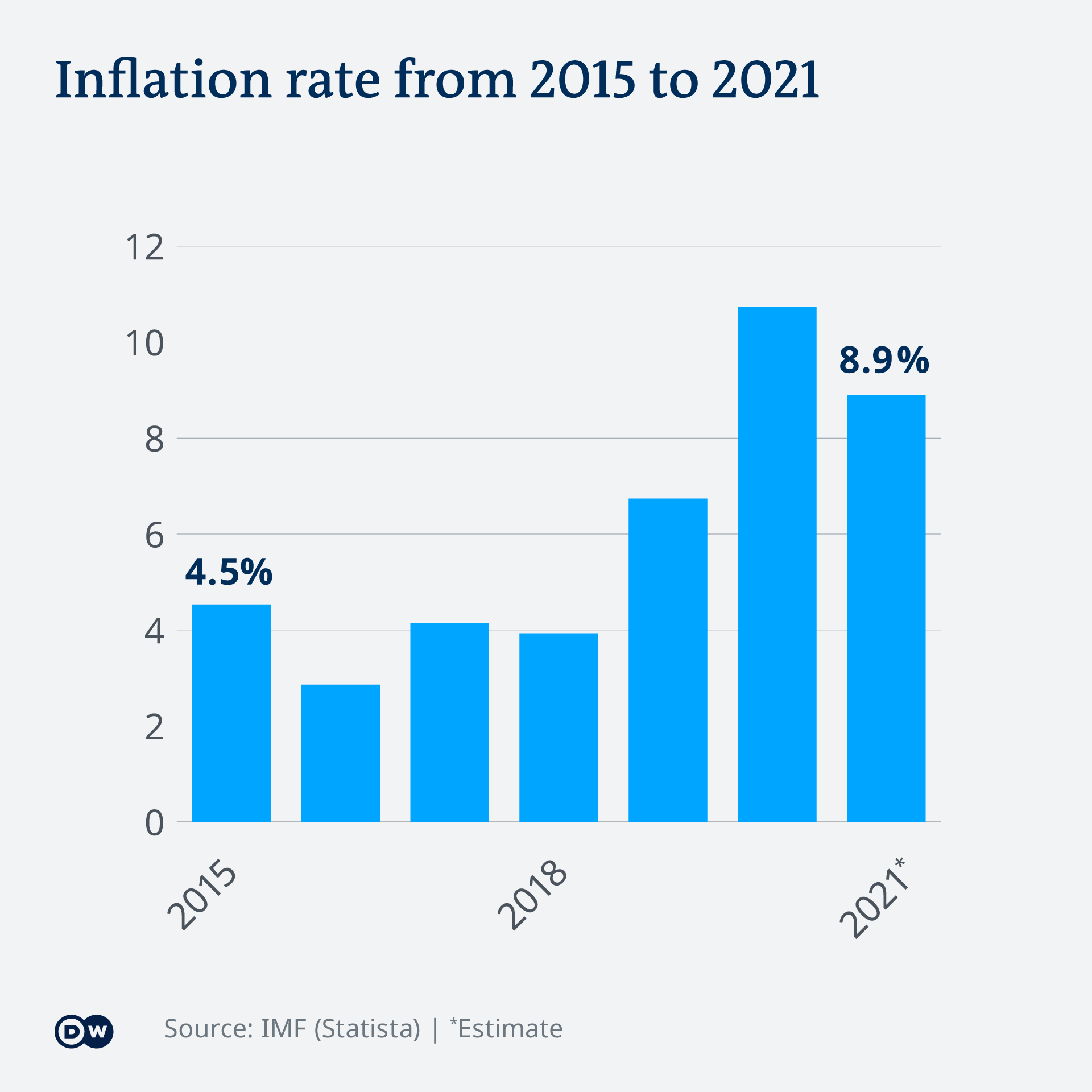
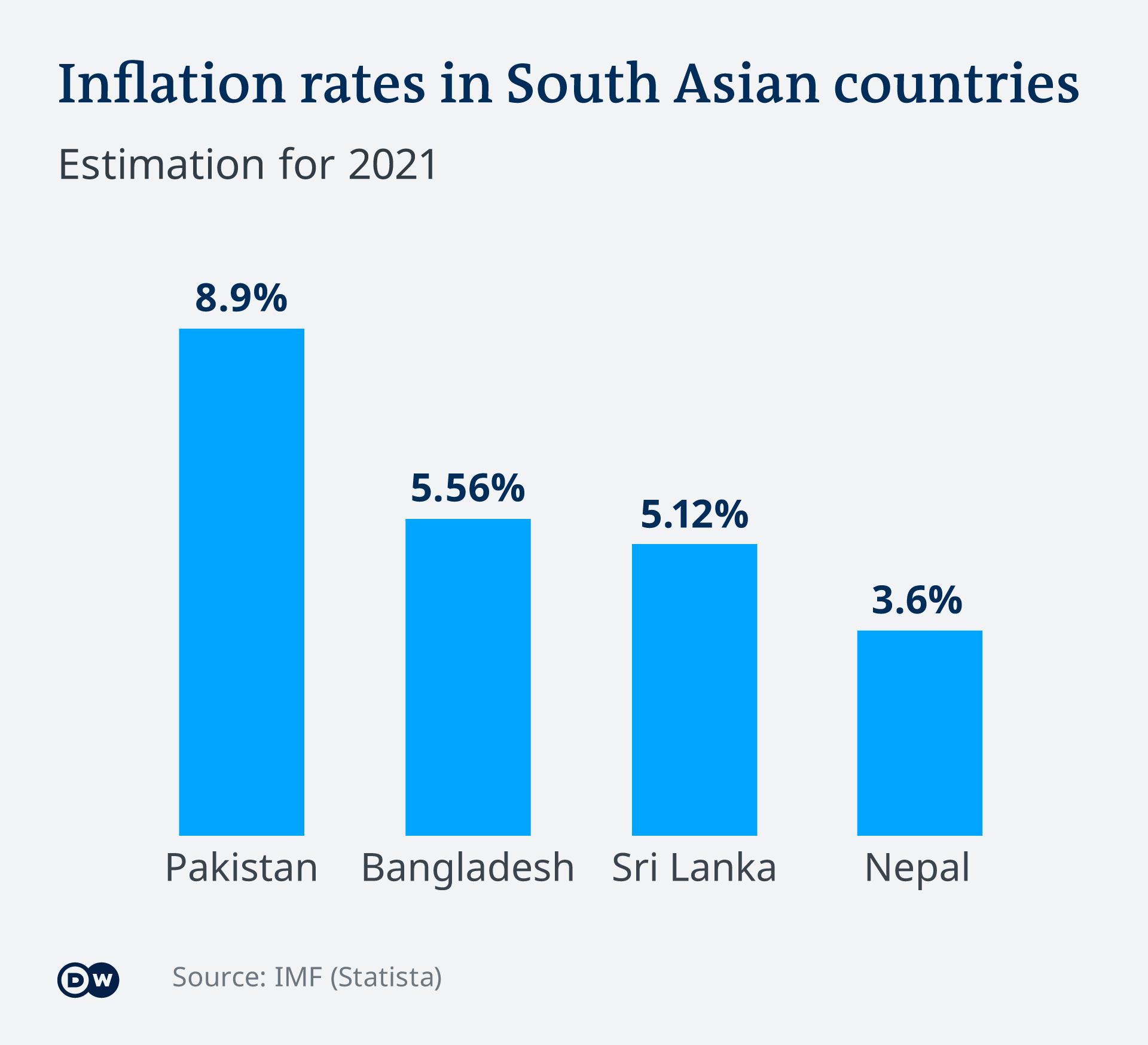
The inflation rate in Pakistan under former Premier Nawaz Sharif in 2015 was 4.5%, which has almost doubled to 8.9% in 2021.
A dire economic situation
Economist Saeed says that Pakistan's 2019 economic deal with the International Monetary Fund (IMF) is responsible for the price hike. "Finance and revenue advisors to PM Khan have acknowledged that the IMF wanted Islamabad to increase electricity and gas prices, as well as taxes," she told DW.
Pakistani finance officials are trying to close a deal with the IMF to release a suspended $1 billion (€0.87 billion) tranche from a bailout package, which Islamabad says is desperately needed to stabilize the country's struggling economy.
In May 2019, Khan's government reached an agreement with the IMF after months of difficult negotiations on a $6-billion bailout package.
The 39-month bailout program is subject to regular IMF reviews of Pakistan's economic policy and growth.
In January 2020, the program was put on hold after Prime Minister Khan did not follow IMF recommendations to increase electricity prices and impose additional taxes.
In March 2021, the IMF released a $500 million tranche, but talks in June to release further funds were inconclusive.
Pakistan's economy contracted by 0.47% in 2019-20 during the coronavirus pandemic, which hobbled the already weak economy.
Prime Minister Khan's top finance adviser, Shaukat Tarin, said last month he was optimistic that the latest round of negotiations on economic reforms with the IMF would result in the disbursement of the $1 billion tranche. In total, Pakistan has so far received $2 billion out of the $6-billion package via the IMF.
Fluctuation in the global market
Opposition parties are blaming Khan's government for the economic mismanagement, but authorities say the instability in the global market due to the COVID pandemic is the main reason behind rising inflation in Pakistan.
"We are not responsible for this inflation," Jamshed Iqbal Cheema, a former advisor to PM Khan on food security, told DW.
"Prices have increased in the global market, and this has had an impact on Pakistan as well," he said, adding that the government has offered subsidies to mitigate the financial hardship for citizens.
Amid the economic turmoil, the poor are relying on charity organizations to avail basic food items. An official at the Saylani Welfare Trust non-governmental organization told DW on condition of anonymity that more people are seeking food items and financial assistance than ever before.
https://www.dw.com/en/pakistan-rampant-inflation-piles-on-the-pressure/a-59823980
Facebook says hackers in Pakistan targeted Afghan users amid government collapse
Monday, November 15, 2021
Plummeting value: Pakistani Rupee, Turkish Lira, and Iran's Rial all face depreciation against USD
https://www.wionews.com/world/plummeting-value-pakistani-rupee-turkish-lira-and-irans-rial-all-face-depreciation-against-usd-429419
#Pakistan - On #InternationalToleranceDay, PPP Chairman Bilawal Bhutto Zardari describes strengthening of democracy as only path to promote tolerance
Chairman Pakistan Peoples Party (PPP) Bilawal Bhutto Zardari has said that the only way to promote tolerance and patience in Pakistanis society lies in strengthening democracy.

Bilawal Bhutto Zardari urged that the need to promote inter-sectarian and interfaith harmony in the world, as it is today, has hardly been felt in the past. “The elimination of biasedness, in all forms and at all levels, besides the adoption of tolerance and moderation can lead to the formation of a global society based on the principles of peace, equality and coexistence,” he maintained.
Chairman PPP pledged that Pakistan Peoples Party will make Pakistan the cradle of tolerance in the light of the vision of Quaid-e-Azam Muhammad Ali Jinnah, the ideology of Quaid-e-Awam Shaheed Zulfikar Ali Bhutto and the philosophy of Shaheed Mohtarma Benazir Bhutto as this is the struggle our Party has been pursuing since the very first day of its foundation.
Sunday, November 14, 2021
Pakistan doesn't want a hostile govt in Kabul, but pardoning the TTP is not a good idea - Negotiating with militants

PAKISTAN’S ongoing talks with the outlawed Tehreek-i-Taliban Pakistan offer a colossal opportunity to the Afghan Taliban regime in Kabul to prove its willingness and ability to deal with a multitude of foreign militants in Afghanistan. The world is sceptical about the Taliban’s pledges. But if the Taliban can help Pakistan neutralise the TTP, it might pave the way for the recognition of their government by at least a few of Afghanistan’s immediate neighbours.
By fulfilling their commitments regarding regional militant groups, the Taliban can also win the trust of China, Russia and the Central Asian states. However, this will not be easy. Apart from ideological affinity, the Taliban have a past of coexistence and shared armed resistance in Afghanistan with many of these religiously inspired militant groups. Some reports are suggesting that many Taliban leaders do not endorse the negotiations between Pakistan and the TTP as they believe that the Pakistani militants are not a separate entity from them. It is also not certain how the Afghan Taliban, or the Haqqanis, will deal with the TTP if Pakistan-TTP negotiations collapse.
Many experts believe that Pakistan’s simple demand for the Taliban would have been strict action against the TTP and expulsion of its leadership from Afghanistan. The Taliban however chose, either on their own or on the request of Pakistan, to offer mediation between the TTP and the Pakistani state just as Pakistan had facilitated the talks between them and the US; Sirajuddin Haqqani is apparently acting as Zalmay Khalilzad in the TTP’s talks with Pakistan. Pakistan’s security institutions are giving the impression that the state is negotiating with the TTP from a position of strength as the group is currently deprived of resources and foreign support in Afghanistan. Some media reports have claimed that the security establishment fears Pakistan could lose its influence over the Afghan Taliban once other players including India start entering the equation. If there is such a fear then one should ask what Pakistan has achieved by investing huge resources in Afghanistan, supporting the Taliban at the cost of internal security, and burning its strategic and diplomatic capital.
As reported in the media, Pakistan should not allow the TTP militants to have access to the weapons left behind by the Americans in Afghanistan; but that does not provide any strong justification for negotiations with the terrorists. It is understandable that states employ both political and military approaches to counter insurgents. However, the TTP has lost the ability to convert its militant movement into a large-scale insurgency in the merged tribal districts of ex-Fata. The TTP can achieve that goal only with Afghan Taliban support.
Experience suggests that after every deal the TTP gained more power.
The government also claims that talks with the TTP are underway in line with the Constitution. If the TTP accepts any solution within the ambit of the constitution nothing could be better. But the group regards the document as un-Islamic and Pakistani rulers as ‘transgressors’ and puppets of the ‘infidel’ West. Almost all religious extremist groups and even some religious parties developed this narrative over time, which was later adopted by Al Qaeda. Now the TTP is its flagbearer.
The security institutions also mix up deradicalisation approaches with amnesty and reconciliation. No one can oppose the idea of deradicalisation of the detainees who surrendered and did not commit any heinous crime. However, general amnesty or entertaining the demands of militants who are not ready to review their ideological and political paradigm could prove to be a dangerous move. Using such concessions, the TTP could relocate to the areas it had once lost, with or without weapons, where its cadres would certainly propagate the group’s ideology. A little public support and empowerment would be enough for the group to reassert the implementation of its version of Sharia. Secondly, in the form of a ‘reconciled TTP’ in Pakistan’s tribal areas, the Afghan Taliban would have vocal support inside Pakistan, which would always look towards Kabul.
Indeed, Pakistan has very little time to neutralise the TTP threat. The militant groups are usually very receptive to the offer of talks, and they extract legitimacy, and time, through such offers. However, it is always hard for the state. The Pakistani state has already tested the TTP in several peace deals. Experience suggests that after every deal the Pakistani Taliban gained more power to propagate their narrative and to flex their muscles.
Someone in the power corridors may be thinking that the TTP will weaken the sub-nationalist forces in the tribal districts, and also minimise the risk of an anti-Afghan Taliban movement in Pakistan. So far, there is no sign that the tribal districts could become the base for an anti-Taliban movement, but the return of TTP militants will increase tensions in the bordering region.
Such critical policies should not be based on mere hypotheses and must have solid empirical evidence. The idea of negotiation with the TTP is not new and has been in the air for the last several years. In a presser in January 2019, military officials said that the state was working on some mechanism to sort out the TTP and affiliated militant movements. At that time, it was argued that TTP militants could join the Islamic State (IS) group if there was no engagement plan for the abandoned militants. However, only a few individuals and small splinter groups from the TTP had joined IS. The reason was that IS was very exclusive in its nature and the TTP was closely associated with Al Qaeda and the Taliban. Had an amnesty been granted to the TTP on such assumptions, what sort of security situation would Pakistan have been facing right now?
It seems Pakistan is providing maximum support to the Taliban regime for the sake of its geoeconomic and strategic interests. There is a legitimate reason why Pakistan doesn’t want a hostile government in Kabul but pardoning the Taliban’s Pakistani supporters is not a good idea. It reflects that state institutions have very few ideas. Parliament and inclusive policymaking processes can help widen policy options but bridging the trust deficit among institutions is another big challenge.