Wednesday, June 2, 2021
'I know the power that a young girl carries in her heart': Malala unveiled as new Vogue cover star
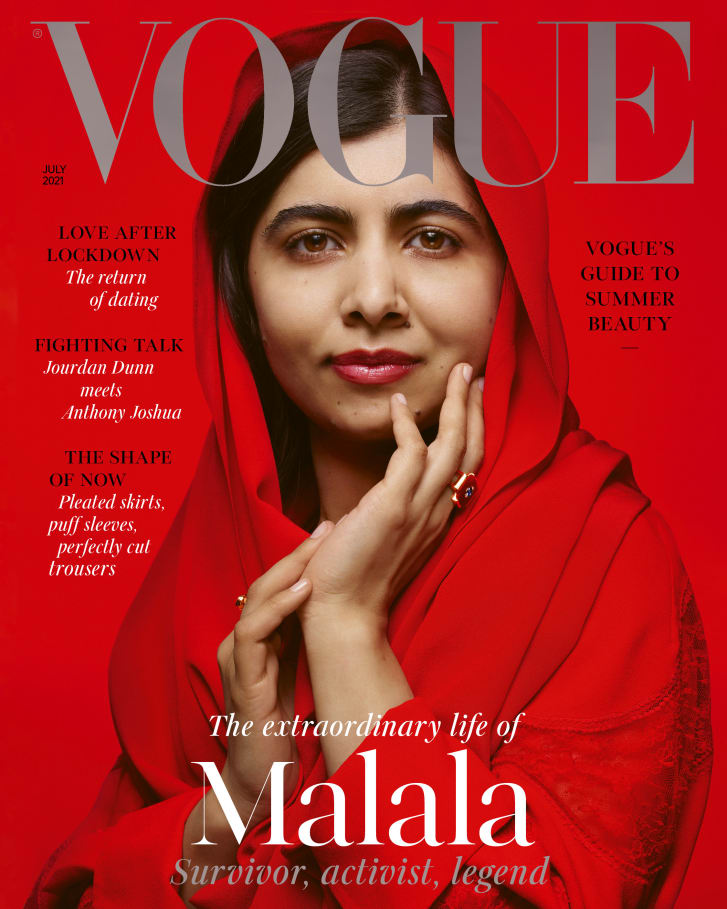
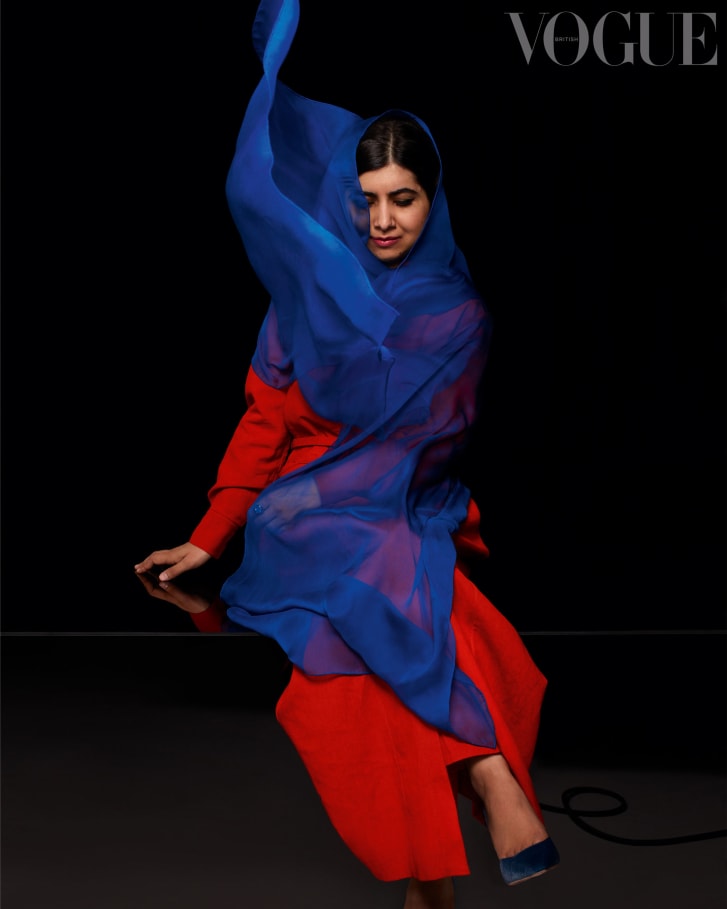
On Instagram, Yousafzai said she was "thrilled and humbled" to be the magazine's newest cover star, adding: "I hope that every girl who sees this cover will know that she can change the world."
Her life now Having long championed human rights and girls' right to education, the Pakistani activist became the subject of global attention when, aged 15, she was shot in the head by the Taliban. She survived after being airlifted to Queen Elizabeth Hospital in Birmingham, UK, and went on to establish her own non-profit organization, the Malala Fund. Last year, Yousafzai graduated from Oxford University with a degree in politics, philosophy and economics, and she recently launched her own production house, Extracurricular. A multi-year deal with AppleTV+ will see the company release documentaries about girls' education and women's rights, as well as comedies, animation and children's series.Elsewhere in the Vogue interview, Yousafzai offered her opinions on the state of activism and politics today. "Right now we have associated activism with tweets," she is quoted as saying. "That needs to change, because Twitter is a completely different world."
She also shared details about her time studying in the UK, saying that she "finally got some time to myself." The activist added that she was "excited about literally everything," from eating at McDonald's to playing poker with friends, although Vogue also described her as "the essay crisis queen," as she recalled leaving essays until the night before they were due. "I was enjoying each and every moment because I had not seen that much before," Yousafzai said. "I had never really been in the company of people my own age because I was recovering from the incident (the Taliban's attempt on her life), and traveling around the world, publishing a book and doing a documentary, and so many things were happening."
https://edition.cnn.com/style/article/malala-yousafzai-vogue-cover/index.html
‘Worse day by day’: journalists speak out after Pakistani vlogger tortured

Gathered before a solemn crowd, Hamid Mir, one of Pakistan’s best-known journalists, spoke defiantly. “Do not ever enter the homes of journalists again,” he said. “We don’t have tanks or guns like you, but we can tell the people of Pakistan about the stories that emerge from inside your homes.”
Mir may have been addressing journalists in Islamabad on Friday, but his words were not directed at them; they were a clear message to Pakistan’s all-powerful military establishment.
Days before, attackers had barged into the home of YouTube journalist Asad Toor, whose videos are critical of the ruling elite. They tied him up and tortured him, but not before allegedly introducing themselves as officers from the Inter-Services Intelligence (ISI), the shadowy security arm of the military.
“I was told that the army and ISI were not happy with my journalism,” says Toor after the attack. “While torturing me, they asked me why I had named ISI and the army in my reporting.”
The Pakistan authorities have denied all involvement and claimed Toor staged the attack in order to seek political asylum abroad. On Tuesday, the Federal Investigation Agency filed a case against Toor for “defamation” of a government institution.
“There is no space for freedom of speech and dissent,” says Toor. “If one criticises the military and Imran Khan, they face physical and online attacks. The level of frustration has rocketed. They can’t tolerate criticism by journalists.”
In response to the attack, Mir was among a group of journalists who had gathered to voice their anger at the increasing violence, intimidation and censorship of journalists who have dared to criticise Khan’s government.
Mir’s speech, which was directed at the military without mentioning it by name, went viral. But on Monday, Mir was told that his popular chatshow, which has been running for two decades, was to be pulled from the news channel Geo TV. The last time this happened to Mir was in 2007, when military leader Pervez Musharraf, then president of Pakistan, declared a state of emergency and suspended the constitution.
Mir is no stranger to intimidation for his reporting: he still has two bullets in his body from an assassination attempt in 2014. But Mir says that press freedom has deteriorated to one of the lowest points he has experienced in his decades-long career.
“They have gone so low,” says Mir, who would not directly name the military or ISI. “They have even shared the contact number of my daughter on WhatsApp and asked others to threaten her. She is just a student. She is now getting threatening and intimidating messages.”
The decision to pull Mir’s show was condemned by many, including Amnesty International, which said it further undermined any protection of free speech “in an already repressive environment”.
“Censorship, harassment and physical violence must not be the price journalists pay to do their jobs,” said Amnesty.
Since Khan came to power in 2018 with the backing of the military, journalists and civil rights groups have spoken out against a steady erosion of press freedom. Violent attacks on journalists are on the rise. In April, a senior Pakistani journalist was shot and wounded in Islamabad, believed to have been targeted because of his reporting.
The military now routinely issues threats to ensure news stories which are negative about the military or Khan’s government are pulled, critical journalists are fired and no coverage is given to opposition politicians and rallies.
According to the International Federation of Journalists, Pakistan is the world’s fifth most dangerous country for journalists. In its 2020 world press freedom index, Reporters Without Borders ranked Pakistan 145th out of 180 countries.
The assault on the media in Pakistan is now about to become law, as the president, Arif Alvi, introduces some of the most draconian censorship seen in years, including an almost blanket ban on negative coverage of the government or the military.
Under these rules, existing press freedom laws will be repealed and a new authority granted power to inspect and raid any news organisation, summon any journalist for investigation and cancel the licence of a media network. Even journalists broadcasting over YouTube would need a licence.
The ordinance also states that TV news anchors cannot broadcast views which are “prejudicial to the ideology of Pakistan or sovereignty, integrity or security of Pakistan” and that no coverage can be given to any story which “defames or brings into ridicule the head of state, or members of the armed forces, or legislative or judicial organs of the state”.
Shahzada Zulfiqar, president of the Pakistan Federal Union of Journalists, describes the new regulation as “media martial law. We are entering into the worst and darkest era of media freedom. In this era there is a lack of safety for journalists both in their career and in their life.
“It is getting worse day by day. Journalists don’t feel safe here.”
https://www.theguardian.com/global-development/2021/jun/02/hamid-mir-journalists-speak-out-after-pakistani-vlogger-asad-toor-tortured
People will no longer be fooled by the PM’s illusion of economic prosperity – says Chairman PPP Bilawal Bhutto Zardari

In a statement issued from the Media Cell Bilawal House, the Chairman PPP exposed Prime Minister Imran Khan for hatching a plot with his advisors to target the low-income group in the budget 2021. He also pointed out that inflation in the country has already peaked at 20%, according to the SPI index. If the situation worsens, the impoverished will be unable to survive.
“By imposing heavy taxes in the budget, PTI government wants to burden those who are receiving low salaries,” declared Chairman Bilawal Bhutto Zardari. “Imagine what Pakistan’s condition will be if the salaried group is tied up in taxes?”
Speaking of the COVID healthcare crisis and the downfall of world economies caused by the pandemic, Chairman PPP pointed out that the globe is already suffering. Several economies are on the brink of destruction, and we must ensure Pakistan is not one of them. There will be no greater injustice if our already crippling economy is presented with a budget that does not provide relief to the poverty-stricken public.
“Imran Khan is proving his enmity to the common people by giving amnesty schemes to the rich and collecting taxes from the poor,” remarked Chairman PPP. “How can he sit by and watch thousands of his countrymen die of hunger? Our future generations will be ruined since many families can’t afford to educate them,” he protested.
Addressing the selected prime minister’s claims regarding the nation’s economic growth, Chairman PPP Bilawal Bhutto Zardari commented, “Where is this so-called economic growth? We can’t see it in the statistics! But the doubling rate of unemployment is surely evident.”
He further declared, “The puppet Prime Minister can get appreciation from his ‘fans’ by manipulating the numbers, but the masses will not be fooled by the PM’s illusion of economic prosperity.”
Perplexed at the conniving plan of the current government, Chairman PPP revealed that before presenting the fourth budget, Imran Khan brought his third finance minister and the fifth trade secretary. The economic team of the PM, however, was nowhere to be seen. “A few days before the budget, the PTI government changed the secretary of the finance department and then turned the economic catastrophe into a fake economic growth,” stated Chairman PPP Bilawal Bhutto Zardari, outraged at the audacity of the reigning government.
“Imran Khan Niazi may be influenced by those who want their pockets filled, but I reject PTI’s plot to impose taxes worth billions of rupees in the PTIMF budget. The current inflation rate has caused enough suffering,” asserted Chairman PPP. “We will not sit idly and watch PM Imran Khan present one failed budget after another. Mark my words, his name will go down in the history of his country for the economic crimes. The country will never forgive him,” he concluded.
https://www.ppp.org.pk/pr/24948/
#Pakistan - Draconian media law

Tuesday, June 1, 2021
Pakistani TV Bans Host of Talk Show After He Criticized Army
By
Hamid Mir was taken off the air by Geo News TV after giving a fiery speech at a rally to support Asad Ali Toor, a journalist recently beaten by unidentified men.
https://thediplomat.com/2021/06/pakistani-tv-bans-host-of-talk-show-after-he-criticized-army/
Hamid Mir’s defiance of military, ISI and emergence of a new ‘General Rani’ in Pakistan

The Pakistani media may never undertake a full-throated challenge to the diktats of the deep state, but sometimes it is angry enough to let out a roar.
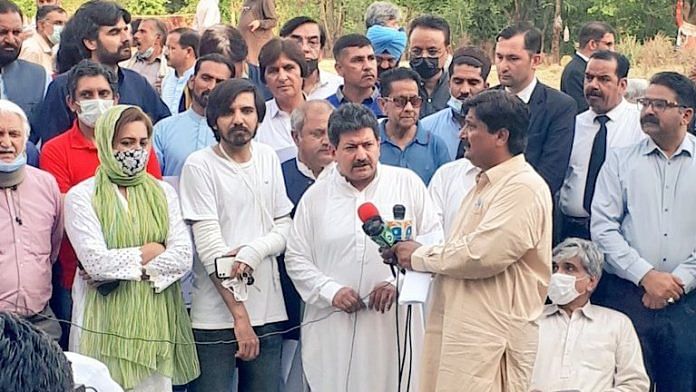
When you fail to create a narrative about Israel in the Pakistani media, you get very angry. You pick up Matiullah Jan, shoot Absar Alam and enter the houses of people like Asad Toor. Then you say that your tanks are becoming rusty, so let’s make peace with India…You called ‘Madre-Millat Fatima Jinnah a traitor and today you call Asad Toor a traitor…Do not ever enter the homes of journalists again. We don’t have tanks or guns like you, but we can tell the people of Pakistan about the stories that emerge from inside your homes. We will tell them whose wife shot whom inside the confines of their home. And which ‘General Rani’ was behind this. I hope you all have understood what I am saying.”
This was Pakistani journalist Hamid Mir of Geo News, speaking at the National Press Club in Islamabad over the weekend, in defence of his country’s media and mediapersons.
For a country that has been ruled by its army for more than half its existence and whose politics has consequently followed a tortuous course, Pakistan’s media has always kept at least one candle burning in pursuit of free speech and expression.Mouthpiece of regimes as well as fiercely independent, both ultra-nationalist as well as severely critical of the military establishment, you can love or hate the Pakistani media; but it’s not easy to be indifferent to it. A section holds its own Over the decades, Pakistani journalists have been imprisoned, beaten and censored for writing and reporting on the 1971 break-up of Pakistan; on human rights abuses in Balochistan and elsewhere; on the shenanigans of political parties; and especially on the aggrandisement of the “deep state,” a euphemism for the army-ISI intelligence dyad that has infiltrated almost every branch of State and society. In the past ten years, journalists have increasingly fallen foul. In May 2011, the body of Saleem Shahzad was found “entangled” in the Upper Jhelum canal, a couple of hours away from Islamabad; his body bore signs of torture. In April 2014, four gunmen fired at Hamid Mir, as he drove from Karachi airport to his Geo News office – he received bullets in his stomach and upper legs. Mir had told his friends that if he was attacked, he would hold ISI chief Lt Gen Zaheerul Islam responsible. One month before, journalist Raza Rumi barely escaped with his life and now mostly lives abroad – along with other journalists like Ayesha Siddiqa (a columnist at ThePrint), Taha Siddiqui and Gul Bukhari. More recently, the Pakistani media’s reporting of its “hybrid government” – the rule of Prime Minister Imran Khan, brought to power with more than a little help from the military establishment, which means the establishment demands its pound of flesh more often than not – has been less tolerant.But the gloves are not fully off – and may never be. The Pakistani media may never undertake a full-throated challenge to the diktats of the deep state, but sometimes it is angry enough to let out a roar that may damage not just the “enemy,” but also its own, cosy compact with it. One of those moments is now. The method of silencing One week ago, three men barged into the house of popular vlogger and journalist Asad Ali Toor, told him they “belonged to the ISI” and proceeded to torture him. It seems that Toor, in his YouTube channel ‘Asad Toor Uncensored’, had talked about the sudden elevation of ISI chief Faiz Hameed’s brother Najaf Hameed, from ‘patwari’ to ‘naib tehsildar’ (both positions in the provincial civil service). Only a month ago, journalist and former head of Pakistan’s broadcasting authority PEMRA, Absar Alam, had fortunately escaped with his life, the bullet merely grazing his ribs; last year in July, journalist Matiullah Jan, was picked up outside his wife’s school in Islamabad, but soon released. On the eve of the attack against him, Alam had tweeted that as the head of PEMRA in 2017, he had ordered that TV Channel 92 be shut down because it violated guidelines, but was told by the ISI’s then counter-intelligence head General Faiz Hameed (he had not become ISI chief yet) to keep it open. Certainly, Gen. Hameed earned his public spurs in that incident. For three weeks, the extreme Islamist Tehreek-e-Labbaik party gheraoed Nawaz Sharif’s Pakistan Muslim League (PML-N) government, which was in power at the time, upon which Hameed brokered an agreement between the two sides and signed off as guarantor. Many believed the Labbaik was merely a front for the ISI, which wanted to oust the PMLN and install a more favourable outfit, Imran Khan’s Pakistan Tehreek-e-Insaf (PTI) – an accusation Nawaz Sharif would make later. Opening Pandora’s box? Asad Toor’s break-in and torture last week has now galvanised Pakistan’s media. Demonstrations have been held all over the country, but none more in the spotlight than outside the National Press Club, Islamabad, over the weekend — where three journalists, Munizae Jahangir, Asma Shirazi and Hamid Mir, set the stage on fire. The pushback was immediate. One Pakistani journalist alleged that a woman had complained to Pakistan’s investigative agency about harassment from Asad Toor. Another TV journalist wondered why Hamid Mir was accusing intelligence agencies. Certainly, among Mir’s memorable lines at the protest was the challenge to the military establishment not to touch Pakistani journalists again. “We cannot enter your homes, like you enter ours, but we can write about the stories that emerge from them,” Mir said, going on to talk about a “General Rani” of the present-day military dispensation in Pakistan. There has been a hushed silence to Mir’s remarks, save for a few YouTube comments. So who was “General Rani” and why is Mir talking about her today? Speculation is rife in Pakistan about sexual favours being exchanged by the current military establishment – a bit like the time Aqleem Akhtar was both “muse and mistress” to Gen. Yahya Khan, the martial law administrator from 1969-71. Akhtar turned out to be one of the most influential and enterprising women in Pakistan’s power circles. Whatever the truth, it seems as if one section of the Pakistani media, at least for the moment, is tired of playing cat-and-mouse. There’s a certain Dutch courage about that community that is rare – they want their country to be a “normal place” where the army and the ISI are subordinate to an elected leadership and all citizens, including Ahmadis, are equal. The pragmatists say this will never happen; the dreamers insist that one day it will. Pakistan lurches between these two positions today, even as its media refuses to totally capitulate. It knows that staying alive for that new dawn, just like Faiz Ahmad Faiz once wrote, is its best strategy. POSTSCRIPT: Within 48 hours of delivering his speech, Hamid Mir’s employers, Geo News, took him off his show ‘Capital Talk’. Mir says he is determined to fight back and uphold Pakistan’s Constitution. A new page in Pakistan’s media history is turning.Pakistan’s poverty rate is over 21% and these numbers do not show any economic growth – says Chairman PPP Bilawal Bhutto Zardari

Monday, May 31, 2021
PPP Chairman Bilawal Bhutto Zardari condemns police brutality on teachers in Peshawar
Chairman Pakistan Peoples Party, Bilawal Bhutto Zardari has said that police

brutality against teachers in Khyber Pakhtunkhwa is highly condemnable. He said that on one hand KP government is cutting staff allowances and on the other, the government is claiming economic growth.
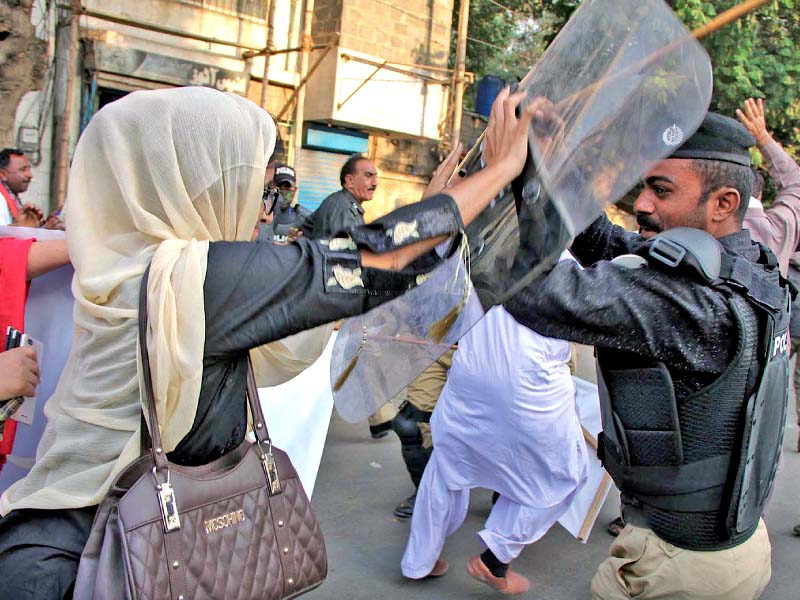
He said that the Pakistan Tehreek-e-Insaf federal government has given less of its budget to the universities of Khyber Pakhtunkhwa. Chairman Bilawal Bhutto Zardari demanded that more than 15 teachers sustained injuries while protesting for their rights by Khyber Pakhtunkhwa police and should be given free medical treatment. He asked where is the justice in handcuffing 22 teachers including grade 21 Ph. D professors.
Chairman Bilawal Bhutto Zardari demanded the immediate release of arrested staff of universities in the KP province. He said that on the one hand, the budget of KP universities has been reduced and on the other, students are being burdened by increasing university fees. He deplored the baton charge and tear gas shelling on respected teachers.
Pakistani talk show host Hamid Mir suspended after critical comments on the military
In response to the suspension today of Pakistani journalist Hamid Mir, host of “Capital Talk” news program, by the Geo News network following Mir’s critical comments about the Pakistan military at a rally on Saturday, the Committee to Protect Journalists issued the following statement:
“Forcing a popular news talk show host like Hamid Mir off the air after voicing criticism of Pakistan’s military—and support for a fellow journalist—only underscores the lack of true press freedom in Pakistan,” said Steven Butler, CPJ’s Asia program coordinator. “Critical comments about key state institutions are an important component of democracy, not a scourge to be eliminated.”
Mir’s suspension followed comments about the military at a rally outside the National Press Club in Islamabad in support of journalist Asad Ali Toor, according to news reports, video posted on Twitter, text messages from Mir to CPJ, and a statement issued by the Pakistan Federal Union of Journalists, which was posted on Twitter. Toor was assaulted at his home last week, as CPJ documented.
A Geo News representative, who declined to be identified because of the sensitivity of the issue, told CPJ in a telephone conversation that Geo was in the process of drafting a statement for public release on Mir’s suspension.
Mir survived an attempt on his life in 2014, when he was hit by six bullets in Karachi, as CPJ reported at the time.
https://cpj.org/2021/05/pakistani-talk-show-host-hamid-mir-suspended-after-critical-comments-on-the-military/
Sunday, May 30, 2021
EDITORIAL - Working Less Is a Matter of Life and Death


Why are Arabs so powerless? Unlike Israel, they never valued brain over brawn

What makes Israel with nine million people — between one-half and one-third of Karachi’s population — a Goliath of biblical proportions? Equally, notwithstanding their fabulous oil wealth, why are 427m Arabs the pygmies of international politics? GCC Arabs can certainly control what happens in a few miskeen countries like Pakistan; their leaders can be summoned to Riyadh at a moment’s notice and sent back with sackfuls of rice as wages of obedience. But before Israel — which has almost zero natural resources — Arab kings and sheikhs must perforce bow their heads.Blame the West if you want and, in particular, America. Indeed, from 2000-2019 armaments supplied to Israel by the Western powers (US, UK, France, Spain, Germany) are documented at a hefty $9.6 billion. But within that 20-year period the same document shows this amount is dwarfed by arms sold by the same suppliers to Saudi Arabia ($29.3bn), UAE ($20.1bn), Egypt ($17.5bn), Iraq ($9.1bn), and Qatar ($6bn). And yet these expensive weapons will provide little protection if Israel ever chooses to attack Arab lands again. While the nine-country Saudi-led coalition has created a humanitarian catastrophe in Yemen, it is failing dismally against the rag-tag Iran-supported Houthi forces. Okay, so then let’s blame Palestine’s ill-fortune upon Arab disunity. There’s truth in this: Arabs are indeed bitterly divided. But when were they not? From about AD-634 to AD-750 is the only period in history when they stood together. Then, after Nasser won the Suez War against Britain, Arabs united again for a brief, euphoric moment. But this unity did nothing to avert their crushing defeat in the 1967 Arab-Israeli war, that which forever changed borders. And while friends and activists for Palestine — including myself — would love to see Fatah and Hamas patch up their differences, doing so will not change things fundamentally. The secret of Israel’s strength is not hidden in its weaponry. Instead this still-expanding and still-colonising apartheid settler state uses the same magic that enabled just a handful of 18th-century Englishmen to colonise the entire Indian subcontinent. Let’s recall that in ruling over 200m natives for 250 years, at no time did Britain have more than 50,000 white soldiers on Indian soil. Although better guns and cannons gave them an edge, in fact their real not-so-secret weapon was much bigger. That weapon was a system of organised thought based upon a rational and secular approach to life, a modern system of justice, and a new set of social relations. This was sustained and enhanced by Enlightenment-era education that de-emphasised rote learning of the scriptures, was this-worldly and future-oriented, and which focused upon problem-solving skills using systematic, scientific thinking. Having invented modern means of communication such as railways and telegraph, a mere island in the North Sea could boast of an empire over which the sun never sets.
In a nutshell, imperialist conquests showed that brains would rule over brawn — a stark truth that got still starker with time. But where are brains produced? Obviously in the womb but it is in schools, colleges and universities where minds are shaped and sharpened. Hence, these days everyone and their uncle rush to one single conclusion: fix education and this will level the playing field, greatly diminishing or perhaps ending the inequalities of power.Ah! That’s so much easier said than done. To have buildings and classrooms with teachers is one thing but to coax the potential out of a student is altogether different. With their vast wealth, Arab countries have built impressive university campuses with well-equipped laboratories and well-stocked libraries. They have even imported professors from America and Europe. Yet, the needle has barely flickered so far. That’s because attitudes towards learning take forever to change — and only if they are somehow forced to change. Ditto for Pakistan which follows the Arab model as best as it can, together with abayas and jubbas. No university here has a bookshop, a centre for students that hums with open debate and discussion, or a theatre where classic movies are screened. Looking for a philosopher or a high-grade pure mathematician will be in vain. For 20 years, papers and PhDs have been churned out at a frantic rate. But I suspect that many of Pakistan’s decorated “distinguished national professors” with hundreds of research publications would be judged unfit to teach in a high-end Israeli high school for lack of scholarship.
The problem is not genetics — Arabs have a brilliant past and are probably just as smart as Ashkenazi Israelis. But the two groups have different attitudes towards success and different role models. The Ashkenazi child wants to be Albert Einstein, Niels Bohr, John von Neumann, George Wald, Paul Samuelson, Gertrude Elion, Ralph Lauren, George Soros, or a thousand other such names that fill textbooks on physics, philosophy, technology, medicine, and business. Compare this with the Arab boy who wants to be Salahuddin Ayubi and the Pakistani lad who dreams of becoming Ertugrul Ghazi on horseback. He does not know about Abdus Salam, our discarded Nobelist.
We live in a cruel world which, of course, we must try our best to make less cruel and more humane. But making a socially just world requires much more than condemning the oppressors and crying with the oppressed. Instead, the weak must be made stronger. That strength does not derive from oil or nuclear bombs. Instead, it springs from the human brain, but only when that superb gift of nature is appropriately tutored and trained within a system of secular values that cherishes and rewards logical thinking, questioning and creativity.
#Pakistan - Jahangir Khan Tareen - Power politics
Jahangir Khan Tareen, who faces corruption charges, has galvanised the support of 40 lawmakers
Throughout Pakistan’s political history, ‘forward blocs’ in the parliamentary parties have been used for various purposes.
Some of the blocs have succeeded in achieving their targets but others have failed, ending political careers of many a turncoat. The latest occurrence of a forward bloc has sown discord in Pakistan Tehreek-i-Insaf (PTI) ranks and emboldened the opposition. The ruling party now faces undesirable grouping both in the National Assembly and the Punjab Provincial Assembly.
Despite Jahangir Khan Tareen’s claims to the contrary, the new groups are forward blocs according to every canon.
Another bloc, led by Pakistan Muslim League-Nawaz dissident Jalil Sharqpuri, has existed in the Punjab Assembly in the recent past. Its main objective was to prop up the PTI government at the expense of the Pakistan Muslim League-Nawaz (PML-N). The group has outlived its utility and is now defunct.
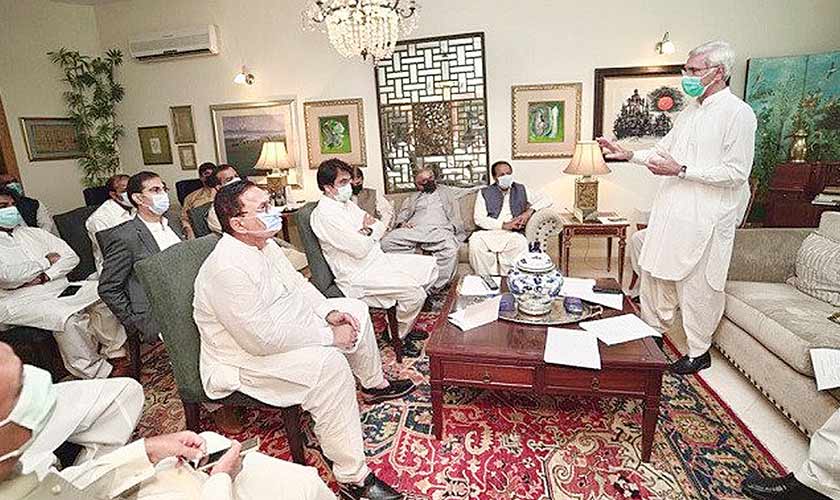
Tareen, who has been barred from elected office and is facing corruption charges, has galvanised a group of nearly 40 MNAs and MPAs. Given their strength, these lawmakers cannot be taken lightly, especially in the Punjab where the PTI majority is particularly slim. The Tareen-led group poses a serious threat to the PTI in both assemblies. However, it seems that the PTI forward bloc is in no mood yet to topple the prime minister or the Punjab chief minister. Statements by some members of the bloc indicate that some of their targets have already been achieved and that they are satisfied with the progress.
Dr Mehdi Hasan, the political analyst, says: “It appears that Tareen and his group got some guarantees and assurances from Prime Minister Khan. Tareen will try to maintain his strength to keep his political relevance alive, but not go against the government for now.”
The forward bloc emerged after Tareen was accused of masterminding the sugar crisis. He and some members of his family were also accused of misusing public funds for personal businesses. Tareen and his son, Ali, have appeared before courts and shown a resolve to face the cases filed against them. They say the cases are politically motivated.
By getting some 40 parliamentarians to publicly endorse his stance and pledge support, Tareen has surprised not only the PTI but also other political parties and the media. He initially claimed that his supporters had decided to form a separate group in the Punjab Assembly to raise their demands. Later, he tried to say that the perception about there being a forward bloc was incorrect. “We were, we are and we will remain a part of the PTI,” he said.
Saeed Akbar Khan Niwani, a veteran legislator in the Punjab Assembly, has been assigned the role of the group’s chief negotiator. Some politicians in other parties, notably Rana Sanaullah of the Pakistan Muslim League-Nawaz, have also raised their voices in his favour. This, seemed to have further unnerved the PTI leadership.
Prime Minister Imran Khan then assigned Barrister Ali Zafar to investigate the charges against Tareen. Zafar has now submitted his report to the prime minister. According to party sources, he has stated in the report that the charges levelled against Tareen and his family are not made out by the available evidence.
After the submission of the report, statements issued by the Tareen group have become more conciliatory.
Talking to The News on Sunday, Niwani said, “We met Prime Minister Khan, Chief Minister Sardar Usman Buzdar and several senior leaders of the PTI. The Prime Minister clearly told us that he would not let anyone victimise anybody in his name. He also said would not allow any group to blackmail him. The PM sounded positive. We trust him.”
“It appears as if Tareen and his group got some guarantees and assurances from Prime Minister Khan. Tareen will try to maintain his strength to keep his political relevance alive, but will not go against the government for now,” says Dr Mehdi Hasan
“How can someone like Tareen, who pays the highest amount of taxes annually and holds a clean business record, be accused of corruption? We trust the PM’s assurance that nobody will be victimised.” He said that his group had several grievances but the matters were internal to the party.
To a question about the group’s strategy in case of a no confidence motion being brought in the National Assembly or the Punjab Assembly, he said: “A no-confidence move against the PTI is out of the question. We will oppose such a motion and will stand with our leaders. We believe that Chief Minister Buzdar will remain in office as long as he enjoys the party’s support. He will quit voluntarily the moment the party tells him to quit.”
Requesting anonymity, another stalwart of the Tareen group said, “Not all dissidents support Tareen. Some are trying to settle their own scores. Everybody in the Tareen group has grievances against the top leaders. They were not being heard for quite some time. They had remained silent earlier because they were on a weak footing. When Tareen raised his voice, they found support. This really worked as everybody started giving them importance.”
Apparently, issues between the PTI’s top-guns and the dissidents have been settled However, our political history shows that the politics of forward blocs is a tricky business.
For Tareen, this is not the first time he has organised such a group. He had formed his first forward bloc in Pakistan Muslim League-Functional. He had won a National Assembly seat on a PML-F ticket in 2008 and later formed a forward bloc. In 2011, he resigned from the National Assembly, announcing that he would form a party of ‘clean’ politicians. Later, he joined the PTI along with several comrades.
In 2009, Pakistan Muslim League-Quaid suffered a huge setback in the Punjab Assembly where it had had more than 80 seats after more than half of its legislators, led by Najaf Abbas Sial, formed a forward bloc in support of the PML-N. The PML-N, which had 178 members in Punjab Assembly, was already ruling the Punjab with the support of the PPP. The PML-N leaders feared that they might be in trouble if the PML-Q joined hands with the PPP. The fears led to the creation of the forward bloc in the PML-Q. The PPP tried to topple the Punjab government by imposing the governor’s rule but the attempt was foiled by the Lahore High Court. Many of the PML-Q forward bloc later leaders joined either the PML-N or the PTI. During these manoeuvres, fears of the PML-N leaders were substantiated when the PML-Q joined hands with the PPP in the National Assembly and replaced the PML-N in the ruling coalition at the Centre.
Another forward bloc had appeared in the PPP after the 2002 election when the PML-Q, the Farooq Leghari-led National Alliance, the PPP-Sherpao, the Muttahida Qaumi Movement and others were unable to put together the numbers needed to elect Mir Zafarullah Jamali as prime minister. The PML-Q had 78 seats in the National Assembly, the Muttahida Majlis-i-Amal 45 and the PML-N 15. Before the prime minister’s election, it appeared that the PML-Q needed more votes. The PPP and the PML-N appeared more willing to join hands with the MMA led by Maulana Fazlur Rehman. However, no agreement was reached.
To overcome the vote deficiency, a forward bloc, comprising 18 National Assembly members, was created in the PPP. Rao Sikandar Iqbal (a classmate of Musharraf), Makhdoom Faisal Saleh Hayat, Chaudhry Noraiz Shakoor and Sardar Khalid Khan Lund led the group. During the division of the house for the election of the prime minister, the 18 PPP MNAs voted for Jamali instead of their very own leader, Makhdoom Amin Fahim. Later, the forward bloc was registered as the PPP-Patriots. The Patriots achieved their mission but most of them lost in the next elections.
In 1989, the purpose of Operation Midnight Jackal was to create a forward bloc in the PPP to oust Benazir Bhutto, then prime minister. Two PPP MNAs, Arif Awan and Rasheed Bhatti were recruited for this purpose. However, the plan failed.
https://www.thenews.com.pk/tns/detail/841248-power-politics