Saturday, May 15, 2021
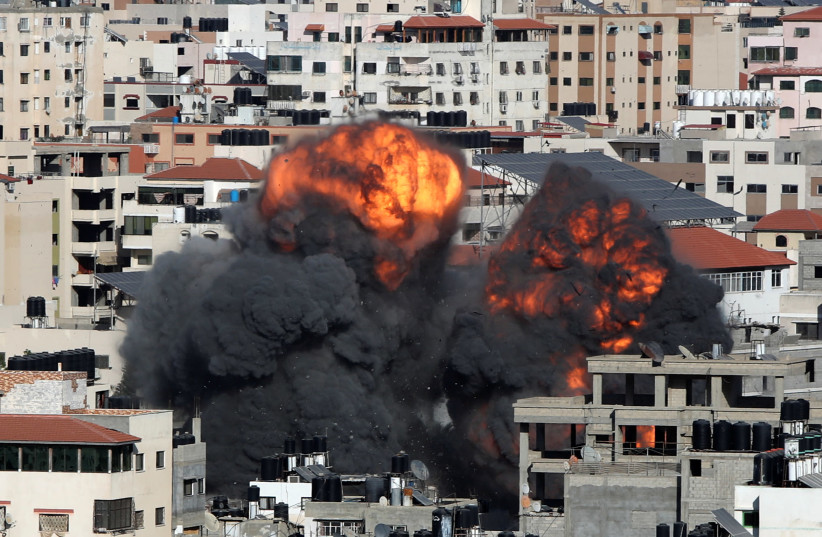
#IsraelPalestine - Did IDF deception lead to massive aerial assault on Hamas’s ‘Metro’?

By YAAKOV KATZ
After Years of Quiet, #Israeli-#Palestinian Conflict Exploded. Why Now?

By Patrick KingsleyA little-noticed police action in Jerusalem last month was one of several incidents that led to the current crisis.

Twenty-seven days before the first rocket was fired from Gaza this week, a squad of Israeli police officers entered the Aqsa Mosque in Jerusalem, brushed the Palestinian attendants aside and strode across its vast limestone courtyard. Then they cut the cables to the loudspeakers that broadcast prayers to the faithful from four medieval minarets. It was the night of April 13, the first day of the Muslim holy month of Ramadan. It was also Memorial Day in Israel, which honors those who died fighting for the country. The Israeli president was delivering a speech at the Western Wall, a sacred Jewish site that lies below the mosque, and Israeli officials were concerned that the prayers would drown it out. The incident was confirmed by six mosque officials, three of whom witnessed it; the Israeli police declined to comment. In the outside world, it barely registered. But in hindsight, the police raid on the mosque, one of the holiest sites in Islam, was one of several actions that led, less than a month later, to the sudden resumption of war between Israel and Hamas, the militant group that rules the Gaza Strip, and the outbreak of civil unrest between Arabs and Jews across Israel itself.
That deterioration has been far more devastating, far-reaching and fast-paced than anyone imagined. It has led to the worst violence between Israelis and Palestinians in years — not only in the conflict with Hamas, which has killed at least 139 people in Gaza and eight in Israel, but in a wave of mob attacks in mixed Arab-Jewish cities in Israel. It has spawned unrest in cities across the occupied West Bank, where Israeli forces killed 11 Palestinians on Friday. And it has resulted in the firing of rockets toward Israel from a Palestinian refugee camp in Lebanon, prompted Jordanians to march toward Israel in protest, and led Lebanese protesters to briefly cross their southern border with Israel.The crisis came as the Israeli government was struggling for its survival; as Hamas — which Israel views as a terrorist group — was seeking to expand its role within the Palestinian movement; and as a new generation of Palestinians was asserting its own values and goals. And it was the outgrowth of years of blockades and restrictions in Gaza, decades of occupation in the West Bank, and decades more of discrimination against Arabs within the state of Israel, said Avraham Burg, a former speaker of the Israeli Parliament and former chairman of the World Zionist Organization. “All the enriched uranium was already in place,” he said. “But you needed a trigger. And the trigger was the Aqsa Mosque.” It had been seven years since the last significant conflict with Hamas, and 16 since the last major Palestinian uprising, or intifada. There was no major unrest in Jerusalem when President Donald J. Trump recognized the city as Israel’s capital and nominally moved the United States Embassy there. There were no mass protests after four Arab countries normalized relations with Israel, abandoning a long-held consensus that they would never do so until the Palestinian-Israeli conflict had been resolved. Two months ago, few in the Israeli military establishment were expecting anything like this. In private briefings, military officials said the biggest threat to Israel was 1,000 miles away in Iran, or across the northern border in Lebanon. When diplomats met in March with the two generals who oversee administrative aspects of Israeli military affairs in Gaza and the West Bank, they found the pair relaxed about the possibility of significant violence and celebrating an extended period of relative quiet, according to a senior foreign diplomat who asked to remain anonymous in order to speak freely. Gaza was struggling to overcome a wave of coronavirus infections. Most major Palestinian political factions, including Hamas, were looking toward Palestinian legislative elections scheduled for March, the first in 15 years. And in Gaza, where the Israeli blockade has contributed to an unemployment rate of about 50 percent, Hamas’s popularity was dwindling as Palestinians spoke increasingly of the need to prioritize the economy over war. The mood began to shift in April. The prayers at Aqsa for the first night of Ramadan on April 13 occurred as the Israeli president, Reuven Rivlin, was making his speech nearby. The mosque leadership, which is overseen by the Jordanian government, had rejected an Israeli request to avoid broadcasting prayers during the speech, viewing the request as disrespectful, a public affairs officer at the mosque said. So that night, the police raided the mosque and disconnected the speakers. “Without a doubt,” said Sheikh Sabri, “it was clear to us that the Israeli police wanted to desecrate the Aqsa Mosque and the holy month of Ramadan.” A spokesman for the president denied that the speakers had been turned off, but later said they would double-check. In another year, the episode might have been quickly forgotten. But last month, several factors suddenly and unexpectedly aligned that allowed this slight to snowball into a major showdown. A resurgent sense of national identity among young Palestinians found expression not only in resistance to a series of raids on Al Aqsa, but also in protesting the plight of six Palestinian families facing expulsion from their homes. The perceived need to placate an increasingly assertive far right gave Benjamin Netanyahu, Israel’s caretaker prime minister, little incentive to calm the waters. A sudden Palestinian political vacuum, and a grass-roots protest that it could adopt, gave Hamas an opportunity to flex its muscles. These shifts in the Palestinian dynamics caught Israel unawares. Israelis had been complacent, nurtured by more than a decade of far-right governments that treated Palestinian demands for equality and statehood as a problem to be contained, not resolved. “We have to wake up,” said Ami Ayalon, a former director of the Israeli domestic intelligence agency, Shin Bet. “We have to change the way we understand all this, starting with the concept that the status quo is stable.” The loudspeaker incident was followed almost immediately by a police decision to close off a popular plaza outside the Damascus Gate, one of the main entrances to the Old City of Jerusalem. Young Palestinians typically gather there at night during Ramadan. A police spokesman, Micky Rosenfeld, said the plaza was closed to prevent dangerously large crowds from forming there, and to head off the possibility of violence.To Palestinians, it was another insult. It led to protests, which led to nightly clashes between the police and young men trying to reclaim the space.“This was the turning point,” said Sheikh Ekrima Sabri, the grand mufti of Jerusalem. “Their actions would cause the situation to deteriorate.”

To the police, the protests were disorder to be controlled. But to many Palestinians, being pushed out of the square was a slight, beneath which were much deeper grievances.Most Palestinian residents of East Jerusalem, which Israel occupied during the 1967 Arab-Israeli war and later annexed, are not Israeli citizens by choice, because many say applying for citizenship would confer legitimacy on an occupying power. So they cannot vote.Many feel they are gradually being pushed out of Jerusalem. Restrictions on building permits force them to either leave the city or build illegal housing, which is vulnerable to demolition orders. So the decision to block Palestinians from a treasured communal space compounded the sense of discrimination that many have felt all their lives. “It made it feel as though they were trying to eliminate our presence from the city,” said Majed al-Qeimari, a 27-year-old butcher from East Jerusalem. “We felt the need to stand up in their faces and make a point that we are here.” The clashes at the Damascus Gate had repercussions. Later that week, Palestinian youths began attacking Jews. Some posted videos on TikTok, a social media site, garnering public attention. And that soon led to organized Jewish reprisals. On April 21, just a week after the police raid, a few hundred members of an extreme-right Jewish group, Lehava, marched through central Jerusalem, chanting “Death to Arabs” and attacking Palestinian passers-by. A group of Jews was filmed attacking a Palestinian home, and others assaulted drivers who were perceived to be Palestinian. Foreign diplomats and community leaders tried to persuade the Israeli government to lower the temperature in Jerusalem, at least by reopening the square outside Damascus Gate. But they found the government distracted and uninterested, said a person involved in the discussions, who was not authorized to speak publicly. Mr. Netanyahu was in the middle of coalition negotiations after an election in March — the fourth in two years — that ended without a clear winner. To form a coalition, he needed to persuade several extreme-right lawmakers to join him. One was Itamar Ben Gvir, a former lawyer for Lehava who advocates expelling Arab citizens whom he considers disloyal to Israel, and who until recently hung a portrait of Baruch Goldstein, a Jewish extremist who massacred 29 Palestinians in Hebron in 1994, in his living room. Mr. Netanyahu was accused of pandering to the likes of Mr. Ben Gvir, and fomenting a crisis to rally Israelis around his leadership, by letting tensions rise in Jerusalem. “Netanyahu didn’t invent the tensions between Jews and Arabs,” said Anshel Pfeffer, a political commentator and biographer of the prime minister. “They’ve been here since before Israel was founded. But over his long years in power, he’s stoked and exploited these tensions for political gain time and again and has now miserably failed as a leader to put out the fires when it boiled over.” Mark Regev, a senior adviser to Mr. Netanyahu, rejected that analysis. “Exactly the opposite is true,” Mr. Regev said. “He has done everything he can to try to make calm prevail.” On April 25, the government relented on allowing Palestinians to gather outside the Damascus Gate. But then came a brace of developments that significantly widened the gyre. First was the looming eviction of the six families from Sheikh Jarrah, a Palestinian neighborhood in East Jerusalem. With a final court decision on their case due in the first half of May, regular protests were held throughout April — demonstrations that accelerated after Palestinians drew a connection between the events at Damascus Gate and the plight of the residents. “What you see now at Sheikh Jarrah or at Al Aqsa or at Damascus Gate is about pushing us out of Jerusalem,” said Salah Diab, a community leader in Sheikh Jarrah, whose leg was broken during a recent police raid on his house. “My neighborhood is just the beginning.” The police said they were responding to violence by demonstrators in Sheikh Jarrah, but video and images showed they engaged in violence themselves. As the images began to circulate online, the neighborhood turned into a rallying point for Palestinians not just across the occupied territories and Israel, but among the diaspora. The experience of the families, who had already been displaced from what became Israel in 1948, was something “every single Palestinian in the diaspora can relate to,” said Jehan Bseiso, a Palestinian poet living in Lebanon. And it highlighted a piece of legal discrimination: Israeli law allows Jews to reclaim land in East Jerusalem that was owned by Jews before 1948. But the descendants of hundreds of thousands of Palestinians who fled their homes that year have no legal means to reclaim their families’ land. “There’s something really triggering and cyclical about seeing people being removed from their homes all over again,” Ms. Bseiso said. “It’s very triggering and very, very relatable, even if you’re a million miles away.” On April 29, President Mahmoud Abbas of the Palestinian Authority canceled the Palestinian elections, fearing a humiliating result. The decision made Mr. Abbas look weak. Hamas saw an opportunity, and began to reposition itself as a militant defender of Jerusalem. “Hamas thought that by doing so, they were showing that they were a more capable leadership for the Palestinians,” said Mkhaimar Abusada, a political expert at Al Azhar University in Gaza City. On May 4, six days before the war began, the head of the Hamas military, Muhammed Deif, issued a rare public statement. “This is our final warning,” Mr. Deif said. “If the aggression against our people in the Sheikh Jarrah neighborhood does not stop immediately, we will not stand idly by.” War nevertheless seemed unlikely. But then came the most dramatic escalation of all: a police raid on the Aqsa Mosque on Friday, May 7. Police officers armed with tear gas, stun grenades and rubber-tipped bullets burst into the mosque compound shortly after 8 p.m., setting off hours of clashes with stone-throwing protesters in which hundreds were injured, medics said.
The police said the stone throwers started it; several worshipers said the opposite. Whoever struck first, the sight of stun grenades and bullets inside the prayer hall of one of the holiest sites in Islam — on the last Friday of Ramadan, one of its holiest nights — was seen as a grievous insult to all Muslims.“This is about the Judaization of the city of Jerusalem,” Sheikh Omar al-Kisswani, another leader at the mosque, said in an interview hours after the raid. “It’s about deterring people from going to Al Aqsa.” That set the stage for a dramatic showdown on Monday, May 10. A final court hearing on Sheikh Jarrah was set to coincide with Jerusalem Day, when Jews celebrate the reunification of Jerusalem, by dint of the capture of East Jerusalem, in 1967. Jewish nationalists typically mark the day by marching through the Muslim Quarter of the Old City and trying to visit Temple Mount, the site on which the Aqsa Mosque is built. The looming combination of that march, tensions over Al Aqsa and the possibility of an eviction order in Sheikh Jarrah seemed to be building toward something dangerous. The Israeli government scrambled to tamp down tensions. The Supreme Court hearing in the eviction case was postponed. An order barred Jews from entering the mosque compound. But the police raided the Aqsa Mosque again, early on Monday morning, after Palestinians stockpiled stones in anticipation of clashes with the police and far-right Jews. For the second time in three days, stun grenades and rubber-tipped bullets were fired across the compound, in scenes that were broadcast across the world. At the last minute, the government rerouted the Jerusalem Day march away from the Muslim Quarter, after receiving an intelligence briefing about the risk of escalation if it went ahead. But that was too little, and far too late. By then, the Israeli Army had already begun to order civilians away from the Gaza perimeter. Shortly after 6 p.m. on Monday, the rocket fire from Gaza began.
https://www.nytimes.com/2021/05/15/world/middleeast/israel-palestinian-gaza-war.html?action=click&module=Top%20Stories&pgtype=Homepage
Sectarian strife in #Pakistan
Deobandi and Bareilvi alignments a challenge to governance and peace.
Did Pakistan’s top army chief just back down over Kashmir in backchannel talks with India?
- Pakistan’s most powerful army chief, Qamar Javed Bajwa, is said to be willing to drop demand that India reverse course on special status after ‘off-the-record’ meeting
- The development has upset the country’s military-led establishment, as has Bajwa’s calls for a normalisation of relations with New Delhi in pursuit of economic ties.
Pakistan and India have fought several major conflicts in Kashmir since independence in 1947. The terms of their relationship vis-à-vis Kashmir were last officially determined under the 1972 Simla Agreement, following the last all-out war between India and Pakistan. The war ended in outright victory for Indian forces which invaded Pakistan’s erstwhile eastern wing in support of a popular independence movement, leading to the creation of Bangladesh.
India’s agreement at Simla to maintaining the status quo in Kashmir was a quid pro quo for Pakistan accepting that the future status of the territory would be decided bilaterally, rather than under the auspices of the United Nations Security Council as decided in resolutions passed in 1949 to bring an end to their first Kashmir war. The controversy revolves around the interpretation of the two articles of India’s constitution scrapped by the Modi administration in August 2019. Article 370 had previously granted Indian-administered Kashmir a unique status, while article 35-A had protected the rights of the indigenous population by barring land ownership by non-Kashmiris.News reports and video blogs by journalists and television show hosts who attended Bajwa’s off-the-record briefing cited anonymous top national security sources as saying they did not see India’s point-blank refusal to reinstate article 370 as a serious impediment to talks. Downplaying it as a mere change of the Indian government’s internal nomenclature, the sources said they were more concerned about New Delhi’s attempts to change the demography of Muslim-majority Kashmir. Since 2019, the Indian administration in Kashmir has granted domicile certificates to some two million mostly Hindu residents and ex-army personnel. This has significantly changed the demographic makeup in the region of 12.5 million people, according to the last census conducted in 2011, when Muslims accounted for 68 per cent of the population and Hindus made up 30 per cent. The sources appeared to drop Pakistan’s demand that India reverse its decision to end Kashmir’s special status and instead echoed Bajwa’s landmark speeches in February calling for the normalisation of relations with India. In those speeches, he had advocated a strategic shift away from geopolitical goals which have fuelled confrontation in Kashmir and Afghanistan for 30 years, in favour of a geoeconomic agenda built upon peaceful relations and economic connectivity with Pakistan’s hitherto adversarial neighbours.Following Bajwa’s speeches, delivered amid back channel talks in Dubai, Pakistan and India suddenly announced the restoration of a 2003 ceasefire agreement along the Line of Control in Kashmir, ending several years of heavy skirmishing. The sources were quoted as expressing optimism about Pakistan reaping a substantial economic dividend from normalised ties with New Delhi and Kabul. The media narrative that emerged after Bajwa’s off-the-record briefing earned a rare public rebuke from retired generals and ex-ambassadors whose views are widely accepted as reflecting the institutional view of Pakistan’s military-led establishment. At a videoconference hosted on May 5 by the Islamabad Policy Institute think tank, ex-secretary for defence retired Lieutenant General Asif Yasin Malik debunked Bajwa’s argument that the potential economic benefits of normalised relations with India outweighed the heavy financial cost of years of skirmishes along the Line of Control, the Kashmir boundary created under the 1972 Simla Agreement. Referring to “statements from various quarters about the economic dividends of peace with India”, Malik asked if the backchannel process would end India’s propaganda warfare against Pakistan, its adversarial role in Afghanistan and its opposition to Pakistan at international forums like the Paris-based Financial Action Task Force (FATF). Supported by the Group of Seven, India successfully lobbied FATF, a global anti-money-laundering and anti-terrorist financing organisation, into placing Pakistan on its watch list of countries in June 2018 on account of its continued support for jihadist groups fighting Indian forces in Kashmir.India and its allies pressed for Pakistan’s “grey listing”, which carries the threat of serious financial sanctions, after a deadly jihadist attack on an Indian military camp in the Jammu region of Kashmir in February 2018. According to a press statement issued by the host think tank, Malik observed that Pakistan and India differed in their perceptions about peace and normalisation of ties. He said that compromise on Kashmir could not be the price for peace with India. “Instead of the process yielding selected dimensions of peace, wholesome comprehensive peace is required,” Malik said. Pakistan’s former ambassador to Britain, the UN and the United States, Maleeha Lodhi said she did not share the optimism being expressed in Pakistan about the Modi government’s readiness to talk about all issues.“It remains to be ascertained what that actually means when they say India is prepared to talk about all issues. Well India was always prepared to talk about all issues. It is how it wants to talk about Kashmir,” she said, speaking at the same event. “We all seek peace with honour, but not at the expense of compromising our fundamental position on Kashmir because then that kind of normalisation will neither be lasting nor would it be politically acceptable to the people of Pakistan,” Lodhi said. To show they were serious, Lodhi called on Pakistan and India to formally appoint and name their backchannel negotiators, warning that otherwise the talks would look merely tactical, rather than strategic in nature. Pakistani Foreign Minister Shah Mehmood Qureshi, in a television interview late last week, fuelled the controversy by echoing Bajwa’s off-the-record reinterpretation of India’s scrapping of Kashmir’s special constitutional status as an “internal problem”, and parroting greater concern about demographic change. “How is the foreign minister calling article 370 an internal matter of India?” asked Senator Sherry Rehman of the opposition Pakistan People’s Party. “This kind of confusion must be clarified in parliament. Backchannels are not for making decisions, they are for seeking strategic clarity in conflict. From what we can see, the government is either confused or complicit in some deal,” said Rehman, a former ambassador to the US. Facing a storm of criticism, Qureshi retracted his statement. Prime Minister Khan weighed in for the first time on Tuesday, following an important visit by him and Bajwa to Saudi Arabia, which has worked with the United Arab Emirates to facilitate the backchannel talks with India. In a live public call-in programme on state television, Khan maintained his previous policy position that talks with India were conditional upon New Delhi’s restoration of Kashmir’s special constitutional status. Nonetheless, a subtle but powerful change in the official position of Pakistan’s Foreign Office on Kashmir had been enacted, journalists said in social media posts. Whereas it previously said talks with India could not take place unless it reversed its 2019 decision on Kashmir, now it says they are dependent upon India reviewing its decision.
https://www.scmp.com/week-asia/politics/article/3133523/did-pakistans-top-army-chief-just-back-down-over-kashmir
Friday, May 14, 2021
Understanding The Origins Of Pan-Islamism During World War I – Analysis
OP-ED: #Pakistan - Increasing intolerance towards minorities
The fact that no arrests have been made so far nor any action taken against those who forcibly occupied a Christian place of worship speaks volumes about our ‘fair’ treatment of minorities
General Zia, in his enthusiasm to impose his own brand of Islam on the country, is always singled out as leaving indelible scars on the national psyche that will probably never fully heal; most notably through the introduction of the now notorious blasphemy laws. According to criminal jurisprudence, an offence bears three components. First, is mens rea (‘guilty mind’, that is, a person’s intention to commit a crime). Second, is the physical movement towards its commission. Third, is the execution of the crime itself. In the absence of one of these components, the offence cannot be proved against the accused. The case of S 295-C of the Pakistan Penal Code (PPC), which was introduced by an act of Parliament in 1986, made it a criminal offence to make derogatory remarks against the Holy Prophet (PBUH). However, those who framed this law — intentionally or unintentionally — omitted to include mens rea . The result being that an individual charged with this offence cannot avoid the death sentence as there is no wiggle-room to prove intention. Thus, this omission gives unbridled powers to law enforcement agents to implicate anyone, whether Muslim or non-Muslim, for the grave offence of blasphemy. Naturally, minority communities have the most to fear in this regard.
Most countries in the world have blasphemy laws on the books and Pakistan is no exception, with the origins for these provisions dating back to British rule. Yet, here, the problem lies in the inherent jurisprudential flaw in drafting S 295-C (PPC). Reforming this provision ought not to be difficult, in theory at least. After all, the military dictator under whose rule these draconian laws were introduced had no pretensions of either being a legal or an Islamic scholar. And since Parliament introduced the aberration of S 295-C, it naturally has the right to vote on its fate. This is the only way to accord full rights to Pakistan’s minorities, while also reining in the police.
It is unfortunate that under the government of Imran Khan, incidents targeting minorities are on the rise. The ruling PTI must come down hard on culprits and ensure punishment in accordance with the law. This is also essential to restore Pakistan’s image internationally; where we are seen as a nation of bigots and fanatics. The fact that no arrests have been made so far nor any action taken against those who forcibly occupied a Christian place of worship speaks volumes about our “fair” treatment of minorities.
https://dailytimes.com.pk/755244/increasing-intolerance-towards-minorities/
Pakistan Faces Tough Choices In Post-US Afghanistan -Analysis
By Saif Khattak
President Biden’s announcement last month regarding an unconditional US military withdrawal from Afghanistan has altered the geopolitical landscape of the region. Russia and China are cautious of a potential spillover of militancy into their borders. Iran and Saudi Arabia are moving towards normalization of ties. India has shown resentment over a move that would see its influence in Afghanistan diminished. But none of them face as perplexing a situation as faced by Pakistan – a country that will have to make tough choices in the days to come.
For decades now, Pakistan has been regarded as the mediator of choice when it comes to negotiations with the Taliban. It has been widely credited for bringing the Taliban on board with the Afghan peace process. The relations between the Pakistani establishment and the Taliban are no secret – the former is believed to hold significant influence over the latter. With the Taliban now increasingly becoming stronger within Afghanistan, many believe the present course of events project a win for Islamabad.
As it turns out, such a view is quite myopic. At present, the Taliban are preventing substantial progress in the intra-Afghan negotiations, biding their time till the departure of US and NATO troops. In the past two weeks, there has been an escalation in the number of skirmishes between the Taliban and Afghan security forces, both vying for control over areas previously under supervision of US troops. President Biden’s announcement seems to have emboldened the Taliban, who are now more likely to pursue a hostile takeover of the country rather than accept a political settlement based on compromise.
Islamabad’s recent activities suggest that it is not too keen on the idea of the Taliban having absolute power in Afghanistan. Since last year, Pakistan has sought to diversify its options by cultivating relations with multiple political actors in Kabul. It first hosted Dr Abdullah Abdullah, who leads Afghanistan’s High Council of National Reconciliation – a person previously sidelined by Islamabad. And later a visit was arranged to Kabul by a Pakistani delegation led by Prime Minister Imran Khan. More recently, Pakistan was part of the extended Troika meeting that urged parties in Afghanistan to reach a political settlement, condemning violence and cautioning against a potential Spring offensive by the Taliban – one that seems to have already begun.
Pakistan’s preference of a political settlement that sees the Taliban having a share of power rather than absolute Taliban control over Kabul is based on a couple of reasons.
First, Islamabad’s influence over the Taliban has waned over the past decade. Earlier relations between both parties were an extension of the spirit of Afghan Jihad against the Soviet Union. The Taliban’s previous leadership has now been replaced by a new generation, embodied by the likes of Mullah Yaqoob and Mullah Abdul Hakim Ishaqzai, who have not operated side by side with Pakistani intelligence officers, nor have they been acculturated through long stays in Pakistan. Their present relation with Pakistan is one of convenience, and one that is likely to weaken once the Taliban move out of their position of dependence.
Second, if the Taliban – who are mostly ethnic Pashtuns – hold a monopoly on power in Kabul, it is likely that it would incite Pashtun nationalism on Pakistan’s western border. Pashtun nationalism lies at the base of Pakistan’s longstanding border dispute with Afghanistan over the Durand line. Islamabad wants a government in Kabul that would see a favorable resolution to this dispute but a Taliban regime provides no such guarantees – especially, given the fact that the Taliban were against it when they previously held power.
But there is a catch to not supporting the Taliban’s complete hold on power: it provides maneuvering room for Pakistan’s traditional rival, India. The current political establishment in Kabul has developed cordial relations with New Delhi over the past two decades. During this time, India has invested over $3 billion in Afghanistan, developing its soft power while strategically encircling Pakistan and thwarting Islamabad’s strategic depth doctrine. Any political arrangement that comes out of the intra-Afghan negotiations is likely to have elements of the current political establishment, and hence, some level of Indian influence in it. India could leverage its economic strength to improve its position in the new dynamic arising after a successful dialogue. Islamabad would want to see this influence diminished but its only available option to avoid this outcome is backing the Taliban’s hold on power and dealing with its repercussions.
Moreover, even if the previously mentioned dilemma does not play itself out and Islamabad finds the perfect balance between both options, there are other factors at play that do not bode well for Pakistan. Over the past four decades, more than 4 million Afghan refugees have made their way across the border into Pakistan. Not only will it be a challenge for Islamabad to ensure the return of these refugees, it might also face blowback as a result of demographic changes caused by their return.
But an even worse situation seems to be on the cards for Pakistan. The current course of events in Afghanistan makes the possibility of stability unlikely in the near future. In the best-case scenario, a political settlement might be reached in which the Taliban have a significant hold on power. Given the record of the Taliban’s previous regime, some are predicting that more refugees will flow out of Afghanistan even if the best case scenario is realized. Pakistan, being an immediate neighbor, will have to bear the brunt of this regional refugee influx. Such a situation would have extreme effects on Pakistan’s economy, which is already struggling as the result of the pandemic.
In the past, as much as 75% of Kabul’s expenditure was supported through foreign assistance. The withdrawal of US troops marks a decrease in the United States’ interest in the region and makes the future of foreign assistance to Afghanistan uncertain. Over the years, the Afghan government has failed to develop substantial revenue sources that would sustain administrative functioning if foreign aid were cut off. On the other hand, the Taliban have greatly depended on the narcotics trade to finance their operations. A regime in Kabul under the influence of the Taliban might compensate for discontinued aid by turning to its current revenue source. Since most opium cultivation in Afghanistan occurs in the region bordering Pakistan, a significant rise in drug smuggling would be observed across the border – a challenge Pakistan previously faced in the 1980s. Such an outcome would have detrimental effects on Pakistani society, requiring years of effort and immense resources to counter it.
The present situation in Afghanistan marks out some very tough choices for Pakistan. On one hand, the Taliban’s rise to power will provide Pakistan with influence in Kabul. On the other, a strengthened Taliban are likely to act independently and against Pakistani interests. President Biden’s announcement seems to have ended the endless war for the United States. But for Pakistan, the real struggle might have just begun.
https://www.eurasiareview.com/14052021-pakistan-faces-tough-choices-in-post-us-afghanistan-analysis/
COVID: What's behind Pakistan's low vaccination rate?

Experts have said that negative publicity combined with a shortage of vaccines are keeping people from getting inoculated. The country has vaccinated just 0.8% of its total population.As other South Asian countries roll out their vaccine programs, critics have said that Pakistan's vaccination drive is moving along at a much slower rate. As of May 6, Pakistan had vaccinated 3.32 million people, or just 0.8% of its population of 216 million. The percentage of vaccinations per 100 people also stands at just 1.53%, against the global average of 16.44%. Both the federal and provincial governments have set up hundreds of vaccination centers.
On the condition of anonymity, a senior government official also blamed the slow pace on the shortage of vaccines. "We are trying to get as many vaccines as possible and might get 18.7 million doses by June," he told DW.
Sindh province's health minister, Dr. Azra Fazal Pechuho, said that the registration system is also partially to blame for the pace. "The portal launched by the federal government is slow, so people find it difficult to register. However, the Sindh government is asking people to just walk into their nearest vaccine centers if they are of eligible age," Pechuho told DW.
Others, however, contest the claim that the vaccination rate is too slow. Dr. Ikram Ullah Khan, an official from the northwestern city of Peshawar, told DW that around 65,000 out of 75,000 total health care workers have been vaccinated in the city.
The rest would be inoculated soon, he said, adding that the province has already vaccinated more than 450,000 people and plans to give shots to over 10 million people by December this year.
Pechuho believes that the heart-wrenching scenes of relatives and loved ones dying in India have also made a deep impact on people's impression of the vaccine in Pakistan, and have encouraged more people to register.
Vaccine registration on the rise
On May 4, Asad Umar, Pakistan's federal minister of planning, development and special initiatives, announced that more than 164,000 people had been vaccinated in a single day, and around 200,000 people the following day. Additionally, he said, the pace of registration had also picked up.
Meanwhile in Sindh, authorities have launched a center that could be used to vaccinate 30,000 people a day. "We are setting up more such centers and will ask people over the age of 18 to just walk in," Pechuho told DW. "A mobile service is also vaccinating those who are bedridden and people with disabilities."
Additionally, the government of Punjab, Pakistan's most populous province, is setting up new centers to offer the vaccine to around 80,000 people per day.
Rashid believes that Pakistan will solve its vaccination issue. "We are seeking cooperation with China, which has agreed to get vaccines filled and packaged in Pakistan," he said, adding that the Drugs Regulatory Authority is allowing another Chinese company to carry out clinical trials of a different vaccine which would consist of three doses.
"With all of this, we will not have a supply problem and will have enough vaccines to vaccinate all Pakistanis," he said.
Chairman PPP Bilawal Bhutto Zardari appoints office bearers of PYO District Larkano
Chairman Pakistan Peoples Party Bilawal Bhutto Zardari has appointed following office bearers of PYO District Larkano with immediate effect.
- Imran Ali Sethar (President)
- Ghulam Asghar Narejo (Senior Vice President)
- Agha Baddardin Jatoi (Vice President-I)
- Abdul Jabbar Memon (Vice President-II)
- Amjad Ali Brohi (Vice President-III)
- Mehran Khan Khaskheli (General Secretary)
- Abdul Ghafar Malano (Deputy General Secretary-I)
- Istiqamat Ali Samo (Deputy General Secretary-II)
- Toufiq Ahmed Bhutto (Information Secretary)
- Fahad Hussain Lashari (Deputy Information Secretary)
- Javed Ali Chandio (Public Relation Secretary)
- Sadam Hussain Junejo (Finance Secretary)
- Sadaqat Ali Mirali (Record & Events Secretary)
Notification in this regard was issued from the Chairman’s Secretariat by his Political Secretary Jameel Soomro here today.
Released by
Surendar Valasai
Incharge
Media Cell Bilawal House
https://www.ppp.org.pk/pr/24800/