Thursday, December 17, 2020
It is time to talk about caste in Pakistan and Pakistani diaspora
Pakistani officials may have met with Israelis amid rumor of peace deal
49 years later, lessons that remain to be learnt from 1971 India-Pakistan War


In episode 641 of #CutTheClutter, Shekhar Gupta unpacks the volatile 1960s that led to the short but bloody war in 1971. On 16 December 1971, India won a decisive victory over Pakistan after a 13-day war that led to the creation of Bangladesh. While it was a short and decisive war, 4,000 soldiers were killed and more than 8,000 were injured.
https://theprint.in/opinion/49-years-later-lessons-that-remain-to-be-learnt-from-1971-india-pakistan-war/568503/
Wednesday, December 16, 2020
EDITORIAL: #Pakistan - New social media laws
https://dailytimes.com.pk/702117/new-social-media-laws/
OP-ED: 1971: #BangladeshLiberationWar #BangladeshGenocide - Power did come from the barrel of a gun
Bengalis picked up the gun to fight for freedom in 1971? Why didn’t Indian leaders do the same 50 years earlier?
The case for using violence in 1971 is self-evident. The cruel negligence of the cyclone victims in the cold winter of 1970 revealed the true face of Pakistani indifference, indeed contempt, towards Bengalis. When their civil-military leaders prevaricated over the stunning election results in December, there were three paths open: Acquiesence and collaboration, a peaceful People-Power movement, and an armed struggle for freedom. Option three was chosen, as it had to be.
1971 righted the wrongs of 1947, which were themselves a consequence of missed opportunities in 1922 and 1930. The Non-Cooperation Movement of 1920-22 and the Salt Marches in 1930 had been orchestrated by MK Gandhi. These historic challenges against the British Raj mobilized millions, gathering massive momentum. On both occasions, just as London began to panic, Gandhi backed down. Inexplicably, he called off the movements. The decisions made little strategic sense. It gave the colonialists a get-out-of-jail card. Evidently, Gandhi wasn’t planning liberation “by any means necessary.”
The Irish model
Ireland was under brutal English rule too. In 1916, Irish republicans launched the armed Easter Rising. Defeated, they began a guerilla campaign in 1919 and won independence for most of the island in 1922. Dublin is less than 500km from London. Delhi is almost 7,000km away. The British army and navy were literally next door to Ireland.
So why did the Irish rise up in armed revolt while the much more numerous Indians did not? Why did the Irish not rely solely on peaceful protests like the Congress and Gandhi? Turn that around. Why did the Indian freedom movement not take up weapons and wrest liberation like the Irish did (and Bengalis in 1971)?
Nehru v Bose
Viceroy Linlithgow once asked Nehru when he thought India would gain independence. Nehru replied: 1972. How wrong he was. Or, how right he was (unintentionally). Bangladesh’s first leader returned home to take power in 1972. Had it not been for another Bengali leader, then Nehru might well have been correct for the sub-continent.
A one-time leader of Congress, the charismatic Subhas Chandra Bose, represented the radical, rebellious wing of the Independence movement, and was bitterly opposed by the Gandhi-Nehru duopoly.
During World War Two, Subhas Chandra Bose raised an army from Indian POWs and accompanied the Japanese army up through Burma towards Assam and Bengal. The slogans were Cholo Delhi and Jai Hind. The British engineered the Bengal famine (and the death of 3 million) by deliberately interfering in grain movements -- a scorched earth policy to deter INA-Japanese forces.
Ultimately, the Indian National Army (INA) was unable to break through. In 1945, Bose subsequently died in a plane crash in Formosa. He apparently intended to start another front for India’s liberation.
When the British authorities soon put three INA officers on show-trial (a Sikh, Muslim, and Hindu), the official Indian Raj army’s soldiers started to rumble, some threatening mutiny. The Raj realized that without the loyalty of the Indian soldiers, they could not hold down India. They feared another 1857 uprising in 1946. Bose’s armed rebellion had shattered the confidence of the British. The game was up, as the saying goes. Nehru and Jinnah’s messy compromise led to Partition, hurriedly brought forward by the Labour Party from 1948. Jai Hind did not materialize as hoped. Joi Bangla did though, a generation later.
Bengal and Bangladesh
In the 1940s, there was talk about a United Bengal, independent and nothing to do with Pakistan. While Hindu leading lights in Calcutta had opposed the division on Bengal in 1905, they had changed their minds by now. MK Gandhi, partly funded by millionaire Birla, hindered the concept on one Bengal. After all, Marwari business interests saw profit in a divided Bengal. The rest was history.
In the winter of 1971, when Nehru’s daughter, Indira Gandhi, sent armoured columns over to surround the Pakistani Army in the Bengali delta, some older heads wondered whether they would return to barracks, across the border, as rapidly as they as they had come to help the Bengali Mukti Bahini freedom fighters.
The Indian military would receive deserved, unreserved gratitude. Their relatively prompt exit meant the sovereignty of Bangladesh would not be in doubt.
In 1974, Bangladesh’s paramount leader recognized the political and military significance of Subhas Chandra Bose’s armed struggle. As prime minister, he invited the Japanese liasion officer and close associate of Bose, Fujiwara Iwaichi, as a distinguished state guest. It was a way of “demostrating his admiration of Netaji and the profound achievement of the Indian National Army.”
Deep down, the inspiration for the Bangladeshi freedom struggle in 1971 was never Gujarat’s Gandhi. It was Bengal’s Bose.
https://www.dhakatribune.com/opinion/op-ed/2020/12/16/op-ed-1971-power-did-come-from-the-barrel-of-a-gun
ED: #BangladeshLiberationWar - After nine months of battle, a nation is born

A Pakistan apology could heal Bangladesh's war wounds

Bloody 1971 Bangladesh Liberation War was a crucial defining chapter in the history of the subcontinent.
Dec. 16 is Victory Day in Bangladesh. On this day in 1971, some 93,000 Pakistani soldiers settled for an unconditional surrender to India-Bangladesh joint forces in Dhaka that led to the emergence of a new nation state in South Asia. The bloody nine-month Bangladesh Liberation War from March 25 to Dec. 16 was a crucial defining chapter in the history of the Indian subcontinent and a pointer to the historic blunder of the partition of India and Pakistan along religious lines in 1947. Bangladeshi fighters defeated Pakistan with the support of its arch-enemy India, which was drawn into the war as over 10 million refugees overwhelmed its territory.Pakistan’s military and its local collaborators, including Islamist militias, were accused of killing three million people in what was then East Pakistan, raping 200,000 women and committing the most horrible war crimes in one of the worst genocides of the 20th century.One of the darkest chapters of the war was the abduction, brutal torture and massacre of over 1,000 Bengali intellectuals including teachers, doctors, journalists, writers and cultural artists by the military and Islamic militias for supporting Bangladesh independence. It was a Gestapo-style killing mission seeking to eliminate the brightest sons and daughters to cripple the emerging nation. Pakistan never officially apologized to Bangladesh for the military atrocities of 1971 when its leadership sought a genocidal solution to a political crisis. Relations between the nations have been bitter and cold in the past decades. There were some attempts to normalize ties, but the unwillingness of successive Pakistani governments to offer an apology never let it happen.Analysts say several factors, including a fear of huge reparations and a backlash from the powerful military and political establishments, have held back Pakistan from issuing an apology. Relations have further soured since 2013, when Bangladesh started prosecuting and executing more than a dozen leaders of the country’s largest Islamist party, Jamaat-e-Islami, for 1971 war crimes — a long-standing popular demand for national healing from the wounds of the war. The war crimes tribunal was important for Bangladesh because Pakistan never prosecuted its leadership and military commanders for war crimes as promised when its troops were extradited in exchange for repatriation of Bengali migrants after the war. Related News-Bangladesh hits out at war crimes tribunal criticismBangladesh hits out at war crimes tribunal criticismUN to raise global awareness of 1971 Bangladesh genocideUN to raise global awareness of 1971 Bangladesh genocideBangladeshi war heroines honored at lastBangladeshi war heroines honored at lastThe priest-martyrs of Bangladesh's independence warThe priest-martyrs of Bangladesh's independence war Pakistani politicians expressed dismay publicly and in parliament over war crime trials and executions, angering Bangladesh. Pakistan’s position on trials was a pointless attempt to meddle in the domestic affairs of an independent nation and showed it has yet to admit its faults over the war, let alone offer a heartfelt apology. In Pakistan, the younger generation are more eager to confront the bitter past including 1971 and improve the international image still tainted by it. They also wish to get away from the legacy of an Islamist-military unholy alliance that still plagues the nation. However, many of the older generation are less inclined as they still consider Bangladesh independence a result of Indian conspiracy instead of Bengali people’s genuine struggle for self-determination and emancipation from neo-colonialist, Islamic Pakistan. 1971 is an emotive issue in Bangladesh that continues to shape political, social, economic, cultural and even religious discourses. People, irrespective of faith and ethnicity, supported, sacrificed and fought for independence.Anyone speaking ill of independence is viewed as a blasphemer, while any entity, whether social, political or economic, that has the slightest dispassion about the spirit of the war is considered suicidal and self-destructive. Islamist collaborators with Pakistan's army like the Jamaat-e-Islami leaders are still hated as traitors. That is why political Islamists have never been a strong force in Bangladesh.During the war, minority Hindus were the worst sufferers due to Pakistan’s hatred for India, which was accused of breaking Pakistan. Hindus made up the majority of refugees who fled to India during the war. Most returned but many were scared and stayed there. Christians, who make up roughly 600,000 of Muslim-majority Bangladesh’s population of more than 160 million, have been overwhelmingly in favor of independence. They also denounced the repressive Pakistan regime and felt they would be more at home in secular and pluralistic Bangladesh than in the Islamic state. Hundreds of Christians became guerrilla fighters against Pakistan's military. Priests, nuns and laypeople opened their hearts, while churches and Christian houses became shelters for war refugees for months.In retaliation, Christians were massacred and villages were burned down by the military and their local collaborators. Three Catholic priests including two foreigners were shot dead.Thus, the issue of apology also reverberates in the Christian community and they too strongly demand Pakistan should apologize for atrocities committed in 1971. For the victims, families and relatives of the war, many still alive, an apology from Pakistan amounts to justice for the horrific atrocities they suffered. Since cricketer-turned-politician Imran Khan became Pakistan’s prime minister, there have been louder calls in Bangladesh and abroad for the long overdue apology. Some even suggested Bangladesh should file cases in international courts against Pakistan for the cause and even break all diplomatic relations. Khan has shown renewed interest in forging better relations with Bangladesh recently. In July, he made an unusual call to Bangladeshi Prime Minister Sheikh Hasina to discuss flooding, the coronavirus pandemic and better bilateral and regional cooperation. And, after nearly two years, Bangladesh finally accepted the credentials of Imran Ahmed Siddiqui as Pakistan’s high commissioner to the country. Siddiqui also recently met with Hasina in an apparent effort to improve relations. Such gestures are welcome, but with the wounds of 1971 still fresh in the public psyche in Bangladesh, it would be impossible for Pakistan to improve ties without a formal apology. Moreover, it would be an important boost for Bangladesh to sustain its secular and pluralistic nature against creeping radicalism. On the other hand, it can improve Pakistan’s image internationally and empower itself as it struggles to overcome a powerful military, religious fanatics and a fragile democracy. As Bangladesh kicks off year-long celebrations of the 50th anniversary of independence, Pakistan’s leadership needs to do some serious soul searching to decide on whether it can shed its ego with an apology to move forward or continue to nurture the ghosts of the past.https://www.ucanews.com/news/a-pakistan-apology-could-heal-bangladeshs-war-wounds/90701#
Pakistan: Is Imran Khan on the way out?

Opposition parties in Pakistan have ramped up their anti-government protests to oust Prime Minister Imran Khan from power. The chances of their success depend on both domestic and international factors.
Almost all major political parties in Pakistan are demanding that Prime Minister Imran Khan step down, claiming he came to power through a rigged election in 2018.
For the past few months, the Pakistani Democratic Alliance (PDM), a coalition of 11 political parties, has been staging massive public rallies across the country to ramp up pressure on Khan's government.
The latest demonstration was held on Sunday in the eastern city of Lahore, a stronghold of former PM Nawaz Sharif, who was ousted from power in 2017 on corruption charges. Sharif, who denies the graft allegations against him as politically motivated, is currently living in the UK undergoing medical treatment.
Opposition leaders announced Sunday they would march to the capital, Islamabad, with their supporters in January 2021 in a final attempt to overthrow Khan, who has been criticized for bad governance and economic mismanagement since he took power in 2018.
Can protests oust Khan?
Khan on Monday said he was not concerned about the opposition rallies. His aides believe the protests are not large enough to topple the government.
"They are free to march to Islamabad (in January), but I don't think the opposition parties have the public support," Mirza Shahzad Akbar, an advisor to the prime minister, told DW.
"There is a constitutional way to oust the premier; by a vote of no-confidence in parliament. Imran Khan is a democratically elected prime minister and the opposition will not be able to force him out through protests," he added.
Some political analysts agree that protest rallies alone won't be enough to oust Khan.
"The protest movement will put pressure on the government, and this is what the opposition is trying to do," Mosharraf Zaidi, an Islamabad-based political analyst, told DW.
Political analyst Qamar Cheema is of the view that although the opposition parties lack a majority in parliament to remove Khan from his post, "they can try to create political instability in the country," he told DW.
Pakistan's political collision course
Opposition leaders have ruled out the possibility of negotiations with the government and the military, which they accuse of installing Khan as a "puppet regime."
"The time for talks is over and we will organize a long march to Islamabad," Bilawal Bhutto-Zardari, the leader of the Pakistan People's Party (PPP), told the Lahore rally participants on Sunday.
Khan's aide, Akbar, told DW the government was ready for negotiations. "But we won't be blackmailed into dropping corruption cases against the opposition leaders," he stressed.
Experts say that a dialogue between the government and the opposition alliance is unavoidable.
"The military, the civilian government, and the opposition need to hold negotiations to determine the future political course of the country," said analyst Zaidi.
Cheema believes the government is unlikely to hold direct talks with the opposition and will engage with the PDM through a "third party."
"The military wants to have a consensus on key national security issues," he said.
Confrontation with the military
Although, the main target of the opposition rallies is Premier Khan, the anti-government campaign has transformed into an anti-military movement in the past few months.
Experts say the civilian political class in Pakistan increasingly sees the military as an opponent not only in matters of political governance but also of the economy.
"The military is not only involved in politics, it also has huge stakes in Pakistan's economic affairs. To protect these interests, it has captured the state. The situation is so grave that elected representatives have become totally powerless," Arshad Mahmood, an Islamabad-based political analyst, told DW.
Former Prime Minister Sharif and his daughter Maryam Nawaz are the most vocal critics of the military in the opposition alliance.
Addressing the Lahore rally on Sunday via video link, Sharif lashed out at the military generals for their alleged interference in the political affairs of the country.
"They say, don't take names? Tell me, what should we do? Is Imran Khan alone responsible for the predicament the country is in?" Sharif said in a reference to the military generals.
Some political observers also believe that the opposition is optimistic that a change in the US presidency in January, with Joe Biden replacing President Donald Trump, could benefit their cause.
Democrats, historically, have backed civilian supremacy in Pakistan. But regardless of who sits in the White House, the political situation in Pakistan is likely to remain volatile and unstable.
https://www.dw.com/en/pakistan-is-imran-khan-on-the-way-out/a-55946869
Baluchistan: Lawyers to challenge Gwadar fencing issue, Baloch senator says ‘safe city project’ unacceptable
Lawyers in Balochistan have decided to challenge Pakistan’s government’s decision to fence Gwadar in the name of security.
The Quetta Bar Association’s Vice Chairman Muneer Kakad said on Saturday a Balochistan-wide strike will be held and the decision will be challenged in the Balochistan High Court.
Mr Kakar announced this while addressing a joint press conference with the Balochistan Bar Council.
He was quoted as saying, “The Centre thinks it will control Gwadar once it has been fenced but we won’t let that happened. You can’t seal a city for its protection.”
Kakad also added that people in Gwadar don’t have access to clean drinking water yet funds are being spent on fencing the city.
Earlier an opposition senator Mir Kabir Mohammad Shahi has blamed the federal and provincial governments of hatching a conspiracy to “separate Gwadar from Balochistan” by fencing the port town in the name of Gwadar Safe City project.
During a press conference, he said, “A fence is being erected around Gwadar in the name of the Safe City project through which the city will be divided into two parts. Those people who regularly go inside the city will be given a card without which no one could enter the city.”
He said the plan to bring Gwadar under the control of Centre was initiated during Musharraf regime and now the federal government was implementing it.
He maintained that initially an attempt was made to declare the coastal belt of Balochistan the property of the federation through an ordinance and later islands of Balochistan and Sindh were handed over to the federal government through another ordinance.
“The ordinance on the islands of Sindh and Balochistan was not discussed in the Senate,” he said, adding that the “move to hand over Gwadar to the federal government” in the name of security was interference in provincial [Balochistan’s] affairs.
Mr Mohammad Shahi said that Balochistan was not someone’s estate to hand over its resources to the federation through a piece of paper. “We will not allow the looting of Balochistan’s resources through a presidential ordinance.”
He said the China-Pakistan Economic Corridor existed due to Gwadar but the development of the port city had been ignored.
“The people of Gwadar are compelled to purchase drinking water at the rate of Rs2, 500 per tanker,” the senator said, adding that there was no permanent arrangement of water supply in the city.
Jam Kamal Khan CM Balochistan, however, dubbed as fencing of Gwarar as ‘additional security’ saying, ‘barbed wire has been laid in some areas to provide additional security.’
https://balochwarna.com/2020/12/13/balochistan-lawyers-to-challenge-gwadar-fencing-issue-baloch-senator-says-safe-city-project-unacceptable/
Imran Khan will have to resign by 31st January, Chairman PPP Bilawal Bhutto Zardari

Responding the questions by the journalists Bilawal Bhutto Zardari said that he had gone to visit Shahbaz Sharif to condole with him on the death of his mother. He and Shahbaz Sharif talked about the unity of opposition in the country. He said that his party is ready to sacrifice Sindh government in this movement to achieve its goal. He said that opposition will form such a strategy which will not harm the democracy. Opposition will not be damaged by this movement and warning has already been issued to Imran Khan to step down or face the music. There will be pdama dam mast qalandar’. He said that Shaheed Zulfikar Ali Bhutto and Shaheed Mohtarma Benazir Bhutto both knew the politics of resistance as well as the politics of reconciliation. We know how to use both tools. He rejected any dialogue with puppet government and puppet prime minister, puppet chief minister and puppet speaker national assembly.
Bilawal Bhutto Zardari said that this is wrong notion that any phone call had ended long march held for judiciary. He said that the PPP leaders had convinced President Zardari to restore the judiciary and afterwards telephone calls were made for face saving of others.
بلاول کی زیر صدارت اجلاس، بے نظیر بھٹو کی برسی سے متعلق فیصلے

چئیرمین پیپلز پارٹی بلاول بھٹو زرداری کی سربراہی میں بے نظیر بھٹو کے یوم شہادت کے حوالے سے اجلاس ہوا، بلاول ہاؤس میں ہونے والے اجلاس میں قائم علی شاہ، شیری رحمان، نثار کھوڑو، وقار مہدی اور سعید غنی، منظور وسان، ناصر شاہ، عاجز دھامرا، مکیش چاولہ اور دیگر نے شرکت کی
اجلاس میں پاکستان ڈیموکریٹک موومنٹ کے رہنماؤں کی میزبانی و دیگر انتظامی معاملات کا جائزہ لیا گیا۔
اجلاس میں بے نظیر بھٹو کے یوم شہادت پر گڑھی خدا بخش میں جلسے کے انتظامات سے متعلق فیصلوں کو حتمی شکل دی گئی۔
https://jang.com.pk/news/859242
سینیٹ میں کسی کو غیر آئینی ہتھکنڈے دہرانے نہیں دیں گے، بلاول، مریم کا اتفاق
پیپلز پارٹی کے چئیرمین بلاول بھٹو زرداری کا پاکستان مسلم لیگ (ن) کی نائب صدر مریم نواز سے ٹیلیفونک رابطہ ہوا ہے۔ دونوں رہنمائوں نے اتفاق کیا کہ سینیٹ میں کسی کو ایسے غیر آٸینی ہتھکنڈے دہرانے نہیں دیں گے کہ وہ 2018 کے الیکشن بن جائیں۔
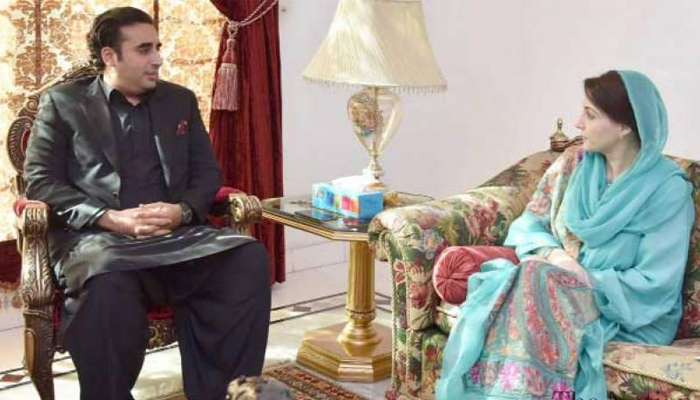
اعلامیہ کے مطابق گفتگو میں دونوں رہنماٶں نے پی ڈی ایم کے کامیاب جلسوں کے بعد بوکھلاہٹ کی شکار حکومت سمیت مجموعی سیاسی صورتحال پر تبادلہ خیال کیا گیا۔
پی ڈی ایم کے سرکردہ رہنماؤں نے سینیٹ کے آئندہ انتخابات کے متعلق حکمت عملی پر بھی تبادلہ خیال کیا۔
اس موقع پر دونوں نے اتفاق کیا کہ سینیٹ میں کسی کو ایسے غیر آٸینی ہتھکنڈے دہرانے نہیں دیں گے کہ وہ 2018 کے الیکشن بن جائیں۔
بلاول بھٹو زرداری نے مریم نواز کو شہید محترمہ بینظیر بھٹو کی برسی کے جلسے میں شرکت کی دعوت بھی دی
https://jang.com.pk/news/859240
Tuesday, December 15, 2020
Barr shielded Trump from Congress, Mueller and the law, but couldn't save him from voters
Barr's legacy of presidential supremacy
► Almost his first act in office was to defend Trump by wildly mischaracterizing Special Counsel Robert Mueller’s report. That report credibly collected evidence that the president had obstructed justice and laid out extensive evidence of connections between the Trump campaign and Russian actors. In defending the president against these claims. Barr sank into obfuscation and outright misdescription.
Not content with misstating the law, Barr also took operational control of defending the president’s political image. He personally directed law enforcement and military officials to clear Lafayette Square of protesters last summer so that Trump could walk across the part and have a Bible-holding photo op in front of St. John’s Church.
► Diverging from the long-standing practice of attorney general neutrality, Barr injected himself into the presidential election, warning that if Biden won, the United States would be “irrevocably committed to the socialist path.”
He interfered in the criminal investigation of Trump confidants Roger Stone and Michael Flynn to protect the interests of the president. In Stone’s case he sought to get Stone a lighter sentence. In Flynn’s he sought to dismiss criminal charges to which Flynn had already pled guilty. In both cases, career prosecutors at the Department of Justice resigned in protest at Barr’s political interference.
► He likewise politicized the criminal investigation process by continuing a seemingly-unending investigation into the Russian investigators — an inquiry he has now sought to entrench by the appointment of a special counsel in a manner that is clearly intended to limit the discretion of the incoming Biden-appointed attorney general.
DOJ in ruins:Trump and Barr wrecked the Justice Department. Here are 6 ways Joe Biden can fix it.
► He refused to recognize the lawful authority of Congress to conduct oversight of the executive branch. On Barr’s watch, Trump’s Department of Justice has fought every subpoena issued by Congress, sometimes on the fanciful ground that the president is absolutely immune from congressional review.
But most fundamentally, Barr served Trump by promoting the principle that the president is above the law. At every turn, Barr has advanced a view that the executive branch is not restrained by our constitutional system of checks and balances and that the president is not subject to criminal review of his actions. Here, perhaps, Barr most closely mirrors Cromwell, whose view of royal supremacy is an almost perfect analog for Barr’s view of presidential supremacy.
Barr is the Cromwell of the Trump era
In the end, Cromwell lost his head because he could got give Henry the one thing Henry wanted most desperately — a male heir. It simply proved impossible, and for the sin of failing to achieve the impossible, Cromwell was removed and executed.
Barr, likewise, has lost his job because of his failure to do the impossible. Confronted with the hard reality that there was no evidence of significant fraud in this election — indeed that it was, as Trump’s cybersecurity chief put it, “the most secure election in history” (for which apostasy he, too, got fired) — Barr simply could not conjure an alternate reality in which Donald Trump won reelection.
2020 election watershed:Barr finally met a Trump lie he couldn't swallow
And for that failure Barr, like Cromwell, met the fate of all failed loyalists, discarded on the ash heap of history where his memory will deservedly be that of a faithful subordinate to a failed leader. The best thing that can be said of him — quite literally the very best — is that he refused to join other Republican leaders as they followed Trump like lemmings off the cliff of electoral authoritarianism. His refusal to influence the election by announcing an investigation of Hunter Biden, combined with his refusal to call the election a fraud, show that even for the most devoted adherents there are lines they cannot or will not cross. But after all of Barr’s failures that have gone before, that is modest praise, indeed.
And so, William P. Barr’s legacy is this: He is the Thomas Cromwell of our age.
https://www.usatoday.com/story/opinion/2020/12/15/barr-blind-loyalty-not-enough-to-save-trump-from-voters-column/3904158001/
Pakistan Army is now an echo chamber — look at what it did to ex-ISI chief Asad Durrani

The ex-ISI chief was punished not for disclosing any secret, but for analysing the tantalising event of the 2011 American operation in Abbottabad to kill Osama bin Laden.
When Field Marshal Sir Claude John Eyre Auchinleck returned to India in 1943 as the commander-in-chief of the military, one of his goals was to ‘Indianise’ the force while ensuring high levels of professionalism. Though the demands of performing in the Second World War obfuscated his plans to move away from limiting recruitment to the ‘martial races’, he developed a culture of professionalism that made it imperative for the armed forces to analyse every operation, including failures, for future benefit.
Reading the recently published opinion article by the former head of the Inter-Services Intelligence (ISI), Lt. General (retd) Asad Durrani, it seems that Pakistan’s military has deviated from the culture of questioning its actions and carrying out analysis. General Headquarters of Pakistan Army in Rawalpindi is no longer interested in critical evaluation even if it is from one of its own. The current leadership has reached the new milestone of tightly locking itself up in an echo chamber and not tolerating dissent. A senior retired officer like Durrani fears for his life and has been constrained from traveling to meet family. This is in addition to him being hauled up in front of an inquisition regarding his books, especially Spy Chronicles, which he co-authored with the former chief of India’s Research and Analysis Wing (RAW), A.S. Dulat, and his pension being stopped for a while.
Durrani’s punishment
Durrani was punished not for disclosing any secret, but for analysing the tantalising event of the 2011 American operation in Abbottabad to kill al-Qaeda leader Osama bin Laden. The general retired in 1993, which means he wasn’t privy to any secret, but could still analyse based on his knowledge of his institution. Perhaps due to his pride in the military, he could not believe that the Pakistan Army could be caught with its pants down. And so, he claimed in an interview to Al Jazeera that the top generals negotiated the Osama bin Laden operation with the Americans. While the interview was ignored, Durrani repeating this claim in the book angered army chief General Qamar Javed Bajwa, who was totally sidetracked by his political ego. Durrani’s theory about the Abbottabad operation took attention away from what the army chief was trying to do – tell the world that former Prime Minister Nawaz Sharif had hurt national interests by disclosing to the newspaper Dawn that the world was concerned about Pakistan’s involvement with militant groups and extremism.
The jury on how much the army top brass knew about the American operation is still out. In his recently published book The Promised Land, former US President Barack Obama claims that it was a secret kept from Pakistan because some of its intelligence personnel were deeply connected with the Taliban and al-Qaeda. Former army chief General Ashfaq Kayani seems to have only demanded that Washington come clean about the operation after it was all done. None of this means that the generals at the helm of the Pakistan Army did or did not have more details. We will probably have to wait many more years when American records get declassified to get a clearer picture. Durrani, and many other officers like him, might eventually get disappointed as they realise that the military high command continued to sleep during the operation, as they did during the outbreak of the 1965 war with India.
Impact of the Durrani leak
However, Durrani’s article is important due to six factors. First, there is unrest in the larger military fraternity of Pakistan caused by actions of the new generation of generals. Second, there is an indication of a shift in the army’s culture. The institution has strayed away from its tradition of showing respect to the senior command, and even the retired ones. What started under General Pervez Musharraf in the form of criticising Lt. General Ali Quli Khan in his book has come full circle with a senior retired general being mercilessly hounded.
Third, the article says a lot about the military’s socialisation process. Power is maintained not just through distribution of perks and privileges, a system that Durrani criticises as being abused by the top brass, but also by revoking security clearance of officers that are seen as having stepped out of line. While Asad Durrani’s clearance was withdrawn for using his pen instead of the sword, Maj. General (retd) Mahmud Durrani lost his clearance that would enable him to attend functions where the chief would be present probably for his admission that Ajmal Kasab was a Pakistani citizen. There are many more stories waiting to be told about how men may retire from their respective services but can never return to civilian life.
Fourth, Durrani seems to have exposed the working of General Bajwa’s cabal, the influence of former generals, and the petty-mindedness behind the targeting of a senior retired officer. The former spy chief came out guns blazing about corruption of the military leadership, especially the story of General Beg extracting money from a Karachi banker, Younis Habib, to finance an ISI operation against Benazir Bhutto’s government. I remember my own interview with General Beg for my first book on Pakistan’s arms procurement decision-making at his think tank in Rawalpindi, in which he confessed that this was not the first time that the ISI had got money from private entrepreneurs. Intriguingly, Beg also managed to extract resources from the Germans, who continue to be a significant European source for financing both kosher and dubious think tank activities in Pakistan. The picture that emerges then is of a military with issues at the top.
Fifth, such close-mindedness means that the top-brass lacks capacity to deviate from their traditional behaviour, and are not capable of any strategic policy review. This means they are more likely to get stuck geo-politically and politically in situations from which they will be unable to extricate themselves. Finally, the institution’s capacity to harm people, including its own officers, has multiplied.
The building of an echo-chamber
Durrani published his thoughts in an Indian news blog probably because because he didn’t think it would be printed in Pakistan. He timed it well to further expose the shallowness of the existing top brass that is confronted with mounting political opposition to its hybrid rule formula. His article is a rap on Bajwa’s knuckles, and could become painful if it gets circulated widely in military circles. In his novel Honour Among Spies, Durrani shows the army chief exiting from the office, which is not a probability in real life except in case of a coup by another general. But additional pressures could be consequential for Lieutenant General Faiz Hameed’s future, whose desire to become the next army chief is no secret.
The Durrani leaks tell us about the growing weakness of an institution that has made it a habit not to expose itself to critical examination or alternative views. This particular problem dates back to the Musharraf years, when any discussion of the Kargil operation and shooting down of Pakistan Navy’s Breguet Atlantic maritime patrol aircraft at war colleges was totally forbidden. At that time, any discussion that took place was by the larger security community and in the country’s media. However, over the years, this became a bad habit with the military shifting from not listening to alternative views to gagging voices and planting views that would echo its own. The 14-15 think tanks in Islamabad mostly say what is approved. This creates the problem of an echo chamber that only regurgitates what the military leadership wants to hear.
There is a larger problem at the back of this behaviour: the proclivity of military leadership to generally consider itself like Caesar’s wife — above questioning. It tends to enforce its sensitivity on society as a fact of life. From a command-and-control perspective, such sensitivity is tricky. From the Pakistan Army punishing its own general for reviewing his institution’s performance to the Indian Air Force chief complaining about something minor in a Netflix series, this kind of behaviour implies that military leadership is not open to the idea of evaluation, or even laughter. In the process, it’s a bid to create a special category for the military as an institution that cannot be examined.
Surely, modern militaries are technologically advanced and more complex, which makes control difficult. The myth-building about their service to the nation and how critical they are for ensuring security to the State then puts them at a pedestal where questioning becomes relatively difficult. This is not easy to ignore because it presents a long-term issue for civil-military relations. The sensitivity of the military is negotiated through the society with the legitimacy of politicians, depending upon the respect they show their armed forces.
Zulfiqar Ali Bhutto, the leader of the Pakistan People’s Party (PPP), was told not to allow any discussion of the 1971 debacle and the military’s performance. He ensured silence, but paid with his own life. The survival of politics makes it vital for societies and polities to engage with the armed forces and treat them as one of the institutions, rather than the only one.
https://theprint.in/opinion/pakistan-army-is-now-an-echo-chamber-look-at-what-it-did-to-ex-isi-chief-asad-durrani/566966/