Tuesday, October 6, 2020
#COVID19 : US military leaders quarantine after official tests positive
Pentagon spokesman Jonathan Hoffman told reporters there had been "no change to the operational readiness or mission capability of the US Armed Forces."
"Senior military leaders are able to remain fully mission capable and perform their duties from an alternative work location," he said.
The Pentagon is conducting contact tracing related to last week's meetings.
Cases rising at the White House
Meanwhile, since President Trump tested positive last week, a number of senior Republicans and others close to him have been confirmed as having the virus as well.
This includes First Lady Melania Trump, aide Hope Hicks, and a number of Republican senators. Several junior White House staff members have also tested positive.
Press Secretary Kayleigh McEnany was the latest person close to the president to test positive, announcing her diagnosis on Monday.
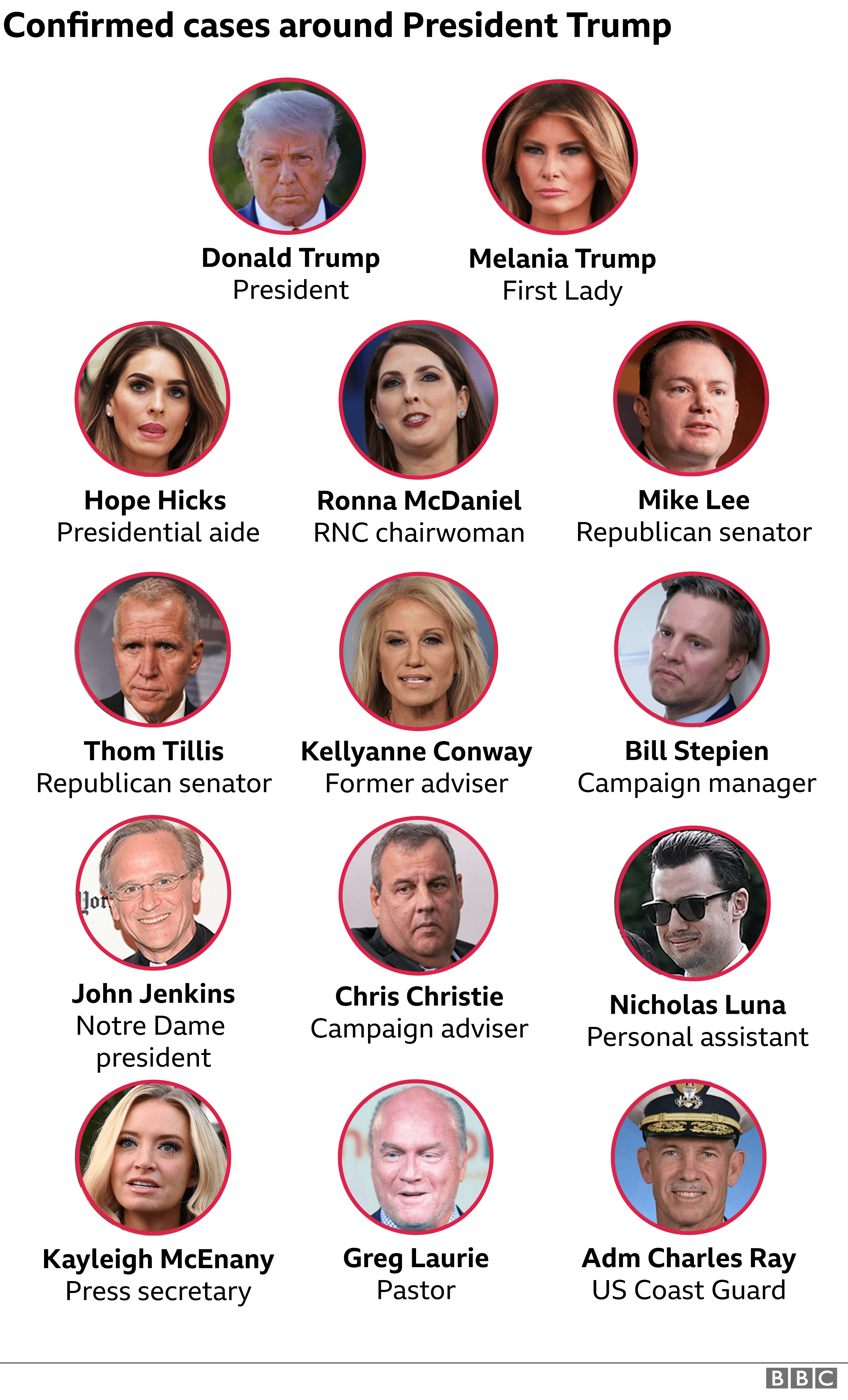

US media said two other aides to Ms McEnany had had positive results. The press secretary was seen speaking to journalists without wearing a mask on Sunday but said no members of the press had been listed as close contacts by the White House medical unit.
Many of the people in Mr Trump's inner circle who have tested positive attended a gathering at the White House Rose Garden on 26 September that is being scrutinised as a possible "super-spreader event".
The latest coronavirus case to emerge from that event, at which the president unveiled his nominee for the US Supreme Court, is a Christian minister from California.
Pastor Greg Laurie, who is said to have mild symptoms, was also with US Vice-President Mike Pence earlier in that day at a prayer march in central Washington DC.
Plexiglass will be used to separate Vice-President Mike Pence and Democratic challenger Kamala Harris and limit the risk of Covid transmission when they go head-to-head in a debate in Salt Lake city, Utah, on Wednesday. Both candidates have recently tested negative.
President Trump, meanwhile, returned to the White House yesterday after being hospitalised with the virus.
While at Walter Reed Medical Center, he was treated with dexamethasone - a steroid medication usually given to severe and critical Covid patients - and supplemental oxygen.
https://www.bbc.com/news/world-us-canada-54441986
Covid-19 recoveries cross 300,000 mark in Pakistan

https://www.pakistantoday.com.pk/2020/10/06/covid-19-recoveries-cross-300000-mark-in-pakistan/#comment-1241246997748759026
#Pakistan’s Drug Habit Is Endangering the Region

By Habiba Ashna Marhoon
In the past, Pakistan’s clandestine services have used profits from drug trafficking to fund proxy groups in South Asia.
The Golden Crescent of South Asia – a region comprising Afghanistan, Iran and Pakistan – is a principal site for the production and distribution of opium and heroin. Over the past few decades, war, terrorism and a shifting political landscape have facilitated an active heroin trade throughout the region.
There are three well-defined heroin trafficking routes that originate in the Golden Crescent region. The Balkan route operates through Iran and Turkey and traffics the bulk of Afghan heroin to Europe. The northern route supplies heroin to the Russian Federation and Central Asia. Due to increased law enforcement along these two routes, alternate routes have emerged, collectively called the southern route, which traffics heroin to Iran and Pakistan, and from these countries, via sea and air, to other parts of the world.
Pakistan’s geographic location next to Afghanistan, the world’s largest producer of opium, places the country in a veritable front-row position in terms of drug trafficking. Its establishment has left no stone unturned in exploiting this geographic location to its own advantage. The money generated from the drug trade has been used to fund proxy terror groups. The role of narcotics in funding terror activities by Pakistan was revealed by Lashkar-e-Taiba (LeT) terrorist David Coleman Headley, one of the main accused in the 26/11 Mumbai attacks. During his interrogation in 2010, he revealed the role played by Pakistan’s spy agency, the Inter-Services Intelligence (ISI), in linking drug lords and terrorists and facilitating the transportation of weapons, along with drugs, to India.
While poppy cultivation has largely been eliminated in Pakistan, the crop is still grown in large parts of southern provinces of Afghanistan like Kandahar and Helmand, where the Taliban has a strong influence. Analysts say opium poppies and heroin are among the main sources of income for the Taliban, which controls 80 percent of the drug production area in Afghanistan. The problem for them is how to transport these drugs to other countries. Here, Pakistan acts as a facilitator. The drug consignments, in connivance with Pakistan’s authorities, are smuggled through the Pakistan-Afghanistan border. From there, these consignments head for Pakistan’s air and seaports and, hence, to further destinations in China, Southeast Asia, Africa and Europe.
As United Nations World Drug Report 2012 reported, “Pakistan provides a vital transit route for smuggling of drugs worth $30 billion from neighboring Afghanistan.” Though not a major reason, Pakistan backs restoration of Taliban rule in Afghanistan because if the group returns to power, all these drug cartels could be resuscitated and its major benefactor Pakistan will have even more funds with which to sponsor its proxy terror groups.
Pakistan’s role in drug proliferation is validated by a number of arrests of its nationals in other countries on charges of drug trafficking. Shahbaz Khan, a Pakistani national, was the leader of a drug trafficking organization (the “DTO”) based in Afghanistan and Pakistan, which produced and distributed massive quantities of narcotics around the world. He was arrested by Liberian authorities in December 2016 and later deported to the United States, where in 2019 he was sentenced to 15 years for conspiring and attempting to import heroin into the U.S. In May 2017, officials for the U.K.’s Border Force impounded a Pakistan International Airlines (PIA) flight from Islamabad at London’s Heathrow airport. Later, the National Crime Agency said that a quantity of heroin had been found hidden in different panels of the plane. In March 2018, two members of the cabin crew of a PIA flight, traveling on an Islamabad-Paris flight (PK-749), were caught smuggling narcotics on board the flight.
Of late, speculations abound that PIA has come under the scanner of Qatar authorities who have recently discovered narcotics smuggling modules by Pakistani nationals who arrive in Doha, taking advantage of the country’s Visa on Arrival (VoA) facility. Some suggest that Qatari officials have photographic and video evidence of arrested drug smugglers from Pakistan. If these speculations turn out to be true, then it is quite possible Qatar could suspend the VoA facility for Pakistan’s nationals if it does not take action to prevent the smuggling of narcotics into Qatar.
The issue of narcotics smuggling has the potential to derail Pakistan’s bilateral relations and besmirch its international reputation. Indeed, the question arises as to why Pakistan would jeopardize its relations with other countries in order to benefit from narcotics. The answer is that the money derived from drug smuggling serves Pakistan’s larger agenda of sponsoring proxy terror groups. With the plenary session of the intergovernmental Financial Action Task Force (FATF) scheduled for later this month, Pakistan’s role in funding terror organizations through drugs/narcotics smuggling is sure to come up for discussion, as the FATF determines the country’s listing. If Pakistan does not want to be blacklisted, it must take action to stop drug proliferation. Blacklisting by FATF could spell ruin for Pakistan’s already dwindling economy.
#Pakistan - Sindh islands illegally annexed by Imran Khan govt: #PPP chairman Bilawal Bhutto
President Dr Arif Alivi on September 1 promulgated the ordinance for establishing Pakistan Islands Development Authority (PIDA) for "development and management of islands in internal and territorial waters of Pakistan".A presidential ordinance by the Imran Khan government to take control of two islands in Sindh province has been slammed by the Opposition parties in Pakistan, with PPP chairman Bilawal Bhutto calling it an “illegal annexation”. President Dr Arif Alivi on September 1 promulgated the ordinance for establishing Pakistan Islands Development Authority (PIDA) for “development and management of islands in internal and territorial waters of Pakistan”. Its ultimate objective was stated to be development of cities on the islands of Bundal and Buddo along the Karachi coast. While the Pakistan Tehreek-i-Insaf government managed to keep it out of limelight, Bhutto on Monday posted the development on Twitter, vowing that his party would oppose the federal government’s move in the National Assembly, Senate and the provincial assembly.

“The Pakistan People’s Party (PPP) will oppose the illegal annexation of Sindh’s Islands through Presidential ordinance by the PTI government,” he said in a tweet on Monday. “The PPP rejects this unconstitutional ordinance establishing island development authority. This is no less than a land grab and occupation of islands that belong to the people of #Sindh under article 172/2 of the Constitution,” said PPP central information secretary Dr Nafisa Shah on Twitter. Former chairman of Senate and PPP leader Raza Rabbani termed the ordinance a crude attempt to bring under control of the federal government the coastal areas of the provinces of Sindh and Balochistan,” the Dawn newspaper reported. Under the ordinance, PIDA would be exempted from paying income tax for one full decade. It is also empowered to retain, lease, sell, exchange, rent of otherwise dispose of any land vested in it, the report said.Sindh based political parties, civil society organisations as well as the PPP led Sindh government on Saturday expressed their dismay and anger over a presidential ordinance. Several nationalist parties, writers, intellectuals and poets also announced to launch a massive movement against the decision by organising rallies and demonstrations in various cities and towns if the decision was not taken back, The Express Tribune reported. Human rights activist I A Rehman said these islands were property of the people. “You cannot take them without their consultation. Any takeover of the islands will be against the country,” Rehman said. “Due to this recent decision, 800,000 fishermen who live there for centuries would be displaced. The federal government’s decision is not only against the Constitution of Pakistan but it is also against international conventions and agreements, which provide social, economic and cultural sovereignty to the indigenous people,” said Pakistan Fisher-folk Forum (PFF) Chairman Mohammad Ali Shah. Noting that this was not the first time the islands (over 12,000 acres of land) were being snatched, Shah said such an attempt was also made in 2007 when a memorandum of understanding (MoU) was signed to hand over two islands to Dubai based investors. Former PPP chairperson Benazir Bhutto had announced a movement against the decision to take over the islands during General Pervez Musharraf’s regime in 2007. After protests by the PPP, the national parties and the civil society organisations, the government had to take back the decision. https://indianexpress.com/article/pakistan/sindh-islands-illegally-annexed-by-imran-khan-govt-ppp-chairman-bilawal-6705690/
Monday, October 5, 2020
#TrumpCovid19 - GOP Sen. John Cornyn Criticizes Trump On COVID-19: ‘A Lesson To All Of Us’
In some of his harshest criticism of the president to date, Sen. John Cornyn (R-Texas) on Monday said Donald Trump’s inconsistent rhetoric on the COVID-19 pandemic has stoked confusion, as the coronavirus continues its spread among high-ranking White House and GOP officials.
“I think he let his guard down,” the Republican senator told the Houston Chronicle when asked about Trump’s repeated flouting of various public health guidelines. “And I think in his desire to try to demonstrate that we are somehow coming out of this and that the danger is not still with us — I think he got out over his skis and frankly, I think it’s a lesson to all of us that we need to exercise self-discipline.”
Cornyn, the former second-ranking Senate Republican, has himself shared misinformation about COVID-19, and defended and espoused Trump’s use of racist misnomers to blame the virus on China.
On Monday, he defended Trump’s policy responses such as shutting off travel from China, which he said “demonstrated the seriousness of the virus,” but went after Trump’s messaging.
“He tries to balance that with saying, ‘Well, you know, we got this.’ And clearly we don’t have this,” Cornyn said, according to the Chronicle. “I think the biggest mistake people make in public life is not telling the truth, particularly in something with as much public interest as here because you know the real story is going to come out.”
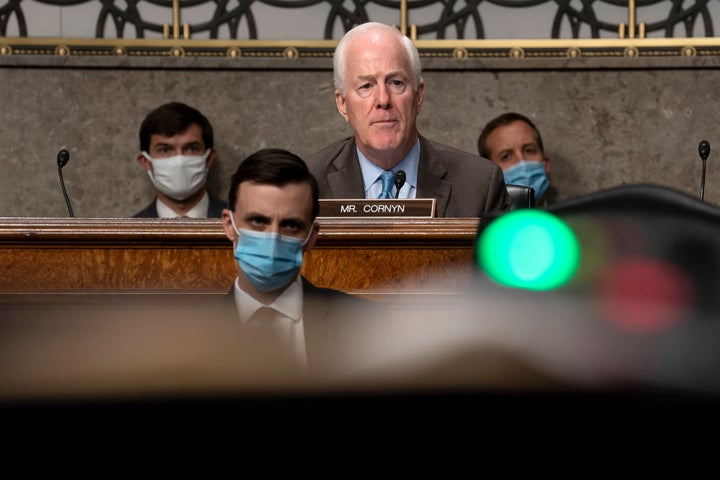
His comments came as the coronavirus tears through the West Wing and Capitol, where a mounting number of top Republicans, including Trump, his press secretary Kayleigh McEnany, his campaign manager Bill Stepien and Sens. Mike Lee (R-Utah.) and Thom Tillis (R-N.C.) ― both members of the Senate Judiciary Committee ― have tested positive.
Cornyn, who also sits on that committee, may have been exposed to the virus when he attended hearings last week.
Many of the positive cases involve those who attended a Sept. 26 Rose Garden ceremony for Judge Amy Coney Barrett, Trump’s Supreme Court pick to replace the late Justice Ruth Bader Ginsburg. Maskless people did not socially distance at the event.
Trump has persistently ignored mask-wearing, social distancing and other public health guidelines throughout the pandemic, which has now killed more than 200,000 people in America. He’s mocked others for wearing masks; held packed campaign rallies for hundreds, sometimes thousands, of supporters; pushed to reopen schools and businesses even when his own metrics for safely doing so had not been met; and acted as though the disease would just miraculously disappear of its own accord, even after admitting on tape in March that it’s much more deadly than he was letting on.
https://www.huffpost.com/entry/john-cornyn-trump-coronavirus_n_5f7b93bac5b6e5aba0ce8dd3
Pakistani women have led democracy protests. Can Maryam Nawaz do it now?

Imran Khan, another divisive world leader, is more interested in incarcerating political opponents than delivering for the people.
From India to Brazil, and the United States to Europe, a drift to authoritarianism is derailing democracy. Divisive polarising figures occupy high offices, challenging the very edifice on which democracies thrive. Respecting political opponents, fair play and transparency are hallmarks of democratic tradition. But these values are increasingly disappearing.
The manhandling of Rahul Gandhi by Indian police on the orders of the UP chief minister as he attempted to reach out to a Dalit rape victim’s family has been viewed globally as an attack on India’s democracy. So has Donald Trump’s attempt to pack the US supreme court with right-wing justices not representative of changing American demographics, or his attempts at discrediting mail-in ballots, endeavouring to call into question the credibility of the November presidential election. Less talked about internationally, but equally worrying, are the efforts of the Tories in the UK to appoint an ex-tabloid editor known for his partisan views as head of the BBC.
All of this is shocking for many in established democracies but it is an unfortunate sign of our times. So many who previously thought that the US, for instance, a strong democracy with checks and balances and a clear separation of powers, could survive a Trump presidency without any damage to American democratic ideals have changed their minds. More and more Americans have begun to realise that the politics of resistance is the need of the hour.
In Pakistan, we have not historically had the robust democratic structure that countries like the US, UK and even India had, but we have had our share of democratic movements, at various junctures, to push back against dictators and undemocratic forces. Curiously, the burden to lead these movements has often fallen on female shoulders. From Fatima Jinnah fighting against Ayub Khan’s dictatorial regime, to Benazir Bhutto standing firm against Ziaul Haq, it has been Pakistani women who have been the biggest symbols of resistance to authoritarianism. Is Maryam Nawaz up to the task? We know that Maryam often disagreed with the uncles in her party and was characterised by the establishment as a hardliner pursuing ‘the politics of confrontation’. What this really means is that she was far less willing to meet kingmakers through back-door channels, and preferred a more above-board politics. With the arrest of leader of the opposition Shahbaz Sharif, previously considered conciliator-in-chief, Maryam’s stance has been vindicated. The question now arises — will she speak out only when the Sharif family is politically victimised or will she also raise her voice for more marginalised activists and politicians, the likes of the PTM, for instance? There was a time when the Sharif brothers were simply corrupt. Now, like PTM leaders, Nawaz Sharif has also moved into the traitor category. Will Maryam be able to reach out beyond the Punjabi heartland to make alliances in the peripheral regions of ex-Fata and Balochistan? In the US, it took the Democratic Party far too long to embrace the Black Lives Matter movement, and include within its fold the marginalised segments of society. Four years ago, like the PTM in Pakistan, BLM was considered a radical movement from which Democrats cautiously kept their distance, but this election cycle the movement has been mainstreamed to the point of not only influencing American but also European politics. Towards the end of Musharraf’s reign, when he failed to end corruption or dynastic politics in Pakistan, as he had promised on taking over, a minister in his cabinet confessed to me that, “When the establishment propped up Nawaz Sharif, it unwittingly provided a political voice to the Punjabi trading classes, and that base isn’t so easy to dismantle now.” Maryam’s support in Punjab, therefore, isn’t in question. If she wants to emerge as a leader on the national stage, however, she will need to make unconventional alliances and speak out for those in the peripheries, who have borne the brunt of the establishment’s high-handedness for a lot longer than she and her family have. It is quite clear that Imran Khan, another polarising and divisive world leader, is more interested in incarcerating political opponents than delivering for the people. But it was heartening to see that Maryam did not only call him out but also questioned the role of other key players in the hybrid regime. The most honest and relevant statement in her recent press conference was her acknowledgement that it isn’t easy to resist undemocratic forces. She spoke about journalists, judges, politicians — all being put under pressure to compromise on principled positions. It is a cost that is difficult to bear and should not be asked of any citizen, particularly not in a state that claims to follow Madina ki riyasat. Resistance is a tall order, but resist we must.Pakistan PM Imran Khan heads into his biggest challenge. Military is also target
Ahmadi professor shot dead in Peshawar
62-year-old Gulzar Ahmad was attacked at his store located in the Qissa Khawani market of Peshawar. He managed to escape with four bullet wounds to his leg and one to his hand. Ahmad was rushed to a local hospital for treatment, Police said.
Sunday’s attack is the third attack on Ahmadis in Peshawar in less than three months. On July 29th an American-Ahmadi Tahir Naseem was shot dead in a courtroom. Soon after on August 12, another Ahmadi Mairaj Ahmad was shot dead outside his pharmacy.
https://www.rabwah.net/ahmadi-man-wounded-peshawar-shooting/
Bilawal opposes ‘illegal annexation’ of Sindh’s Islands


Sunday, October 4, 2020
Opinion: The American People Need the Truth

The American people deserve better than to be misled about the health of the president.
Several days into President Trump’s battle with Covid-19, even basic facts about his illness — when he was diagnosed, how high his fever climbed, what triggered his hospitalization — remain hard to come by. The White House is being evasive and secretive. That’s nothing new, nor is it unreasonable to withhold some sensitive information from the public. But too often in the past few days, the administration has appeared to be actively misleading the American people. Administration insiders are expressing frustration that no one even among Mr. Trump’s own staff seems to know what is going on. Among the broader public, anxious speculation and wild conspiracy theories are multiplying. The unnerving impression is of a White House in chaos. We wish the president — and everyone stricken with this horrible disease — a full and speedy recovery. Critical to the protection of the nation’s health, however, is an honest accounting of what’s going on. Despite reassurances from the White House on Friday afternoon that Mr. Trump was experiencing only “mild symptoms,” he was transported to Walter Reed National Military Medical Center early that evening. The visit was pitched as a precautionary measure, but this requires an incredibly loose definition of “precautionary.” The president, as later came to light, had a high fever on Friday and his blood oxygen levels dropped to the point that he was given supplemental oxygen. To get the situation under control, his medical team is hitting him with, among other measures, steroids and an experimental antibody treatment.On Saturday, Mr. Trump’s doctors assembled outside of Walter Reed for a news briefing, overseen by the White House physician, Dr. Sean Conley. Far from providing clarity, the spectacle was surreal. Dr. Conley delivered a sunny assessment that made it sound as though the president had popped out for a weekend spa getaway. He dodged questions about testing, Mr. Trump’s symptoms and whether the president had ever received supplemental oxygen.The briefing also created confusion about the progression of Mr. Trump’s illness. Dr. Conley suggested that the president’s disease had been diagnosed on Wednesday — a day earlier than originally thought, and before Mr. Trump attended a Thursday fund-raiser. Dr. Conley later issued a “timeline clarification,” saying he had misspoken. Immediately after the briefing, Mark Meadows, the White House chief of staff, painted a far grimmer picture: “The president’s vitals over the last 24 hours were very concerning and the next 48 hours will be critical in terms of his care,” Mr. Meadows said. “We’re still not on a clear path to a full recovery.” Mr. Trump was furious with the negative comments, according to media reports. He issued upbeat comments through Rudy Giuliani, his friend and lawyer. A couple of perky tweets popped up on his Twitter feed. Early Saturday evening, a video of Mr. Trump was posted on Twitter. Wearing a dress shirt and suit jacket, he sat at a table and delivered a four-minute message of reassurance. “I think I’ll be back soon,” he predicted, offering thanks for all the good wishes he had received, praising his medical care and even doing a little low-key campaigning. At Sunday’s briefing, Dr. Conley provided a bit more detail but continued his evasive maneuvers. He danced around numerous inquiries about precisely how low the president’s blood-oxygen levels had dipped on Friday and then again on Saturday, and he claimed not to know whether a second round of supplemental oxygen had been administered since Friday. Dr. Conley said that the president’s oxygenation issues had prompted doctors to start him on a course of dexamethasone, a corticosteroid aimed at reducing inflammation. But he dodged questions about what scans of the president’s lungs showed, saying only that there were “expected findings.” It is unclear what Dr. Conley meant. Dr. Conley did address a question about why he had been untruthful about the president’s condition on Saturday. “I was trying to reflect the upbeat attitude that the team, the president, his course of illness has had,” he said. “I didn’t want to give any information that might steer the course of illness in another direction, and in doing so, you know, it came off that we were trying to hide something, which wasn’t necessarily true.” There is a long history of misleading the public about a president’s health. Grover Cleveland’s White House lied about his cancer. Woodrow Wilson’s lied about his stroke. Franklin D. Roosevelt’s team covered up his deteriorating medical condition, and John F. Kennedy hid his chronic health problems for his entire presidency. Today, information is hard to contain, and misinformation is too easily spread. Yet at the root of all of the things we must to do fight coronavirus is honesty. Honesty about where those who test positive have been and who they’ve seen is the only way that contact tracing works. Honesty about the science — what works in fighting the disease and what doesn’t — is how we best treat it in the human body. Honesty about how we can try to protect ourselves and our communities is a key to stopping the spread. Efforts by the administration to manipulate the public fuel distrust and frustration. Moreover, Mr. Trump is not suffering from an infirmity particular to him. He has contracted a virus that has already killed more than 209,000 Americans. His refusal from the start to be straight with the public about the severity of this disease has made it harder for the country to get the pandemic under control, and an untold number of lives have been lost as a result. However sick the president may be, the truth cannot be more harmful than the thick fog of confusion the White House has created. The American people are entitled to the truth.Imran Khan is proving that Pakistan’s state policy is to lie and Balochistan doesn’t exist

PM Imran Khan is concerned about Kashmir and Palestine but can't see atrocities against Baloch and Pashtuns in Pakistan.
It almost felt like Pakistan Prime Minister Imran Khan was stating the national policy of his country when he said at the start of his United Nations General Assembly speech that “non-use of or threat of unilateral force, self-determination of peoples, the sovereign equality and territorial integrity of States, non-interference in their internal affairs, internal affairs, international cooperations — all these ideas are being systematically eroded”.
Ironically, he was complaining about “the foundations of ‘world order’” being changed. It must be the state policy of Pakistan to lie.
Imran Khan continued his speech and, as expected, talked about the ‘injustices against Muslims and Islamophobia around the world’. However, he shamelessly ignored inhuman treatment of religious and ethnic minorities in his own country.
He showed ‘grave concern’ for Kashmir and Palestine while staying silent on the atrocities against Baloch and Pashtuns in Pakistan. He raged against India for the “killings of muslims with impunity” without providing a shred of evidence, even as he pushed under the carpet the systematic genocide of Baloch people by his own army, which he had publicly spoken about and ‘exposed’ before becoming the prime minister with the blessing of the mighty Pakistan Army.
Imran Khan admitted on many occasions that the Pakistan Army was bombing villages populated with women and children in Balochistan as it did in Bangladesh. This makes one think whether lying through the teeth is the state policy of Pakistan, which has led to the public believing in those lies and living in a world far away from reality.
This is the reason that you can find Pakistanis giving expert opinion on Kashmir, Palestine and Afghanistan while remaining completely oblivious about the happenings in their country and especially about crimes of their own army.
What do average Pakistanis know?
A question to an average Pakistani reader: What comes to your mind when you read or hear the word “Balochistan”? The exotic landscape? The riches and minerals? Gwadar, the ‘future dubai’ and China-Pakistan Economic Corridor (CPEC)?
Do you think there are ‘estranged Balochies’ and ‘tribal sardars’ who do not allow development in their areas because they fear that ‘an educated and developed people will reject the medieval tribal system’? Or do you think more about the poverty-stricken people? The tales of missing persons and their crying families on the roads, in front of press clubs and at the doorsteps of government offices?
Your answer really depends on where you come from in Pakistan and your interest in the geopolitics of this region. For example, if you come from Lahore or some other metropolitan city of Punjab, chances are that you have either never heard about the Baloch missing persons and the agonies of their families or you ‘know’ that the missing persons are actually people who went into foreign countries and the recovery of their dead bodies is a result of intra-tribal conflicts in Balochistan.
BBC News conducted a survey in Punjab in 2014 where it asked random people on the streets if they knew Balochistan and if they could tell the names of any cities there. Most of the people had no clue about the geography, culture, language and people of Balochistan. Some of the top media persons and politicians too did not know the basic difference between Balochi (the language) and Baloch (the people).
A systemic operation
Who is to be blamed for this unawareness among the people from the largest province of Pakistan about Balochistan that covers almost half of Pakistan? Is it the lack of interest of people? But how can people be uninterested about a region that covers 50 per cent of their country and, more importantly, supplies natural gas to their kitchens, while the Baloch have to rely on firewoods?
One can easily put the blame on the media and news agencies for not giving coverage to the human tragedy that is taking place in Balochistan, and it will be true to some extent. Few journalists who do talk about Balochistan and its suffering are silenced through use of force. Attack on Hamid Mir and the brutal killing of Sabeen Mahmud are just a few examples.
The real reason behind the ignorance of the average Pakistani is the policies of state institutions that have been ruling the country since its inception, sometimes blatantly occupying the driving wheel and other times taking the back seat while still calling the shots. This does not automatically exempt the media and the politicians from the moral and legal duty of standing for truth but simply exposes the real culprits behind the curtain.
When it comes to Balochistan, this policy of keeping the Pakistanis, and to some extent the international community, in complete darkness and misleading them with disinformation is as old as the country itself.
This policy has been furthered after the assassination of Baloch leader Nawab Akbar Bugti in a military operation in 2006, in order to cover the real motive behind his killing and the brutalities against the Baloch populace that followed it.
Military operations in civilian areas get reported as ‘action against a handful of RAW agents’. For the Pakistani media, and by extension the average populace of the country, cases of enforced disappearances in Balochistan are just ‘people moving to foreign countries’ and the recovery of their mutilated dead bodies become the result of ‘intra-tribal fights within Baloch people’.
The betrayal of political class
The Pakistani politicians are equally responsible for furthering these propaganda statements for their temporary political power. They play at the hands of the security establishment while in power, and reveal bits and pieces of truth when they become useless to the same establishment.
One example is the Chaudhary brothers, who were part of the Pervez Musharraf dictatorship when Nawab Akbar Bugti was killed. It was later revealed that Bugti’s demands were justified and that killing him was wrong.
Same is the case with the Pakistan People’s Party (PPP) government, which left no stone unturned to malign the political Baloch leadership and to paint the indigenous Baloch movement as ‘India-funded miscreants’. The PPP ministers who blamed the abduction of UN official John Solecki in 2009 on Nawab Brahumdagh Bugti, the successor of Nawab Akbar Bugti, later confessed in private gatherings that they did so on the behest of the security establishment that wanted to ‘get rid of Brahumdagh Bugti just like his grandfather’.
Nawaz Sharif is no different. Every time he is thrown out of the government, he “speaks up” for Balochistan and Musharraf to be brought to justice but forgets even the name of Balochistan when in power.
Social media and calls for justice
Things have started to change with the rise of social media. Now, more and more people are getting informed about the injustices being meted out to the people of Balochistan and human rights crises that are taking place there.
The plight of missing persons and their families in Balochistan is reaching a wider audience through social media and voices in their support are getting louder and louder. More importantly, social media has given a platform to the oppressed Baloch, Pashtuns, Sindhis and religious minorities — all those who have been suffering at the hands of the Pakistani security establishment — to be united and rise against the injustices.
The Inter-Services Public Relations (ISPR) of Pakistan Army has also launched its counter narrative campaigns against the voices of the oppressed people, which they shamelessly call ‘fifth generation warfare’. But these voices can no longer be silenced now.
It becomes the moral duty of every individual, whether a Pakistani or a member of wider international community, to not only become aware of the sufferings of Baloch and other people in Pakistan. They must stand on the right side of history by supporting their movement for justice and rights.
Baloch Rights Activists Protest Atrocities By Pakistan, Remember Disappearance Of Activist Shabir
Baloch rights activists protested against Pakistani atrocities in Balochistan. October 4 commemorates the fourth year of the disappearance of Baloch student leader, Shabbir Baloch who was arrested and disappeared on Oct 4, 2016, from Awaran, Balochistan.
Speakers; Karima Baloch, Lateef Johar, Zaffar Baloch, Tarek Fatah, and Hajan Kalhoro condemned human rights violations in Balochistan, Sindh and Khyber Pakhtunkhwa. They demanded the immediate release of Shabbir Baloch and all disappeared persons.
World Sindhi Congress and Pashtun Tahafuz Movement actively participated in the protest gathering in the Canadian city.
“#ReleaseShabirBaloch Toronto protest rally demanded an end to atrocities, political abductions & extrajudicial killings in #Balochistan #Sindh #Pakhtunistan #StopBalochGenocide . End Pakistani military occupation of Balochistan, Sindh and Pakhtunistan. #FreeBalochistan,” Zaffar Baloch, a Baloch activist, wrote on Twitter.
The activist further shared a video on Twitter with the message, “We have gathered here today to remember who Shabbir Baloch is and why he was taken away by the Pakistani army during an operation in 2016 in Balochistan. Shabbir Ahmed is a student of Balochistan University and the secretary of BSO Azad.”
His video message further added that the reason why the Pakistani authorities “had a problem” with the student leader was because “of his agitation, his demands” asking the rights of the Baloch people and Balochistan.
“The reason why the Pakistani authorities had a problem with Shabbir Baloch (was) because of his agitation, his demands that he was asking–from the authorities–for the rights of the Baloch people and the rights of Balochistan,” it added.
Shabir was allegedly abducted by the Pakistani Army on October 4, 2016, from Gowarkop and was attending a gathering the China Pakistan Economic Corridor (CPEC) when the army conducted a raid at the place where a gathering was being held. Apart from Shabir, 29 others were also picked up.
Balochistan is a resource-rich but least developed province of Pakistan where a movement for freedom is ongoing for the past several decades. Many Baloch believe that the region was independent before 1947 and was forcibly occupied by Pakistan.
Pakistan Army has launched several operations in Balochistan and has supported criminals, which locals call “death squads”.
A large number of political activists, intellectuals, women and children in Pakistan’s Balochistan province are victims of enforced disappearances by the security agencies.
Many of them are languishing in detention centres whereas mutilated bodies of some of these abducted Baloch are found in isolated places.
https://balochwarna.com/2020/10/04/canada-baloch-rights-activists-protest-atrocities-by-pakistan-remember-disappearance-of-activist-shabir/
Opposition's PDM: A storm on the horizon?

Pushed to the wall by the government, opposition parties, especially the Pakistan Muslim League-Nawaz (PML-N), have finally decided to up the ante in their tussle with the establishment.
Though the outcome of this political battle is yet to be decided, both sides have chosen their strategies.
Talking to The News on Sunday, top PML-N leaders outlined their future course of action. “Nawaz Sharif will not return to Pakistan until he is physically fit and feels safe returning,” they said.
Addressing a party meeting on September 30, Nawaz Sharif too had hinted at not returning to Pakistan any time soon: “I am not prepared to live under the tyranny of certain people. We have to rid our country of their oppression.”
Meanwhile, the government has written to the British authorities, seeking Nawaz Sharif’s extradition. However, the UK government has reportedly declined the request on the grounds that most of the cases against the former PM appear to be politically motivated.
“The second decision is to launch Maryam Nawaz as the party’s top leader. Nawaz Sharif did not even take Shehbaz into confidence about the content of his speech at the Multi-Party Conference. He has ruled against his younger brother’s idea of avoiding confrontation with the establishment,” a party insider said.
“The PML-N will launch a mass mobilisation campaign, alongside the Pakistan Democratic Movement (PDM) rallies. The first PML-N rally will be held at Gujranwala on October 16. The PDM will hold its first public rally in Quetta. If Maryam is arrested, Nawaz loyalists will continue their protest campaign,” said another PML-N stalwart.
The Pakistan Peoples Party (PPP) too expects that its principal leaders Asif Ali Zardari and Bilawal Bhutto might be arrested. “If this happens, we may bring Aseefa Bhutto to the field. She will be our trump card,” a PPP leader said.
On the other hand, the PTI has decided to launch a massive crackdown against the opposition parties. “The government has decided to handle the opposition parties with an iron hand. In this connection, Imran Khan has given a free hand to Punjab Chief Minister Usman Buzdar. The recent meeting between Buzdar and Punjab Assembly Speaker Chaudhry Parvez Elahi was meant to seek the latter’s support for the campaign,” a PTI source said.
Most of the top leaders of the PML-N, the PPP and Jamiat Ulama-i-Islam-Fazl (JUI-F) face accountability cases.
Following the September 20 MPC, there have been a lot of developments. Shehbaz Sharif has been arrested in a money laundering case and arrest warrants have been issued for his wife and daughter by the National Accountability Bureau (NAB). Asif Zardari and his sister Faryal Talpur have been indicted in corruption cases. The NAB also issued a notice to Maulana Fazlur Rehman. It was, however, withdrawn after he threatened to storm the NAB offices.
A highly informed source says that Prime Minister Imran Khan is in no mood to accommodate the opposition. “The powers that be had advised the PM to go slow, but he is not prepared to take that advice. He has also been advised recently to replace Buzdar who has been unable to deliver good governance. However, the PM has said he would not do so.” “The establishment is thinking differently and is not satisfied. They fear that it will become harder for them to support the government in the near future on account of its rigidity. The government’s failures on the administrative front are another factor behind their disappointment.”
On October 1, posters in support of the army chief and the intelligence chief appeared in Islamabad. Those have apparently been put up by a civilian. However, opposition parties claim that the government is behind this move.
As matters head towards a dramatic confrontation, the political calm of only a month ago appears unbelievable in hindsight. Then, Nawaz Sharif and his daughter Maryam Nawaz were silent and PPP’s Asif Zardari and Bilawal Bhutto spoke in a more measured tone. Maulana Fazlur Rehman seemed to be the only vocal critic of the government trying unsuccessfully to convince other opposition parties to make common cause with him against the government.
The Multi-Party Conference has proved a political game-changer. Speeches by former president Asif Ali Zardari, former PM Nawaz Sharif and Maulana Fazlur Rehman are being seen as a declaration of war against the government.
In his address Zardari said: “We don’t want to derail the system. We want restoration of democracy in the country.” Zardari, known for his political acumen, also predicted: “I might be the first one to go to jail after the conference. I will request Maulana Fazl to visit me; I will be waiting for him.” However, it was Nawaz Sharif who stole the show through his speech via video link. “I am not targeting Imran Khan but those who have installed him by rigging the elections. The practice of stealing people’s mandate must stop.”
Such statements, coupled with the strongly-worded joint declaration issued at the end of the conference, were seen as a direct challenge to the PTI and the establishment. The resulting Pakistan Democratic Movement (PDM) has the potential to rival the Movement for the Restoration of Democracy (MRD), launched during Gen Zia’s regime and the Alliance for the Restoration of Democracy (ARD) during Gen Musharraf’s era. It is ironic that a democratic movement has now been launched against an elected government. It is probably because opposition parties increasingly believe that the establishment is micromanaging the current government and it is time to demand a stop to the increasing interference in political affairs.
Soon after the APC, the army spokesman reiterated that military leaders were not interfering in politics. Several government ministers then joined the chorus of criticism of the opposition.
As matters head towards a dramatic confrontation, the political clam that prevailed only a month ago appears unbelievable in hindsight. Nawaz Sharif and Maryam Nawaz had been silent and Asif Zardari and Bilawal Bhutto spoke in a more measured tone. Maulana Fazlur Rehman was then the only one trying to convince other opposition parties to make common cause with him against the government.
In a bid to undermine the opposition’s anti-establishment narrative, Federal Minister Sheikh Rasheed Ahmed broke the news that only recently some PML-N leaders had held meetings with the establishment. He also stated that several ministers were in contact with the opposition over proposed legislation on the status of Gilgit-Baltistan.
The disclosure dented the narrative of the opposition parties and their credibility. Analysts and supporters of the opposition parties also sought justification for the secret meetings with military leaders. The government also reacted the same way and called the MPC a group of corrupt people trying to avoid the accountability process.
It appears that the opposition’s objective is to get rid of the PTI government before the Senate elections in March. The coming days can thus be tough for the government. Their biggest challenge is to hold the local government elections in the Punjab without losing face. Some PTI leaders have advised the government to delay the local elections, sensing that the PML-N will win a lot of seats. They believe that the government should instead focus on chipping away at the PML-N and PPP strength in the provincial assemblies.
Given the circumstances, the most important question is: will the opposition be able to maintain its unity and momentum?
Already, PML-N’s Khawaja Asif has expressed his apprehensions about the PPP and stated that he does not trust Zardari. Nawaz Sharif, however, has distanced himself from the statement. “It is Asif’s own point of view and has nothing to do with the party’s mindset. I respect Zardari and trust him.”
Talking to the TNS, Senator Pervaiz Rasheed, a PML-N stalwart, said: “The nation is watching how Imran Khan is using the NAB against his political opponents. He is violating all political ethics. Some of the courts are also acting his tool.”
To a question about the future of the PDM and opposition unity, he said: “All parties in the PDM strongly believe that there should be rule of law in accordance with the constitution, supremacy of the parliament and unadulterated democracy in the country. I don’t think that anybody will back out. If any party backs out, it will be answerable to the democratic people of Pakistan.”
To a question about the possibility of arrests of PML-N leaders and the future campaign, he said: “Even if all our leaders are arrested, PML-N workers will launch the movement.”
Pakistan Peoples Party’s Punjab chief Qamar Zaman Kaira said: “We appreciate Nawaz Sharif for his speech. What he is asking for now is a decades-old demand of the PPP. We have been demanding supremacy of the parliament as enshrined in the constitution. We demand that all [national] institutions work within the limits defined by the constitution.”
“The army chief’s statement that army will not interfere in politics is music to our ears. We wish his words come true, but it will only be possible if the constitution is strictly followed by all including the army and the judiciary,” said Kaira. “We don’t want any confrontation with a national institution. Our fight is for the supremacy of the parliament.”
About the future of the PDM, he said: “In 2006, the PPP and the PML-N signed the Charter of Democracy. Despite having several differences, the two parties implemented 90 percent of the clauses of the CoD. Now, these forces would ensure implementation of the joint declaration of the APC.” The PPP and the PML-N have both committed mistakes in the past but they have learned from them and made CoD a success, he added.
Nawaz Sharif’s seriousness about the movement can be judged from the recent activities of his party and his fiery address to the meeting of PML-N central executive committee and council on two consecutive days. The present political tussle between the opposition and the government is expected to peak in the coming two months.
https://www.thenews.com.pk/tns/detail/723448-a-storm-on-the-horizon