Thursday, September 24, 2020
Amid civilian-military conflict, does Pakistan need a new social contract?
By Shamil Shams
Pakistan's opposition says the army has too much political power. The army generals say politicians don't deliver on promises. Can Pakistan's politicians and generals sit together and resolve their differences?
Pakistan's opposition politicians are confronting the country's army generals head on, in a sign that civilian politicians are taking off their gloves to directly criticize the powerful military establishment.
On Sunday, major Pakistani political parties, excluding Premier Imran Khan's ruling Pakistan Tehreek-e-Insaf (PTI), held a conference in Islamabad and openly slammed the military for interfering in civilian matters.
Former Premier Nawaz Sharif, who is currently in London for medical treatment, chose not to hold Khan responsible for multiple crises wracking Pakistan. Instead he blamed those who "brought him to power" – a veiled reference to the military.
"Today, our struggle is against those who installed Imran Khan and who manipulated elections to bring an incapable man like him into power and thus, destroyed the country," Sharif said in his address to the opposition conference via a video link.
It was not the first time that Sharif and other opposition politicians accused the army of rigging the 2018 general election. It was also not the first time that politicians accused the generals of undermining civilian supremacy.
However, the tone of the conference was predominantly anti-military, with almost all opposition parties agreeing that the country's military has exceeded its constitutional role. In Sharif's word, the Pakistani military is now "above the state."
"It is saddening that the situation has escalated to a state above the state. This parallel government illness is the root-cause of our problems," Sharif said.
The increasing hostility between the army and the political class doesn't augur well for Pakistan. The economy right now is in shambles, and the human rights situation is dire. Climate change and coronavirus only add to these problems.
Trust between lawmakers and military generals could help the state function better. But it is an open question on how to get a new social agreement to work between Pakistan's military and civilian ruling classes.
Lack of trust
Pakistan's civil society wants a subservient role for the military, as is laid down in the country's 1973 constitution. Rights groups accuse the military agencies of unlawfully detaining activists, journalists and political workers, and censoring the media.
They want the civilian administration to be in charge of all government affairs – domestic matters, the economy and foreign policy.
"Both civil and political societies in Pakistan have a responsibility to safeguard the constitution, democracy, federalism and supremacy of parliament by resisting any actions that will be detrimental to the country's integrity and security," Harris Khalique, secretary-general of the Human Rights Commission of Pakistan (HRCP), told DW.
Constitutionally, the argument is valid, but the reality on ground is different.
Security issues have dominated Pakistan since it got independence from British rule in 1947. The civilian space shrank further after the start of the Afghan War in the 1980s. The US invasion of Afghanistan in 2001 gave the army an even bigger role in the country's affairs.
This geopolitical situation makes it difficult for Pakistan to function as a normal state. It is reality that the military is ubiquitous in Pakistan and won't relinquish its power anytime soon.
Ghulam Mustafa, a retired army general and defense analyst, is in favor of a dialogue between the military and the opposition parties but believes that Sharif is not ready for it.
"Nawaz Sharif works in an authoritarian way. He does not want to pay heed to the advice of national security institutions," Mustafa told DW.
"Similarly, the Pakistan Peoples Party [headed by former president Asif Ali Zardari and his son Bilawal Bhutto Zardari] needs to take security matters seriously. Only these steps could lead to reconciliation. The military is in favor of a friendly environment," the general added.
Qamar Cheema, an Islamabad-based political analyst, said it is Khan's job to bring the military and political class closer together.
"Khan is the leader of the House (parliament). He needs to create space for democratic groups, start a dialogue with the opposition. He does not even want to talk to them," Cheema told DW.
"Actually, the prime minister has given more space to unelected offices," Cheema said, referring to the military establishment. "It is not democratic behavior," he added.
Cheema believes that the army also wants to strengthen the democratic setup in the country, but it doesn't trust politicians.
"Sharif, for instance, tried to cut down the army's powers. That created mistrust," he said, adding that the military doesn't want the civilian leadership to take "hasty decisions" to normalize ties with India, something which Sharif attempted during his third stint as premier between 2013 and 2017.
Habib Akram, a Lahore-based analyst, said the army also enjoys public support; therefore it would be incorrect to say that the conflict is between the people and the military.
"The army controls the mainstream political narrative. Many Pakistanis support the army and consider politicians corrupt," Akram told DW.
A new system for Pakistan?
Genera Mustafa believes the political crisis could be resolved if the country opts for a new constitution.
"We need new constitutional arrangements. The parliamentary form of government is not suitable for Pakistan and we should rather have a presidential system," Mustafa said, adding that a council should be formed under new arrangements to debate all issues of national importance.
But the country's democratic forces say the demand for a new political system is undemocratic.
Imran Zafar Laghari, a PPP leader and former lawmaker, said there is no need for any constitutional role for the army.
"The 1973 constitution clearly defines the military's role, which is to defend the country. It must stay within its constitutional domain. It would be catastrophic for Pakistan if some forces try to meddle with the constitution," Laghari told DW.
With compromise looking impossible, a middle road could be a new social contract between all stakeholders of the ruling class.
"I don't think that Pakistan needs a new social contract. What the country needs is the supremacy of parliament as per the constitution," according to HRCP's Khalique.
"All stakeholders need to respect the existing social contract that citizens have with the state. If citizens or human rights defenders have some issues with the constitution, it is the prerogative and mandate of the lawmakers to amend the constitution as representatives of the people of Pakistan," Khalique said, adding that the constitution delineates the role of every institution.
Analyst Cheema prefers a novel way to deal with the situation. "The gulf between elected offices and non-elected institutions of the state is growing. Pakistan needs to start a national dialogue," he said.
"It is not just about the constitution. The military believes that politicians don't deliver when they come to power and that they don't devolve powers. The political class says that the military is not letting them work."
https://www.dw.com/en/amid-civilian-military-conflict-does-pakistan-need-a-new-social-contract/a-55029526
Is she 18? How Pakistan’s forced conversion of minors gets legal cover

If your kidnapper-husband says you are 18, or have had your first period, no more questions are asked in Pakistan about abduction-conversions of young girls.
Their names change, their dreadful stories remain the same. It can be Kavita, Maria, Simran or Huma, what bonds their doomed fates in Pakistan are their faiths. The forced conversion of minor girls from minority communities to Islam is a pandemic that won’t end on its own.
Prime Minister Imran Khan can say Pakistan will take strict against anyone targeting minorities, but this practice has continued for years with impunity.
Pakistani contractors preach the world on Islamophobia, while Pakistan persecutes its own Shias and Ahmadis. We are triggered over Muslim rights in Europe and India, while oppressing our own minorities with state patronage.
And now, there is another popular way to hide forced conversions to Islam — say the minor girl was 18 and show a fake certificate or say she has had her first period. She is an adult then, and no more questions are asked by the state.
‘Free-will affidavit’
Last month, a teenage Hindu girl, Simran Kumari from Ghotki in Sindh, was kidnapped and then miraculously resurfaced at the shrine of Bharchundi Sharif, infamous for converting thousands of Hindu girls to Islam. Kumari’s family members are now forbidden to see their daughter because they are ‘kafirs’ and she has been married off to her Muslim kidnapper.
In another case earlier this month, 14-year-old Parsha Kumari from Khairpur was abducted, forced to convert and married to Abdul Saboor. Like in most conversions cases, the family produced a school certificate to verify age, but a ‘free-will affidavit’ from the kidnapper-husband set the minor’s age at 18. Thus, showing that the girl is an adult and can make her own decisions.
The dilemma of each forced conversion is that no medical examinations are done to determine the age of the minor independently by the authorities.
And automatically, the system, which has been rigged by the religious and social VIPs, sides with the captors and not the aggrieved families in most cases. Questions arise on why only minor Hindu and Christian girls ‘fall in love to get converted’ for men thrice their age? Why don’t Sindhi Hindu boys fall in such love?
With court sanction
How does the system help even if a girl escapes? There’s not even the pretence of carrying out justice then.
Maria Shahbaz, a 14-year-old Christian teenager who recently escaped her abductors, provided testimony on how she was raped, forced to convert and then married to her kidnapper. She was videotaped while being raped and was threatened with release of her video if she didn’t obey orders. Maria was then pushed into the prostitution ring — from where she escaped. Even after braving the ordeal of repeating what happened to her, Maria and her family are being threatened, and justice remains a far cry.
The Lahore High Court had earlier ordered her to go back to her kidnapper after her family protested. And when her family contested that she wasn’t 18 and was forced, the court said: “The statement of Maria Shahbaz as well as her general appearance unambiguously show that she is a grown-up young lady who seems to have attained the age of puberty.”
Huma Younas, another Christian girl who was abducted and converted at 14, is now pregnant from rape by Abdul Jabbar. In her case, the Sindh High Court ruled that a girl can get married after her first menstrual cycle under the Sharia law. It did not matter if Huma was non-Muslim, or that her school and baptism certificate showed she was born in 2005, or that she was kidnapped and forcefully converted and married. Her forced marriage was given a legal cover despite the fact that in Sindh, the Child Marriage Restraint Act 2013 prohibits marriage under the age of 18. The federal government of Pakistan Tehreek-e-Insaf (PTI) had vehemently opposed the bill to set the marriageable age of girls at 18 saying it was un-Islamic.
A lesser god
In the absence of any law against forced conversion in Pakistan, there is hardly any will from the provincial Pakistan Peoples Party (PPP) government or the federal Pakistan Tehreek-e-Insaf (PTI) government to effectively implement the child marriage laws in place. There is no dearth of cases but the seriousness of the government is visible because it is still deciding on the “definition of forced conversion” with the help of the clergy. Wonder how many more minors have to be kidnapped and converted for lawmakers to define what a forced conversion is, what is free will and what is statutory rape, how to independently verify age of minors, and how the law should see sexual relationships with anyone below 16.
The fear of kidnapping and conversion has had an impact even on affluent Sikh and Hindu families, who, over the years, have stopped their girls from getting an education after primary school. They say that it is the only way for them to protect vulnerable girls.
Conversions coupled with discriminatory laws and societal prejudices make life miserable for the non-Muslims who want to survive in the country. But when notorious men such as Mian Mithoo of Bharchundi dargah hobnob with powerful men, it is a clear message for Hindu parents — your daughters are children of a lesser god.
https://theprint.in/opinion/letter-from-pakistan/is-she-18-how-pakistan-forced-conversion-of-minors-gets-legal-cover/509646/
#Pakistan - Chairman #PPP Bilawal Bhutto Zardari condemns NAB’s notice sent to Maulana Fazal-ur-Rehman

Bilawal Bhutto Zardari said that Imran Ahmed Niazi regime can no longer suppress the people’s resistance no matter what it does or use NAB or any other tool to victimise the Opposition leaders.
PPP Chairman asked the PTI regime to stop using such tactics against JUI-F Maulana Fazalur Rehman and other Opposition leaders adding that reverse counting has started for the regime as people are fed up with its anti-people, anti-democracy and anti-economic policies.
Wednesday, September 23, 2020
Bilawal Bhutto Zardari warns against making issues of national security disputed and asks Imran Khan to step down for his abysmal failure

In the APC, he said, we had chalked out an action plan against this government with firm resolve to see that action plan implementation in letter and spirit. “There should be equal law for all in the country. We want democracy for all. There should be equal opportunities for all, be it elections, parliament, courts, Election Commission of Pakistan or freedom of media.”
PPP Chairman stated that ‘Pakistan Democratic Movement – or – PDM” would carry out movement against the incumbent selected government and its facilitators.
Talking about the devastation caused by torrential rains and heavy floods in nook and corner of the country, he said there was devastation everywhere due to these catastrophic rains and ensuing floods in his province. There are serious problems in Sindh province, in Swat, Khyber Pakhtunkhwa, Gilgit-Baltistan as there are countless flood victims who are in dire need of relief. Rains and floods have destroyed crops across Pakistan. In addition, the COVID-19 pandemic had already inflicted havoc while another locust attack completed the havoc as ready crops were smashed. “Crops of chilies, cotton and tomato vanished under the locust attack in Sindh and thus the farmers suffered immensely. It is the obligation of the Federal government to come for the relief of the affected farmers and rains and floods affected masses in Sindh and all over the country. As we gave Pakistan/Wattan cards to the victims in 2011 floods, the Federal government should now issue the same cards, too. We demand the government to support agriculture. The Federal government will have to come forward.”
PPP Chairman Bilawal Bhutto Zardari while speaking about the meeting of National Security said it pertained about country’s security and was held in-camera. “Such meetings should never let those irresponsible to be present there particularly those who have no stake in Kashmir or Gilgit-Baltistan. The meeting convened on the issue of national security and foreign affairs was discussed publicly irresponsibly. Whoever is the spokesperson should take these connotations; otherwise these sensitive issues of national security will become controversial. PM has always failed in any other national security issue. He does not attend such crucial meetings that are of pivotal importance. Everyone has to be united on national security issues,” he added.
He said, “PM has even this time did not attend the national security briefing. The meeting should not have taken place without him. But the absence of him is a complete failure on his part as the PM.”
He informed that in the 2018, the PPP had in its manifesto talked about reforms in Gilgit-Baltistan and the page 56 of the Manifesto is on Gilgit-Baltistan. We will fight the same manifesto and electoral reforms and we won’t change even a single word of that manifesto.
Bilawal Bhutto Zardari while continuing to speak on the point of GB said that he would also ask other parties to contest the elections on their own manifestos or to change their manifestos and participate in the Gilgit-Baltistan elections. Even in the National Security briefing, our position was that the PM should lead or resign. PPP spoke in favour of the people of GB in the meeting. It was also said in the meeting that the people there should make their own decision. Sadly, no representative of GB was present in the meeting, he added.
In fact, as far as the PPP is concerned, the party feels optimistic that there will be free and fair elections in GB and that he has decided to supervise the Party electioneering in GB personally. We wish general elections should also be free and fair in Pakistan, the PPP Chairman hoped.
PPP Chairman said that he would speak less on the meeting on national security where Army Chief had not talked about any amendment. It would have been better if the PM had presided over the meeting. This is also our position that the PM should take the whole nation along on these issues but sadly his role is missing and stands utterly failed.
He said that the meeting on national security was neither the first nor the last as discussions on sensitive issues of national security will continue to be held in coming days but it will not be possible if anyone comes out and makes such sensitive issues a joke for the media. If there would be any kind of legislation with regard to GB, it must only be in wider interests of the people of GB as It is an integrated part of Party’s manifesto, he added.
Bilawal Bhutto Zardari said that Sheikh Rashid cannot be allowed to make the meeting of the National Security controversial. This is irresponsible. We condemn it. The people of GB want their rights. “If the issues of national security are made disputed, neither I nor my Party will attend any meeting in future. There was no discussion on the issue of NAB but fair and transparent elections came under discussion. We hope to remove the reservations and objections on elections in future, he added.”
To a question, PPP Chairman said that we have been saying Go Imran Go from day one. How can a person who cannot take the opposition into confidence on the Kashmir issue lead the country? He reminded that the PPP had invited the Opposition to the cabinet on the Marriott hotel attack. There is one person who is the main hurdle in this whole process and that is Imran Khan, he added.
He said that PPP has not changed its any stance and the interests of the country can never be exposed to compromises. It is unfortunate for this country that despite that the opposition has been ready to cooperate on national security but the PM seriously lack political sanity and maturity, he added.
Sindh Chief Minister Murad Ali Shah along with Sindh Ministers Nisar Ahmed Khuhro, Syed Nasir Hussain Shah and Saeed Ghani were also present during the press conference.
’وزیر اعظم نیشنل سکیورٹی کی میٹنگ نہیں کرسکتے تو استعفیٰ دیکر کسی اور کو موقع دیں‘ - بلاول بھٹو زرداری

پاکستان پیپلز پارٹی کے چیئرپرسن بلاول بھٹو زرداری کا کہنا ہے کہ آئندہ قومی سلامتی سے متعلق اجلاس ہو یا کوئی بھی معاملہ ہوا ایسے کسی اجلاس میں پیپلز پارٹی شریک نہیں ہوگی جس میں شیخ رشید موجود ہوں گے۔
کراچی بلاول ہاؤس میں پریس کانفرنس کرتے ہوئے بلاول بھٹو زرداری کا کہنا تھا کہ 'قومی سلامتی کے امور پر آئندہ کسی میٹنگ میں شیخ رشید ہوئے تو میں نہیں جاؤں گا۔'
بلاول بھٹو نے کہا کہ قومی سلامتی سے متعلق اجلاس یا کوئی بھی ان کیمرہ اجلاس ہو تو اس کی تفصیلات سامنے نہیں لائی جاتیں لیکن کچھ غیر ذمہ دار لوگ جن کا تعلق نہ قومی سلامتی سے، نہ گلگت بلتستان سے نہ آزاد کشمیر سے نہ ہی خارجہ پالیسی سے تھا، انھوں نے مجبور کیا ہے کہ میں اس حوالے سے بات کروں۔
بلاول بھٹو کا کہنا تھا کہ 'جنھوں نے عسکری قیادت سے ہونے والی ملاقات میں ایک لفظ نہیں کہا وہ آج کل ہر ٹی وی چینل پر آکر بات کر رہے ہیں۔'
چیئرمین پیپلز پارٹی نے کہا کہ قومی سلامتی کے معاملے پر جو اجلاس بلایا گیا اس کے حوالے سے میڈیا پر ایسی باتیں کرنے سے معاملہ متنازع ہوتا ہے۔
چیئرمین پیپلز پارٹی بلاول بھٹو زرداری نے اِن کیمرہ اجلاس کی باتیں باہر کرنے والے کو چپ کرانے کا مطالبہ کیا۔
'اِن کیمرہ اجلاس کی باتیں کرنے والا جس کا بھی ترجمان ہے انھیں چاہیے کہ اُسے چپ کرائیں، ہم ملکی سلامتی پر متحد ہیں، ان کیمرا اجلاس کی بات باہر نہیں کرتے۔'
'وزیر اعظم ہر معاملے پر ناکام رہے ہیں'
وزیراعظم عمران خان پر تنقید کرتے ہوئے انھوں نے کہا کہ 'وزیراعظم عمران خان ہر معاملے پر ناکام رہے ہیں، قومی مسائل پر اپوزیشن کو انگیج کرنا وزیراعظم کی ذمہ داری ہے، اہم ایشوز پر وزیر اعظم نیشنل سکیورٹی کی میٹنگ نہیں کرسکتے تو استعفیٰ دیکر کسی اور کو موقع دیں، اس بار بھی وزیراعظم شریک نہیں ہوئے، ان کے بغیرمیٹنگ نہیں ہونی چاہیے تھی، وزیراعظم کی موجودگی ضروری تھی یہ ہمارا حتمی موقف ہے۔'
ان کا کہنا تھا کہ 'آرمی چیف کی طرف سے کسی خاص ترمیم پر کوئی بات نہیں ہوئی، گلگت بلتستان کی میٹنگ میں زیادہ بات صاف شفاف الیکشن پر ہوئی، ماضی میں جو اعتراضات رہے ہیں، وہ دور کیے جائیں گے۔'
خیال رہے کہ گزشتہ دنوں عسکری قیادت اور پارلیمانی رہنماؤں کی ملاقات ہوئی تھی۔
'نواز شریف کی تقریر نے اے پی سی کو اچھی سمت دی'
پاکستان پیپلز پارٹی کے چیئرپرسن بلاول بھٹو زرداری نے اپوزیشن کی آل پارٹیز کانفرنس کو مثبت قرار دیتے ہوئے کہا کہ سابق وزیراعظم ' نواز شریف نے طویل اور تفصیلی تقریر کی جس نے ہماری سے اے پی سی کو اچھی ڈائریکشن دی، جس کے نتیجے میں ہم نے نو گھنٹے بحث کے بعد ایک مشترکہ اعلامیہ اور ایکشن پلان بھی جاری کیا۔'
ان کا کہنا تھا کہ اے پی سی پاکستان کی تاریخی اے پی سی ہے اور موجودہ حکومت کے آنے کے بعد پہلی مرتبہ آصف زرداری اور نواز شریف ایک ساتھ موجود تھے۔
بلاول کا کہنا تھا کہ 'اب ہماری جماعتیں مل کر بیٹھیں گی اور آگے کا لائحہ عمل بنائیں گے اور اعلامیے کے تحت اس کا اعلان کریں گے۔'
انھوں نے کہا کہ 'ہم نے اس دن بھی کہا تھا اور اب یہی کہتے ہیں ہم ملک میں جمہوریت، جمہوری آزادی، بولنے کی آزادی چاہتے ہیں اور میڈیا پر جو سنسر شپ ہے اس کا خاتمہ چاہتے ہیں۔'
ان کا کہنا تھا کہ ہم تمام جماعتوں اور تمام صوبوں کو کام کرنے کے برابر موقع دینے بات کررہے ہیں، انتخابات، چینلز، عدالتوں اور الیکشن کمیشن کو برابر موقع دیا جائے ورنہ اس ملک میں جمہوریت آگے نہیں بڑھ سکتی۔
بلاول بھٹو کا کہنا تھا کہ تمام سیاسی جماعتیں الیکشن ریفارمز پر کام کریں تو عام انتخابات بھی شفاف اور غیر جانبدار ہوسکتے ہیں۔
'آرمی چیف بھی گلگت بلتستان میں شفاف انتخابات پر متفق ہیں'
گلگت بلتستان سے پیپلزپارٹی کے امیدواروں کا اعلان کرتے ہوئے بلاول کا کہنا تھا کہ 'پیپلزپارٹی نے 2018 کے منشور میں گلگلت بلتستان میں اصلاحات کی بات کی تھی، میں انہی اصلاحات پرالیکشن لڑوں گا۔'
بلاول نے گلگت بلتستان میں شفاف الیکشن کرانے کا مطالبہ کرتے ہوئے کہا کہ ملاقات میں ہمارا موقف تھا کہ گلگت بلتستان کےعوام اپنے مستقبل کے فیصلے خود کرے گی، منتخب اسمبلی جو بھی فیصلہ کرے گی ہمیں قبول ہوگا، آرمی چیف بھی متفق ہیں کہ گلگت بلتستان میں شفاف انتخابات ہونے چاہیئں۔
چیئرمین پیپلزپارٹی نے کہا کہ آرمی چیف سے یہ تاثر ملا کہ ایسی اصلاحات ہوں جس سے الیکشن متنازعہ نہ ہوں۔
اپوزیشن نے ہمیشہ قومی سلامتی کے مسائل پر تعاون کیا، ملک کی سلامتی کے معاملے پر کل بھی ایک تھے اور آج بھی ایک ہیں۔
https://www.bbc.com/urdu/pakistan-54264455?at_campaign=64&at_custom3=BBC+Urdu&at_medium=custom7&at_custom4=D2FFFBF0-FDA6-11EA-98ED-6DD14744363C&at_custom1=%5Bpost+type%5D&at_custom2=twitter
Tuesday, September 22, 2020
#Pakistan - Why is women’s success hard to digest?
By Aaliyah Shah

If in this society, women have gained a little importance, definitely, on the other hand, people start believing that they are called immoral and bad characters.
Sometimes they become stains in the name of rituals, sometimes they have nothing to do with it by being found guilty of violating the honour of the family. And sometimes women become victims of mud sliding and accused of as an agent of state institutions.
There is no doubt that anyone can be a state agent, collaborator, and spy but it also seems to have become a new trend to killed people for personal motives and grudges and label them as agents.
Is the success of women is only gauged when she is overwhelmed with household chores all her life or is a woman just a machine to only produce children in all life?
These are questions almost every woman has in their minds and only a few have now started to raise these questions openly. I am, of course, not trying to imply that all men are the same and all men are evil. Similarly, not all women are saints and pious.
Shaheena Shaheen achieved success at a young age because she loved her desires and dreams immensely. She was just like her name – Shaheen, a falcon who loved to fly in high altitude.
Today, a failed man who is MI’s right hand and who could not see the Shaheen flying above his head, brutally killed her. Yet, he’s roaming freely and the authorities are not doing anything to arrest him let alone punishing him.
Unfortunately, This is just because the Baloch nation and Baloch society have a dead conscience that they are trying to save a murderer instead of raising a voice for his arrest and demanding justice for the victim’s family.
The government its supporters and this backward society could not digest Shaheena Shaheen for flying high. Shaheena’s murder is not only the murder of Shaheena but of every Baloch daughter who wants to fly like Shaheena. It is the murder of every girl who wants to turn her dreams into reality in the world.
Everyone who wants to prove Shaheena’s murder is just a domestic issue is Shaheena Shaheen’s killer. What makes them think that Shaheena’s murder was a demotic issue?
Some people say that a woman should not have so much freedom and they are equally complicit in the killings of Shaheena Shaheen saying that women’s emancipation is a sin in our culture.
Only almighty knows after Shaheena Shaheen, which daughter of Balochistan will be killed in the name of which domestic issue. This is just the beginning. Who knows if the next target is me because I am daring to speak about the reality of this so-called society.
BUT everyone must know that even domestic violence is a crime and criminals involved in domestic violence are also punished severely everywhere else around the world except in Pakistan.
https://balochwarna.com/2020/09/18/why-is-womens-success-hard-to-digest/
Free Balochistan Movement (FBM) urges #FATF to Blacklist Pakistan for Promoting Religious Extremism and Drug trafficking
He said that on 13th Sept 2020 the religious foot soldiers of the Pakistan army, Sabah-e-Sahaba, armed with machine guns, attacked the peaceful protesting camp of Voice for Missing Persons of Sindhi & Baloch missing persons in Karachi in which several men and women were injured.

 Movement (FBM) Spokesperson Mr Gamshaad Baloch said in a statement that Pakistan is still vigorously promoting religious extremism in occupied Balochistan, Sindh, and Khyber Pakhtunkhwa.
The videos and photos of this attack, now viral in social media, show that the fanatics members of Sipah-e-Sahaba, the armed wing of Jamaat-e-Islami were brazenly attacking the secular Baloch and Sindhi Human Rights activists whose loved ones were forcefully disappeared by the Pakistan army.
FBM spokesperson said that just eight days ago on September 12, 2020, Jamaat-e-Islami, the mother organization of all religious extremism forces across the world, held a rally in Karachi in which sectarian slogans were raised against another religious sect of Islam. It shows that Pakistan didn’t abandon its policy of promoting religious extremism in the region to advance its deep state agenda of Punjab’s monopoly over resources of Baloch, Sindhis, and Pashtun nations.
FBM spokesperson urged the Paris based Financial Action Task Force (FATF) that it must not overlook the current wave of religious violence Pakistan has unleashed against the peaceful secular people of Balochistan, Sindh and Khyber Pakhtunkhwa.
If the past is a guide, then the country study of Pakistan shows that it will never heed to guidelines and warnings, therefore the Financial Action Task Force, FATF must immediately put Pakistan into blacklist because it adopted religious extremism as a state policy to promote its vested in interests in South Asia.
Furthermore, Free Balochistan Movement (FBM) spokesperson urged FATF to look into the facts that why Pakistan has failed to deliver as a responsible member state of the United Nations in terms of promotion of peace and prosperity in South Asia?
It has internally subjugated Baloch Sindhi and Pashtun people to abject poverty and externally it has wreaked havoc in Afghanistan and India and above all, it has proliferated nuclear technology to rogue states like Iran, North Korea, and Libya, besides promoting its stockpile of dirty tactical weapons. Today these rogue states have become the deadliest countries for world peace.
Pakistani militia forces, locally known as Frontier Corps (FC) has turned the Balochistan coast & Southern Afghanistan border near Baramcha into opium trade corridors, and from these drugs corridors it is trafficking opium to Africa, Europe, and America, Mr Gamshaad Baloch said.
He further maintained, ‘Pakistan Army & ISI are earning billions of dollars through drug trafficking, unfortunately, the international community and the FATF are overlooking this source of black money because Pakistan has deceptively termed drugs smuggling money as remittances it receives from its overseas citizens from Europe America and the Gulf States.’
https://balochwarna.com/2020/09/20/fbm-urges-fatf-to-blacklist-pakistan-for-promoting-religious-extremism-and-drug-trafficking/
Explained: Pakistan's emotive blasphemy laws

By Asad Hashim

In recent years, a record number of cases have been filed under blasphemy law introduced during British colonial rule.
Bishop John Joseph, 65, one of Pakistan’s most prominent human rights activists, had been campaigning for decades to reform the country's strict blasphemy laws.
On the morning of May 6, 1998, he led a procession to the steps of the court in the central Pakistani town of Sahiwal, where a young man, Ayub Masih, had been convicted and sentenced to death for blasphemy days earlier.
Masih, an illiterate man, had been accused of quoting from Salman Rushdie's controversial book The Satanic Verses in an argument with a Muslim man. In a controversial trial, a judge found him guilty of having insulted Islam's prophet and sentenced him to the mandatory death penalty.
Joseph led prayers for Masih and walked protesters to the doors of the court. He then pulled out a pistol and shot himself in the head.
The bishop's suicide was a striking protest against Pakistan's harsh blasphemy laws, initially a holdover from British colonial rule that were strengthened in independent Pakistan due to pressure from the religious right wing.
In recent years, record numbers of cases are being filed under the law, which can carry a death sentence, inside or outside the courtroom. Last month, several cases were filed against members of the country's Shia Muslim minority, who form roughly 20 percent of the country’s 207 million population.
Currently, there are about 80 convicts on death row or serving life imprisonment terms in Pakistan for committing "blasphemy", according to (PDF) the US Commission for International Religious Freedom.
In the last decade, the "offences" committed by those accused of blasphemy have been as absurd as throwing a business card into the rubbish (the man's name was Muhammad), a rural water dispute, spelling errors, the naming of a child, the design of a place of worship, burning a (non-religious) talisman or sharing a picture on Facebook.
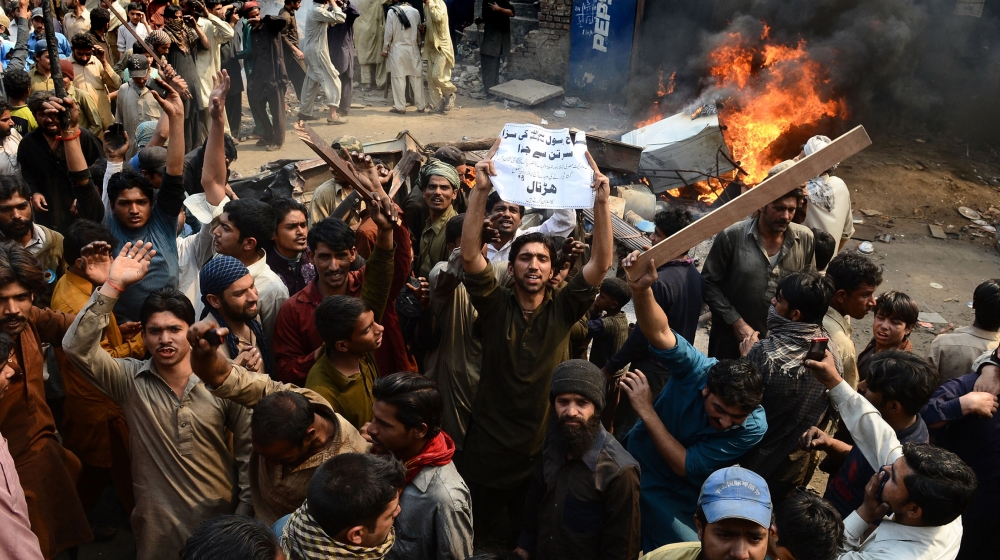
Increasingly, cases are being settled with violence outside the courtroom, with mob and targeted attacks against those accused. In many cases, families and lawyers of the accused, and even judges who have acquitted defendants, have been targeted.
Since 1990, at least 77 people have been killed in connection with such accusations, the latest murder occurring in a courtroom last month.
What makes this issue so emotive in Pakistan?
'Religious identity tied to the authority of the state'
"There's no simple answer to this question," says Arsalan Khan, an anthropologist who studies Islamic revivalist movements.
"In a sense, all religious traditions have deep connections to specific sacred objects and would be hurt by perceived defilement of their religious traditions, but this has certainly taken heightened political significance in Pakistan."
Khan argues that the heightened significance of "blasphemy" in Pakistan, as opposed to other Muslim countries (including theocracies such as Saudi Arabia and Iran), is linked to the formation of the country in 1947 as a homeland for South Asia’s Muslims.
"Religious identity has been centred as one of the core bases for national belonging in Pakistan," he says. "When] the state has defined Islam as the ultimate source of sovereignty, such battles have taken on deeper political significance."
When religious identity and authenticity is tied to the authority of the state, "blasphemy" becomes a site for political contestation.
"What is important in Pakistan is the jostling for position as the true, authentic and passionate representatives of Islam, that has given blasphemy accusations its real force in political life," explains Khan.
Increasingly, this has seen far-right religious parties rise to prominence campaigning explicitly on the basis of protecting the "honour" and "sanctity" of Islam and its Prophet Muhammad.
That rise can be traced to the murder of Salman Taseer, then-governor of Pakistan's most populous Punjab province, in January 2011. Taseer had been campaigning for months to reform the country’s blasphemy laws as he sought justice for a young Christian woman, Aasia Bibi, who had been sentenced to death for the crime.
He was killed by his bodyguard, Mumtaz Qadri, for his campaign against the controversial law. Qadri was executed five years later for the shocking murder, but he was hailed as a hero, even a saint, by many in Pakistan for his act of killing a perceived blasphemer.
Two months after Taseer’s murder, a federal minister was shot dead by the Pakistan Taliban for the same reason.
The murders, and subsequent public mobilisation in support of violence in the name of the blasphemy law, gave religious parties that represented the country's majority Sunni Muslim Barelvi sect, long sidelined from political prominence, an opportunity to regain lost political ground, say analysts.
"After Taseer's assassination and the lionisation of Mumtaz Qadri, it is clear that Barelvis begin to position themselves as the group that are the true 'ashiq-e-Rasool' [lovers of the Prophet] and assume the position as true representatives of Islam in the public arena through blasphemy," says Khan.
Barelvis form roughly half of Pakistan's population, and their beliefs are a synthesis of conservative Islam and South Asian Sufi practices, including the veneration of saints and a particular devotion to the Prophet Muhammad.
The Sunni Tehreek (ST) political party, then the largest Barelvi political party, saw its ranks swell. With hardline Barelvi clerics across the country taking up the issue of blasphemy to whip up public outrage, a new political party, the Tehreek-e-Labbaik Pakistan (TLP), was formed in the run-up to the 2018 general election.
The TLP led large anti-government protests over perceived "blasphemy" in 2017. Though it could not win a seat in the national parliament in the 2018 polls, it did gain the fourth-highest share of the popular vote in that general election.
"Electoral success is ultimately a secondary goal for these religious movements," says Khan. "The aim of blasphemy politics is ultimately about defining yourself as the authentic representative of Islam in the public sphere […] which in turn forces the Pakistani state, which defines its own sovereignty in relationship to Islam, to yield to this power."
The laws, lawyers and analysts say, are treated by followers of the TLP and others who support them as "sacred", having been laid down by God.
But are they?
All religious traditions have deep connections to specific sacred objects and would be hurt by perceived defilement of their religious traditions, but this has certainly taken heightened political significance in Pakistan
Pakistan inherited its blasphemy laws from its former British colonial rulers, who in 1860 introduced a set of laws related to religion in order to quell Hindu-Muslim violence in the Indian subcontinent.
The laws were strengthened in 1927 with the addition of a vague clause to criminalise "deliberate and malicious acts intended to outrage religious feelings of any class by insulting its religion or religious believers", in response to a high-profile case that ultimately ended in the murder of a Hindu man who published a pamphlet deemed "blasphemous" by some Muslims.
Between 1860 and 1947, when Pakistan gained independence from the British and broke away from India, there were just seven recorded cases of blasphemy, according to a report by the Centre for Research and Security Studies (CRSS).
Use of the law remained rare in the following decades, with just 10 judgments relating to offences against religion reported until 1977, according to a report by the International Commission of Jurists.
In 1974, however, then-Prime Minister Zulfiqar Ali Bhutto's government oversaw the introduction of a constitutional amendment that declared members of the Ahmadiyya sect "non-Muslim".
Between 1980 and 1986, the military government of General Zia-ul-Haq further strengthened the laws, adding five new clauses, all specific to Islam and criminalising offences such as defiling the Holy Quran, insulting Islam’s Prophet or using "derogatory" language against certain religious figures.
During Haq's rule, from 1977-1988, the number of cases skyrocketed, with more than 80 blasphemy cases filed in that period, according to the CRSS.
That trend continued through the 1990s, in particular after a controversial higher Islamic court decision in 1991 that made the imposition of the death penalty mandatory for the crime of insulting Islam's prophet.
Between 2011 and 2015, the latest period for which consolidated data is available, there were more than 1,296 blasphemy cases filed in Pakistan.
The laws are now treated as sacred, but experts say there is no clear definition of "blasphemy" in Islamic jurisprudence, nor is there agreement on the punishment for it.
"There are as many definitions and positions on blasphemy as there are Muslim countries and scholars," says Arafat Mazhar, a filmmaker and director of the Engage Pakistan research collective. "Many Muslim countries have laws that deal with religious or sacred figures, or religion as a whole, as opposed to the very specific laws enacted in Pakistan."
Pakistan's laws are some of the strictest in the world, harsher and more specific than comparable laws in Saudi Arabia, Iran, Malaysia, Indonesia, Afghanistan and other countries.
Mazhar says other countries' laws appear to be informed by the variance in Islamic scholars' views on the issue.
"Scholars consider a range of factors - such as whether the offender is Muslim or non-Muslim, the severity of the insult, whether or not the person is a habitual offender, the mental state of the offender, whether what they said is a part of their faith, intent to insult, whether or not they repent […] - to reach an incredibly wide range of conclusions," he told Al Jazeera.
Pakistan's strict interpretation of the issue, he says, "is based on manufactured interpretations".
"The legislative process for [a key clause] which made the death penalty mandatory, are full of misleading and edited references to books of Islamic jurisprudence," he says, citing several examples.
Since 2011, with the rise of a new wave of Barelvi politicians and clerics campaigning on "blasphemy", experts say there has also been a change in the motive for blasphemy accusations.
Previously, lawyers told Al Jazeera, most accusations could be traced to pre-existing disputes between the two parties. These were often personal disputes, arguments or ongoing battles over land ownership.
In recent times, however, that has changed.
"With the rise of TLP and, in particular, the weaponisation and politicisation of 'ishq-e-Rasool', there is a greater ideological interest in blasphemy cases regardless of personal altercations," says Mazhar.
The shift in vested interest, argues Mazhar, has now moved from being personal, between the plaintiff and the accused, to being in the interest of political and religious groups.
"The personal vested interest in blasphemy cases has shifted to another form of vested interest: one that is much more organised and has to do with political and social power."
In that situation, when such groups repeatedly bring thousands onto the streets over any perceived sign that the laws may be reformed, will it ever be possible for the laws to change?
"The assassination of Punjab Governor Salmaan Taseer in 2011 turned a debate on the blasphemy law into a death sentence," says Cyril Almeida, a senior journalist.
"Since then, even the semblance of momentum towards legislative debate has stalled and, more recently, been entirely reversed - far-right religious groups now campaign explicitly on protecting the blasphemy laws from any tampering."
Given a vast structure designed to create public pressure on the issue of blasphemy, lower-court conviction rates for blasphemy cases remain high, even in cases where the evidence is flimsy. For Ayub Masih, over whose case Bishop John Joseph took his own life, the pendulum swung towards justice.
He was acquitted by the country’s Supreme Court in 2002, after six years in prison.
Joseph, who never lived to see that day, wrote a letter to the media on the day of his suicide, the words of which may still echo for those who continue to fight against injustice in the name of blasphemy.
"Now we must act strongly and in unity, Christians and Muslims, in order, not only, to get [Masih's] death sentence suspended, but to get [the blasphemy laws] repealed without worrying about the sacrifice we will have to offer.
"Dedicated persons do not count the cost."